Review

Management Strategy for Non-Responsive and Refractory Celiac Disease in Adults: A Review Article


Department of Gastroenterology and Hepatology, St. Antonius Hospital, 3430 EM Nieuwegein, The Netherlands
J. Clin. Med. 2025, 14(19), 6934; https://doi.org/10.3390/jcm14196934
Submission received: 8 September 2025 / Revised: 24 September 2025 / Accepted: 28 September 2025 / Published: 30 September 2025
(This article belongs to the Special Issue Future Trends in the Diagnosis and Management of Celiac Disease)

Abstract

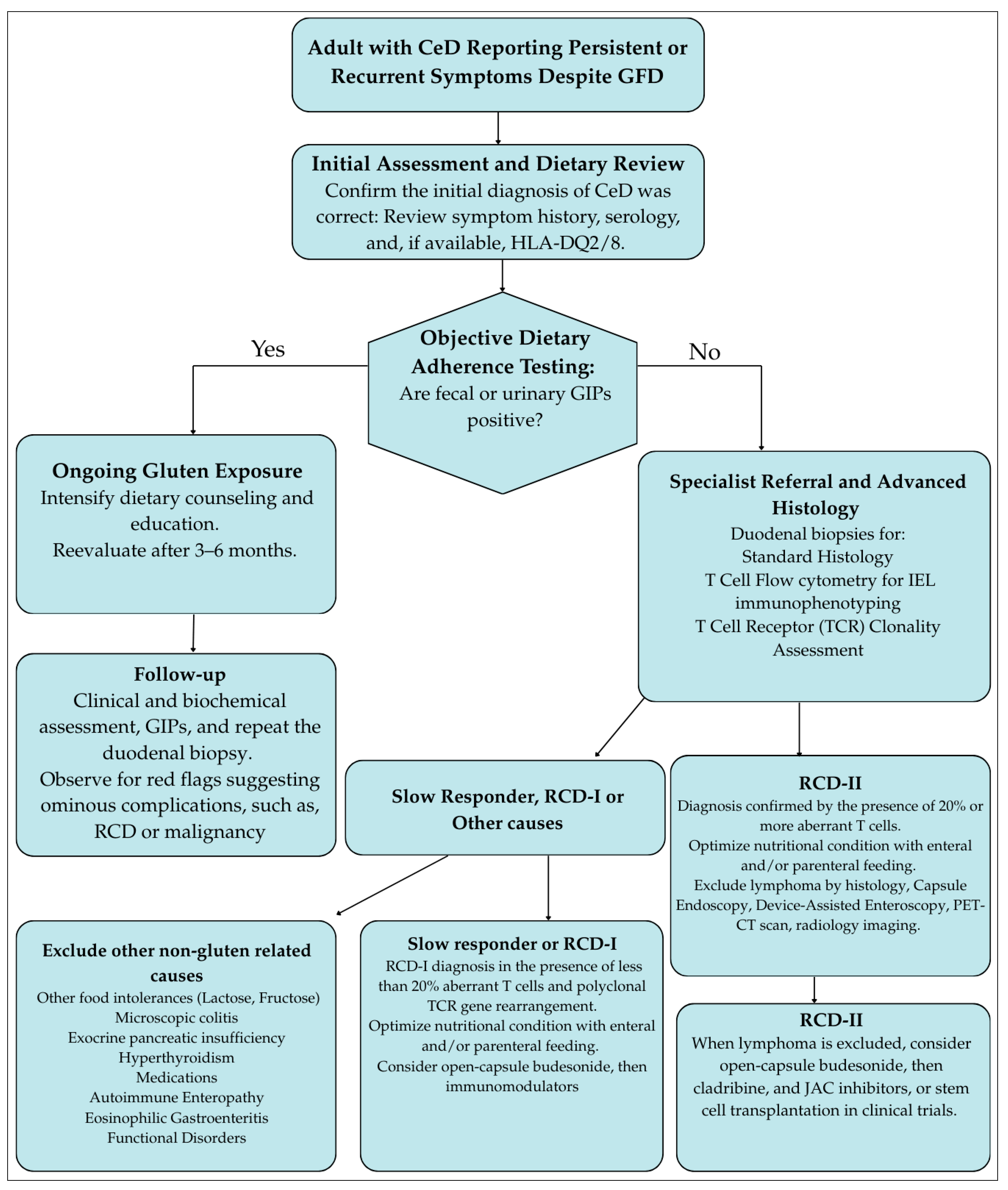
Background/Objectives: A substantial number of adults with celiac disease (CeD) experience ongoing symptoms despite consuming a gluten-free diet (GFD), a condition labelled as non-responsive CeD (NRCD). However, many experts contest the term, viewing NRCD not as a distinct entity, but as a clinical prompt to identify a specific underlying cause. A minority develop refractory CeD (RCD), a severe complication with persistent villous atrophy, after beginning a diet excluding gluten exposure. This review synthesizes evidence to provide a practical, stepwise algorithm for managing these complex patients. Methods: A narrative review was conducted based on a targeted literature search of major databases seeking studies on adults with NRCD or RCD, focusing on diagnostic and therapeutic strategies. Results: The most frequent cause of NRCD is inadvertent gluten ingestion. Objective and systematic assessment, including expert dietitian evaluation and testing with gluten immunogenic peptides (GIPs) in stool or urine GIP testing, is essential before the investigation seeking to exclude or establish RCD. This is a critical step for evaluating adherence beyond the patient self-report. The management of confirmed RCD hinges on precise subtyping via duodenal biopsy with immunophenotyping. While RCD type I (RCD-I) typically responds to budesonide, RCD type II (RCD-II) carries a high risk of lymphoma and necessitates aggressive therapies in specialized centers. Conclusions: This review underscores the necessity of a structured, hierarchical diagnostic approach in distinguishing persistent gluten exposure from true RCD. The integration of GIP testing and specialist dietitian review is a cornerstone of modern management. The findings highlight significant evidence gaps, particularly for RCD-II, and aim to guide clinical practice and inform future research towards standardized protocols.
Keywords: non-responsive celiac disease; refractory celiac disease; gluten-free diet; adult celiac disease; treatment; management; review non-responsive celiac disease; refractory celiac disease; gluten-free diet; adult celiac disease; treatment; management; review