Article

Resting Energy Expenditure in Patients with Extreme Obesity: Comparison of the Harris–Benedict Equation with Indirect Calorimetry


1
Department of Microbiology, Nutrition and Dietetics, Faculty of Agrobiology, Food and Natural Resources, Czech University of Life Sciences Prague, 165 21 Prague, Czech Republic
2
3rd Internal Department of Endocrinology and Metabolism, General University Hospital, 1st Faculty of Medicine, Charles University, 128 08 Prague, Czech Republic
*
Author to whom correspondence should be addressed.
J. Clin. Med. 2024, 13(19), 5993; https://doi.org/10.3390/jcm13195993
Submission received: 20 August 2024 / Revised: 4 October 2024 / Accepted: 6 October 2024 / Published: 8 October 2024
(This article belongs to the Section Endocrinology & Metabolism)

Abstract

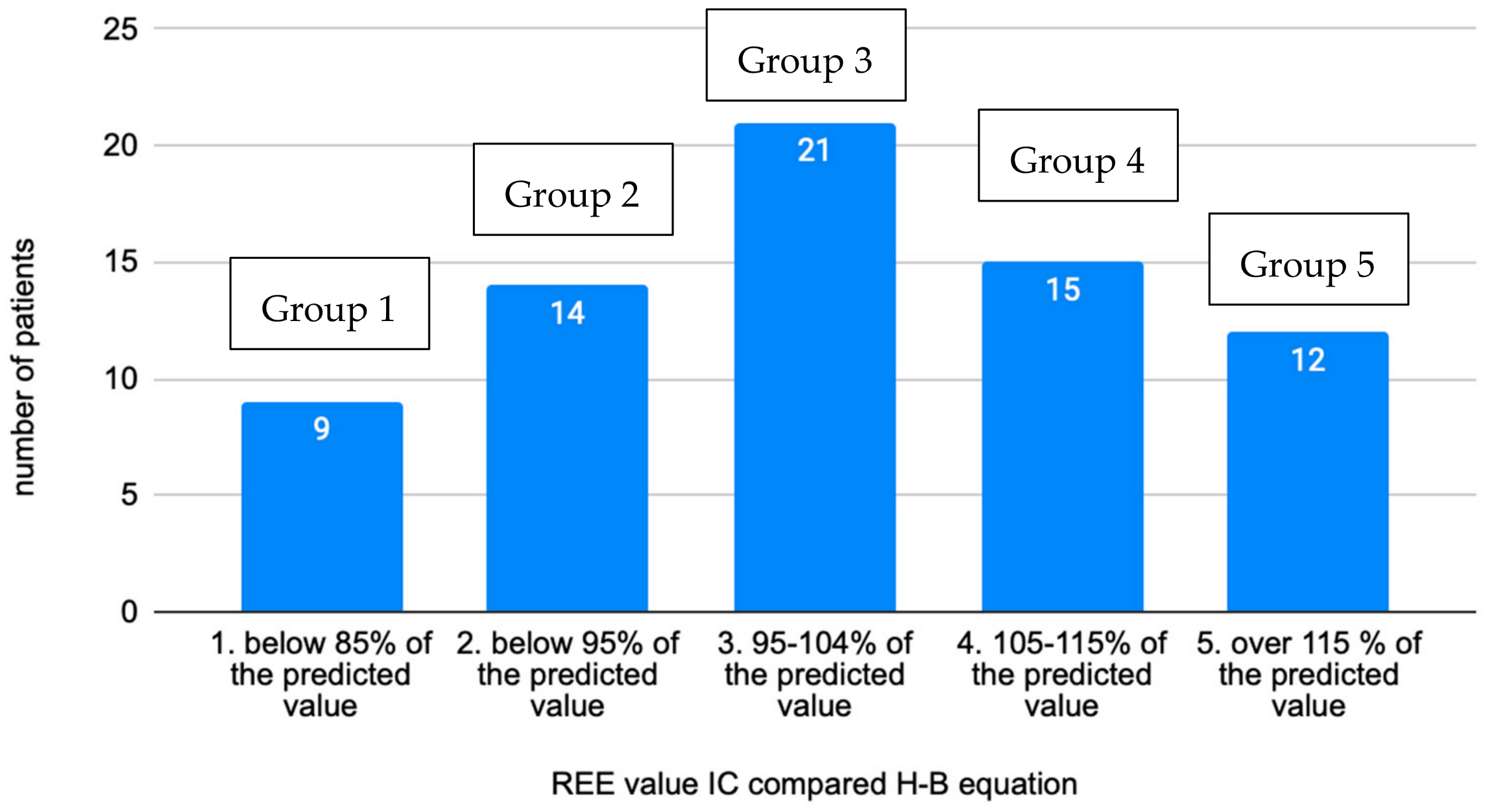
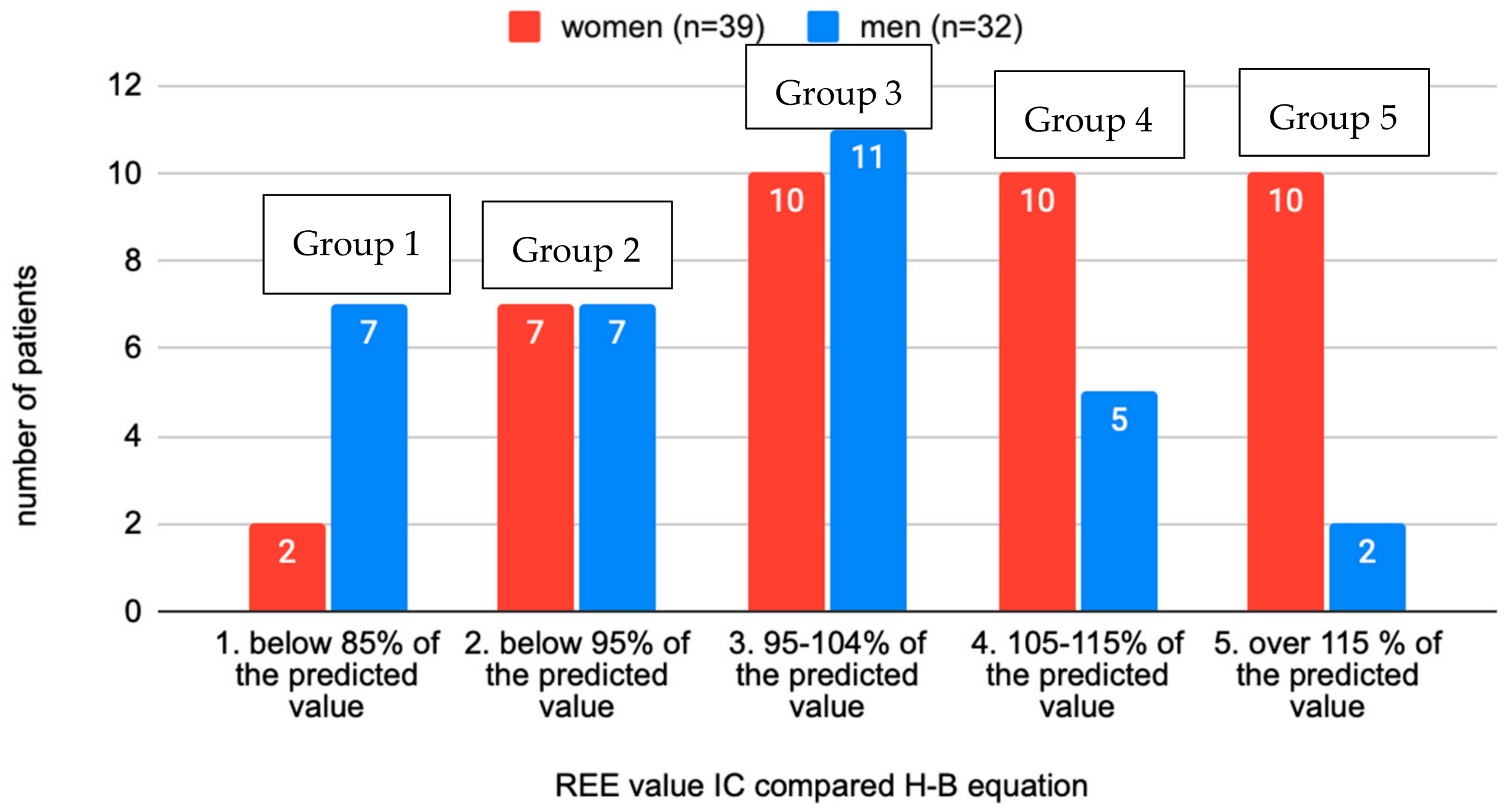
Background: The main objective of the work was the analysis and description of data on body composition and resting energy expenditure (REE) values of selected groups of patients with obesity whose REE measurement results using indirect calorimetry reached a level below 95% of the predicted REE calculated using the Harris–Benedict (H–B) equation. The sub-goals were to describe the dependence of body composition on the size of the REE and to find out if the deviations between the number of the total measured REE and the REE calculated using H–B in the adapted group (patients with altered REE values, lower than expected caused by long caloric restriction) are significant. Methods: For the research, 71 (39 women and 32 men) patients treated in obesitology were selected. Patients underwent the measurement of resting metabolism using indirect calorimetry (IC) and body composition measurement on the bioimpedance device and, at the same time, the value of resting metabolism was calculated for everyone using the H–B equation. The whole group was divided into five groups according to the deviation of the measurement using IC and the calculation of the H–B equation. Results: In the total set of examined individuals, there were 32.4% with a reduced REE value compared to the REE calculation according to the H–B equation, which corresponds to 23 individuals. In the adapted group, the average measured REE was 2242 ± 616 kcal compared to the H–B calculation of 2638 ± 713 kcal. Statistically, these results were not significant, but a high case-to-case variation was found. The highest deviation from the H–B predictive calculation was −42% and +43% in the whole research group. The amount of muscle tissue in the adapted group averaged 44.3 ± 11.9 kg and the amount of fat-free mass (FFM) 77.9 ± 20.1 kg. When statistically testing the dependence of REE on FFM and muscle tissue in the adapted group, a strong correlation was found. Conclusions: The H–B equation alone is not suitable for setting a suitable diet therapy for an individual with obesity. In order to select and characterize a group of adapted individuals, it will be necessary to use other methods or a larger research sample, and preferably examine and divide patients with specific comorbidities or include their health status.
Keywords: obesity; energy expenditure; weight loss; indirect calorimetry obesity; energy expenditure; weight loss; indirect calorimetry