Symptom-Level Disability Status Assessed with an Electronic Unsupervised Patient-Reported Expanded Disability Status Scale (ePR-EDSS) in Multiple Sclerosis Patients—The Example of Croatia



Abstract
1. Introduction
2. Materials and Methods
2.1. General Procedures
2.2. Participants
2.3. Methods
2.4. Statystical Analysis
3. Results
3.1. Demographic Characteristics, Comorbidity, and MS Disease-Related Factors
3.2. MS Type and EDSS-Related Differences
3.3. ePR-EDSS Disability Status and Symptom-Level Analysis
4. Discussion
5. Conclusions
Author Contributions
Funding
Institutional Review Board Statement
Informed Consent Statement
Data Availability Statement
Acknowledgments
Conflicts of Interest
References
- Howard, J.; Trevick, S.; Younger, D.S. Epidemiology of Multiple Sclerosis. Neurol. Clin. 2016, 34, 919–939. [Google Scholar] [CrossRef] [Scilit] [PubMed]
- MS International Federation. Available online: https://www.atlasofms.org/map/global/epidemiology/number-of-people-with-ms (accessed on 8 March 2022).
- Benjak, T.; Štefančić, V.; Draušnik, Ž.; Cerovečki, I.; Roginić, D.; Habek, M.; Mihel, S.; Stevanović, R. Prevalence of multiple sclerosis in Croatia: Data from national and non-governmental organization registries. Croat. Med. J. 2018, 59, 65–70. [Google Scholar] [CrossRef] [Scilit]
- Kamińska, J.; Koper, O.M.; Piechal, K.; Kemona, H. Multiple sclerosis—Etiology and diagnostic potential. Postep. Hig. Med. Dosw. 2017, 71, 551–563. [Google Scholar] [CrossRef] [Scilit]
- Ysrraelit, M.C.; Correale, J. Impact of sex hormones on immune function and multiple sclerosis development. Immunology 2019, 156, 9–22. [Google Scholar] [CrossRef] [Scilit]
- Goodin, D.S.; Khankhanian, P.; Gourraud, P.A.; Vince, N. The nature of genetic and environmental susceptibility to multiple sclerosis. PLoS ONE 2021, 16, e0246157. [Google Scholar] [CrossRef] [Scilit] [PubMed]
- Poser, C.M.; Brinar, V.V. Diagnostic criteria for multiple sclerosis. Clin. Neurol. Neurosurg. 2001, 103, 1–11. [Google Scholar] [CrossRef] [Scilit]
- Poser, C.M.; Paty, D.W.; Scheinberg, L.; McDonald, W.I.; Davis, F.A.; Ebers, G.C.; Johnson, K.P.; Sibley, W.A.; Silberberg, D.H.; Tourtellotte, W.W. New diagnostic criteria for multiple sclerosis: Guidelines for research protocols. Ann. Neurol. 1983, 13, 227–231. [Google Scholar] [CrossRef] [Scilit]
- McDonald, W.I.; Compston, A.; Edan, G.; Goodkin, D.; Hartung, H.P.; Lublin, F.D.; McFarland, H.F.; Paty, D.W.; Polman, C.H.; Reingold, S.C.; et al. Recommended diagnostic criteria for multiple sclerosis: Guidelines from the International Panel on the diagnosis of multiple sclerosis. Ann. Neurol. 2001, 50, 121–127. [Google Scholar] [CrossRef] [Scilit]
- Thompson, A.J.; Banwell, B.L.; Barkhof, F.; Carroll, W.M.; Coetzee, T.; Comi, G.; Correale, J.; Fazekas, F.; Filippi, M.; Freedman, M.S.; et al. Diagnosis of multiple sclerosis: 2017 revisions of the McDonald criteria. Lancet Neurol. 2018, 17, 162–173. [Google Scholar] [CrossRef] [Scilit]
- Kurtzke, J.F. Rating neurologic impairment in multiple sclerosis: An expanded disability status scale (EDSS). Neurology 1983, 33, 1444–14452. [Google Scholar] [CrossRef] [Scilit]
- Kurtzke, J.F. A new scale for evaluating disability in multiple sclerosis. Neurology 1955, 5, 580–583. [Google Scholar] [CrossRef] [Scilit] [PubMed]
- Glaser, A.; Stahmann, A.; Meissner, T.; Flachenecker, P.; Horáková, D.; Zaratin, P.; Brichetto, G.; Pugliatti, M.; Rienhoff, O.; Vukusic, S.; et al. Multiple sclerosis registries in Europe—An updated mapping survey. Mult. Scler. Relat. Disord. 2019, 27, 171–178. [Google Scholar] [CrossRef] [Scilit] [PubMed]
- Collins, C.D.; Ivry, B.; Bowen, J.D.; Cheng, E.M.; Dobson, R.; Goodin, D.S.; Lechner-Scott, J.; Kappos, L.; Galea, I. A comparative analysis of Patient-Reported Expanded Disability Status Scale tools. Mult. Scler. J. 2016, 22, 1349–1358. [Google Scholar] [CrossRef] [Scilit] [PubMed]
- Neurostatus. Available online: https://www.neurostatus.net/media/specimen/Definitions_0410-2_s.pdf (accessed on 10 February 2022).
- Hohol, M.J.; Orav, E.J.; Weiner, H.L. Disease steps in multiple sclerosis: A simple approach to evaluate disease progression. Neurology 1995, 45, 251–255. [Google Scholar] [CrossRef] [Scilit] [PubMed]
- Lavorgna, L.; Miele, G.; Petruzzo, M.; Lanzillo, R.; Bonavita, S. Online validation of the Italian version of the patient determined disease steps scale (PDDS) in people with multiple sclerosis. Mult. Scler. Relat. Disord. 2018, 21, 108–109. [Google Scholar] [CrossRef] [Scilit]
- Romeo, A.R.; Rowles, W.M.; Schleimer, E.S.; Barba, P.; Hsu, W.Y.; Gomez, R.; Santaniello, A.; Zhao, C.; Pearce, J.R.; Jones, J.B.; et al. An electronic, unsupervised patient-reported Expanded Disability Status Scale for multiple sclerosis. Mult. Scler. J. 2021, 27, 1432–1441. [Google Scholar] [CrossRef] [Scilit]
- Çinar, B.P.; Yorgun, Y.G. What We Learned from The History of Multiple Sclerosis Measurement: Expanded Disability Status Scale. Noro. Psikiyatr. Ars. 2018, 55, S69–S75. [Google Scholar] [CrossRef] [Scilit]
- Harbo, H.F.; Gold, R.; Tintoré, M. Sex and gender issues in multiple sclerosis. Ther. Adv. Neurol. Disord. 2013, 6, 237–248. [Google Scholar] [CrossRef] [Scilit]
- Bergamaschi, R. Prognostic factors in multiple sclerosis. Int. Rev. Neurobiol. 2007, 79, 423–447. [Google Scholar] [CrossRef] [Scilit]
- Voskuhl, R.R.; Patel, K.; Paul, F.; Gold, S.M.; Scheel, M.; Kuchling, J.; Cooper, G.; Asseyer, S.; Chien, C.; Brandt, A.U.; et al. Sex differences in brain atrophy in multiple sclerosis. Biol. Sex Diff. 2020, 11, 49. [Google Scholar] [CrossRef] [Scilit]
- Tutuncu, M.; Tang, J.; Zeid, N.A.; Kale, N.; Crusan, D.J.; Atkinson, E.J.; Siva, A.; Pittock, S.J.; Pirko, I.; Keegan, B.M.; et al. Onset of progressive phase is an age-dependent clinical milestone in multiple sclerosis. Mult. Scler. J. 2013, 19, 188–198. [Google Scholar] [CrossRef] [Scilit] [PubMed]
- Coret, F.; Pérez-Miralles, F.C.; Gascón, F.; Alcalá, C.; Navarré, A.; Bernad, A.; Boscá, I.; Escutia, M.; Gil-Perotin, S.; Casanova, B. Onset of secondary progressive multiple sclerosis is not influenced by current relapsing multiple sclerosis therapies. Mult. Scler. J. Exp. Transl. Clin. 2018, 4, 2055217318783347. [Google Scholar] [CrossRef] [Scilit] [PubMed]
- Zeydan, B.; Kantarci, O.H. Progressive forms of multiple sclerosis: Distinct entity or age-dependent phenomena. Neurol. Clin. 2018, 36, 163–171. [Google Scholar] [CrossRef] [Scilit] [PubMed]
- Hauer, L.; Perneczky, J.; Sellner, J. A global view of comorbidity in multiple sclerosis: A systematic review with a focus on regional differences, methodology, and clinical implications. J. Neurol. 2021, 268, 4066–4077. [Google Scholar] [CrossRef] [Scilit] [PubMed]
- Moss, B.P.; Rensel, M.R.; Hersh, C.M. Wellness and the Role of Comorbidities in Multiple Sclerosis. Neurotherapeutics 2017, 14, 999–1017. [Google Scholar] [CrossRef] [Scilit]
- Petruzzo, M.; Reia, A.; Maniscalco, G.T.; Luiso, F.; Lanzillo, R.; Russo, C.V.; Carotenuto, A.; Allegorico, L.; Palladino, R.; Brescia Morra, V.; et al. The Framingham cardiovascular risk score and 5-year progression of multiple sclerosis. Eur. J. Neurol. 2021, 28, 893–900. [Google Scholar] [CrossRef] [Scilit]
- Marrie, R.A.; Reider, N.; Cohen, J.; Stuve, O.; Trojano, M.; Cutter, G.; Reingold, S.; Sorensen, P.S. A systematic review of the incidence and prevalence of cardiac, cerebrovascular, and peripheral vascular disease in multiple sclerosis. Mult. Scler. J. 2015, 21, 318–331. [Google Scholar] [CrossRef] [Scilit]
- Meca-Lallana, V.; Berenguer-Ruiz, L.; Carreres-Polo, J.; Eichau-Madueño, S.; Ferrer-Lozano, J.; Forero, L.; Higueras, Y.; Téllez Lara, N.; Vidal-Jordana, A.; Pérez-Miralles, F.C. Deciphering Multiple Sclerosis Progression. Front. Neurol. 2021, 12, 608491. [Google Scholar] [CrossRef] [Scilit]
- Watson, C.; Scippa, K.; Barlev, A.; Kresa-Reahl, K.; Cole, J.C. Results from Patient Interviews on Fatigue in Progressive Multiple Sclerosis and Evaluation of Fatigue Patient-Reported Outcome (PRO) Instruments. Neurol. Ther. 2022, 11, 725–739. [Google Scholar] [CrossRef] [Scilit]
- Kos, D.; Kerckhofs, E.; Nagels, G.; D’hooghe, M.B.; Ilsbroukx, S. Origin of fatigue in multiple sclerosis: Review of the literature. Neurorehabil. Neural Repair 2008, 22, 91–100. [Google Scholar] [CrossRef] [Scilit]
- Hayes, H.A.; Gappmaier, E.; LaStayo, P.C. Effects of high-intensity resistance training on strength, mobility, balance, and fatigue in individuals with multiple sclerosis: A randomized controlled trial. J. Neurol. Phys. Ther. 2011, 35, 2–10. [Google Scholar] [CrossRef] [Scilit] [PubMed]
- Jerković, A.; Proroković, A.; Matijaca, M.; Katić, A.Ć.; Košta, V.; Mihalj, M.; Dolić, K.; Đogaš, Z.; Vidaković, M.R. Validation of the fatigue severity scale in Croatian population of patients with multiple sclerosis disease: Factor structure, internal consistency, and correlates. Mult. Scler. Relat. Disord. 2022, 58, 103397. [Google Scholar] [CrossRef] [Scilit] [PubMed]
- Armutlu, K.; Korkmaz, N.C.; Keser, I.; Sumbuloglu, V.; Akbiyik, D.I.; Guney, Z.; Karabudak, R. The validity and reliability of the Fatigue Severity Scale in Turkish multiple sclerosis patients. Int. J. Rehabil. Res. 2007, 30, 81–85. [Google Scholar] [CrossRef] [Scilit]
- Gavrilov, Y.V.; Shkilnyuk, G.G.; Valko, P.O.; Stolyarov, I.D.; Ivashkova, E.V.; Ilves, A.G.; Nikiforova, I.G.; Shchelkova, O.Y.; Vasserman, L.I.; Vais, E.E.; et al. Validation of the Russian version of the Fatigue Impact Scale and Fatigue Severity Scale in multiple sclerosis patients. Acta Neurol. Scand. 2018, 138, 408–416. [Google Scholar] [CrossRef] [Scilit] [PubMed]
- Abbadessa, G.; Brigo, F.; Clerico, M.; De Mercanti, S.; Trojsi, F.; Tedeschi, G.; Bonavita, S.; Lavorgna, L. Digital therapeutics in neurology. J. Neurol. 2022, 269, 1209–1224. [Google Scholar] [CrossRef] [Scilit] [PubMed]
- Giunti, G.; Rivera-Romero, O.; Koo, J.; Bansi, J.; Sevillano, J.L.; Granja-Dominguez, A.; Izquierdo-Ayuso, G.; Giunta, D. Evaluation of More Stamina, a Mobile App for Fatigue Management in Persons with Multiple Sclerosis: Protocol for a Feasibility, Acceptability, and Usability Study. JMIR Res. Protoc. 2020, 9, e18196. [Google Scholar] [CrossRef] [Scilit]
- Rogić Vidaković, M.; Šimić, N.; Poljičanin, A.; Nikolić Ivanišević, M.; Ana, J.; Đogaš, Z. Psychometric properties of the Croatian version of the depression, anxiety, and stress scale-21 and multiple sclerosis impact scale-29 in multiple sclerosis patients. Mult. Scler. Relat. Disord. 2021, 50, 102850. [Google Scholar] [CrossRef] [Scilit]
- Jerković, A.; Matijaca, M.; Proroković, A.; Šikić, A.; Košta, V.; Ćurković Katić, A.; Dolić, K.; Duka Glavor, K.; Šoda, J.; Đogaš, Z.; et al. Information Processing Speed Assessed with Letter Digit Substitution Test in Croatian Sample of Multiple Sclerosis Patients. Diagnostics 2022, 12, 111. [Google Scholar] [CrossRef] [Scilit]


| RRMS | PPMS | SPMS | MS Type Not Known | Total | Test | p | |
|---|---|---|---|---|---|---|---|
| N | 105 | 19 | 6 | 17 | 147 | - | - |
| Age in years (mean ± SD) | 41.1 ± 1.9 | 47.1 ± 7.7 | 49.6 ± 9.1 | 42.9 ± 9.3 | 41.1 ± 11.3 | F = 6.12 | 0.009 ** |
| Female/Male (%) | 80/20 | 84/16 | 100/0 | 95/5 | 84/16 | χ2 = 2.45 | 0.27 |
| Hand dominance-right hand (%) | 92.4 | 94.7 | 100 | 82.4 | 91.8 | - | - |
| BMI (mean ± SD) | 24.5 ± 4.2 | 24.6 ± 5.9 | 24.3 ± 4.8 | 21.3 ± 2.9 | 19.6 ± 10.4 | - | - |
| Years of MS disease (mean ± SD) | 7.1 ± 1.7 | 5.2 ± 5.5 | 14.8 ± 7.4 | 7.2 ± 8.4 | 8.5 ± 7.4 | F = 0.29 | 0.48 |
| EDSS (median(IQR), range 0–8 | 3(2.5) | 5.5(3) | 4.7(1.5) | 1.5(4.5) | 3.0(3.0) | χ2 = 18.5 | <0.001 ** |
| Corticosteroid treatment (%) | 90.4 | 89.5 | 100 | 94.1 | 91.2 | χ2 = 0.26 | 0.87 |
| Immunomodulatory therapy (%) | 70.5 | 78.9 | 16.7 | 58.8 | 68.0 | χ2 = 1.73 | 0.56 |
| Immunomodulation Medication | RRMS n = 64 n/% | PPMS n = 11 n/% | SPMS n = 1 n/% | MS Type Not Known, n = 9 n/% | Total n = 85 n/% |
|---|---|---|---|---|---|
| Ocrelizumab (Ocrevus) | 14/21.8 | 3/27.2 | - | 1/11.1 | 17/20.0 |
| Glatiramer-Acetate (Copaxone, Glatopa, Remurel) | 7/10.9 | 3/27.2 | - | 2/22.2 | 13/15.5 |
| Fingolimod (Gilenya) | 8/12.5 | 1/9.1 | - | 2/22.2 | 13/15.5 |
| Dimethyl Fumarate (Tecfidera) | 9/14.2 | - | 1/100 | 1/11.1 | 10/11.6 |
| Interferon (ifn beta-1a) (Rebif) | 7/10.9 | - | - | 1/11.1 | 10/11.6 |
| Peginterferon (beta-1a) (Plegridy) | 6/9.3 | 1/9.1 | - | - | 6/7.8 |
| Teriflunomid (Aubagio) | 2/3.1 | 2/18.2 | - | - | 4/4.6 |
| Interferon (ifn beta-1b) (Betaferon) | 3/4.7 | - | - | 1/11.1 | 4/4.6 |
| Natalizumab (Tysabri) | 3/4.7 | - | - | - | 3/3.3 |
| Cladribine (Leustatin, Mavenclad) | 2/3.1 | - | - | - | 3/3.3 |
| Alemtuzumab (Campath, Lemtrada) | - | 1/9.1 | 1/11.1 | 2/2.3 |
| Other Chronic Diseases (Not MS) | RRMS n = 35 n/% | PPMS n = 5 n/% | SPMS n = 2 n/% | MS Type Not Known, n = 1 n/% | Total n = 43 n/% |
|---|---|---|---|---|---|
| Endocrine, nutritional and metabolic diseases | 15/42.8 | 4/80.0 | - | - | 19/44.1 |
| Diseases of the circulatory system | 5/14.3 | 1/20.0 | - | - | 6/13.9 |
| Diseases of the nervous system | 4/11.4 | 1/20.0 | 1/50.0 | - | 5/11.6 |
| Diseases of the digestive system | 4/11.4 | - | - | - | 4/9.3 |
| Diseases of the respiratory system | 1/2.8 | - | 1/50.0 | 1/100 | 3/6.9 |
| Musculoskelet disorders | 2/5.7 | - | 1/50.0 | - | 3/6.9 |
| Diseases of the eye | 3/8.5 | - | - | - | 3/6.9 |
| Mental and behavioural disorders | 2/5.7 | - | 1/50.0 | - | 3/6.9 |
| Neoplasms | 2/5.7 | - | - | - | 2/4.6 |
| Diseases of the genitourinary system | 1/2.8 | - | - | - | 1/2.3 |
| Diseases of the skin | 1/2.8 | - | - | - | 1/2.3 |
| EDSS Range | EDSS 0–3.5 | EDSS 4–8 | Test | p |
|---|---|---|---|---|
| N (%) | 69 (58.4) | 49 (41.6) | - | - |
| Age (mean ± SD) | 39.7 ± 8.5 | 46.0 ± 12.5 | t = −3.51 | <0.001 ** |
| Male/female (%) | 8.7/91.3 | 28.6/71.4 | χ2 = 8.04 | 0.01 ** |
| Years of MS disease (mean ± SD) | 8.8 ± 7.6 | 10.4 ± 7.2 | t = −1.71 | 0.33 |
| Corticosteroid treatment (y/n, %) | 91.3/8.7 | 97.9/2.1 | χ2 = 2.27 | 0.13 |
| Immunomodulatory drug (y/n, %) | 79.7/20.3 | 59.1/40.9 | χ2 = 5.89 | 0.02 * |
| RRMS n = 105 | PPMS and SPMS n = 25 | Ms Type Not Know n = 17 | Total n = 147 | Test (H Value) | p | |
|---|---|---|---|---|---|---|
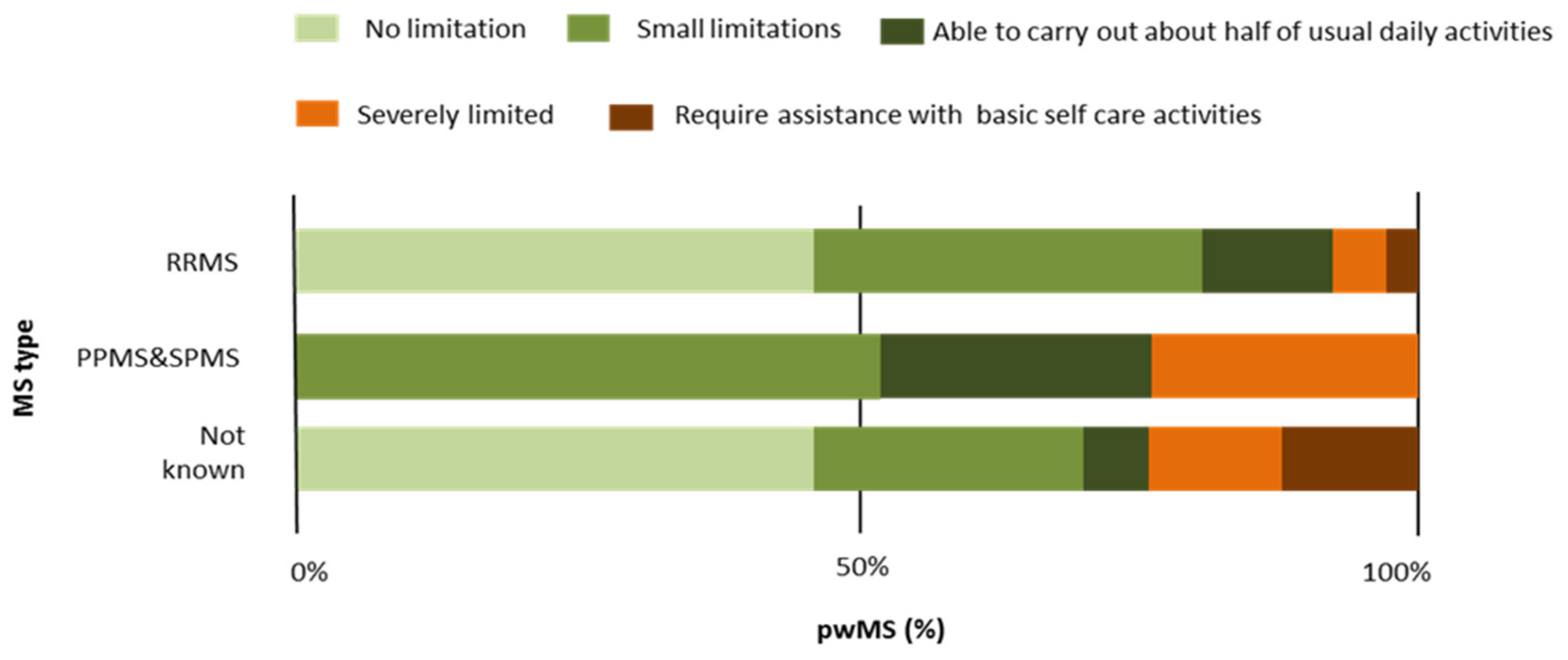
| Overall wellness—functional abilities (1–5) * | 2.0 (1.0) | 2.0 (2.0) | 2.0 (2.0) | 2.0 (2.0) | 18.6 | <0.001 |
| Mobility-ability to walk | ||||||
| Ability to walk (1–4) | 1.0 (1.0) | 2.0 (0) | 1.0 1.(0) | 2.0 1.(0) | 21.3 | <0.001 |
| Ability to walk without aid (1–4) | 2.0 (3.0) | 5.0 (2.0) | 5.0 (0) | 3.0 (4.0) | 9.17 | 0.01 ** |
| Ability to walk without aid (% of time) | 1.0 (0.25) | 0.2 (0.75) | 1.0 (0.7) | 1.0 (0.5) | 18.02 | <0.001 |
| Use a cane, a single crutch, or hold onto another person (% of time) | 0 (0.3) | 0.8 (0.7) | 0 (1.0) | 0.1(0.8) | 17.36 | <0.001 |
| Use a walker or other bilateral support (% of time) | 0 (0) | 0.5 (1.0) | 0 (0.9) | 0 (0.3) | 12.38 | <0.001 |
| Use a wheelchair (% of time) | 0 (0) | 0 (0.3) | 0 (0) | 0 (0) | 7.12 | <0.02 * |
| Sensation | ||||||
| Right hand or arm (1–6) | 2.0 (1.0) | 2.0 (2.0) | 2.0 (2.0) | 2.0 (1.0) | 6.04 | 0.05 |
| Left hand or arm (1–6) | 1.0 (1.0) | 2.0 (1.0) | 2.0 (1.0) | 2.0 (1.0) | 2.72 | 0.25 |
| Right foot or leg (1–6) | 2.0 (1.0) | 2.0 (1.0) | 2.0 (1.0) | 2.0 (2.0) | 7.13 | 0.028 * |
| Left foot or leg (1–6) | 2.0 (1.0) | 2.0 (1.0) | 2.0 (1.0) | 2.0 (1.0) | 6.07 | 0.04 * |
| Strength † | ||||||
| Right arm (1–6) | 1.0 (1.0) | 2.0 (1.0) | 2.0 (2.0) | 1.0 (1.0) | 13.64 | 0.01 ** |
| Left arm (1–6) | 1.0 (1.0) | 1.0 (1.0) | 1.0 (1.0) | 1.0 (1.0) | 2.44 | 0.29 |
| Right leg (1–6) | 2.0 (1.0) | 2.0 (2.0) | 2.0 (2.0) | 2.0 (1.0) | 16.93 | <0.001 |
| Left leg (1–6) | 2.0 (1.0) | 2.0 (1.0) | 2.0 (1.0) | 2.0 (1.0) | 12.16 | <0.01 ** |
| Strength †† | ||||||
| Right arm (1–5) | 1.0 (1.0) | 2.0 (1.0) | 2.0 (1.0) | 1.0 (1.0) | 2.78 | 0.24 |
| Left arm (1–5) | 1.0 (1.0) | 1.0 (1.0) | 1.0 (1.0) | 1.0 (1.0) | 0.65 | 0.71 |
| Right leg (1–5) | 2.0 (1.0) | 2.0 (1.0) | 2.0 (1.0) | 2.0 (2.0) | 14.96 | <0.001 |
| Left leg (1–5) | 2.0 (1.0) | 2.0 (1.0) | 2.0 (1.0) | 2.0 (1.0) | 9.51 | 0.01 ** |
| Coordination | ||||||
| Arms (1–5) | 2.0 (2.0) | 2.0 (1.0) | 2.0 (1.0) | 2.0 (2.0) | 4.08 | 0.13 |
| Legs (1–5) | 2.0 (2.0) | 3.0 (2.0) | 3.0 (2.0) | 2.0 (2.0) | 14.36 | <0.001 |
| Balance when standing (1–5) | 2.0 (1.0) | 3.0 (1.0) | 3.0 (1.0) | 2.0 (2.0) | 13.85 | <0.001 |
| Balance when walking (1–5) | 2.0 (2.0) | 3.0 (1.0) | 3.0 (1.0) | 2.0 (2.0) | 21.97 | <0.001 |
| Balance when sitting (1–5) | 1.0 (0) | 1.0 (1.0) | 1.0 (1.0) | 1.0 (1.0) | 5.38 | 0.06 |
| Vision | ||||||
| Double vision (1–4) | 1.0 (1.0) | 1.0 (1.0) | 1.0 (1.0) | 1.0 (1.0) | 2.84 | 0.24 |
| Vision problems—right eye (1–4) | 1.0 (1.0) | 2.0 (1.0) | 2.0 (1.0) | 1.0 (1.0) | 8.46 | 0.01 * |
| Vision problems—left eye (1–4) | 1.0 (1.0) | 2.0 (2.0) | 2.0 (2.0) | 2.0 (1.0) | 7.21 | 0.02 * |
| Blind spot in vision (1–4) | 1.0 (0) | 1.0 (0) | 1.0 (0) | 1.0 (0) | 2.65 | 0.26 |
| Face and neck | ||||||
| Muscle weakness—right side (1–4) | 1.0 (0) | 1.0 (1.0) | 1.0 (1.0) | 1.0 (0) | 11.18 | <0.01 |
| Muscle weakness—left side (1–4) | 1.0 (0) | 1.0 (1.0) | 1.0 (1.0) | 1.0 (0) | 7.73 | 0.02 * |
| Feeling—right side (1–5) | 1.0 (0) | 1.0 (2.0) | 1.0 (2.0) | 2.0 (0) | 6.9 | 0.03 * |
| Feeling—left side (1–5) | 1.0 (0) | 1.0 (1.0) | 1.0 (1.0) | 2.0 (0) | 3.81 | 0.14 |
| Ability to speak (1–6) | 2.0 (1.0) | 1.0 (1.0) | 1.0 (1.0) | 1.0 (1.0) | 3.27 | 0.19 |
| Ability to swallow liquids and solids (1–4) | 1.0 (0) | 1.0 (1.0) | 1.0 (1.0) | 1.0 (0) | 2.94 | 0.22 |
| Hearing problems (1–4) | 1.0 (0) | 1.0 (1.0) | 1.0 (1.0) | 1.0 (0) | 4.15 | 0.12 |
| Bowel and bladder | ||||||
| Urinary urgency (1–5) | 2.0 (3.0) | 4.0 (1.0) | 4.0 (1.0) | 3.0 (3.0) | 12.69 | <0.001 |
| Urine leak (1–5) | 1.0 (1.0) | 2.0 (1.0) | 2.0 (1.0) | 1.0 (1.0) | 3.03 | 0.21 |
| Wearing a pad or use a urinal (yes/no) ¶ | 26/79 | 9/16 | 4/17 | 39/112 | χ2 = 1.10 | 0.49 |
| Start to urinate (1–6) | 1.0 (1.0) | 2.0 (2.0) | 2.0 (2.0) | 2.0 (1.0) | 4.65 | 0.11 |
| Constipation (1–3) | 2.0 (1.0) | 2.0 (1.0) | 2.0 (1.0) | 2.0 (1.0) | 1.55 | 0.45 |
| Bowel frequency (1–4) | 1.0 (1.0) | 1.0 (1.0) | 1.0 (1.0) | 1.0 (1.0) | 1.38 | 0.06 |
| Mood and thinking ability | ||||||
| Cognitive abilities (1–5) | 2.0 (1.0) | 2.0 (0) | 2.0 (0) | 2.0 (1.0) | 4.73 | 0.09 |
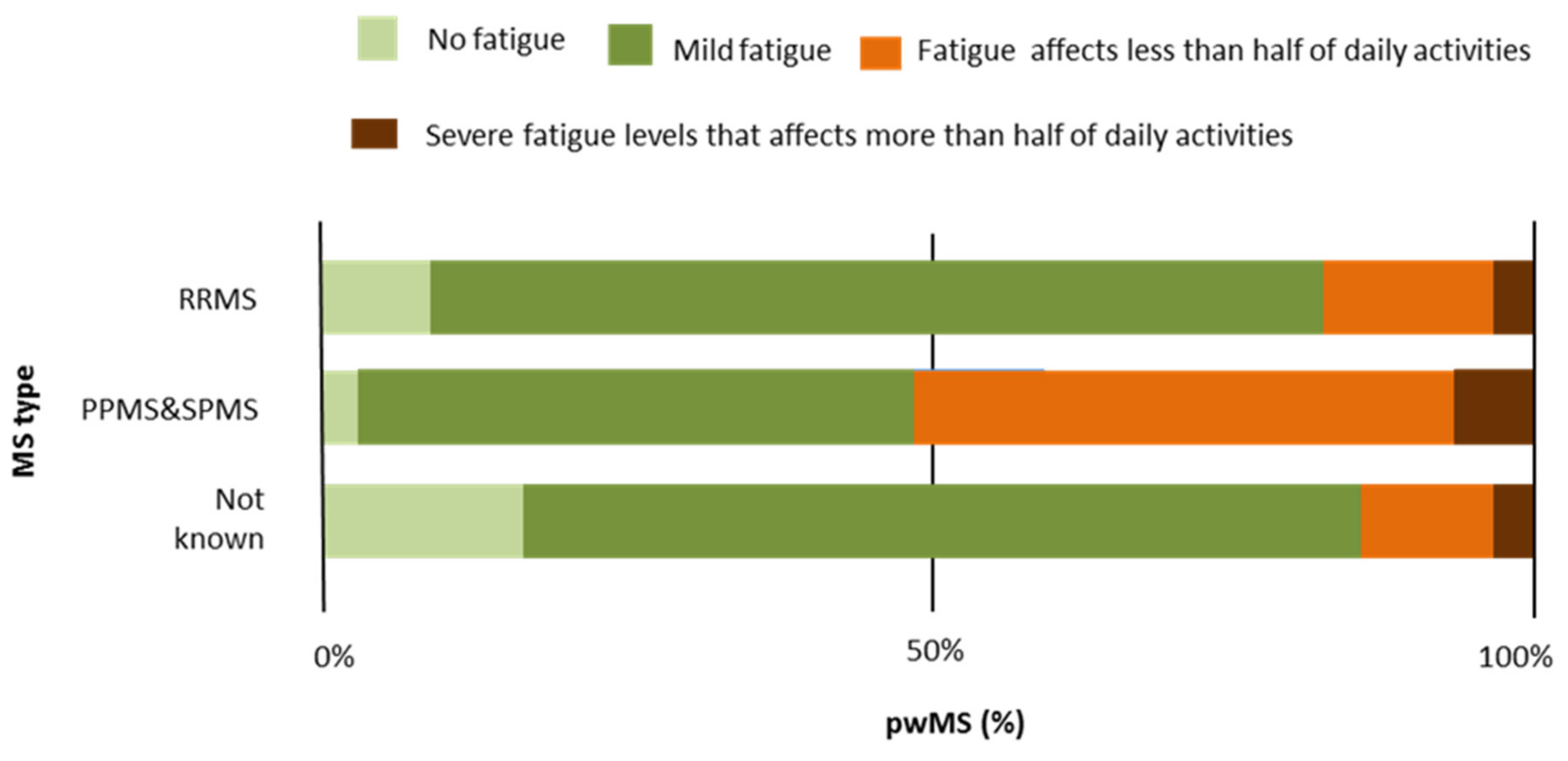
| Fatigue (1–4) | 2.0 (0) | 3.0 (1.0) | 3.0 (1.0) | 2.0 (1.0) | 9.37 | 0.01 ** |
| Little interest or pleasure in doing things (1–4) | 2.0 (1.0) | 2.0 (2.0) | 2.0 (2.0) | 2.0 (1.0) | 3.71 | 0.15 |
| Feeling down, depressed, or hopeless (1–4) | 2.0 (1.0) | 2.0 (2.0) | 2.0 (2.0) | 2.0 (1.0) | 3.54 | 0.17 |
Publisher’s Note: MDPI stays neutral with regard to jurisdictional claims in published maps and institutional affiliations. |
© 2022 by the authors. Licensee MDPI, Basel, Switzerland. This article is an open access article distributed under the terms and conditions of the Creative Commons Attribution (CC BY) license (https://creativecommons.org/licenses/by/4.0/).
Share and Cite
Jerković, A.; Pavelin, S.; Šoda, J.; Vujović, I.; Rogić Vidaković, M. Symptom-Level Disability Status Assessed with an Electronic Unsupervised Patient-Reported Expanded Disability Status Scale (ePR-EDSS) in Multiple Sclerosis Patients—The Example of Croatia. J. Clin. Med. 2022, 11, 4081. https://doi.org/10.3390/jcm11144081
Jerković A, Pavelin S, Šoda J, Vujović I, Rogić Vidaković M. Symptom-Level Disability Status Assessed with an Electronic Unsupervised Patient-Reported Expanded Disability Status Scale (ePR-EDSS) in Multiple Sclerosis Patients—The Example of Croatia. Journal of Clinical Medicine. 2022; 11(14):4081. https://doi.org/10.3390/jcm11144081
Chicago/Turabian StyleJerković, Ana, Sanda Pavelin, Joško Šoda, Igor Vujović, and Maja Rogić Vidaković. 2022. "Symptom-Level Disability Status Assessed with an Electronic Unsupervised Patient-Reported Expanded Disability Status Scale (ePR-EDSS) in Multiple Sclerosis Patients—The Example of Croatia" Journal of Clinical Medicine 11, no. 14: 4081. https://doi.org/10.3390/jcm11144081
APA StyleJerković, A., Pavelin, S., Šoda, J., Vujović, I., & Rogić Vidaković, M. (2022). Symptom-Level Disability Status Assessed with an Electronic Unsupervised Patient-Reported Expanded Disability Status Scale (ePR-EDSS) in Multiple Sclerosis Patients—The Example of Croatia. Journal of Clinical Medicine, 11(14), 4081. https://doi.org/10.3390/jcm11144081