You are currently viewing a new version of our website. To view the old version click .

Membranes, Volume 8, Issue 2

June 2018 - 18 articles

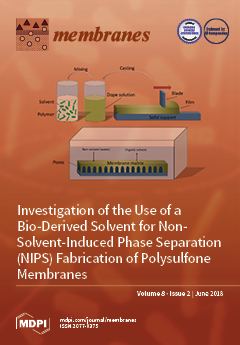
Cover Story: Petroleum-derived solvents have traditionally been used to fabricate polymeric membranes, however, these potentially have negative impacts on the environment and human health. This study focused on replacing petroleum-derived solvents with a bio-derived solvent, Rhodiasolv® PolarClean, to fabricate polysulfone membranes in order to make the process more environmentally friendly. Polysulfone/PolarClean membranes were cast and characterized, and were compared to membranes prepared using petroleum-derived solvents. Results show that PolarClean offers the potential to fabricate polysulfone membranes successfully. View this paper
  • Issues are regarded as officially published after their release is announced to the table of contents alert mailing list .
  • You may sign up for email alerts to receive table of contents of newly released issues.
  • PDF is the official format for papers published in both, html and pdf forms. To view the papers in pdf format, click on the "PDF Full-text" link, and use the free Adobe Reader to open them.

Articles (18)

  • Review
  • Open Access
68 Citations
9,182 Views
35 Pages

Performance of Nanocomposite Membranes Containing 0D to 2D Nanofillers for CO2 Separation: A Review

  • Saravanan Janakiram,
  • Mahdi Ahmadi,
  • Zhongde Dai,
  • Luca Ansaloni and
  • Liyuan Deng

Membrane technology has the potential to be an eco-friendly and energy-saving solution for the separation of CO2 from different gaseous streams due to the lower cost and the superior manufacturing features. However, the performances of membranes made...

  • Article
  • Open Access
139 Citations
25,619 Views
17 Pages

Organic solvents, such as N-methyl-2-pyrrolidone (NMP) and dimethylacetamide (DMAc), have been traditionally used to fabricate polymeric membranes. These solvents may have a negative impact on the environment and human health; therefore, using renewa...

  • Article
  • Open Access
8 Citations
5,771 Views
15 Pages

Effect of DS Concentration on the PRO Performance Using a 5-Inch Scale Cellulose Triacetate-Based Hollow Fiber Membrane Module

  • Masahiro Yasukawa,
  • Daisuke Shigefuji,
  • Masafumi Shibuya,
  • Yuki Ikebe,
  • Ryuto Horie and
  • Mitsuru Higa

In this study, pressure-retarded osmosis (PRO) performance of a 5-inch scale cellulose triacetate (CTA)-based hollow fiber (HF) membrane module was evaluated under a wide range of operating conditions (0.0–6.0 MPa of applied pressure, 0.5&ndash...

  • Article
  • Open Access
19 Citations
5,742 Views
11 Pages

A supported liquid membrane is developed for the separation of Cd from either high in salinity or acidity aqueous media. The membrane consisted of a durapore (polyvinylidene difluoride) polymeric support impregnated with a 0.5 M Aliquat 336 solution...

  • Article
  • Open Access
24 Citations
9,611 Views
13 Pages

Carboxylate-functionalised polymers of intrinsic microporosity (C-PIMs) are highly desirable materials for membrane separation applications. The recently reported method to afford C-PIMs was via an extensive base hydrolysis process requiring 360 h. H...

  • Article
  • Open Access
4 Citations
4,675 Views
10 Pages

The different species of nickel present in natural waters exhibit different transport behaviour through bulk liquid membranes (BLMs). This fact has been used to design and optimise a separation/pre-concentration system applicable to separate labile a...

  • Review
  • Open Access
255 Citations
19,371 Views
40 Pages

Progress of Nanocomposite Membranes for Water Treatment

  • Claudia Ursino,
  • Roberto Castro-Muñoz,
  • Enrico Drioli,
  • Lassaad Gzara,
  • Mohammad H. Albeirutty and
  • Alberto Figoli

The use of membrane-based technologies has been applied for water treatment applications; however, the limitations of conventional polymeric membranes have led to the addition of inorganic fillers to enhance their performance. In recent years, nanoco...

  • Communication
  • Open Access
26 Citations
9,437 Views
13 Pages

Reverse osmosis (RO) and nanofiltration (NF) are among the state-of-the-art technologies for treating landfill leachates. Due to the complexity and variance in the composition of leachates, numerous combinations of multiple technologies are used for...

of 2

Get Alerted

Add your email address to receive forthcoming issues of this journal.

XFacebookLinkedIn
Membranes - ISSN 2077-0375