Antioxidant Recovery from Massachusetts Cranberry Pomace: The Role of Solvent

Abstract
1. Introduction
2. Materials and Methods
2.1. Samples and Reagents
2.2. Extract Preparation
2.3. Determination of Flavonols, Phenolic Acids, and Anthocyanins by HPLC-DAD
2.4. Determination of Triterpenoids by UPLC-MS
2.5. Method Validation for HPLC-DAD and UPLC-MS
2.6. Determination of Total Proanthocyanidin Content by DMAC Method
2.7. Determination of Total Phenolic Content by Folin–Ciocalteu Assay
2.8. Determination of Antioxidant Activity by DPPH Free Radical-Scavenging Assay
2.9. Determination of Antioxidant Activity by ABTS•+ Free Radical-Scavenging Assay
2.10. Determination of Antioxidant Activity by FRAP Assay
2.11. Statistical Analysis
3. Results
3.1. Extraction Yield
3.2. Identification and Quantification of Flavonols, Anthocyanins, Phenolic Acids
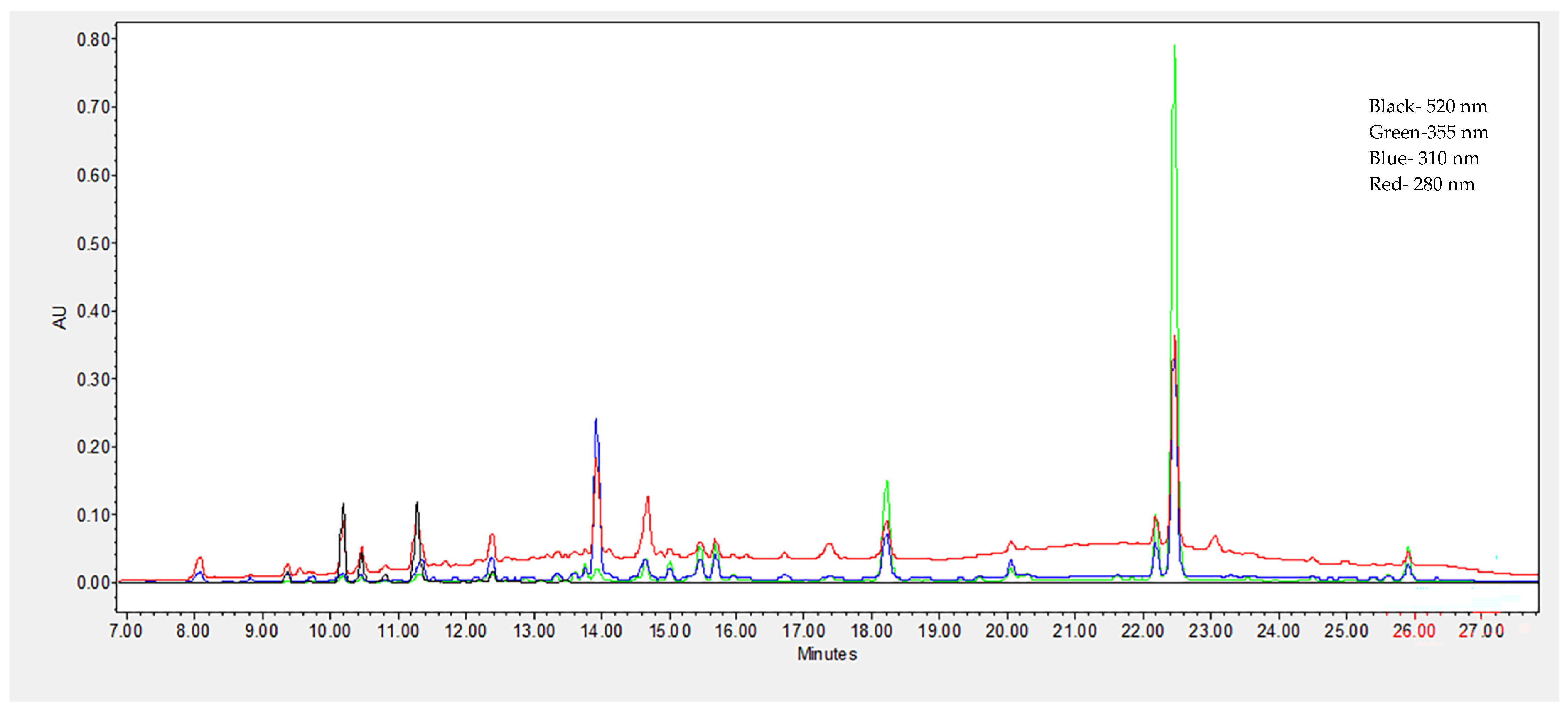
3.2.1. Polyphenol Characterization of Pomace CPAMFAH2O
3.3. Identification and Quantification of Triterpenoid Content
3.4. Determination of Total Proanthocyanidins (PACs)
3.5. Total Phenolic Content
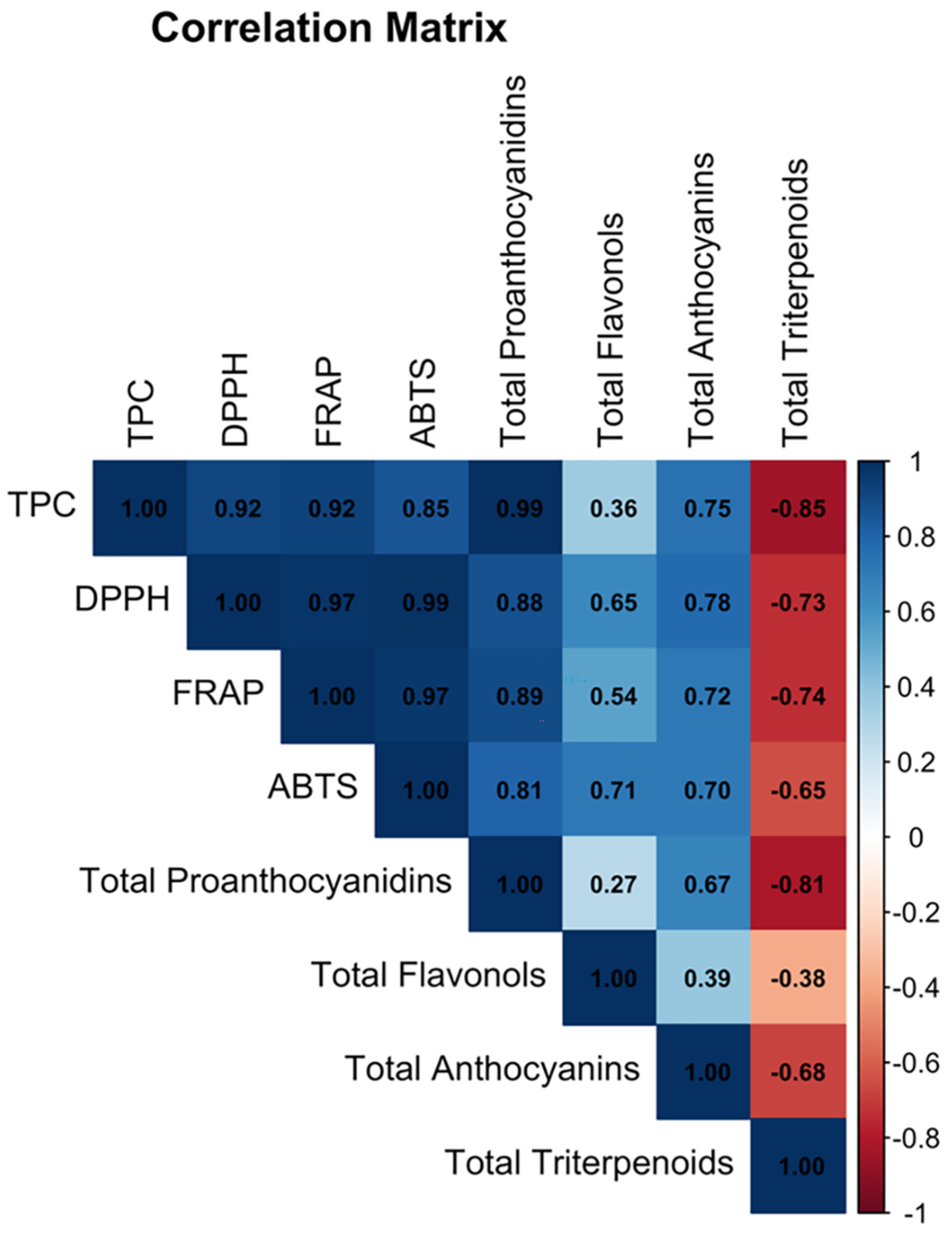
3.6. Antioxidant Capacity
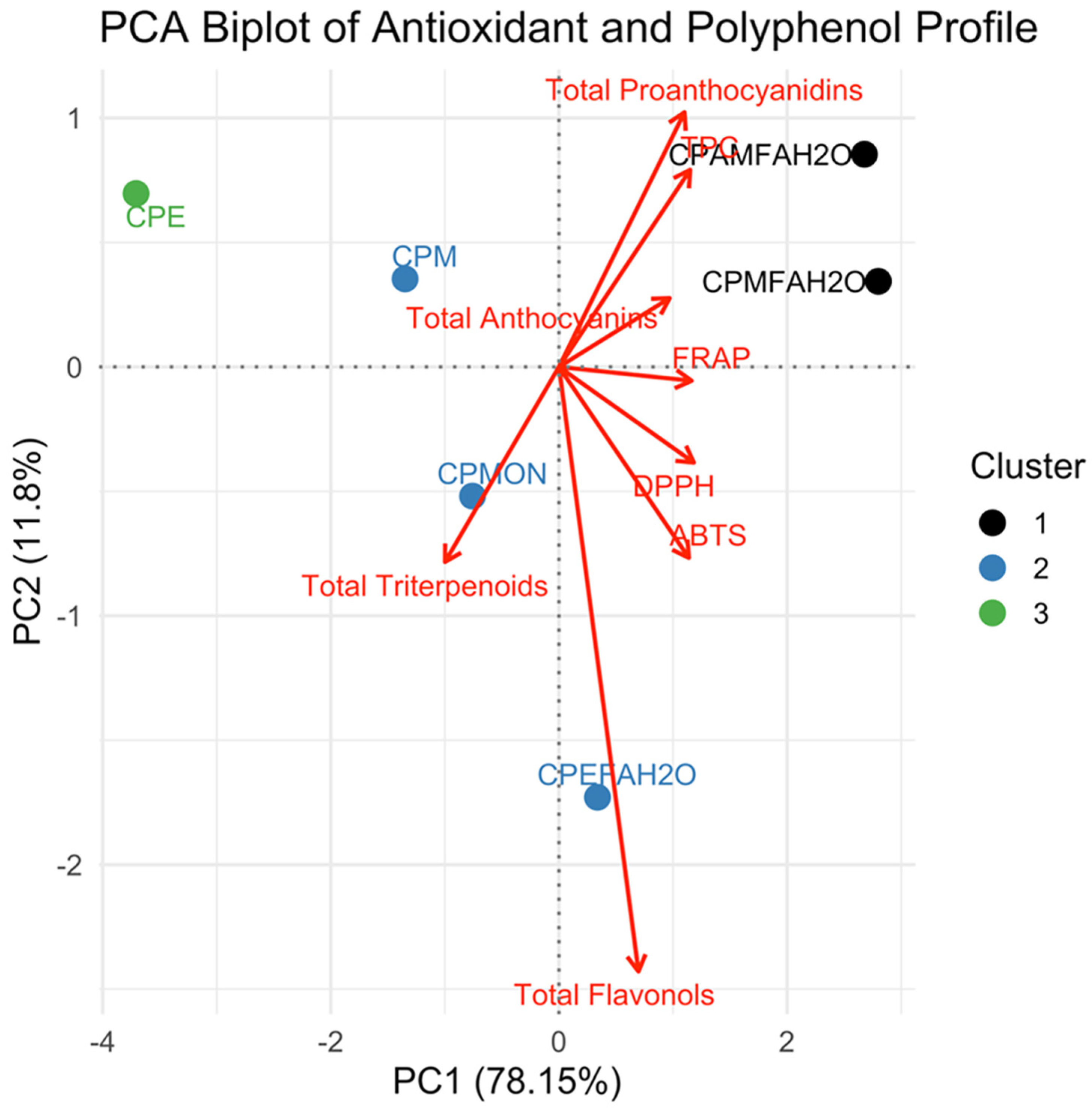
3.7. Principal Component Analysis
4. Discussion
5. Conclusions
Supplementary Materials
Author Contributions
Funding
Institutional Review Board Statement
Informed Consent Statement
Data Availability Statement
Acknowledgments
Conflicts of Interest
Abbreviations
| DPPH | (2,2-diphenyl-1-picrylhydrazyl) |
| ABTS•+ | 2,2′-azinobis(3-ethylbenzthiazolin-6-sulfonic acid) |
| FRAP | ferric reducing antioxidant power |
| DMAC | 4-dimethylaminocinnamaldehyde |
| HPLC-DAD | high-performance liquid chromatography with diode array detector |
| UPLC-MS | ultrahigh-performance liquid chromatography–mass spectrometry |
| Q-TOF | quadrupole time of flight |
| ESI-MS | electrospray ionization–mass spectrometry |
| BEH | ethylene-bridged hybrid |
| CPAMFAH2O | cranberry pomace acetone–methanol–formic acid–water (40:40:1:19) |
| CPMFAH2O | cranberry pomace methanol–formic acid–water (70:0.1:29.9) |
| CPEFAH2O | cranberry pomace ethanol–formic acid–water (70:0.1:29.9) |
| CPMON | cranberry pomace methanol overnight (100%) |
| CPE | cranberry pomace ethanol (100%) |
| CPM | cranberry pomace methanol (100%) |
References
- Whetstone, K. 2022 Massachusetts Cranberry Crop Up 31% from Previous Year; USDA National Agricultural Statistics Service, Northeastern Regional Field Office: Harrisburg, PA, USA, 2023. [Google Scholar]
- White, B.L.; Howard, L.R.; Prior, R.L. Proximate and Polyphenolic Characterization of Cranberry Pomace. J. Agric. Food Chem. 2010, 58, 4030–4036. [Google Scholar] [CrossRef] [Scilit] [PubMed]
- Varnaitė, L.; Keršienė, M.; Šipailienė, A.; Kazernavičiūtė, R.; Venskutonis, P.R.; Leskauskaitė, D. Fiber-Rich Cranberry Pomace as Food Ingredient with Functional Activity for Yogurt Production. Foods 2022, 11, 758. [Google Scholar] [CrossRef] [Scilit] [PubMed]
- Fontana, A.R.; Antoniolli, A.; Bottini, R. Grape Pomace as a Sustainable Source of Bioactive Compounds: Extraction, Characterization, and Biotechnological Applications of Phenolics. J. Agric. Food Chem. 2013, 61, 8987–9003. [Google Scholar] [CrossRef] [Scilit]
- Dulf, F.V.; Vodnar, D.C.; Dulf, E.-H.; Toşa, M.I. Total Phenolic Contents, Antioxidant Activities, and Lipid Fractions from Berry Pomaces Obtained by Solid-State Fermentation of Two Sambucus Species with Aspergillus niger. J. Agric. Food Chem. 2015, 63, 3489–3500. [Google Scholar] [CrossRef] [Scilit]
- Lau, A.T.Y.; Arvaj, L.; Strange, P.; Goodwin, M.; Barbut, S.; Balamurugan, S. Effect of Cranberry Pomace on the Physicochemical Properties and Inactivation of Salmonella during the Manufacture of Dry Fermented Sausages. Curr. Res. Food Sci. 2021, 4, 636–645. [Google Scholar] [CrossRef] [Scilit]
- Saldaña, M.D.A.; Martinez, E.R.; Sekhon, J.K.; Vo, H. The Effect of Different Pressurized Fluids on the Extraction of Anthocyanins and Total Phenolics from Cranberry Pomace. J. Supercrit. Fluids 2021, 175, 105279. [Google Scholar] [CrossRef] [Scilit]
- Diarra, M.S.; Hassan, Y.I.; Block, G.S.; Drover, J.C.G.; Delaquis, P.; Oomah, B.D. Antibacterial Activities of a Polyphenolic-Rich Extract Prepared from American Cranberry (Vaccinium macrocarpon) Fruit Pomace against Listeria spp. LWT 2020, 123, 109056. [Google Scholar] [CrossRef] [Scilit]
- Xue, L.; Otieno, M.; Colson, K.; Neto, C. Influence of the Growing Region on the Phytochemical Composition and Antioxidant Properties of North American Cranberry Fruit (Vaccinium macrocarpon Aiton). Plants 2023, 12, 3595. [Google Scholar] [CrossRef] [Scilit]
- Wu, X.; Xue, L.; Tata, A.; Song, M.; Neto, C.C.; Xiao, H. Bioactive Components of Polyphenol-Rich and Non-Polyphenol-Rich Cranberry Fruit Extracts and Their Chemopreventive Effects on Colitis-Associated Colon Cancer. J. Agric. Food Chem. 2020, 68, 6845–6853. [Google Scholar] [CrossRef] [Scilit]
- Tamkutė, L.; Liepuoniūtė, R.; Pukalskienė, M.; Venskutonis, P.R. Recovery of Valuable Lipophilic and Polyphenolic Fractions from Cranberry Pomace by Consecutive Supercritical CO2 and Pressurized Liquid Extraction. J. Supercrit. Fluids 2020, 159, 104755. [Google Scholar] [CrossRef] [Scilit]
- Xue, L.; Carreiro, B.; Mia, M.S.S.; Paetau-Robinson, I.; Khoo, C.; Neto, C. Pentacyclic Triterpenoid Content in Cranberry Raw Materials and Products. Foods 2024, 13, 3136. [Google Scholar] [CrossRef] [Scilit]
- Mokrani, A.; Madani, K. Effect of Solvent, Time and Temperature on the Extraction of Phenolic Compounds and Antioxidant Capacity of Peach (Prunus persica L.) Fruit. Sep. Purif. Technol. 2016, 162, 68–76. [Google Scholar] [CrossRef] [Scilit]
- Sun, S.; Yu, Y.; Jo, Y.; Han, J.H.; Xue, Y.; Cho, M.; Bae, S.-J.; Ryu, D.; Park, W.; Ha, K.-T.; et al. Impact of Extraction Techniques on Phytochemical Composition and Bioactivity of Natural Product Mixtures. Front. Pharmacol. 2025, 16, 1615338. [Google Scholar] [CrossRef] [Scilit]
- White, B.L.; Howard, L.R.; Prior, R.L. Polyphenolic Composition and Antioxidant Capacity of Extruded Cranberry Pomace. J. Agric. Food Chem. 2010, 58, 4037–4042. [Google Scholar] [CrossRef] [Scilit]
- Franco-Londoño, M.; Laribi, M.; Strelkov, S.E.; Saldaña, M.D.A. Extraction of Anthocyanins from Cranberry Pomace Using HIUS and NADES: Antioxidant and Antifungal Activity. LWT 2025, 235, 118616. [Google Scholar] [CrossRef] [Scilit]
- Patel, K.D.; Scarano, F.J.; Kondo, M.; Hurta, R.A.R.; Neto, C.C. Proanthocyanidin-Rich Extracts from Cranberry Fruit (Vaccinium macrocarpon Ait.) Selectively Inhibit the Growth of Human Pathogenic Fungi Candida spp. and Cryptococcus neoformans. J. Agric. Food Chem. 2011, 59, 12864–12873. [Google Scholar] [CrossRef] [Scilit]
- The Effects of Cultivars and Regions on Phytochemical Composition and Bioactivities of American Cranberry (Vaccinium macrocarpon) from the East and West Coast: A Dissertation in Chemistry—University of Massachusetts Dartmouth. Available online: https://repository.lib.umassd.edu/esploro/outputs/doctoral/The-effects-of-cultivars-and-regions/9914424809401301 (accessed on 17 September 2025).
- Characterization of Anti-Inflammatory and Anti-Proliferative Triterpenoids and Phytosterols from Cranberry (Vaccinium macrocarpon) Pomace: A Dissertation in Chemistry and Biochemistry—University of Massachusetts Dartmouth. Available online: https://repository.lib.umassd.edu/esploro/outputs/doctoral/Characterization-of-anti-inflammatory-and-anti-proliferative-triterpenoids/9914528162101301 (accessed on 12 May 2026).
- Feliciano, R.P.; Shea, M.P.; Shanmuganayagam, D.; Krueger, C.G.; Howell, A.B.; Reed, J.D. Comparison of Isolated Cranberry (Vaccinium macrocarpon Ait.) Proanthocyanidins to Catechin and Procyanidins A2 and B2 for Use as Standards in the 4-(Dimethylamino)Cinnamaldehyde Assay. J. Agric. Food Chem. 2012, 60, 4578–4585. [Google Scholar] [CrossRef] [Scilit] [PubMed]
- Ainsworth, E.A.; Gillespie, K.M. Estimation of Total Phenolic Content and Other Oxidation Substrates in Plant Tissues Using Folin–Ciocalteu Reagent. Nat. Protoc. 2007, 2, 875–877. [Google Scholar] [CrossRef] [Scilit]
- Agbor, G.A.; Vinson, J.A.; Donnelly, P.E. Folin-Ciocalteau Reagent for Polyphenolic Assay. IJFS 2014, 3, 147–156. [Google Scholar] [CrossRef] [Scilit]
- Liu, J.; Zhao, J.; Dai, Z.; Lin, R.; Wang, G.; Ma, S. A Pair of New Antioxidant Phenolic Acid Stereoisomers Isolated from Danshen Injection (Lyophilized powder). Molecules 2014, 19, 1786–1794. [Google Scholar] [CrossRef] [Scilit]
- Klavins, L.; Perkons, I.; Mezulis, M.; Viksna, A.; Klavins, M. Procyanidins from Cranberry Press Residues—Extraction Optimization, Purification and Characterization. Plants 2022, 11, 3517. [Google Scholar] [CrossRef] [Scilit]
- Tomasina, F.; Carabio, C.; Celano, L.; Thomson, L. Analysis of Two Methods to Evaluate Antioxidants. Biochem. Mol. Bio Educ. 2012, 40, 266–270. [Google Scholar] [CrossRef] [Scilit]
- Bosso, A.; Guaita, M.; Petrozziello, M. Influence of Solvents on the Composition of Condensed Tannins in Grape Pomace Seed Extracts. Food Chem. 2016, 207, 162–169. [Google Scholar] [CrossRef] [Scilit] [PubMed]
- Downey, M.O.; Hanlin, R.L. Comparison of Ethanol and Acetone Mixtures for Extraction of Condensed Tannin from Grape Skin. S. Afr. J. Enol. Vitic. 2016, 31, 154. [Google Scholar] [CrossRef] [Scilit]
- Brglez Mojzer, E.; Knez Hrnčič, M.; Škerget, M.; Knez, Ž.; Bren, U. Polyphenols: Extraction Methods, Antioxidative Action, Bioavailability and Anticarcinogenic Effects. Molecules 2016, 21, 901. [Google Scholar] [CrossRef] [Scilit]
- Vattem, D.A.; Shetty, K. Ellagic Acid Production and Phenolic Antioxidant Activity in Cranberry Pomace (Vaccinium macrocarpon) Mediated by Lentinus Edodes Using a Solid-State System. Process Biochem. 2003, 39, 367–379. [Google Scholar] [CrossRef] [Scilit]
- Matłok, N.; Piechowiak, T.; Kapusta, I.; Balawejder, M. From By-Product to Bioactive Molecular Ingredient: The Impact of Cranberry Pomace on Antioxidant Properties and Enzyme Modulation in Functional Biscuits. Int. J. Mol. Sci. 2025, 26, 9002. [Google Scholar] [CrossRef] [Scilit]
- Złotek, U.; Mikulska, S.; Nagajek, M.; Świeca, M. The Effect of Different Solvents and Number of Extraction Steps on the Polyphenol Content and Antioxidant Capacity of Basil Leaves (Ocimum basilicum L.) Extracts. Saudi J. Biol. Sci. 2016, 23, 628–633. [Google Scholar] [CrossRef] [Scilit] [PubMed]
- Roopchand, D.E.; Krueger, C.G.; Moskal, K.; Fridlender, B.; Lila, M.A.; Raskin, I. Food-Compatible Method for the Efficient Extraction and Stabilization of Cranberry Pomace Polyphenols. Food Chem. 2013, 141, 3664–3669. [Google Scholar] [CrossRef] [Scilit]
- Prasain, J.K.; Grubbs, C.; Barnes, S. Cranberry Anti-Cancer Compounds and Their Uptake and Metabolism: An Updated Review. J. Berry Res. 2020, 10, 1–10. [Google Scholar] [CrossRef] [Scilit]
- Neto, C.C. Cranberry and Its Phytochemicals: A Review of In Vitro Anticancer Studies. J. Nutr. 2007, 137, 186S–193S. [Google Scholar] [CrossRef] [Scilit]
- Yan, X.; Murphy, B.T.; Hammond, G.B.; Vinson, J.A.; Neto, C.C. Antioxidant Activities and Antitumor Screening of Extracts from Cranberry Fruit (Vaccinium macrocarpon). J. Agric. Food Chem. 2002, 50, 5844–5849. [Google Scholar] [CrossRef] [Scilit]
- Singh, A.P.; Wilson, T.; Kalk, A.J.; Cheong, J.; Vorsa, N. Isolation of Specific Cranberry Flavonoids for Biological Activity Assessment. Food Chem. 2009, 116, 963–968. [Google Scholar] [CrossRef] [Scilit]
- Pappas, E.; Schaich, K.M. Phytochemicals of Cranberries and Cranberry Products: Characterization, Potential Health Effects, and Processing Stability. Crit. Rev. Food Sci. Nutr. 2009, 49, 741–781. [Google Scholar] [CrossRef] [Scilit]
- Murphy, B.T.; MacKinnon, S.L.; Yan, X.; Hammond, G.B.; Vaisberg, A.J.; Neto, C.C. Identification of Triterpene Hydroxycinnamates with in Vitro Antitumor Activity from Whole Cranberry Fruit (Vaccinium macrocarpon). J. Agric. Food Chem. 2003, 51, 3541–3545. [Google Scholar] [CrossRef] [Scilit]
- Lee, J.H.; Choi, Y.J.; Park, S.-H.; Nam, M.J. Potential Role of Nucleoside Diphosphate Kinase in Myricetin-Induced Selective Apoptosis in Colon Cancer HCT-15 cells. Food Chem. Toxicol. 2018, 116, 315–322. [Google Scholar] [CrossRef] [Scilit] [PubMed]
- Nemzer, B.V.; Al-Taher, F.; Yashin, A.; Revelsky, I.; Yashin, Y. Cranberry: Chemical Composition, Antioxidant Activity and Impact on Human Health: Overview. Molecules 2022, 27, 1503. [Google Scholar] [CrossRef] [Scilit] [PubMed]
- Saini, R.K.; Khan, M.I.; Shang, X.; Kumar, V.; Kumari, V.; Kesarwani, A.; Ko, E.-Y. Dietary Sources, Stabilization, Health Benefits, and Industrial Application of Anthocyanins—A Review. Foods 2024, 13, 1227. [Google Scholar] [CrossRef] [Scilit]
- Boeing, J.S.; Barizão, É.O.; e Silva, B.C.; Montanher, P.F.; de Cinque Almeida, V.; Visentainer, J.V. Evaluation of Solvent Effect on the Extraction of Phenolic Compounds and Antioxidant Capacities from the Berries: Application of Principal Component Analysis. Chem. Cent. J. 2014, 8, 48. [Google Scholar] [CrossRef] [Scilit]
- Urbstaite, R.; Raudone, L.; Janulis, V. Phytogenotypic Anthocyanin Profiles and Antioxidant Activity Variation in Fruit Samples of the American Cranberry (Vaccinium macrocarpon Aiton). Antioxidants 2022, 11, 250. [Google Scholar] [CrossRef] [Scilit] [PubMed]
- Ho, M.-L.; Chen, P.-N.; Chu, S.-C.; Kuo, D.-Y.; Kuo, W.-H.; Chen, J.-Y.; Hsieh, Y.-S. Peonidin 3-Glucoside Inhibits Lung Cancer Metastasis by Downregulation of Proteinases Activities and MAPK Pathway. Nutr. Cancer 2010, 62, 505–516. [Google Scholar] [CrossRef] [Scilit] [PubMed]
- Smeriglio, A.; Barreca, D.; Bellocco, E.; Trombetta, D. Chemistry, Pharmacology and Health Benefits of Anthocyanins. Phytother. Res. 2016, 30, 1265–1286. [Google Scholar] [CrossRef] [Scilit]
- Liu, J.; Hao, W.; He, Z.; Kwek, E.; Zhu, H.; Ma, N.; Ma, K.Y.; Chen, Z.-Y. Blueberry and Cranberry Anthocyanin Extracts Reduce Bodyweight and Modulate Gut Microbiota in C57BL/6 J Mice Fed with a High-Fat Diet. Eur. J. Nutr. 2021, 60, 2735–2746. [Google Scholar] [CrossRef] [Scilit]
- Abeywickrama, G.; Debnath, S.C.; Ambigaipalan, P.; Shahidi, F. Phenolics of Selected Cranberry Genotypes (Vaccinium macrocarpon Ait.) and Their Antioxidant Efficacy. J. Agric. Food Chem. 2016, 64, 9342–9351. [Google Scholar] [CrossRef] [Scilit]
- Tiwari, D.S.; Talreja, S. Health Benefits of Cranberries: An In-Depth Overview. Health Sci. J. 2023, 17, 1–6. [Google Scholar] [CrossRef]
- Boo, Y.C. P-Coumaric Acid as An Active Ingredient in Cosmetics: A Review Focusing on Its Antimelanogenic Effects. Antioxidants 2019, 8, 275. [Google Scholar] [CrossRef] [Scilit]
- Xue, L.; Liu, C.; Ma, H.; Seeram, N.P.; Neto, C.C. Anti-Inflammatory Activities of Cranberry Fruit Extracts in Human THP-1 Monocytes Are Influenced by Their Phytochemical Composition. ACS Food Sci. Technol. 2022, 2, 75–83. [Google Scholar] [CrossRef] [Scilit]
- Sedbare, R.; Raudone, L.; Zvikas, V.; Viskelis, J.; Liaudanskas, M.; Janulis, V. Development and Validation of the UPLC-DAD Methodology for the Detection of Triterpenoids and Phytosterols in Fruit Samples of Vaccinium macrocarpon Aiton and Vaccinium oxycoccos L. Molecules 2022, 27, 4403. [Google Scholar] [CrossRef] [Scilit]
- Turbitt, J.R.; Colson, K.L.; Killday, K.B.; Milstead, A.; Neto, C.C. Application of 1 H-NMR-Based Metabolomics to the Analysis of Cranberry (Vaccinium macrocarpon) Supplements. Phytochem. Anal. 2020, 31, 68–80. [Google Scholar] [CrossRef] [Scilit]
- Kondo, M.; MacKinnon, S.L.; Craft, C.C.; Matchett, M.D.; Hurta, R.A.R.; Neto, C.C. Ursolic Acid and Its Esters: Occurrence in Cranberries and Other Vaccinium Fruit and Effects on Matrix Metalloproteinase Activity in DU145 Prostate Tumor Cells. J. Sci. Food Agric. 2011, 91, 789–796. [Google Scholar] [CrossRef] [Scilit] [PubMed]
- Huang, Y.; Nikolic, D.; Pendland, S.; Doyle, B.J.; Locklear, T.D.; Mahady, G.B. Effects of Cranberry Extracts and Ursolic Acid Derivatives on P-Fimbriated Escherichia Coli, COX-2 Activity, pro-Inflammatory Cytokine Release and the NF-Κβ Transcriptional Response in Vitro. Pharm. Biol. 2009, 47, 18–25. [Google Scholar] [CrossRef] [Scilit]
- He, X.; Liu, R.H. Cranberry Phytochemicals: Isolation, Structure Elucidation, and Their Antiproliferative and Antioxidant Activities. J. Agric. Food Chem. 2006, 54, 7069–7074. [Google Scholar] [CrossRef] [Scilit]
- Williams, G.; Hahn, D.; Stephens, J.H.; Craig, J.C.; Hodson, E.M. Cranberries for Preventing Urinary Tract Infections. Cochrane Database Syst. Rev. 2023, 2023, CD001321. [Google Scholar] [CrossRef] [Scilit]
- Khalil, R.R.; Mohammed, E.T.; Mustafa, Y.F. Various Promising Biological Effects of Cranberry Extract: A Review. Clin. Schizophr. Relat. Psychoses 2021, 15, S6. [Google Scholar]
- Gardana, C.; Scialpi, A.; Fachechi, C.; Simonetti, P. Identification of Markers for the Authentication of Cranberry Extract and Cranberry-Based Food Supplements. Heliyon 2020, 6, e03863. [Google Scholar] [CrossRef] [Scilit] [PubMed]
- Blumberg, J.B.; Camesano, T.A.; Cassidy, A.; Kris-Etherton, P.; Howell, A.; Manach, C.; Ostertag, L.M.; Sies, H.; Skulas-Ray, A.; Vita, J.A. Cranberries and Their Bioactive Constituents in Human Health. Adv. Nutr. 2013, 4, 618–632. [Google Scholar] [CrossRef] [Scilit]
- Samara, M.; Nasser, A.; Mingelgrin, U. Critical Examination of the Suitability of the Folin-Ciocalteu Reagent Assay for Quantitative Analysis of Polyphenols—The Case of Olive-Mill Wastewater. Am. J. Anal. Chem. 2022, 13, 476–493. [Google Scholar] [CrossRef]
- Do, Q.D.; Angkawijaya, A.E.; Tran-Nguyen, P.L.; Huynh, L.H.; Soetaredjo, F.E.; Ismadji, S.; Ju, Y.-H. Effect of Extraction Solvent on Total Phenol Content, Total Flavonoid Content, and Antioxidant Activity of Limnophila aromatica. J. Food Drug Anal. 2014, 22, 296–302. [Google Scholar] [CrossRef] [Scilit] [PubMed]
- Rodrigues, R.P.; Sousa, A.M.; Gando-Ferreira, L.M.; Quina, M.J. Grape Pomace as a Natural Source of Phenolic Compounds: Solvent Screening and Extraction Optimization. Molecules 2023, 28, 2715. [Google Scholar] [CrossRef] [Scilit]
- Munteanu, I.G.; Apetrei, C. Analytical Methods Used in Determining Antioxidant Activity: A Review. Int. J. Mol. Sci. 2021, 22, 3380. [Google Scholar] [CrossRef] [Scilit] [PubMed]
- Christodoulou, M.C.; Orellana Palacios, J.C.; Hesami, G.; Jafarzadeh, S.; Lorenzo, J.M.; Domínguez, R.; Moreno, A.; Hadidi, M. Spectrophotometric Methods for Measurement of Antioxidant Activity in Food and Pharmaceuticals. Antioxidants 2022, 11, 2213. [Google Scholar] [CrossRef] [Scilit] [PubMed]
- Bibi Sadeer, N.; Montesano, D.; Albrizio, S.; Zengin, G.; Mahomoodally, M.F. The Versatility of Antioxidant Assays in Food Science and Safety—Chemistry, Applications, Strengths, and Limitations. Antioxidants 2020, 9, 709. [Google Scholar] [CrossRef] [Scilit] [PubMed]
- Martysiak-Żurowska, D.; Wenta, W. A Comparison of ABTS and DPPH Methods for Assessing the Total Antioxidant Capacity of Human Milk. Acta Sci. Pol. Technol. Aliment. 2012, 11, 83–89. [Google Scholar]
- Kedare, S.B.; Singh, R.P. Genesis and Development of DPPH Method of Antioxidant Assay. J. Food Sci. Technol. 2011, 48, 412–422. [Google Scholar] [CrossRef] [Scilit]
- Sun, Y.-J.; Bai, H.-Y.; Han, R.-J.; Zhao, Q.-L.; Li, M.; Chen, H.; Si, Y.-Y.; Xue, G.-M.; Zhao, Z.; Feng, W.-S. Dysosmaflavonoid A–F, New Flavonols with Potent DPPH Radical Scavenging Activity from Dysosma versipellis. Fitoterapia 2023, 166, 105440. [Google Scholar] [CrossRef] [Scilit]
- Narwojsz, A.; Tańska, M.; Mazur, B.; Borowska, E.J. Fruit Physical Features, Phenolic Compounds Profile and Inhibition Activities of Cranberry Cultivars (Vaccinium macrocarpon) Compared to Wild-Grown Cranberry (Vaccinium oxycoccus). Plant Foods Hum. Nutr. 2019, 74, 300–306. [Google Scholar] [CrossRef] [Scilit] [PubMed]



| Solvent | Pomace (g DW) | Extract Net Weight (g) | % Recovery |
|---|---|---|---|
| CPAMFAH2O (40/40/1/19 v/v/v) | 40 | 3.30 | 8.3 |
| CPMFAH2O (70/0.1/29.9 v/v/v) | 40 | 1.85 | 4.6 |
| CPM (100% methanol) | 40 | 3.55 | 8.9 |
| CPMON (100% methanol) | 40 | 2.85 | 7.1 |
| CPEFAH2O (70/0.1/29.9 v/v/v) | 40 | 1.84 | 4.6 |
| CPE (100% ethanol) | 40 | 3.66 | 9.2 |
| Average Analyte Concentration (mg/g of Extract) | CPAMFAH2O | CPMFAH2O | CPEFAH2O | CPM | CPMON | CPE |
|---|---|---|---|---|---|---|
| Quercetin | 2.74 ± 0.01 | 3.09 ± 0.04 | 4.58 ± 0.01 | 2.35 ± 0.06 | 3.36 ± 0.05 | 2.20 ± 0.001 |
| Myricetin | 0.85 ± 0.002 | 1.01 ± 0.01 | 1.21 ± 0.001 | 0.53 ± 0.01 | 0.77 ± 0.01 | 0.50 ± 0.001 |
| Isorhamnetin | 0.44 ± 0.001 | 0.48 ± 0.03 | 0.76 ± 0.01 | 0.4 ± 0.01 | 0.53 ± 0.01 | 0.38 ± 0.001 |
| Total flavonol aglycones | 4.04 ± 0.01 | 4.57 ± 0.04 | 6.56 ± 0.003 | 3.29 ± 0.09 | 4.66 ± 0.07 | 3.09 ± 0.001 |
| Total flavonol glycosides | 2.81 ± 0.03 | 4.54 ± 0.18 | 5.12 ± 0.03 | 1.68 ± 0.05 | 3.04 ± 0.66 | 1.00 ± 0.02 |
| Total Flavonols | 6.85 ± 0.03 d | 9.11 ± 0.16 b | 11.7 ± 0.03 a | 4.97 ± 0.14 e | 7.70 ± 0.13 c | 4.09 ± 0.02 f |
| Chlorogenic Acid | 0.12 ± 0.004 | 0.14 ± 0.01 | 0.13 ± 0.01 | 0.05 ± 0.001 | 0.09 ± 0.01 | 0.05 ± 0.01 |
| Caffeic Acid | 0.26 ± 0.01 | 0.31 ± 0.02 | 0.27 ± 0.01 | 0.16 ± 0.003 | 0.23 ± 0.003 | 0.14 ± 0.001 |
| P-Coumaric Acid | 1.06 ± 0.02 | 1.67 ± 0.17 | 1.66 ± 0.03 | 0.70 ± 0.03 | 1.28 ± 0.02 | 0.73 ± 0.002 |
| Total Anthocyanins | 1.33 ± 0.02 bc | 1.77 ± 0.13 a | 0.82 ± 0.01 d | 0.89 ± 0.01 c | 1.39 ± 0.01 ab | 0.42 ± 0.001 e |
| Ursolic Acid (UA) | 44.7 ± 0.5 | 21.8 ± 0.3 | 70.3 ± 0.3 | 113 ± 1.2 | 116 ± 1.6 | 122 ± 1.8 |
| Oleanolic Acid (OA) | 36.7 ± 0.7 | 23.3 ± 0.9 | 53.6 ± 0.7 | 57.5 ± 1.4 | 65.8 ± 1.6 | 58.4 ±0.1 |
| Trans-HCA-UA Ester | 37.5 ± 1.1 | 11.9 ± 0.4 | 44.2 ± 0.9 | 39.4 ± 0.9 | 44.5 ± 2.3 | 40.3 ± 2.5 |
| Cis-HCA-UA Ester | 35.5 ± 1.2 | 16.0 ± 0.02 | 41.3 ± 2.2 | 33.6 ± 1.5 | 40.4 ± 1.7 | 31.9 ± 0.8 |
| Corosolic Acid (CA) | 6.94 ± 0.2 | 7.35 ± 0.1 | 12.0 ± 0.2 | 11.1 ± 0.2 | 13.0 ± 0.9 | 10.4 ± 0.2 |
| Maslinic Acid (MA) | 2.62 ± 0.2 | 4.64 ± 0.1 | 4.21 ± 0.1 | 2.73 ± 0.1 | 3.39 ± 0.1 | 2.51 ± 0.1 |
| Cis-HCA-OA Ester | 3.21 ± 0.1 | 0.64 ± 0.5 | 3.30 ± 1.9 | 2.99 ± 0.5 | 2.27 ± 1.7 | 2.77 ± 0.3 |
| Trans-HCA-OA Ester | 0.67 ± 1.1 | 0.00 ± 0.0 | 1.38 ± 0.1 | 1.28 ± 1.1 | 1.75 ± 2.0 | 0.00 ± 0.0 |
| Total triterpenoid acids | 90.9 ± 1.6 | 57.1 ± 1.4 | 140 ± 1.4 | 185 ± 2.9 | 199 ± 4.2 | 193 ± 2.1 |
| Total triterpenoid HCA 3 esters | 76.9 ± 3.5 | 28.5 ± 1.0 | 90.2 ± 5.1 | 77.4 ± 3.8 | 89.0 ± 7.6 | 75.0 ± 3.6 |
| Total Triterpenoids | 168 ± 5.1 d | 85.6 ± 2.3 e | 230 ± 6.4 c | 262 ± 6.8 b | 287 ± 12 a | 268 ± 5.8 b |
| Total Phenolic Content 1 | 166 ± 8.6 a | 144 ± 5.7 b | 71.7 ± 3.5 c | 54.3 ± 2.5 d | 59.6 ± 2.4 cd | 21.0 ± 1.5 e |
| Total Proanthocyanidins 2 | 240 ± 38 a | 175 ± 7.9 b | 68.4 ± 4.3 c | 49.6 ± 4.3 d | 46.1 ± 4.7 d | 6.00 ± 0.8 e |
| Sample | DPPH IC50 (µg/mL) | FRAP IC50 (µg/mL) | ABTS•+ IC50 (µg/mL) |
|---|---|---|---|
| CPAMFAH2O | 6.46 ± 2.8 | 2.61 ± 0.1 | 3.70 ± 0.6 |
| CPMFAH2O | 12.1 ± 1.7 | 4.09 ± 0.1 | 8.95 ± 1.0 |
| CPEFAH2O | 26.4 ± 5.5 | 6.66 ± 0.2 | 10.7 ± 1.5 |
| CPMON | 38.8 ± 2.9 | 9.55 ± 0.5 | 24.1 ± 5.7 |
| CPM | 49.5 ± 5.6 | 8.29 ± 0.1 | 28.0 ± 4.8 |
| CPE | 78.4 ± 6.8 | 14.9 ± 0.5 | 52.0 ± 9.0 |
| PC1 | PC2 | PC3 | PC4 | PC5 | PC6 | Variable |
|---|---|---|---|---|---|---|
| 1.182 | −0.384 | −0.098 | −0.170 | −0.104 | −0.795 | DPPH |
| 1.162 | −0.056 | −0.254 | −0.175 | 0.644 | −0.087 | FRAP |
| 1.150 | 0.791 | −0.143 | 0.028 | −0.357 | 0.047 | TPC |
| 1.138 | −0.767 | −0.217 | −0.216 | 0.223 | 0.545 | ABTS |
| 1.100 | 1.023 | −0.299 | 0.024 | −0.468 | 0.213 | Total PACs |
| −0.999 | −0.783 | −0.282 | −0.780 | −0.302 | 0.019 | Total Triterpenoids |
| 0.970 | 0.276 | 0.824 | −0.424 | −0.054 | 0.106 | Total Anthocyanins |
| 0.697 | −2.429 | 0.102 | 0.322 | −0.291 | 0.067 | Total Flavonols |
| Variable | Correlation * | p-Value |
|---|---|---|
| TPC | 0.899 | 0.015 |
| DPPH | 0.998 | 0.000 |
| FRAP | 0.979 | 0.001 |
| ABTS | 0.994 | 0.000 |
| Total Proanthocyanidins | 0.857 | 0.029 |
| Total Flavonols | 0.665 | 0.150 |
| Total Anthocyanins | 0.748 | 0.087 |
| Total Triterpenoids | −0.705 | 0.118 |
| TPC | DPPH | FRAP | ABTS | Total PACs | Total Flavonols | Total Anthocyanins | Total Triterpenoids | Variable |
|---|---|---|---|---|---|---|---|---|
| 1 | 0.918 | 0.924 | 0.852 | 0.991 | 0.358 | 0.746 | −0.847 | TPC |
| 0.918 | 1 | 0.973 | 0.985 | 0.875 | 0.649 | 0.777 | −0.731 | DPPH |
| 0.924 | 0.973 | 1 | 0.968 | 0.895 | 0.536 | 0.719 | −0.738 | FRAP |
| 0.852 | 0.985 | 0.968 | 1 | 0.807 | 0.710 | 0.702 | −0.649 | ABTS |
| 0.991 | 0.875 | 0.895 | 0.807 | 1 | 0.270 | 0.668 | −0.811 | Total PACs |
| 0.358 | 0.649 | 0.536 | 0.710 | 0.270 | 1 | 0.389 | −0.375 | Total Flavonols |
| 0.746 | 0.777 | 0.719 | 0.702 | 0.668 | 0.389 | 1 | −0.678 | Total Anthocyanins |
| −0.847 | −0.731 | −0.738 | −0.649 | −0.811 | −0.375 | −0.678 | 1 | Total Triterpenoids |
Disclaimer/Publisher’s Note: The statements, opinions and data contained in all publications are solely those of the individual author(s) and contributor(s) and not of MDPI and/or the editor(s). MDPI and/or the editor(s) disclaim responsibility for any injury to people or property resulting from any ideas, methods, instructions or products referred to in the content. |
© 2026 by the authors. Licensee MDPI, Basel, Switzerland. This article is an open access article distributed under the terms and conditions of the Creative Commons Attribution (CC BY) license.
Share and Cite
Otieno, M.; De Pra, E.; Thatcher, R.; Neto, C. Antioxidant Recovery from Massachusetts Cranberry Pomace: The Role of Solvent. Antioxidants 2026, 15, 682. https://doi.org/10.3390/antiox15060682
Otieno M, De Pra E, Thatcher R, Neto C. Antioxidant Recovery from Massachusetts Cranberry Pomace: The Role of Solvent. Antioxidants. 2026; 15(6):682. https://doi.org/10.3390/antiox15060682
Chicago/Turabian StyleOtieno, Maureen, Elena De Pra, Ryley Thatcher, and Catherine Neto. 2026. "Antioxidant Recovery from Massachusetts Cranberry Pomace: The Role of Solvent" Antioxidants 15, no. 6: 682. https://doi.org/10.3390/antiox15060682
APA StyleOtieno, M., De Pra, E., Thatcher, R., & Neto, C. (2026). Antioxidant Recovery from Massachusetts Cranberry Pomace: The Role of Solvent. Antioxidants, 15(6), 682. https://doi.org/10.3390/antiox15060682