Endovascular Temporary Balloon Occlusion for Microsurgical Clipping of Posterior Circulation Aneurysms


Abstract
1. Introduction
2. Materials and Methods
2.1. Illustrative Cases
2.1.1. Surgical Procedure
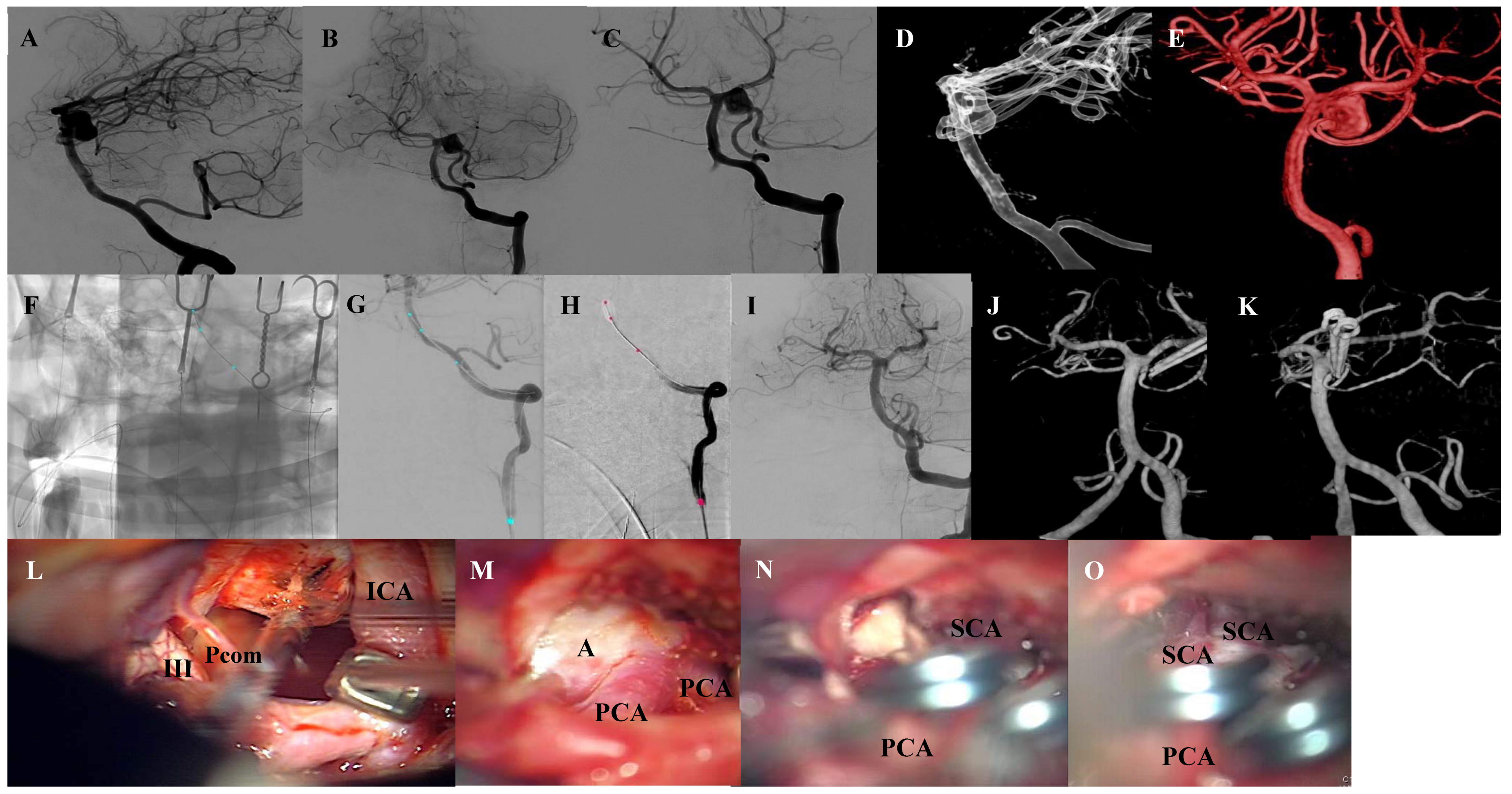
Case 1
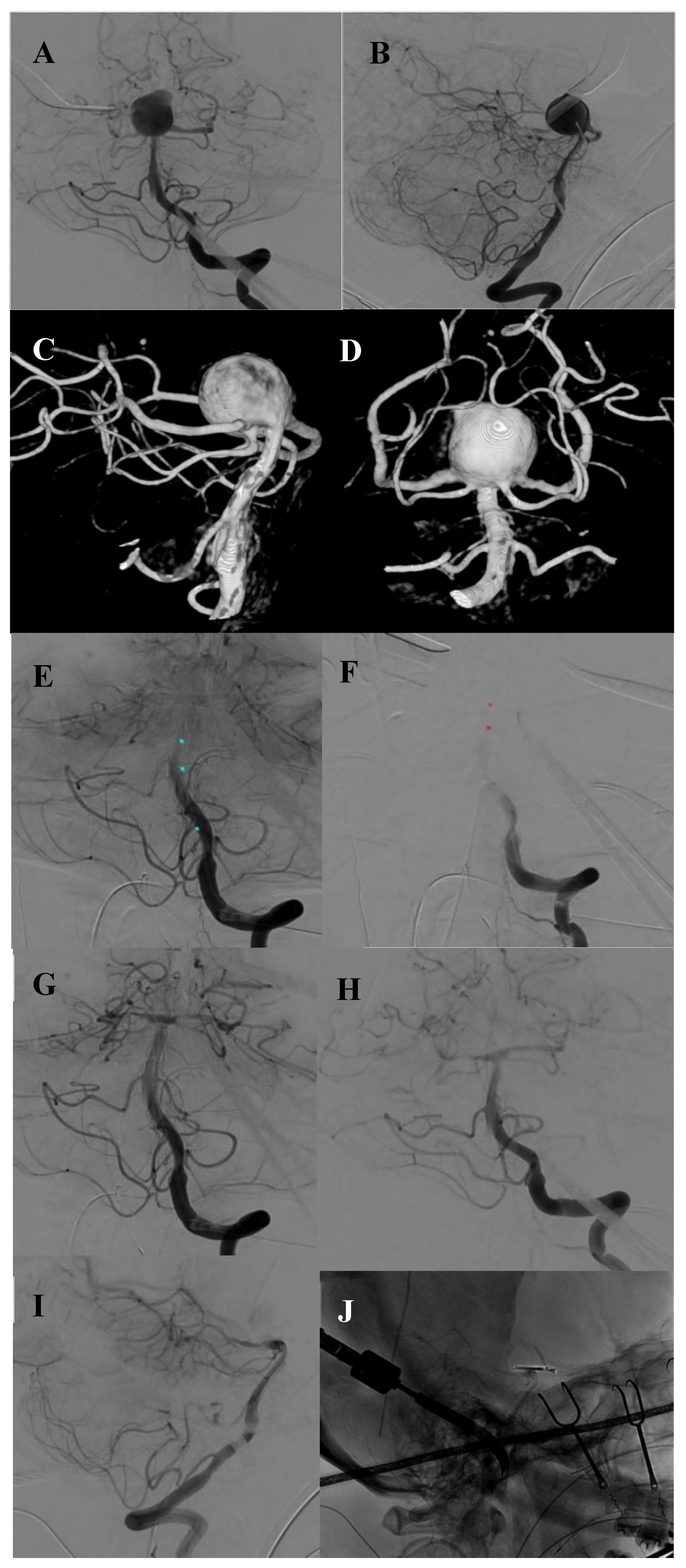
Case 2
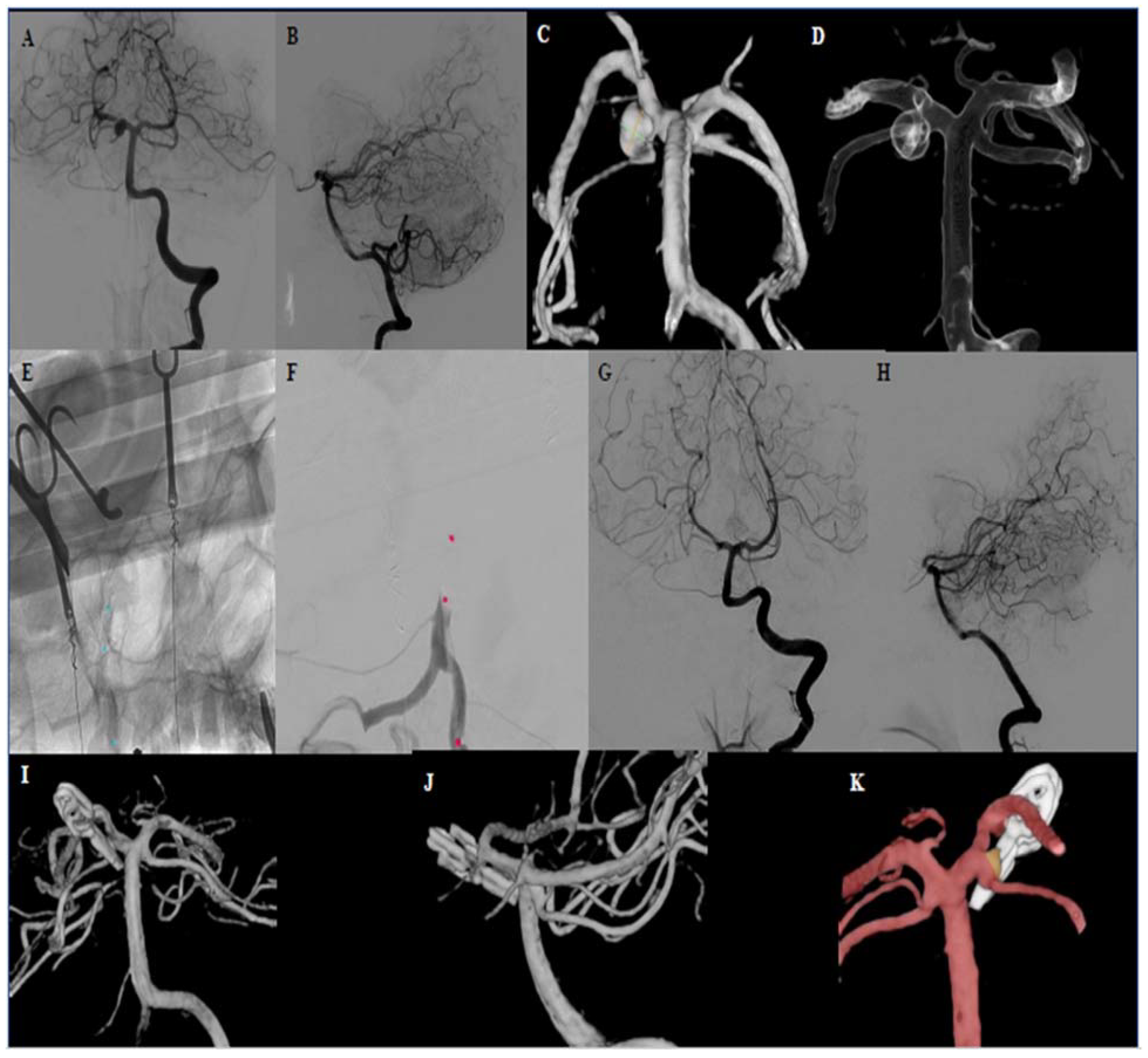
Case 3
3. Results
4. Discussion
5. Conclusions
Author Contributions
Funding
Conflicts of Interest
References
- Batjer, H.H.; Samson, D.S. Retrograde suction decompression of giant paraclinoidal aneurysms. Technical note. J. Neurosurg. 1990, 73, 305–306. [Google Scholar] [CrossRef] [Scilit] [PubMed]
- Batjer, H.H.; Kopitnik, T.A.; Giller, C.A.; Samson, D.S. Surgery for paraclinoidal carotid artery aneurysms. J. Neurosurg. 1994, 80, 650–658. [Google Scholar] [CrossRef] [Scilit] [PubMed]
- Vlak, M.H.; Rinkel, G.J.; Greebe, P.; van der Bom, J.G.; Algra, A. Trigger factors for rupture of intracranial aneurysms in relation to patient and aneurysm characteristics. J. Neurol. 2012, 259, 1298–1302. [Google Scholar] [CrossRef] [Scilit]
- Brisman, J.L.; Song, J.K.; Newell, D.W. Cerebral aneurysms. N. Engl. J. Med. 2006, 355, 928–939. [Google Scholar] [CrossRef] [Scilit] [PubMed]
- Molyneux, A.J.; Kerr, R.S.; Yu, L.M.; Clarke, M.; Sneade, M.; Yarnold, J.A.; Sandercock, P.; International Subarachnoid Aneurysm Trial Collaborative Group. International subarachnoid aneurysm trial (ISAT) of neurosurgical clipping versus endovascular coiling in 2143 patients with ruptured intracranial aneurysms: A randomised comparison of effects on survival, dependency, seizures, rebleeding, subgroups, and aneurysm occlusion. Lancet 2005, 366, 809–817. [Google Scholar] [PubMed]
- Greving, J.P.; Wermer, M.J.; Brown, R.D., Jr.; Morita, A.; Juvela, S.; Yonekura, M.; Ishibashi, T.; Torner, J.C.; Nakayama, T.; Rinkel, G.J.; et al. Development of the PHASES score for prediction of risk of rupture of intracranial aneurysms: A pooled analysis of six prospective cohort studies. Lancet Neurol. 2014, 13, 59–66. [Google Scholar] [CrossRef] [Scilit]
- Etminan, N.; Brown, R.D., Jr.; Beseoglu, K.; Juvela, S.; Raymond, J.; Morita, A.; Torner, J.C.; Derdeyn, C.P.; Raabe, A.; Mocco, J.; et al. The unruptured intracranial aneurysm treatment score: A multidisciplinary consensus. Neurology 2015, 85, 881–889. [Google Scholar] [CrossRef] [Scilit]
- Nanda, A.; Sonig, A.; Banerjee, A.D.; Javalkar, V.K. Microsurgical management of basilar artery apex aneurysms: A single surgeon’s experience from Louisiana State University, Shreveport. World Neurosurg. 2014, 82, 118–129. [Google Scholar] [CrossRef] [Scilit]
- Hernesniemi, J.; Goehre, F. Approaches to upper basilar artery aneurysms. World Neurosurg. 2014, 82, 1001–1002. [Google Scholar] [CrossRef] [Scilit]
- Batjer, H.; Samson, D. Intraoperative aneurysmal rupture: Incidence, outcome, and suggestions for surgical management. Neurosurgery 1986, 18, 701–707. [Google Scholar] [CrossRef] [Scilit]
- Molyneux, A.; Kerr, R.; Stratton, I.; Sandercock, P.; Clarke, M.; Shrimpton, J.; Holman, R.; International Subarachnoid Aneurysm Trial Collaborative Group. International Subarachnoid Aneurysm Trial (ISAT) of neurosurgical clipping versus endovascular coiling in 2143 patients with ruptured intracranial aneurysms: A randomised trial. Lancet 2002, 360, 1267–1274. [Google Scholar] [CrossRef] [Scilit]
- Ogilvy, C.S.; Hoh, B.L.; Singer, R.J.; Putman, C.M. Clinical and radiographic outcome in the management of posterior circulation aneurysms by use of direct surgical or endovascular techniques. Neurosurgery 2002, 51, 14–21; discussion 21–22. [Google Scholar] [CrossRef] [Scilit] [PubMed]
- Krisht, A.F.; Bikmaz, K.; Kadri, P.A.; Partington, S. Outcome of Surgical Clipping of 40 Complex Basilar Aneurysms Using the Transcavernous Route: Paper 34. Neurosurgery 2006, 58, 407. [Google Scholar] [CrossRef] [Scilit]
- Eskridge, J.M.; Song, J.K. Endovascular embolization of 150 basilar tip aneurysms with Guglielmi detachable coils: Results of the Food and Drug Administration multicenter clinical trial. J. Neurosurg. 1998, 89, 81–86. [Google Scholar] [CrossRef] [Scilit]
- Bavinzski, G.; Killer, M.; Gruber, A.; Reinprecht, A.; Gross, C.E.; Richling, B. Treatment of basilar artery bifurcation aneurysms by using Guglielmi detachable coils: A 6-year experience. J. Neurosurg. 1999, 90, 843–852. [Google Scholar] [CrossRef] [Scilit]
- Tateshima, S.; Murayama, Y.; Gobin, Y.P.; Duckwiler, G.R.; Guglielmi, G.; Vinuela, F. Endovascular treatment of basilar tip aneurysms using Guglielmi detachable coils: Anatomic and clinical outcomes in 73 patients from a single institution. Neurosurgery 2000, 47, 1332–1339; discussion 1339–1342. [Google Scholar] [CrossRef]
- Henkes, H.; Fischer, S.; Mariushi, W.; Weber, W.; Liebig, T.; Miloslavski, E.; Brew, S.; Kuhne, D. Angiographic and clinical results in 316 coil-treated basilar artery bifurcation aneurysms. J. Neurosurg. 2005, 103, 990–999. [Google Scholar] [CrossRef] [Scilit]
- Owen, C.M.; Montemurro, N.; Lawton, M.T. Microsurgical Management of Residual and Recurrent Aneurysms After Coiling and Clipping: An Experience With 97 Patients. Neurosurgery 2015, 62 (Suppl. 1), 92–102. [Google Scholar] [CrossRef] [Scilit]
- Spetzler, R.F.; McDougall, C.G.; Zabramski, J.M.; Albuquerque, F.C.; Hills, N.K.; Russin, J.J.; Partovi, S.; Nakaji, P.; Wallace, R.C. The Barrow Ruptured Aneurysm Trial: 6-year results. J. Neurosurg. 2015, 123, 609–617. [Google Scholar] [CrossRef] [Scilit]
- Ferns, S.P.; Sprengers, M.E.; van Rooij, W.J.; Rinkel, G.J.; van Rijn, J.C.; Bipat, S.; Sluzewski, M.; Majoie, C.B. Coiling of intracranial aneurysms: A systematic review on initial occlusion and reopening and retreatment rates. Stroke 2009, 40, e523–e529. [Google Scholar] [CrossRef] [Scilit]
- van Eijck, M.; Bechan, R.S.; Sluzewski, M.; Peluso, J.P.; Roks, G.; van Rooij, W.J. Clinical and Imaging Follow-Up of Patients with Coiled Basilar Tip Aneurysms Up to 20 Years. AJNR Am. J. Neuroradiol. 2015, 36, 2108–2113. [Google Scholar] [CrossRef] [Scilit] [PubMed]
- Molyneux, A.J.; Kerr, R.S.; Birks, J.; Ramzi, N.; Yarnold, J.; Sneade, M.; Rischmiller, J.; Collaborators, I. Risk of recurrent subarachnoid haemorrhage, death, or dependence and standardised mortality ratios after clipping or coiling of an intracranial aneurysm in the International Subarachnoid Aneurysm Trial (ISAT): Long-term follow-up. Lancet Neurol. 2009, 8, 427–433. [Google Scholar] [CrossRef] [Scilit]
- Ferns, S.P.; Sprengers, M.E.; van Rooij, W.J.; van Zwam, W.H.; de Kort, G.A.; Velthuis, B.K.; Schaafsma, J.D.; van den Berg, R.; Sluzewski, M.; Brouwer, P.A.; et al. Late reopening of adequately coiled intracranial aneurysms: Frequency and risk factors in 400 patients with 440 aneurysms. Stroke 2011, 42, 1331–1337. [Google Scholar] [CrossRef] [Scilit] [PubMed]
- Juvela, S.; Porras, M.; Heiskanen, O. Natural history of unruptured intracranial aneurysms: A long-term follow-up study. J. Neurosurg. 1993, 79, 174–182. [Google Scholar] [CrossRef] [Scilit] [PubMed]
- Juvela, S.; Porras, M.; Poussa, K. Natural history of unruptured intracranial aneurysms: Probability of and risk factors for aneurysm rupture. J. Neurosurg. 2000, 93, 379–387. [Google Scholar] [CrossRef] [Scilit]
- Wiebers, D.O.; Whisnant, J.P.; Huston, J., III; Meissner, I.; Brown, R.D., Jr.; Piepgras, D.G.; Forbes, G.S.; Thielen, K.; Nichols, D.; O’Fallon, W.M.; et al. Unruptured intracranial aneurysms: Natural history, clinical outcome, and risks of surgical and endovascular treatment. Lancet 2003, 362, 103–110. [Google Scholar] [CrossRef] [Scilit]
- Molyneux, A.J.; Birks, J.; Clarke, A.; Sneade, M.; Kerr, R.S. The durability of endovascular coiling versus neurosurgical clipping of ruptured cerebral aneurysms: 18 year follow-up of the UK cohort of the International Subarachnoid Aneurysm Trial (ISAT). Lancet 2015, 385, 691–697. [Google Scholar] [CrossRef] [Scilit]
- Investigators, U.J.; Morita, A.; Kirino, T.; Hashi, K.; Aoki, N.; Fukuhara, S.; Hashimoto, N.; Nakayama, T.; Sakai, M.; Teramoto, A.; et al. The natural course of unruptured cerebral aneurysms in a Japanese cohort. N. Engl. J. Med. 2012, 366, 2474–2482. [Google Scholar] [CrossRef] [Scilit]
- Sekhar, L.N.; Tariq, F.; Morton, R.P.; Ghodke, B.; Hallam, D.K.; Barber, J.; Kim, L.J. Basilar tip aneurysms: A microsurgical and endovascular contemporary series of 100 patients. Neurosurgery 2013, 72, 284–298; discussion 298–299. [Google Scholar] [CrossRef] [Scilit]
- Hernesniemi, J.; Korja, M. At the apex of cerebrovascular surgery--basilar tip aneurysms. World Neurosurg. 2014, 82, 37–39. [Google Scholar] [CrossRef] [Scilit]
- Yasargil, M.G.; Antic, J.; Laciga, R.; Jain, K.K.; Hodosh, R.M.; Smith, R.D. Microsurgical pterional approach to aneurysms of the basilar bifurcation. Surg. Neurol. 1976, 6, 83–91. [Google Scholar] [PubMed]
- Drake, C.G. Bleeding aneurysms of the basilar artery. Direct surgical management in four cases. J. Neurosurg. 1961, 18, 230–238. [Google Scholar] [CrossRef] [Scilit] [PubMed]
- Tjahjadi, M.; Kivelev, J.; Serrone, J.C.; Maekawa, H.; Kerro, O.; Jahromi, B.R.; Lehto, H.; Niemela, M.; Hernesniemi, J.A. Factors Determining Surgical Approaches to Basilar Bifurcation Aneurysms and Its Surgical Outcomes. Neurosurgery 2016, 78, 181–191. [Google Scholar] [CrossRef] [Scilit] [PubMed]
- Day, J.D.; Fukushima, T.; Giannotta, S.L. Cranial base approaches to posterior circulation aneurysms. J. Neurosurg. 1997, 87, 544–554. [Google Scholar] [CrossRef] [Scilit]
- Hsu, F.P.; Clatterbuck, R.E.; Spetzler, R.F. Orbitozygomatic approach to basilar apex aneurysms. Neurosurgery 2005, 56 (Suppl. 1), 172–177. [Google Scholar] [CrossRef] [Scilit]
- Gonzalez, L.F.; Amin-Hanjani, S.; Bambakidis, N.C.; Spetzler, R.F. Skull base approaches to the basilar artery. Neurosurg. Focus 2005, 19, E3. [Google Scholar] [CrossRef] [Scilit]
- Kawase, T.; Toya, S.; Shiobara, R.; Mine, T. Transpetrosal approach for aneurysms of the lower basilar artery. J. Neurosurg. 1985, 63, 857–861. [Google Scholar] [CrossRef] [Scilit]
- Kato, Y.; Sano, H.; Behari, S.; Kumar, S.; Nagahisa, S.; Iwata, S.; Kanno, T. Surgical clipping of basilar aneurysms: Relationship between the different approaches and the surgical corridors. Minim. Invasive Neurosurg. MIN 2002, 45, 142–145. [Google Scholar] [CrossRef] [Scilit]
- Spiessberger, A.; Strange, F.; Fandino, J.; Marbacher, S. Microsurgical Clipping of Basilar Apex Aneurysms: A Systematic Historical Review of Approaches and their Results. World Neurosurg. 2018, 114, 305–316. [Google Scholar] [CrossRef] [Scilit]
- Groff, M.W.; Adams, D.C.; Kahn, R.A.; Kumbar, U.M.; Yang, B.Y.; Bederson, J.B. Adenosine-induced transient asystole for management of a basilar artery aneurysm. Case report. J. Neurosurg. 1999, 91, 687–690. [Google Scholar] [CrossRef] [Scilit]
- Lawton, M.T.; Raudzens, P.A.; Zabramski, J.M.; Spetzler, R.F. Hypothermic circulatory arrest in neurovascular surgery: Evolving indications and predictors of patient outcome. Neurosurgery 1998, 43, 10–20; discussion 20–21. [Google Scholar] [CrossRef] [Scilit]
- Samson, D.; Batjer, H.H.; Bowman, G.; Mootz, L.; Krippner, W.J., Jr.; Meyer, Y.J.; Allen, B.C. A clinical study of the parameters and effects of temporary arterial occlusion in the management of intracranial aneurysms. Neurosurgery 1994, 34, 22–28; discussion 28–29. [Google Scholar] [PubMed]
- Elhammady, M.S.; Nakaji, P.; Farhat, H.; Morcos, J.J.; Aziz-Sultan, M.A. Balloon-assisted clipping of a large paraclinoidal aneurysm: A salvage procedure. Neurosurgery 2009, 65, E1210–E1211; discussion E1211. [Google Scholar] [CrossRef] [Scilit] [PubMed]
- Fandino, J.; Taussky, P.; Marbacher, S.; Muroi, C.; Diepers, M.; Fathi, A.R.; Remonda, L. The concept of a hybrid operating room: Applications in cerebrovascular surgery. Acta Neurochir. Suppl. 2013, 115, 113–117. [Google Scholar] [PubMed]
- Sanai, N.; Tarapore, P.; Lee, A.C.; Lawton, M.T. The current role of microsurgery for posterior circulation aneurysms: A selective approach in the endovascular era. Neurosurgery 2008, 62, 1236–1249; discussion 1249–1253. [Google Scholar] [CrossRef] [Scilit] [PubMed]
- Lawton, M.T.; Abla, A.A.; Rutledge, W.C.; Benet, A.; Zador, Z.; Rayz, V.L.; Saloner, D.; Halbach, V.V. Bypass Surgery for the Treatment of Dolichoectatic Basilar Trunk Aneurysms: A Work in Progress. Neurosurgery 2016, 79, 83–99. [Google Scholar] [CrossRef] [Scilit]
- Basma, J.; Ryttlefors, M.; Latini, F.; Pravdenkova, S.; Krisht, A. Mobilization of the transcavernous oculomotor nerve during basilar aneurysm surgery: Biomechanical bases for better outcome. Neurosurgery 2014, 10 (Suppl. 1), 106–114; discussion 114–115. [Google Scholar] [CrossRef] [Scilit]
- Shi, X.; Qian, H.; Singh, K.C.; Zhang, Y.; Zhou, Z.; Sun, Y.; Liu, F. Surgical management of vertebral and basilar artery aneurysms: A single center experience in 41 patients. Acta Neurochir. (Wien) 2013, 155, 1087–1093. [Google Scholar] [CrossRef] [Scilit]
- Yanagisawa, T.; Kinouchi, H.; Sasajima, T.; Shimizu, H. Long-Term Follow-Up for a Giant Basilar Trunk Aneurysm Surgically Treated by Proximal Occlusion and External Carotid Artery to Posterior Cerebral Artery Bypass Using a Saphenous Vein Graft. J. Stroke Cerebrovasc. Dis. 2016, 25, e212–e213. [Google Scholar] [CrossRef] [Scilit]
- Indo, M.; Oya, S.; Matsui, T. Ruptured Basilar Tip Aneurysm in a Patient with Bilateral Internal Carotid Artery Occlusion Successfully Treated with Bilateral Superficial Temporal Artery-Middle Cerebral Artery Anastomoses: Case Report. World Neurosurg. 2016, 86, 512.e5–512.e8. [Google Scholar] [CrossRef] [Scilit]
- Kai, Y.; Hamada, J.; Morioka, M.; Yano, S.; Hamasaki, K.; Ushio, Y. Successful treatment of a ruptured dissecting basilar artery aneurysm. Case report. J. Neurosurg. 2004, 100, 1072–1075. [Google Scholar] [CrossRef] [Scilit] [PubMed]
- Krisht, A.F.; Krayenbuhl, N.; Sercl, D.; Bikmaz, K.; Kadri, P.A. Results of microsurgical clipping of 50 high complexity basilar apex aneurysms. Neurosurgery 2007, 60, 242–250; discussion 250–252. [Google Scholar] [CrossRef] [Scilit] [PubMed]
- Tanaka, Y.; Kobayashi, S.; Hongo, K.; Tada, T.; Nagashima, H.; Kakizawa, Y. Intentional body clipping of wide-necked basilar artery bifurcation aneurysms. J. Neurosurg. 2000, 93, 169–174. [Google Scholar] [CrossRef] [Scilit] [PubMed]
- Matsukawa, H.; Tanikawa, R.; Kamiyama, H.; Tsuboi, T.; Noda, K.; Ota, N.; Miyata, S.; Tokuda, S. Localization in the Interpeduncular Cistern as Risk Factors for the Thalamoperforators’ Ischemia, Poor Outcome, and Oculomotor Nerve Palsy in Patients with Complex Unruptured Basilar Apex Aneurysm Treated with Neck Clipping. World Neurosurg. 2015, 84, 475–482. [Google Scholar] [CrossRef] [Scilit] [PubMed]
- Mooney, M.A.; Kalani, M.Y.; Nakaji, P.; Albuquerque, F.C.; McDougall, C.G.; Spetzler, R.F.; Zabramski, J.M. Long-term Patient Outcomes After Microsurgical Treatment of Blister-Like Aneurysms of the Basilar Artery. Neurosurgery 2015, 11 (Suppl. 3), 387–393. [Google Scholar] [CrossRef] [Scilit]
- Griessenauer, C.J.; Poston, T.L.; Shoja, M.M.; Mortazavi, M.M.; Falola, M.; Tubbs, R.S.; Fisher, W.S., III. The impact of temporary artery occlusion during intracranial aneurysm surgery on long-term clinical outcome: Part I. Patients with subarachnoid hemorrhage. World Neurosurg. 2014, 82, 140–148. [Google Scholar] [CrossRef] [Scilit]
- Taylor, C.L.; Selman, W.R.; Kiefer, S.P.; Ratcheson, R.A. Temporary vessel occlusion during intracranial aneurysm repair. Neurosurgery 1996, 39, 893–905; discussion 905–906. [Google Scholar]
- Steinberg, G.K.; Drake, C.G.; Peerless, S.J. Deliberate basilar or vertebral artery occlusion in the treatment of intracranial aneurysms. Immediate results and long-term outcome in 201 patients. J. Neurosurg. 1993, 79, 161–173. [Google Scholar] [CrossRef] [Scilit]
- Al-Mousa, A.; Bose, G.; Hunt, K.; Toma, A.K. Adenosine-assisted neurovascular surgery: Initial case series and review of literature. Neurosurg. Rev. 2019, 42, 15–22. [Google Scholar] [CrossRef] [Scilit]
- Desai, V.R.; Rosas, A.L.; Britz, G.W. Adenosine to facilitate the clipping of cerebral aneurysms: Literature review. Stroke Vasc. Neurol. 2017, 2, 204–209. [Google Scholar] [CrossRef] [Scilit]
- Mack, W.J.; Ducruet, A.F.; Angevine, P.D.; Komotar, R.J.; Shrebnick, D.B.; Edwards, N.M.; Smith, C.R.; Heyer, E.J.; Monyero, L.; Connolly, E.S., Jr.; et al. Deep hypothermic circulatory arrest for complex cerebral aneurysms: Lessons learned. Neurosurgery 2007, 60, 815–827. [Google Scholar] [CrossRef] [Scilit] [PubMed]
- Konczalla, J.; Platz, J.; Fichtlscherer, S.; Mutlak, H.; Strouhal, U.; Seifert, V. Rapid ventricular pacing for clip reconstruction of complex unruptured intracranial aneurysms: Results of an interdisciplinary prospective trial. J. Neurosurg. 2018, 128, 1741–1752. [Google Scholar] [CrossRef] [Scilit] [PubMed]
- Skrap, M.; Petralia, B.; Toniato, G. Temporary balloon occlusion during the surgical treatment of giant paraclinoid and vertebrobasilar aneurysms. Acta Neurochir. (Wien) 2010, 152, 435–442. [Google Scholar] [CrossRef] [Scilit] [PubMed]
- Mizoi, K.; Yoshimoto, T.; Takahashi, A.; Ogawa, A. Direct clipping of basilar trunk aneurysms using temporary balloon occlusion. J. Neurosurg. 1994, 80, 230–236. [Google Scholar] [CrossRef] [Scilit] [PubMed]
- Thorell, W.; Rasmussen, P.; Perl, J.; Masaryk, T.; Mayberg, M. Balloon-assisted microvascular clipping of paraclinoid aneurysms. Technical note. J. Neurosurg. 2004, 100, 713–716. [Google Scholar] [CrossRef] [Scilit]
- MacDonald, J.D.; Gyorke, A.; Jacobs, J.M.; Mohammad, S.F.; Sunderland, P.M.; Reichman, M.V. Acute phase vascular endothelial injury: A comparison of temporary arterial occlusion using an endovascular occlusive balloon catheter versus a temporary aneurysm clip in a pig model. Neurosurgery 1994, 34, 876–881; discussion 881. [Google Scholar] [CrossRef] [Scilit]
- Kinjo, T.; Mizoi, K.; Takahashi, A.; Yoshimoto, T.; Suzuki, J. A successfully treated case of giant basilar artery aneurysm utilizing balloon catheter occlusion and brain protective substances. No Shinkei Geka 1986, 14 (Suppl. 3), 397–402. [Google Scholar]
- Shucart, W.A.; Kwan, E.S.; Heilman, C.B. Temporary balloon occlusion of a proximal vessel as an aid to clipping aneurysms of the basilar and paraclinoid internal carotid arteries: Technical note. Neurosurgery 1990, 27, 116–119. [Google Scholar] [CrossRef] [Scilit]
- Xu, F.; Huang, L.; Xu, B.; Gu, Y.; Leng, B. Endovascular Retrograde Suction Decompression-Assisted Clipping of Large Paraclinoid Aneurysm in Hybrid Operating Room: 2-Dimensional Operative Video. World Neurosurg. 2018, 114, 178. [Google Scholar] [CrossRef] [Scilit]
- Ricci, G.; Ricci, A.; Gallucci, M.; Zotta, D.; Scogna, A.; Costagliola, C.; Galzio, R.J. Combined endovascular and microsurgical approach in the treatment of giant paraclinoid and vertebrobasilar aneurysms. J. Neurosurg. Sci. 2005, 49, 1–6. [Google Scholar]
- Ng, P.Y.; Huddle, D.; Gunel, M.; Awad, I.A. Intraoperative endovascular treatment as an adjunct to microsurgical clipping of paraclinoid aneurysms. J. Neurosurg. 2000, 93, 554–560. [Google Scholar] [CrossRef] [Scilit] [PubMed]
- Albert, F.K.; Forsting, M.; Aschoff, A.; Krieger, D.; Kunze, S. Clipping of proximal paraclinoid aneurysms with support of the balloon-catheter "trapping-evacuation" technique. Technical note. Acta Neurochir. (Wien) 1993, 125, 138–141. [Google Scholar] [CrossRef] [Scilit] [PubMed]
- Fulkerson, D.H.; Horner, T.G.; Payner, T.D.; Leipzig, T.J.; Scott, J.A.; Denardo, A.J.; Redelman, K.; Goodman, J.M. Endovascular retrograde suction decompression as an adjunct to surgical treatment of ophthalmic aneurysms: Analysis of risks and clinical outcomes. Neurosurgery 2009, 64 (Suppl. 3), ons107–ons111; discussion ons111–ons112. [Google Scholar] [CrossRef] [Scilit] [PubMed]
- Bailes, J.E.; Deeb, Z.L.; Wilson, J.A.; Jungreis, C.A.; Horton, J.A. Intraoperative angiography and temporary balloon occlusion of the basilar artery as an adjunct to surgical clipping: Technical note. Neurosurgery 1992, 30, 949–953. [Google Scholar]
- Petralia, B.; Skrap, M. Temporary Balloon Occlusion during Giant Aneurysm Surgery. A Technical Description. Interv. Neuroradiol. 2006, 12, 245–250. [Google Scholar] [CrossRef] [Scilit]
- Hacein-Bey, L.; Connolly, E.S., Jr.; Mayer, S.A.; Young, W.L.; Pile-Spellman, J.; Solomon, R.A. Complex intracranial aneurysms: Combined operative and endovascular approaches. Neurosurgery 1998, 43, 1304–1312; discussion 1312–1313. [Google Scholar]
- Steiger, H.J.; Lins, F.; Mayer, T.; Schmid-Elsaesser, R.; Stummer, W.; Turowski, B. Temporary aneurysm orifice balloon occlusion as an alternative to retrograde suction decompression for giant paraclinoid internal carotid artery aneurysms: Technical note. Neurosurgery 2005, 56 (Suppl. 2), E442. [Google Scholar] [CrossRef] [Scilit]
- Scott, J.A.; Horner, T.G.; Leipzig, T.J. Retrograde suction decompression of an ophthalmic artery aneurysm using balloon occlusion. Technical note. J. Neurosurg. 1991, 75, 146–147. [Google Scholar] [CrossRef] [Scilit]
- Hoh, D.J.; Larsen, D.W.; Elder, J.B.; Kim, P.E.; Giannotta, S.L.; Liu, C.Y. Novel use of an endovascular embolectomy device for retrograde suction decompression-assisted clip ligation of a large paraclinoid aneurysm: Technical case report. Neurosurgery 2008, 62 (Suppl. 2), ONSE412–ONSE413; discussion ONSE413–ONSE414. [Google Scholar] [CrossRef] [Scilit] [PubMed]
- Fahlbusch, R.; Nimsky, C.; Huk, W. Open surgery of giant paraclinoid aneurysms improved by intraoperative angiography and endovascular retrograde suction decompression. Acta Neurochir. (Wien) 1997, 139, 1026–1032. [Google Scholar] [CrossRef] [Scilit]
- Arnautovic, K.I.; Al-Mefty, O.; Angtuaco, E. A combined microsurgical skull-base and endovascular approach to giant and large paraclinoid aneurysms. Surg. Neurol. 1998, 50, 504–518; discussion 518–520. [Google Scholar] [CrossRef] [Scilit]
- Mizoi, K.; Takahashi, A.; Yoshimoto, T.; Fujiwara, S.; Koshu, K. Combined endovascular and neurosurgical approach for paraclinoid internal carotid artery aneurysms. Neurosurgery 1993, 33, 986–992. [Google Scholar] [PubMed]
- Capo, G.; Vescovi, M.C.; Toniato, G.; Petralia, B.; Gavrilovic, V.; Skrap, M. Giant vertebral aneurysm: A case report detailing successful treatment with combined stenting and surgery. Surg. Neurol. Int. 2018, 9, 6. [Google Scholar] [CrossRef] [Scilit] [PubMed]
- Marbacher, S.; Kienzler, J.C.; Mendelowitsch, I.; D’Alonzo, D.; Andereggen, L.; Diepers, M.; Remonda, L.; Fandino, J. Comparison of Intra- and Postoperative 3-Dimensional Digital Subtraction Angiography in Evaluation of the Surgical Result After Intracranial Aneurysm Treatment. Neurosurgery 2019, nyz487. [Google Scholar] [CrossRef] [Scilit] [PubMed]
- Marbacher, S.; Mendelowitsch, I.; Gruter, B.E.; Diepers, M.; Remonda, L.; Fandino, J. Comparison of 3D intraoperative digital subtraction angiography and intraoperative indocyanine green video angiography during intracranial aneurysm surgery. J. Neurosurg. 2018, 131, 64–71. [Google Scholar] [CrossRef] [Scilit] [PubMed]


| Case | Age (Years) | Gender | Aneurysm Location and Anatomical Variation | Aneurysm Size (mm) | Previous Treatment | Clinical Presentation | Fisher Grade | H and H/ WFNS Grade | GCS | mRS | GOS |
|---|---|---|---|---|---|---|---|---|---|---|---|
| 1 | 53 | Female | Basilar tip aneurysm Bilateral PCA and SCA are leaving from the aneurysm base | 16 × 16 × 15 | no | Dizziness attack and syncope, SAH | 4 | 5/5 | 3 | 6 | 1 |
| 2 | 44 | Male | Partially thrombosed distal left side dissecting basilar artery aneurysm with secondary wall hematoma Ampullary exit of the left double-laid SCA from the aneurysm fundus | 11 × 8 × 8 | no | Thunderclap headache | N/A | N/A | 15 | 0 | 5 |
| 3 | 48 | Female | Proximal right side PCA aneurysm (P1 branch) Right SCA exits the P1 segment from the aneurysms side wall | 4 × 5 × 5 | no | Incidental finding Diagnostic in the context of a vestibular syndrome | N/A | N/A | 15 | 0 | 5 |
| Case | Duration of TBO (Min) | Number of Clips | Intraoperative DSA Findings | Balloon Catheter Used | Complications |
|---|---|---|---|---|---|
| 1 | 9 | 1 | Complete occlusion of the aneurysm All branches open | ASCENT® 4 × 7 balloon (DePuy Synthes) | None |
| 2 | 10 | 2 | Small remnant at the neck to preserve the SCA exit No aneurysm perfusion All branches open | ASCENT® 4 × 7 balloon (DePuy Synthes) | None |
| 3 | 11 | 3 | Small remnant at the neck to preserve the SCA exit No aneurysm perfusion All branches open | ASCENT® 4 × 7 balloon (DePuy Synthes) | None |
| Author | Aneurysm Location | TBO Occlusion Time | Additional Techniques | Complete Occlusion | Complications |
|---|---|---|---|---|---|
| Kinjo T. et al. [41] 1986 | Giant BA aneurysm | N/A | Sendai cocktail Temporary clips on basilar artery and bilateral PCA | N/A | None |
| Shucart W.A. et al. [71] 1990 | BA aneurysm 3 × large paraclinoid ICA aneurysms | 3–18 min (mean 12.5 min.) | None | 3 × optimal clip placement 1 × clip repositioning | Transient oculomotor palsy Oculomotor and abducens palsy Hemiparesis due to vasospasm Aphasia due frontal infarct (Moya Moya disease) |
| Tamaki N. et al. [76] 1991 | Four large and giant carotid-ophthalmic artery aneurysm | N/A | Temporary ICA clipping distal to aneurysm ICA blood aspiration through second catheter | Successful clipping | Transient oculomotor palsy Hemorrhagic infarction Hydrocephalus (n = 2) |
| Scott J.A. et al. [68] 1991 | Large ophthalmic artery aneurysm | 1.5 min. per balloon inflation | Temporary ICA clipping distal to aneurysm Suction through distal lumen of occlusion balloon catheter | Successful obliteration | None |
| Bailes J.E. et al. [4] 1992 | 4 BA aneurysms | N/A | None | Complete obliteration | Intraoperative aneurysm rupture Transient oculomotor nerve palsy in 3 patients |
| Albert F.K. et al. [2] 1993 | 2 proximal paraclinoid aneurysm | N/A | Suction-decompression Temporary clip distal ICA | N/A | None |
| Mizoi K. et al. [51] 1993 | 9 paraclinoid ICA aneurysms | 13–50 min. (mean 26.2 min.) | Retrograde suction-decompression Repeated TBO | 3 × Clip repositioning (due to narrowing of parent artery) Successful obliteration in all cases | Intraoperative TBO balloon rupture → surgery continued with new balloon →Embolus developed in M1 Segment → Embolectomy through M1 incisio, MCA occlusion for 20 min → aneurysm clipping followed → patient with transient hemiparesis for 6 h |
| Mizoi K. et al. [52] 1994 | 5 BA aneurysms (including 1 large & 1 giant) | 15–30 min. (mean 22 min.) | None | 3 cases successful obliteration 2 × clip repositioning: Finally one case with remnant at the neck, one complete occlusion | Transient abducens nerve palsy Transient hemiparesis |
| Fahlbusch R. et al. [19] 1997 | 3 giant paraclinoid ICA aneurysms | 2–6 min. | Retrograde suction-decompression | Clip repositioning in all 3 cases (stenosis of parent vessel or incomplete occlusion) | Vasospasm and temporoparietal infarction (hemiparesis and transient dysphasia, deterioration of vision) 1 thromboembolic complication: sensimotor dysphasia, infarct in temporo-parietal region |
| Hacein-Bey L. et al. [28] 1998 | 1 large & 1 giant ICA ophthalmic aneurysm | N/A | None | Complete obliteration | None |
| Arnautovic K.I. et al. [3] 1998 | 8 giant and 8 large paraclinoid aneurysm | mean 10.7 min. | Distal temporary clip Suction-decompression | In 1 patient clipping was not possible due to calcification of aneurysm neck and wall, no aneurysm collapse achieved → Coiling Successful clipping in 15 cases | Transient oculomotor nerve palsy 2 temporal lobe infarction with new neurological deficit Hydrocephalus and subdural hygroma Ipsilateral ICA intimal dissection and occlusion at balloon side Transient dysphasia (thromboembolic) Cerebral abscess Transient cerebral edema One death due to intraventricular hemorrhage |
| Ng P-Y. et al. [60] 2000 | 24 paraclinoid ICA segment aneurysms (13 large & 11 giant) | 2–27 min. (mean 13 min.) | Suction-decompression in 16 cases | Clip adjustment in 7 cases (residual filling of aneurysm and 4 ICA compromise) Complete obliteration in 20 cases, greater than 90% occlusion in 22 cases | 1 major MCA infarct related to catheter thromboembolism vasospasm in 3 cases with delayed ischemia 2 deaths (one from fatal MCA infarct) |
| Thorell W. et al. [80] 2004 | 6 paraclinoid giant or complex ICA aneurysms | Balloon inflation time less than 3 min. in all cases | None | In 4 patients, navigation of the balloon into intracranial circulation due to carotid tortuosity was not possible All aneurysms were complete occluded | Lumbar drain due to subgaleal CSF collection Lacunar infarction ipsilateral 6 weeks after surgery with mild transient hemiparesis |
| Steiger H.J. et al. [74] 2005 | 2 giant carotid opthalmic aneurysms | 16 + 24 min. (mean 20 min.) | None | Case 1: Complete occlusion of the intracranial aneurysm part at surgery and 5 months later, endovascular occlusion of infraclinoid aspect of aneurysm Case 2: Small remnant at the neck for patency of parent vessel | Acceleration of vasospasms 15 h after surgery and transient hemiparesis in one case, resolved with hypertensive therapy |
| Ricci G. et al. [65] 2005 | 5 giant paraclinoidal ICA aneurysms 1 giant vertebrobasilar junction aneurysm | N/A | None | Aneurysm obliteration achieved in all cases | None |
| Parkinson R.J. et al. [63] 2006 | Giant paraclinoid ICA aneurysm | Suction-decompression Temporary clip distal to aneurysm | Complete occlusion and reconstruction of parent vessel | None | |
| Petralia B. et al. [64] 2006 | 10 giant paraclinoid ICA aneurysm 3 giant vertebrobasilar aneurysm | 15–20 min. | None | All aneurysm excluded with parent vessel patency One balloon rupture One patient underwent coiling at recurrence | None |
| Hoh D.J. et al. [32] 2008 | Large paraclinoid aneurysm | 11 min. | Retrograde suction-decompression Temporary clip distal to aneurysm | Aneurysm completely occluded | None |
| Fulkerson D.H. et al. [23] 2008 | 63 opthalmic artery aneurysm (26 small, 23 large, 14 giant) | N/A | Temporary clip distal to aneurysm Suction-decompression | N/A | Stroke Hematoma requiring treatment Intraoperative aneurysm rupture New visual deficit 5 deaths |
| Elhammady M.S. et al. [16] 2009 | Large paraclinoid aneurysm | 20 min. | Prior attempt for with temporary clipping, thereafter aneurysm rupture and switch to TBO as salvage technique | Complete obliteration | Hemiparesis due to stroke in the inferior division of MCA Vasospasm requiring intra-arterial nicardipine infusion |
| Skrap M. et al. [72] 2010 | 11 giant paraclinoid aneurysm 4 vertebrobasilar aneurysm | 15–20 min. (Average 17 min.) Max 5 min. per balloon inflation | One balloon below the aneurysm neck and another in the PCA to stop retrograde flow from ICA | One balloon rupture intraop One clip repositioning in BA Complete occlusion in all cases | None |
| Dehdashti A.R [13] 2015 | Large ophthalmic artery aneurysm | N/A | Temporary clip distal to aneurysm (Pcomm and ICA) | Complete occlusion and patent ophthalmic artery | None |
| Matano F. et al. [49] 2017 | 2 large ICPC aneurysms | N/A | STA-MCA Bypass prior to clipping Temporary clips on M1, A1 and Pcomm Retrograde suction decompression | Complete occlusion of aneurysms and patent parent vessel | None |
| Capo G. et al. [11] 2018 | Giant VA aneurysm | N/A | Temporary clip on PICA | Complete aneurysm occlusion | Transient dysphonia Transient dysphagia Facial nerve palsy PICA occlusion |
| Xu F. et al. [69] 2018 | Large paraclinoid aneurysm | N/A | Temporary clip on Pcomm Retrograde suction-decompression | Complete obliteration of aneurysm | None |
© 2020 by the authors. Licensee MDPI, Basel, Switzerland. This article is an open access article distributed under the terms and conditions of the Creative Commons Attribution (CC BY) license (http://creativecommons.org/licenses/by/4.0/).
Share and Cite
Kienzler, J.C.; Diepers, M.; Marbacher, S.; Remonda, L.; Fandino, J. Endovascular Temporary Balloon Occlusion for Microsurgical Clipping of Posterior Circulation Aneurysms. Brain Sci. 2020, 10, 334. https://doi.org/10.3390/brainsci10060334
Kienzler JC, Diepers M, Marbacher S, Remonda L, Fandino J. Endovascular Temporary Balloon Occlusion for Microsurgical Clipping of Posterior Circulation Aneurysms. Brain Sciences. 2020; 10(6):334. https://doi.org/10.3390/brainsci10060334
Chicago/Turabian StyleKienzler, Jenny C., Michael Diepers, Serge Marbacher, Luca Remonda, and Javier Fandino. 2020. "Endovascular Temporary Balloon Occlusion for Microsurgical Clipping of Posterior Circulation Aneurysms" Brain Sciences 10, no. 6: 334. https://doi.org/10.3390/brainsci10060334
APA StyleKienzler, J. C., Diepers, M., Marbacher, S., Remonda, L., & Fandino, J. (2020). Endovascular Temporary Balloon Occlusion for Microsurgical Clipping of Posterior Circulation Aneurysms. Brain Sciences, 10(6), 334. https://doi.org/10.3390/brainsci10060334