Effects of Wheel-Ground Conditions on Racing Car Aerodynamics Under Ride-Height-Related Attitude Variations


Featured Application
Abstract
1. Introduction
2. Digital Aerodynamic Model
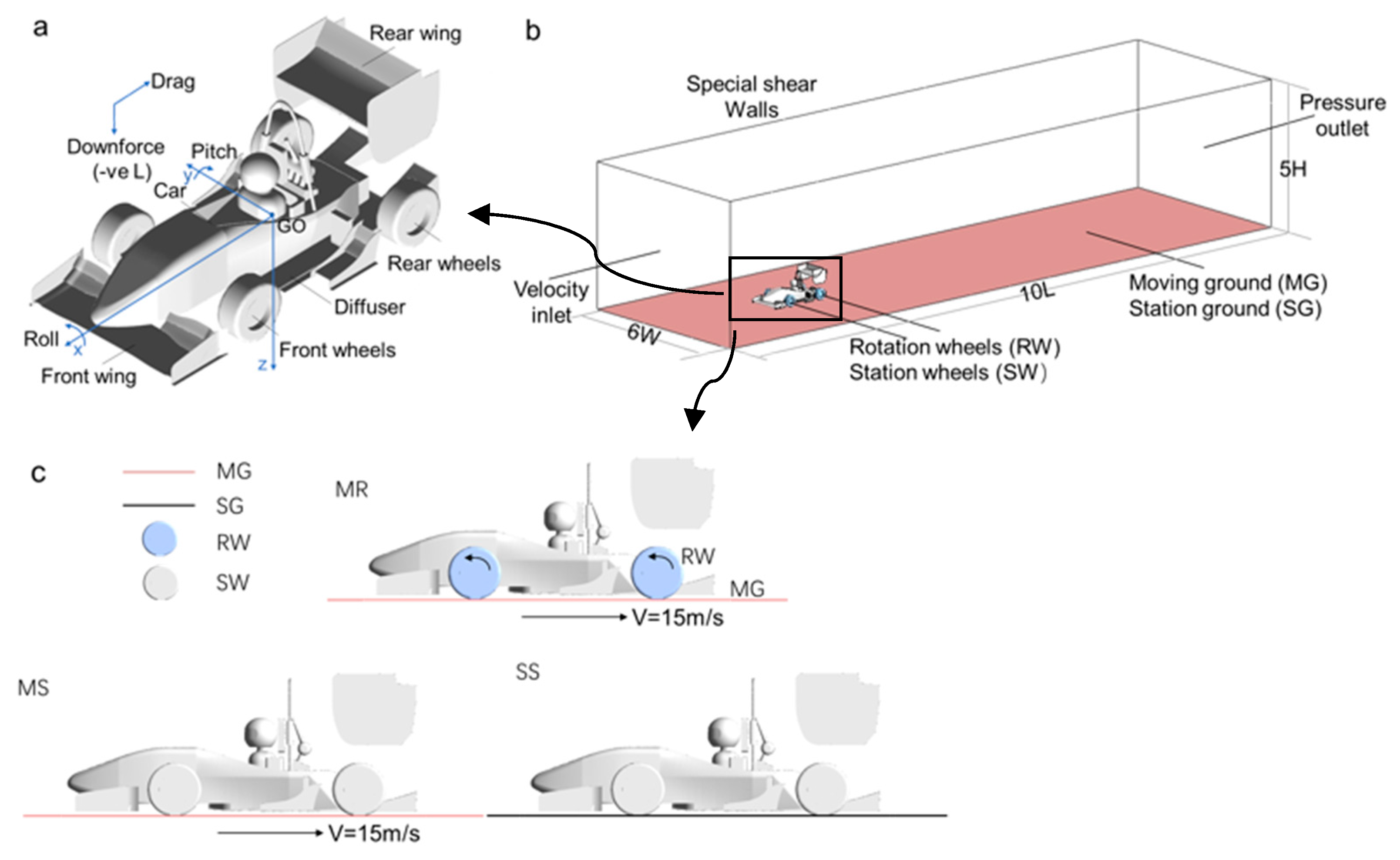
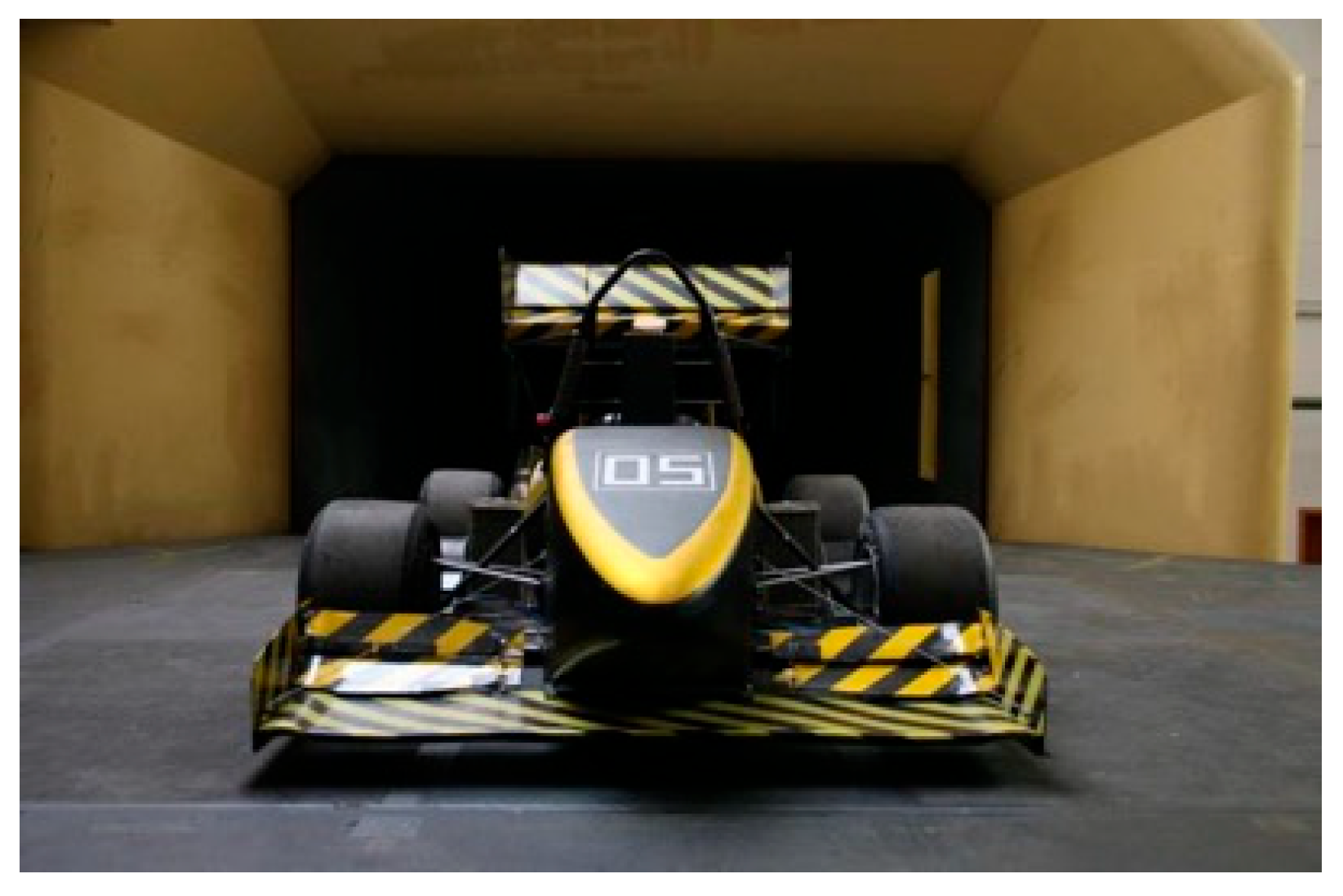
2.1. Vehicle Model
2.2. Equations for Controlling
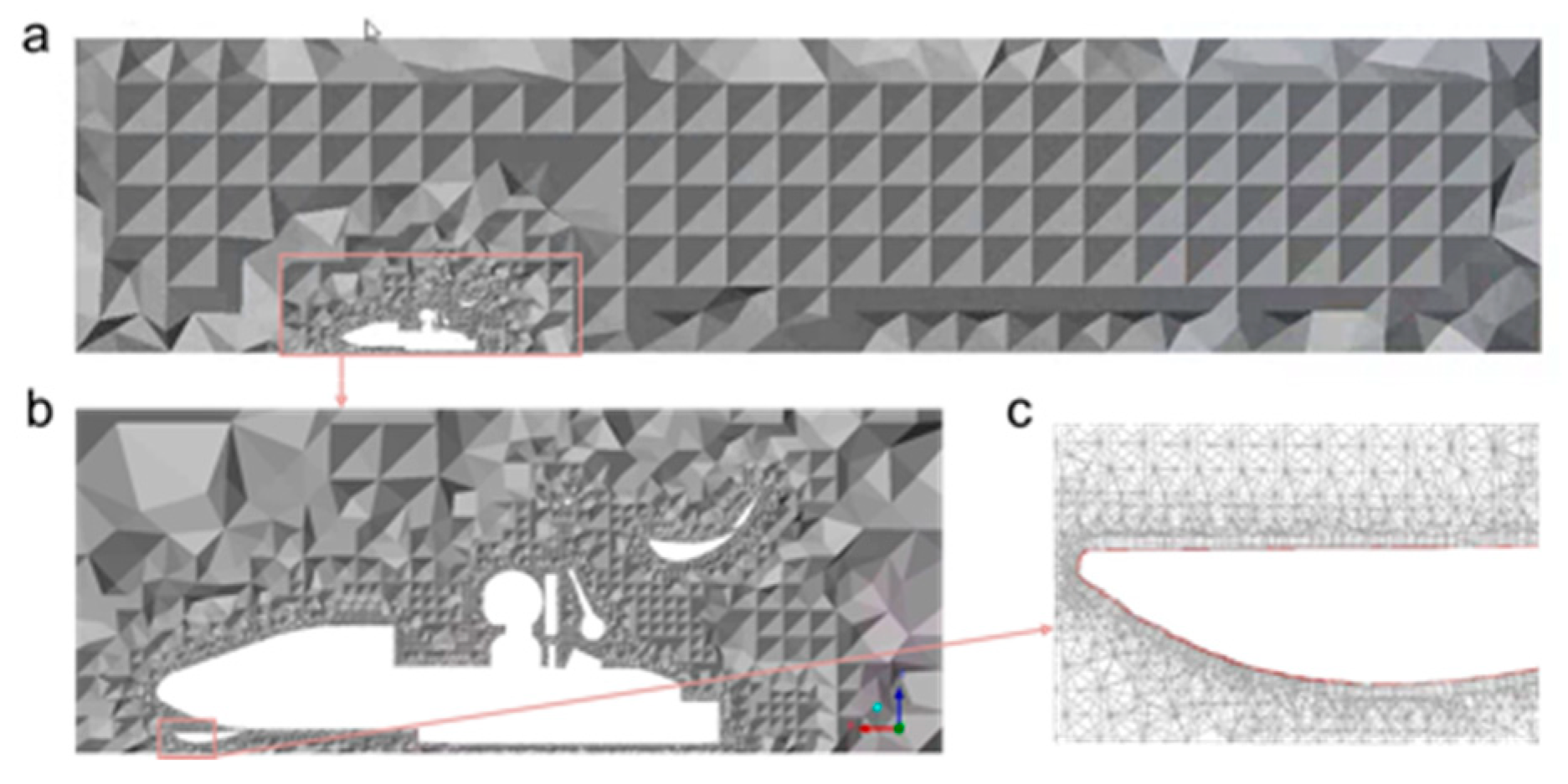
2.3. Computational Domain and Meshing
2.4. Boundary Conditions and Solver Setting
3. Results
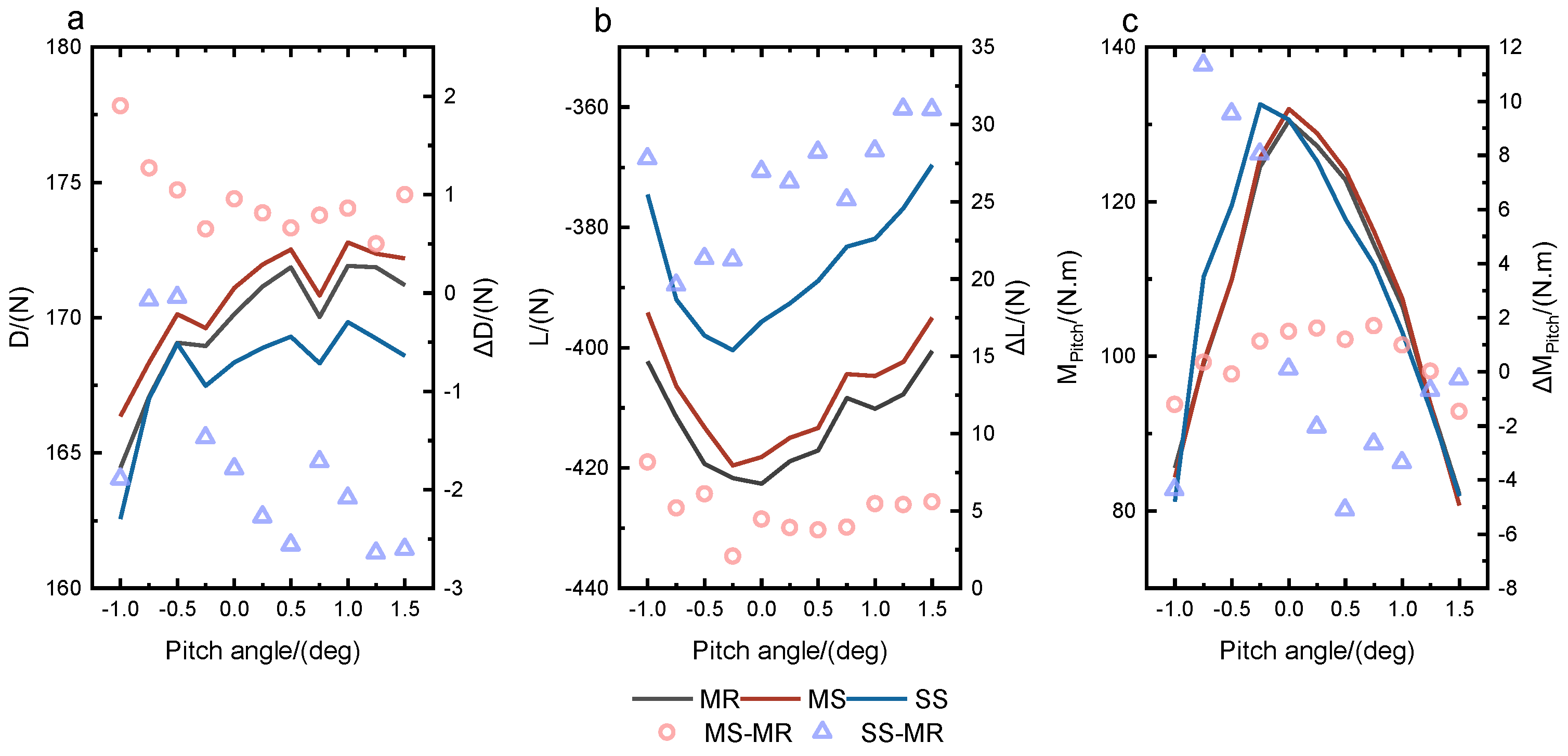
3.1. Pitch Cases
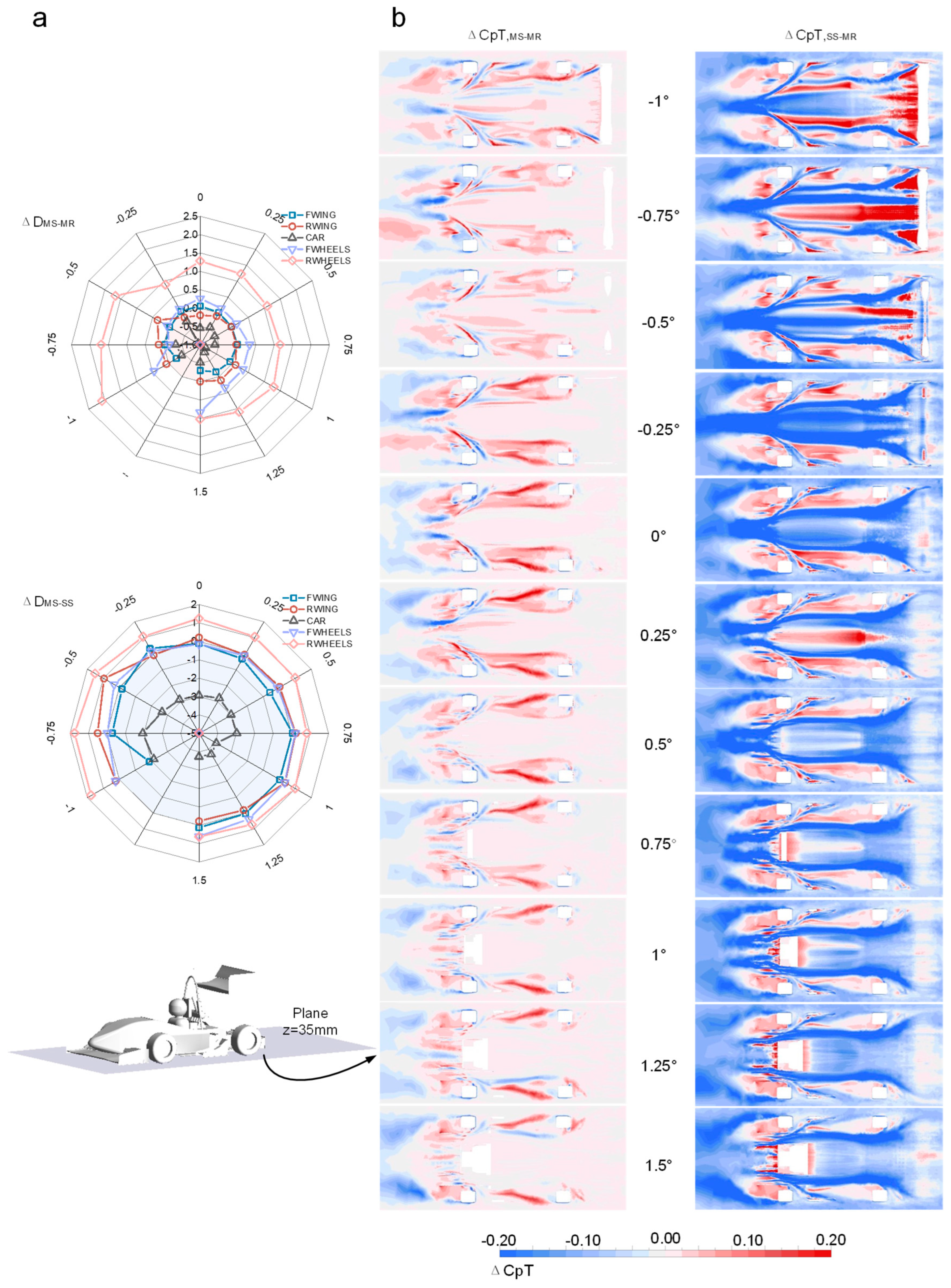
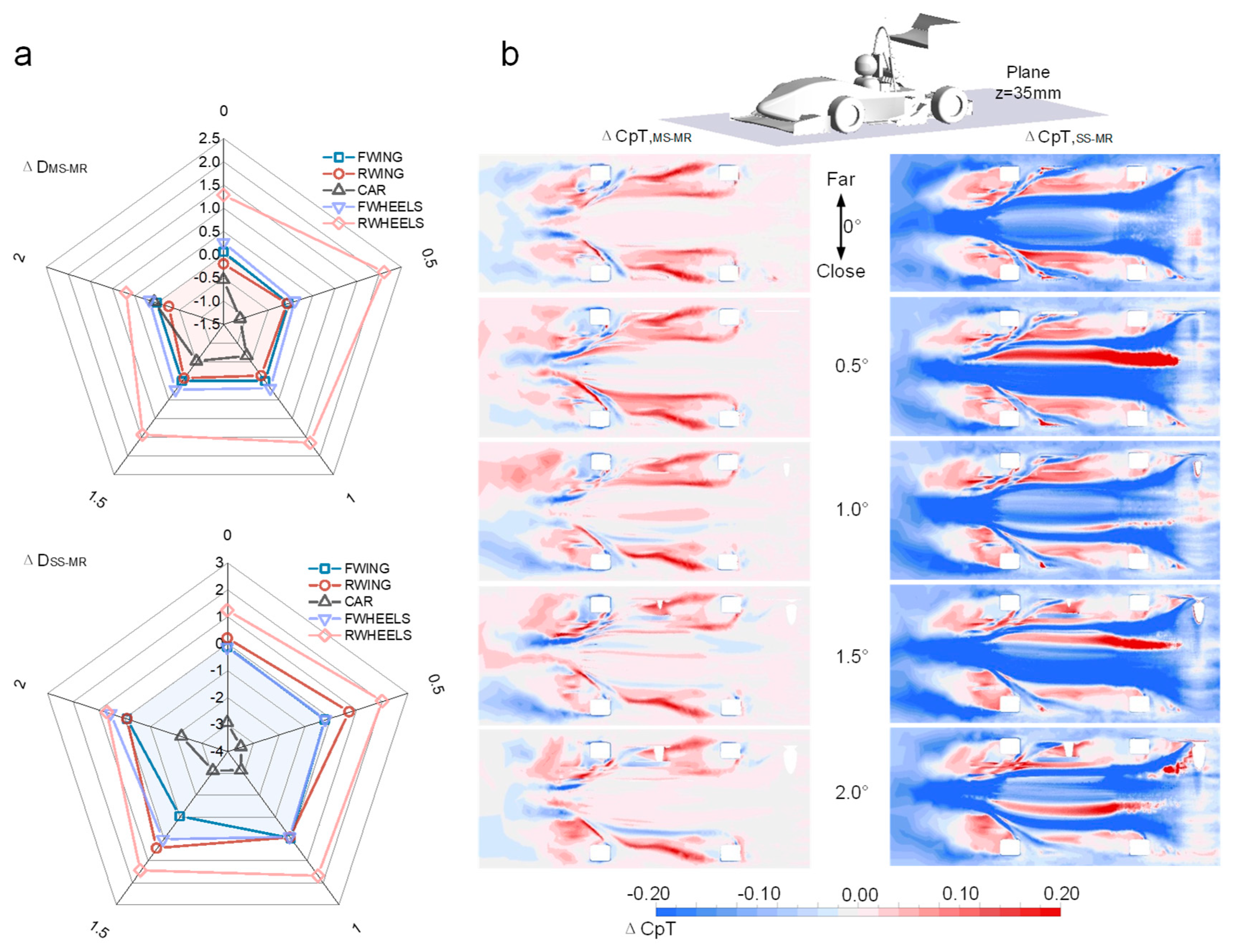
3.1.1. Drag
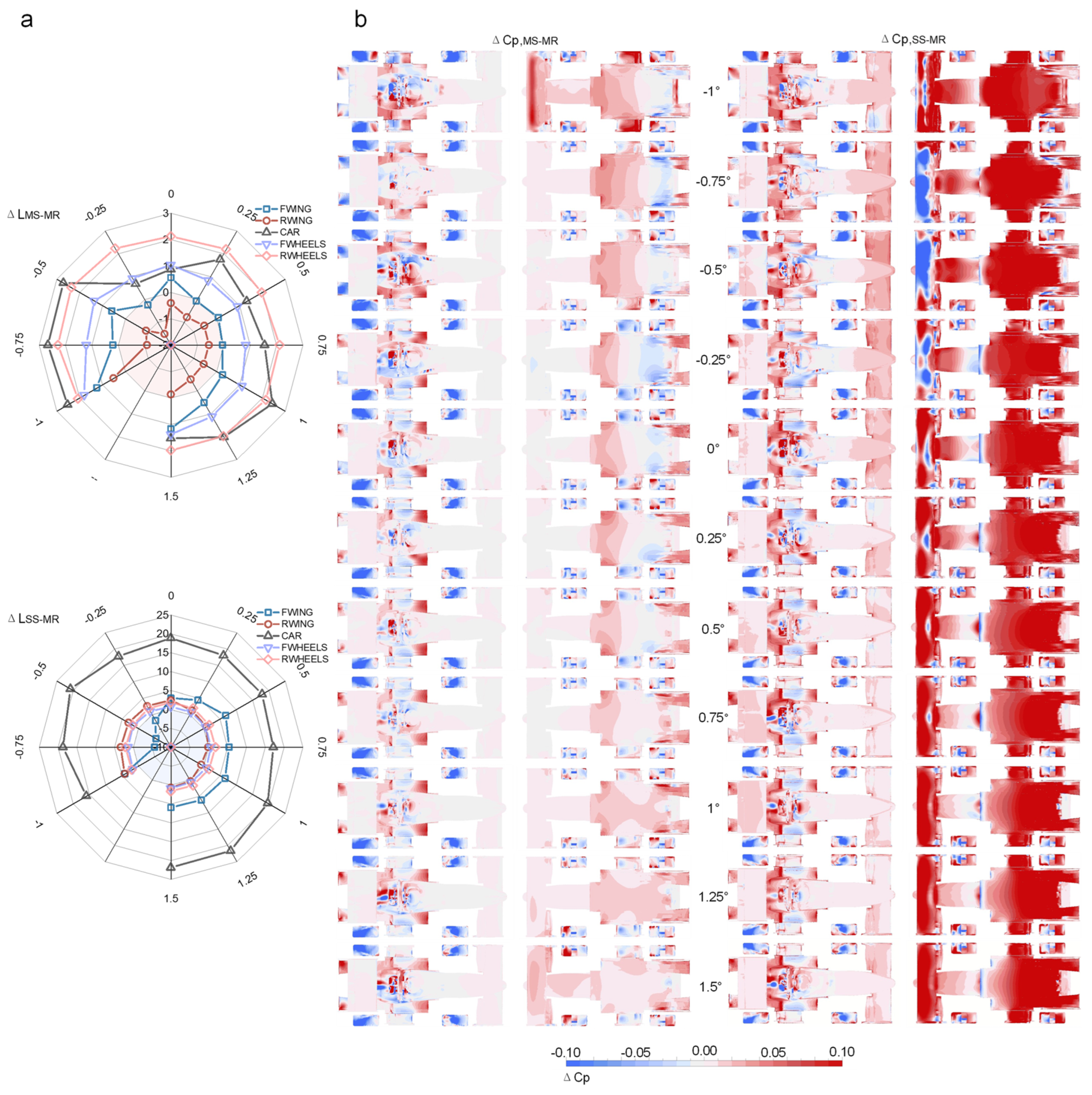
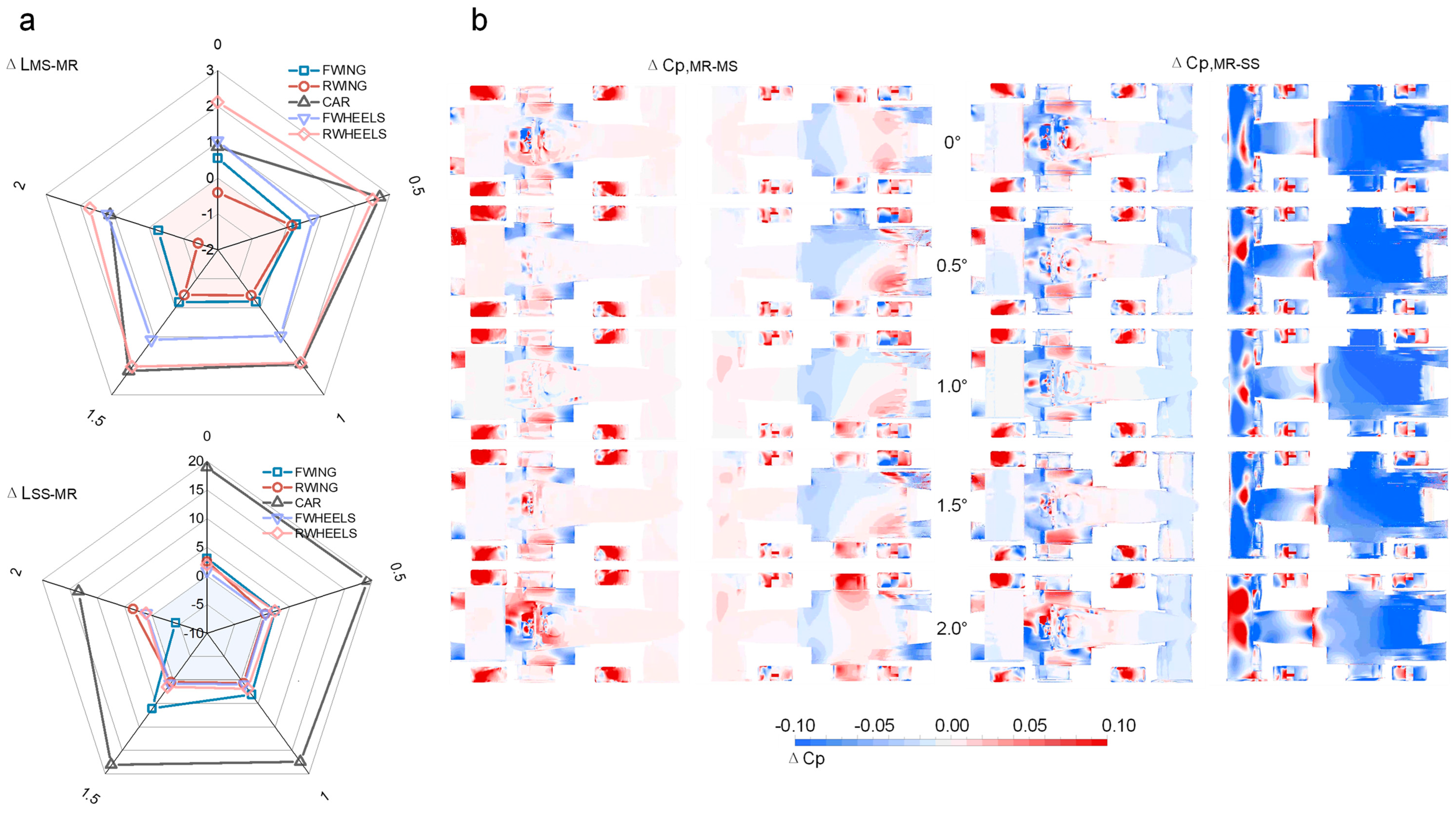
3.1.2. Lift
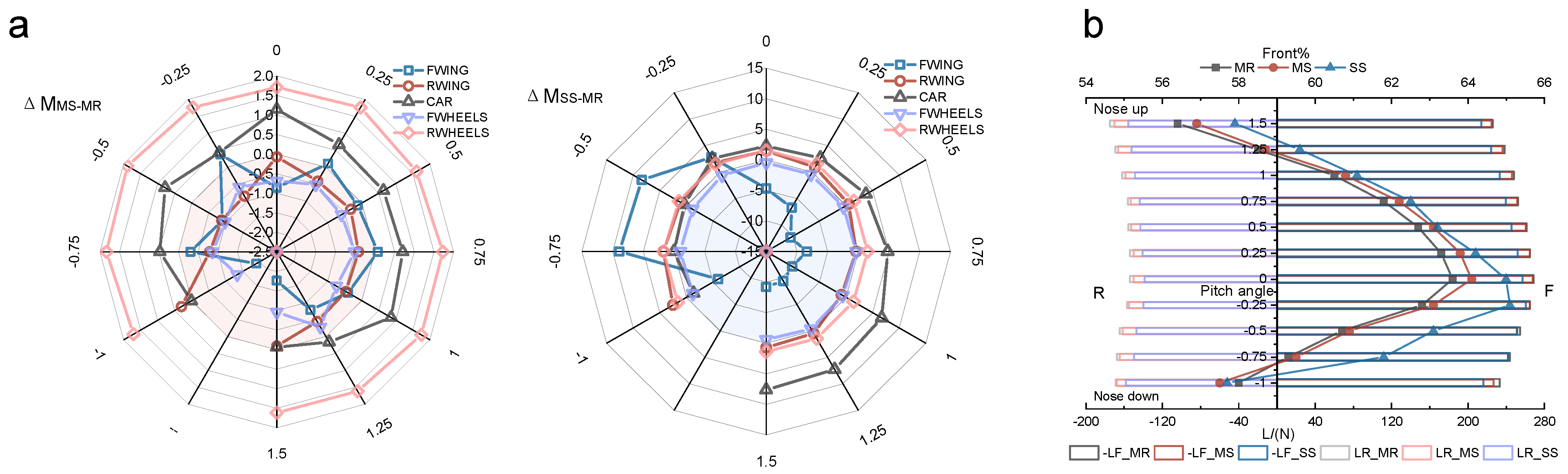
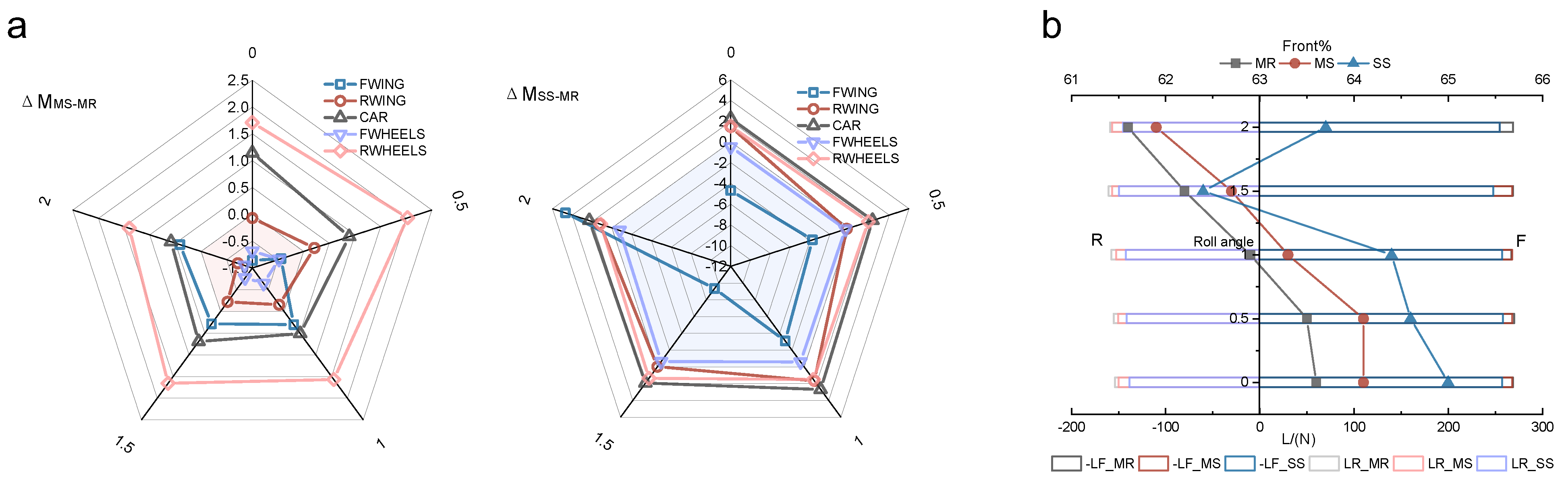
3.1.3. Pitch Moment and Aerodynamic Balance
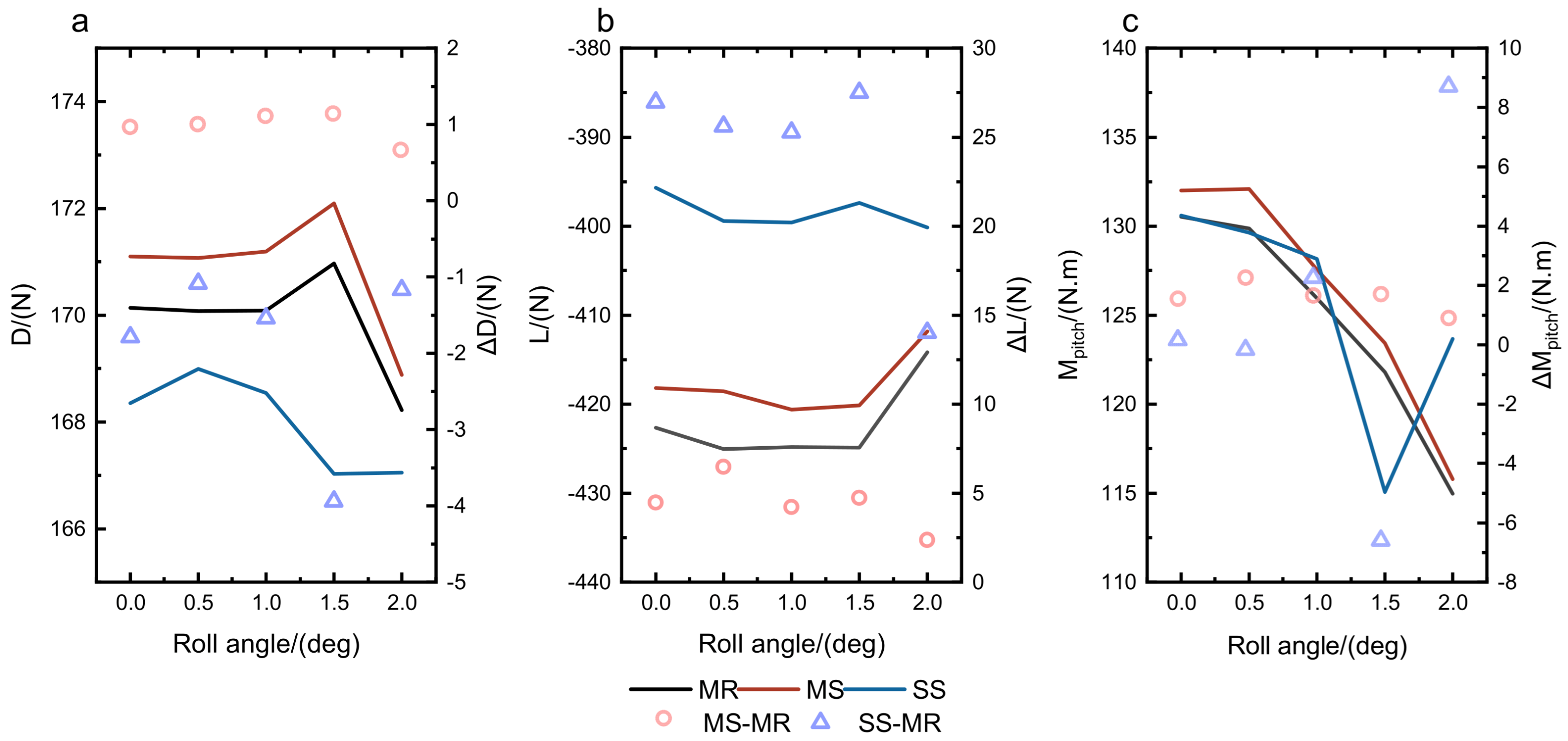
3.2. Roll Case
3.2.1. Drag
3.2.2. Lift
3.2.3. Pitch Moment and Aerodynamic Balance
4. Conclusions
Author Contributions
Funding
Institutional Review Board Statement
Informed Consent Statement
Data Availability Statement
Conflicts of Interest
References
- Katz, J. Aerodynamics of race cars. Annu. Rev. Fluid Mech. 2006, 38, 27–63. [Google Scholar] [CrossRef] [Scilit]
- Dang, T.P.; Gu, Z.; Chen, Z. Numerical simulation of flow field around the race car in case: Stationary wheel and rotating wheels. Int. J. Numer. Methods Heat Fluid Flow 2015, 25, 1896–1911. [Google Scholar] [CrossRef] [Scilit]
- Diasinos, S.; Barber, T.; Doig, G. Numerical analysis of the effect of the change in the ride height on the aerodynamic front wing–wheel interactions of a racing car. Proc. Inst. Mech. Eng. Part D J. Automob. Eng. 2017, 231, 900–914. [Google Scholar]
- Diasinos, S.; Barber, T.J.; Doig, G. The effects of simplifications on isolated wheel aerodynamics. J. Wind. Eng. Ind. Aerodyn. 2015, 146, 90–101. [Google Scholar] [CrossRef] [Scilit]
- Diasinos, S.; Barber, T.J.; Doig, G. The influence of wing span and angle of attack on racing car wing/wheel interaction aerodynamics. J. Fluids Eng. 2017, 139, 061102. [Google Scholar] [CrossRef] [Scilit]
- Diasinos, S.; Doig, G.; Barber, T. On the interaction of a racing car front wing and exposed wheel. Aeronaut. J. 2014, 118, 1385–1407. [Google Scholar] [CrossRef] [Scilit]
- Diasinos, S.; Gatto, A. Experimental investigation into wing span and angle-of-attack effects on sub-scale race car wing/wheel interaction aerodynamics. Exp. Fluids 2008, 45, 537–546. [Google Scholar] [CrossRef] [Scilit]
- Dominy, R.G.; Ryan, A.; Sims-Williams, D. The aerodynamic stability of a Le Mans prototype race car under off-design pitch conditions. SAE Trans. 2000, 109, 1454–1460. [Google Scholar]
- Qi, X.; Ou, Y.; Zhang, H.; Wang, D. Efficiency Enhancement Design Approach in the Side Wing of a FSAE Car Utilizing a Shutter-like Fairing Structure. Appl. Sci. 2022, 12, 6552. [Google Scholar] [CrossRef] [Scilit]
- Guerrero, A.; Castilla, R.; Eid, G. A Numerical Aerodynamic Analysis on the Effect of Rear Underbody Diffusers on Road Cars. Appl. Sci. 2022, 12, 3763. [Google Scholar] [CrossRef] [Scilit]
- Howell, J.; Le Good, G. The influence of aerodynamic lift on high speed stability. SAE Trans. 1999, 108, 1008–1015. [Google Scholar]
- Hucho, W.-H. Aerodynamics of Road Vehicles: From Fluid Mechanics to Vehicle Engineering; Elsevier: Amsterdam, The Netherlands, 2013. [Google Scholar]
- Limebeer, D.J.; Massaro, M. Dynamics and Optimal Control of Road Vehicles; Oxford University Press: Oxford, UK, 2018. [Google Scholar]
- Milliken, W.F.; Milliken, D.L.; Metz, L.D. Race Car Vehicle Dynamics; SAE International: Warrendale, PA, USA, 1995; Volume 400. [Google Scholar]
- Lenzo, B.; Rossi, V. A Simple Mono-Dimensional Approach for Lap Time Optimisation. Appl. Sci. 2020, 10, 1498. [Google Scholar] [CrossRef] [Scilit]
- Stewart, B.E.; Thompson, M.C.; Leweke, T.; Hourigan, K. The wake behind a cylinder rolling on a wall at varying rotation rates. J. Fluid Mech. 2010, 648, 225–256. [Google Scholar] [CrossRef] [Scilit]
- Williamson, C. Vortex dynamics in the cylinder wake. Annu. Rev. Fluid Mech. 1996, 28, 477–539. [Google Scholar] [CrossRef]
- Fackrell, J.E. The Aerodynamics of an Isolated Wheel Rotating in Contact with the Ground. Ph.D. Thesis, Imperial College London, University of London, London, UK, 1974. [Google Scholar]
- Duronio, F.; Di Mascio, A. Aerodynamic characterization of rolling wheels at high Reynolds numbers. Phys. Fluids 2024, 36, 115154. [Google Scholar] [CrossRef] [Scilit]
- Javadi, A. Flow structures on rolling wheels in various thicknesses and Reynolds numbers. Int. Commun. Heat Mass Transfer 2024, 158, 107862. [Google Scholar] [CrossRef] [Scilit]
- Knowles, R.; Saddington, A.; Knowles, K. On the near wake of rotating, 40%-scale Champ Car wheels. SAE Trans. 2002, 111, 2245–2253. [Google Scholar]
- Knowles, R.D.; Saddington, A.J.; Knowles, K. On the near wake of a Formula One front wheel. Proc. Inst. Mech. Eng. Part D J. Automob. Eng. 2013, 227, 1491–1502. [Google Scholar] [CrossRef] [Scilit]
- Mcmanus, J.; Zhang, X. A computational study of the flow around an isolated wheel in contact with the ground. J. Fluids Eng. 2006, 128, 520–530. [Google Scholar] [CrossRef] [Scilit]
- Parfett, A.; Babinsky, H.; Harvey, J. A study of the time-resolved structure of the vortices shed into the wake of an isolated f1 car wheel. Exp. Fluids 2022, 63, 116. [Google Scholar] [CrossRef] [Scilit]
- Patel, D.; Garmory, A.; Passmore, M. On the wake of an isolated rotating wheel: An experimental and numerical investigation. J. Wind. Eng. Ind. Aerodyn. 2022, 227, 105049. [Google Scholar] [CrossRef] [Scilit]
- Saddington, A.; Knowles, R.; Knowles, K. Laser Doppler anemometry measurements in the near-wake of an isolated Formula One wheel. Exp. Fluids 2007, 42, 671–681. [Google Scholar] [CrossRef] [Scilit]
- Yi, W.; Bertin, C.; Zhou, P.; Mao, J.; Zhong, S.; Zhang, X. Aerodynamics of isolated cycling wheels using wind tunnel tests and computational fluid dynamics. J. Wind. Eng. Ind. Aerodyn. 2022, 228, 105085. [Google Scholar] [CrossRef] [Scilit]
- Gulyás, A.; Bodor, Á.; Regert, T.; Jánosi, I.M. PIV measurement of the flow past a generic car body with wheels at LES applicable Reynolds number. Int. J. Heat Fluid Flow 2013, 43, 220–232. [Google Scholar] [CrossRef] [Scilit]
- Zhou, H.; Qin, R.; Wang, G.; Xin, L.; Wang, Q.; Zheng, Z. Comparative analysis of the aerodynamic behavior on Ahmed body mounted with different wheel configurations. Proc. Inst. Mech. Eng. Part D J. Automob. Eng. 2024, 238, 128–146. [Google Scholar] [CrossRef] [Scilit]
- Wang, Y.; Sicot, C.; Boree, J.; Grandemange, M. Experimental study of wheel-vehicle aerodynamic interactions. J. Wind Eng. Ind. Aerodyn. 2020, 198, 104062. [Google Scholar] [CrossRef] [Scilit]
- Bao, D.; Borée, J.; Haffner, Y.; Sicot, C. Near wake interactions and drag increase regimes for a square-back bluff body. J. Fluid Mech. 2022, 936, A2. [Google Scholar] [CrossRef] [Scilit]
- Bao, D.; Borée, J.; Sicot, C.; Roebroeck, C. Influence of vehicle back shape on wheel-vehicle aerodynamic interactions: A model study. Exp. Fluids 2024, 65, 50. [Google Scholar] [CrossRef] [Scilit]
- Bao, D.; Borée, J.; Sicot, C.; Roebroeck, C. Front–rear wheel interactions for a model vehicle: Consequence for drag. Exp. Fluids 2025, 66, 13. [Google Scholar] [CrossRef] [Scilit]
- Bao, D.; Borée, J.; Sicot, C.; Roebroeck, C. Salient features of wheel-vehicle aerodynamic interactions: Consequences for drag. J. Wind Eng. Ind. Aerodyn. 2023, 236, 105366. [Google Scholar] [CrossRef] [Scilit]
- Su, X.; He, K.; Xu, K.; Gao, G.; Krajnović, S. Comparison of flow characteristics behind squareback bluff-bodies with and without wheels. Phys. Fluids 2023, 35, 035114. [Google Scholar] [CrossRef] [Scilit]
- Wang, S.; Avadiar, T.; Thompson, M.C.; Burton, D. Effect of moving ground on the aerodynamics of a generic automotive model: The DrivAer-Estate. J. Wind Eng. Ind. Aerodyn. 2019, 195, 104000. [Google Scholar] [CrossRef] [Scilit]
- Yu, X.; Jia, Q.; Yang, Z. Comprehensive study of the aerodynamic influence of ground and wheel states on the notchback DrivAer. Energies 2022, 15, 1124. [Google Scholar] [CrossRef] [Scilit]
- Aultman, M.; Auza-Gutierrez, R.; Disotell, K.; Duan, L. Effects of wheel rotation on long-period wake dynamics of the DrivAer fastback model. Fluids 2021, 7, 19. [Google Scholar] [CrossRef] [Scilit]
- Shao, S.X.; Zhang, Y.C.; Zhao, J.; Tang, W.H. The influence of wheel rotating to FSAE racing car aerodynamic characteristics. Appl. Mech. Mater. 2013, 300, 1054–1057. [Google Scholar] [CrossRef] [Scilit]
- Zhang, X.; Toet, W.; Zerihan, J. Ground effect aerodynamics of race cars. Appl. Mech. Rev. 2006, 59, 33–49. [Google Scholar] [CrossRef] [Scilit]
- Van Den Berg, M.A.; Zhang, X. The Aerodynamic Interaction Between an Inverted Wing and a Rotating Wheel. J. Fluids Eng. 2009, 131, 101104. [Google Scholar] [CrossRef] [Scilit]
- Cravero, C.; Marsano, D. Computational investigation of the aerodynamics of a wheel installed on a race car with a multi-element front wing. Fluids 2022, 7, 182. [Google Scholar] [CrossRef] [Scilit]
- Martins, D.; Correia, J.; Silva, A. The influence of front wing pressure distribution on wheel wake aerodynamics of a F1 car. Energies 2021, 14, 4421. [Google Scholar] [CrossRef] [Scilit]
- Anbalagan, S.; Deepak, C.; Virmani, K.; Madhogaria, T.; Ramesh, R.; Narendhra, T.M.; Panneerselvam, P. Computational Analysis of Pitch Sensitivity for a Concept Race Car; SAE Technical Paper 0148-7191; SAE International: Warrendale, PA, USA, 2022. [Google Scholar]
- Zhang, Y.; Yang, C.; Wang, Q.; Zhan, D.; Zhang, Z. Aerodynamics of Open Wheel Racing Car in Pitching Position; SAE Technical Paper No. 2018-01-0729; SAE International: Warrendale, PA, USA, 2018. [Google Scholar]
- Zhang, Z.; Wang, Q.; Song, S.; Zhang, C.; Ren, L.; Zhang, Y. Joint research on aerodynamic characteristics and handling stability of racing car under different body attitudes. Energies 2022, 15, 393. [Google Scholar] [CrossRef] [Scilit]
- Ma, X.; Li, J.; Zhao, J.; Chen, J. Aerodynamic characteristics of the race car in pitch and roll attitude. Int. J. Numer. Methods Heat Fluid Flow 2025, 35, 330–357. [Google Scholar] [CrossRef] [Scilit]
- Chode, K.; Viswanathan, H.; Chow, K.; Reese, H. Investigating the aerodynamic drag and noise characteristics of a standard squareback vehicle with inclined side-view mirror configurations using a hybrid computational aeroacoustics (CAA) approach. Phys. Fluids 2023, 35, 075148. [Google Scholar] [CrossRef] [Scilit]
- Viswanathan, H.; Chode, K.K. The role of forebody topology on aerodynamics and aeroacoustics characteristics of squareback vehicles using Computational Aeroacoustics (CAA). Flow Turbul. Combust. 2024, 112, 1055–1081. [Google Scholar] [CrossRef] [Scilit]
- Zhang, J.; Wang, F.; Guo, Z.; Han, S.; Gao, G.; Wang, J. Investigation of the wake flow of a simplified heavy vehicle with different aspect ratios. Phys. Fluids 2022, 34, 065135. [Google Scholar] [CrossRef] [Scilit]
- Aultman, M.; Wang, Z.; Auza-Gutierrez, R.; Duan, L. Evaluation of CFD methodologies for prediction of flows around simplified and complex automotive models. Comput. Fluids 2022, 236, 105297. [Google Scholar] [CrossRef] [Scilit]
- Siddiqui, N.A.; Agelin-Chaab, M. Investigation of the wake flow around the elliptical Ahmed body using detached Eddy simulation. Int. J. Heat Fluid Flow 2023, 101, 109125. [Google Scholar] [CrossRef] [Scilit]
- Phan, T.-L.; Pham, Q.T.; Nguyen, T.K.L.; Nguyen, T.T. A Numerical Analysis of Active Flow Control Techniques for Aerodynamic Drag Reduction in the Square-Back Ahmed Model. Appl. Sci. 2022, 13, 239. [Google Scholar] [CrossRef] [Scilit]
- Chen, Z.; Liu, J.; Ma, C.; Wu, H.; Li, Z. Research on precise and standardized numerical simulation strategy for vehicle aerodynamics. Int. J. Numer. Methods Heat Fluid Flow 2024, 34, 1937–1968. [Google Scholar] [CrossRef] [Scilit]


Disclaimer/Publisher’s Note: The statements, opinions and data contained in all publications are solely those of the individual author(s) and contributor(s) and not of MDPI and/or the editor(s). MDPI and/or the editor(s) disclaim responsibility for any injury to people or property resulting from any ideas, methods, instructions or products referred to in the content. |
© 2026 by the authors. Licensee MDPI, Basel, Switzerland. This article is an open access article distributed under the terms and conditions of the Creative Commons Attribution (CC BY) license.
Share and Cite
Ma, X.; Li, J.; Zhang, K.; Zou, Y.; Massaro, M. Effects of Wheel-Ground Conditions on Racing Car Aerodynamics Under Ride-Height-Related Attitude Variations. Appl. Sci. 2026, 16, 874. https://doi.org/10.3390/app16020874
Ma X, Li J, Zhang K, Zou Y, Massaro M. Effects of Wheel-Ground Conditions on Racing Car Aerodynamics Under Ride-Height-Related Attitude Variations. Applied Sciences. 2026; 16(2):874. https://doi.org/10.3390/app16020874
Chicago/Turabian StyleMa, Xiaojing, Jie Li, Kun Zhang, Yi Zou, and Matteo Massaro. 2026. "Effects of Wheel-Ground Conditions on Racing Car Aerodynamics Under Ride-Height-Related Attitude Variations" Applied Sciences 16, no. 2: 874. https://doi.org/10.3390/app16020874
APA StyleMa, X., Li, J., Zhang, K., Zou, Y., & Massaro, M. (2026). Effects of Wheel-Ground Conditions on Racing Car Aerodynamics Under Ride-Height-Related Attitude Variations. Applied Sciences, 16(2), 874. https://doi.org/10.3390/app16020874