Article

Demagnetization Fault Location of Direct-Drive Permanent Magnet Synchronous Motor Based on Search Coil Data-Driven

1
School of Electrical Engineering and Automation, Henan Polytechnic University, Jiaozuo 454150, China
2
College of Electrical Engineering, Zhengzhou University, Zhengzhou 450000, China
*
Author to whom correspondence should be addressed.
Appl. Sci. 2026, 16(2), 870; https://doi.org/10.3390/app16020870
Submission received: 21 December 2025 / Revised: 9 January 2026 / Accepted: 12 January 2026 / Published: 14 January 2026

Abstract

Demagnetization faults in direct-drive permanent magnet synchronous motors (DDPMSM) can cause significant performance degradation and unplanned downtime. Traditional fault location methods, which rely on manual feature extraction, exhibit limited accuracy and efficiency in complex and variable operating conditions. To address these limitations, this study presents a demagnetization fault location method based on a search coil employing a data-driven one-dimensional convolutional neural network (1D-CNN). Firstly, the arrangement of search coils was determined, and a partitioned mathematical model was established, using the residual back electromotive force (back-EMF) of the search coil over a single electrical cycle as the fundamental unit. Secondly, the residual back-EMF in the search coil is analyzed under various demagnetization parameters and operating conditions to assess the robustness of the proposed method. Furthermore, a 1D-CNN-based fault location model was developed using residual back-EMF signals as the input and targeting the identification of demagnetized permanent magnet types. Simulation and experimental results demonstrate that the proposed method can effectively detect and locate demagnetization faults across different operating conditions. When the demagnetization degree is not less than 10%, the fault location accuracy reaches 99.58%, and the minimum detectable demagnetization degree is 8%. The approach demonstrates excellent robustness and generalization, offering an intelligent solution for demagnetization fault location in PMSMs.

1. Introduction

With its direct load connection eliminating mechanical transmission, the direct-drive permanent magnet synchronous motor (DDPMSM) offers key advantages, including direct drive, high power density, and a compact structure. These merits have led to its broad adoption in aerospace, rail transport, industrial automation, and other fields [1,2]. However, motors are subject to the combined effects of electrical, thermal, and mechanical stresses and other factors during operation, posing a risk of fault. Common fault types include demagnetization, inter-turn short circuits, eccentricity, etc. As the core excitation component of a PMSM, permanent magnets can lead to a decline in motor output torque when they undergo an irreversible demagnetization fault. Under the constant load torque constraints, to maintain stable torque output from the motor, the armature current needs to increase simultaneously to compensate for the weakening of the excitation magnetic field. At this point, the motor temperature will gradually rise, which not only exacerbates the demagnetization fault but also damages the winding insulation and induces winding short-circuit faults. If the motor operates in this state for a long time, it will result in motor burnout, cause unscheduled downtime, and even cause catastrophic accidents. Therefore, achieving timely detection and accurate location of demagnetization faults not only facilitates early warning but also provides an important basis for post-fault operation and maintenance strategies formulation and accident prevention, thereby effectively ensuring the stable operation of the motor system. Furthermore, for DDPMSM, with a larger number of magnetic poles, the precise location of faulty magnetic poles becomes more challenging. Therefore, conducting in-depth research on demagnetization fault detection and location methods holds significant theoretical and practical engineering value.
Currently, online demagnetization detection methods have primarily relied on spectral analysis of signals, such as current [3,4], voltage [5,6,7], torque [8], and noise [9,10]. However, the characteristic harmonics in these signals that indicate demagnetization are mostly suitable for local demagnetization and are less sensitive to uniform demagnetization. Moreover, most methods can only achieve fault detection but struggle with precise location. This limitation stems primarily from their reliance on characteristic harmonics for analysis, which are susceptible to interference from factors such as motor winding configuration, structural design, and fault type. Consequently, the reliability of these methods is often compromised in complex and variable real-world industrial environments for diagnosis.
To address the limitations of spectral analysis, some researchers have proposed detection strategies based on magnetic signals. Demagnetization faults lead to alterations in the air gap magnetic flux density distribution, and such variations are measurable through detection coils installed in the motor. Search coils offer advantages such as low cost and simple structure (made solely of fine copper wire winding) and have been widely used for demagnetization fault diagnosis via induced voltage. By winding search coils around stator teeth, localized and uniform demagnetization can be detected based on the induced voltage; however, fault location remains unachievable [11]. To improve location capabilities, researchers have attempted to install independent coils on each stator tooth, extracting tooth flux to diagnose the quantity of demagnetized permanent magnets and decouple the induced electromotive force to determine their positions [12,13]. However, these methods currently only study the fault mode of a single demagnetized PM, and the installation of multiple coils results in complex system structures and high invasiveness. To balance location accuracy, implementation invasiveness, and early fault detection capability, our previous research proposed a detection solution based on toroidal yoke search coils [14]. This method involves placing three coils in stator slots to generate three positioning signals and determining the demagnetization location by matching with predefined waveforms. However, the multi-coil structure and reliance on multiple signals also lead to high algorithm complexity.
With the aim of coil reduction and diagnostic system simplification, a novel demagnetization fault diagnosis strategy is proposed in this paper, utilizing only two series-connected toroidal yoke search coils, with their residual voltage serving as the fault characteristic [15]. By matching the measured waveform with predefined waveforms in a fault dictionary, precise identification of the demagnetization type and location is achieved. Although the method effectively reduces the number of coils and simplifies the process, its performance still heavily relies on the accurate setting of predefined waveform templates and manual thresholds. Therefore, an intelligent approach capable of autonomously adapting to varying operating conditions and automatically extracting features is required.
In recent years, artificial intelligence algorithms have been widely applied in fault diagnosis, primarily attributed to their powerful capabilities in feature learning and pattern recognition. In traditional machine learning, the Support Vector Machine (SVM) is suitable for small-sample classification tasks but has limitations such as weak interpretability and reliance on manual feature extraction [16]. On the other hand, shallow neural networks can realize automatic feature learning. The Probabilistic Neural Network (PNN) is appropriate for pattern classification and offers fast training speed, but its classification accuracy is highly affected by the choice of the smoothing factor [17,18]. Backpropagation Neural Network (BPNN) has excellent function approximation capabilities but exhibits instability in classification tasks and tends to fall into local optima [19]. Shallow neural networks generally lack sufficient representation capability, whereas deep learning models like Recurrent Neural Network (RNN), Long Short-Term Memory (LSTM) network, and CNN significantly improve feature representation by increasing network depth and structural complexity. RNNs excel in long-time-series prediction but face challenges in spatiotemporal feature extraction and are prone to gradient vanishing or explosion, making it hard to establish effective long-term dependencies [20]. LSTM networks address these issues through gating mechanisms and strengthen the ability of long-term dependency modeling; however, they have high computational resources and longer training times [21]. CNNs, leveraging their structural advantages, reduce sequence dimensionality while preserving key information, leading to improved training efficiency [22]. Notably, as an effective feature extractor, CNN is capable of extracting high-level abstract features directly from raw signals, providing a more accurate characterization of fault features compared to raw data [23,24,25,26,27].
To address the issues of traditional methods relying on precise threshold setting and the high computational complexity and poor real-time performance of intelligent algorithms, this paper proposes a fault location method based on 1-D CNN. The main contributions and innovations of this study are as follows:
(1)
A precise method for demagnetization fault localization in DDPMSM based on the back-EMF signal of the search coil is proposed. This method utilizes the sensitivity of the residual back-EMF signal to changes in the internal magnetic field of the motor, significantly enhancing the sensitivity of fault location.
(2)
This study adopts a CNN to construct an end-to-end fault diagnosis model. This approach avoids the reliance on manual feature extraction and threshold setting in traditional methods, thereby improving the development efficiency of the diagnostic system.
(3)
In response to the raw one-dimensional time series signals as input and the need for real-time diagnosis, this paper proposes a lightweight 1D-CNN structure. The model directly processes the original one-dimensional time series signals, avoiding complex feature engineering and two-dimensional image conversion steps, thereby reducing computational complexity and enhancing the real-time processing performance of the location system.
This article is organized as follows: Section 2 establishes a mathematical model for the search coil residual back-EMF and analyzes the influence patterns of different fault types, operating conditions, and severity levels affect signal characteristics based on the model. Section 3 details the construction process of building a comprehensive fault sample database. and elaborates on the architecture and operational principles of the proposed one-dimensional CNN diagnostic network. Section 4 presents experimental validation and a comparative analysis of the proposed method’s effectiveness, conducted on a developed experimental platform. Finally, Section 5 concludes the article.

2. Analysis of Search Coil Residual Back-EMF Under Demagnetization Fault

2.1. Search Coil Arrangement

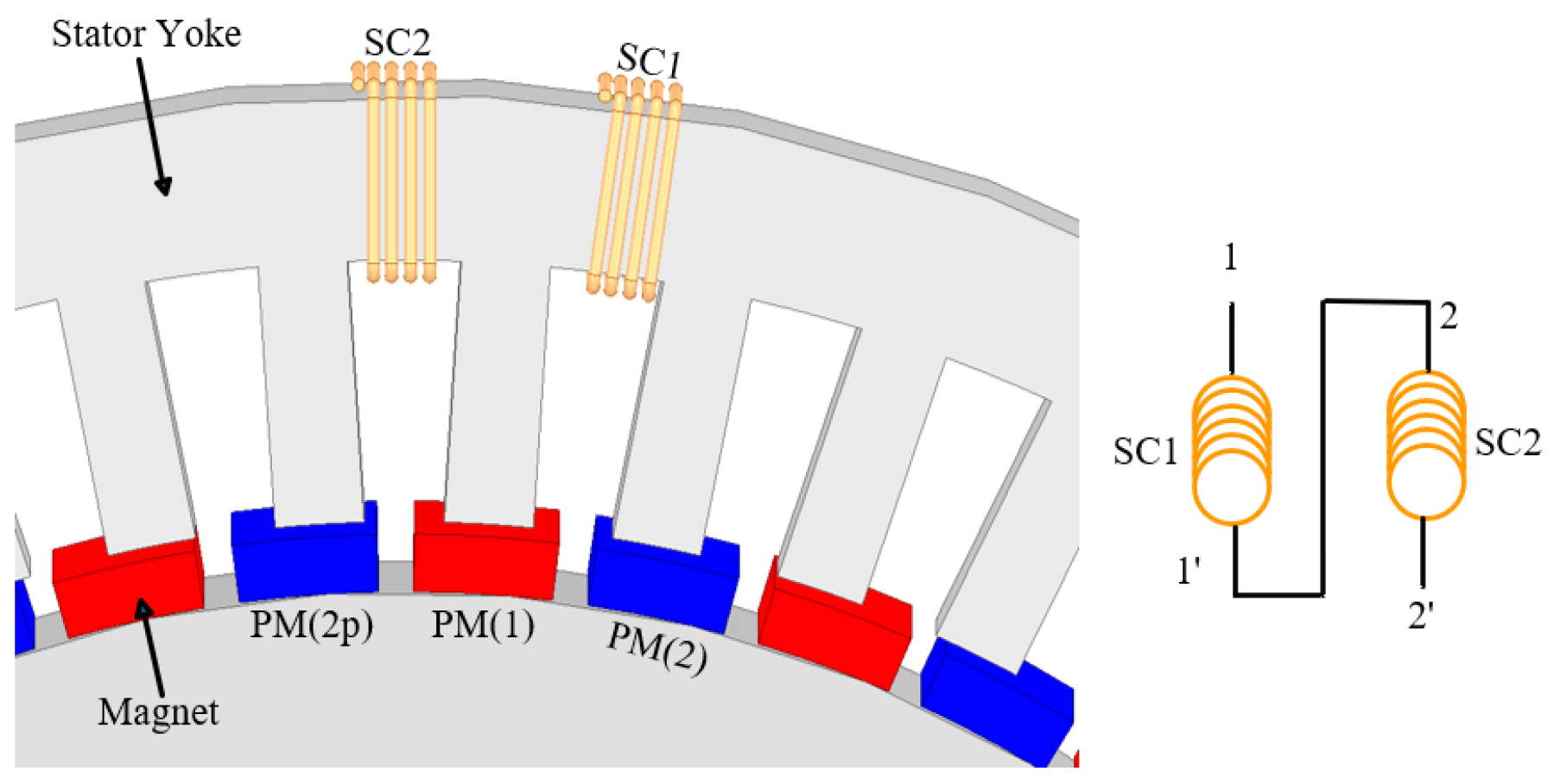
The demagnetization fault in PMSM weakens the magnetic field of the demagnetized magnet, a change detectable via stator-mounted coils. The waveform of the coil’s back-EMF, being directly dependent on the magnetic state of its coupled permanent magnet, carries substantial demagnetization fault information and is therefore ideal for demagnetization diagnosis. To accurately locate the demagnetized magnet, a search coil configuration is employed, consisting of two identical toroidal yoke coils. These coils are installed within the stator slots of the PMSM and connected in forward series to constitute a search coil, as shown in Figure 1. Each of the toroidal yoke coils is arranged in the inner and outer stator slots of the PMSM. The two yoke coils should be spaced approximately one pole pitch apart to enhance the signal amplitude, which improves the Signal-to-Noise Ratio (SNR). The operating mechanism of the novel searching coil will be analyzed in the following section.

2.2. Residual Back-EMF Model of SC

The search coil’s back-EMF arises from the time-varying magnetic flux linked with the coil. Under no-load conditions, the spatial distribution of this magnetic field is primarily determined by the arrangement of PMs. For analytical convenience, the PMs are sequentially numbered from 1 to 2p, as illustrated in Figure 1. To achieve synchronous sampling over the entire mechanical cycle, the initial data acquisition point is defined when PM1 and PM2p are positioned such that their geometric centers are alignment with the geometric center of coil SC1. The back-EMFs of SC1 and SC2 for a full motor rotation cycle are collected, and they are subtracted from those under healthy conditions to obtain the residuals of these EMFs. The residual back-EMFs induced by PMi in SC1 and SC2 are defined as:
e 1 PM i rs = N s l st v k demi B g i h
e 2 PM i rs = N s l st v k demi B g i h e j θ s
where Ns denotes toroidal yoke coil turns, lst represents the motor stack length, and v is the motor rotational speed. kdemi is the demagnetization severity coefficient, and kdemi ϵ [0, 1], which is 0 when the PMi is healthy and is 1 when the PMi is totally demagnetized. As the severity of demagnetization increases, kdemi approaches 1. Bg-i-h is the airgap flux density produced by the healthy permanent magnet PMi. The residual back-EMF induced by PMi in SC2 is calculated by phase shifting (1). θs is the electrical angle between SC1 and SC2, and this angle equals or nearly approximates one pole pitch.
The SC is obtained by summing the residual EMFs from SC1 and SC2. The SC for PMi demagnetization (eSC-PMi) is obtained by subtracting (2) from (1) as:
e S C PM i = N s l st v k demi B g i h ( 1 + e j θ s ) i π α i π + θ s + θ pm
where α denotes the electrical angle relative to the coordinate origin. θpm is the electrical angle corresponding to the surface angle of PM, and it is close to π.
For simplicity, the residual EMF is assumed to be a sinusoidal wave. Based on Fourier series decomposition, eSC-PMi may be simplified as:
e S C PM i = ( 1 ) i 1 E 1 Sin ( α ( i 1 ) π ) i π α ( i + 2 ) π
where E1 denotes the amplitude of esc-PMi’s fundamental component.
Reliable fault location features must effectively distinguish fault locations under various demagnetization modes. Therefore, aiming to acquire more reliable location information, this paper investigates the influence of various demagnetization modes on SC residual back-EMF. Considering the alternating arrangement of N and S poles in permanent magnet motors, the same fault pattern exhibits similar characteristics across different electrical cycles. For this reason, this paper adopts one electrical cycle of the SC as the fundamental unit for analysis and segments the signal accordingly. The kth interval of the SC (SCk) corresponds to the [(2k − 2) π, 2kπ]. According to (4), the waveform of SCk is determined by the demagnetization state of PM(2k), PM(2k − 1), and PM(2k − 2). Specifically, if k satisfies k = 1, then the PM(2k − 2) corresponds to PM2p. Based on the superposition principle, the model for the kth electrical period (SCk) is expressed as:
S C k = e S C PM ( 2 k ) + e S C PM ( 2 k 1 ) + e S C PM ( 2 k 2 ) ( 2 k 2 ) π α 2 k π
where k indicates the number of electrical cycles.
This model reveals the core mapping correlation between the SC signal and the condition of the PMs. This relationship establishes a theoretical foundation for analyzing the impact of different demagnetization patterns (including the quantity, position, and severity of demagnetized PMs) on the SC signals, thereby providing a theoretical basis for precisely locating demagnetized PMs.

2.3. Analysis of Demagnetization Faults on the Residual Back-EMF of SC

For exploring the influence of the quantity, location, and severity of demagnetized PMs on the residual back-EMF of search coils, a prototype equipped with search coils is established via Infolytica Magnet (R2017) under preconfigured healthy states and demagnetization fault scenarios. The key parameters of the prototype for testing are listed in Table 1.
Based on the analytical model of SC in Section 2.2, the residual back-EMF waveform of the search coil over one electrical cycle is affected by three consecutive PMs. According to the combination of the three PMs’ conditions, there are one healthy and seven demagnetized types, as presented in Table 2.
As shown in Table 2, 0 represents a healthy condition of the PM, and 1 represents the demagnetized condition. For instance, Type 6 means PM(2k) and PM(2k − 2) exhibit demagnetization, while PM(2k−1) remains healthy.
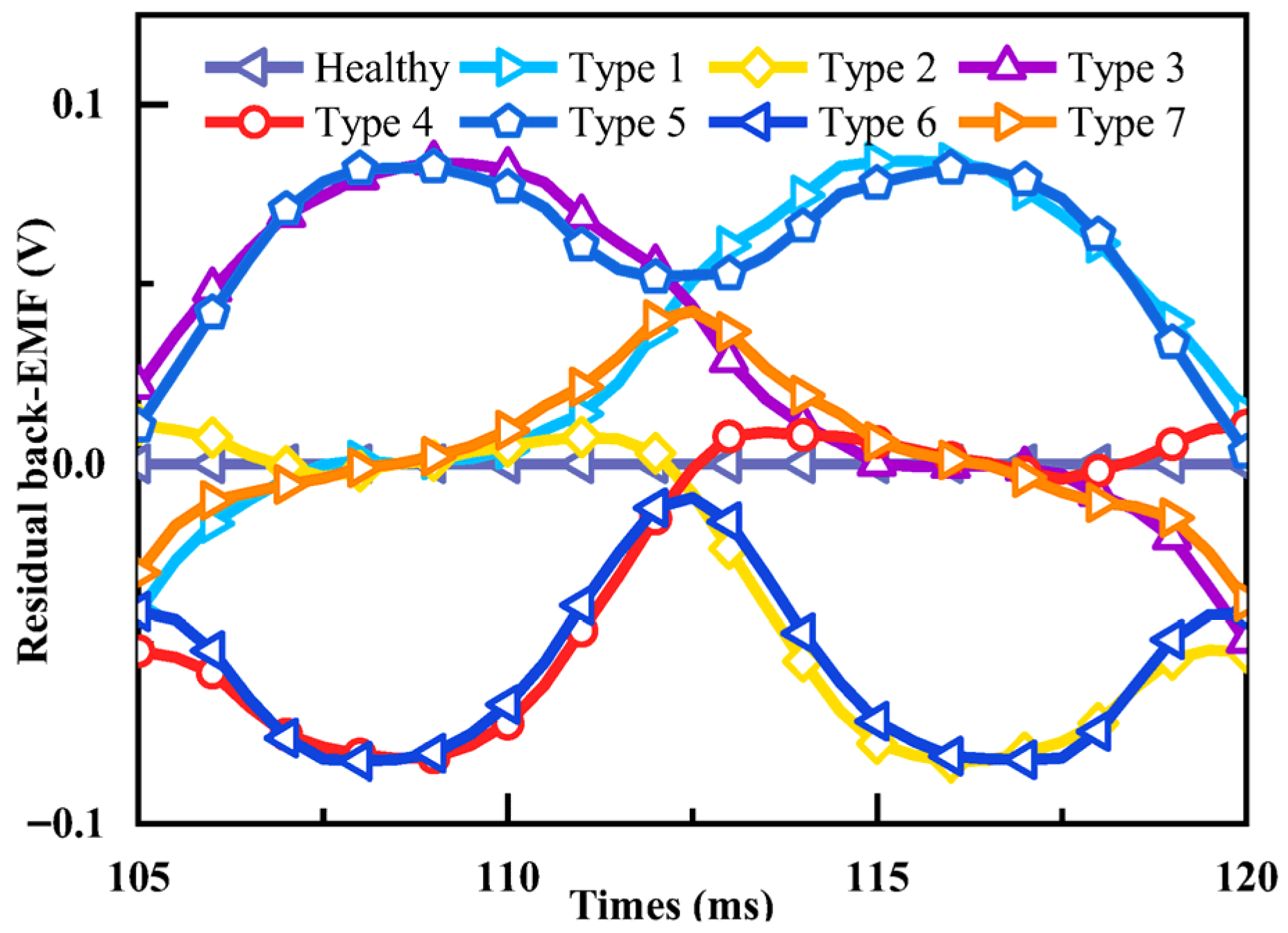
In this study, the 8th electrical period of SC is a case for analysis, which is subject to the health and fault conditions of PM14, PM15, and PM16. Demagnetization faults are simulated through uniform reduction in the PMs’ coercivity, and the demagnetization degree is set to 10% for each faulty PM. The simulation of search coil residual back-EMF under healthy conditions and different fault types is illustrated in Figure 2.
As illustrated in Figure 2, the partitioned residual back-EMF provides distinct signatures that enable reliable discrimination among the healthy condition and all seven demagnetization fault types.

2.4. Robustness Analysis of Demagnetization Fault Characteristic Signal

(1)
Effect of fault severity on the characteristic signal of demagnetization fault.
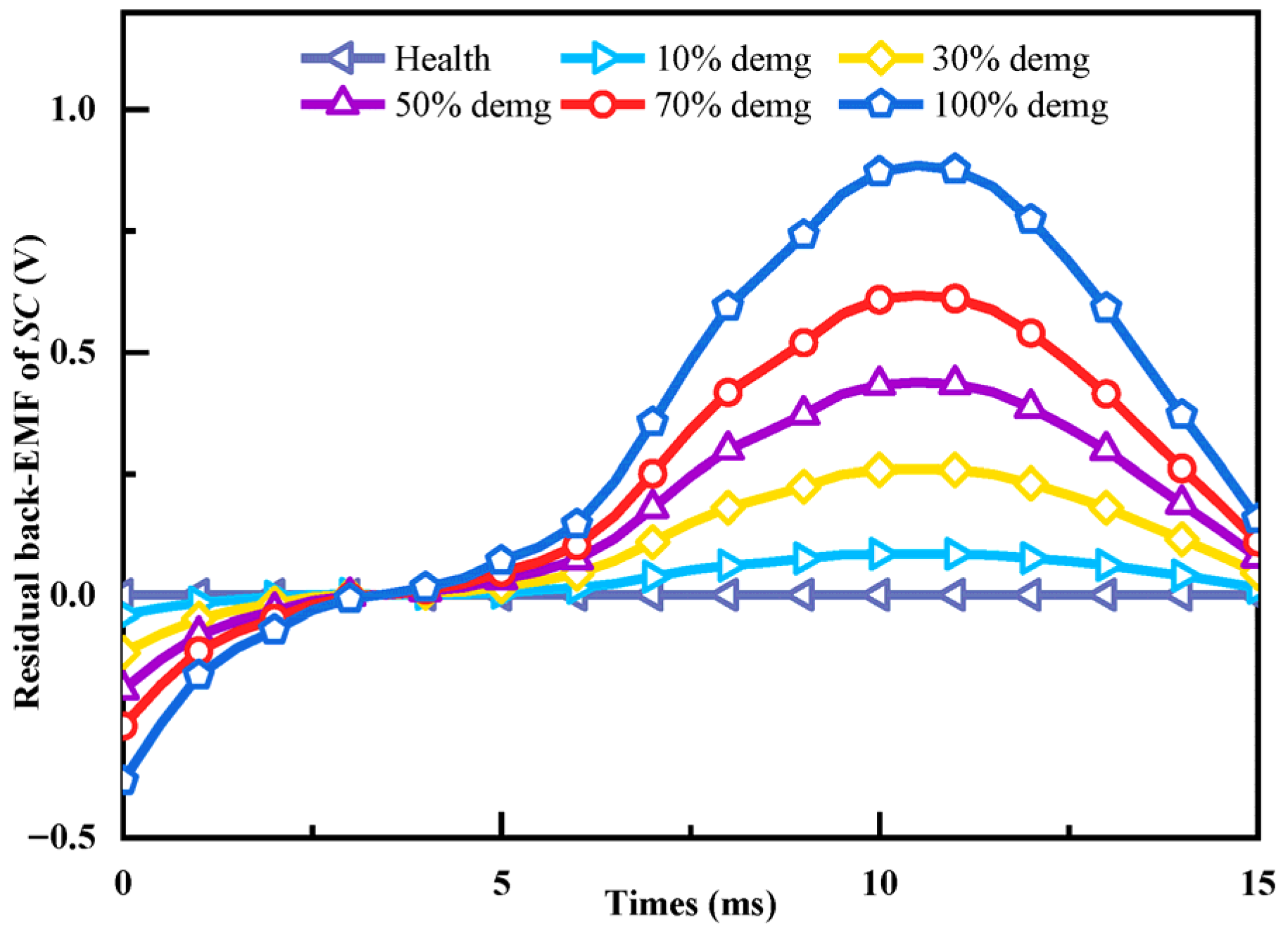
For exploring the influence of fault severity on the residual back-EMF of SC, five demagnetization fault severities are considered, which include 10%, 30%, 50%, 70%, and 100% demagnetization. Taking Type 1 as an example, the residual back-EMF of SC with different levels of severity is illustrated in Figure 3.
As illustrated in Figure 3, the residual back-EMF of SC increases proportionally with the severity of the demagnetization fault. In Type 1, the search coil back-EMF at different fault severities has identical waveform morphology, with only amplitude variations. Therefore, the fault severity does not affect the ability to distinguish between demagnetization fault types.
(2)
Effect of load on the characteristic signal of demagnetization fault.
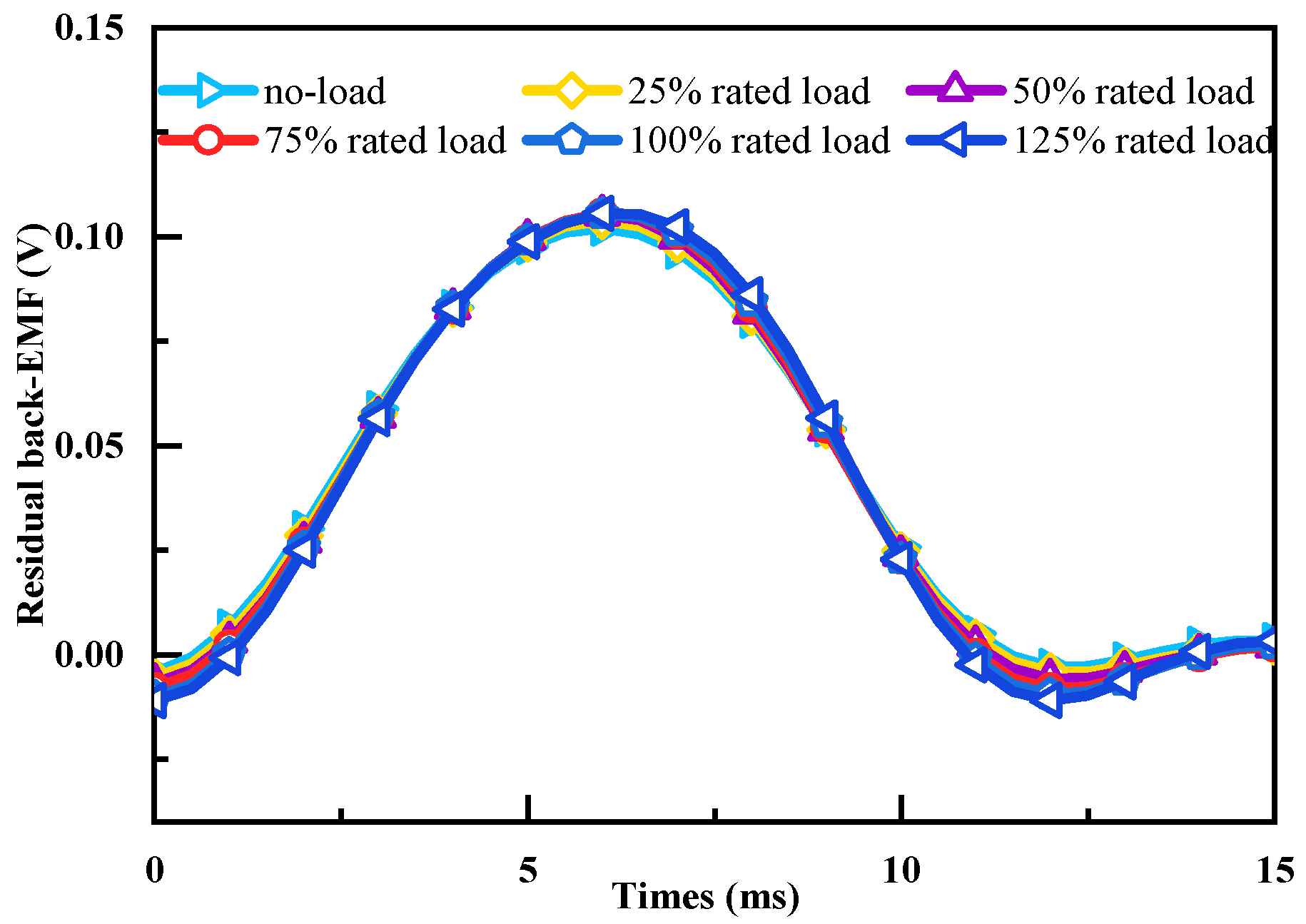
For exploring the influence of rated load on SC residual back-EMF, six loads of demagnetization fault are considered under constant speed, which include 0%, 25%, 50%, 75%, 100%, and 125% load. Taking Type 3 as an example, the residual back-EMF of SC with different rated loads is illustrated in Figure 4.
As illustrated in Figure 4, the back-EMF in the SC exhibits minimal variation under different load conditions for demagnetization faults of identical severity. In Type 3, both the waveform morphology and amplitude remain largely consistent across the tested load range. Therefore, the load condition has a negligible impact on the detection of demagnetization faults.
(3)
Effect of speed on the characteristic signal of demagnetization fault.
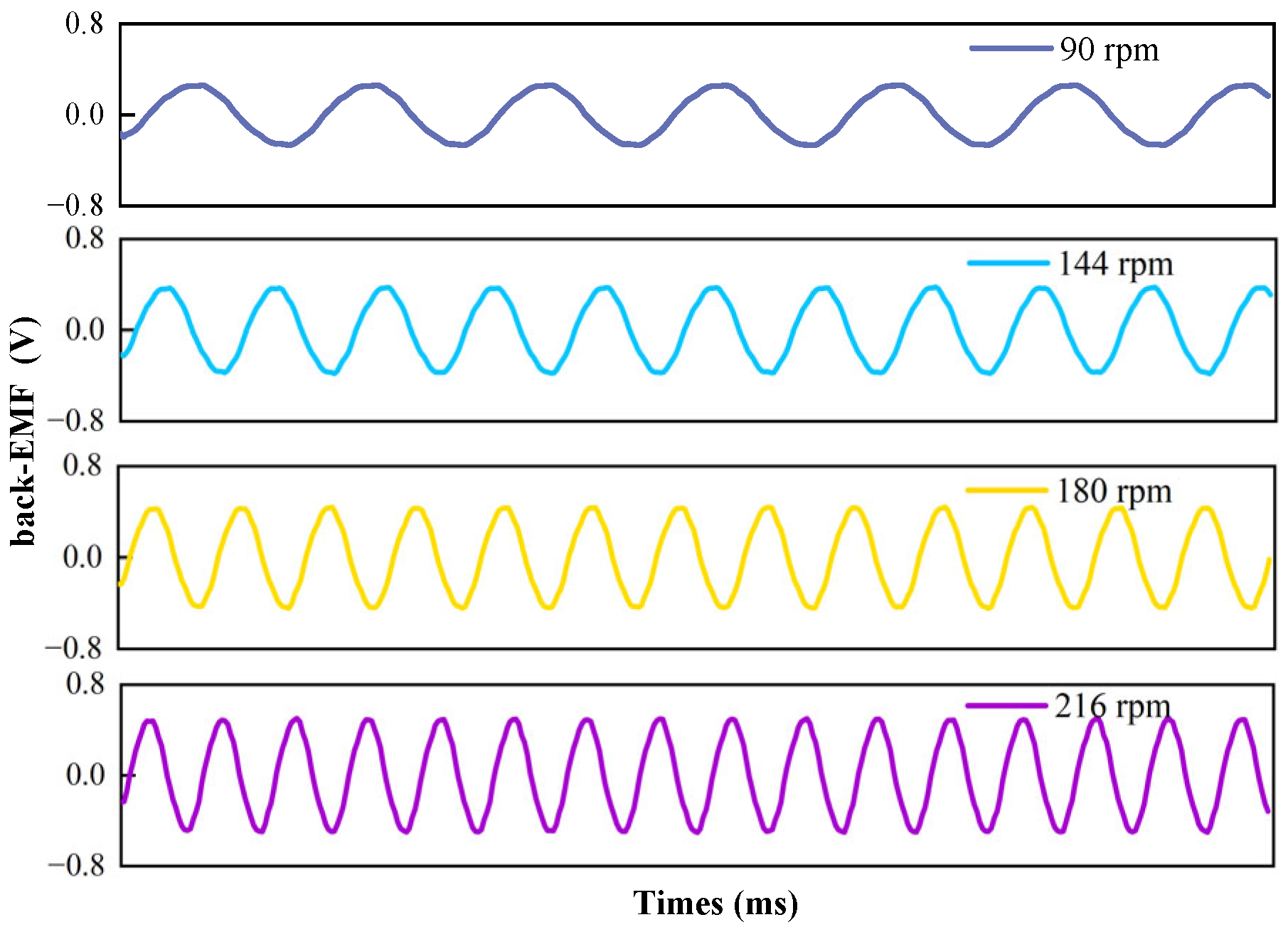
For exploring the influence of speed on the residual back-EMF of the SC, four speed conditions are considered under rated conditions, which include 90 rpm, 144 rpm, 180 rpm, and 216 rpm. The back-EMF of the SC1 in a healthy motor under different rotational speeds is illustrated in Figure 5.
As illustrated in Figure 5, the back-EMF waveforms of a healthy SC1 at different rotational speeds exhibit significant variations in both amplitude and period with speed: The amplitude difference stems from the proportionality between back-EMF and speed (as given in Equation (1)), while the period variation results from the use of a fixed sampling frequency under varying speeds. These discrepancies complicate the selection of a unified reference signal for differential-based analysis, thereby limiting the diagnostic model’s generalization capability.
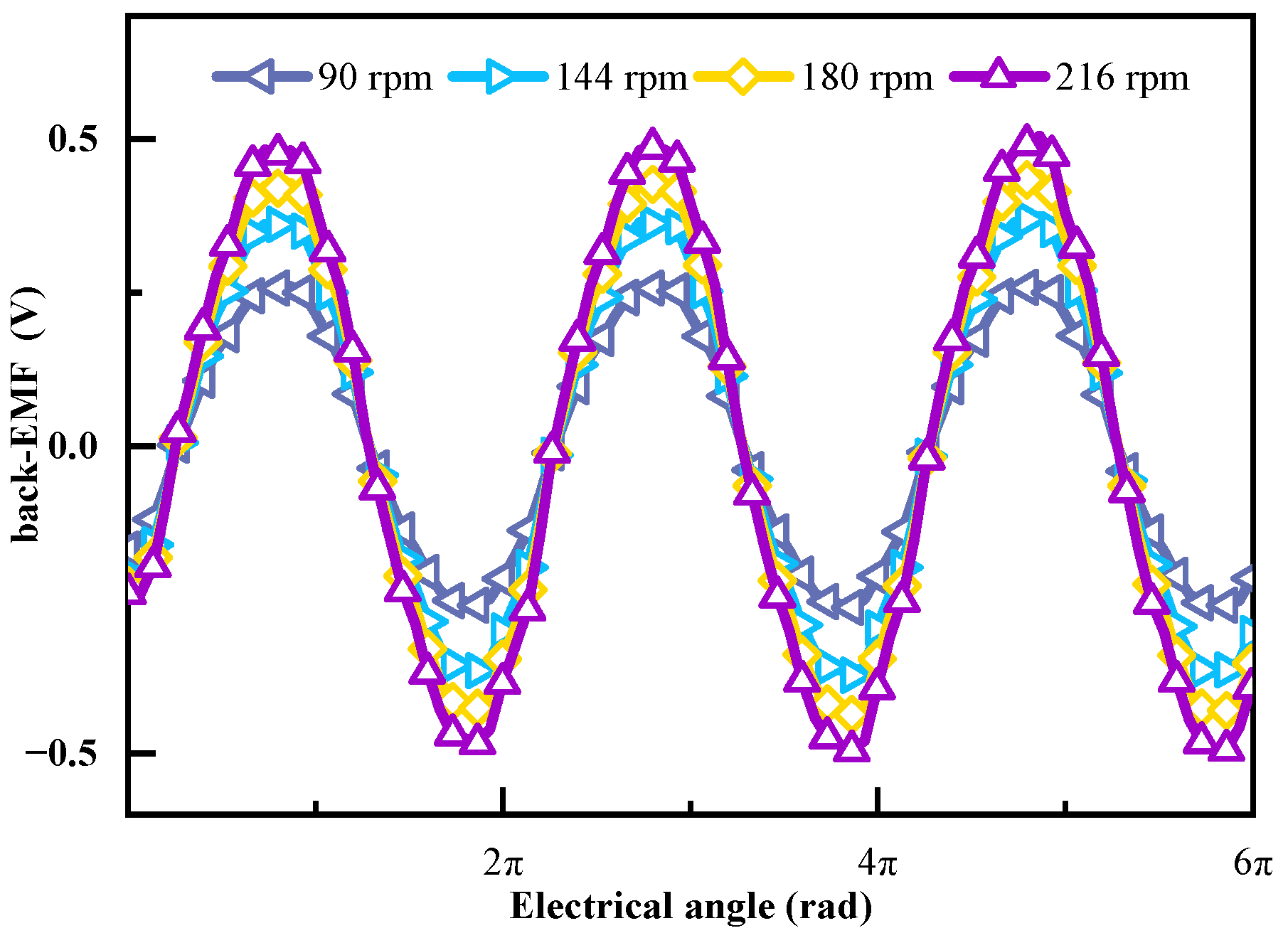
To overcome this limitation, equiangular resampling and amplitude normalization were applied to the SC1 back-EMF signal. Following resampling, as shown in Figure 6, the angular-domain waveforms exhibit consistent periods across speeds, eliminating period-related discrepancies. For amplitude normalization, the measured signal was multiplied by a normalization coefficient kv, given by
k v = V /   V n
where Vn is the rated speed, and V is the actual motor speed.
After these processing steps, both the amplitude and waveform of the SC1 back-EMF become independent of speed, endowing the proposed diagnostic method with robustness against speed fluctuations.

3. Permanent Magnet Fault Diagnosis Based on CNN

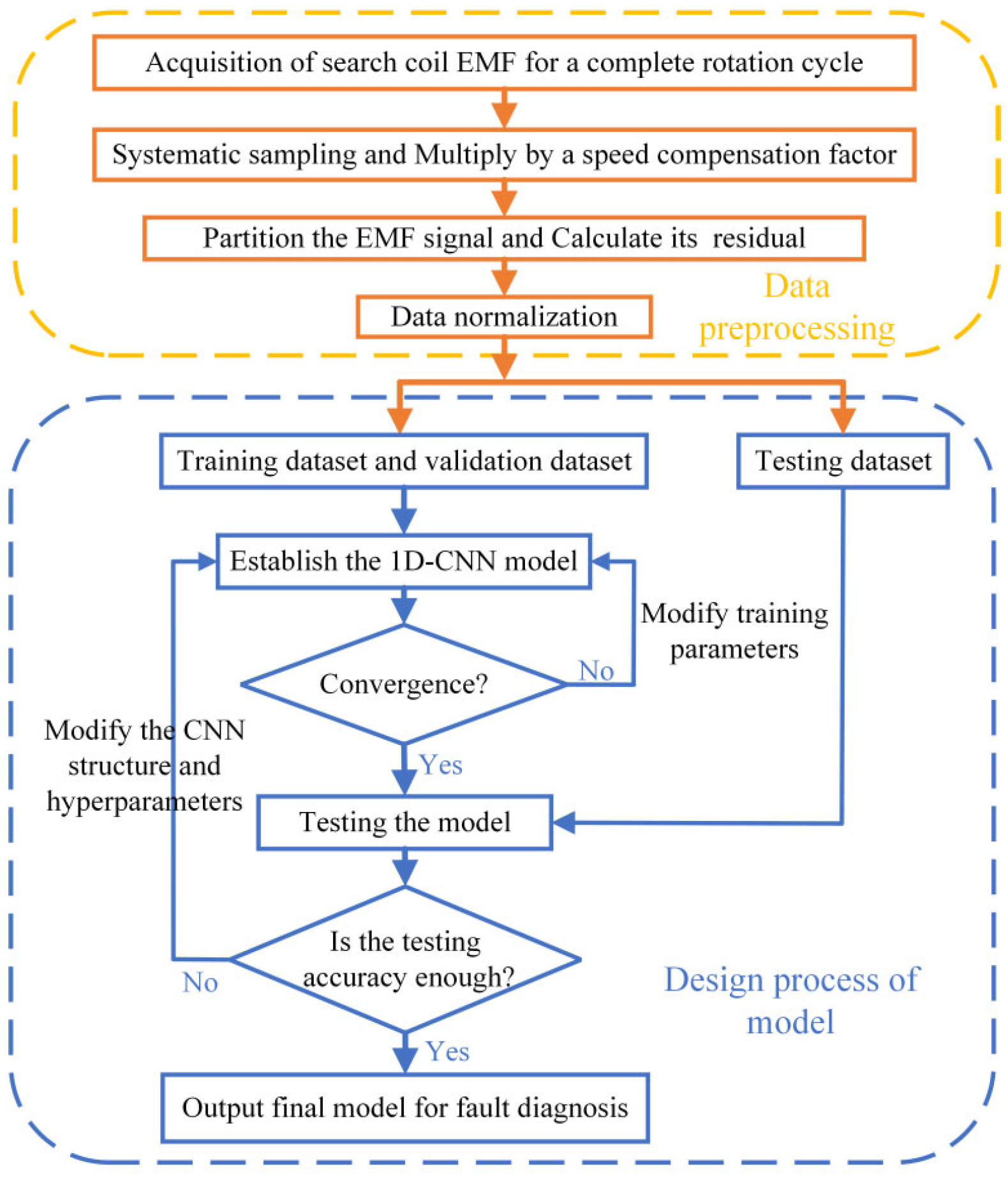
Extracting fault features from characteristic signals is a crucial step in fault diagnosis. However, traditional fault diagnostic methods rely on manually extracting features based on signal processing techniques, with diagnostic performance constrained by expert expertise and exhibit limited generalization capability. In contrast, deep learning techniques possess a remarkable ability to extract discriminative features adaptively and have been widely adopted in various equipment fault diagnosis applications. Among these, the CNN, as one of the most representative architectures in deep learning, has achieved outstanding performance in motor fault diagnosis scenarios. Therefore, this study proposes an intelligent diagnosis method based on CNN. The workflow can be generally split into data processing and CNN model design, as illustrated in Figure 7. Specifically, it consists of three main steps: (1) constructing an enhanced fault sample library by injecting noise; (2) designing a CNN architecture suitable for residual sequences of search coils back-EMF; and (3) conducting model training and performance evaluation. Each step is detailed in the subsequent subsections.

3.1. Fault Sample Database Construction with Noise Injection

The limited availability of experimental samples (only one healthy prototype and one with a Type 5 demagnetization fault) restricted the comprehensive coverage of fault types, severity levels, and locations. To overcome this constraint, we employed finite element simulations to generate 720 samples for establishing a comprehensive initial sample library.
This sample library encompasses eight operational states (one healthy and seven fault Types, Type1-Type7), six load levels (0%, 25%, 50%, 100%, 125% of rated load), four speed conditions (40%, 60%, 80%, 100% rated speed), and five fault severity levels (10%, 30%, 50%, 70%, 100% demagnetization). A full-factorial design was used to evaluate all combinations of these states and conditions. Both healthy and faulty samples cover identical ranges of load and speed, with data in each group being mutually independent and non-overlapping.
Since motors are susceptible to external environmental noise during actual operation, a factor not considered in finite element model simulations. To validate the model’s robustness, Gaussian white noise is injected into the simulated data. This type of noise is widely adopted for CNN robustness testing due to its flat power spectral density (simulates random interference) and computational efficiency. To better emulate real-world noise conditions, SNR levels of 5 dB and 15 dB are applied, representing strong electromagnetic interference (5 dB) and moderate background noise (15 dB), respectively. The noise intensity is quantified by the SNR, defined as:
S N R = 10 × log 10 ( P s P n )
where Ps and Pn denote the average power of the signal component and noise component, respectively, within a specified time interval.
The resampled signal x(m) constitutes a discrete sequence of length Lm. The average power Px of this discrete signal x(m) is computed as follows:
P x = 1 L m × 0 L m 1 x ( m ) 2
The discrete SC fault signal s(m) were substituted into Equation (8) to obtain the original signal power (Ps). Substituting the predefined SNR threshold and Ps into Equation (7) yields the target noise power (Pn). Gaussian white noise with a power of Pn is generated via Equation (9).
N o i s e = P n o i s e × r a n d n ( 1 , L m )
where the randn () function generates random samples drawn from a standard normal distribution, and noise represents the synthesized noise data.
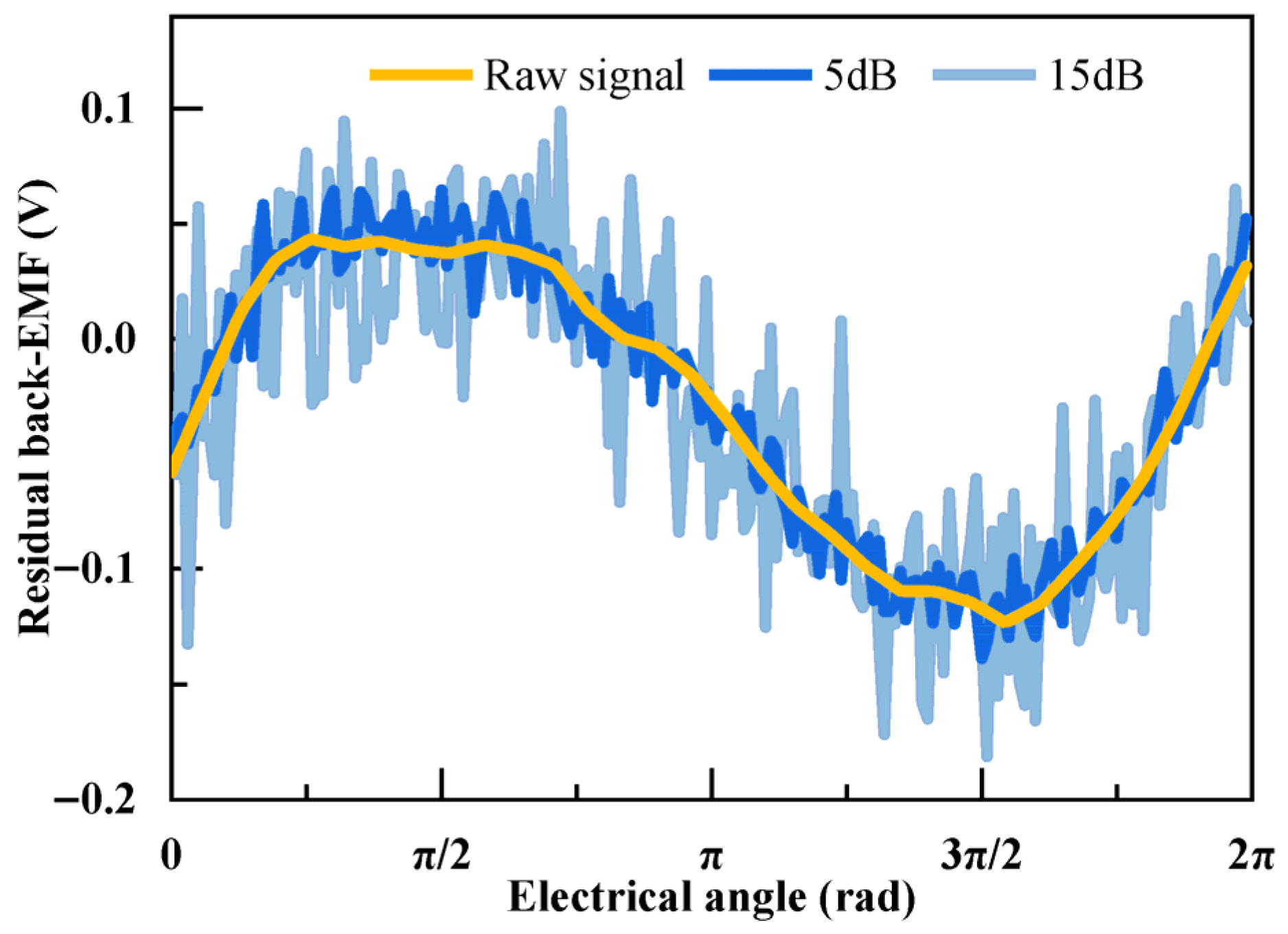
The generated noise was superimposed onto all raw signals to produce noise-contaminated signals at the target SNRs. Taking Type 2 as an example, the residual back-EMF of the search coil under different SNRs is illustrated in Figure 8.
As shown in Figure 8, the raw signal is the residual back-EMF waveform without noise interference, exhibiting a smooth and continuous trend with stable periodic characteristics. After adding noise, the smoothness of the residual back-EMF waveform significantly decreases and waveform amplitude fluctuation intensifies. As the SNR decreases, the signal quality deteriorates significantly, the smoothness of the waveform further decreases, and the amplitude fluctuation becomes more severe, and the greater the deviation from the raw signal trend. Under strong noise interference, if the fault feature is weak, it will be difficult to effectively extract, which is prone to misdiagnosis and seriously affects the accuracy of diagnosis.
To facilitate analysis of these reliable fault features, a fault sample library was developed using experimental data from healthy and faulty prototypes as well as finite element simulation data, as detailed in Table 3.

3.2. Proposed 1D-CNN Model Design

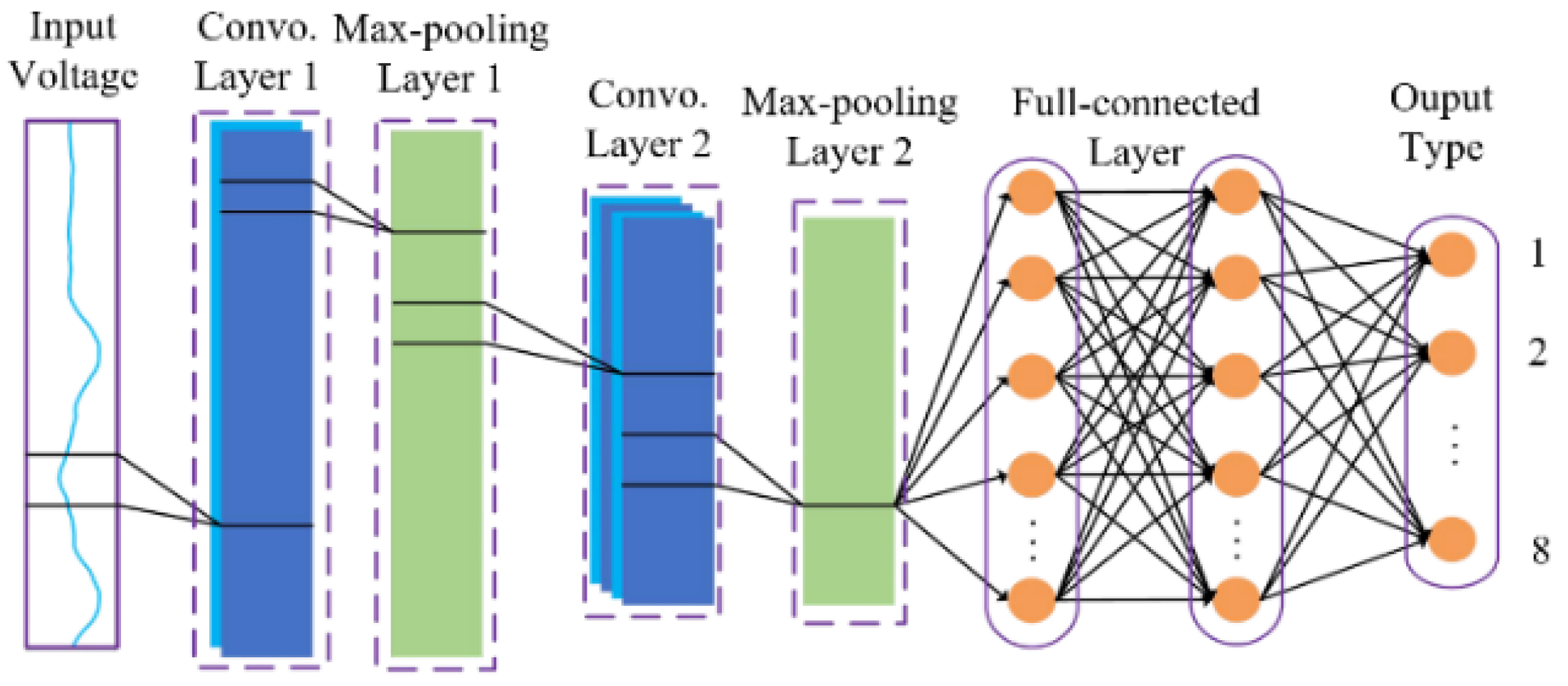
Based on the established dataset, this study focuses on the core component of the intelligent diagnostic model: a 1-D CNN architecture for end-to-end demagnetization fault diagnosis. When designing the CNN, the following concepts were adhered to: uniform filter size, the number of filters should increase layer by layer, and each convolutional layer must be followed by an activation function and a pooling layer. Therefore, we propose a CNN that adjusts parameters based on the above principles, relying on experience and previous experimental tuning. After experimental tuning, the finalized CNN architecture generally comprises one input layer, two convolutional layers, two max-pooling layers, one fully connected layer, and one output layer, as illustrated in Figure 9.
(1) The input layer is configured to receive a 200 × 1 residual signal from the search coil. This dimension was selected because, firstly, the features of demagnetization faults are most distinctly exhibited over one full electrical cycle; Secondly, integer-period sampling was employed to eliminate spectral leakage. This requires the number of samples N to satisfy N = fs/f0. Consequently, with a fundamental frequency f0 of 66 Hz and a sampling frequency fs of 13.2 kHz, N is determined to be 200. This approach can retain the complete information of the phase and amplitude, thereby providing input data for the convolutional layers to learn the essential discriminative features.
(2) The convolution layer utilizes the convolution operation to automatically extract features from the output of the preceding layer or the original signal. The convolution operation is given by
x j l = f ( x M j x i l 1 * k j l + b j l )
where x i l 1 indicates the input data for the lth layer and ∗ represents the convolution operation, x j l is the output of layer l, Mj denotes the set of input features, k j l and b j l represent the convolutional kernel weight and bias corresponding to the jth kernel in the lth convolutional layer, respectively. where f (·) refers to a nonlinear activation function, applied to enhance the network’s nonlinear expression capability.
The ReLU activation function is commonly used to accelerate the convergence of the model during its training process, as given by
Re LU ( x ) = max ( 0 , x )
After determining the basic network composition, the effectiveness of feature extraction primarily depends on two key architectural parameters: convolutional depth and kernel size. These parameters collectively determine the receptive field size and the granularity of feature extraction, which are essential to accurately extracting the local patterns exhibited by demagnetization faults in residual back-EMF sequences. Therefore, this study adopts a stepwise systematic optimization strategy: first determining the optimal network depth, and then optimizing the kernel size based on this foundation.
First, network depth optimization was conducted. Considering the limited length of the input sequence (200 × 1) and the need to precisely capture the localized pulse signatures characteristic manifested in the residual back-EMF under demagnetization faults, this study employed a small initial convolutional kernel (kernel size = 3, stride = 1) to preserve the temporal details of the input signal. With this configuration, this study evaluated architectures with 1 to 4 convolutional layers. The different convolutional layers’ diagnostic accuracy is presented in Table 4. The results indicated that the two-layer network achieved significantly higher diagnostic accuracy compared to the single-layer model. However, increasing the depth to 3 or 4 layers yielded no substantial improvement in accuracy. This suggests that the two-layer structure already provides a sufficient receptive field to capture fault characteristics, while deeper structures increase the risks of vanishing/exploding gradients. Consequently, a two-layer architecture was identified as optimal, employing 16 and 32 filters in its first and second layers, respectively.
Subsequently, within the two-layer framework, this study compared four kernel sizes (2 × 1, 3 × 1, 5 × 1, 7 × 1). The results indicate that CNN models with different kernel sizes all achieve classification accuracy of approximately 99%. The kernel size has minimal impact on the classification accuracy of the CNN model. Balancing computational efficiency and result accuracy, this paper selects a 3 × 1 kernel size for the model design.
(3) The pooling layer is placed after the convolutional layer to reduce the dimension of the extracted features. The pooling operation is treated as a down-sampling operation. This reduces the computational and parametric overhead, thereby mitigating overfitting and improving model generalization capability. The most widely used in CNN is maximum pooling. The mathematical expression is
P i l + 1 = m a x ( j 1 ) W + 1 < t < j W { q i l ( t ) }
where P i l + 1 represents the output value of the (l + 1)th layer, W refers to the width of the pooling window. q i l ( t ) represents the output of the tth neurons in the ith channel of the l layer.
Following the convolutional operation, a max pooling layer (kernel size = 2, stride = 2) is employed to downsample the feature maps. This configuration is specifically optimized for 1-D residual back-EMF time-series signals, with its key advantages being: First, its compact receptive field preserves fine-grained temporal features more effectively than larger kernels, maintaining essential structural details during down-sampling. Second, a stride of 2 halves the length of the feature maps, reducing computational complexity and memory consumption in subsequent layers by approximately 50%. Finally, for an input sequence length of 200, this stride ensures non-overlapping and complete coverage of the entire sequence, preventing information loss at the boundaries. In summary, this empirically validated configuration achieves an optimal balance between computational efficiency and feature preservation.
(4) The purpose of a fully connected layer is to project the feature space to the sample label space; the features are converted into 1-D vectors. Each neuron in this layer is fully connected to all neurons in the preceding layer. The output vector of the l layer is
x j l = f ( i = 1 M x i l 1 × w i j l + b j l ) , j = 1 ,   2 ,   ,   N
where M is the input feature dimensionality, and N is the output vector dimensionality. w i j l denotes the weight of the connection between the ith neuron of the (l − 1) th layer and the jth neuron of the lth layer, and b j l indicates the bias term of the jth neuron of the lth layer.
The SoftMax is connected after the fully connected layer and acts as a classifier. The SoftMax function calculates the probability that the input data belongs to each class. The output expression of SoftMax regression is
p ( x j l ) = e x j l 1 k = 1 N e x k l 1
where N is the number of classes, x j l 1 is the output of the upper layer, and p ( x j l ) is the output probability.
The classification module, comprising fully connected layers and an output layer, utilizes the Softmax activation function, maps the high-dimensional features to a probability distribution over fault classes, enabling detection and location of demagnetization faults. The model’s detailed architecture is specified in Table 5.

3.3. Model Training and Performance Evaluation

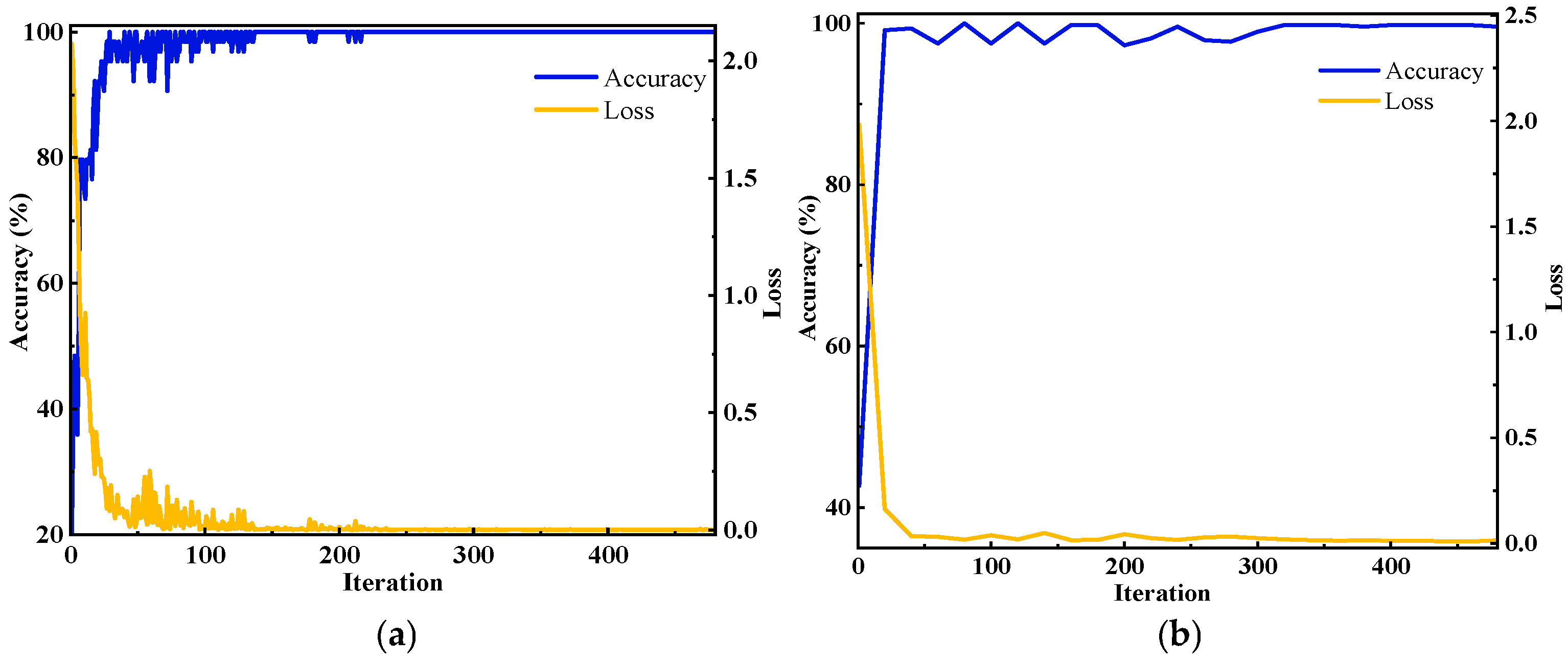
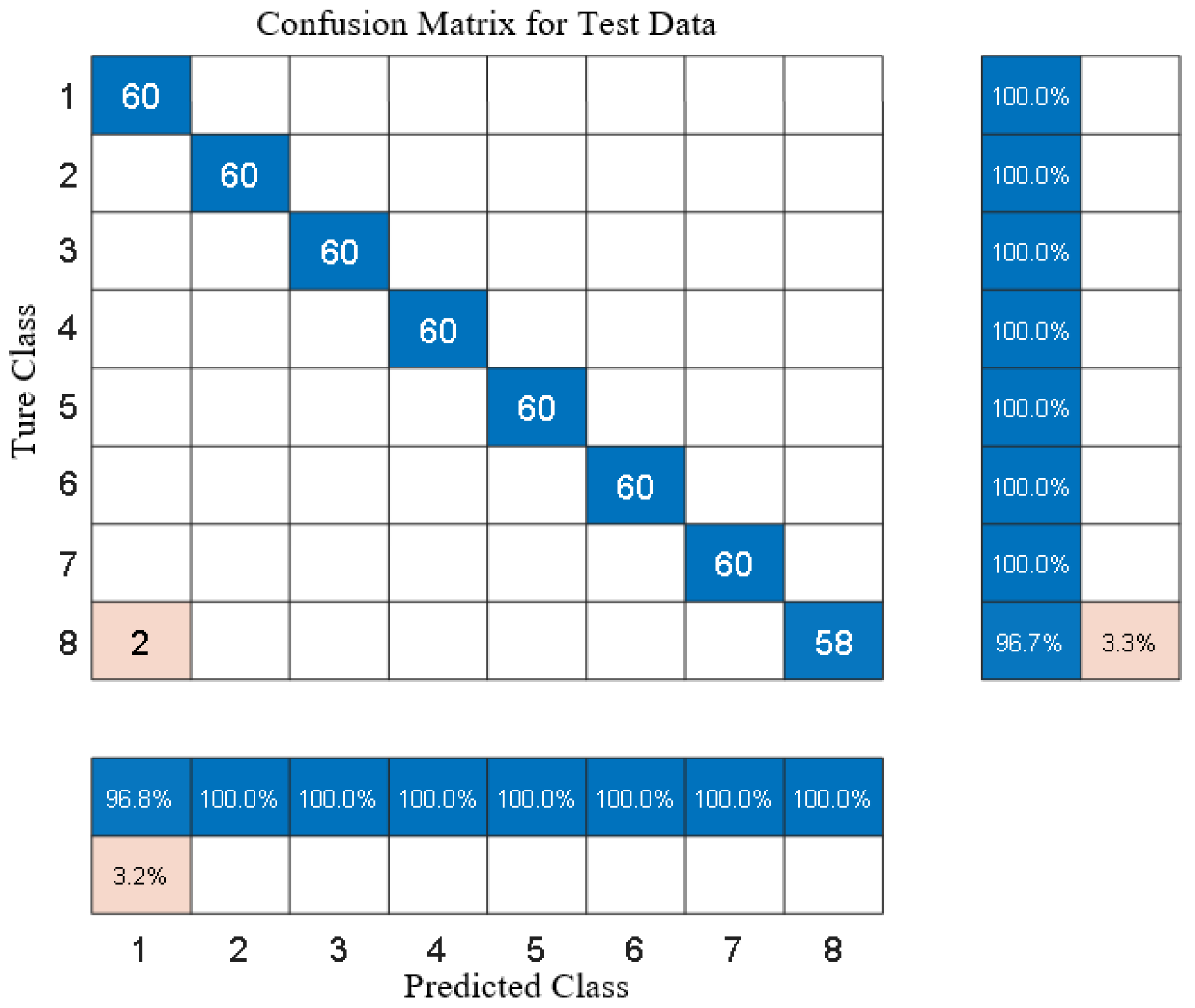
To evaluate the performance and generalization capability of the designed 1D-CNN model, we employed the comprehensive fault database detailed in Table 3. The dataset was partitioned randomly into training, validation, and test sets at a 2:1:1 proportion to ensure an unbiased model evaluation process, then fed into a CNN model constructed with the MATLAB 2024a Deep Learning Toolbox for training. Training of the 1D-CNN model was using the Adaptive Moment Estimation (Adam) optimizer. Key hyperparameters are set as follows: 0.01 for the learning rate, 40 for the maximum epochs, and 64 for the batch size. The training and validation progress are illustrated in Figure 10, and the confusion matrix corresponding to the 1D-CNN test results is illustrated in Figure 11.
As shown in Figure 10, the model approached convergence after approximately 300 iterations. Both training and validation accuracy exceeded 99%. Furthermore, the training and validation losses decreased consistently and stabilized around 0.001. These results suggest that the model exhibits strong convergence and generalization performance.
As illustrated in Figure 11, the model demonstrated excellent performance on the test set, achieving an overall accuracy of 99.5% and a classification accuracy exceeding 96.5% for all eight fault states. However, confusion matrix analysis revealed one misclassification: a small number of samples from Type 7 (uniform demagnetization of three permanent magnets within the same electrical cycle) were incorrectly identified as normal. This misclassification can be attributed to the preservation of magnetic field symmetry in Type 7, which only causes variations in signal amplitude without waveform distortion. In contrast, demagnetization of single or dual permanent magnets disrupts magnetic symmetry, resulting in more distinguishable features.
Notably, all misclassifications of Type 7 occurred at the 10% demagnetization level. At this early stage, the fault feature closely resembles normal conditions, making differentiation difficult. From an engineering safety perspective, a 10% demagnetization degree generally does not immediately cause system failure or severe performance degradation, thus providing enough maintenance time before performance deteriorates.

4. Experimental Result

4.1. Experimental Setup

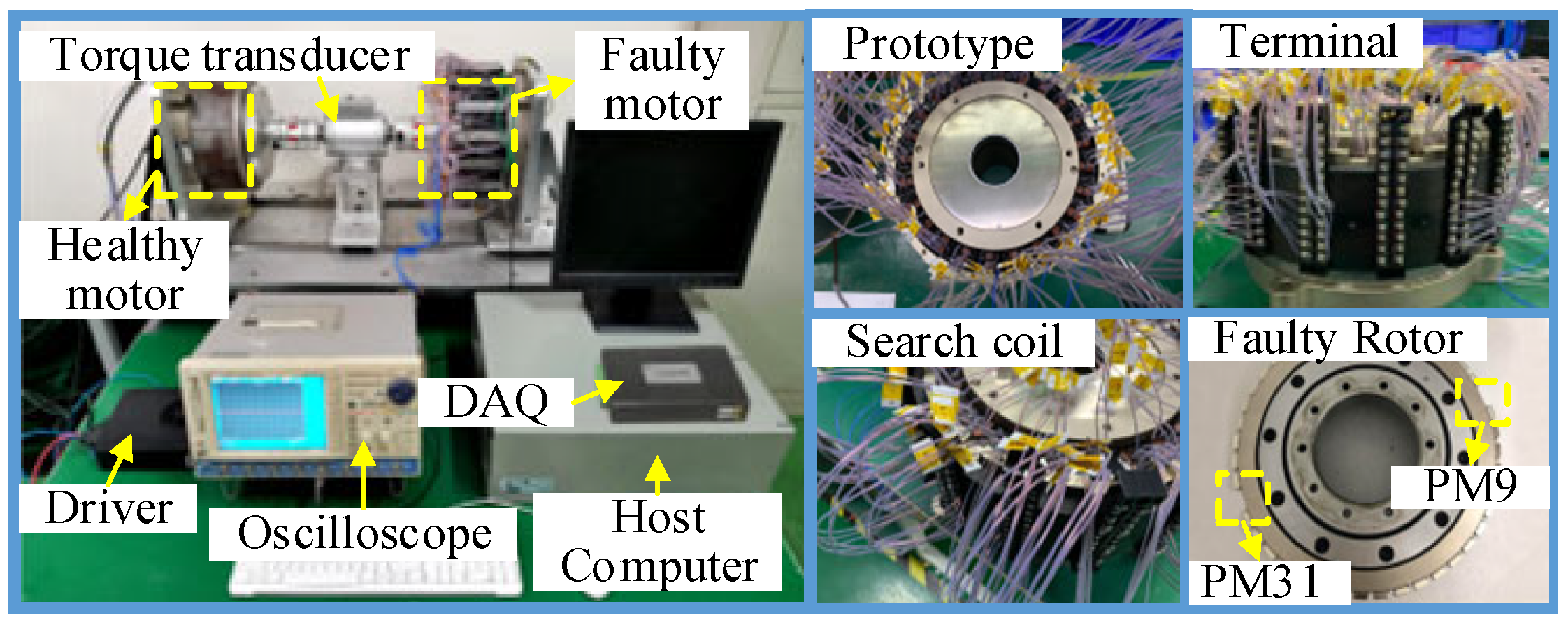
The experimental platform is illustrated in Figure 12. It primarily comprises two comparative prototypes (healthy and defective, with key parameters summarized in Table 1). During the experiment, the driver powers the test prototype while an independent motor provides the load. Both prototypes were mechanically coupled to a torque transducer for simultaneous speed and torque measurement. Search coils (diameter: 0.5 mm, turns per coil: 5) were installed in the test prototype to sense the back-EMF. The back-EMF data, recorded by the acquisition card, is routed to the computer via USB. An oscilloscope, connected to the search coils via probes in parallel, provided visual monitoring of the back-EMF. To simulate demagnetization faults, permanent magnets PM9 and PM31 were detached from the test prototype. These magnets were symmetrically positioned relative to the center line, thereby avoiding potential eccentricity effects.

4.2. Experimental Results and Analysis

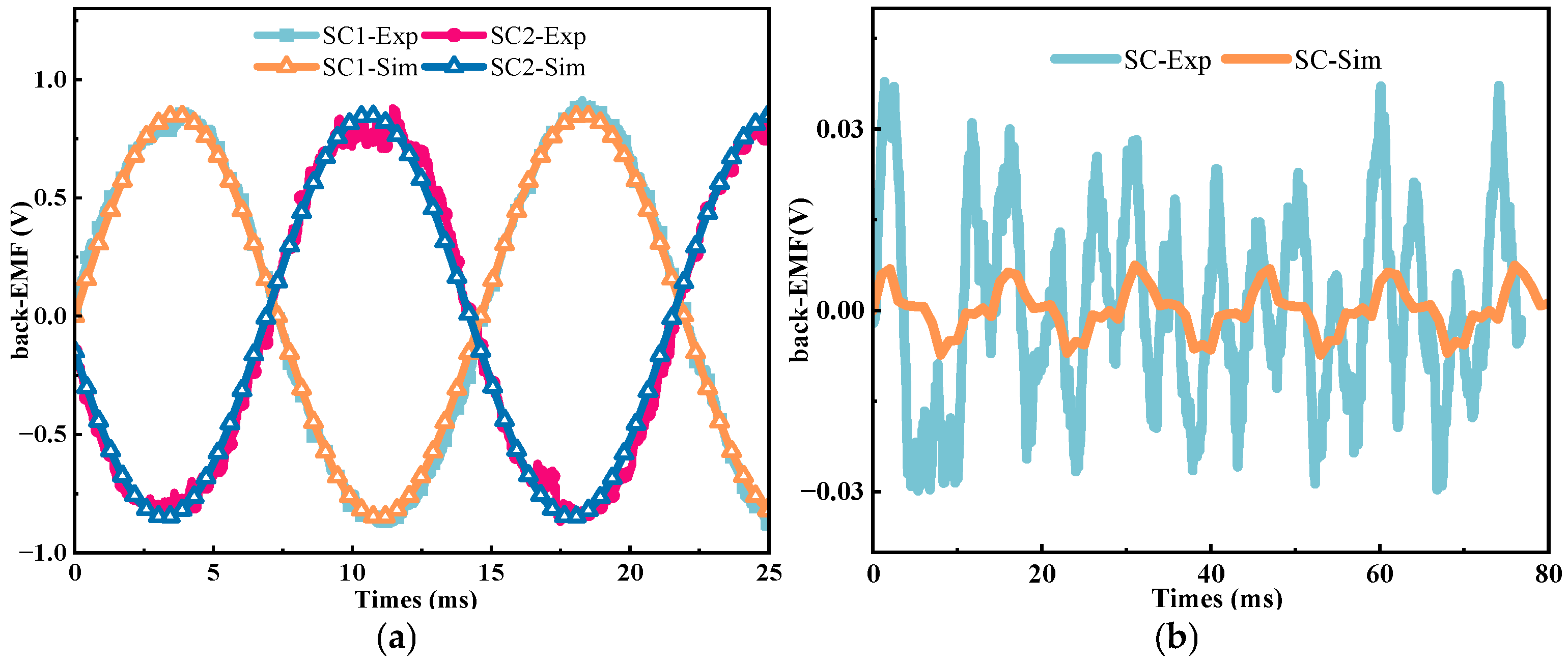
To verify the proposed location method, the experimental back-EMF signals from the healthy prototype under rated load conditions were compared with the corresponding simulation results. A low-pass filter realized in MATLAB was applied to process the measured back-EMF signal. The back-EMF signals of SC1, SC2, and SC for the healthy prototype under rated load conditions are illustrated in Figure 13.
As illustrated in Figure 13a, the experimental back-EMF results for search coils agree well with the theoretical predictions, with a maximum relative error of 4.4% between the actual and theoretical peak values. As illustrated in Figure 13b, the maximum discrepancy between simulated and experimental results of SC was 0.04 V. This discrepancy stems from environmental noise, PMSM magnetic field non-uniformity, and stator winding imbalances, inherent phenomena present in both healthy and faulty states. However, these minor discrepancies have a negligible impact on diagnostic outcomes, as the 1-D CNN model is not dependent on precise peak-value measurements. Instead, it utilizes an end-to-end learning approach to extract discriminative features directly from the raw signal data.
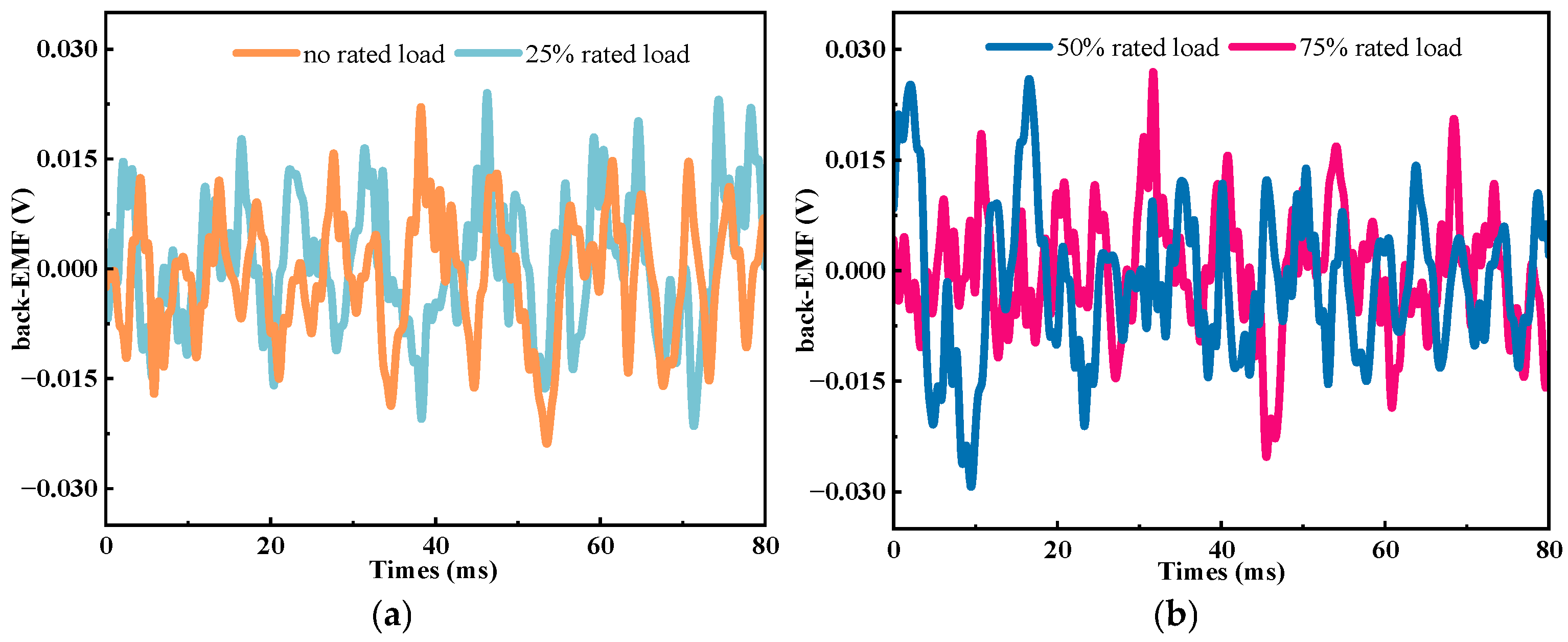
After verifying the reliability of the healthy baseline measurements under rated load, the influence of load variations on diagnostic signals was further analyzed. The SC waveforms of the healthy motor at rated speed under four rated load conditions are illustrated in Figure 14.
As shown in Figure 14, the SC signal of the healthy motor is largely independent of load variations, and these minor differences do not affect the diagnostic outcome.
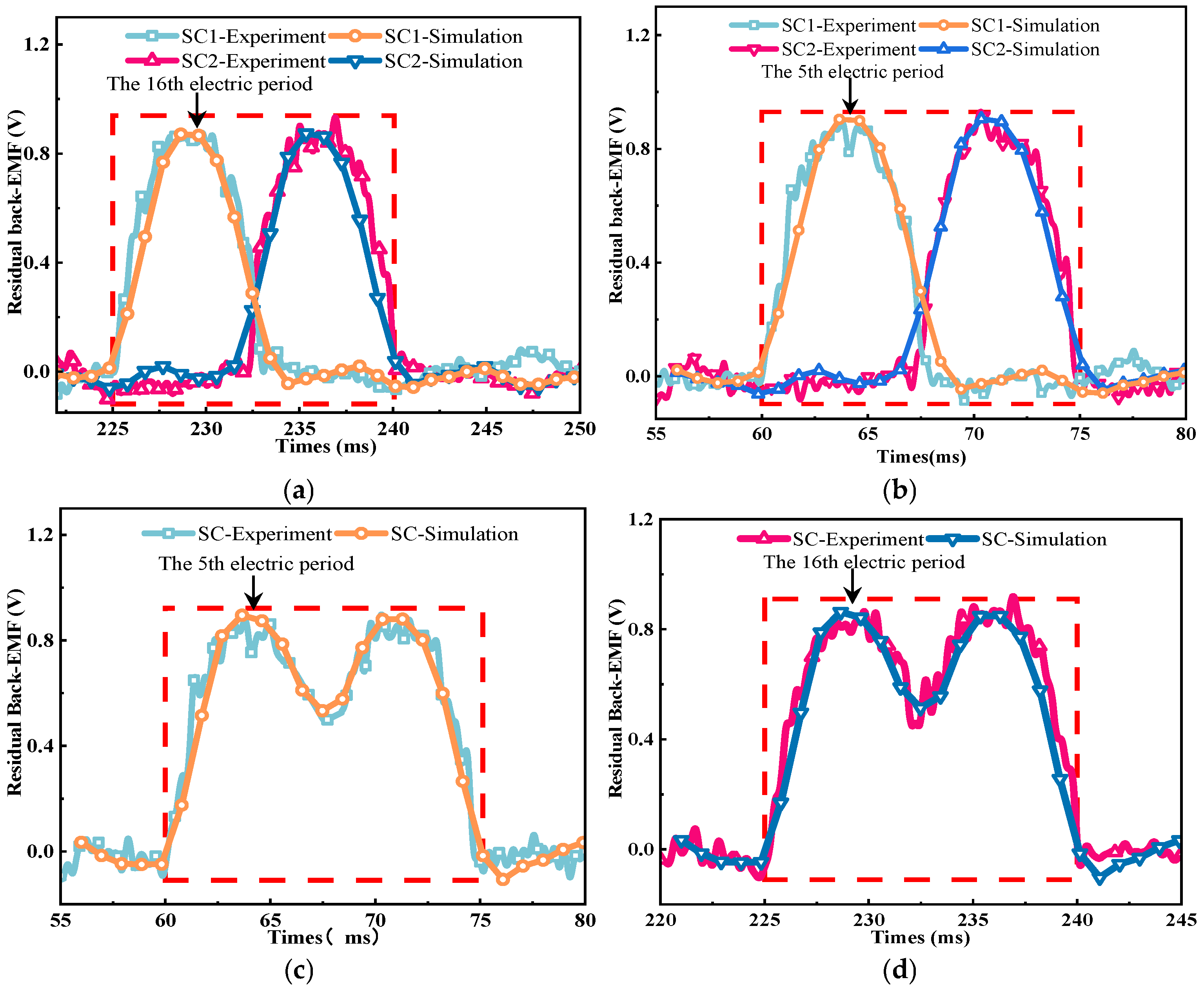
To demonstrate its objective of fault diagnosis, the method was subsequently applied to fault location experiments. In the faulty prototype, permanent magnets PM9 and PM31 were completely removed. The fault location signal exhibits distinct features at the 5th and 16th electrical cycles, which correspond precisely to the magnetic pole partitions of the removed PMs. The waveforms of the fault location signal measured under rated operating conditions are illustrated in Figure 15.
As illustrated in Figure 15a,b, the simulated and experimental residual back-EMF waveforms obtained from the search coil are in strong agreement. Specifically, both SC1 and SC2 exhibit pronounced signals during the intervals of [60 ms, 75 ms] and [225 ms, 245 ms], which correspond to the 5th and 16th electrical periods, respectively. As illustrated in Figure 15c,d, the SC waveform within these critical intervals displays the same characteristics previously defined for Type 5 and matches the fault signature (0, 1, 0) listed in Table 2. Substituting k = 5 and k = 16 into the expression (2k − 2, 2k − 1, 2k), the demagnetized permanent magnets are identified as PM9 and PM31.

4.3. Comparison with Other Methods

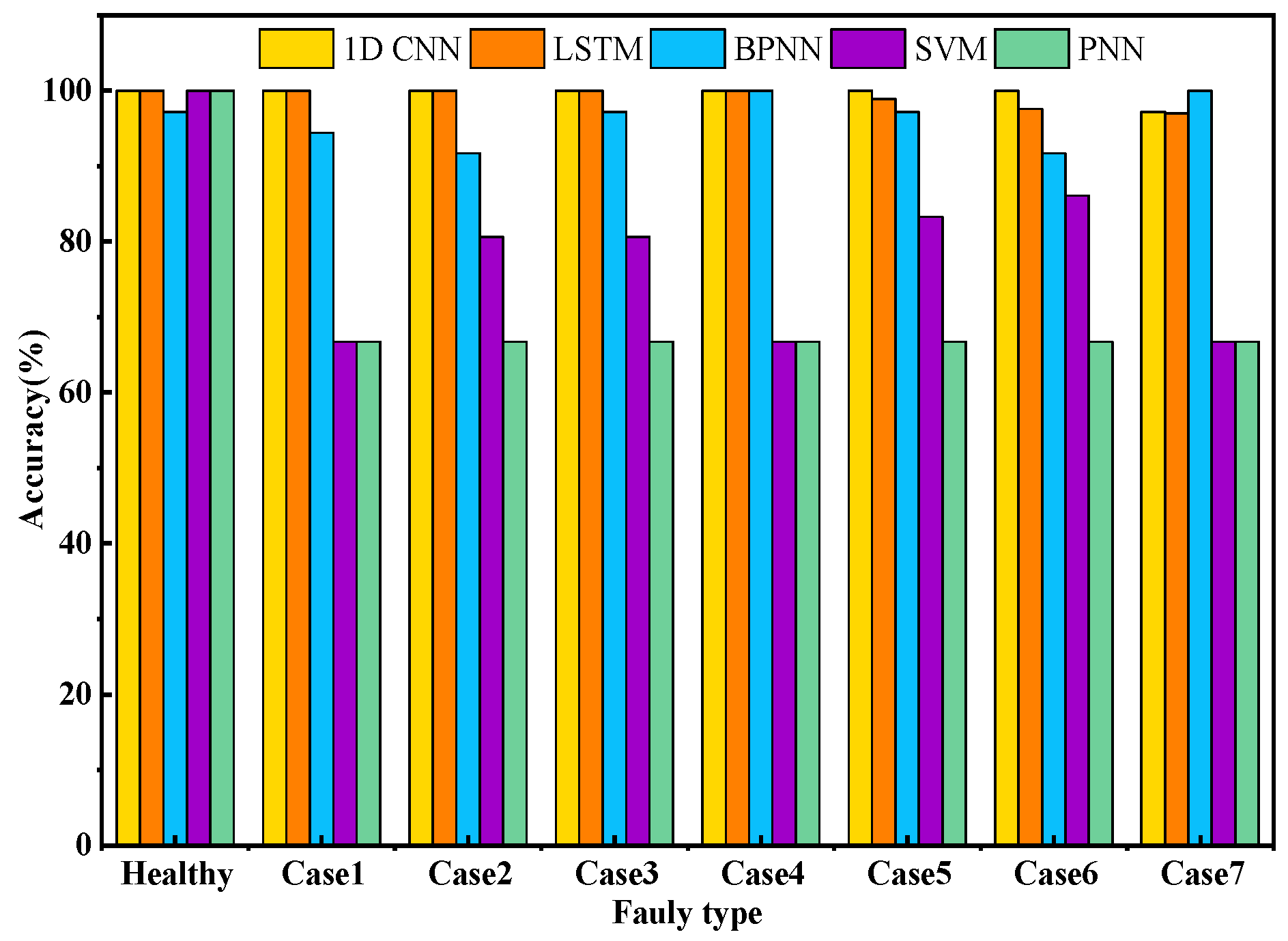
To validate the performance advantages of the 1-D CNN model, LSTM, BPNN, PNN, and SVM are used as comparative models. Meanwhile, to avoid random errors caused by a single test, each model underwent ten independent experiments, with the average classification accuracy serving as the performance evaluation metric. The per-class accuracy of these models is illustrated in Figure 16, and overall accuracy and computational time are summarized in Table 6.
As illustrated in Figure 16, the proposed 1D-CNN model achieved superior performance in classification, with all fault-type accuracies exceeding 96.5%. Although the BPNN marginally outperformed our model in Type 7, the 1D-CNN maintained the highest accuracy across all other fault types.
As summarized in Table 6, the proposed 1D-CNN achieved the highest testing accuracy (99.58%) with a computational time of only 3 s, outperforming other methods. In contrast, the LSTM achieves 98.93% accuracy but requires 9 s for computation, while the BPNN reaches 96.18% accuracy but requires 12 s for computation. Although the PNN and SVM computed faster (0.06 s and 0.2 s), their accuracy was more than 21% lower than the proposed model. This demonstrates that the CNN model holds significant advantages when applied to demagnetization fault detection and location in DDPMSMs.

5. Conclusions

This study proposes a 1-D CNN location method based on the residual back-EMF of SC to locate demagnetization faults in DDPMSM. Experiments and simulations corroborated the efficacy and reliability of the proposed method.
(1) SC1 and SC2, two toroidal coils, are installed in corresponding positions within adjacent pole-pairs in the stator slots, connected in series to constitute the SC assembly. This configuration enables fault location through residual back-EMF analysis. This approach significantly reduces intrusiveness and implementation cost compared to conventional methods that involve installing search coils and applies to permanent magnet synchronous motors with any pole-slot combination.
(2) The rotor is partitioned into several sectors based on the pole pairs of the permanent magnets, dividing the full mechanical cycle accordingly. Previous analysis indicates that the residual back-EMF waveform is related to the state of three adjacent permanent magnets. Therefore, by analyzing the location signal waveform within each sector, the magnetic state of the permanent magnets in that sector can be effectively identified, thereby enabling accurate location of the demagnetized permanent magnets.
(3) This paper proposes a precise location method based on a 1D-CNN, which is capable of achieving both detection and location of demagnetization faults. Compared with the other classification approaches, the experimental result shows that the proposed method’s fault type location accuracy reaches 99.58%, significantly outperforming methods such as LSTM, BPNN, PNN, and SVM. Although the computational efficiency of this method is slightly lower than that of PNN and SVM, its diagnostic accuracy shows an improvement of over 20%, and both its computational efficiency and comprehensive diagnostic performance are superior to those of BPNN and LSTM.
The proposed method demonstrates strong capabilities in detecting and locating demagnetization faults. While the method is invasive, it applies to safety-sensitive scenarios, including rail transit systems, aerospace power systems, and industrial automation systems.
Future work will primarily focus on the refining and enhancing the existing location model to improve its performance and investigating fault severity assessment methodologies to achieve a comprehensive diagnostic procedure from fault location to severity evaluation.

Author Contributions

C.G. supervised the study, reviewed the manuscript, and proposed the research direction of the paper. Z.J. wrote the main manuscript text, prepared the figures and tables, performed coding work, and conducted data processing. X.X. and J.S. supervised the study, reviewed the manuscript. All authors have read and agreed to the published version of the manuscript.

Funding

This work was supported by National Natural Science Foundation of China (52177039) and, Natural Science Foundation of Henan Province (252300421328). Fundamental Research Funds for the Universities of Henan Province (NSFRF240306).

Institutional Review Board Statement

Not applicable.

Informed Consent Statement

Not applicable.

Data Availability Statement

The data that support the findings are available from the corresponding author upon reasonable request.

Conflicts of Interest

The authors have no conflicts to disclose.

References

  1. Mohamed, Y.A.-R.I. Direct Instantaneous torque control in direct drive permanent magnet synchronous motors—A new approach. IEEE Trans. Energy Convers. 2007, 22, 829–838. [Google Scholar] [CrossRef]
  2. Mohamed, Y.A.-R.I. A Hybrid-Type variable-structure instantaneous torque control with a robust adaptive torque observer for a high performance direct-drive PMSM. IEEE Trans. Ind. Electron. 2007, 55, 2491–2499. [Google Scholar] [CrossRef]
  3. Goktas, T.; Zafarani, M.; Akin, B. Discernment of broken magnet and static eccentricity faults in permanent magnet synchronous motors. IEEE Trans. Energy Convers. 2016, 31, 578–587. [Google Scholar] [CrossRef]
  4. Kao, I.H.; Wang, W.J.; Lai, Y.H.; Perng, J.W. Analysis of permanent magnet synchronous motor fault diagnosis based on learning. IEEE Trans. Instrum. Meas. 2018, 68, 310–324. [Google Scholar] [CrossRef]
  5. Urresty, J.-C.; Riba, J.-R.; Romeral, L. A back-EMF based method to detect magnet failures in PMSMs. IEEE Trans. Magn. 2013, 49, 591–598. [Google Scholar] [CrossRef]
  6. Bossio, J.; Ruschett, C.; Bossio, G.; Verucchi, C.; De Angelo, C. Rotor fault diagnosis in permanent magnet synchronous machine using the midpoint voltage of windings. IET Electr. Power Appl. 2020, 14, 256–261. [Google Scholar] [CrossRef]
  7. Usman, A.; Rajpurohit, B.S. Modeling and classification of stator inter-turn fault and demagnetization effects in BLDC motor using rotor back-EMF and radial magnetic flux analysis. IEEE Access 2020, 8, 118030–118049. [Google Scholar] [CrossRef]
  8. Ebrahimi, M.; Faiz, J. Demagnetization fault diagnosis in surface mounted permanent magnet synchronous motors. IEEE Trans. Magn. 2013, 49, 1185–1192. [Google Scholar] [CrossRef]
  9. Zhu, M.; Yang, B.; Hu, W.; Feng, G.; Kar, N.C. Vold–Kalman Filtering Order Tracking Based Rotor Demagnetization Detection in PMSM. IEEE Trans. Ind. Appl. 2019, 55, 5768–5778. [Google Scholar] [CrossRef]
  10. Barmpatza, A.C.; Kappatou, J.C. Study of the total demagnetization fault of an AFPM wind generator. IEEE Trans. Energy Convers. 2021, 36, 916–928. [Google Scholar] [CrossRef]
  11. Rafaq, M.S.; Lee, H.; Park, Y.; Lee, S.B.; Zapico, M.O.; Fernandez, D.; Diaz-Reigosa, D.; Briz, F. Airgap search coil based identification of PM synchronous motor defects. IEEE Trans. Ind. Electron. 2022, 69, 6551–6560. [Google Scholar] [CrossRef]
  12. Zeng, C.; Huang, S.; Lei, J.; Wan, Z.; Yang, Y. Online rotor fault diagnosis of permanent magnet synchronous motors based on stator tooth flux. IEEE Trans. Ind. Appl. 2021, 57, 2366–2377. [Google Scholar] [CrossRef]
  13. Da, Y.; Shi, X.; Krishnamurthy, M. A New approach to fault diagnostics for permanent magnet synchronous machines using electromagnetic signature analysis. IEEE Trans. Power Electron. 2013, 28, 4104–4112. [Google Scholar] [CrossRef]
  14. Chen, H.; Gao, C.; Si, J.; Nie, Y.; Hu, Y. A novel method for diagnosing demagnetization fault in PMSM using toroidal-yoke-type search coil. IEEE Trans. Instrum. Meas. 2021, 71, 750101. [Google Scholar] [CrossRef]
  15. Gao, C.; Li, B.; Chen, H.; Xu, Y.; Xu, X.; Si, J. A less-invasive method for accurately diagnosing demagnetization fault in PMSM using rotor partition. IEEE Trans. Transp. Electrif. 2021, 9, 2356–2366. [Google Scholar] [CrossRef]
  16. Shi, Q.; Zhang, H. Fault diagnosis of an autonomous vehicle with an improved SVM algorithm subject to unbalanced datasets. IEEE Trans. Ind. Electron. 2021, 68, 6248–6256. [Google Scholar] [CrossRef]
  17. Guo, F.; Fu, W.; Wang, Y.; Chen, J. Research on fault diagnosis method for photovoltaic array based on model fusion. Electr. Eng. 2025, 107, 8189–8199. [Google Scholar] [CrossRef]
  18. Yang, X.; Chen, W.; Li, A.; Yang, C. A Hybrid machine-learning method for oil-immersed power transformer fault diagnosis. IEEJ Trans. Electr. Electron. Eng. 2020, 15, 501–507. [Google Scholar] [CrossRef]
  19. Liu, F.; Wu, R.; Teng, F.; Liu, Y.; Lu, S.; Ju, B.; Cao, Z. A Two-stage learning model for track-side acoustic bearing fault diagnosis. IEEE Trans. Instrum. Meas. 2021, 70, 3516512. [Google Scholar] [CrossRef]
  20. Ma, L.; Dong, J.; Peng, K. A practical root cause diagnosis framework for quality-related faults in manufacturing processes with irregular sampling measurements. IEEE Trans. Instrum. Meas. 2022, 71, 3511509. [Google Scholar] [CrossRef]
  21. Dao, F.; Zeng, Y.; Qian, J. Fault diagnosis of hydro-turbine via the incorporation of Bayesian algorithm optimized CNN-LSTM neural network. Energy 2024, 290, 130326. [Google Scholar] [CrossRef]
  22. Skowron, M.; Orlowska-Kowalska, T.; Kowalski, C.T. Detection of permanent magnet damage of PMSM drive based on direct analysis of the Stator phase currents using Convolutional Neural Network. IEEE Trans. Ind. Electron. 2022, 69, 13665–13675. [Google Scholar] [CrossRef]
  23. Dai, Y.; Zhang, L.; Xu, D.; Chen, Q.; Li, J. Development of deep learning-based cooperative fault diagnosis method for multi-PMSM drive system in 4WID-EVs. IEEE Trans. Instrum. Meas. 2024, 73, 3506513. [Google Scholar] [CrossRef]
  24. Lv, K.; Wang, D.; Huang, W.; Liu, H.; Jiang, Y.; Hu, J. Multiple fault diagnosis of PMSM based on stator tooth flux and parallel residual convolutional neural network. IEEE Trans. Transp. Electrif. 2024, 10, 9727–9748. [Google Scholar] [CrossRef]
  25. Eker, M.; Gündogan, B. Demagnetization fault detection of permanent magnet synchronous motor with convolutional neural network. Electr. Eng. 2023, 105, 1695–1708. [Google Scholar] [CrossRef]
  26. Ni, S.; Wang, H.; Liu, S.; Wang, Y.; Yu, J.; Wang, L. Efficient multimodal motor demagnetization diagnosis framework with half-wave fundamental wave division transformation. IEEE Trans. Ind. Electron. 2025, 74, 2533116. [Google Scholar] [CrossRef]
  27. Ince, T.; Kiranyaz, S.; Eren, L.; Askar, M.; Gabbouj, M. Real-Time motor fault detection by 1-D convolutional neural network. IEEE Trans. Ind. Electron. 2016, 63, 7067–7075. [Google Scholar] [CrossRef]
Figure 1. The arrangement of the search coil.
Applsci 16 00870 g001
Figure 2. Residual back-EMF of SC in healthy condition and seven demagnetization fault types.
Applsci 16 00870 g002
Figure 3. Residual back-EMF of SC under Type 1 with different demagnetization degrees.
Applsci 16 00870 g003
Figure 4. Residual back-EMF of SC under Type 3 with different loads.
Applsci 16 00870 g004
Figure 5. Back-EMF waveforms of SC1 at different speeds.
Applsci 16 00870 g005
Figure 6. The back-EMF waveform of SC1 after equiangular resampling.
Applsci 16 00870 g006
Figure 7. Flowchart of the 1-D CNN model design process.
Applsci 16 00870 g007
Figure 8. Residual back-EMF of the SC at different SNRs.
Applsci 16 00870 g008
Figure 9. The basic structure of 1-D CNN.
Applsci 16 00870 g009
Figure 10. Accuracy and loss curves during training and validation. (a) Training process. (b) Validation process.
Applsci 16 00870 g010
Figure 11. Confusion matrix of the 1D-CNN test results.
Applsci 16 00870 g011
Figure 12. Experiment platform.
Applsci 16 00870 g012
Figure 13. Experimental results of search coil back-EMF (a) SC1 and SC2 back-EMF, (b) SC back-EMF.
Applsci 16 00870 g013
Figure 14. Experimental results of SC residual back-EMF for the different loads. (a) no rated load and 25% rated load (b) 50% rated load and 75% rated load.
Applsci 16 00870 g014
Figure 15. Experimental results of search coils’ residual back-EMFs for defective prototype. (a) Residual back-EMF in the 5th electrical cycle (b) Residual EMF of SC1 and SC2 in the 16th electrical cycle (c) Residual EMF of SC in the 5th electrical cycle (d) Residual EMF of SC in the 16th electrical cycle.
Applsci 16 00870 g015
Figure 16. Comparison of diagnostic accuracy among different algorithms.
Applsci 16 00870 g016
Table 1. Main structure parameters of the DDPMSM.
ItemsValuesUnit
Number of stator slots48
Number of pole pairs22
Stator outer-diameter270mm
Rotor outer-diameter 201mm
Stator inter-diameter230mm
Rotor inter-diameter176mm
Axial length100mm
Thickness of PM4.5mm
Rated frequency66Hz
Rated speed180rpm
Rated power1.5kW
Number of coils24/
Coil turns70/
Magnet typeN45M/
Table 2. Combination of demagnetization fault types for three PMs coupled with residual back-EMF of SC.
Health Condition
and Demagnetization Fault Modes
PM Numbers and Their Corresponding Condition
2k2k − 12k − 2
The kth Electrical PeriodHealth000
Type 1011
Type 2100
Type 3110
Type 4001
Type 5010
Type 6101
Type 7111
Table 3. Fault sample.
Category
Label
TypeDetailsSNR (dB)Sample
Quantity
1HealthySpeed(r/min): 90/144/180/216
Load(A): 0/1/2/3/4/5
Demagnetization Degree: -
-240
2Type 1Speed(r/min): 90/144/180/216
Load(A): 0/1/2/3/4/5
Demagnetization Degree: 10%/30%/50%/70%/100%
5/15240
3Type 25/15240
4Type 35/15240
5Type 45/15240
6Type 5-240
7Type 65/15240
8Type 75/15240
Table 4. Diagnostic accuracy with different convolutional layers.
Layer1234
Accuracy98.20%99.50%99.60%99.62%
Table 5. Network architecture and parameters.
LayerParameterOutput Dim
Input Layer\200 × 1
Convolution Layer(C1)16 filters,
kernel = 3 × 1
200 × 1 × 16
Activation FunctionReLU\
Maximum PoolingKernel = 2
Stride = 2
100 × 1 × 16
Convolution Layer(C2)32 filters,
kernel = 3 × 1
100 × 1 × 32
Activation FunctionReLU\
Maximum PoolingKernel = 2
Stride = 2
50 × 1 × 32
Fully connected Layer\1 × 1 × 8
SoftMax Layer\1 × 1 × 8
Output Layer\1 × 1 × 8
Table 6. The result of different methods.
MethodsTesting AccuracyTime
1-D CNN99.58%3 s
LSTM98.93%9 s
BPNN96.18%12 s
PNN78.84%0.06 s
SVM70.86%0.2 s
Disclaimer/Publisher’s Note: The statements, opinions and data contained in all publications are solely those of the individual author(s) and contributor(s) and not of MDPI and/or the editor(s). MDPI and/or the editor(s) disclaim responsibility for any injury to people or property resulting from any ideas, methods, instructions or products referred to in the content.