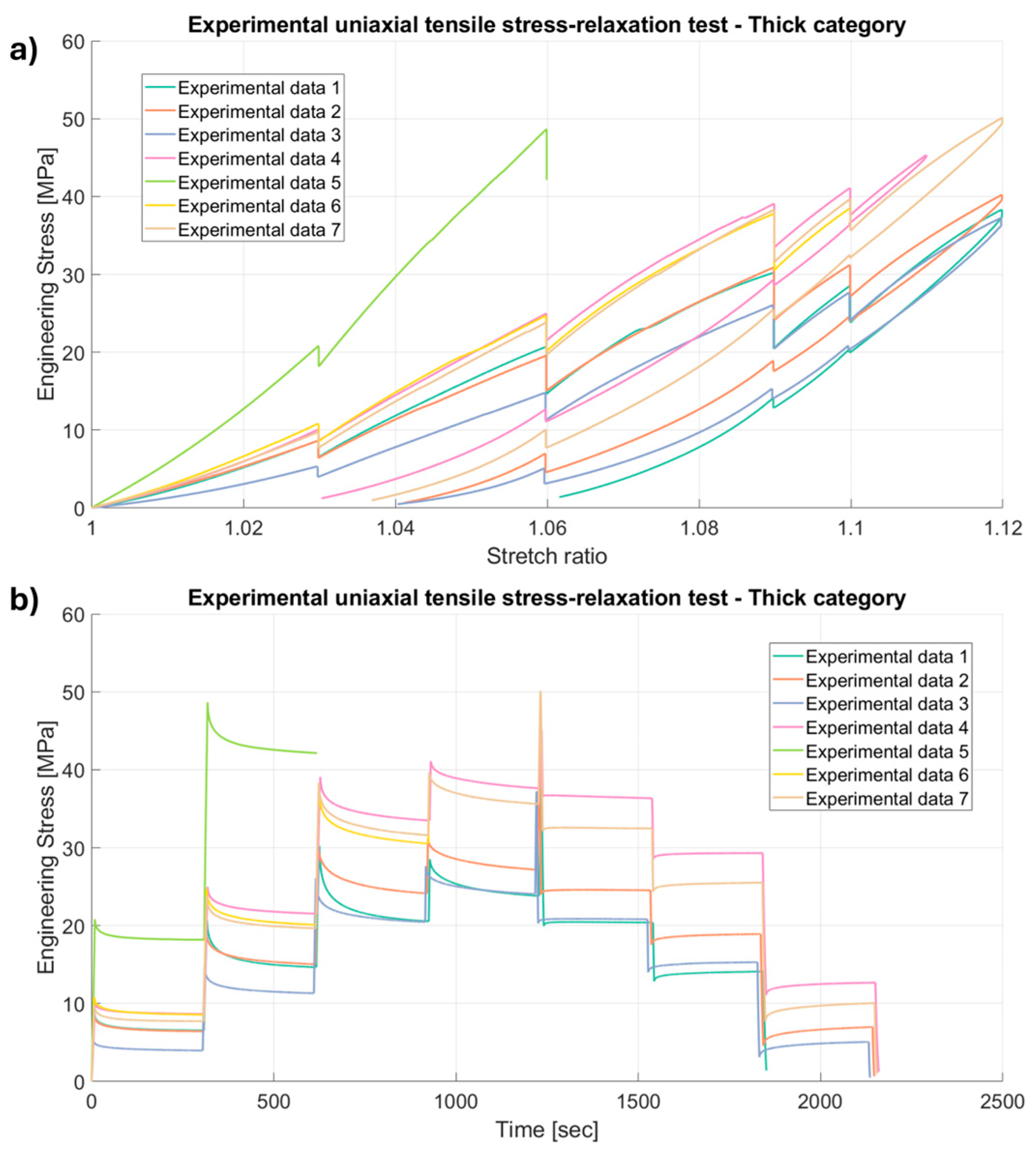
Figure 1.
Results of the experimental uniaxial tensile stress-relaxation tests on porcine FDS tendons classified in the “Thick” category, with a relaxation time of 300 s, (a) Stretch ratio vs. Engineering Stress and (b) Time vs. Engineering Stress.
Figure 1.
Results of the experimental uniaxial tensile stress-relaxation tests on porcine FDS tendons classified in the “Thick” category, with a relaxation time of 300 s, (a) Stretch ratio vs. Engineering Stress and (b) Time vs. Engineering Stress.
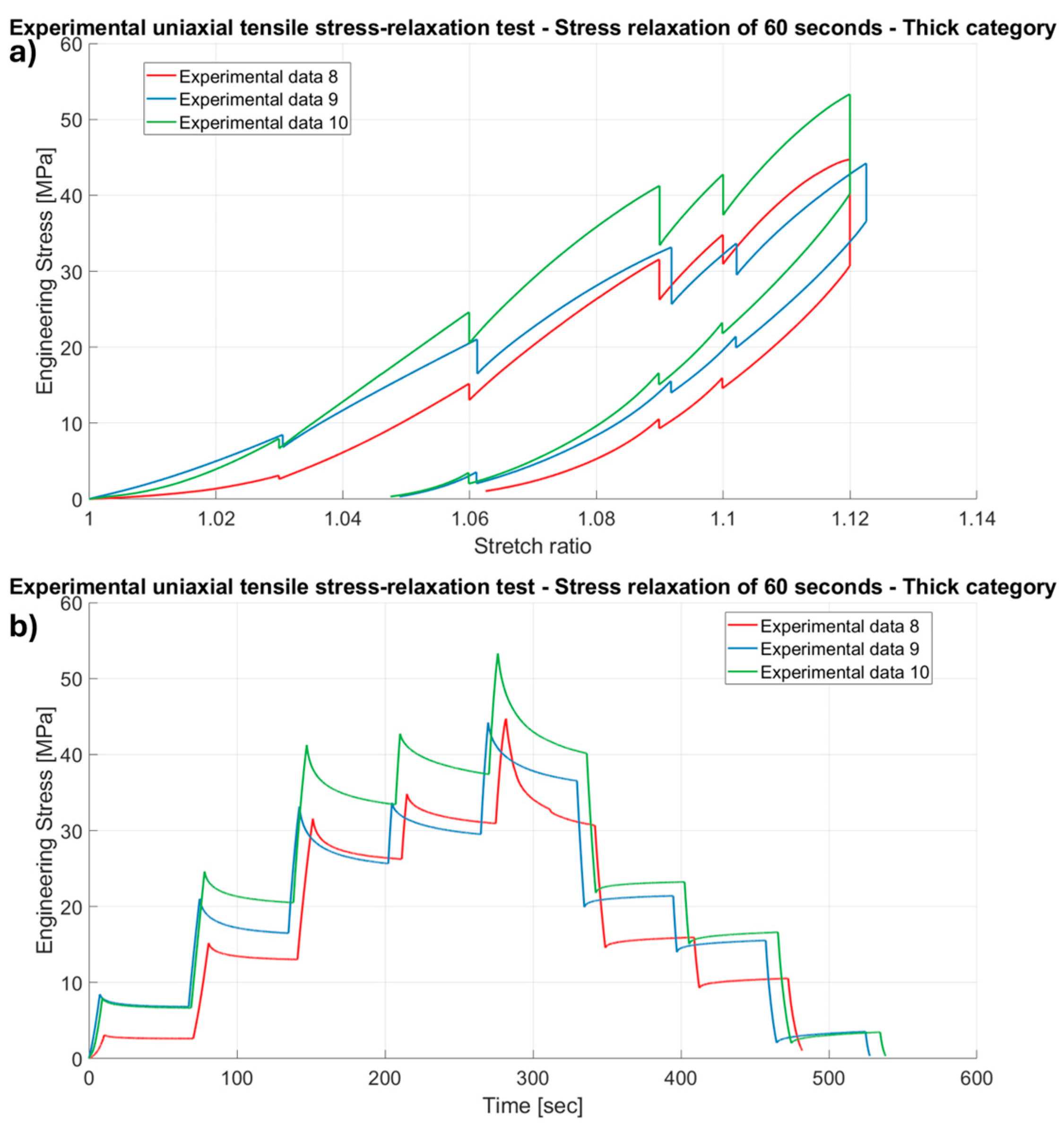
Figure 2.
Results of the experimental uniaxial tensile stress-relaxation tests on porcine FDS tendons classified in the “Thick” category, with a relaxation time of 60 s, (a) Stretch ratio vs. Engineering Stress and (b) Time vs. Engineering Stress.
Figure 2.
Results of the experimental uniaxial tensile stress-relaxation tests on porcine FDS tendons classified in the “Thick” category, with a relaxation time of 60 s, (a) Stretch ratio vs. Engineering Stress and (b) Time vs. Engineering Stress.
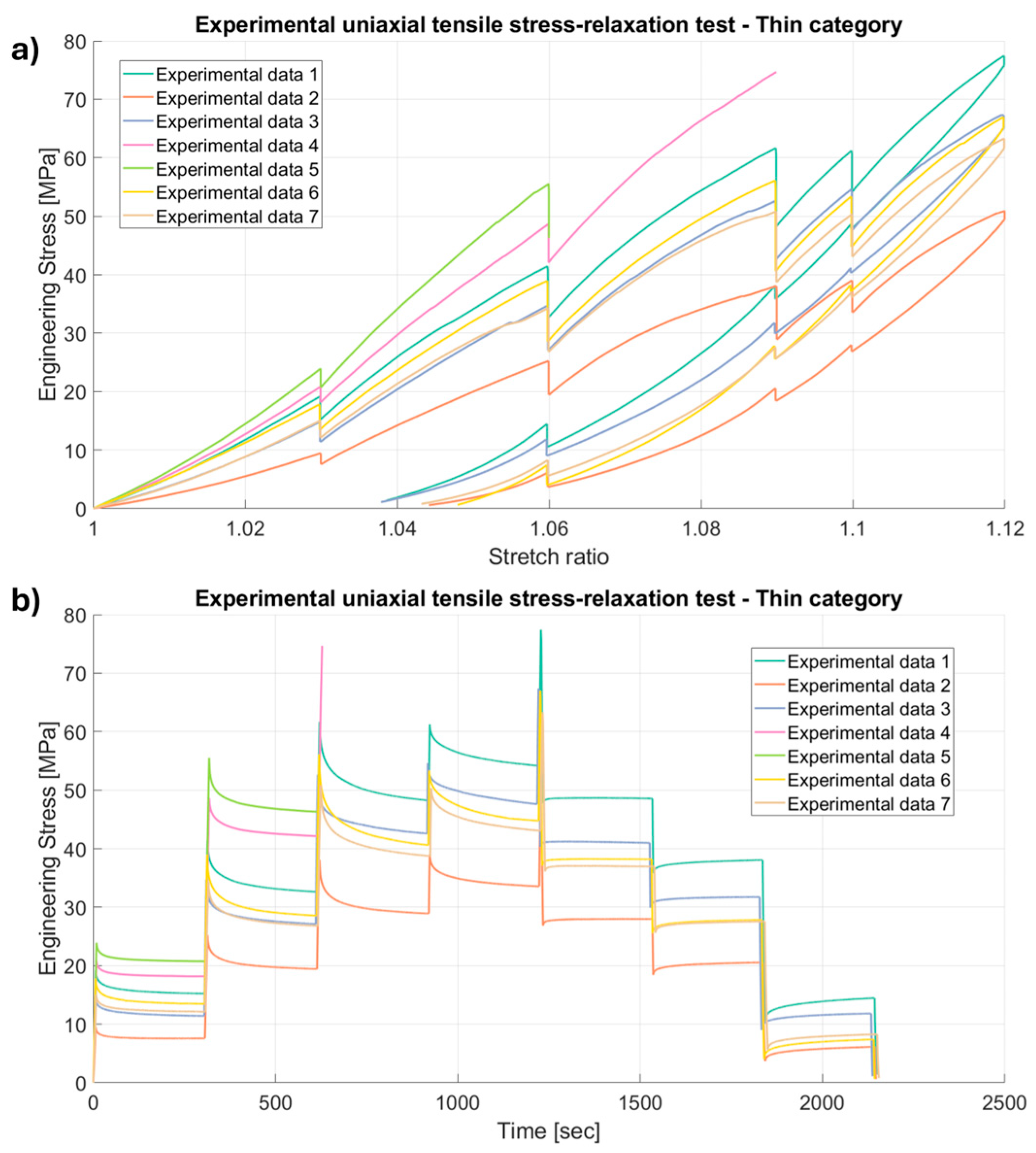
Figure 3.
Results of the experimental uniaxial tensile stress-relaxation tests on porcine FDS tendons classified in the “Thin” category, with a relaxation time of 300 s, (a) Stretch ratio vs. Engineering Stress and (b) Time vs. Engineering Stress.
Figure 3.
Results of the experimental uniaxial tensile stress-relaxation tests on porcine FDS tendons classified in the “Thin” category, with a relaxation time of 300 s, (a) Stretch ratio vs. Engineering Stress and (b) Time vs. Engineering Stress.
Figure 4.
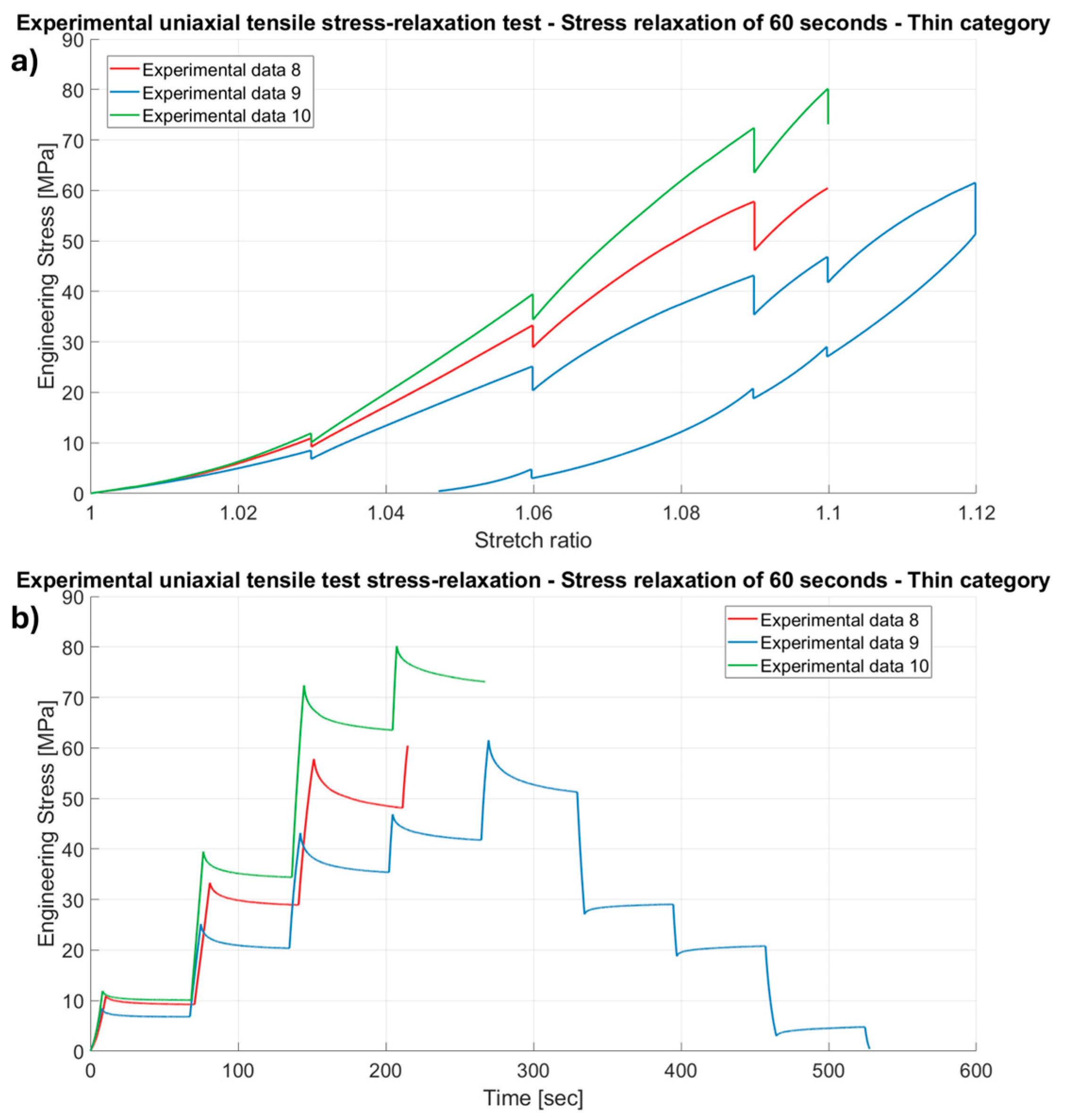
Results of the experimental uniaxial tensile stress-relaxation tests on porcine FDS tendons classified in the “Thin” category, with a relaxation time of 60 s, (a) Stretch ratio vs. Engineering Stress and (b) Time vs. Engineering Stress.
Figure 4.
Results of the experimental uniaxial tensile stress-relaxation tests on porcine FDS tendons classified in the “Thin” category, with a relaxation time of 60 s, (a) Stretch ratio vs. Engineering Stress and (b) Time vs. Engineering Stress.
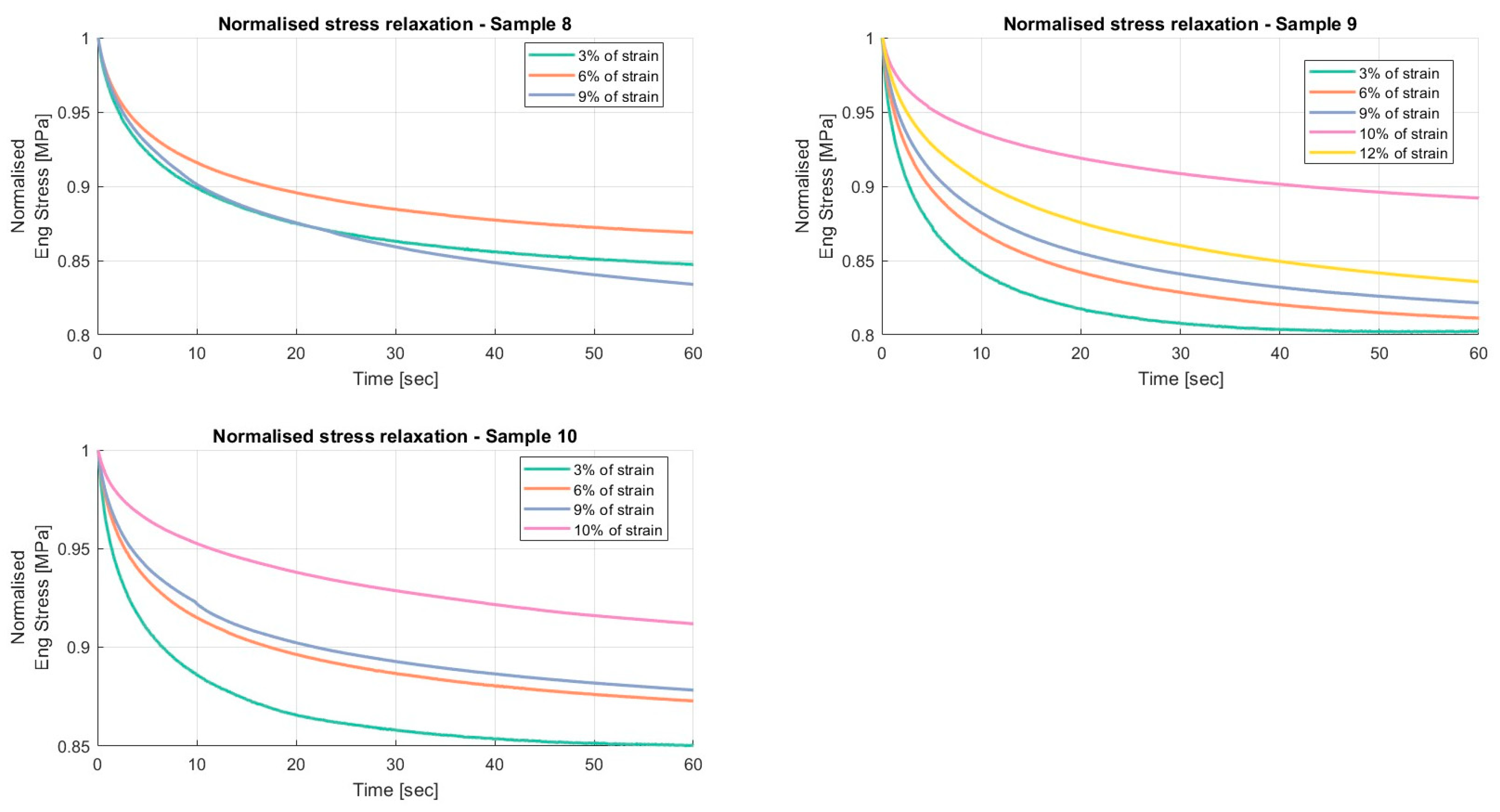
Figure 5.
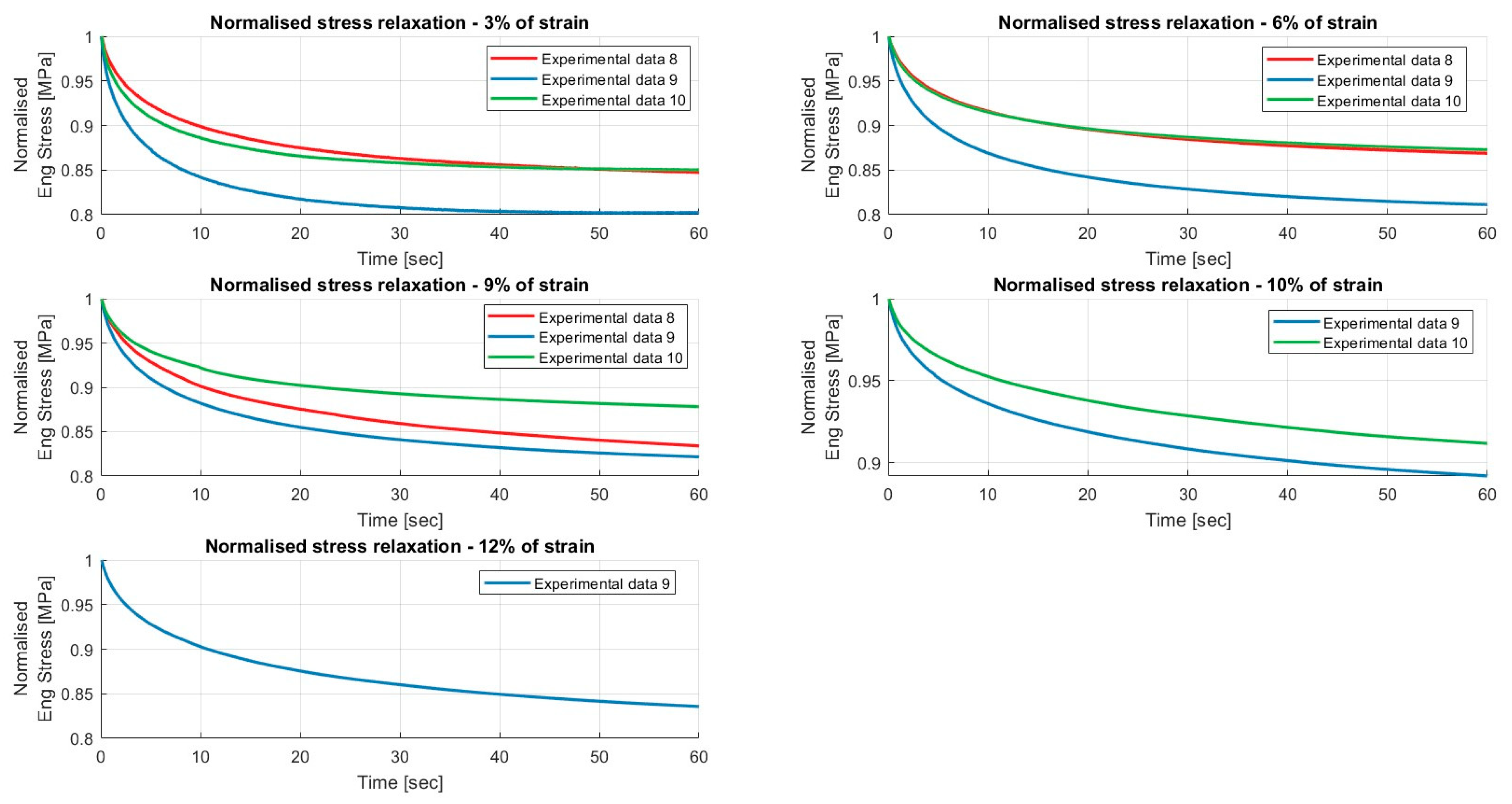
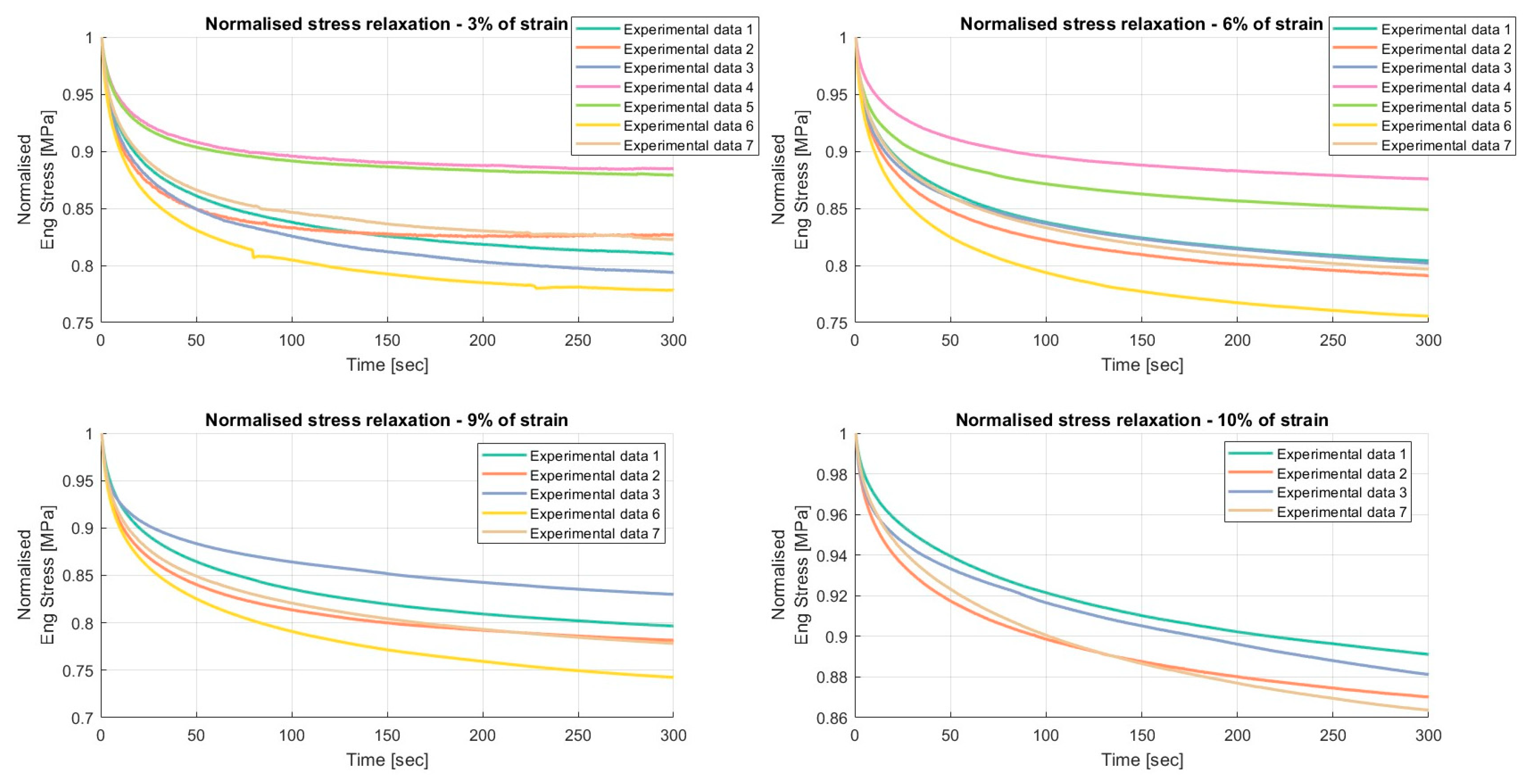
Results of the relaxation segments, during the loading phase, on porcine FDS tendons classified in the “Thick” category, with a relaxation time of 300 s. In each graph, the same normalised relaxation segment for all specimens is reported.
Figure 5.
Results of the relaxation segments, during the loading phase, on porcine FDS tendons classified in the “Thick” category, with a relaxation time of 300 s. In each graph, the same normalised relaxation segment for all specimens is reported.
Figure 6.
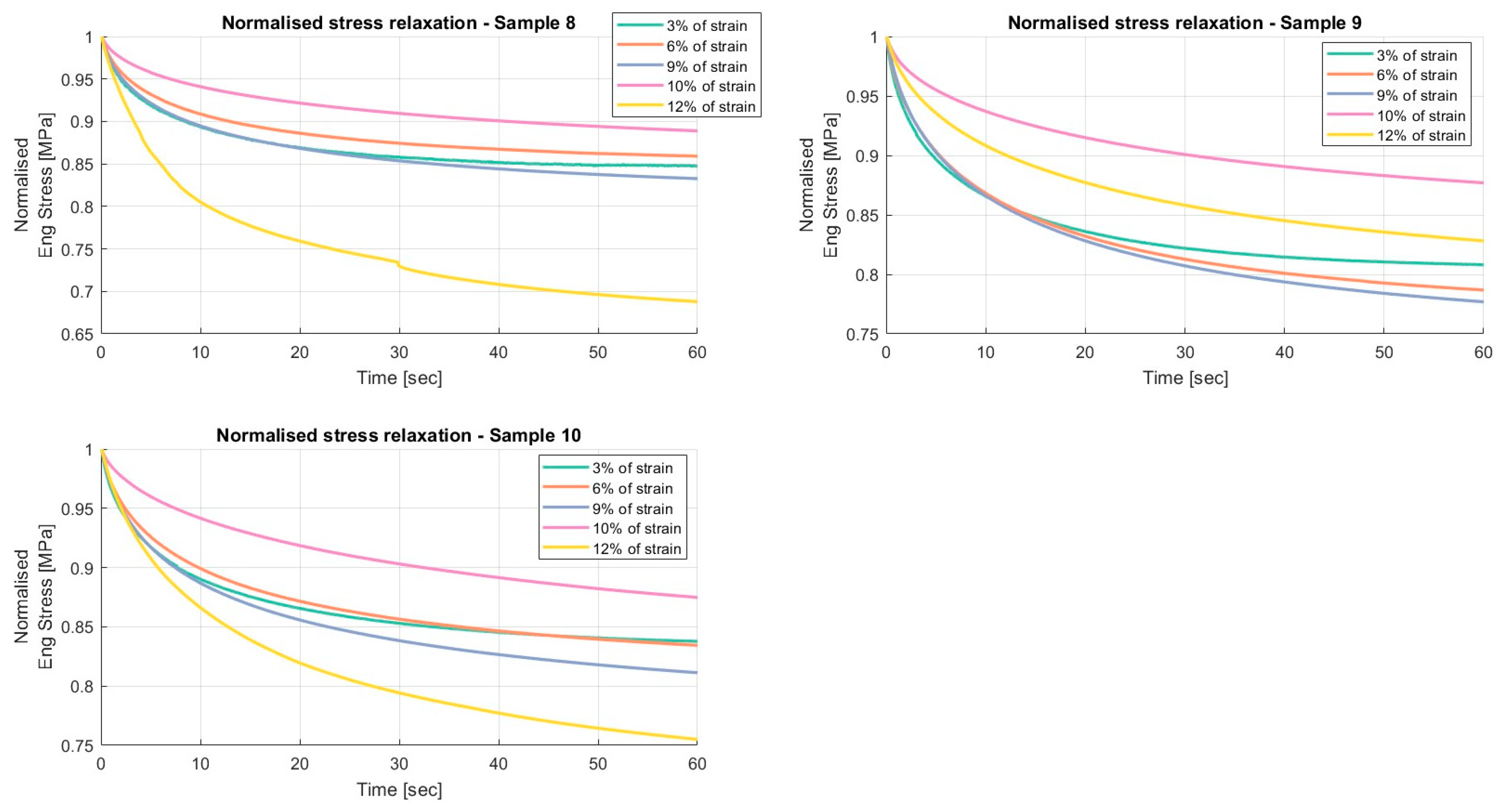
Results of the relaxation segments, during the loading phase, on porcine FDS tendons classified in the “Thick” category, with a relaxation time of 60 s. In each graph, the same normalised relaxation segment for all specimens is reported.
Figure 6.
Results of the relaxation segments, during the loading phase, on porcine FDS tendons classified in the “Thick” category, with a relaxation time of 60 s. In each graph, the same normalised relaxation segment for all specimens is reported.
Figure 7.
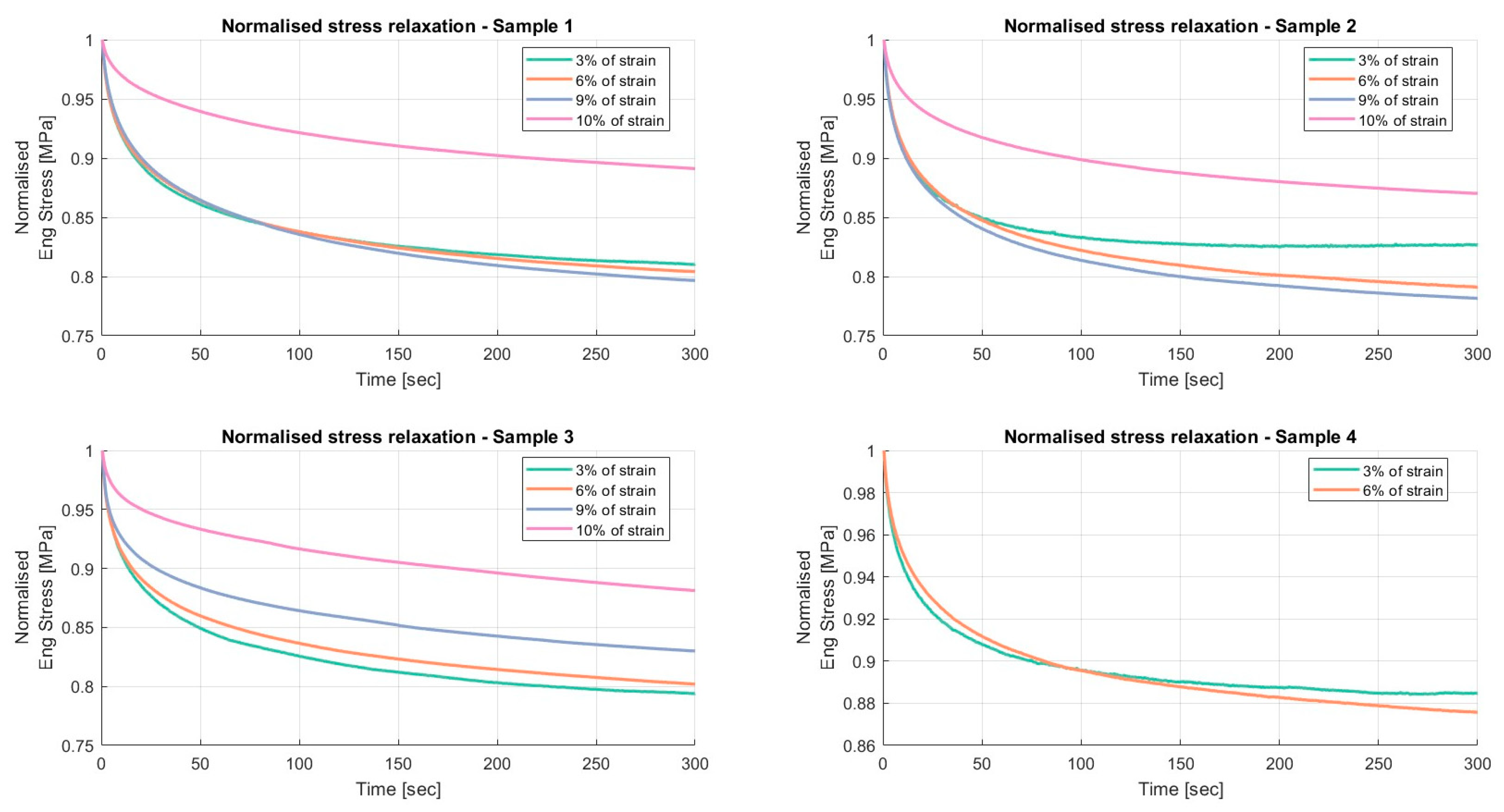
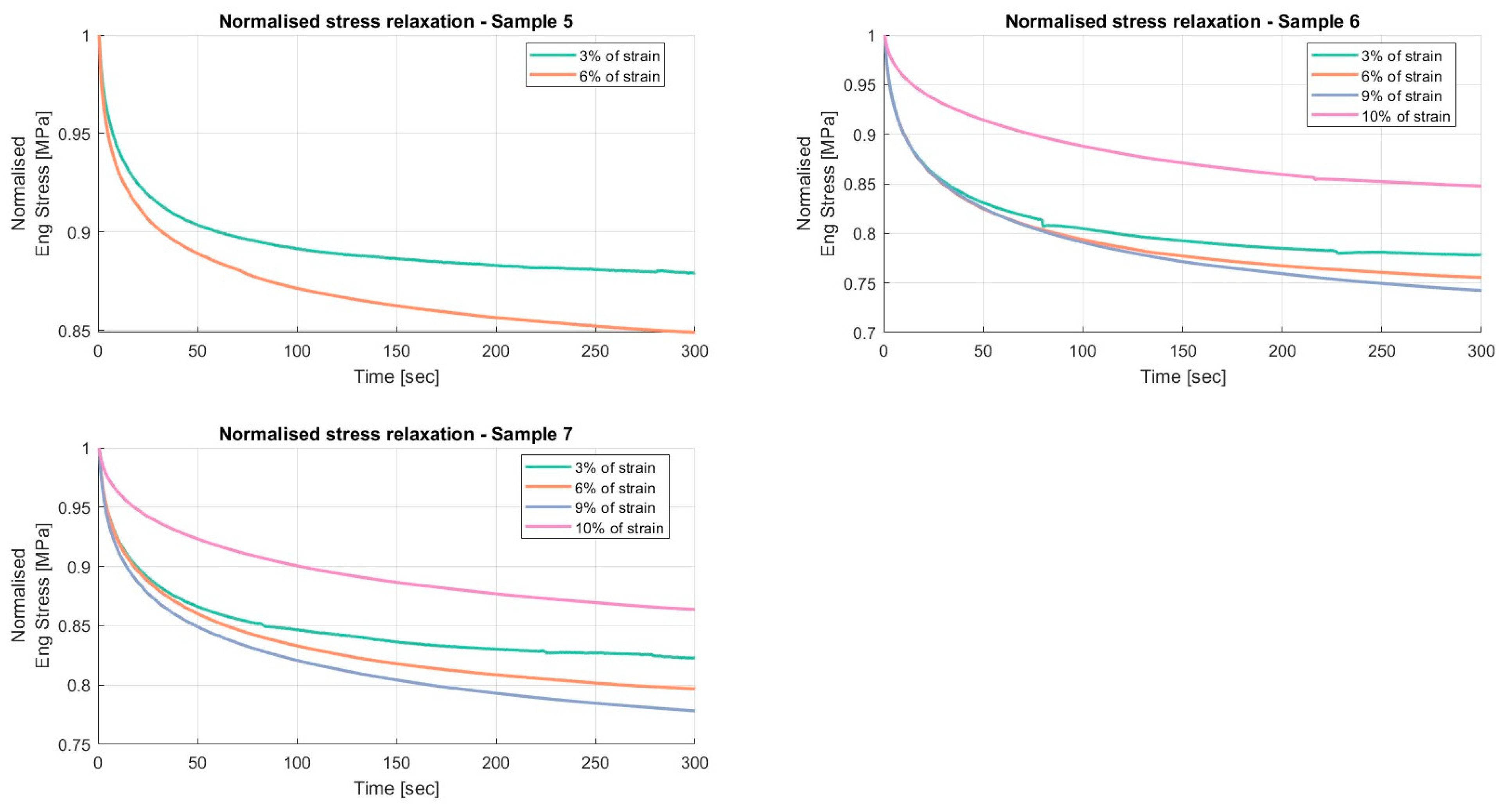
Results of the relaxation segments, during the loading phase, on porcine FDS tendons classified in the “Thick” category, with a relaxation time of 300 s. In each graph, all the normalised relaxation segments for the same specimen are reported.
Figure 7.
Results of the relaxation segments, during the loading phase, on porcine FDS tendons classified in the “Thick” category, with a relaxation time of 300 s. In each graph, all the normalised relaxation segments for the same specimen are reported.
Figure 8.
Results of the relaxation segments, during the loading phase, on porcine FDS tendons classified in the “Thick” category, with a relaxation time of 60 s. In each graph, all the normalised relaxation segments for the same specimen are reported.
Figure 8.
Results of the relaxation segments, during the loading phase, on porcine FDS tendons classified in the “Thick” category, with a relaxation time of 60 s. In each graph, all the normalised relaxation segments for the same specimen are reported.
Figure 9.
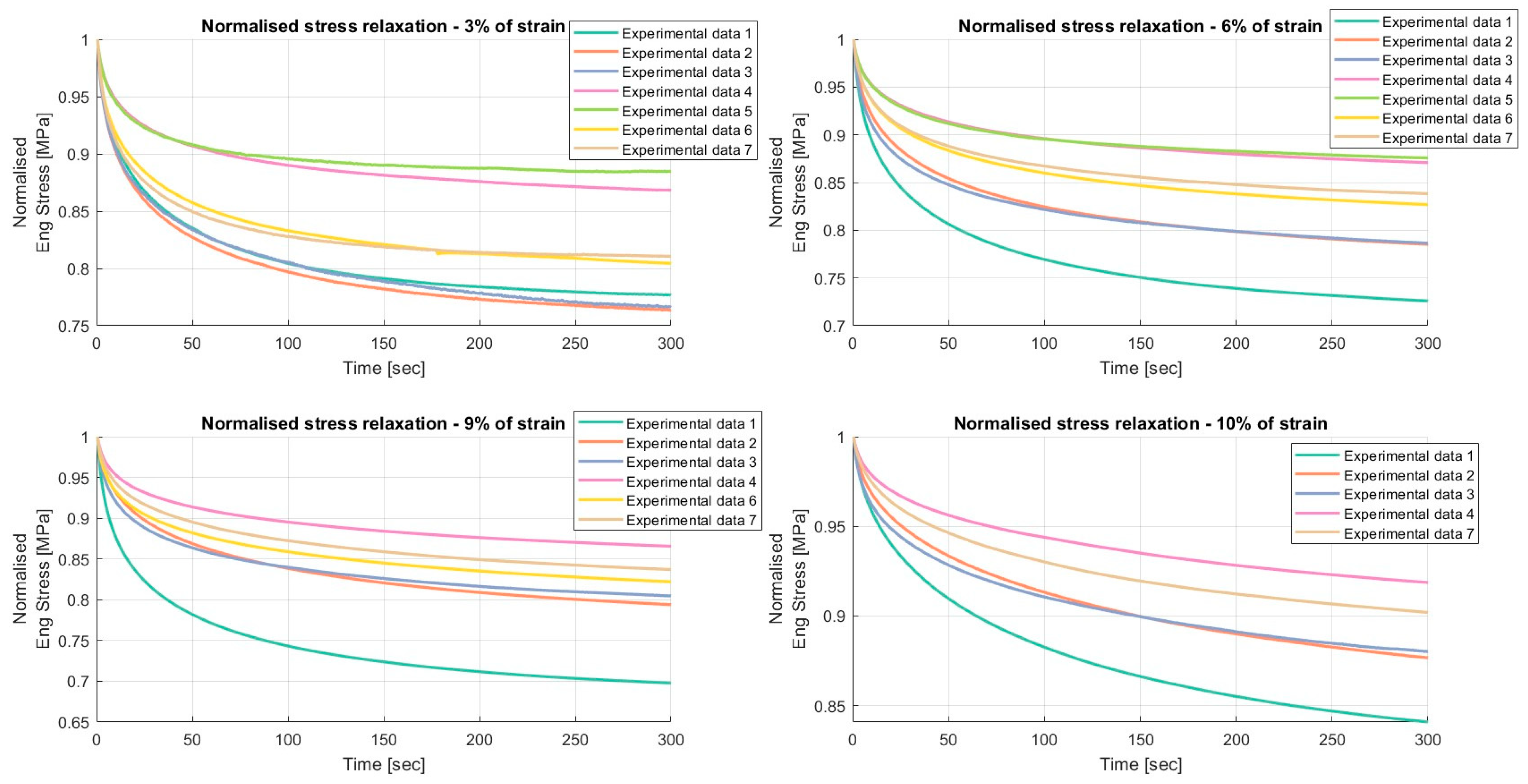
Results of the relaxation segments, during the loading phase, on porcine FDS tendons classified in the “Thin” category, with a relaxation time of 300 s. In each graph, the same normalised relaxation segment for all specimens is reported.
Figure 9.
Results of the relaxation segments, during the loading phase, on porcine FDS tendons classified in the “Thin” category, with a relaxation time of 300 s. In each graph, the same normalised relaxation segment for all specimens is reported.
Figure 10.
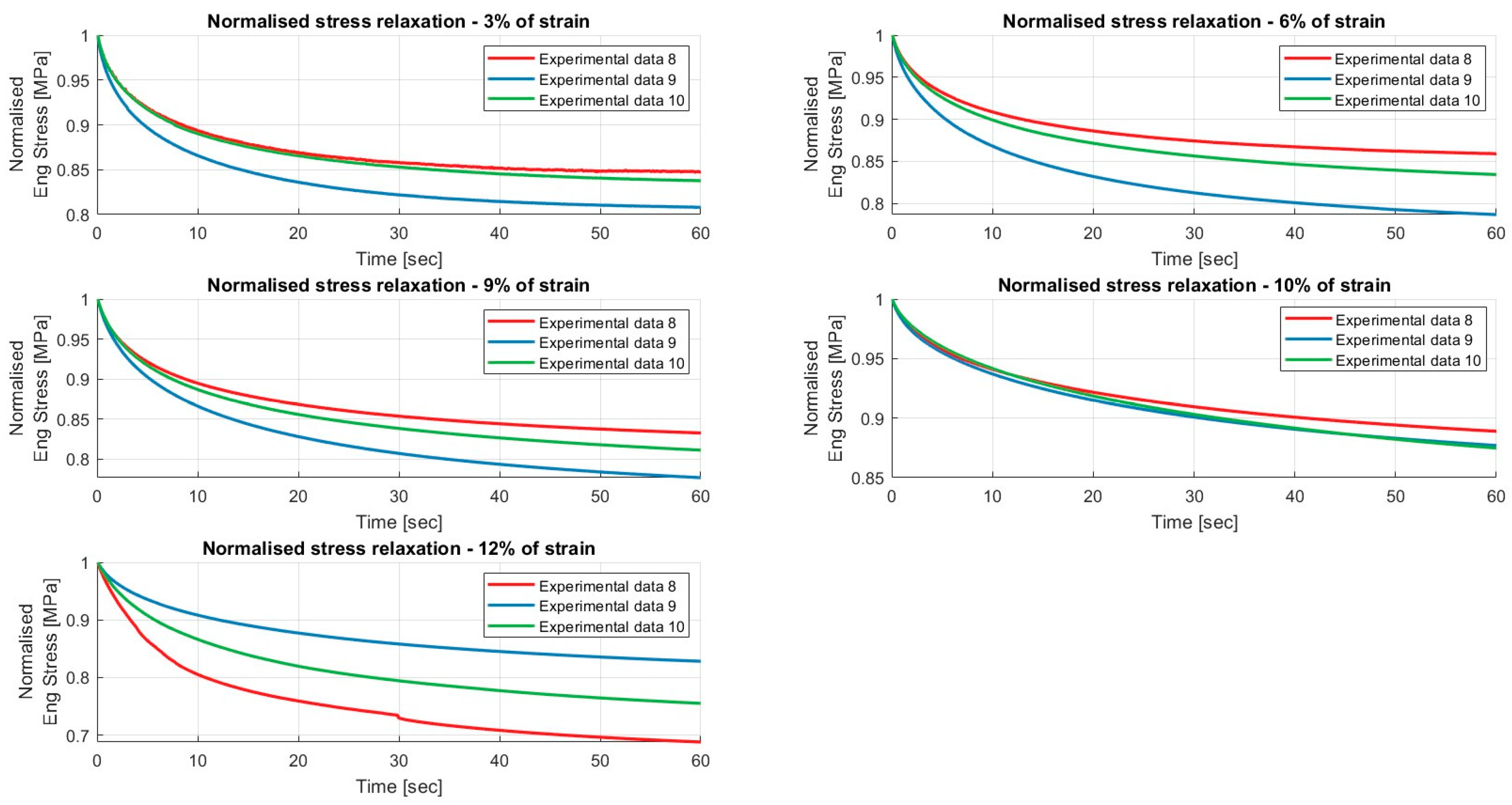
Results of the relaxation segments, during the loading phase, on porcine FDS tendons classified in the “Thin” category, with a relaxation time of 60 s. In each graph, the same normalised relaxation segment for all specimens is reported.
Figure 10.
Results of the relaxation segments, during the loading phase, on porcine FDS tendons classified in the “Thin” category, with a relaxation time of 60 s. In each graph, the same normalised relaxation segment for all specimens is reported.
Figure 11.
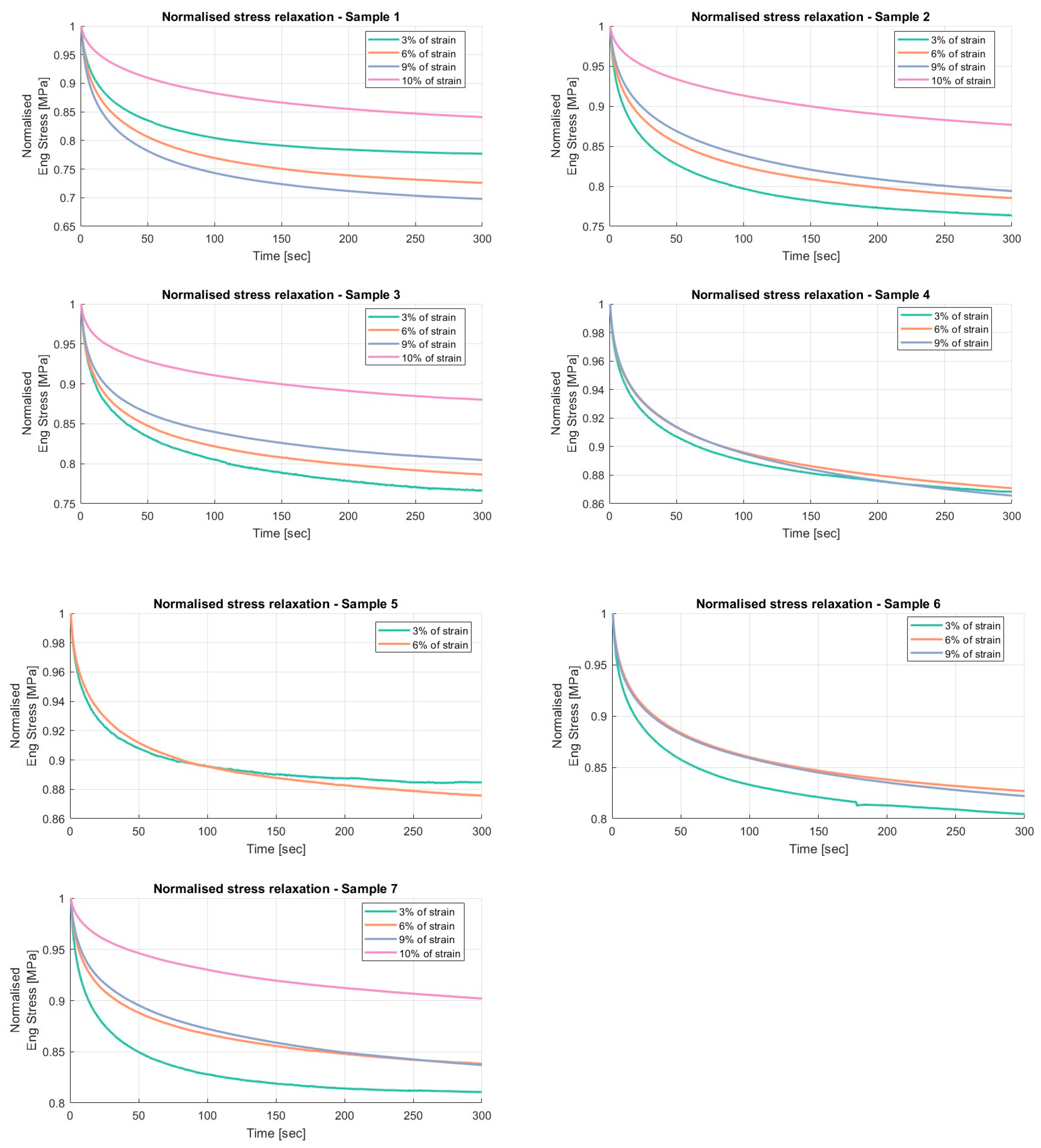
Results of the relaxation segments, during the loading phase, on porcine FDS tendons classified in the “Thin” category, with a relaxation time of 300 s. In each graph, all the normalised relaxation segments for the same specimen are reported.
Figure 11.
Results of the relaxation segments, during the loading phase, on porcine FDS tendons classified in the “Thin” category, with a relaxation time of 300 s. In each graph, all the normalised relaxation segments for the same specimen are reported.
Figure 12.
Results of the relaxation segments, during the loading phase, on porcine FDS tendons classified in the “Thin” category, with a relaxation time of 60 s. In each graph, all the normalised relaxation segments for the same specimen are reported.
Figure 12.
Results of the relaxation segments, during the loading phase, on porcine FDS tendons classified in the “Thin” category, with a relaxation time of 60 s. In each graph, all the normalised relaxation segments for the same specimen are reported.
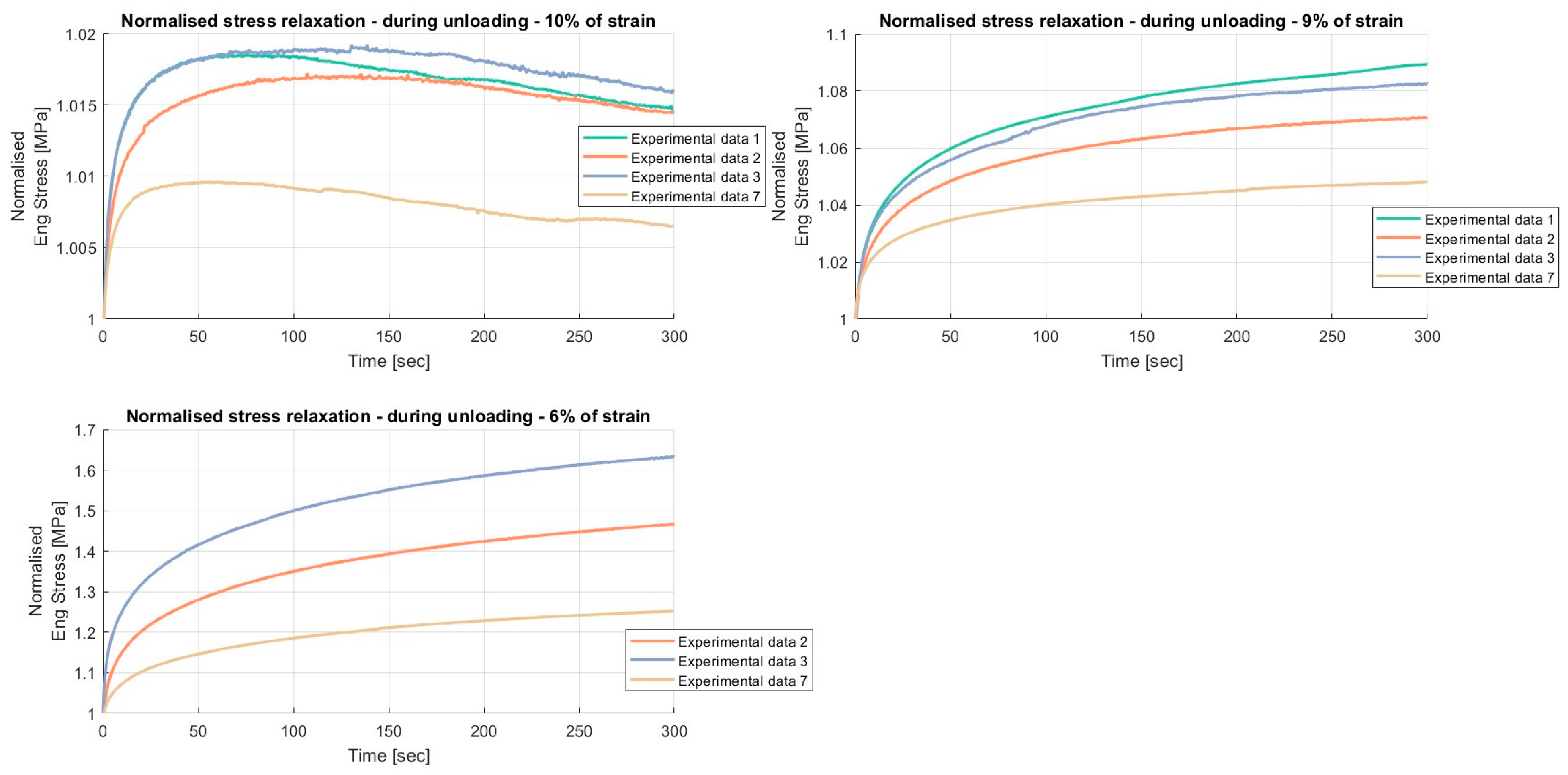
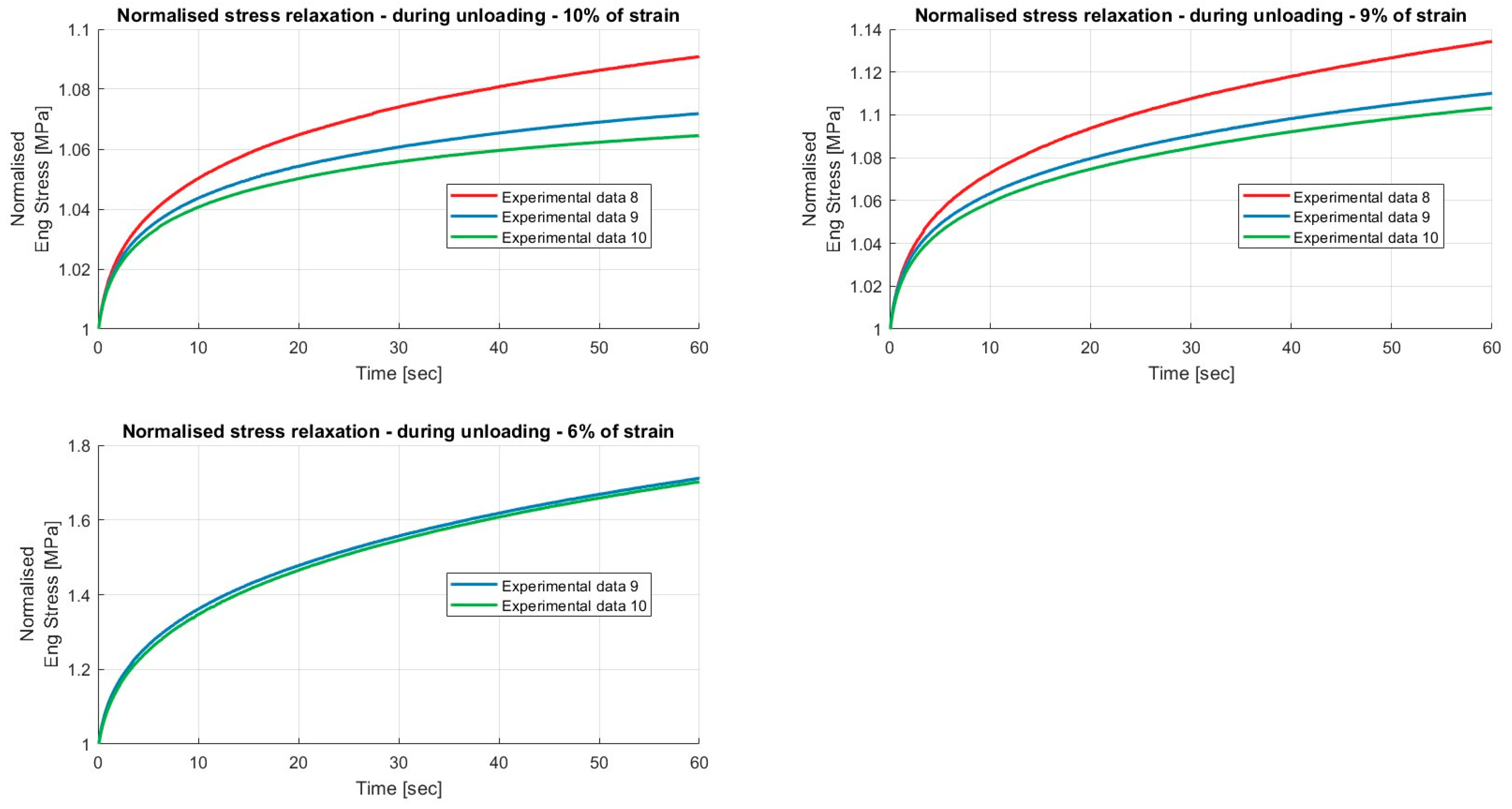
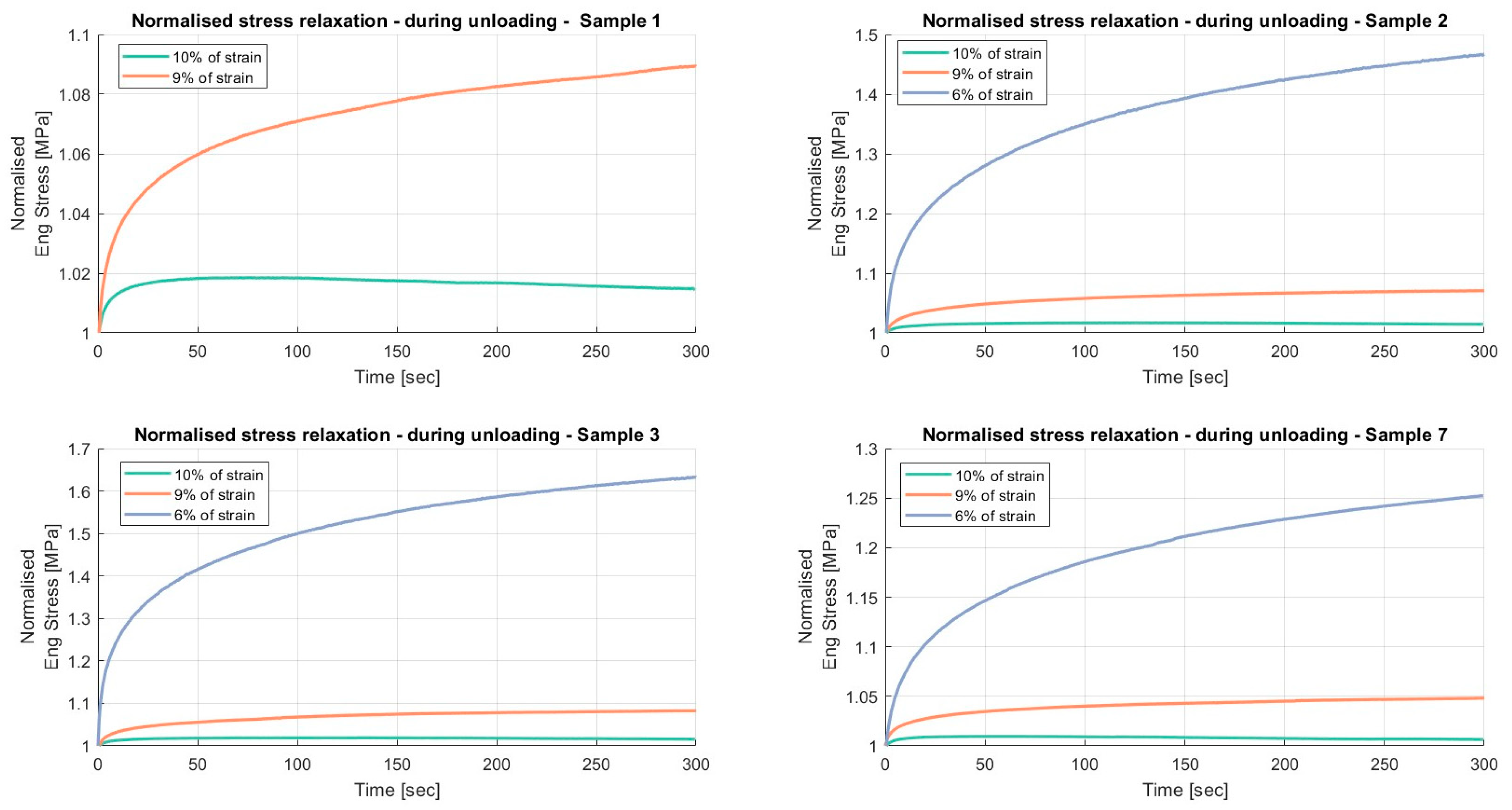
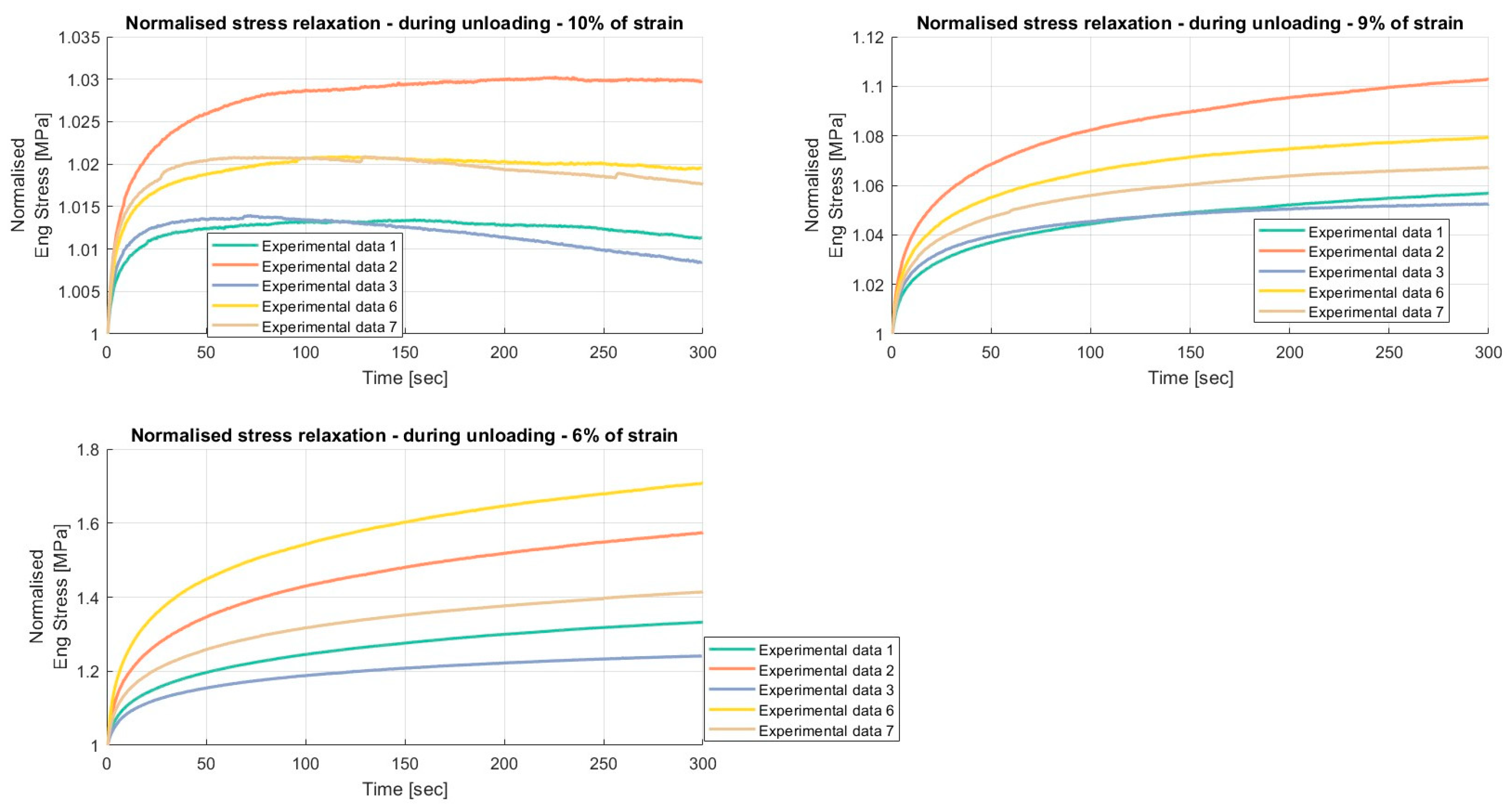
Figure 13.
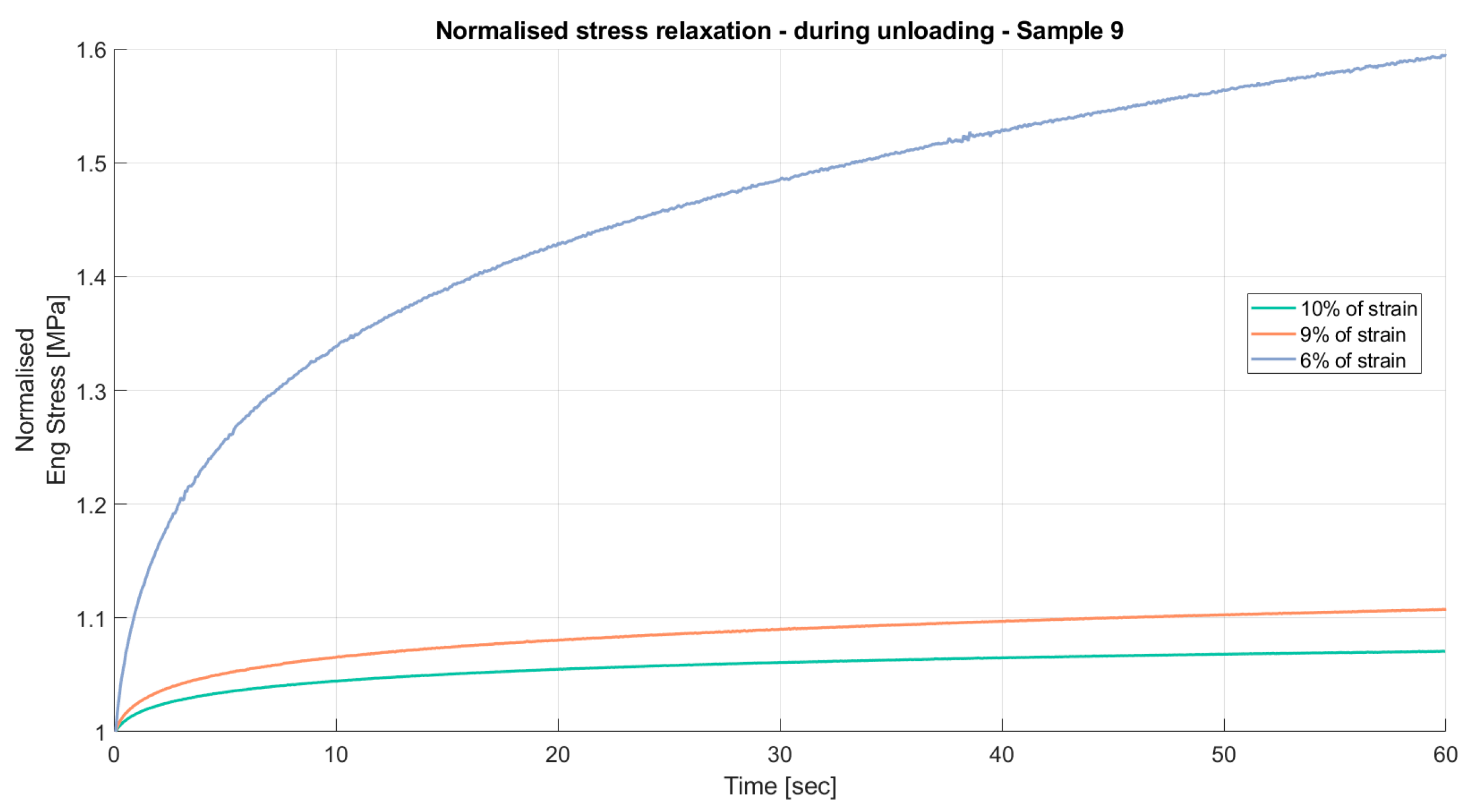
Results of the relaxation segments, during the unloading phase, on porcine FDS tendons classified in the “Thick” category, with a relaxation time of 300 s. In each graph, the same normalised relaxation segment for all specimens is reported.
Figure 13.
Results of the relaxation segments, during the unloading phase, on porcine FDS tendons classified in the “Thick” category, with a relaxation time of 300 s. In each graph, the same normalised relaxation segment for all specimens is reported.
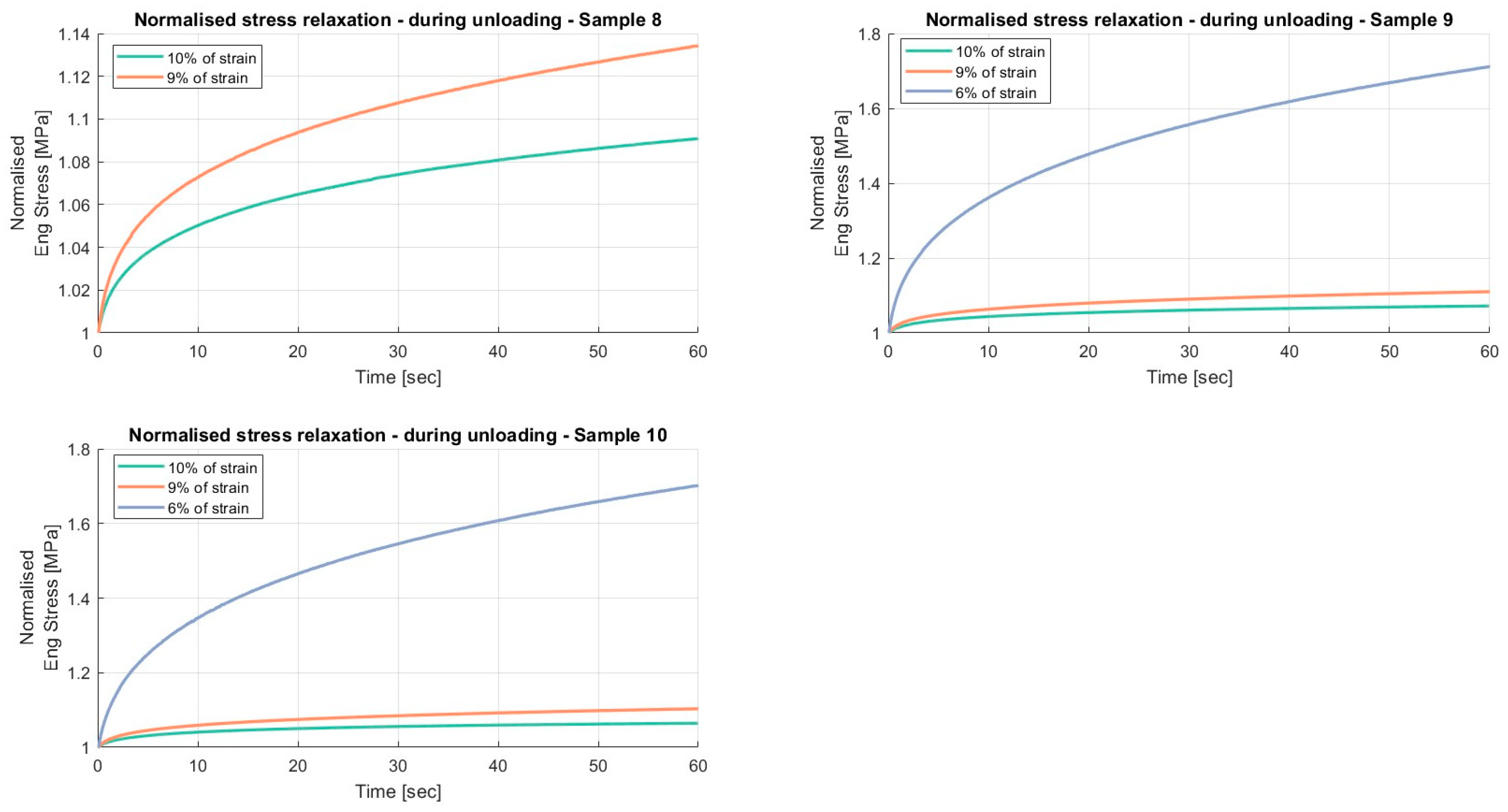
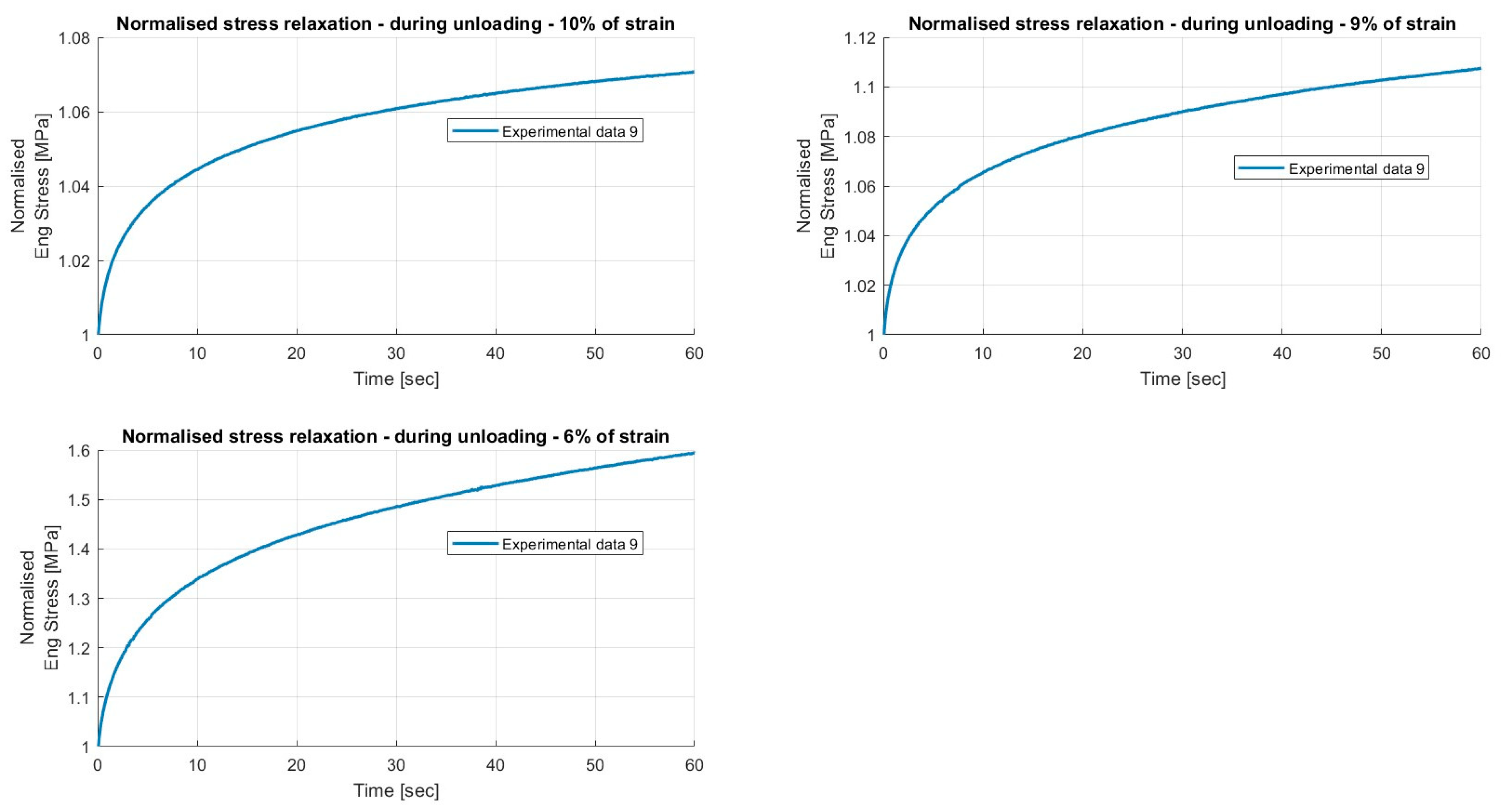
Figure 14.
Results of the relaxation segments, during the unloading phase, on porcine FDS tendons classified in the “Thick” category, with a relaxation time of 60 s. In each graph, the same normalised relaxation segment for all specimens is reported.
Figure 14.
Results of the relaxation segments, during the unloading phase, on porcine FDS tendons classified in the “Thick” category, with a relaxation time of 60 s. In each graph, the same normalised relaxation segment for all specimens is reported.
Figure 15.
Results of the relaxation segments, during the unloading phase, on porcine FDS tendons classified in the “Thick” category, with a relaxation time of 300 s. In each graph, all the normalised relaxation segments for the same specimen are reported.
Figure 15.
Results of the relaxation segments, during the unloading phase, on porcine FDS tendons classified in the “Thick” category, with a relaxation time of 300 s. In each graph, all the normalised relaxation segments for the same specimen are reported.
Figure 16.
Results of the relaxation segments, during the unloading phase, on porcine FDS tendons classified in the “Thick” category, with a relaxation time of 60 s. In each graph, all the normalised relaxation segments for the same specimen are reported.
Figure 16.
Results of the relaxation segments, during the unloading phase, on porcine FDS tendons classified in the “Thick” category, with a relaxation time of 60 s. In each graph, all the normalised relaxation segments for the same specimen are reported.
Figure 17.
Results of the relaxation segments, during the unloading phase, on porcine FDS tendons classified in the “Thin” category, with a relaxation time of 300 s. In each graph, the same normalised relaxation segment for all specimens is reported.
Figure 17.
Results of the relaxation segments, during the unloading phase, on porcine FDS tendons classified in the “Thin” category, with a relaxation time of 300 s. In each graph, the same normalised relaxation segment for all specimens is reported.
Figure 18.
Results of the relaxation segments, during the unloading phase, on porcine FDS tendons classified in the “Thin” category, with a relaxation time of 60 s. In each graph, the same normalised relaxation segment for all specimens is reported.
Figure 18.
Results of the relaxation segments, during the unloading phase, on porcine FDS tendons classified in the “Thin” category, with a relaxation time of 60 s. In each graph, the same normalised relaxation segment for all specimens is reported.
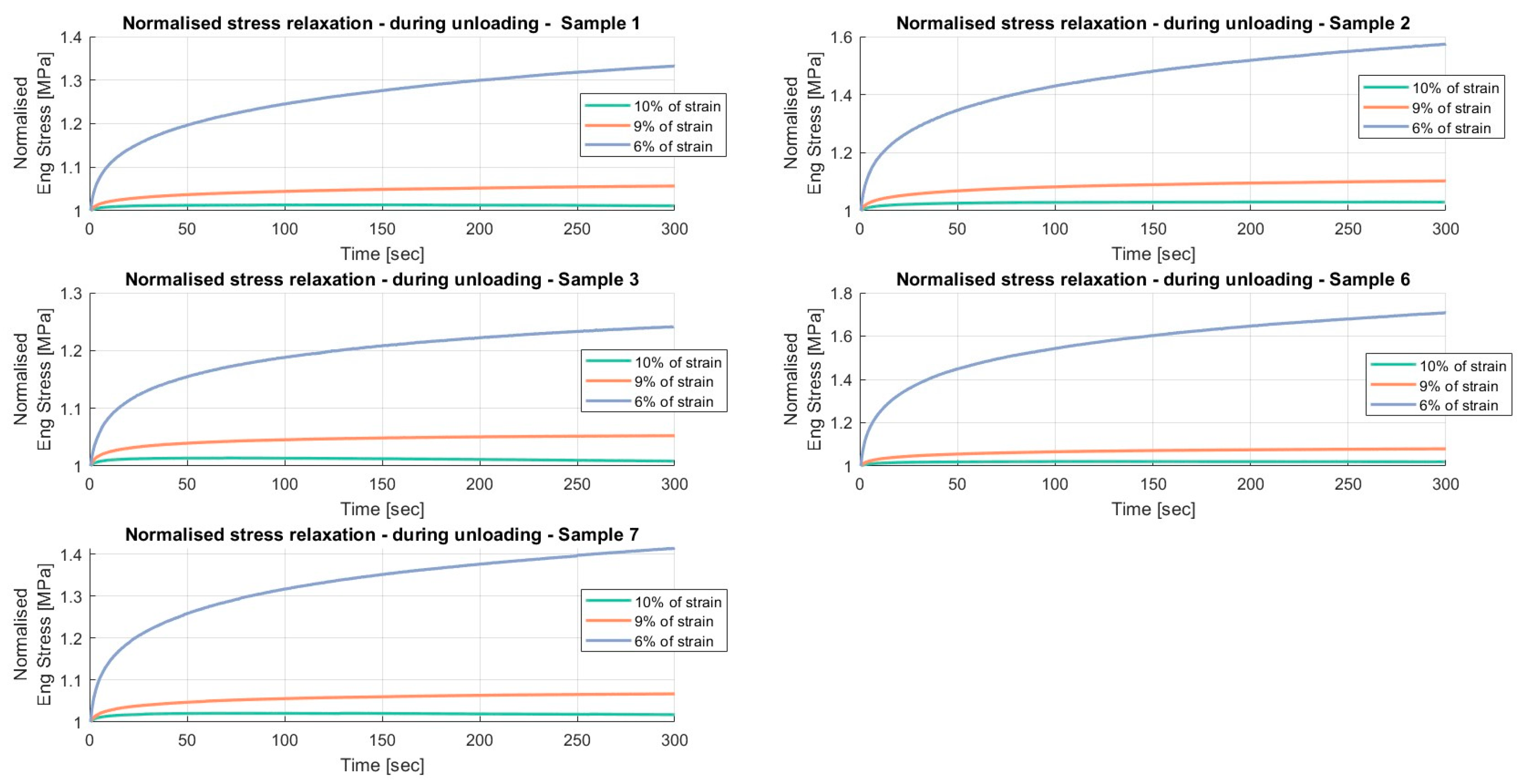
Figure 19.
Results of the relaxation segments, during the unloading phase, on porcine FDS tendons classified in the “Thin” category, with a relaxation time of 300 s. In each graph, all the normalised relaxation segments for the same specimen are reported.
Figure 19.
Results of the relaxation segments, during the unloading phase, on porcine FDS tendons classified in the “Thin” category, with a relaxation time of 300 s. In each graph, all the normalised relaxation segments for the same specimen are reported.
Figure 20.
Results of the relaxation segments, during the unloading phase, on porcine FDS tendons classified in the “Thin” category, with a relaxation time of 60 s. In each graph, all the normalised relaxation segments for the same specimen are reported.
Figure 20.
Results of the relaxation segments, during the unloading phase, on porcine FDS tendons classified in the “Thin” category, with a relaxation time of 60 s. In each graph, all the normalised relaxation segments for the same specimen are reported.
Figure 21.
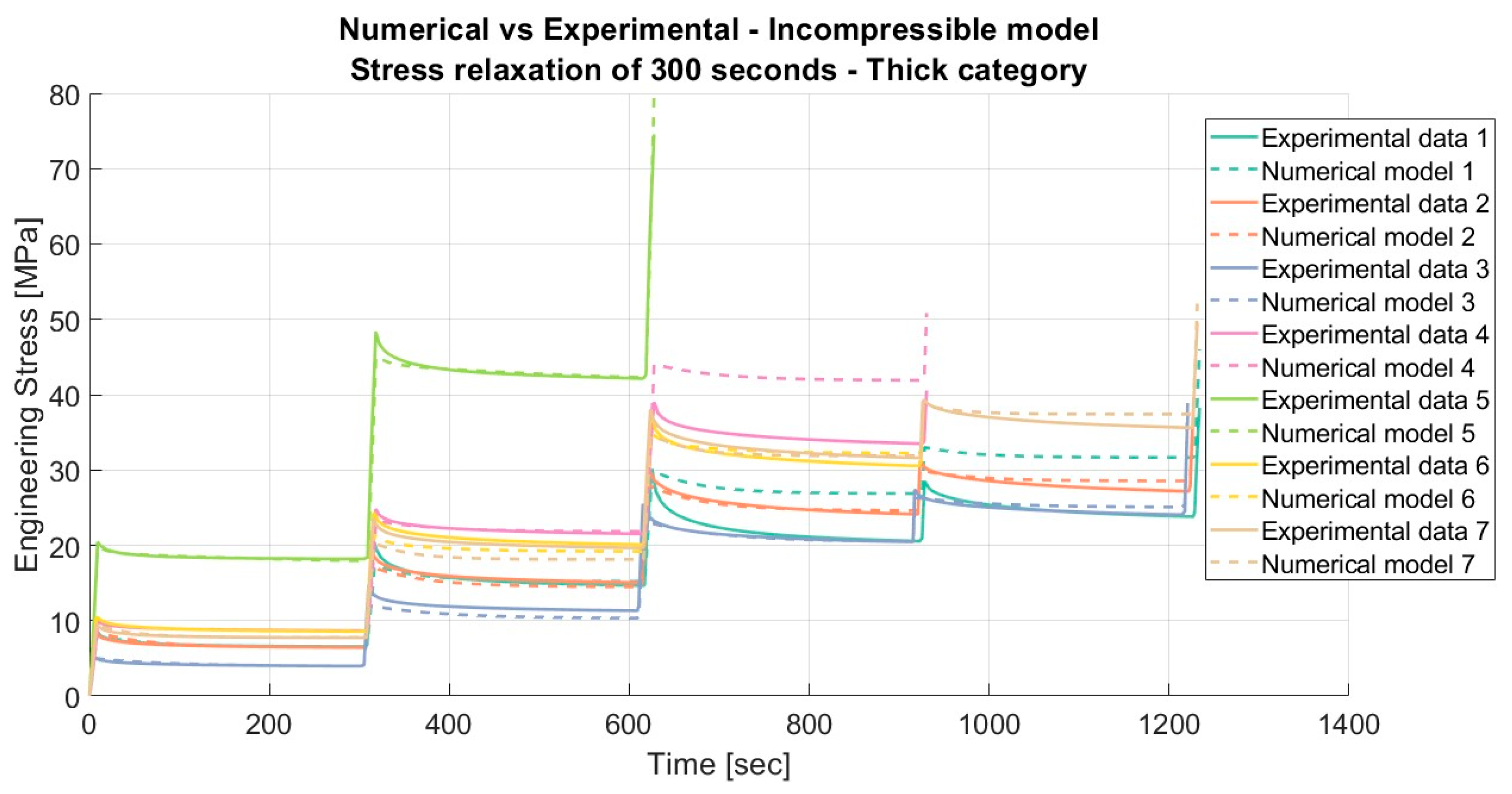
Results of the calibration procedure for the incompressible material model on porcine FDS tendons classified in the “Thick” category, with a relaxation time of 300 s.
Figure 21.
Results of the calibration procedure for the incompressible material model on porcine FDS tendons classified in the “Thick” category, with a relaxation time of 300 s.
Figure 22.
Results of the calibration procedure for the incompressible material model on porcine FDS tendons classified in the “Thick” category, with a relaxation time of 60 s.
Figure 22.
Results of the calibration procedure for the incompressible material model on porcine FDS tendons classified in the “Thick” category, with a relaxation time of 60 s.
Figure 23.
Results of the calibration procedure for the incompressible material model on porcine FDS tendons declassified in the “Thin” category, with a relaxation time of 300 s.
Figure 23.
Results of the calibration procedure for the incompressible material model on porcine FDS tendons declassified in the “Thin” category, with a relaxation time of 300 s.
Figure 24.
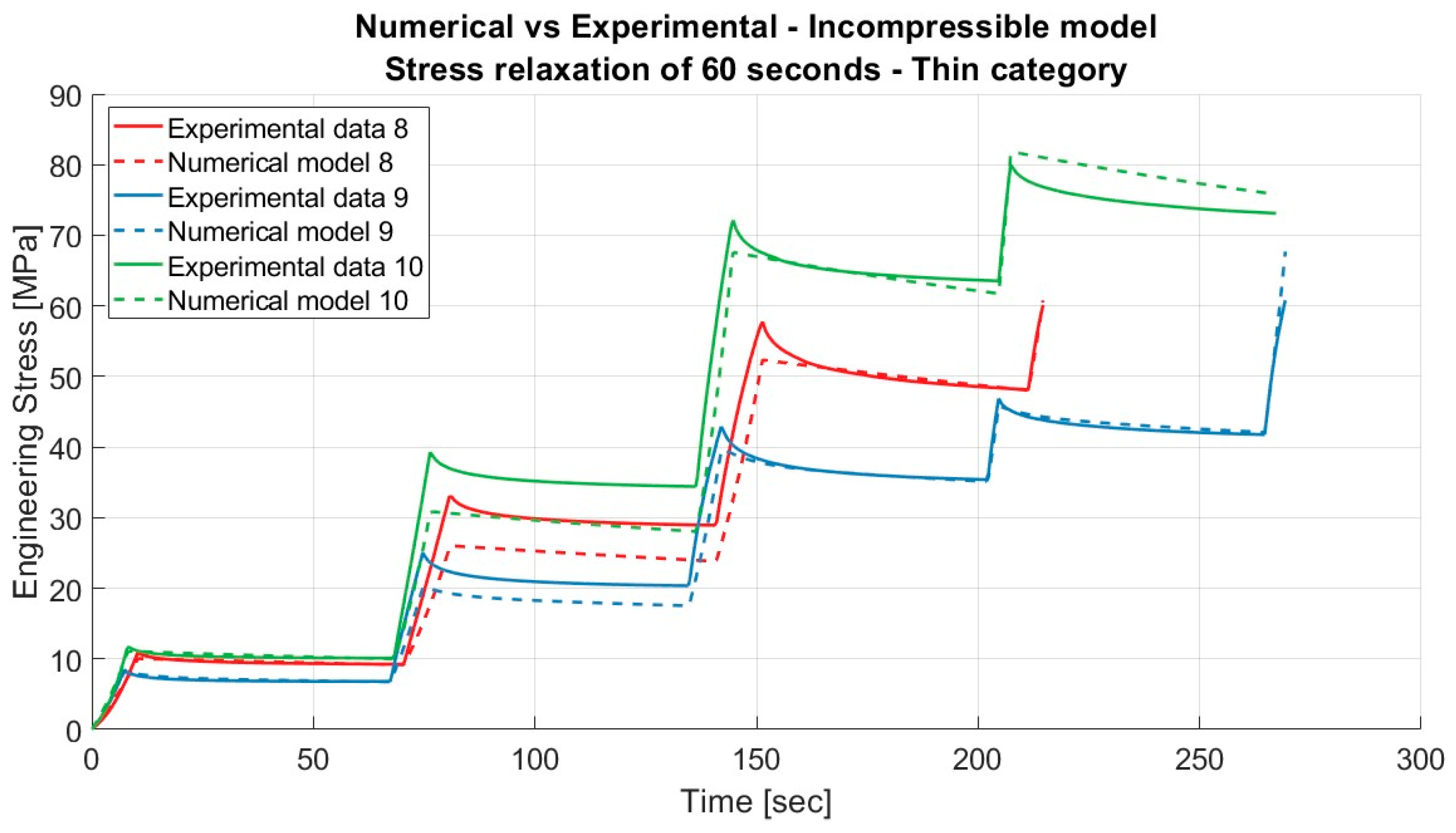
Results of the calibration procedure for the incompressible material model on porcine FDS tendons classified in the “Thin” category, with a relaxation time of 60 s.
Figure 24.
Results of the calibration procedure for the incompressible material model on porcine FDS tendons classified in the “Thin” category, with a relaxation time of 60 s.
Figure 25.
Results of the calibration procedure for the nearly incompressible material model on porcine FDS tendons classified in the “Thick” category, with a relaxation time of 300 s.
Figure 25.
Results of the calibration procedure for the nearly incompressible material model on porcine FDS tendons classified in the “Thick” category, with a relaxation time of 300 s.
Figure 26.
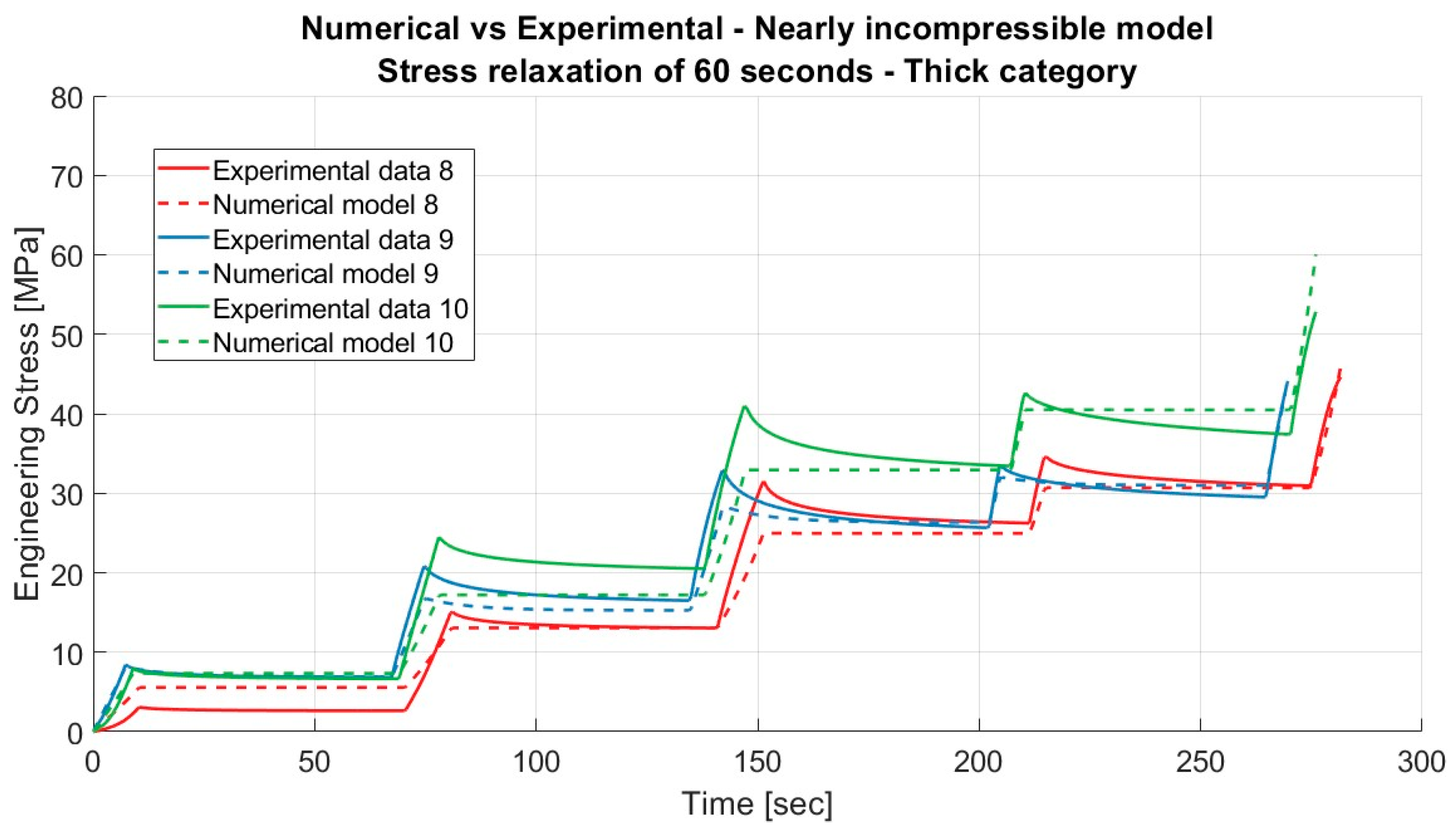
Results of the calibration procedure for the nearly incompressible material model on porcine FDS tendons classified in the “Thick” category, with a relaxation time of 60 s.
Figure 26.
Results of the calibration procedure for the nearly incompressible material model on porcine FDS tendons classified in the “Thick” category, with a relaxation time of 60 s.
Figure 27.
Results of the calibration procedure for the nearly incompressible material model on porcine FDS tendons classified in the “Thin” category, with a relaxation time of 300 s.
Figure 27.
Results of the calibration procedure for the nearly incompressible material model on porcine FDS tendons classified in the “Thin” category, with a relaxation time of 300 s.
Figure 28.
Results of the calibration procedure for the nearly incompressible material model on porcine FDS tendons classified in the “Thin” category, with a relaxation time of 60 s.
Figure 28.
Results of the calibration procedure for the nearly incompressible material model on porcine FDS tendons classified in the “Thin” category, with a relaxation time of 60 s.
Figure 29.
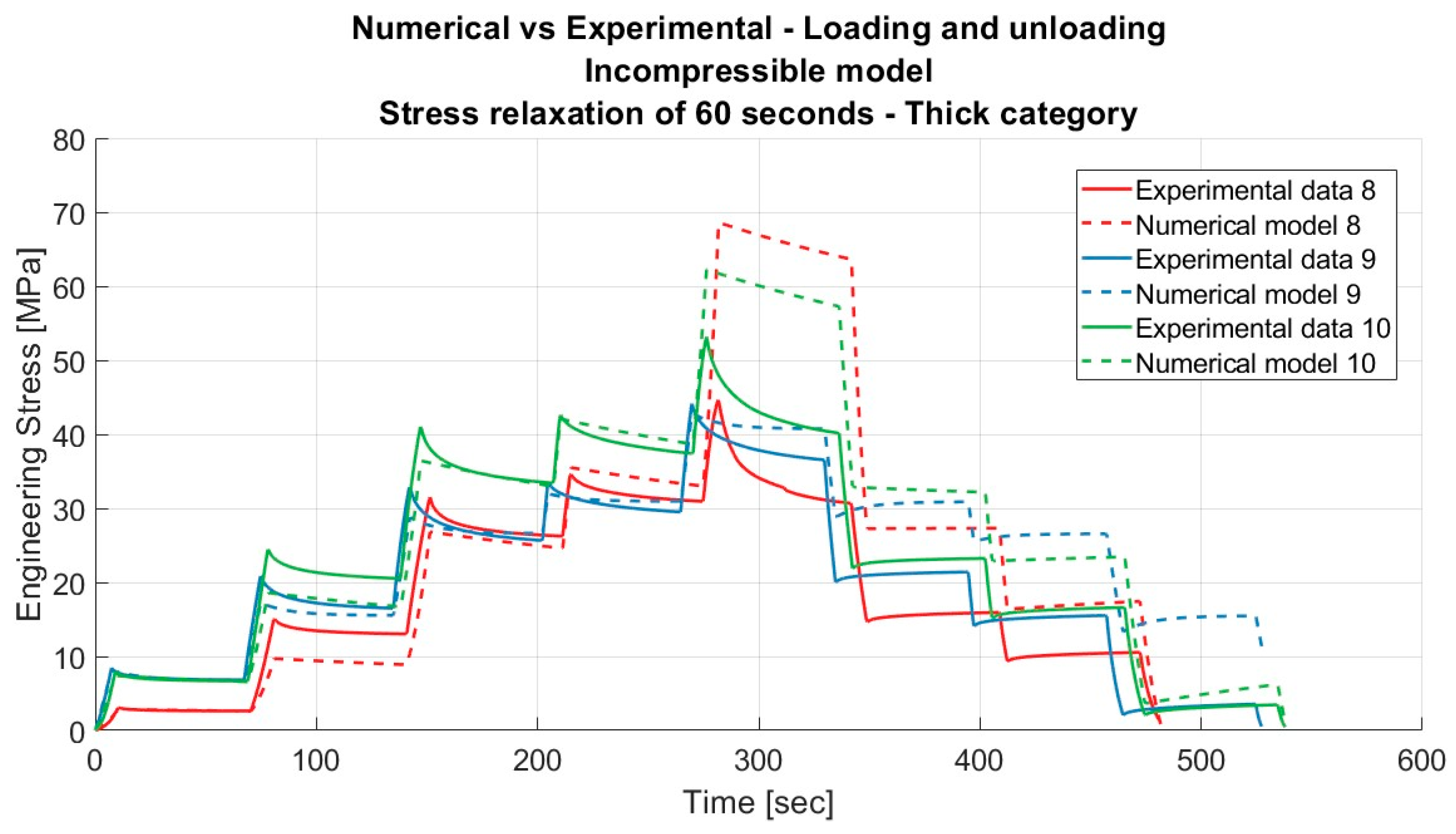
Results for the incompressible material model applied to porcine FDS tendons of the “Thick” category for loading and unloading, with a relaxation time of 300 s.
Figure 29.
Results for the incompressible material model applied to porcine FDS tendons of the “Thick” category for loading and unloading, with a relaxation time of 300 s.
Figure 30.
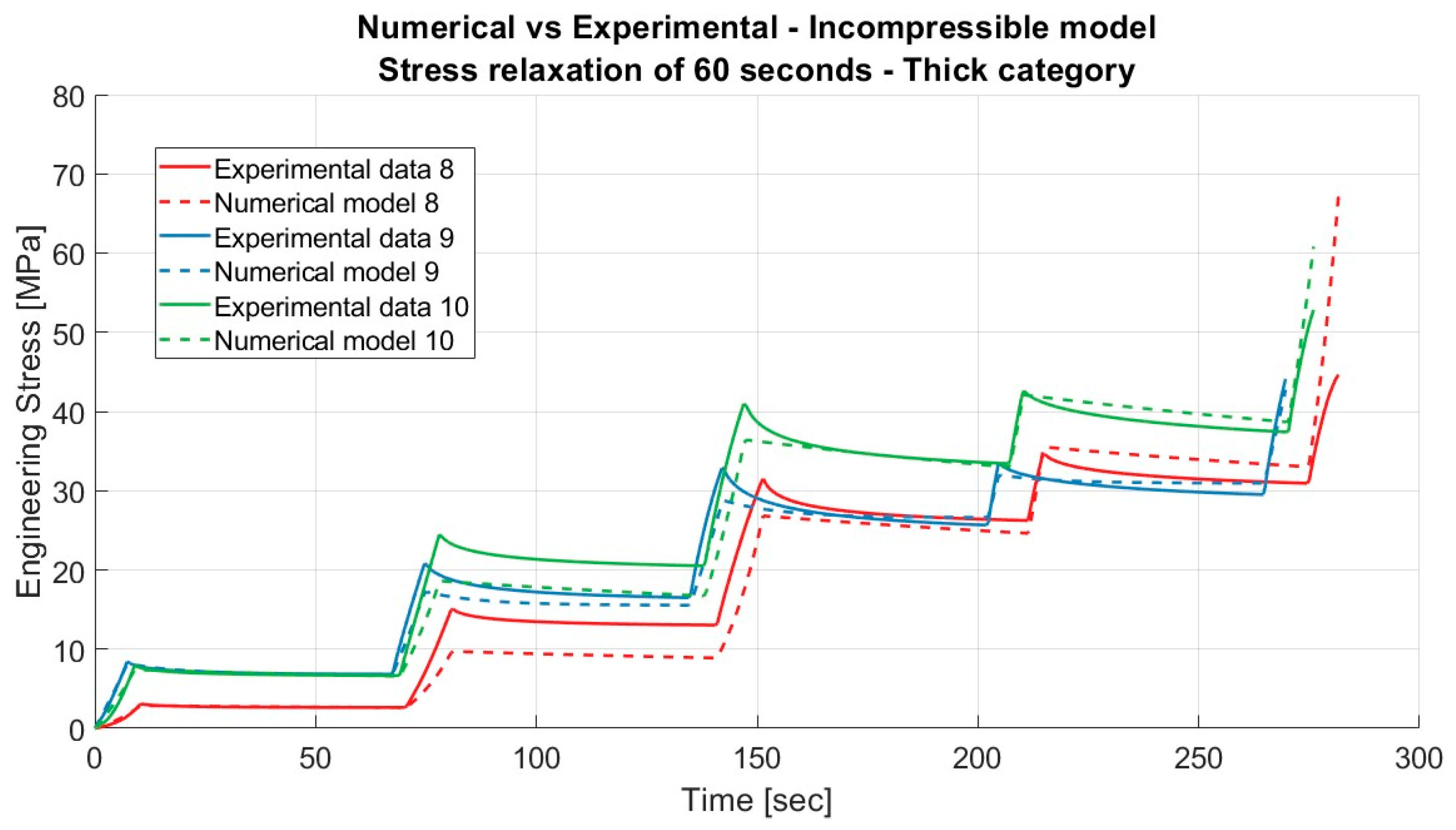
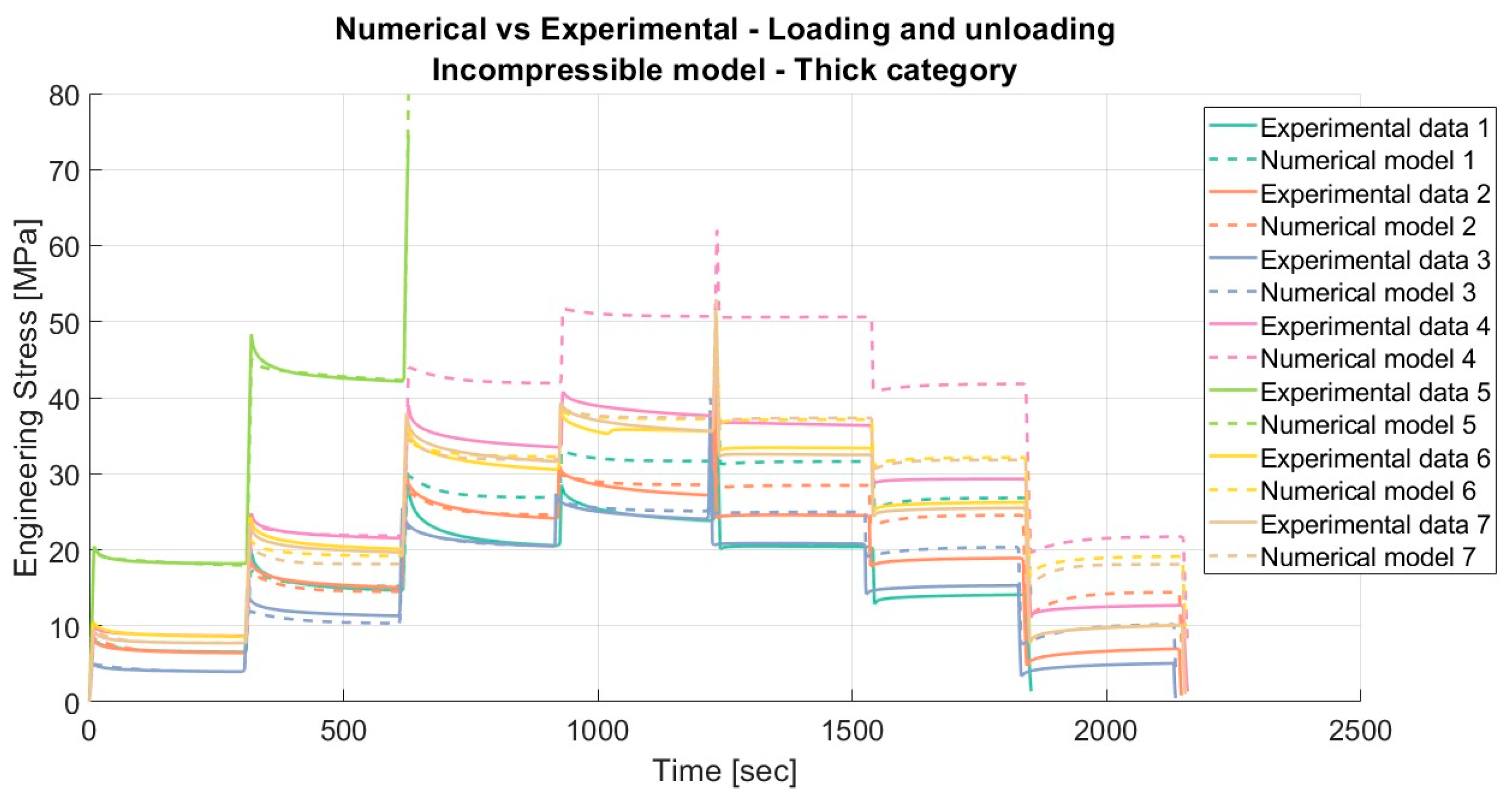
Results for the incompressible material model applied to porcine FDS tendons of the “Thick” category for loading and unloading, with a relaxation time of 60 s.
Figure 30.
Results for the incompressible material model applied to porcine FDS tendons of the “Thick” category for loading and unloading, with a relaxation time of 60 s.
Figure 31.
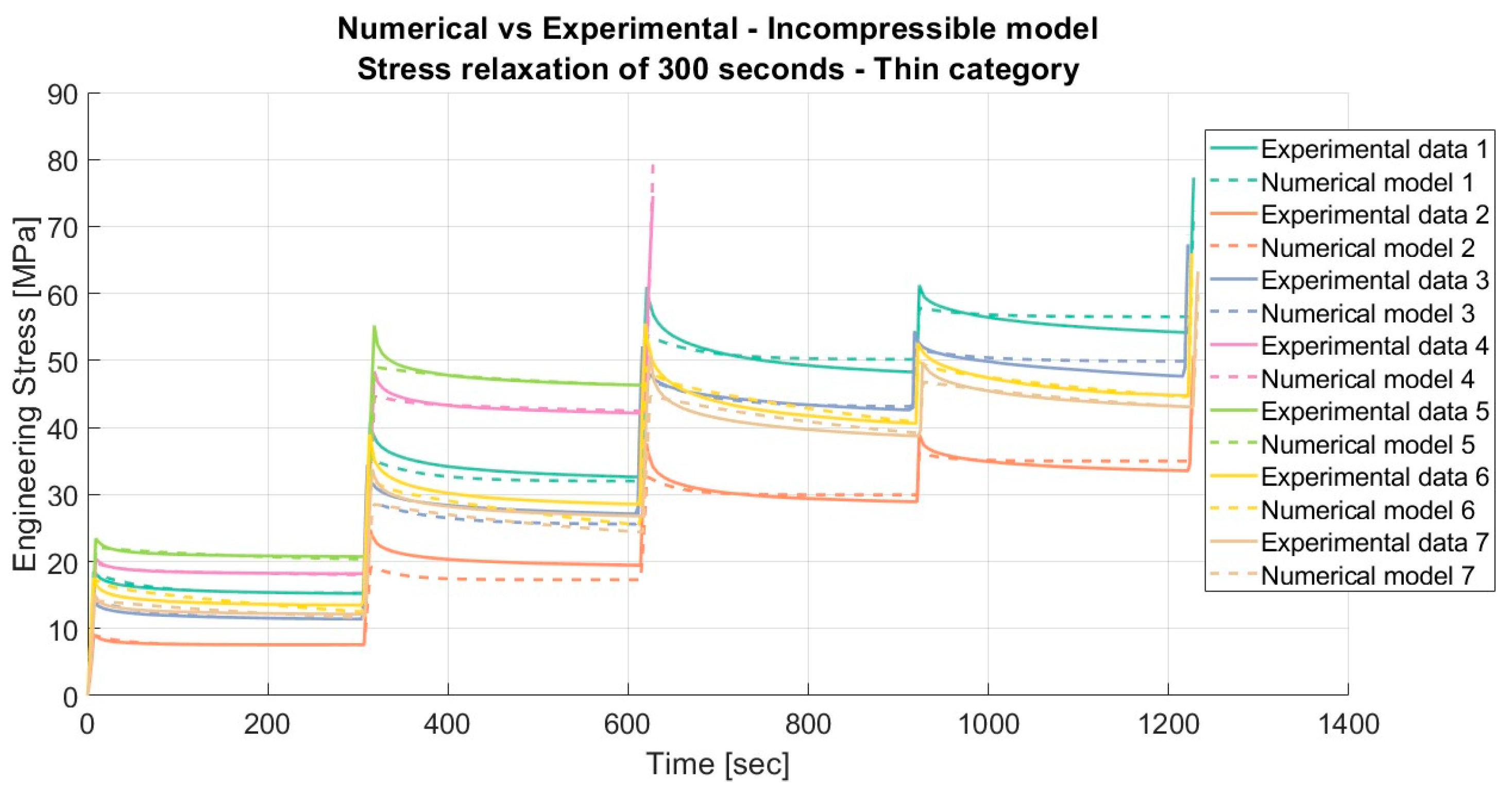
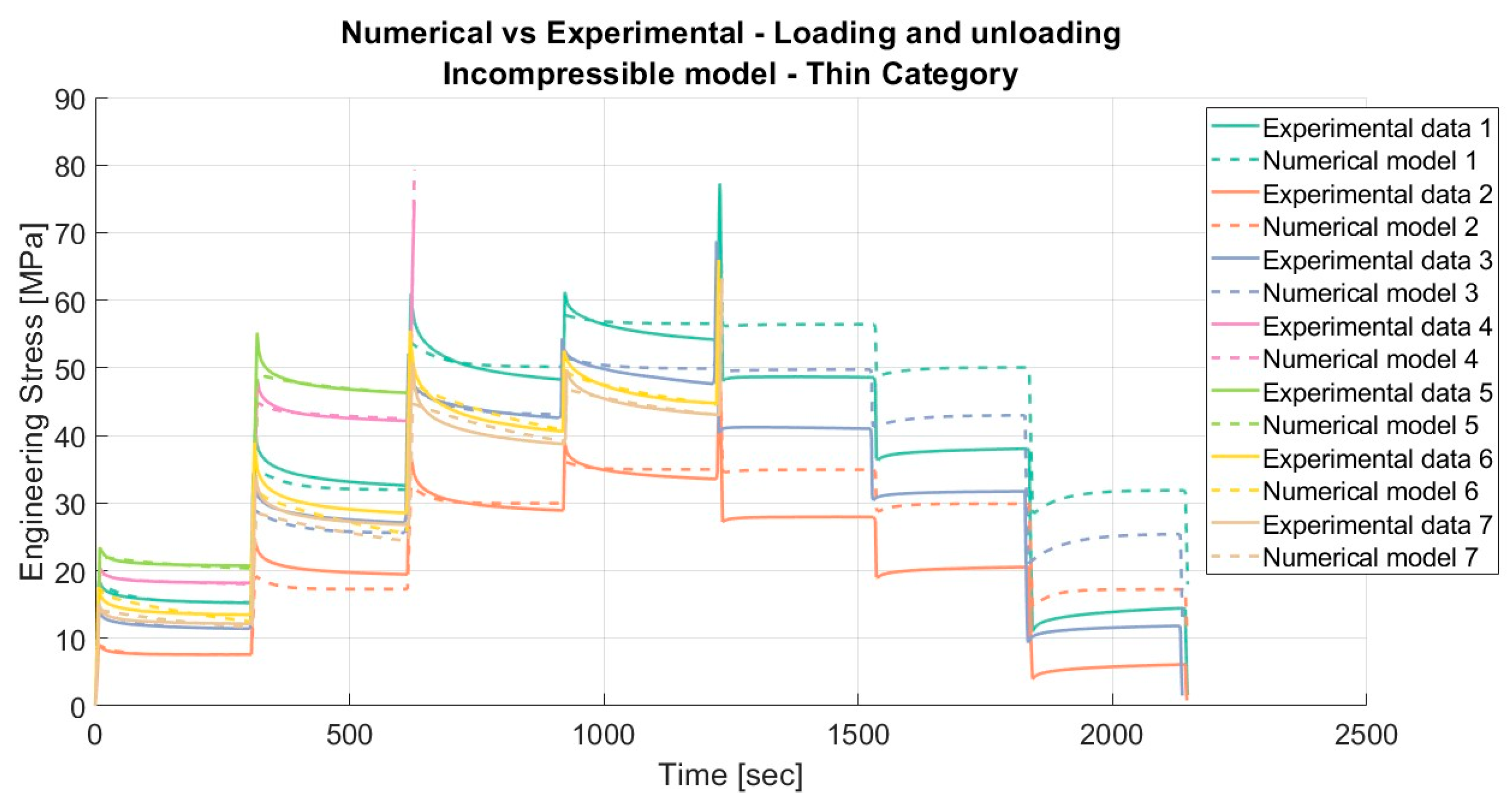
Results for the incompressible material model applied to porcine FDS tendons of the “Thin” category for loading and unloading, with a relaxation time of 300 s.
Figure 31.
Results for the incompressible material model applied to porcine FDS tendons of the “Thin” category for loading and unloading, with a relaxation time of 300 s.
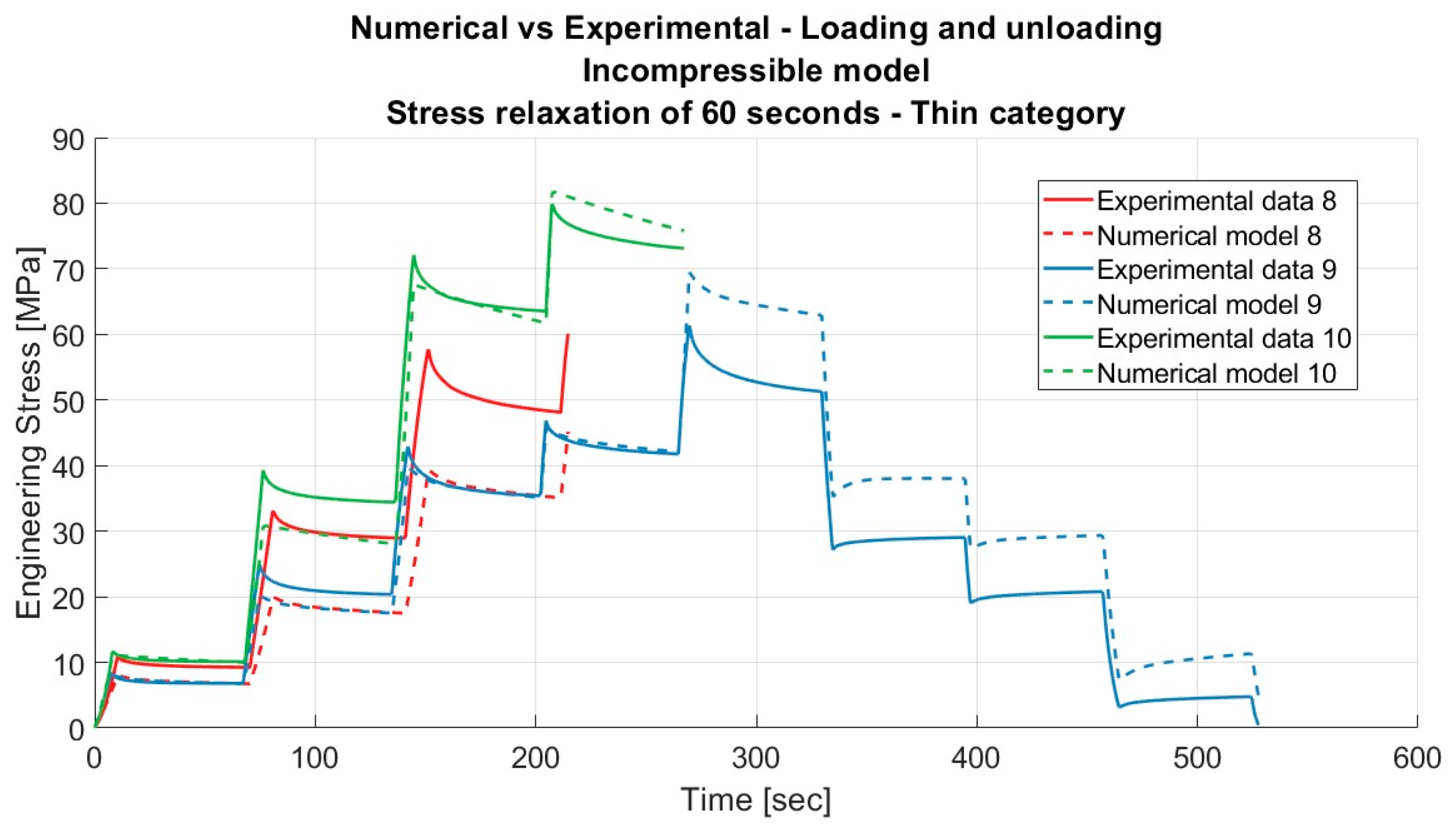
Figure 32.
Results for the incompressible material model applied to porcine FDS tendons of the “Thin” category for loading and unloading, with a relaxation time of 60 s.
Figure 32.
Results for the incompressible material model applied to porcine FDS tendons of the “Thin” category for loading and unloading, with a relaxation time of 60 s.
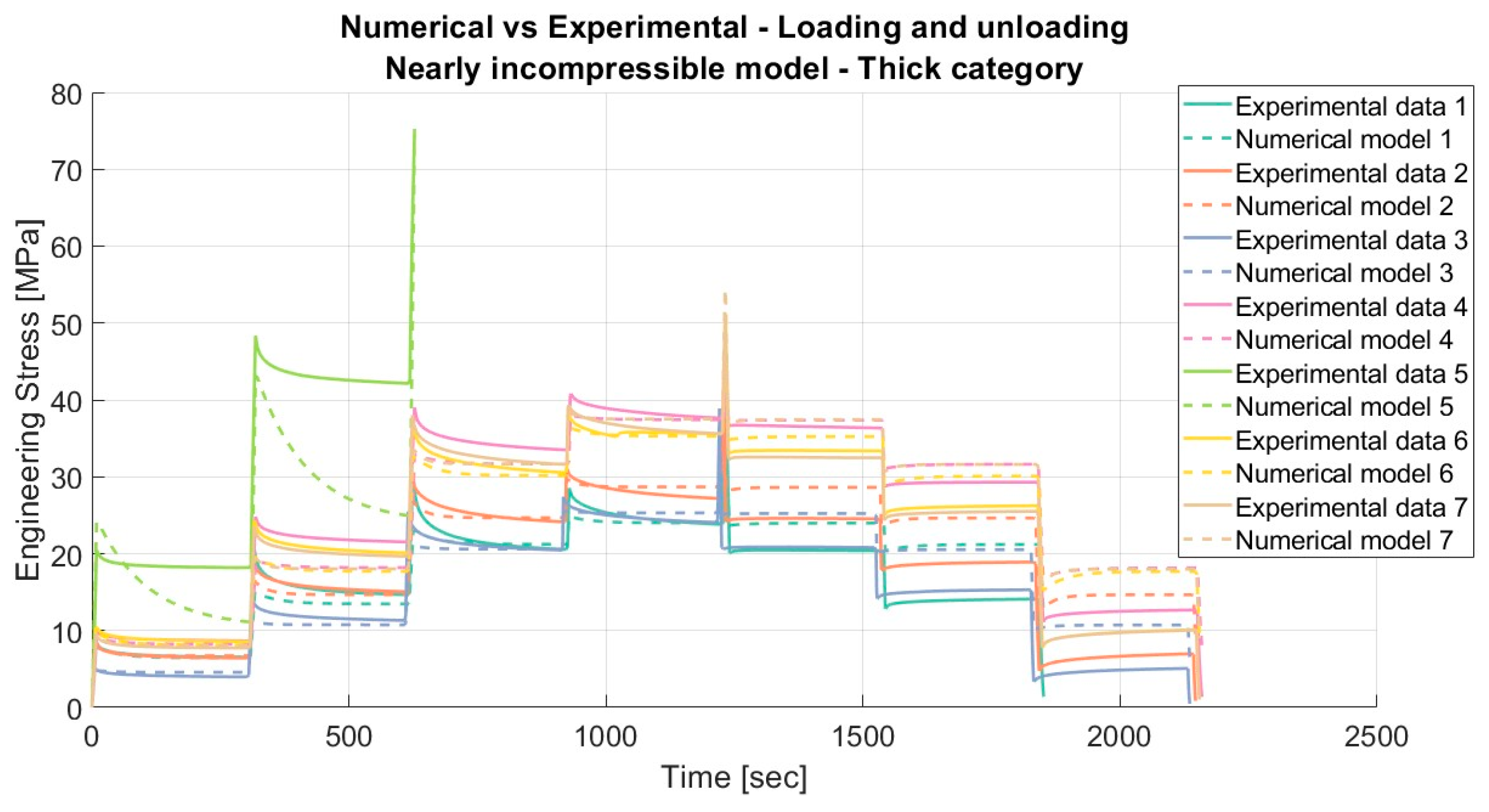
Figure 33.
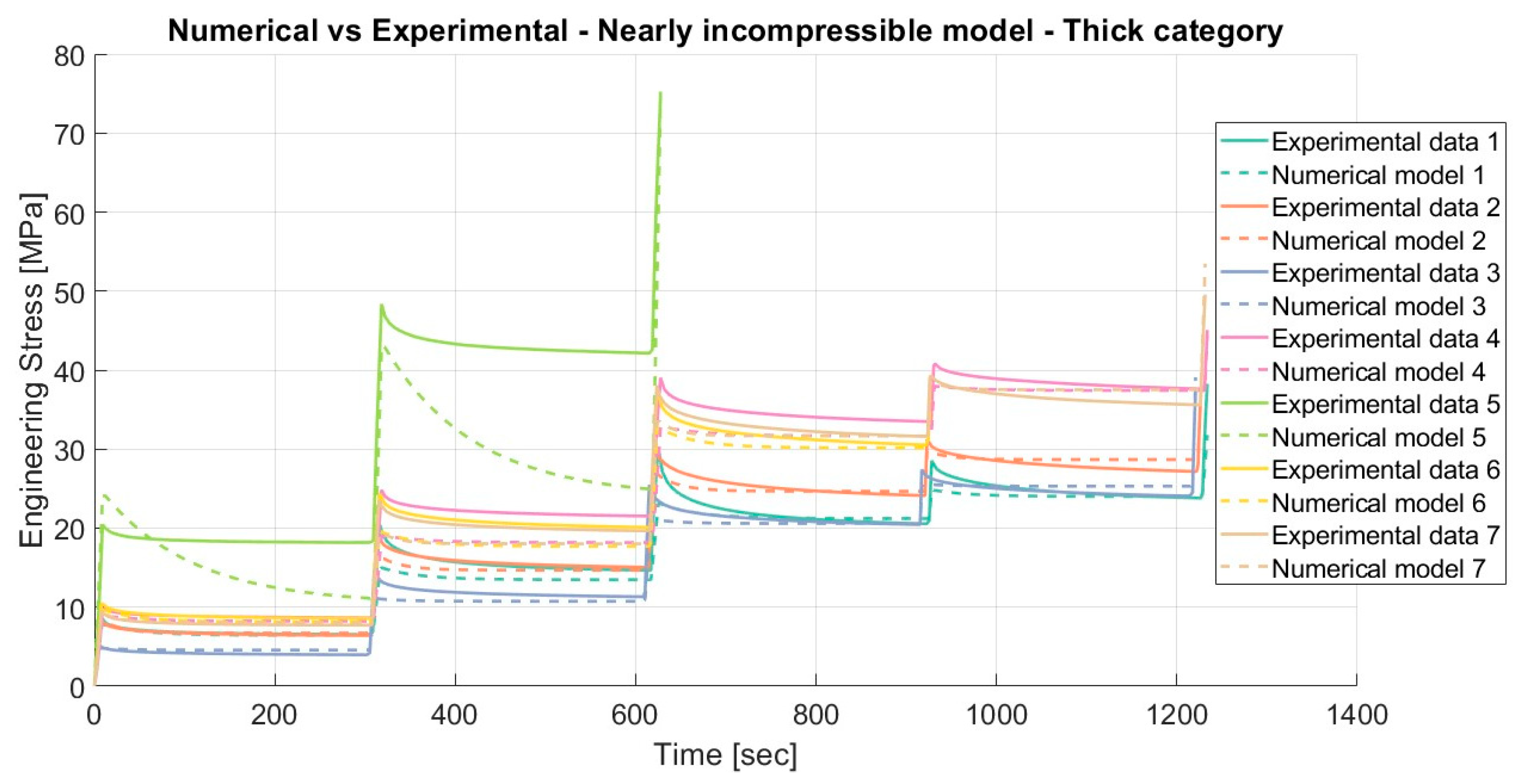
Results for the nearly incompressible material model applied to porcine FDS tendons of the “Thick” category for loading and unloading, with a relaxation time of 300 s.
Figure 33.
Results for the nearly incompressible material model applied to porcine FDS tendons of the “Thick” category for loading and unloading, with a relaxation time of 300 s.
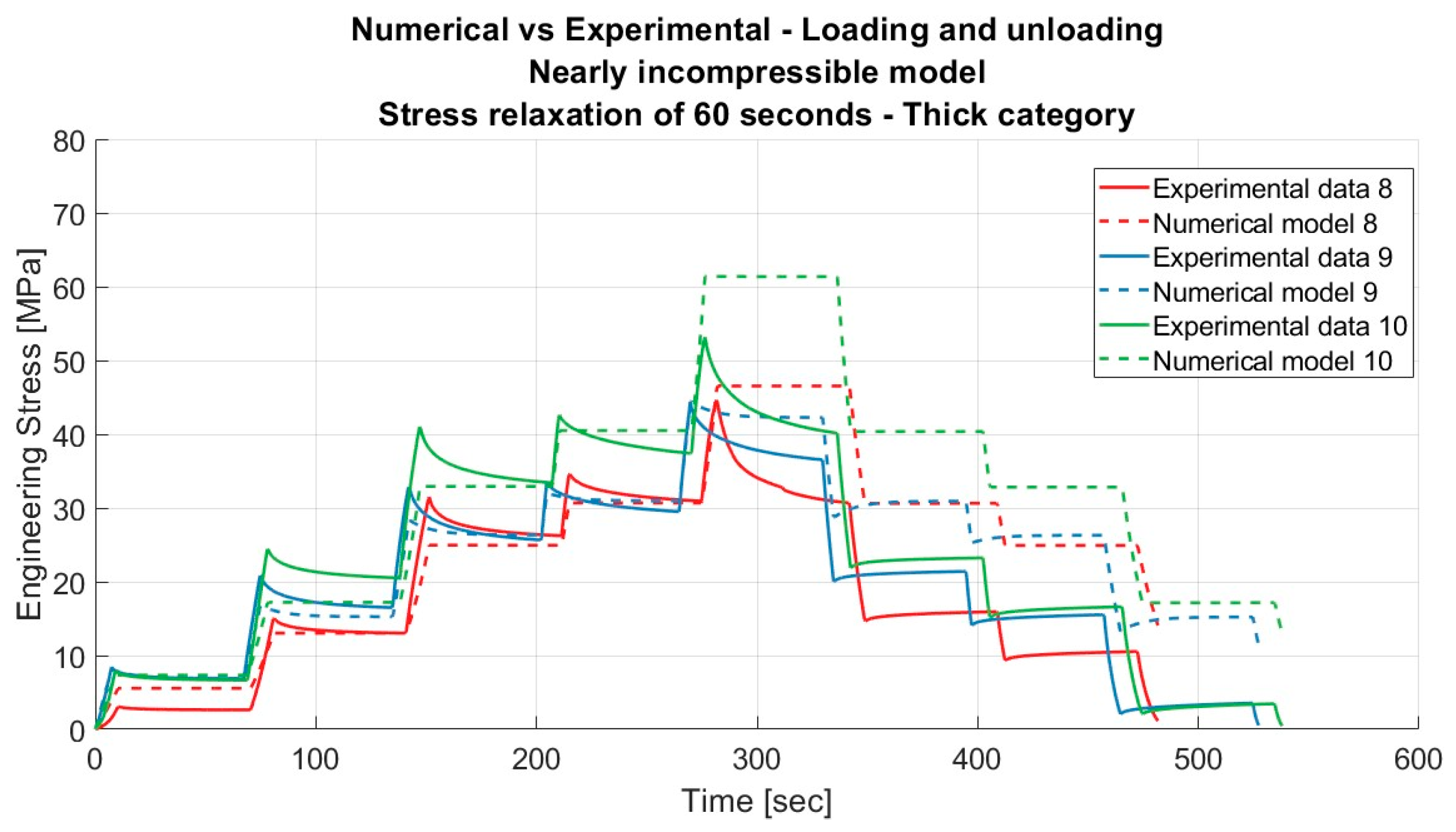
Figure 34.
Results for the nearly incompressible material model applied to porcine FDS tendons of the “Thick” category for loading and unloading, with a relaxation time of 60 s.
Figure 34.
Results for the nearly incompressible material model applied to porcine FDS tendons of the “Thick” category for loading and unloading, with a relaxation time of 60 s.
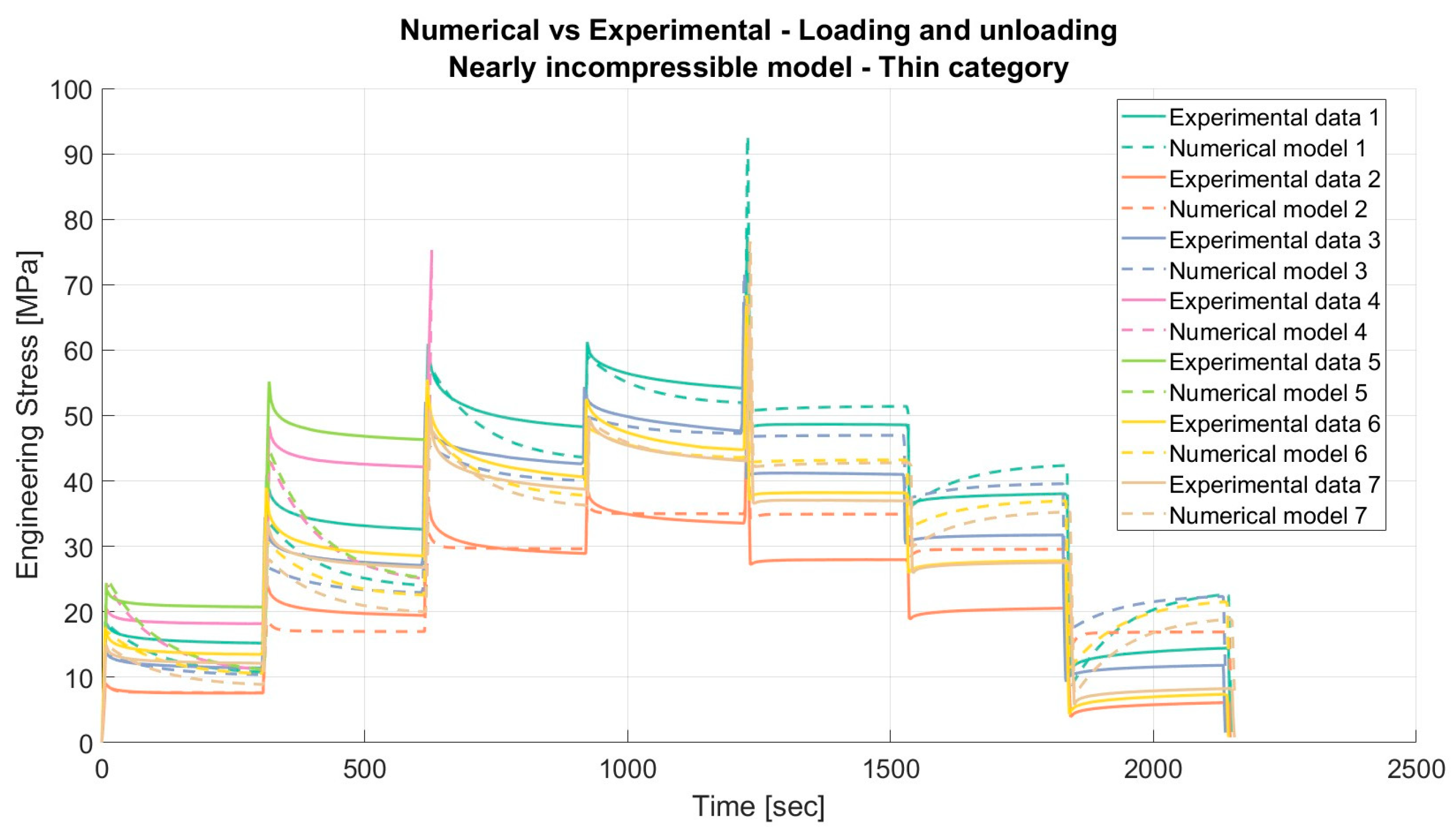
Figure 35.
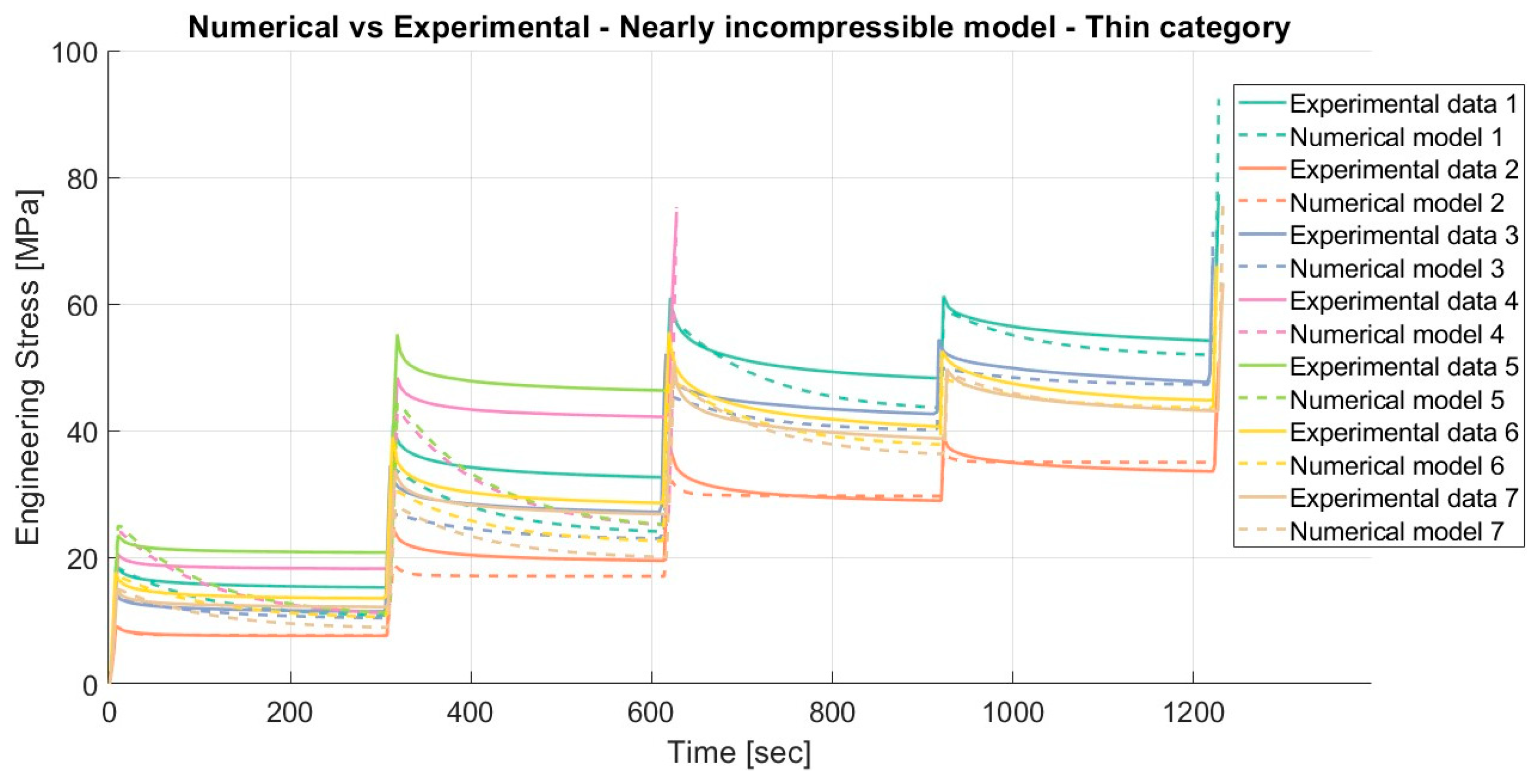
Results for the nearly incompressible material model applied to porcine FDS tendons of the “Thin” category for loading and unloading, with a relaxation time of 300 s.
Figure 35.
Results for the nearly incompressible material model applied to porcine FDS tendons of the “Thin” category for loading and unloading, with a relaxation time of 300 s.
Figure 36.
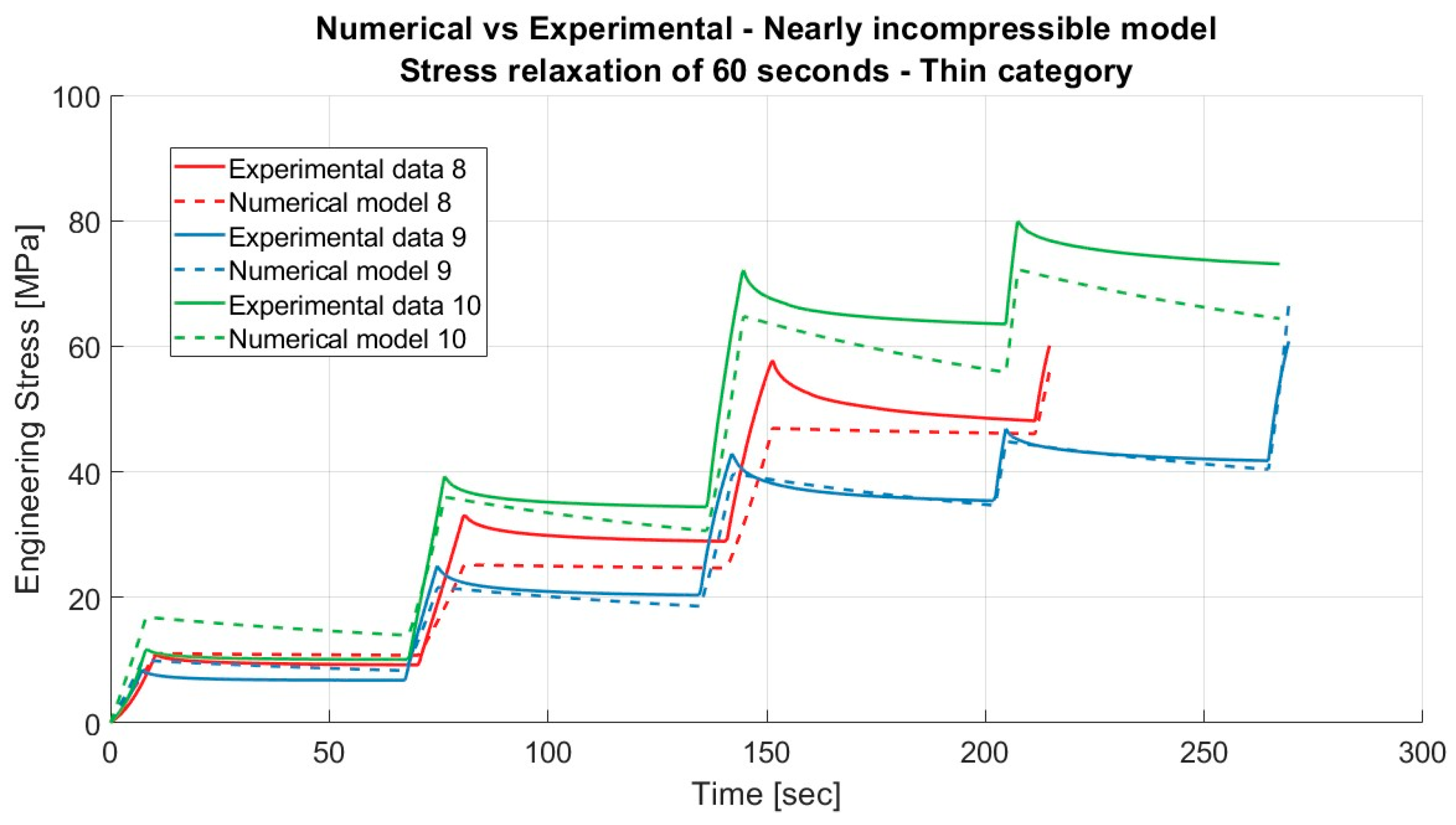
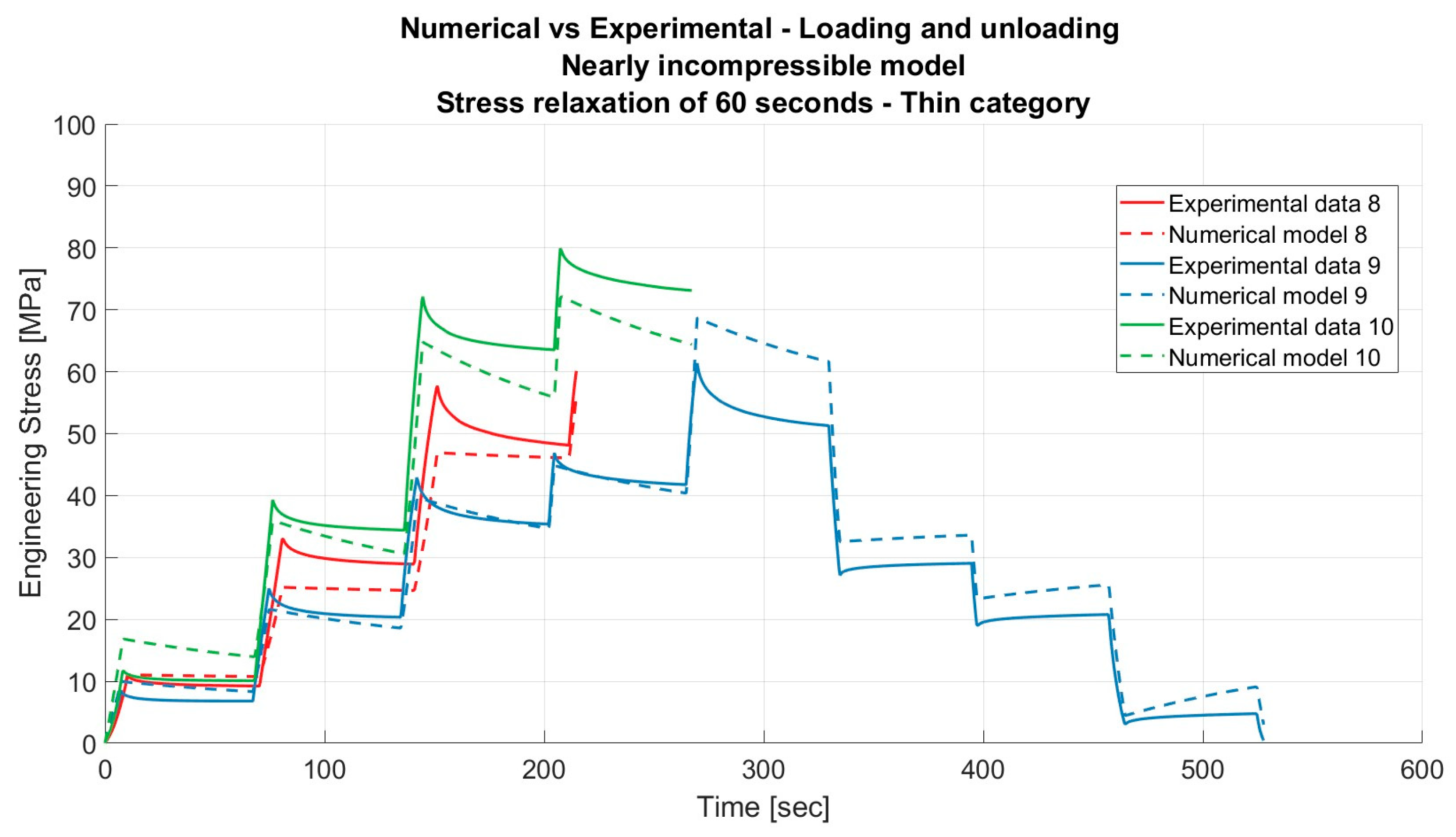
Results for the nearly incompressible material model applied to porcine FDS tendons of the “Thin” category for loading and unloading, with a relaxation time of 60 s.
Figure 36.
Results for the nearly incompressible material model applied to porcine FDS tendons of the “Thin” category for loading and unloading, with a relaxation time of 60 s.
Table 1.
Width, thickness, and length in millimetres (mm) of specimens belonging to the “Thick” category.
Table 1.
Width, thickness, and length in millimetres (mm) of specimens belonging to the “Thick” category.
| | Width (mm) | Thickness (mm) | l0 (mm) |
|---|
| | Distal | Medial | Proximal | Distal | Medial | Proximal |
|---|
| Specimen 1 | 4.92 | 5.80 | 6.47 | 2.93 | 2.34 | 2.34 | 46.63 |
| Specimen 2 | 4.03 | 5.24 | 6.73 | 2.89 | 2.78 | 1.98 | 38.28 |
| Specimen 3 | 4.46 | 3.35 | 5.37 | 2.28 | 2.23 | 1.65 | 28.44 |
| Specimen 4 | 5.25 | 6.29 | 7.29 | 2.63 | 2.46 | 2.45 | 50.90 |
| Specimen 5 | 4.82 | 5.22 | 7.63 | 2.40 | 2.61 | 2.47 | 50.90 |
| Specimen 6 | 4.73 | 5.07 | 7.16 | 3.17 | 2.78 | 2.99 | 44.06 |
| Specimen 7 | 5.14 | 5.54 | 6.34 | 2.72 | 2.82 | 2.50 | 43.53 |
| Specimen 8 | 4.67 | 5.19 | 6.73 | 2.27 | 2.07 | 2.60 | 57.80 |
| Specimen 9 | 4.87 | 5.31 | 7.63 | 2.06 | 2.13 | 2.73 | 40.09 |
| Specimen 10 | 4.29 | 4.73 | 6.15 | 2.45 | 2.36 | 2.94 | 50.12 |
| Mean ± standard deviation | 4.72 ± 0.37 | 5.17 ± 0.77 | 6.75 ± 0.71 | 2.58 ± 0.35 | 2.46 ± 0.28 | 2.46 ± 0.41 | / |
Table 2.
Width, thickness, and length in millimetres (mm) of specimens belonging to the “Thin” category.
Table 2.
Width, thickness, and length in millimetres (mm) of specimens belonging to the “Thin” category.
| | Width (mm) | Thickness (mm) | l0 (mm) |
|---|
| | Distal | Medial | Proximal | Distal | Medial | Proximal |
|---|
| Specimen 1 | 4.57 | 3.69 | 3.67 | 1.71 | 1.43 | 1.43 | 38.28 |
| Specimen 2 | 4.05 | 3.97 | 3.96 | 1.64 | 1.70 | 1.78 | 38.28 |
| Specimen 3 | 4.00 | 3.50 | 3.06 | 1.53 | 1.37 | 1.65 | 29.44 |
| Specimen 4 | 4.12 | 4.37 | 4.62 | 1.36 | 1.24 | 1.39 | 50.90 |
| Specimen 5 | 3.49 | 4.02 | 4.49 | 1.30 | 1.23 | 1.36 | 50.90 |
| Specimen 6 | 4.38 | 4.21 | 4.47 | 1.39 | 1.58 | 1.54 | 35.84 |
| Specimen 7 | 5.70 | 4.29 | 5.77 | 1.60 | 1.39 | 1.47 | 44.72 |
| Specimen 8 | 4.86 | 3.83 | 5.26 | 1.28 | 1.32 | 1.62 | 57.80 |
| Specimen 9 | 4.38 | 4.15 | 4.07 | 1.45 | 1.33 | 1.19 | 40.86 |
| Specimen 10 | 4.20 | 3.94 | 4.70 | 1.34 | 1.14 | 1.23 | 45.42 |
| Mean ± standard deviation | 4.37 ± 0.59 | 4.0 ± 0.27 | 4.41 ± 0.77 | 1.46 ± 0.15 | 1.37 ± 0.17 | 1.46 ± 0.19 | / |
Table 3.
Evaluation of the PSL parameter for FDS tendons classified in the “Thick” category.
Table 3.
Evaluation of the PSL parameter for FDS tendons classified in the “Thick” category.
| | Loading Phase | | Unloading Phase |
| | 3% | 6% | 9% | 10% | | 10% | 9% | 6% |
| Specimen 1 | 22.32 | 27.40 | 30.21 | 15.91 | | 1.44 | 8.93 | / |
| Specimen 2 | 23.63 | 21.46 | 20.60 | 12.33 | | 1.45 | 7.07 | 46.69 |
| Specimen 3 | 23.39 | 21.34 | 19.53 | 11.99 | | 1.59 | 8.24 | 63.22 |
| Specimen 4 | 13.11 | 12.91 | 18.86 | 8.13 | | / | / | / |
| Specimen 5 | 11.53 | 12.42 | / | / | | / | / | / |
| Specimen 6 | 19.57 | 17.31 | 17.79 | / | | / | / | / |
| Specimen 7 | 18.93 | 16.16 | 16.29 | 9.81 | | 0.64 | 4.81 | 25.22 |
| Mean ± standard deviation | 18.93 ± 4.86 | 18.43 ± 5.34 | 19.64 ± 5.76 | 11.63 ± 2.94 | | 1.28 ± 0.43 | 7.26 ± 1.80 | 45.04 ± 19.05 |
| | Loading phase | Unloading phase |
| | 3% | 6% | 9% | 10% | 12% | 10% | 9% | 6% |
| Specimen 8 | 15.23 | 14.08 | 16.73 | 11.10 | 31.21 | 9.09 | 13.44 | / |
| Specimen 9 | 19.20 | 21.30 | 22.30 | 12.30 | 17.17 | 7.18 | 11.00 | 71.08 |
| Specimen 10 | 16.22 | 16.56 | 18.87 | 12.52 | 24.49 | 6.45 | 10.32 | 70.28 |
| Mean ± standard deviation | 16.88 ± 2.06 | 17.31 ± 3.67 | 19.30 ± 2.81 | 11.97 ± 0.76 | 24.29 ± 7.02 | 7.58 ± 1.36 | 11.59 ± 1.64 | 70.68 ± 0.56 |
Table 4.
Evaluation of the PSL parameter for FDS tendons classified in the “Thin” category.
Table 4.
Evaluation of the PSL parameter for FDS tendons classified in the “Thin” category.
| | Loading Phase | | Unloading Phase |
| | 3% | 6% | 9% | 10% | | 10% | 9% | 6% |
| Specimen 1 | 18.95 | 19.59 | 20.34 | 10.89 | | 1.14 | 5.69 | 33.22 |
| Specimen 2 | 17.31 | 20.88 | 21.83 | 12.99 | | 2.98 | 10.28 | 57.47 |
| Specimen 3 | 20.59 | 19.88 | 16.99 | 11.87 | | 0.85 | 5.24 | 24.13 |
| Specimen 4 | 11.53 | 12.42 | / | / | | / | / | / |
| Specimen 5 | 12.07 | 15.10 | / | / | | / | / | / |
| Specimen 6 | 22.19 | 24.44 | 25.75 | 15.24 | | 1.95 | 7.92 | 70.71 |
| Specimen 7 | 17.70 | 20.32 | 22.17 | 13.63 | | 1.76 | 6.72 | 41.49 |
| Mean ± standard deviation | 17.19 ± 4.04 | 18.93 ± 3.96 | 21.42 ± 3.17 | 12.92 ± 1.66 | | 1.73 ± 0.83 | 7.17 ± 2.02 | 45.40 ± 18.73 |
| | Loading phase | Unloading phase |
| | 3% | 6% | 9% | 10% | 12% | 10% | 9% | 6% |
| Specimen 8 | 15.24 | 13.11 | 16.99 | 10.51 | / | / | / | / |
| Specimen 9 | 19.76 | 18.88 | 16.60 | 10.80 | 16.42 | 7.06 | 10.75 | 59.38 |
| Specimen 10 | 14.97 | 12.72 | 17.84 | 8.81 | / | / | / | / |
| Mean ± standard deviation | 16.67 ± 2.68 | 14.91 ± 3.44 | 15.54 ± 2.98 | 10.04 ± 1.07 | 16.42 ± 0.0 | 7.06 ± 0.00 | 10.76 ± 0.00 | 59.38 ± 0.00 |