


Abstract
Oxidative stress and chronic inflammation, driven by reactive oxygen species (ROS) and pro-inflammatory cytokines, contribute significantly to diseases like inflammatory bowel diseases (IBD), yet the therapeutic potential of phenolic compounds-rich agricultural byproducts like ramie leaves (Boehmeria nivea L.) remains underexplored for multi-target antioxidant and anti-inflammatory applications. Using response surface methodology, optimal ultrasonic extraction conditions for ramie leaf aqueous extract (RLAE) were determined as a 1:30 g/mL solid-to-liquid ratio, 43 min, and 50 °C, yielding 2.26 ± 0.16 mg/g total phenolic content. RLAE exhibited strong antioxidant activity with IC50 values of 1.09 ± 0.06 mg/mL (DPPH), 0.60 ± 0.02 mg/mL (ABTS), and 0.93 ± 0.03 mg/mL (O2−), a FRAP equivalent of 11.85 ± 0.47 mmol FeSO4/g, and notable SOD-like activity. In LPS-stimulated IEC-6 cells, RLAE (0.1–0.2 mg/mL) significantly reduced pro-inflammatory cytokines (IL-1β, IL-6, TNF-α) and enhanced IL-10 expression, with low cytotoxicity up to 0.4 mg/mL. HPLC identified 21 compounds, including pyrocatechuic acid, rutin, and hyperoside, driving these effects via ROS scavenging and NF-κB modulation. RLAE’s multi-mechanistic antioxidant and anti-inflammatory properties position it as a sustainable candidate for nutraceutical development in gastrointestinal health, warranting further in vivo studies.
1. Introduction
Inflammation, a fundamental pathological process involved in responding to stimuli and repairing injuries, serves as a pivotal driver in the pathogenesis of numerous diseases, encompassing both acute and chronic forms [1], thus imposing a substantial global disease burden. Various factors such as biological pathogen invasion, physical trauma, chemical insults, and immune dysregulation can trigger inflammation [2]. Consequently, precise regulation of the inflammatory response is crucial for mitigating inflammation-related diseases. Oxidative stress emerges as a critical player in this regulatory framework [3]. In conditions of inflammation, an imbalance between reactive oxygen species (ROS) generated by immune cells and the antioxidant defense system can lead to oxidative damage to cellular components and activation of inflammatory signaling pathways like nuclear factor kappa-B (NF-κB) and mitogen-activated protein kinase (MAPK) [4], perpetuating a detrimental cycle of “oxidative stress-inflammation”. Hence, the quest for pharmacological agents possessing dual antioxidant and anti-inflammatory properties holds significant promise in managing these conditions.
Currently, clinical anti-inflammatory interventions predominantly involve biological agents, including steroidal and nonsteroidal anti-inflammatory drugs (NSAIDs), as well as infliximab (anti-TNF-α) antibodies. Nonetheless, NSAIDs exhibit rapid efficacy but are associated with a heightened risk of gastrointestinal ulcers and cardiovascular complications [5]. Steroidal anti-inflammatory medications demonstrate potent activity but are prone to inducing drug resistance and concurrent infections [6]. Biological agents offer precise targeting but are constrained by high production costs, limiting their widespread use [7]. These limitations have spurred investigations into natural bioactive compounds as potential novel anti-inflammatory agents characterized by enhanced safety profiles and multitarget modulation. Given their potential in regulating inflammation, plant extract derivatives have emerged as a focal point in research for the prevention and management of inflammation-related disorders due to their abundant sources, favorable biocompatibility, and antioxidant constituents with safety and multitarget regulatory properties [8]. Phenolic compounds (Phenols) are known for their high antioxidant capacity and are key components in plant extracts [9]. For instance, Hypericum capitatum extract, abundant in rutin, boosts antioxidant enzymes like catalase (CAT) and superoxide dismutase (SOD), reducing ROS and reactive nitrogen species (RNS) to alleviate oxidative stress from inflammation [10]. Coffee extract, rich in pyrocatechol, hinders NF-κB activation induced by lipopolysaccharide (LPS) and demonstrates anti-inflammatory properties by suppressing inflammatory cytokine expression [11]. Bioactive extracts are typically derived from medicinal and edible plants, although agricultural waste from farming activities has also been identified as a viable alternative source for extracting bioactive compounds.
Ramie (Boehmeria nivea) is a traditional fiber crop in China, with approximately 350,000 mu of ramie seed cultivated annually, yielding 55,000 tons of raw hemp primarily used for textiles [10]. Ramie leaves constitute 40% of the total plant weight, yet their agricultural by-product utilization remains low, posing a burden [12]. Ramie leaves is a rich source of bioactive compounds, including phenols, and is employed in traditional medicinal practices for heat-clearing, detoxification, blood cooling, and bleeding cessation. Studies have demonstrated that Ramie leaf extract mitigates gut oxidative stress in rats by reducing intracellular ROS levels and enhancing antioxidant enzyme activity [13]. Ramie leaves exhibit antioxidant, anti-cancer, neuroprotective, estrogenic, and anti-inflammatory properties, attributed mainly to compounds like caffeic acid, isoquercetin, p-coumaric acid, and rutin [14]. However, current extraction methods involve organic solvents, posing environmental concerns [15] while the use of benign solvents like water remains limited. Notably, there is a lack of research on the anti-inflammatory mechanisms of water-based ramie leaf extracts, which could circumvent the use of toxic solvents, aligning with global sustainability goals.
This study aimed to optimize ramie leaf aqueous extract (RLAE) and assess its antioxidant and anti-inflammatory properties using LPS-induced intestinal epithelial cells as an inflammatory model. The study evaluated the impact of RLAE on key inflammatory cytokines and explored its potential mechanisms in inflammation regulation. The research seeks to enhance understanding of the therapeutic properties of ramie leaves, promote their potential application as a natural remedy for inflammation-related conditions, and establish a theoretical foundation for minimizing ramie waste and enhancing ramie utilization efficiency.
2. Materials and Methods
2.1. Materials and Reagents
Ramie leaves were purchased in July 2024 from the ramie planting base in Dazhu County, Sichuan Province, China. SOD and CAT were purchased from Sangon Biotech Co., Ltd. (Shanghai, China). Nitric oxide (NO) was provided by Shanghai Yuetian Biotechnology Co., Ltd. (Shanghai, China). LPS was purchased from Beyotime Biotechnology Co., Ltd. (Shanghai, China). The cell counting kit-8 (CCK-8) reagent kit was purchased from Guangzhou Bolu Teng Biotechnology Co., Ltd. (Guangzhou, China)., and the rat small intestine crypt epithelial cells (ICE-6) cells were obtained from BeNa Culture Collection (Beijing, China). The Enzyme-Linked Immunosorbent Assay (ELISA) kits, including those fortumor necrosis factor-α (TNF-α), Interleukin-1β (IL-1β), Interleukin-6 (IL-6), and Interleukin-10 (IL-10), came from Beijing Solarbio Science & Technology Co., Ltd. (Beijing, China). Folin-Ciocalteu reagent, sodium carbonate (Na2CO3), aluminum chloride (AlCl3), sodium nitrite (NaNO2), sodium hydroxide (NaOH), and 2,4,6-tris(2-pyridyl)-s-triazine (TPTZ) were purchased from Sinopharm Chemical Reagent Co., Ltd. (Beijing, China). Formic acid and acetonitrile were both high performance liquid chromatography (HPLC) grade.
2.2. Preparation of RLAE
The ramie leaves were obtained from the ramie cultivation base in Dazhu County, Sichuan Province. The leaves were rinsed with distilled water to remove surface impurities and then dried in an oven at 60 °C until a constant weight was achieved. Subsequently, the leaves were ground with a high-speed grinder, sieved through a 60-mesh screen, and stored for later use. For extract preparation, dried ramie leaf powder was mixed with ultrapure water at a 1:30 (g/mL) solid-to-liquid ratio and subjected to ultrasonic extraction at 50 °C for 43 min. After extraction, the mixture was centrifuged at 8000 r/min for 15 min at 4 °C, and perform filtration. The supernatant was collected and concentrated to 25 mL by rotary evaporation. Finally, the extract was sterilized by filtration through a 0.22 μm PVDF membrane and stored at 4 °C in the dark for subsequent use.
2.3. Total Polyphenol (TPC) and Flavonoid Contents (TFC)
The TPC and TFC of the RLAE were determined according to the method described by Manchanda et al. [16]. TPC was assessed using the Folin-Ciocalteu method, and the results were expressed as milligrams of gallic acid equivalents per gram of dry leaf (mg gallic acid/g). The value was calculated from the calibration curve of gallic acid (concentration range 0–150 μg/mL). TFC was determined using the NaNO2- AlCl3-NaOH method and was expressed as milligrams of rutin equivalents per gram of dry leaf (mg rutin/g). The value was calculated from the calibration curve of rutin as a standard (concentration range 0–125 μg/mL).
2.4. Optimization of Phenols Extraction Conditions from RLAE
Single-Factor experiment: The extraction of Phenols was investigated by examining the effects of different parameters, including the solid-to-liquid ratio, extraction time, and extraction temperature, on the TPC. One gram of pretreated ramie leaf powder was weighed, and a single parameter was varied while the other two parameters were kept constant. The effects of different solid-to-liquid ratios (1:10, 1:20, 1:30, 1:40, 1:50 g/mL), extraction times (10, 20, 30, 40, 50 min), and extraction temperatures (25, 35, 45, 55, 65 °C) on the TPC were studied. The optimal parameter for each factor was then used as the fixed parameter for subsequent experiments, with the initial conditions set as a solid-liquid ratio of 1:20 g/mL, an extraction time of 30 min, and an extraction temperature of 35 °C.
Response surface methodology (RSM) optimization experiment: A response surface optimization experiment was designed using Design-Expert 13 software. The solid-to-liquid ratio, extraction time, and extraction temperature were chosen as independent variables, along with their interactions, to assess their effects on TPC. The factors and levels for the response surface experiment design are shown in Table 1. The effect of each parameter and their interactions on TPC was evaluated, and this method was used to predict the optimal parameter levels for maximum phenols extraction.
Table 1.
Experimental design factors and level table of response surface.
2.5. Liquid Chromatography-Electrospray Ionization-Quadrupole-Time of Flight-Tandem Mass Spectrometry (HPLC-ESI-QTOF-MS/MS) Analysis
The liquid chromatography-mass spectrometry (LC-MS) analysis was performed using an ultra-high-performance liquid chromatography system (U3000, Thermo Fisher Scientific, USA) coupled with a hybrid quadrupole-Orbitrap mass spectrometer (Q-Exactive, Thermo Fisher Scientific, Billerica, MA, USA). The HPLC-ESI-QTOF-MS/MS analysis was performed using an C18 column (2.1 mm × 100 mm, 1.7 μm) with a flow rate set to 1 mL/min. The mobile phase consisted of 0.1% formic acid aqueous solution (solvent A) and acetonitrile (solvent B), with the following gradient elution program: 0–15 min, 5–25% B; 15–19 min, 25–50% B; 19–21 min, 50–5% B; and 21–23 min, maintaining 5% B [17]. The injection volume was 10 μL, and the UV detection wavelength was set to 280 nm. Mass spectrometry analysis was conducted in negative ion electrospray ionization (ESI−) mode, with a data acquisition range of m/z 100–1000. The instrument was controlled by xcalibur software (Thermo Fisher Scientific, USA), and the data were processed using the xcalibur setup module. Target compounds were identified based on their exact m/z values and secondary fragmentation information, with data comparison against metabolite databases such as human metabolome database (HMDB) and metabolite link (METLIN). The analysis was further supported by precise molecular weight determination and matching of secondary fragment ions with the known mass spectrometric characteristics of compounds.
2.6. Determination of In Vitro Antioxidant Activity of RLAE
In this study, the antioxidant activity of ramie leaf extract was systematically evaluated using six antioxidant assays: 2,2-Diphenyl-1-picrylhydrazyl (DPPH) Radical Scavenging Assay, 2,2′-Azino-bis (3-ethylbenzothiazoline-6-sulfonic acid) (ABTS) Radical Scavenging Assay, Ferric reducing antioxidant power (FRAP) Assay, Superoxide Anion Radical (O2−) Scavenging Assay, SOD Assay and CAT Activity Assay.
2.6.1. DPPH Radical Scavenging Assay
The DPPH radical scavenging assay was performed according to the method suggested by Li et al. [18] with slight modifications. A 1.5 mL of 50 μg/mL DPPH ethanol solution was mixed with 0.5 mL of RLAE at different concentrations, vortexed, and reacted in the dark at room temperature for 30 min. After the reaction, the absorbance was immediately measured at 517 nm using a microplate reader. All samples were measured in triplicate.
2.6.2. ABTS Radical Scavenging Assay
The ABTS radical scavenging activity was measured according to the method described by Dou et al. [19] with appropriate modifications. First, a 7 mmol/L ABTS solution was mixed with an equal volume of 2.45 mmol/L potassium persulfate solution and allowed to stand in the dark at room temperature for 12 h to generate a stable ABTS+ radical stock solution. Before use, the stock solution was diluted with methanol to adjust the absorbance at 734 nm to 0.7 ± 0.05, resulting in the ABTS+ working solution. Then, 0.2 mL of RLAE at different concentrations was mixed with 1.8 mL of the ABTS+ working solution and allowed to react in the dark at room temperature for 6 min. The absorbance was measured at 734 nm using a microplate reader.
2.6.3. FRAP Assay
The FRAP assay was slightly modified according to Mehta [20]. First, the FRAP reagent was prepared by mixing 300 mmol/L sodium acetate buffer (pH 3.6), 10 mmol/L TPTZ solution, 40 mmol/L HCl solution, and 20 mmol/L FeCl3 solution in a 10:1:1 (v/v) ratio, and the mixture was thoroughly mixed. The FRAP reagent was prepared fresh and preheated at 37 °C in a water bath before use. Then, 0.1 mL of the sample solution was mixed with 1.8 mL of FRAP reagent and 3.1 mL of ultrapure water, thoroughly mixed, and incubated in the dark at 37 °C for 30 min. After the reaction, the absorbance of the reaction system was immediately measured at 593 nm using a microplate reader. A standard curve was constructed using FeSO4 solutions with concentrations ranging from 0 to 0.8 mmol/L. The FRAP value is expressed as micromoles of Fe(II) per gram of dry weight (DW).
2.6.4. O2− Scavenging Assay
The O2− scavenging assay was performed according to Zhao et al. [21]. A 2 mL sample of RLAE at different concentrations was mixed thoroughly with 9 mL of 50 mmol/L Tris-HCl buffer solution (pH 8.2). The mixture was incubated in a water bath at 25 °C for 15 min, then 0.8 mL of 10 mmol/L pyrogallol solution was added, mixed rapidly, and the reaction continued at 25 °C for 5 min. Afterward, 0.2 mL of 8 mol/L hydrochloric acid solution was added to terminate the reaction. The absorbance was immediately measured at 325 nm.
2.6.5. SOD Assay
The effect of the sample on SOD activity was assessed using the pyrogallol autoxidation assay. A 1 U/mL SOD enzyme solution was prepared in 0.1 M Tris-HCl buffer at pH 8.2. The reaction system was prepared in 5 mL Eppendorf tubes with the following compositions: Control tube (with SOD): 2.35 mL Tris-HCl buffer, 1.99 mL ultrapure water, and 10 μL SOD enzyme solution. Blank tube (without sample and enzyme): 2.35 mL buffer and 2 mL ultrapure water. Experimental tube (with SOD and sample): 2.35 mL buffer, 1.98 mL ultrapure water, 10 μL SOD enzyme solution, and 10 μL sample. No enzyme blank sample tube: 2.35 mL buffer, 1.98 mL ultrapure water, and 20 μL sample (replacing enzyme with sample volume). After mixing the contents of each tube with a microplate mixer, 150 μL of pH-matched buffer containing 4.5 mM pyrogallol was added. The absorbance was immediately measured at 326 nm at 5 min, intervals using a microplate reader. The inhibition rate of pyrogallol autoxidation was calculated using the following formula:
If P > 0, it indicates that the sample inhibited the rate of pyrogallol autoxidation, suggesting that the sample has a promoting effect on SOD enzyme activity. If P < 0, it indicates that the sample has an inhibitory effect on SOD enzyme activity.
2.6.6. CAT Activity Assay
The effect of RLAE on CAT activity was assessed based on the rate of hydrogen peroxide decomposition. A 50 mM H2O2 solution and a 50 mM ammonium molybdate solution were prepared. A 1000 U/mL CAT enzyme solution was prepared using 0.2 M PBS (pH 7.8), along with a supersaturated NaCl solution. The corresponding reagents were added according to the Table 2 for the reaction.
Table 2.
Sample Addition Table for CAT Activity Assay.
Incubate at room temperature for 2 min, then add 1 mL NaCl and 2.8 mL 50 mM ammonium molybdate to terminate the reaction. Immediately measure A405 absorbance.
2.7. Determination of In Vitro Anti-Inflammatory Activity of RLAE
2.7.1. Albumin Denaturation (ALB)
ALB inhibition was assessed as described by Zhao et al. [21]. Reaction mixtures contained 50 μL RLAE (1–5 mg/mL) and 450 μL BSA (1% w/v in 0.01 M PBS, pH 7.4). Mixtures were incubated at 37 °C for 15 min, then heat-denatured at 90 °C for 20 min. Turbidity was measured at 660 nm (25 °C) using a microplate reader. Ultrapure water replaced sample solution for blank controls. Denaturation inhibition was calculated as:
2.7.2. Inhibition Rate of NO Release
For the NO inhibition assay, 40 μL of the RLAE (1–5 mg/mL) was mixed with 260 μL of phosphate-buffered saline (PBS, 0.1 M, pH 7.4) and 100 μL of sodium nitroprusside (SNP, 100 mM, aqueous solution), followed by incubation at 37 °C under constant illumination for 2 h. After incubation, a 100 μL aliquot of the reaction mixture was reacted with Griess reagent—prepared by mixing equal volumes of 1% (w/v) sulfanilamide in 5% (v/v) H3PO4 and 0.1% (w/v) N-(1-naphthyl)ethylenediamine dihydrochloride (NEDD). Following 10 min of incubation in the dark, the absorbance of the mixture was measured at a wavelength of 540 nm using a microplate reader. For blank control samples, ultrapure water was used in place of the sample solution under identical experimental conditions. Subsequently, the NO inhibition rate (%) was calculated using the following formula:
2.8. Cell Culture
BNCC IEC-6 cells were used in the study. IEC-6 cells were cultured in dulbecco’s modified eagle medium (DMEM) medium supplemented with 10% fetal bovine serum, 100 U/mL penicillin, 100 μg/mL streptomycin, and 0.1 IU/mL insulin. The cells were incubated in a humidified incubator at 37 °C with 5% CO2 [22].
2.9. Cytotoxicity Assay
To exclude the interference of cell viability status on the results of subsequent inflammatory factor detection and thereby ensure the accuracy of subsequent experimental data, a cytotoxicity assay was first conducted after cell culture to determine the safe concentration range of the RLAE. Cell toxicity of the RLAE on IEC-6 cells was evaluated using the CCK-8 assay. The experimental procedure was as follows: IEC-6 cells macrophage cell suspensions with a density of 1 × 10⁵ cells/mL were seeded into a 96-well culture plate and pre-incubated at 37 °C with 5% CO2 for 12 h to allow attachment. RLAE at different concentrations of 0.05–0.6 mg/mL was used for intervention culture and the cells were incubated with these solutions for 24 h. After the intervention, the culture medium was discarded, and fresh medium containing 1% (v/v) CCK-8 reagent was added to each well. The cells were then incubated in the dark for 2 h. Absorbance (OD) was measured at 570 nm using a multifunctional microplate reader. The untreated cell group served as a negative control. Three biological replicates were performed for all experiments.
2.10. Gene Expression Analyses
IEC-6 cells were seeded in 12-well plates at a density of 1 × 10⁵ cells/well. After routine culture for 12 h, different concentrations of RLAE (0.1, 0.2 and 0.3 mg/mL) were added for pretreatment for 4 h [23]. The original medium was discarded, and then replaced with fresh medium containing 0.1 mg/mL LPS. After further incubation for 24 h, cell culture supernatants were collected and reserved for subsequent use. Total ribonucleic acid (RNA) from IEC-6 cells swas extracted with HiPure Total RNA Mini Kit. Complementary deoxyribonucleic acid (cDNA) was synthesized using PrimeScript RT reagent kit. The gene expression levels of inducible TNF-α, IL-1β, IL-6, IL-10 were analyzed by ΔΔCT method. Glyceraldehyde -3-phosphate dehydrogenase (GAPDH) served as endogenous control. Cells treated with LPS alone served as the model control, while cells not treated with either RLAE or LPS served as the blank control.
2.11. ELISA Assay
The levels of inflammation-related factors IL-1β, IL-6, TNF-α, IL-10 in IEC-6 cells were detected using the appropriate kits according to the manufacturer’s instructions, respectively. Cells treated with LPS alone served as the model control, while cells not treated with either RLAE or LPS served as the blank control.
2.12. Statistical Analysis
Experimental results are presented as the mean ± standard error (SE) of three independent replicate experiments. Differences between groups were analyzed using one-way ANOVA. Experimental graphs were generated using GraphPad Prism 10.1.2 (USA)and Design-Expert 13 (USA). Statistical significance was set at p < 0.05. The statistical analysis of the data was conducted using IBM SPSS Statistics 25.
3. Results
3.1. Optimization of TPC Conditions
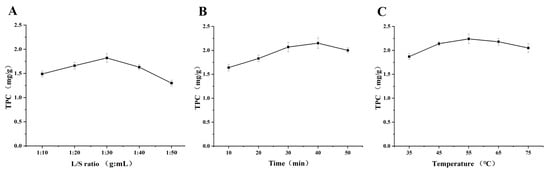
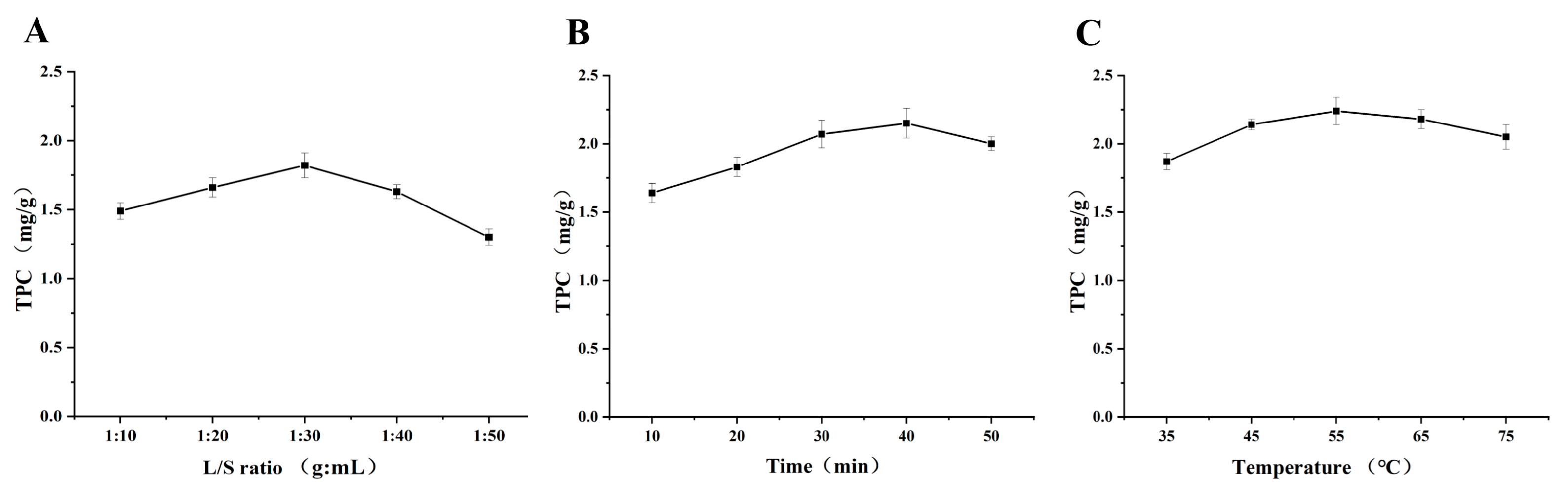
Data (Figure 1A) showed that as the solid-to-liquid ratio increased from 1:10 (g/mL) to 1:30 (g/mL), the total phenolic content exhibited a significant increasing trend. The peak extraction yield was observed at a solid-to-liquid ratio of 1:30 (g/mL), with a yield of 1.82 ± 0.09 mg/g. However, further increasing the solid-to-liquid ratio to 1:40 (g/mL) and 1:50 (g/mL) resulted in a decrease in the extraction yield. Figure 1B showed that as the ultrasonic extraction time increased from 10 min to 40 min, the TPC first increased and then decreased. The highest yield of 2.15 ± 0.11 mg/mL was achieved at 40 min. Figure 1C shows the results of the single-factor experiment for extraction temperature. The optimal extraction temperature was found to be 55 °C, with a corresponding TPC of 2.24 ± 0.10 mg/mL. Based on the single-factor results, the final optimized conditions were: solid-to-liquid ratio of 1:30 (g/mL), ultrasonic extraction time of 40 min, and extraction temperature of 55 °C.
Figure 1.
Effects of (A) solid-liquid ratio, (B) ultrasonic time, and (C) extraction temperature on the TPC from RLAE.
According to the results of the analysis of variance in Table 3, the model’s F-value is greater than 0.05 and the p-value is less than 0.01. Additionally, the first-order, interaction, and second-order terms are all significant, while the lack of fit is not significant, indicating that the model fits the data well.
Table 3.
Analysis of variance of regression model.
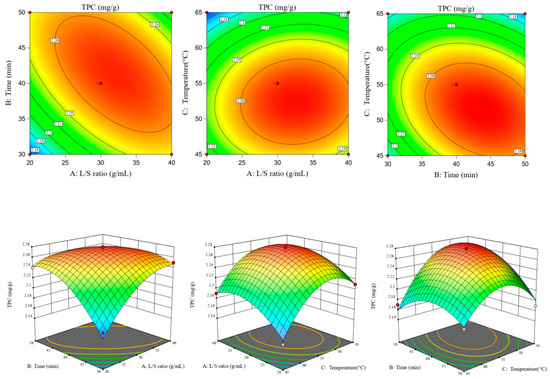
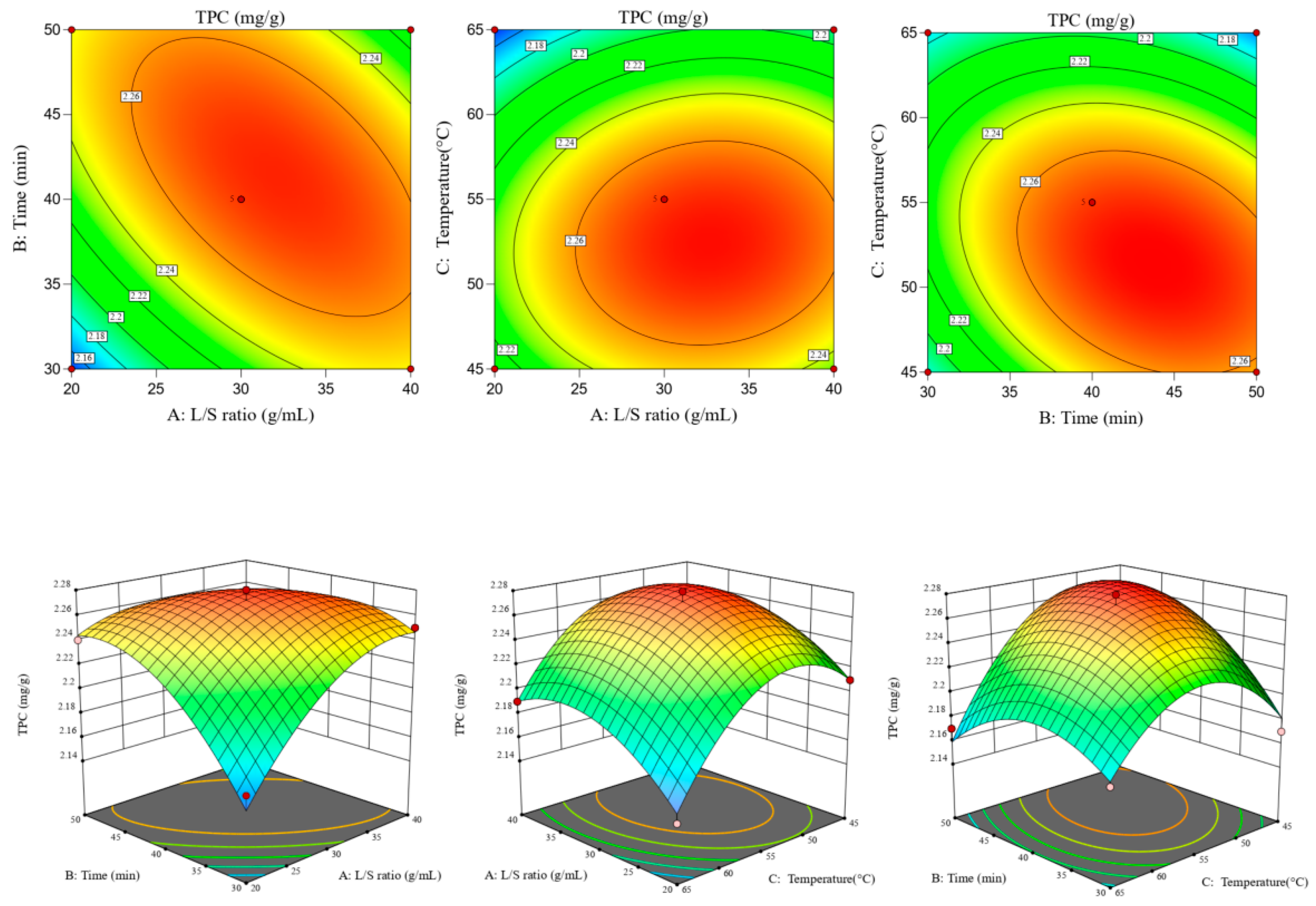
The second-order multiple regression equation is: Y = 2.27 + 0.0162A + 0.015B − 0.0262C − 0.0325AB + 0.0225BC − 0.0285A2 − 0.031B2 − 0.0485C2. In this equation, the influence of the first-order terms A, B, and C on the total phenolic content follows the order: C > A > B, with A, B, and C all having significant effects on the total phenolic content (p < 0.05). The interaction terms AB, BC, and the second-order terms A2, B2, and C2 also significantly influence the total phenolic content (p < 0.05 and p < 0.01). This indicates that the changes in the response value are not merely due to a simple linear relationship but rather a quadratic relationship. Using the regression equation, the 3D surface plots and 2D contour plots in Figure 2, depicting the interactions between the three factors—solid-to-liquid ratio, ultrasonic time, and ultrasonic temperature—were generated using Design-Expert 8.0.6. The contour lines between any two factors were elliptical, indicating a significant interaction. Through analysis of the equation using Design-Expert 8.0.6, the optimal values for the regression model were determined as: solid-to-liquid ratio 1:30, ultrasonic time 43.322 min, and ultrasonic temperature 51.56 °C, with a predicted phenols extraction of 2.28 mg/g. Owing to the precision constraints of the ultrasonic extraction equipment, the theoretically optimal parameters could not be accurately controlled. Thus, the conditions were appropriately adjusted to a solid-liquid ratio of 1:30, ultrasonic time of 43 min, and extraction temperature of 50 °C. Repeated extractions under these modified conditions yielded a total phenolic content (TPC) of 2.26 ± 0.16 mg/g, with a relative error of approximately 1% compared to the predicted value 2.28 mg/g, the experimental results are considered consistent with the predicted outcomes.
Figure 2.
Response surface analysis. Phenolic content (TPC, mg/g). The variables under investigation were A (L:S ratio, g/mL), B (Time, min), and C (Temperature, °C).
3.2. Evaluation of the In Vitro Oxidative Stress Capacity of RLAE
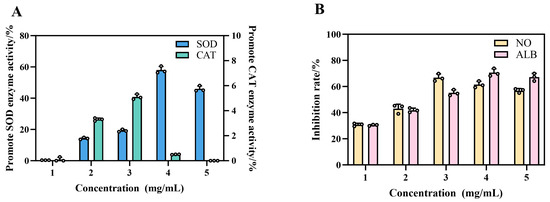
The radical scavenging potential of RLAE was evaluated using various in vitro assays, as outlined in Table 4. The IC50 values for DPPH, ABTS, and O2− radical scavenging activities were determined to be 1.09 ± 0.06 mg/mL, 0.60 ± 0.02 mg/mL, and 0.93 ± 0.03 mg/mL, respectively. Particularly, the ABTS+ assay indicated the highest radical scavenging activity, suggesting RLAE’s efficacy against both hydrophilic and lipophilic radicals, thereby potentially interfering with reactive ROS implicated in initiating oxidative stress [24]. The scavenging capacity of RLAE suggests a possible role in mitigating the initial oxidative triggers of inflammation. Furthermore, in the FRAP assay, RLAE displayed a substantial reducing power equivalent to 11.85 ± 0.47 mmol FeSO4/g, indicating a notable electron-donating capacity, possibly attributed to its phenolic compounds known for facilitating metal chelation and redox reactions. Prior research has indicated that polyphenols found in ramie leaves can bind to iron ions, suggesting potential applications of RLAE beyond the realm of food [25]. Notably, RLAE exhibited a concentration-dependent impact on SOD-like activity in the pyrogallol autoxidation assay. In contrast, no substantial change in CAT-like activity was detected, as shown in Figure 3A.
Table 4.
In vitro antioxidant activity of RLAE.
Figure 3.
Effects of RLAE on in vitro anti-inflammatory. (A) Effect of RLAE on SOD and CAT activity. (B) Effect of RLAE on NO release and inhibit albumin denaturation. Data are presented as mean ± SEM, n = 3. Each data point represents the result of a parallel experiment.
3.3. Evaluation of the In Vitro Anti-Inflammatory Activity of RLAE
Figure 3B illustrates that RLAE once again exhibited superior in vitro anti-inflammatory properties, consistent with its antioxidant effectiveness. RLET notably and significantly suppressed the release of NO in a dose-dependent manner, achieving inhibition rates exceeding 80% at the highest concentration tested. Additionally, RLAE demonstrated notable efficacy in inhibiting heat-induced albumin denaturation, with an inhibition rate of nearly 70% at the highest concentration.
3.4. Cytotoxicity Assay of RLAE
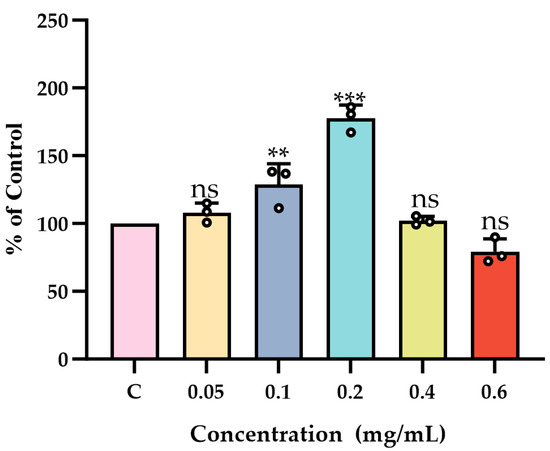
Figure 4 is cells intestinal epithelial cells. Our findings revealed that at concentrations ranging from 0.05 to 0.2 mg/mL, the viability of IEC-6 cells remained consistently at 100%, with concentrations between 0.1 and 0.4 mg/mL exhibiting a stimulatory effect on cell proliferation. Even at 0.4 mg/mL, cell viability remained high at 102%, only declining to 79.3% at 0.6 mg/mL. These results indicate a low toxicity of Ramie leaf water extract on intestinal epithelial cells, at low doses, some nutrients in RLAE may promote cell growth, leading us to designate the concentration range of 0.1–0.3 mg/mL as safe for subsequent experiments.
Figure 4.
Effect of ramie leaf aqueous extracts (0.05, 0.1, 0.2, 0.4, 0.6 mg/mL) on IEC-6 cells viability via CCK-8 assay. Results are presented as percentage of untreated control (C), with data as mean ± S.D., n = 3. Statistical analysis: one-way ANOVA. Each data point represents the result of a parallel experiment, ns means no significant difference (p ≥ 0.05). **, *** mean statistically significant difference compared with LPS induction group (** p < 0.01, *** p < 0.001).
3.5. Effects of RLAE on the Inflammatory Response of IEC-6 Cells Induced by LPS
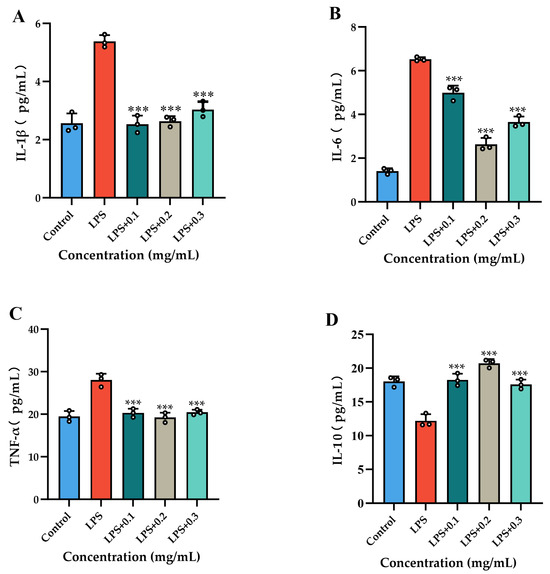
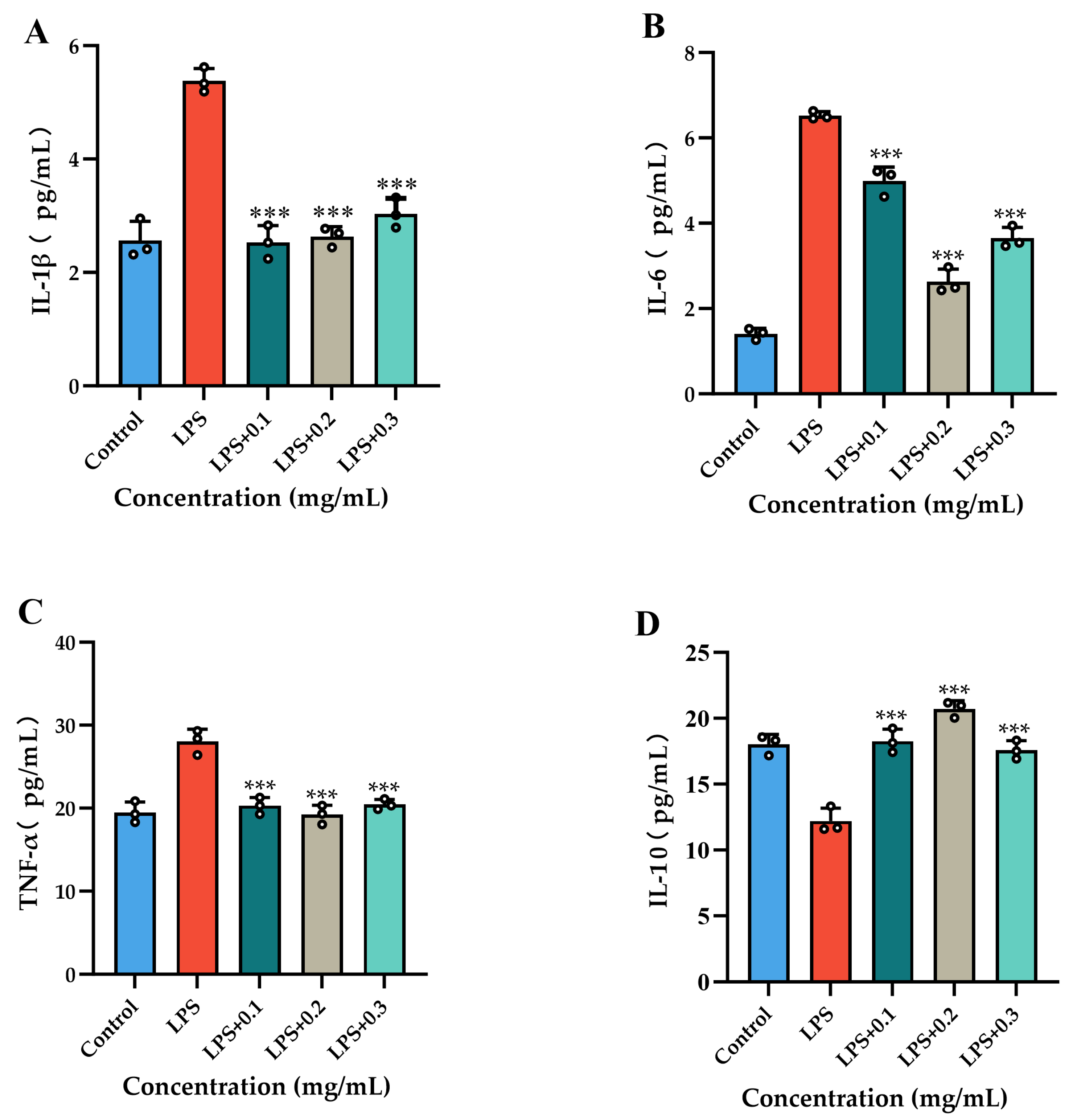
The anti-inflammatory efficacy of RLAE was confirmed in an LPS-induced inflammation model using IEC-6 cells. Treatment with 0.1 and 0.2 mg/mL RLAE significantly reduced the secretion of pro-inflammatory cytokines IL-1β, IL-6, and TNF-α, while increasing the level of the anti-inflammatory cytokine IL-10 (p < 0.001), as shown in Figure 5. However, when the RLAE concentration was increased to 0.3 mg/mL, the inhibitory effect on inflammatory factors decreased, as shown in Figure 5. This study confirmed that RLAE can dose-dependently and significantly inhibit the production of pro-inflammatory cytokines, including TNF-α, IL-1β, IL-6, in LPS-stimulated IEC-6 cells. Within the inflammatory signaling transduction network, NF-κB serves as a central hub regulating the expression of multiple pro-inflammatory genes, including those encoding TNF-α and IL-6. Given the aforementioned anti-inflammatory effects of RLAE, it is reasonable to hypothesize that its mechanism of action may be associated with the inhibition of LPS-induced NF-κB signaling pathway activation [26].
Figure 5.
The effect of different concentrations of ramie leaf aqueous extract on IEC-6 cells (A) 1L-1β, (B) 1L-6, (C) TNF-α, (D) 1L-10 levels was evaluated by Elisa kit, and the results are expressed in pg/mL. C is untreated control group, each data point represents the result of a parallel experiment, *** mean statistically significant difference compared with LPS induction group (*** p < 0.001).
These findings, in conjunction with previous antioxidant data, propose that RLAE exerts its anti-inflammatory effects through a dual mechanism: direct scavenging of free radicals and modulation of critical inflammatory pathways. This multi-faceted action positions RLAE as a promising candidate for the management of inflammatory bowel diseases and other conditions where intestinal epithelial inflammation is pivotal.
3.6. mRNA Expression of Genes Related to Inflammation Response
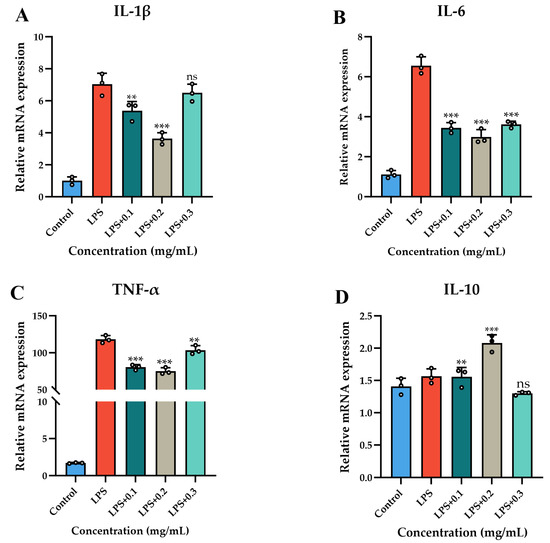
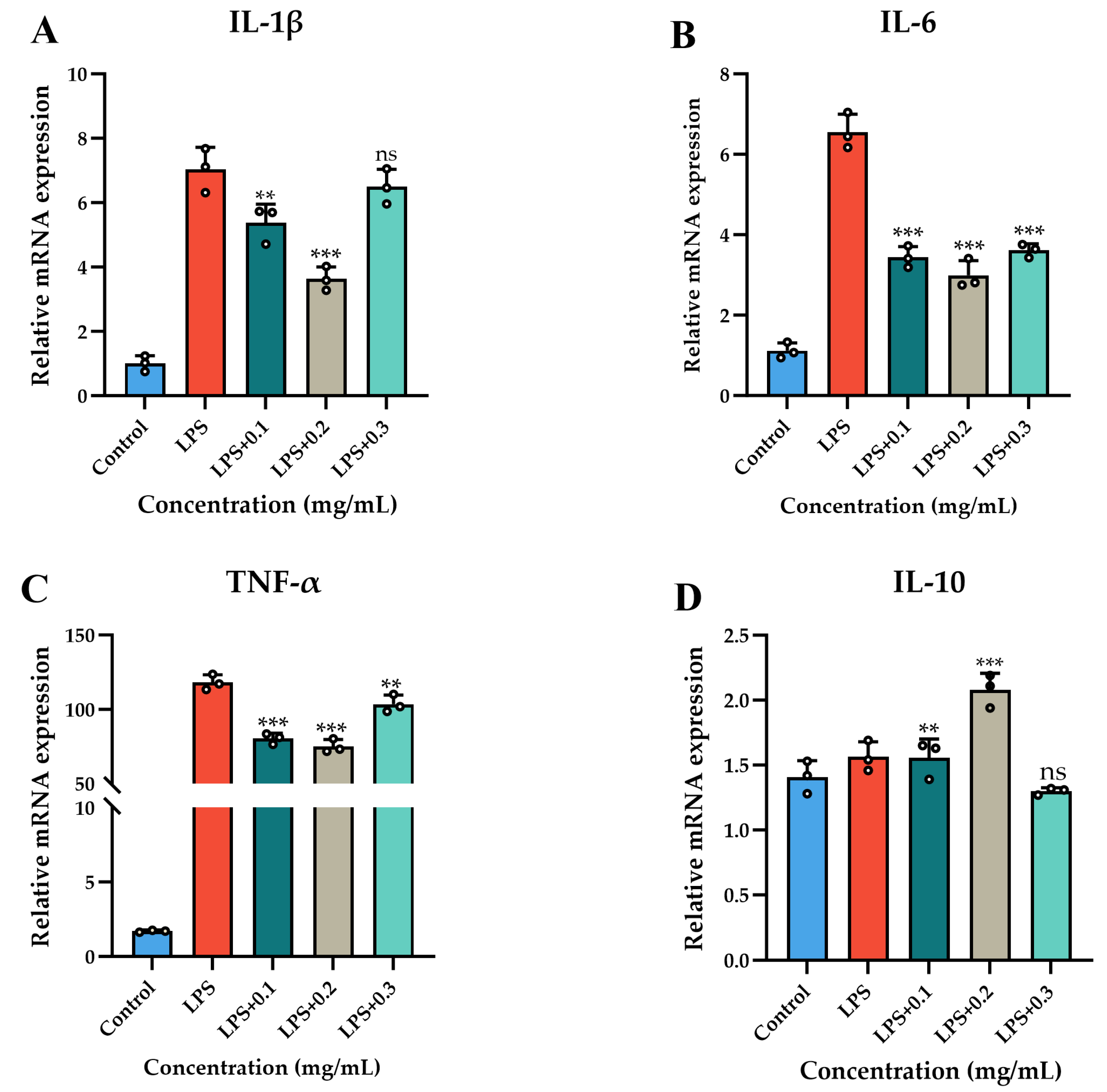
To elucidate the anti-inflammatory mechanism of RLAE, we evaluated the mRNA expression levels of key cytokines in LPS-stimulated IEC-6 cells. Figure 6 illustrates that LPS significantly increased the transcription of pro-inflammatory genes IL-1β, IL-6, and TNF-α, while decreasing the anti-inflammatory IL-10. Pre-treatment with RLWE reversed these effects in a concentration-dependent manner, with 0.2 mg/mL being the most effective concentration. At this concentration, RLWE notably reduced TNF-α, IL-1β, and IL-6 expression, and increased IL-10 mRNA expression significantly (p < 0.001). Importantly, mRNA expression patterns were consistent with protein secretion data obtained from ELISA, indicating that RLAE likely exerts its anti-inflammatory effects through transcriptional regulation, possibly by modulating the NF-κB signaling pathway, a key mediator of LPS-induced inflammation.
Figure 6.
RT-qPCR assay to assess the effect of different concentrations of Ramie leaf aqueous extract on the expression of (A) 1L-1β, (B) 1L-6, (C) TNF-α, (D) 1L-10 mRNA in IEC-6 cells. C is untreated control group. Data were analyzed by one-way ANOVA. Each data point represents the result of a parallel experiment, ns means no significant difference (p ≥ 0.05); **, *** mean statistically significant difference compared with LPS induction group (** p < 0.01, *** p < 0.001).
3.7. HPLC-ESI-QTOF-MS/MS Analysis
The relevant mass spectrum information of the compounds in the Table 5 can be found on PubChem website https://pubchem.ncbi.nlm.nih.gov/ (accessed on 27 November 2025) as the basis.
Table 5.
Identification of compounds in ramie leaf extracts.
The potent antioxidant and anti-inflammatory properties exhibited by RLWE warrant a comprehensive analysis of its phytochemical composition. Utilizing HPLC-ESI-QTOF-MS/MS, the metabolite profile of RLAE was scrutinized, leading to the identification of 21 compounds through comparison of molecular weights and secondary fragments with existing databases. These compounds encompass a range of categories such as phenols, vitamins, amino acids, carbohydrates, organic acids, and nucleotides, including pyrocatechuic acid, rutin, and hyperoside, see Supplementary Document.
4. Discussion
In the single-factor experiment, we found that as the solid-to-liquid ratio increased from 1:30 (g/mL), the total phenol extraction decreased. This might be attributed to the fact that a relatively high solid-liquid ratio dilutes the ultrasonic energy density in the extraction system, leading to the weakened promoting effect on plant cell disruption and phenolic compound leaching, and ultimately reducing the extraction yield [27].
In the antioxidant experiment, we found in comparison to other plant extracts like Ocimum basilicum L. (IC50 = 11.23 mg/mL in DPPH) [28] and Anchusa italica Retz (IC50 = 0.14 μg/mL in DPPH, equivalent to 0.00014 mg/mL) [29], RLAE exhibited moderate free radical scavenging ability but stood out due to its multifunctional mechanism [27]. Notably, RLAE demonstrated significant effectiveness against O2−, which are precursors to more harmful ROS and can trigger pro-inflammatory pathways such as NF-κB via NADPH oxidase (NOX) [30].
In experiments affecting oxidase, we found that this indicates the enzymatic antioxidant mechanism employed by RLAE is specific. The primary function of CAT is to scavenge H2O2, preventing its conversion into more toxic hydroxyl radicals via the Fenton reaction [31]. Phenolic compounds can act as metal chelators to inhibit the Fenton reaction and reduce the formation of H2O2 [32]. In the present study, it was observed that RLAE has no significant effect on CAT activity, which is highly consistent with the findings of Lee et al. [13]. In their study on the effects of ramie leaf ethanol extract on constipation and oxidative stress in rats, they found that CAT activity in the intestinal mucosa of experimental animals did not exhibit a significant change, while the H2O2 level was still significantly reduced. This phenomenon directly confirms the dual antioxidant effects of the phenolic components in RLAE. Therefore, the antioxidant activity of RLAW is not strongly dependent on CAT. The comprehensive antioxidant profile suggests that RLAE operates through diverse pathways, including hydrogen donation, electron transfer, metal reduction, and SOD-like activity. While its IC50 values in individual radical quenching assays exceed those of certain specialized plant extracts, its broad-spectrum efficacy and enzymatic enhancement underscore its functional adaptability. The presence of phenolic acids and flavonoids, commonly found in ramie leaves [13,33], likely underlie these characteristics, bolstering its potential for health-related applications such as anti-inflammatory and antidiabetic formulations.
In the RLAE in vitro anti-inflammatory activity experiment, we found RLAE can inhibit the release of NO and the deterioration of albumin. NO, a pivotal inflammatory mediator generated by inducible nitric oxide synthase (iNOS) in activated macrophages, is closely linked to chronic inflammation and tissue damage when overproduced. The potent inhibition of NO suggests that RLAE may disrupt iNOS expression or directly scavenge NO radicals, thereby mitigating inflammatory signaling. Protein denaturation, a characteristic feature of inflammatory conditions, often results in impaired cellular function and activation of immune responses [34]. The potential anti-inflammatory effect of RLAE lies in its ability to stabilize albumin structure, thereby protecting biomacromolecules from oxidative or thermal stress. This anti-inflammatory activity is attributed to the abundant polyphenolic content of RLAE, which not only scavenges free radicals such as O2− and NO but also modulates signaling pathways like NF-κB and MAPK. Consequently, the expression of pro-inflammatory cytokines (e.g., TNF-α, IL-6) and enzymes (e.g., iNOS) is reduced. These findings suggest that RLAE exerts a multi-target action, consistent with its broad-spectrum antioxidant capacity observed in DPPH, ABTS, and FRAP assays.
In cytotoxicity experiments, we found that RLAE exhibited low cytotoxicity at 0.1–0.4 mg/mL. In terms of safety assessment, Tang et al. [35]. demonstrated in animal studies that replacing 35% of alfalfa feed with Ramie leaves in the diet of black goats notably enhanced mutton quality without any observed adverse effects, providing supportive evidence at the animal husbandry level. Moreover, historical records in traditional Chinese medicine highlight the hemostatic and detoxifying properties of Ramie leaves, with their incorporation into dietary practices as green vegetables further suggesting their safety at low doses for human consumption. However, when the RLAE concentration was increased to 0.3 mg/mL, the inhibitory effect on inflammatory factors decreased, as shown in Figure 5. This study confirmed that RLAE can dose-dependently and significantly inhibit the production of pro-inflammatory cytokines, including TNF-α, IL-1β, IL-6, in LPS-stimulated IEC-6 cells. Within the inflammatory signaling transduction network, NF-κB serves as a central hub regulating the expression of multiple pro-inflammatory genes, including those encoding TNF-α and IL-6. Given the aforementioned anti-inflammatory effects of RLAE, it is reasonable to hypothesize that its mechanism of action may be associated with the inhibition of LPS-induced NF-κB signaling pathway activation [36].
Interestingly, in the cellular inflammation experiments, we observed a dose-dependent response, at a concentration of 0.3 mg/mL, the inhibitory effect of RLAE on pro-inflammatory cytokines was attenuated, which may be associated with the presence of a biphasic response or adaptive response [37]. Such responses are characterized by beneficial effects exerted by substances at low doses, while higher doses may diminish these effects or even induce adverse outcomes such as pro-inflammatory promotion, or trigger the production of compensatory anti-inflammatory response syndrome (CARS) in cells. Notably, previous studies have demonstrated that the anti-inflammatory activity of the ethanol extract from Moringa oleifera leaves exhibits a dose-independent pattern, whose mechanism is attributed to the presence of antinutritional components such as phytic acid, these components can hinder the absorption and functional exertion of bioactive phytocompounds [38]. Given that ramie leaves also contain antinutritional components like tannins [39], it is hypothesized that a similar mechanism may be involved in mediating the attenuation of anti-inflammatory activity of RLAE at high doses. Furthermore, cell viability remained at approximately 100% at 0.4 mg/mL, however, it should be noted that the CCK-8 assay primarily reflects mitochondrial dehydrogenase-related metabolic activity and is unable to capture non-lethal cellular functional states that can alter the inflammatory response threshold, potentially overlooking underlying mild cellular stress. Therefore, the possibility that mild cellular stress exists at 0.3 mg/mL, which in turn leads to the rebound of inflammatory signals, cannot be completely ruled out. Collectively, the aforementioned mechanisms may jointly explain the phenomenon wherein the anti-inflammatory activity of RLAE is attenuated at high doses without exhibiting obvious cytotoxicity.
Integrating these findings with prior research reveals a coherent mechanism: Rich in phenolic compounds, RLAE scavenges ROS produced during LPS challenge, reducing oxidative stress. This antioxidant activity may indirectly inhibit NF-κB activation, resulting in reduced pro-inflammatory cytokine transcription and increased anti-inflammatory IL-10 expression. The observed biphasic response at higher concentrations (e.g., 0.3 mg/mL) highlights the nuanced regulation needed to modulate inflammatory pathways, a characteristic shared with various polyphenol-rich extracts. In essence, RLAE exhibits robust anti-inflammatory effects at both transcriptional and translational levels, acting through the ROS–NF-κB–cytokine axis. These findings not only validate its traditional use for inflammatory conditions but also endorse its potential as a natural ingredient in functional foods targeting gastrointestinal health.
Among the detected substances, flavonoid glycosides like rutin and hyperoside are recognized for their dual antioxidative and anti-inflammatory properties. Rutin not only directly scavenges free radicals but also augments the activity of endogenous antioxidant enzymes like SOD [40]. Hyperoside has been demonstrated to regulate the SIRT1/NF-κB and Nrf2/ARE signaling pathways [41], thereby inhibiting the expression of pro-inflammatory cytokines such as TNF-α and IL-6 [42]. Similarly, pyrocatechuic acid confers protective effects by inhibiting NOX-4 and the p38 MAPK pathway, thereby diminishing both ROS generation and inflammatory responses [43]. The presence of azelaic acid, a dicarboxylic acid known for its antioxidant and anti-inflammatory properties, suggests significant health implications, particularly in dermatological and metabolic contexts [44]. Azelaic acid’s ability to inhibit tyrosinase and alleviate oxidative stress indicates its potential application in cosmetic or topical formulations alongside RLWE. Additionally, vitamin B6 (pyridoxine) acts as a vital cofactor in various enzymatic reactions, indirectly supporting cellular redox balance and adding a metabolic aspect to the extract’s bioactivity [45]. In comparison to extensively studied plant extracts like those from Ginkgo biloba or green tea [46,47], RLAE contains phenolic constituents such as rutin and quercetin derivatives but stands out due to its unique combination of azelaic acid, vitamin B6, and nucleosides (e.g., guanosine and inosine), which may enhance synergistic effects. This diverse chemical profile allows RLAE to combat oxidative stress and inflammation through various mechanisms, including direct free radical neutralization, metal chelation, enzyme cofactor support, and transcriptional regulation of inflammatory mediators. In essence, RLAE’s chemical composition forms a solid phytochemical basis for its observed bioactivities. The interplay among flavonoids, phenolic acids, and organic acids enables a comprehensive intervention in oxidative and inflammatory processes, positioning RLWE as a promising candidate for further exploration in functional foods or preventive health applications targeting inflammatory-related disorders.
5. Conclusions
This research systematically investigated the antioxidant and anti-inflammatory properties of ultrasound-optimized RLAE. The extract exhibited diverse antioxidant activity by effectively scavenging free radicals, demonstrating metal-reducing capacity, and showing SOD-like activity. At the cellular level, RLAE significantly reduced the expression of pro-inflammatory cytokines and increased anti-inflammatory mediators in LPS-stimulated intestinal epithelial cells, indicating its potential involvement in modulating the NF-κB signaling pathway. HPLC-ESI-QTOF-MS/MS analysis revealed that RLAE contains three classes of compounds, phenolic acids, flavonoids, and organic acids, all of which have been confirmed to possess antioxidant and anti-inflammatory activities. Given the mixed nature of the aqueous extract, its comprehensive activity is speculated to stem from the synergistic effect of these three classes of compounds. These results underscore the potential of RLAE as a natural multifunctional extract for addressing oxidative stress and inflammation-related conditions. The study lays a scientific foundation for developing ramie leaf-based functional ingredients for nutraceutical or preventive health applications. Future research directions should include in vivo validation, isolation of active compounds, and exploration of synergistic effects in disease models.
Supplementary Materials
The following supporting information can be downloaded at: https://www.mdpi.com/article/10.3390/app16010450/s1.
Author Contributions
Methodology, writing—original, software, draft: J.P.; Conceptualization, methodology, writing—review and editing: L.D. and X.D.; Writing—review and editing, supervision: H.W. and Y.W.; Conceptualization, Resources: Q.C.; Investigation: Y.L. Conceptualization, Resources and Funding acquisition: J.C. All authors have read and agreed to the published version of the manuscript.
Funding
This work was supported by National Natural Science Foundation of China (32302019); Research Fund for Key R&D projects in Hubei Province (2022BBA0053).
Data Availability Statement
The original contributions presented in this study are included in the article/Supplementary Material. Further inquiries can be directed to the corresponding author.
Acknowledgments
The author thanks Yanjun Niu from the School of Exercise and Health, Shanghai University of Sport, for providing assistance with the cell experiments in the article.
Conflicts of Interest
The authors declare no conflicts of interest.
Correction Statement
This article has been republished with a minor correction to the Data Availability Statement. This change does not affect the scientific content of the article.
References
- Kim, M.-B.; Lee, H.; Vance, T.; Lee, S.G. Antioxidant and Anti-Inflammatory Effects of Agarum Cribrosum Extract and Its Fractions in Lps-Induced Raw 264.7 Macrophages. Appl. Sci. 2023, 13, 10048. [Google Scholar]
- Luo, H. Global Burden and Cross-Country Inequalities in Six Major Immune-Mediated Inflammatory Diseases from 1990 to 2021: A Systemic Analysis of the Global Burden of Disease Study 2021. Autoimmun Rev 2024, 23, 103639. [Google Scholar] [PubMed]
- Mokhtari-Zaer, A.; Norouzi, F.; Askari, V.R.; Khazdair, M.R.; Roshan, N.M.; Boskabady, M.; Hosseini, M.; Boskabady, M.H. The Protective Effect of Nigella Sativa Extract on Lung Inflammation and Oxidative Stress Induced by Lipopolysaccharide in Rats. J. Ethnopharmacol. 2020, 253, 112653. [Google Scholar] [CrossRef] [Scilit] [PubMed]
- Averill-Bates, D. Reactive Oxygen Species and Cell Signaling. Review. Biochim. Et Biophys. Acta (BBA) Mol. Cell Res. 2024, 1871, 119573. [Google Scholar] [CrossRef] [Scilit]
- Zuzarte, M.; Francisco, V.; Neves, B.; Liberal, J.; Cavaleiro, C.; Canhoto, J.; Salgueiro, L.; Cruz, M.T. Lavandula Viridis L Her. Essential Oil Inhibits the Inflammatory Response in Macrophages through Blockade of Nf-Kb Signaling Cascade. Front. Pharmacol. 2021, 12, 695911. [Google Scholar]
- Gul, Z.; Akbar, A.; Leghari, S.K. Elucidating Therapeutic and Biological Potential of Berberis Baluchistanica Ahrendt Bark, Leaf, and Root Extracts. Front. Microbiol. 2022, 13, 823673. [Google Scholar] [CrossRef] [Scilit]
- Jia, J.; Feng, L.; Ye, S.; Ping, R.; Mo, X.; Zhang, Y.; Li, X.; Chen, D. Therapeutic Effect of Chinese Herbal Medicine Gu-Ben-Hua-Shi (Aess) Formula on Atopic Dermatitis through Regulation of Yes-Associated Protein. Front. Pharmacol. 2022, 13, 929580. [Google Scholar]
- Pantalos, G.; Vaou, N.; Papachristidou, S.; Stavropoulou, E.; Tsigalou, C.; Voidarou, C.; Bezirtzoglou, E. Antioxidant and Anti-Inflammatory Phytochemicals for the Treatment of Inflammatory Bowel Disease: A Systematic Re-view. Appl. Sci. 2024, 14, 2177. [Google Scholar] [CrossRef] [Scilit]
- Radojković, M.; Moreira, M.M.; Soares, C.; Fátima Barroso, M.; Cvetanović, A.; Švarc-Gajić, J.; Morais, S.; Delerue-Matos, C. Microwave-Assisted Extraction of Phenolic Compounds from Morus Nigra Leaves: Optimization and Characterization of the Antioxidant Activity and Phenolic Composition. J. Chem. Technol. Biotechnol. 2018, 93, 1684–1693. [Google Scholar] [CrossRef] [Scilit]
- Farcas, A.D.; Mot, A.C.; Zagrean-Tuza, C.; Ticolea, M.; Sevastre, B.; Kulak, M.; Silaghi-Dumitrescu, R.; Parvu, A. Remarkable Rutin-Rich Hypericum Capitatum Extract Exhibits Anti-Inflammatory Effects on Turpentine Oil-Induced In-flammation in Rats. BMC Complement. Altern. Med. 2019, 19, 289. [Google Scholar]
- Funakoshi-Tago, M.; Nonaka, Y.; Tago, K.; Takeda, M.; Ishihara, Y.; Sakai, A.; Matsutaka, M.; Kobata, K.; Tamura, H. Pyrocatechol, a Component of Coffee, Suppresses Lps-Induced Inflammatory Responses by Inhibiting Nf-Kappab and Activating Nrf2. Sci. Rep. 2020, 10, 2584. [Google Scholar] [CrossRef] [Scilit]
- Rehman, M.; Gang, D.; Liu, Q.; Chen, Y.; Wang, B.; Peng, D.; Liu, L. Ramie, a Multipurpose Crop: Potential Applications, Constraints and Improvement Strategies. Ind. Crops Prod. 2019, 137, 300–307. [Google Scholar] [CrossRef] [Scilit]
- Lee, H.J.; Choi, E.J.; Park, S.; Lee, J.J. Laxative and Antioxidant Effects of Ramie (Boehmeria nivea L.) Leaf Extract in Experimental Constipated Rats. Food Sci. Nutr. 2020, 8, 3389–3401. [Google Scholar] [CrossRef] [Scilit] [PubMed]
- Choi, J.; Nguyen, Q.N.; Baek, J.Y.; Cho, D.E.; Kang, K.S.; Hahm, D.H.; Jang, T.W.; Park, J.H.; Lee, A.Y.; Lee, S. Beneficial Role of Boehmeria Nivea in Health and Phytochemical Constituents. J. Food Biochem. 2022, 46, e14474. [Google Scholar] [CrossRef] [Scilit] [PubMed]
- Pereira, E.D.; Cardoso, D.V.; da Silva, E.A.; Triques, C.C.; Pavan, E.C.; Andressa Santos, K.; Zara, R.F.; Hoscheid, J.; Fagundes-Klen, M.R. Ultrasound-Assisted Extraction with Water of Lyophilized Camu-Camu (Myrciaria Dubia) Resulted in High Antioxidant and Antimicrobial Inhibition. J. Chem. Technol. Biotechnol. 2025, 100, 1956–1972. [Google Scholar] [CrossRef] [Scilit]
- Manchanda, P.; Kaur, H.; Mankoo, R.K.; Kaur, J.; Kaur, M.; Sidhu, G.S. Effect of Solvent Ratio, Temperature and Time on Extraction of Bioactive Compounds and Their Antioxidant Potential from Callus, Leaf and Peel Extracts of Citrus Pseudolimon Taraka. J. Food Meas. Charact. 2023, 17, 6180–6190. [Google Scholar] [CrossRef] [Scilit]
- Wang, Q.; Rehman, M.; Peng, D.; Liu, L. Antioxidant Capacity and A-Glucosidase Inhibitory Activity of Leaf Extracts from Ten Ramie Cultivars. Ind. Crops Prod. 2018, 122, 430–437. [Google Scholar] [CrossRef] [Scilit]
- Li, Z.; Lan, Y.; Miao, J.; Chen, X.; Chen, B.; Liu, G.; Wu, X.; Zhu, X.; Cao, Y. Phytochemicals, Antioxidant Capacity and Cytoprotective Effects of Jackfruit (Artocarpus Heterophyllus Lam.) Axis Ex-tracts on Hepg2 Cells. Food Biosci. 2021, 41, 100933. [Google Scholar] [CrossRef] [Scilit]
- Dou, N.; Sun, R.; Su, C.; Ma, Y.; Zhang, X.; Wu, M.; Hou, J. Soybean Oil Bodies as a Milk Fat Substitute Improves Quality, Antioxidant and Digestive Properties of Yogurt. Foods 2022, 11, 2088. [Google Scholar] [CrossRef] [Scilit]
- Mehta, A. Dpph and Frap Assays for Different Extracts of in Vitro and in Vivo Grown Plantlets of Bacopa monnieri L. Vegetos 2023, 36, 1570–1575. [Google Scholar] [CrossRef] [Scilit]
- Zhao, L.; Ji, Z.; Li, K.; Wang, B.; Zeng, Y.; Tian, S. Hplc-Dad Analysis of Hyssopus Cuspidatus Boriss Extract and Mensuration of Its Antioxygenation Property. BMC Complement. Med. Ther. 2020, 20, 228. [Google Scholar] [CrossRef] [Scilit] [PubMed]
- Lauro, M.R.; Marzocco, S.; Rapa, S.F.; Musumeci, T.; Giannone, V.; Picerno, P.; Aquino, R.P.; Puglisi, G. Recycling of Almond by-Products for Intestinal Inflammation: Improvement of Physical-Chemical, Technological and Bi-ological Characteristics of a Dried Almond Skins Extract. Pharmaceutics 2020, 12, 884. [Google Scholar] [CrossRef] [Scilit] [PubMed]
- Chen, N.; Fu, Y.; Wang, Z.X.; Zhao, X.H. Casein Lactose-Glycation of the Maillard-Type Attenuates the Anti-Inflammatory Potential of Casein Hydrolysate to Iec-6 Cells with Lipopolysaccharide Stimulation. Nutrients 2022, 14, 5067. [Google Scholar] [CrossRef] [Scilit] [PubMed]
- Gu, C.; Howell, K.; Dunshea, F.R.; Suleria, H.A.R. Lc-Esi-Qtof/Ms Characterisation of Phenolic Acids and Flavonoids in Polyphenol-Rich Fruits and Vegetables and Their Potential Antioxidant Activities. Antioxidants 2019, 8, 405. [Google Scholar] [CrossRef] [Scilit]
- Zeng, J.; Xie, B.; He, Y.; Lai, C.; Li, X.; Wei, Y.; Wang, W.; Yao, B.; Wen, X.; Deng, C. Experimental and Theoretical Insights into Ramie (Boehmeria nivea (L.) Gaudich) Leaves Extract as an Eco-Friendly Corrosion Inhibitor for Mild Steel in 1.0 M Hcl. Surf Interfaces 2025, 62, 106155. [Google Scholar] [CrossRef] [Scilit]
- Liu, R.; Zhou, B.; Che, K.; Gao, W.; Luo, H.; Yang, J.; Chen, Z.; Hu, W. Torreya Grandis Seed Polyphenols Protect Raw264.7 Macrophages by Inhibiting Oxidative Stress and Inflammation. Food Sci. Nutr. 2025, 13, e70682. [Google Scholar] [CrossRef] [Scilit]
- Bouaoudia-Madi, N.; Boulekbache-Makhlouf, L.; Madani, K.; Silva, A.M.S.; Dairi, S.; Oukhmanou-Bensidhoum, S.; Cardoso, S.M. Optimization of Ultrasound-Assisted Extraction of Polyphenols from Myrtus communis L. Pericarp. Antioxidants 2019, 8, 205. [Google Scholar] [CrossRef] [Scilit]
- Ahmed, A.F.; Attia, F.A.K.; Liu, Z.; Li, C.; Wei, J.; Kang, W. Antioxidant Activity and Total Phenolic Content of Essential Oils and Extracts of Sweet Basil (Ocimum basilicum L.) Plants. Food Sci. Hum. Wellness 2019, 8, 299–305. [Google Scholar] [CrossRef] [Scilit]
- Khomsi, M.E.; Imtara, H.; Kara, M.; Hmamou, A.; Assouguem, A.; Bourkhiss, B.; Tarayrah, M.; AlZain, M.N.; Alzamel, N.M.; Noman, O.; et al. Antimicrobial and Antioxidant Properties of Total Polyphenols of Anchusa Italica Retz. Molecules 2022, 27, 416. [Google Scholar] [CrossRef] [Scilit]
- Ikarashi, N.; Toda, T.; Hatakeyama, Y.; Kusunoki, Y.; Kon, R.; Mizukami, N.; Kaneko, M.; Ogawa, S.; Sugiyama, K. Anti-Hypertensive Effects of Acacia Polyphenol in Spontaneously Hypertensive Rats. Int. J. Mol. Sci. 2018, 19, 700. [Google Scholar] [CrossRef] [Scilit]
- Alhumaydhi, F.A.; Younus, H.; Khan, M.A. Catalase Functions and Glycation: Their Central Roles in Oxidative Stress, Metabolic Disorders, and Neurodegeneration. Catalysts 2025, 15, 817. [Google Scholar] [CrossRef] [Scilit]
- Andrés, C.M.C.; Pérez de la Lastra, J.M.; Juan, C.A.; Plou, F.J.; Pérez-Lebeña, E. Polyphenols as Antioxidant/Pro-Oxidant Compounds and Donors of Reducing Species: Relationship with Human Anti-oxidant Metabolism. Processes 2023, 11, 2771. [Google Scholar] [CrossRef] [Scilit]
- Mandim, F.; Petropoulos, S.A.; Pinela, J.; Dias, M.I.; Kostic, M.; Sokovic, M.; Ferreira, I.; Santos-Buelga, C.; Barros, L. Phenolic Composition and Antioxidant, Anti-Inflammatory, Cytotoxic, and Antimicrobial Activities of Cardoon Blades at Different Growth Stages. Biology 2022, 11, 699. [Google Scholar] [CrossRef] [Scilit] [PubMed]
- Osman, N.I.; Sidik, N.J.; Awal, A.; Adam, N.A.; Rezali, N.I. In Vitro Xanthine Oxidase and Albumin Denaturation Inhibition Assay of Barringtonia racemosa L. And Total Phenolic Content Analysis for Potential Anti-Inflammatory Use in Gouty Arthritis. J. Intercult. Ethnopharmacol. 2016, 5, 343–349. [Google Scholar] [CrossRef] [Scilit]
- Tang, S.; He, Y.; Zhang, P.; Kang, J.; Yan, Q.; Han, X.; Tan, Z.; Wang, H.; Wu, D.; Yu, L.; et al. Substitution of Ramie (Boehmeria Nivea) for Alfalfa in Improving the Carcass and Meat Quality of Liuyang Black Goats. Anim. Nutr. 2021, 7, 688–694. [Google Scholar] [CrossRef] [Scilit]
- Liu, W.; Cui, X.; Zhong, Y.; Ma, R.; Liu, B.; Xia, Y. Phenolic Metabolites as Therapeutic in Inflammation and Neoplasms: Molecular Pathways Explaining Their Efficacy. Pharmacol. Res. 2023, 193, 106812. [Google Scholar] [CrossRef] [Scilit]
- Jayanegara, A.; Rahminiwati, M.; Sismin Satyaningtijas, A.; Nadia Poetri, O.; Madyastuti Purwono, R.; Niderkorn, V.; Caesarendra, W.; Gusrialdi, A.; Huda, N.; Pratiwi, A.; et al. Effect of Hedyotis Corymbosa (Pearl Grass) Extract on Pro-Inflammatory Cytokines Il10, Il6, and Tnfα in Mice with Acute Lung Inflammation Induced by Lps. BIO Web Conf. 2025, 171, 03018. [Google Scholar] [CrossRef] [Scilit]
- Mahdi, H.J.; Khan, N.A.K.; Asmawi, M.Z.B.; Mahmud, R.; Murugaiyah, V.A. In Vivo Anti-Arthritic and Anti-Nociceptive Effects of Ethanol Extract of Moringa Oleifera Leaves on Complete Freund’s Adjuvant (Cfa)-Induced Arthritis in Rats. Integr. Med. Res. 2018, 7, 85–94. [Google Scholar] [CrossRef] [Scilit]
- Wei, J.T.; Yang, X.H.; Yan, N.D.; Xiong, C.C.; Wang, H.W.; Chen, F.; Zhang, N.; Diao, Q. Nutritional Value of Ramie and Its Ruminal Degradability. Acta Prataculturae Sin. 2017, 26, 197–204. [Google Scholar]
- Ahmed, O.M.; Elkomy, M.H.; Fahim, H.I.; Ashour, M.B.; Naguib, I.A.; Alghamdi, B.S.; Mahmoud, H.U.R.; Ahmed, N.A. Rutin and Quercetin Counter Doxorubicin-Induced Liver Toxicity in Wistar Rats Via Their Modulatory Effects on In-flammation, Oxidative Stress, Apoptosis, and Nrf2. Oxid. Med. Cell Longev. 2022, 2022, 2710607. [Google Scholar] [CrossRef] [Scilit]
- Abdelhameed, R.F.A.; Fattah, S.A.; Mehanna, E.T.; Hal, D.M.; Mosaad, S.M.; Abdel-Kader, M.S.; Ibrahim, A.K.; Ahmed, S.A.; Badr, J.M.; Eltamany, E.E. Zygo-Albuside A: New Saponin from Zygophyllum album L. With Significant Antioxidant, Anti-Inflammatory and Antiapoptotic Effects against Methotrexate-Induced Testicular Damage. Int. J. Mol. Sci. 2022, 23, 10799. [Google Scholar] [CrossRef] [Scilit]
- Xie, T.; Yuan, J.; Mei, L.; Li, P.; Pan, R. Hyperoside Ameliorates Tnf-Alpha-Induced Inflammation, Ecm Degradation and Er Stress-Mediated Apoptosis Via the Sirt1/Nf-Kappab and Nrf2/Are Signaling Pathways in Vitro. Mol. Med. Rep. 2022, 26, 260. [Google Scholar] [CrossRef] [Scilit]
- Alvarez Cilleros, D.; Lopez-Oliva, M.E.; Martin, M.A.; Ramos, S. (-)-Epicatechin and the Colonic Metabolite 2,3-Dihydroxybenzoic Acid Protect against High Glucose and Lipopolysaccha-ride-Induced Inflammation in Renal Proximal Tubular Cells through Nox-4/P38 Signalling. Food Funct. 2020, 11, 8811–8824. [Google Scholar] [CrossRef] [Scilit]
- Zhang, D.; Luo, Z.; Jin, Y.; Chen, Y.; Yang, T.; Yang, Q.; Wu, B.; Shang, Y.; Liu, X.; Wei, Y.; et al. Azelaic Acid Exerts Antileukemia Effects against Acute Myeloid Leukemia by Regulating the Prdxs/Ros Signaling Path-way. Oxid. Med. Cell Longev. 2020, 2020, 1295984. [Google Scholar] [CrossRef] [Scilit]
- Yanaka, N.; Kanda, M.; Toya, K.; Suehiro, H.; Kato, N. Vitamin B6 Regulates Mrna Expression of Peroxisome Proliferator-Activated Receptor-Gamma Target Genes. Exp. Ther. Med. 2011, 2, 419–424. [Google Scholar] [CrossRef] [Scilit]
- Stefanovits-Banyai, E.; Szentmihalyi, K.; Hegedus, A.; Koczka, N.; Vali, L.; Taba, G.; Blazovics, A. Metal Ion and Antioxidant Alterations in Leaves between Different Sexes of Ginkgo biloba L. Life Sci. 2006, 78, 1049–1056. [Google Scholar] [CrossRef] [Scilit]
- Zhao, T.; Li, C.; Wang, S.; Song, X. Green Tea (Camellia sinensis): A Review of Its Phytochemistry, Pharmacology, and Toxicology. Molecules 2022, 27, 3909. [Google Scholar] [CrossRef] [Scilit] [PubMed]

Disclaimer/Publisher’s Note: The statements, opinions and data contained in all publications are solely those of the individual author(s) and contributor(s) and not of MDPI and/or the editor(s). MDPI and/or the editor(s) disclaim responsibility for any injury to people or property resulting from any ideas, methods, instructions or products referred to in the content. |
© 2025 by the authors. Licensee MDPI, Basel, Switzerland. This article is an open access article distributed under the terms and conditions of the Creative Commons Attribution (CC BY) license.