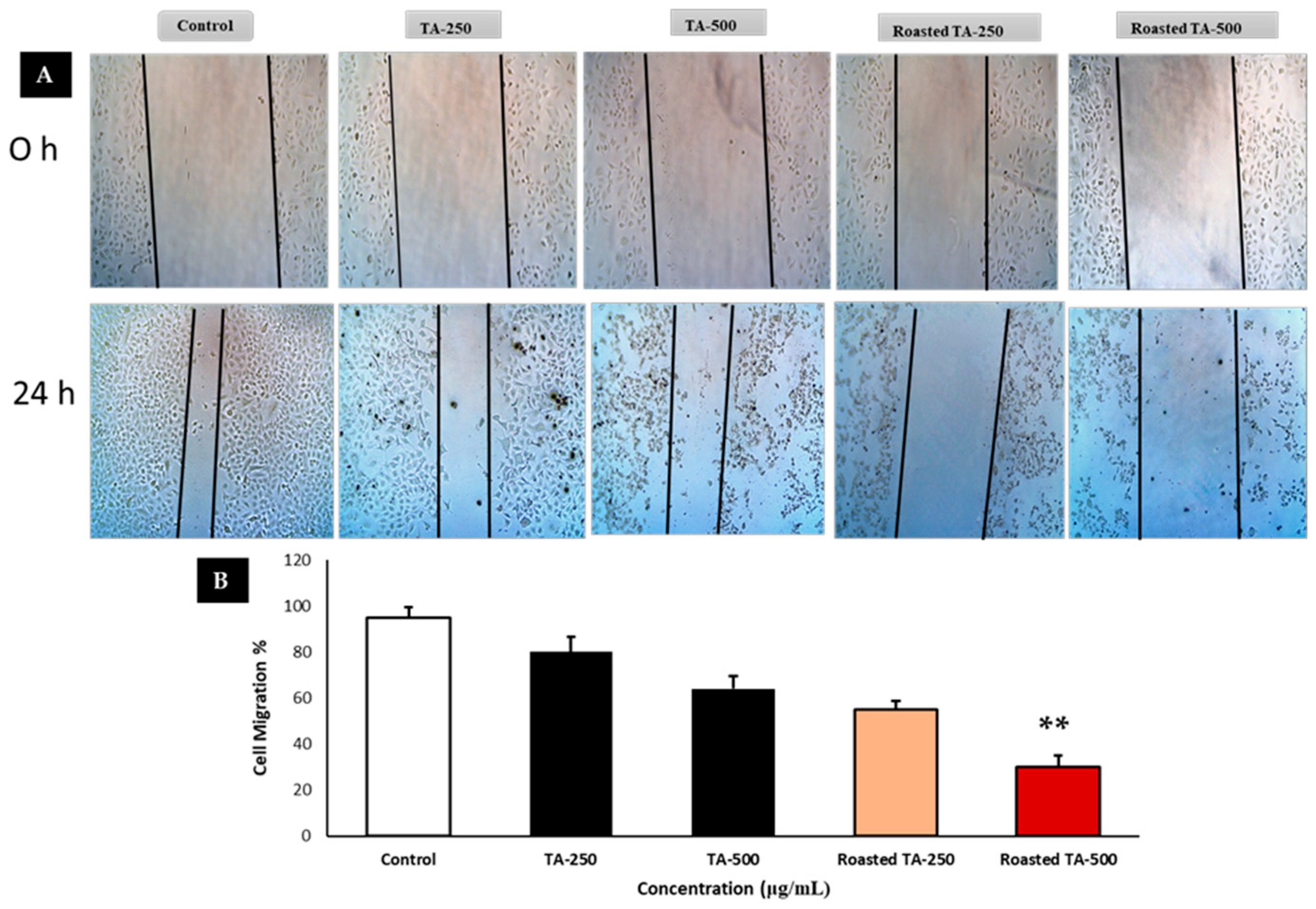
Correction: Nahar et al. Roasting Extract of Handroanthus impetiginosus Enhances Its Anticancer Activity in A549 Lung Cancer Cells and Improves Its Antioxidant and Anti-Inflammatory Effects in Normal Cells. Appl. Sci. 2023, 13, 13171

 ,
,  ,
,  ,
,  and
and - 46.
- Zaidieh, T.; Smith, J.R.; Ball, K.E.; An, Q. ROS as a novel indicator to predict anticancer drug efficacy. BMC Cancer 2019, 19, 1224.
- 47.
- Zou, Z.; Chang, H.; Li, H.; Wang, S. Induction of reactive oxygen species: An emerging approach for cancer therapy. Apoptosis 2017, 22, 1321–1335.
Reference
- Nahar, J.; Morshed, M.N.; Rupa, E.J.; Lee, J.H.; Kariyarath Valappil, A.; Awais, M.; Hun, K.J.; Sook, L.J.; Al-Amin, M.; Ahn, J.C.; et al. Roasting Extract of Handroanthus impetiginosus Enhances Its Anticancer Activity in A549 Lung Cancer Cells and Improves Its Antioxidant and Anti-Inflammatory Effects in Normal Cells. Appl. Sci. 2023, 13, 13171. [Google Scholar] [CrossRef]


| Samples | Total Phenolic Contents (TPC) (µg AAE/g Extract) | Total Flavonoid Contents (TFC) (µg AAE/g Extract) | DPPH Scavenging (µg AAE/g Extract) | Reducing Power (µg AAE/g Extract) |
|---|---|---|---|---|
| Roasted Taheebo | 65,263.64 ± 0.029 | 1526.82 ± 0.001 | 989.62 ± 0.015 | 15.59 ± 0.006 |
| Unroasted taheebo | 54,877.27 ± 0.069 | 1185.36 ± 0.001 | 767.73 ± 0.025 | 11.66 ± 0.029 |
Disclaimer/Publisher’s Note: The statements, opinions and data contained in all publications are solely those of the individual author(s) and contributor(s) and not of MDPI and/or the editor(s). MDPI and/or the editor(s) disclaim responsibility for any injury to people or property resulting from any ideas, methods, instructions or products referred to in the content. |
© 2025 by the authors. Licensee MDPI, Basel, Switzerland. This article is an open access article distributed under the terms and conditions of the Creative Commons Attribution (CC BY) license.
Share and Cite
Nahar, J.; Morshed, M.N.; Rupa, E.J.; Lee, J.H.; Kariyarath Valappil, A.; Awais, M.; Hun, K.J.; Sook, L.J.; Al-Amin, M.; Ahn, J.C.; et al. Correction: Nahar et al. Roasting Extract of Handroanthus impetiginosus Enhances Its Anticancer Activity in A549 Lung Cancer Cells and Improves Its Antioxidant and Anti-Inflammatory Effects in Normal Cells. Appl. Sci. 2023, 13, 13171. Appl. Sci. 2026, 16, 390. https://doi.org/10.3390/app16010390
Nahar J, Morshed MN, Rupa EJ, Lee JH, Kariyarath Valappil A, Awais M, Hun KJ, Sook LJ, Al-Amin M, Ahn JC, et al. Correction: Nahar et al. Roasting Extract of Handroanthus impetiginosus Enhances Its Anticancer Activity in A549 Lung Cancer Cells and Improves Its Antioxidant and Anti-Inflammatory Effects in Normal Cells. Appl. Sci. 2023, 13, 13171. Applied Sciences. 2026; 16(1):390. https://doi.org/10.3390/app16010390
Chicago/Turabian StyleNahar, Jinnatun, Md Niaj Morshed, Esrat Jahan Rupa, Jung Hyeok Lee, Anjali Kariyarath Valappil, Muhammad Awais, Ko Jeong Hun, Lee Ji Sook, Md. Al-Amin, Jong Chan Ahn, and et al. 2026. "Correction: Nahar et al. Roasting Extract of Handroanthus impetiginosus Enhances Its Anticancer Activity in A549 Lung Cancer Cells and Improves Its Antioxidant and Anti-Inflammatory Effects in Normal Cells. Appl. Sci. 2023, 13, 13171" Applied Sciences 16, no. 1: 390. https://doi.org/10.3390/app16010390
APA StyleNahar, J., Morshed, M. N., Rupa, E. J., Lee, J. H., Kariyarath Valappil, A., Awais, M., Hun, K. J., Sook, L. J., Al-Amin, M., Ahn, J. C., Yang, D. C., & Jung, S.-K. (2026). Correction: Nahar et al. Roasting Extract of Handroanthus impetiginosus Enhances Its Anticancer Activity in A549 Lung Cancer Cells and Improves Its Antioxidant and Anti-Inflammatory Effects in Normal Cells. Appl. Sci. 2023, 13, 13171. Applied Sciences, 16(1), 390. https://doi.org/10.3390/app16010390