Plant-Derived Bioactive Compounds: One Health Perspective

 , , ,
, , ,  , ,
, ,  ,
,  and
and
Abstract
1. Introduction
2. Plant-Derived Bioactive Compounds: An Overview
3. Mechanisms of Action of Plant-Derived Bioactive Compounds
3.1. Conserved Molecular and Cellular Pathways
3.2. Structure–Mechanism Relationships in Plant-Derived Bioactive Compounds
3.3. From Molecular Mechanisms to One Health Effects
4. One Health Relevance of Bioactive Compounds
4.1. Plant-Derived Bioactive Compounds and Human Health
4.1.1. Impact of Plant-Derived Bioactive Compounds on Human Health
4.1.2. Cardiovascular and Metabolic Health
4.1.3. Obesity and Low-Grade Inflammation
4.1.4. Cancer Prevention and Cellular Protection
4.1.5. Ageing, Cognitive Function, and Skin Health
4.2. Plant-Derived Bioactive Compounds and Animal Health
4.2.1. Plant-Derived Bioactive Compounds as Alternatives to Antibiotics
4.2.2. Modulation of Gut Health, Microbiota, and Immune Function
4.2.3. Implications for Zoonotic Risk and Antimicrobial Resistance
4.3. Environmental Health and Ecosystem Sustainability
4.3.1. Role of Plant-Derived Bioactive Compounds in Ecological Interactions
4.3.2. Applications in Biopesticides, Biofertilisers, and Sustainable Agriculture
4.3.3. Reduction in Environmental Impact and Contribution to One Health
5. Applicability of Selected Plant-Derived Bioactive Compounds: Evidence-Based Case Examples Within One Health
5.1. Human Health
5.2. Animal Health
5.3. Environmental Health

| Compound | Conformation | Pathway | Experimental Models | Human Health | Animal Health | Environmental Relevance | References |
|---|---|---|---|---|---|---|---|
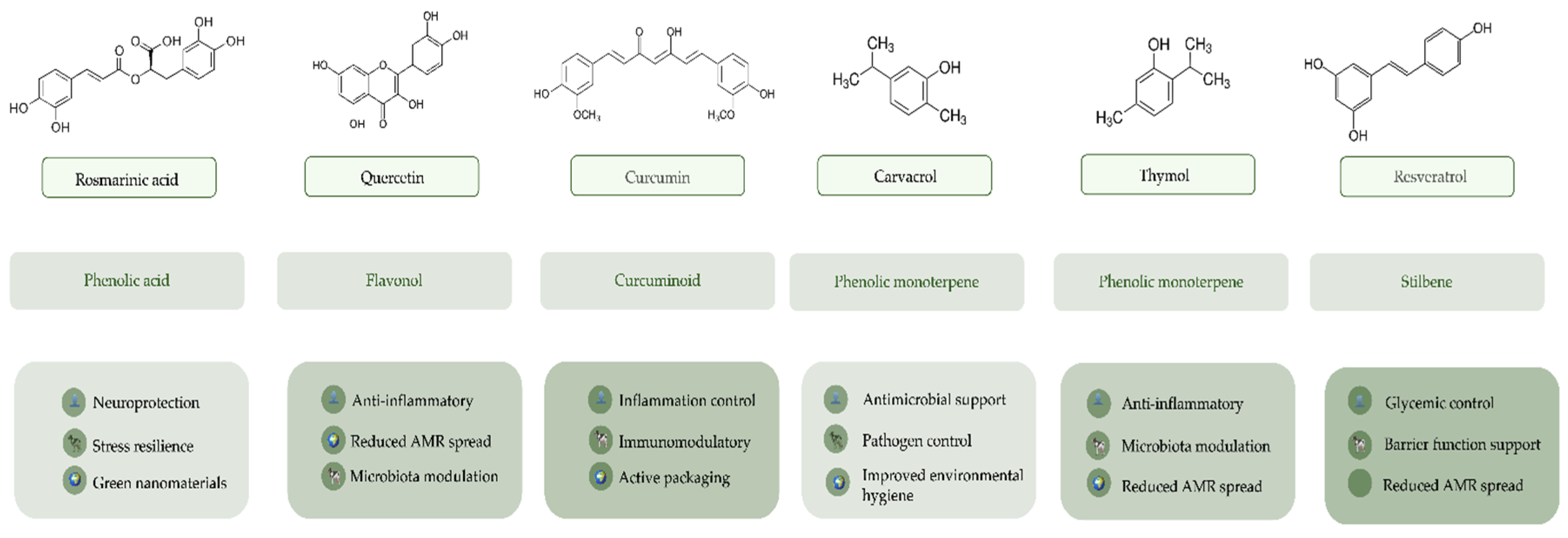
| Quercetin | Flavonol (C15H10O7) with five hydroxyls at positions 3, 5, 7, 3′, 4′. | Inhibition of IκBα phosphorylation and NF-κB activation. | Humans; Broiler chickens; Swine; Ruminants. | In coronary artery disease, oral supplementation (120 mg/day) reduced circulating IL-1β and TNF-α and downregulated IκBα expression. | In broiler chickens, dietary quercetin supplementation at 200–400 ppm for 35 days increased the European production efficiency factor (EPEF), decreased total coliforms and Clostridium perfringens, increased Lactobacillus counts, and improved antioxidant status, meat quality and overall productive performance. | Reduced need for AGPs; lower drug residues in products and effluents. | [119,120,121,123,128,129,130,131] |
| Resveratrol | Stilbene (3,5,4′-trihydroxystilbene) with two phenolic rings linked by an ethylenic bond. | Activation of SIRT1/AMPK; inhibition of PI3K/Akt/mTOR; modulation of ERK/JNK/p38 and Bcl-2/Bax-dependent apoptosis. | Humans; Broiler chickens; Swine; Ruminants; Fish. | In T2D (1 g/day for 45 days), improved insulin sensitivity and reduced fasting glucose. | In weaned piglets, dietary resveratrol at 300 mg/kg feed for 42 days improved growth, antioxidant status, intestinal morphology and barrier function and lowered inflammatory markers; in growing–finishing pigs, 300–600 mg/kg for 49 days enhanced meat quality and reduced carcass fat; in fish species such as tilapia, turbot and rainbow trout, inclusion of 0.05–0.3% of the diet for 9 weeks increased antioxidant capacity, disease resistance and flesh quality, although the highest doses could attenuate growth. | Substitution for AGPs reduces antibiotic discharge into ecosystems and mitigates AMR spread; lower methane improves environmental footprint. | [102,122,125,132,133,134,135,136] |
| Curcumin | Curcuminoid (diferuloylmethane) with two phenolic rings linked by a conjugated β-diketone chain bearing hydroxyl and methoxy groups. | Modulation of NF-κB, AMPK and COX-2; induction in SOD, CAT, and GPx; inhibition of IκB kinase; regulation of p38/JNK in inflammation and apoptosis. | Humans; Broiler chickens; Swine. | In T2D and ulcerative colitis, oral supplementation (80 mg/day for 3 months) reduced HbA1c, fasting glucose and clinical disease activity. | In poultry, dietary curcumin supplementation at about 0.25–0.5% of the diet for 8 weeks reduced oocyst shedding (Eimeria), improved egg quality, decreased abdominal fat and enhanced immunity and oxidative stability of meat. | Supports replacement of pharmaceutical additives; applicable to biosensors and active packaging, reducing chemical burden in ecosystems. | [60,62,126,127,137,138,139,140,141,142,143] |
| Thymol | Monoterpenoid phenol (2-isopropyl-5-methylphenol) with an isopropyl and a para-hydroxyl group on the aromatic ring. | Modulation of NF-κB and COX-2 signalling. | Humans; Broiler chickens; Swine; Ruminants; Fish. | Antimicrobial against S. aureus, E. coli, Candida spp, anti-inflammatory effect (NF-κB, COX-2), antioxidant, potential in inflammatory disorders and cancer. | ↑ Growth, ↓ Clostridium spp., improved meat/egg quality. ↑Lactobacillus, ↓ E. coli, better digestibility, ↑ survival, immunity, resistance to infections. | Reduced antibiotic residues in manure; ↓ coliforms, ammonia, methane and odour in livestock units. | [58,59,60,63,64,144] |
| Carvacrol | Monoterpenoid phenol, positional isomer of thymol (5-isopropyl-2-methylphenol) with an ortho-hydroxyl group. | Modulation of NF-κB and MAPKs. | Humans; Broiler chickens; Swine; Ruminants; fish. | Anti-inflammatory (↓ TNF-α, IL-6, IL-1β), antimicrobial against Gram± bacteria and Candida biofilms; neuroprotective and metabolically beneficial. In a phase I clinical study, healthy adults supplemented orally with 1–2 mg/kg/day of carvacrol for 30 days showed good safety and tolerability, with only mild laboratory changes remaining within normal reference ranges. | Dietary incorporation of carvacrol resulted in clear zootechnical and health benefits across species. In broilers, 200–500 mg/kg feed for 28–42 days increased growth and feed efficiency and reduced Clostridium perfringens and Salmonella spp; in weaned piglets, 100 mg/kg for 14 days reduced post-weaning diarrhoea; in laying hens, 300 mg/kg for ~50 weeks improved egg quality and antioxidant status; in fish, 1–3 g/kg in feed increased survival. | ↓ Antibiotic reliance; ↓ pathogen shedding in litter and manure; ↓ odour and ammonia emissions; ↓ methane from ruminants; lower environmental pharmaceutical load. | [65,124,145,146] |
| Rosmarinic acid | Polyphenolic ester of caffeic acid and 3,4-dihydroxyphenyllactic acid, with two catechol moieties. | Modulation of NF-κB and MAPKs (ERK, JNK, p38); regulation of PI3K/Akt. | Humans; Broiler chickens; Rodents; Fish. | Anti-inflammatory and antioxidant; neuroprotective (Alzheimer’sParkinson’s); improves glucose metabolism; hepatoprotective and anticancer. In patients with seasonal allergic rhinoconjunctivitis, oral rosmarinic acid at 50 or 200 mg/day for 21 days reduced nasal symptoms and neutrophil/eosinophil infiltration. | In rodent models, oral rosmarinic acid at 1–50 mg/kg/day for 12 days protected kidney, liver, heart and brain from toxic, ischaemic or diabetic injury by reducing oxidative stress, inflammation and apoptosis; in poultry and fish, diets enriched with rosmarinic-acid-rich extracts administered for several weeks improved antioxidant status, immune responses and survival under infectious challenge. | Used in green nanomaterials for pollutant removal; enables partial replacement of synthetic additives and reduces pharmaceutical residues in ecosystems. | [147,148,149] |
6. Challenges and Future Perspectives
7. Conclusions
Author Contributions
Funding
Institutional Review Board Statement
Informed Consent Statement
Data Availability Statement
Acknowledgments
Conflicts of Interest
References
- Council Recommendation on Stepping Up EU Actions to Combat Antimicrobial Resistance in a One Health Approach (OJ C 220). 2023. Available online: https://eur-lex.europa.eu/legal-content/EN/TXT/?uri=oj:JOC_2023_220_R_0001 (accessed on 24 December 2025).
- Monciardini, P.; Iorio, M.; Maffioli, S.; Sosio, M.; Donadio, S. Discovering new bioactive molecules from microbial sources. Microb. Biotechnol. 2014, 7, 209–220. [Google Scholar] [CrossRef] [Scilit]
- Conrado, R.; Gomes, T.C.; Roque, G.S.C.; De Souza, A.O. Overview of bioactive fungal secondary metabolites: Cytotoxic and antimicrobial compounds. Antibiotics 2022, 11, 1604. [Google Scholar] [CrossRef] [Scilit] [PubMed]
- Pham, J.V.; Yilma, M.A.; Feliz, A.; Majid, M.T.; Maffetone, N.; Walker, J.R.; Kim, E.; Cho, H.J.; Reynolds, J.M.; Song, M.C.; et al. A review of the microbial production of bioactive natural products and biologics. Front. Microbiol. 2019, 10, 1404. [Google Scholar] [CrossRef] [Scilit] [PubMed]
- Keller, N.P. Fungal secondary metabolism: Regulation, function and drug discovery. Nat. Rev. Microbiol. 2019, 17, 167–180. [Google Scholar] [CrossRef] [Scilit]
- Ziemert, N.; Alanjary, M.; Weber, T. The evolution of genome mining in microbes–a review. Nat. Prod. Rep. 2016, 33, 988–1005. [Google Scholar] [CrossRef] [Scilit]
- Nurkolis, F. Marine bioactives: Pioneering sustainable solutions for advanced cosmetics and therapeutics. Pharmacol. Res. 2025, 218, 107868. [Google Scholar] [CrossRef] [Scilit]
- Benameur, T.; Soleti, R.; Panaro, M.A.; La Torre, M.E.; Monda, V.; Messina, G.; Porro, C. Curcumin as prospective anti-aging natural compound: Focus on brain. Molecules 2021, 26, 4794. [Google Scholar] [CrossRef] [Scilit] [PubMed]
- Bjørklund, G.; Shanaida, M.; Lysiuk, R.; Butnariu, M.; Peana, M.; Sarac, I.; Strus, O.; Smetanina, K.; Chirumbolo, S. Natural compounds and products from an anti-aging perspective. Molecules 2022, 27, 7084. [Google Scholar] [CrossRef] [Scilit]
- Lindequist, U. Marine-derived pharmaceuticals–challenges and opportunities. Biomol. Ther. 2016, 24, 561–571. [Google Scholar] [CrossRef] [Scilit]
- Barzkar, N.; Jahromi, S.T.; Poorsaheli, H.B.; Vianello, F. Metabolites from marine microorganisms, micro, and macroalgae: Immense scope for pharmacology. Mar. Drugs 2019, 17, 464. [Google Scholar] [CrossRef] [Scilit]
- Martins, A.; Vieira, H.; Gaspar, H.; Santos, S. Marketed marine natural products in the pharmaceutical and cosmeceutical industries: Tips for success. Mar. Drugs 2014, 12, 1066–1101. [Google Scholar] [CrossRef] [Scilit]
- Blunt, J.W.; Carroll, A.R.; Copp, B.R.; Davis, R.A.; Keyzers, R.A.; Prinsep, M.R. Marine natural products. Nat. Prod. Rep. 2018, 35, 8–53. [Google Scholar] [CrossRef] [Scilit] [PubMed]
- Tan, L.T. Impact of marine chemical ecology research on the discovery and development of new pharmaceuticals. Mar. Drugs 2023, 21, 174. [Google Scholar] [CrossRef] [Scilit]
- Latif, R.; Nawaz, T. Medicinal plants and human health: A comprehensive review of bioactive compounds, therapeutic effects, and applications. Phytochem. Rev. 2025, 1–44. [Google Scholar] [CrossRef] [Scilit]
- Atanasov, A.G.; Waltenberger, B.; Pferschy-Wenzig, E.M.; Linder, T.; Wawrosch, C.; Uhrin, P.; Temml, V.; Wang, L.; Schwaiger, S.; Heiss, E.H.; et al. Discovery and resupply of pharmacologically active plant-derived natural products: A review. Biotechnol. Adv. 2015, 33, 1582–1614. [Google Scholar] [CrossRef] [Scilit]
- Di Fabio, G.; Romanucci, V.; De Marco, A.; Zarrelli, A. Triterpenoids from Gymnema sylvestre and their pharmacological activities. Molecules 2014, 19, 10956–10981. [Google Scholar] [CrossRef] [Scilit]
- Dincheva, I.; Badjakov, I.; Galunska, B. New Insights in the Research on Bioactive Compounds from Plant Origins with Nutraceutical and Pharmaceutical Potential II. Plants 2025, 14, 500. [Google Scholar] [CrossRef] [Scilit]
- McGaw, L. Use of plant-derived extracts and bioactive compound mixtures against multidrug resistant bacteria affecting animal health and production. In Fighting Multidrug Resistance with Herbal Extracts, Essential Oils and Their Components; Academic Press: Cambridge, MA, USA, 2025; pp. 291–311. [Google Scholar] [CrossRef] [Scilit]
- Feliziani, G.; Bordoni, L.; Gabbianelli, R. Regenerative Organic Agriculture and Human Health: The Interconnection Between Soil, Food Quality, and Nutrition. Antioxidants 2025, 14, 530. [Google Scholar] [CrossRef] [Scilit]
- Villa, F.; Cappitelli, F. Plant-derived bioactive compounds at sub-lethal concentrations: Towards smart biocide-free antibiofilm strategies. Phytochem. Rev. 2013, 12, 245–254. [Google Scholar] [CrossRef] [Scilit]
- Inchingolo, A.D.; Inchingolo, A.M.; Malcangi, G.; Avantario, P.; Azzollini, D.; Buongiorno, S.; Viapiano, F.; Campanelli, M.; Ciocia, A.M.; De Leonardis, N.; et al. Effects of Resveratrol, Curcumin and Quercetin Supplementation on Bone Metabolism—A Systematic Review. Nutrients 2022, 14, 3519. [Google Scholar] [CrossRef] [Scilit] [PubMed]
- Koehn, F.E.; Carter, G.T. The evolving role of natural products in drug discovery. Nat. Rev. Drug Discov. 2005, 4, 206–220. [Google Scholar] [CrossRef] [Scilit]
- Atanasov, A.G.; Zotchev, S.B.; Dirsch, V.M.; The International Natural Product Sciences Taskforce; Supuran, C.T. Natural products in drug discovery: Advances and opportunities. Nat. Rev. Drug Discov. 2021, 20, 200–216. [Google Scholar] [CrossRef] [Scilit]
- Harvey, A.L.; Edrada-Ebel, R.; Quinn, R.J. The re-emergence of natural products for drug discovery in the genomics era. Nat. Rev. Drug Discov. 2015, 14, 111–129. [Google Scholar] [CrossRef] [Scilit]
- Chintada, V.; Golla, N. Exploring the therapeutic potential of bioactive compounds from plant sources. In Biotechnological Intervention in Production of Bioactive Compounds. Sustainable Landscape Planning and Natural Resources Management; Springer: Cham, Switzerland, 2025. [Google Scholar] [CrossRef] [Scilit]
- Riaz, M.; Khalid, R.; Afzal, M.; Anjum, F.; Fatima, H.; Zia, S.; Rasool, G.; Egbuna, C.; Mtewa, A.G.; Uche, C.Z.; et al. Phytobioactive compounds as therapeutic agents for human diseases: A review. Food Sci. Nutr. 2023, 11, 2500–2529. [Google Scholar] [CrossRef] [Scilit]
- Demain, A.L.; Fang, A. The natural functions of secondary metabolites. In History of Modern Biotechnology I. Advances in Biochemical Engineering/Biotechnology; Fiechter, A., Ed.; Springer: Berlin/Heidelberg, Germany, 2001; Volume 69, ISBN 978-3-540-44964-5. [Google Scholar] [CrossRef] [Scilit]
- Pichersky, E.; Lewinsohn, E. Convergent evolution in plant specialized metabolism. Annu. Rev. Plant Biol. 2011, 62, 549–566. [Google Scholar] [CrossRef] [Scilit] [PubMed]
- Elshafie, H.S.; Camele, I.; Mohamed, A.A. A comprehensive review on the biological, agricultural and pharmaceutical properties of secondary metabolites based-plant origin. Int. J. Mol. Sci. 2023, 24, 3266. [Google Scholar] [CrossRef] [Scilit]
- Croteau, R.; Kutchan, T.M.; Lewis, N.G. Natural products (secondary metabolites). Biochem. Mol. Biol. Plants 2000, 24, 1250–1319. [Google Scholar]
- Ncube, B.; Van Staden, J. Tilting plant metabolism for improved metabolite biosynthesis and enhanced human benefit. Molecules 2015, 20, 12698–12731. [Google Scholar] [CrossRef] [Scilit]
- Harvey, A.L. Natural products in drug discovery. Drug Discov. Today 2008, 13, 894–901. [Google Scholar] [CrossRef] [Scilit]
- Leuci, R.; Brunetti, L.; Poliseno, V.; Laghezza, A.; Loiodice, F.; Tortorella, P.; Piemontese, L. Natural compounds for the prevention and treatment of cardiovascular and neurodegenerative diseases. Foods 2020, 10, 29. [Google Scholar] [CrossRef] [Scilit] [PubMed]
- Salam, U.; Ullah, S.; Tang, Z.H.; Elateeq, A.A.; Khan, Y.; Khan, J.; Khan, A.; Ali, S. Plant metabolomics: An overview of the role of primary and secondary metabolites against different environmental stress factors. Life 2023, 13, 706. [Google Scholar] [CrossRef] [Scilit]
- Samtiya, M.; Aluko, R.E.; Dhewa, T.; Moreno-Rojas, J.M. Potential Health Benefits of Plant Food-Derived Bioactive Components: An Overview. Foods 2021, 10, 839. [Google Scholar] [CrossRef] [Scilit]
- Newman, D.J.; Cragg, G.M. Natural products as sources of new drugs over the nearly four decades from 01/1981 to 09/2019. J. Nat. Prod. 2020, 83, 770–803. [Google Scholar] [CrossRef] [Scilit]
- Cragg, G.M.; Pezzuto, J.M. Natural products as a vital source for the discovery of cancer chemotherapeutic and chemopreventive agents. Med. Princ. Pract. 2016, 25, 41–59. [Google Scholar] [CrossRef] [Scilit]
- Batool, T.; Ali, R.W.; Nawaz, M.; Khan, S.; Mehmood, K.; Hassan, A.; Javed, M.; Jamil, W. Biotechnological techniques for sugarcane crop improvement, applications and challenges. J. Crop Sci. Biotechnol. 2025, 28, 167–176. [Google Scholar] [CrossRef] [Scilit]
- Alamgir, A.N.M. Classification of drugs, nutraceuticals, functional food, and cosmeceuticals; proteins, peptides, and enzymes as drugs. In Therapeutic Use of Medicinal Plants and Their Extracts: Volume 1: Progress in Drug Research; Springer: Berlin/Heidelberg, Germany, 2017; Volume 73, ISBN 978-3-319-63862-1. [Google Scholar] [CrossRef] [Scilit]
- Gul, K.; Singh, A.K.; Jabeen, R. Nutraceuticals and functional foods: The foods for the future world. Crit. Rev. Food Sci. Nutr. 2016, 56, 2617–2627. [Google Scholar] [CrossRef] [Scilit]
- Koca, B.E.; Sarıtaş, S.; Bechelany, M.; Karav, S. The Functional Role of Polyphenols Across the Human Lifespan. Int. J. Mol. Sci. 2025, 26, 11074. [Google Scholar] [CrossRef] [Scilit] [PubMed]
- Ma, D.; Guo, Y.; Ali, I.; Lin, J.; Xu, Y.; Yang, M. Accumulation characteristics of plant flavonoids and effects of cultivation measures on their biosynthesis: A review. Plant Physiol. Biochem. 2024, 215, 108960. [Google Scholar] [CrossRef] [Scilit] [PubMed]
- Hassanein, E.H.; Althagafy, H.S.; Baraka, M.A.; Abd-Alhameed, E.K.; Ibrahim, I.M.; Abd El-Maksoud, M.S.; Mohamed, N.M.; Ross, S.A. The promising antioxidant effects of lignans: Nrf2 activation comes into view. Naunyn-Schmiedeberg’s Arch. Pharmacol. 2024, 397, 6439–6458. [Google Scholar] [CrossRef] [Scilit] [PubMed]
- Gao, Z.; Cao, Q.; Deng, Z. Unveiling the Power of Flax Lignans: From Plant Biosynthesis to Human Health Benefits. Nutrients 2024, 16, 3520. [Google Scholar] [CrossRef] [Scilit]
- Al Jitan, S.; Alkhoori, S.A.; Yousef, L.F. Phenolic acids from plants: Extraction and application to human health. Stud. Nat. Prod. Chem. 2018, 58, 389–417. [Google Scholar] [CrossRef] [Scilit]
- Sepehri, S.; Khedmati, M.; Yousef-Nejad, F.; Mahdavi, M. Medicinal chemistry perspective on the structure–activity relationship of stilbene derivatives. RSC Adv. 2024, 14, 19823–19879. [Google Scholar] [CrossRef] [Scilit]
- Shahidi, F.; Ambigaipalan, P. Phenolics and polyphenolics in foods, beverages and spices: Antioxidant activity and health effects–A review. J. Funct. Foods 2015, 18, 820–897. [Google Scholar] [CrossRef] [Scilit]
- Carocho, M.; Ferreira, I.C.F.R. A review on antioxidants, prooxidants and related controversy: Natural and synthetic compounds, screening and analysis methodologies and future perspectives. Food Chem. Toxicol. 2013, 51, 15–25. [Google Scholar] [CrossRef] [Scilit]
- Villegas-Aguilar, M.D.C.; Fernández-Ochoa, Á.; Cádiz-Gurrea, M.D.L.L.; Pimentel-Moral, S.; Lozano-Sánchez, J.; Arráez-Román, D.; Segura-Carretero, A. Pleiotropic biological effects of dietary phenolic compounds and their metabolites on energy metabolism, inflammation and aging. Molecules 2020, 25, 596. [Google Scholar] [CrossRef] [Scilit]
- Grosso, G.; Godos, J.; Currenti, W.; Micek, A.; Falzone, L.; Libra, M.; Giampieri, F.; Forbes-Hernández, T.Y.; Quiles, J.L.; Battino, M.; et al. The effect of dietary polyphenols on vascular health and hypertension: Current evidence and mechanisms of action. Nutrients 2022, 14, 545. [Google Scholar] [CrossRef] [Scilit]
- Naz, R.; Saqib, F.; Awadallah, S.; Wahid, M.; Latif, M.F.; Iqbal, I.; Mubarak, M.S. Food polyphenols and type II diabetes mellitus: Pharmacology and mechanisms. Molecules 2023, 28, 3996. [Google Scholar] [CrossRef] [Scilit] [PubMed]
- Aghababaei, F.; Hadidi, M. Recent Advances in Potential Health Benefits of Quercetin. Pharmaceuticals 2023, 16, 1020. [Google Scholar] [CrossRef] [Scilit]
- Ramírez-Moreno, E.; Arias-Rico, J.; Jiménez-Sánchez, R.C.; Estrada-Luna, D.; Jiménez-Osorio, A.S.; Zafra-Rojas, Q.Y.; Ariza-Ortega, J.A.; Flores-Chávez, O.R.; Morales-Castillejos, E.M.; Sandoval-Gallegos, E.M. Role of bioactive compounds in obesity: Metabolic mechanism focused on inflammation. Foods 2022, 11, 1232. [Google Scholar] [CrossRef] [Scilit]
- Galiniak, S.; Aebisher, D.; Bartusik-Aebisher, D. Health benefits of resveratrol administration. Acta Biochim. Pol. 2019, 66, 13–21. [Google Scholar] [CrossRef] [Scilit] [PubMed]
- Magrone, T.; Jirillo, E. The interplay between the gut immune system and microbiota in health and disease: Nutraceutical intervention for restoring intestinal homeostasis. Curr. Pharm. Des. 2013, 19, 1329–1342. [Google Scholar] [CrossRef] [Scilit] [PubMed]
- Cuciniello, R.; Di Meo, F.; Filosa, S.; Crispi, S.; Bergamo, P. The antioxidant effect of dietary bioactives arises from the interplay between the physiology of the host and the gut microbiota: Involvement of short-chain fatty acids. Antioxidants 2023, 12, 1073. [Google Scholar] [CrossRef] [Scilit] [PubMed]
- Tako, E. Dietary plant-origin bio-active compounds, intestinal functionality, and microbiome. Nutrients 2020, 12, 3223. [Google Scholar] [CrossRef] [Scilit]
- Panche, A.N.; Diwan, A.D.; Chandra, S.R. Flavonoids: An overview. J. Nutr. Sci. 2016, 5, e47. [Google Scholar] [CrossRef] [Scilit]
- Bertoncini-Silva, C.; Vlad, A.; Ricciarelli, R.; Fassini, P.G.; Suen, V.M.M.; Zingg, J.-M. Enhancing the Bioavailability and Bioactivity of Curcumin for Disease Prevention and Treatment. Antioxidants 2024, 13, 331. [Google Scholar] [CrossRef] [Scilit]
- Racz, L.Z.; Racz, C.P.; Pop, L.-C.; Tomoaia, G.; Mocanu, A.; Barbu, I.; Sárközi, M.; Roman, I.; Avram, A.; Tomoaia-Cotisel, M.; et al. Strategies for Improving Bioavailability, Bioactivity, and Physical-Chemical Behavior of Curcumin. Molecules 2022, 27, 6854. [Google Scholar] [CrossRef] [Scilit] [PubMed]
- Maiti, P.; Dunbar, G.L. Use of Curcumin, a Natural Polyphenol for Targeting Molecular Pathways in Treating Age-Related Neurodegenerative Diseases. Int. J. Mol. Sci. 2018, 19, 1637. [Google Scholar] [CrossRef] [Scilit]
- Ezzat Abd El-Hack, M.; Alagawany, M.; Ragab Farag, M.; Tiwari, R.; Karthik, K.; Dhama, K.; Zorriehzahra, J.; Adel, M. Beneficial impacts of thymol essential oil on health and production of animals, fish and poultry: A review. J. Essent. Oil Res. 2016, 28, 365–382. [Google Scholar] [CrossRef] [Scilit]
- Salehi, B.; Mishra, A.P.; Shukla, I.; Sharifi-Rad, M.; Contreras, M.d.M.; Segura-Carretero, A.; Fathi, H.; Nasrabadi, N.N.; Kobarfard, F.; Sharifi-Rad, J. Thymol, thyme, and other plant sources: Health and potential uses. Phytother. Res. 2018, 32, 1688–1706. [Google Scholar] [CrossRef] [Scilit]
- Sharifi-Rad, M.; Varoni, E.M.; Iriti, M.; Martorell, M.; Setzer, W.N.; del Mar Contreras, M.; Salehi, B.; Soltani-Nejad, A.; Rajabi, S.; Tajbakhsh, M.; et al. Carvacrol and human health: A comprehensive review. Phytother. Res. 2018, 32, 1675–1687. [Google Scholar] [CrossRef] [Scilit]
- Kussmann, M.; Abe Cunha, D.H.; Berciano, S. Bioactive compounds for human and planetary health. Front. Nutr. 2023, 10, 1193848. [Google Scholar] [CrossRef] [Scilit] [PubMed]
- Ibeagha-Awemu, E.M.; Omonijo, F.A.; Piché, L.C.; Vincent, A.T. Alternatives to antibiotics for sustainable livestock production in the context of the One Health approach: Tackling a common foe. Front. Vet. Sci. 2025, 12, 1605215. [Google Scholar] [CrossRef] [Scilit]
- Liu, M.; Luan, H.; Qiu, W.; Zhang, Y.; Feng, W.; Xu, W.; Wang, F.; Xuan, H.; Song, P. Antibiotic alternatives in livestock feeding. Sci. Total Environ. 2025, 989, 179867. [Google Scholar] [CrossRef] [Scilit] [PubMed]
- Acosta, A.; Tirkaso, W.; Nicolli, F.; Van Boeckel, T.P.; Cinardi, G.; Song, J. The future of antibiotic use in Dailivestock. Nat. Commun. 2025, 16, 2469. [Google Scholar] [CrossRef] [Scilit]
- Dai, J.; Mumper, R.J. Plant phenolics: Extraction, analysis and their antioxidant and anticancer properties. Molecules 2010, 15, 7313–7352. [Google Scholar] [CrossRef] [Scilit]
- Papuc, C.; Goran, G.V.; Predescu, C.N.; Tudoreanu, L.; Ștefan, G. Plant polyphenols mechanisms of action on insulin resistance and against the loss of pancreatic beta cells. Crit. Rev. Food Sci. Nutr. 2021, 62, 325–352. [Google Scholar] [CrossRef] [Scilit]
- Câmara, J.S.; Perestrelo, R.; Ferreira, R.; Berenguer, C.V.; Pereira, J.A.M.; Castilho, P.C. Plant-derived terpenoids: A plethora of bioactive compounds with several health functions and industrial applications—A comprehensive overview. Molecules 2024, 29, 3861. [Google Scholar] [CrossRef] [Scilit]
- Ben-Fadhel, Y.; Maherani, B.; Aragones, M.; Lacroix, M. Antimicrobial properties of encapsulated antimicrobial natural plant products for ready-to-eat carrots. Foods 2019, 8, 535. [Google Scholar] [CrossRef] [Scilit]
- Kim, S.; Yu, S.; Kim, J.; Khaliq, N.U.; Choi, W.I.; Kim, H.; Sung, D. Facile fabrication of α-bisabolol nanoparticles with improved antioxidant and antibacterial effects. Antioxidants 2023, 12, 207. [Google Scholar] [CrossRef] [Scilit]
- Ellulu, M.S. Obesity, cardiovascular disease, and role of vitamin C on inflammation: A review of facts and underlying mechanisms. Inflammopharmacology 2017, 25, 313–328. [Google Scholar] [CrossRef] [Scilit] [PubMed]
- Adegbola, P.; Aderibigbe, I.; Hammed, W.; Omotayo, T. Antioxidant and anti-inflammatory medicinal plants have potential role in the treatment of cardiovascular disease: A review. Am. J. Cardiovasc. Dis. 2017, 7, 19. [Google Scholar]
- Mrowicka, M.; Mrowicki, J.; Kucharska, E.; Majsterek, I. Lutein and zeaxanthin and their roles in age-related macular degeneration—Neurodegenerative disease. Nutrients 2022, 14, 827. [Google Scholar] [CrossRef] [Scilit]
- Yang, Q.; Liang, Q.; Balakrishnan, B.; Belobrajdic, D.P.; Feng, Q.J.; Zhang, W. Role of dietary nutrients in the modulation of gut microbiota: A narrative review. Nutrients 2020, 12, 381. [Google Scholar] [CrossRef] [Scilit] [PubMed]
- Shahidi, F. Functional foods: Their role in health promotion and disease prevention. J. Food Sci. 2004, 69, R146–R149. [Google Scholar] [CrossRef] [Scilit]
- Simsek, M.; Whitney, K. Examination of primary and secondary metabolites associated with a plant-based diet and their impact on human health. Foods 2024, 13, 1020. [Google Scholar] [CrossRef] [Scilit]
- Liu, Y.; Fang, M.; Tu, X.; Mo, X.; Zhang, L.; Yang, B.; Wang, F.; Kim, Y.; Huang, C.; Chen, L.; et al. Dietary polyphenols as anti-aging agents: Targeting the hallmarks of aging. Nutrients 2024, 16, 3305. [Google Scholar] [CrossRef] [Scilit]
- Yamagata, K. Polyphenols regulate endothelial functions and reduce the risk of cardiovascular disease. Curr. Pharm. Des. 2019, 25, 2443–2458. [Google Scholar] [CrossRef] [Scilit]
- Martínez-González, M.Á.; Sánchez-Villegas, A. The emerging role of Mediterranean diets in cardiovascular epidemiology: Monounsaturated fats, olive oil, red wine or the whole pattern? Eur. J. Epidemiol. 2004, 19, 9–13. [Google Scholar] [CrossRef] [Scilit] [PubMed]
- Li, Y.; Peng, Y.; Shen, Y.; Zhang, Y.; Liu, L.; Yang, X. Dietary polyphenols: Regulate the advanced glycation end products-RAGE axis and the microbiota-gut-brain axis to prevent neurodegenerative diseases. Crit. Rev. Food Sci. Nutr. 2023, 63, 9816–9842. [Google Scholar] [CrossRef] [Scilit] [PubMed]
- Markowiak, P.; Śliżewska, K. Effects of probiotics, prebiotics, and synbiotics on human health. Nutrients 2017, 9, 1021. [Google Scholar] [CrossRef] [Scilit]
- Bevilacqua, A.; Campaniello, D.; Speranza, B.; Racioppo, A.; Sinigaglia, M.; Corbo, M.R. An update on prebiotics and on their health effects. Foods 2024, 13, 446. [Google Scholar] [CrossRef] [Scilit]
- Shaik Mohamed Sayed, U.F.; Moshawih, S.; Goh, H.P.; Kifli, N.; Gupta, G.; Singh, S.K.; Chellappan, D.K.; Dua, K.; Hermansyah, A.; Ser, H.L.; et al. Natural products as novel anti-obesity agents: Insights into mechanisms of action and potential for therapeutic management. Front. Pharmacol. 2023, 14, 1182937. [Google Scholar] [CrossRef] [Scilit] [PubMed]
- Subramaniam, S.; Selvaduray, K.R.; Radhakrishnan, A.K. Bioactive compounds: Natural defense against cancer? Biomolecules 2019, 9, 758. [Google Scholar] [CrossRef] [Scilit]
- Yuan, M.; Zhang, G.; Bai, W.; Han, X.; Li, C.; Bian, S. The role of bioactive compounds in natural products extracted from plants in cancer treatment and their mechanisms related to anticancer effects. Oxidative Med. Cell. Longev. 2022, 2022, 1429869. [Google Scholar] [CrossRef] [Scilit]
- Dehelean, C.A.; Marcovici, I.; Soica, C.; Mioc, M.; Coricovac, D.; Iurciuc, S.; Cretu, O.M.; Pinzaru, I. Plant-derived anticancer compounds as new perspectives in drug discovery and alternative therapy. Molecules 2021, 26, 1109. [Google Scholar] [CrossRef] [Scilit]
- Liu, L.; Guo, P.; Wang, P.; Zheng, S.; Qu, Z.; Liu, N. The review of anti-aging mechanism of polyphenols on Caenorhabditis elegans. Front. Bioeng. Biotechnol. 2021, 9, 635768. [Google Scholar] [CrossRef] [Scilit] [PubMed]
- Correia, P.; Araújo, P.; Ribeiro, C.; Oliveira, H.; Pereira, A.R.; Mateus, N.; De Freitas, V.; Brás, N.F.; Gameiro, P.; Coelho, P.; et al. Anthocyanin-related pigments: Natural allies for skin health maintenance and protection. Antioxidants 2021, 10, 1038. [Google Scholar] [CrossRef] [Scilit] [PubMed]
- Iqbal, I.; Wilairatana, P.; Saqib, F.; Nasir, B.; Wahid, M.; Latif, M.F.; Iqbal, A.; Naz, R.; Mubarak, M.S. Plant polyphenols and their potential benefits on cardiovascular health: A review. Molecules 2023, 28, 6403. [Google Scholar] [CrossRef] [Scilit]
- Ditano-Vázquez, P.; Torres-Peña, J.D.; Galeano-Valle, F.; Pérez-Caballero, A.I.; Demelo-Rodríguez, P.; Lopez-Miranda, J.; Katsiki, N.; Delgado-Lista, J.; Alvarez-Sala-Walther, L.A. The fluid aspect of the Mediterranean diet in the prevention and management of cardiovascular disease and diabetes: The role of polyphenol content in moderate consumption of wine and olive oil. Nutrients 2019, 11, 2833. [Google Scholar] [CrossRef] [Scilit]
- Dong, L.; Li, Y.; Chen, Q.; Liu, Y.; Wu, Z.; Pan, D.; Yan, N.; Liu, L. Cereal polyphenols inhibition mechanisms on advanced glycation end products and regulation on type 2 diabetes. Crit. Rev. Food Sci. Nutr. 2024, 64, 9495–9513. [Google Scholar] [CrossRef] [Scilit]
- Sauter, E.R. Cancer prevention and treatment using combination therapy with natural compounds. Expert Rev. Clin. Pharmacol. 2020, 13, 265–285. [Google Scholar] [CrossRef] [Scilit]
- Shen, J.; Shan, J.; Zhong, L.; Liang, B.; Zhang, D.; Li, M.; Tang, H. Dietary phytochemicals that can extend longevity by regulation of metabolism. Plant Foods Hum. Nutr. 2022, 77, 12–19. [Google Scholar] [CrossRef] [Scilit]
- Hughes, S.; Kolsters, N.; van de Klashorst, D.; Kreuter, E.; Berger Büter, K. An extract of Rosaceae, Solanaceae and Zingiberaceae increases health span and mobility in Caenorhabditis elegans. BMC Nutr. 2022, 8, 5. [Google Scholar] [CrossRef] [Scilit] [PubMed]
- Marza, S.M.; Munteanu, C.; Papuc, I.; Radu, L.; Purdoiu, R.C. The Role of Probiotics in Enhancing Animal Health: Mechanisms, Benefits, and Applications in Livestock and Companion Animals. Animals 2025, 15, 2986. [Google Scholar] [CrossRef] [Scilit]
- Allemailem, K.S. Antimicrobial potential of naturally occurring bioactive secondary metabolites. J. Pharm. Bioallied Sci. 2021, 13, 155–162. [Google Scholar] [CrossRef] [Scilit]
- Ayon, N.J. High-throughput screening of natural product and synthetic molecule libraries for antibacterial drug discovery. Metabolites 2023, 13, 625. [Google Scholar] [CrossRef] [Scilit]
- Kari, Z.A.; Téllez-Isaías, G.; Khoo, M.I.; Wee, W.; Kabir, M.A.; Cheadoloh, R.; Wei, L.S. Resveratrol impacts on aquatic animals: A review. Fish Physiol. Biochem. 2024, 50, 307–318. [Google Scholar] [CrossRef] [Scilit]
- Karaoğlan, B.; Alkassab, A.T.; Borges, S.; Fisher, T.; Link-Vrabie, C.; McVey, E.; Ortego, L.; Nuti, M. Microbial pesticides: Challenges and future perspectives for non-target organism testing. Environ. Sci. Eur. 2024, 36, 205. [Google Scholar] [CrossRef] [Scilit]
- Halder, N.; Sunder, J.; De, A.K.; Bhattacharya, D.; Joardar, S.N. Probiotics in poultry: A comprehensive review. J. Basic Appl. Zool. 2024, 85, 23. [Google Scholar] [CrossRef] [Scilit]
- Mafe, A.N.; Iruoghene Edo, G.; Akpoghelie, P.O.; Gaaz, T.S.; Yousif, E.; Zainulabdeen, K.; Isoje, E.F.; Igbuku, U.A.; Opiti, R.A.; Garba, Y.; et al. Probiotics and food bioactives: Unraveling their impact on gut microbiome, inflammation, and metabolic health. Probiotics Antimicrob. Proteins 2025, 17, 1851–1892. [Google Scholar] [CrossRef] [Scilit] [PubMed]
- Wang, J.; Tong, T.; Yu, C.; Wu, Q. The research progress on the impact of pig gut microbiota on health and production performance. Front. Vet. Sci. 2025, 12, 1564519. [Google Scholar] [CrossRef] [Scilit] [PubMed]
- Robles Ramírez, O.; Osuna, G.; Plisson, F.; Barrientos-Salcedo, C. Antimicrobial peptides in livestock: A review with a One Health approach. Front. Cell. Infect. Microbiol. 2024, 14, 1339285. [Google Scholar] [CrossRef] [Scilit]
- Silva, A.; Silva, V.; Dapkevicius, M.D.L.E.; Azevedo, M.; Cordeiro, R.; Pereira, J.E.; Valentão, P.; Falco, V.; Igrejas, G.; Caniça, M.; et al. Unveiling Antibiotic Resistance, Clonal Diversity, and Biofilm Formation in E. coli Isolated from Healthy Swine in Portugal. Pathogens 2024, 13, 305. [Google Scholar] [CrossRef] [Scilit]
- Bento, J.T.; Gomes-Gonçalves, S.; Cruz, R.; Esteves, F.; Baptista, A.L.; Pereira, M.A.; Caseiro, P.; Carreira, P.; Figueira, L.; Mesquita, J.R. The prevalence of antimicrobial resistance genes in the environments of small ruminant farms from central Portugal. Antibiotics 2025, 14, 576. [Google Scholar] [CrossRef] [Scilit] [PubMed]
- Naeem, M.; Bourassa, D. Probiotics in poultry: Unlocking productivity through microbiome modulation and gut health. Microorganisms 2025, 13, 257. [Google Scholar] [CrossRef] [Scilit]
- Caren, J.; Zhu, Y.-C.; Read, Q.D.; Du, Y. Risk Assessment of Effects of Essential Oils on Honeybees (Apis mellifera L.). Insects 2025, 16, 303. [Google Scholar] [CrossRef] [Scilit]
- Marrone, P.G. Increasing the use of biological pesticides in integrated pest management. Front. Insect Sci. 2025, 2, 1552361. [Google Scholar] [CrossRef] [Scilit]
- Ayilara, M.S.; Adeleke, B.S.; Akinola, S.A.; Fayose, C.A.; Adeyemi, U.T.; Gbadegesin, L.A.; Omole, R.K.; Johnson, R.M.; Uthman, Q.O.; Babalola, O.O. Biopesticides as a promising alternative to synthetic pesticides: A case for microbial pesticides, phytopesticides, and nanobiopesticides. Front. Microbiol. 2023, 14, 1040901. [Google Scholar] [CrossRef] [Scilit]
- Mamede, M.; Cotas, J.; Pereira, L.; Bahcevandziev, K. Seaweed Polysaccharides as Potential Biostimulants in Turnip Greens Production. Horticulturae 2024, 10, 130. [Google Scholar] [CrossRef] [Scilit]
- Maffia, A.; Oliva, M.; Marra, F.; Mallamaci, C.; Nardi, S.; Muscolo, A. Humic Substances: Bridging Ecology and Agriculture for a Greener Future. Agronomy 2025, 15, 410. [Google Scholar] [CrossRef] [Scilit]
- Ke, M.; Zhang, K.; Hicks, A.L.; Wu, F.; You, J. A life cycle risk assessment of nanopesticides in freshwater. Environ. Sci. Ecotechnol. 2025, 25, 100565. [Google Scholar] [CrossRef] [Scilit]
- Alsaiari, N.S.; Alzahrani, F.M.; Amari, A.; Osman, H.; Harharah, H.N.; Elboughdiri, N.; Tahoon, M.A. Plant and microbial approaches as green methods for the synthesis of nanomaterials: Synthesis, applications, and future perspectives. Molecules 2023, 28, 463. [Google Scholar] [CrossRef] [Scilit]
- Niu, X.; Xing, Y.; Wang, J.; Bai, L.; Xie, Y.; Zhu, S.; Sun, M.; Yang, J.; Li, D.; Liu, Y. Effects of Caragana korshinskii tannin on fermentation, methane emission, community of methanogens, and metabolome of rumen in sheep. Front. Microbiol. 2024, 15, 1334045. [Google Scholar] [CrossRef] [Scilit]
- Chekalina, N.; Burmak, Y.; Petrov, Y.; Borisova, Z.; Manusha, Y.; Kazakov, Y.; Kaidashev, I. Quercetin reduces the transcriptional activity of NF-kB in stable coronary artery disease. Indian Heart J. 2018, 70, 593–597. [Google Scholar] [CrossRef] [Scilit]
- Zhou, Y.; Qian, C.; Tang, Y.; Song, M.; Zhang, T.; Dong, G.; Zheng, W.; Yang, C.; Zhong, C.; Wang, A.; et al. Advance in the pharmacological effects of quercetin in modulating oxidative stress and inflammation related disorders. Phytother. Res. 2023, 37, 4999–5016. [Google Scholar] [CrossRef] [Scilit] [PubMed]
- El-Aziz, A.A.; Ghanima, M.A.; Kamal, M.; Aldhalmi, A.K.; Khan, M.M.H.; Abd El-Hack, M.E. Quercetin as a bioactive feed additive: Nutritional, antioxidant, and gut health implications in poultry and rabbits. Vet. Anim. Sci. 2025, 29, 100487. [Google Scholar] [CrossRef] [Scilit] [PubMed]
- Zhu, X.; Wu, C.; Qiu, S.; Yuan, X.; Li, L. Effects of resveratrol on glucose control and insulin sensitivity in subjects with type 2 diabetes: Systematic review and meta-analysis. Nutr. Metab. 2017, 14, 60. [Google Scholar] [CrossRef] [Scilit]
- Abdel-Latif, M.A.; Elbestawy, A.R.; El-Far, A.H.; Noreldin, A.E.; Emam, M.; Baty, R.S.; Albadrani, G.M.; Abdel-Daim, M.M.; Abd El-Hamid, H.S. Quercetin Dietary Supplementation Advances Growth Performance, Gut Microbiota, and Intestinal mRNA Expression Genes in Broiler Chickens. Animals 2021, 11, 2302. [Google Scholar] [CrossRef] [Scilit]
- Gholami-Ahangaran, M.; Ahmadi-Dastgerdi, A.; Azizi, S.; Basiratpour, A.; Zokaei, M.; Derakhshan, M. Thymol and carvacrol supplementation in poultry health and performance. Vet. Med. Sci. 2022, 8, 267–288. [Google Scholar] [CrossRef] [Scilit]
- Meng, Q.; Li, J.; Wang, C.; Shan, A. Biological function of resveratrol and its application in animal production: A review. J. Anim. Sci. Biotechnol. 2023, 14, 25. [Google Scholar] [CrossRef] [Scilit] [PubMed]
- Zhang, J.; Sun, X.; Chai, X.; Jiao, Y.; Sun, J.; Wang, S.; Yu, H.; Feng, X. Curcumin mitigates oxidative damage in broiler liver and ileum caused by aflatoxin B1-contaminated feed through Nrf2 signaling pathway. Animals 2024, 14, 409. [Google Scholar] [CrossRef] [Scilit] [PubMed]
- Rasal, R.K.; Badsha, I.; Shellaiah, M.; Subramanian, K.; Gayathri, A.; Hirad, A.H.; Kaliaperumal, K.; Devasena, T. Fabrication of Curcumin-Based Electrochemical Nanosensors for the Detection of Environmental Pollutants: 1,4-Dioxane and Hydrazine. Biosensors 2024, 14, 291. [Google Scholar] [CrossRef] [Scilit]
- Kim, G.-D.; Park, Y.; Jin, Y.-H.; Park, C.S. Production and applications of rosmarinic acid and structurally related compounds. Appl. Microbiol. Biotechnol. 2015, 99, 2083–2092. [Google Scholar] [CrossRef] [Scilit]
- Khan, S.; Chand, N.; Hafeez, A.; Ali, M.; Qattan, S.Y.; Alam, M.; Siddiqui, S.A.; Nass, N.M.; AlMalki, F.; Abd El-Hack, M.E. Impact of Bacillus subtilis Probiotic on Growth, Visceral and Lymphatic Organ Weights, Intestinal Histomorphology, and Pathogenic Bacteria of Broilers. Ann. Anim. Sci. 2025, 25, 661–668. [Google Scholar] [CrossRef] [Scilit]
- Vastolo, A.; Serrapica, F.; Cavallini, D.; Fusaro, I.; Atzori, A.S.; Todaro, M. Editorial: Alternative and novel livestock feed: Reducing environmental impact. Front. Vet. Sci. 2024, 11, 1441905. [Google Scholar] [CrossRef] [Scilit]
- Wang, S.; Yao, J.; Zhou, B.; Yang, J.; Chaudry, M.; Wang, M.; Xiao, F.; Li, Y.; Yin, W. Bacteriostatic Effect of Quercetin as an Antibiotic Alternative In Vivo and Its Antibacterial Mechanism In Vitro. J. Food Prot. 2018, 81, 68–78. [Google Scholar] [CrossRef] [Scilit]
- Brockmueller, A.; Buhrmann, C.; Moravejolahkami, A.R.; Shakibaei, M. Resveratrol and p53: How are they involved in CRC plasticity and apoptosis? J. Adv. Res. 2024, 66, 181–195. [Google Scholar] [CrossRef] [Scilit]
- Jing, X.; Cheng, W.; Wang, S.; Li, P.; He, L. Resveratrol induces cell cycle arrest in human gastric cancer MGC803 cells via the PTEN-regulated PI3K/Akt signaling pathway. Oncol. Rep. 2016, 35, 472–478. [Google Scholar] [CrossRef] [Scilit] [PubMed]
- Wang, J.; Zhang, X.; Gao, L.; Wang, L.; Song, F.; Zhang, L.; Wan, Y. The synergistic antifungal activity of resveratrol with azoles against Candida albicans. Lett. Appl. Microbiol. 2021, 72, 688–697. [Google Scholar] [CrossRef] [Scilit]
- Bejenaru, L.E.; Biţă, A.; Belu, I.; Segneanu, A.-E.; Radu, A.; Dumitru, A.; Ciocîlteu, M.V.; Mogoşanu, G.D.; Bejenaru, C. Resveratrol: A review on the biological activity and applications. Appl. Sci. 2024, 14, 4534. [Google Scholar] [CrossRef] [Scilit]
- Câmara, J.S.; Albuquerque, B.R.; Aguiar, J.; Corrêa, R.C.G.; Gonçalves, J.L.; Granato, D.; Pereira, J.A.M.; Barros, L.; Ferreira, I.C.F.R. Food Bioactive Compounds and Emerging Techniques for Their Extraction: Polyphenols as a Case Study. Foods 2021, 10, 37. [Google Scholar] [CrossRef] [Scilit] [PubMed]
- Hanai, H.; Iida, T.; Takeuchi, K.; Watanabe, F.; Maruyama, Y.; Andoh, A.; Tsujikawa, T.; Fujiyama, Y.; Mitsuyama, K.; Sata, M.; et al. Curcumin maintenance therapy for ulcerative colitis: Randomized, multicenter, double-blind, placebo-controlled trial. Clin. Gastroenterol. Hepatol. 2006, 4, 1502–1506. [Google Scholar] [CrossRef] [Scilit] [PubMed]
- Holt, P.R.; Katz, S.; Kirshoff, R. Curcumin Therapy in Inflammatory Bowel Disease: A Pilot Study. Dig. Dis. Sci. 2005, 50, 2191–2193. [Google Scholar] [CrossRef] [Scilit]
- Mohseni, S.; Tavakoli, A.; Ghazipoor, H.; Pouralimohamadi, N.; Zare, R.; Rampp, T.; Shayesteh, M.; Pasalar, M. Curcumin for the clinical treatment of inflammatory bowel diseases: A systematic review and meta-analysis of placebo-controlled randomized clinical trials. Front. Nutr. 2025, 12, 1494351. [Google Scholar] [CrossRef] [Scilit]
- Tang, M.; Taghibiglou, C. The Mechanisms of Action of Curcumin in Alzheimer’s Disease. J. Alzheimer’s Dis. 2017, 58, 1003–1016. [Google Scholar] [CrossRef] [Scilit]
- Fuloria, S.; Mehta, J.; Chandel, A.; Sekar, M.; Rani, N.N.I.M.; Begum, M.Y.; Subramaniyan, V.; Chidambaram, K.; Thangavelu, L.; Nordin, R.; et al. A Comprehensive Review on the Therapeutic Potential of Curcuma longa Linn. in Relation to its Major Active Constituent Curcumin [Review]. Front. Pharmacol. 2022, 13, 2022. [Google Scholar] [CrossRef] [Scilit]
- Hewlings, S.J.; Kalman, D.S. Curcumin: A review of its effects on human health. Foods 2017, 6, 92. [Google Scholar] [CrossRef] [Scilit]
- Zadeh, A.M.; Mirghelenj, S.A.; Hasanlou, P.; Alishah, H.S. Effects of turmeric (Curcuma longa) powder supplementation in laying hens’ diet on production performance, blood biochemical parameters and egg quality traits. J. Anim. Physiol. Anim. Nutr. 2023, 107, 691–702. [Google Scholar] [CrossRef] [Scilit] [PubMed]
- Kowalczyk, A.; Przychodna, M.; Sopata, S.; Bodalska, A.; Fecka, I. Thymol and thyme essential oil—New insights into selected therapeutic applications. Molecules 2020, 25, 4125. [Google Scholar] [CrossRef] [Scilit]
- Carmel, K.; Gundogdu, O.; Pircalabioru, G.; Cean, A.; Scates, P.; Linton, M.; Pinkerton, L.; Magowan, E.; Stef, L.; Simiz, E. The in vitro and in vivo effect of Carvacrol in preventing Campylobacter infection, colonisation and improve chicken broilers productivity. Foodborne Pathog. Dis. 2017, 14, 341–349. [Google Scholar] [CrossRef] [Scilit]
- Ghorani, V.; Alavinezhad, A.; Rajabi, O.; Mohammadpour, A.H.; Boskabady, M.H. Safety and tolerability of carvacrol in healthy subjects: A phase I clinical study. Drug Chem. Toxicol. 2021, 44, 177–189. [Google Scholar] [CrossRef] [Scilit]
- Amoah, S.K.; Sandjo, L.P.; Kratz, J.M.; Biavatti, M.W. Rosmarinic acid–pharmaceutical and clinical aspects. Planta Medica 2016, 82, 388–406. [Google Scholar] [CrossRef] [Scilit] [PubMed]
- Hitl, M.; Kladar, N.; Gavarić, N.; Božin, B. Rosmarinic acid–human pharmacokinetics and health benefits. Planta Medica 2021, 87, 273–282. [Google Scholar] [CrossRef] [Scilit]
- Marchev, A.S.; Vasileva, L.V.; Amirova, K.M.; Savova, M.S.; Koycheva, I.K.; Balcheva-Sivenova, Z.P.; Vasileva, S.M.; Georgiev, M.I. Rosmarinic acid-From bench to valuable applications in food industry. Trends Food Sci. Technol. 2021, 117, 182–193. [Google Scholar] [CrossRef] [Scilit]
- Song, X. Antibacterial, antifungal, and antiviral bioactive compounds from natural products. Molecules 2024, 29, 825. [Google Scholar] [CrossRef] [Scilit]
- Vamanu, E. Bioactive Compounds from Natural Products: Separation, Characterization, and Applications. Appl. Sci. 2022, 12, 3922. [Google Scholar] [CrossRef] [Scilit]
- Goda, Y. Regulatory science of natural products. J. Nat. Med. 2022, 76, 732–747. [Google Scholar] [CrossRef] [Scilit]
- Pai, S.; Hebbar, A.; Selvaraj, S. A critical look at challenges and future scopes of bioactive compounds and their incorporations in the food, energy, and pharmaceutical sector. Environ. Sci. Pollut. Res. 2022, 29, 35518–35541. [Google Scholar] [CrossRef] [Scilit]
- El-Saadony, M.T.; Zabermawi, N.M.; Zabermawi, N.M.; Burollus, M.A.; Shafi, M.E.; Alagawany, M.; Yehia, N.; Askar, A.M.; Alsafy, S.A.; Noreldin, A.E.; et al. Nutritional aspects and health benefits of bioactive plant compounds against infectious diseases: A review. Food Rev. Int. 2023, 39, 2138–2160. [Google Scholar] [CrossRef] [Scilit]
- Zhang, H.W.; Lv, C.; Zhang, L.J.; Guo, X.; Shen, Y.W.; Nagle, D.G.; Zhou, Y.D.; Liu, S.H.; Zhang, W.D.; Luan, X. Application of omics- and multi-omics-based techniques for natural product target discovery. Biomed. Pharmacother. 2021, 141, 111833. [Google Scholar] [CrossRef] [Scilit] [PubMed]


| Class of Plant-Derived Bioactive Compounds | Representative Molecules | Main Mechanisms of Action | References |
|---|---|---|---|
| Polyphenols | Quercetin, resveratrol, catechins, olive oil, and wine polyphenols | Scavenging of reactive oxygen species; modulation of NF-κB, MAPK, and Nrf2 pathways; improvement of endothelial function and mitochondrial activity | [24,25,48,51] |
| Flavonoids | Apigenin, luteolin, hesperidin, anthocyanins | Antioxidant and anti-inflammatory activity; regulation of cytokine production; modulation of immune and metabolic signalling | [49,50,54,59] |
| Phenolic acids | Apigenin, luteolin, hesperidin, anthocyanins | Antioxidant and anti-inflammatory activity; regulation of cytokine production; modulation of immune and metabolic signalling | [49,52,70,71] |
| Terpenoids and essential oil constituents | Caffeic, chlorogenic, and rosmarinic acids | Reduction in oxidative stress and inflammation; modulation of insulin resistance and glucose metabolism | [72,73,74] |
| Carotenoids | Caffeic, chlorogenic, and rosmarinic acids | Reduction in oxidative stress and inflammation; modulation of insulin resistance and glucose metabolism | [75,76,77] |
| Health Domain | Main Bioactive Compounds Involved | Key Biological Mechanisms | Reported Health Outcomes | References |
|---|---|---|---|---|
| Cardiovascular health | Polyphenols, flavonoids | Reduction in oxidative stress; improvement of endothelial function; inhibition of vascular inflammation and platelet aggregation | Lower blood pressure; improved lipid profile; reduced cardiovascular risk | [51,76,82,93,94] |
| Type 2 diabetes and glycaemic control | Polyphenols, phenolic acids, flavonoids | Enhancement of insulin sensitivity; modulation of glucose metabolism; regulation of AGE–RAGE axis; microbiota-mediated effects | Improved glycaemic control and metabolic balance | [52,71,84,95] |
| Obesity and metabolic inflammation | Polyphenols, prebiotic fibres | Regulation of adipogenesis and lipid metabolism; modulation of gut microbiota; increased SCFA production | Reduced low-grade inflammation; support of weight management | [54,60,85,86,87] |
| Cancer prevention | Flavonoids, stilbenes, phenolic acids | Modulation of apoptosis, angiogenesis and inflammatory signalling; antioxidant protection | Chemopreventive effects; improved cellular homeostasis | [88,89,90,96] |
| Ageing, cognitive function and skin health | Polyphenols, carotenoids, anthocyanins | Regulation of oxidative stress, mitochondrial function and autophagy; activation of SIRT1 and AMPK pathways | Slowed functional decline; improved cognitive performance; enhanced skin integrity | [50,77,81,91,92,97,98] |
| Plant-Derived Bioactive Compounds | Animal Model (In Vivo) | Main Observed Effects | Relevance Within the One Health Framework | References |
|---|---|---|---|---|
| Essential oil constituents (thymol, carvacrol, eugenol) | Poultry, swine | Reduced intestinal colonisation by pathogenic bacteria; improved feed conversion ratio; modulation of gut microbiota | Reduced use of antibiotic growth promoters; lower selective pressure for AMR | [67,68] |
| Plant polyphenols (e.g., quercetin, resveratrol) | Poultry, piglets, fish | Improved antioxidant status; enhanced gut integrity; modulation of immune responses | Improved animal resilience reduces therapeutic antibiotic interventions | [68,111] |
| Tannin-rich plant extracts | Ruminants, poultry | Reduced enteric pathogens; improved nitrogen utilisation; modulation of rumen microbiota | Lower environmental contamination and reduced antimicrobial inputs | [68,111] |
| Plant-derived prebiotics (dietary fibres, polysaccharides) | Poultry, swine | Increased beneficial gut bacteria; enhanced short-chain fatty acid production; improved intestinal barrier function | Improved gut health contributes to reduced zoonotic risk | [99,106] |
| Phytogenic blends (plant extracts; essential oils) | Poultry, swine | Improved growth performance; reduced intestinal inflammation; enhanced immune competence | Supports antibiotic-free production systems | [67,69] |
| Plant-derived bioactives combined with probiotics or antimicrobial peptides | Poultry, piglets | Synergistic improvement of gut microbiota stability and immune balance | Integrated strategies reduce AMR dissemination along the food chain | [106,112] |
| Plant-derived bioactives in aquaculture feeds | Fish | Enhanced innate immunity; reduced disease-related mortality; improved redox balance | Reduced antimicrobial use in aquatic environments | [111] |
| Compound/Source | Main Ecological Function | Botanical Biopesticide | One Health Relevance | References |
|---|---|---|---|---|
| Azadirachtin (Azadirachta indica) | Insect growth regulation | Botanical biopesticide | Reduced reliance on synthetic pesticides; protection of non-target species | [69,99,103,111,112,114] |
| Pyrethrins (Chrysanthemum spp.) | Neurotoxic to insect pests | Biopesticide in integrated pest management | Lower environmental persistence and toxicity | [69,103,111,114] |
| Phenolic acids (root exudates) | Plant defence and microbial signalling | Rhizosphere modulation | Enhanced soil microbial balance | [67,68,69,99,103,104,106,107,108,109,110,111,112,115] |
| Humic and fulvic acids | Soil conditioning and nutrient cycling | Biofertilisers and soil amendments | Improved soil health and crop resilience | [69,99,103,104,106,107,108,110,111,112,113,114,115,116,117,118] |
| Seaweed-derived polysaccharides | Biostimulation | Improved root growth and nutrient uptake | Sustainable crop productivity | [114] |
| Aspect | Plant-Derived Bioactive Compounds | Conventional Synthetic Inputs | One Health Implications | References |
|---|---|---|---|---|
| Environmental persistence | Generally biodegradable with shorter environmental half-life | Often persistent and bioaccumulative | Reduced long-term soil and water contamination | [103,116] |
| Ecotoxicity to non-target organisms | Lower toxicity when properly applied; reduced impact on pollinators and aquatic life | High toxicity reported for pollinators, soil fauna and aquatic organisms | Protection of ecosystem services and biodiversity | [103,111] |
| Resistance development | Multitarget modes of action reduce resistance pressure | Single-target mechanisms favour resistance emergence | Lower risk of resistance spread across ecosystems | [112,116] |
| Impact on soil microbiota | Supports microbial diversity and functional resilience | Disrupts soil microbial communities | Enhanced soil health and nutrient cycling | [111,115] |
| Contribution to AMR dissemination | Indirect reduction through lower chemical and antimicrobial pressure | Promotes co-selection of resistance traits | Reduced environmental AMR reservoirs | [108,113,117] |
| Alignment with sustainability frameworks | Compatible with circular economy and integrated pest management | Often incompatible with long-term sustainability goals | Supports One Health and Sustainable Development Goals | [112,116] |
Disclaimer/Publisher’s Note: The statements, opinions and data contained in all publications are solely those of the individual author(s) and contributor(s) and not of MDPI and/or the editor(s). MDPI and/or the editor(s) disclaim responsibility for any injury to people or property resulting from any ideas, methods, instructions or products referred to in the content. |
© 2025 by the authors. Licensee MDPI, Basel, Switzerland. This article is an open access article distributed under the terms and conditions of the Creative Commons Attribution (CC BY) license.
Share and Cite
Gonçalves, A.C.; Pinto, A.R.; Cima, A.; Olo-Fontinha, E.; Martins, J.C.L.; Garcia, J.; Lemos, A.; Saavedra, M.J.; Pintado, M.M.; Alves, M.J. Plant-Derived Bioactive Compounds: One Health Perspective. Appl. Sci. 2026, 16, 327. https://doi.org/10.3390/app16010327
Gonçalves AC, Pinto AR, Cima A, Olo-Fontinha E, Martins JCL, Garcia J, Lemos A, Saavedra MJ, Pintado MM, Alves MJ. Plant-Derived Bioactive Compounds: One Health Perspective. Applied Sciences. 2026; 16(1):327. https://doi.org/10.3390/app16010327
Chicago/Turabian StyleGonçalves, Ana C., Ana R. Pinto, André Cima, Eva Olo-Fontinha, Joana C. L. Martins, Juliana Garcia, André Lemos, Maria José Saavedra, Maria Manuela Pintado, and Maria José Alves. 2026. "Plant-Derived Bioactive Compounds: One Health Perspective" Applied Sciences 16, no. 1: 327. https://doi.org/10.3390/app16010327
APA StyleGonçalves, A. C., Pinto, A. R., Cima, A., Olo-Fontinha, E., Martins, J. C. L., Garcia, J., Lemos, A., Saavedra, M. J., Pintado, M. M., & Alves, M. J. (2026). Plant-Derived Bioactive Compounds: One Health Perspective. Applied Sciences, 16(1), 327. https://doi.org/10.3390/app16010327