


Abstract
Background: Climate change is increasingly altering the distribution and burden of infectious diseases in Sub-Saharan Africa, where ecological diversity, fragile health systems, and widespread poverty heighten vulnerability. The One Health approach, which integrates human, animal, and environmental health, provides a useful framework for addressing these climate-sensitive health challenges; its application in the region remains limited. Methods: This review was conducted in accordance with PRISMA-ScR guidelines and synthesized evidence from 30 peer-reviewed studies published between 2019 and 2025, identified through PubMed, Scopus, Web of Science, and the Cochrane Library. Results: Studies consistently showed that rising temperatures, altered rainfall patterns, and extreme weather events shifted malaria transmission into highland zones, modified schistosomiasis risk through changes in snail habitats, and drove diarrheal outbreaks following flooding. While One Health initiatives such as Ghana’s Climate-Smart One Health framework and university-led programmes in East Africa demonstrated promise, their impact remained constrained by donor dependence, institutional silos, and limited policy integration. Conclusions: To enhance climate resilience, national strategies need to integrate climate-informed surveillance, predictive modelling, and One Health governance. Future research should extend beyond malaria and schistosomiasis, incorporate longitudinal data, and establish standardized metrics for assessing One Health interventions.
1. Introduction
Climate change impacts on the dynamics of infectious diseases, e.g., increased risk of accelerating cross-species viral transmission, have become more apparent, particularly in developing regions of the Global South where vulnerabilities are most pronounced [1]. Climate change alters temperature, precipitation, and ecosystem conditions, affecting vector biology, pathogen development, and human exposure pathways. These impacts are intensified by socioeconomic vulnerabilities, including poverty, food and water insecurity, and rapid urbanization, which are especially severe in Sub-Saharan Africa (SSA) [2]: Sub-Saharan Africa faces a disproportionate burden because it relies on climate-sensitive natural resources, limited public health infrastructure, and ecological diversity that supports numerous disease vectors and reservoirs [3].
Altered temperature and precipitation patterns, as well as increased frequency of extreme weather events, are reshaping the epidemiology of infectious diseases across Africa [4]. Many African regions are projected to experience unprecedented high temperatures, while rainfall changes remain less certain; however, most climate models show consistent patterns of increasing extremes in precipitation and regional drying under multiple emission scenarios [5,6]. This review focuses on three climate-sensitive infectious diseases, malaria, schistosomiasis, and diarrhoeal diseases, that represent vector-borne, intermediate-host and waterborne transmission pathways. The SSA region accounts for approximately 90% of all malaria cases and deaths worldwide, with the highest occurrence levels in Nigeria, Congo, Uganda and Mozambique, and the highest mortality occurring among pregnant women and small children [6,7]. Malaria, one of the most climate-sensitive vector-borne diseases, is transmitted by the female Anopheles mosquito. Temperature rises affect mosquito development, feeding behaviour, and reproduction. Humidity and rainfall influence mosquito survival and breeding site availability, while droughts or floods can alter breeding ecology [8].
Schistosomiasis, a chronic disease and one of the most prevalent parasitic infections globally, is caused by trematode parasites using certain water snail species as an intermediate host. Among the main schistosome species endemic to Africa are S. mansoni and S. haematobium. Temperature influences snail distribution and, correspondingly, parasite maturation; water temperatures below the freezing point lead to snail death, resembling a natural transmission boundary [9]. During extreme events such as flooding, the vectors may spread over large new areas, and likely schistosomal offspring may reach new locations by the floodwaters [10].
Higher global temperatures associated with global warming can increase the spread of diarrhoeal pathogens and lead to more cases of disease. Intensified drought conditions may increase the risk of diarrhoeal diseases, excessive rainfall could contaminate drinking water, while droughts concentrate pathogens in limited water sources, raising the risk of diarrhoeal illnesses [11,12,13]. The resultant poor water quality, coupled with inadequate sanitation and hygiene practices, heightens the risk of diarrhoeal diseases, particularly in children whose immune systems are still developing and who are more susceptible to dehydration and severe illness [14]. Diarrhoeal diseases remain a leading cause of morbidity and mortality in children under five and contribute to malnutrition and stunted growth through impaired nutrient absorption [15,16].
Within this context, the One Health framework can resemble a critical lens through which to understand and address complex interactions between its four conceptual components that serve to capture (i) the impact of globalized animal and animal products’ trade, (ii) how environmental factors may influence the spread and maintenance of infections, (iii) the level of integration between veterinary and human medicine and need to pursue a multidisciplinary approach, and (iv) the whole food production chain from farm-to-fork. The epidemiology of the three distinct infectious diseases in this paper is influenced mainly by environmental factors, i.e., favourable ecological conditions for vector reproduction, but climate change as a distinct geographical factor driving the changes in the geographical distribution of several vectors through impacting ecosystems worldwide [17,18]. Even though Africa-specific studies emphasize the need to prioritize One Health strategies that integrate human, animal, and environmental health in response to these outbreaks, the operationalization of One Health remains limited [19,20].
This paper contributes by mapping the extent to which climate change influences malaria, schistosomiasis, and diarrhoeal disease patterns and how the One Health approach, as an integrated, cross-sectoral framework, is being applied to support coordination in disease prevention and control. Furthermore, this review identifies critical areas for future research, improved policy integration, and capacity-building. Given the interdisciplinary and emerging nature of climate–health–One Health linkages, a scoping review is appropriate for mapping diverse evidence across human, animal, and environmental health domains.
2. Materials and Methods
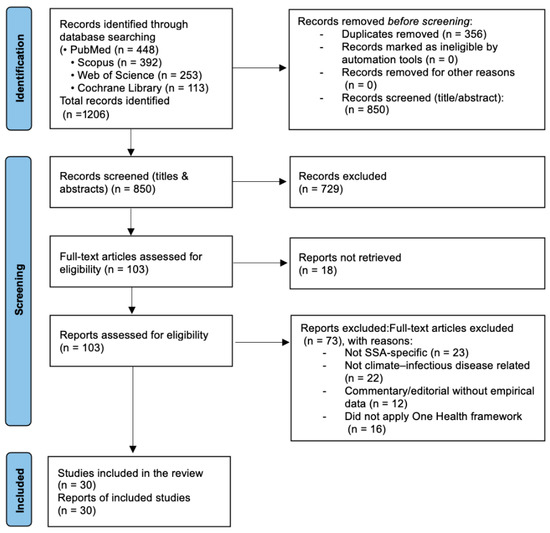
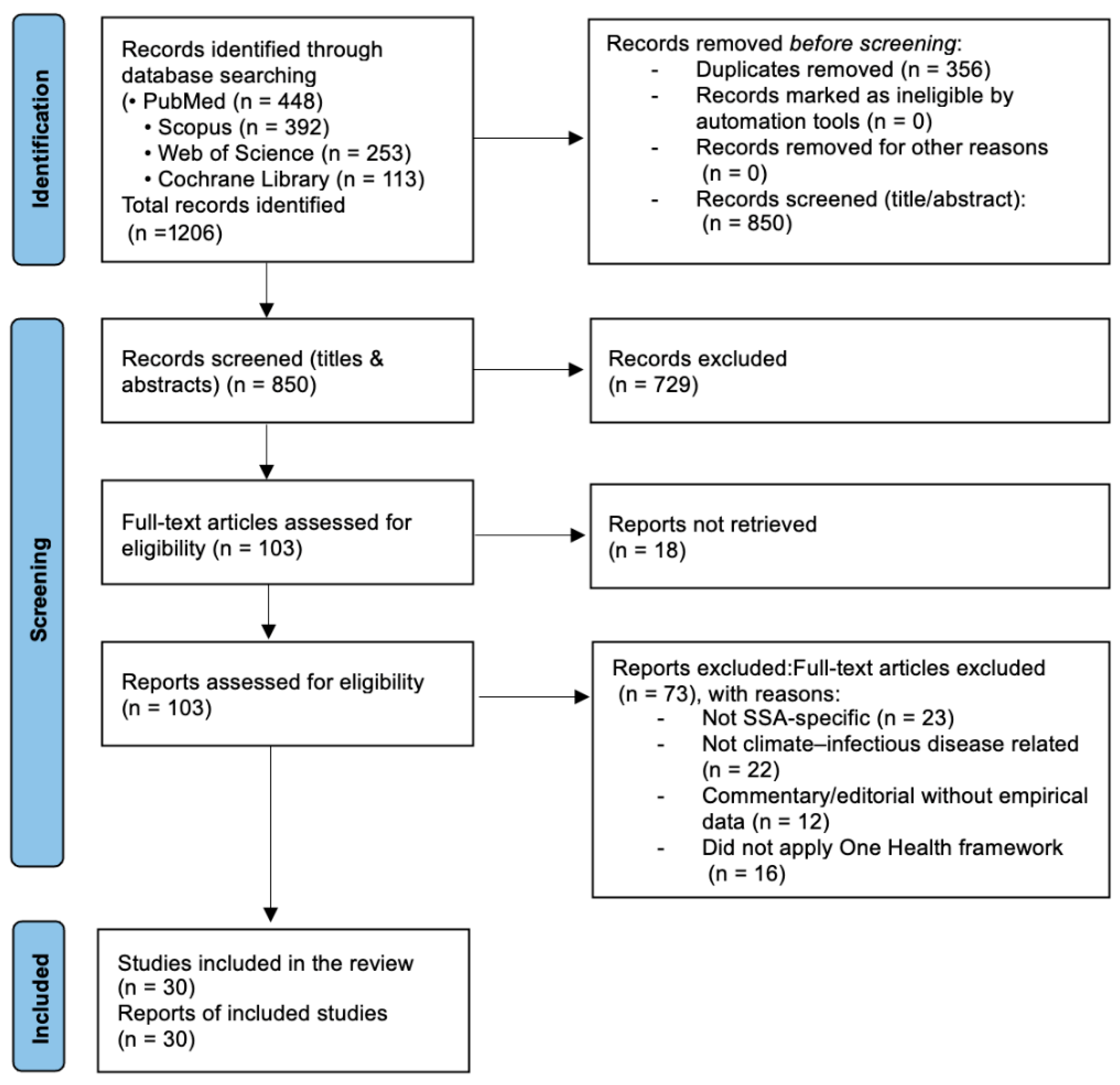
This review was conducted in accordance with the PRISMA-ScR (Preferred Reporting Items for Systematic Reviews and Meta-Analyses extension for Scoping Reviews) guidelines to ensure methodological rigour and transparency [21]. The use of PRISMA is considered the gold standard in scoping reviews, providing additional guidance for broader evidence syntheses [22,23]. The process followed the PRISMA checklist, and a visual overview of the study selection is provided in Figure 1, with further details outlined below. This scoping review synthesized peer-reviewed literature on climate change, infectious diseases, and OH approaches in SSA. Both quantitative and qualitative studies were included, as qualitative evidence on governance and policy integration can provide critical insights into complex interventions. This study followed a scoping review design in accordance with PRISMA-ScR, which is appropriate for mapping broad and heterogeneous evidence and identifying conceptual or methodological gaps rather than evaluating intervention effects.
Figure 1.
PRISMA-ScR flow chart of the article selection process.
2.1. Search Strategy
A comprehensive search was conducted from 5 to 30 July 2025 and was updated in October 2025 following the first-round reviewer feedback using the same eligibility window (January 2019–July 2025) across four databases: PubMed, Scopus, Web of Science, and the Cochrane Library. These databases were selected due to their complementary coverage of biomedical, environmental, and interdisciplinary research [24,25]. The database-specific yields were as follows: PubMed (n = 448), Scopus (n = 392), Web of Science (n = 253), and the Cochrane Library (n = 113), totalling 1206 records before de-duplication. The October 2025 update re-ran the same search strategy and eligibility window solely to confirm completeness following reviewer feedback; no new eligible studies published after July 2025 were identified. The search strategy combined Medical Subject Headings (MeSH) in PubMed (e.g., “Climate Change,” “Vector-Borne Diseases,” “Zoonoses”) with free-text keywords to maximise coverage. Climate-related terms included “climate variability,” “extreme precipitation,” “rainfall patterns,” “temperature rise,” “heatwaves,” “flooding,” and “drought.” The search strategy for infectious diseases used both controlled vocabulary and free-text synonyms such as “Vector-Borne Diseases” and “Zoonoses” (MeSH), as well as terms like “malaria,” “schistosomiasis,” “diarrhoea/diarrhoea,” “cholera,” “typhoid,” “dysentery,” “dengue,” and “chikungunya.” US and UK spellings were used to ensure no relevant records were missed. “One Health” was searched both as a keyword and as an interdisciplinary concept when controlled vocabulary was unavailable.
Boolean operators (AND/OR) were used to build the search string. Structured search approaches based on Boolean logic are widely recommended to maximize both sensitivity and specificity in scoping reviews [26]. Search terms were adapted to the syntax and controlled vocabulary of each database. An example of the search string used in PubMed with the full strings for each database included in the Supplementary Materials is: (“climate change”[MeSH Terms] OR “climate variability”[Title/Abstract] OR “global warming”[Title/Abstract] OR “extreme weather”[Title/Abstract] OR “extreme precipitation” [Title/Abstract] OR “temperature rise”[Title/Abstract] OR flooding[Title/Abstract] OR drought[Title/Abstract]) AND (“infectious diseases”[MeSH Terms] OR “vector-borne diseases”[Title/Abstract] OR “zoonoses”[Title/Abstract] OR “zoonotic diseases”[Title/Abstract] OR malaria[Title/Abstract] OR schistosomiasis[Title/Abstract] OR diarrhea[Title/Abstract] OR cholera[Title/Abstract] OR dengue[Title/Abstract] OR chikungunya[Title/Abstract]) AND (“One Health”[MeSH Terms] OR “cross-sectoral”[Title/Abstract] OR interdisciplinary [Title/Abstract] OR “veterinary collaboration”[Title/Abstract]) AND (“Sub-Saharan Africa”[MeSH Terms] OR “Africa South of the Sahara”[Title/Abstract] OR the full list of SSA countries as detailed in Supplementary Table S2). To ensure comprehensiveness, the full list of SSA countries used in the searches is provided in the Supplementary Materials.
Searches were limited to peer-reviewed articles published in English from January 2019 to July 2025, ensuring the inclusion of relevant and up-to-date studies. While this restriction enhanced feasibility and ensured methodological consistency among reviewers, it may also introduce publication and language bias. This is particularly relevant in SSA, where many government or NGO-led initiatives are documented in non-English or grey literature. This limitation is acknowledged and discussed further in Section 4.5. This limitation highlights the potential for language and publication bias, a concern frequently cited in scoping review methodologies [27]. The reference lists of included articles were manually reviewed to identify additional eligible studies. This snowballing method remains an effective approach for identifying hard-to-locate but relevant publications [28]. Inclusion of qualitative evidence in scoping reviews has also been shown to strengthen insights into complex interventions [21]. All retrieved records were imported into Zotero for de-duplication. Duplicates were identified and removed using Zotero’s standard matching algorithms.
2.2. Eligibility Criteria
Studies were considered eligible if they were peer-reviewed articles published between January 2019 and July 2025, ensuring the inclusion of recent and relevant literature. This timeframe was chosen to include evidence generated following the 2015 Paris Agreement, a period marked by significant growth in climate-health and One Health research in SSA, and to ensure the review incorporates the most current findings. Only English-language publications were included. The primary geographic focus was SSA, defined as the 46 countries identified by the United Nations classification, and only multi-regional or global studies that included disaggregated analyses or case studies explicitly mentioning SSA were considered. This approach ensured unrelated geographic areas were excluded. In addition, eligible studies had to use or evaluate a One Health or cross-sectoral framework explicitly. For this review, “cross-sectoral” was defined in accordance with the FAO/WHO/OIE/UNEP Tripartite definition of One Health, referring to collaborative approaches that explicitly integrate at least two of the following domains: human health, animal health, and environmental/ecosystem health [29]. Studies involving only multidisciplinary teams (e.g., economist and physician) without clear integration across these domains were not classified as One Health and were excluded. Only studies with full-text access were included to allow comprehensive evaluation. Studies, including commentaries, conference abstracts, and editorials, that lacked empirical data were excluded. Further details on inclusion and exclusion criteria are provided in Table 1.
Table 1.
Inclusion and Exclusion Criteria.
2.3. Study Selection Process
Two authors conducted title and abstract screening, followed by a full-text review of potentially eligible studies. A total of 1206 records were retrieved from four databases: PubMed (n = 448), Scopus (n = 392), Web of Science (n = 253), and the Cochrane Library (n = 113). After removing 356 duplicates, 850 records remained for title and abstract screening. Of these, 729 were excluded, leaving 121 articles for full-text retrieval. N = 18 could not be retrieved in full due to changes in repository access, unavailable PDFs, or broken links at the time of retrieval, resulting in 103 articles assessed for eligibility. After full-text review, 73 were excluded (23 were not SSA-specific, 22 unrelated to climate–infectious disease, 12 were commentaries/editorials without empirical data, and 16 did not use a One Health framework). Ultimately, 30 studies met the inclusion criteria and were retained for synthesis, as shown in the PRISMA-ScR flow diagram (Figure 1).
Each article was reviewed for relevance, methodological clarity, and alignment with the review objectives. Data was extracted on study design, country or region, climate variables assessed, infectious disease outcomes, and addressed One Health components. For qualitative findings related to governance and policy, thematic coding was used to identify cross-cutting issues. Two authors independently extracted data, while two others validated the process. Discrepancies were resolved through discussion and consensus to enhance the reliability and reproducibility of the results. Consistent with scoping review methodology, data extraction followed a charting approach focused on mapping study characteristics rather than performing a formal risk-of-bias assessment. Key methodological characteristics, including study design, data sources, and reporting clarity, were extracted to transparently map strengths and gaps in the evidence base, in accordance with PRISMA-ScR guidelines. Two authors (M.M. and R.H.) conducted the initial screening and data extraction, while H.S. and F.W. validated the findings and supplemented additional sources where relevant. Any disagreements regarding study inclusion were resolved through discussion among the reviewers and, if necessary, consultation with the supervising researcher. The full database search strings used in this review are provided in the Supplementary Materials.
3. Results
3.1. Study Selection and Characteristics
From the 103 full-text articles reviewed for eligibility, 73 were excluded (23 were not SSA-specific, 22 unrelated to climate–infectious disease, 12 were commentaries/editorials without empirical data, and 16 did not use a One Health framework. A total of 30 studies met the inclusion criteria and were compiled for analysis. The final set of studies spanned diverse contexts across SSA, highlighting the interplay between climate variability and infectious disease dynamics. Published between 2019 and 2025, these studies demonstrate growing scholarly attention to the intersection of climate change, infectious disease, and One Health. Key climate variables included temperature, precipitation, humidity, and extreme weather events, which influenced vector distribution, pathogen lifecycles, and disease transmission. Many studies emphasized the importance of the One Health perspective, including governance, regulatory frameworks, capacity building, and cross-sectoral collaboration [20,30,31]. Systems-based and Climate-Smart One Health (CS-OH) approaches were promoted to improve resilience and health outcomes [32]. The extracted study characteristics, including authorship, year, region, disease focus, and key findings, are summarised in Table 2.
Table 2.
Key characteristics of reviewed studies.
3.2. Climate Drivers and Disease Associations
3.2.1. Malaria and Vector-Borne Transmission
Infectious disease dynamics are significantly influenced by climate variability across the SSA region. Increased humidity, altered rainfall patterns, and rising temperatures have expanded the range of disease vectors, enabling them to establish new habitats and extend the transmission seasons. In highland areas that were previously unsuitable for malaria and other vector-borne illnesses, these impacts are particularly noticeable [35,48,56]. Higher malaria incidence and mortality are directly correlated with rising temperatures, with East and Central Africa being especially susceptible [35]. Nonetheless, thermal thresholds differ across pathogens: while malaria transmission peaks around 25 °C and may decline in areas that surpass this optimum, arboviruses such as dengue and chikungunya thrive at higher temperature ranges, approximately 29 °C [47]. These findings are consistent with global data that climate change has already amplified over half of all known infectious diseases, disproportionately harming the poorest communities most vulnerable to malaria and neglected tropical diseases [46]. Seasonal transmission dynamics are also shifting, with some areas experiencing longer periods of disease circulation and others facing emerging risks in previously unaffected zones [36,47].
3.2.2. Arboviral Diseases
Arboviral diseases, such as dengue and chikungunya, are increasingly recognized as major health concerns in Sub-Saharan Africa. Warming temperatures and fast urbanization are generating favorable conditions for Aedes aegypti and Aedes albopictus, expanding their geographical range and seasonal activity [47,57]. Experimental evidence indicates that infection, dissemination, and transmission rates for these arboviruses increase significantly between 26 and 32 °C, while transmission is insignificant below 20 °C [58]. Mechanistic simulations also show that malaria transmission peaks around 25 °C, while arboviral transmission by Aedes aegypti peaks around 29 °C, meaning that continuous warming may limit malaria suitability while increasing arbovirus potential across most of the region [47]. Comprehensive evaluations have found that climate variability, deforestation, inadequate sanitation, and livestock growth all contribute to increased vector breeding and disease dissemination [57]. The limited diagnostic infrastructure and frequent misinterpretation of arboviral infections as malaria obscure the true disease burden. Climate change is increasing arboviral transmission risks in Sub-Saharan Africa, highlighting the importance of strengthening diagnostic capacity, integrated vector surveillance, and One Health-based control approaches [47,57,58].
3.2.3. Schistosomiasis
Schistosomiasis exemplifies the climate sensitivity of infectious illnesses. Fluctuations in temperature, rainfall, and hydrological conditions directly alter freshwater snail populations, which serve as intermediate hosts, hence enabling disease expansion in both endemic and non-endemic locations. Newly identified hotspots in Kenya and Tanzania indicate how climate-driven ecological changes interact with snail infection rates and human exposure [40]. Recent analyses suggest that climate change may not only expand but also shift schistosomiasis distribution, with S. haematobium predicted to be more vulnerable than S. mansoni to climatic stressors [38]. Predictive models further indicate that rainfall variability and flooding events can substantially influence snail distribution, increasing transmission potential in new ecological niches [34].
3.2.4. Zoonotic Infections
Comparable patterns are observed for zoonotic illnesses, where variations in bat and rodent habitats contribute to the introduction or resurgence of infections such as Lassa fever, Marburg virus, and Mpox [48]. Changes in temperature and precipitation also have an impact on vector-borne diseases like dengue and malaria, which emphasizes the necessity of integrated climate–health modelling [47]. According to Asare et al. [40] and Agyarko et al. [48], these models are becoming more and more important for directing targeted interventions, guiding surveillance, and encouraging cross-sectoral collaboration. Climate-sensitive diseases do not affect everyone equally. Highland communities, vulnerable demographic groups, including women, children, and the elderly, as well as rural populations with limited access to healthcare facilities, are disproportionately at risk [48,56]. Limited diagnostic infrastructure continues to obstruct early identification and prompt action, and current monitoring systems are inadequate for capturing new threats [40,44,56].
3.2.5. Waterborne Diseases
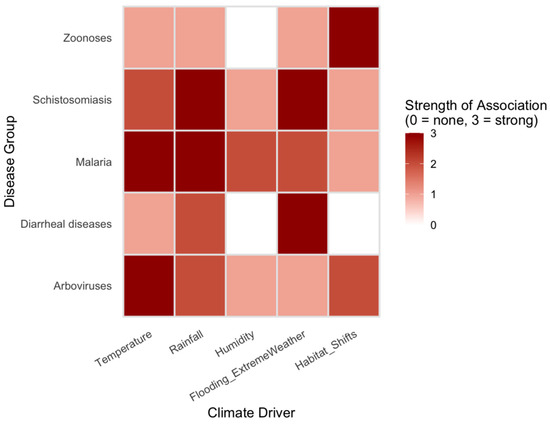
The impact of climate drivers on the spread of infectious diseases in SSA goes beyond schistosomiasis and malaria to encompass diarrheal illnesses. Cholera, dysentery, and typhoid fever outbreaks have been associated with extreme rainfall events and flooding, which frequently jeopardize access to clean water and sanitation. Despite being less often modeled than vector-borne diseases, Agyarko et al. [48] highlight that these waterborne infections are nevertheless highly climate-sensitive and disproportionately impact vulnerable rural populations. Figure 2 illustrates the associations between climate drivers and infectious disease groups identified in the included studies.
Figure 2.
Heatmap illustrating the strength of associations between climate drivers and infectious disease groups in Sub-Saharan Africa. Examples of analyzed associations include increased temperature influencing malaria transmission, flooding and rainfall extremes influencing diarrheal diseases and schistosomiasis, and high humidity influencing arboviral abundance.
3.2.6. Conflicting Evidence and Uncertainties
Evidence from the literature also reveals conflicting interpretations of how climate change alters disease risk. While Stensgaard et al. [38] contend that climate change is more likely to redistribute rather than expand transmission zones, Adekiya et al. [34] argue that warming and changes in rainfall may expand the ecological range of schistosomiasis, with S. haematobium exhibiting greater sensitivity than S. mansoni. Projections for malaria also differ. According to Yao et al. [35] and Leal Filho et al. [49], rising temperatures and rainfall variability are associated with increased malaria incidence and death, particularly in East and Central Africa. To synthesise the relationships described above, Table 3 summarizes the main disease groups affected by climate variability in sub-Saharan Africa, their predominant climatic drivers, overall impact trends, and representative Climate-Smart One Health (CS-OH) responses.
Table 3.
Summary of climate–health linkages and representative Climate-Smart One Health (CS-OH) responses in sub-Saharan Africa.
3.3. One Health Approaches
One Health, which addresses zoonotic diseases, climate change, antimicrobial resistance, food safety, and environmental health, has developed into a transdisciplinary framework in SSA. Within the region, East Africa leads the area in One Health program implementation, with Southern, Central, and West Africa following closely behind. As a reflection of the range of involvement throughout the health landscape, these efforts function at several levels, including national, regional, continental, and global [20,44]. These methods are especially relevant to bacterial zoonoses, which contribute greatly to febrile disease but are still underdiagnosed (e.g., brucellosis, leptospirosis, and Q fever) [44].
Concrete examples of implementation across the region demonstrate the variety of methods employed. Elton et al. [33] assessed zoonotic preparation in 44 SSA countries using WHO JEE data, finding that just 14% had multisectoral national action plans and 32% had an inter-agency response team, indicating early national-level One Health coordination efforts. Omuse et al. [39] reviewed 21 projects implemented by smallholder farmers in 11 African countries and identified integrated zoonotic disease surveillance, participatory capacity-building, and community-led livestock vaccination programs as key One Health practices that improve both human and animal health outcomes.
Mamabolo et al. [31] emphasized the importance of economic integration within One Health by highlighting South Africa’s National One Health Forum and One Health Economics mini-congress, which use cost–benefit analysis to guide zoonotic disease prevention and vaccine funding. Massengo et al. [57] emphasized practical One Health methods to arbovirus control, particularly integrated human–animal-vector surveillance and combined immunization regimens for Rift Valley fever and other emerging viruses.
Gozlan et al. expanded the scope of One Health by showing how climate-driven changes in non-native species and aquaculture methods affect pathogen dynamics and food security. Their findings demonstrate that invasive species can both enhance disease spread and, in some situations, dilute infection loads, emphasising the necessity of One Health frameworks that incorporate environmental and food production elements [53].
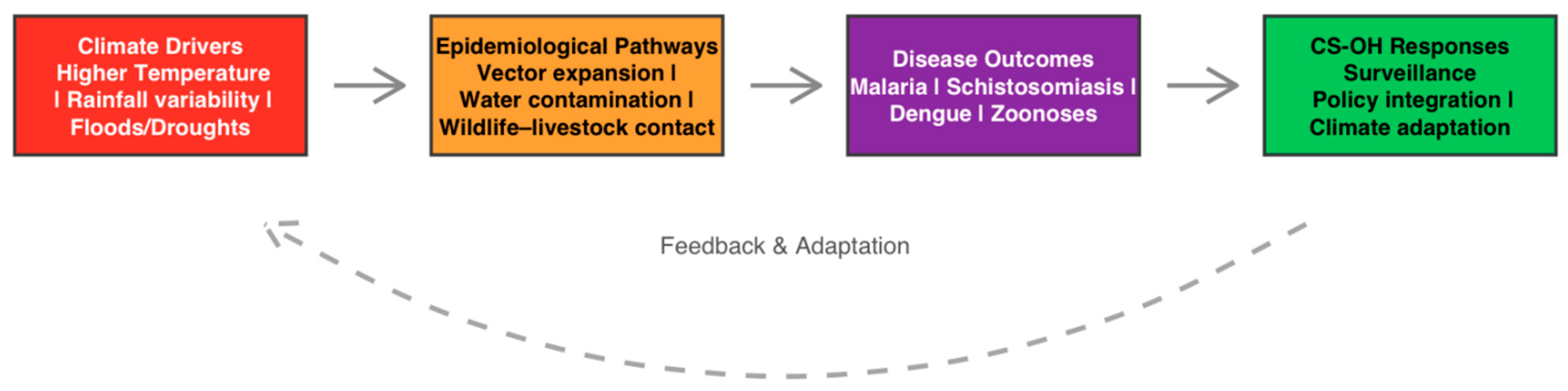
However, the majority of initiatives still mostly depend on external funding, which raises questions about their long-term viability. Effective implementation is further hindered by entrenched professional silos, inadequate stakeholder involvement, and limited intersectoral coordination [20,30]. The need for greater international collaboration and broader thematic coverage, especially in low- and middle- Human Development Index (HDI) settings, is highlighted by analyses of One Health research trends that also show enduring gaps in areas like environmental health, climate adaptation, and sustainable food systems [42,48]. Scholars suggest establishing supportive legal frameworks, enhancing multisectoral coordination, developing workforce capacity, and incorporating One Health principles into formal education and training systems as ways to address these issues [20,30,42]. To synthesize the identified approaches and their interconnections, a conceptual framework (Figure 3) illustrates the pathways linking climate drivers, ecosystem changes, disease outcomes, and Climate-Smart One Health (CS-OH) responses in SSA.
Figure 3.
Overview of the Climate-Smart One Health (CS-OH) framework integrating climate adaptation with One Health actions in sub-Saharan Africa.
3.4. Disease Burden Patterns
The infectious disease burden in SSA exhibits substantial spatial and temporal variation. Overall, climate-related environmental changes continue to shape disease risks in the region, with malaria, schistosomiasis, zoonoses, and arboviruses remaining dominant contributors. Malaria remains highly sensitive to climatic variability, particularly in East Africa, where rising temperatures and humidity exert major health and economic effects [35,47]. Schistosomiasis has also become increasingly recognized as a climate-sensitive neglected tropical disease, with flooding, hydrological extremes, and precipitation changes driving its spread across both endemic and newly affected areas. Strong relationships between human case incidence and high snail infection rates emphasize the need to incorporate environmental monitoring into public health surveillance [40]. Notably, projections indicate that climate change may reconfigure the distribution of schistosomiasis rather than simply expand it, leading to shifting endemic zones across the continent [38]. The use of predictive models highlights how rainfall and temperature variability influence the snail–schistosome cycle, reinforcing the urgency of tailored, climate-sensitive intervention strategies [34].
With preparedness and response capabilities differing significantly throughout the region, zoonotic infections—such as rabies, anthrax, brucellosis, and highly pathogenic avian influenza—remain common [33,44]. The introduction of viruses, including Lassa fever, Mpox, and dengue, has also been related to climate-driven changes in wildlife ecology and vector distribution, which have complicated management measures and increased the disease burden [47,48]. High-risk populations are made more vulnerable by inadequate multisectoral coordination, brittle surveillance systems, and weak diagnostic infrastructure [33,44,56].
Beyond infectious diseases, non-communicable and environmental health consequences, such as cardiovascular disease, asthma, Chronic Obstructive Pulmonary Disease (COPD), and increased mortality during heat waves, were also highlighted. Moreover, environmental toxins amplified these risks, especially among disadvantaged groups. These findings demonstrate the combined burden of climate-sensitive infectious, zoonotic, and non-communicable diseases, emphasizing the importance of integrated One Health and exposomic approaches [52].
These evolving disease patterns, intensified by urbanization, seasonal variability, and limited adaptive capacity, highlight the importance of incorporating climate projections into health policy and resource allocation. One Health frameworks provide an effective platform for integrating interdisciplinary research, community engagement, and climate-informed planning [42,48]. Country-level data further illustrate these dynamics: Nigeria remains a global malaria hotspot, with incidence rates of 299 per 1000 in 2018 and contributing roughly 27% of global cases. Despite substantial national progress—such as a 90% decrease in Mozambique from 2000 to 2010 and a decline in South Africa from 2001 to 2016—warming trends have occasionally reversed gains, as shown by South Africa’s increase to 3.95 per 1000 in 2017. Ethiopia achieved reductions of 55% (2004–2008) and 80% (2013–2018), aligning with cooler mean temperatures during those years [49].
Additionally, according to Xu et al., Seasonal Malaria Chemoprevention (SMC) has become a cornerstone strategy in the Sahel, with a meta-analysis indicating 74% preventive effectiveness in children under the age of 5. Coverage will be expanded to 45 million children in 15 countries by 2021, although issues remain with adherence, duration of coverage, and disruptions caused by COVID-19. These findings show both the efficiency and operational limitations of regional malaria management under changing climatic circumstances [37]. Warming trends and shifting vector distributions have also been linked to the emergence of dengue and other arboviruses [47]. In addition to exacerbating the existing high burden of rabies, anthrax, brucellosis, and avian influenza, which are still prevalent throughout the region, these advances make disease control measures more challenging. Vulnerable communities are at significantly greater danger due to the unequal distribution of readiness and diagnostic capabilities [33,44]. Both global and regional studies indicate that zoonotic and parasitic diseases necessitate One Health interventions that consider human, animal, and environmental health. According to Anisuzzaman et al., companion animals and livestock remain key reservoirs for parasitic diseases, including hydatidosis and toxoplasmosis, which highlights cross-sectoral transmission pathways that exacerbate health burdens [54]. Climate change further increases the risks of these infections, making poor and rural populations particularly vulnerable [46].
3.5. Synthesis of Findings
When considered collectively, the literature reveals several distinct trends and notable gaps. Despite being extremely climate-sensitive, diarrheal illnesses and arboviruses are still underrepresented in the evidence base, whereas malaria and schistosomiasis continue to dominate These results are also inconsistent. Research on malaria alternates between forecasts of decreasing transmission when areas exceed the parasite’s temperature optimum and predictions of increasing occurrence under warming [35,47,49]. Similar to this, Stensgaard et al. [38] suggest that redistribution rather than expansion may be the dominant trend, despite Adekiya et al. [34] warning of schistosomiasis expansion under climate change. These inconsistencies highlight the impact of various modelling methodologies and assumptions, as well as regional diversity.
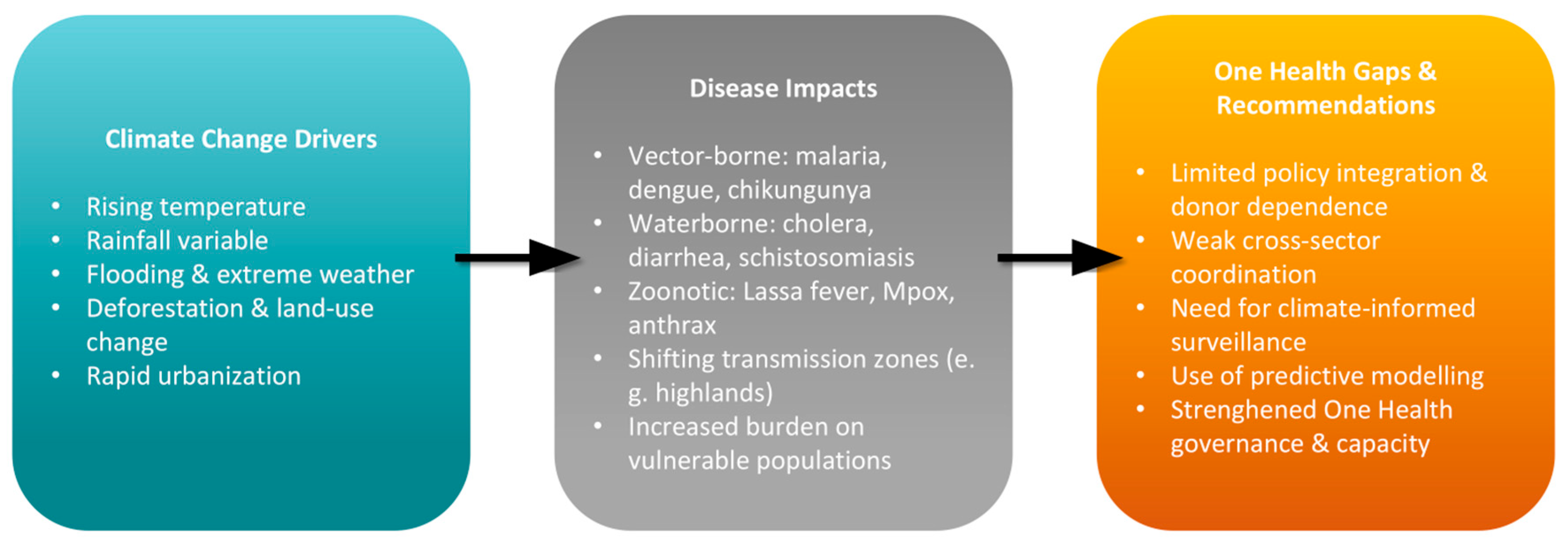
Additionally, few long-term, national datasets can fully capture the variety of climate–disease relationships, as most studies rely on modelling, reviews, or short-term observations. Although the research on One Health places a strong emphasis on cross-sector integration, governance, and coordination, there are still few quantitative assessments of the efficacy of interventions. It is urgent to expand the study focus beyond malaria and schistosomiasis, as the unequal attention given to various diseases and geographical areas indicates that important facets of climate-sensitive health concerns in SSA are still poorly understood [20,44]. A summary of the main findings, climate drivers, disease impacts, and One Health gaps is illustrated in Figure 4.
Figure 4.
Summary of the review findings.
4. Discussion
This review emphasises that climate change is an immediate and escalating driver of infectious disease dynamics in Sub-Saharan Africa (SSA). Evidence from recent studies shows that rising temperatures, changing rainfall patterns, and frequent flooding are shifting the transmission of malaria, schistosomiasis, and diarrhoeal diseases into new ecological zones, with particularly severe effects in East and Central Africa [2,29,30,31,47]. These findings confirm that climate variability worsens existing vulnerabilities in fragile health systems, increasing inequalities among rural, low-income, and marginalised populations [2,29,42,52,53]. Although the One Health (OH) framework has gained prominence in SSA policy discussions, its implementation remains inconsistent. It is often dependent on donors and hindered by weak intersectoral coordination, fragmented governance structures, and limited domestic funding [10,17,46]. The continued existence of institutional silos among ministries of health, agriculture, and environment further restricts the translation of OH principles into sustainable national strategies [10,17,58].
4.1. Contribution to Existing Evidence and Knowledge Gaps
Compared with earlier reviews on climate change and health in Africa, which primarily examined single-disease patterns or focused on general adaptation measures, this review provides a novel synthesis that explicitly integrates the operationalization of One Health across multiple disease groups within the SSA climate context [3,32,33]. Previous analyses have often concentrated on malaria alone or on conceptual frameworks of OH without linking them to empirical disease evidence [9,10,46]. By concurrently examining malaria, schistosomiasis, diarrhoeal diseases, and zoonotic infections, this study extends understanding of how climate variability interacts with multisectoral responses. It highlights the uneven progress of One Health implementation across SSA, identifying donor dependence, weak governance, and lack of standardized metrics as persistent barriers. These insights fill a critical gap in the literature by linking the biophysical impacts of climate change with institutional and governance dimensions that shape health system resilience. Recent research indicates that climatic factors, including temperature, humidity, and air pollution, can affect the incidence of infectious diseases both independently and in combined forms, going beyond ecological connections. For instance, these exposures have been connected to child-related illnesses such as Helicobacter pylori and COVID-19, through pathways involving TRP-channel signalling, reactive oxygen species (ROS), and airway inflammation [59,60]. Proposed mechanisms include oxidative stress through reactive oxygen species (ROS) generation, airway inflammation, and activation of transient receptor potential (TRP) channels [61,62]. The observed epidemiological trends, such as increased susceptibility in children and the burden of respiratory diseases, can be biologically explained by these pathways. Although ecological connections (such as rainfall and vector expansion) have been the focus of the majority of SSA investigations, incorporating mechanistic information can aid in the explanation of the interactions between climate determinants and host physiology [59,63]. This emphasises the significance of cross-disciplinary Research from One Health that connects the biomedical sciences, environmental toxicity, and climate. Moreover, this review’s focus on peer-reviewed evidence from 2019–2025 provides the most up-to-date synthesis of the post-COVID-19 period, when OH frameworks gained renewed importance for epidemic preparedness and climate resilience.
4.2. Regional and Institutional Insights
Regional contrasts underscore the heterogeneous nature of One Health integration and adaptive capacity. East Africa demonstrates comparatively advanced One Health capacity, anchored in university-led initiatives and community-based surveillance networks [10,54], whereas West and Central Africa lag due to limited political commitment, financial constraints, and underdeveloped preparedness metrics [60]. Southern Africa shows promise through its One Health economics models linking animal and human health to cost efficiency [27] yet challenges in coordination and sustainability remain. These disparities highlight that context-specific governance, targeted resource allocation, and legal institutionalization are essential for scaling One Health across the continent.
4.3. Policy and Practice Implications
Despite growing recognition of the climate health nexus, most national climate adaptation strategies in SSA still fail to embed One Health principles explicitly [10,50]. Key policy barriers include fragmented institutional mandates, insufficient data integration, and lack of coordination between human, animal, and environmental sectors [17]. However, several promising developments are emerging. The African Union and Africa CDC have launched One Health coordination platforms and strategic frameworks that emphasize mainstreaming One Health within national adaptation and health-security agendas. Ghana’s Climate-Smart One Health (CS-OH) framework exemplifies a practical pathway to embed climate adaptation into national health planning [28]. Advances in predictive modelling and early-warning systems present additional opportunities for proactive risk management [31,33,39].
To translate these insights into practice, countries should prioritize
- Institutionalization of One Health governance through national legislation and inter-ministerial coordination mechanisms.
- Integration of climate-informed surveillance and predictive modelling into disease-control strategies.
- Domestic financing and capacity building to reduce dependence on external donors; and
- Community engagement and equity-focused interventions to ensure inclusivity in resilience planning.
Linking One Health frameworks with global financing mechanisms such as the Green Climate Fund could also secure sustainable funding for climate-resilient health systems. By articulating these actionable steps, this review moves beyond synthesis to offer concrete policy guidance for national and regional stakeholders.
4.4. Policy Gaps, Barriers, and Opportunities
Despite growing recognition of the climate–health nexus, most national climate adaptation strategies in SSA do not explicitly incorporate OH principles [50]. Policy barriers include siloed institutional mandates, fragmented funding streams, and limited coordination between health, agriculture, and environmental sectors [20]. Even where One Health platforms exist, they are often underutilized, lack formalized legal frameworks, and depend on external funding [30]. These challenges hinder the development of sustainable, climate-resilient health systems.
At the same time, several opportunities exist. The African Union has launched One Health coordination platforms to foster regional collaboration, while country-specific frameworks such as Ghana’s CS-OH model provide replicable pathways [32]. Advances in predictive modelling and integrated data systems also present opportunities to move from reactive responses to anticipatory action [47]. The African CDC’s 2024 framework on climate and health explicitly calls for embedding OH within national adaptation plans [64]. Furthermore, linking One Health integration with global financing streams, such as the Green Climate Fund, could provide the resources needed for scaling up. Policymakers therefore have a window of opportunity to embed One Health into broader climate adaptation and health security agendas.
4.5. Limitations of This Review
Several limitations must be acknowledged. First, the review focused exclusively on English-language, peer-reviewed articles published between 2019 and 2025. This timeframe aligns with recent major climate–health reports, including the 2019 IPCC Special Report and AR6 (2022), ensuring the evidence base includes the most recent science. While this restriction enhanced feasibility and methodological consistency, it may have introduced both language and publication bias, especially in Sub-Saharan Africa, where many government and NGO-led initiatives are documented in grey literature or non-English sources. Global or multi-regional studies were included only if they presented explicit SSA data or stratified analyses. Studies offering only indirect relevance, such as extrapolations from non-African regions, were excluded. These omissions could limit the representativeness of our findings, especially regarding community-level interventions.
Second, the heterogeneity of study designs, ranging from modelling studies to scoping reviews, limited the direct comparability of findings. In line with scoping review standards, no formal risk-of-bias tool was used; instead, methodological characteristics (clarity, transparency, appropriateness of methods) were documented. Third, malaria and schistosomiasis dominated the literature, while diarrhoeal diseases and arboviruses were underrepresented. This imbalance reflects broader funding and research priorities, and it constrains the ability to generalize about climate–health interactions across the full spectrum of diseases. Finally, although PRISMA-ScR guidelines were followed for transparency, a formal risk-of-bias tool was not used, in accordance with typical scoping review methodology. This may limit the robustness of evidence appraisal but is consistent with other climate–health scoping reviews, which also note limited long-term datasets and underrepresented grey literature [21].
4.6. Areas for Future Research
Future research should prioritize underexplored diseases, such as cholera, arboviruses (e.g., dengue, chikungunya), and bacterial zoonoses, which are highly sensitive to climate variability yet are insufficiently documented in the literature. Longitudinal and multicountry studies are needed to capture the temporal dynamics of disease–climate interactions, particularly in West and Central Africa, where data remain sparse. There is also a critical need for rigorous evaluations of One Health interventions, using standardized metrics to assess effectiveness, cost-effectiveness, and sustainability [42].
Further research should examine the institutionalization of One Health principles within governance systems, professional training, and climate adaptation policies. Integrating One Health into national curricula and civil service structures may strengthen long-term capacity. Additionally, participatory approaches that incorporate local knowledge and community-based adaptation strategies should be prioritized. Such techniques can enhance cultural relevance, increase intervention uptake, and reinforce the social dimensions of resilience. Emerging evidence shows that participatory climate-health interventions, such as community early warning systems and locally adapted health adaptation strategies, improve outcomes and strengthen resilience [65]. Digital e-surveillance platforms such as SORMAS institutionalized in Ghana further demonstrate potential for scalable, community-aligned One Health interventions [66]. This research focus would facilitate the development of solutions that connect scientific, policy, and community perspectives, moving beyond merely documenting vulnerabilities.
5. Conclusions
This review showed that climate change intensified infectious disease burdens in Sub-Saharan Africa and altered their spatial and temporal patterns. Malaria is spreading into highland areas once considered unsuitable for transmission, schistosomiasis is shifting due to rainfall variability, and diarrhoeal outbreaks are increasing after flooding. Zoonotic diseases like Lassa fever, Ebola, and arboviruses highlighted how climate change disrupted fragile health systems. These trends revealed that climate-sensitive diseases impact regions unevenly and disproportionately affect rural and marginalised populations. The One Health framework provides a pathway to address interconnected threats, exemplified by Ghana’s CS-OH model and East Africa’s university-led One Health programmes. Key gaps to date include inadequate integration of surveillance systems across human, animal, and environmental health sectors; insufficient climate-health modelling capacity; and weak policy coordination among relevant institutions [17,20,67]. Strengthening coordination of the One Health approach has been highlighted as a critical step for zoonotic disease prevention [30], alongside addressing implementation challenges under smallholder farmer contexts in rural Africa [39]. Integrated surveillance systems have also been proposed as a way to enhance global health security against zoonotic diseases and environmental threats [68]. Future research should extend beyond malaria and schistosomiasis to encompass diarrhoeal diseases, arboviruses, and bacterial zoonoses, employing longitudinal, multi-country approaches to capture evolving disease–climate interactions. Rigorous evaluation of One Health interventions, with standardised metrics for effectiveness and sustainability, is essential. Integrating these insights into governance and policy is vital for SSA to transition from reactive crisis response to proactive, climate-resilient health systems.
Supplementary Materials
The following supporting information can be downloaded at https://www.mdpi.com/article/10.3390/app16010261/s1, Table S1: Full database search strategies used for the scoping review; Table S2: List of Sub-Saharan African countries included in the database search filters (based on the United Nations M49 regional classification).
Author Contributions
Conceptualization, M.M. and R.H.; methodology, M.M.; software, R.H.; validation, M.M., R.H., H.S. and F.W.; resources, M.M., R.H., H.S. and F.W.; writing—original draft preparation, M.M.; writing—review and editing, M.M., H.S. and R.H.; visualization, M.M. and R.H.; supervision, F.W. All authors have read and agreed to the published version of the manuscript.
Funding
This research received no external funding.
Data Availability Statement
All data generated or analysed during this study are included in this published article and its Supplementary Information Files.
Acknowledgments
The authors have reviewed and edited the output and take full responsibility for the content of this publication. This paper has been produced by researchers and their research fellows from the Interdisciplinary Expert Centre on Climate Change and Health (IECCCH) of the Hamburg University of Applied Sciences, Germany.
Conflicts of Interest
The authors declare that they have no conflicts of interest.
Abbreviations
The following abbreviations are used in this manuscript:
| CS-OH | Climate-Smart One Health |
| COVID-19 | Coronavirus Disease 2019 |
| COPD | Chronic Obstructive Pulmonary Disease |
| DALYs | Disability-Adjusted Life Years |
| ECOWAS | Economic Community of West African States |
| HDI | Human Development Index |
| OH | One Health |
| PRISMA | Preferred Reporting Items for Systematic Reviews and Meta-Analyses |
| SMC | Seasonal Malaria Chemoprevention |
| SPAR | State Party Self-Assessment Annual Reporting |
| SSA | Sub-Saharan Africa |
References
- Romanello, M.; McGushin, A.; Napoli, C.D.; Drummond, P.; Hughes, N.; Jamart, L.; Kennard, H.; Lampard, P.; Rodriguez, B.S.; Arnell, N.; et al. The 2021 report of the Lancet Countdown on health and climate change: Code red for a healthy future. Lancet 2021, 398, 1619–1662. [Google Scholar] [CrossRef] [Scilit] [PubMed]
- Pescaroli, G.; Alexander, D. Understanding Compound, Interconnected, Interacting, and Cascading Risks: A Holistic Framework. Risk Anal. 2018, 38, 2245–2257. [Google Scholar] [CrossRef] [Scilit] [PubMed]
- Intergovernmental Panel on Climate Change (IPCC). The Ocean and Cryosphere in a Changing Climate: Special Report of the Intergovernmental Panel on Climate Change; Cambridge University Press: Cambridge, UK, 2022; ISBN 978-1-009-15797-1. [Google Scholar]
- Nova, N.; Athni, T.S.; Childs, M.L.; Mandle, L.; Mordecai, E.A. Global Change and Emerging Infectious Diseases. Annu. Rev. Resour. Econ. 2022, 14, 333–354. [Google Scholar] [CrossRef] [Scilit] [PubMed]
- IPCC. Chapter 9: Africa. Intergovernmental Panel on Climate Change. Available online: https://www.ipcc.ch/report/ar6/wg2/chapter/chapter-9/ (accessed on 12 September 2025).
- Taguela, T.N.; Akinsanola, A.A.; Adeliyi, T.E.; Rhoades, A.; Nazarian, R.H. Understanding drivers and uncertainty in projected African precipitation. npj Clim. Atmos. Sci. 2025, 8, 222. [Google Scholar] [CrossRef] [Scilit]
- World Malaria Report 2023. Available online: https://www.who.int/teams/global-malaria-programme/reports/world-malaria-report-2023 (accessed on 16 October 2025).
- Megersa, D.M.; Luo, X.-S. Effects of Climate Change on Malaria Risk to Human Health: A Review. Atmosphere 2025, 16, 71. [Google Scholar] [CrossRef] [Scilit]
- Yang, G.-J.; Bergquist, R. Potential Impact of Climate Change on Schistosomiasis: A Global Assessment Attempt. Trop. Med. Infect. Dis. 2018, 3, 117. [Google Scholar] [CrossRef] [Scilit]
- Levia, D.F.; Bergquist, R.; Meydani, A.; Hu, Y.; Hannah, D.M. Hydrological Extremes Heighten Vulnerability to Schistosomiasis. Earth’s Future 2024, 12, e2024EF004659. [Google Scholar] [CrossRef] [Scilit]
- Fanzo, J.C.; Downs, S.M. Climate change and nutrition-associated diseases. Nat. Rev. Dis. Primers 2021, 7, 90. [Google Scholar] [CrossRef] [Scilit]
- Wang, P.; Asare, E.; Pitzer, V.E.; Dubrow, R.; Chen, K. Associations between long-term drought and diarrhea among children under five in low- and middle-income countries. Nat. Commun. 2022, 13, 3661. [Google Scholar] [CrossRef] [Scilit]
- Kaneza, D.; Andegiorgish, A.K.; Kubahoniyesu, T. Prevalence and associated factors of diarrhea among children under five years of age in the Western Province of Rwanda: Analysis of the Rwanda Demographic and Health Survey (RDHS) 2019–2020. PAMJ-One Health 2025, 16, 7. [Google Scholar]
- Morales, F.; Montserrat-de la Paz, S.; Leon, M.J.; Rivero-Pino, F. Effects of Malnutrition on the Immune System and Infection and the Role of Nutritional Strategies Regarding Improvements in Children’s Health Status: A Literature Review. Nutrients 2023, 16, 1. [Google Scholar] [CrossRef] [Scilit]
- Fatima, S.H.; Judge, M.A.; Le Souëf, P.N.; Bradshaw, C.J. Impact of climate change on diarrhoea risk in low- and middle-income countries. Environ. Res. 2025, 285, 122412. [Google Scholar] [CrossRef] [Scilit]
- Al Wazni, A.B.; Chapman, M.V.; Ansong, D.; Tawfik, L. Climate Change, Fragility, and Child Mortality; Understanding the Role of Water Access and Diarrheal Disease Amongst Children Under Five During the MDG Era. J. Prev. 2023, 44, 409–419. [Google Scholar] [CrossRef] [Scilit]
- Ghai, R.R.; Wallace, R.M.; Kile, J.C.; Shoemaker, T.R.; Vieira, A.R.; Negron, M.E.; Shadomy, S.V.; Sinclair, J.R.; Goryoka, G.W.; Salyer, S.J.; et al. A generalizable one health framework for the control of zoonotic diseases. Sci. Rep. 2022, 12, 8588. [Google Scholar] [CrossRef] [Scilit] [PubMed]
- Calistri, P.; Iannetti, S.; Danzetta, M.L.; Narcisi, V.; Cito, F.; Sabatino, D.D.; Bruno, R.; Sauro, F.; Atzeni, M.; Carvelli, A.; et al. The components of “One World—One Health” approach. Transbound. Emerg. Dis. 2013, 60, 4–13. [Google Scholar] [CrossRef] [Scilit] [PubMed]
- Otu, A.; Effa, E.; Meseko, C.; Cadmus, S.; Ochu, C.; Athingo, R.; Namisango, E.; Ogoina, D.; Okonofua, F.; Ebenso, B. Africa needs to prioritize One Health approaches that focus on the environment, animal health and human health. Nat. Med. 2021, 27, 943–946. [Google Scholar] [CrossRef] [Scilit]
- Fasina, F.O.; Fasanmi, O.G.; Makonnen, Y.J.; Bebay, C.; Bett, B.; Roesel, K. The one health landscape in Sub-Saharan African countries. One Health 2021, 13, 100325. [Google Scholar] [CrossRef] [Scilit]
- Mak, S.; Thomas, A. Steps for Conducting a Scoping Review. J. Grad. Med. Educ. 2022, 14, 565–567. [Google Scholar] [CrossRef] [Scilit]
- Tricco, A.C.; Lillie, E.; Zarin, W.; O’Brien, K.K.; Colquhoun, H.; Levac, D.; Moher, D.; Peters, M.D.J.; Horsley, T.; Weeks, L.; et al. PRISMA Extension for Scoping Reviews (PRISMA-ScR): Checklist and Explanation. Ann. Intern. Med. 2018, 169, 467–473. [Google Scholar] [CrossRef] [Scilit] [PubMed]
- Munn, Z.; Peters, M.D.J.; Stern, C.; Tufanaru, C.; McArthur, A.; Aromataris, E. Systematic review or scoping review? Guidance for authors when choosing between a systematic or scoping review approach. BMC Med. Res. Methodol. 2018, 18, 143. [Google Scholar] [CrossRef]
- Falagas, M.E.; Pitsouni, E.I.; Malietzis, G.A.; Pappas, G. Comparison of PubMed, Scopus, Web of Science, and Google Scholar: Strengths and weaknesses. FASEB J. 2008, 22, 338–342. [Google Scholar] [CrossRef] [Scilit] [PubMed]
- Bramer, W.M.; Rethlefsen, M.L.; Kleijnen, J.; Franco, O.H. Optimal database combinations for literature searches in systematic reviews: A prospective exploratory study. Syst. Rev. 2017, 6, 245. [Google Scholar] [CrossRef] [Scilit]
- Alharbi, A.; Stevenson, M. Refining Boolean queries to identify relevant studies for systematic review updates. J. Am. Med. Inf. Assoc. 2020, 27, 1658–1666. [Google Scholar] [CrossRef] [Scilit] [PubMed]
- Jüni, P.; Holenstein, F.; Sterne, J.; Bartlett, C.; Egger, M. Direction and impact of language bias in meta-analyses of controlled trials: Empirical study. Int. J. Epidemiol. 2002, 31, 115–123. [Google Scholar] [CrossRef] [Scilit]
- Greenhalgh, T.; Peacock, R. Effectiveness and efficiency of search methods in systematic reviews of complex evidence: Audit of primary sources. BMJ 2005, 331, 1064–1065. [Google Scholar] [CrossRef] [Scilit]
- WHO Regional Office for Africa. Climate and Health in Africa Outlook Report 2023; WHO: Brazzaville, Republic of Congo, 2023. [Google Scholar]
- Alimi, Y.; Wabacha, J. Strengthening coordination and collaboration of one health approach for zoonotic diseases in Africa. One Health Outlook 2023, 5, 10. [Google Scholar] [CrossRef] [Scilit] [PubMed]
- Mamabolo, M.; Machalaba, C.; Zantsi, S.; Rostal, M.K.; Karesh, W.B.; Thompson, P.N.; Chaminuka, P. One Health Economics approach to prevention and control of zoonotic and animal diseases—Considerations for South Africa. One Health Outlook 2025, 7, 30. [Google Scholar] [CrossRef] [Scilit]
- Tepa-Yotto, G.T.; Tonnang, H.E.Z.; Yeboah, S.; Osae, M.Y.; Gariba, A.A.; Dalaa, M.; Adomaa, F.O.; Damba, O.T.; Kyere, R.; Moutouama, F.T.; et al. Implementation Outline of Climate-Smart One Health: A System-Thinking Approach. Sustainability 2024, 16, 6652. [Google Scholar] [CrossRef] [Scilit]
- Elton, L.; Haider, N.; Kock, R.; Thomason, M.J.; Tembo, J.; Arruda, L.B.; Ntoumi, F.; Zumla, A.; McHugh, T.D.; And the PANDORA-ID-NET consortium. Zoonotic disease preparedness in sub-Saharan African countries. One Health Outlook 2021, 3, 5. [Google Scholar] [CrossRef] [Scilit]
- Adekiya, T.A.; Aruleba, R.T.; Oyinloye, B.E.; Okosun, K.O.; Kappo, A.P. The Effect of Climate Change and the Snail-Schistosome Cycle in Transmission and Bio-Control of Schistosomiasis in Sub-Saharan Africa. Int. J. Environ. Res. Public Health 2020, 17, 181. [Google Scholar] [CrossRef] [Scilit]
- Yao, T.; Yang, X.; Ye, H.; Wang, Y.; Yu, X.; Huang, Y.; Xu, M. Spatiotemporal patterns and climate-induced macroeconomic burden of malaria in sub-Saharan Africa. BMC Public Health 2025, 25, 1975. [Google Scholar] [CrossRef] [Scilit]
- Ryan, S.J.; Lippi, C.A.; Zermoglio, F. Shifting transmission risk for malaria in Africa with climate change: A framework for planning and intervention. Malar. J. 2020, 19, 170. [Google Scholar] [CrossRef] [Scilit] [PubMed]
- Xu, M.; Hu, Y.-X.; Lu, S.-N.; Idris, M.A.; Zhou, S.-D.; Yang, J.; Feng, X.-N.; Huang, Y.-M.; Xu, X.; Chen, Y.; et al. Seasonal malaria chemoprevention in Africa and China’s upgraded role as a contributor: A scoping review. Infect. Dis. Poverty 2023, 12, 63. [Google Scholar] [CrossRef] [Scilit] [PubMed]
- Stensgaard, A.-S.; Vounatsou, P.; Sengupta, M.E.; Utzinger, J. Schistosomes, snails and climate change: Current trends and future expectations. Acta Trop. 2019, 190, 257–268. [Google Scholar] [CrossRef] [Scilit]
- Omuse, E.R.; Machekano, H.; Sokame, B.M.; Mutyambai, D.M.; Dubois, T.; Subramanian, S.; Chidawanyika, F. One Health interventions and challenges under rural African smallholder farmer settings: A scoping review. One Health 2025, 20, 100959. [Google Scholar] [CrossRef] [Scilit] [PubMed]
- Asare, K.K.; Mohammed, M.-D.W.; Aboagye, Y.O.; Arndts, K.; Ritter, M. Impact of Climate Change on Schistosomiasis Transmission and Distribution—Scoping Review. Int. J. Environ. Res. Public Health 2025, 22, 812. [Google Scholar] [CrossRef] [Scilit]
- Hounkpatin, H.; Nieto-Sanchez, C.; Castellano Pleguezuelo, V.; Polman, K.; Marchal, B. How are health systems in sub-Saharan Africa adapting to protect human health from climate change threats? A scoping review and case study. Lancet Planet. Health 2024, 8 (Suppl. 1), S10. [Google Scholar] [CrossRef] [Scilit]
- Ahmed, T.; Tahir, M.F.; Boden, L.; Kingston, T. Future directions for One Health research: Regional and sectoral gaps. One Health 2023, 17, 100584. [Google Scholar] [CrossRef] [Scilit]
- Zhang, R.; Tang, X.; Liu, J.; Visbeck, M.; Guo, H.; Murray, V.; Mcgillycuddy, C.; Ke, B.; Kalonji, G.; Zhai, P.; et al. From concept to action: A united, holistic and One Health approach to respond to the climate change crisis. Infect. Dis. Poverty 2022, 11, 17. [Google Scholar] [CrossRef] [Scilit]
- Carugati, M.; Kilonzo, K.G.; Crump, J.A. Fever, bacterial zoonoses, and One Health in sub-Saharan Africa. Clin. Med. 2019, 19, 375–380. [Google Scholar] [CrossRef] [Scilit]
- Tabo, Z.; Kalinda, C.; Breuer, L.; Albrecht, C. Exploring the interplay between climate change and schistosomiasis transmission dynamics. Infect. Dis. Model. 2024, 9, 158–176. [Google Scholar] [CrossRef] [Scilit] [PubMed]
- Klepac, P.; Hsieh, J.L.; Ducker, C.L.; Assoum, M.; Booth, M.; Byrne, I.; Dodson, S.; Martin, D.L.; Turner, C.M.R.; van Daalen, K.R.; et al. Climate change, malaria and neglected tropical diseases: A scoping review. Trans. R. Soc. Trop. Med. Hyg. 2024, 118, 561–579. [Google Scholar] [CrossRef] [Scilit]
- Mordecai, E.A.; Ryan, S.J.; Caldwell, J.M.; Shah, M.M.; LaBeaud, A.D. Climate change could shift disease burden from malaria to arboviruses in Africa. Lancet Planet Health 2020, 4, e416–e423. [Google Scholar] [CrossRef] [Scilit]
- Agyarko, R.K.D.; Kithinji, D.; Nsarhaza, K.B. Climate Change and the Rise of Emerging and Re-Emerging Infectious Diseases in Africa: A Literature Review. Int. J. Environ. Res. Public Health 2025, 22, 903. [Google Scholar] [CrossRef] [Scilit]
- Leal Filho, W.; May, J.; May, M.; Nagy, G.J. Climate change and malaria: Some recent trends of malaria incidence rates and average annual temperature in selected sub-Saharan African countries from 2000 to 2018. Malar. J. 2023, 22, 248. [Google Scholar] [CrossRef] [Scilit]
- Opoku, S.K.; Filho, W.L.; Hubert, F.; Adejumo, O. Climate Change and Health Preparedness in Africa: Analysing Trends in Six African Countries. Int. J. Environ. Res. Public Health 2021, 18, 4672. [Google Scholar] [CrossRef] [Scilit]
- Cham, D.; Barrow, A.; Shah-Rohlfs, R.; Standley, C.J. Can global health security frameworks measure One Health implementation in West Africa? A mixed-methods study. BMC Public Health 2024, 24, 2113. [Google Scholar] [CrossRef] [Scilit] [PubMed]
- Agache, I.; Hernandez, M.L.; Radbel, J.M.; Renz, H.; Akdis, C.A. An Overview of Climate Changes and Its Effects on Health: From Mechanisms to One Health. J. Allergy Clin. Immunol. Pract. 2025, 13, 253–264. [Google Scholar] [CrossRef] [Scilit]
- Gozlan, R.E.; Bommarito, C.; Caballero-Huertas, M.; Givens, J.; Mortillaro, J.-M.; Pepey, E.; Ralaiarison, R.P.; Senff, P.; Combe, M. A One-Health approach to non-native species, aquaculture, and food security. Water Biol. Secur. 2024, 3, 100250. [Google Scholar] [CrossRef] [Scilit]
- Anisuzzaman; Hossain, S.; Hatta, T.; Labony, S.S.; Kwofie, K.D.; Kawada, H.; Tsuji, N.; Alim, A. Chapter Two—Food- and vector-borne parasitic zoonoses: Global burden and impacts. In Advances in Parasitology; Rollinson, D., Stothard, R., Eds.; Academic Press: Cambridge, MA, USA, 2023; Volume 120, pp. 87–136. [Google Scholar]
- Marrana, M. Epidemiology of disease through the interactions between humans, domestic animals, and wildlife. In One Health; Prata, J.C., Ribeiro, A.I., Rocha-Santos, T., Eds.; Academic Press: London, UK, 2022; pp. 73–111. [Google Scholar]
- Edward, M.; Heniedy, A.M.; Saminu, A.; Mary, J.J.F.; Ahmed, D.A.; Engmann, S.T.; Onyeaghala, C.; Shah, S. Climate change and contagion: The emerging threat of zoonotic diseases in Africa. Infect. Ecol. Epidemiol. 2025, 15, 2441534. [Google Scholar] [CrossRef] [Scilit] [PubMed]
- Massengo, N.R.B.; Tinto, B.; Simonin, Y. One Health Approach to Arbovirus Control in Africa: Interests, Challenges, and Difficulties. Microorganisms 2023, 11, 1496. [Google Scholar] [CrossRef] [Scilit]
- Delrieu, M.; Martinet, J.-P.; O’Connor, O.; Viennet, E.; Menkes, C.; Burtet-Sarramegna, V.; Frentiu, F.D.; Dupont-Rouzeyrol, M. Temperature and transmission of chikungunya, dengue, and Zika viruses: A systematic review of experimental studies on Aedes aegypti and Aedes albopictus. Curr. Res. Parasitol. Vector-Borne Dis. 2023, 4, 100139. [Google Scholar] [CrossRef] [Scilit]
- Lupu, A.; Gavrilovici, C.; Lupu, V.V.; Cianga, A.L.; Cernomaz, A.T.; Starcea, I.M.; Mihai, C.M.; Tarca, E.; Mocanu, A.; Fotea, S. Helicobacter pylori Infection in Children: A Possible Reason for Headache? Diagnostics 2023, 13, 1293. [Google Scholar] [CrossRef] [Scilit] [PubMed]
- Cormier, S.A.; Yamamoto, A.; Short, K.R.; Vu, L.; Suk, W.A. Environmental Impacts on COVID-19: Mechanisms of Increased Susceptibility. Ann. Glob. Health 2022, 88, 94. [Google Scholar] [CrossRef] [Scilit] [PubMed]
- Milici, A.; Talavera, K. TRP Channels as Cellular Targets of Particulate Matter. Int. J. Mol. Sci. 2021, 22, 2783. [Google Scholar] [CrossRef] [Scilit]
- Zheng, J. Molecular Mechanism of TRP Channels. Compr. Physiol. 2013, 3, 221–242. [Google Scholar] [CrossRef] [Scilit]
- Romero-Mesones, C.; de Homdedeu, M.; Soler-Segovia, D.; Gómez-Ollés, C.; Espejo-Castellanos, D.; Ojanguren, I.; Saez-Gimenez, B.; Cruz, M.-J.; Munoz, X. The Impact of the Reduction in Environmental Pollution during COVID-19 Lockdown on Healthy Individuals. Toxics 2024, 12, 492. [Google Scholar] [CrossRef] [Scilit]
- Africa CDC. Climate Change and Health: Strategic Framework 2025; Africa CDC: Addis Ababa, Ethiopia, 2025. [Google Scholar]
- Brink, N.; Mansoor, K.; Swiers, J.; Lakhoo, D.P.; Parker, C.; Nakstad, B.; Sawry, S.; Aunan, K.; Otto, I.M.; Chersich, M.F. Scoping Review of Climate Change Adaptation Interventions for Health: Implications for Policy and Practice. Int. J. Environ. Res. Public Health 2024, 21, 1565. [Google Scholar] [CrossRef] [Scilit] [PubMed]
- Kaburi, B.B.; Wyss, K.; Kenu, E.; Asiedu-Bekoe, F.; Hauri, A.M.; Laryea, D.O.; Klett-Tammen, C.J.; Leone, F.; Walter, C.; Krause, G. Facilitators and Barriers in the Implementation of a Digital Surveillance and Outbreak Response System in Ghana Before and During the COVID-19 Pandemic: Qualitative Analysis of Stakeholder Interviews. JMIR Form. Res. 2023, 7, e45715. [Google Scholar] [CrossRef] [Scilit]
- Richards, S.; Knight-Jones, T.; Angombe, S.; Becker, J.; Bukachi, S.; Chirenda, J.; Araujo, L.; De Nys, H.; Desta, H.; Fafetine, J.; et al. Towards Institutionalization of One Health in Eastern and Southern Africa. One Health Cases 2024, ohcs20240007. [Google Scholar] [CrossRef] [Scilit]
- Gashema, P.; Sesonga, P.; Iradukunda, P.G.; Muvunyi, R.; Mugisha, J.C.; Ndayisenga, J.; Musafiri, T.; Habimana, R.; Bigirimana, R.; Kabanda, A.; et al. Enhancing Global Health Security in Sub-Saharan Africa: The case for integrated One Health surveillance against zoonotic diseases and environmental threats. One Health 2025, 21, 101136. [Google Scholar] [CrossRef] [Scilit] [PubMed]

Disclaimer/Publisher’s Note: The statements, opinions and data contained in all publications are solely those of the individual author(s) and contributor(s) and not of MDPI and/or the editor(s). MDPI and/or the editor(s) disclaim responsibility for any injury to people or property resulting from any ideas, methods, instructions or products referred to in the content. |
© 2025 by the authors. Licensee MDPI, Basel, Switzerland. This article is an open access article distributed under the terms and conditions of the Creative Commons Attribution (CC BY) license.