Review

Rethinking Cities Beyond Climate Neutrality: Justice and Inclusion to Prevent Climate Gentrification

PDTA Department, Sapienza University of Rome, 00196 Rome, Italy
*
Author to whom correspondence should be addressed.
Appl. Sci. 2026, 16(1), 259; https://doi.org/10.3390/app16010259 (registering DOI)
Submission received: 3 November 2025 / Revised: 21 December 2025 / Accepted: 24 December 2025 / Published: 26 December 2025

Abstract

Contemporary cities constitute both the primary site where the climate crisis manifests its most evident impacts and the privileged laboratory for testing strategies of adaptation and resilience. However, the growing emphasis on “climate neutrality” policies risks obscuring the social dimension of urban regeneration processes, thus generating new imbalances and forms of exclusion. This paper offers a critical reflection on the role of urban planning beyond climate neutrality, reorienting it towards a perspective of climate justice capable of integrating ecological transition goals with those of social and territorial cohesion. The research adopts a mixed-method approach, combining theoretical and documentary analysis with empirical case comparison, to investigate the relationship among urban regeneration, urban welfare, and spatial inequalities. The study aims to identify strategies for preventing climate gentrification, a phenomenon in which adaptation and mitigation measures—if not accompanied by adequate redistributive mechanisms—produce socio-spatial displacement effects that exclude the most vulnerable communities from the environmental benefits generated. The comparative analysis of two international case studies—Little Haiti (Miami) and the Green Corridors of Medellín (Colombia)—reveals two contrasting trajectories of the ecological transition: a regressive one, driven by market logics and real-estate valorization, and a progressive one, grounded in principles of equity, participation, and inclusive distribution of environmental benefits.

1. New Rules, Tools, Procedures, and Operational References for a Socially and Eco-Sustainable Approach to Urban Regeneration

The crisis of the contemporary city differs profoundly from that which emerged in the second half of the twentieth century. While the urban question of the last century was primarily linked to demographic growth, suburban expansion, and the economic inequalities associated with industrial and post-industrial transformations, today it takes on a more complex form, marked by the inseparable interweaving of socio-economic issues and the new challenges generated by the climate crisis [1,2].
These transformations, resulting from processes of metropolisation, bring about significant changes in the understanding of urban and environmental issues and call for urgent policies and tools capable of providing integrated responses to the demands of environmental regeneration, social revitalisation, and cultural and economic enhancement. Priority must be given to a new urban welfare system that guarantees the right to health, education, mobility, housing, and the city itself. This constitutes the primary objective of an integrated and multi-scalar public governance strategy aimed at urban regeneration, which assumes the concept of the public city as the structural reference of this new welfare model [3].
The integrative nature of urban regeneration, as defined by the European Community (2007) and forming the basis of the European Urban Agenda (2016) [4], finds broad convergence within EU policies under a Smart perspective [5], and operational references in the Green New Deal (2019) [6], the Just Transition Fund (2021) [7], the Horizon Europe Programme (2021–2027) [8], and the Italian National Recovery and Resilience Plan (PNRR, 2021) [9]. The latter, under Mission 5 “Inclusion and Cohesion”, pursues the regeneration of degraded areas “focusing on green innovation and sustainability”, while the National Research Programme (PNR 2021–2027) identifies lines of action related to urban welfare, the public city, and regeneration strategies. These guidelines are consistent with the 17 Sustainable Development Goals (SDGs) of the 2030 Agenda (2015) [10], particularly with the goal of “making cities inclusive, safe, resilient and sustainable” (SDG 11).
Within this framework, the present contribution is situated within the research activities of Thematic Line 4, Flagship 2, “New rules, parameters, indicators, operational references of the urban plan for an eco-sustainable approach to urban regeneration”, of the Rome Technopole Project “Energy transition and digital transition in urban regeneration and construction” (PI Prof. F. Tucci, Co-PI Prof. L. Ricci). The aim is to highlight the importance of considering, within urban regeneration processes, the interconnection between environmental and socio-economic dimensions in order to reduce the risk of generating new inequalities and, consequently, new forms of social exclusion, such as that of climate gentrification, in which ecological transition processes risk marginalising the most vulnerable groups from the benefits of climate adaptation measures. To achieve this goal, the research looks beyond national borders to analyze paradigmatic cases of ecological transition. The comparison between international case studies is aimed at identifying risks (such as climate gentrification) and good practices (climate justice), with the objective of outlining socio-environmental guidelines for urban regeneration that are consistent with European objectives while also being embedded within global dynamics.
The objective is to explore new theoretical, methodological, and operational references for innovative planning capable of integrating ecological–environmental and socio-economic dimensions, in order to support strategies that combine climate justice with the right to the public city [11].
To this end, the authors propose an examination of the theoretical framework concerning what may be defined as an integrated socio-environmental crisis of the contemporary city, and of the increasingly pressing issues of climate gentrification and spatial justice. This is followed by the analysis of two international case studies of urban regeneration practices, the first driven by market logic, the latter with strong public traction. The discussion seeks to identify the dynamics that risk generating climate gentrification and those that instead guarantee climate justice.
Given the complexity of these interconnected challenges, it is essential to establish a clear semantic and theoretical framework from the outset that will be useful for understanding the text. To avoid ambiguity, Table 1 provides specific definitions of the key concepts adopted in this research, distinguishing between normative objectives (e.g., Climate Justice) and operational processes (e.g., Equitable Adaptation), and clarifying the specific nature of climate-induced urban displacement.

2. Methodology

The research methodology is based on a mixed-method approach articulated in three main phases:
  • Documentary analysis, aimed at constructing the theoretical framework of reference;
  • Case study analysis, aimed at comparing market-driven and strongly public-led urban regeneration projects;
  • Comparative analysis, focused on defining preliminary guidelines to inform environmentally and socio-economically sustainable urban regeneration interventions capable of preventing the phenomenon of climate gentrification.
During the first phase “Documentary Analysis”, reports by international organisations, peer-reviewed scientific articles, and policy documents were examined concerning the following thematic areas:
  • Urban welfare and the public city: the role of public spaces and essential services in promoting equity and social cohesion;
  • Integrated socio-environmental crisis: definitions and interconnections between environmental challenges (climate crisis) and social challenges (inequality, urban poverty, housing exclusion);
  • Climate gentrification and spatial justice: analysis of the dynamics of social displacement caused by climate adaptation measures and “green” urban regeneration initiatives.
This phase enabled the identification of key concepts, main challenges, and analytical dimensions for the subsequent stage of case study investigation.
The second phase “Case Study Analysis”, involved the selection of two representing antithetical models of governance and intervention logic in response to climate pressure. They were selected as archetypes of divergent trends: one predominantly market-driven (Miami, Little Haiti) and one driven by public planning and social urbanism (Medellín, Green Corridors).
In the case of Florida, the Miami metropolitan area has for over a decade been one of the most observed and debated contexts internationally with regard to the impacts of sea-level rise (SLR) on urban, real-estate, and socio-demographic dynamics (Keenan, Hill & Gumber, 2018; Wdowinski et al., 2016) [14,21]. Within this scenario, Little Haiti emerges as a particularly significant area for understanding how climate vulnerabilities, real-estate market pressures, and urban transformation processes can interact in complex ways. Indeed, analyzing a context in which such relationships are the subject of extensive scientific and institutional debate (Bernstein, 2019) [22] is considered to offer a useful vantage point for anticipating possible developments that could emerge—with their own specific characteristics—even in European cities exposed to increasing climate risks.
The case of Medellín, on the other hand, represents a recognized paradigm of social urbanism and integrated ecological regeneration (Escobedo, 2015; Brand, 2011; Sotomayor, 2017) [23,24,25]—as evidenced by numerous international awards, including the “Cooling by Nature: An Urban Greening Award” (Ashden, 2019, UNEP, 2019) [26,27]—which has transformed a context marked by deep inequalities and conflict into an advanced laboratory of green infrastructuring and environmental justice (Brand & Dávila, 2011; Anguelovski et al., 2018) [24,28].
Although this research is situated within the European regulatory and strategic framework, the adoption of non-EU cases aims to broaden the analytical horizon, in line with transnational approaches recently proposed in studies on green gentrification and climate justice, which highlight the need to contextualize European trajectories within a global and multisited debate (Anguelovski et al., 2022) [29]. The selection was guided by two main criteria:
  • Thematic relevance: eligible cases had to display either dynamics of climate gentrification or, conversely, successful practices in promoting climate and social justice;
  • Geographical variety: two case studies were selected from different urban contexts in order to highlight their specificities and to provide a generalised, internationally relevant framework of the issue.
Both case studies were analysed through the examination of official reports, project documents, media articles, and academic research in order to identify, for each case, the factors contributing to success or failure.
The number and types of documents analyzed in Phases 1 and 2 are specified in Table 2 to enhance the reproducibility and rigor of the research. In the third phase “Comparative Analysis”, the two case studies were assessed through five descriptors that, in the authors’ view, determined the extent to which the objectives of climate and social justice were achieved:
  • Strategic vision and governance;
  • Housing and mobility accessibility;
  • Distribution of environmental benefits;
  • Employment generation and community empowerment;
  • Safeguarding of cultural and social identity.

3. First Phase: Documentary Analysis

3.1. An Integrated Socio-Environmental Crisis

In recent decades, the persistence of phenomena such as urban poverty, housing exclusion, job insecurity, and territorial marginalisation has dramatically intersected with the increasingly evident and pervasive effects of climate change, including the rise in average global temperatures and the growing frequency of extreme climatic events such as heatwaves, floods, droughts, and sea-level rise [19]. This convergence has produced what several scholars and international organisations have defined as a genuine integrated socio-environmental crisis [44,45], in which social inequalities and ecological impacts can no longer be treated as separate issues but rather as interdependent dimensions of the same profound urban transformation.
Cities today are unequivocally the epicentres of the climate crisis and, at the same time, privileged laboratories of innovation for resilience and sustainability. They concentrate the majority of the world’s population (over 55% and growing, according to UN-Habitat, 2020) [31], the highest levels of energy consumption, and are responsible for approximately 70% of global greenhouse gas emissions. However, precisely because of this density and complexity, they also represent the places where sustainability policies and practices can yield the most significant positive impacts and the most innovative solutions [31,46]. This centrality, however, reveals deep internal contradictions: on the one hand, the urgent need to reduce the ecological footprint and to tackle decisively the devastating effects of the climate crisis; on the other, the equally essential need to ensure social equity, universal access to essential services, and the right to the city [12] for increasingly heterogeneous, complex, and often fragmented urban communities.
The heterogeneous and multifactorial features of this new urban question reveal how efforts to address ecological challenges can, if not carefully governed and calibrated, produce significant negative side effects on equality and social well-being, particularly in the most vulnerable and disadvantaged urban contexts [47,48]. In many metropolitan areas, ecological transition and climate adaptation policies—if not designed through a lens of justice—have already shown the risk of generating regressive outcomes [49], whereby environmental benefits tend to be concentrated in wealthier and more privileged neighbourhoods, while the social, economic, and territorial costs fall disproportionately on peripheral areas and marginalised communities [15,50,51]. This highlights the importance of adopting an integrated approach that considers not only environmental metrics but also social and distributive impacts [52,53].
This dynamic is inextricably linked to the emerging and crucial debate on climate and urban justice, which emphasises that cities are not merely physical spaces exposed to climate change, but also complex social systems in which pre-existing conditions of vulnerability and inequality determine who suffers the most from negative impacts and who benefits from proposed solutions [54,55]. In this regard, attention cannot and must not be limited to the purely technical-environmental dimension of urban strategies; it must necessarily include in-depth assessments of the distributive effects of policies, the institutional capacities required to ensure inclusive and participatory resilience, and the role of public spaces as fundamental social infrastructures for cohesion, interaction, and the construction of resilient communities [2].
The European Commission, for example, has underscored the importance of integrating social justice into Green Deal policies, recognising the risk of growing inequality if the transition is not managed equitably [30].
The new urban question, therefore, does not consist solely in addressing the climate crisis through the implementation of advanced technological tools and innovative planning approaches, but—perhaps above all—in doing so without exacerbating existing inequalities or generating new, more subtle and pervasive forms of exclusion.

3.2. Climate Gentrification and Spatial Justice

One of the most critical urban dynamics emerging within the described socio-environmental emergency is climate gentrification, a manifestation of spatial inequalities that exacerbates pre-existing vulnerabilities [13]. This occurs when urban regeneration and adaptation measures aimed at mitigating the impacts of climate change—such as the creation of resilient green spaces, the implementation of “blue and green” infrastructure, or protection from extreme events in at-risk areas—ultimately increase the property values of those areas. If not accompanied by equitable and inclusive urban policies, this process inevitably leads to the displacement of low-income populations and marginalised communities who can no longer afford to reside in regenerated neighbourhoods, forcing them to move to less protected or more climate-exposed areas.
This dynamic fits within a broader context described by the International Displacement Monitoring Centre in its 2024 Annual Report [56], which reports that over 32 million people were forced to leave their homes due to environmental disasters in 2022, rising to nearly 75.9 million by the end of 2023. These migrants typically move to urban centres, which are often already overburdened and marked by profound inequalities. In this context, climate gentrification is not only a matter of intra-urban population redistribution but is part of a broader pattern of forced mobility, in which climate migrants risk being doubly disadvantaged: first by the environmental impacts in their places of origin, and then by socio-spatial exclusion in their destinations [57,58].
Urban areas particularly vulnerable to this phenomenon include coastal and riverine cities, where investments in adaptation and flood defence may transform areas previously considered “at risk” into exclusive and exclusionary neighbourhoods. Similarly, the implementation of urban heat mitigation strategies, such as tree planting and the creation of parks in areas highly affected by the urban heat island effect, can trigger “green” gentrification dynamics.
Consequently, communities that have contributed most to global environmental pressures and enjoy greater economic resources are the first to exploit and benefit from climate solutions, while the most vulnerable communities—often those least responsible for climate change—bear the social and economic burdens [2].
This dynamic raises fundamental questions of spatial justice, a concept which, building on Henri Lefebvre’s reflections on the right to the city, emphasises that access to urban resources, services, and environmental protection is not equitably distributed, but is profoundly dependent on socio-economic position and the capacity to influence decision-making processes [18,59]. However, climate gentrification should not be seen merely as an undesirable side effect, but rather as the structural outcome of urban policies unable to integrate social justice into adaptation and mitigation strategies. This demonstrates that mere “climate neutrality” without a strong social dimension may in fact exacerbate inequalities, transforming the climate crisis from a universal threat into a catalyst for new forms of social exclusion [30].
Therefore, to counter climate gentrification and promote genuine spatial justice, climate adaptation and ecological transition policies must be designed with a distributive and participatory equity perspective. This entails proactive measures to guarantee affordable housing in regenerated areas, investment in social and green infrastructure in marginalised neighbourhoods, and the promotion of inclusive decision-making processes that give voice and power to the most vulnerable communities. Only through such measures can climate solutions be ensured as a universal right rather than becoming a privilege.

4. Second Phase: Case Study Analysis

4.1. A Case of Climate Gentrification: The Secondary Migration of Little Haiti

Miami, Florida, is one of the metropolitan areas most vulnerable in the world to the impacts of climate change, particularly to the intensification of extreme events such as coastal flooding, tropical storms, sea-level rise, and coastal erosion [32].
In this context, the city of Miami, long characterised by strong multiculturalism—almost 70% of residents are Hispanic—is experiencing a particularly concerning exclusionary dynamic driven by the effects of climate change [41].
According to statements from the association Make The Homeless Smile, in recent years, troubling phenomena of gentrification have been observed in Miami’s poorer neighbourhoods, phenomena that would not have occurred had the impacts of climate change—particularly the gradual rise in sea levels—not begun to threaten the infrastructure, services, and residential areas along the coast, historically occupied by the wealthier segments of the population [42].
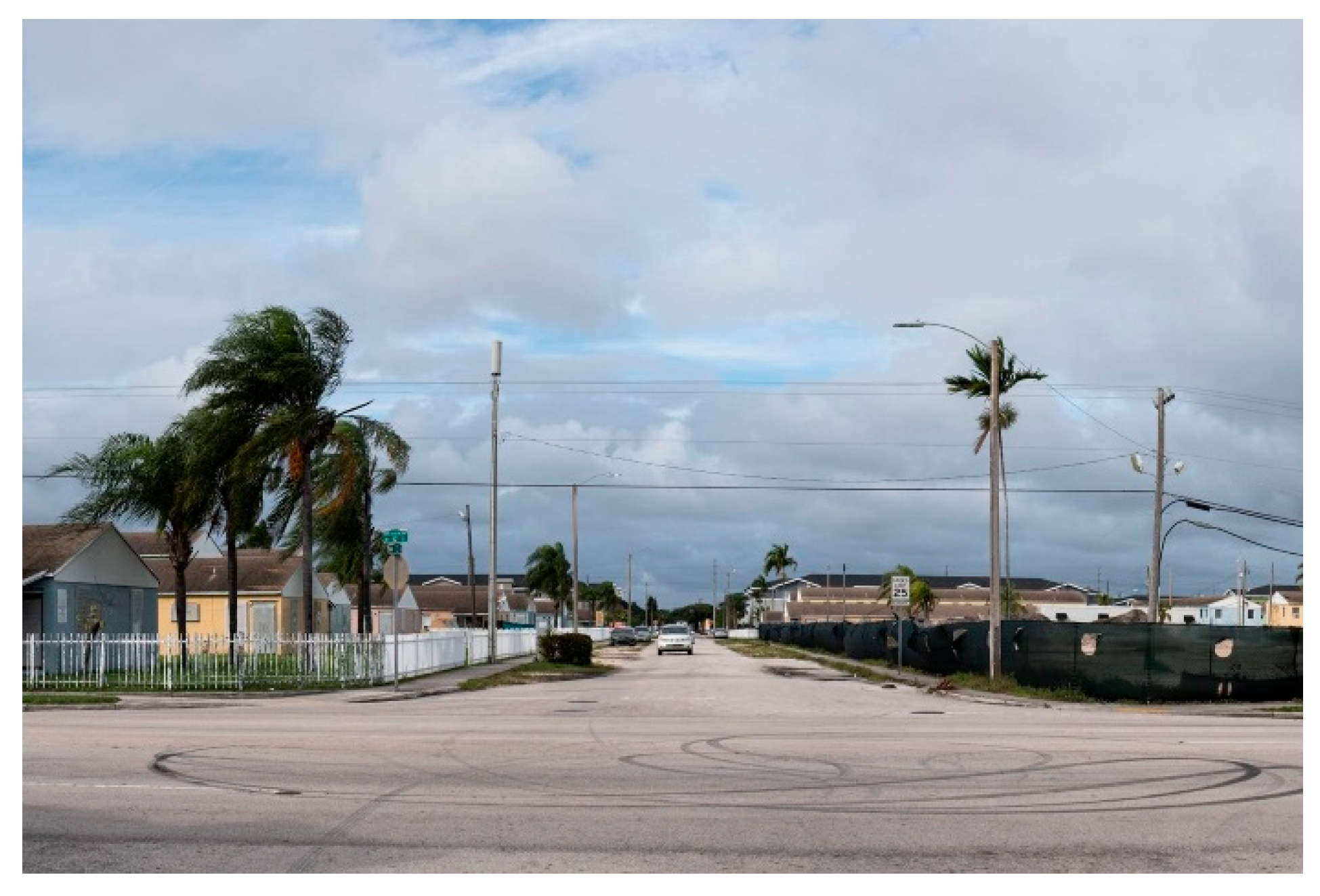
Indeed, due to their relative elevation, Miami’s more inland neighbourhoods, historically working-class, have become the areas most protected from the effects of climate change. This characteristic has, in recent years, rendered them increasingly attractive to private investors (Figure 1 and Figure 2).
The correlation between elevation and real estate appreciation in Miami has been scientifically framed as the “Climate Gentrification Elevation Hypothesis” (Keenan et al., 2018) [14]. Empirical studies show that properties at higher elevations, are appreciating at a faster rate than coastal properties. This trend is not merely due to the search for affordable land but is structurally linked to long-term climate risk perception and insurability. Investors are actively shifting capital towards ‘high-ground’ areas to mitigate future losses from sea-level rise and storm surges. Consequently, the lack of explicit public adaptation policies for the existing low-income residents transforms this geographical safety into a driver of displacement.
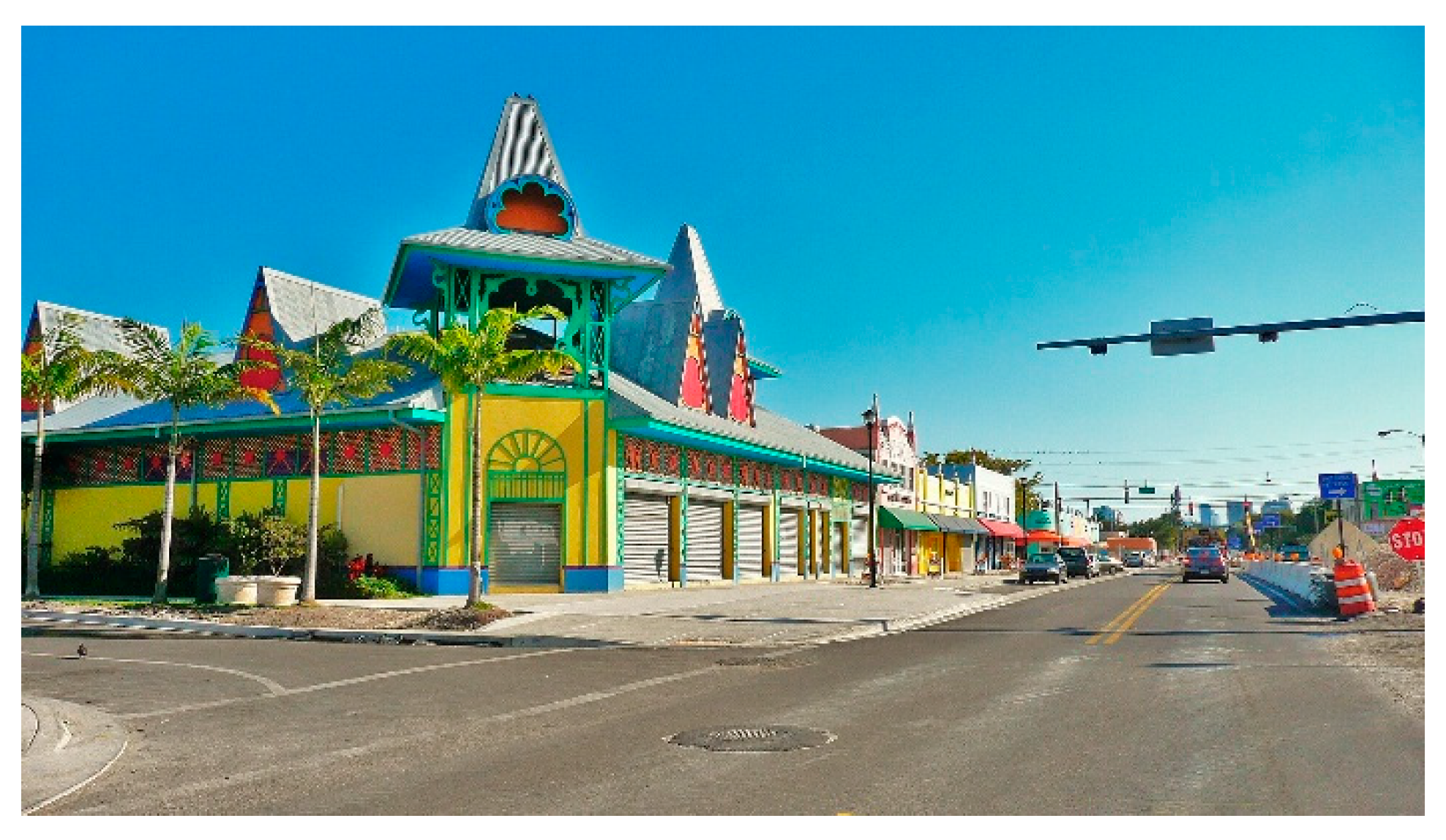
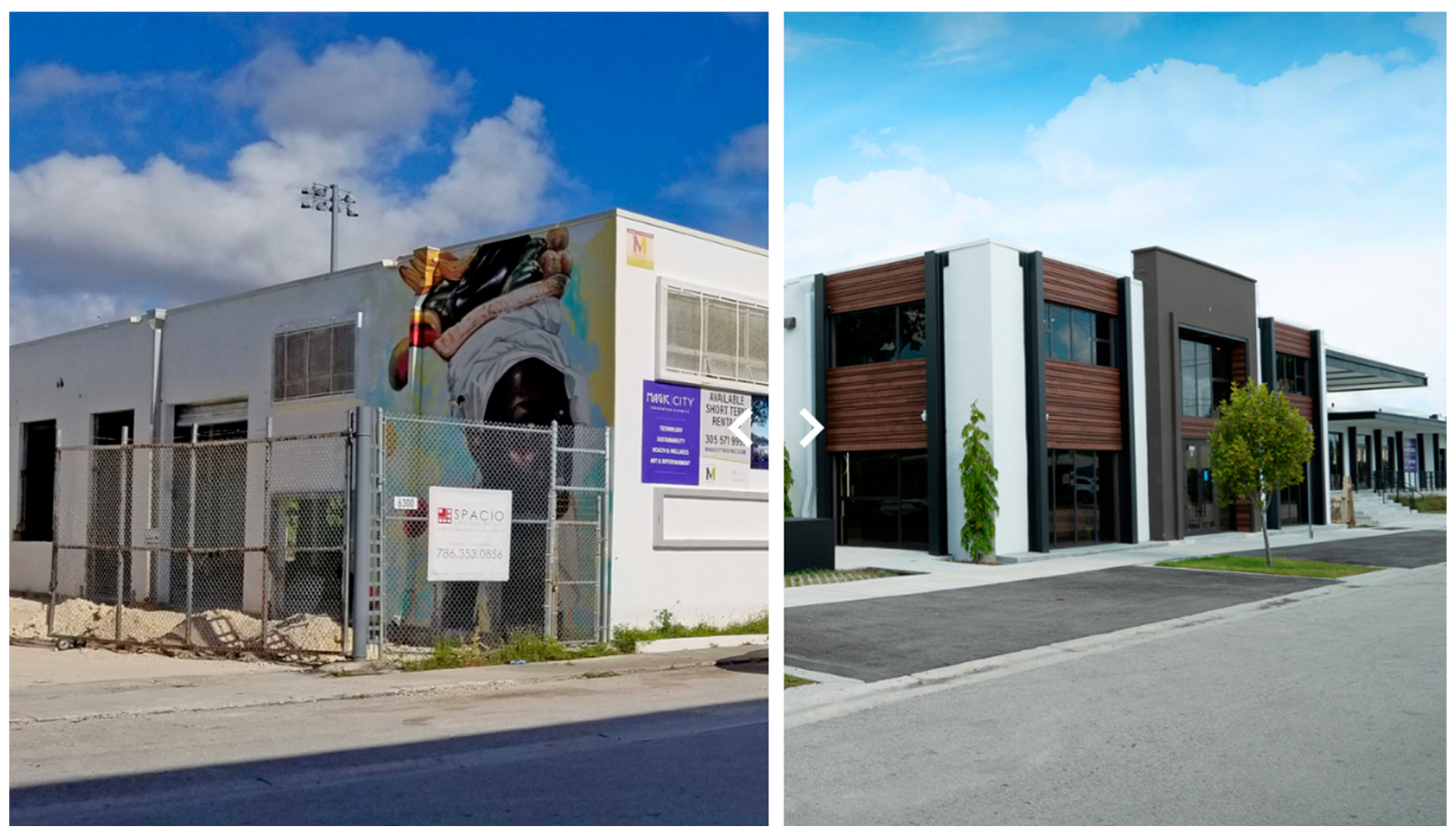
One of these neighbourhoods, known as Little Haiti (historically neglected due to their distance from the beach) and formerly referred to as “Lemon City” due to its abundance of lemon and other citrus trees, still hosts the largest Haitian community outside Haiti (Figure 3). According to local activists, gentrification is progressively depriving them of their traditional livelihood—lemon cultivation—partly as a result of certain projects, presented under the guise of “socio-cultural revitalisation” initiatives, which appropriate land previously used for agriculture (Figure 4).
As a result of these initiatives, many residents have already been forced to leave the neighbourhood, relocating to the northern parts of the city, as well as to Texas and Georgia, while some have even returned to Haiti [40].
While comprehensive census data on recent displacement often lags real-time market dynamics, quantitative trends in property values support the climate gentrification hypothesis. Research by Keenan et al. (2018) [14] indicates that single-family homes in higher-income areas of Miami-Dade, such as Little Haiti, have experienced a significantly higher rate of price appreciation than properties in lower-income areas since 2000. Market reports (Zillow, 2021; Community Justice Project, 2020) [35,60] suggest that property values in Little Haiti increased by more than 150% between 2013 and 2020 alone, creating an unbridgeable gap in rental prices for the native population, whose median income remains among the lowest in the metropolitan area.
This phenomenon can be also understood as a form of secondary climate migration, in which low-income residents of areas protected from the effects of climate change are compelled to move due to primary climate migration—that is, the relocation of wealthier coastal residents, threatened by increasingly frequent floods and inundations, to the more protected inland areas.
It should also be emphasised that such violent processes of social replacement risk generating social exclusion dynamics even for the original residents who might still be able to afford to live in their neighbourhood but choose to leave due to the identity shift of a place they no longer recognise as their own.
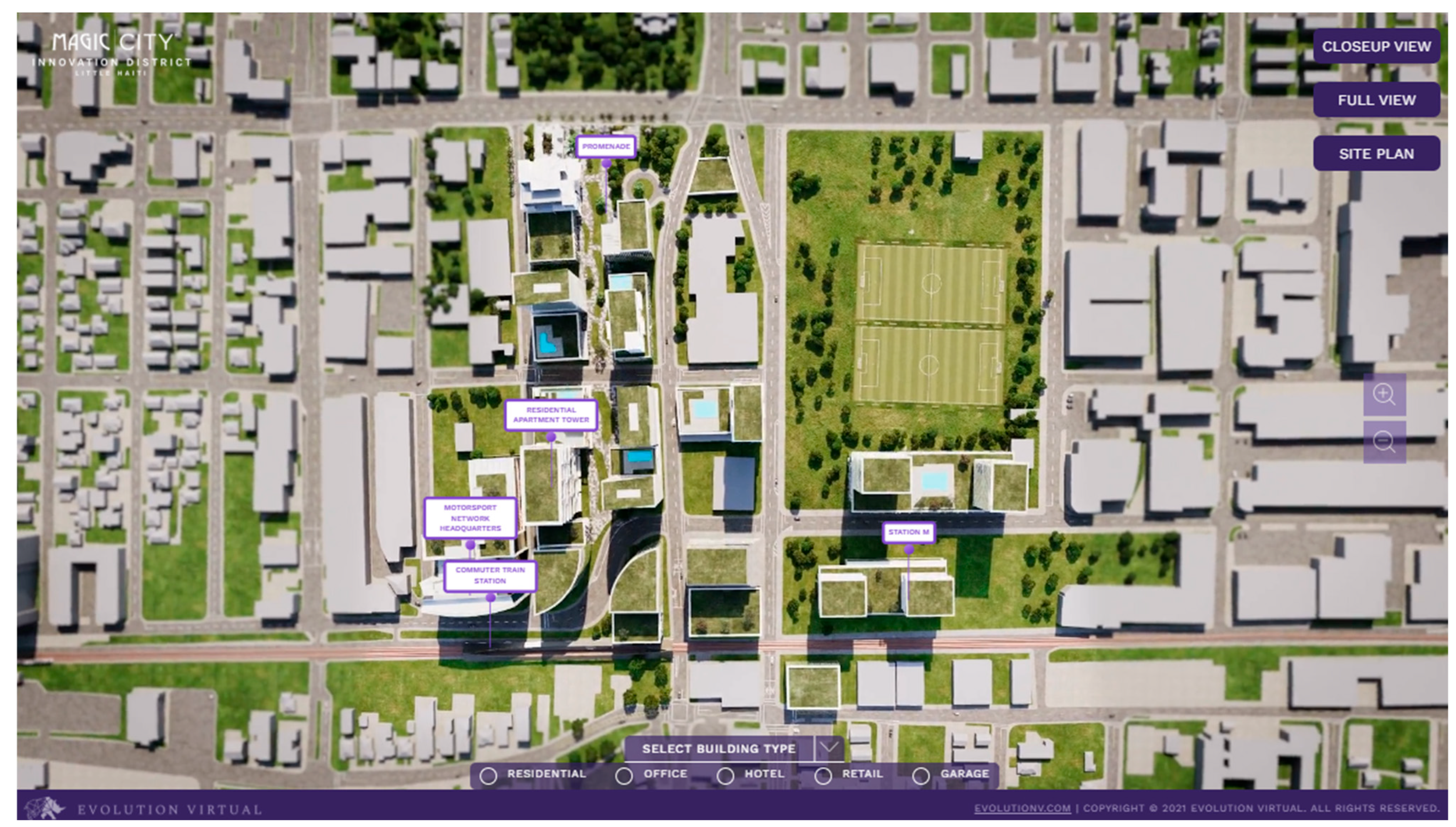
One of the most debated projects planned for Little Haiti is the Magic City Innovation District (2021–2036), which aims to create a neighbourhood dedicated to art, innovation, and entertainment [34]. The project presentation refers to the intention of laying the foundations for a prosperous future while paying homage to the past. This intention is reflected in the integration, within the identity and cultural context of Little Haiti, of an innovation district combining commercial, recreational, cultural, and residential functions (Figure 5).
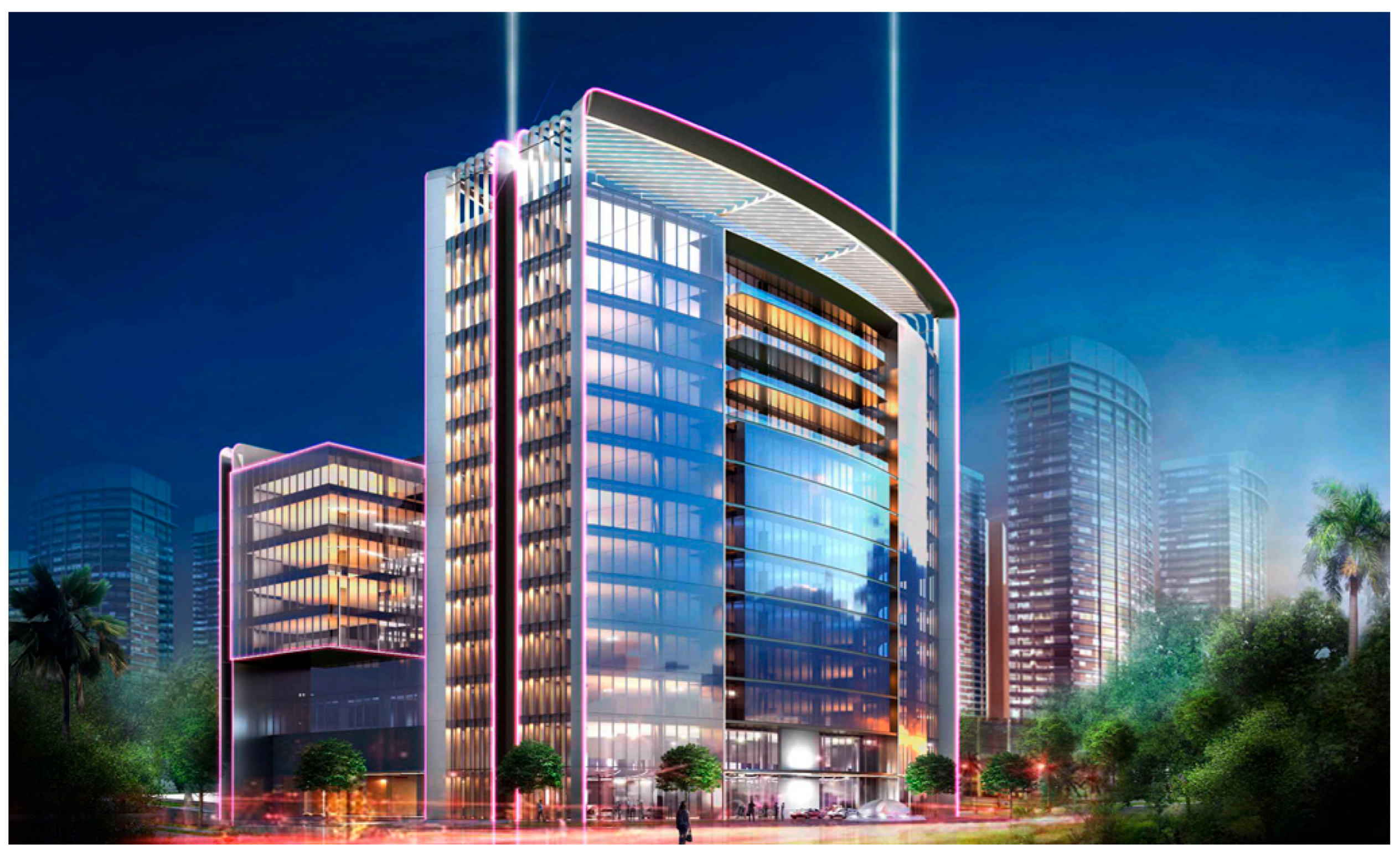
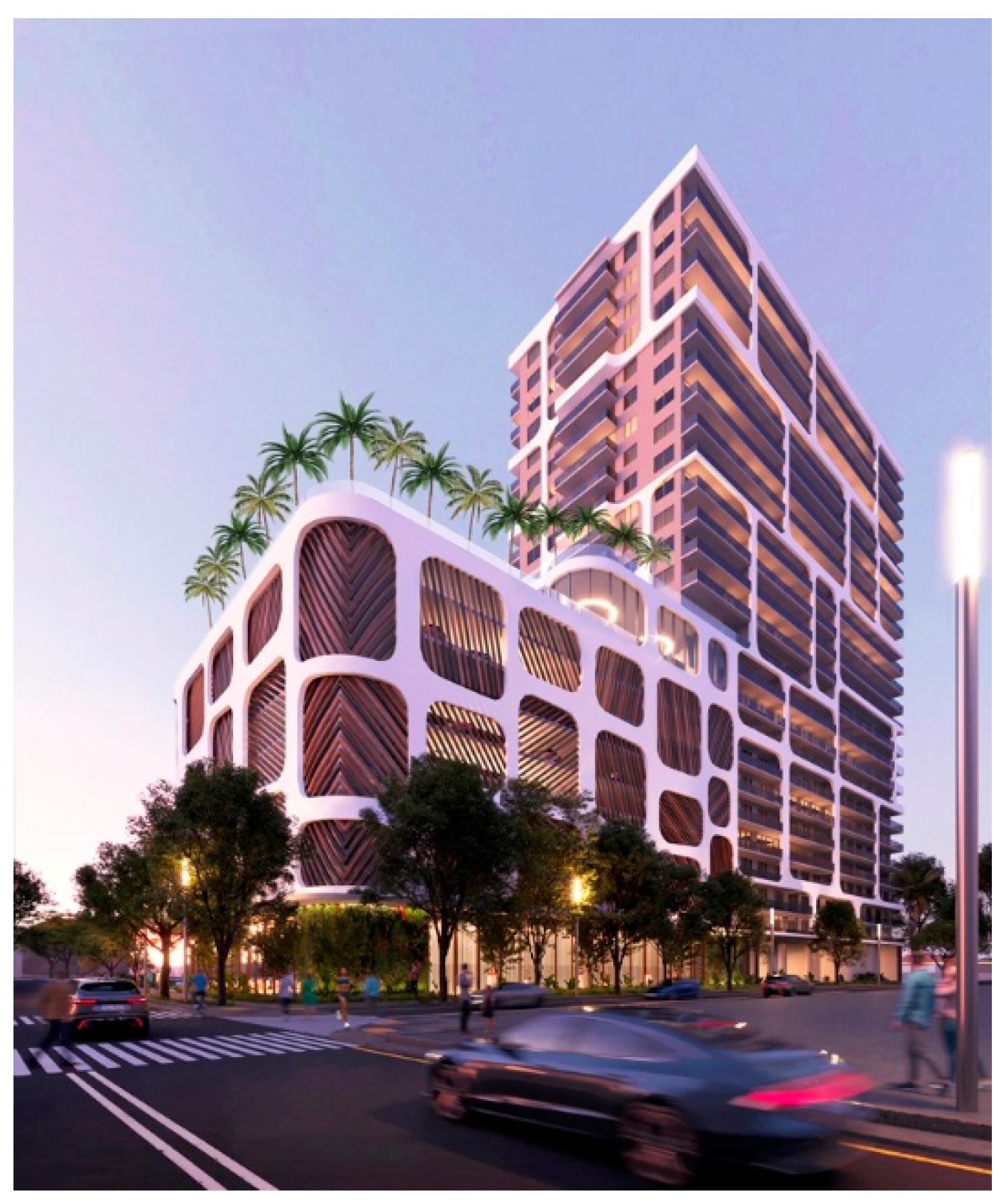
Among the planned interventions, for which the land has already been acquired by private investors, are: an office and commercial tower of approximately 370,000 square metres, which will serve as the headquarters of the Motorsport Network group (Figure 6), and luxury residential towers—one of which will be 25 storeys high—comprising 349 housing units, exclusive amenities, and ground-floor commercial spaces, designed by the architectural firm Arquitectonica (Figure 7) (City of Miami; Miami-Dade County; Miami-Dade) [33,61].

4.2. An Example of Climate Justice: The Green Revolution of Medellín

Medellín, the second-largest city in Colombia, has historically been characterised by marked socio-spatial inequalities, evident in the proliferation of informal settlements and peripheral neighbourhoods (comunas). These areas, predominantly located on hillside slopes, have long been distinguished by extreme poverty, structural deficits in essential public services, inadequate infrastructure, and high rates of violence and crime [62]. The topographical and functional isolation of the comunas from the urban centre has exacerbated social exclusion, limiting access to education, healthcare, and employment opportunities. From a morphological perspective, the fragmented and chaotic urban fabric has resulted in a scarcity of high-quality public spaces and a high degree of informal construction, factors that have consistently complicated public intervention and urban planning [63].
In just over three decades, following the death of Pablo Escobar (1993), the city has undergone a profound transformation, overcoming its past as the “world capital of drug trafficking” and one of the most dangerous cities globally, gradually establishing itself as an internationally recognised case study for innovative urban regeneration and social inclusion strategies.
This transformation achieved symbolic recognition in 2013, when Medellín was awarded the title of “Most Innovative City in the World,” surpassing metropolises such as New York and Tel Aviv, in an award presented by City Group, the Wall Street Journal, and the Urban Land Institute [64].
Indeed, beginning in the early 2000s, Medellín embarked on an ambitious path of social urbanism [65], with the primary aim of integrating marginalised peripheral areas into the formal urban fabric in order to radically improve residents’ quality of life.
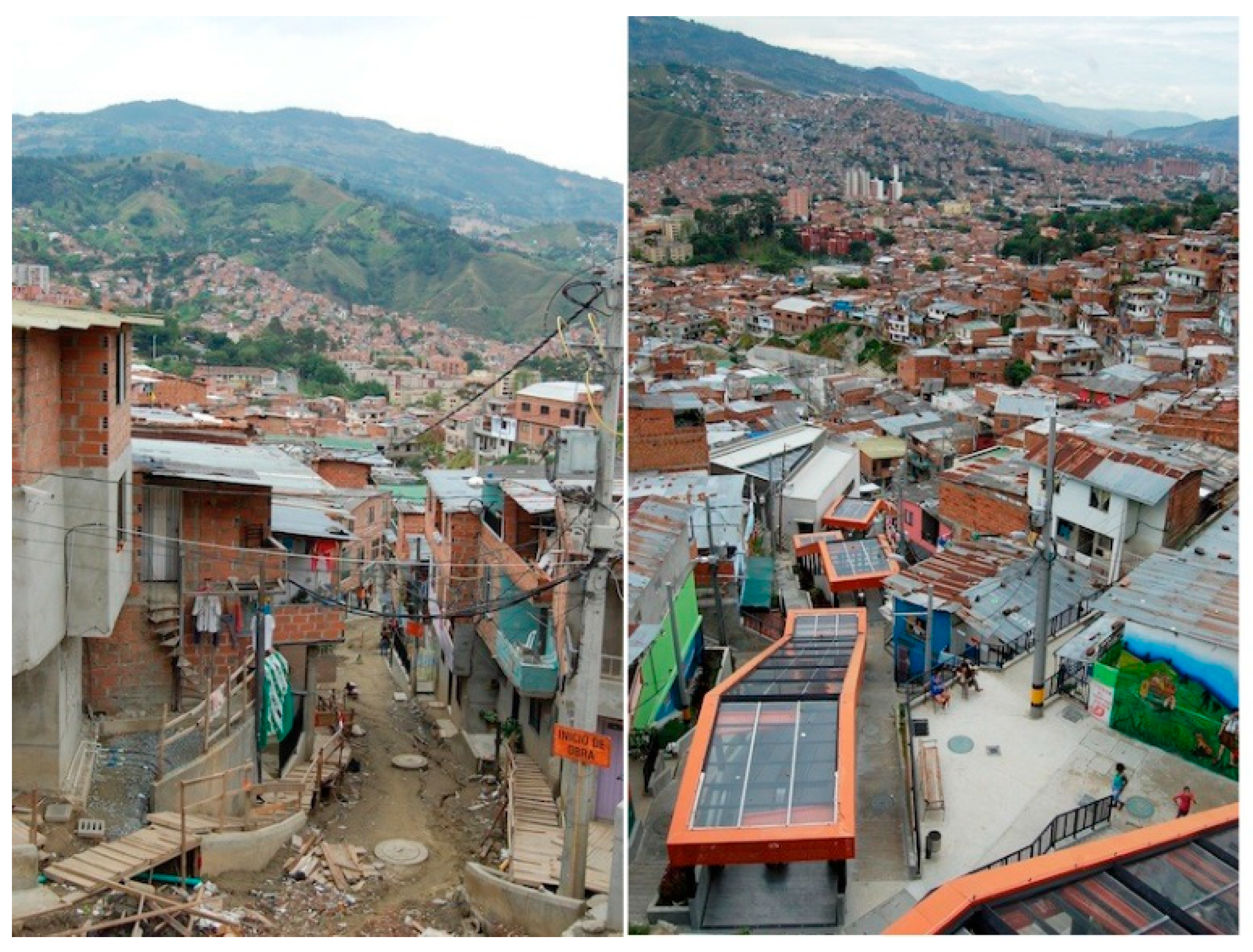
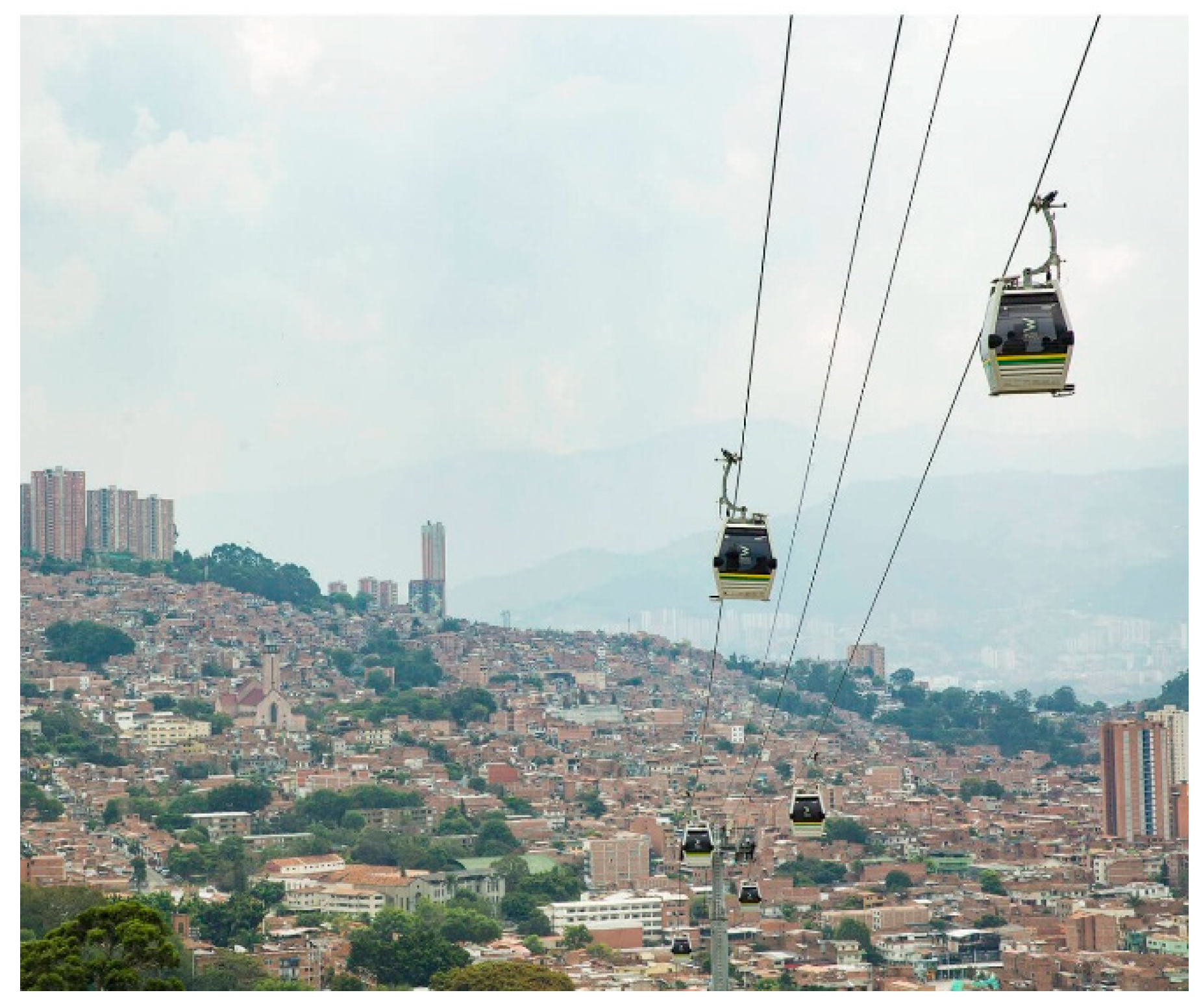
The rationale was twofold: to reduce violence and crime through social and spatial inclusion, and to promote a more equitable and sustainable urban development (Figure 8 and Figure 9).
This objective was pursued by focusing on three main aspects:
  • A modern and innovative integrated public transport system, including the metro and metrocable (a network of cable cars connecting the city’s suburbs);
  • An eco-sustainable approach to urban regeneration, emphasising blue and green infrastructure as structuring elements of urban design;
  • Cultural promotion, through the development of cultural services such as universities, museums, schools, libraries, and cultural centres, which became new spaces for social aggregation.
Within this framework, over the past two decades, the city of Medellín (Colombia) has faced increasing climate vulnerability due to rising urban average temperatures and the intensification of the Urban Heat Island (UHI) effect. This phenomenon, caused by the high concentration of impervious surfaces and materials with high thermal capacity (concrete, asphalt), has resulted in significant microclimatic imbalance and a deterioration in residents’ quality of life, particularly in densely populated and socioeconomically disadvantaged areas [43].
In response to these challenges, the Medellín City Administration launched the Green Corridors (Corredores Verdes) project in 2016, implemented between 2016 and 2019 and subsequently integrated into the 2024–2027 Strategic Urban Plan as a model of sustainable urban infrastructure [39]. The project was promoted by the Municipality of Medellín in collaboration with the Joaquín Antonio Uribe Botanical Garden, the National University of Colombia, the Ministry of Environment and Sustainable Development, and a network of international partners including Ashden—Climate Solutions in Action, the Kigali Cooling Efficiency Program (K-CEP), and Sustainable Energy for All (SEforALL). In 2019, the initiative received the international Cooling by Nature: Urban Greening Award in recognition of the effectiveness of its nature-based solutions (NBS) in urban cooling.
From the outset, the project established several main objectives:
  • Mitigate the Urban Heat Island effect and improve air quality;
  • Increase the climate resilience of the urban system;
  • Promote biodiversity and ecological connectivity through the integration of green and blue infrastructure;
  • Foster social inclusion and create employment opportunities for the most vulnerable population groups;
  • Strengthen social capital and civic participation in the management of public spaces.
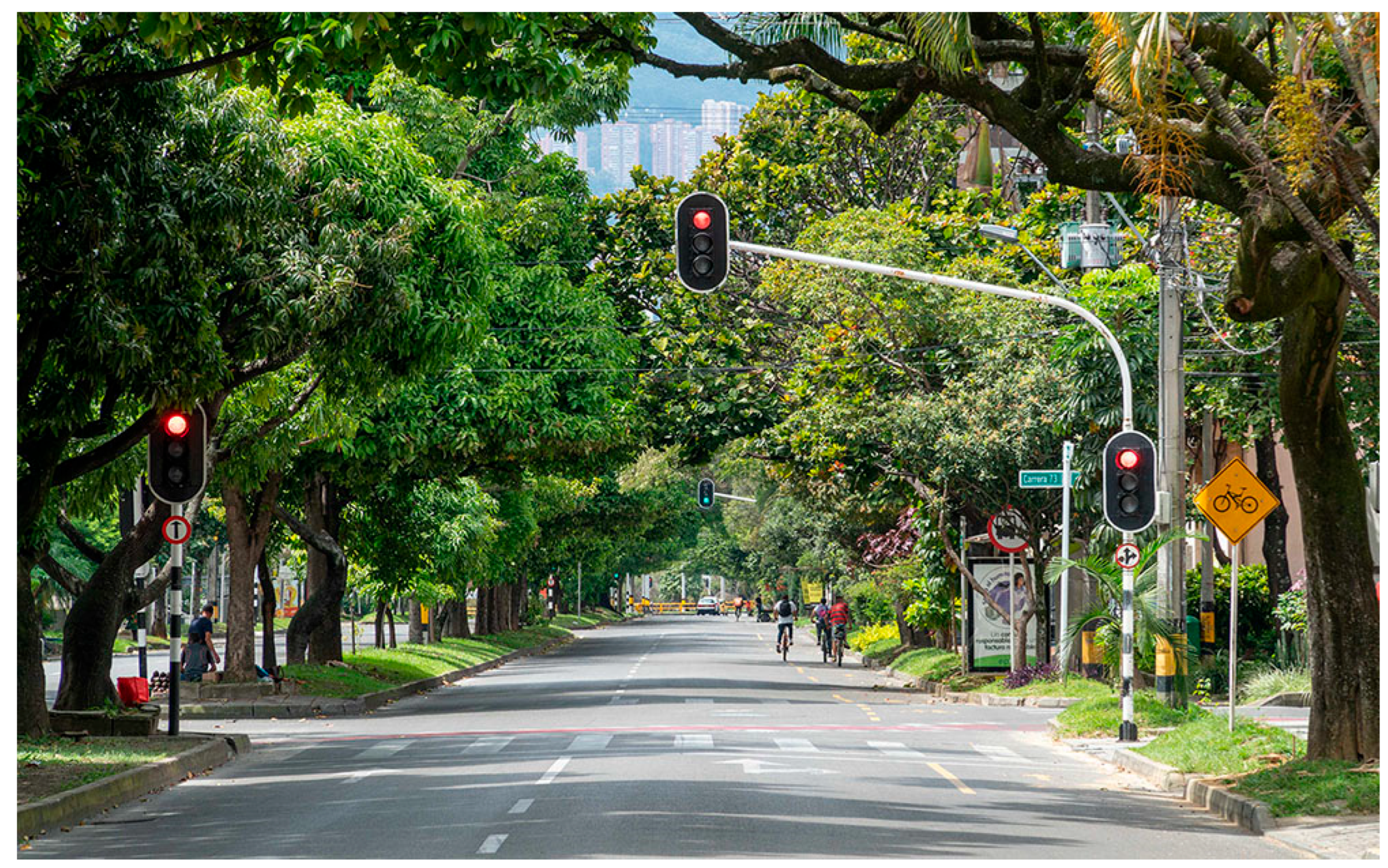
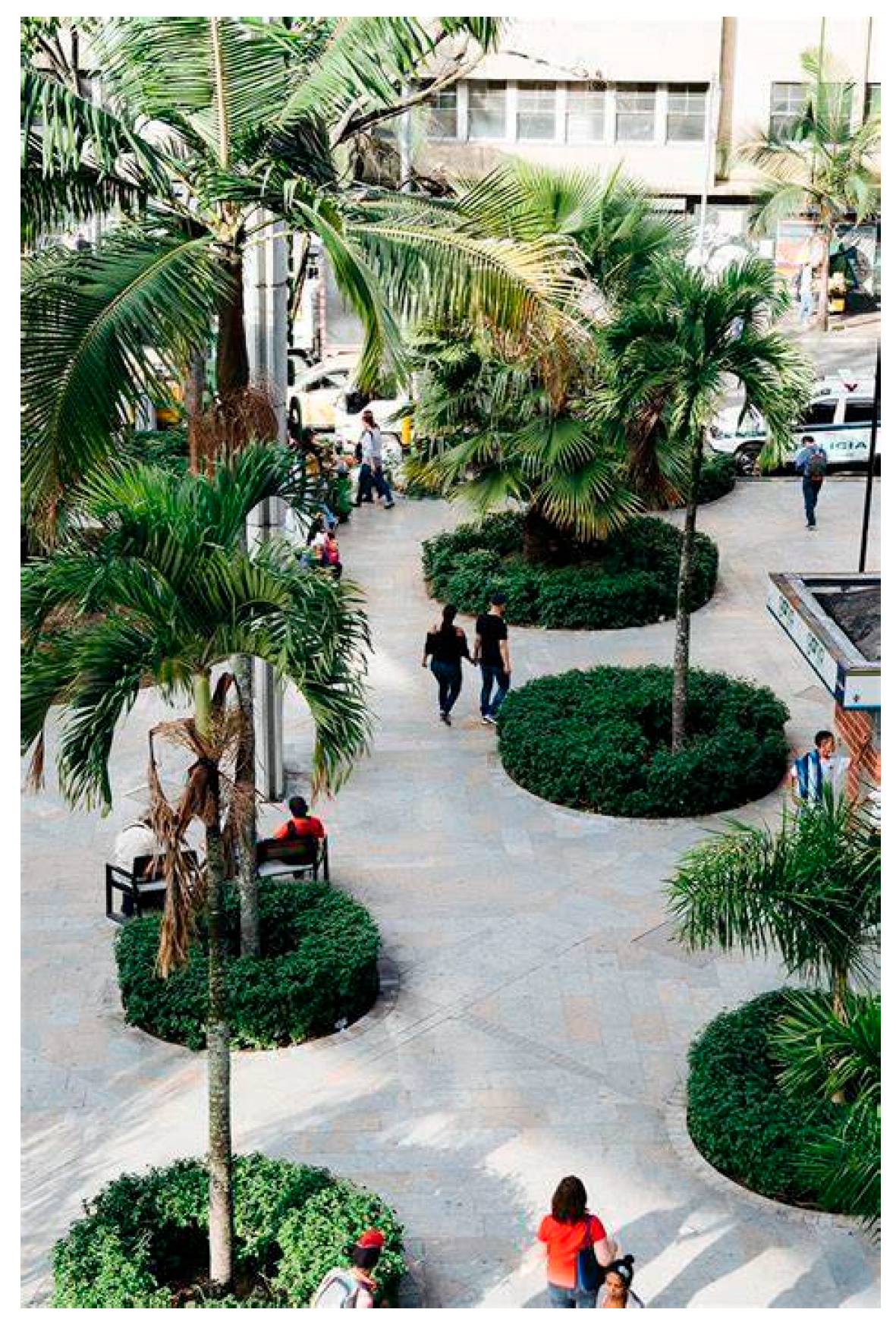
The intervention methodology was based on the renaturalisation of 18 main road axes and 12 urban watercourses (quebradas), with the planting of over 75,000 trees and 350,000 shrubs and perennial plants (Figure 10 and Figure 11).
The plant species were selected according to criteria of climate resilience, photosynthetic efficiency, CO2 sequestration capacity, and atmospheric phytoremediation potential, prioritising native species. The renovated areas were connected through shaded pedestrian and cycling networks, forming a comprehensive “green-blue infrastructure” that traverses the urban fabric, linking parks, squares, and peripheral neighbourhoods [66].
Surveys conducted between 2018 and 2020 by the Instituto de Estudios Urbanos (IEU) and local academic research groups reported an average reduction in surface temperature of between 2.0 °C and 3.5 °C in the project areas [67]. At the same time, relative humidity increased by 10–15%, PM2.5 (fine particulate matter) concentrations decreased, and urban vegetation cover rose by 25% compared with pre-2016 levels. The synergistic effect of tree vegetation and water corridors further contributed to improved local thermal regulation, surface water recycling, and atmospheric pollutant capture.
From a socio-economic perspective, the project generated over 700 new permanent jobs for residents from vulnerable communities, employed as environmental operators and urban green maintenance staff, professionally trained by the Botanical Garden under the supervision of Claudia Lucía García. This approach initiated processes of community empowerment, contributing to the reduction in urban marginalisation and the strengthening of territorial social capital.
Unlike typical greening projects that often trigger immediate property value spikes and displacement (green gentrification), the Green Corridors focused on public infrastructure (road medians, sidewalks) rather than private residential development. By embedding the project within the broader strategy of ‘Social Urbanism’, the municipality prioritized the “retention” of the original population. The concomitant investment in public transport (Metrocable) and local employment programs (the “gardeners” program) provided economic stability to residents, mitigating the risk of displacement. While property values in renovated areas have stabilized or increased moderately due to improved quality of life, the absence of aggressive large-scale private redevelopment in these specific corridors has allowed the original communities to benefit directly from the thermal comfort and air quality improvements.
However, it will be interesting to monitor the project to verify that in the future there are no dynamics of social exclusion or green gentrification [36,37,38].

5. Third Phase: Comparison

The comparative phase of the research, adopting an inductive approach, was conducted to identify structural differences and socio-environmental outcomes arising from two models of urban regeneration subjected to climate pressures. The analysis contrasts Little Haiti (Miami, USA), characterized by market-driven adaptation dynamics often associated with climate gentrification, with the Green Corridors project (Medellín, Colombia), which exemplifies a public-led approach focused on nature-based solutions and social inclusion
The comparative analysis is based on the logic of “Most Different Systems Design” (MDSD) (Przeworski, 1970; Landman, 2008, Lijphart, 1971) [68,69,70]. This methodological approach was chosen precisely because Miami and Medellín represent divergent political-economic archetypes: the former operates within a neoliberal framework driven by real estate deregulation, while the latter exemplifies a “developmental state” approach characterized by strong public interventionism and social urbanism.
Despite these structural differences, both cities share two fundamental common elements that make them comparable: (1) high exposure to extreme climate risks (sea level rise and urban heat islands, respectively) and (2) profound socio-spatial inequalities. The comparison aims to isolate the governance variable to understand the mechanisms of climate gentrification. In Miami, the formation mechanism is market-driven: the “price of safety” (altitude) determines value, leading to the displacement of low-income residents without state protection. In Medellín, the potential “green premium” generated by environmental improvements was neutralized by specific policy mechanisms (public investment, blocking speculation, inclusive employment).
This contrast highlights that climate gentrification is not an inevitable economic outcome of adaptation, but a political product. Consequently, the adaptability of these case studies to other contexts (such as European cities) lies not in the replication of specific policies, but in the adoption of governance principles: the need for anti-displacement protocols and the integration of social welfare into environmental planning.

5.1. Comparative Method and Descriptors

The comparison was conducted using a multidimensional analytical framework structured around five critical descriptors conceptualised by the authors, derived from international literature on climate justice [71] and from the authors’ previous work on indicators for measuring urban well-being [72].
The descriptors (Table 3), systematically applied to both case studies, enabled an initial assessment of the alignment between climate objectives, social inclusion, and territorial impacts, following a comparative logic that can be replicated in other contexts.
The results obtained from applying the descriptors to the two case studies were analysed through an interpretative matrix, which allowed for the distinction between regressive interventions, in which the ecological transition exacerbates inequalities, and progressive interventions, in which it serves as a lever for social cohesion.
To ensure the analytical rigor and replicability of the assessment, the five descriptors were operationalized through a set of qualitative evaluation criteria derived from the documentary corpus. Since the research is based on a policy analysis rather than a quantitative impact assessment, the indicators focus on the presence, absence, or orientation of specific planning tools and governance mechanisms described in the official documents and reports. Table 3 details this qualitative operationalization, linking each descriptor to the specific dimensions investigated.

5.2. Comparative Analysis of the Results

This paragraph aims to provide a comparative evaluation of the two case studies analysed in the second phase, through the application of the five descriptors defined in Table 1.
In the case of Little Haiti (Table 4), the comparison reveals an overall negative outcome across all the analysed descriptors. The combination of these elements allows Little Haiti to be classified as a case of regressive regeneration, in which the climate transition functions as a mechanism of exclusion and concentrates benefits in the hands of economically privileged actors.
By contrast, the Medellín case (Table 5) demonstrates a positive and consistent performance across all descriptors. Medellín therefore represents a model of inclusive regeneration, in which climate adaptation is conceived as a tool for equity and redistribution, in line with the principles of the 2030 Agenda [10].
The systematic comparison between the case studies of Little Haiti (Miami, USA) and the Green Corridors of Medellín (Colombia) highlights two antithetical trajectories of urban adaptation to climate change, representative respectively of an exclusionary model, generating climate gentrification, and an inclusive model, oriented towards climate and spatial justice. The analysis, conducted according to the critical descriptors defined in the research methodology (governance, housing accessibility, distributive environmental benefits, community empowerment, and identity preservation), illustrates how different institutional and strategic configurations profoundly influence the social and ecological outcomes of urban regeneration policies.
In the case of Little Haiti, the urban transformation process appears structurally linked to a market-driven development strategy focused on real estate valorisation rather than equitable resilience. The Magic City Innovation District project (2021–2036), although presented as a sustainable regeneration intervention, constitutes a predominantly private initiative lacking institutional mechanisms to mitigate gentrification. Governance is fragmented, top-down, and minimally participatory; the absence of socio-economic safeguarding protocols has facilitated a rapid increase in property values in the higher-elevation inner areas, historically occupied by low-income populations. This dynamic has triggered a phenomenon of secondary climate migration, whereby vulnerable communities are progressively displaced from the most resilient neighbourhoods and forced to move to less secure or marginal areas. Environmental and infrastructural benefits are distributed very unevenly, while economic opportunities generated by the innovation district appear to be exclusive to new investors and middle-to-upper-class groups. Consequently, a process of erosion of cultural and territorial identity occurs, with traditional practices and economies (e.g., local cultivation, artisanal activities) replaced by high-capital commercial and residential functions. Little Haiti therefore represents a paradigmatic example of climate gentrification, in which the ecological transition, rather than reducing inequalities, amplifies them, transforming climate resilience into a selective privilege.
By contrast, the Green Corridors project in Medellín constitutes a virtuous case of integration between environmental sustainability and social justice, founded on a long-term strategic vision and a multilevel governance coordinated among public and private institutions, universities, and local communities. Incorporated into the 2024–2027 Strategic Urban Plan, the programme functions as a green-blue infrastructure capable of combining climate mitigation, socio-economic inclusion, and ecological regeneration. The approach has ensured an equitable distribution of environmental benefits, with empirically measurable results: average surface temperature reductions of 2.0–3.5 °C, a 25% increase in vegetation cover, and improvements in air quality and relative humidity [39,67]. Simultaneously, the project generated over 700 permanent jobs for residents from vulnerable communities, professionally trained as environmental operators, thereby promoting community empowerment processes and strengthening territorial social capital. The cultural and identity dimension has been enhanced through the creation of multifunctional public spaces and the regeneration of quebradas as ecological and symbolic connectors between the city centre and peripheries. In this way, climate resilience becomes a collective and redistributive asset, consistent with the principles of equity and inclusion promoted by the 2030 Agenda [10].
In this perspective, the insights gained from comparing these two international case studies offer practical guidance for the Roman context, particularly for the Pietralata neighbourhood, a strategic intervention area within the Rome Technopole Project. The planned technology hub in the area—which will host university, research, and innovation functions, as well as public spaces and mobility infrastructure—is embedded in a complex and fragmented urban fabric, characterised by the discontinuous coexistence of residential buildings, industrial settlements, and largely underutilised open spaces. However, proximity to Tiburtina station and major transport arteries, as well as the upcoming construction of AS Roma’s new stadium, positions the area as a potential node of metropolitan interconnection.
The authors argue that, in such a context, urban regeneration cannot be limited to objectives of physical upgrading or energy efficiency of building stock; it must be guided by principles of climate justice and social inclusion, ensuring that the benefits of ecological and digital transition do not translate into new spatial inequalities within an already fragile urban setting.
In this regard, the research proposes an analytical-evaluative model capable of preventing potential processes of climate gentrification linked to regeneration interventions in the neighbourhood. The application of the descriptors developed in the study (integrated governance, housing accessibility, distributive environmental benefits, community empowerment, and identity preservation) could provide a methodological basis for defining operational guidelines and equity indicators to be adopted during planning and design phases of the new hub.
The applicability of these findings to the Pietralata neighborhood is not merely theoretical but is based on specific morphological and social similarities. Pietralata is characterized by a fragmented urban fabric, where residential enclaves coexist with industrial ruins and vacant lots, generating severe “heat island” effects similar to those of Medellín. At the same time, the arrival of large-scale new developments—the Rome Technopol, the new university campus, and the AS Roma stadium project—creates a potential “rent gap” comparable to Miami’s dynamics, risking displacement of the existing lower-middle-class population.
Therefore, implementing the five descriptors for Pietralata requires specific adaptation strategies:
  • Governance: Unlike the fragmented approach of Little Haiti, Pietralata requires a binding public governance pact (between the Municipality, the University, and investors) that requires social impact assessments prior to approval.
  • Housing: To prevent “studentification” or gentrification induced by the new campus, the redevelopment plan must include rent-controlled social housing within the new complexes, protecting long-term residents from market saturation.
  • Environmental benefits: Following the Medellín model, the “green” component cannot simply be a landscape element for the new campus but must serve as a public ecological connector. The planned park should be designed as a network of green corridors that penetrate the existing building fabric to lower temperatures uniformly, not just within the boundaries of the Technopol.
  • Community empowerment: The Technopol’s “innovation” must not remain a foreign object. A local employment clause should be introduced, giving priority to residents for facilities management and green maintenance jobs, along with digital skills training programs for local youth.
By applying this filter, the Pietralata project can transform from a potential enclave of exclusion into a laboratory for climate justice, demonstrating that large-scale urban transformation can be both ecologically ambitious and socially protective. The authors hope that the Pietralata Technopole experience can become an experimental urban laboratory for developing a model of environmentally and socio-economically sustainable regeneration, capable of integrating environmental dimensions with urban welfare.

6. Conclusions and Future Developments

The systematic comparison between the case studies of Little Haiti (Miami, USA) and the Green Corridors of Medellín (Colombia) highlights two antithetical trajectories of urban adaptation to climate change, representing, respectively, an exclusionary model that generates climate gentrification and an inclusive model oriented towards climate and spatial justice. This dichotomy is not incidental but rooted in profoundly divergent choices of governance, planning approaches, and political visions.
The analysis, conducted according to the critical descriptors defined in Table 3 (governance, housing accessibility, distributive environmental benefits, community empowerment, and identity preservation), demonstrates how different institutional and strategic configurations deeply influence the social and ecological outcomes of urban regeneration policies. It is evident that the mere implementation of “green solutions” or climate infrastructures does not automatically ensure equitable outcomes; on the contrary, if not embedded within a framework of social justice, they may exacerbate existing inequalities.
Limitations of the Study
However, this study has specific limitations that should be acknowledged to properly contextualize the findings.
First, a structural limitation lies in the profound differences between the governance frameworks of the United States (market-oriented and federal) and Colombia (centralized municipal interventionism with strong public utility companies). The “Medellín Model” relies on institutional prerequisites, such as the availability of public funds for social urban planning, which limits the direct transferability of these policies to other geopolitical contexts without careful adaptation.
Second, the research faced a methodological challenge regarding the structural asymmetry of data availability. While the Miami case analysis was supported by some real estate market metrics, the Medellín assessment relied predominantly on institutional policy reports and qualitative social indicators. Furthermore, the difficulty in accessing precise, real-time quantitative data on displacement rates—often informal and not immediately captured by census statistics—meant the study emphasized qualitative policy analysis. As noted, the absence of such monitoring data is often a political choice that masks the severity of the phenomenon.
Third, the reliance on secondary data (documentary analysis, official reports, and media investigations), while effective for a critical policy review, limits the “bottom-up” perspective. The absence of primary data collection, such as direct interviews with residents, means that subjective perceptions of displacement and well-being are mediated by third-party sources.
Finally, the research represents a synchronic snapshot of ongoing urban processes. The lack of a deep diachronic (longitudinal) dimension prevents a definitive assessment of the long-term durability of the observed outcomes—for instance, whether the social benefits in Medellín will withstand future political shifts over the next decade.
Future Research Directions
To bridge these gaps and build upon the findings, future research should move beyond general analysis to test specific hypotheses regarding the causality between governance models and social outcomes. Directions for future investigation include:
Longitudinal and Comparative Expansion: Adopting a diachronic approach to track displacement rates and local business survival over a 5–10-year horizon, moving beyond the current static assessment. To capture the complexity of these impacts, future monitoring frameworks should integrate Social Impact Assessment methodologies [73,74] and approaches based on equitable well-being indicators [75]. Additionally, extending the analysis to European ‘intermediate’ cases (e.g., Barcelona or Rotterdam) would help test the validity of these governance models in regulatory frameworks closer to the Rome Technopole scenario.
Strategic Research Questions for the Rome Technopole
Based on the observed divergence between Miami and Medellín, we propose three key research questions to guide the regeneration of the Pietralata district:
  • Participatory Budgeting and Displacement: To what extent can binding participatory budgeting mechanisms (as evidenced in Medellín) effectively mitigate the rise in real estate values in European cities undergoing climate regeneration?
  • Co-design and Long-Term Resilience: Does the early inclusion of local communities in the co-design of green infrastructure significantly increase the “appropriation” and maintenance of these spaces, preventing the alienation typical of top-down “green gentrification”?
  • Regulatory Transferability: What specific anti-displacement tools (e.g., Community Land Trusts, rent caps) are legally and politically viable to accompany large tech hubs like the Pietralata Technopole, ensuring they function as inclusive public cities rather than exclusive enclaves?
In conclusion, this article aimed to highlight a crucial point: there is no “climate neutrality” if it does not seek to prevent social inequalities within cities. Every intervention, even if technically oriented towards sustainability, inherently carries a distributive dimension. The authors’ objective was to demonstrate that the ecological transition should not be understood solely as a technical process but as a political and ethical battleground. Prioritising real estate valorisation (as in Little Haiti) or social inclusion (as in Medellín) is a political choice that defines the very nature of the “resilience” being constructed.
Thus, the research not only describes two models but also raises a fundamental question for the future of global cities: what kind of climate transition do we want? One that amplifies inequalities in the name of progress and the market, or one that reduces them, promoting social justice and the right to a healthy environment for all citizens, especially the most vulnerable? The answer to this question will require not only innovative planning tools but also a profound reconsideration of the values guiding urban development and a committed political effort to build more equitable and sustainable cities.
In summary, the challenge is not merely to “green” cities, but to ensure that the fruits of urban greening initiatives are accessible and that the benefits are equitably distributed, leaving no one behind, in line with the principles of a true Green Deal that places people and the planet at the centre [6].

Author Contributions

Conceptualization, L.R., C.M. and M.M.; methodology, L.R., C.M. and M.M.; software, M.M.; validation, M.M.; formal analysis, M.M.; investigation, C.M. and M.M.; resources, C.M. and M.M.; data curation, M.M.; writing—original draft preparation, L.R., C.M. and M.M.; writing—review and editing, C.M. and M.M.; visualization, M.M.; supervision, L.R., C.M. and M.M.; project administration, L.R.; funding acquisition, L.R. All authors have read and agreed to the published version of the manuscript.

Funding

Gangemi VAT No.: IT07068861009.

Institutional Review Board Statement

Not applicable.

Informed Consent Statement

Not applicable.

Data Availability Statement

The original contributions presented in this study are included in the article. Further inquiries can be directed to the corresponding author.

Acknowledgments

The article results from a joint reflection of the authors; however, Section 1 “New rules, tools, procedures, and operational references for a socially and eco-sustainable approach to urban regeneration” is attributed to Laura Ricci, Section 2 “Methodology” is attributed to all three authors, Section 3.1 “An integrated socio-environmental crisis” is attributed to Carmela Mariano, Section 3.2 “Climate Gentrification and Spatial Justice” is attributed to Marsia Marino, Section 4.1 “A Case of Climate Gentrification: the secondary migration of Little Haiti” is attributed to Carmela Mariano, Section 4.2 “An Example of Climate Justice: The Green Revolution of Medellín” is attributed to Marsia Marino, Section 5 “Third Phase: Comparison”, Section 5.1 “Comparative Method and Descriptors”, and Section 5.2 “Comparative Analysis of the Results” are attributed to Carmela Mariano and Marsia Marino, Section 6 “Conclusions and Future Developments” is attributed to all three authors.

Conflicts of Interest

The authors declare no conflicts of interest.

References

  1. Ricci, L. Governare la città contemporanea—Riforme e strumenti per la rigenerazione urbana | Governing contemporary cities—Reform and measures promoting urban regeneration. Urbanistica 2017, 160, 91–95. [Google Scholar]
  2. UN-Habitat. Urban-Rural Linkages: Guiding Principles. Available online: https://unhabitat.org/urban-rural-linkages-guiding-principles (accessed on 19 July 2025).
  3. Ricci, L.; Mariano, C.; Iacomoni, A. Nuova questione urbana e nuovo welfare—Regole, strumenti, meccanismi e risorse per una politica integrata di produzione di servizi. Ananke 2020, 90, 111–120. [Google Scholar]
  4. European Commission. Urban Agenda for the EU. Available online: https://commission.europa.eu/eu-regional-and-urban-development/topics/cities-and-urban-development/urban-agenda-eu_en (accessed on 21 July 2025).
  5. Giffinger, R.; Fertner, C.; Kramar, H.; Meijers, E. Smart Cities Ranking of European Medium-Sized Cities; Centre of Regional Science: Vienna, UT, USA, 2007; Available online: http://www.smart-cities.eu/download/city_ranking_final.pdf (accessed on 18 July 2025).
  6. European Commission. Communication on the European Green Deal. European Commission. Available online: https://commission.europa.eu/publications/communication-european-green-deal_en (accessed on 22 July 2025).
  7. European Commission. Regulation (EU) 2021/1056 of the European Parliament and of the Council establishing the Just Transition Fund. Official Journal of the European Union 2021. Available online: https://eur-lex.europa.eu/eli/reg/2021/1056/oj/eng (accessed on 22 July 2025).
  8. European Commission. Horizon Europe (2021–2027): The Framework Programme for Research and Innovation. European Commission 2021. Available online: https://commission.europa.eu/funding-tenders/find-funding/eu-funding-programmes/horizon-europe_en (accessed on 2 November 2025).
  9. Italian Government/Ministero dell’Economia e delle Finanze. Piano Nazionale di Ripresa e Resilienza (PNRR). Available online: https://www.mef.gov.it/en/focus/The-National-Recovery-and-Resilience-Plan-NRRP/ (accessed on 2 August 2025).
  10. United Nations. Transforming Our World: The 2030 Agenda for Sustainable Development (A/RES/70/1); United Nations: New York, NY, USA, 2015; Available online: https://sdgs.un.org/2030agenda (accessed on 23 July 2025).
  11. Ricci, L. Governare il cambiamento—Più Urbanistica, più Piani. In Sulla Città Futura—Verso un Progetto Ecologico; Franceschini, A., Ed.; ListLab: Trento, Italy, 2014; pp. 97–104. [Google Scholar]
  12. Lefebvre, H. Il Diritto Alla Città; Ombre Corte: Verona, Italy, 2014. [Google Scholar]
  13. Secchi, B. La Città dei Ricchi e la Città dei Poveri; Laterza Editore: Roma, Italy, 2013. [Google Scholar]
  14. Keenan, J.M.; Hill, T.; Gumber, A. Climate gentrification: From theory to empiricism in Miami-Dade County, Florida. Environ. Res. Lett. 2018, 13, 054001. Available online: https://iopscience.iop.org/article/10.1088/1748-9326/aabb32 (accessed on 12 October 2025). [CrossRef]
  15. Shi, L.; Chu, E.; Anguelovski, I.; Aylett, A.; Debats, D.; Goh, K.; Schenk, T.; Seto, K.C.; Dodman, D.; Roberts, D.; et al. Roadmap towards justice in urban climate adaptation research. Nat. Clim. Change 2016, 6, 131–137. [Google Scholar] [CrossRef]
  16. Schlosberg, D. Defining Environmental Justice: Theories, Movements, and Nature; Oxford University Press: Oxford, UK, 2007. [Google Scholar]
  17. Bulkeley, H.; Edwards, G.A.; Fuller, S. Contesting climate justice in the city: The politics of urban sustainability transitions. Glob. Environ. Change 2014, 25, 31–40. [Google Scholar] [CrossRef]
  18. Soja, E.W. Seeking Spatial Justice; Univ of Minnesota Pr: Minneapolis, MN, USA, 2010. [Google Scholar]
  19. Intergovernmental Panel on Climate Change (IPCC). Climate Change 2023: Synthesis Report. Contribution of Working Groups I, II and III to the Sixth Assessment Report of the Intergovernmental Panel on Climate Change. Available online: https://www.ipcc.ch/report/ar6/syr/ (accessed on 26 July 2025).
  20. Crenshaw, K. Demarginalizing the intersection of race and sex: A Black feminist critique of antidiscrimination doctrine, feminist theory and antiracist politics. Univ. Chic. Leg. Forum 1989, 1989, 139–167. [Google Scholar]
  21. Wdowinski, S.; Bray, R.; Kirtman, B.P.; Wu, Z. Increasing flooding hazard in coastal communities due to rising sea level: Case study of Miami Beach, Florida. Ocean Coast. Manag. 2016, 126, 1–8. [Google Scholar] [CrossRef]
  22. Bernstein, A.; Gustafson, M.T.; Lewis, R. Disaster on the horizon: The price effect of sea level rise. J. Financ. Econ. 2019, 134, 253–272. [Google Scholar] [CrossRef]
  23. Escobedo, F.J.; Clerici, N.; Staudhammer, C.L.; Corzo, G.T. Socio-ecological dynamics and inequality in Bogotá and Medellín: A historic-urban ecology perspective. Urban For. Urban Green 2015, 14, 1040–1052. [Google Scholar] [CrossRef]
  24. Brand, P.; Dávila, J.D. Mobility Innovation at the Urban Margins: Medellín’s Metrocables. City 2011, 15, 647–661. [Google Scholar] [CrossRef]
  25. Sotomayor, L. Dealing with dangerous spaces: The construction of urban policy in Medellín. Lat. Am. Perspect. 2017, 44, 71–90. [Google Scholar] [CrossRef]
  26. Ashden. Cooling by Nature: Medellín’s Green Corridors; 2019 Award Winner Case Study; Ashden: London, UK, 2019; Available online: https://ashden.org/awards/winners/alcaldia-de-medellin/ (accessed on 3 September 2025).
  27. UNEP (United Nations Environment Programme). Medellín Shows How Nature-Based Solutions Can Keep People and Planet Cool, 2019. Available online: https://www.unep.org/news-and-stories/story/medellin-shows-how-nature-based-solutions-can-keep-people-and-planet-cool (accessed on 3 September 2025).
  28. Anguelovski, I.; Connolly, J.J.; Brand, A.L. From landscapes of utopia to the margins of the green urban life: For whom is the new green city? City 2018, 22, 417–436. Available online: https://www.tandfonline.com/doi/full/10.1080/13604813.2018.1473126?utm_source=researchgate.net&utm_medium=article (accessed on 5 October 2025). [CrossRef]
  29. Anguelovski, I.; Connolly, J.J.T.; Cole, H.; Garcia-Lamarca, M.; Triguero-Mas, M.; Baró, F.; Martin, N.; Conesa, D.; Shokry, G.; Del Pulgar, C.P.; et al. Green gentrification in European and North American cities. Nat. Commun. 2022, 13, 3816. Available online: https://www.nature.com/articles/s41467-022-31572-1 (accessed on 5 October 2025). [CrossRef]
  30. European Commission. The Just Transition Mechanism: Making Sure No One Is Left Behind. Available online: https://commission.europa.eu/strategy-and-policy/priorities-2019-2024/european-green-deal/finance-and-green-deal/just-transition-mechanism_en (accessed on 24 July 2025).
  31. UN-Habitat. World Cities Report 2020: The Value of Sustainable Urbanization. Available online: https://unhabitat.org/world-cities-report-2020-the-value-of-sustainable-urbanization (accessed on 28 July 2025).
  32. Miami-Dade County. Miami-Dade County Sea Level Rise Strategy How Can We Gracefully, Strategically Live with Two Feet of Additional Sea Level Rise? Available online: https://miami-dade-county-sea-level-rise-strategy-draft-mdc.hub.arcgis.com/ (accessed on 5 August 2025).
  33. Miami-Dade County. Resilient305 Strategy: Our Greater Miami & The Beaches. Available online: https://www.miamidade.gov/global/environment/resilience/resilient305.page (accessed on 11 August 2025).
  34. Magic City District. The Magic of Opportunities. Available online: https://magiccitydistrict.com/ (accessed on 9 August 2025).
  35. Zillow Research. Little Haiti Home Values and Real Estate Market Overview; Zillow Group: Seattle, WA, USA, 2021; Available online: https://www.zillow.com/home-values/127110/little-haiti-miami-fl/ (accessed on 10 August 2025).
  36. Alcaldía de Medellín. Plan de Desarrollo 2016–2019: Medellín Cuenta con vos; Gaceta Oficial; Alcaldía de Medellín: Medellín, Colombia, 2016. Available online: https://www.medellin.gov.co/irj/portal/medellin?NavigationTarget=contenido/8845-Plan-de-Desarrollo-2016---2019--Gaceta-oficial (accessed on 16 August 2025).
  37. Alcaldía de Medellín. Secretaría de Medio Ambiente: Official Website. Available online: https://www.medellin.gov.co/es/secretaria-medio-ambiente/ (accessed on 28 September 2025).
  38. Yeung, P. How Medellín is beating the heat with green corridors. BBC Future, 22 September 2023. Available online: https://www.bbc.com/future/article/20230922-how-medellin-is-beating-the-heat-with-green-corridors (accessed on 28 September 2025).
  39. Moloney, A. FEATURE-Colombia’s Medellin Plants ‘Green Corridors’ to Beat Rising Heat. Reuters 2021. Available online: https://www.reuters.com/article/business/autos-transportation/feature-colombias-medellin-plants-green-corridors-to-beat-rising-heat-idUSL8N2OY69Q/ (accessed on 14 August 2025).
  40. Viglucci, A. Little Haiti Is Up for Grabs. Will Gentrification Trample Its People and Culture? Miami Herald 2022. Available online: https://www.miamiherald.com/news/business/real-estate-news/article232134932.html (accessed on 8 August 2025).
  41. Hernandez, S. Little Haiti’s Fight to Preserve Its History and Roots. 6 South Florida 2024. Available online: https://www.nbcmiami.com/news/local/little-haitis-fight-to-preserve-its-history-and-roots/3454251/ (accessed on 6 August 2025).
  42. Martin, A. Welcome to Miami: Speculation, Gentrification and Inundation. Equal Times 2022. Available online: https://www.equaltimes.org/welcome-to-miami-speculation?lang=en (accessed on 7 August 2025).
  43. Soto-Estrada, E.; Correa-Echeveri, S.; Posada-Posada, M.I. Thermal analysis of urban environments in Medellin, Colombia, using an unmanned aerial vehicle (UAV). J. Urban Environ. Eng. 2017, 11, 142–149. [Google Scholar]
  44. Mourato, J.M.; de Wit, F. The geography of urban sustainability transitions: A critical review. In Sustainable Policies and Practices in Energy, Environmental and Health Research: Addressing Cross-Cutting Issues; Leal Filho, W., Guedes Vidal, D., Pimenta Dinis, M.A., Cunha Dias, R., Eds.; Springer: Cham, Switzerland, 2021; pp. 563–576. [Google Scholar] [CrossRef]
  45. Leichenko, R.; O’Brien, K. Climate and Society: Transforming the Future; Polity Press: Cambridge, UK, 2024. [Google Scholar]
  46. Rosenzweig, C.; Solecki, W.; Romero-Lankao, P.; Mehrotra, S.; Dhakal, S.; Ali Ibrahim, S. (Eds.) Climate Change and Cities: Second Assessment Report of the Urban Climate Change Research Network; Cambridge University Press: Cambridge, UK, 2018. [Google Scholar] [CrossRef]
  47. European Environment Agency. The European Environment—State and Outlook 2020: Knowledge for Transition to a Sustainable Europe. Available online: https://www.eea.europa.eu/publications/soer-2020 (accessed on 30 July 2025).
  48. Vargas-Hernandez, J.G.; Vargas-González, O.C. Urban Anthropocene-socio-ecology planning resilience. In Perspectives on Global Biodiversity Scenarios and Environmental Services in the 21st Century; IGI Global: Hershey, PA, USA, 2023. [Google Scholar] [CrossRef]
  49. Ricci, L.; Poli, I.; Marino, M. Urban welfare and regeneration—Sustainability and social inclusion for achieving the SDGs. AGATHÓN|Int. J. Archit. Art Des. 2025, 17, 94–107. [Google Scholar] [CrossRef]
  50. Anguelovski, I.; Shi, L.; Chu, E.; Gallagher, D.; Goh, K.; Lamb, Z.; Reeve, K.; Teicher, H. Equity impacts of urban land use planning for climate adaptation: Critical perspectives from the Global North and South. J. Plan. Educ. Res. 2016, 36, 333–348. [Google Scholar] [CrossRef]
  51. European Commission. A Renovation Wave for Europe—Greening our Buildings, Creating Jobs, Improving Lives. Available online: https://ec.europa.eu/commission/presscorner/detail/en/ip_20_1835 (accessed on 1 August 2025).
  52. Marino, M. Governare la Transizione. Il Piano Urbanistico Locale tra Sperimentazione e Innovazione Climate-Proof; FrancoAngeli: Milano, Italy, 2023. [Google Scholar]
  53. Marino, M. From Urban Challenges to “ClimaEquitable” Opportunities: Enhancing Resilience with Urban Welfare. Land 2023, 12, 2157. [Google Scholar] [CrossRef]
  54. Drolet, J.L. Societal adaptation to climate change. In The Impact of Climate Change: A Comprehensive Study of Physical, Biophysical, Social and Political Issues; Letcher, M., Ed.; Elsevier: Amsterdam, The Netherlands, 2021; pp. 365–377. [Google Scholar] [CrossRef]
  55. Rice, J.L.; Cohen, D.A.; Long, J.; Jurjevich, J. Urban Climate Justice: Theory, Praxis, Resistance (Geographies of Justice and Social Transformation); University of Georgia Press: Athens, GA, USA, 2023. [Google Scholar]
  56. IDMC—International Displacement Monitoring Centre. 2024 Global Report on Internal Displacement. Available online: https://www.internal-displacement.org/global-report/grid2024/ (accessed on 3 August 2025).
  57. Waters, M.C. Preparing for climate migration and integration: A policy and research agenda. J. Ethn. Migr. Stud. 2024, 51, 4–23. [Google Scholar] [CrossRef]
  58. IOM—UN Migration. World Migration Report 2022. Available online: https://publications.iom.int/books/world-migration-report-2022 (accessed on 4 August 2025).
  59. Lefebvre, H. La Révolution Urbaine; Librairie du Bassin: Paris, France, 1970. [Google Scholar]
  60. Community Justice Project. Miami Workers Center. Housing Justice in the Face of Climate Change; Technical Report; Community Justice Project: Miami, FL, USA, 2020; Available online: https://d3n8a8pro7vhmx.cloudfront.net/catalystmiami/pages/140/attachments/original/1590720073/Housing_Justice_is_Climate_Justice_2020-compressed.pdf?1590720073 (accessed on 10 August 2025).
  61. City of Miami. Planning Department: Official Website. Available online: https://www.miami.gov/My-Government/Departments/Planning (accessed on 11 August 2025).
  62. UN-Habit. Annual Report 2010. Available online: https://unhabitat.org/annual-report-2010 (accessed on 20 July 2025).
  63. Alcadia de Medellin. Plan de Desarrollo 2004–2007. Available online: https://www.medellin.gov.co/irj/portal/medellin?NavigationTarget=contenido/8841-Material-de-Consulta:-Plan-de-Desarrollo--2004---2007 (accessed on 11 August 2025).
  64. BBC News. Colombia’s Medellin Named ‘Most Innovative City’. Available online: https://www.bbc.com/news/world-latin-america-21638308 (accessed on 12 August 2025).
  65. Alcadia de Medellin. Medellín, Ejemplo de Urbanismo Social y Arquitectura Escolar: 90 Delegados Internacionales Visitaron la Ciudad. Available online: https://www.medellin.gov.co/es/sala-de-prensa/noticias/medellin-ejemplo-de-urbanismo-social-y-arquitectura-escolar-90-delegados-internacionales-visitaron-la-ciudad/ (accessed on 13 August 2025).
  66. DepoBeta. Review of Green Corridor Medelline as a Nature Based Solution (NBS) Infrastructure. Available online: https://depobeta.com/magazine/artikel/review-of-green-corridor-medelline-NBS/ (accessed on 15 August 2025).
  67. Universidad Nacional de Colombia. Instituto de Estudios Urbanos. Available online: https://ieu.unal.edu.co (accessed on 16 August 2025).
  68. Przeworski, A.; Teune, H. The Logic of Comparative Social Inquiry; Wiley-Interscience: New York, NY, USA, 1970. [Google Scholar]
  69. Landman, T. Issues and Methods in Comparative Politics: An Introduction, 3rd ed.; Routledge: London, UK, 2008. [Google Scholar]
  70. Lijphart, A. Comparative Politics and the Comparative Method. Am. Political Sci. Rev. 1971, 65, 682–693. [Google Scholar] [CrossRef]
  71. Chang, S.; Su, Q.; Chen, Y.S. Establish an assessment framework for risk and investment under climate change from the perspective of climate justice. Environ. Sci. Pollut. Res. 2021, 28, 66435–66447. [Google Scholar] [CrossRef]
  72. Ricci, L.; Mariano, C.; Marino, M. Public City as Network of Networks: A Toolkit for Healthy Neighbourhoods. Sustainability 2024, 16, 8539. [Google Scholar] [CrossRef]
  73. IISD—International Institute for Sustainable Development. Social Impact Assessment (SIA). Available online: https://www.iisd.org/learning/eia/wp-content/uploads/2016/05/SIA.pdf (accessed on 17 August 2025).
  74. Vanclay, F. International Principles for Social Impact Assessment. Impact Assess. Project Appraisal 2003, 21, 5–12. [Google Scholar] [CrossRef]
  75. ISTAT. Aggiornamento Indicatori Bes—Aprile 2025. Available online: https://www.istat.it/notizia/aggiornamento-indicatori-benessere-equo-e-sostenibile/ (accessed on 1 October 2025).
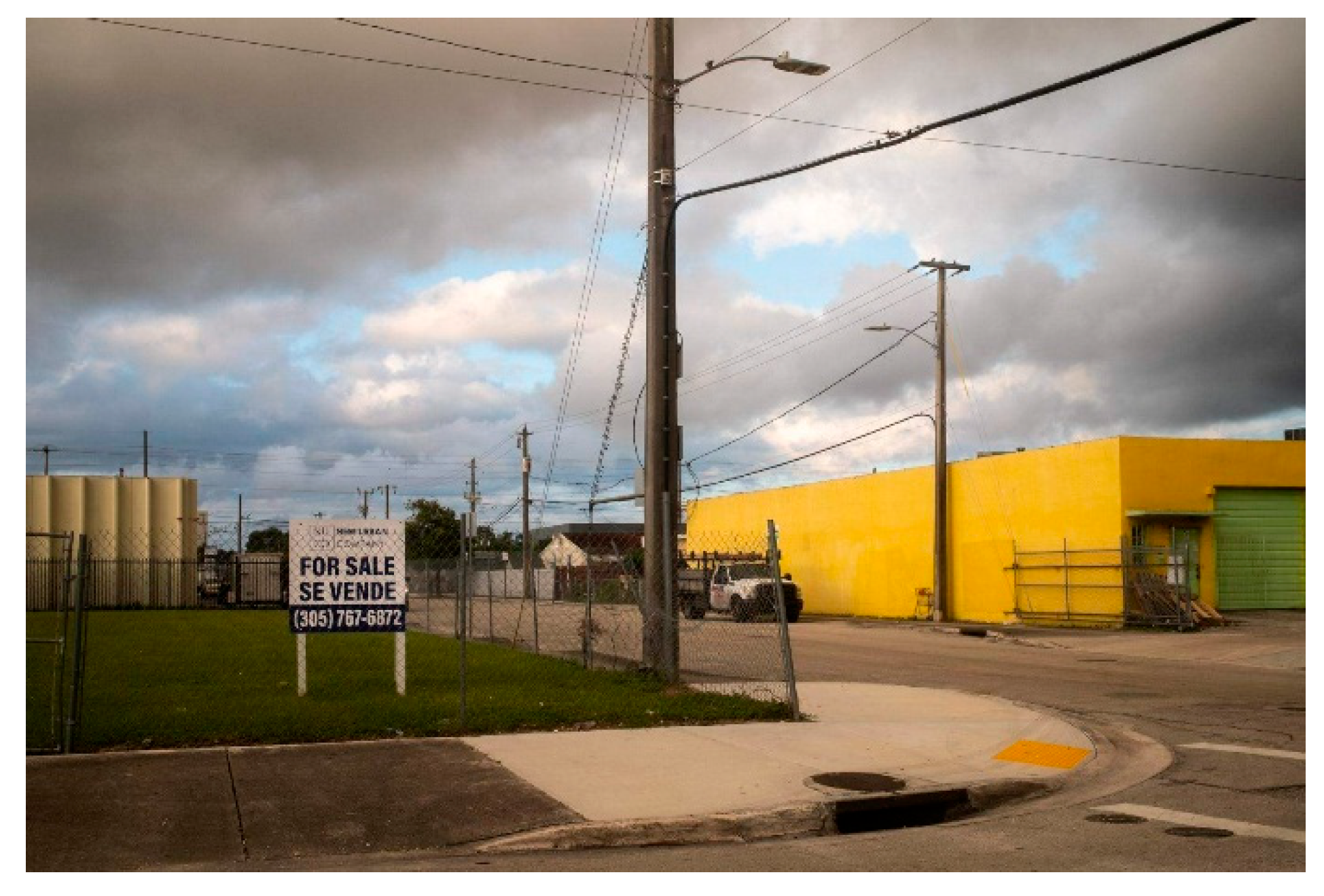
Figure 1. Thanks to its elevation and proximity to the airport, Allapattah is one of many working-class neighborhoods in Miami highly sought after by investors. In the photo, one of the many lots for sale. Source: Antoine Martin via Equal Times. Retrieved from: https://www.equaltimes.org/welcome-to-miami-speculation?lang=en (accessed on 15 September 2025).
Applsci 16 00259 g001
Figure 2. The lot on the right was purchased to make way for new residences. The houses on the left are awaiting demolition. Liberty City neighborhood, Miami, 2021. Source: Antoine Martin via Equal Times. Retrieved from: https://www.equaltimes.org/welcome-to-miami-speculation?lang=en (accessed on 15 September 2025).
Applsci 16 00259 g002
Figure 3. One of the historic buildings still present in the Little Haiti neighborhood, Miami, 2011. Source: Marc Averette. Retrieved from: https://it.wikipedia.org/wiki/Little_Haiti#/media/File:Little_Haiti_south.jpg (accessed on 15 September 2025).
Applsci 16 00259 g003
Figure 4. The transformation (before/after) of an industrial warehouse in the Little Haiti neighborhood, converted into a commercial building. Source: Magic City Innovation District. Retrieved from: https://magiccitydistrict.com/the-district/#adaptive (accessed on 15 September 2025).
Applsci 16 00259 g004
Figure 5. Master plan of the Magic City Innovation District project. Source: Magic City Innovation District. Retrieved from: https://magiccitydistrict.com/masterplan/ (accessed on 15 September 2025).
Applsci 16 00259 g005
Figure 6. The office tower planned in the Magic City Innovation District project. Source: Magic City Innovation District. Retrieved from: https://magiccitydistrict.com/masterplan/ (accessed on 15 September 2025).
Applsci 16 00259 g006
Figure 7. The luxury residential tower planned in the Magic City Innovation District project. Source: Magic City Innovation District. Retrieved from: https://magiccitydistrict.com/masterplan/ (accessed on 15 September 2025).
Applsci 16 00259 g007
Figure 8. Before and after the urban regeneration intervention in Comuna 13, Medellín. Retrieved from: Healthymedellin. Retrieved from: https://healthymedellin.weebly.com/comuna-13.html (accessed on 15 September 2025).
Applsci 16 00259 g008
Figure 9. Aerial view of the Metrocable connecting the comunas of Medellín to the formal urban fabric. Source: Poma. Retrieved from: https://www.poma.net/en/work/line-m-metrocable-medellin/ (accessed on 15 September 2025).
Applsci 16 00259 g009
Figure 10. A view of the tree-lined avenues of Medellín. Retrieved from: https://en.innovando.news/medellin-verde-citta-battuto-caldo-con-natura/ (accessed on 15 September 2025).
Applsci 16 00259 g010
Figure 11. A public space in Medellín. Retrieved from: https://en.innovando.news/medellin-verde-citta-battuto-caldo-con-natura/ (accessed on 15 September 2025).
Applsci 16 00259 g011
Table 1. Semantic and Theoretical Framework.
Key ConceptDefinition and Conceptual DistinctionTheoretical Reference
Public CityDefined not merely as state-owned property, but as the structural network of public spaces, essential services (mobility, health, education), and welfare infrastructures that guarantee the universal right to the city. It acts as the primary physical platform for social cohesion.Ricci (2020); Lefebvre (1968) [3,12]
Urban welfareA spatial reinterpretation of the traditional Welfare State that shifts focus from purely economic assistance to the equitable distribution of spatial opportunities. It views the city’s physical infrastructure (public spaces, mobility, housing, ecosystem services) as the primary provider of social security and rights, ensuring that high-quality urban environments are accessible to all citizens regardless of income.Ricci et al. (2020); Secchi (2013) [3,13]
Climate GentrificationDistinct from ordinary gentrification (driven by the rent gap in undervalued areas), this phenomenon is triggered by the “resilience gap”. It occurs when capital flows into areas with lower climate risk (e.g., higher elevation) or newly implemented green infrastructure, displacing lower-income residents due to the “safety premium” on property values.Keenan et al. (2018); Shi et al. (2016) [14,15]
Climate JusticeClimate Justice is the normative goal: fair distribution of environmental benefits and burdens.Schlosberg (2007) [16]
Equitable AdaptationEquitable Adaptation is the operational process: the specific planning tools (e.g., anti-displacement protocols, participatory design) used to achieve that goal and prevent maladaptation.Bulkeley et al. (2014) [17]
Spatial JusticeThe fair and equitable distribution in space of socially valued resources and the opportunities to use them. In this paper, it implies that access to climate resilience (e.g., cool islands, flood protection) must not depend on a neighborhood’s socioeconomic status.Soja (2010) [18]
Most Vulnerable GroupsIdentified through an intersectional approach: populations characterized not only by low income but by limited adaptive capacity due to overlapping factors (housing informality, age, ethnicity, health status) that make them disproportionately sensitive to climate shocks.IPCC (2023); Crenshaw (1989) [19,20]
Table 2. Number and types of documents analyzed in Phases 1 and 2.
Research PhaseDocument TypologyQuantityDescription and Examples
Phase 1: Theoretical Framework & ContextAcademic Literature25Peer-reviewed articles and books defining the theoretical paradigms of urban welfare, climate justice, and gentrification.
Examples: Ricci et al. (2020) [3]; Schlosberg (2007) [16]; Soja (2010) [18]; Keenan et al. (2018) [14]; Anguelovski et al. (2018, 2022) [27,28]; Crenshaw (1989) [20].
Policy Reports & Guidelines12Official documents from international bodies and EU frameworks.
Examples: European Green Deal (2019) [6]; Just Transition Mechanism [30]; IPCC Synthesis Report (2023) [19]; UN-Habitat World Cities Report (2020) [31]; EU Horizon Europe Framework (2021) [8].
Phase 2: Case Study Analysis (Miami & Medellín)Local Planning & Technical Documents11Official masterplans, government strategies, and technical datasets.
Miami: Miami-Dade Sea Level Rise Strategy [32]; Resilient305 Strategy [33]; Magic City Innovation District Master Plan [34]; Zillow Real Estate Market Overview [35],; Medellín: Plan de Desarrollo 2016–2019 [36]; Secretaría de Medio Ambiente Indicators [37]; UNEP “Cooling by Nature” Report [27]; Ashden Award Case Study [26].
Investigative Media & News Reports6Major media analysis tracking real-time gentrification and project outcomes.
Examples: BBC Future (Yeung, 2023) [38]; Reuters (Moloney, 2021) [39]; Miami Herald (Viglucci, 2022) [40]; NBC 6 South Florida (Hernandez, 2024) [41]; Equal Times (Martin, 2022) [42].
Methodological references4Specific quantitative and qualitative academic studies applied to the analyzed cities.
Examples: Wdowinski et al. (2016) on flooding hazards in Miami [21]; Soto-Estrada et al. (2017) on thermal analysis in Medellín [43]; Escobedo et al. (2015) on socio-ecological dynamics [23]; Bernstein et al. (2019) on sea-level rise price effects [22].
Total 58
Table 3. 5 descriptors for a systemic and multidimensional evaluation of sustainable urban regeneration projects.
DescriptorsQualitative Assessment Criteria (What Was Evaluated?)Key Analytical Dimensions (Indicators Looked for in Documents)
1. Strategic vision and governanceAssessment of the governance model and its orientation towards public interest versus private profit.Public vs. Private Logic: Is the intervention driven by market speculation or public welfare?
Regulation: Presence/Absence of binding protocols for social inclusion.
Coordination: Level of inter-institutional cooperation described in plans.
2. Housing accessibility and mobilityEvaluation of the project’s impact on housing stability and connectivity for original residents.Protection Mechanisms: Presence of policies to prevent displacement (e.g., affordable housing requirements).
Market Pressure: Evidence of speculative trends or “climate gentrification” risks in reports.
Connectivity: Integration with public transport networks serving vulnerable areas.
3. Distributive environmental benefitsAnalysis of who physically accesses and benefits from the environmental improvements.Access Rights: Are the green/blue infrastructures public and open, or privatized/gated?
Geographic Coverage: Do interventions target marginalized neighborhoods or only high-income zones?
Nature of Intervention: Focus on luxury landscaping vs. functional ecosystem services (e.g., cooling).
4. Job creation and community empowermentAssessment of the economic fallout on the local community.Target Beneficiaries: Are new jobs accessible to current residents or do they require external skilled labor?
Training: Existence of professional training programs funded by the project
Participation: Degree of community involvement in the management of spaces.
5. Preservation of cultural and social identityEvaluation of the compatibility between the new project and the existing cultural fabric.Cultural Continuity: Does the project integrate local traditions/activities or replace them?
Heritage Sensitivity: Recognition of the area’s symbolic value in planning documents.
Social Mix: Maintenance of the existing demographic diversity.
Table 4. Evaluation of the Little Haiti case study using the 5 descriptors.
DescriptorsCase study: Magic City Innovation DistrictCritical Evaluation
Regressive InterventionsProgressive Interventions
Strategic vision and governancePlanning is fragmented and developer-led. The absence of mandatory Inclusionary Zoning or binding Community Benefit Agreements (CBAs) allowed the Special Area Plan to prioritize real estate volume over social resilience.
Housing accessibility and mobilityThe “Elevation Hypothesis” drives demand: property values rise due to climate safety. Lack of rent control policies or property tax freezes for long-term low-income owners facilitates rapid displacement by wealthier climate migrants.
Distributive environmental benefitsEnvironmental upgrades (drainage, greening) are privatized within the project boundaries. There is no municipal mechanism to redistribute the “resilience dividend” to the surrounding existing fabric.
Job creation and community empowermentSkill mismatch: new jobs are in high-tech/innovation sectors. Absence of funded workforce development programs for local residents leads to economic exclusion despite job creation.
Preservation of cultural and social identityZoning changes from industrial/residential to mixed-use commercial encourage the replacement of culturally specific local businesses (botanicas, Caribbean markets) with generic globalized retail.
Table 5. Evaluation of the Green Corridor case study (Medellin) using the 5 descriptors.
DescriptorsCase Study: MedellinCritical Evaluation
Regressive InterventionsRegressive Interventions
Strategic vision and governancePublic-led governance: The project is funded by public utility revenues (EPM) and anchored in the Plan de Desarrollo, ensuring that climate goals align with the “Social Urbanism” policy of prioritizing vulnerable areas.
Housing accessibility and mobilityAnti-displacement strategy: Investments focused on public space rather than private housing stock. Integration with the Metrocable system improved accessibility without triggering immediate mass eviction dynamics.
Distributive environmental benefitsUniversal Design: The green corridors are public infrastructures (streets, sidewalks) accessible to all, ensuring the cooling effect (−2 °C) benefits pedestrians and residents regardless of income.
Empirical data (temperature reduction of 2–3.5 °C, 25% increase in vegetation coverage) confirm an equitable distribution of climate benefits.
Job creation and community empowerment“Jardineros” Program: The municipality directly hired and trained 700 vulnerable residents as “expert gardeners,” transforming maintenance costs into social investment and community ownership.
Preservation of cultural and social identityReclaiming public space: The design incorporated local knowledge and prioritized pedestrian life, strengthening the “Right to the City” and reinforcing community bonds in historically violent neighborhoods. The enhancement of quebradas and public spaces as cohesion hubs has preserved territorial memory and the sense of collective belonging.
Disclaimer/Publisher’s Note: The statements, opinions and data contained in all publications are solely those of the individual author(s) and contributor(s) and not of MDPI and/or the editor(s). MDPI and/or the editor(s) disclaim responsibility for any injury to people or property resulting from any ideas, methods, instructions or products referred to in the content.