A Seven-Level Single-DC-Source Inverter with Triple Voltage Gain and Reduced Component Count

 ,
,  , ,
, ,  and
and
Abstract
1. Introduction
- (1)
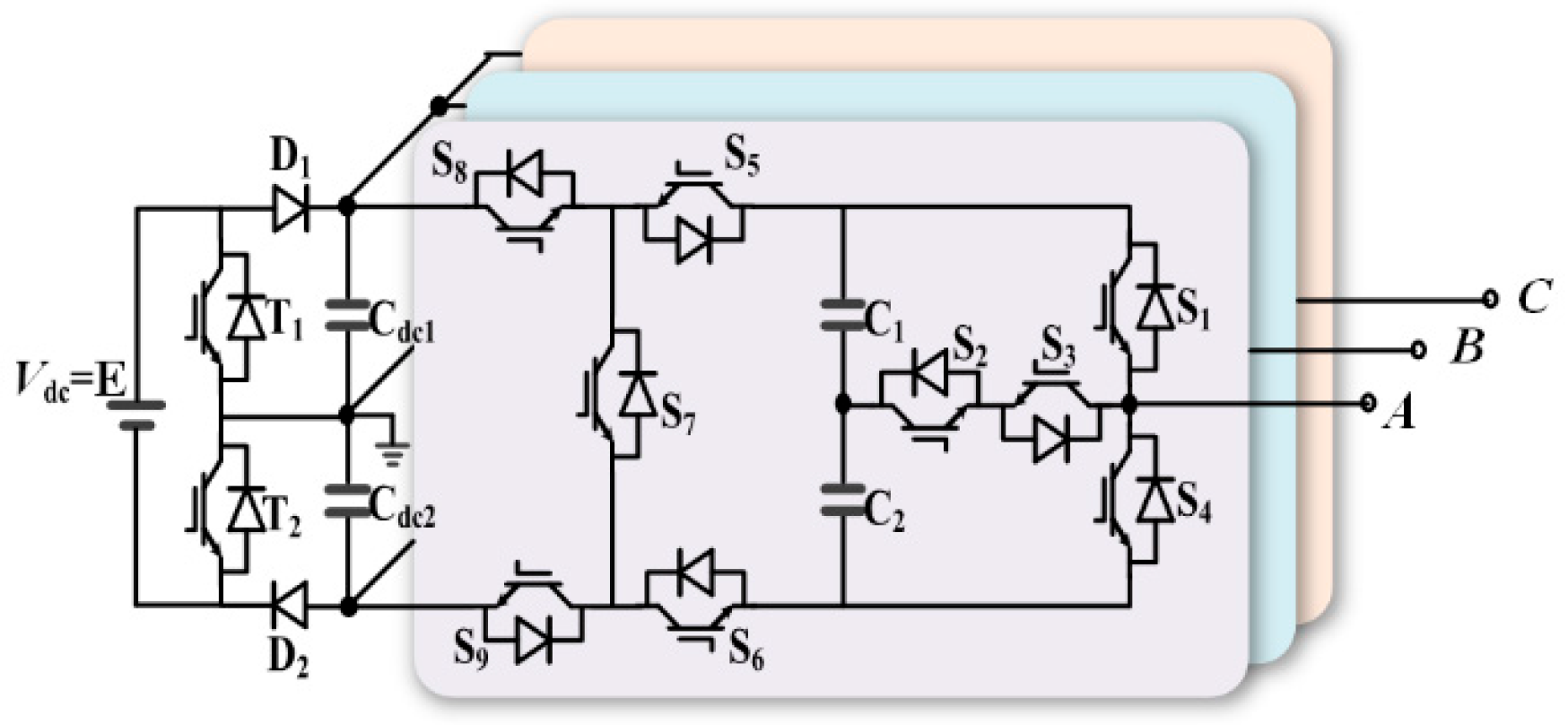
- Single-source three-phase implementation: Unlike existing triple-gain topologies [15,16,17,18,19] that require separate DC sources for each phase in three-phase applications, the proposed topology enables all three phases to share a single DC power supply along with the front-stage switched-capacitor network.
- (2)
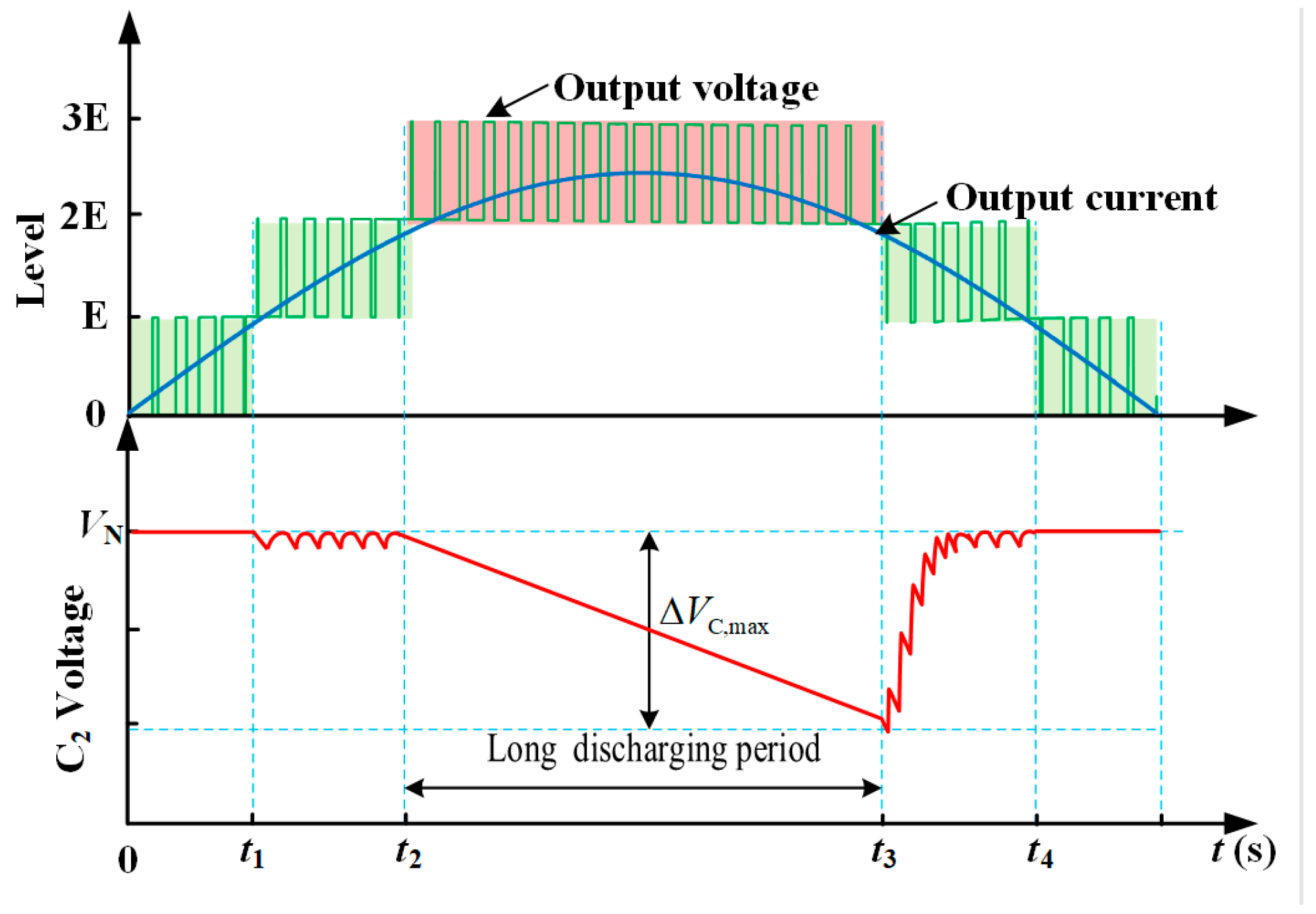
- Inherent capacitor voltage self-balancing: The topology achieves natural voltage balancing across all capacitors without requiring complex auxiliary balancing circuits or control algorithms.
- (3)
- Simplified single-carrier PWM modulation: An improved carrier-based modulation strategy requiring only one triangular carrier is proposed, reducing the control complexity compared to conventional multi-carrier methods.
- (4)
2. The Proposed Seven-Level Single-DC-Source Inverter with Triple Voltage Gain
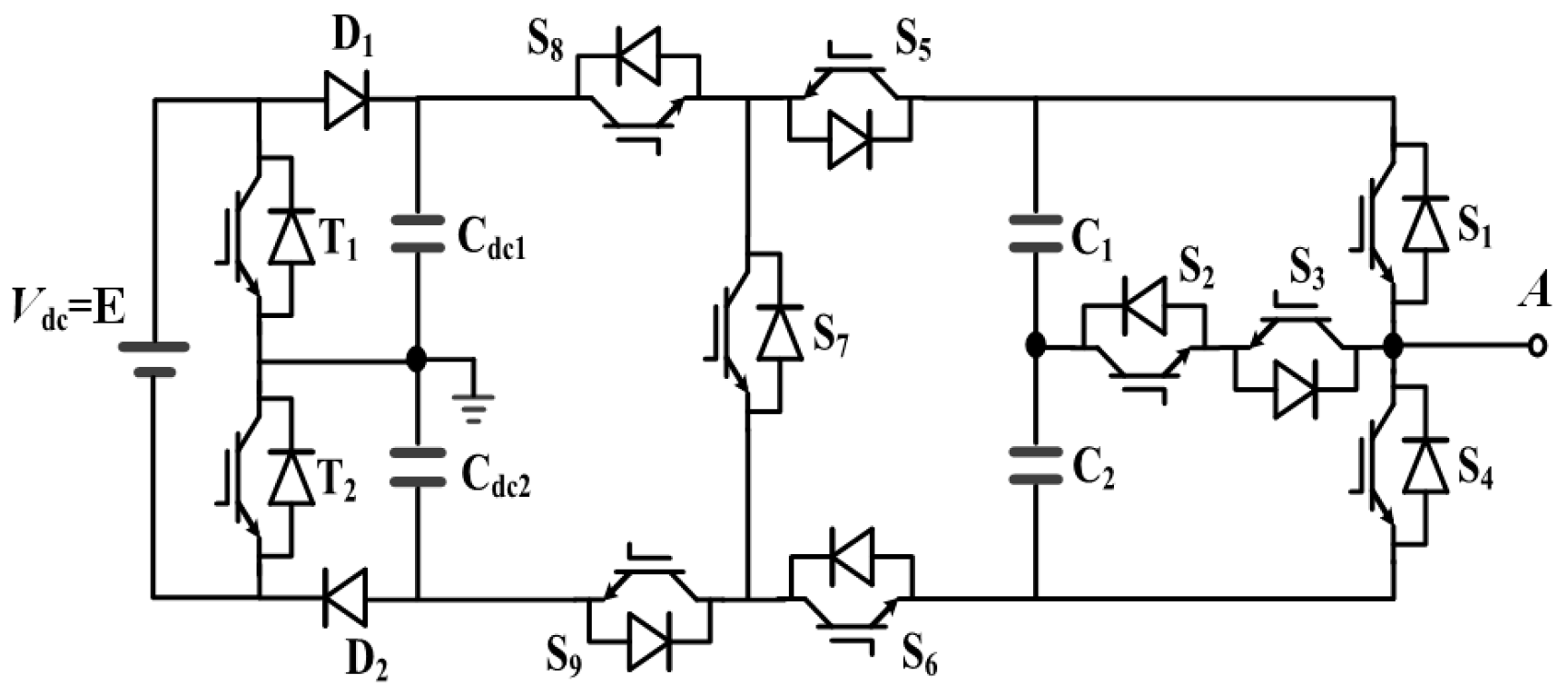
2.1. Topology
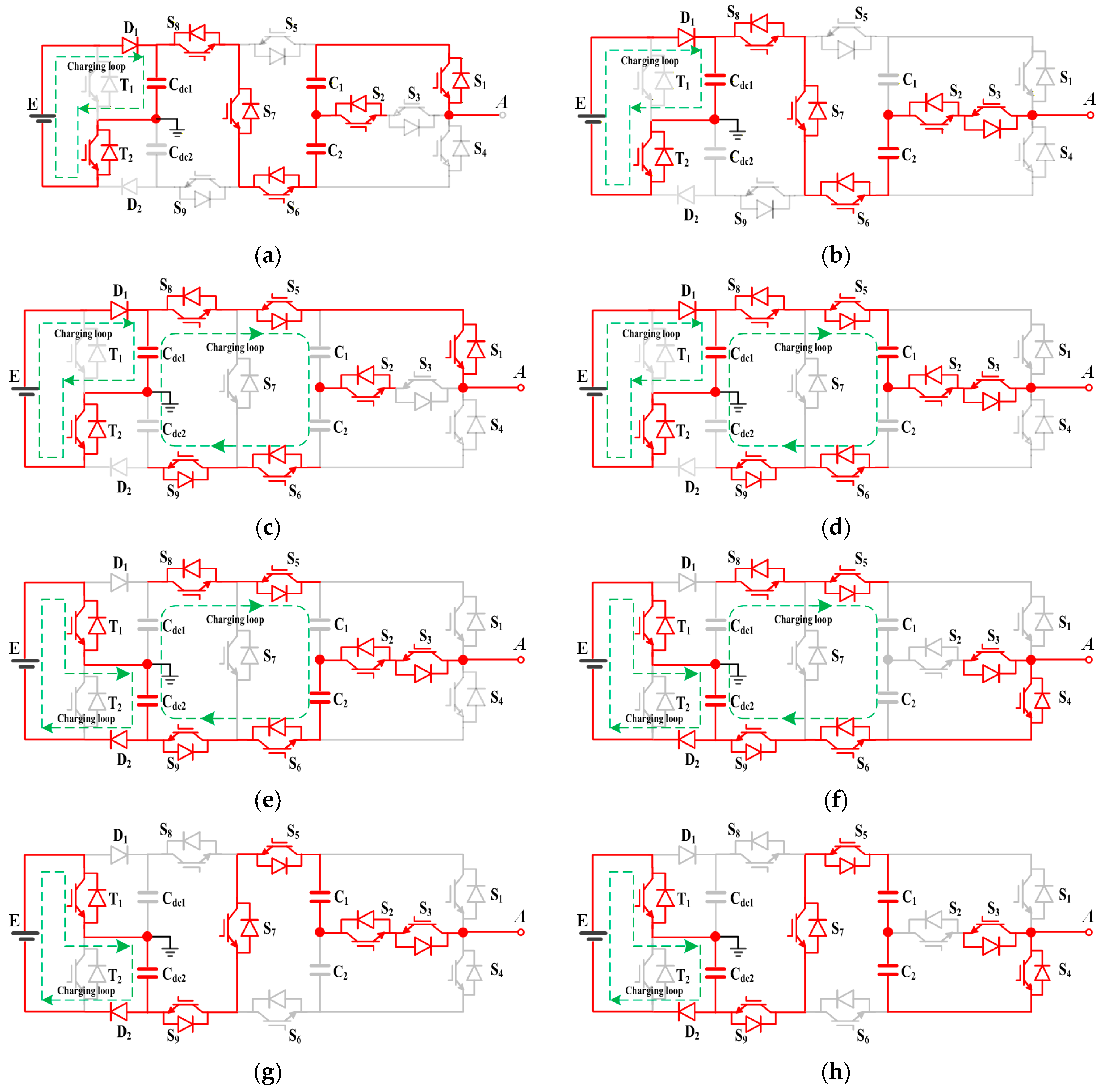
2.2. Working Principle
3. Proposed Single Carrier PWM Modulation and Analysis of Capacitor Characteristics
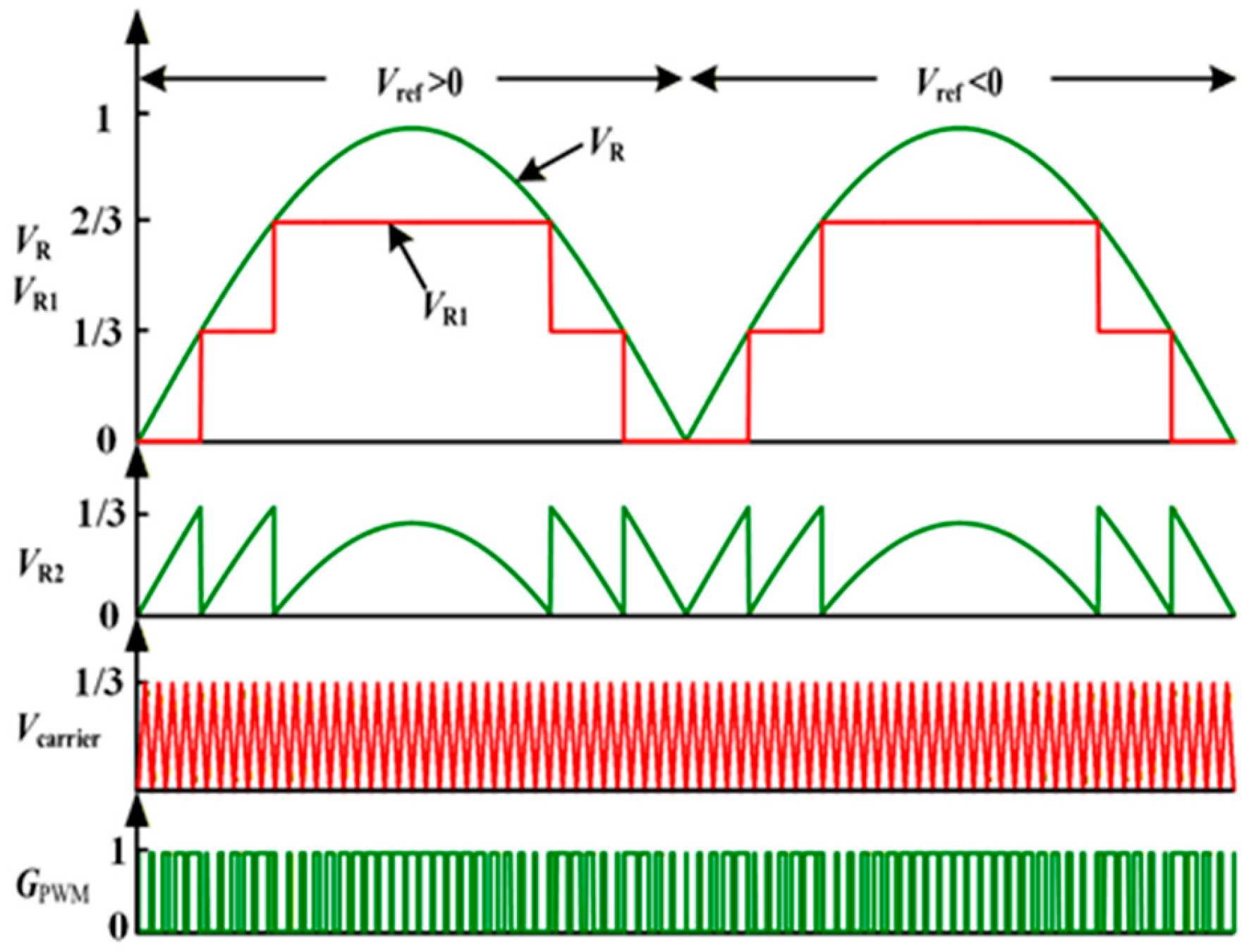
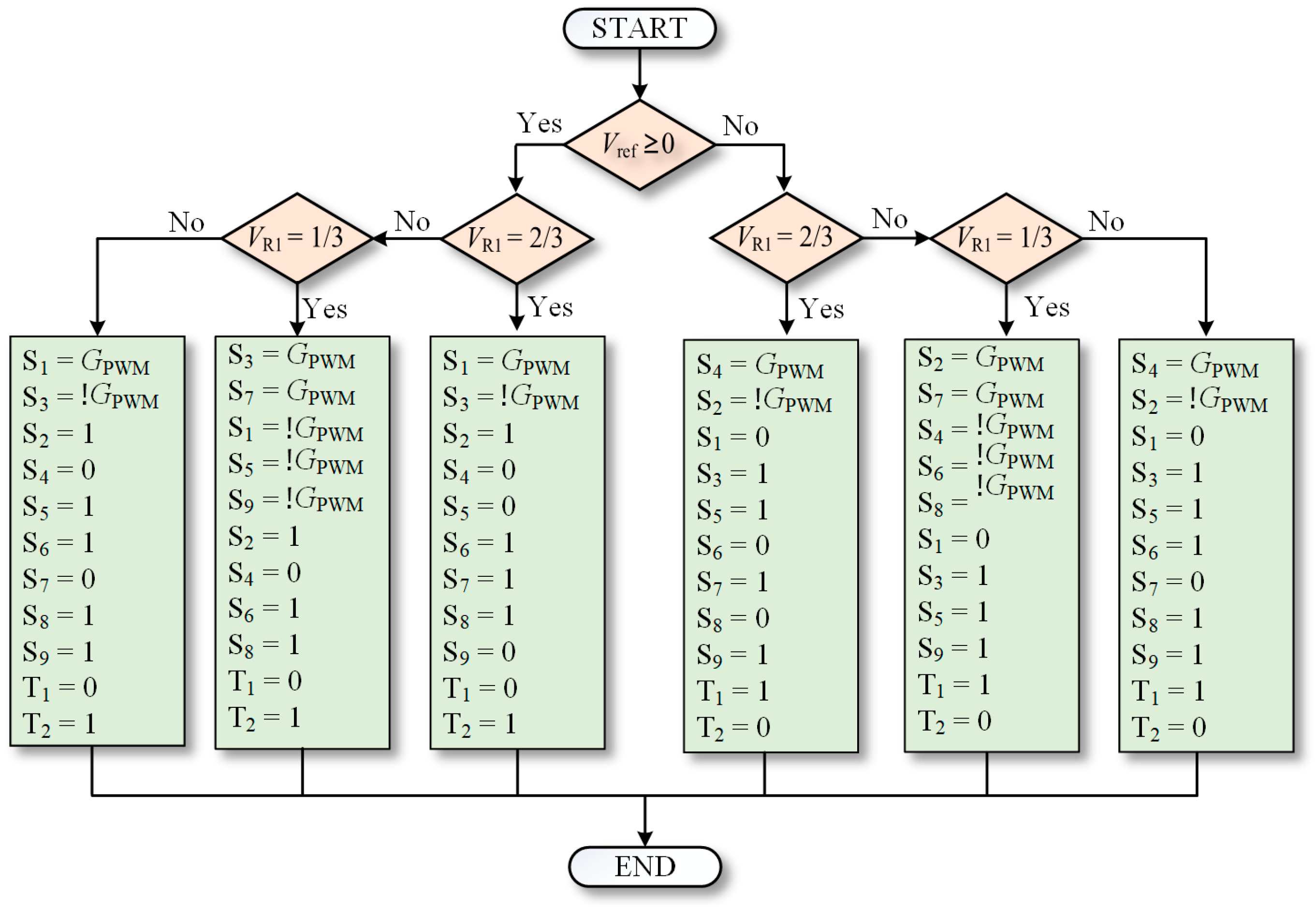
3.1. Proposed Single Carrier PWM Modulation
3.2. Capacitor Voltage Self-Balancing Analysis
3.3. Capacitance Value Calculation
3.4. Three-Phase Configuration of the Proposed Inverter
3.5. Topological Comparative Assessment
4. Simulation Results
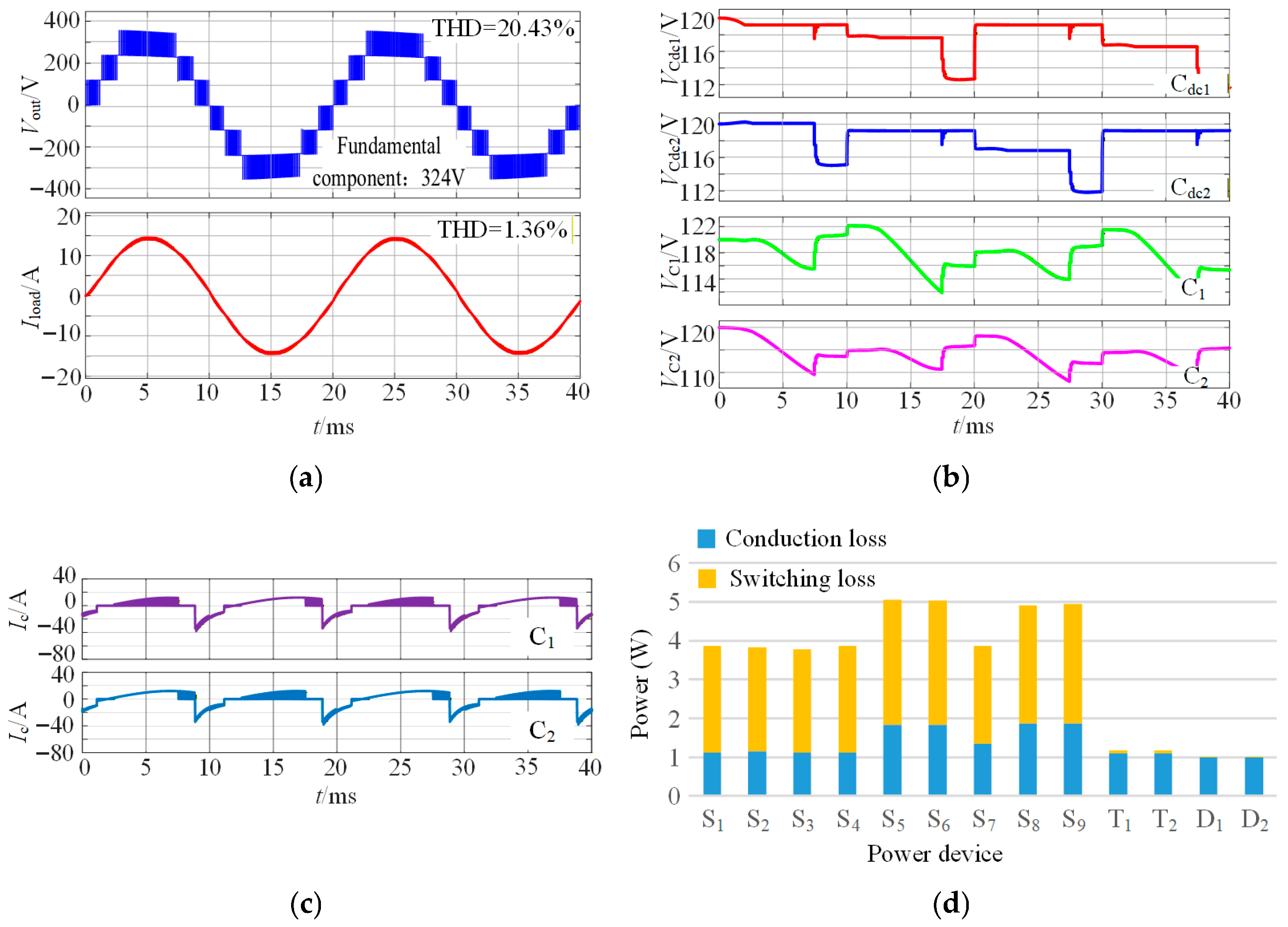
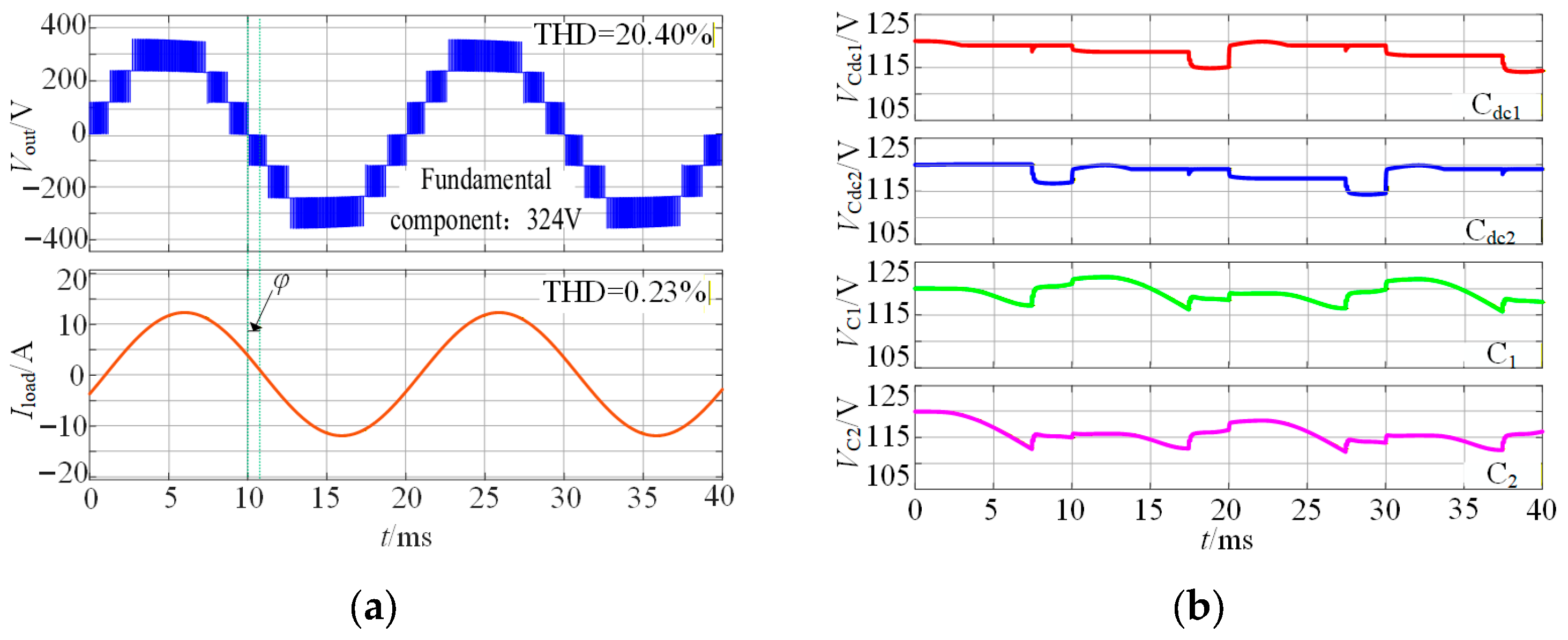
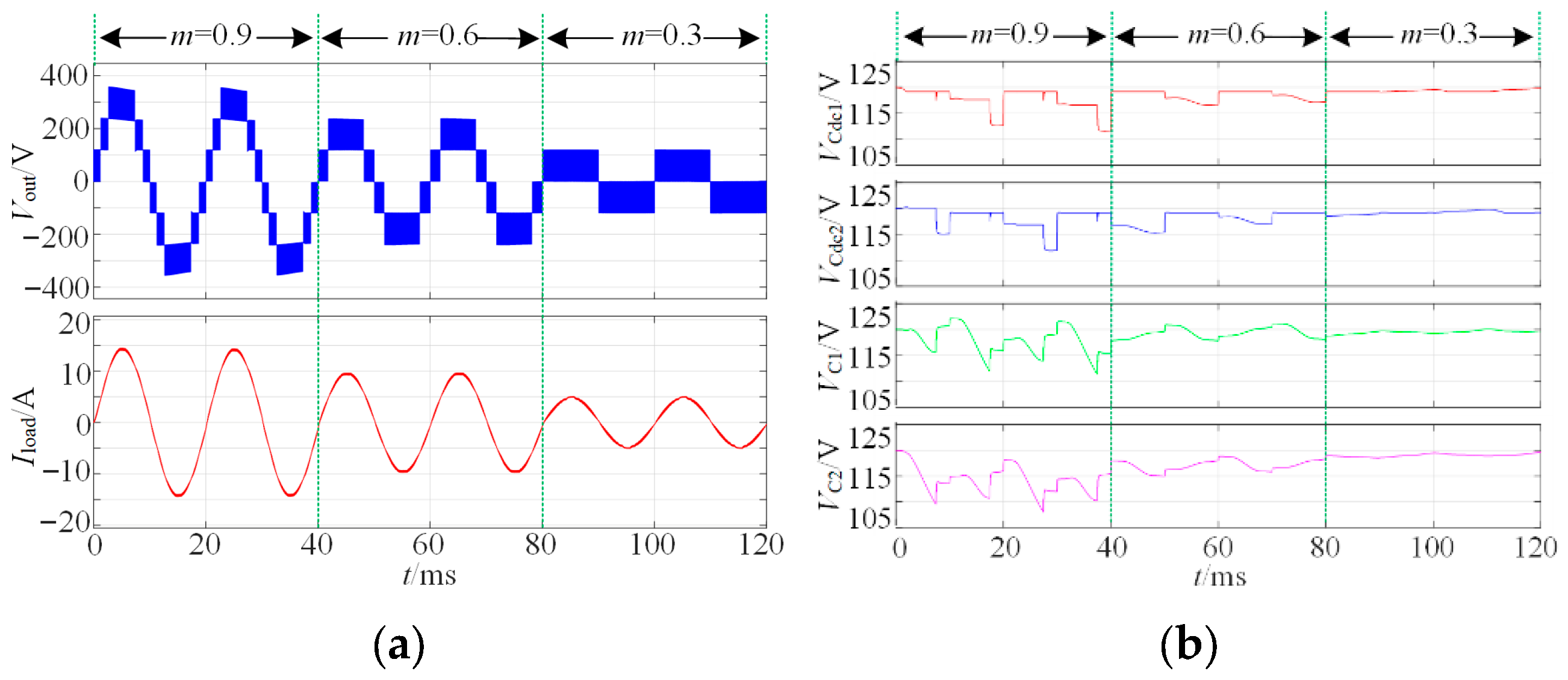
4.1. Simulation Results for the Single-Phase Configuration
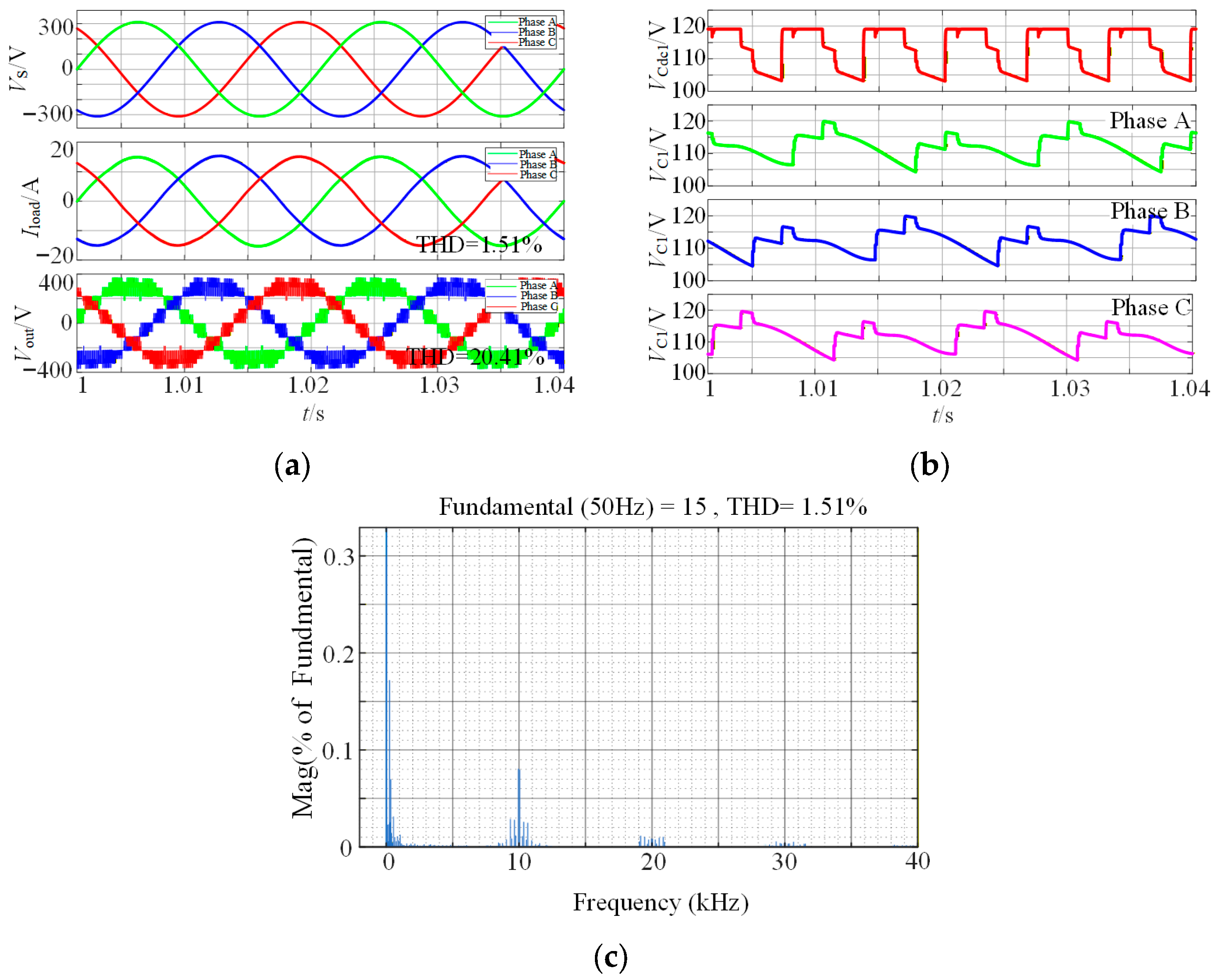
4.2. Simulation Results for the Three-Phase Configuration
5. Experimental Verification
6. Conclusions
Author Contributions
Funding
Institutional Review Board Statement
Informed Consent Statement
Data Availability Statement
Conflicts of Interest
References
- Barzegarkhoo, R.; Forouzesh, M.; Lee, S.S.; Blaabjerg, F.; Siwakoti, Y.P. Switched-capacitor multilevel inverters: A comprehensive review. IEEE Trans. Power Electron. 2022, 37, 11209–11243. [Google Scholar] [CrossRef] [Scilit]
- Lin, Z.; Zhang, X.; Zhu, J.; Du, W.; Ye, J.; Bai, Y. Advances in space vector modulation techniques for multilevel inverters: A comprehensive review. Chin. J. Electr. Eng. 2025, 11, 63–77. [Google Scholar] [CrossRef] [Scilit]
- Liu, Z.; Chen, J.; Guerrero, J.M.; Wang, Q.; Li, P.; Xia, Z. A review of five-level active neutral-point clamped (5L-ANPC) converter. IEEE Trans. Transp. Electrif. 2025, 11, 12115–12135. [Google Scholar] [CrossRef] [Scilit]
- Vijeh, M.; Rezanejad, M.; Samadaei, E.; Bertilsson, K. A general review of multilevel inverters based on main submodules: Structural point of view. IEEE Trans. Power Electron. 2019, 34, 9479–9502. [Google Scholar] [CrossRef] [Scilit]
- Rodriguez, J.; Lai, J.-S.; Peng, F.Z. Multilevel inverters: A survey of topologies, controls, and applications. IEEE Trans. Ind. Electron. 2002, 49, 724–738. [Google Scholar] [CrossRef] [Scilit]
- Winston, D.P. Design of sustainable PV module for efficient power generation during faults. IEEE Trans. Compon. Packag. Manuf. Technol. 2020, 10, 389–392. [Google Scholar] [CrossRef] [Scilit]
- Oufettoul, H.; Lamdihine, N.; Motahhir, S.; Lamrini, N.; Abdelmoula, I.A.; Aniba, G. Comparative performance analysis of PV module positions in a solar PV array under partial shading conditions. IEEE Access 2023, 11, 12176–12194. [Google Scholar] [CrossRef] [Scilit]
- Hinago, Y.; Koizumi, H. A switched-capacitor inverter using series/parallel conversion with inductive load. IEEE Trans. Ind. Electron. 2012, 59, 878–887. [Google Scholar] [CrossRef] [Scilit]
- Roy, T.; Nandi, S.; Patel, R.; Misra, B.; Nayak, B. Investigation of an extendable multisource switched-capacitor multilevel inverter with reduced device count. IEEE J. Emerg. Sel. Top. Power Electron. 2025, 13, 3013–3027. [Google Scholar] [CrossRef] [Scilit]
- Taghvaie, A.; Adabi, J.; Rezanejad, M. A self-balanced step-up multilevel inverter based on switched-capacitor structure. IEEE Trans. Power Electron. 2018, 33, 199–209. [Google Scholar] [CrossRef] [Scilit]
- Iqbal, A.; Siddique, M.D.; Ali, J.S.M.; Mekhilef, S.; Lam, J. A new eight switch seven level boost active neutral point clamped (8S-7L-BANPC) inverter. IEEE Access 2020, 8, 203972–203981. [Google Scholar] [CrossRef] [Scilit]
- Sathik, M.J.; Sandeep, N.; Blaabjerg, F. High gain active neutral point clamped seven-level self-voltage balancing inverter. IEEE Trans. Circuits Syst. II Express Briefs 2020, 67, 2567–2571. [Google Scholar] [CrossRef] [Scilit]
- Lee, S.S.; Lee, K.-B. Dual-T-type seven-level boost active-neutral-point-clamped inverter. IEEE Trans. Power Electron. 2019, 34, 6031–6035. [Google Scholar] [CrossRef] [Scilit]
- Sathik, M.J.; Bhatnagar, K.; Sandeep, N.; Blaabjerg, F. An improved seven-level PUC inverter topology with voltage boosting. IEEE Trans. Circuits Syst. II Express Briefs 2020, 67, 127–131. [Google Scholar] [CrossRef] [Scilit]
- Lee, S.S. A single-phase single-source 7-level inverter with triple voltage boosting gain. IEEE Access 2018, 6, 30005–30011. [Google Scholar] [CrossRef] [Scilit]
- Kishore, P.S.V.; Jayaram, N.; Jakkula, S.; Sankar, Y.R.; Rajesh, J.; Halder, S. A new reduced switch seven-level triple boost switched capacitor based inverter. IEEE Access 2022, 10, 73931–73944. [Google Scholar] [CrossRef] [Scilit]
- Khodaparast, A.; Hassani, M.J.; Azimi, E.; Adabi, M.E.; Adabi, J.; Pouresmaeil, E. Circuit conFigureuration and modulation of a seven-level switched-capacitor inverter. IEEE Trans. Power Electron. 2021, 36, 7087–7096. [Google Scholar] [CrossRef] [Scilit]
- Roy, T.; Tesfay, M.W.; Nayak, B.; Panigrahi, C.K. A 7-level switched capacitor multilevel inverter with reduced switches and voltage stresses. IEEE Trans. Circuits Syst. II Express Briefs 2021, 68, 3587–3591. [Google Scholar] [CrossRef] [Scilit]
- Siddique, M.D.; Mekhilef, S.; Shah, N.M.; Ali, J.S.M.; Blaabjerg, F. A new switched capacitor 7L inverter with triple voltage gain and low voltage stress. IEEE Trans. Circuits Syst. II Express Briefs 2020, 67, 1294–1298. [Google Scholar] [CrossRef] [Scilit]
- Lim, Z.; Maswood, A.I.; Ooi, G.H.P. Modular-cell inverter employing reduced flying capacitors with hybrid phase-shifted carrier phase-disposition PWM. IEEE Trans. Ind. Electron. 2015, 62, 4086–4095. [Google Scholar] [CrossRef] [Scilit]
- Deng, F.; Yu, Q.; Wang, Q.; Zhu, R.; Cai, X.; Chen, Z. Suppression of DC-link current ripple for modular multilevel converters under phase-disposition PWM. IEEE Trans. Power Electron. 2020, 35, 3310–3324. [Google Scholar] [CrossRef] [Scilit]
- Bai, Y.; Guo, K.; Li, B.; Chen, Y. Double closed-loop control strategy for photovoltaic inverter based on improved average current control. In Proceedings of the 2023 3rd Power System and Green Energy Conference (PSGEC), Shanghai, China, 24–26 August 2023; pp. 171–175. [Google Scholar]
- Wu, Y.; Li, N.; Yao, Z.; Xue, Y.; Wu, D. Control strategy based on double coordinates for three-phase grid-connected inverters. In Proceedings of the 7th International Power Electronics and Motion Control Conference, Harbin, China, 2–5 June 2012; pp. 2272–2276. [Google Scholar]



| Output | The Switching Devices in the Conducting State | Capacitor States | |||
|---|---|---|---|---|---|
| C1 | C2 | Cdc1 | Cdc2 | ||
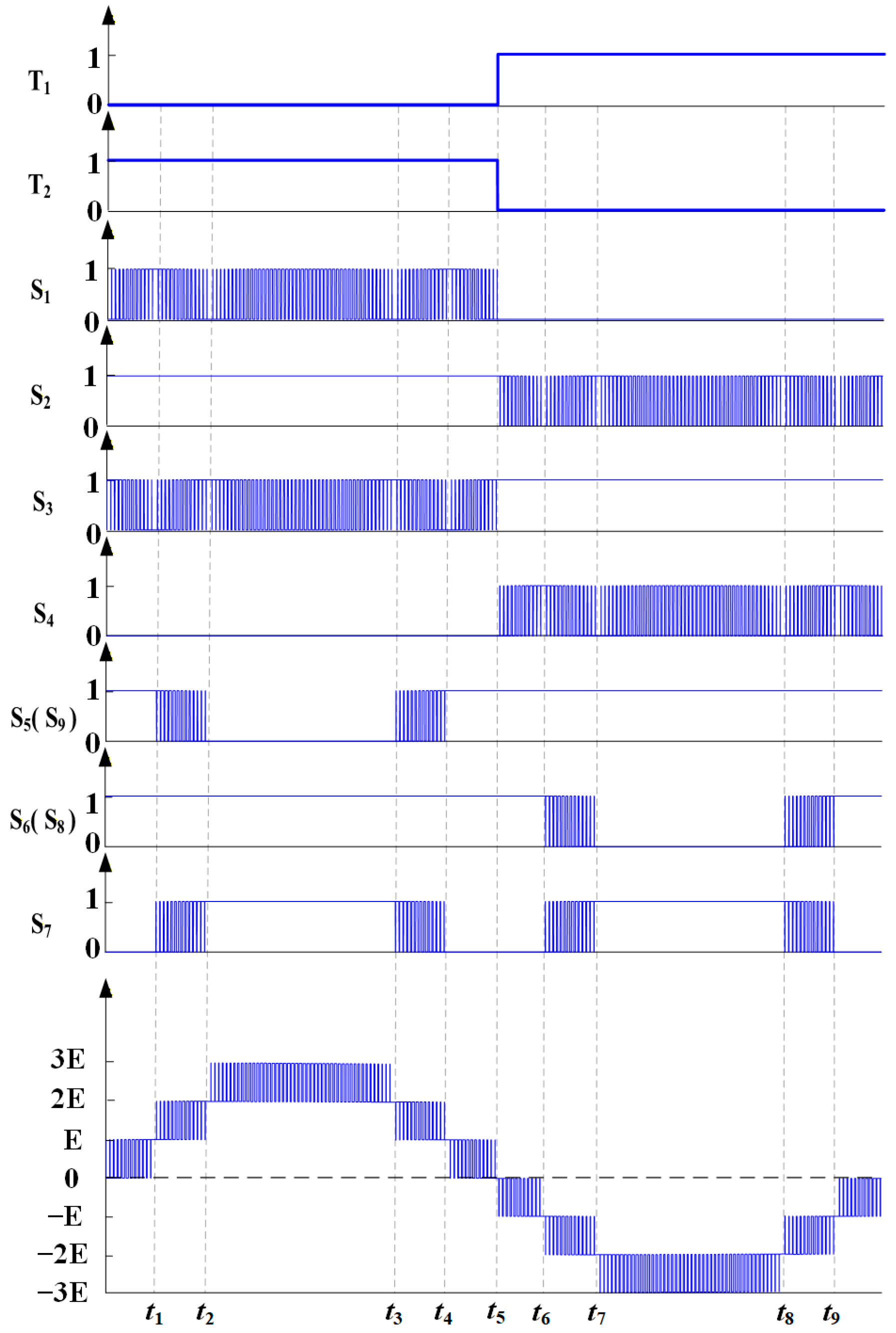
| +3E | S1, S2, S6, S7, S8, T2 | D | D | C | — |
| +2E | S2, S3, S6, S7, S8, T2 | — | D | C | — |
| +E | S1, S2, S5, S6, S8, S9, T2 | C | C | C | D |
| 0 | S2, S3, S5, S6, S8, S9, T2 | C | C | C | D |
| 0 | S2, S3, S5, S6, S8, S9, T1 | C | C | D | C |
| −E | S3, S4, S5, S6, S8, S9, T1 | C | C | D | C |
| −2E | S2, S3, S5, S7, S9, T1 | D | — | — | C |
| −3E | S3, S4, S5, S7, S9, T1 | D | D | — | C |
| Modulation Depth | Output Voltage | Level |
|---|---|---|
| 0, ±E | 3 | |
| 0, ±E, ±2E | 5 | |
| 0, ±E, ±2E, ±3E | 7 |
| Sector | I | II | III | IV | V | VI |
|---|---|---|---|---|---|---|
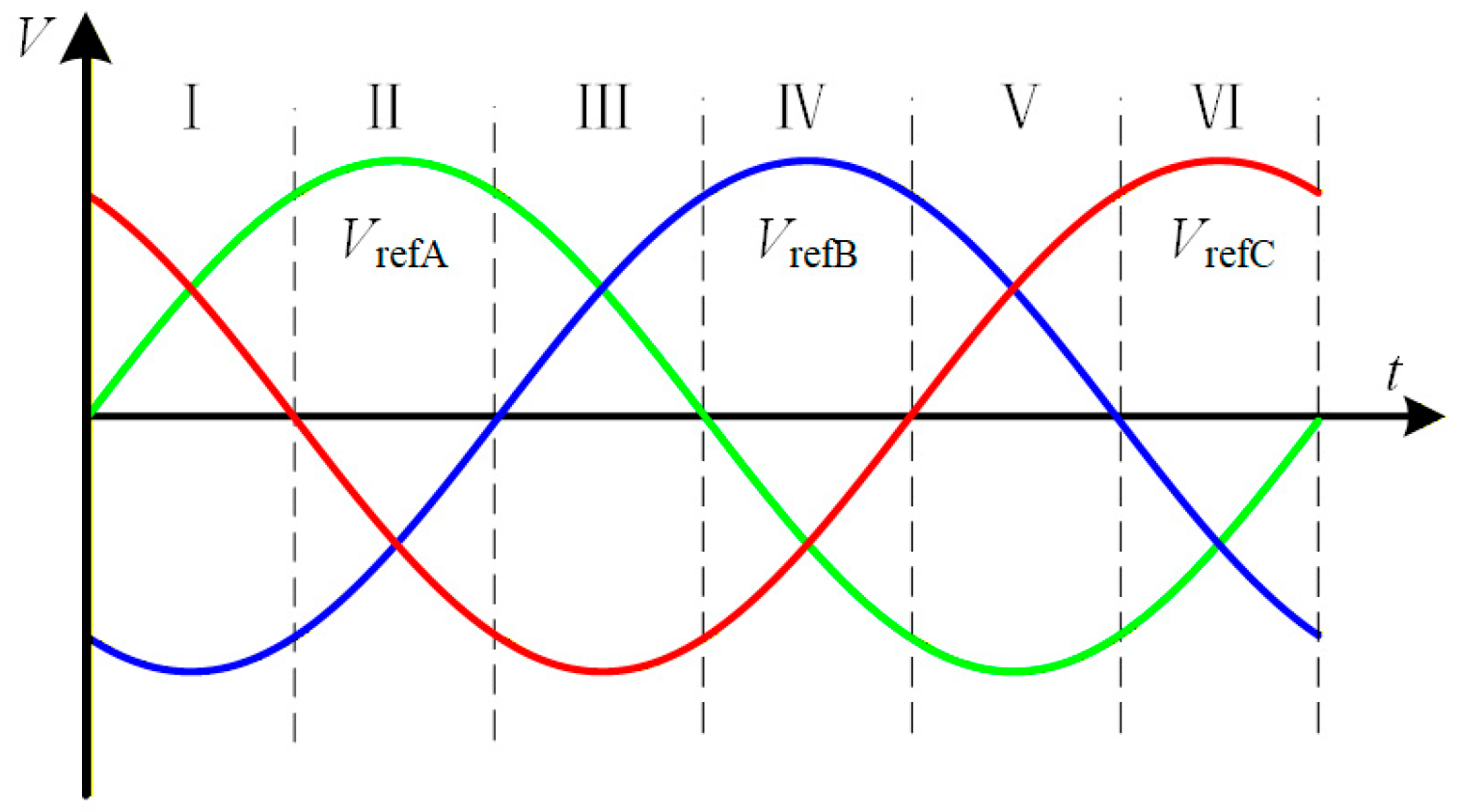
| Condition | VrefA > 0 VrefB < 0 VrefC > 0 | VrefA > 0 VrefB < 0 VrefC ≤ 0 | VrefA > 0 VrefB ≥ 0 VrefC < 0 | VrefA ≤ 0 VrefB > 0 VrefC < 0 | VrefA < 0 VrefB > 0 VrefC ≥ 0 | VrefA < 0 VrefB ≤ 0 VrefC > 0 |
| Switching devices | T1 off T2 on | T1 on T2 off | T1 off T2 on | T1 on T2 off | T1 off T2 on | T1 on T2 off |
| Single-Phase Configuration | Three-Phase Configuration | |||||||
|---|---|---|---|---|---|---|---|---|
| Topology | Nsw | Nd | Nc | Maximum Blocking Voltage | TVS/G | Total Number | TVS/G | Share the DC Power Supply |
| Ref. [11] | 8 | 0 | 3 | 1 | 9/1.5 | 3 ∗ (Nsw + Nd + Nc) | 27/1.5 | Yes |
| Ref. [12] | 10 | 0 | 3 | 1 | 8.5/1.5 | 3 ∗ (Nsw + Nd + Nc) | 25.5/1.5 | Yes |
| Ref. [13] | 10 | 0 | 4 | 1 | 11/1.5 | 3 ∗ (Nsw + Nd + Nc) | 33/1.5 | Yes |
| Ref. [14] | 9 | 0 | 1 | 1 | 6/1.5 | 3 ∗ (Nsw + Nd + Nc) | 18/1.5 | No |
| Ref. [15] | 16 | 0 | 2 | 1 | 16/3 | 3 ∗ (Nsw + Nd + Nc) | 48/3 | No |
| Ref. [16] | 10 | 1 | 2 | 3 | 20/3 | 3 ∗ (Nsw + Nd + Nc) | 60/3 | No |
| Ref. [17] | 9 | 4 | 2 | 3 | 17/3 | 3 ∗ (Nsw + Nd + Nc) | 51/3 | No |
| Ref. [18] | 9 | 2 | 3 | 3 | 17/3 | 3 ∗ (Nsw + Nd + Nc) | 51/3 | No |
| Ref. [19] | 12 | 0 | 2 | 2 | 16/3 | 3 ∗ (Nsw + Nd + Nc) | 48/3 | No |
| Proposed | 11 | 2 | 4 | 2 | 20/3 | 2.6 ∗ Nsw + Nd + 2 ∗ Nc | 52/3 | Yes |
| Parameter | Value |
|---|---|
| Three-phase grid voltage | 380 V |
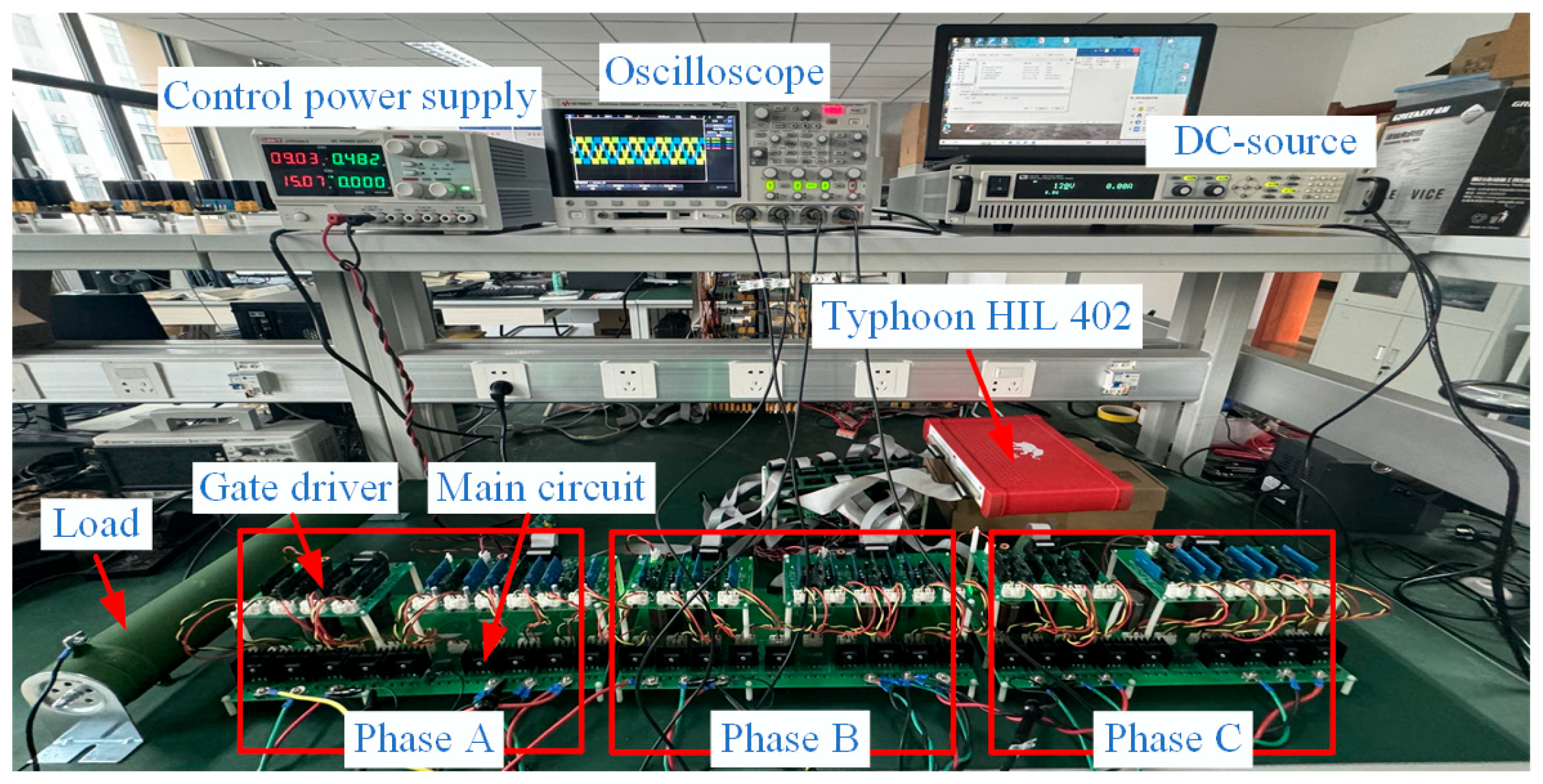
| DC source | 120 V |
| Rated phase current amplitude | 15 A |
| Cdc1, Cdc2 | 6600 μF |
| C1, C2 | 6600 μF |
| Fundamental frequency | 50 Hz |
| Carrier frequency | 10 kHz |
| Filter inductors | 5 mH |
| Load resistor + inductor | (0~200 Ω) + (0~100 mH) |
| S1~S9 and T1, T2 | AIKW20N60CT (Infineon) |
| D1 and D2 | IDW30C65D1(Infineon) |
| Parameter | Value |
|---|---|
| DC-source | 120 V |
| Cdc1, Cdc2 | 6600 μF |
| C1, C2 | 6600 μF |
| Fundamental frequency | 50 Hz |
| Carrier frequency | 5 kHz |
| Filter inductors | 5 mH |
| Load resistor + inductor | (0~200 Ω) + (0~100 mH) |
| S1~S9 and T1, T2 | AIKW20N60CT (Infineon) |
| D1 and D2 | IDW30C65D1 (Infineon) |
Disclaimer/Publisher’s Note: The statements, opinions and data contained in all publications are solely those of the individual author(s) and contributor(s) and not of MDPI and/or the editor(s). MDPI and/or the editor(s) disclaim responsibility for any injury to people or property resulting from any ideas, methods, instructions or products referred to in the content. |
© 2025 by the authors. Licensee MDPI, Basel, Switzerland. This article is an open access article distributed under the terms and conditions of the Creative Commons Attribution (CC BY) license.
Share and Cite
Wang, Z.; Niu, D.; Fang, J.; Chen, M.; Zhang, L.; Zhang, W.; Wang, D.; Ma, Q. A Seven-Level Single-DC-Source Inverter with Triple Voltage Gain and Reduced Component Count. Appl. Sci. 2026, 16, 215. https://doi.org/10.3390/app16010215
Wang Z, Niu D, Fang J, Chen M, Zhang L, Zhang W, Wang D, Ma Q. A Seven-Level Single-DC-Source Inverter with Triple Voltage Gain and Reduced Component Count. Applied Sciences. 2026; 16(1):215. https://doi.org/10.3390/app16010215
Chicago/Turabian StyleWang, Ziyang, Decun Niu, Jingyang Fang, Minghao Chen, Lei Zhang, Wei Zhang, Dong Wang, and Qianli Ma. 2026. "A Seven-Level Single-DC-Source Inverter with Triple Voltage Gain and Reduced Component Count" Applied Sciences 16, no. 1: 215. https://doi.org/10.3390/app16010215
APA StyleWang, Z., Niu, D., Fang, J., Chen, M., Zhang, L., Zhang, W., Wang, D., & Ma, Q. (2026). A Seven-Level Single-DC-Source Inverter with Triple Voltage Gain and Reduced Component Count. Applied Sciences, 16(1), 215. https://doi.org/10.3390/app16010215