Forecasting Future Earthquakes with Machine Learning Models Based on Seismic Prediction Zoning

Abstract
1. Introduction
2. Data and Methods
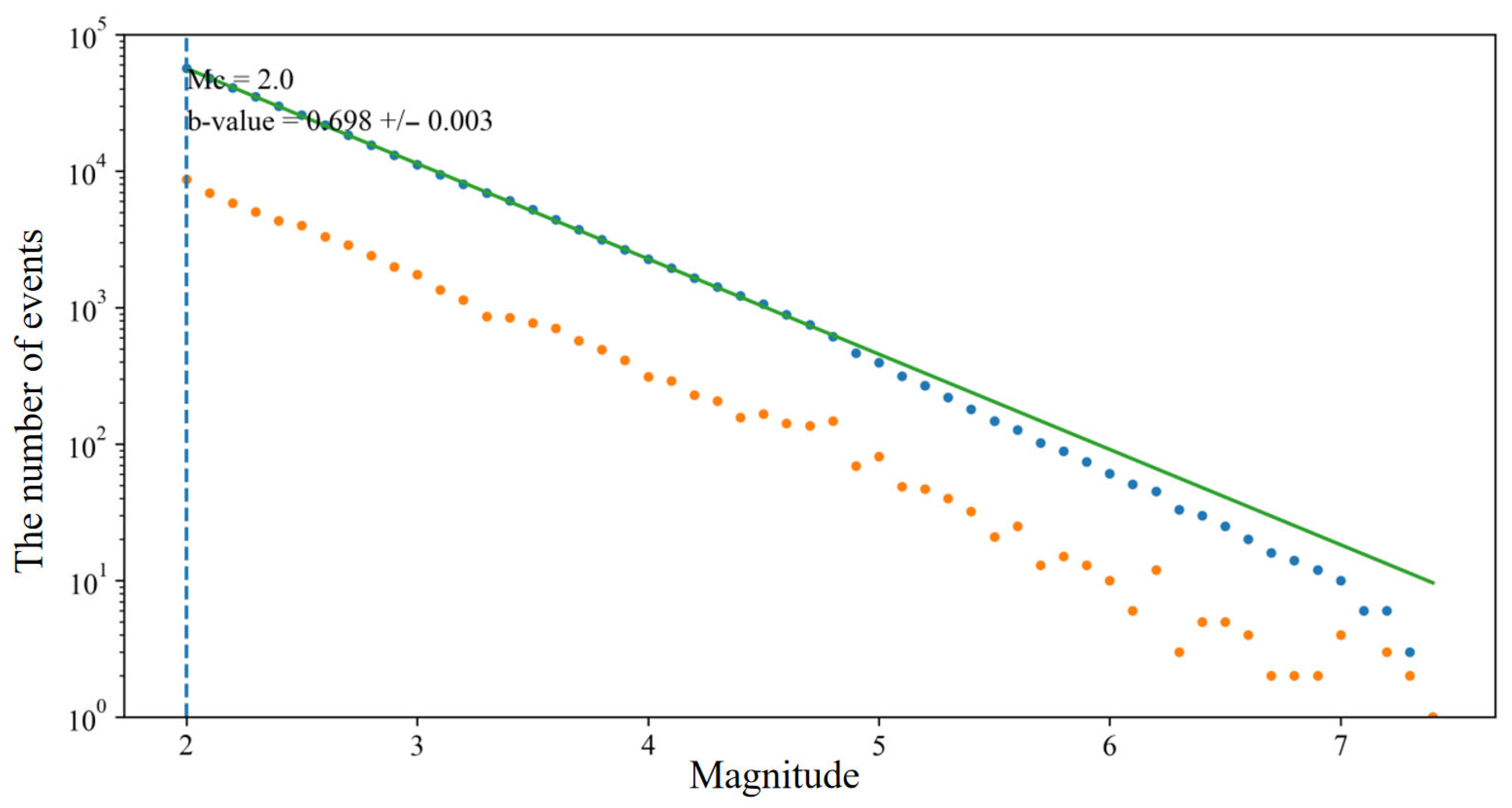
2.1. Estimating Completeness Magnitude
2.2. Seismic Indicators
2.3. Analytical Methods and Metric
3. Results and Discussion
3.1. Comparison of Feature Extraction Based on Longitude-Latitude Grid Division and Seismic Prediction Zoning
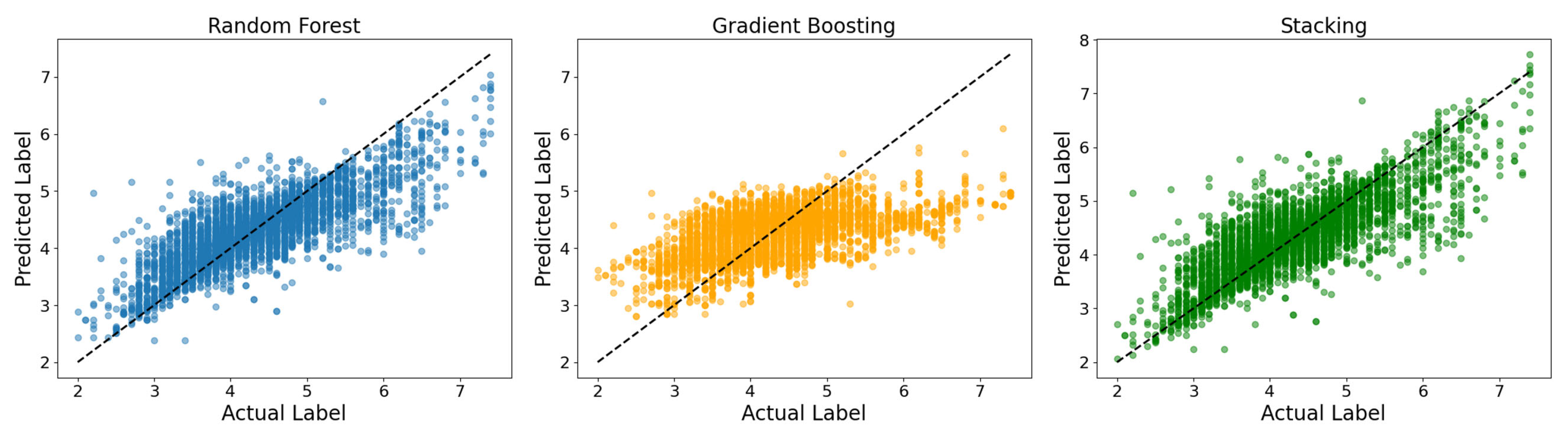
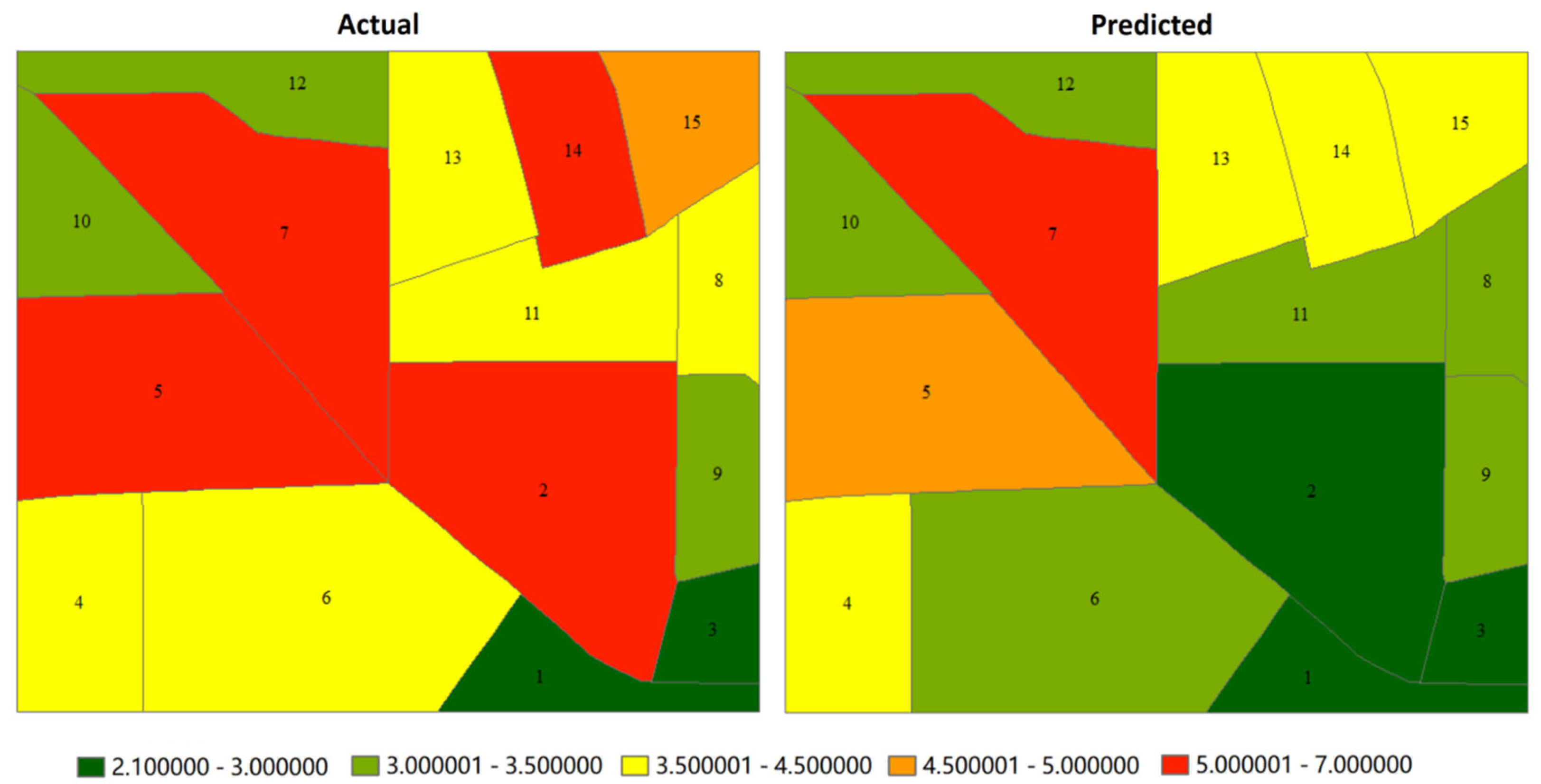
3.2. Comparative Analysis of Machine Learning Methods Based on Different Seismic Prediction Regions
4. Conclusions
Author Contributions
Funding
Institutional Review Board Statement
Informed Consent Statement
Data Availability Statement
Acknowledgments
Conflicts of Interest
References
- Meng, L.Y.; Hu, F.; Zang, Y.; Zhang, Q.; Li, M. Introduction to the Artificial Intelligence Earthquake Prediction Models in Sichuan–Yunnan Region. J. Seismol. Res. 2026, 49, 43–50. [Google Scholar]
- Gutenberg, B.; Richter, C.F. Earthquake Magnitude, Intensity, Energy, and Acceleration. Bull. Seismol. Soc. Am. 1942, 32, 163–191. [Google Scholar] [CrossRef]
- Aslam, B.; Zafar, A.; Qureshi, U.A.; Ahmad, R.; Ali, M.; Khan, S. Seismic Investigation of the Northern Part of Pakistan Using Statistical and Neural Network Algorithms. Environ. Earth Sci. 2021, 80, 59. [Google Scholar] [CrossRef]
- Kaftan, I.; Şalk, M.; Şenol, Y. Processing of Earthquake Catalog Data of Western Turkey with Artificial Neural Networks and Adaptive Neuro-Fuzzy Inference System. Arab. J. Geosci. 2017, 10, 243. [Google Scholar] [CrossRef]
- Wang, Q.; Guo, Y.; Yu, L.; Zhang, X.; Chen, J. Earthquake Prediction Based on Spatio-Temporal Data Mining: An LSTM Network Approach. IEEE Trans. Emerg. Top. Comput. 2017, 8, 148–158. [Google Scholar] [CrossRef]
- Shi, X.Y. Research on Earthquake Prediction Based on Machine Learning Regression Algorithms and Its Application in the China Earthquake Scientific Experimentation Site. Ph.D. Thesis, Institute of Earthquake Prediction, China Earthquake Administration, Beijing, China, 2021. [Google Scholar]
- Panakkat, A.; Adeli, H. Neural Network Models for Earthquake Magnitude Prediction Using Multiple Seismicity Indicators. Int. J. Neural Syst. 2007, 17, 13–33. [Google Scholar] [CrossRef]
- Adeli, H.; Panakkat, A. A Probabilistic Neural Network for Earthquake Magnitude Prediction. Neural Netw. 2009, 22, 1018–1024. [Google Scholar] [CrossRef]
- Panakkat, A.; Adeli, H. Recurrent Neural Network for Approximate Earthquake Time and Location Prediction Using Multiple Seismicity Indicators. Comput.-Aided Civ. Infrastruct. Eng. 2009, 24, 280–292. [Google Scholar] [CrossRef]
- Asencio-Cortés, G.; Scitovski, S.; Scitovski, R.; Štambuk, M. Temporal Analysis of Croatian Seismogenic Zones to Improve Earthquake Magnitude Prediction. Earth Sci. Inform. 2017, 10, 303–320. [Google Scholar] [CrossRef]
- Asim, K.M.; Awais, M.; Martínez-Álvarez, F.; Hussain, A.; Ali, S. Seismic Activity Prediction Using Computational Intelligence Techniques in Northern Pakistan. Acta Geophys. 2017, 65, 919–930. [Google Scholar] [CrossRef]
- Asim, K.M.; Idris, A.; Iqbal, T.; Martínez-Álvarez, F.; Hussain, A. Seismic Indicators-Based Earthquake Predictor System Using Genetic Programming and AdaBoost Classification. Soil Dyn. Earthq. Eng. 2018, 111, 1–7. [Google Scholar] [CrossRef]
- Zhou, W.; Dong, H.; Liang, Y. The Deterministic Dendritic Cell Algorithm with Haskell in Earthquake Magnitude Prediction. Earth Sci. Inform. 2020, 13, 447–457. [Google Scholar] [CrossRef]
- Li, L.F.; Shi, Y.L.; Cheng, S. Exploration of Long Short-Term Memory Neural Network in Intermediate Earthquake Forecast: A Case Study in Sichuan–Yunnan Region. Chin. J. Geophys. 2022, 65, 12–25. [Google Scholar]
- Asencio-Cortés, G.; Morales-Esteban, A.; Shang, X.; Martínez-Álvarez, F. Earthquake Prediction in California Using Regression Algorithms and Cloud-Based Big Data Infrastructure. Comput. Geosci. 2018, 115, 198–210. [Google Scholar] [CrossRef]
- Mallouhy, R.; Abou Jaoude, C.; Guyeux, C.; Makhoul, A. Major Earthquake Event Prediction Using Various Machine Learning Algorithms. In Proceedings of the International Conference on Information and Communication Technologies for Disaster Management, Paris, France, 18–20 December 2019; pp. 1–6. [Google Scholar]
- Sadhukhan, B.; Chakraborty, S.; Mukherjee, S. Predicting the Magnitude of an Impending Earthquake Using Deep Learning Techniques. Earth Sci. Inform. 2025, 16, 803–823. [Google Scholar] [CrossRef]
- Florido, E.; Asencio-Cortés, G.; Aznarte, J.L.; Rubio-Escudero, C.; Martínez-Álvarez, F. A Novel Tree-Based Algorithm to Discover Seismic Patterns in Earthquake Catalogs. Comput. Geosci. 2018, 115, 96–104. [Google Scholar] [CrossRef]
- Wang, X.; Zhong, Z.Y.; Yao, Y.C.; Li, Z.; Zhou, S.H.; Jiang, C.C.; Jia, K. Small Earthquakes Can Help Predict Large Earthquakes: A Machine Learning Perspective. Appl. Sci. 2023, 13, 6424. [Google Scholar] [CrossRef]
- Jiang, H.K.; Li, Y.L.; Qu, Y.J.; Zhao, X.W.; Chen, P.; Zhang, M. Spatial Distribution Characteristics of Sequence Types for Moderate–Strong Earthquakes in the Chinese Mainland. Acta Seismol. Sin. 2006, 28, 389–398. [Google Scholar]
- Wiemer, S.; Wyss, M. Minimum Magnitude of Completeness in Earthquake Catalogs: Examples from Alaska, the Western United States, and Japan. Bull. Seismol. Soc. Am. 2000, 90, 859–869. [Google Scholar] [CrossRef]
- Wiemer, S. A Software Package to Analyze Seismicity: ZMAP. Seismol. Res. Lett. 2001, 72, 373–382. [Google Scholar] [CrossRef]
- Su, Y.J.; Li, Y.L.; Li, Z.H.; Yi, G.X.; Liu, L.F. Analysis of the Minimum Magnitude of Completeness for Regional Earthquake Catalogs in the Sichuan–Yunnan Region. J. Seismol. Res. 2003, 26 (Suppl. 1), 7–15. [Google Scholar]
- Mignan, A.; Woessner, J. Estimating the Magnitude of Completeness for Earthquake Catalogs; Community Online Resource for Statistical Seismicity Analysis (CORSSA). 2012. Available online: https://www.researchgate.net/publication/285715153_Estimating_the_magnitude_of_completeness_for_earthquake_catalogs (accessed on 20 October 2025).
- Martínez-Álvarez, F.; Reyes, J.; Morales-Esteban, A.; Rubio-Escudero, C. Determining the Best Set of Seismicity Indicators to Predict Earthquakes: Two Case Studies—Chile and the Iberian Peninsula. Knowl.-Based Syst. 2013, 50, 198–210. [Google Scholar] [CrossRef]
- Breiman, L. Random Forests. Mach. Learn. 2001, 45, 5–32. [Google Scholar] [CrossRef]
- Friedman, J.H. Greedy Function Approximation: A Gradient Boosting Machine. Ann. Stat. 2001, 29, 1189–1232. [Google Scholar] [CrossRef]
- Wolpert, D.H. Stacked Generalization. Neural Netw. 1992, 5, 241–259. [Google Scholar] [CrossRef]
- Hochreiter, S.; Schmidhuber, J. Long Short-Term Memory. Neural Comput. 1997, 9, 1735–1780. [Google Scholar] [CrossRef]
- Bickel, P.J.; Doksum, K.A. Mathematical Statistics: Basic Ideas and Selected Topics, 2nd ed.; Pearson Education: London, UK, 2015; Volume 1, p. 20. [Google Scholar]
- Wright, S. Correlation and Causation. J. Agric. Res. 1921, 20, 557–585. [Google Scholar]





| Indicators | Description | Mathematical Expression |
|---|---|---|
| Seismic frequency | ||
| Mean magnitude | ||
| Slope of the G-R relation | ||
| Intercept of the G-R relation | ||
| Magnitude difference | ||
| Release rate of the square root | ||
| Root mean square of the regression line | ||
| Mean recurrence interval |
| Methods | Longitude-Latitude Grid | Seismotectonic Zoning | ||
|---|---|---|---|---|
| Metrics | MSE | R-Squared | MSE | R-Squared |
| Random Forest Regressor | 0.2262 | 0.6561 | 0.167303 | 0.787097 |
| Gradient Boosting Regressor | 0.4694 | 0.2864 | 0.362549 | 0.538635 |
| Stacking Regressor | 0.2087 | 0.6827 | 0.202732 | 0.742012 |
| Region No | LSTM_MSE | Stacking_MSE | SumN |
|---|---|---|---|
| 1 | 3.460 | 1.074 | 4583 |
| 2 | 0.616 | 0.606 | 128,796 |
| 4 | 0.897 | 1.074 | 14,845 |
| 5 | 0.150 | 0.345 | 241,582 |
| 6 | 0.866 | 1.102 | 219,911 |
| 7 | 0.852 | 1.403 | 222,303 |
| 8 | 1.380 | 0.999 | 3159 |
| 9 | 0.239 | 0.255 | 5377 |
| 10 | 0.793 | 0.608 | 11,270 |
| 11 | 0.499 | 0.501 | 68,456 |
| 12 | 0.553 | 0.524 | 34,621 |
| 13 | 0.540 | 0.210 | 45,436 |
| 14 | 0.451 | 0.484 | 55,671 |
| 15 | 1.915 | 0.810 | 85,196 |
Disclaimer/Publisher’s Note: The statements, opinions and data contained in all publications are solely those of the individual author(s) and contributor(s) and not of MDPI and/or the editor(s). MDPI and/or the editor(s) disclaim responsibility for any injury to people or property resulting from any ideas, methods, instructions or products referred to in the content. |
© 2025 by the authors. Licensee MDPI, Basel, Switzerland. This article is an open access article distributed under the terms and conditions of the Creative Commons Attribution (CC BY) license (https://creativecommons.org/licenses/by/4.0/).
Share and Cite
Chen, X.; Peng, D.; Li, L. Forecasting Future Earthquakes with Machine Learning Models Based on Seismic Prediction Zoning. Appl. Sci. 2025, 15, 13116. https://doi.org/10.3390/app152413116
Chen X, Peng D, Li L. Forecasting Future Earthquakes with Machine Learning Models Based on Seismic Prediction Zoning. Applied Sciences. 2025; 15(24):13116. https://doi.org/10.3390/app152413116
Chicago/Turabian StyleChen, Xiaolin, Daicheng Peng, and Li Li. 2025. "Forecasting Future Earthquakes with Machine Learning Models Based on Seismic Prediction Zoning" Applied Sciences 15, no. 24: 13116. https://doi.org/10.3390/app152413116
APA StyleChen, X., Peng, D., & Li, L. (2025). Forecasting Future Earthquakes with Machine Learning Models Based on Seismic Prediction Zoning. Applied Sciences, 15(24), 13116. https://doi.org/10.3390/app152413116