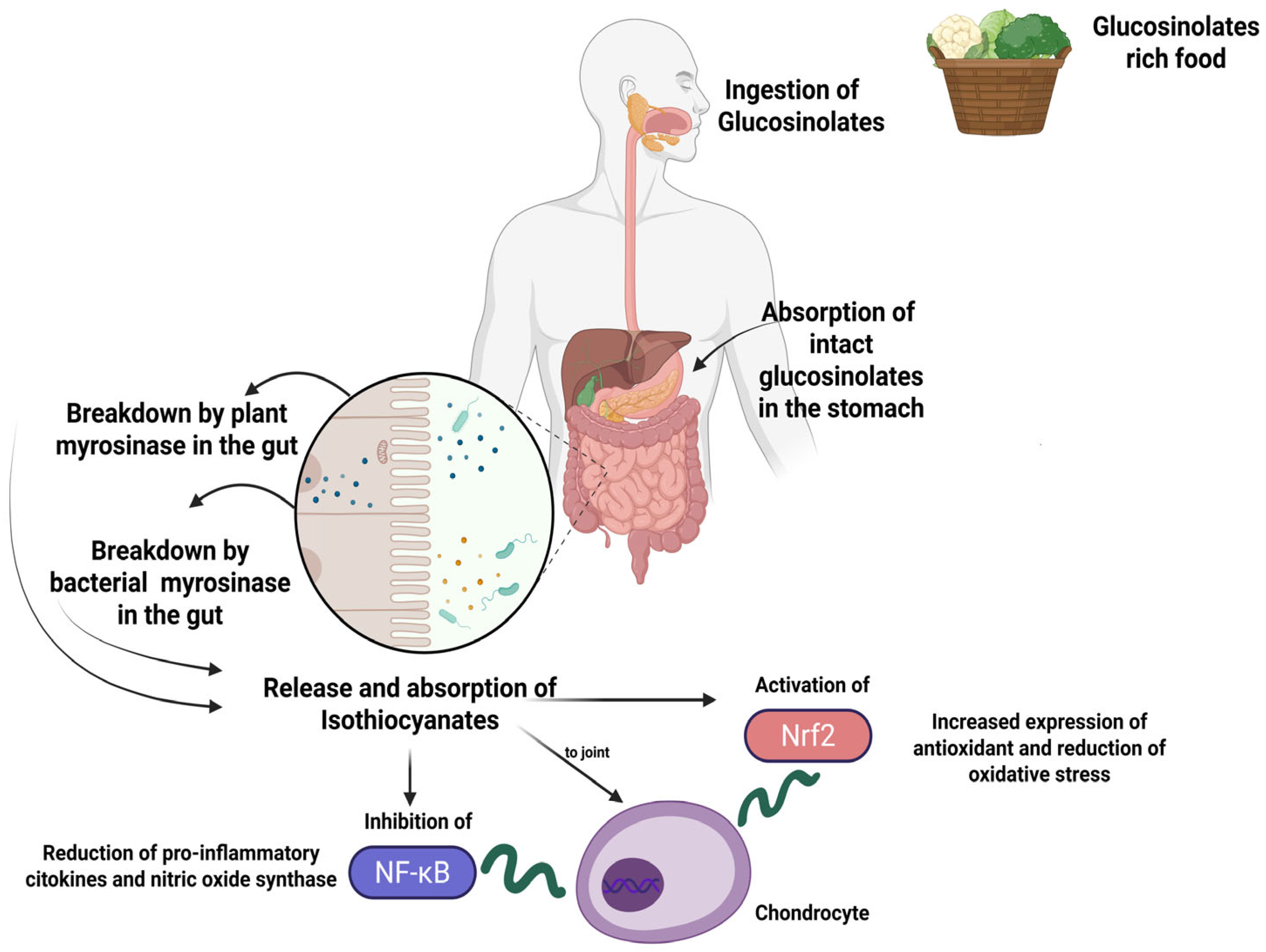


Role of Dietary Glucosinolates and Isothiocyanate Derivatives in Osteoarthritis: Insights from a Narrative Review

 , , , , ,
  and
and 
Abstract
1. Introduction
2. Methods
3. Glucosinolates
3.1. Chemical Structure and Classification
3.2. Biosynthesis, Storage, and Degradation
3.3. Natural Occurrence
3.4. Breakdown Products of Glucosinolates
3.5. Bioavailability and Absorption
4. Results from Literature Search
5. Mechanisms of Action and Role of GLS-Derived ITC Intake in OA
5.1. In Vitro Studies
5.2. In Vivo Studies
5.3. Clinical Studies
6. Challenges and Prospects
Author Contributions
Funding
Institutional Review Board Statement
Informed Consent Statement
Data Availability Statement
Conflicts of Interest
References
- Martel-Pelletier, J.; Barr, A.J.; Cicuttini, F.M.; Conaghan, P.G.; Cooper, C.; Goldring, M.B.; Goldring, S.R.; Jones, G.; Teichtahl, A.J.; Pelletier, J.P. Osteoarthritis. Nat. Rev. Dis. Primers 2016, 2, 16072. [Google Scholar] [CrossRef] [PubMed]
- Glyn-Jones, S.; Palmer, A.J.R.; Agricola, R.; Price, A.J.; Vincent, T.L.; Weinans, H.; Carr, A.J. Osteoarthritis. Lancet 2015, 386, 376–387. [Google Scholar] [CrossRef]
- Herrero-Beaumont, G.; Castro-Dominguez, F.; Migliore, A.; Naredo, E.; Largo, R.; Reginster, J.Y. Systemic Osteoarthritis: The Difficulty of Categorically Naming a Continuous Condition. Aging Clin. Exp. Res. 2024, 36, 45. [Google Scholar] [CrossRef]
- Sinusas, K. Osteoarthritis: Diagnosis and Treatment. Am. Fam. Physician 2012, 85, 49–56. [Google Scholar]
- Sullivan, S.W.; Aladesuru, O.M.; Ranawat, A.S.; Nwachukwu, B.U. The Use of Biologics to Improve Patient-Reported Outcomes in Hip Preservation. J. Hip Preserv. Surg. 2021, 8, 3–13. [Google Scholar] [CrossRef]
- Zaffagnini, M.; Boffa, A.; Andriolo, L.; Raggi, F.; Zaffagnini, S.; Filardo, G. Orthobiologic Injections for the Treatment of Hip Osteoarthritis: A Systematic Review. J. Clin. Med. 2022, 11, 6663. [Google Scholar] [CrossRef]
- Budhiparama, N.C.; Putramega, D.; Lumban-Gaol, I. Orthobiologics in Knee Osteoarthritis, Dream or Reality? Arch. Orthop. Trauma Surg. 2024, 144, 3937–3946. [Google Scholar] [CrossRef]
- Majdan, M.; Bobrowska-Korczak, B. Active Compounds in Fruits and Inflammation in the Body. Nutrients 2022, 14, 2496. [Google Scholar] [CrossRef] [PubMed]
- Ameye, L.G.; Chee, W.S.S. Osteoarthritis and Nutrition. From Nutraceuticals to Functional Foods: A Systematic Review of the Scientific Evidence. Arthritis Res. Ther. 2006, 8, R127. [Google Scholar] [CrossRef] [PubMed]
- Lapane, K.L.; Sands, M.R.; Yang, S.; McAlindon, T.E.; Eaton, C.B. Use of Complementary and Alternative Medicine among Patients with Radiographic-Confirmed Knee Osteoarthritis. Osteoarthr. Cartil. 2012, 20, 22–28. [Google Scholar] [CrossRef]
- Buck, A.N.; Shultz, S.P.; Huffman, K.F.; Vincent, H.K.; Batsis, J.A.; Newman, C.B.; Beresic, N.; Abbate, L.M.; Callahan, L.F. Mind the Gap: Exploring Nutritional Health Compared With Weight Management Interests of Individuals with Osteoarthritis. Nutr. Health Interests People OA 2022, 6, nzac084. [Google Scholar] [CrossRef] [PubMed]
- Loeser, R.F.; Beavers, D.P.; Bay-Jensen, A.C.; Karsdal, M.A.; Nicklas, B.J.; Guermazi, A.; Hunter, D.J.; Messier, S.P. Effects of Dietary Weight Loss with and without Exercise on Interstitial Matrix Turnover and Tissue Inflammation Biomarkers in Adults with Knee Osteoarthritis: The Intensive Diet and Exercise for Arthritis Trial (IDEA). Osteoarthr. Cartil. 2017, 25, 1822–1828. [Google Scholar] [CrossRef]
- Basu, A.; Schell, J.; Scofield, R.H. Dietary Fruits and Arthritis. Food Funct. 2018, 9, 70–77. [Google Scholar] [CrossRef]
- Veronese, N.; Stubbs, B.; Noale, M.; Solmi, M.; Luchini, C.; Maggi, S. Adherence to the Mediterranean Diet Is Associated with Better Quality of Life: Data from the Osteoarthritis Initiative. Am. J. Clin. Nutr. 2016, 104, 1403–1409. [Google Scholar] [CrossRef]
- Rashidinejad, A. The Road Ahead for Functional Foods: Promising Opportunities amidst Industry Challenges. Future Postharvest Food 2024, 1, 266–273. [Google Scholar] [CrossRef]
- Shirodkar, S.; Khanchey, F.; Babre, N. Role of Functional Foods and Nutraceuticals in Nutrition and Health. Acad. Nutr. Diet. 2025, 2, 1–21. [Google Scholar] [CrossRef]
- Morales-Ivorra, I.; Romera-Baures, M.; Roman-Viñas, B.; Serra-Majem, L. Osteoarthritis and the Mediterranean Diet: A Systematic Review. Nutrients 2018, 10, 1030. [Google Scholar] [CrossRef]
- Kapusta-Duch, J.; Kopeć, A.; Piątkowska, E.; Borczak, B. The Beneficial Effects of Brassica Vegetables on Human Health. Rocz. Państwowego Zakładu Hig. 2012, 63, 389–395. [Google Scholar]
- German, D.A.; Hendriks, K.P.; Koch, M.A.; Lens, F.; Lysak, M.A.; Bailey, C.D.; Mummenhoff, K.; Al-Shehbaz, I.A. An Updated Classification of the Brassicaceae (Cruciferae). PhytoKeys 2023, 220, 127–144. [Google Scholar] [CrossRef]
- Baldelli, S.; Lombardo, M.; D’Amato, A.; Karav, S.; Tripodi, G.; Aiello, G. Glucosinolates in Human Health: Metabolic Pathways, Bioavailability, and Potential in Chronic Disease Prevention. Foods 2025, 14, 912. [Google Scholar] [CrossRef]
- Devkota, H.P. Analysis of Glucosinolates. In Recent Advances in Natural Products Analysis; Elsevier BV: Amsterdam, The Netherlands, 2020; pp. 651–661. [Google Scholar] [CrossRef]
- Feng, X.; Ma, J.; Liu, Z.; Li, X.; Wu, Y.; Hou, L.; Li, M. Analysis of Glucosinolate Content and Metabolism Related Genes in Different Parts of Chinese Flowering Cabbage. Front. Plant Sci. 2022, 12, 767898. [Google Scholar] [CrossRef]
- Thinh Nguyen, V.P.; Stewart, J.; Lopez, M.; Ioannou, I.; Allais, F. Glucosinolates: Natural Occurrence, Biosynthesis, Accessibility, Isolation, Structures, and Biological Activities. Molecules 2020, 25, 4537. [Google Scholar] [CrossRef]
- Mitreiter, S.; Gigolashvili, T. Regulation of Glucosinolate Biosynthesis. J. Exp. Bot. 2021, 72, 70–91. [Google Scholar] [CrossRef]
- Abdel-Massih, R.M.; Debs, E.; Othman, L.; Attieh, J.; Cabrerizo, F.M. Glucosinolates, a Natural Chemical Arsenal: More to Tell than the Myrosinase Story. Front. Microbiol. 2023, 14, 1130208. [Google Scholar] [CrossRef]
- Blažević, I.; Montaut, S.; Burčul, F.; Olsen, C.E.; Burow, M.; Rollin, P.; Agerbirk, N. Glucosinolate Structural Diversity, Identification, Chemical Synthesis and Metabolism in Plants. Phytochemistry 2020, 169, 112100. [Google Scholar] [CrossRef]
- Aǧagündüz, D.; Şahin, T.Ö.; Yilmaz, B.; Ekenci, K.D.; Duyar Özer, Ş.; Capasso, R. Cruciferous Vegetables and Their Bioactive Metabolites: From Prevention to Novel Therapies of Colorectal Cancer. Evid.-Based Complement. Altern. Med. 2022, 2022, 1534083. [Google Scholar]
- Cartea, M.E.; Velasco, P. Glucosinolates in Brassica Foods: Bioavailability in Food and Significance for Human Health. Phytochem. Rev. 2008, 7, 213–229. [Google Scholar] [CrossRef]
- Sones, K.; Heaney, R.K.; Fenwick, G.R. Glucosinolates in Brassica Vegetables. Analysis of Twenty-Seven Cauliflower Cultivars (Brassica oleracea L. Var. botrytis Subvar. Cauliflora DC). J. Sci. Food Agric. 1984, 35, 762–766. [Google Scholar] [CrossRef]
- Lewis, J.; Fenwick, G.R. Glucosinolate Content of Brassica Vegetables: Analysis of Twenty-Four Cultivars of Calabrese (Green Sprouting Broccoli, Brassica oleracea L. Var. botrytis Subvar. cymosa Lam.). Food Chem. 1987, 25, 259–268. [Google Scholar] [CrossRef]
- Williams, D.J.; Critchley, C.; Pun, S.; Chaliha, M.; O’Hare, T.J. Differing Mechanisms of Simple Nitrile Formation on Glucosinolate Degradation in Lepidium Sativum and Nasturtium Officinale Seeds. Phytochemistry 2009, 70, 1401–1409. [Google Scholar] [CrossRef]
- Bell, L.; Oruna-Concha, M.J.; Wagstaff, C. Identification and Quantification of Glucosinolate and Flavonol Compounds in Rocket Salad (Eruca sativa, Eruca vesicaria and Diplotaxis tenuifolia) by LC-MS: Highlighting the Potential for Improving Nutritional Value of Rocket Crops. Food Chem. 2015, 172, 852–861. [Google Scholar] [CrossRef]
- Brindisi, L.J.; Lyu, W.; Juliani, H.R.; Wu, Q.; Tepper, B.J.; Simon, J.E. Determination of Glucosinolates and Breakdown Products in Brassicaceae Baby Leafy Greens Using UHPLC-QTOF/MS and GC/MS. Food Chem. Adv. 2023, 3, 100389. [Google Scholar] [CrossRef]
- Kim, S.H.; Ochar, K.; Hwang, A.; Lee, Y.J.; Kang, H.J. Variability of Glucosinolates in Pak Choy (Brassica rapa Subsp. chinensis) Germplasm. Plants 2024, 13, 9. [Google Scholar] [CrossRef] [PubMed]
- Uda, Y.; Ozawa, Y.; Maeda, Y. Volatile Isothiocyanates of Cruciferous vegetables introduced from China. J. Agric. Chem. Soc. Jpn. 1982, 56, 1057–1060. [Google Scholar]
- Gudiño, I.; Casquete, R.; Martín, A.; Wu, Y.; Benito, M.J. Comprehensive Analysis of Bioactive Compounds, Functional Properties, and Applications of Broccoli By-Products. Foods 2024, 13, 3918. [Google Scholar] [CrossRef] [PubMed]
- Ciska, E.; Drabińska, N.; Honke, J.; Narwojsz, A. Boiled Brussels Sprouts: A Rich Source of Glucosinolates and the Corresponding Nitriles. J. Funct. Foods 2015, 19, 91–99. [Google Scholar] [CrossRef]
- Wermter, N.S.; Rohn, S.; Hanschen, F.S. Seasonal Variation of Glucosinolate Hydrolysis Products in Commercial White and Red Cabbages (Brassica oleracea Var. capitata). Foods 2020, 9, 1682. [Google Scholar] [CrossRef]
- Abellán, Á.; Domínguez-Perles, R.; García-Viguera, C.; Moreno, D.A. Evidence on the Bioaccessibility of Glucosinolates and Breakdown Products of Cruciferous Sprouts by Simulated in Vitro Gastrointestinal Digestion. Int. J. Mol. Sci. 2021, 22, 11046. [Google Scholar] [CrossRef]
- Oloyede, O.O.; Wagstaff, C.; Methven, L. Influence of Cabbage (Brassica Oleracea) Accession and Growing Conditions on Myrosinase Activity, Glucosinolates and Their Hydrolysis Products. Foods 2021, 10, 2903. [Google Scholar] [CrossRef]
- Lee, J.W.; Kim, I.H.; Woyengo, T.A. Toxicity of Canola-Derived Glucosinolate Degradation Products in Pigs—A Review. Animals 2020, 10, 2337. [Google Scholar] [CrossRef]
- Yousefi, E.; Abedi, M.; Aghajanzadeh, T.A.; Moreno, D.A. Caper Bush (Capparis spinosa L.) Bioactive Compounds and Antioxidant Capacity as Affected by Adaptation to Harsh Soils. Sci. Rep. 2025, 15, 11893. [Google Scholar] [CrossRef]
- Đulović, A.; Burčul, F.; Čikeš Čulić, V.; Rollin, P.; Blažević, I. Glucosinolates and Cytotoxic Activity of Collard Volatiles Obtained Using Microwave-Assisted Extraction. Molecules 2023, 28, 1657. [Google Scholar] [CrossRef]
- Qinghang, W.; Zhang, C.; Zhang, J.; Xin, X.; Li, T.; He, C.; Zhao, S.; Liu, D. Variation in Glucosinolates and the Formation of Functional Degradation Products in Two Brassica Species during Spontaneous Fermentation. Curr. Res. Food Sci. 2023, 6, 100493. [Google Scholar] [CrossRef]
- Kim, S.H.; Ochar, K.; Iwar, K.; Lee, Y.J.; Kang, H.J.; Na, Y.W. Variations of Major Glucosinolates in Diverse Chinese Cabbage (Brassica rapa Ssp. pekinensis) Germplasm as Analyzed by UPLC-ESI-MS/MS. Int. J. Mol. Sci. 2024, 25, 4829. [Google Scholar] [CrossRef]
- Popović, M.; Maravić, A.; Čulić, V.Č.; Đulović, A.; Burčul, F.; Blažević, I. Biological Effects of Glucosinolate Degradation Products from Horseradish: A Horse That Wins the Race. Biomolecules 2020, 10, 343. [Google Scholar] [CrossRef]
- Mbudu, K.G.; Witzel, K.; Börnke, F.; Hanschen, F.S. Glucosinolate Profile and Specifier Protein Activity Determine the Glucosinolate Hydrolysis Product Formation in Kohlrabi (Brassica oleracea Var. gongylodes) in a Tissue-Specific Way. Food Chem. 2025, 465, 142032. [Google Scholar] [CrossRef] [PubMed]
- Lietzow, J. Biologically Active Compounds in Mustard Seeds: A Toxicological Perspective. Foods 2021, 10, 2089. [Google Scholar] [CrossRef] [PubMed]
- Chen, C.; Kim, R.H.; Hwang, K.T.; Kim, J. Chemical Compounds and Bioactivities of the Extracts from Radish (Raphanus sativus) Sprouts Exposed to Red and Blue Light-Emitting Diodes during Cultivation. Eur. Food Res. Technol. 2023, 249, 1551–1562. [Google Scholar] [CrossRef]
- Barbieri, G.; Pernice, R.; Maggio, A.; De Pascale, S.; Fogliano, V. Glucosinolates Profile of Brassica rapa L. subsp. Sylvestris L. Janch. var. esculenta Hort. Food Chem. 2008, 107, 1687–1691. [Google Scholar] [CrossRef]
- Chong, C.; Ju, H.-Y.; Bible Bernard, B. Glucosinolate Composition of Turnip and Rutabaga Cultivars. Can. J. Plant Sci. 1981, 62, 533–536. [Google Scholar] [CrossRef]
- Greer, M.A. Isolation from Rutabaga Seed of Progoitrin, the Precursor of the Naturally Occurring Antithyroid Compound, Goitrin (L-5-Vinyl-2-Thiooxazolidone). J. Am. Chem. Soc. 1956, 78, 1260–1261. [Google Scholar] [CrossRef]
- Cole, R.A. Epithiospecifier Protein in Turnip and Changes in Products of Autolysis during Ontogeny. Phytochemistry 1978, 17, 1563–1565. [Google Scholar] [CrossRef]
- Kim, S.J.; Ishida, M.; Matsuo, T.; Watanabe, M.; Watanabe, Y. Separation and Identification of Glucosinolates of Vegetable Turnip Rape by LC/APCI-MS and Comparison of Their Contents in Ten Cultivars of Vegetable Turnip Rape (Brassica rapa L.). Soil. Sci. Plant Nutr. 2001, 47, 167–177. [Google Scholar] [CrossRef]
- Lockhart, J. Methionine-Derived Glucosinolates: The Compounds That Give Brassicas Their Bite. Plant Cell 2019, 31, 1429. [Google Scholar] [CrossRef]
- Barba, F.J.; Nikmaram, N.; Roohinejad, S.; Khelfa, A.; Zhu, Z.; Koubaa, M. Bioavailability of Glucosinolates and Their Breakdown Products: Impact of Processing. Front. Nutr. 2016, 3, 24. [Google Scholar] [CrossRef]
- Sikorska-Zimny, K.; Beneduce, L. The Metabolism of Glucosinolates by Gut Microbiota. Nutrients 2021, 13, 2750. [Google Scholar] [CrossRef]
- Costa-Pérez, A.; Núñez-Gómez, V.; Baenas, N.; Di Pede, G.; Achour, M.; Manach, C.; Mena, P.; Del Rio, D.; García-Viguera, C.; Moreno, D.A.; et al. Systematic Review on the Metabolic Interest of Glucosinolates and Their Bioactive Derivatives for Human Health. Nutrients 2023, 15, 1424. [Google Scholar] [CrossRef]
- Casajùs, V.; Howe, K.; Fish, T.; Civello, P.; Thannhauser, T.; Li, L.; Lobato, M.G.; Martinez, G. Modified Atmosphere Affects Glucosinolate Metabolism during Postharvest Storage of Broccoli. Food Sci. Technol. 2024, 44, 56–65. [Google Scholar] [CrossRef]
- Blekkenhorst, L.C.; Hodgson, J.M.; Lewis, J.R.; Devine, A.; Woodman, R.J.; Lim, W.H.; Wong, G.; Zhu, K.; Bondonno, C.P.; Ward, N.C.; et al. Vegetable and Fruit Intake and Fracture-Related Hospitalisations: A Prospective Study of Olderwomen. Nutrients 2017, 9, 511. [Google Scholar] [CrossRef]
- Sim, M.; Blekkenhorst, L.C.; Lewis, J.R.; Bondonno, C.P.; Devine, A.; Zhu, K.; Woodman, R.J.; Prince, R.L.; Hodgson, J.M. Vegetable and Fruit Intake and Injurious Falls Risk in Older Women: A Prospective Cohort Study. Br. J. Nutr. 2018, 120, 925–934. [Google Scholar] [CrossRef] [PubMed]
- Davidson, R.K.; Jupp, O.; De Ferrars, R.; Kay, C.D.; Culley, K.L.; Norton, R.; Driscoll, C.; Vincent, T.L.; Donell, S.T.; Bao, Y.; et al. Sulforaphane Represses Matrix-Degrading Proteases and Protects Cartilage from Destruction in Vitro and in Vivo. Arthritis Rheum. 2013, 65, 3130–3140. [Google Scholar] [CrossRef]
- Rapposelli, S.; Gambari, L.; Digiacomo, M.; Citi, V.; Lisignoli, G.; Manferdini, C.; Calderone, V.; Grassi, F. A Novel H2S-Releasing Amino-Bisphosphonate Which Combines Bone Anti-Catabolic and Anabolic Functions. Sci. Rep. 2017, 7, 11940. [Google Scholar] [CrossRef]
- Kim, H.A.; Yeo, Y.; Kim, W.U.; Kim, S. Phase 2 Enzyme Inducer Sulphoraphane Blocks Matrix Metalloproteinase Production in Articular Chondrocytes. Rheumatology 2009, 48, 932–938. [Google Scholar] [CrossRef][Green Version]
- Chen, M.; Huang, L.; Lv, Y.; Li, L.; Dong, Q. Sulforaphane Protects against Oxidative Stress-Induced Apoptosis via Activating SIRT1 in Mouse Osteoarthritis. Mol. Med. Rep. 2021, 24, 612. [Google Scholar] [CrossRef]
- Morris, B.J. Seven Sirtuins for Seven Deadly Diseases Ofaging. Free Radic. Biol. Med. 2013, 56, 133–171. [Google Scholar] [CrossRef]
- Ko, J.Y.; Choi, Y.J.; Jeong, G.J.; Im, G. Il Sulforaphane-PLGA Microspheres for the Intra-Articular Treatment of Osteoarthritis. Biomaterials 2013, 34, 5359–5368. [Google Scholar] [CrossRef]
- Javaheri, B.; Poulet, B.; Aljazzar, A.; de Souza, R.; Piles, M.; Hopkinson, M.; Shervill, E.; Pollard, A.; Chan, B.; Chang, Y.M.; et al. Stable Sulforaphane Protects against Gait Anomalies and Modifies Bone Microarchitecture in the Spontaneous STR/Ort Model of Osteoarthritis. Bone 2017, 103, 308–317. [Google Scholar] [CrossRef] [PubMed]
- Redondo, A.; Chamorro, P.A.F.; Riego, G.; Leánez, S.; Pol, O. Treatment with Sulforaphane Produces Antinociception and Improves Morphine Effects during Inflammatory Pain in Mice. J. Pharmacol. Exp. Ther. 2017, 363, 293–302. [Google Scholar] [CrossRef] [PubMed]
- Davidson, R.K.; Watts, L.; Beasy, G.; Saha, S.; Kroon, P.; Cassidy, A.; Clark, A.; Fraser, W.; Mcnamara, I.; Kingsbury, S.R.; et al. The BRoccoli In Osteoarthritis (BRIO Study)—A Randomised Controlled Feasibility Trial to Examine the Potential Protective Effect of Broccoli Bioactives, (Specifically Sulforaphane), on Osteoarthritis. medRxiv 2024. [Google Scholar] [CrossRef]
- Davidson, R.; Gardner, S.; Jupp, O.; Bullough, A.; Butters, S.; Watts, L.; Donell, S.; Traka, M.; Saha, S.; Mithen, R.; et al. Isothiocyanates Are Detected in Human Synovial Fluid Following Broccoli Consumption and Can Affect the Tissues of the Knee Joint. Sci. Rep. 2017, 7, 3398. [Google Scholar] [CrossRef]
- Connolly, E.L.; Sim, M.; Travica, N.; Marx, W.; Beasy, G.; Lynch, G.S.; Bondonno, C.P.; Lewis, J.R.; Hodgson, J.M.; Blekkenhorst, L.C. Glucosinolates From Cruciferous Vegetables and Their Potential Role in Chronic Disease: Investigating the Preclinical and Clinical Evidence. Front. Pharmacol. 2021, 12, 767975. [Google Scholar] [CrossRef] [PubMed]
- Ruiz-Alcaraz, A.J.; Martínez-Sánchez, M.A.; García-Peñarrubia, P.; Martinez-Esparza, M.; Ramos-Molina, B.; Moreno, D.A. Analysis of the Anti-Inflammatory Potential of Brassica Bioactive Compounds in a Human Macrophage-like Cell Model Derived from HL-60 Cells. Biomed. Pharmacother. 2022, 149, 112804. [Google Scholar] [CrossRef] [PubMed]
- Zhu, W.; Cremonini, E.; Mastaloudis, A.; Oteiza, P.I. Glucoraphanin and Sulforaphane Mitigate TNFα-Induced Caco-2 Monolayers Permeabilization and Inflammation. Redox Biol. 2024, 76, 103359. [Google Scholar] [CrossRef]
- Lee, H.W.; Lee, C.G.; Rhee, D.K.; Um, S.H.; Pyo, S. Sinigrin Inhibits Production of Inflammatory Mediators by Suppressing NF-ΚB/MAPK Pathways or NLRP3 Inflammasome Activation in Macrophages. Int. Immunopharmacol. 2017, 45, 163–173. [Google Scholar] [CrossRef]
- Abdull Razis, A.F.; Bagatta, M.; De Nicola, G.R.; Iori, R.; Ioannides, C. Up-Regulation of Cytochrome P450 and Phase II Enzyme Systems in Rat Precision-Cut Rat Lung Slices by the Intact Glucosinolates, Glucoraphanin and Glucoerucin. Lung Cancer 2011, 71, 298–305. [Google Scholar] [CrossRef]
- Schlotz, N.; Odongo, G.A.; Herz, C.; Waßmer, H.; Kühn, C.; Hanschen, F.S.; Neugart, S.; Binder, N.; Ngwene, B.; Schreiner, M.; et al. Are Raw Brassica Vegetables Healthier than Cooked Ones? A Randomized, Controlled Crossover Intervention Trial on the Health-Promoting Potential of Ethiopian Kale. Nutrients 2018, 10, 1622. [Google Scholar] [CrossRef]
- Gambari, L.; Barone, M.; Amore, E.; Grigolo, B.; Filardo, G.; Iori, R.; Citi, V.; Calderone, V.; Grassi, F. Glucoraphanin Increases Intracellular Hydrogen Sulfide (H2 S) Levels and Stimulates Osteogenic Differentiation in Human Mesenchymal Stromal Cell. Nutrients 2022, 14, 435. [Google Scholar] [CrossRef] [PubMed]
- Gambari, L.; Pagnotta, E.; Ugolini, L.; Righetti, L.; Amore, E.; Grigolo, B.; Filardo, G.; Grassi, F. Insights into Osteogenesis Induced by Crude Brassicaceae Seeds Extracts: A Role for Glucosinolates. Nutrients 2024, 16, 3457. [Google Scholar] [CrossRef]
- MacArthur Clark, J. The 3Rs in Research: A Contemporary Approach to Replacement, Reduction and Refinement. Br. J. Nutr. 2018, 120, S1–S7. [Google Scholar] [CrossRef]
- Li, H.; Wang, J.; Hao, L.; Huang, G. Exploring the Interconnection between Metabolic Dysfunction and Gut Microbiome Dysbiosis in Osteoarthritis: A Narrative Review. Biomedicines 2024, 12, 2182. [Google Scholar] [CrossRef]
- Dmytriv, T.R.; Lushchak, O.; Lushchak, V.I. Glucoraphanin Conversion into Sulforaphane and Related Compounds by Gut Microbiota. Front. Physiol. 2025, 16, 1497566. [Google Scholar] [CrossRef] [PubMed]
- Gilani, G.S.; Xiao, C.W.; Cockell, K.A. Impact of Antinutritional Factors in Food Proteins on the Digestibility of Protein and the Bioavailability of Amino Acids and on Protein Quality. Br. J. Nutr. 2012, 108, S315–S332. [Google Scholar] [CrossRef] [PubMed]
- Lavecchia, T.; Rea, G.; Antonacci, A.; Giardi, M.T. Healthy and Adverse Effects of Plant-Derived Functional Metabolites: The Need of Revealing Their Content and Bioactivity in a Complex Food Matrix. Crit. Rev. Food Sci. Nutr. 2013, 53, 198–213. [Google Scholar] [CrossRef] [PubMed]
- Galanty, A.; Grudzińska, M.; Paździora, W.; Służały, P.; Paśko, P. Do Brassica Vegetables Affect Thyroid Function?—A Comprehensive Systematic Review. Int. J. Mol. Sci. 2024, 25, 3988. [Google Scholar] [CrossRef]
- Hoch, C.C.; Shoykhet, M.; Weiser, T.; Griesbaum, L.; Petry, J.; Hachani, K.; Multhoff, G.; Bashiri Dezfouli, A.; Wollenberg, B. Isothiocyanates in Medicine: A Comprehensive Review on Phenylethyl-, Allyl-, and Benzyl-Isothiocyanates. Pharmacol. Res. 2024, 201, 107107. [Google Scholar] [CrossRef]


| Common Name | Botanical Classification | References |
|---|---|---|
| Arugula (rocket) | Eruca vesicaria ssp 1. Sativa | [27,29,30] |
| Bok/Pak choi | Brassica rapa ssp. Chinensi | [27,29,30] |
| Broccoli | Brassica oleracea convar. botrytis var. cimosa (commonly var. italica) | [27,29,30] |
| Brussels sprouts | Brassica oleracea var. gemmifer | [27,29,30] |
| Cabbage, red | Brassica oleracea convar. capitata var. rubra | [27,29,30] |
| Cabbage, savoy | Brassica oleracea convar. capitata var. sabauda | [27,29,30] |
| Cabbage, white | Brassica oleracea convar. capitata var. alba | [27,29,30] |
| Canola/rapeseed | Brassica napus | [27,29,30] |
| Capers | Capparis spinosa L. subsp. Spinosa 2 | [27,29,30] |
| Collards | Brassica oleracea var. sabellica | [27,29,30] |
| Cauliflower | Brassica. oleracea convar. botrytis var. botrytis | [27,29,30] |
| Chinese cabbage | Brassica rapa ssp. Pekinensis | [27,29,30] |
| Garden cress | Lepidium sativum | [27,29,30,31] |
| Horseradish | Armoracia rusticana | [27,29,30] |
| Kale, red | Brassica oleracea convar. Acephala | [27,29,30] |
| Kohlrabi | Brassica. oleracea var. gongylodes | [27,29,30] |
| Mustard | Brassica nigra and Sinapis alba | [27,29,30] |
| Mustard greens | Brassica juncea | [27,29,30] |
| Portuguese tronchuda cabbage | Brassica oleracea var. costata | [27,29,30] |
| Radish | Raphanus sativus | [27,29,30] |
| Rapini | Brassica rapa subsp. sylvestris var. esculenta. | [27,29,30] |
| Rutabaga | Brassica napus var. napobrassica | [27,29,30] |
| Swede | Brassica napus subsp. Rapifera | [27,29,30] |
| Turnip | Brassica rapa var. rapa | [27,29,30] |
| Wasabi | Eutrema japonica | [27,29,30] |
| Watercres | Nasturtium officinale | [27,29,30] |
| Plant | Main Glucosinolates | Breakdown Products | References |
|---|---|---|---|
| Arugula (rocket) | Glucobarbarin, glucoerucin, glucosativin, glucoiberin, gluconasturtiin, glucoraphanin, and neoglucobrassicin | Erucin, ITCs (4-methylpentyl ITC) | [32,33] |
| Bok/pak choi | Glucobrassicanapine and gluconapine | Not found | [34,35] |
| Broccoli | Glucoraphanin, glucobrassicin, glucoiberin, and gluconapin | Sulforaphane (SFN) from glucoraphanin | [36] |
| Brussels sprouts | Glucobrassicin Sinigrin Glucoiberin Gluconasturtiin | Ascorbigen, Indole-3-carbinol, Indole-3-acetonitrile, 3,3′-Diindolylmethane 3-butenylnitrile 4–methylsulphinyl butanenitrile 2-phenylacetonitrile | [37] |
| Cabbage, red | Glucobrassicin, neoglucobrassicin, glucoerucin, epi/progoitrin, glucoiberin, and glucoraphanin | ITCs: 3-(methylsulfinyl)propyl ITC and 4-(methylsulfinyl)butyl ITC Indoles: 3-indolemethanol derived from glucobrassicin Nitriles: 4-(methylsulfinyl)pentanenitrile Oxazolidine-2-thiones: 5-vinyloxazolidine-2-thione. | [38,39,40] |
| Cabbage, savoy | Glucoiberin, sinigrin, and glucobrassicin, glucoerucin | Iberin and iberin nitrile (glucoiberin hydrolysis products) | [40] |
| Cabbage, white | Epi/progoitrin, glucoiberin, and glucoraphanin | SFN and SFN nitrile (hydrolysis products of glucoraphanin) | [40] |
| Canola (rapeseed) | Progoitrin, glucobrassicin | goitrin, crambene, and epithionitriles from progoitrin indole-3-acetonitrile, thiocyanate, and indole-3-carbinol from glucobrassicin | [41] |
| Capers | Methyl, isopropyl, and sec-butyl ITCs in ripe fruits Indole-3-acetonitrile glycosides in the fruits glucocapparin in shoots, and seeds glucobrassicin, neo-glucobrassicin, and hydroxy-glucobrassicin in leaves glucocapparin in flowers and buds glucobrassicin in leaves, 4-hydroxy glucobrassicin in buds and flowers, neoglucobrassicin in buds and leaves | ITCs and nitriles (from glucocapparin) | [42] |
| Collard | Glucobrassicin, 4-hydroxyglucobrassicin, and 4-methoxyglucobrassicin, glucoiberin and sinigrin | Indole-3-carbinol, indole-3-acetonitrile | [43] |
| Cauliflower | Progoitrin, glucoraphanin, sinigrin, glucobrassicin | ITCs, indole-3-carbinols, nitriles, thiocyanates, and oxazolidine-2-thiones | [44] |
| Chinese cabbage | Gluconapin, glucobrassicanapin, and gluconasturtiin | ITCs (e.g., SFN), epithionitriles, and nitriles | [45] |
| Garden cress | Glucotropaeolin and Gluconasturtiin | phenylacetonitrile, benzyl thiocyanate, and benzyl ITCs | [31] |
| Horseradish | Sinigrin, gluconasturtiin, and glucobrassicin | allyl ITC and 2-phenylethyl ITC | [46] |
| Kale, red | Glucobrassicin, progoitrin, gluconapin, and neoglucobrassicin | butyl ITC and 4-ITC, ITC (4-methylpentyl ITC) | [33] |
| Kohlrabi | 3-(methylthio)propyl GLS 3-(methylsulfinyl)propyl GLS 4-(methylthio)butyl GLS 4-(methylsulfinyl)butyl GLS 2-phenylethyl GLS indol-3-ylmethyl GLS 4-hydroxyindol-3-ylmethyl GLS 1-methoxyindol-3-ylmethyl GLS 4-methoxyindol-3-ylmethyl GLS | 3-(methylthio)propyl, ITC3-(methylthio)propyl ITC 3-(methylsulfinyl)propyl ITC, 4-(methylsulfinyl)butanenitrile 4-(methylthio)butyl ITC, 5-(methylthio)pentanenitrile 4-(methylsulfinyl)butyl ITC, 5-(methylsulfinyl)pentanenitrile 2-phenylethyl ITC, 3-phenylpropionitrile indole-3-acetonitrile 1-methoxyindole-3-acetonitrile | [47] |
| Mustard (seeds) | Sinigrin and sinalbin (seeds, white mustard), | p-hydroxybenzyl ITCT, 2-propenyl ITCs (from sinigrin), and 4-hydroxybenzyl ITCs (from sinalbin) | [48] |
| Mustard greens (leafy green tops) | Sinigrin, gluconapin, gluconasturtiin, neoglucobrassicin, and glucobrassicin | 1-butene, 4-ITC, 4-methylpentyl ITC, allyl thiocyanate, allyl ITC, and phenylethyl ITC | [33] |
| Portuguese tronchuda cabbage | Glucoiberin (3-methylsulfinylpropyl), progoitrin (2-hydroxy-3-butenyl); SIN: sinigrin (2-propenyl); GAL: glucoalysiin (5-methylsulphinylpentyl); GRA: glucoraphanin (4-methylsulphinylbutyl); GNA: gluconapin (3-butenyl); GBN: glucobrassicanapin (4-pentenyl); GIV: Glucoiberverin (3-methylthiopropyl); GBS: glucobrassicin (3-indolylmethyl); NGBS: neoglucobrassicin (1- methoxy-3-indolylmethyl); 4HGBS: 4-hydroxyglucobrassicin (4-hydroxy-3-indolylmethyl); 4MGBS: 4-methoxyglucobrassicin (4-methoxy-3-indolylmethyl), GST: Gluconasturtiin (2-phenylethyl) | ITCs | [28] |
| Radish | Glucoraphasatin and glucoraphanin | SFN | [49] |
| Rapini | Gluconapin and glucobrassicanapin | Not found | [50] |
| Rutabaga | Progoitrin | Goitrin (l-5-vinyl-2-thioöxazolidone) | [51,52] |
| Turnip | Progoitrin, glucoraphanin, sinigrin, gluconapin, and glucobrassicanapin, 4-hydroxyglucobrassicin, glucobrassicin, and gluconasturtiin. |
4,5-epithiopentanenitrile
1-cyano-epithioalkanes | [53,54] |
| Wasabi | Aliphatic methionine-derived GSLs like glucohesperin | 6-(methylsulfinyl) hexyl ITC (6-MSITC) from glucohesperin | [55] |
| Watercres | Gluconasturtiin, glucoibarin, glucohirsutin, and lucotropaeolin | 3-Phenylpropionitrile 2-Phenylethyl ITC | [31] |
Disclaimer/Publisher’s Note: The statements, opinions and data contained in all publications are solely those of the individual author(s) and contributor(s) and not of MDPI and/or the editor(s). MDPI and/or the editor(s) disclaim responsibility for any injury to people or property resulting from any ideas, methods, instructions or products referred to in the content. |
© 2025 by the authors. Licensee MDPI, Basel, Switzerland. This article is an open access article distributed under the terms and conditions of the Creative Commons Attribution (CC BY) license (https://creativecommons.org/licenses/by/4.0/).
Share and Cite
Desando, G.; Gambari, L.; Amore, E.; Borciani, G.; Carpentieri, S.; Grassi, F.; Grigolo, B.; Roseti, L. Role of Dietary Glucosinolates and Isothiocyanate Derivatives in Osteoarthritis: Insights from a Narrative Review. Appl. Sci. 2025, 15, 13025. https://doi.org/10.3390/app152413025
Desando G, Gambari L, Amore E, Borciani G, Carpentieri S, Grassi F, Grigolo B, Roseti L. Role of Dietary Glucosinolates and Isothiocyanate Derivatives in Osteoarthritis: Insights from a Narrative Review. Applied Sciences. 2025; 15(24):13025. https://doi.org/10.3390/app152413025
Chicago/Turabian StyleDesando, Giovanna, Laura Gambari, Emanuela Amore, Giorgia Borciani, Sara Carpentieri, Francesco Grassi, Brunella Grigolo, and Livia Roseti. 2025. "Role of Dietary Glucosinolates and Isothiocyanate Derivatives in Osteoarthritis: Insights from a Narrative Review" Applied Sciences 15, no. 24: 13025. https://doi.org/10.3390/app152413025
APA StyleDesando, G., Gambari, L., Amore, E., Borciani, G., Carpentieri, S., Grassi, F., Grigolo, B., & Roseti, L. (2025). Role of Dietary Glucosinolates and Isothiocyanate Derivatives in Osteoarthritis: Insights from a Narrative Review. Applied Sciences, 15(24), 13025. https://doi.org/10.3390/app152413025