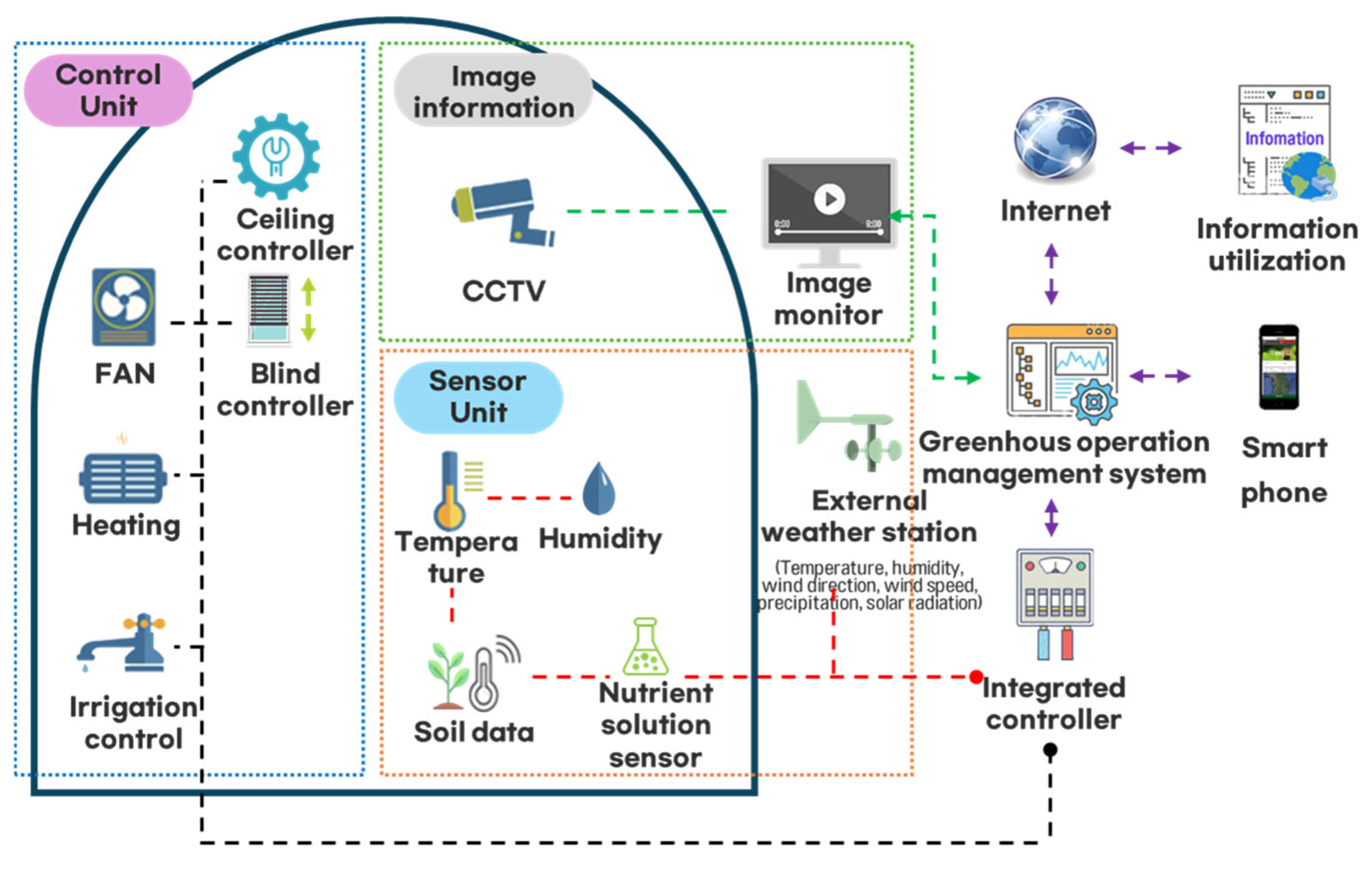
Figure 1.
Structure of a smart farm (facility horticulture).
Figure 1.
Structure of a smart farm (facility horticulture).
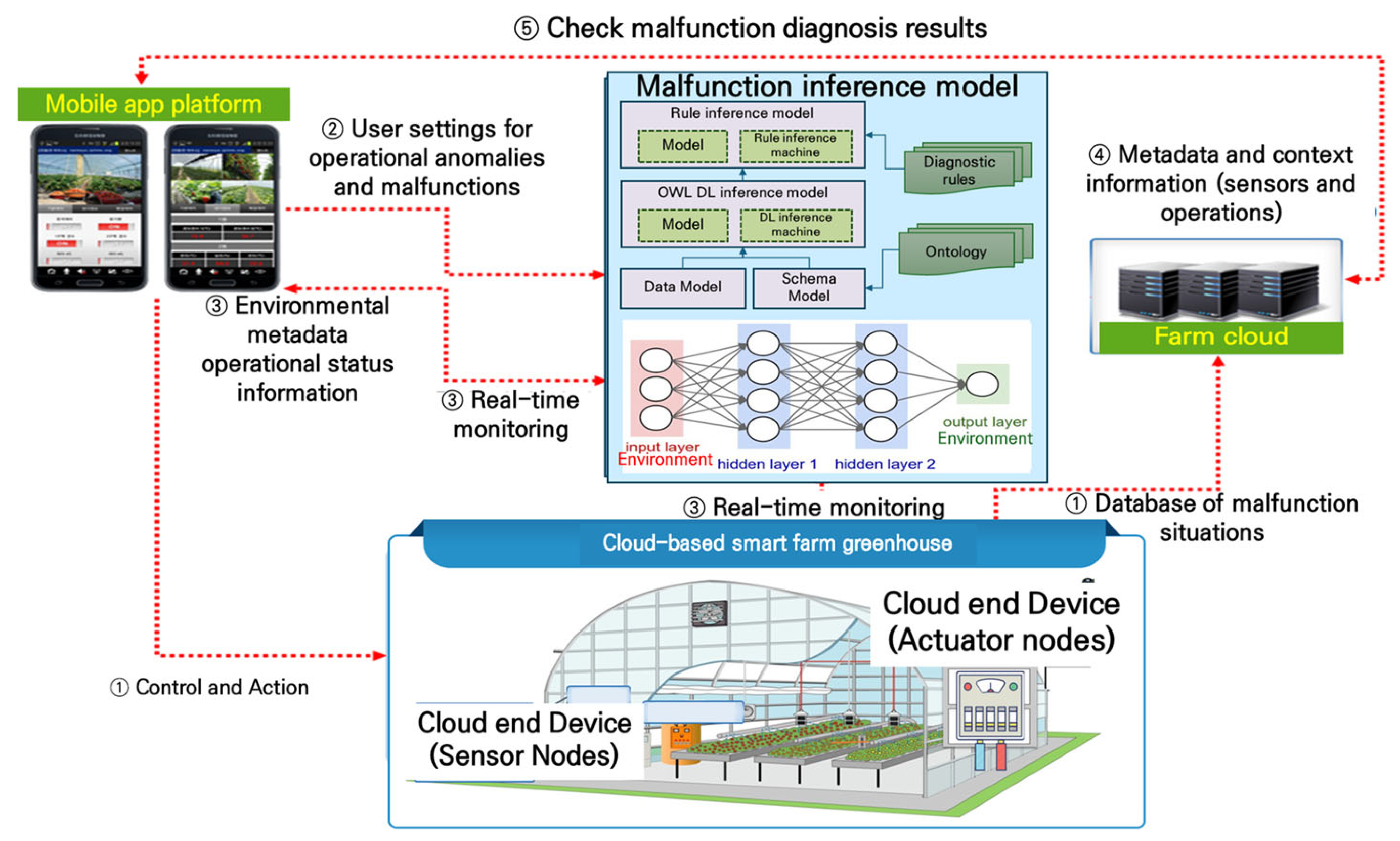
Figure 2.
Farm cloud-based greenhouse equipment malfunction response service scenario.
Figure 2.
Farm cloud-based greenhouse equipment malfunction response service scenario.
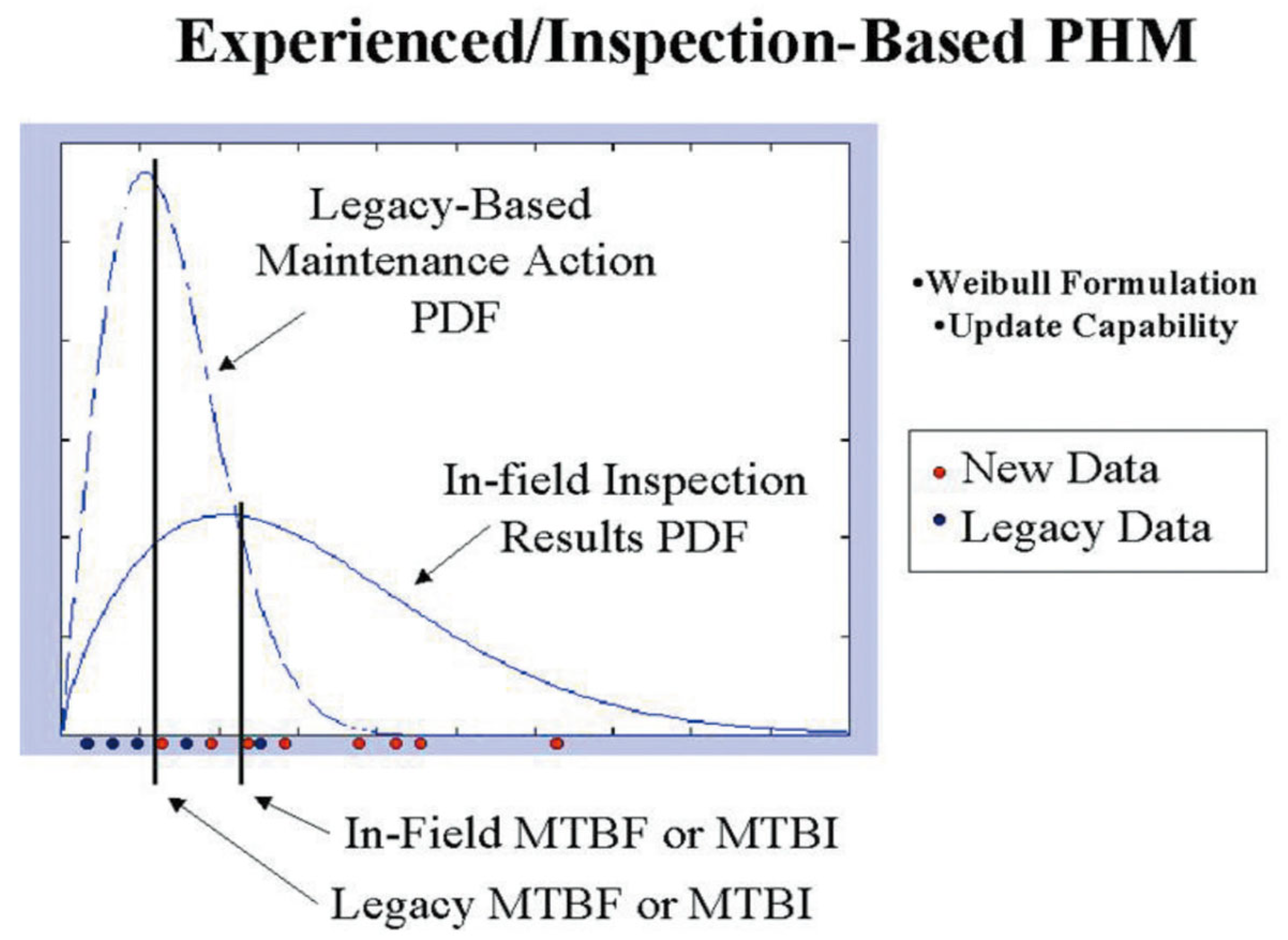
Figure 3.
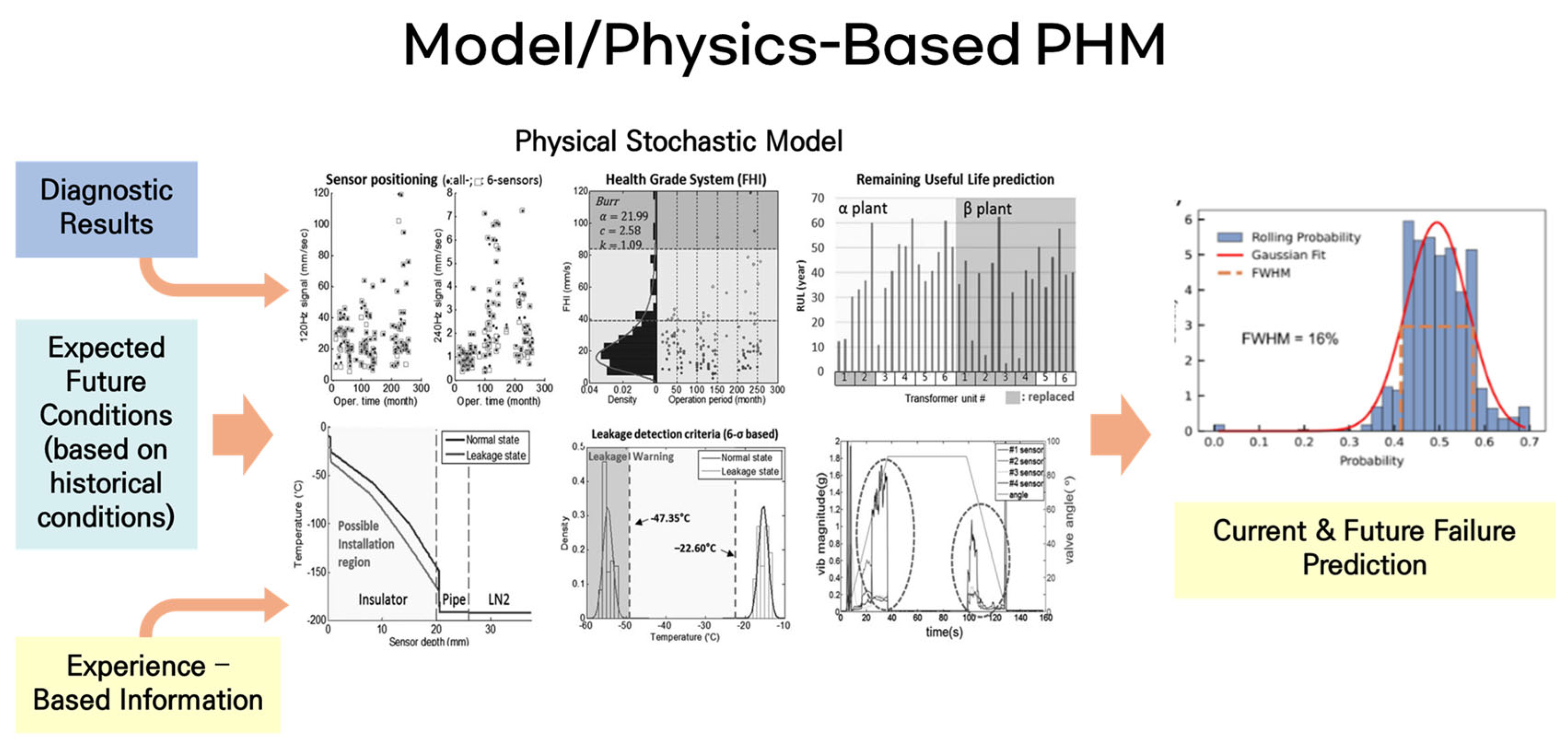
Experience-based soundness management.
Figure 3.
Experience-based soundness management.
Figure 4.
Basic process for building PHM.
Figure 4.
Basic process for building PHM.
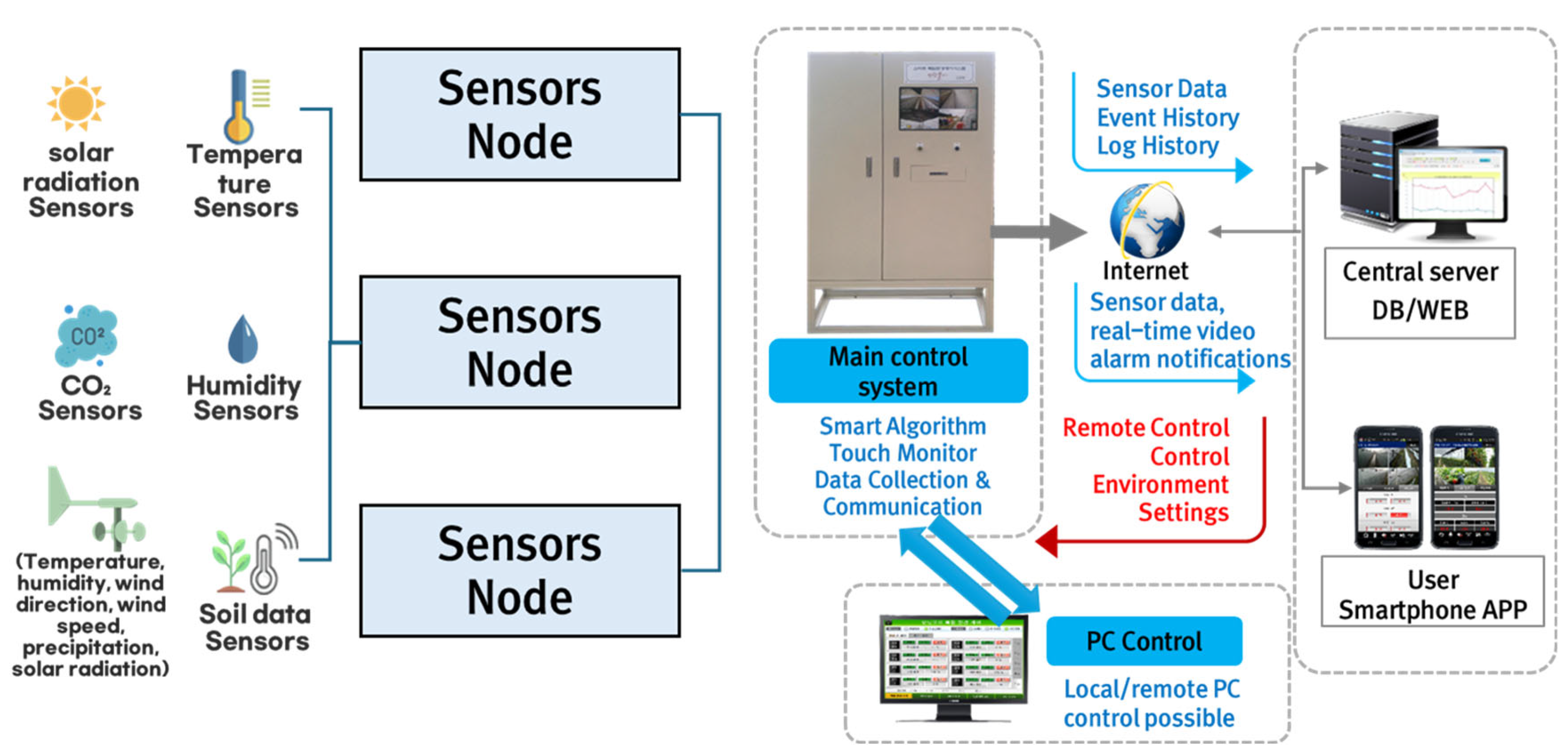
Figure 5.
Narae Trend Co., Ltd. (Bucheon City, Gyeonggi-do, Republic of Korea). Firefly complex environment control smart farm configuration diagram.
Figure 5.
Narae Trend Co., Ltd. (Bucheon City, Gyeonggi-do, Republic of Korea). Firefly complex environment control smart farm configuration diagram.
Figure 6.
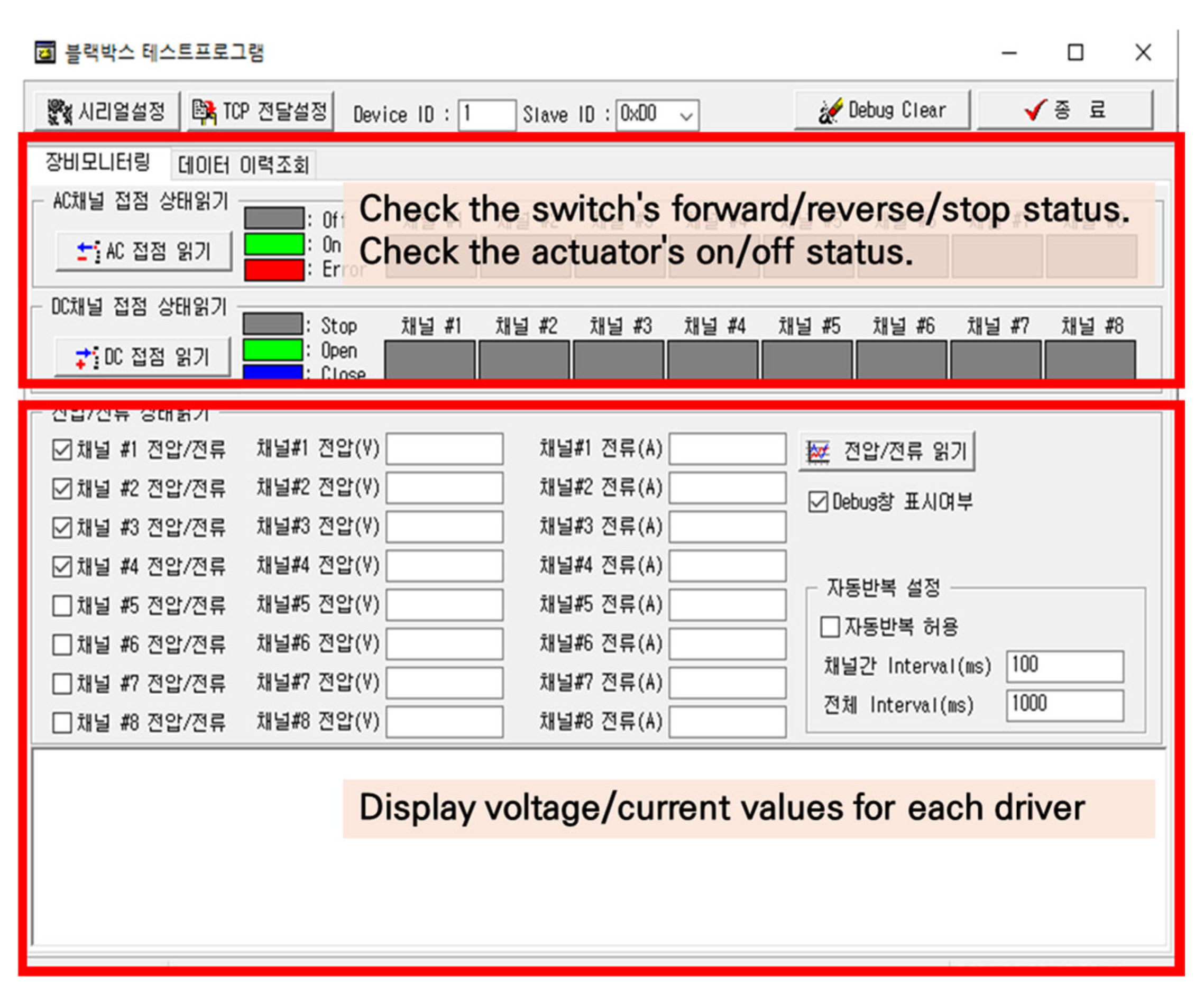
Voltage/current measurement main screen.
Figure 6.
Voltage/current measurement main screen.
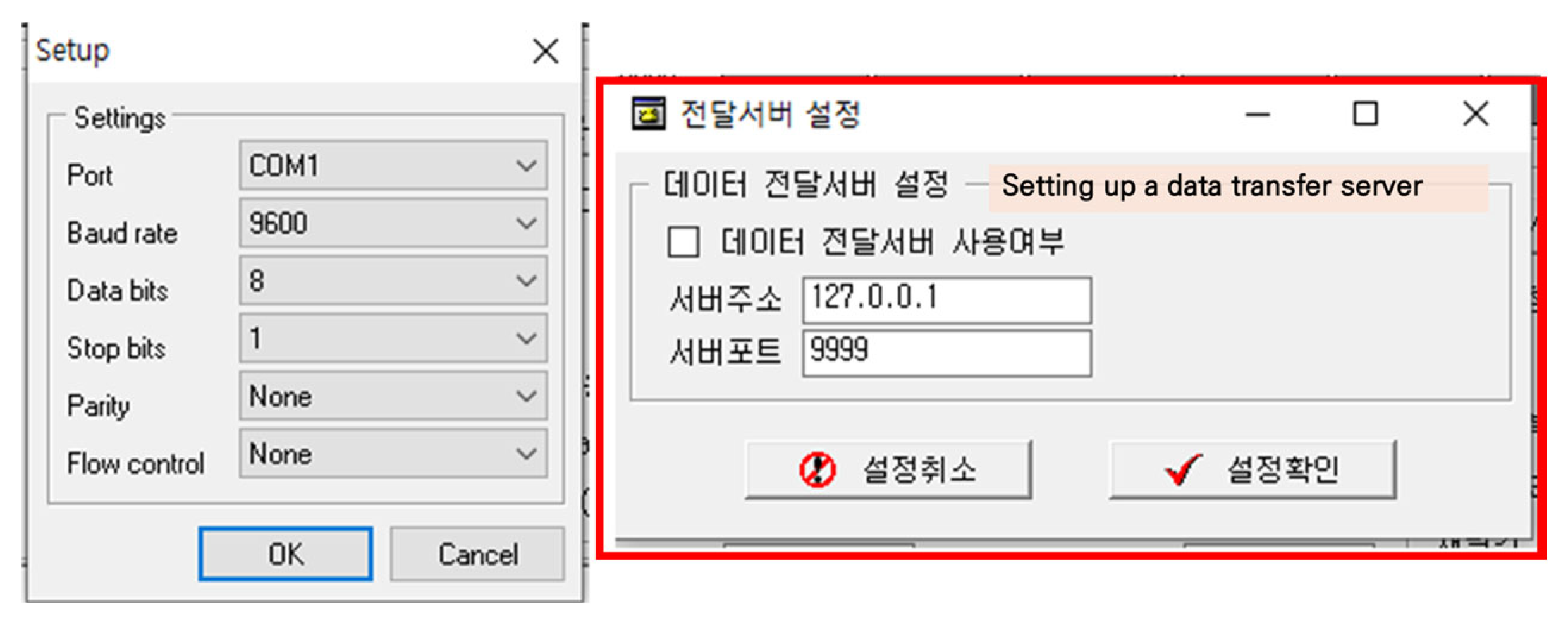
Figure 7.
Driver node and main device communication setting screen.
Figure 7.
Driver node and main device communication setting screen.
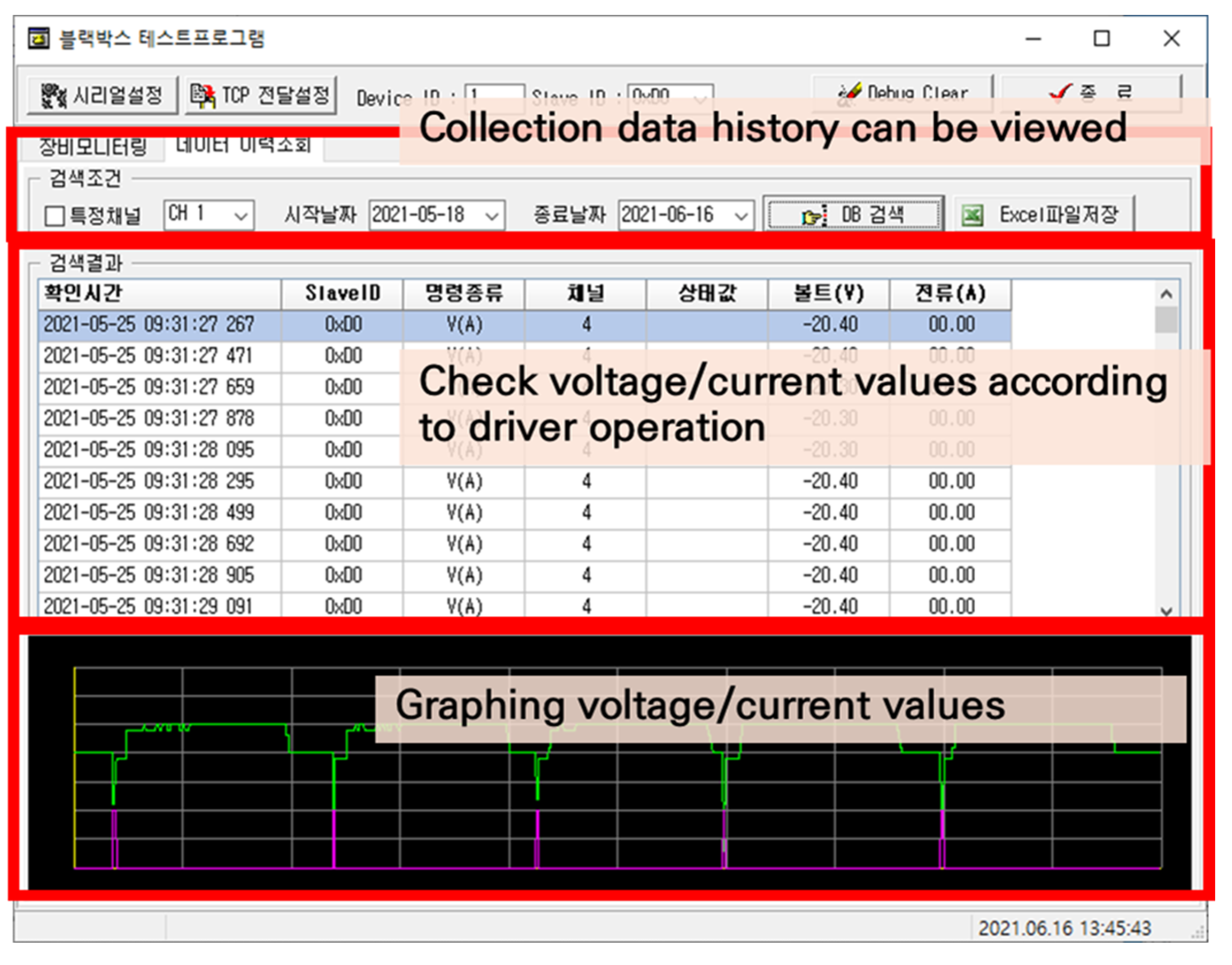
Figure 8.
Voltage change screen according to driver operation.
Figure 8.
Voltage change screen according to driver operation.
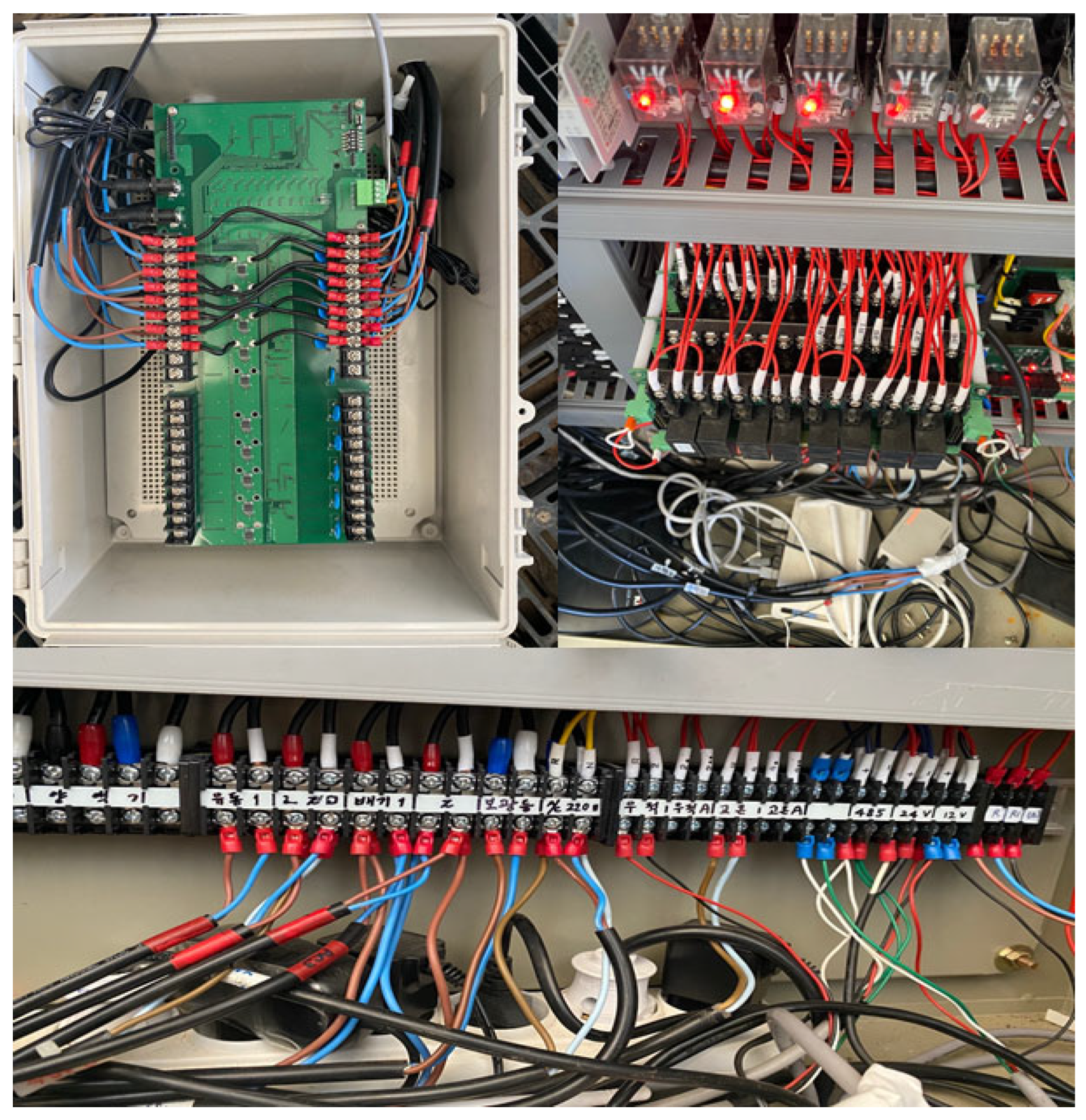
Figure 9.
Testbed driver signal test (installation photograph).
Figure 9.
Testbed driver signal test (installation photograph).
Figure 10.
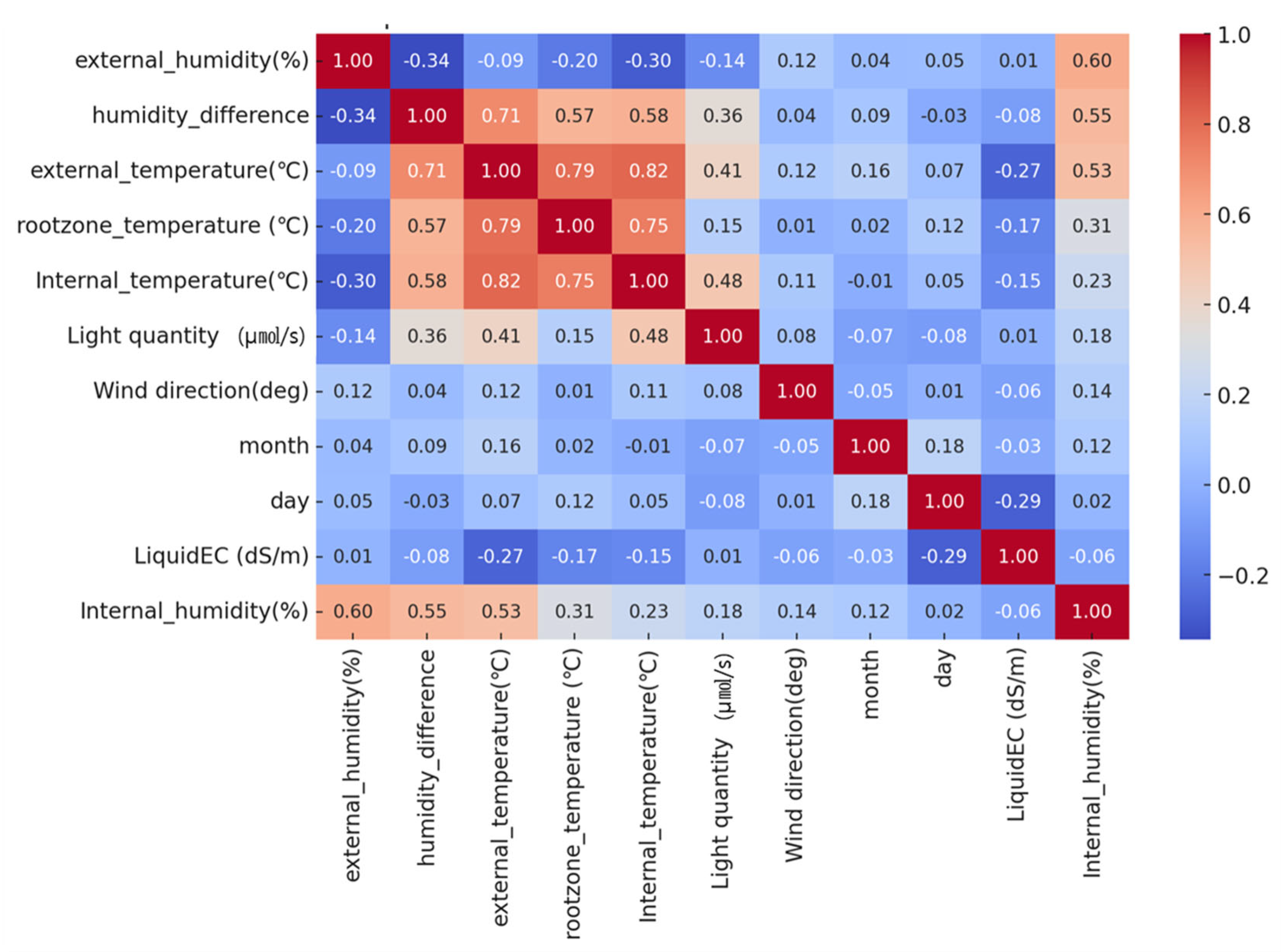
Internal humidity sensor correlation analysis results.
Figure 10.
Internal humidity sensor correlation analysis results.
Figure 11.
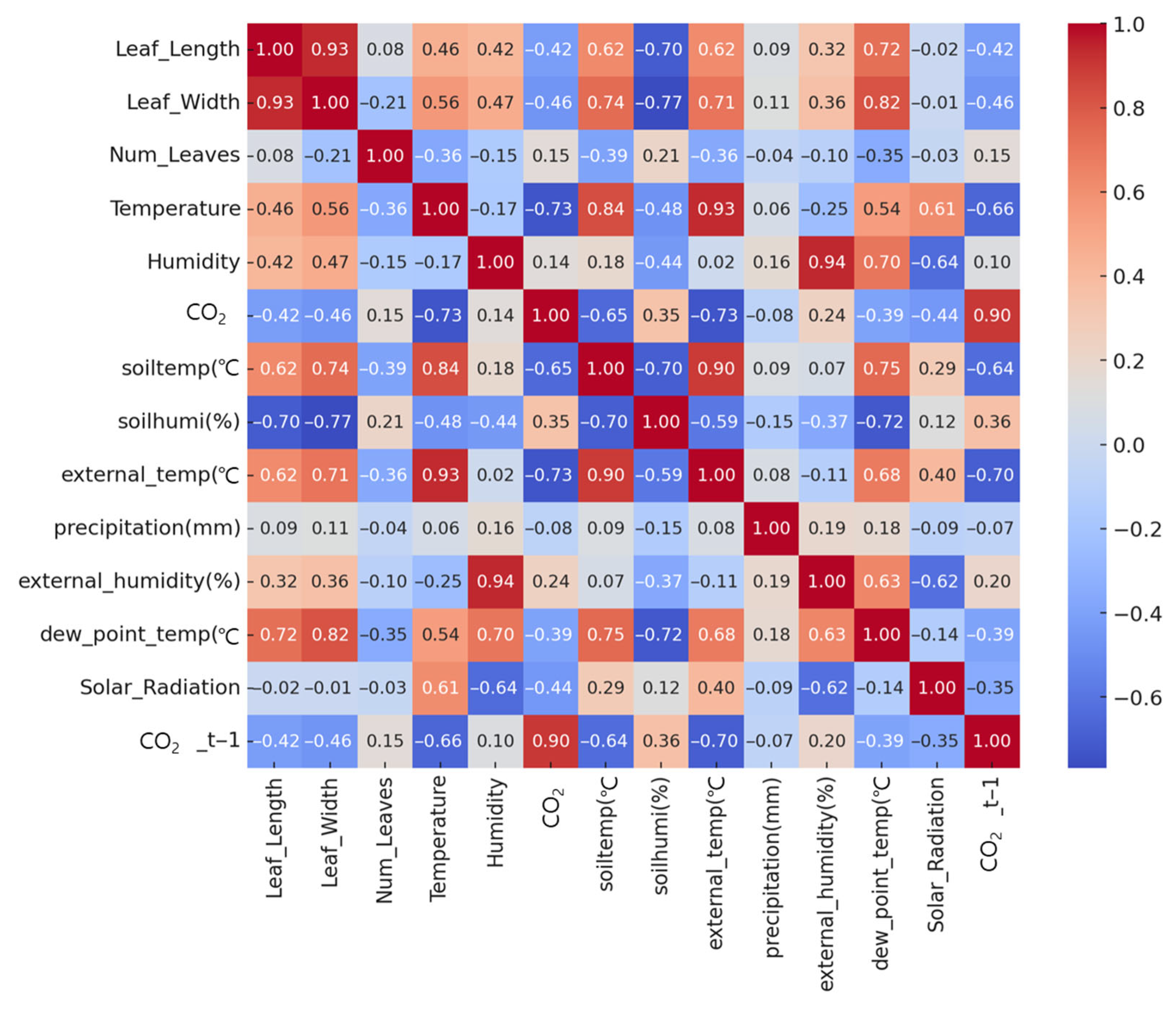
Correlation analysis for CO2 concentration prediction.
Figure 11.
Correlation analysis for CO2 concentration prediction.
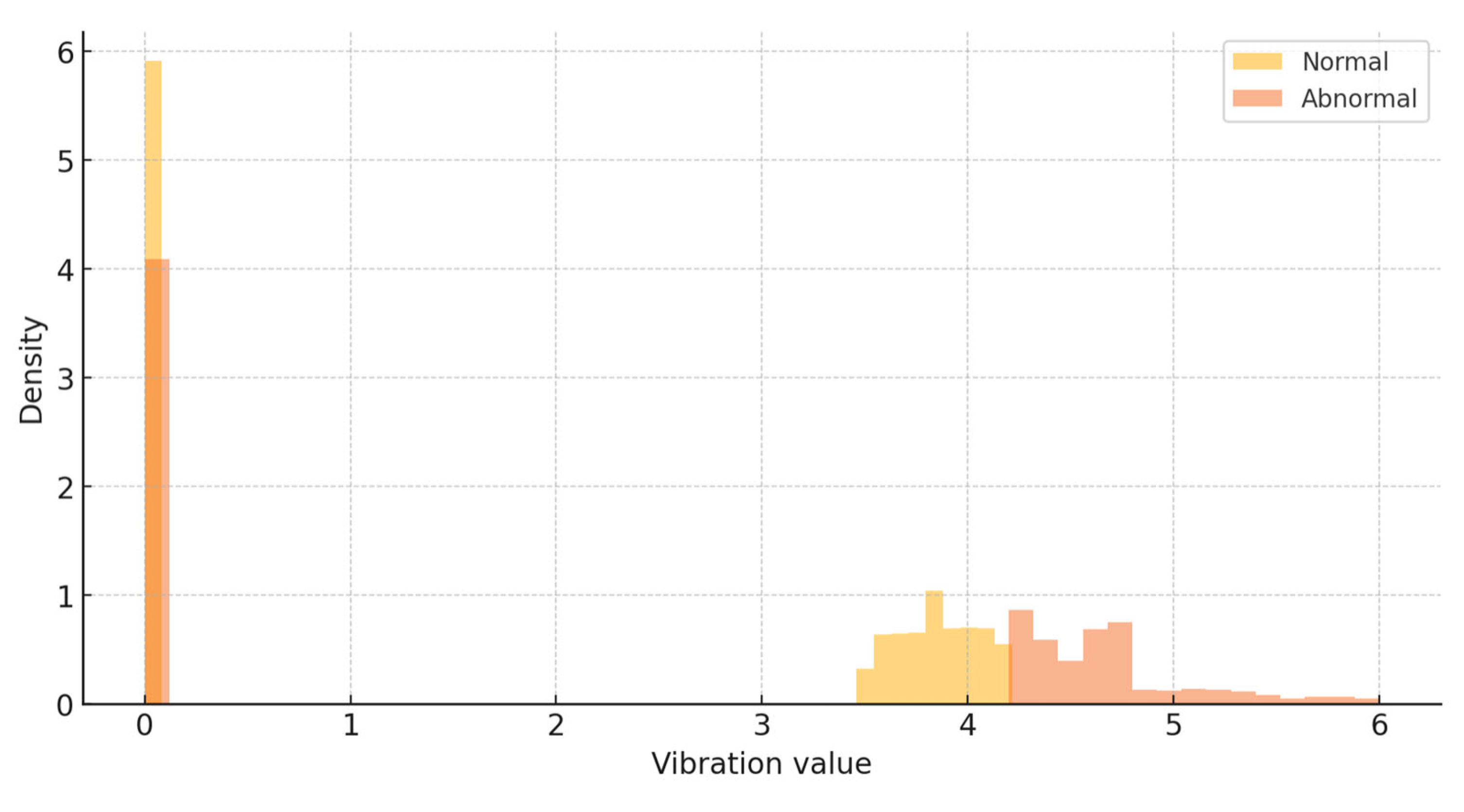
Figure 12.
Vibration value distribution.
Figure 12.
Vibration value distribution.
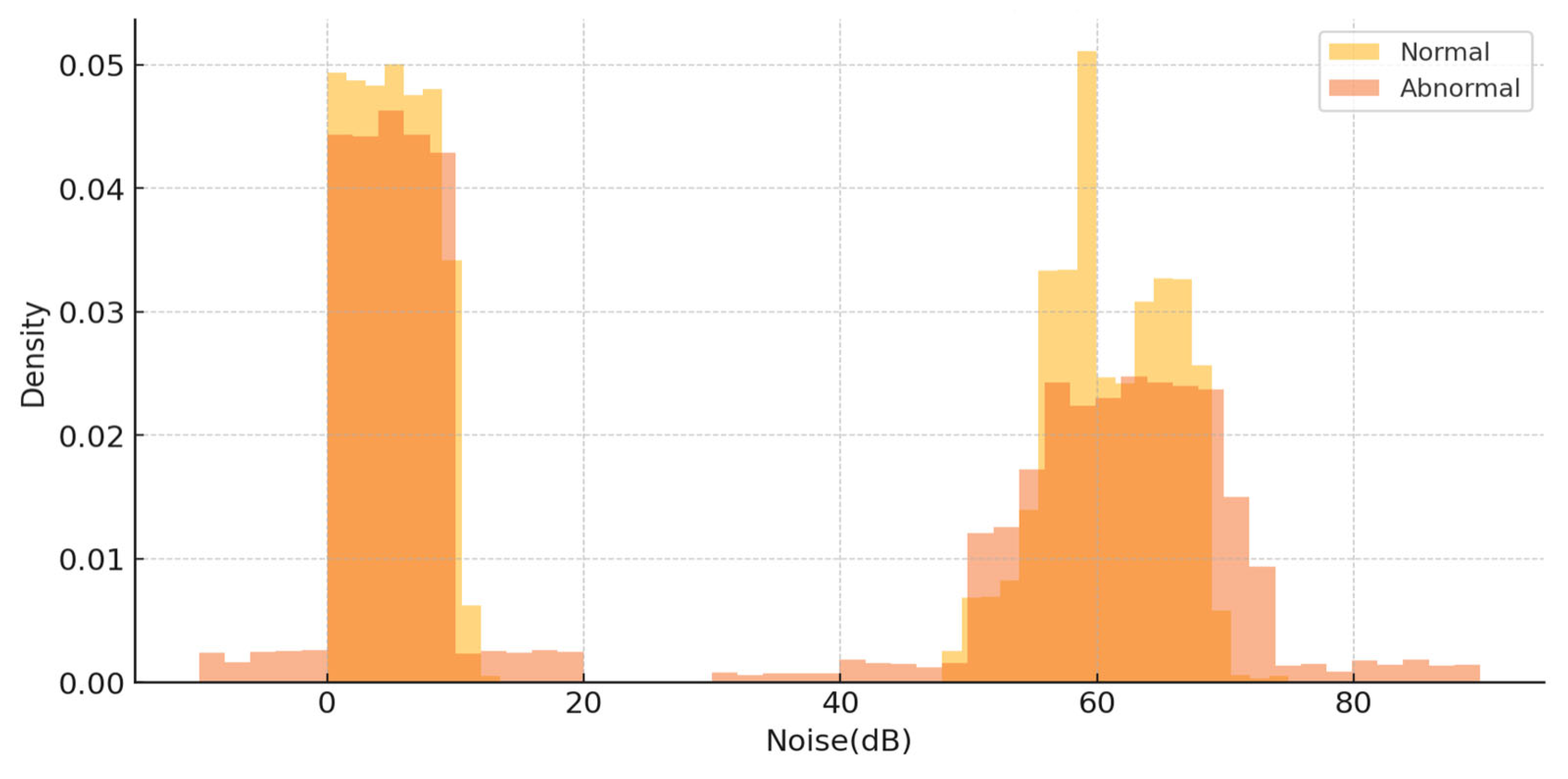
Figure 13.
Noise value distribution.
Figure 13.
Noise value distribution.
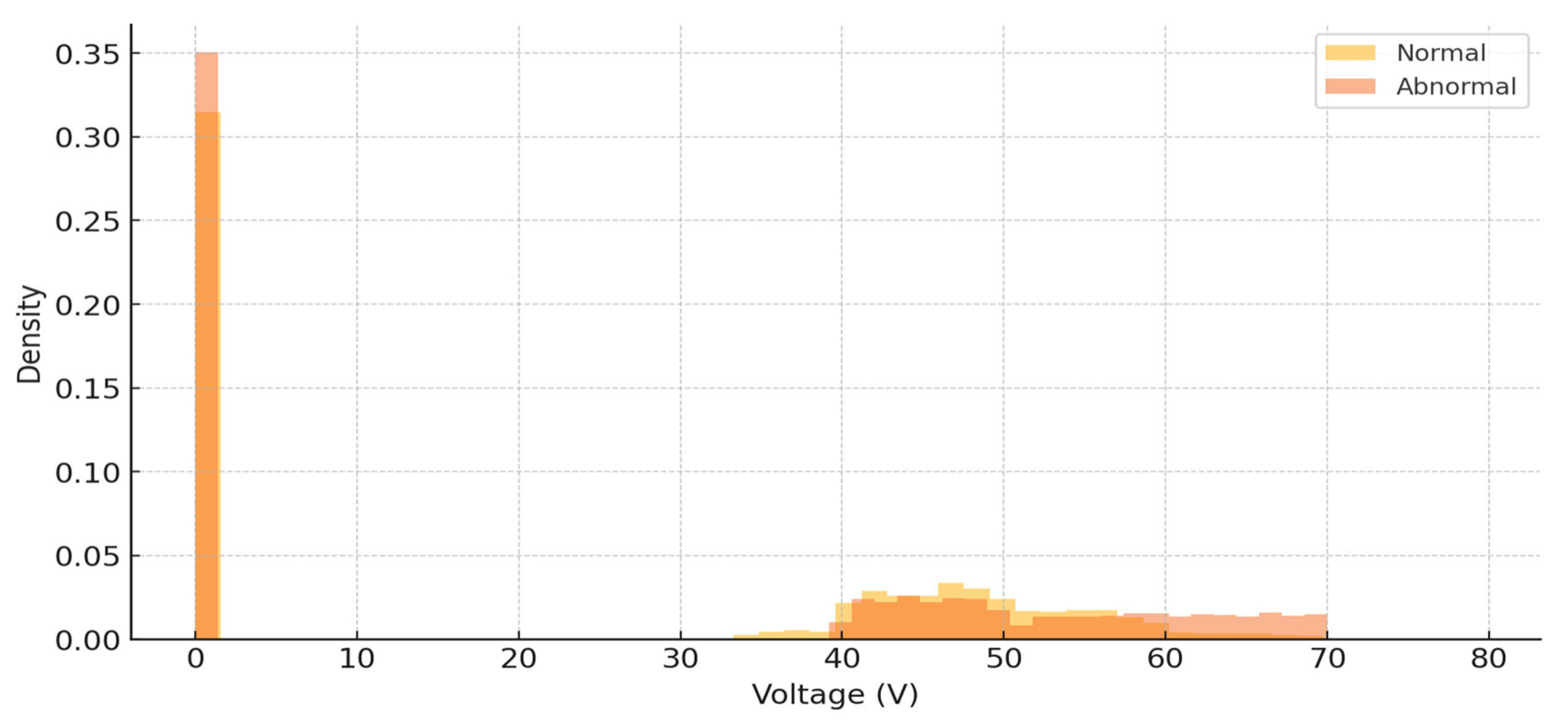
Figure 14.
Voltage value distribution.
Figure 14.
Voltage value distribution.
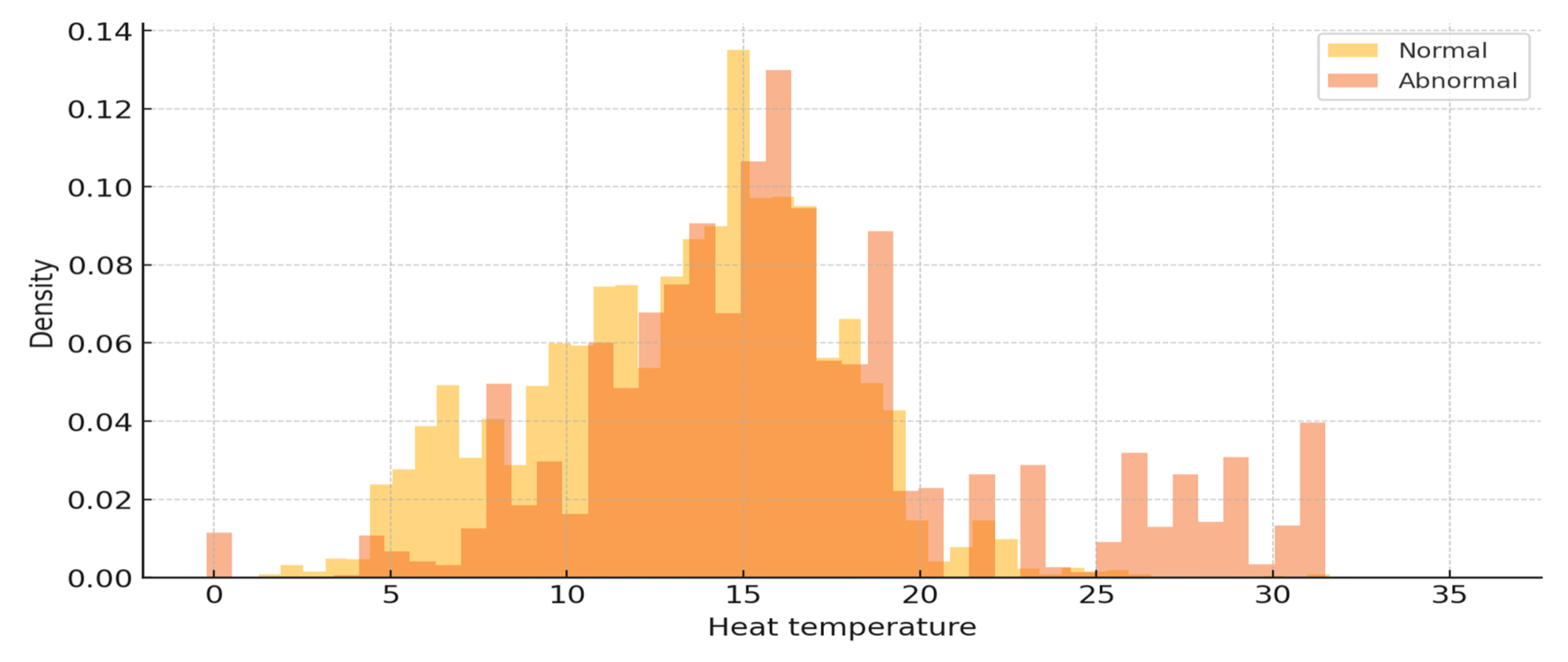
Figure 15.
Heat temperature distribution.
Figure 15.
Heat temperature distribution.
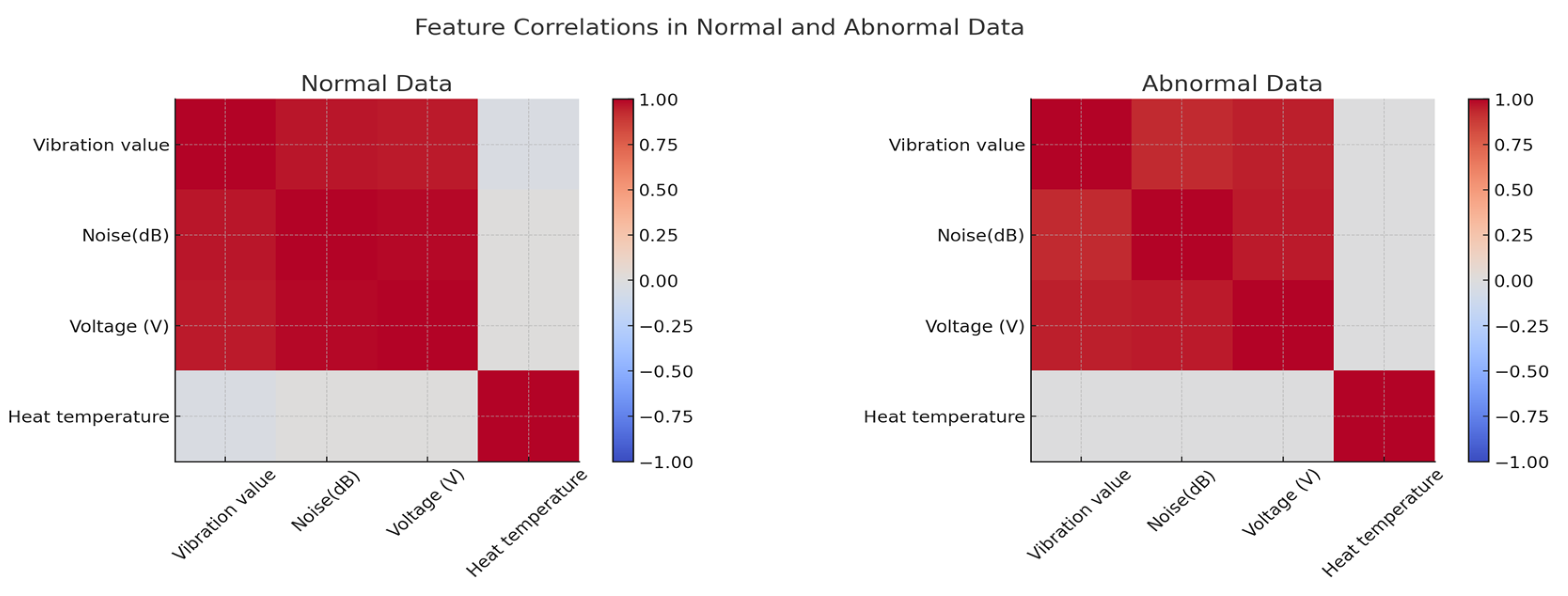
Figure 16.
Feature correlations in normal (left) and abnormal (right) switch operation data. Red indicates strong positive correlations, blue indicates strong negative correlations, and gray indicates feature pairs for which correlation values are undefined due to insufficient or missing data.
Figure 16.
Feature correlations in normal (left) and abnormal (right) switch operation data. Red indicates strong positive correlations, blue indicates strong negative correlations, and gray indicates feature pairs for which correlation values are undefined due to insufficient or missing data.
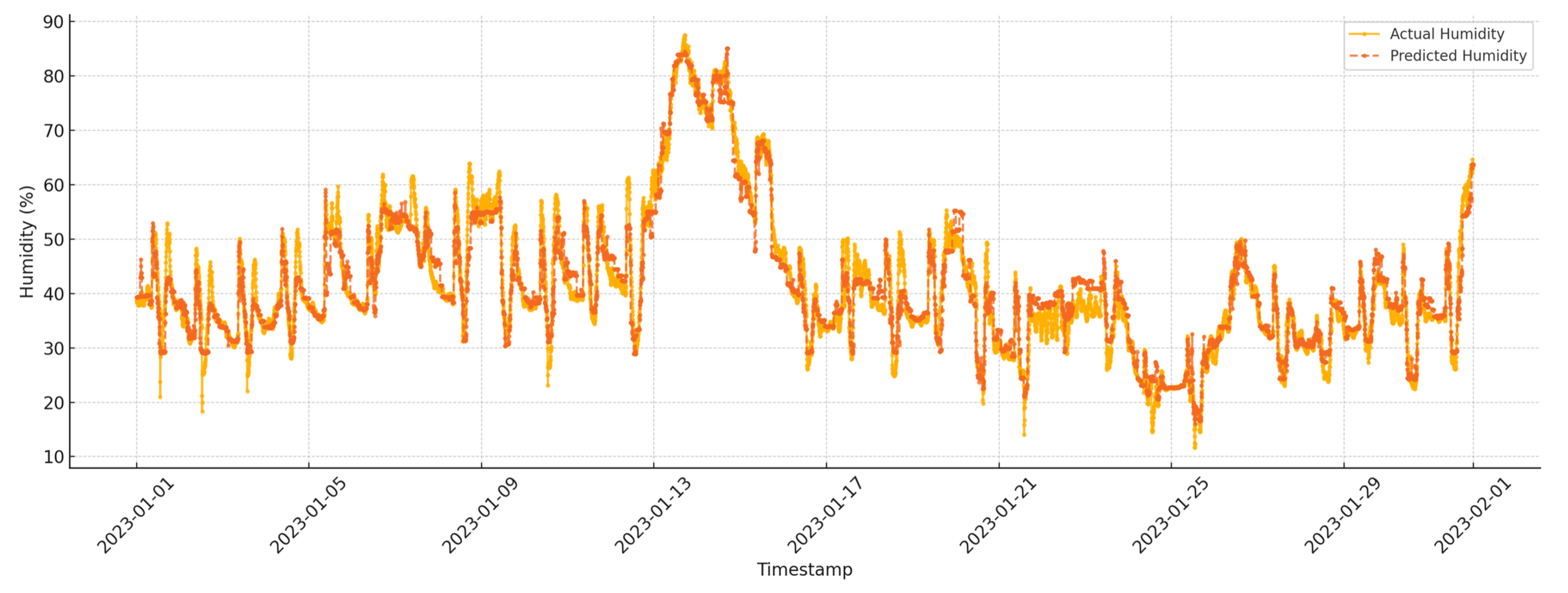
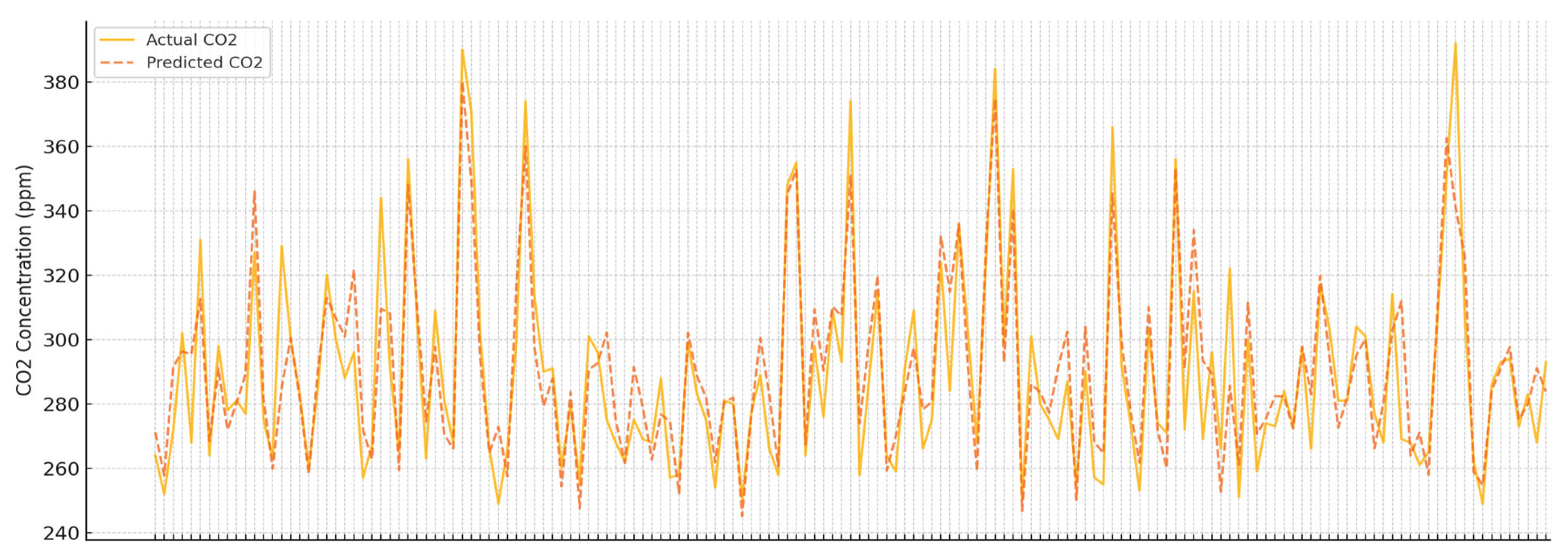
Figure 17.
Comparison of actual humidity values with predicted values.
Figure 17.
Comparison of actual humidity values with predicted values.
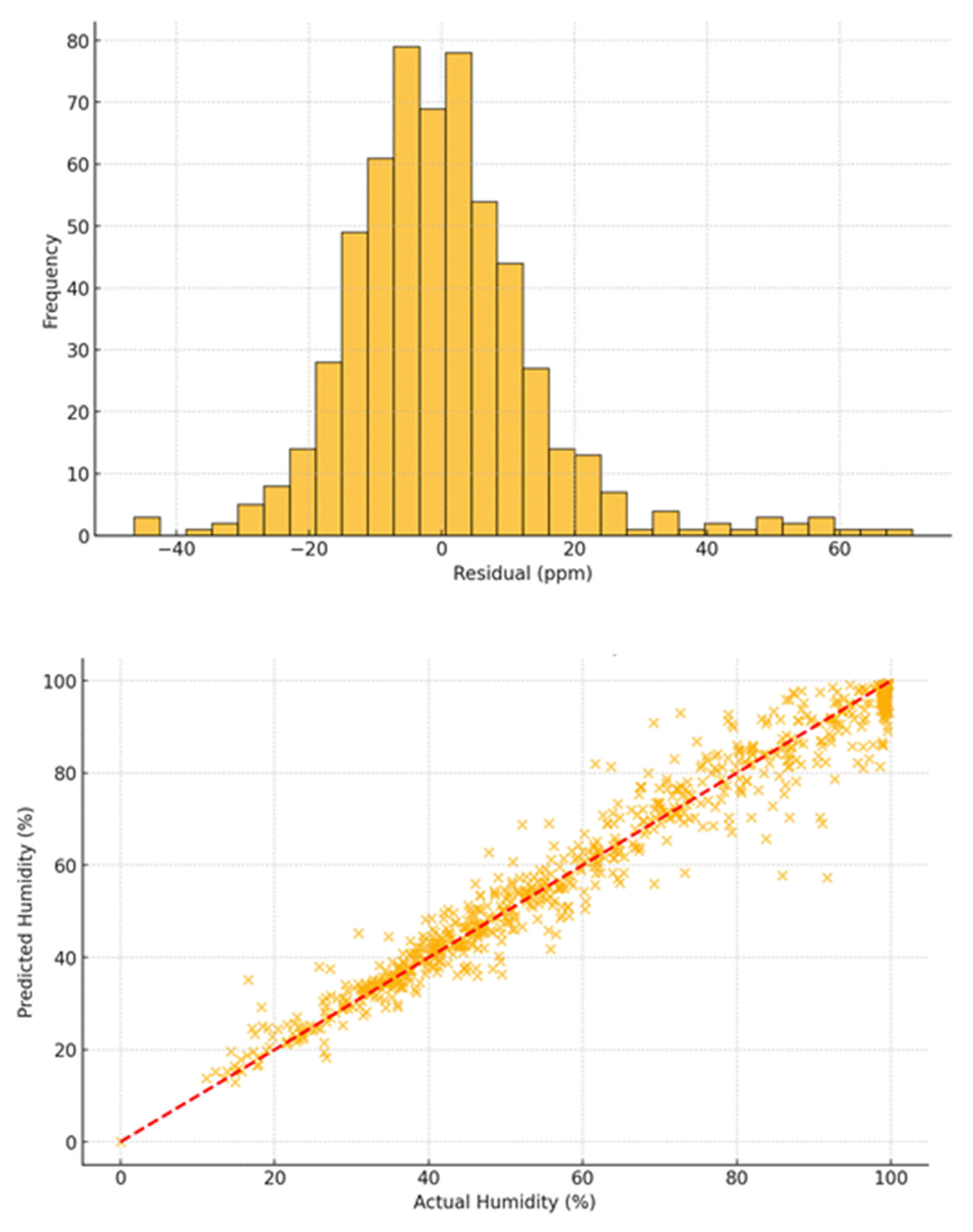
Figure 18.
Scatterplot of actual vs. predicted values (below); residual plot (above).
Figure 18.
Scatterplot of actual vs. predicted values (below); residual plot (above).
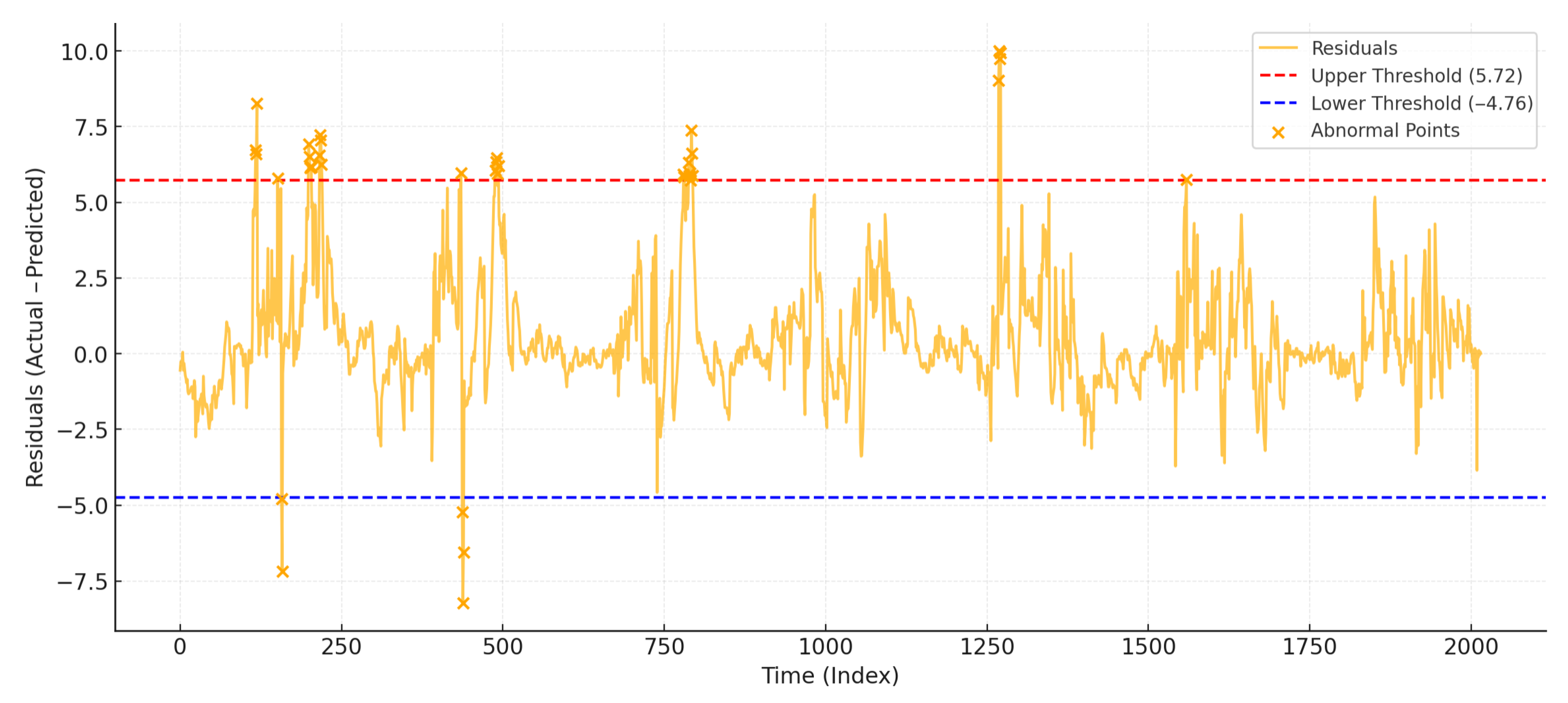
Figure 19.
Residuals (difference between actual and predicted humidity) over time.
Figure 19.
Residuals (difference between actual and predicted humidity) over time.
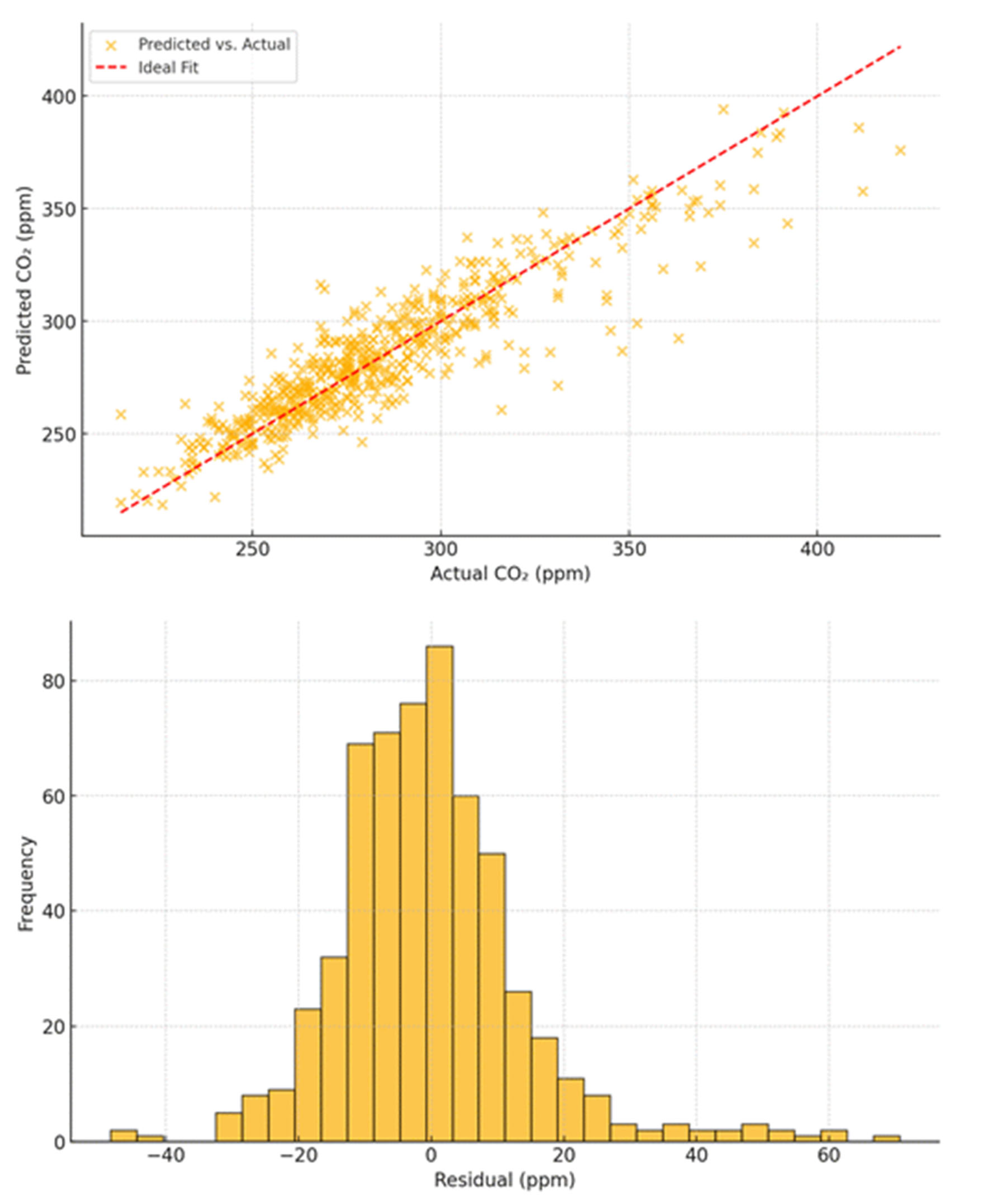
Figure 20.
Scatterplot of actual vs. predicted CO2 values (above); residual plot (below).
Figure 20.
Scatterplot of actual vs. predicted CO2 values (above); residual plot (below).
Figure 21.
Distribution of residuals for CO2 predictions.
Figure 21.
Distribution of residuals for CO2 predictions.
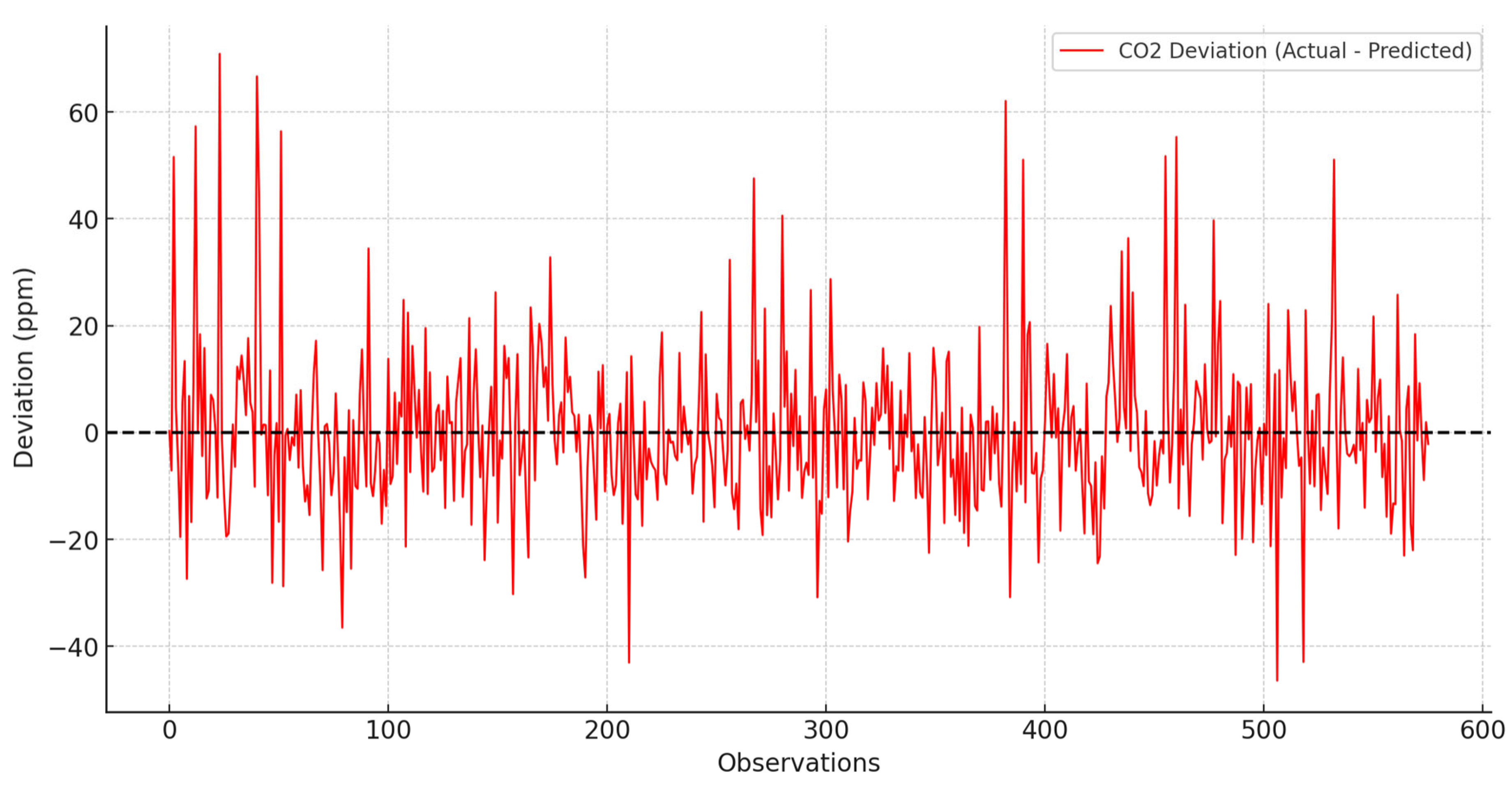
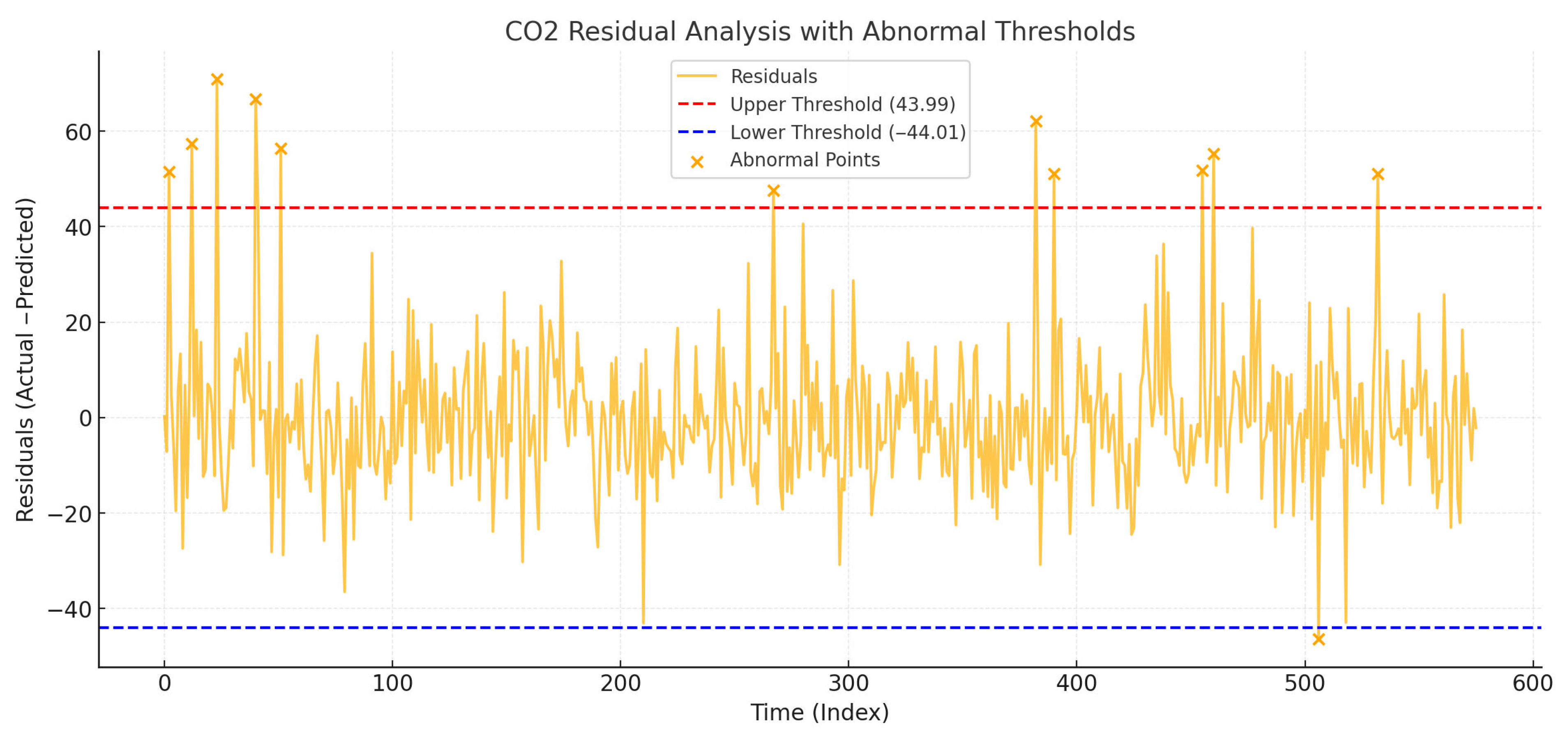
Figure 22.
Residuals (difference between actual and predicted CO2 values) over time.
Figure 22.
Residuals (difference between actual and predicted CO2 values) over time.
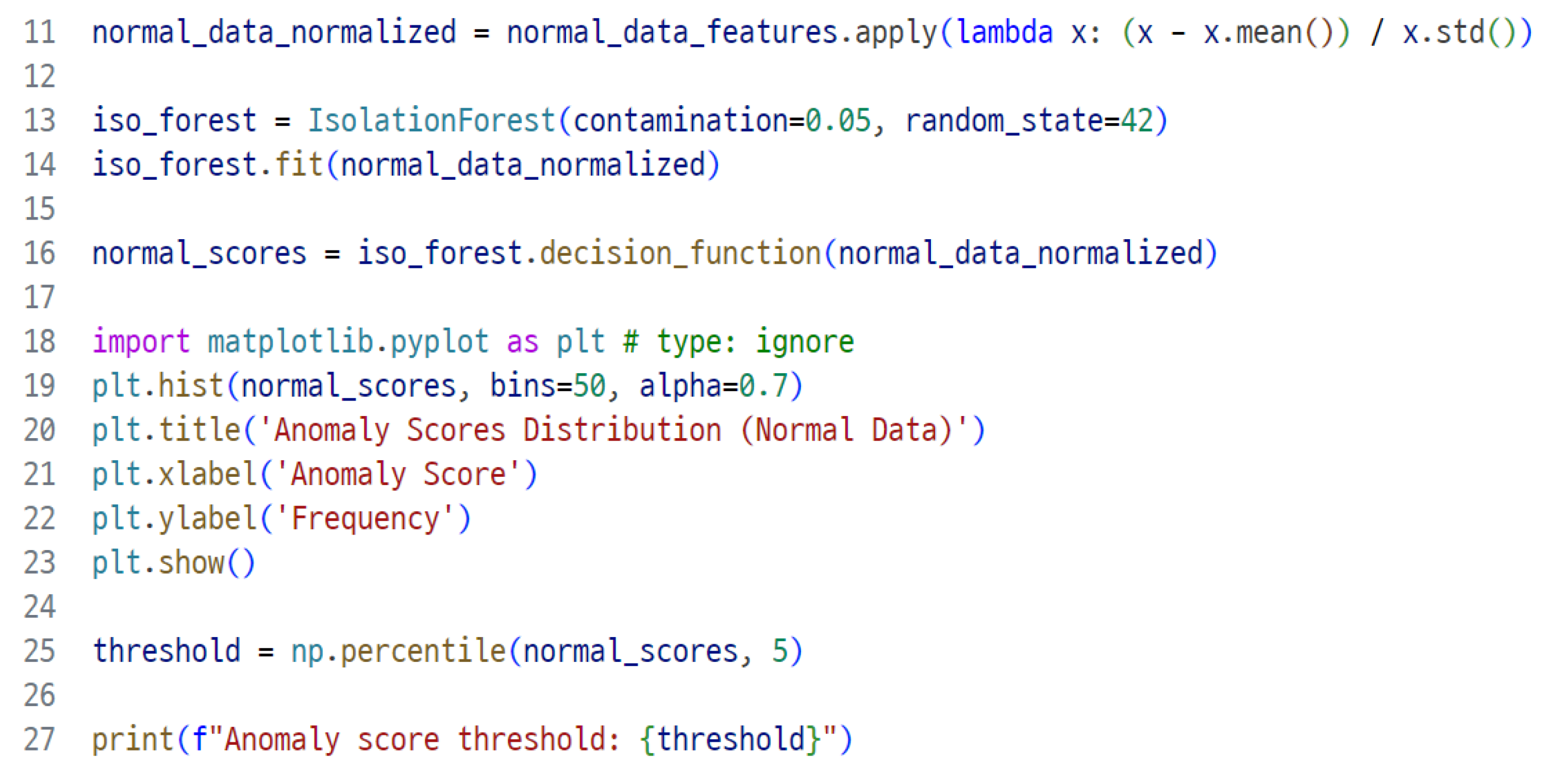
Figure 23.
Ideal score distribution code after model training.
Figure 23.
Ideal score distribution code after model training.
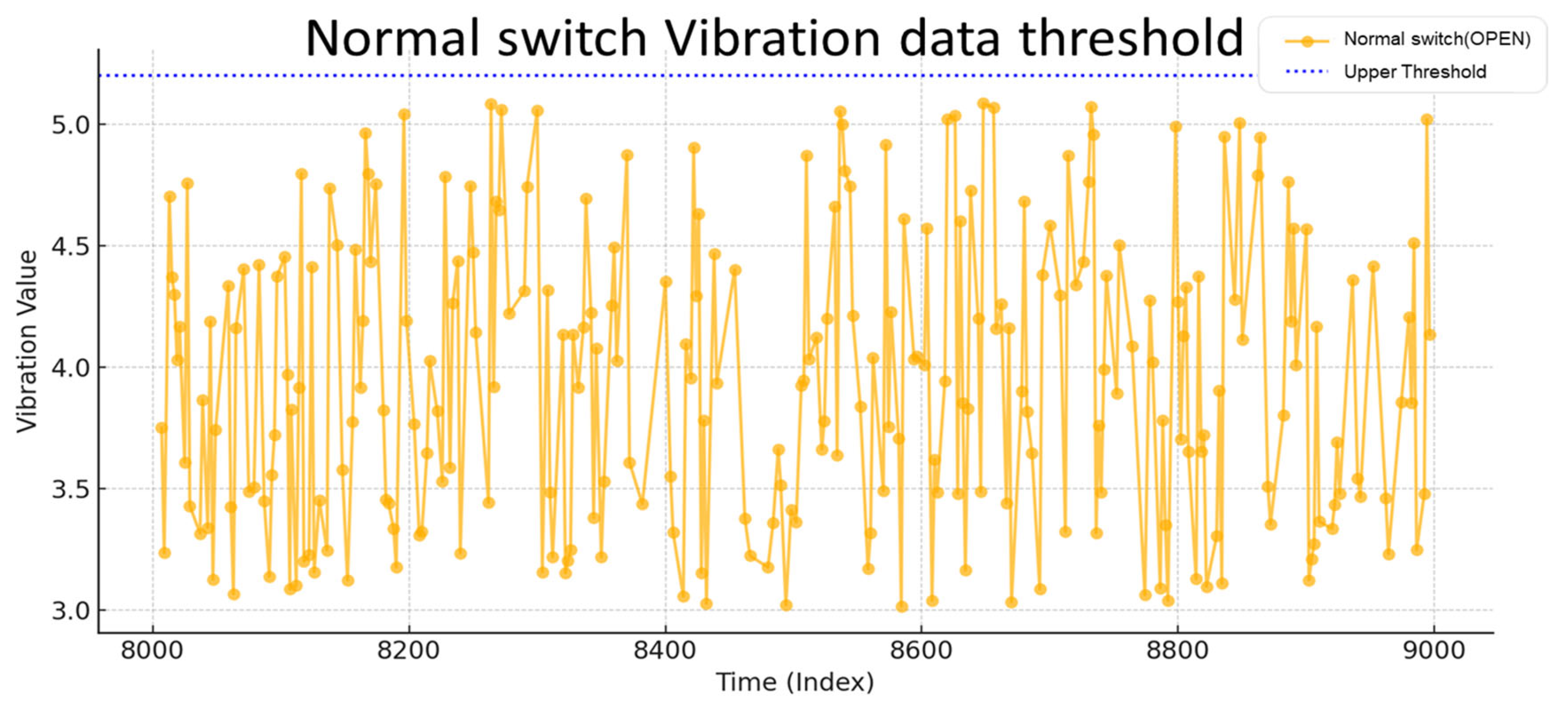
Figure 24.
Normal opener vibration data (OPEN).
Figure 24.
Normal opener vibration data (OPEN).
Figure 25.
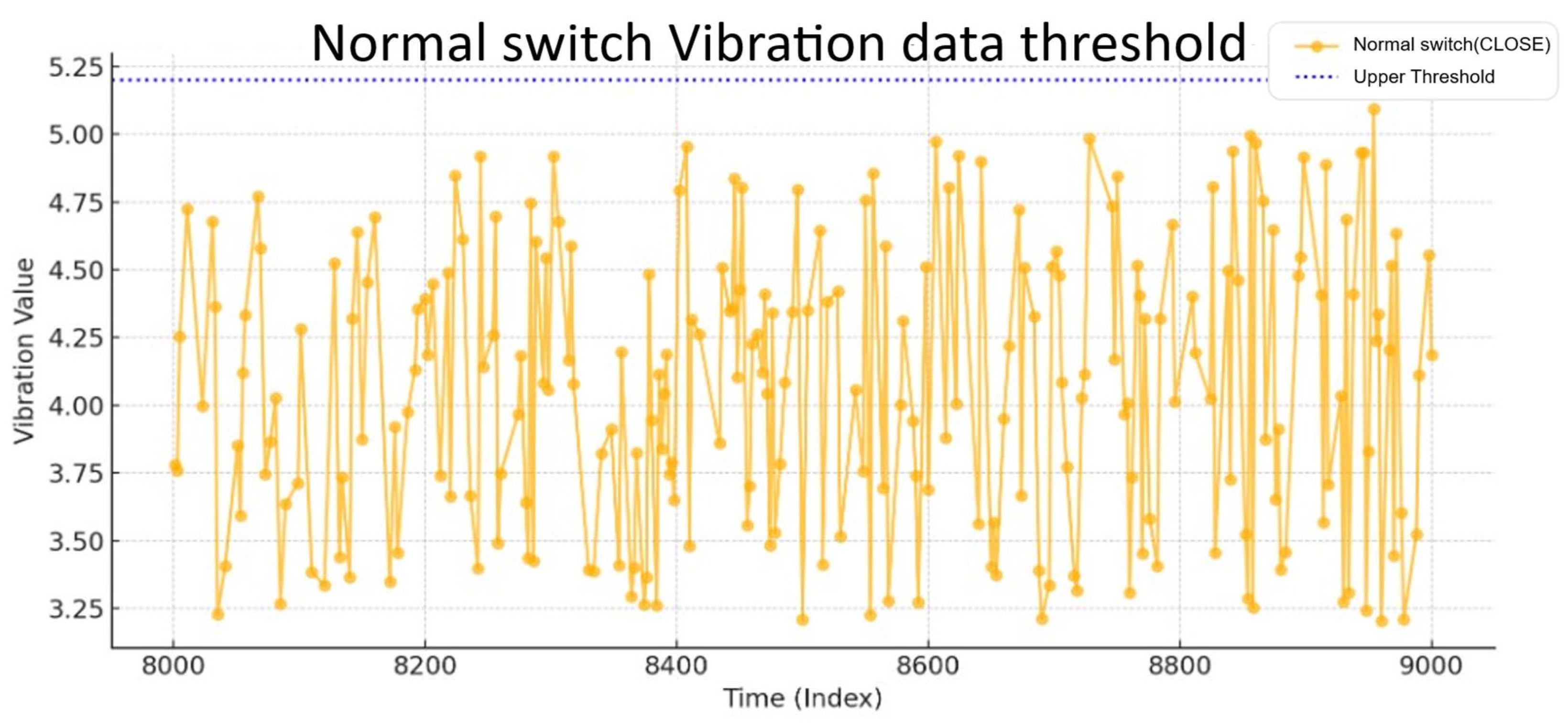
Normal switch vibration data (CLOSE).
Figure 25.
Normal switch vibration data (CLOSE).
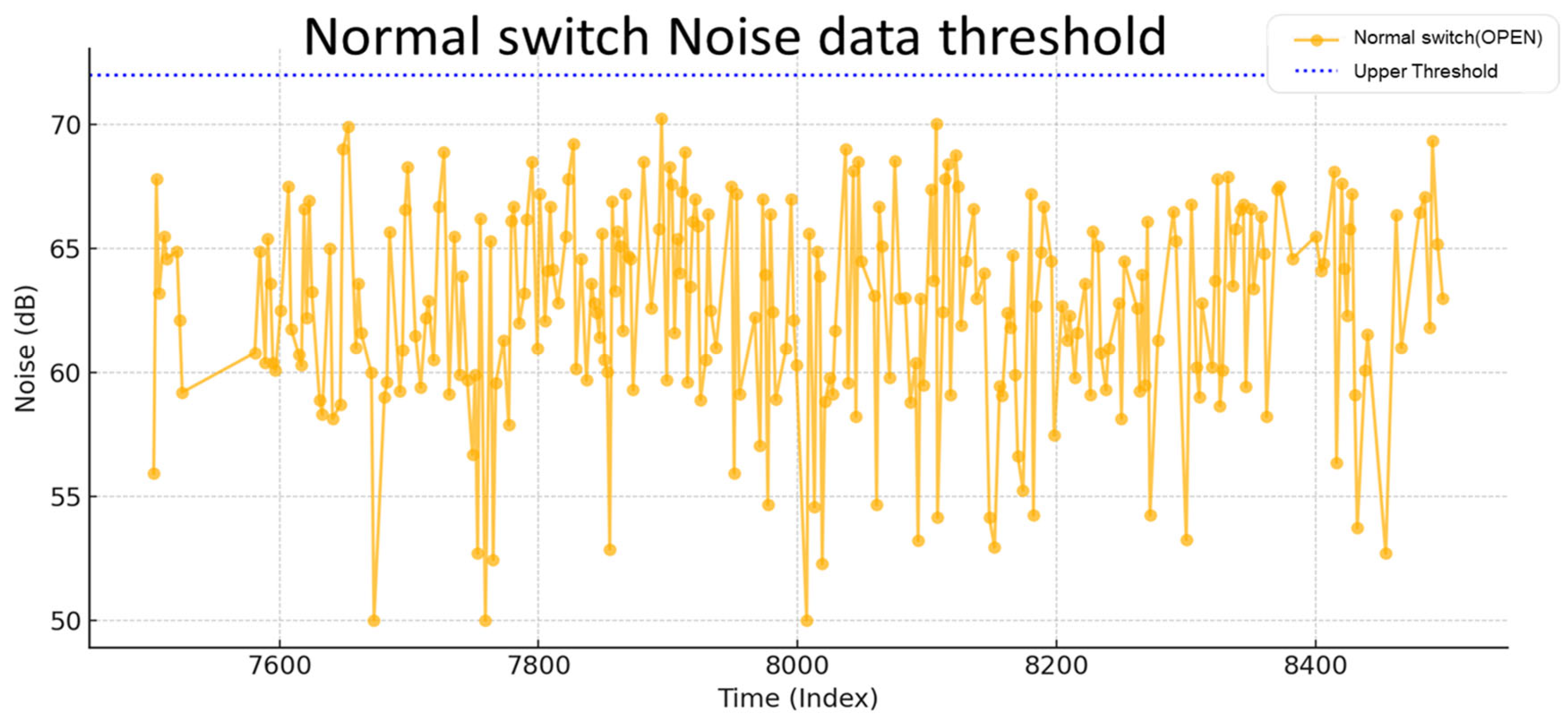
Figure 26.
Normal opener noise data (OPEN).
Figure 26.
Normal opener noise data (OPEN).
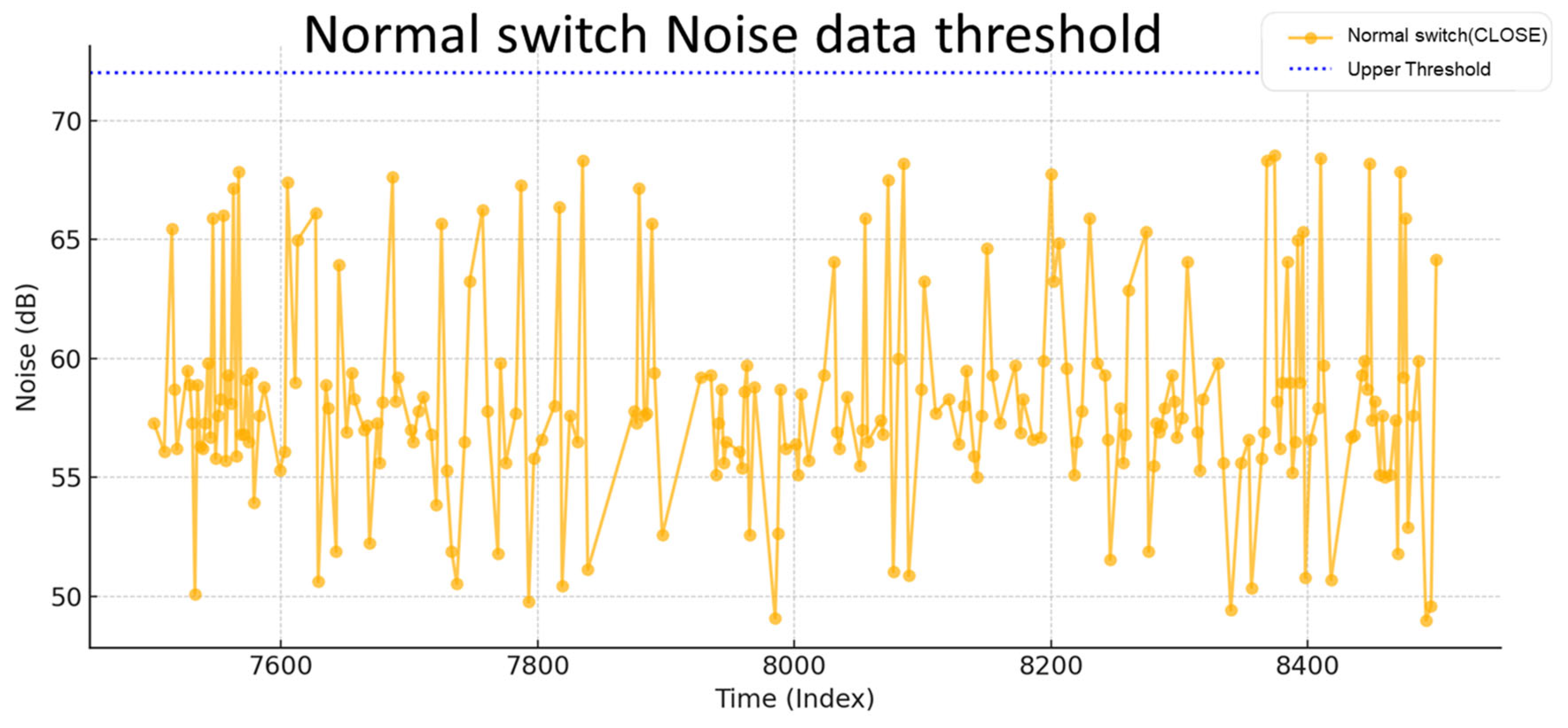
Figure 27.
Normal switch noise data (CLOSE).
Figure 27.
Normal switch noise data (CLOSE).
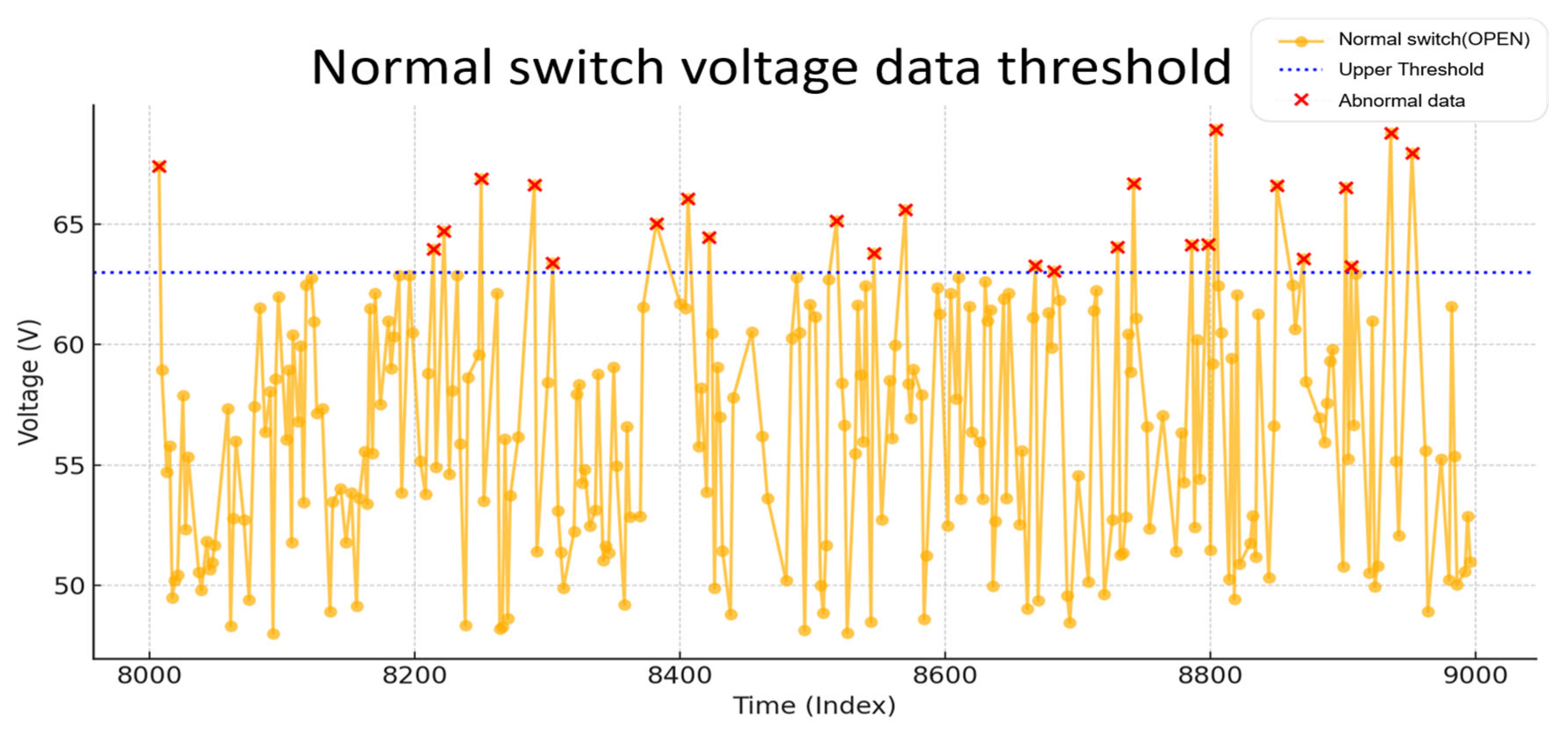
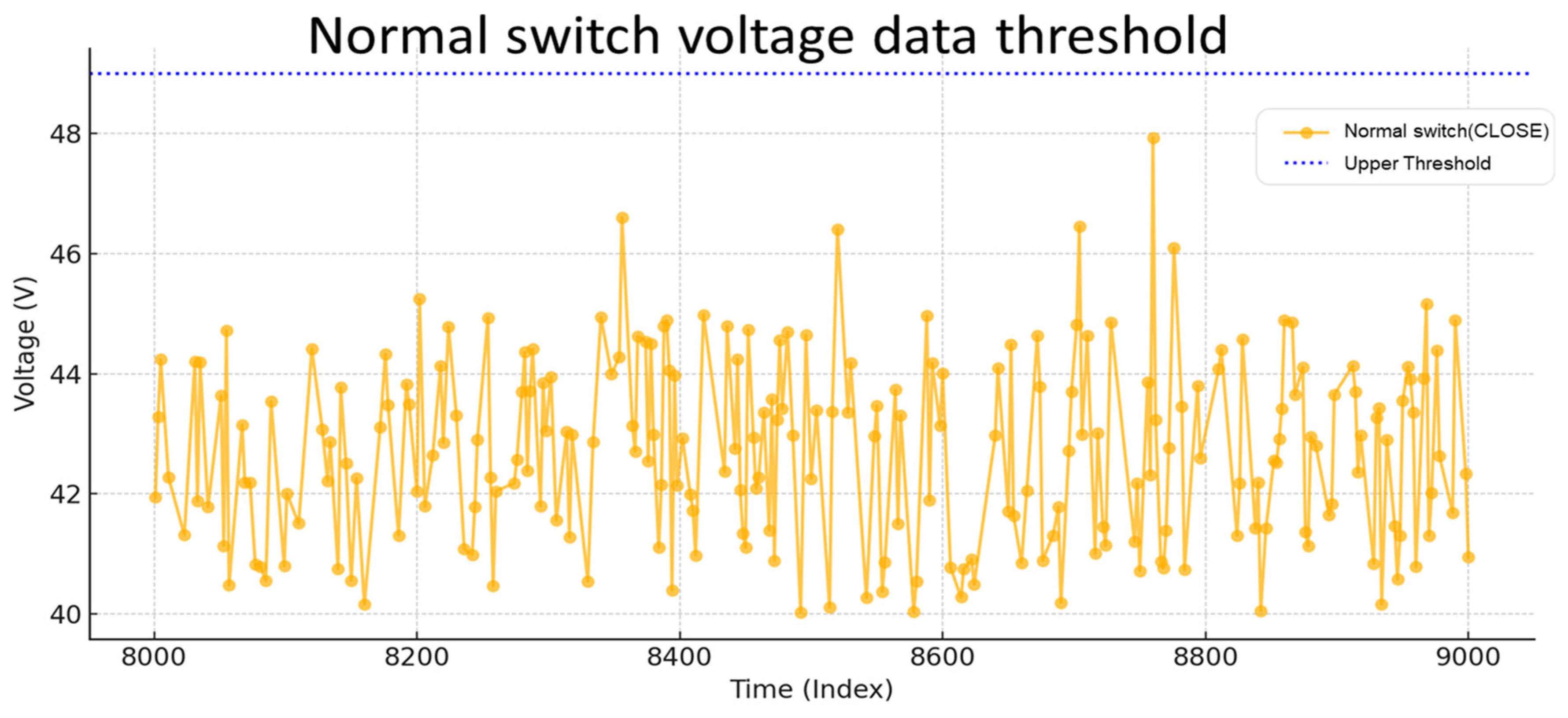
Figure 28.
Normal switch voltage data (OPEN).
Figure 28.
Normal switch voltage data (OPEN).
Figure 29.
Normal switch voltage data (CLOSE).
Figure 29.
Normal switch voltage data (CLOSE).
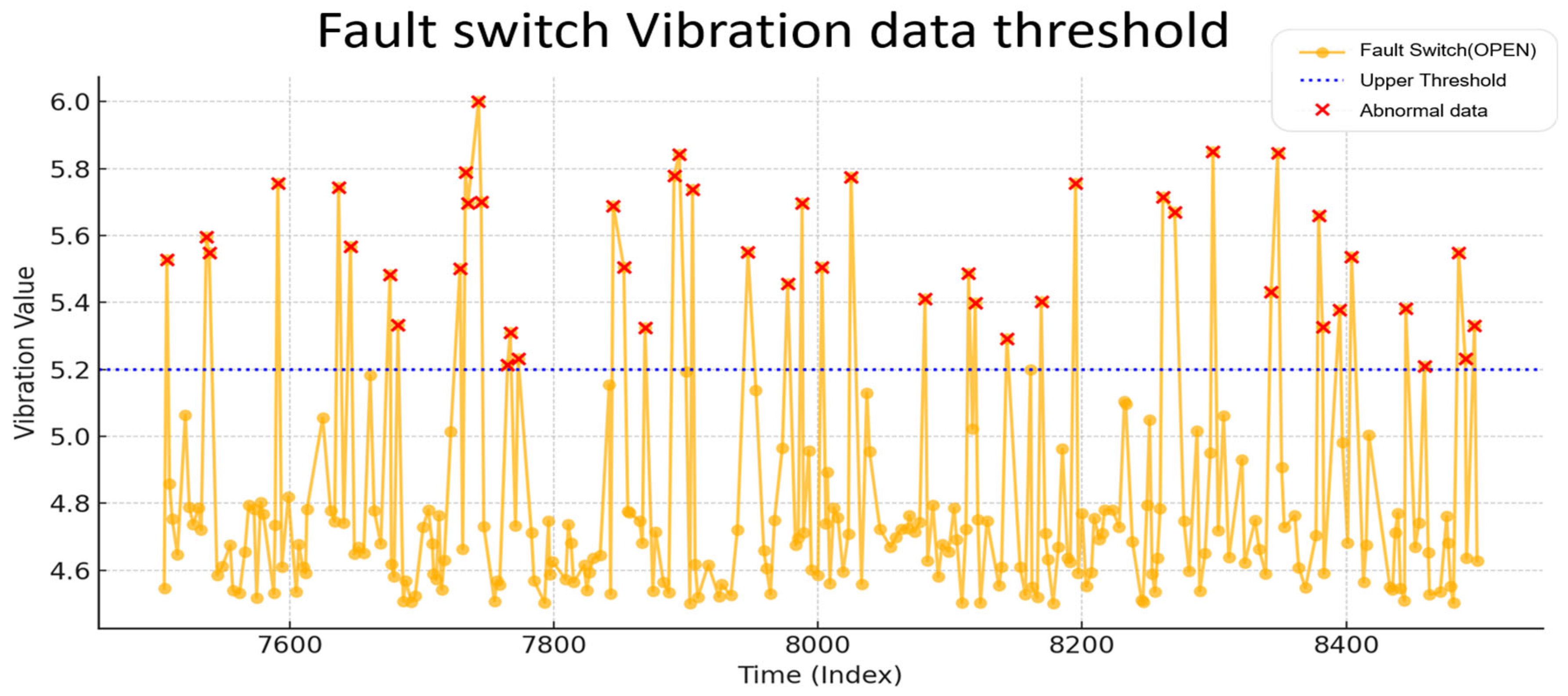
Figure 30.
Faulty switch vibration data (OPEN).
Figure 30.
Faulty switch vibration data (OPEN).
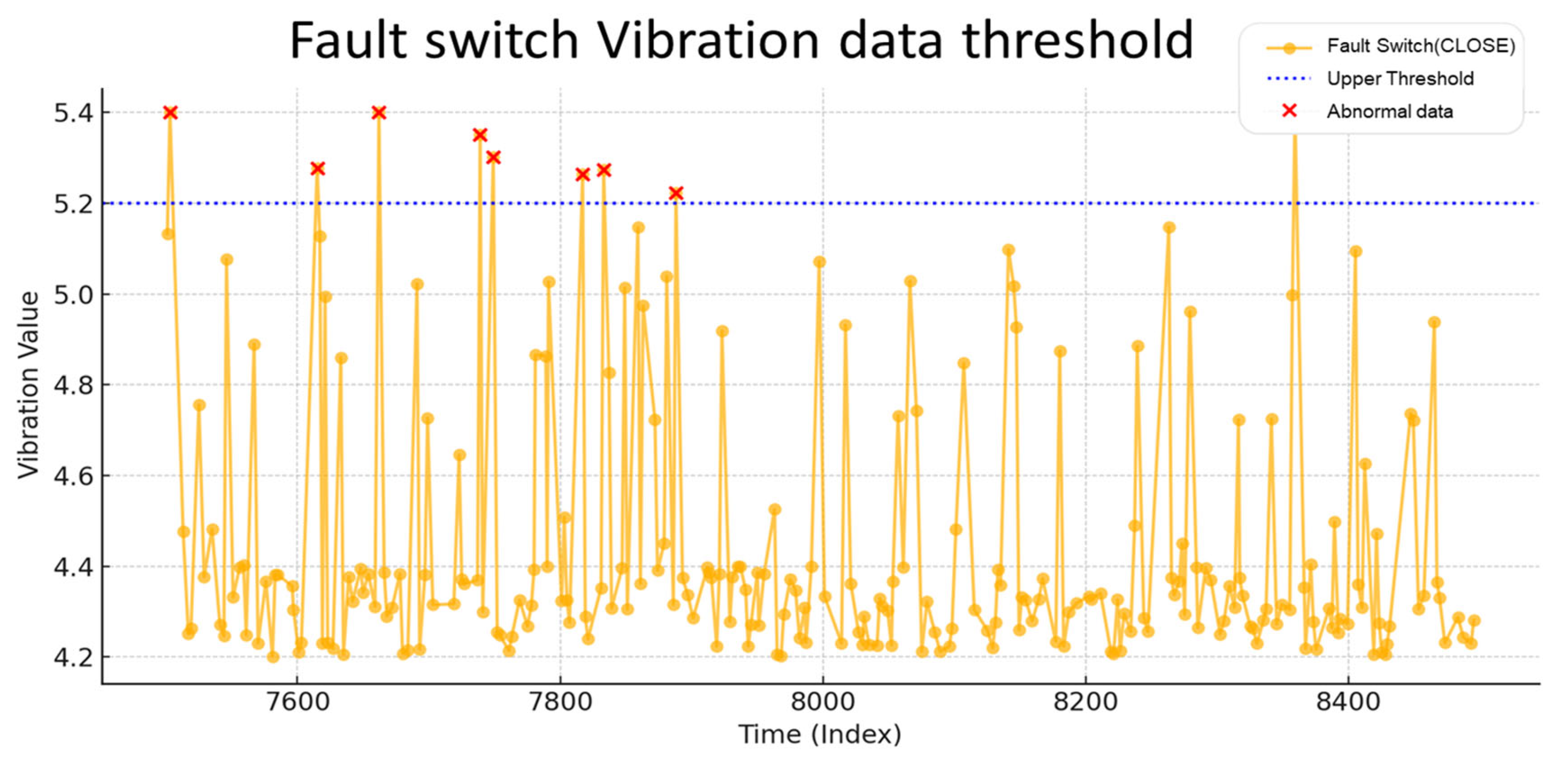
Figure 31.
Faulty switch vibration data (CLOSE).
Figure 31.
Faulty switch vibration data (CLOSE).
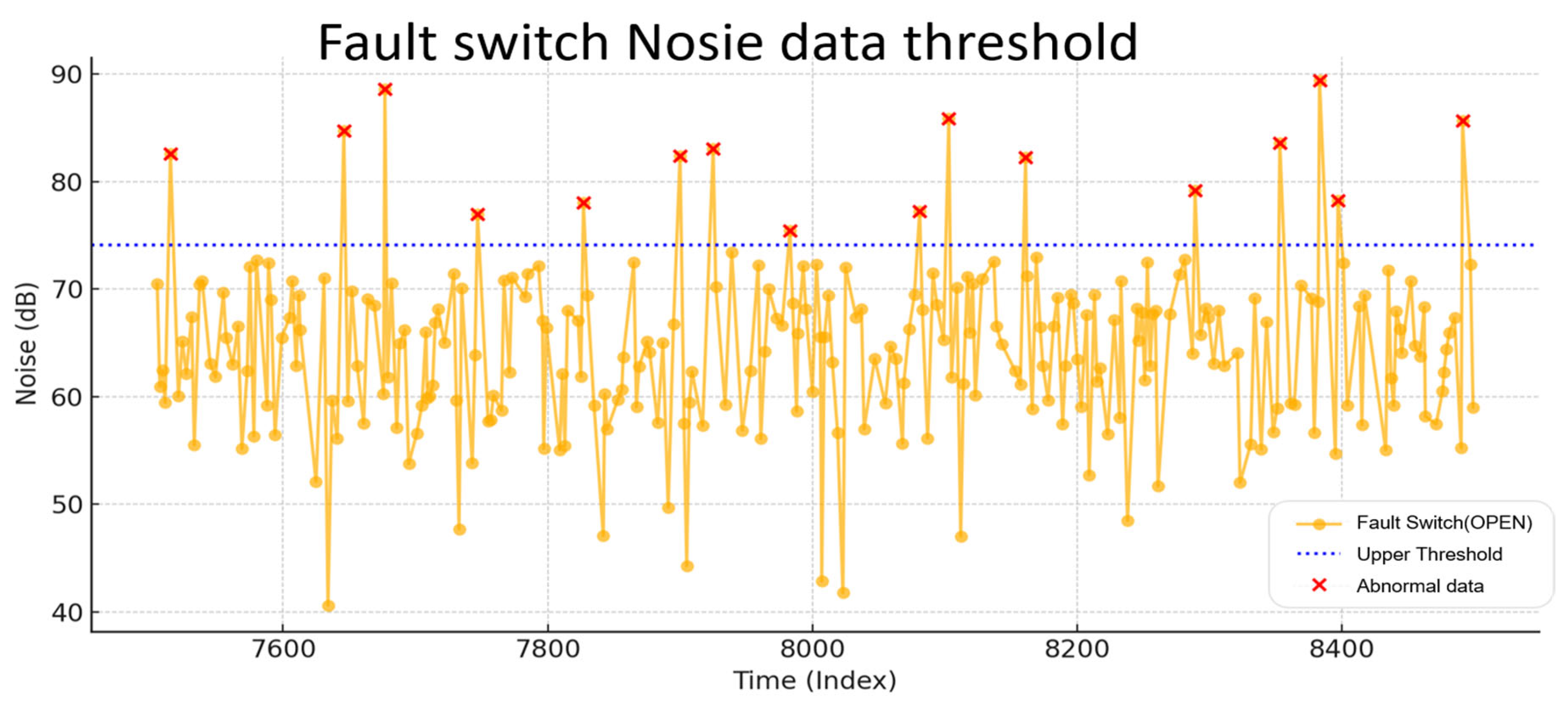
Figure 32.
Faulty switch noise data (OPEN).
Figure 32.
Faulty switch noise data (OPEN).
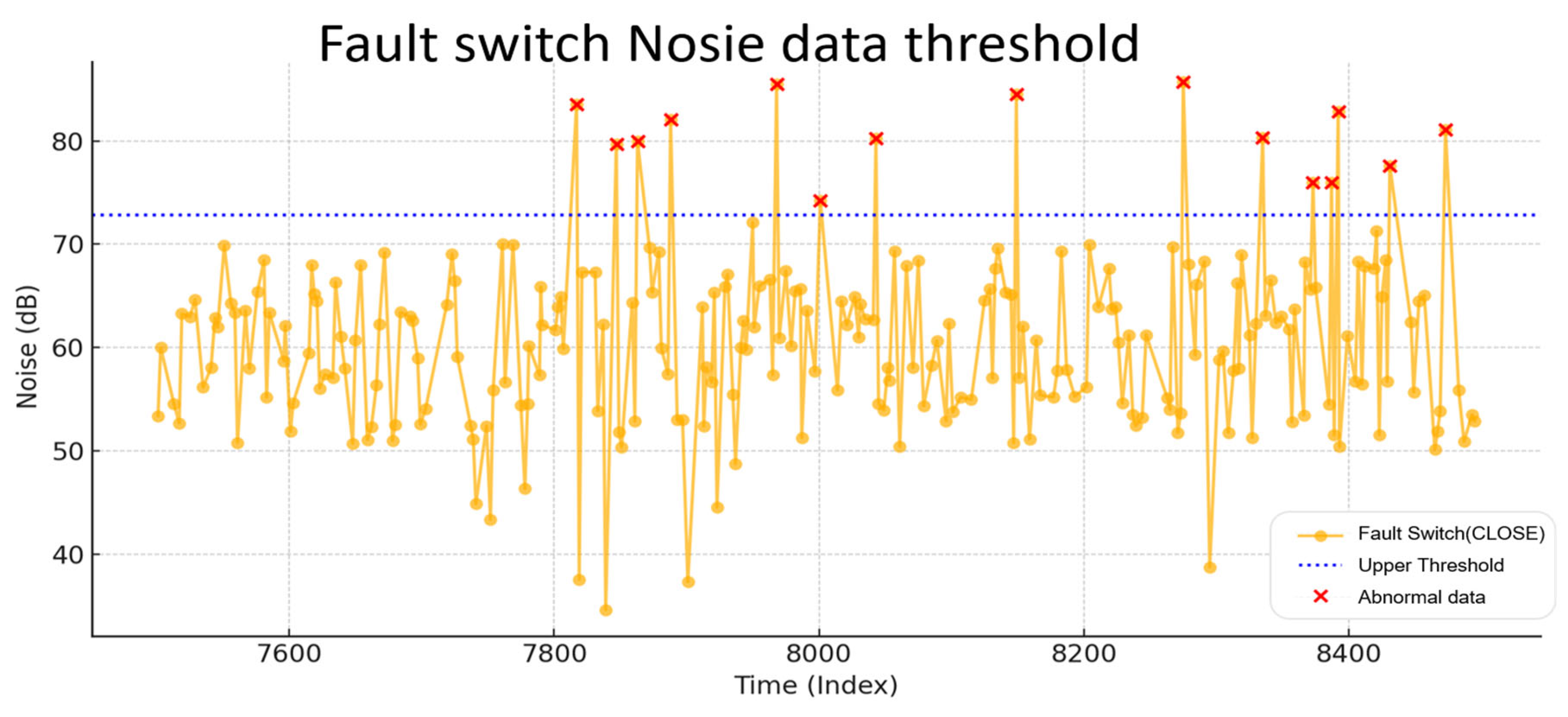
Figure 33.
Faulty switch noise data (CLOSE).
Figure 33.
Faulty switch noise data (CLOSE).
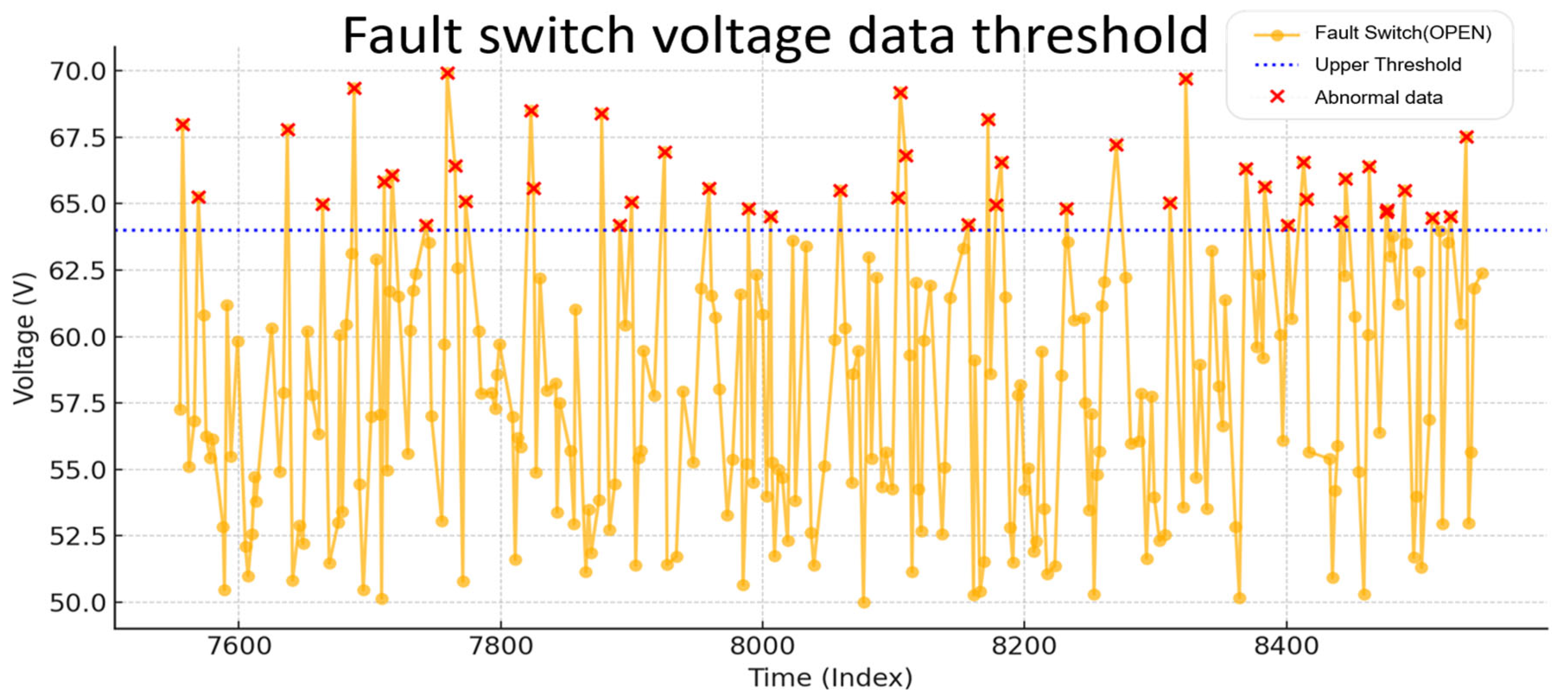
Figure 34.
Faulty switch voltage data (OPEN).
Figure 34.
Faulty switch voltage data (OPEN).
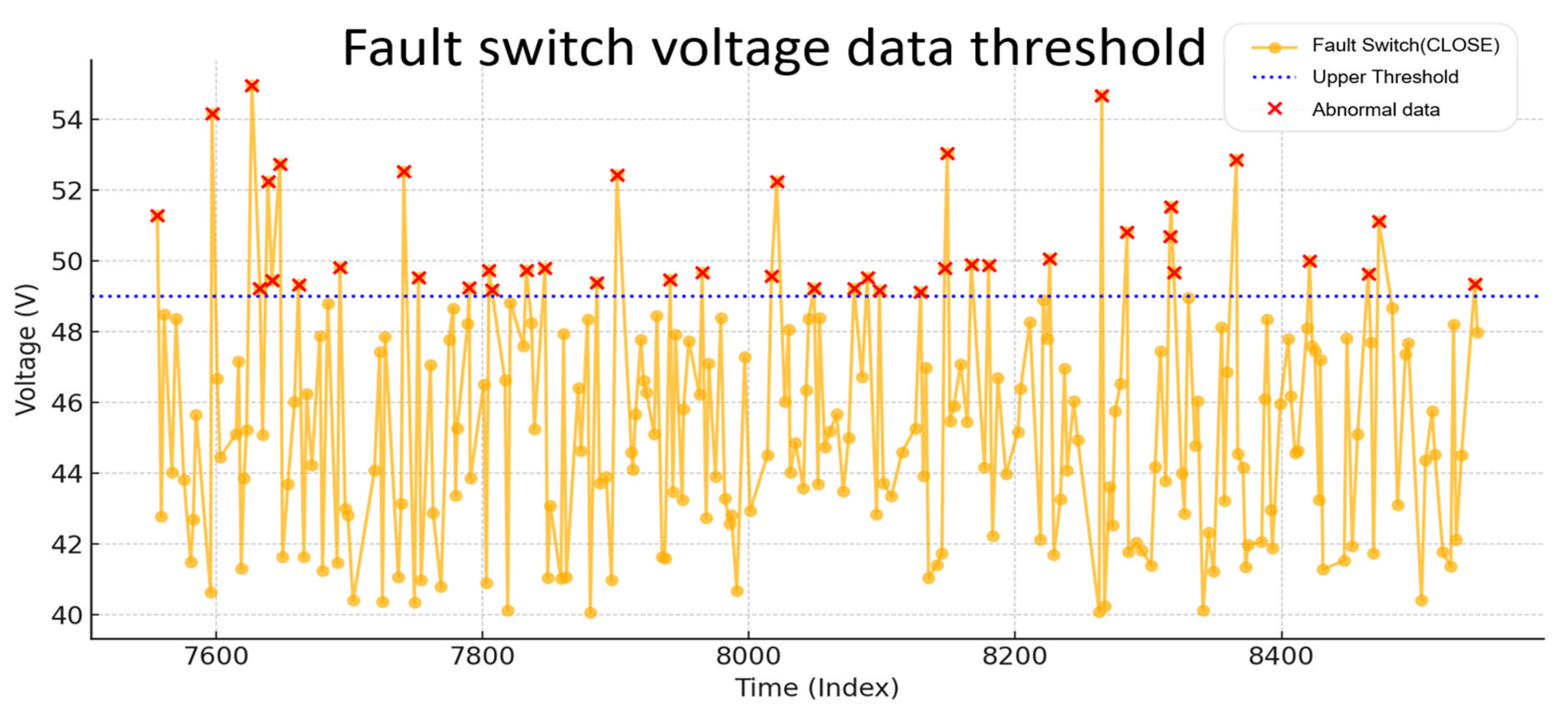
Figure 35.
Faulty switch voltage data (CLOSE).
Figure 35.
Faulty switch voltage data (CLOSE).
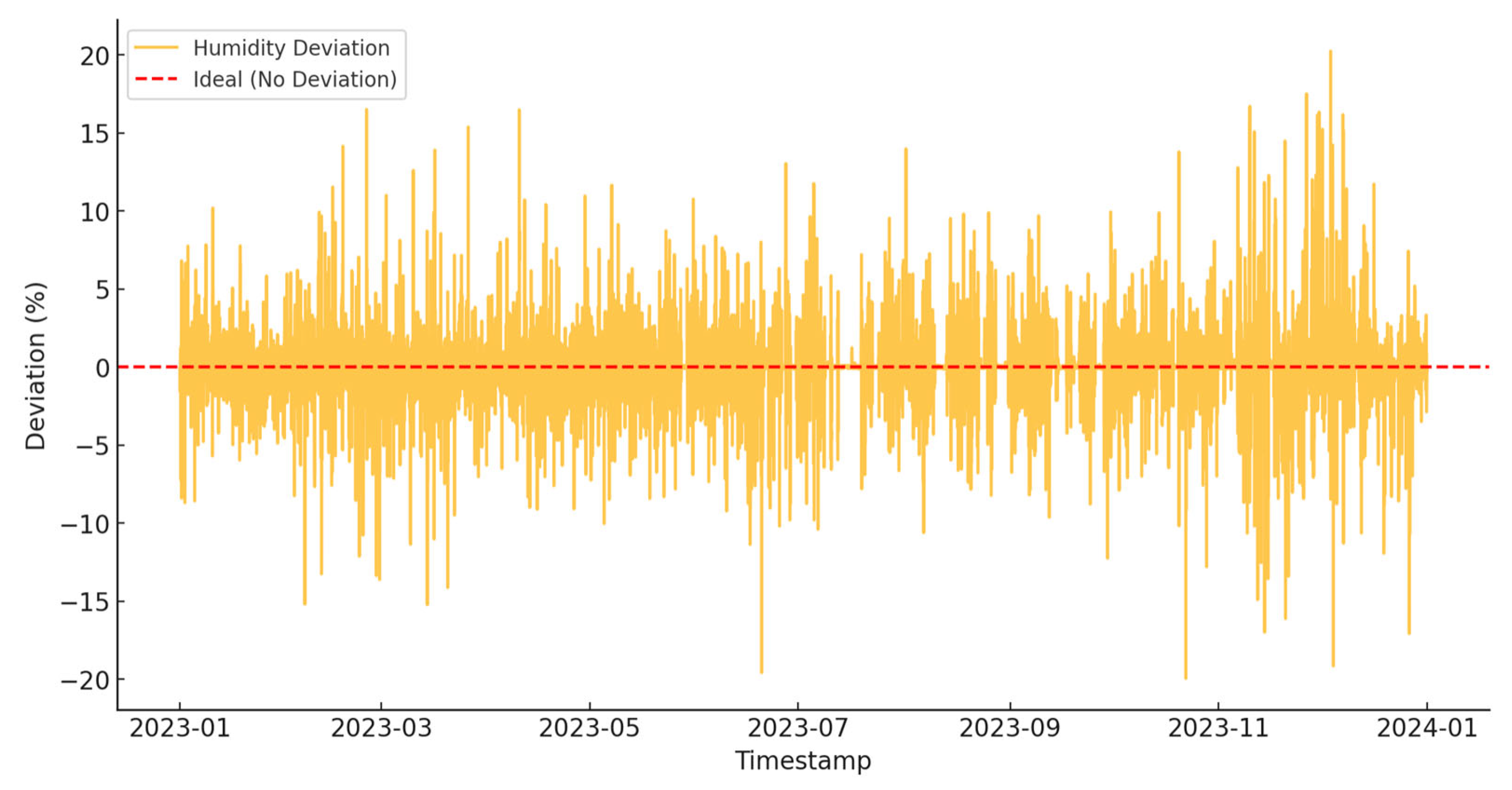
Figure 36.
Difference between actual humidity sensor readings and predicted humidity values.
Figure 36.
Difference between actual humidity sensor readings and predicted humidity values.
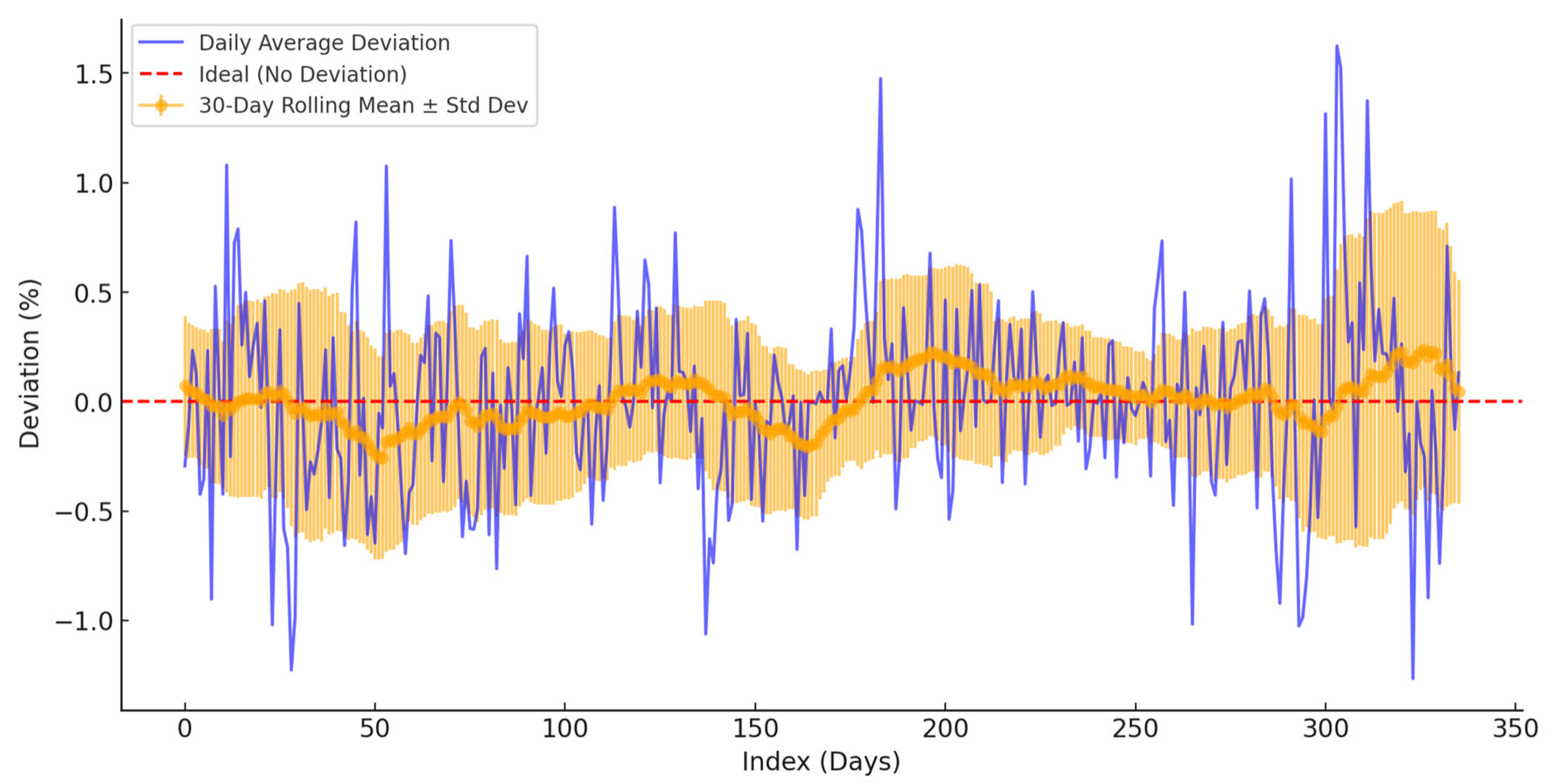
Figure 37.
30 d moving average and corresponding standard deviation of humidity deviations.
Figure 37.
30 d moving average and corresponding standard deviation of humidity deviations.
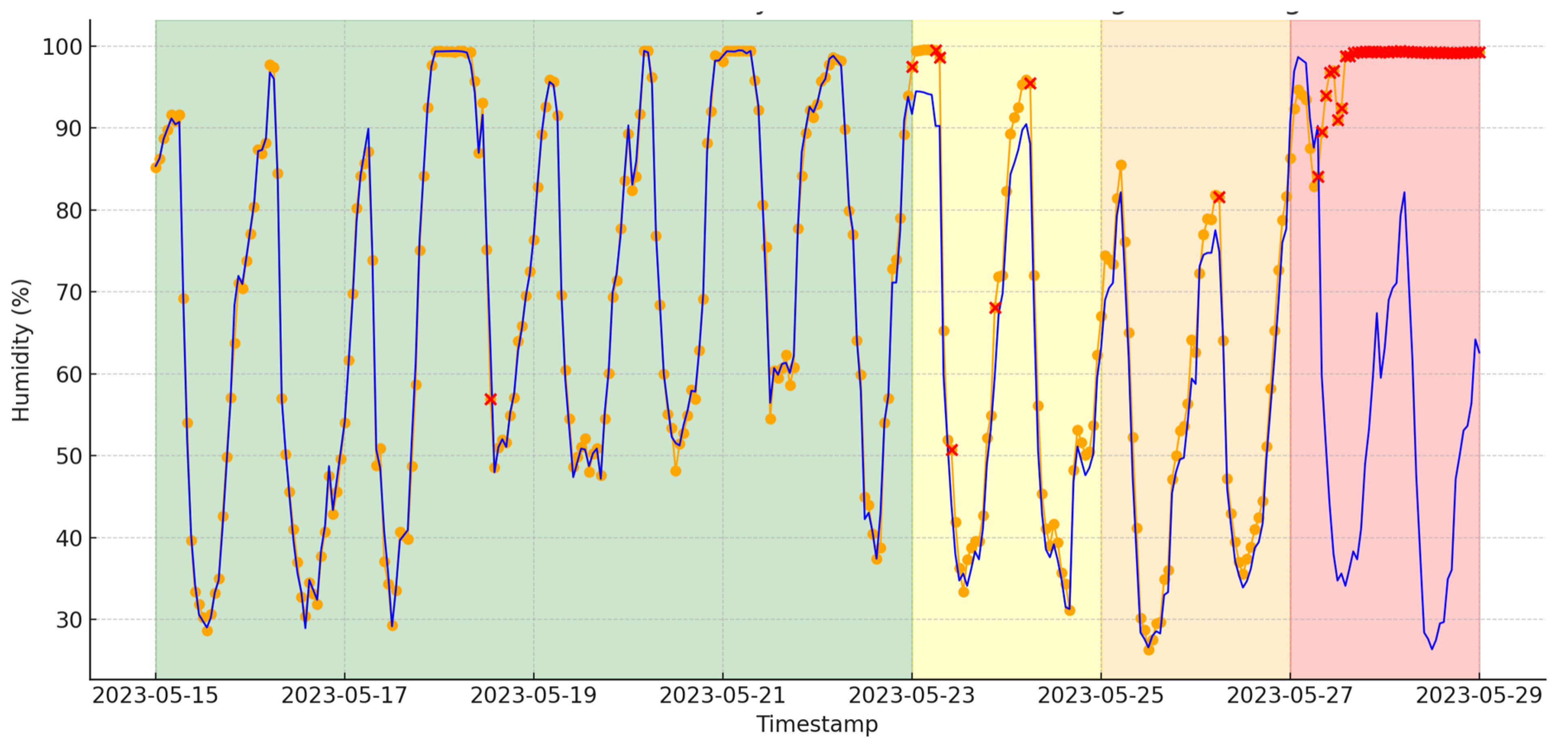
Figure 38.
Humidity sensor anomaly detection graph based on predicted thresholds.
Figure 38.
Humidity sensor anomaly detection graph based on predicted thresholds.
Figure 39.
Difference between actual and predicted CO2 values.
Figure 39.
Difference between actual and predicted CO2 values.
Figure 40.
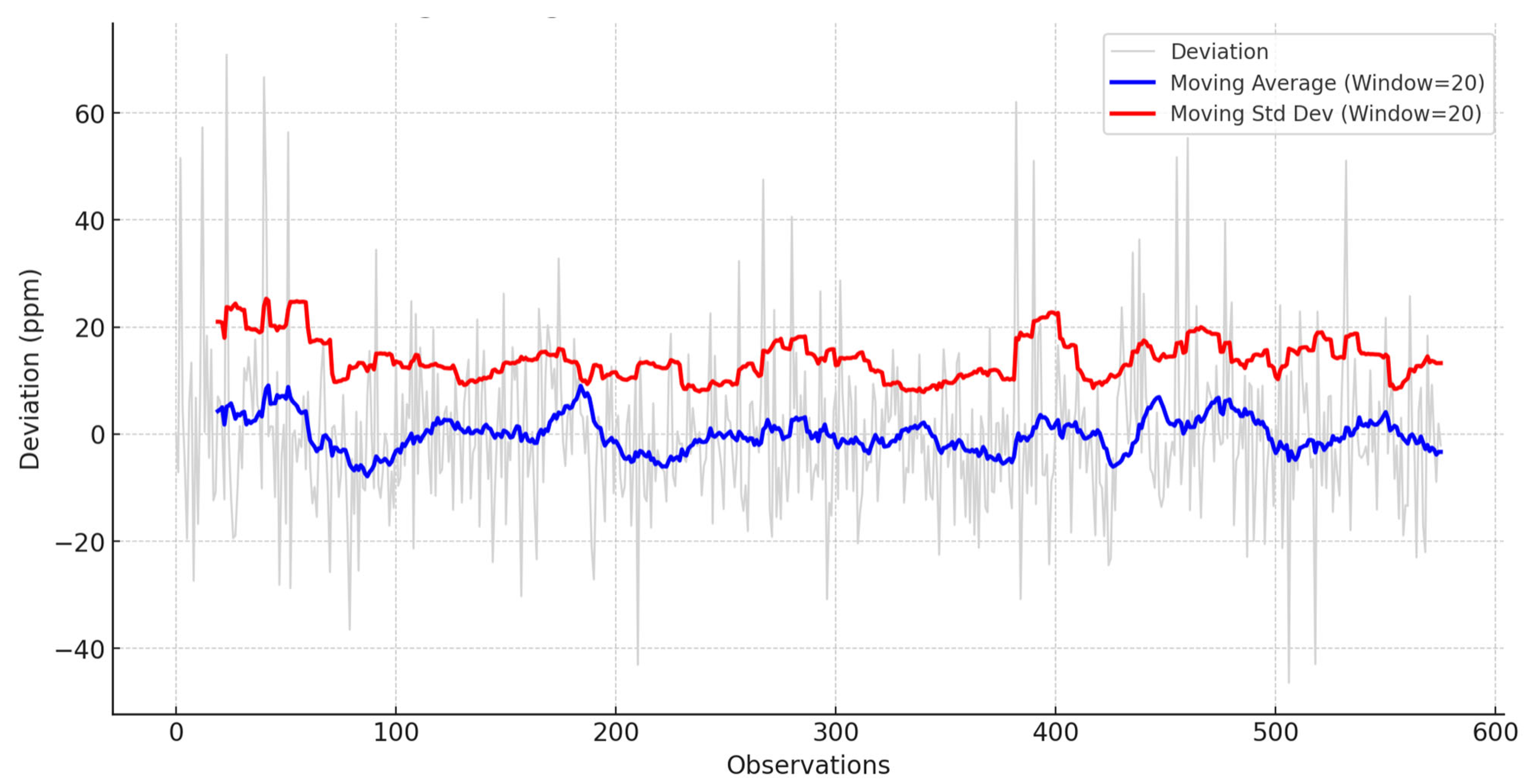
Moving average and standard deviation of CO2 deviations.
Figure 40.
Moving average and standard deviation of CO2 deviations.
Figure 41.
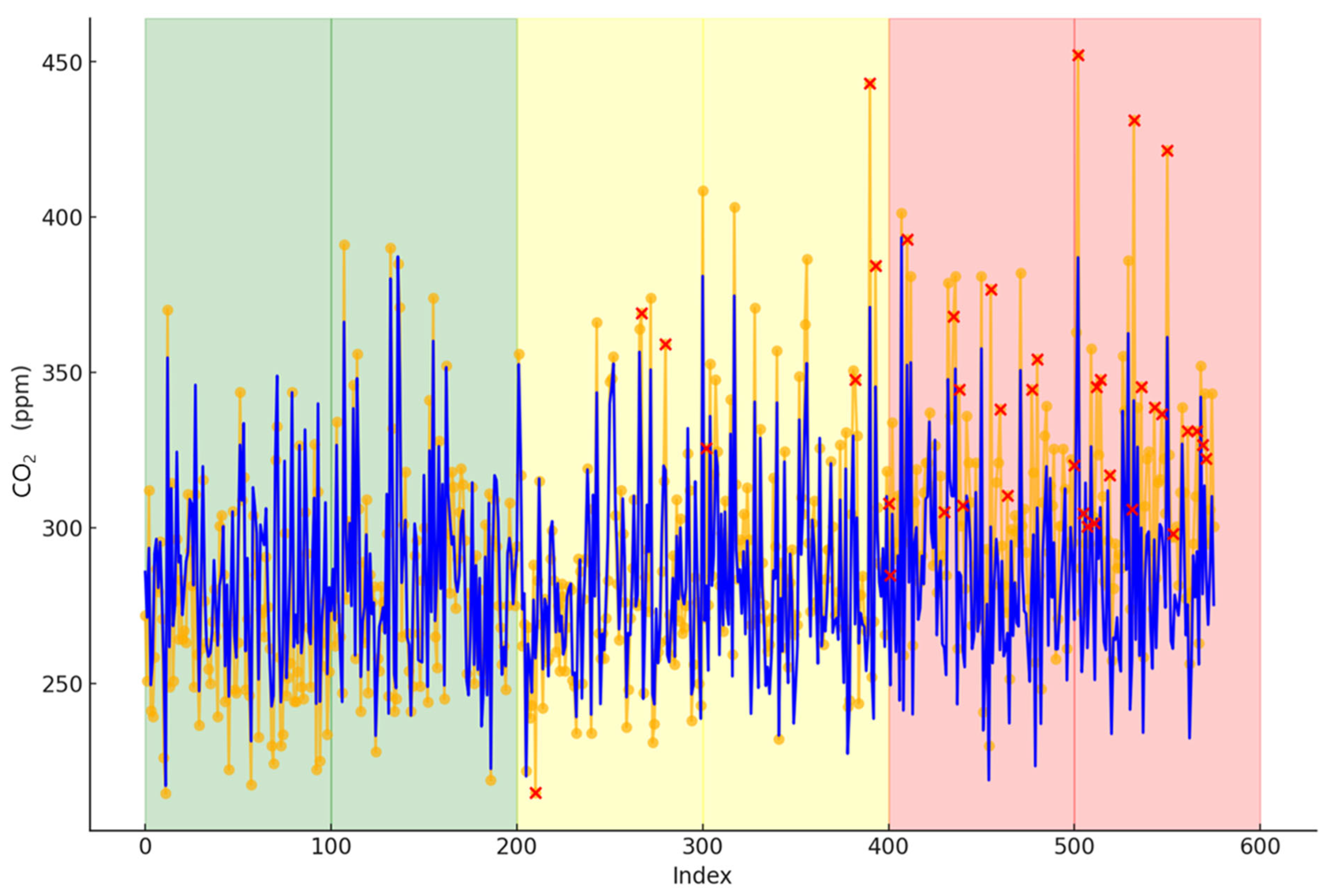
CO2 anomaly detection graph based on predicted thresholds.
Figure 41.
CO2 anomaly detection graph based on predicted thresholds.
Figure 42.
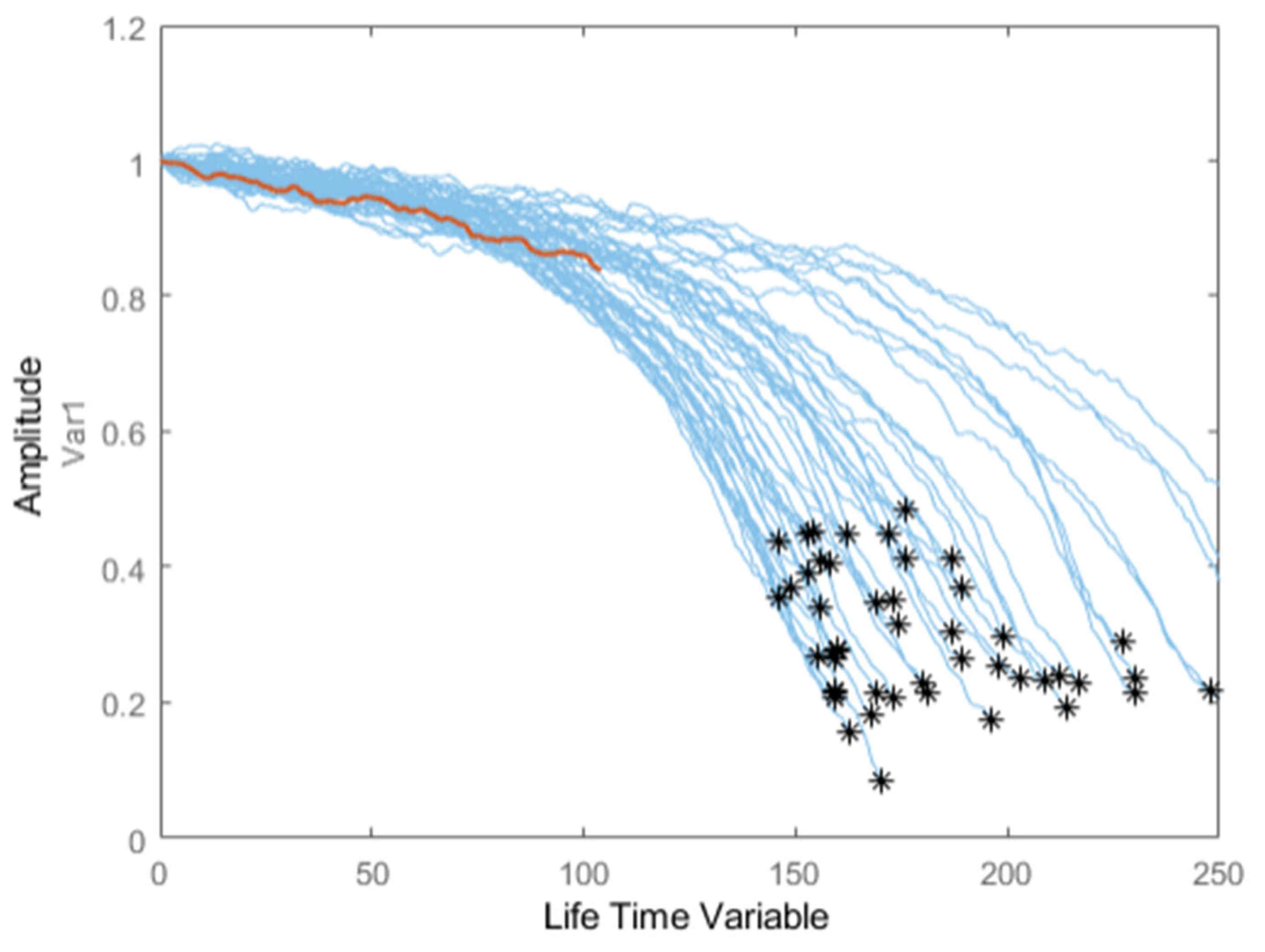
Performance degradation trend using the KNN approach. (Black asterisks (*) represent the observed degradation/failure points of the device, which are used as ground truth for evaluating the KNN-based RUL prediction).
Figure 42.
Performance degradation trend using the KNN approach. (Black asterisks (*) represent the observed degradation/failure points of the device, which are used as ground truth for evaluating the KNN-based RUL prediction).
Figure 43.
Estimation of remaining switch life.
Figure 43.
Estimation of remaining switch life.
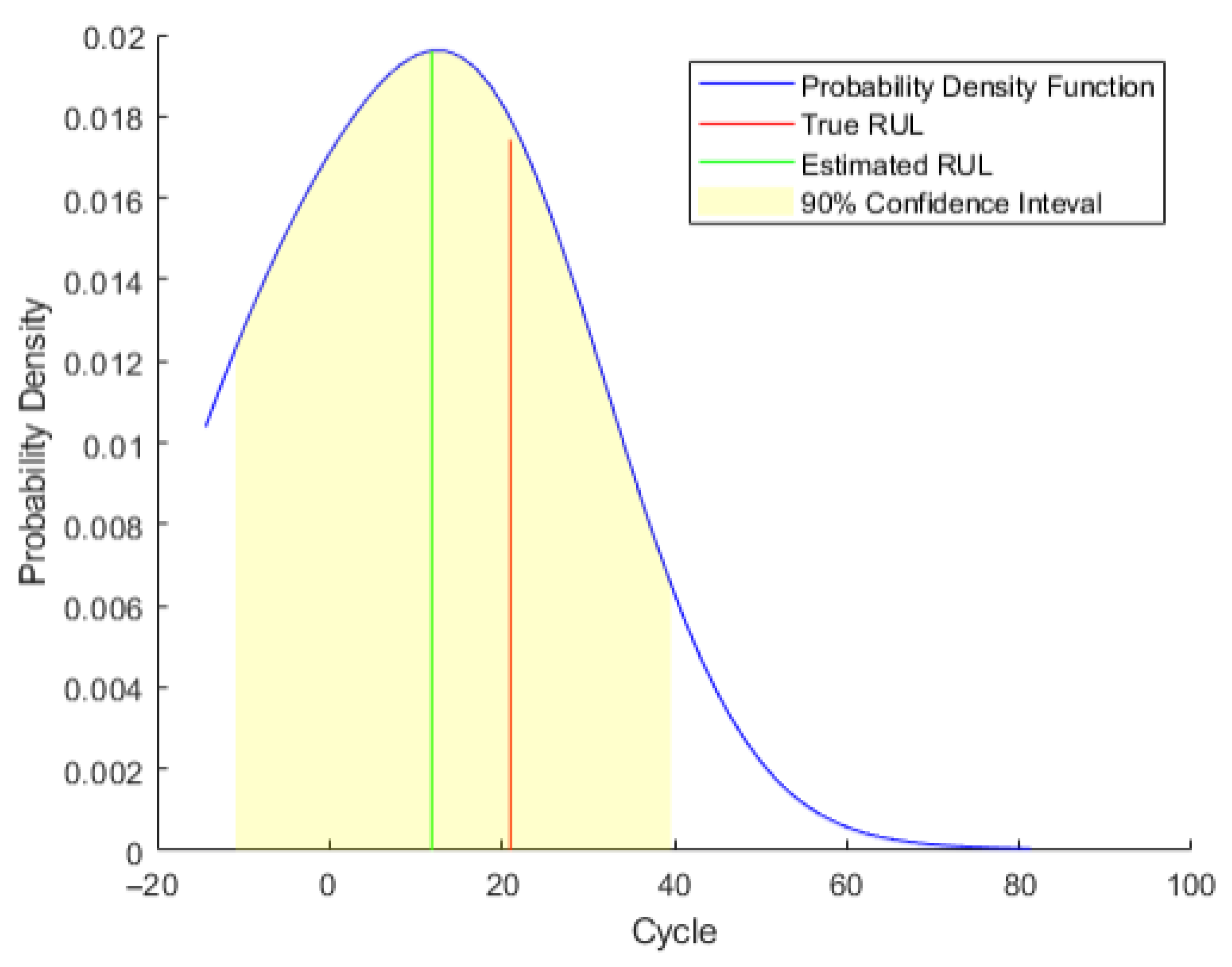
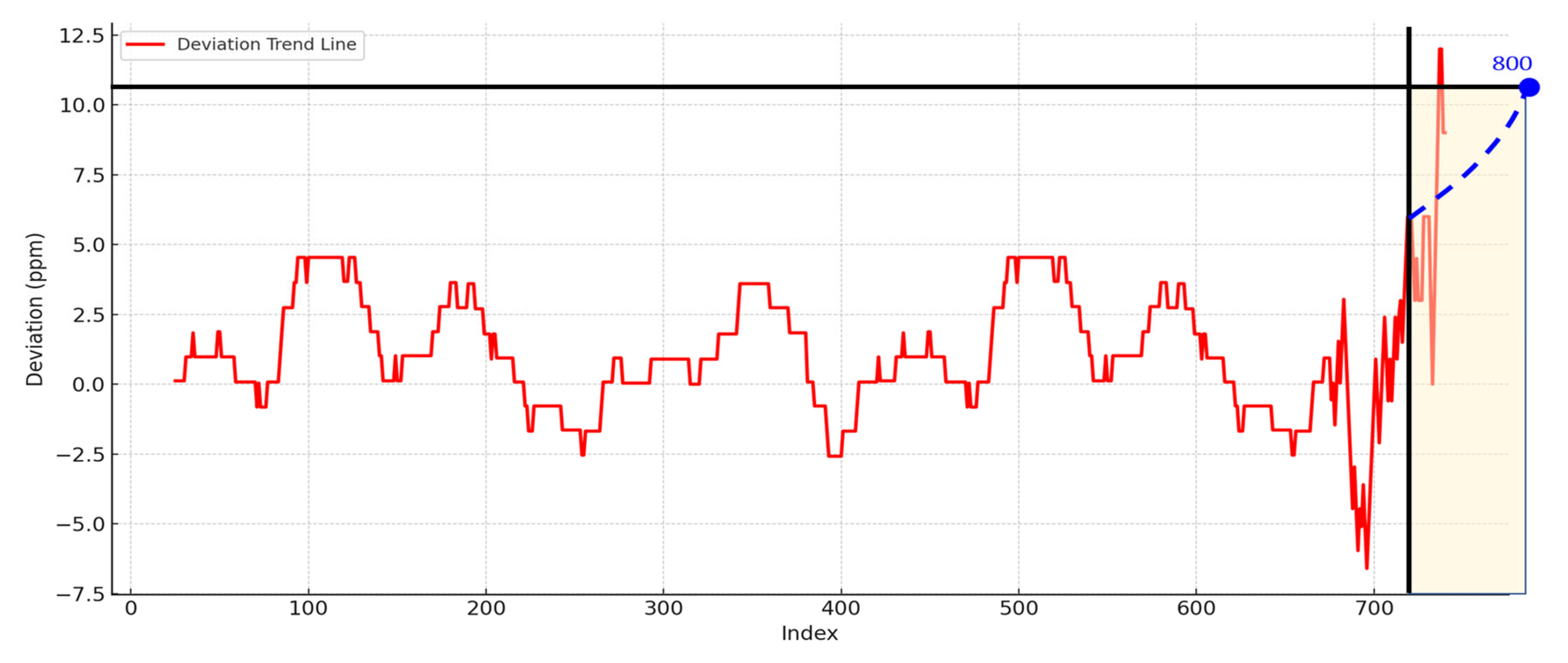
Figure 44.
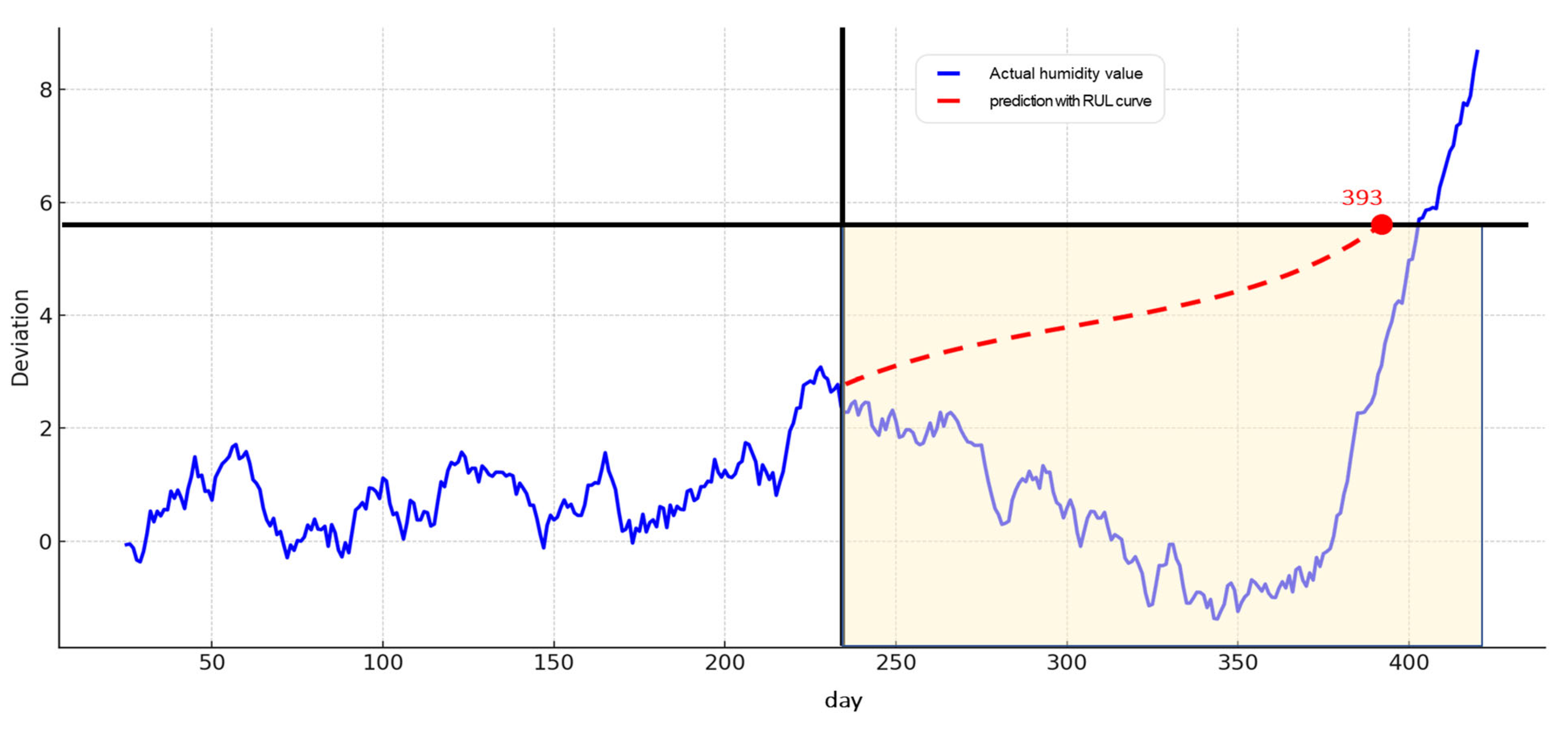
Humidity sensor remaining life prediction. The yellow-shaded region represents the prediction horizon during which the model forecasts future deviation trends to estimate the remaining useful life (RUL).
Figure 44.
Humidity sensor remaining life prediction. The yellow-shaded region represents the prediction horizon during which the model forecasts future deviation trends to estimate the remaining useful life (RUL).
Figure 45.
CO2 sensor remaining life prediction. The yellow-shaded region represents the prediction horizon during which the model forecasts future deviation trends to estimate the sensor’s remaining useful life (RUL).
Figure 45.
CO2 sensor remaining life prediction. The yellow-shaded region represents the prediction horizon during which the model forecasts future deviation trends to estimate the sensor’s remaining useful life (RUL).
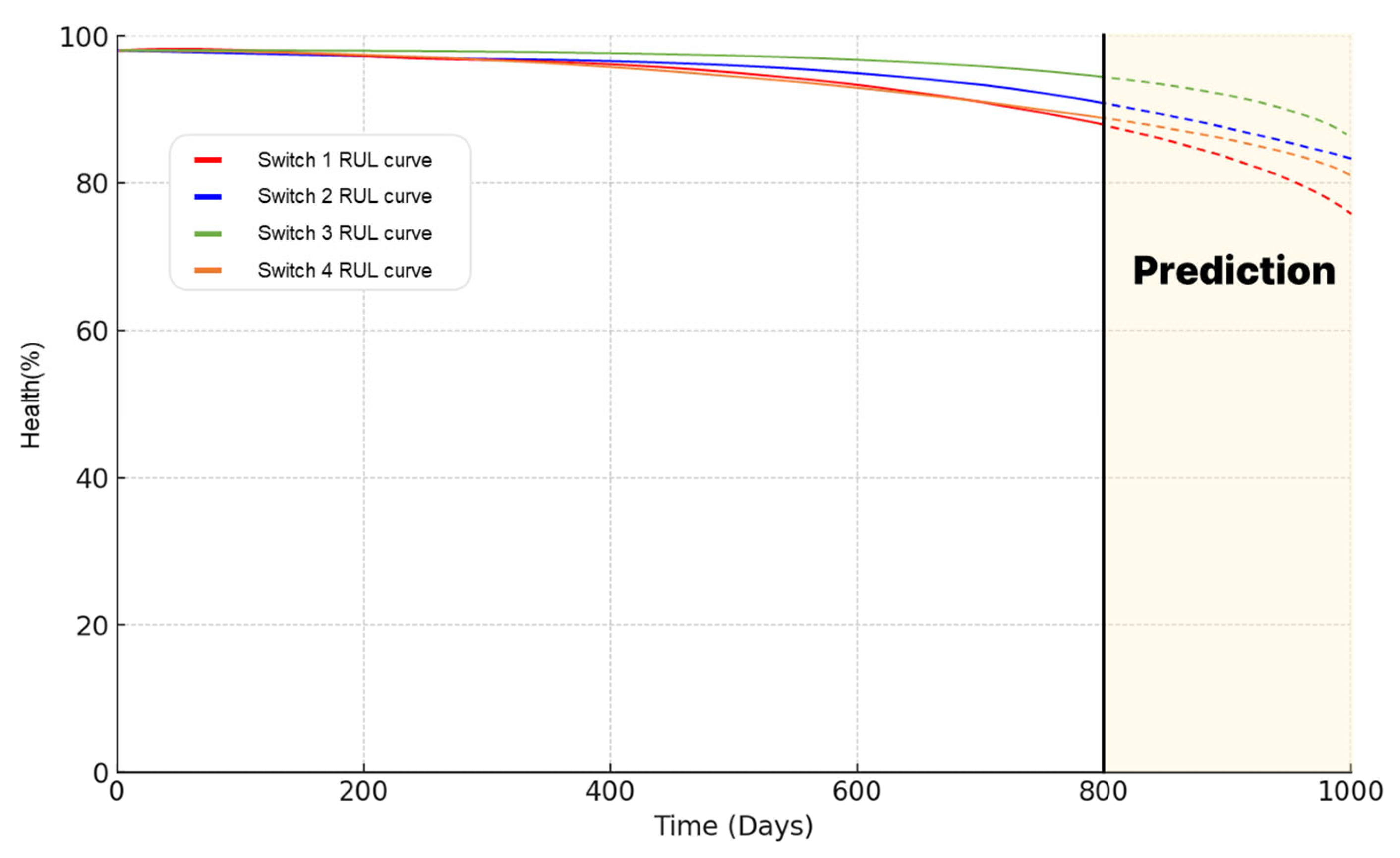
Figure 46.
Remaining life prediction for switches based on operating days. The yellow-shaded area indicates the forward-prediction interval, during which the model projects future health degradation to compute the RUL of the four switches.
Figure 46.
Remaining life prediction for switches based on operating days. The yellow-shaded area indicates the forward-prediction interval, during which the model projects future health degradation to compute the RUL of the four switches.
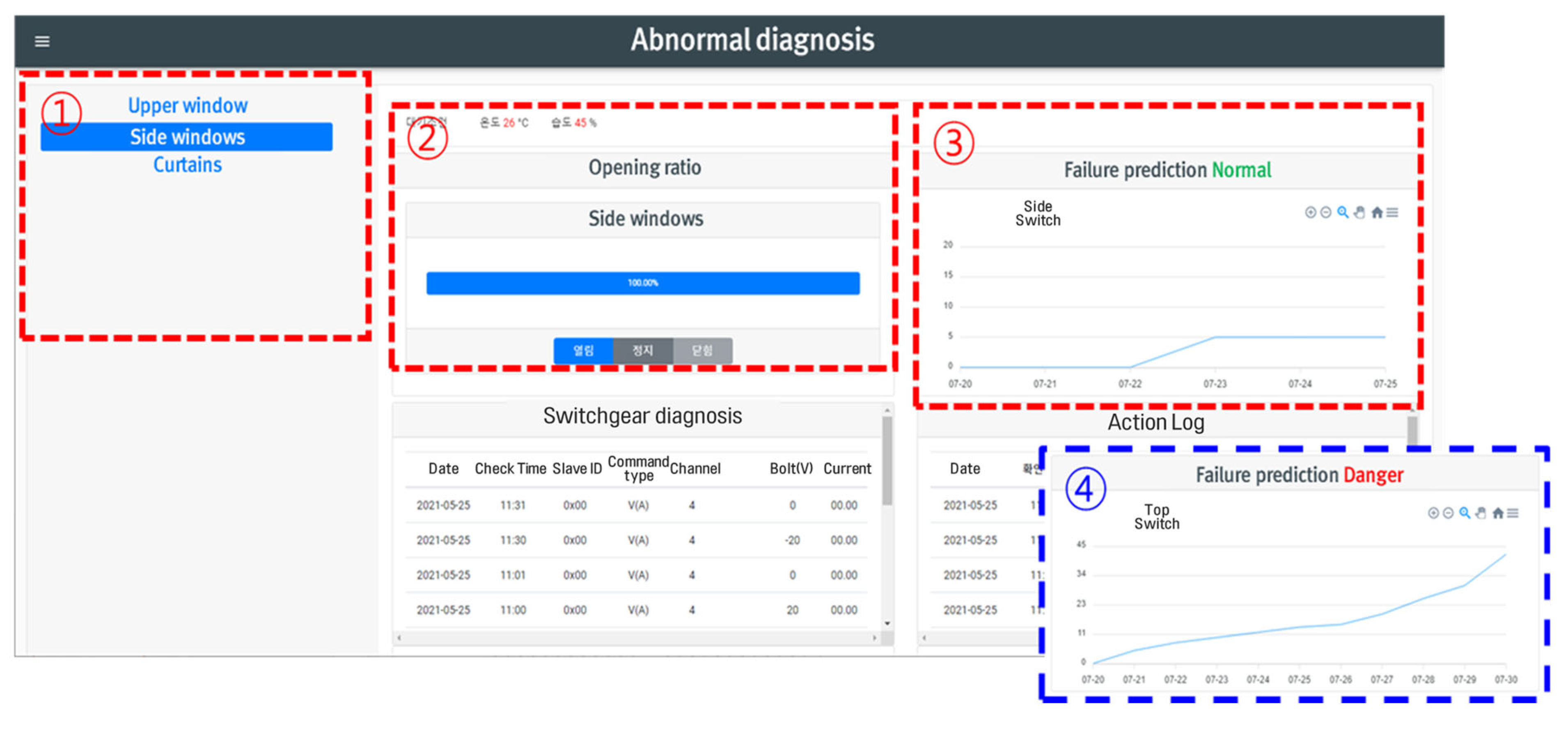
Figure 47.
Web-based anomaly detection platform for smart farm equipment.
Figure 47.
Web-based anomaly detection platform for smart farm equipment.
Table 1.
Smart farm generation classification.
Table 1.
Smart farm generation classification.
| Category | First Generation | Second Generation | Third Generation |
|---|
| Commercialization timeline | Present | 2030 | 2040 |
| Intended effect | Improvement in convenience | Improvement in productivity | Improvement in sustainability |
| Key functions | Remote facility control | Precision cultivation and growth management | Full life cycle management, intelligent and automated management |
| Core technologies | Communication technology | Communication technology, big data, artificial intelligence (AI) | Communication technology, robots, big data, AI |
| Decision making and control | Human/human | Human/computer | Computer/robot |
| Representative examples | Smartphone greenhouse control system | Data-driven growth management software | Intelligent robotic farm |
Table 2.
Key components of a smart farm (facility horticulture).
Table 2.
Key components of a smart farm (facility horticulture).
| Category | Details |
|---|
| Environmental sensors | Outside | Temperature, humidity, wind direction, wind speed, rainfall, solar radiation, etc. |
| Inside | Temperature, humidity, CO2, soil moisture (soil cultivation), nutrient solution measurement sensors (electrical conductivity (EC) and pH of nutrient solution), substrate moisture sensors, etc. |
| Imaging devices | Infrared cameras, digital video recorders, etc. |
| Facility-level and integrated control equipment | Ventilation, heating, energy-saving facilities, shade curtains, circulation fans, hot water and heating water control, motor control, nutrient solution unit control, LED lighting, etc. |
| Information management system for the optimal growth environment | Real-time monitoring of the growth environment, facility control, and analysis system with a database (DB) of environmental and growth information, etc. |
Table 3.
Error data for smart farm sensors.
Table 3.
Error data for smart farm sensors.
| Sensor Type | Farmers | Error Data | Notes |
|---|
| Temperature | 1536 | 231 | 15% |
| Humidity | 1536 | 672 | 43% |
| CO2 | 1536 | 441 | 28% |
| Insolation | 1232 | 156 | 12% |
| Wind direction | 1227 | 56 | 4% |
| Wind speed | 1234 | 50 | 4% |
| Precipitation | 1231 | 66 | 5% |
| Light | 1200 | 263 | 21% |
| Soil moisture content | 318 | 38 | 11% |
| Soil water tension | 326 | 55 | 16% |
| Soil temperature | 324 | 34 | 10% |
Table 4.
Usage rates of smart farm controllers.
Table 4.
Usage rates of smart farm controllers.
| Actuator Type | Farmers | Notes |
|---|
| Upper window | 1536 | 100% owned |
| Side window | 1536 | 100% owned |
| Insulating cover | 807 | Approximately 53% owned |
| Shade screen | 754 | Approximately 49% owned |
| Ventilation fan | 1383 | Approximately 90% owned |
| Flow fan | 1366 | Approximately 89% owned |
| Irrigation motor | 440 | Approximately 29% owned |
| Irrigation valve | 442 | Approximately 30% owned |
| Air conditioner | 171 | Approximately 10% owned |
Table 5.
External environmental sensor data,.
Table 5.
External environmental sensor data,.
| Survey Items | Standard Words | Unit of Measurement | Data Type |
|---|
| Outside precipitation | Damp rain | O/X | Metadata |
| Outside temperature | Outside temperature | °C | Metadata |
| Outside relative humidity | Outside relative humidity | % | Metadata |
| Outside wind direction | Outside wind direction | deg | Metadata |
| Outside wind speed | Outside wind speed | m/s | Metadata |
| Outside average nighttime temperature | Outside temperature (nighttime average) | °C | Metadata |
| Outside average daytime temperature | Outside temperature (daytime average) | °C | Processed data |
| Outside maximum temperature | Outside temperature (highest) | °C | Processed data |
| Outside minimum temperature | Outside temperature (lowest) | °C | Processed data |
| Outside average temperature | Outside temperature (average) | °C | Processed data |
| Outside maximum solar radiation | Insolation (highest) | W/m2 | Processed data |
| Outside accumulated solar radiation | Insolation (accumulated) | J/cm2 | Processed data |
Table 6.
Internal environmental sensor data.
Table 6.
Internal environmental sensor data.
| Survey Items | Standard Words | Unit of Measurement | Data Type |
|---|
| Internal temperature | Internal temperature | °C | Metadata |
| Internal relative humidity | Internal relative humidity | % | Metadata |
| Internal light intensity | Internal light | μmol/m2/s | Metadata |
| Internal average nighttime relative humidity | Internal relative humidity (nighttime average) | % | Processed data |
| Internal average daytime relative humidity | Internal relative humidity (daytime average) | % | Processed data |
| Internal highest relative humidity | Internal relative humidity (highest) | % | Processed data |
| Internal lowest relative humidity | Internal relative humidity (lowest) | % | Processed data |
| Internal average relative humidity | Internal relative humidity (average) | % | Processed data |
| Internal average nighttime temperature | Internal temperature (nighttime average) | °C | Processed data |
| Internal average daytime temperature | Internal temperature (daytime average) | °C | Processed data |
| Internal highest temperature | Internal temperature (highest) | °C | Processed data |
| Internal lowest temperature | Internal temperature (lowest) | °C | Processed data |
| Internal average temperature | Internal temperature (average) | °C | Processed data |
| Internal CO2 concentration | CO2 | ppm | Metadata |
Table 7.
Soil environmental sensor data.
Table 7.
Soil environmental sensor data.
| Survey Items | Standard Words | Unit of Measurement | Data Type |
|---|
| Internal soil EC | Soil EC | dS/m | Metadata |
| Internal soil liquid EC | Soil liquid EC | dS/m | Metadata |
| Internal subsoil moisture | Soil moisture | % | Metadata |
| Internal subsoil temperature | Soil temperature | °C | Metadata |
Table 8.
Humidity sensor detailed specifications.
Table 8.
Humidity sensor detailed specifications.
| Items | Humidity Sensor |
|---|
| Supply voltage | 5 VDC |
| Operating temperature | −35 to 85 °C (standard)/−40 to 125 °C (extended) |
| Operating humidity range | 0–80% RH (relative humidity; standard)/0–100% RH (extended) |
| Humidity output | −0.3 V to 5.3 V |
| Humidity accuracy | ±2% RH (at 25 °C, from 5 VDC) |
| Humidity transmitting range | 0–80% RH (standard)/0–100% RH (extended) |
Table 9.
CO2 sensor detailed specifications.
Table 9.
CO2 sensor detailed specifications.
| Items | CO2 Sensor |
|---|
| Sensing method | Nondispersive infrared |
| Measurement range | 0–10,000 ppm |
| Accuracy | ±30 ppm ±5% |
| Response time (90%) | 150 s |
| Sampling interval | 3 s |
| Operating temperature range | 0–50 °C |
Table 10.
Switch status sensor data.
Table 10.
Switch status sensor data.
| Survey Items | Standard Words | Unit of Measurement | Data Type |
|---|
| Switch voltage | Voltage | V | Metadata |
| Switch current | Electric current | A | Metadata |
| Switch vibration level | Vibration | mm/s | Metadata |
| Switch noise | Noise | dB | Metadata |
| Switch thermal temperature | Heat temperature | °C | Metadata |
Table 11.
Switch control data.
Table 11.
Switch control data.
| Survey Items | Standard Words | Unit of Measurement | Data Type |
|---|
| Upper window | Upper window | Open/close/stop | Metadata |
| Side window | Side window | Open/close/stop | Metadata |
Table 12.
ON/OFF control data.
Table 12.
ON/OFF control data.
| Survey Items | Standard Words | Unit of Measurement | Data Type |
|---|
| Exhaust fan | Exhaust fan | On/off | Metadata |
| Flow fan | Flow fan | On/off | Metadata |
Table 13.
Switch specifications.
Table 13.
Switch specifications.
| Actuator | Model | Specifications |
|---|
 | DC motor
WSM-4035 [37] | Applications: vinyl, nonwoven fabric, thermal insulation covers, horizontal curtain switches
Operating voltage: 24 VDC, 2–12.5 A, open/stop/close |
Table 14.
Overview of Data Collection Settings.
Table 14.
Overview of Data Collection Settings.
| Category | Description |
|---|
| Data collection period | 1 January 2023–31 December 2024 (2 years) |
| Sampling interval | 1 min logging interval |
| Sensors monitored | Humidity sensors (3 units)
CO2 sensors (3 units) |
| Actuators monitored | Switch-type actuators (2 units) |
| Approx. total observations per sensor | ~1,051,200 records per sensor (2 years × 365 days × 24 h × 60 min) |
Table 15.
Normal data.
| Category | Vibration Value | Noise (dB) | Voltage (V) | Heat Temperature (°C) |
|---|
| Count | 20,946 | 20,946 | 20,946 | 20,946 |
| Mean | 1.944169 | 33.10464 | 24.47733 | 13.33905 |
| Std | 1.920376 | 28.22889 | 24.94726 | 4.209443 |
| Min | 0 | 0 | 0 | 0.63 |
| 25% | 0.025225 | 5.1 | 0 | 10.54 |
| 50% | 3.49765 | 48.9625 | 34.17 | 13.92 |
| 75% | 3.84665 | 60.6 | 47.9 | 16.25 |
| Max | 4.218 | 74.9045 | 79.21775 | 32.24 |
Table 16.
Abnormal data.
| Category | Vibration Value | Noise (dB) | Voltage (V) | Heat Temperature (°C) |
|---|
| Count | 16,105 | 16,105 | 16,105 | 16,105 |
| Mean | 2.398319 | 34.06961 | 27.1583 | 16.45986 |
| Std | 2.333344 | 29.29851 | 27.43229 | 6.044037 |
| Min | 0 | −9.96 | 0 | −0.21 |
| 25% | 0.0412 | 5.05 | 0 | 12.9 |
| 50% | 4.2114 | 41.25 | 40.39 | 15.79 |
| 75% | 4.6117 | 62.47 | 52.62 | 18.8 |
| Max | 6 | 89.83 | 69.99 | 35.8 |
Table 17.
Mean and standard deviation values of normal and abnormal data.
Table 17.
Mean and standard deviation values of normal and abnormal data.
| Value | Vibration | Noise | Voltage | Heat Temperature |
|---|
| Normal | Abnormal | Normal | Abnormal | Normal | Abnormal | Normal | Abnormal |
|---|
| Mean | 0.44 | 0.87 | 33.37 | 34.07 | 23.93 | 27.15 | 13.34 | 16.46 |
| Standard residual | 0.44 | 0.86 | 28.57 | 29.30 | 24.18 | 27.43 | 4.21 | 6.04 |
Table 18.
Humidity prediction model performance.
Table 18.
Humidity prediction model performance.
| Measure | Performance |
|---|
| Mean absolute error (MAE) | 0.96 |
| Root mean square error (RMSE) | 1.87 |
| R2 | 0.995 |
Table 19.
Statistical summary of residuals.
Table 19.
Statistical summary of residuals.
| Category | Difference Value |
|---|
| Mean residual | ~0.48 |
| Standard deviation | ~1.75 |
| Minimum residual | ~−8.22 |
| Maximum residual | ~9.99 |
Table 20.
CO2 concentration prediction model performance.
Table 20.
CO2 concentration prediction model performance.
| Measure | Performance |
|---|
| RMSE | 1.87 |
| R2 | 0.815 |
Table 21.
Statistical summary of residuals for CO2 sensor.
Table 21.
Statistical summary of residuals for CO2 sensor.
| Category | Difference Value |
|---|
| Mean residual | ~0.01 |
| Standard deviation | ~14.67 |
| Minimum residual | ~−46.42 |
| Maximum residual | ~70.89 |
Table 22.
Advantages and disadvantages of statistical techniques (IQR, Z-score).
Table 22.
Advantages and disadvantages of statistical techniques (IQR, Z-score).
| Method | Advantage | Disadvantage |
|---|
| IQR | Robust to extreme outliers and skewed data | Less effective in detecting subtle anomalies in highly volatile data |
| Easy to calculate and interpret |
| Z-score | Provides a probabilistic interpretation of anomalies | Sensitive to skewed data and outliers; less effective with non-Gaussian distributions |
Table 23.
Threshold results for normal data using statistical techniques.
Table 23.
Threshold results for normal data using statistical techniques.
| Function | IQR Lower Bound | IQR Upper Bound | Z-Score Lower Bound | Z-Score Upper Bound |
|---|
| Vibration | −5.71 | 9.85 | −3.82 | 7.71 |
| Noise | −78.15 | 143.85 | −51.58 | 117.79 |
| Voltage | −71.85 | 119.75 | −50.36 | 99.32 |
Table 24.
Switch thresholds using hybrid technique.
Table 24.
Switch thresholds using hybrid technique.
| Category | Normal Switch | Faulty Switch |
|---|
| OPEN | CLOSE | OPEN | CLOSE |
|---|
| Vibration | 5.2 | 5.2 | 5.2 | 5.2 |
| Noise | 72 | 72 | 72 | 72 |
| Voltage | 63 | 49 | 63 | 49 |
Table 25.
Summary of Model Training and Validation Settings.
Table 25.
Summary of Model Training and Validation Settings.
| Items | Humidity Sensor |
|---|
| Dataset partitioning | 70% training, 15% validation, 15% test (temporal split to avoid leakage) |
| Cross-validation | 5-fold CV for anomaly detection models (Isolation Forest, Z-score, IQR); no CV for time-series-based RUL estimation (chronological order preserved) |
| Random Forest | n_estimators = 300, max_depth = 12, min_samples_split = 2 |
| XGBoost | n_estimators = 500, learning_rate = 0.05, max_depth = 8, subsample = 0.8 |
| Gradient Boosting | n_estimators = 300, learning_rate = 0.05, max_depth = 5 |
| Stacking model | Base models: RF + XGBoost + GB; Meta-model: Linear Regression |
| Isolation Forest | n_estimators = 200, contamination = 0.01 |
| k-Nearest Neighbors (RUL) | k = 5, distance metric = Euclidean |
| Evaluation metrics | R2, MAE, RMSE for prediction; precision/recall/F1-score for anomaly detection; MAE for RUL |
| Software versions | Python 3.10, scikit-learn 1.3, XGBoost 1.7, NumPy 1.24, TensorFlow 2.12 |
| Hardware | Experiments performed on workstation with Intel i9-12900K CPU and 64 GB RAM |
Table 26.
Humidity sensor RUL prediction model performance.
Table 26.
Humidity sensor RUL prediction model performance.
| Division | Random Forest | XGBoost | Ensemble | Gradient Boosting | Stacking Model (Tuned) |
|---|
| MAE | 281.17 | 372.23 | 361.20 | 501.73 | 80.5 |
| RMSE | 501.73 | 553.09 | 545.09 | 553.09 | 143.37 |
Table 27.
CO2 sensor RUL prediction model performance.
Table 27.
CO2 sensor RUL prediction model performance.
| Division | Random Forest | XGBoost | Ensemble | Gradient Boosting | Stacking Model (Tuned) |
|---|
| MAE | 251.18 | 372.23 | 330.10 | 211.73 | 84 |
| RMSE | 491.42 | 663.09 | 547.95 | 423.09 | 143.33 |
Table 28.
Health index based on sensor RUL prediction.
Table 28.
Health index based on sensor RUL prediction.
| Outlier Rate | Status | Lifespan Recommendation |
|---|
| <2% | Normal | Sensor’s useful lifespan |
| <5% | Caution | 1 month |
| <11% | Warning | 1 week |
| >11% | Serious | Replace immediately |
Table 29.
Narae Trend Co., Ltd.’s testbed specifications.
Table 29.
Narae Trend Co., Ltd.’s testbed specifications.
 |  |
| Outside the House | Inside the House |
| Location | Naraetland Testbed | CEO | Choi Seung-wook |
| Phone | - | Crop | Strawberry |
| Address | 24-8 Dongyang-dong, Gyeyang-gu, Incheon |
| Detail | - -
A strawberry cultivation greenhouse with two connected bays and eight beds, floor area about 80 pyeong (~264.5 m2) and effective cultivation area about 67 pyeong (~221.5 m2). - -
Built for equipment testing to improve smart farm products of Narae Trend Co., Ltd. - -
The system controlled environmental devices such as vent openers, circulation fans, exhaust fans, and supplemental lighting. - -
During the summer cropping season (strawberries for export or tomatoes), operational issues were collected and used for functional improvements. - -
A logging device for ICT equipment stored operating logs of environmental control devices under both remote and local control. - -
A test vent opener was added, and intentional malfunctions were induced to test the “emergency notification device.”
|
Table 30.
Predicted remaining life of switches.
Table 30.
Predicted remaining life of switches.
| Switch | Time (d) | Health (%) |
|---|
| Switch 1 | 1550 | 20% |
| Switch 2 | 1728 |
| Switch 3 | 1509 |
| Switch 4 | 1831 |