Article

Research on the Precise Positioning of Mining Working Faces and an Inversion Method for Characteristic Working Face Parameters Based on a Robust Genetic Algorithm


1
School of Environment and Surveying Engineering, Suzhou University, Suzhou 234000, China
2
Coal Industry Engineering Research Center of Mining Area Environmental and Disaster Cooperative Monitoring, Anhui University of Science and Technology, Huainan 232001, China
3
Key Laboratory of Aviation-Aerospace-Ground Cooperative Monitoring and Early Warning of Coal Mining-Induced Disasters of Anhui Higher Education Institutes, Anhui University of Science and Technology, Huainan 232001, China
*
Authors to whom correspondence should be addressed.
Appl. Sci. 2025, 15(23), 12842; https://doi.org/10.3390/app152312842
Submission received: 17 November 2025 / Revised: 2 December 2025 / Accepted: 2 December 2025 / Published: 4 December 2025

Abstract

Accurate positioning of mining working faces and reliable acquisition of their spatial characteristics play a key role in controlling illegal mining, in addition to identifying underlying hazards in coal mine goafs. However, when errors are present in observation deformation data, the traditional approach used to precisely locate rectangular working faces and invert their spatial characteristics cannot be used to accurately describe the properties of mining working faces. To address this issue, based on the relationship between surface deformation and the mining-induced response of the underground working face, in combination with the weighted iterative robust genetic algorithm (GA), we construct a precise positioning method for mining working faces. The simulation test results of this method demonstrate that, compared with the conventional GA, it not only has lower fitting errors (reduced from 73.5 mm to 49.0 mm and from 80.8 mm to 48.8 mm, respectively) but also significantly decreases the maximum relative error in the mining characteristic parameter inversion results. By applying it in the actual case of Guqiao Mine’s 1414 (1) mining working face, the proposed method’s reliability is further validated. The obtained results offer practical support for underground goaf detection and mining supervision efforts.

1. Introduction

Since 2015, China has implemented a coal mine overcapacity reduction policy, linked to the government’s proposal of the dual-carbon (carbon peak and carbon neutrality) strategic goals in September 2020. This policy has prompted the closure of a number of highly polluting and low-capacity mines [1]. Accurate localization of the mining face and reliable acquisition of working face spatial characteristics are key factors for well-monitored underground mining activities, for detecting illegal underground mining, and for investigating underlying hazards in the coal mine goaf. As such, research on the theory and methods for the precise positioning of mining working faces and the monitoring of working-face spatial characteristics is vital for illegal mining supervision, coal mine safety management, and the efficient use of land in mining areas [2,3].
The accurate localization of mining working faces and reliable acquisition of their spatial attributes constitute key elements of coal mine goaf management and are also core factors in detecting underlying hazards in the goaf area. At present, the methods employed for the precise positioning of mining working faces and obtaining their spatial characteristics mainly include data survey methods and geophysical detection methods. Methods used to obtain accurate positioning and spatial characteristics of the mining face primarily rely on data on the mining area collected by members of the coal mine management department. This method is severely constrained by the accuracy of this data. Geophysical detection methods mainly include electromagnetic exploration [4,5,6], seismic exploration [7,8,9], and gravity exploration, as well as other methods [10,11,12]. However, such methods primarily enable the detection and identification of the position of the residual mining space formed by the caving of overlying rock layers during coal mining; they do not allow for the differentiation of the spatial attributes of mining working faces.
Based on the basic laws of mining subsidence, it is evident that there is an “underground-surface” response mechanism between the mining of underground working surfaces and the deformation of terrestrial surfaces [13,14,15,16]. Therefore, in accordance with mining subsidence theory and monitored surface deformation data, the precise positioning and characteristic attributes of underground mining working faces can be inferred [17]. Using D-InSAR technology to monitor surface deformation data, Hu et al. proposed the DIMDS method to determine the spatial locations and characteristic attributes of mining working faces [17,18]. However, this method cannot be used to identify the most important characteristic working face parameters for the assessment of “hidden disaster factors in coal mine goafs”. On this basis, scholar Du successfully identified the spatial position of the working surface [19]. With the basic principle of the probability integration method as a foundation, Yang et al. accurately described the position and spatial characteristics of rectangular working faces and calculated these factors based on the monitored surface LOS deformation field [20,21,22,23,24,25]. Based on Yang’s method, scholar Wei successfully detected the position and spatial characteristics of a rectangular working face based on traditional ground observation data (leveling measurements) [26]. Scholar Jiang further dynamically monitored working face positions and characteristics based on Yang’s method [27]. The above-mentioned method, based on the “underground-surface” response mechanism of mining subsidence, can be used to accurately determine the positioning and characteristics of the mining working face to a certain extent. However, due to limitations in the “underground-surface” response model and surface observation data, errors in the monitored deformation data diminish the accuracy of the working surface position and spatial parameter estimates.
To address the above issues, relying on the correlation between surface deformation and the mining response of underground working faces, combined with the weighted iterative robust genetic algorithm, a robust genetic algorithm-based precise positioning method for mining working faces is proposed in this paper. The experimental results verify that this method enables more accurate acquisition of the working face position and its characteristic spatial parameters. The findings of this study offer practical support for the detection of underground goafs and for mining supervision efforts.

2. Methods

2.1. Underground Working Face Mining and Surface Deformation Response Mechanism

A complex spatial response relationship exists between the mining of underground working faces and surface deformation. In general, mining subsidence prediction methods can accurately describe this functional relationship, with the probability integration method (PIM) constituting the most widely employed method [13]. Suppose there is a mining working face and treat it as a spatial cuboid. The following characteristic parameters can be used to determine the precise spatial location and relevant characteristics of the underground coal mining working face: the average mining thickness m, which corresponds to the height of the spatial cuboid; the strike length D3, which represents the length dimension of the spatial cuboid; the inclination length D1, which denotes the width dimension of the spatial cuboid; the center point coordinates (X1, Y1), which represent the central position of the spatial cuboid; Depth H, which denotes the distance from the spatial cuboid’s center position to the surface; and the working face inclination angle α and inclination azimuth angle ϑ, which represent the direction of the rectangular prism in space. The precise position and the characteristic parameter system of the working face can be expressed as follows: G = [X1, Y1, H, m, D3, D1, α, ϑ].
The probability integration prediction model contains two types of parameter systems. The first is the PIM model parameter system, including the subsidence coefficient q; tan β, which mainly affects the tangent; the maximum subsidence angle (denoted as θ); and four inflection point offsets (denoted as S1, S2, S3, and S4), that is, the common PIM parameters B = [q, tan β, b, θ, S1, S2, S3, S4]. The second type of parameter system refers to the precise location and characteristic parameter system G = [X1, Y1, H, m, D3, D1, α, ϑ] of the underground mining face described above. Hence, in accordance with the fundamental principle of the PIM, the association between underground mine extraction and surface deformation can be denoted as the following function model:
W ( x , y ) = 1 W 0 W x W x l × W y W y L
U ( x , y , φ ) = 1 W 0 [ b r i 0 ( x ) W 0 ( y ) c o s φ + b r i 0 ( y ) W 0 ( x ) s i n φ ]
where
W 0 = m × q × c o s α W ( x ) = W 0 / 2 × [ e r f ( π x / r ) + 1 ] W ( x l ) = W 0 / 2 × [ e r f ( π ( x l ) / r ) + 1 ] W ( y ) = W 0 / 2 × [ e r f ( π y / r ) + 1 ] W ( y L ) = W 0 / 2 × [ e r f ( π ( y L ) / r ) + 1 ]
W 0 ( x ) = W ( x ) W ( x l ) W 0 ( y ) = W ( y ) W ( y L ) i 0 ( x ) = i ( x ) i ( x l ) i 0 ( y ) = i ( y ) i ( y L ) i ( x ) = W 0 e π x 2 r 2 / r i ( x l ) = W 0 e π ( x l ) 2 r 2 / r i ( y ) = W 0 e π y 2 r 2 / r i ( y L ) = W 0 e π ( y L ) 2 r 2 / r
In the above equations, l (where l = D3S3S4) represents the calculated strike-direction length of the working face; L (where L = (D1S1S2)*sin(θ + ɑ)/sin θ) represents the calculated inclination-direction length of the working face; r denotes the main influence radius; and the parameter φ represents the angle of horizontal movement in a direction, where φ is the angle between the calculated orientation and true north. Based on the above-mentioned relationship between surface deformation and probability integration method model parameter B, the precise positioning and the corresponding working face characteristic parameter system G, the response mechanism of the underground mining working face and surface deformation is expressed as follows:
W = W ( x , y ; B ; G ) U = U ( x , y ; B ; G )
In this equation, G represents the precise position and characteristic parameter system of the underground mining face that is being calculated, and B represents the known probability-integration method parameter system of this mining face. Based on B, through the monitored deformation values of the underground mining face, the accurate spatial position and characteristic parameter system G of the working face can be solved according to Equation (5).

2.2. Method for Solving the Precise Position and Working Surface Characteristic Parameter System

In the field of mining subsidence, numerous researchers have incorporated various intelligent optimization algorithms into calculating the parameters of the PIM, achieving promising application results [28,29]. To address the problem of obtaining the precise position and characteristic parameter system G, a precise positioning method based on the robust genetic algorithm was constructed by referring to the parameter-obtaining method of the PIM and combining it with the weighted iterative robust GA. The specific implementation steps are as follows:
(1)
Data preparation: Regarding the traditional measurement technology-derived surface deformation data of the surface, the parameters of the probability integration method are identified in light of the actual mining conditions and relevant observation information of the adjacent mining face. The position of the underground mining face and the value range of the working face characteristic parameter system G are also provided.
(2)
Genetic algorithm fitness function calculation: Based on the specific position of the underground mining face and the defined value range of its characteristic parameter system G, binary encoding is used to randomly generate an initial population, after which the parameters of the initial population are fed into the PIM model to acquire predicted deformation values. Utilizing the surface deformation monitoring results of the mining working face obtained through traditional measurement technology monitoring, the fitness function can be calculated as follows:
F = C V V = i = 1 j P i v i 2 v i = ( W r j W p j ) + ( U r j U p j )
(3)
Robust genetic algorithm optimization: The optimization process of the robust genetic algorithm is similar to that of the traditional genetic algorithm. Firstly, the probability of individuals being selected is calculated. Secondly, the population is processed through selection, crossover, and mutation operations, which are used to produce a new population. Thereafter, the fitness function corresponding to the new generation of the population is recalculated by updating the weight Pi in Equation (7).
P i = 1 v i 1.5 σ ; 1 v i + k 1.5 σ < v i 2.5 σ ; 0 v i > 2.5 σ ; σ = i = 1 n v i 2 n
(4)
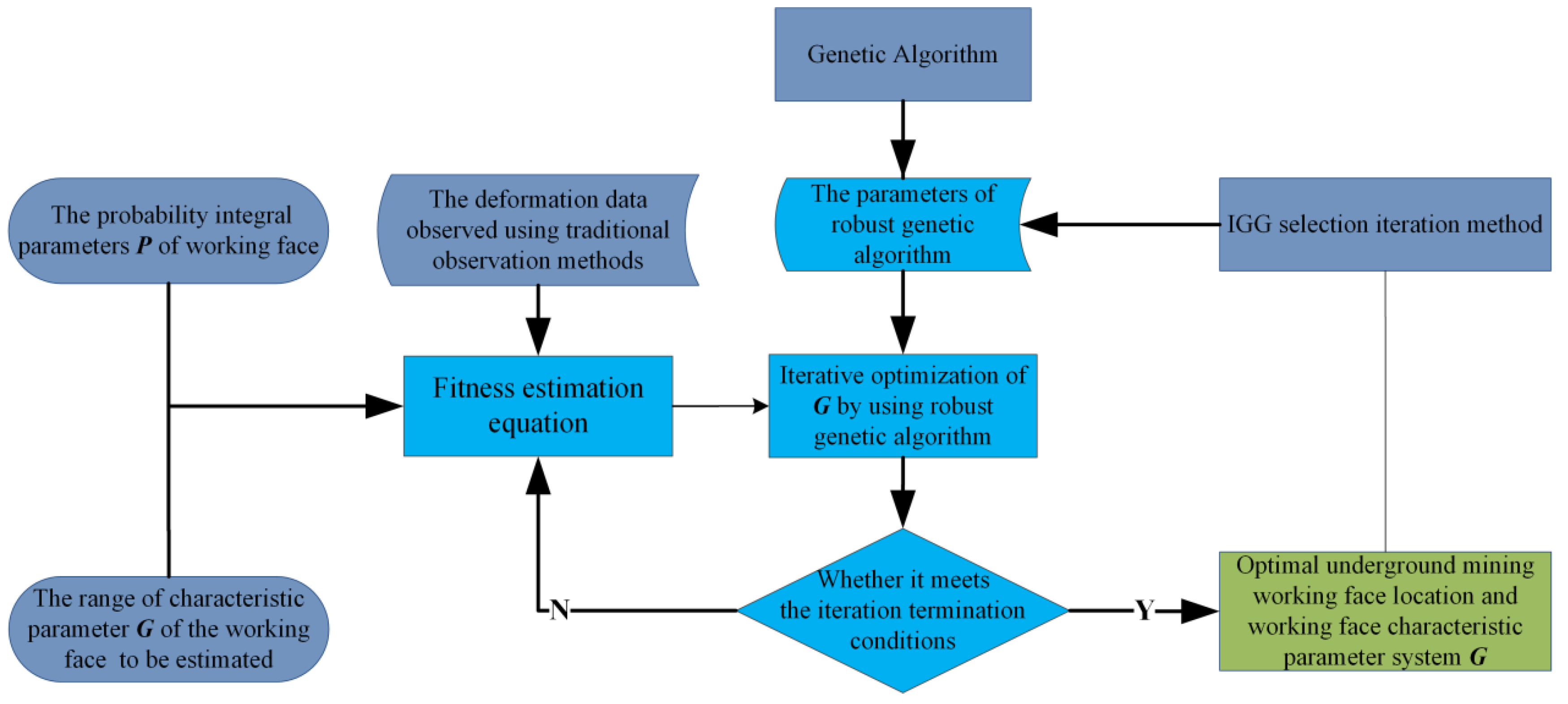
Parameter iteration calculation: Continuously execute steps (2) to (3); after meeting the iteration requirements, stop executing steps (2) to (3) and output the optimal underground mining face position and face characteristic parameter system G. Guided by the above ideas, the technical route of the precise positioning method for mining faces based on the robust GA is presented in Figure 1.

3. Simulated Experiment

3.1. Surface Deformation Simulation and Experimental Plan Design for Underground Working Face Mining

  • Simulation of surface deformation during underground working face mining
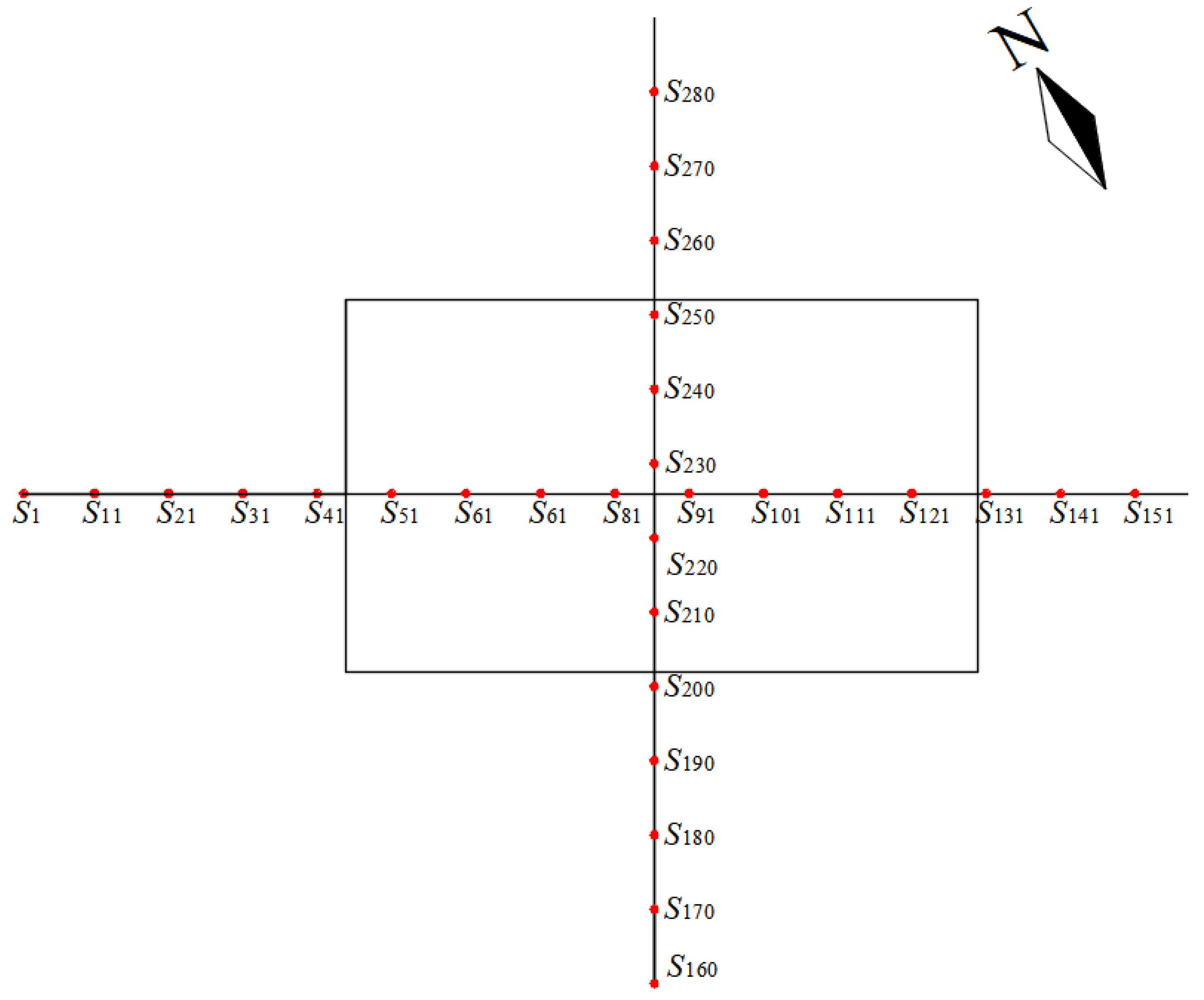
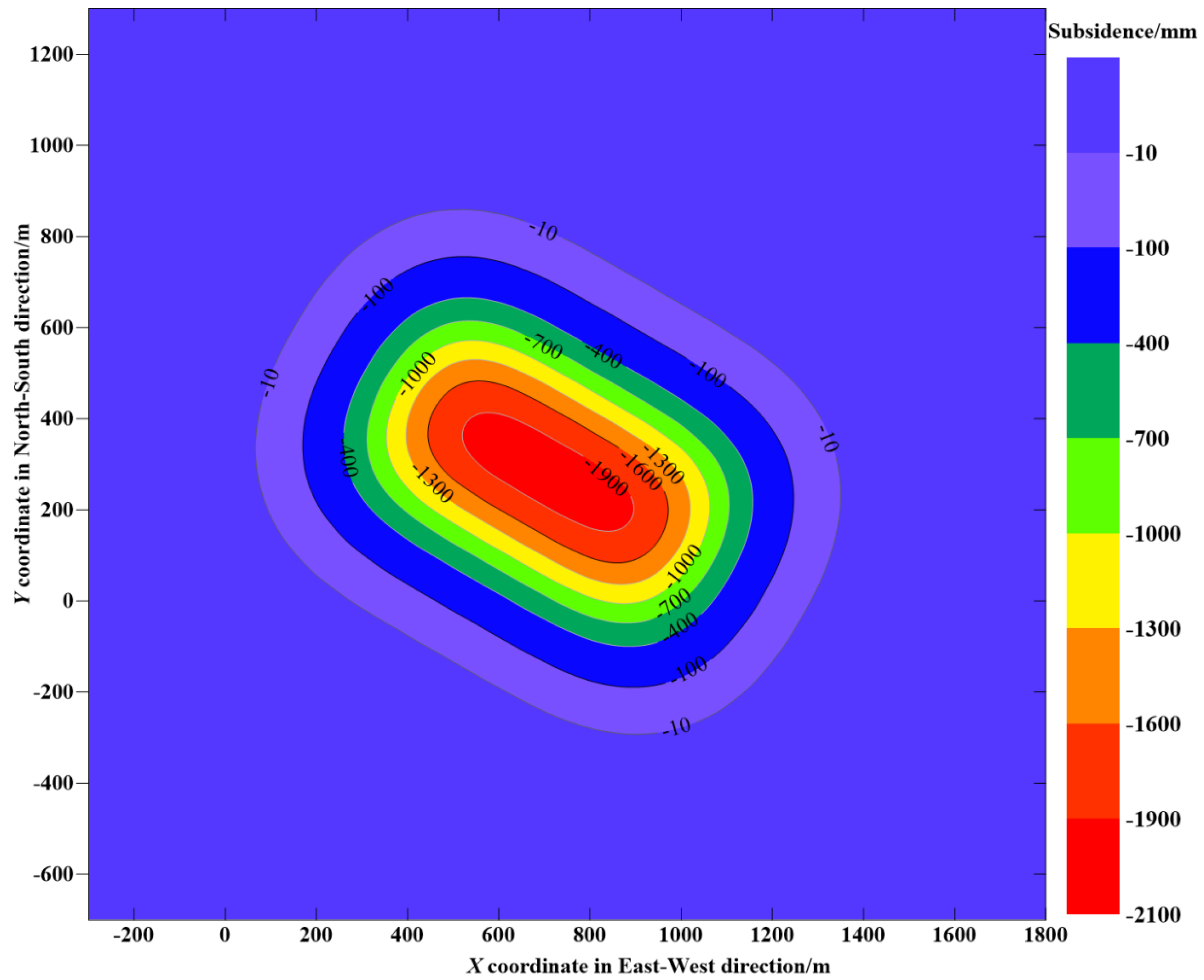
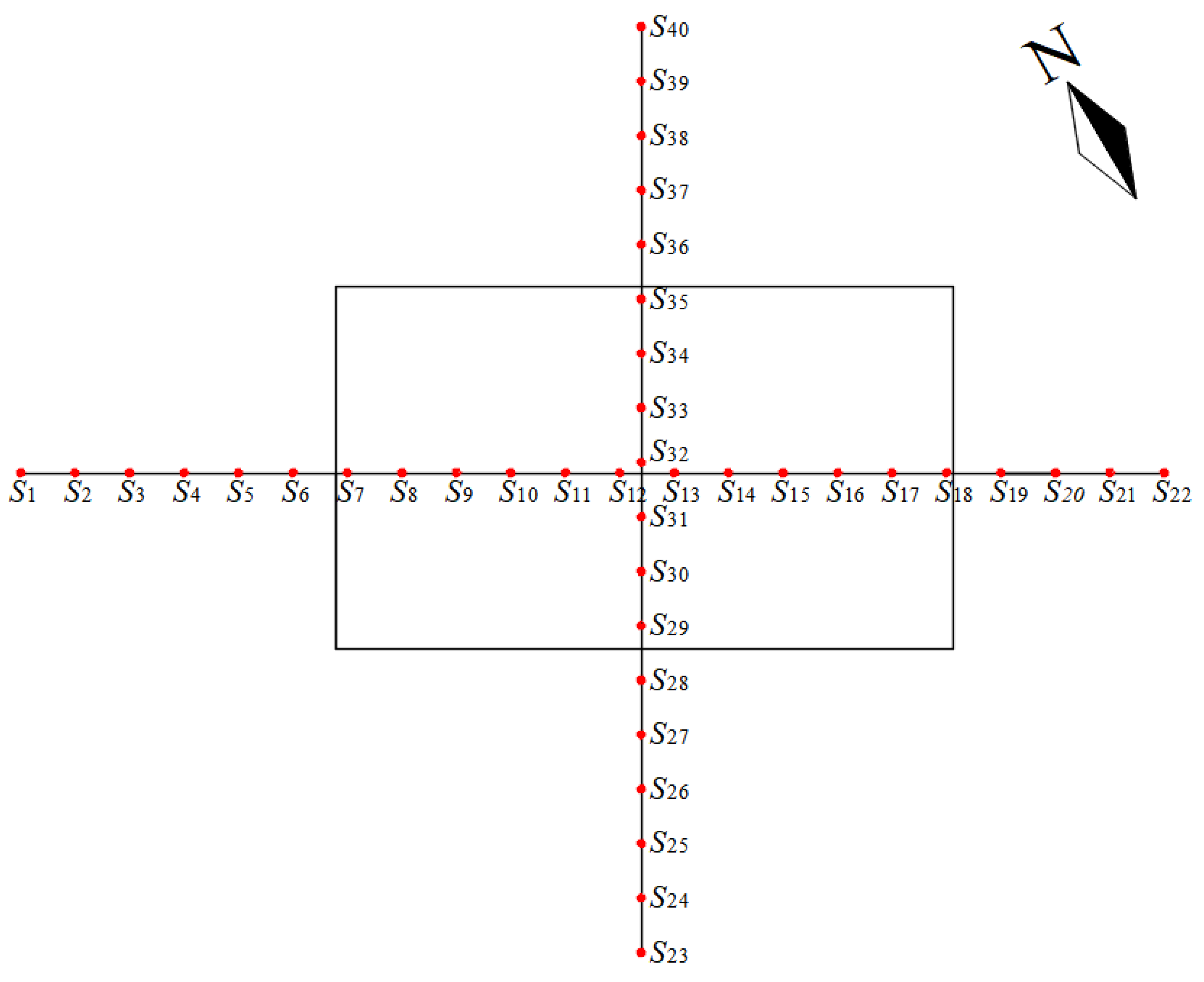
The center points of simulated underground mining are the plane position (X1 = 793.061 m, Y1 = 304.006 m); the mining depth H = 400 m denotes the distance from the spatial cuboid’s center position to the surface. The characteristics of the simulated underground working surface are as follows: length × width × height = D3 × D1 × m = 850 m × 500 m × 3.5 m for the geometric cuboid representing the working surface. The working face inclination angle α = 6/°, and inclination azimuth angle ϑ = 30/° represent the direction of the rectangular prism in space. The simulated probability integration parameters are [q, tan β, b, θ, S1, S2, S3, S4] = [0.62, 0.4, 1.6, 86.7, 60, 60, 60, 60]. Utilizing the above-simulated working face characteristic parameter G and probability integration method parameter P, Equations (1) and (3) are employed to simulate the surface subsidence field induced by working face mining. Figure 2 illustrates the surface subsidence field obtained through simulation. Forty observation points were placed on the simulated mining surface, and Figure 3 illustrates the specific arrangement.
2.
Experimental plan design
In order to validate the feasibility of the construction inversion method, we demonstrate that it is capable of precisely positioning rectangular working faces and retrieving their spatial attributes, even in the presence of errors in observation data. The following experimental scheme was designed: ① There is an inflection point observation error in the mining deformation basin (there is an error of 0.15 times subsidence in the observation data of this point, and there is an error of 100 mm in horizontal movement of this point), and ② there is an error in the maximum subsidence of the subsidence basin induced by mining activities (there is an error of 0.15 times subsidence in the observation data of this point, and there is an error of 100 mm in horizontal movement of this point). Based on the above experimental plan, the construction method presented in this paper and the traditional genetic algorithm were used to determine rectangular working surface positioning and working surface spatial characteristics of the working surface inversion.

3.2. Working Surface Positioning and Spatial Characteristics Inversion

Before performing working face positioning and spatial characteristics inversion, the parameter range of the working face parameter system G must first be determined. In general, drawing on the mining subsidence basin and its angular parameters, the working face’s mining size range and center point coordinates can be determined. The remaining parameter ranges can be determined using the geological mining conditions of analogous mining areas. The parameter range of the working face parameter system G in the simulation experiment is listed in Table 1. In this experiment, the parameters for the IGG weight selection iteration method are set to k = 0.1 [30], and the parameter settings of the genetic algorithm itself are as shown in Table 2.
Based on the surface deformation field simulation detailed in Section 3.1 (including surface subsidence deformation and horizontal movement deformation), experiments were conducted by using the precise positioning of the mining working face and the mining characteristic inversion method detailed in this paper. To ensure the stability of the inversion parameters, we used the average of 50 inversion results for each method. The inverted working face, precise positioning, and characteristic mining parameters are summarized in Table 3 below:
From the precise positioning and inversion results of characteristic mining parameters presented in Table 3, it can be seen that when there is an error in the observed values, the maximum relative absolute error of the characteristic spatial geometry parameters inverted by the GA is 5.41% and 6.66%, respectively. At this point, the absolute values of the maximum relative errors for each mining characteristic parameter, inverted based on the method proposed herein, are 0.09% and 3.22%, respectively. Although the maximum relative error of the characteristic mining parameters inverted using traditional genetic algorithms falls within the practical range for engineering applications, in comparison, the method presented herein significantly reduces this error. Conversely, regarding the size of the fitting error, relative to traditional genetic algorithms, the fitting error of the method presented herein is significantly reduced in mining characteristic parameter inversion, proving that the proposed method exhibits higher fitting accuracy and inversion results that are closer to the design values. In summary, it is confirmed that inversion results obtained using the method proposed herein can precisely describe the spatial geometry characteristic of the goaf corresponding to the simulated working face.
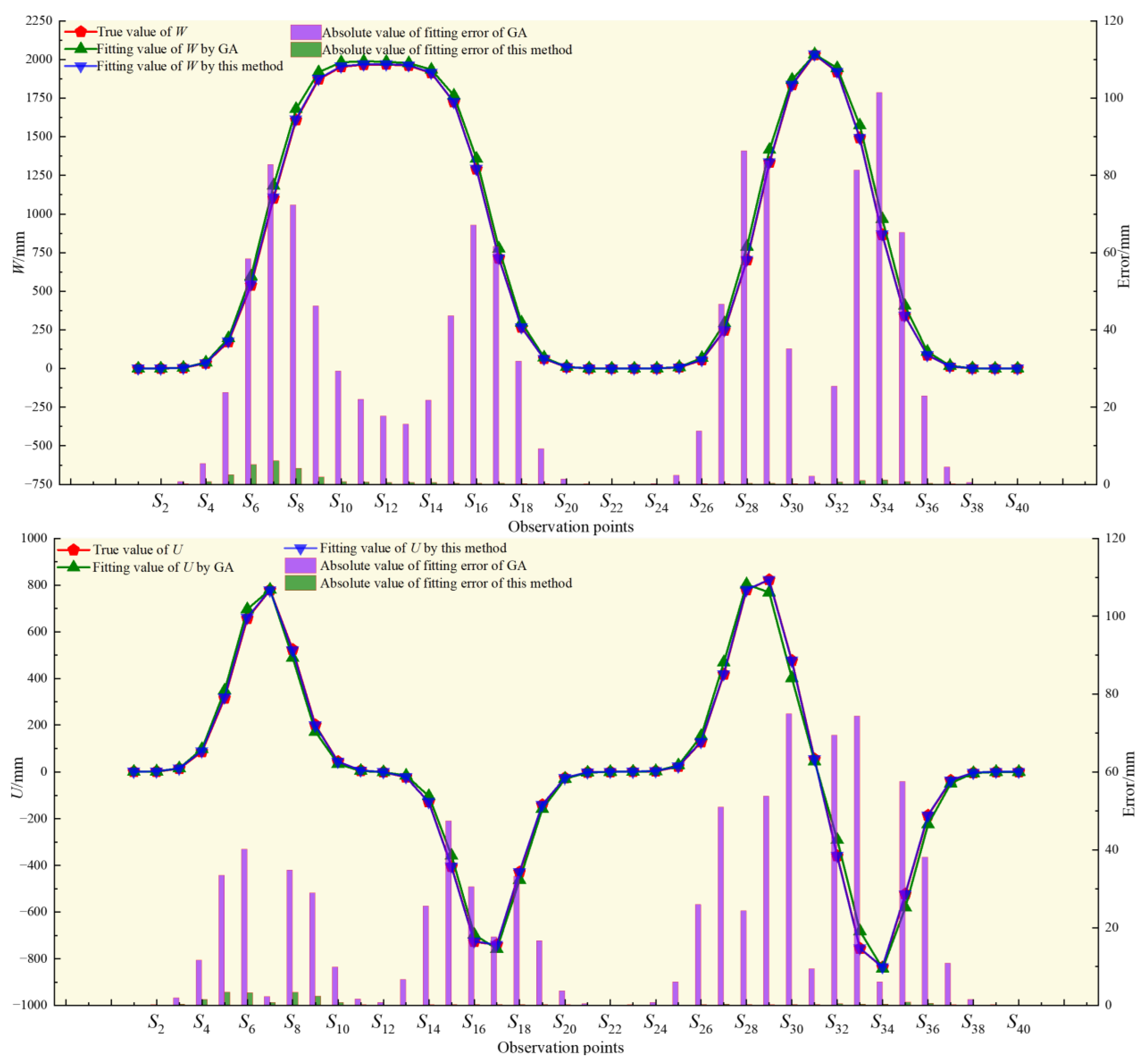
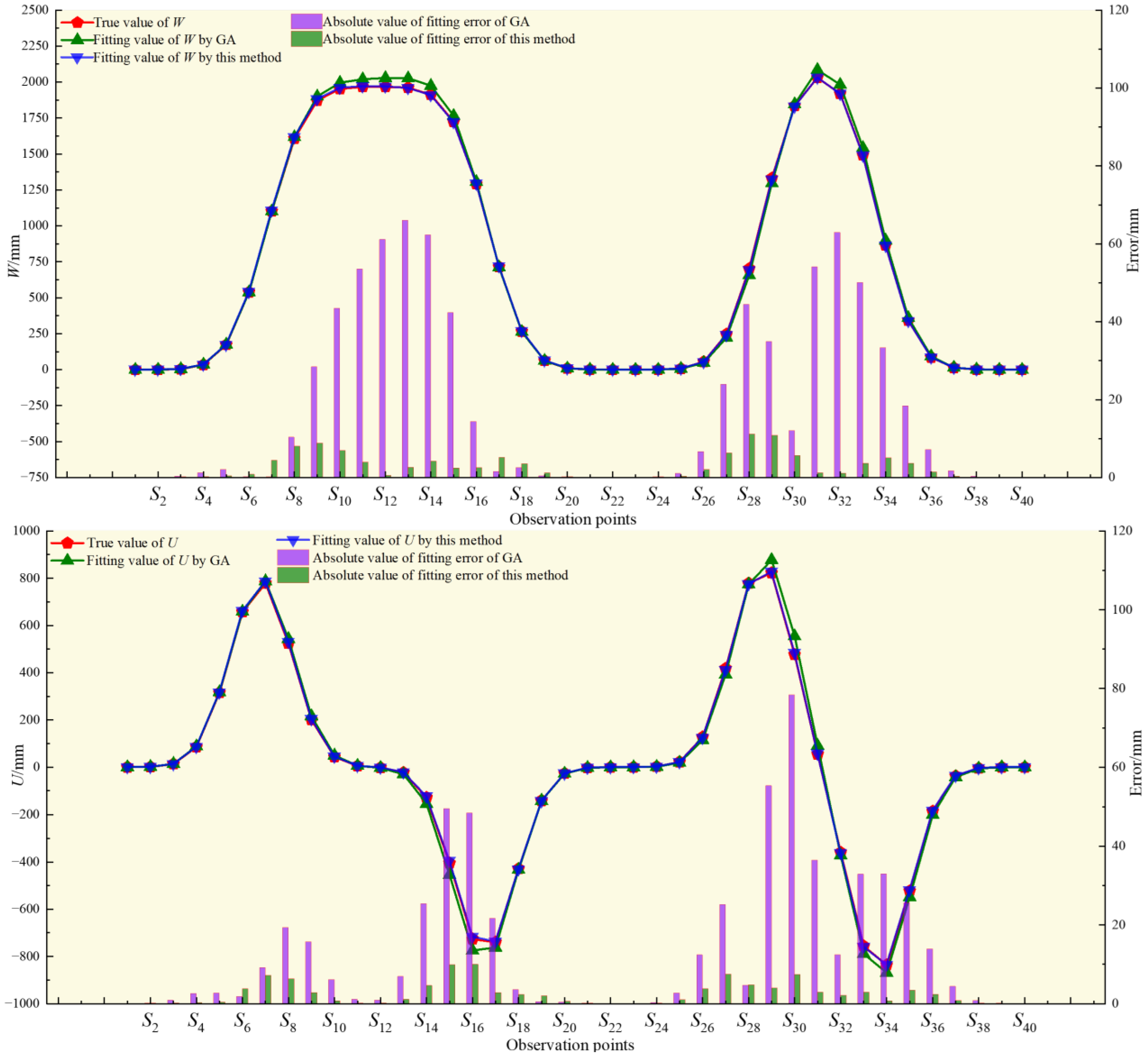
By utilizing the probability integral parameters for surface deformation during underground mining, in addition to the precise positioning and characteristic mining parameters derived from the aforementioned experiments, in conjunction with the PIM model, the deformation values corresponding to the working face under the error scheme were calculated and compared with the simulated measured deformation values. The results are illustrated in Figure 4 and Figure 5.
From Figure 4 and Figure 5, it can be seen that the absolute value error of the precise positioning corresponding to the goaf and the predicted values corresponding to spatial geometry characteristics obtained using the method developed herein is smaller than that of traditional genetic algorithms, which confirms that the proposed method achieves robust performance; in the inflection point area in particular, the resistance effect is significant. The experimental results confirm that this method can be used to more accurately determine the working surface position and its characteristic spatial parameters. The findings of this study thus offer practical support for the detection of underground goafs and for mining supervision efforts.

4. Real Data Experiment on the 1414 (1) Working Face

4.1. Data Overview

As a typical rectangular working face, the 1414 (1) working face is well-suited for practical application and validation of this method. Observation points were arranged in both the strike and inclination directions above the underground 1414 (1) working face. Sufficient surface observation data is available for the 1414 (1) working face, which is critical to the application of the method presented herein. Prior to commencing the mining of the 1414 (1) working face, a considerable amount of preliminary preparation work was completed. Plane coordinates and elevations of the observation points were effectively observed.
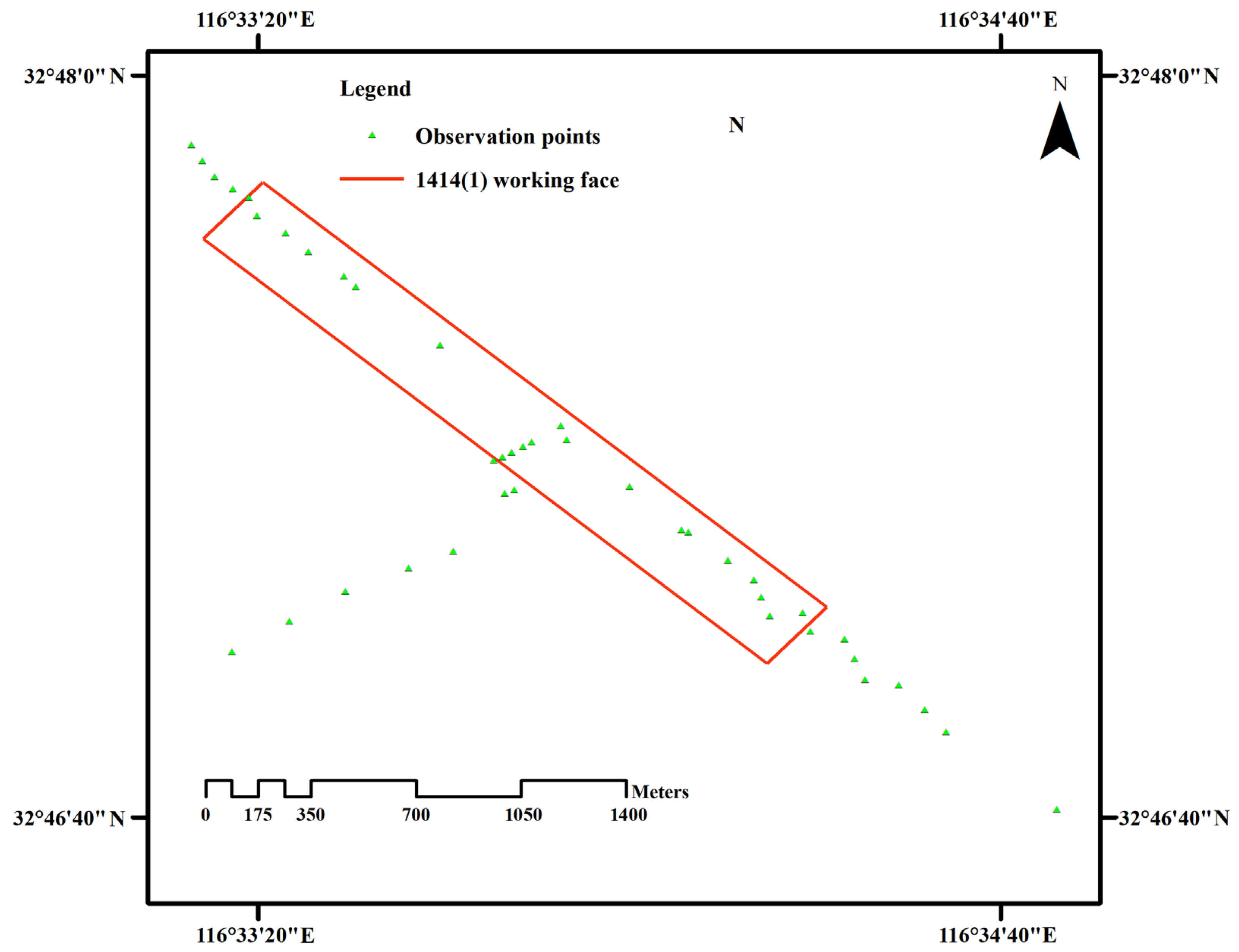
Once working face mining was completed and the surface had generally stabilized, effective observations were performed once again on the three-dimensional coordinates of the observation point, thus enabling the acquisition of complete deformation data and laying a solid data foundation for this experiment. In this experiment, the known empirical parameter values of the employed PIM model are as follows: [q, tanβ, θ, S1, S2, S3, S4] = [0.84, 1.91, 85.1, 34.1, 36.68, −47.31, −27.68]. After data preprocessing, as demonstrated by the results presented in Figure 6, 42 observation points in total were selected for use in engineering application experiments, including the surface strike observation lines (ML01~ML29) and dip observation lines (MS30~MS42) of the working face.

4.2. Experimental Results

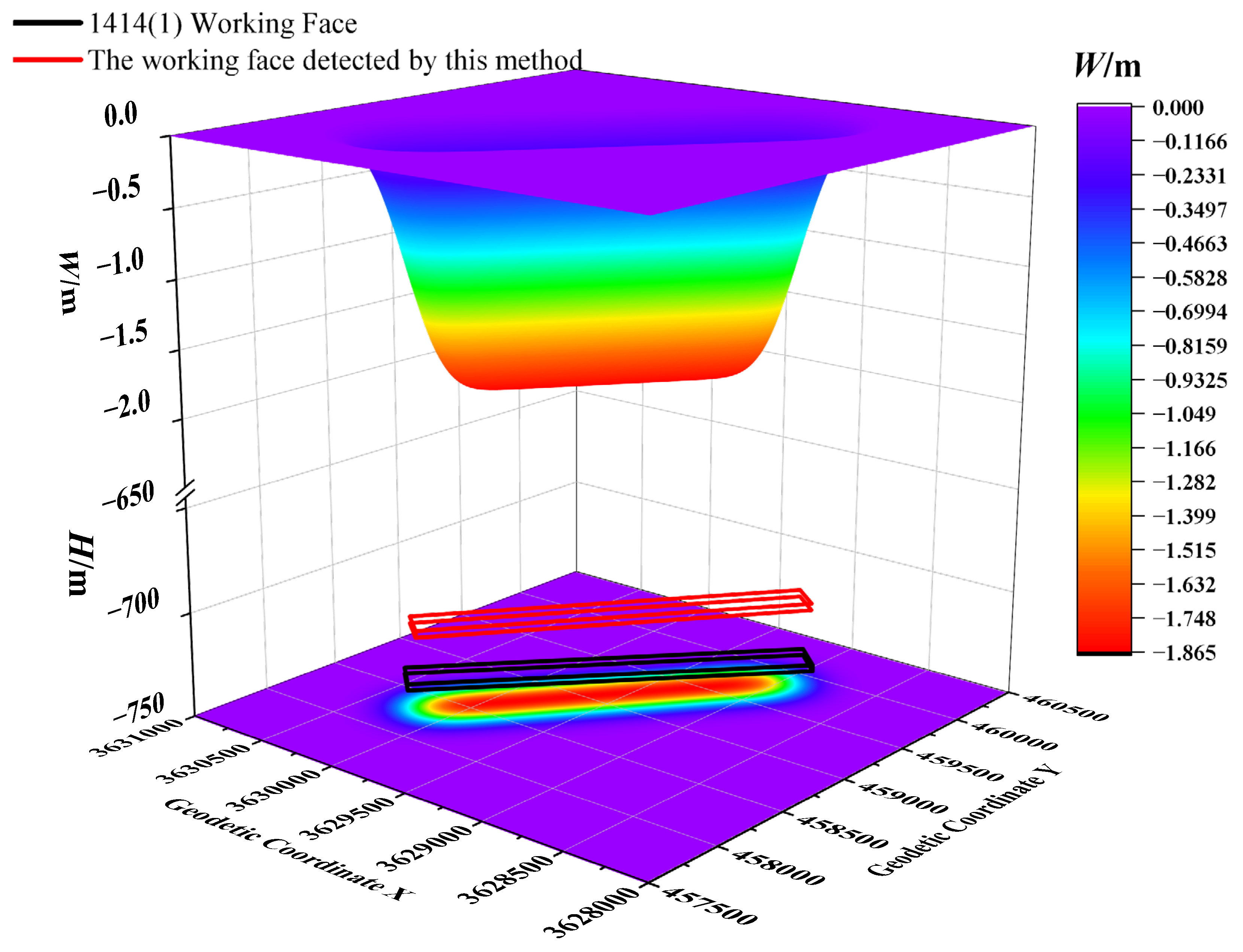
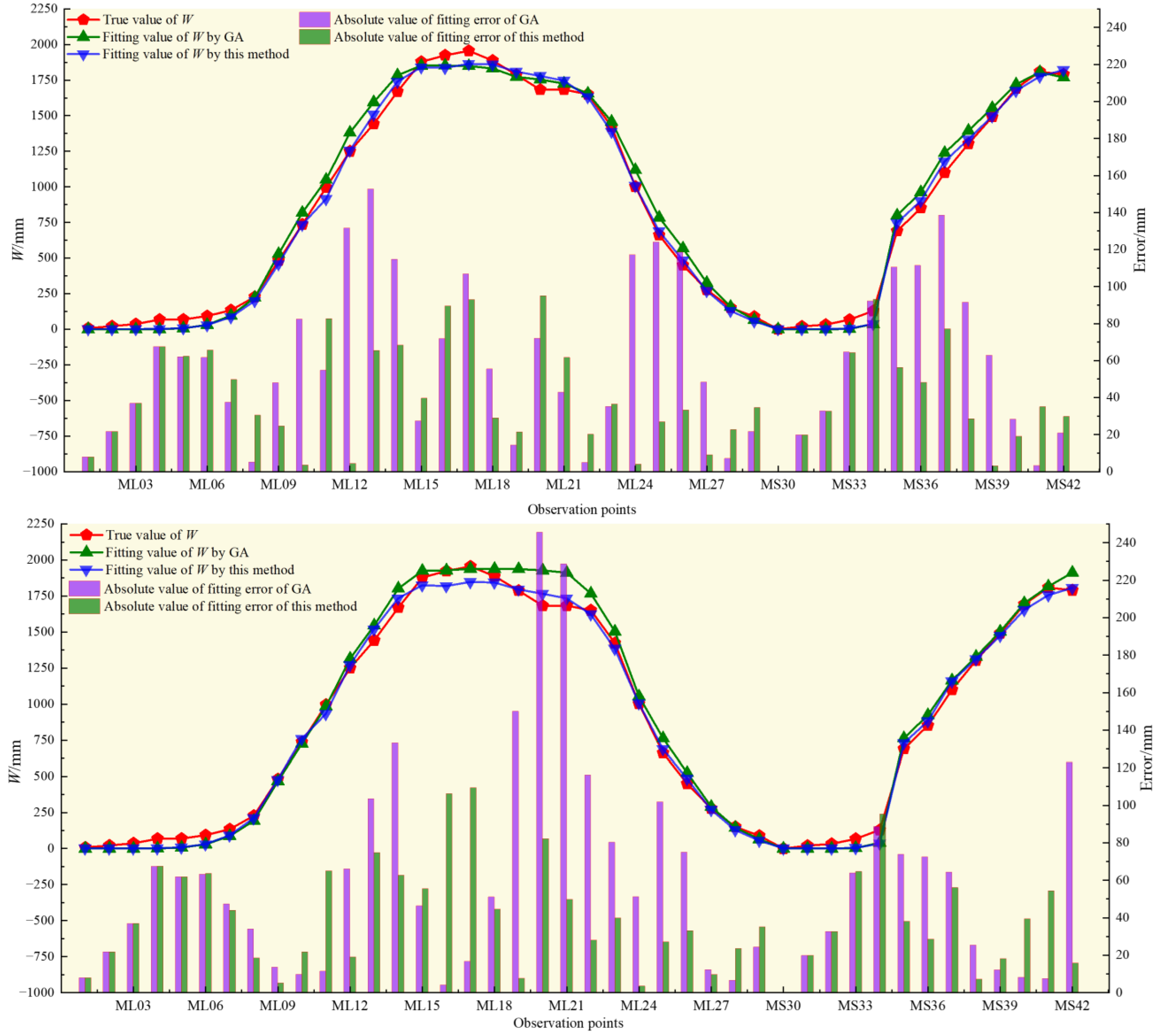
To confirm the advantages of this method over traditional genetic algorithms in practical engineering applications and to verify the experimental results, two experimental schemes were designed, each relying on 42 observation points, as shown in Figure 7. The experimental plans were as follows: ① select two points at the inflection point of the dip observation line, and one point at the inflection point of the inclination observation line to add a 400 mm gross error to, and ② select two points at the maximum value in the measured data to add a 400 mm gross error to. Both the construction method presented in this paper and the traditional genetic algorithm were applied to the positioning of the rectangular working surface and the inversion of its working surface spatial characteristics based on the two experimental schemes above. Throughout the experiment, each scheme underwent 50 inversions to determine the mean value. The mean values of the parameters are listed in Table 4, and precise spatial geometric characteristics are presented in Figure 7.
Considering the precise positioning and the mining spatial geometric characteristic parameter inversion results presented in Table 4, it is evident that when the inflection point is subject to an error, the relative errors for the characteristic mining parameters inverted by the traditional genetic algorithm and the method presented herein are generally consistent. When there is an error at the maximum observation value, except for parameters m and ϑ, the relative errors of the parameters are essentially comparable. Although the relative error is relatively large for parameter ϑ when inverted using the proposed method, it is still within 10%; in comparison, for parameter m, the relative error is significantly larger when inverted using traditional methods, with a relative error of over 15%. Conversely, considering the size of the fitting error, this method demonstrates significantly smaller fitting errors relative to traditional genetic algorithms when performing mining characteristic parameter inversion. In summary, the presented construction method can be used to more effectively and accurately position and invert characteristic spatial geometric parameters.
Through the use of the 1414 (1) working face’s PIM parameters, in addition to the precise positioning and characteristic mining parameters derived from the aforementioned experiments, the deformation values corresponding to the working face under the error scheme were calculated using the PIM model and then compared with the measured value. The corresponding results are presented in Figure 8.
As clearly illustrated in Figure 8, under the above-designed error scheme, the error corresponding to predicted subsidence using the precise positioning and characteristic mining parameters inverted through the method presented herein is substantially smaller than that of the GA, demonstrating that our method has strong robustness, and the inverted working face position and characteristic parameters are ultimately consistent with actual mining activities.

5. Discussion

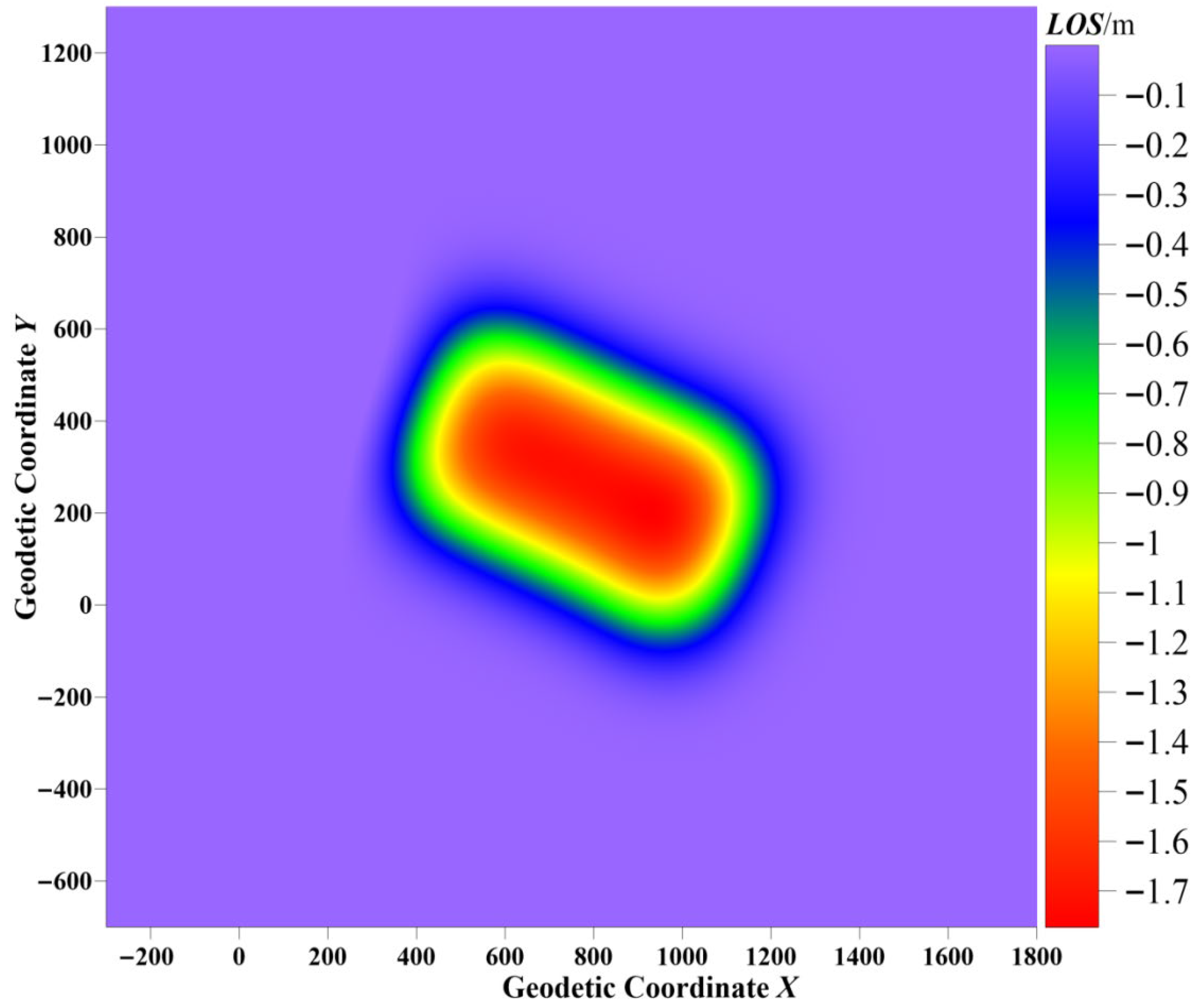
As one of the most frequently utilized technical methods for mining subsidence monitoring, InSAR has seen increasing application; in addition, the development of InSAR technology provides an effective technical approach for large-scale mining subsidence monitoring [31,32,33,34]. To confirm the applicability of InSAR technology using this method, the LOS deformation caused by mining subsidence was simulated based on Equation (8). Based on the simulation parameters and conditions presented in Section 3.1, 288 observation points were placed on the surface. The corresponding layout of the observation points is presented in Figure 9. The corresponding LOS deformation from the simulated experiment is shown in Figure 10.
L O S = U N S s i n γ c o s ( ω 3 2 π ) U E W s i n γ s i n ( ω 3 2 π ) + W c o s γ
In Equation (8), UNS and UEW represent the deformation values in the plane directions north–south-oriented and east–west-oriented, respectively. γ and ω are the parameters for InSAR satellite imaging, respectively, denoting the incidence angle and the flight azimuth angle. In this paper, γ = 33.8582/° and ω = 347.193/°.
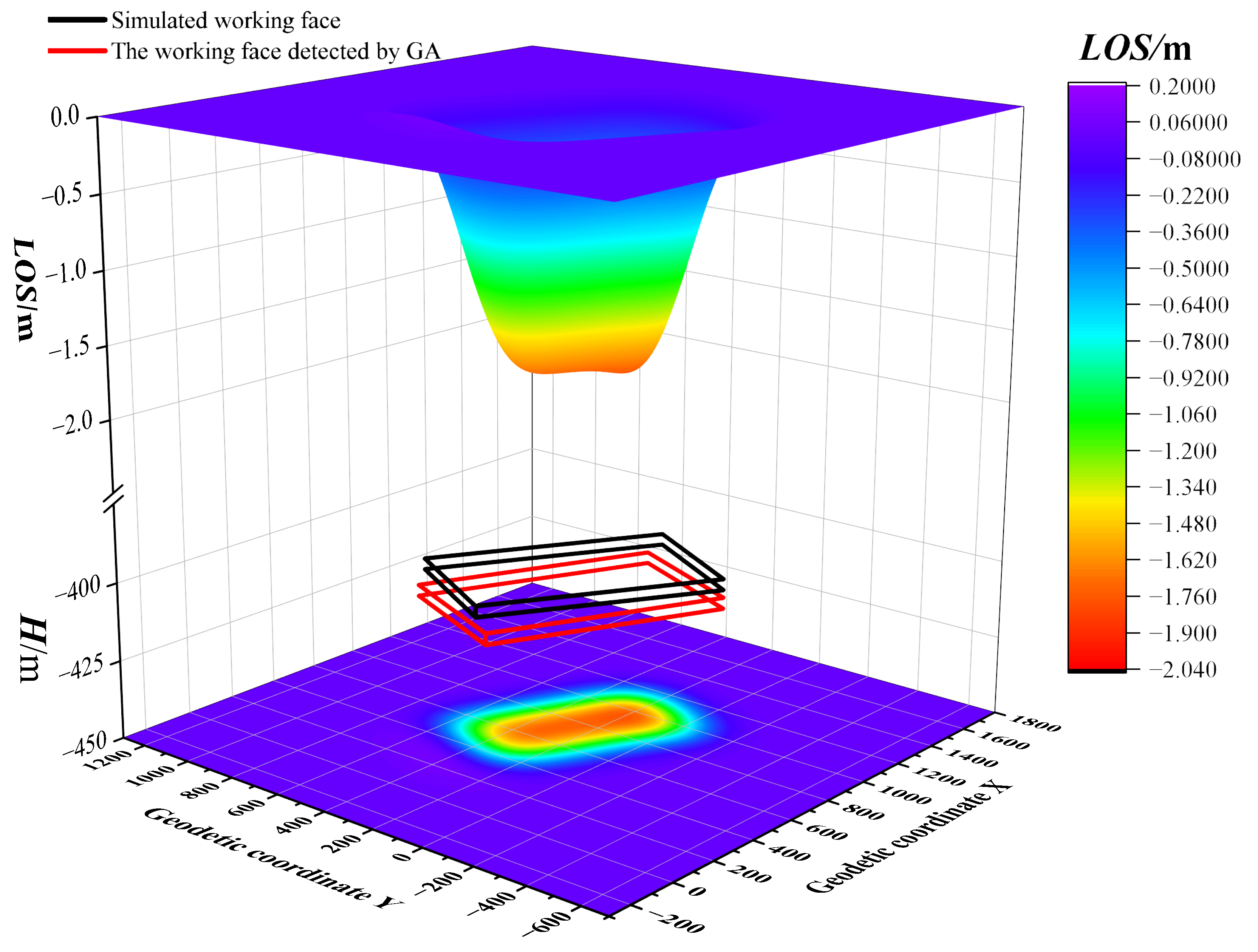
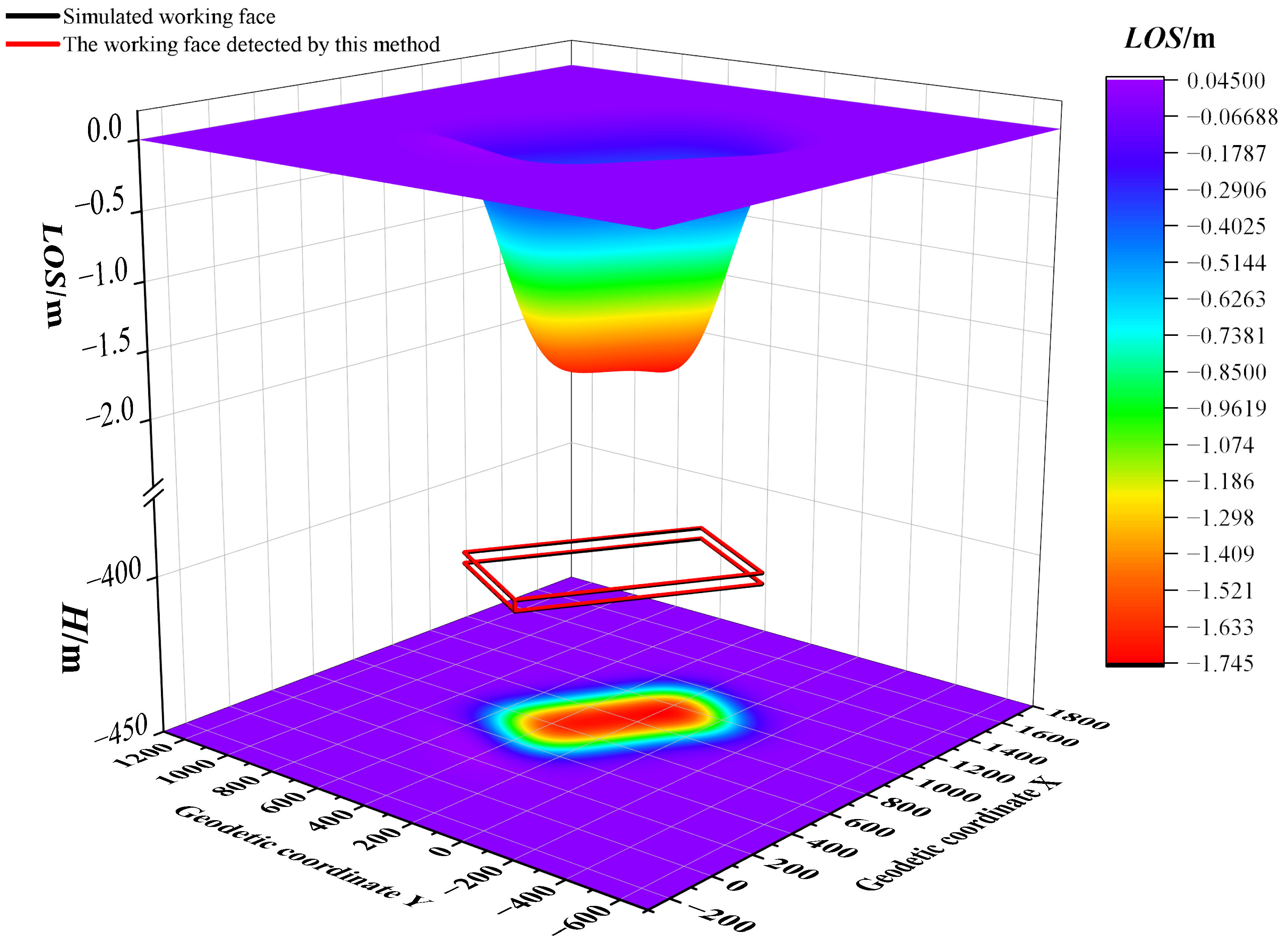
For the simulated experiment, 10% of the LOS deformation data of the observation points were randomly sampled, and a 300 mm gross error was incorporated. Thereafter, the traditional GA and our method were used to invert the position and characteristic parameters. During the simulated inversion experiment, the average of 50 inversion results was taken. The spatial geometric characteristics are displayed in Table 5, with precise positioning of the working face shown in Figure 11 and Figure 12.
Considering the precise positioning and inversion results of characteristic mining parameters presented in Table 5, it can be observed that, apart from the ϑ parameter, the parameters inverted using the two methods are ultimately identical; in comparison, when inverted using the traditional method, the ϑ parameter has a larger error, reaching 18.41%. From the overall parameter inversion results, it can be distinctly observed that the accuracy of the position and characteristic parameters inverted by the method presented herein is distinctly superior. Furthermore, the fitting errors obtained using this method are notably smaller than those obtained using traditional genetic algorithms when determining characteristic mining parameters.
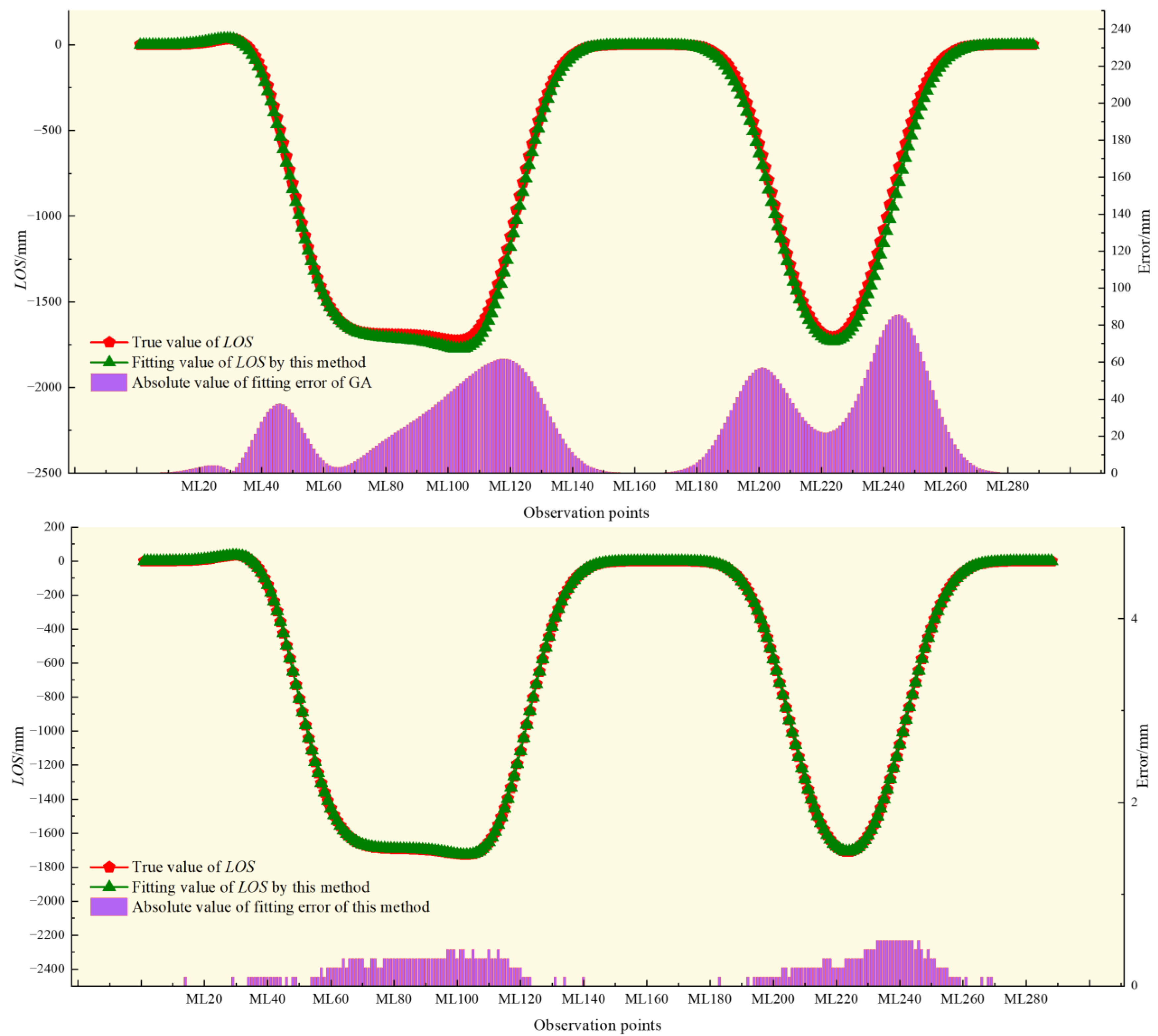
By employing the probability integral parameters for simulating surface deformation in underground mining, in addition to the precise positioning and characteristic mining parameters derived from the aforementioned experiments, combined with the PIM model, the LOS deformation was calculated under this error scheme and compared with the measured value. The corresponding results are presented in Figure 13. Through the comparison presented in Figure 13, it can be seen that under the error scheme designed above, the absolute error associated with the predicted LOS deformation values—based on the working face’s precise position and spatial geometric characteristics inverted using this method—is notably smaller than that obtained with the traditional genetic algorithm, suggesting that the method presented herein has strong robustness. This method can be used to accurately locate the mining face based on InSAR deformation values.

6. Conclusions

(1)
Based on the correlation between deformation and the mining-induced response of the underground working face, combined with a weighted iterative robust genetic algorithm, we constructed a precise positioning method for mining working faces based on a robust genetic algorithm. The results of simulation experiments and from engineering cases show that, in contrast to the traditional genetic algorithm, the fitting error yielded by this method is significantly smaller when inverting characteristic mining parameters, thereby indicating that the proposed method achieves better fitting accuracy. The construction method can be used to accurately locate the working face and invert characteristic mining parameters. It should be noted that the method presented in this paper is not applicable to non-rectangular working face mining. Studying inversion methods suitable for mining subsidence characteristics of arbitrarily shaped working faces constitutes our future plans.
(2)
Utilizing the simulated InSAR monitoring deformation data, the proposed method is further validated. As indicated by the presented results, the absolute error associated with the moving deformation values predicted from accurate positioning of the working face and the inverted characteristic mining parameters produced by the proposed method is notably smaller than that produced by the GA, suggesting that the method presented herein is highly robust. Based on the use of InSAR deformation values, this method can be used to accurately locate mining faces.

Author Contributions

Conceptualization, C.J. and L.W.; methodology, W.L.; validation, C.J., L.W., H.T. and W.L.; formal analysis, C.J. and L.W.; resources, C.J.; data curation, C.J. and L.W.; writing—original draft preparation, C.J. and L.W.; writing—review and editing, C.J. and L.W.; visualization, Z.G. and X.Z.; supervision, Z.G. and H.T.; project administration, C.J. and H.T.; funding acquisition, C.J. All authors have read and agreed to the published version of the manuscript.

Funding

This research was funded by the Research Project of the Scientific Research Foundation of Education Department of Anhui Province, China (grant number 2024AH051819; 2023AH052224); the Doctoral (Postdoctoral) Research Initiation Fund of Suzhou University (grant number 2022BSK006; 2024BSK008); the Quality Engineering Project of Suzhou University (grant number szxy2023jyxm18); the Coal Industry Engineering Research Center of Mining Area Environmental and Disaster Cooperative Monitoring, Anhui University of Science and Technology (grant number KSXTJC202203; KSXTJC202303); the Key Laboratory of Aviation-aerospace-ground Cooperative Monitoring and Early Warning of Coal Mining-induced Disasters of Anhui Higher Education Institutes, Anhui University of Science and Technology (grant number KLAHEI202304; KLAHEI202401; KLAHEI202202); and the Key Research Project of Suzhou University (grant number 2023yzd05; 2024yzd03).

Institutional Review Board Statement

Not applicable.

Informed Consent Statement

Not applicable.

Data Availability Statement

The data can be obtained from the corresponding author according to reasonable requirements. The data are not publicly available due to privacy.

Acknowledgments

The first author thanks the other author for their research contributions and cited references prior to this work.

Conflicts of Interest

The authors declare no conflicts of interest.

Abbreviations

The following abbreviations are used in this manuscript:
DIMDSD-InSAR-based Illegal Mining Detection System
DInSARDifferential Interferometric Synthetic Aperture Radar
InSARInterferometric Synthetic Aperture Radar
IGGInstitute of Geodesy and Geophysics
LOSLine of Sight
GAGenetic Algorithm
RMSERoot Mean Squared Error
PIMProbability Integral Method

References

  1. Yuan, L.; Jiang, Y.-D.; Wang, K.; Wang, K.; Zhao, Y.-X.; Hao, X.-J.; Xu, C. Precision Exploitation and Utilization of Closed/Abandoned Mine Resources in China. J. China Coal Soc. 2018, 43, 14–20. [Google Scholar]
  2. Liu, Q.; Sun, Y.; Xu, Z.; Jiang, S.; Zhang, P.; Yang, B. Assessment of Abandoned Coal Mines as Urban Reservoirs. Mine Water Environ. 2019, 38, 215–225. [Google Scholar] [CrossRef]
  3. Xia, Y.P.; Wang, Y.J. InSAR- and PIM-based Inclined Goaf Determination for Illegal Mining Detection. Remote Sens. 2020, 12, 3884. [Google Scholar] [CrossRef]
  4. Bharti, A.K.; Pal, S.K.; Priyam, P.; Pathak, V.K.; Kumar, R.; Ranjan, S.K. Detection of Illegal Mine Voids Using Electrical Resistivity Tomography: The Case-Study of Raniganj Coalfield (India). Eng. Geol. 2016, 213, 120–132. [Google Scholar] [CrossRef]
  5. Thitimakorn, T.; Kampananon, N.; Jongjaiwanichkit, N.; Kupongsak, S. Subsurface Void Detection Under the Road Surface Using Ground Penetrating Radar (GPR): A Case Study in the Bangkok Metropolitan Area, Thailand. Int. J. Geo-Eng. 2016, 7, 2. [Google Scholar] [CrossRef]
  6. Xue, G.Q.; Yan, Y.J.; Cheng, J.L. Researches on Detection of 3-D Underground Cave Based on TEM Technique. Environ. Earth Sci. 2011, 64, 425–430. [Google Scholar] [CrossRef]
  7. Yuan, H.; Liu, J.; Yuan, Y. Using 4-D Seismic Data for Detecting Gob Areas of Coal Mines: A Case Study from the Zhangji Coal Mine. IEEE Trans. Geosci. Remote Sens. 2022, 60, 5917810. [Google Scholar] [CrossRef]
  8. Yang, X.; Sasak, K.; Zhang, X.; Sugai, Y. Permeability Estimate of Underground Long-Wall Goaf from P-Wave Velocity and Attenuation by Lab-Scale Experiment on Crushed Rock Samples. J. Appl. Geophys. 2018, 159, 785–794. [Google Scholar] [CrossRef]
  9. Zhang, Z.; Zhang, L.; Duan, G.; Chen, Z.; Yuan, X.; Zhao, S.; Zhang, D.; Tian, J. Seismic Response Characteristics of Coal Goaf Based on Forward Modeling. CT Theory Appl. 2021, 30, 291–300. [Google Scholar] [CrossRef]
  10. Martínez-Moreno, F.J.; Galindo-Zaldívar, J.; Pedrera, A.; Teixidó, T.; Peña, J.; González-Castillo, L. Regional and Residual Anomaly Separation in Microgravity Maps for Cave Detection: The Case Study of Gruta de las Maravillas (SW Spain). J. Appl. Geophys. 2015, 114, 1–11. [Google Scholar] [CrossRef]
  11. Zhang, J.Q.; Yin, W.M.; Zhang, X.Z. Application of Comprehensive Geophysical Prospecting Method in Detecting Goaf of Thick Overburden Coal Mine. Geol. Rev. 2021, 67 (Suppl. S1), 51–53. [Google Scholar] [CrossRef]
  12. Wang, Q.; Tian, Y.; Liu, H.; Zhu, C.; Bai, C.; Hao, S. Application of Comprehensive Geophysical Prospecting in Investigation of Coal Mine Goaves. Geophys. Geochem. Explor. 2022, 46, 531–536. [Google Scholar] [CrossRef]
  13. He, G.Q. Mine Mining Subsidence; China University of Mining and Technology Press: Xuzhou, China, 1991. [Google Scholar]
  14. Guo, Z.Z.; Chai, H.B. Coal Mine Mining Subsidence; China Coal Industry Press: Beijing, China, 2013. [Google Scholar]
  15. Li, Z.W.; Xu, W.B.; Hu, J.; Feng, G.; Yang, Z.; Li, J.; Zhang, H.; Zhen, Q.; Zhu, J.; Wang, Q. InSAR Partial Geoscience Parameter Inversion. Acta Geod. Cartogr. Sin. 2022, 51, 1458–1475. [Google Scholar]
  16. Nguyen, L.; Le, T.; Nguyen, T.; Tran, D. Prediction of Underground Mining-Induced Subsidence: Artificial Neural Network Based Approach. Min. Miner. Depos. 2023, 17, 45–52. [Google Scholar] [CrossRef]
  17. Hu, Z.; Ge, L.; Li, X.; Rizos, C. Designing an illegal mining detection system based on DInSAR. In Proceedings of the International Geoscience and Remote Sensing Symposium 2010 (IGARSS), Honolulu, HI, USA, 25–30 July 2010. [Google Scholar]
  18. Hu, Z.; Ge, L.; Li, X.; Zhang, K.; Zhang, L. An underground-mining detection system based on DInSAR. IEEE Trans. Geosci. Remote Sens. 2013, 51, 615–625. [Google Scholar] [CrossRef]
  19. Du, S.; Wang, Y.J.; Zheng, M.N. Goaf Locating Based on InSAR and Probability Integration Method. Remote Sens. 2019, 11, 812. [Google Scholar] [CrossRef]
  20. Yang, Z.F.; Li, Z.W.; Zhu, J.J.; Yi, H.; Feng, G.; Hu, J.; Wu, L.; Preusse, A.; Wang, Y.; Papst, M. Locating and Defining Underground Goaf Caused by Coal Mining from Space-Borne SAR Interferometry. ISPRS J. Photogramm. Remote Sens. 2018, 135, 112–126. [Google Scholar] [CrossRef]
  21. Fan, H.; Li, T.; Gao, Y.; Deng, K.; Wu, H. Characteristics Inversion of Underground Goaf Based on InSAR Techniques and PIM. Int. J. Appl. Earth Obs. Geoinf. 2021, 103, 102526. [Google Scholar] [CrossRef]
  22. Li, T.; Zhang, H.; Fan, H.; Zheng, C.; Liu, J. Position Inversion of Goafs in Deep Coal Seams Based on DS-InSAR Data and the Probability Integral Methods. Remote Sens. 2021, 13, 2898. [Google Scholar] [CrossRef]
  23. Zhang, W.; Shi, J.; Yi, H.; Zhu, Y.; Xu, B. Underground Goaf Parameters Estimation by Cross-Iteration with InSAR Measurements. Remote Sens. 2021, 13, 3204. [Google Scholar] [CrossRef]
  24. Bu, P.; Li, C.K.; Yang, W.T.; Liao, M. D-InSAR and Optimization Algorithm for Goaf Geometric Parameter Inversion. Sci. Surv. Mapp. 2021, 46, 143–152. [Google Scholar]
  25. Zhang, W.H. InSAR-Based Mine Goaf Geometric Parameter Inversion and Dynamic 3D Deformation Prediction. Master’s Thesis, Central South University, Changsha, China, 2022. [Google Scholar]
  26. Wei, T.; Guo, G.L.; Li, H.Z.; Wang, L.; Yang, X.S.; Wang, Y.Z. Fusing Minimal Unit Probability Integration Method and Optimized Quantum Annealing for Spatial Location of Coal Goafs. KSCE J. Civ. Eng. 2022, 26, 2381–2391. [Google Scholar] [CrossRef]
  27. Wang, L.; Jiang, K.G.; Wei, T. Development of a New Inversion Method for Detecting Spatiotemporal Characteristics of Coal Mines Based on Earth Observation Technology. Int. J. Appl. Earth Obs. Geoinf. 2021, 100, 102346. [Google Scholar] [CrossRef]
  28. Zha, J.F.; Feng, W.K.; Zhu, X.J. Research on Parameters Inversion in Probability Integral Method by Genetic Algorithm. J. Min. Saf. Eng. 2011, 28, 655–659. [Google Scholar]
  29. Yang, J.; Liu, C.; Wang, B. BFGS Method Based Inversion of Parameters in Probability Integral Model. J. China Coal Soc. 2019, 44, 3058–3068. [Google Scholar]
  30. Jiang, C.; Liu, W.; Wang, L.; Zhu, X.; Tan, H. A Probability Integral Parameter Inversion Method Integrating a Selection-Weighted Iterative Robust Genetic Algorithm. Appl. Sci. 2025, 15, 8102. [Google Scholar] [CrossRef]
  31. Yang, Z.F.; Li, Z.W.; Zhu, J.J.; Hu, J.; Wang, Y.J.; Chen, G.L. InSAR-Based Model Parameter Estimation of Probability Integral Method and Its Application for Predicting Mining-Induced Horizontal and Vertical Displacements. IEEE Trans. Geosci. Remote Sens. 2016, 54, 4818–4832. [Google Scholar] [CrossRef]
  32. Yang, Z.F.; Li, Z.W.; Zhu, J.J.; Preusse, A.; Yi, H.W.; Wang, Y.J.; Papst, M. An Extension of the InSAR-Based Probability Integral Method and Its Application for Predicting 3-D Mining-Induced Displacements Under Different Extraction Conditions. IEEE Trans. Geosci. Remote Sens. 2017, 55, 3835–3845. [Google Scholar] [CrossRef]
  33. Baltiyeva, A.Y.; Orynbassarova, E.; Zharaspaev, M.; Akhmetov, R. Studying Sinkholes of the Earth’s Surface Involving Radar Satellite Interferometry in Terms of Zhezkazgan Field, Kazakhstan. Min. Miner. Depos. 2023, 17, 61–74. [Google Scholar] [CrossRef]
  34. Bazaluk, O.; Kuchyn, O.; Saik, P.; Soltabayeva, S.; Brui, H.; Lozynskyi, V.; Cherniaiev, O. Impact of Ground Surface Subsidence Caused by Underground Coal Mining on Natural Gas Pipeline. Sci. Rep. 2023, 13, 19327. [Google Scholar] [CrossRef]
Figure 1. Technical roadmap for the precise positioning method of the mining working face based on the robust genetic algorithm.
Applsci 15 12842 g001
Figure 2. Numerical simulation of the surface subsidence field generated by working face mining.
Applsci 15 12842 g002
Figure 3. Simulated working surface and observation point layout diagram.
Applsci 15 12842 g003
Figure 4. Fitting diagram of surface deformation under scheme ①.
Applsci 15 12842 g004
Figure 5. Fitting diagram of surface deformation under scheme ②.
Applsci 15 12842 g005
Figure 6. The 1414 (1) working face and observation points above the surface.
Applsci 15 12842 g006
Figure 7. Detected working face geometry using the proposed method.
Applsci 15 12842 g007
Figure 8. The surface subsidence fitting results obtained under schemes ① and ②.
Applsci 15 12842 g008
Figure 9. The layout of the observation points.
Applsci 15 12842 g009
Figure 10. LOS deformation corresponding to the simulated experiment.
Applsci 15 12842 g010
Figure 11. The results of the GA method for the detection of the working face.
Applsci 15 12842 g011
Figure 12. The results of the method used in this study for the detection of the working face.
Applsci 15 12842 g012
Figure 13. Fitting diagram of LOS deformation.
Applsci 15 12842 g013
Table 1. Scope of the G parameter system.
NameX1/mY1/mH/mm/mD3/mD1/mαϑ
Scope500–11000–600200–6002–5600–1100300–7004–830–90
Table 2. Parameter settings of the genetic algorithm.
NameIteration CountPopulation SizeMutation RateCrossover RateBinary Encoding Length
Value5001000.020.9510
Table 3. Working surface positioning and characteristic parameter results.
NameData
GAOur MethodGAOur Method
X1/minverted value793.060794.027792.759793.357794.341
relative error0.12%0.04%0.04%0.16%
Y1/minverted value304.006303.948304.235309.412303.639
relative error0.02%0.08%1.78%0.12%
H/minverted value400394.665400.098405.301399.662
relative error1.33%0.02%1.33%0.08%
m/minverted value3.53.4363.5013.6413.503
relative error1.83%0.01%4.04%0.11%
D3/minverted value850866.262850.749843.208850.847
relative error1.91%0.09%0.80%0.10%
D1/minverted value500527.072500.130489.250497.875
relative error5.41%0.03%2.15%0.42%
ɑ/°inverted value66.0125.9995.7916.1825
relative error0.20%0.01%3.49%3.04%
ϑinverted value3031.46029.99728.00130.966
relative error4.87%0.01%6.66%3.22%
RMSE/mmWRMSE42.51.629.44.1
URMSE31.00.123.13.7
Table 4. Positioning and characteristic parameter results of the 1414 working surface.
NameData
GAOur MethodGAOur Method
X1/minverted value3,629,560.9533,629,539.7693,629,547.1043,629,558.3933,629,546.097
relative error0.00%0.00%0.00%0.00%
Y1/minverted value459,088.510459,083.251459,096.225459,103.591459,099.081
relative error0.00%0.00%0.00%0.00%
H/minverted value735680.579707.028727.489702.678
relative error7.40%3.81%1.02%4.40%
m/minverted value33.1573.2563.4583.212
relative error5.22%8.52%15.26%7.05%
D1/minverted value241.1220.132220.215220.132220.188
relative error8.70%8.66%8.70%8.67%
D3/minverted value2115.452125.6372083.4962059.9042091.893
relative error0.48%1.51%2.63%1.11%
ɑ/°inverted value54.9165.4915.0165.153
relative error1.69%9.83%0.32%3.06%
ϑinverted value4238.78038.01241.36938.008
relative error7.67%9.49%1.50%9.50%
RMSE/mm73.549.080.848.8
Table 5. Working surface positioning and characteristic parameter results using InSAR technology.
NameX1/mY1/mH/mm/mD3/mD1/mɑ/°ϑRMSE/mm
Data304.00793.064003.5850500630
GAinverted value312.08790.60407.433.54855.94514.336.0424.4834.0
relative error2.66%0.31%1.86%1.12%0.70%2.87%0.64%18.41%
Our methodinverted value304.06793.08399.973.50849.97500.116.1729.990.2
relative error0.02%0.00%0.01%0.04%0.00%0.02%2.88%0.03%
Disclaimer/Publisher’s Note: The statements, opinions and data contained in all publications are solely those of the individual author(s) and contributor(s) and not of MDPI and/or the editor(s). MDPI and/or the editor(s) disclaim responsibility for any injury to people or property resulting from any ideas, methods, instructions or products referred to in the content.