
Abstract
Gifted students often display advanced verbal abilities that facilitate second language acquisition; however, when instruction is insufficiently stimulating, they may experience boredom and demotivation. Due to rising interest in immersive technologies such as augmented reality (AR) and limited evidence of their impact on gifted language learners, a systematic scoping review was necessary to synthesise existing research and identify gaps. It examined the impact of AR on both linguistic development and motivational outcomes among gifted learners in ESL/EFL contexts. It was preregistered in the Open Science Framework (OSF) and conducted according to PRISMA-ScR guidelines. Eligible studies included gifted learners in ESL/EFL contexts, published between 2020 and 2025 in English, Spanish, French, or Italian. Exclusion criteria comprised non–peer-reviewed papers and studies unrelated to AR. Searches were conducted in Scopus, Web of Science, ERIC, and Redalyc. A total of 34 studies were included. Findings indicate that AR interventions improve vocabulary, listening, pronunciation, and fluency; writing also benefits, although grammar remains challenging. AR enhances intrinsic motivation, reduces anxiety, and fosters engagement, especially in younger learners. The results suggest that AR can be a valuable tool in EFL/ESL classrooms to support both linguistic development and motivation among gifted students, though sustainable implementation requires overcoming technological and pedagogical barriers.
1. Introduction
Although the concept of “giftedness” has traditionally been associated with a high Intelligence Quotient (IQ), contemporary approaches include not only cognitive factors but also non-cognitive ones, such as motivation, creativity, and environmental influences [1]. Specifically, models like Renzulli’s (combination of intelligence, task commitment and creativity), Gagné’s (distinction between natural and developed talents), Castelló and Batlle’s (distinction between simple talent, complex talent, precocity, and giftedness), Gardner’s (theory of multiple intelligences) and Sternberg’s (distinction between creative, practical and analytic intelligences) broaden the understanding of giftedness, offering a more holistic framework for identifying and supporting diverse learners.
The identification of giftedness can be carried out by considering the three traits proposed in Renzulli’s Three-Ring Model, as analysed by Javier Tourón [2]. This conception, which integrates above-average ability, creativity, and task commitment, aligns more closely with profiles of complex talent or intellectual giftedness, rather than with simple talent. It reflects a multidimensional view of high ability that goes beyond isolated skills and points to learners capable of excelling across domains through a broad and flexible cognitive foundation. Firstly, these students demonstrate above-average cognitive abilities across general and specific domains, which form a relatively stable foundation for academic performance. Secondly, a high degree of task commitment entails a refined form of motivation, allowing individuals to show strong interest and dedicate energy to a specific task. This is reflected in enthusiasm, perseverance, and high standards in their work. Finally, they often demonstrate a high level of creativity, using divergent thinking to solve problems. They tend to be curious, original, and resourceful. This cognitive profile is consistent with what Siaud-Facchin refers to as “arborescent thinking”, where creativity, flow, and intuition are intertwined.
Kuznetsova et al. [1] compared the performance of gifted children with that of typically developing children, showing that gifted children stand out not only for their intelligence but also for differences in brain physiology, motivation, and their approach to learning. In terms of cognitive abilities, they perform better in verbal working memory, inhibition, attention shifting, reaction time in complex cognitive tasks, and geometric problem-solving. They show strong critical thinking skills and independent thought, enabling them to question and deeply analyse information [3]. In addition, they use more complex cognitive strategies and have a high sense of self-perceived competence and self-efficacy [4]. Furthermore, these students may exhibit high levels of perfectionism, which is often positively associated with both academic and psychological adjustment [5].
Regarding psychophysiological characteristics, this population shows more intense and faster brain activity during high-demand cognitive tasks, greater amplitude in event-related potentials (ERPs) during conflict resolution and information processing, and neural activation patterns indicating more efficient brain activity in key areas related to intelligence and memory. In terms of psychological and behavioural traits, these students display high intrinsic motivation for learning and openness to new experiences. They also tend to have more investigative vocational interests, driving them to explore and learn beyond the standard curriculum [6]. As mentioned, they possess a rapid capacity for understanding, assimilation, and learning [7]. This means that, although their levels of intrinsic motivation are generally high, these students are likely to become bored when the academic content does not represent a challenge [8,9], or when the activities do not match their skill level, needs, or interests. This can lead to underachievement, school burnout, and high rates of academic failure and dropout [10].
It is generally acknowledged that socio-emotional development is not separate from intelligence but an integral component of giftedness. It interacts dynamically with cognitive abilities, shaping how giftedness is expressed and manifested [11]. However, socio-emotional and intellectual development may not progress at the same pace. This asynchrony can affect peer relationships and be misinterpreted as immaturity, introversion, or social difficulties, even though it may simply reflect differences in interests and advanced cognitive maturity [12].
These cognitive and emotional differences are also reflected in their language development. Some of the linguistic traits commonly observed in gifted children include an extensive vocabulary, strong verbal expression and argumentation skills, early comprehension, excellent semantic and procedural memory, the use of long sentences, the tendency to ask unusual questions, and rapid learning across subjects. This higher linguistic ability leads them to use language in an effective way in receiving, understanding, and expressing information [13].
As a result, gifted children with advanced verbal abilities often acquire second languages with ease [14], thanks to their early verbal skills, general interest in words and language, early reading, advanced vocabulary, and a strong drive to identify patterns and make connections within language [15]. However, in foreign language contexts, giftedness can be more difficult to identify. In these settings, linguistic competence often serves as the clearest indicator of giftedness and verbal-linguistic intelligence, making it essential for educators to focus on students’ language potential [16] (p. 63). Still, focusing solely on linguistic potential is not enough; effective education must also foster higher-order thinking, creativity, and intercultural competence [17] (p. 16).
When it comes to the EFL/ESL classroom, Al-Khasawneh and Al-Omari [18] stated that gifted individuals are highly motivated to learn English, as they recognise its global acceptance and understand that proficiency in the language is essential for success in all areas of life [19]. Despite this intrinsic motivation, the slow pace or lack of sufficient challenge can lead to demotivation. Due to this, it is necessary to explore strategies that sustain their engagement and foster meaningful learning, analysing which methods have proven most effective. Using advanced skills such as questioning, critical thinking, problem- or challenge-based learning, creativity, and engaging in open-ended tasks is crucial [20]. In addition, gamification and advanced technologies can also play a key role in enhancing their motivation and supporting the development of higher-order thinking skills [21]. For instance, recent studies demonstrated that augmented reality (AR) facilitates a more immersive and realistic language learning experience, enhancing students’ attention, motivation, and comprehension [22]. It allows them to experience real-life-like situations within the classroom, connects abstract content to everyday contexts, and promotes more natural, functional, practical, and lasting learning [23].
Given the focus on language acquisition, it is particularly relevant to understand if high abilities influence the ease and speed of English language acquisition, and determine which language skills (listening, reading, speaking, and writing) are most positively impacted by the use of AR, if at all, and whether it contributes to increasing the motivation of gifted students. Therefore, it was decided that a systematic scoping review would help consolidate the available evidence and provide data-driven recommendations to improve English instruction for gifted students. Thus, the main research question, based on the SPICE components (Setting, Perspective, Intervention, Comparison and Evaluation), which guides this study is as follows: In English language acquisition environments (S), how do gifted students (P) respond to the use of AR (I), compared to traditional classroom methods (C), in terms of motivation and language learning skills (E)? Specifically, the main research question encompasses the following specific questions.
Q1. Do gifted children acquire a second language more easily than their typically developing peers, and which language skills do they tend to master more easily?
Q2. What specific language skills are most impacted by AR? Is any language skill strongly influenced by AR in gifted students?
Q3. How does AR affect the intrinsic and/or extrinsic motivation of gifted learners? And, if motivation is affected, does this increase the development of their communicative competence?
2. Materials and Methods
This systematic scoping review was preregistered at the Open Science Framework (OSF): https://osf.io/264hd (first version: 30 July 2025; updated version: 20 September 2025).
It was conducted following the PRISMA-ScR (Preferred Reporting Items for Systematic reviews and Meta-Analyses extension for Scoping Reviews) [24], which includes a checklist with 20 essential reporting items and 2 optional items to include when completing a scoping review, and an explanation.
2.1. Search Process
The selection of four databases for this review was based on their relevance and coverage in the fields of education, social sciences, and technology. Scopus was chosen due to its status as one of the most comprehensive databases, offering access to high-impact articles and enabling bibliometric analyses. Web of Science (WoS) was included because it indexes journals with high-impact factors in education and technology, ensuring the retrieval of relevant and high-quality studies. For a specialised focus on education, Education Resources Information Center (ERIC) was selected, as it contains extensive research on second language acquisition, teaching methodologies, and giftedness. Finally, Redalyc was incorporated for its strict indexing of peer-reviewed journals, guaranteeing academic rigor, with a focus on open-access publications from Ibero-America and a strong emphasis on social sciences and education.
The initial search using a single strategy did not yield results; therefore, three distinct strategies were developed, combining the keywords (and their synonyms) “gifted students”, “English as a Second Language (ESL)” and “augmented reality (AR)” with the Boolean operators AND and OR. Each strategy was tailored to the indexing and structure of each database.
- Gifted students + ESL
(gift* OR “talented” OR “high ability” OR “advanced learners”) AND (“English as a Second Language” OR “English acquisition” OR “English learning” OR “ESL” OR “English proficiency” OR “Second Language Acquisition” OR “Second Language learning” OR “English learn*” OR “EFL”)
- 2.
- ESL + AR
(“English as a Second Language” OR “English acquisition” OR “English learning” OR “ESL” OR “English proficiency” OR “Second Language Acquisition” OR “Second Language learning” OR “English learn*”) AND (“augmented reality” OR “AR”)
- 3.
- Gifted students + AR
(gift* OR “talented” OR “high ability” OR “advanced learners”) AND (“augmented reality” OR “AR”)
The search in the WoS, Scopus, and ERIC databases was conducted in February 2025, while the search in Redalyc took place in April 2025. In WoS and Scopus, the data were exported automatically, whereas in ERIC and Redalyc, the extraction had to be done manually.
2.2. Eligibility Criteria
The inclusion criteria for this review were selected as follows: the population consisted of students identified as gifted. Additionally, studies had to involve English as a Second or Foreign Language (ESL/EFL) as part of the learning context. The intervention focused on augmented reality (AR). Studies had to be published in English, Spanish, French, or Italian, and be peer-reviewed journal articles with open access. Only studies published within the last five years (2020–2025) were considered.
Studies were excluded if they were written in languages other than the four specified (English, Spanish, French, or Italian), focused on learning foreign languages other than English, involved any other immersive technologies instead of AR, or belonged to any material other than peer-reviewed articles. See Table 1.
Table 1.
Inclusion and Exclusion Criteria.
2.3. Selection Process
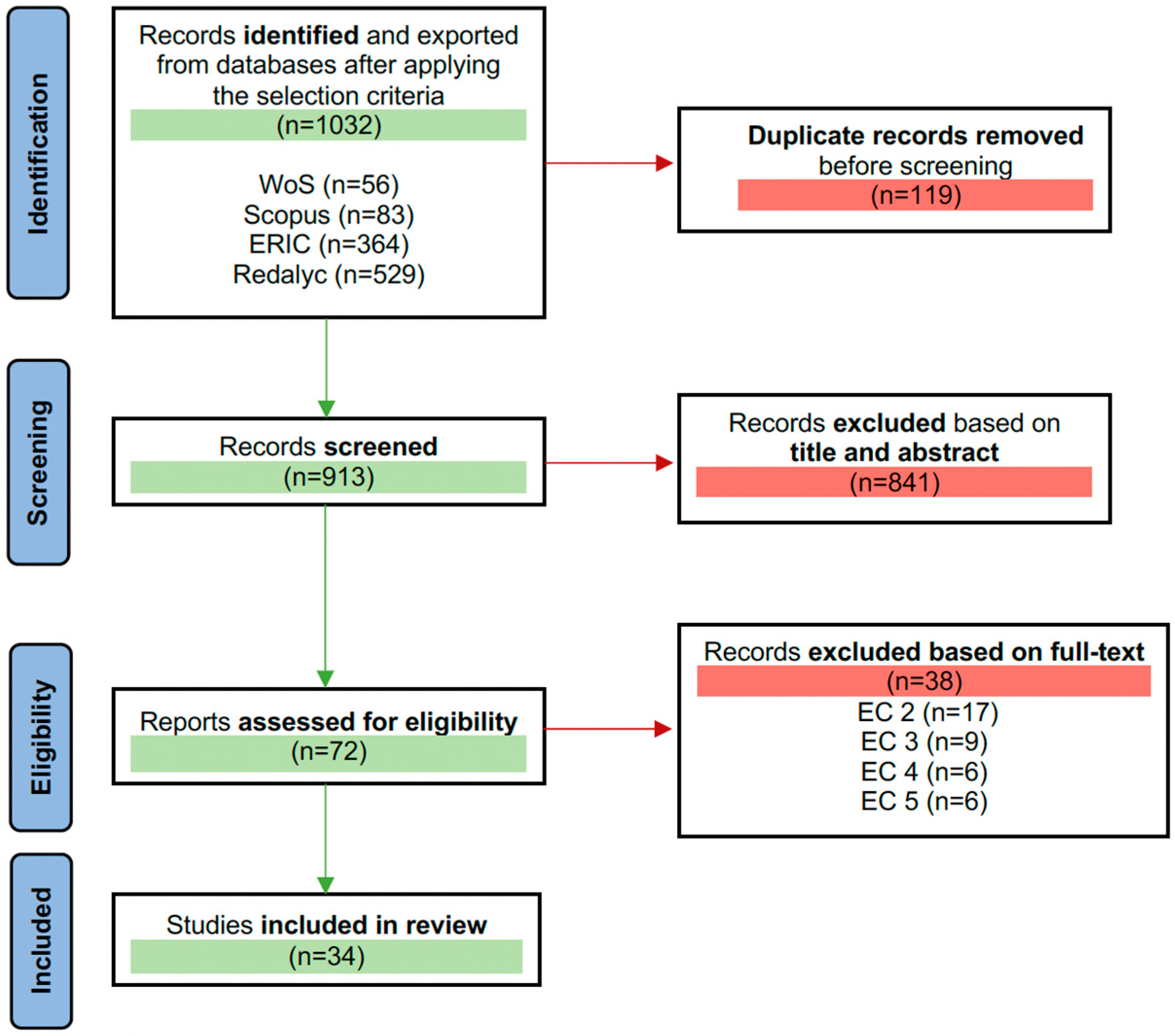
After exporting the selected studies to Microsoft Excel, several screening rounds were conducted (see Figure 1) in which articles were marked as included, uncertain, or excluded: a first screening based on titles, a second screening based on abstracts, and a third one involving a quick full-text reading to understand the content of the selected studies.
Figure 1.
PRISMA-ScR flow diagram. Adapted from Tricco et al. [24].
As shown in the flow diagram, the results per database represent the cumulative output of all three strategies executed within each platform.
2.4. Data Collection
A total of 34 studies were selected for in-depth analysis. In the data collection phase, the following information was organised in a Microsoft Excel table: author(s), article title, publication date, journal of publication, DOI link (when available), citation in APA format, database of origin, type of study (qualitative, quantitative, mixed-methods, or review), the main objective or focus of each study, and additional observations. Furthermore, each study was categorised according to the specific search strategy through which it had been retrieved, allowing for a clearer understanding of how the literature is distributed across the intersections of giftedness, ESL/EFL, and AR.
3. Results
This section aims to provide a concise and precise description of the experimental results, their interpretation, as well as the conclusions that can be drawn.
3.1. General Description of the Results
After the selection process, 34 articles published between 2020 and 2025 were included, originating from diverse geographical contexts (Europe, Asia, America, and the Middle East). Collectively, they cover different educational stages, ranging from early childhood education to higher education, with sample sizes varying between 8 and 518 participants. In terms of methodology, 16 studies were quantitative, 6 qualitative, 8 employed mixed methods, and 4 were reviews. Most of them addressed the relationship between giftedness and English as a Second/Foreign Language (ESL/EFL) acquisition, with a significant number of them focusing on the use of AR as a pedagogical and motivational tool.
Finally, by conducting an in-depth analysis of all included articles and their relevant information for addressing the research questions, the main findings of the selected studies were extracted (See Table A1 in Appendix A).
3.2. Narrative Synthesis
This narrative synthesis is developed with consideration of the three research questions that underpin the review.
Q1. Do gifted children acquire a second language more easily than their typically developing peers, and which language skills do they tend to master more easily? Documentary research has made it possible to identify the key factors involved in second language acquisition among gifted students, as well as to understand how they develop various linguistic skills.
3.2.1. Factors Shaping L2 Learning in Gifted Students
The findings suggest that gifted students tend to outperform their peers across various dimensions of linguistic competence. However, this success in acquiring a second language (L2) appears to depend less on innate talent and more on cognitive, affective and contextual factors. These include personality traits, the use of effective learning strategies (metacognition, strategy management, self-confidence, self-efficacy, learning autonomy), alongside high motivation and sustained exposure to multiple languages [25,26,27]. Notably, these same factors also underpin advanced learners’ L2 Willingness to Communicate (WTC), which reflects their readiness to engage in authentic language use. WTC is shaped by a range of interrelated variables: affective dispositions (e.g., positive attitudes towards English and self-confidence), situational conditions (e.g., type of interlocutor, cultural influences, and fear of social disapproval), and linguistic factors such as the speaker’s and interlocutor’s proficiency levels [28].
A cross-cutting finding was the central role of intrinsic motivation as a driving force in the learning process of gifted students. Although they demonstrate strong motivation, especially linked to future career opportunities and the desire to communicate effectively, they also expressed dissatisfaction with the limited opportunities for authentic oral interaction provided in their classes [29]. This sometimes leads them to face challenges like boredom and fear of mistakes, emphasising the need for a tailored and engaging curriculum that incorporates technology and experiential learning [30].
3.2.2. Development of L2 Linguistic Skills in Gifted Students
Speaking Skills
When it comes to oral expression, learners with higher proficiency in the given language tend to employ more advanced communicative strategies, including metacognitive and socio-affective approaches [31]. They also rely heavily on explicit and reciprocal communication strategies to sustain interaction, while generally avoiding reduction strategies. In this sense, strategic awareness training plays a key role in enhancing oral competence, as it enables learners to consciously monitor, evaluate and adapt their communicative strategies to meet specific interactional demands. This metacognitive skill fosters more effective and autonomous language use [32].
When talking about the different oral performance tasks, personal information tasks (e.g., an interview using question cards) boosted fluency and accuracy, narrative tasks (e.g., telling a story based on sequential pictures) promoted complexity, and decision-making tasks (e.g., negotiating and deciding on the most typical activity for young people based on photos) enhanced lexical variety and social engagement [31]. Nevertheless, error perception and fear of failure are present and can lead to English language anxiety, which is higher in oral and social contexts [33].
Gifted students reported prioritising oral communication skills, particularly speaking and listening, as essential for their language development [29]. However, they perceived that classroom instruction was mainly oriented towards exam preparation, with an emphasis on grammar and reading tasks.
Writing Skills
Regarding academic writing, a clear link was observed between the use of self-regulated strategies such as planning, monitoring, and motivation, and performance in L2 writing [34]. Moreover, higher proficiency levels were strongly associated with the use of more complex and longer collocations. In this regard, more than half of the combinations produced by these learners were native-like collocations, which reflects a gradual and steady development of their collocational competence, suggesting awareness and motivation to achieve natural expression in writing [35,36]. However, the implicit acquisition of advanced morphosyntactic structures continues to be a challenge, particularly when grammatical features have no equivalent in the learners’ first language [37,38].
In this context, as advanced EFL learners strive to express increasingly complex ideas in writing, many turn to translation strategies as a form of cognitive support. To cope with these linguistic challenges, they frequently relied on mental and partial translation (L1 to L2) as scaffolding practices to express complex ideas, finding it helpful for the development of fluency and vocabulary, yet often detrimental to naturalness. As a result, students expressed mixed feelings about relying on translation strategies, appreciating their support but questioning their impact on authentic language use [39].
Q2. What specific language skills are most impacted by AR? Is any language skill strongly influenced by AR in gifted students? Documentary research has provided insights into how AR affects the development of specific language skills.
3.2.3. Development of L2 Linguistic Skills Through AR
Speaking Skills
Several studies indicate that AR supports speaking (M = 4.16 in [40]) leading to greater fluency, pronunciation (M = 4.18 in [40]) and confidence in oral production, largely due to immediate feedback and interaction in simulated environments [37,40,41]. The use of AR also fostered accurate grammar use, particularly in giving and asking for directions, with strong gains in interaction [41].
Listening Skills
The reviewed studies also highlight the positive impact of technology-enhanced approaches on listening comprehension (M = 4 in [40]). Significant gains were reported in phonetic awareness, syntactic processing, and overall understanding using mobile-assisted language learning applications, which offered learners flexibility, autonomy, and varied input [42]. Similarly, it was also found that AR-based courses integrating text-to-speech, speech recognition and immediate feedback fostered improvements in listening skills [40].
Reading and Writing Skills
The application of AR environments to translation and writing tasks enhanced textual comprehension and written expression, with AR groups outperforming their peers in translation (M = 8.5 vs. 7.8) and reading comprehension (M = 9.2 vs. 8.3) [43]. Additionally, AR-supported storytelling contributed to literacy development, while traditional books continued to play a complementary role in promoting reading and writing skills [44].
Vocabulary
Most studies reported significant improvements in vocabulary acquisition (M = 4.26 in [40]; M = 76.1 vs. 48.1 in [45]), retention and performance through immersive AR experiences [46,47]. Students recalled vocabulary more confidently, often linking words to specific AR visual contexts, thus enhancing both definition recall and contextual sentence use [48]. For instance, in the study by Larchen Costuchen et al. [49], the vocabulary retention mean score in AR under the visuospatial bootstrapping (VSB) condition at 1 week was 15.07 out of 30 (SD = 3.88), compared to 8.94 (SD = 6.10) in the Quizlet condition. Tyson’s study [48] demonstrated that, for 75.9% of the participants, learning new vocabulary through AR was easier than with traditional methods. Similarly, Mamani-Calapuja et al. [50] reported significant improvements across all categories, with scores increasing from 10 to 18.7 for Animals and from 7.4 to 16.1 for Clothes.
Intercultural Competence
Beyond linguistic skills, some studies [51] highlighted that AR environments enriched students’ intercultural competence, such as cultural awareness, by exposing them to culturally contextualised content and promoting reflection on identity and communication across cultures. These experiences fostered empathy, and deeper engagement with cultural narratives, while project-based tasks encouraged intercultural communication and critical thinking about issues concerning representation, identity, and community interaction [52].
Q3. How does AR affect the intrinsic and/or extrinsic motivation of gifted learners? And, if motivation is affected, does this increase the development of their communicative competence? Documentary research has shed light on the impact of AR on both intrinsic and extrinsic motivation in gifted learners, and has explored how changes in motivation may contribute to the enhancement of their communicative competence.
3.2.4. Other Variables and the Use of AR
Cognitive Development and Academic Performance
In addition to linguistic outcomes, several studies highlighted the cognitive benefits of AR in second language acquisition. AR-based activities such as escape rooms were shown to stimulate curiosity, provide meaningful challenges, and foster higher-order thinking skills such as creativity, problem solving, and critical reflection [26,41,51,53]. These activities also promote concentration [44]. These findings suggest that AR not only supports language learning but also contributes to the broader cognitive development of gifted learners. Moreover, multiple studies reported measurable benefits in academic performance, such as the ones mentioned above.
Motivation and Engagement
Students are motivated to use English in digital environments by personal interest, confidence, cultural connection, and agency, though interaction with native speakers can either enhance or hinder their WTC [30].
In gamified AR environments, students’ motivation and engagement increased through a dynamic interest loop. Their curiosity was initially triggered by interactive AR features such as gamified maps, English content, and leaderboard competition, which encouraged exploratory behaviour and fostered positive peer interactions. As they progressed, the real-life context of AR enhanced the meaningfulness of English learning, while collaborative tasks and opportunities for reflection promoted a sense of competence, autonomy, and relatedness, sustaining their motivation over time [54]. Therefore, the situated, personalised, and collaborative learning present in these activities fostered deeper engagement [55].
Overall, the studies agree that AR enhances curiosity, enthusiasm, engagement, understanding, self-regulation, confidence and willingness to learn English and actively participate in communicative tasks by incorporating elements of gamification, storytelling, kinesthetic activities (improvements in speaking (30%), listening (44%), reading (28%), and writing [56]), immediate feedback, real-word connections, interactive narratives, and culturally contextualised content [46,49,53,56,57]. Motivation survey scores (attention, confidence, satisfaction, and relevance) were significantly higher in the AR group compared to the group following traditional methods such as flashcards, indicating that students found it particularly exciting and effective [45,47]. Due to its stimulating nature and potential to enhance motivation, one study found that 93.1% of participants wished to continue using AR in some form in their learning [48]. In this regard, this enjoyment of learning translated into measurable improvements in vocabulary, comprehension, and participation [50,57].
Learning Language Anxiety
Most of the studies found AR engaging due to its interactive, immersive and negotiated tasks, thus reducing anxiety and making learning more enjoyable [42,46,55]. Particularly, task familiarity was highlighted as a factor that not only reduces anxiety, but it also increases learning satisfaction, fostering a safer and more stimulating environment [58]. On the downside, it can limit challenge and cognitive motivation [59].
Teacher Professional Development
Some studies stressed that the teacher’s preparation, pedagogical design, and ability to guide students were decisive factors in maximising the benefits of AR and avoiding superficial use [50,55,58]. Furthermore, these studies suggest that students’ extrinsic motivation is strongly influenced by how well teachers are prepared and how much effort they invest in integrating AR into their practice. When teachers actively design meaningful tasks and purposefully embed AR, learners tend to value the experience more and demonstrate higher levels of engagement and achievement.
3.2.5. Limitations and Barriers to the Use of AR
Despite its benefits, the studies identified several barriers. On the technological level, reliance on mobile devices, internet connectivity and the stability of AR applications may hinder the continuity of activities [55]. From a pedagogical perspective, the lack of teacher training to integrate these tools into the curriculum effectively was frequently reported, along with weaker support for grammar and writing skills [37,43], and the risk of superficial use driven by novelty rather than linguistic objectives [58]. At the individual level, unequal technological competence among students and differences in learning styles were noted as factors that can influence the extent to which AR is effectively leveraged.
Overall, the evidence suggests that AR is a promising resource for enhancing both linguistic skills and motivation in gifted students acquiring English, although its effective implementation requires overcoming technological and pedagogical limitations.
4. Discussion and Conclusions
This review set out to examine the relationship between giftedness, English language acquisition, and the use of AR, with a particular focus on three guiding research questions.
In response to the first research question (Q1), the evidence suggests that gifted students with advanced verbal abilities tend to acquire a second language more easily than their typically developing peers, often outperforming them across various dimensions of L2 competence [60]. However, this advantage appears to be mediated less by “innate talent” and more by a constellation of cognitive, affective, and contextual factors, highlighting that motivational and metacognitive variables play a central role in their language development [27]. In other words, giftedness may provide favourable preconditions (e.g., self-regulation, strategy management, self-efficacy and autonomy), but acquisition trajectories are strongly shaped by opportunities to practise and by learners’ motivational profiles.
Among language skills, oral communication (speaking and listening) emerges as both a priority and a relative strength when students are supported by strategic awareness. Their advanced metacognitive and socio-affective strategies allow them to regulate learning more effectively and to achieve higher levels of fluency and accuracy in communication [31,32].
In writing, the use of self-regulation strategies such as planning and monitoring has been linked to superior performance [34]. Lexically, advanced learners produce longer, more complex, less frequent, and more native-like collocations, which shows developing phraseological competence and a drive for natural expression [35,36]. These findings align with prior research suggesting that gifted students’ advanced verbal abilities and early literacy skills provide them with a comparative advantage in second language acquisition [17]. Nonetheless, challenges persist in the implicit acquisition of complex grammatical structures, which remain difficult to master when they are not represented in the learners’ first language [37,38].
In sum, gifted learners tend to attain a higher level of L2 proficiency, particularly in oral communication and phraseological development, when exposed to interactive and authentic learning contexts. However, integrating complex grammatical structures can be challenging if learners perceive them as irrelevant to real-world communication. To build on these strengths, curricula should incorporate targeted support for complex grammatical structures, ensuring that gifted learners remain engaged while fostering progress across diverse proficiency levels. Embedding such structures within AR environments may enable learners to use them naturally in meaningful interactions, fostering implicit acquisition without overt grammar instruction.
With regard to the second research question (Q2), the findings show that AR has the strongest impact on vocabulary learning and retention, with consistent evidence that immersive and interactive tasks enhance both short-term acquisition and long-term recall, a pattern that is consistent with previous findings [52].
Beyond vocabulary, AR also benefits pronunciation, fluency, and listening comprehension by providing immediate feedback and creating authentic communicative scenarios [37,41,45]. In this sense, technology-enhanced approaches, including mobile-assisted applications and AR-based environments, have proven especially beneficial for listening skills, fostering improvements in phonetic awareness, syntactic processing, and overall comprehension [42,45]. In the domain of writing, AR-supported translation and composition tasks have been shown to foster deeper textual understanding and more accurate expression [43]. By contrast, the evidence on grammar acquisition is less conclusive, indicating that AR may not be as effective when it comes to abstract or decontextualised aspects of language learning, as previously shown [32]. However, when it comes to gifted students, there is still a lack of evidence identifying which specific language skills benefit most from AR-based interventions, highlighting a gap that future research should address.
Regarding the final research question (Q3), the evidence indicates that AR primarily enhances intrinsic motivation among gifted learners. While extrinsic factors such as academic achievement or career opportunities were acknowledged, the evidence suggests that AR primarily strengthens intrinsic motivation, which is a critical predictor of long-term engagement in gifted learners [27]. The immersive, game-like nature of AR fosters curiosity, attention, and enjoyment, which in turn increase learners’ willingness to engage in communicative tasks [44,49,53,56,57]. In younger learners, AR proved particularly effective at sustaining enthusiasm and focus, leading to measurable improvements in vocabulary and comprehension, as demonstrated by Lee et al. [61].
Taken together, these results confirm that AR is a promising pedagogical tool for gifted students learning English as a second language. By addressing both linguistic development and motivation, AR has the potential to mitigate some of the challenges faced by this population, such as boredom, anxiety, and under-stimulation [10]. However, limitations remain regarding its implementation. The reliance on technology, disparities in learners’ digital competence, and insufficient teacher training pose significant challenges to the effective use of AR, as highlighted by Nikou et al. [62].
While these findings offer valuable insights into the potential of AR for supporting gifted learners, several limitations of this review should be acknowledged. The analysis was restricted to open-access studies published between 2020 and 2025 in English, Spanish, French, or Italian, which may have excluded relevant research published earlier or in other languages. In addition, the included studies were highly heterogeneous in terms of design, sample size, and outcome measures, which limited comparability and required a narrative synthesis. Due to the difficulty encountered in retrieving results through a single search strategy that encompassed all key concepts (giftedness, EFL/ESL learning, and AR), three separate searches had to be conducted. The keywords used in the search strategies could have been more specific because depending on which synonyms are employed for a given concept, confusion or inconsistencies may arise. For instance, only a small number of studies explicitly focused on gifted learners, and many did not clearly report the criteria used to identify giftedness, which limits the applicability and generalisability of the findings. Given the breadth of the topic and this lack of specificity, a scoping review was conducted to clarify the current state of research and to identify existing limitations in the field. Although a theoretical alignment is proposed, the reviewed studies do not establish a direct, evidence-based link between AR use and improved outcomes for gifted students. This highlights a clear gap in the literature, as few studies directly explore the intersection of AR and giftedness in second-language acquisition. Finally, the accuracy of this review depends on the completeness and clarity of reporting in the included studies, and screening and data extraction were primarily conducted by a single reviewer, which may have introduced selection bias despite efforts to apply consistent criteria.
To this end, this review aimed to examine the existing studies and paves the way for future implementations of AR to enhance both the linguistic competences and the motivation of gifted students, addressing not only vocabulary but also more complex grammatical aspects. Future research should delve deeper into how AR can be systematically integrated into ESL/EFL curricula tailored to gifted learners, considering their cognitive profiles, learning autonomy, and heightened sensitivity to instructional quality. Longitudinal studies are needed to assess the sustained impact of AR on advanced morphosyntactic development, academic writing, and metalinguistic awareness. Moreover, comparative studies between AR-enhanced instruction and other immersive technologies (e.g., VR) could clarify the specific affordances of AR in different aspects of learning. It is also essential to investigate teacher training models that equip educators to design, implement, and evaluate AR-based interventions effectively, ensuring pedagogical alignment and technological feasibility. Finally, future research should explore how AR can be adapted to different educational stages and linguistic backgrounds, examining its role in inclusive gifted education and its potential to reduce underachievement and disengagement in language learning contexts.
Author Contributions
N.O.-M., J.C.B. and S.P.-O. conceptualised the study. N.O.-M. developed the methodology, conducted the systematic search, screening, data extraction, synthesis, and formal analysis, and secured funding. N.O.-M. drafted the manuscript, and all authors contributed to its review and editing. J.C.B. and S.P.-O. supervised the process. All authors have read and agreed to the published version of the manuscript.
Funding
The first author is supported by a predoctoral contract (FPU23/03798) from the Ministry of Science, Innovation and Universities (Government of Spain), awarded under the corresponding official call (see resolution in https://www.ciencia.gob.es/InfoGeneralPortal/documento/f36570cb-cf66-4988-95c7-6a0d6688306a, accessed on 27 October 2025). She is also involved in project 270345, entitled “S73_23D: Laboratory of Neuroeducation, Educational Technology and Development (NeeTeD Lab)”, funded by the Gobierno de Aragón.
Data Availability Statement
The data supporting this study consists of previously published articles, which are available in the respective journals and databases. Full details of the included studies are provided in the reference list.
Conflicts of Interest
The authors declare no conflicts of interest.
Abbreviations
The following abbreviations are used in this manuscript:
| IQ | Intelligence Quotient |
| AR | Augmented reality |
| ESL | English as a second language |
| EFL | English as a foreign language |
| WoS | Web of Science |
| ERIC | Education Resources Information Center |
Appendix A

Table A1.
Main findings of the selected studies.
Table A1.
Main findings of the selected studies.
| Authors and Date | Methodology | Context | Population | Intervention | Topic | Focus on | Linguistic Outcomes | Motivational and Other Outcomes | Barriers |
|---|---|---|---|---|---|---|---|---|---|
| Wen et al. (2022) [25] | Review | Iran | Documents | No, analysis | Giftedness + ESL | Exceptional language aptitudes. | Becoming a polyglot results from a combination of cognitive, affective, and contextual factors rather than innate talent. | - | - |
| Faridi & Izadpanah (2024) [26] | Quantitative | Iran | n = 360 Iranian EFL students at intermediate and advanced levels (ages 13–16) | No | Giftedness + ESL | Perceptions and attitudes toward learning approaches | - | Positive attitudes toward self-regulation and constructivism (critical thinking, problem-solving, active participation). Autonomy, motivation, and active engagement. | -. |
| Rajić et al. (2022) [27] | Review | - | n = 175 studies, 3 of them selected | No, analysis | Giftedness + ESL | Success in L2 acquisition according to variables such as personality traits, metacognition, self-confidence. | - | Intrinsic motivation and certain personality traits (Intellect, Agreeableness) are strong predictors of success, while amotivation hinders it. Motivational autonomy is key to self-regulation and to performance of gifted students. | - |
| Alimorad & Akbarzadeh (2022) [28] | Qualitative | Iran | n = 8 advanced EFL students aged 19–21 | No | Giftedness + ESL | Willingness to communicate (WTC) in English in digital contexts. | L2 WTC fluctuates depending on affective, contextual and linguistic factors. | Students are motivated to use English in digital environments by personal interest, confidence, cultural connection, and agency. | Interaction with native speakers can either enhance or hinder their WTC. |
| Do & Nguyen (2021) [29] | Mixed | Vietnam | n = 180 English-majored students aged 18–20 | No, diagnosis | Giftedness + ESL | L2 Needs: speaking and listening | The students prioritise oral communication (speaking and listening). | Strong motivation related to career opportunities and communication. | Dissatisfaction with the instruction received (exam preparation- grammar and reading). |
| Manasrah et al. (2023) [30] | Quantitative | Saudi Arabia | n = 118 gifted EFL learners aged 25–19 | No, diagnosis | Giftedness + ESL | L2 Needs | English as essential for their future, preferring activities that mirror real-life situations and virtual environments. Need for a tailored, engaging curriculum that incorporates technology and experiential learning. | - | |
| Rayati et al. (2023) [31] | Mixed | - | n = 23 low and 25 high proficiency EFL learners | No, diagnosis | Giftedness + ESL | L2 Speaking | Learners with higher English proficiency tend to employ more advanced strategies (metacognitive and cognitive). | - | - |
| Ostovar-Namaghi et al. (2022) [32] | Qualitative | Iran | n = 17 advanced EFL learners | No, diagnosis | Giftedness + ESL | L2 Speaking | Use of explicit and reciprocal communication strategies to maintain interaction. Importance of strategic awareness training in improving oral competence. | - | - |
| Kasap (2021) [33] | Mixed | Turkey | n = 146 gifted students aged 12–17 | No, diagnosis | Giftedness + ESL | L2 Speaking anxiety | Students in arts and music programmes exhibit significantly lower anxiety levels compared to those in science programmes. | Error perception and fear of failure contribute to increased anxiety levels. | |
| Wang et al. (2023) [34] | Quantitative | China | n = 518 advanced EFL university students aged 18–23 | No | Giftedness + ESL | L2 Writing | Greater use of self-regulated strategies is positively associated with better performance in L2 writing. | Those who manage their motivation more effectively write more successfully in English. Advanced students display more stable and flexible motivational patterns. | - |
| Du et al. (2022) [35] | Quantitative | - | n = 174.743 English learners, K–12 | 128 different writing activities. | Giftedness + ESL | L2 Writing: Collocational competence. | Positive link between proficiency level and collocation difficulty/length. Over half of their combinations were native-like collocations. | Learners attempt to mimic native-like usage even at early stages, suggesting awareness and motivation to achieve natural expression in writing. | - |
| Zinkgraf & Verdú (2021) [36] | Quantitative | Spanish speaking countries | n = 37 advanced English learners, university students aged 20–34 | Dictogloss as a teaching strategy for formulaic sequences | Giftedness + ESL | L2 Writing: Productive use of formulaic sequences | Growing awareness, accuracy, and variety in FS use. | - | - |
| Azimova & Solidjonov (2023) [37] | Review + Quantitative | Uzbekistan | n = 30 university students aged 18–30 | Development of an AR app using Unity + Vuforia | ESL + AR, AR + Motivation | L2 Vocabulary, pronunciation, grammar, reading, and writing in English. | AR is especially effective in vocabulary and pronunciation, thanks to immersive practice and instant feedback. | Real-world context, quick feedback, and immersive language learning experiences. | Weaker support for grammar and writing skills; dependence on stable internet access. |
| He & Oltra-Massuet (2023) [38] | Quantitative | International: China and Spain | n = 81 (12 native, 32 Chinese EFL learners, 37 Spanish EFL learners) aged 20–40, at least C1 level | No, experiment (Word Monitoring Task (WMT)) | Giftedness + ESL | L2 Implicit knowledge of grammar: questions (yes/no and wh-questions) | It is difficult for L2/FL learners to acquire a native-like knowledge of morphosyntactic features. | Learners’ motivation is associated with their academic background and their advanced level of English. | - |
| Murtisari (2021) [39] | Qualitative | Indonesia | n = 29 advanced EFL students enrolled in English Language Education and English Literature programmes | No | Giftedness + ESL | L2 Academic writing. Translation strategies. | Students frequently relied on mental (L1 to L2) (100%) and partial written translation (79%) as scaffolding to express complex ideas, finding it helpful for fluidity and vocabulary. | Motivation is linked both to the need for support and to individual learning preferences. | Often detrimental to naturalness, which led to ambivalent feelings about its use. |
| Lin & Tsai (2021) [40] | Mixed | Taiwan | n = 50 English-major junior students, B1-B2 | Use of two AR-based English courses, 4 weeks | ESL + AR, AR + Motivation | L2 Listening/speaking, with integrated text-to-speech, speech recognition, and instant feedback. | Improvements in vocabulary, pronunciation, speaking and listening. | Strong motivation and positive attitudes toward AR in EFL learning. Instant evaluation and feedback supported error recognition and correction, enhancing oral practice and confidence. | - |
| Khodabandeh (2023) [41] | Quantitative | Iran | n = 60 EFL beginners, aged 13–16 | Use of a custom ARG app with 12 tasks about giving/asking for directions | ESL + AR, AR + Motivation | L2 Speaking and writing, grammar (asking for and giving instructions) | Strong gains in interaction, visualization, and comprehension. | Motivation, engagement, collaborative learning, feedback, contextualised learning, critical thinking, authentic communicative practice, autonomy and active participation. | - |
| Raj & Tomy (2023) [42] | Quantitative | India | n = 121 first-year B. Tech students | Use of mobile-assisted language learning (MALL) with 46 shortlisted listening apps | ESL + AR | L2 Listening skills with indirect support for pronunciation and speaking. | The experimental group improved significantly (phonetics, morphemes, syntax, comprehension). Apps provided flexibility, autonomy, and improved oral comprehension. | Mobile apps increased curiosity, learner autonomy, and engagement. Students reported reduced anxiety and more willingness to practice. | - |
| Binhomran & Altalhab (2021) [43] | Quantitative | China | n = 120 English-major undergraduates | Development of an AR-based translation teaching platform. | ESL + AR, AR + Motivation | Translation skills, reading comprehension, and grammar analysis, with vocabulary and expression development integrated. | They outperformed their peers in translation and reading comprehension. | Higher levels of engagement, interaction, and satisfaction reported in the AR group. | No significant difference in grammar analysis, suggesting AR supports applied/visual tasks more than abstract grammar reasoning. |
| Yangin Ersanli (2023) [44] | Mixed | Turkey | n = 56 fifth graders (A2 CEFR) | Use of storytelling with AR materials (Unity + QR codes, 3D interactive animations). | ESL + AR, AR + Motivation | L2 Vocabulary learning and retention, with support from listening, reading, and speaking through storytelling. | The AR group showed significantly higher retention. | AR storytelling increased intrinsic motivation, concentration, and willingness to learn. | - |
| Tsai (2020) [45] | Mixed | Taiwan | n = 42 fifth graders (ages 11–12) | QuiverVision AR app, 4 weeks | ESL + AR, AR + Motivation | L2 Vocabulary learning and retention + motivation | They outperformed their peers in vocabulary. | Motivation survey scores (attention, confidence, satisfaction, relevance) were significantly higher. AR is exciting and effective. | - |
| Lai & Chang (2021) [46] | Quantitative | Taiwan | n = 47 first graders | Use of Aurasma AR app on tablets. | ESL + AR, AR + Motivation | L2 vocabulary acquisition and performance | AR students improved in vocabulary performance. | AR apps were highly effective at boosting attention, relevance, and satisfaction. Students found AR novel, immersive, and engaging, which reduced anxiety and made vocabulary learning more enjoyable. | - |
| Larchen Costuchen et al. (2022) [47] | Qualitative | Spain and Sweden | n = 12 Spanish native/bilingual speakers (ages 26–48) | Use of MnemoRoom4U | ESL + AR | L2 vocabulary recall (orthographic recognition and translation tasks). | High recall scores, slightly above or equal to controls. | AR app was rated very motivating and easy to use. | - |
| Tyson (2021) [48] | Quantitative | USA | n = 29 students aged 14–18 | Use of AR via Nearpod virtual field trips | ESL + AR, AR + Motivation | L2 Academic vocabulary acquisition and retention (definition recall and contextual sentence use) | Students recalled vocabulary more confidently, often linking words to specific AR visual contexts. | AR increased engagement, attention, and enjoyment. | - |
| Larchen Costuchen et al. (2021) [49] | Quantitative | Spain | n = 62 undergraduate teacher-training students (mean age ≈ 19), English level B1–B2 | Study 10 unknown English idioms for 15 min with AR | ESL + AR | L2 vocabulary recall (idiomatic expressions) | They outperformed their peers in both immediate and delayed one-week tests. | AR method was more engaging and entertaining than flashcards, likely enhancing learner motivation and willingness to engage with the vocabulary task. | Forgetting was steeper in AR-VSB over time. |
| Mamani-Calapuja et al. (2023) [50] | Quantitative | Peru | n = 42 kindergarten children (ages 3–5) | Use of Wordtastic Kids App (age-leveled) | ESL + AR, AR + Motivation | L2 vocabulary acquisition, with support for listening, pronunciation, reading recognition. | Effectiveness of AR for vocabulary learning and retention in early childhood. Significant improvements in all categories (animals, clothes). | Children were highly engaged, curious, and motivated by the novelty, interactivity, and fun of AR. Teachers observed improved attention, enjoyment, and participation. | Successful implementation depends on teacher preparation, AR content quality, etc. |
| Liu et al. (2023) [51] | Mixed | China | n = 48 undergraduate students (average age ≈ 19), intermediate English level. | AR Language Learning App with immersive cultural content | ESL + AR, AR + Motivation | Intercultural competence and motivation | Significant improvements in intercultural competence and motivation. Increased engagement, deeper cultural understanding, and enhanced ability to apply language in authentic scenarios. | AR is immersive, fun, and curiosity-driven. Interactive cultural tasks, immediate feedback, and real-world connections fostered greater enthusiasm, self-regulation, and willingness to learn English. | - |
| Voreopoulou et al. (2024) [53] | Qualitative | Greece | A2 CEFR level schoolchildren | ARTutor4 platform: LockED in Shakespeare’s Globe Theatre (Escape room) | ESL + AR, AR + Motivation | L2 Vocabulary, development of linguistic skills, cultural awareness + motivation, creativity, critical thinking | Improved language practice and cultural knowledge beyond traditional curricula. | The AR escape classroom game was fun, interactive, and engaging, which reduced anxiety and fostered teamwork while enhancing willingness to use English. Deep and meaningful learning through problem-solving and collaboration. | - |
| Wang et al. (2021) [54] | Qualitative | China | n = 38 students (18–20 years old), low English scores | Use of XploreRAFE+, 4 weeks | ESL + AR, AR + Motivation | Addressing low motivation and burnout in English learning | Improvement observed in fluency, vocabulary use, writing practice, and collaborative communication. | Interest was formed through a cyclical process: curiosity → immersion/flow → meaningfulness. | - |
| Zain (2023) [55] | Review | - | n = 22 empirical studies | No, analysis | ESL + AR, AR + Motivation | L2 Writing, reading, vocabulary, pronunciation and speaking + motivation, personalisation | Improved performance and achievement in vocabulary, reading, writing, and pronunciation. | Increased learning satisfaction and reduced anxiety. Situated, personalised, and collaborative learning fostered deeper engagement. | Technical issues. Unequal technological competence among students. Health/social concerns. |
| Briceño (2021) [56] | Quantitative | Ecuador | n = 120 students aged 6–8 | Teaching English through kinesthetic activities (games, dramatisation, dances, etc.). | Giftedness + ESL | Relationship between linguistic intelligence and English proficiency | Significant improvements in speaking, listening, reading, and writing (notable gains in confidence and writing fluency). | It creates a trusting environment, reduces academic pressure, and motivates learners, making the learning process more meaningful and effective. | - |
| Zhao & Wang (2024) [57] | Mixed | Saudi Arabia | n = 73 sixth-grade Saudi female students (ages 11–12) | Use of Storybooks Alive AR app | ESL + AR, AR + Motivation | Translation, vocabulary + motivation | AR group scoring slightly higher. | AR group students reported better understanding, engagement, and confidence. | No teacher support, and minor issues (distraction, technical skills, sharing devices) were noted. |
| Karacan & Akoglu (2021) [58] | Review | Turkey | Documents | No, analysis | ESL + AR, AR + Motivation | AR’s potential | It improves overall performance, with strong evidence for vocabulary gains and retention. | AR as engaging, enjoyable, and less anxiety-inducing compared to traditional approaches, boosting their willingness to participate. | Challenges remain in infrastructure, teacher training, and sustainable integration. |
| Garcia-Ponce & Tavakoli (2022) [59] | Quantitative | Mexico | n = 30 university students aged 18–26 | 3 dialogic tasks: personal information task, narrative task, and decision-making task. | Giftedness + ESL | How different types of dialogic tasks and proficiency level affect oral performance (CALF) and task engagement. | Personal tasks boosted fluency and accuracy, narratives promoted complexity, and decision-making tasks enhanced lexical variety and social engagement. | More interactive and negotiated tasks are more motivating and productive for L2 learning. Greater task engagement correlated with better performance. Task familiarity (personal information) reduces anxiety. | Task familiarity also limits challenge and cognitive motivation. |
References
- Kuznetsova, E.; Liashenko, A.; Zhozhikashvili, N.; Arsalidou, M. Giftendess identification and cognitive, physiological and psychological characteristics of gifted children: A systematic review. Front. Psychol. 2024, 15, 1411981. [Google Scholar] [CrossRef]
- Tourón, J. Entendiendo el Modelo de los Tres Anillos. Javier Tourón. Available online: https://www.javiertouron.es/entendiendo-el-modelo-de-los-tres-anillos/ (accessed on 2 August 2025).
- Dunn, R.; Price, G. The Learning Style Characteristics of Gifted Students. Gift. Child Q. 1980, 24, 33–36. [Google Scholar] [CrossRef]
- Hong, E.; Aqui, Y. Cognitive and Motivational Characteristics of Adolescents Gifted in Mathematics: Comparisons Among Students with Different Types of Giftedness. Gift. Child Q. 2004, 48, 191–201. [Google Scholar] [CrossRef]
- Stricker, J.; Buecker, S.; Schneider, M.; Preckel, F. Intellectual Giftedness and Multidimensional Perfectionism: A Meta-Analytic Review. Educ. Psychol. Rev. 2020, 32, 391–414. [Google Scholar] [CrossRef]
- Bergold, S.; Wirthwein, L.; Steinmayr, R. Similarities and Differences Between Intellectually Gifted and Average-Ability Students in School Performance, Motivation, and Subjective Well-Being. Gift. Child Q. 2020, 64, 285–303. [Google Scholar] [CrossRef]
- Bénony, H.; Van Der Elst, D.; Chahraoui, K.; Bénony, C.; Marnier, J.P. Lien entre dépression et estime de soi scolaire chez les enfants intellectuellement précoces [Link between depression and academic self-esteem in gifted children]. L’Encephale 2007, 33, 11–20. [Google Scholar] [CrossRef]
- Feuchter, M.D.; Preckel, F. Reducing boredom in gifted education—Evaluating the effects of full-time ability grouping. J. Educ. Psychol. 2022, 114, 1477–1493. [Google Scholar] [CrossRef]
- McGregor, M.; Jung, J.Y.; Evans, P. Motivational profiles of gifted students in science. Educ. Psychol. 2025, 45, 215–236. [Google Scholar] [CrossRef]
- Snyder, K.E.; Linnenbrink-Garcia, L. A developmental, person-centered approach to exploring multiple motivational pathways in gifted underachievement. Educ. Psychol. 2013, 48, 209–228. [Google Scholar] [CrossRef]
- Sternberg, R.J. Reframing Social and Emotional Development of the Gifted. Behav. Sci. 2024, 14, 752. [Google Scholar] [CrossRef]
- Breedlove, L. Characteristics of Gifted Learners. In Introduction to Gifted Education; Routledge: New York, NY, USA, 2021. [Google Scholar] [CrossRef]
- Yunus, M.M.; Sulaiman, N.A.; Embi, M.A. Malaysian gifted students’ use of English language learning strategies. Engl. Lang. Teach. 2013, 6, 97–109. [Google Scholar] [CrossRef]
- Baser, C.; Kanar, M. How can you “Gift” to Second Language Young Learners. Procedia Soc. Behav. Sci. 2014, 136, 246–249. [Google Scholar] [CrossRef][Green Version]
- Van Tassel-Baska, J.; MacFarlane, B.; Baska, A. The Need for Second Language Learning. In Parenting for High Potential; National Association for Gifted Children: Washington, DC, USA, 2017; Volume 6, pp. 4–7. [Google Scholar][Green Version]
- Puskás, A. Gifted and Talented Learners in the Foreign Language Classroom; Tribun EU s.r.o.: Brno, Czech Republic, 2021; ISBN 978-80-263-1665-7. [Google Scholar][Green Version]
- Abdallah, M.M.S. New Trends in Gifted Education; Faculty of Education, Assiut University: Asyut, Egypt, 2024. [Google Scholar][Green Version]
- Al-Khasawneh, F.M.; Al-Omari, M.A. Motivations towards learning English: The case of Jordanian gifted students. Int. J. Educ. 2015, 7, 306–321. [Google Scholar] [CrossRef]
- Harris, B.; Rapp, K.E.; Martínez, R.S.; Plucker, J.A. Identifying English language learners for gifted and talented programs: Current practices and recommendations for improvement. Roeper Rev. 2007, 29, 26–29. [Google Scholar] [CrossRef]
- Kronborg, L.; Plunkett, M. Providing an optimal school context for talent development: An extended curriculum program in practice. Australas. J. Gift. Educ. 2015, 24, 61–69. [Google Scholar] [CrossRef]
- Riwayatiningsih, R.; Prastikawati, E.F.; Muchson, M.; Haqiqi, F.N.; Setyowati, S.; Kartiko, D.A. Empowering Higher-Order Thinking Skills in Writing through Gamification and Multimodal Learning within PBL. Forum Linguist. Stud. 2025, 7, 385–398. [Google Scholar] [CrossRef]
- Marrahi-Gomez, V.; Belda-Medina, J. Assessing the effect of Augmented Reality on English language learning and student motivation in secondary education. Front. Educ. 2024, 9, 1359692. [Google Scholar] [CrossRef]
- Karaman, F. An Example Praxis for Teaching German as a Second Foreign Language with Augmented Reality Technology at Secondary Education Level. Int. J. Contemp. Educ. Res. 2023, 10, 279–292. [Google Scholar] [CrossRef]
- Tricco, A.C.; Lillie, E.; Zarin, W.; O’Brien, K.K.; Colquhoun, H.; Levac, D.; Moher, D.; Peters, M.D.J.; Horsley, T.; Weeks, L.; et al. PRISMA extension for Scoping Reviews (PRISMA-ScR): Checklist and explanation. Ann. Intern. Med. 2018, 169, 467–473. [Google Scholar] [CrossRef]
- Wen, Z.; Yang, J.; Han, L. Do polyglots have exceptional language aptitudes? Lang. Teach. Res. Q. 2022, 31, 53–66. [Google Scholar] [CrossRef]
- Faridi, M.; Izadpanah, S. The Study of EFL Learners’ Perception of Using E-learning, Self-Regulation and Constructivism in English Classrooms: Teachers, Intermediate and Advanced Learners′ Attitude. J. Lang. Educ. 2024, 10, 45–58. [Google Scholar] [CrossRef]
- Rajić, A.G.; Šafranj, J.; Prtljaga, J. Predictive values of the structure of the self-regulatory construct in L2 learning of the gifted. Res. Pedagog. 2022, 12, 186–215. [Google Scholar] [CrossRef]
- Alimorad, Z.; Akbarzadeh, S. Unraveling Advanced EFL Learners’ L2 Willingness to Communicate in Extramural Digital Settings. J. Pan-Pac. Assoc. Appl. Linguist. 2022, 26, 39–61. [Google Scholar] [CrossRef]
- Do, M.H.; Nguyen, T.T.A. Gifted High School Students’ Needs for English Learning in Vietnam Contexts. Arab World Engl. J. 2021, 12, 351–365. [Google Scholar] [CrossRef]
- Manasrah, M.; Alzobiani, I.; Alharthi, N.; Alelyani, N. Exploring Gifted Secondary School Students’ Needs for English Learning in Saudi Arabia. Arab World Engl. J. 2023, 14, 89–104. [Google Scholar] [CrossRef]
- Rayati, M.; Abedi, H.; Aghazadeh, S. EFL learners’ speaking strategies: A study of low and high proficiency learners. Mextesol J. 2023, 46, 1–16. [Google Scholar] [CrossRef]
- Ostovar-Namaghi, S.A.; Mohit, F.; Morady Moghaddam, M. Exploring advanced EFL learners’ awareness of communication strategies. Aust. J. Appl. Linguist. 2022, 5, 64–76. [Google Scholar] [CrossRef]
- Kasap, S. Foreign language anxiety of gifted students in Turkey. Pegem J. Educ. Instr. 2021, 11, 169–176. [Google Scholar] [CrossRef]
- Wang, X.; Ma, J.; Li, X.; Shen, X. Validation of self-regulated writing strategies for advanced EFL learners in China: A structural equation modeling analysis. Eur. J. Investig. Health Psychol. Educ. 2023, 13, 776–795. [Google Scholar] [CrossRef] [PubMed]
- Du, X.; Afzaal, M.; Al Fadda, H. Collocation Use in EFL Learners’ Writing Across Multiple Language Proficiencies: A Corpus-Driven Study. Front. Psychol. 2022, 13, 752134. [Google Scholar] [CrossRef]
- Zinkgraf, M.; Verdú, M.A. Dictogloss steals the show? Productive use of formulaic sequences by advanced learners. Lexis 2021, 18. [Google Scholar] [CrossRef]
- Azimova, D.; Solidjonov, D. Learning English language as a second language with augmented reality. Qo’Qon Univ. Xabarnomasi 2023, 1, 112–115. [Google Scholar] [CrossRef]
- He, Q.; Oltra-Massuet, I. Implicit Knowledge Acquisition and Potential Challenges for Advanced Chinese and Spanish EFL Learners: A Word Monitoring Test on English Questions. Behav. Sci. 2023, 13, 99. [Google Scholar] [CrossRef] [PubMed]
- Murtisari, E.T. Use of translation strategies in writing: Advanced EFL students. J. Lang. Lang. Teach. 2021, 24, 228–239. [Google Scholar] [CrossRef]
- Lin, H.-Y.; Tsai, S.-C. Student perceptions towards the usage of AR-supported STEMUP application in mobile courses development and its implementation into English learning. Australas. J. Educ. Technol. 2021, 37, 88–103. [Google Scholar] [CrossRef]
- Khodabandeh, F. Exploring the viability of augmented reality game- enhanced education in WhatsApp flipped and blended classes versus face-to-face classes. Educ. Inf. Technol. 2023, 28, 617–646. [Google Scholar] [CrossRef] [PubMed]
- Raj, A.; Tomy, P. Mobile technology as a dependable alternative to language labs and to improve listening skills. Int. J. Engl. Lang. Lit. Stud. 2023, 12, 17–32. [Google Scholar] [CrossRef]
- Binhomran, K.; Altalhab, S. The impact of implementing augmented reality to enhance the vocabulary of young EFL learners. JALT CALL J. 2021, 17, 23–44. [Google Scholar] [CrossRef]
- Yangın Ersanli, C. The effect of using augmented reality with storytelling on young learners’ vocabulary learning and retention. Novitas-ROYAL. (Res. Youth Lang.) 2023, 17, 62–72. [Google Scholar]
- Tsai, C.-C. The Effects of Augmented Reality to Motivation and Performance in EFL Vocabulary Learning. Int. J. Instr. 2020, 13, 987–1000. [Google Scholar] [CrossRef]
- Lai, J.-Y.; Chang, L.-T. Impacts of Augmented Reality Apps on First Graders’ Motivation and Performance in English Vocabulary Learning. Sage Open 2021, 11. [Google Scholar] [CrossRef]
- Larchen Costuchen, A.; Font Fernández, J.M.; Stavroukalis, M. AR-supported mind palace for L2 vocabulary recall. Int. J. Emerg. Technol. Learn. IJET 2022, 17, 47–63. [Google Scholar] [CrossRef]
- Tyson, M. Impact of augmented reality on vocabulary acquisition and retention. Issues Trends Learn. Technol. 2021, 9, 3–26. [Google Scholar] [CrossRef]
- Larchen Costuchen, A.; Darling, S.; Uytman, C. Augmented reality and visuospatial bootstrapping for second-language vocabulary recall. Innov. Lang. Learn. Teach. 2021, 15, 352–363. [Google Scholar] [CrossRef]
- Mamani-Calapuja, A.; Laura-Revilla, V.; Hurtado-Mazeyra, A.; Llorente-Cejudo, C. Learning English in Early Childhood Education with Augmented Reality: Design, Production, and Evaluation of the “Wordtastic Kids” App. Educ. Sci. 2023, 13, 638. [Google Scholar] [CrossRef]
- Liu, S.; Gao, S.; Ji, X. Beyond borders: Exploring the impact of augmented reality on intercultural competence and L2 learning motivation in EFL learners. Front. Psychol. 2023, 14, 1234905. [Google Scholar] [CrossRef] [PubMed]
- Haoming, L.; Wei, W. A systematic review on vocabulary learning in AR and VR gamification context. Comput. Educ. X Real. 2024, 4, 100057. [Google Scholar] [CrossRef]
- Voreopoulou, A.; Mystakidis, S.; Tsinakos, A. Augmented Reality Escape Classroom Game for Deep and Meaningful English Language Learning. Computers 2024, 13, 24. [Google Scholar] [CrossRef]
- Wang, D.; Md Khambari, M.N.; Wong, S.L.; Razali, A.B. Exploring Interest Formation in English Learning through XploreRAFE+: A Gamified AR Mobile App. Sustainability 2021, 13, 12792. [Google Scholar] [CrossRef]
- Zain, D. The implementation of Augmented Reality for language teaching and learning: A research synthesis. Mextesol J. 2023, 47, 1–15. [Google Scholar] [CrossRef]
- Briceño Núñez, C.E. Interacción de las inteligencias lingüística y kinestésica y su impacto sobre la adquisición de idiomas. Rev. Franz Tamayo 2021, 3, 303–317. [Google Scholar] [CrossRef]
- Zhao, Y.; Wang, Q. Applying augmented reality multimedia technology to construct a platform for translation and teaching system. Heliyon 2024, 10, e28700. [Google Scholar] [CrossRef] [PubMed]
- Karacan, C.G.; Akoğlu, K. Educational Augmented Reality technology for language learning and teaching: A comprehensive review. Shanlax Int. J. Educ. 2021, 9, 68–79. [Google Scholar] [CrossRef]
- Garcia-Ponce, E.E.; Tavakoli, P. Effects of task type and language proficiency on dialogic performance and task engagement. System 2022, 105, 102734. [Google Scholar] [CrossRef]
- Tai, S.; Chen, H.-J. A Comparative Study of the Effect of CALL on Gifted and Non-Gifted Adolescents’ English Proficiency. In Proceedings of the 2015 EUROCALL Conference, Padova, Italy, 26–29 August 2015; Helm, F., Bradley, L., Guarda, M., Thouësny, S., Eds.; Research-publishing.net: Dublin, Ireland, 2015; pp. 512–517. [Google Scholar] [CrossRef][Green Version]
- Lee, J.H.; Ahn, J.J.; Lee, H. The role of motivation and vocabulary learning strategies in L2 vocabulary knowledge: A structural equation modeling analysis. Stud. Second Lang. Learn. Teach. 2022, 12, 435–458. [Google Scholar] [CrossRef]
- Nikou, S.A.; Perifanou, M.; Economides, A.A. Exploring teachers’ competences to integrate augmented reality in education: Results from an international study. TechTrends: Lead. Educ. Train. 2024, 68, 1208–1221. [Google Scholar] [CrossRef]
Disclaimer/Publisher’s Note: The statements, opinions and data contained in all publications are solely those of the individual author(s) and contributor(s) and not of MDPI and/or the editor(s). MDPI and/or the editor(s) disclaim responsibility for any injury to people or property resulting from any ideas, methods, instructions or products referred to in the content. |
© 2025 by the authors. Licensee MDPI, Basel, Switzerland. This article is an open access article distributed under the terms and conditions of the Creative Commons Attribution (CC BY) license (https://creativecommons.org/licenses/by/4.0/).