


Featured Application
Fallen yellow ginkgo leaves, typically treated as waste in urban and landscaped areas, can be valorized as a sustainable and non-invasive source of pharmacologically relevant biflavonoids. Their high content of sciadopitysin, ginkgetin, isoginkgetin, and related compounds makes them suitable for development into standardized extracts or purified fractions with potential applications in pharmaceuticals, nutraceuticals, and functional foods. Moreover, the utilization of naturally shed leaves reduces environmental waste while avoiding disruption of the ginkgo tree’s physiological cycle, offering a scalable and eco-friendly raw material supply for bioactive product development.
Abstract
Ginko (Ginkgo biloba L.) is a widely distributed ornamental tree that produces large quantities of leaves annually, turning golden yellow in autumn due to chlorophyll degradation and carotenoid retention. While green ginkgo leaves and standardized extracts have been extensively studied, senescent and naturally fallen leaves remain only scarcely investigated, despite representing a substantial biomass resource. In this study, we analyzed yellow ginkgo leaves collected directly from trees and those naturally shed at four time points during autumn. We determined pigment composition, total polyphenols, flavonoids, phenolic acids, and the concentrations of five major biflavonoids. Chlorophylls decreased progressively in tree-collected leaves, whereas carotenoid levels remained stable or slightly elevated. Polyphenolic compounds were more abundant in fallen leaves. Biflavonoid profiling revealed the presence of amentoflavone, bilobetin, ginkgetin, isoginkgetin, and sciadopitysin, with sciadopitysin as the most abundant. Total biflavonoid content reached up to 8 mg/g dw, with higher levels in fallen leaves compared to those collected from the tree. These findings highlight yellow ginkgo leaves, particularly fallen ones, as a sustainable and non-invasive source of pharmacologically relevant biflavonoids. However, further research is needed to optimize eco-friendly extraction strategies and to evaluate safety aspects.
1. Introduction
Flavonoids are one of the most widespread and structurally diverse classes of plant polyphenols, fulfilling essential roles in pigmentation, UV protection, defense, and signaling. Their structural core, derived from the phenylpropanoid pathway, allows for numerous chemical modifications that expand diversity and modulate function. Beyond monomeric forms, flavonoids also undergo dimerization, producing a unique group of compounds collectively referred to as biflavonoids. According to the review article by He et al. [1], more than 592 biflavonoids have been structurally elucidated and may show a wide range of pharmacological activities, including anti-inflammatory, antioxidant, antibacterial, antiviral, antidiabetic, antitumor, and cytotoxic properties. Moreover, biflavonoids have demonstrated promising activity in experimental and preclinical models related to neurodegenerative diseases such as Alzheimer’s and Parkinson’s [2,3,4]. The dimerization of flavonoids significantly extends their functional landscape. For example, biflavonoids are better acetylcholinesterase, α-amylase and α-glucosidase inhibitors than their monomeric subunits, which indicates their potential role in the prevention of neurodegenerative diseases and diabetes [5].
Unlike monomeric flavonoids, which are widely distributed across the plant kingdom, biflavonoids are comparatively rare and not universally present in all plant species [1]. Their exact distribution remains incompletely characterized, as systematic surveys across taxa are still limited. Current evidence suggests that biflavonoids occur sporadically in certain lineages, often with taxonomic or ecological significance. Some examples of biflavonoid sources include Selaginella (Lycophytes) [6], Hypericum (Clusiaceae) [7], and Juniperus (Cupressaceae) [8], where they contribute to structural diversity, antimicrobial activity, and chemical defense.
Biflavonoids were first isolated from yellow ginkgo (Ginkgo biloba L.) leaves, which remains one of the best-known and most extensively studied sources; in this species, characteristic 3′,8″-linked biflavones such as amentoflavone, bilobetin, ginkgetin, isoginkgetin, and sciadopitysin have been identified [9]. The standardized G. biloba preparation, EGb761, contains 24% ginkgo flavonoids and 6% terpene trilactones (TTLs) and has long been used in the treatment of asthma, bronchitis, ischemia, arteriosclerosis, and rheumatism [10]. Yellow ginkgo leaf extracts may exhibit stronger biological activity than those from green leaves [11,12,13,14,15]. Our recent report shows higher accumulation of biflavonoids in yellow leaves [16], and yellow ginkgo leaves contain higher amounts of terpene trilactones bilobalide and ginkgolides B and C [17]. Therefore, senescent yellow ginkgo leaves may represent a valuable source of biflavonoids with potential pharmaceutical applications.
Given the large size of many ginkgo trees and their wide distribution across the globe in urban parks, streetscapes, and landscaped areas, the annual leaf fall represents a substantial amount of biomass. At present, these fallen ginkgo leaves are generally managed as green waste and are removed and discarded without further utilization. Although there have been reports suggesting alternative applications, for example, the use of ginkgo leaf biomass in biochar production [18], the vast majority of leaves remain unexploited and are ultimately treated as waste.
In this study, we investigated the potential of yellow ginkgo leaves, both those collected directly from the tree and those naturally senesced and fallen, as a source of valuable phytochemicals, with particular emphasis on biflavonoids. While ginkgo leaves are well known to contain a wide range of metabolites with pharmacological significance [19], to the best of our knowledge, no previous studies have specifically addressed the presence, concentration, or stability of biflavonoids in senescent or fallen leaves. Assessing this overlooked biomass could open new opportunities for sustainable resource utilization, help reduce organic waste in urban environments, and support the development of novel bioactive compounds from a currently neglected natural source.
To this end, we analyzed seasonal changes in biflavonoid content in yellow ginkgo leaves by determining pigment concentration, total polyphenols, flavonoids, phenolic acids, and the concentrations of five major biflavonoids—amentoflavone, bilobetin, ginkgetin, isoginkgetin and sciadopitysin. Both tree-collected and naturally fallen leaves were examined at four different time points during autumn, providing insight into how leaf senescence and natural abscission influence the accumulation and preservation of these pharmacologically relevant compounds.
2. Materials and Methods
2.1. Chemicals and Instruments
For this research, the following equipment and reagents were employed. Ginkgo leaves were freeze-dried using a LIO-5PLT (KAMBIČ, Ljubljana, Slovenia), and the resulting material was ground to a fine powder with a Bead Ruptor 12 (Omni International, Kennesaw, GA, USA). Plant material was weighed on an analytical balance (Adam Equipment, Maidstone, United Kingdom). Extractions were carried out with 70% ethanol (GRAM-MOL, Zagreb, Croatia) employing an ultrasonic bath (DU-100, Argo Lab, Carpi, Italy), followed by mixing on a mechanical rotator (Bio RS-24, Biosan, Riga, Latvia) and a vortex mixer (V-1 plus, Biosan, Riga, Latvia). The extracts were then clarified by centrifugation (LMC-4200R, Biosan, Riga, Latvia). For the determination of chlorophylls and carotenoids, acetone was used as the extraction solvent (GRAM-MOL, Zagreb, Croatia). UV-VIS measurements were performed on a spectrophotometer (ONDA TOUCH UV-21, China). For the determination of polyphenolic compounds, the following chemicals were used: gallic acid 98% (Acros Organics, Shanghai, China), caffeic acid ≥ 98% HPLC grade (Sigma Aldrich, St. Louis, Missouri, MO, USA), (+)-catechin hydrate (Sigma Aldrich, St. Louis, Missouri, MO, USA), Folin–Ciocalteu’s reagent (Sigma Aldrich, Buchs, Switzerland), sodium carbonate (T.T.T., Sveta Nedelja, Croatia), aluminum chloride hexahydrate (Thermo Fischer Scientific, Kandel, Germany), hydrochloric acid 36.5% (Kemika, Zagreb, Croatia), sodium hydroxide (T.T.T., Sveta Nedelja, Croatia), sodium nitrite (Kemika, Zagreb, Croatia), sodium molybdate (VI) dihydrate (Sigma Aldrich, St. Louis, Missouri, MO, USA), and methanol (Kemika, Zagreb, Croatia). Biflavonoid quantification was carried out on an Agilent 1260 Infinity II high-performance liquid chromatography system (Agilent, Santa Clara, CA, USA) equipped with a diode array detector (DAD). The mobile phase consisted of acetonitrile (≥99.9% UHPLC gradient grade; Fischer Scientific, Taipei City, Taiwan), ultrapure water, and formic acid (98–100%; Sigma Aldrich, Darmstadt, Germany). HPLC-grade standards of amentoflavone, ginkgetin, isoginkgetin, bilobetin, and sciadopitysin (PhytoLab, Vestenbergsgreuth, Germany) were prepared as stock solutions in pure dimethyl sulfoxide (Fisher Scientific, Loughborough, UK).
2.2. Leaves Collection and Storage
Ginkgo autumn leaves were collected in 2022; leaves from trees as well as fallen leaves were collected at four different time points (Table 1).

Table 1.
Date of sampling of leaves from tree and fallen leaves.
Leaf material was collected from an alley of ginkgo trees (46°09′20″ N; 16°49′46″ E) located in the city of Koprivnica, Croatia. Sampling was carried out on five ginkgo trees of the same age (approximately 30 years), which nevertheless differed in the onset and intensity of leaf yellowing and abscission (Figure 1). In this study, some trees completed leaf fall by mid-October, while in others the final leaf drop occurred as late as late November, so this is the reason why we collect samples at different time points, since the complete leaf drop occurs in one tree in less than 24 h.
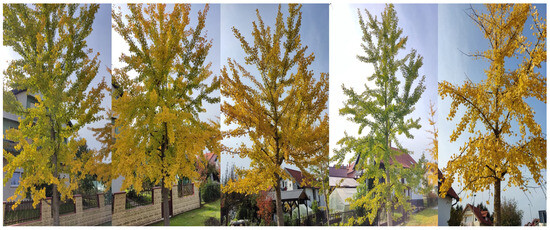
Figure 1.
Different dynamics of ginkgo leaf yellowing in late October.
Immediately after collection, leaf samples were stored at –80 °C until lyophilization. Freeze-drying was carried out for 48 h at approximately –102 °C under a pressure of 0.3303 mBar. The lyophilized material was then ground into a fine powder using a bead mill, which served as the starting material for subsequent extractions.
2.3. Determination of Pigment Content
For the quantification of chlorophylls and carotenoids in autumn ginkgo leaves, the method of Lichtenthaler and Buschmann [20] was applied. Approximately ten milligrams of finely ground leaf powder was weighed and extracted with 1 mL of pure acetone. The extracts were centrifuged, and the resulting supernatant was collected for analysis. Absorbance was measured at three wavelengths: 661.6 nm, 644.8 nm, and 470 nm. Pigment concentrations were calculated using the equations specific for pure acetone and results are expressed as micrograms per gram of dry weight (µg/g dw) of lyophilized leaf powder.
2.4. Determination of Polyphenolic Compounds
The determination of phenolic compounds included the measurement of total polyphenols, total flavonoids, total phenolic acids, and five major 3′,8″-biflavones from autumn ginkgo leaf extracts. Extract preparation was performed as follows: 60 mg of finely ground leaf powder was weighed for each sample and extracted with 2 mL of 70% ethanol. The extraction solvent and isolation protocol were selected based on our previously published work [16]. The mixture was vortexed briefly and then placed in an ultrasonic bath for 10 min at room temperature. Subsequently, the samples were mixed on a rotary mixer for 45 min and centrifuged at 4000 rpm for 10 min at room temperature. The resulting supernatant was collected and used for further analyses.
2.4.1. Total Polyphenols
Total polyphenol content was assessed using a modified Folin–Ciocalteu method [21]. In brief, 200 µL of ginkgo leaf extract was combined with 1580 µL of distilled water and 100 µL of Folin–Ciocalteu reagent, followed by the addition of 300 µL of saturated sodium carbonate solution. The mixture was incubated at room temperature for 2 h, and absorbance was then recorded at 765 nm. Quantification was performed against a calibration curve (y = 0.0011x, R2 = 0.99) prepared with gallic acid in a range 0–2000 mg/L, and results are expressed as gallic acid equivalents per milligram of dry weight (µg GAE/mg dw) of lyophilized leaf powder.
2.4.2. Total Flavonoids
The total flavonoid content was determined following the method described by Zhishen et al. [22]. In short, 200 µL of extract was combined with 800 µL of distilled water, after which 60 µL of 5% sodium nitrite (NaNO2) solution was added to initiate the reaction. Following a 5 min incubation, 60 µL of 10% aluminum chloride (Al2Cl3) solution was introduced, and after an additional 6 min, 400 µL of 1 M sodium hydroxide (NaOH) was added. The absorbance was then measured at 510 nm. Quantification was performed using a catechin (0–500 mg/L) calibration curve (y = 0.0023x, R2 = 0.99), and results are reported as catechin equivalents per milligram of dry weight (µg CE/mg dw) of lyophilized leaf powder.
2.4.3. Total Phenolic Acids
The total phenolic acid content was assessed using the Arnow reagent method [23]. Briefly, 300 µL of extract was combined with 300 µL of distilled water, 100 µL of 0.5 M hydrochloric acid (HCl), and 100 µL of Arnow’s reagent (sodium nitrite and sodium molybdate dihydrate). This was followed by the addition of 100 µL of 1 M sodium hydroxide (NaOH) and 100 µL of distilled water. Absorbance was then recorded at 505 nm. Quantification was carried out using a calibration curve (y = 0.0074x, R2 = 0.98) constructed with caffeic acid (0–250 mg/L), and results are expressed as caffeic acid equivalents per milligram of dry weight (µg CAE/mg dw) of lyophilized leaf powder.
2.4.4. Biflavonoid Profiling
The major 3′,8″-biflavones (amentoflavone, bilobetin, ginkgetin, isoginkgetin, and sciadopitysin) in ginkgo leaf extracts were determined following the method of Jurčević Šangut and Šamec [16]. Detection and quantification were performed using an Agilent 1260 Infinity II high-performance liquid chromatography (HPLC) system (Agilent, Santa Clara, CA, USA) equipped with a diode array detector (DAD). Both samples and standards were injected at a volume of 10 µL. Prior to injection, ginkgo extracts were filtered through polytetrafluoroethylene (PTFE) syringe filters with a pore size of 0.45 µm.
Standard stock solutions (1 mg/mL) were prepared in pure DMSO, and serial dilutions with pure methanol yielded final concentrations of 1, 10, 50, and 100 µg/mL. Chromatographic detection was carried out at 330 nm, and data acquisition and processing were performed using Agilent OpenLab CDS software (version 2.6). Identification of the five biflavones was based on the comparison of UV–Vis spectra and retention times between sample peaks and their respective standards. Quantification was performed using calibration curves, and concentrations are expressed as micrograms per milligram of dry weight (µg/g dw) of lyophilized leaf powder. Chromatographic separation was performed using a Zorbax 300Extend-C18 column (150 × 4.6 mm, 3.5 µm; Agilent, Santa Clara, CA, USA) maintained at 40 °C. The mobile phase consisted of 0.1% formic acid in water (A) and acetonitrile (B), with a multistep linear gradient program applied for analyte elution at a constant flow rate of 1.0 mL/min over a 45 min run. The gradient elution profile was as follows: 0 min 98% A, 10 min 79% A, 15 min 77% A, 20 min 75% A, 25 min 64% A, 30 min 62% A, 35 min 51% A, 40 min 25% A, 43 min 8% A, and 45 min 98% A.
2.5. Statistical Analysis
Leaf sampling was performed on five ginkgo trees, each serving as an independent biological replicate. All measurements were conducted in at least three technical replicates, and results are presented as mean ± standard deviation. Statistical analyses were carried out using PAST software (version 4.15) [24], applying one-way ANOVA followed by Tukey’s post hoc test. Differences were considered statistically significant at p < 0.05, with values followed by different letters indicating statistically significant differences.
3. Results
3.1. Pigment Content
The content of green pigments, chlorophyll a, chlorophyll b and total chlorophylls as well as total carotenoids is shown in Table 2.
Table 2.
The contents of chlorophyll a, chlorophyll b, total chlorophylls and total carotenoids in yellow leaves collected from trees and fallen leaves at four time points. Values are presented as mean ± SD and expressed as µg/g dw.
As expected, the contents of chlorophyll a, chlorophyll b, and total chlorophyll gradually decreased in leaves collected from trees from the beginning of sampling (I) to the end of the growing season (IV), reflecting the typical physiological response to senescence. In fallen leaves, although no longer photosynthetically active, chlorophylls were still detected; their levels remained relatively stable across the different collection time points but were significantly lower than in leaves collected directly from the trees. In leaves from the tree, carotenoid content increased with time, and in fallen leaves at three time points, the content was higher than in leaves from the tree.
3.2. Polyphenolic Compounds Content
3.2.1. Total Polyphenols, Flavonoids and Phenolic Acids
The content of total polyphenols (TP), total flavonoids (TF) and total phenolic acids (TPA) in analyzed yellow ginkgo leaves is shown in Table 3.
Table 3.
The content of polyphenols (TP), total flavonoids (TF) and total phenolic acids (TPA) in yellow ginkgo leaves collected from the tree and fallen leaves.
In general, the total contents of polyphenols, flavonoids, and phenolic acids were higher in fallen leaves compared to those collected directly from the tree, although the collection date had a significant influence. The highest total polyphenol and flavonoid content was detected in leaves from the tree sampled at the second sampling date (II). The highest polyphenol, flavonoid and phenolic acid content was observed in fallen leaves collected at the first sampling date (I).
3.2.2. Biflavonoids
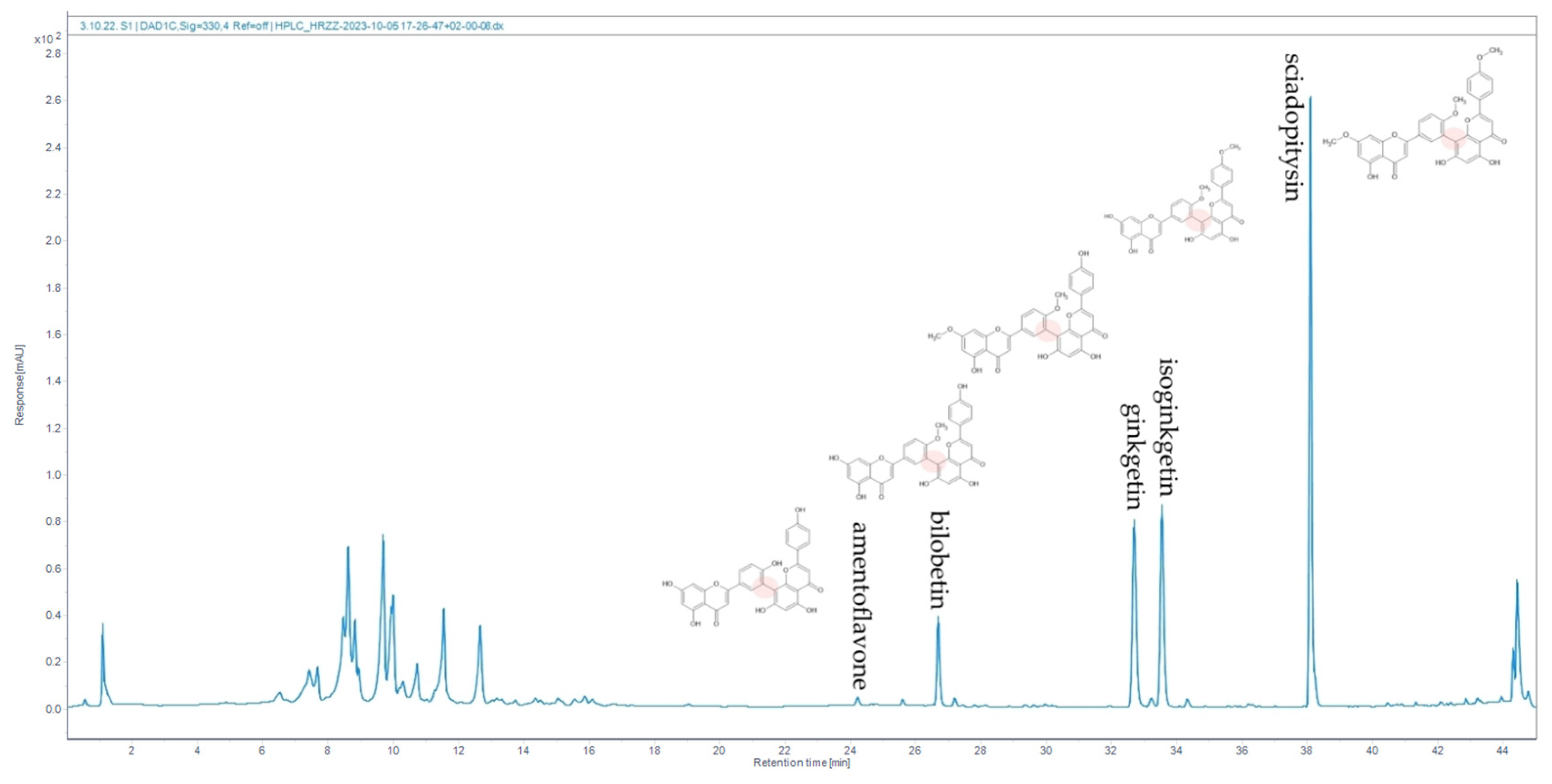
In all collected samples of yellow ginkgo leaves, we especially focused on the determination of five major biflavonoids, amentoflavone, bilobetin, ginkgetin, isoginkgetin and sciadopitysin, using HPLC-DAD. Representative chromatograms with all five biflavonoids peaks are shown in Figure 2.
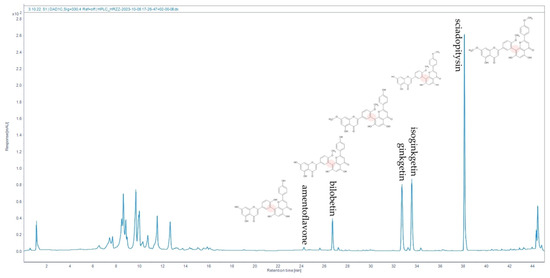
Figure 2.
Yellow ginkgo leaf extract chromatogram recorded at 330 nm.
All five biflavonoids were detected in every sample, although their levels varied depending on the collection date and leaf type. The results are presented in Table 4.
Table 4.
The content of individual biflavonoids (µg/g dw), amentoflavone, bilobetin, ginkgetin, isoginkgetin and sciadopitysin, in yellow ginkgo leaves from trees and fallen leaves.
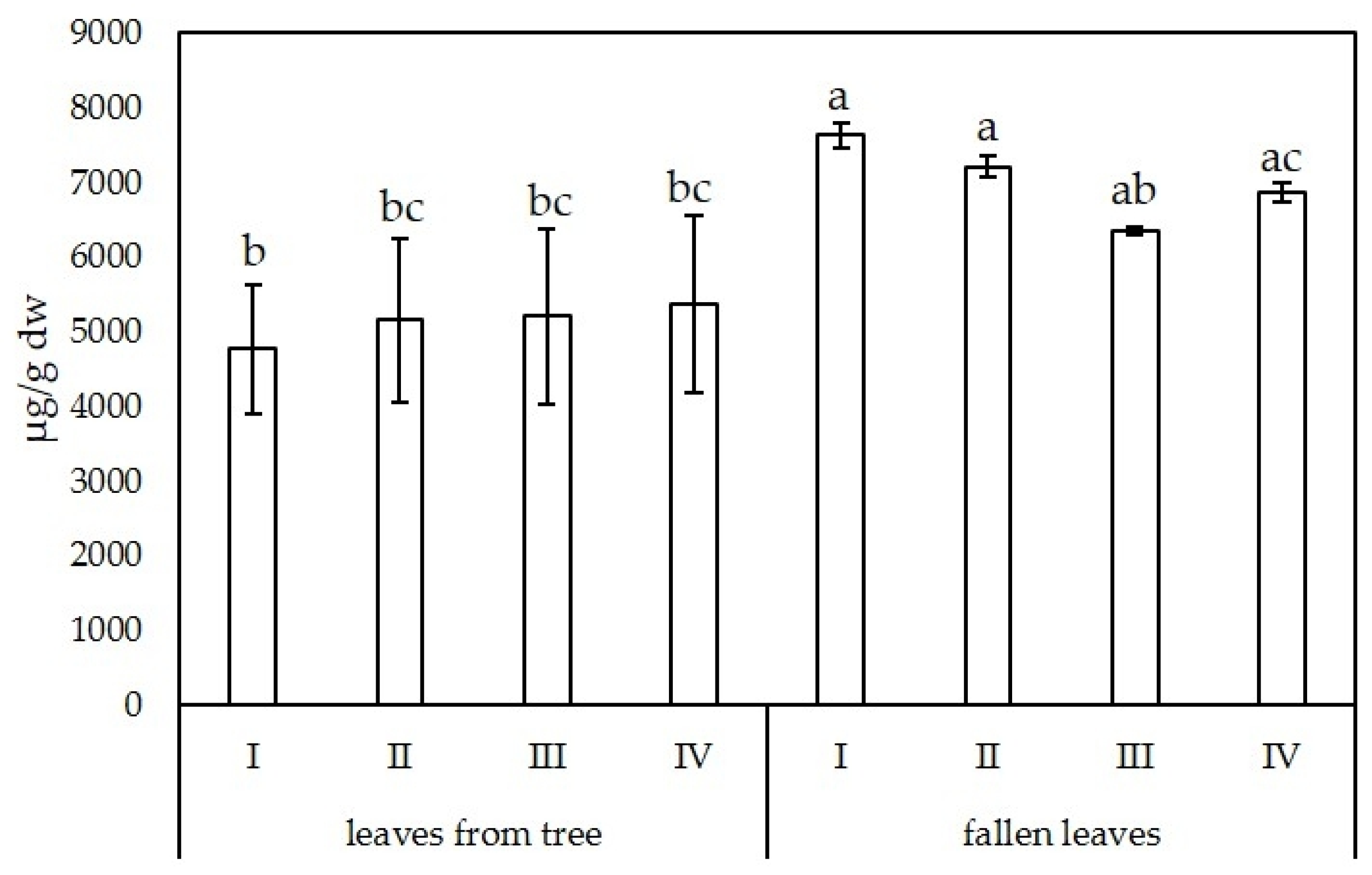
In all analyzed samples, the most abundant biflavonoid was sciadopitysin, followed by isoginkgetin and ginkgetin. Bilobetin and amentoflavone were consistently present at concentrations below 1000 µg/g dw. All fallen leaf samples showed a higher amount of biflavonoids, which is also evident from the content of total biflavonoids presented in Figure 3.
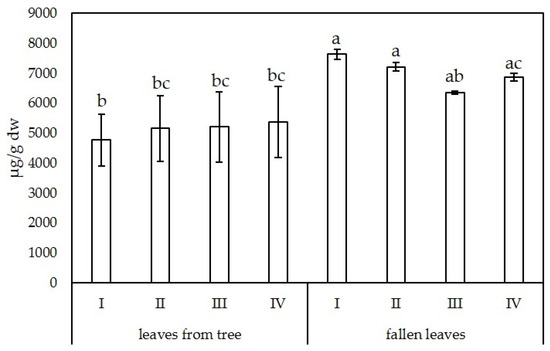
Figure 3.
Total biflavonoid content in yellow ginkgo leaves collected from trees and fallen leaves. Statistical significance was determined at p < 0.05, and values marked with different letters denote statistically significant differences.
The total biflavonoid content ranged from 4774.05 to 5370.40 µg/g dw in leaves collected from the tree and from 6359.52 to 7634.82 µg/g dw in fallen leaves, indicating that fallen leaves contain higher levels of biflavonoids.
4. Discussion
Ginkgo is a well-known ornamental plant that turns golden yellow in autumn. This color change results from the loss of green pigments (chlorophylls) [25,26,27], as is evident also from our results in Table 2 by their gradual decrease over time in leaves collected from the trees. According to Tang et al. [27], chlorophyll degradation in ginkgo involves enzyme chlorophyllase, whose activity is highest in green leaves and significantly declines during the process of leaf yellowing. Since fallen leaves are no longer photosynthetically active, their chlorophyll content is, as expected, very low (Table 2). In contrast, the carotenoid content in our samples is stable and even higher in fallen leaves. Zhang et al. [28], Yang et al. [25] and Li et al. [29] reported comparable amount of carotenoids in ginkgo leaves collected during October and November. Several studies have reported that the yellow coloration of ginkgo leaves is associated with their carotenoid levels [28,30], but exact mechanisms are still under investigation, with particular attention in recent years to combining transcriptomic and metabolomics data [26,29,30,31]. Carotenoids represent a diverse group of biologically active phytochemicals, and their potential health effects are mainly attributed to pronounced antioxidant and singlet oxygen-quenching activities [32]. Epidemiological studies consistently indicate that higher dietary intake and elevated tissue concentrations of carotenoids are associated with a lower incidence of various chronic disorders, including cardiovascular disease, type 2 diabetes mellitus, obesity, neurodegenerative conditions, and several forms of cancer [32].
According to our findings, yellow ginkgo leaves represent a significant source of polyphenolic compounds (Table 3 and Table 4, Figure 3). The total concentrations of polyphenols, flavonoids, and phenolic acids were higher in fallen leaves than in those collected directly from the trees (Table 3). This pattern is likely related to the degradation of complex polyphenolic structures after leaf abscission, which leads to the release of simpler monomeric compounds that can be more readily detected using the applied analytical methods. Postharvest degradation of plant cell walls results from the activity of cell wall-degrading enzymes, leading to the depolymerization of polyphenolic compounds. Consequently, this may manifest as an apparent increase in total polyphenolic content, a phenomenon also documented in previous studies [33]. Polyphenolic compounds constitute one of the principal biologically active components of ginkgo extracts [34,35]. Liu et al. [19] summarized information about ginkgo biologically active compounds published from 2015 to 2020 and found that in ginkgo 110 flavonoids were reported with unambiguous structures. These compounds include 52 flavonol glycosides, seven flavonols, 14 flavone glycosides and five flavones, two flavanones and one flavanone glycoside, two isoflavones and one isoflavone glycoside, four flavan-3-ols, 13 biflavonoids, and nine biginkgosides. In recent years, biflavonoids, naturally occurring flavonoid dimers, have gained increasing attention due to their diverse pharmacological potential [13,36,37,38,39]. In our study, we quantified biflavonoids in yellow ginkgo leaves, comparing samples collected directly from trees with those naturally fallen to the ground (Table 4, Figure 3). Across all samples, we identified amentoflavone, bilobetin, ginkgetin, isoginkgetin, and sciadopitysin. This profile is consistent with previous reports, which describe these compounds as the predominant biflavonoids in ginkgo leaves [9,40,41]. Among the identified biflavonoids, sciadopitysin was the most abundant in all our analysed samples, in agreement with some literature data [42,43]. However, other studies have reported isoginkgetin [44] or ginkgetin [45] as the dominant biflavonoid, suggesting that environmental conditions, plant age, or seasonal factors may influence biflavonoid composition.
Our quantitative analysis revealed that the total biflavonoid content reached up to 8 mg/g dry weight (dw) in yellow leaves (Figure 3), confirming that ginkgo leaves are a valuable natural source of these compounds. Previous studies also showed that yellow gingko leaves are more abundant in biflavonoids than green ones [16,40]. Interestingly, we observed even higher concentrations of biflavonoids in fallen leaves compared to leaves still attached to the tree (Table 4, Figure 3). This finding highlights the potential of utilizing naturally shed leaves as a sustainable and non-invasive source of biflavonoids. By harvesting fallen leaves, it may be possible to obtain substantial quantities of pharmacologically relevant compounds without disrupting the normal physiological cycle of the ginkgo tree. However, further studies are needed to optimize extraction protocols for the efficient isolation of biflavonoids from fallen ginkgo leaves. Previously, Shen et al. [46] reported a protocol for large-scale, targeted isolation of biflavonoids with high purity from industrial ginkgo exocarp using two-dimensional chromatography, although their methodology was not specifically applied to leaf-derived biflavonoids. In our earlier research, we explored the potential of green extraction techniques [47], including deep eutectic solvents (DESs) [48], as sustainable approaches for biflavonoid isolation. While these methods show promise, additional optimization is required to improve yield, selectivity, and scalability. At the same time, there are some concerns regarding the direct use of yellow ginkgo leaves in traditional preparations such as infusions or wine due to the presence of potentially undesirable constituents [49]. For example, Horbowicz et al. [17] reported that the concentrations of major terpene trilactones ginkgolides B and C and bilobalide were significantly higher (higher than recommended values) in the leaf blades of naturally senesced yellow leaves compared with green leaves. Therefore, further studies are necessary to assess the safety, efficacy, and suitability of such applications, while also developing reliable purification strategies to ensure that ginkgo-derived products meet both pharmacological and safety standards.
5. Conclusions
Our study demonstrates that yellow ginkgo leaves, both collected from the tree and naturally senesced, represent a valuable source of biologically active phytochemicals. Pigment analysis confirmed chlorophyll degradation and carotenoid persistence as key features of leaf yellowing, consistent with previous reports. Polyphenolic and biflavonoid contents were higher in fallen leaves, with sciadopitysin identified as the most abundant biflavonoid across all samples. The total biflavonoid concentration, reaching up to 8 mg/g dw, positions ginkgo leaves among significant natural sources of these pharmacologically important compounds.
Importantly, the higher levels detected in naturally fallen leaves suggest a sustainable opportunity for their use in biflavonoid production without interfering with the physiological cycle of the tree or generating unnecessary biomass waste. This finding supports the concept of valorizing ginkgo leaf litter as an underutilized resource in urban and landscape environments. Nevertheless, further studies are required to: (i) optimize extraction and purification protocols, particularly using green technologies; (ii) clarify variability in biflavonoid composition due to environmental or seasonal factors; and (iii) rigorously assess the safety of preparations from yellow leaves, with particular attention to potential risks such as microbial contamination, mycotoxins, chemical degradation, and variability in quality. Addressing these aspects will be critical for the safe and efficient utilization of fallen ginkgo leaves as a renewable source of bioactive compounds for pharmaceutical, nutraceutical, and functional applications.
Author Contributions
Conceptualization, D.Š.; methodology, I.J.Š.; validation, I.J.Š.; formal analysis, I.J.Š.; data curation, I.J.Š.; writing—original draft preparation, D.Š.; writing—review and editing, D.Š. and I.J.Š.; visualization, D.Š. and I.J.Š.; supervision, D.Š.; project administration, D.Š.; funding acquisition, D.Š. All authors have read and agreed to the published version of the manuscript.
Funding
This research was funded by the Croatian Science Foundation project “Biflavonoids role in plants: Ginkgo biloba L. as a model system” under Project No. UIP-2019-04-1018.
Institutional Review Board Statement
Not applicable.
Informed Consent Statement
Not applicable.
Data Availability Statement
Additional data are available upon request.
Conflicts of Interest
The authors declare no conflicts of interest.
References
- He, X.; Yang, F.; Huang, X. Proceedings of Chemistry, Pharmacology, Pharmacokinetics and Synthesis of Biflavonoids. Molecules 2021, 26, 6088. [Google Scholar] [CrossRef]
- Sabogal-Guáqueta, A.M.; Carrillo-Hormaza, L.; Osorio, E.; Cardona-Gómez, G.P. Effects of Biflavonoids from Garcinia Madruno on a Triple Transgenic Mouse Model of Alzheimer’s Disease. Pharmacol. Res. 2018, 129, 128–138. [Google Scholar] [CrossRef]
- Tatlı Çankaya, İ.İ.; Devkota, H.P.; Zengin, G.; Šamec, D. Neuroprotective Potential of Biflavone Ginkgetin: A Review. Life 2023, 13, 562. [Google Scholar] [CrossRef]
- Thapa, A.; Chi, E.Y. Biflavonoids as Potential Small Molecule Therapeutics for Alzheimer’s Disease. Adv. Exp. Med. Biol. 2015, 863, 55–77. [Google Scholar]
- Jurčević Šangut, I.; Šarkanj, B.; Karalija, E.; Šamec, D. A Comparative Analysis of Radical Scavenging, Antifungal and Enzyme Inhibition Activity of 3′-8″-Biflavones and Their Monomeric Subunits. Antioxidants 2023, 12, 1854. [Google Scholar] [CrossRef]
- Kang, F.; Zhang, S.; Chen, D.; Tan, J.; Kuang, M.; Zhang, J.; Zeng, G.; Xu, K.; Zou, Z.; Tan, G. Biflavonoids from Selaginella Doederleinii as Potential Antitumor Agents for Intervention of Non-Small Cell Lung Cancer. Molecules 2021, 26, 5401. [Google Scholar] [CrossRef] [PubMed]
- Napoli, E.; Siracusa, L.; Ruberto, G.; Carrubba, A.; Lazzara, S.; Speciale, A.; Cimino, F.; Saija, A.; Cristani, M. Phytochemical Profiles, Phototoxic and Antioxidant Properties of Eleven Hypericum Species—A Comparative Study. Phytochemistry 2018, 152, 162–173. [Google Scholar] [CrossRef]
- Medvedec, B.; Jurčević Šangut, I.; Macanović, A.; Karalija, E.; Šamec, D. Biflavonoid Profiling of Juniperus Species: The Influence of Plant Part and Growing Location. Appl. Sci. 2025, 15, 7082. [Google Scholar] [CrossRef]
- Kovač Tomas, M.; Jurčević, I.; Šamec, D. Tissue-Specific Profiling of Biflavonoids in Ginkgo (Ginkgo Biloba L.). Plants 2022, 12, 147. [Google Scholar] [CrossRef] [PubMed]
- Liu, X.-G.; Lu, X.; Gao, W.; Li, P.; Yang, H. Structure, Synthesis, Biosynthesis, and Activity of the Characteristic Compounds from Ginkgo Biloba L. Nat. Prod. Rep. 2022, 39, 474–511. [Google Scholar] [CrossRef] [PubMed]
- Da Silva Pinto, M.; Kwon, Y.-I.; Apostolidis, E.; Lajolo, F.M.; Genovese, M.I.; Shetty, K. Potential of Ginkgo Biloba L. Leaves in the Management of Hyperglycemia and Hypertension Using in Vitro Models. Bioresour. Technol. 2009, 100, 6599–6609. [Google Scholar] [CrossRef]
- Kobus-Cisowska, J.; Dziedziński, M.; Szczepaniak, O.; Kusek, W.; Kmiecik, D.; Ligaj, M.; Telichowska, A.; Byczkiewicz, S.; Szulc, P.; Szwajgier, D. Phytocomponents and Evaluation of Acetylcholinesterase Inhibition by Ginkgo Biloba L. Leaves Extract Depending on Vegetation Period. CyTA-J. Food 2020, 18, 606–615. [Google Scholar] [CrossRef]
- Jurčević Šangut, I.; Šola, I.; Šamec, D. Neuroprotective, Anti-Hyperpigmentation, and Anti-Diabetic Effects and Bioaccessibility of Flavonoids in Ginkgo Leaf Infusions from Green and Yellow Leaves. Appl. Sci. 2024, 14, 10231. [Google Scholar] [CrossRef]
- Park, H.-J.; Kim, M.-M. Flavonoids in Ginkgo Biloba Fallen Leaves Induce Apoptosis through Modulation of P53 Activation in Melanoma Cells. Oncol. Rep. 2015, 33, 433–438. [Google Scholar] [CrossRef]
- Gong, T.; Liu, S.; Wang, H.; Zhang, M. Supercritical CO2 Fluid Extraction, Physicochemical Properties, Antioxidant Activities and Hypoglycemic Activity of Polysaccharides Derived from Fallen Ginkgo Leaves. Food Biosci. 2021, 42, 101153. [Google Scholar] [CrossRef]
- Jurčević Šangut, I.; Šamec, D. Seasonal Variation of Polyphenols and Pigments in Ginkgo (Ginkgo Biloba L.) Leaves: Focus on 3′,8″-Biflavones. Plants 2024, 13, 3044. [Google Scholar] [CrossRef] [PubMed]
- Horbowicz, M.; Wiczkowski, W.; Góraj-Koniarska, J.; Miyamoto, K.; Ueda, J.; Saniewski, M. Effect of Methyl Jasmonate on the Terpene Trilactones, Flavonoids, and Phenolic Acids in Ginkgo Biloba L. Leaves: Relevance to Leaf Senescence. Molecules 2021, 26, 4682. [Google Scholar] [CrossRef]
- Lee, M.-E.; Park, J.; Chung, J. Adsorption of Pb(II) and Cu(II) by Ginkgo-Leaf-Derived Biochar Produced under Various Carbonization Temperatures and Times. Int. J. Environ. Res. Public Health 2017, 14, 1528. [Google Scholar] [CrossRef] [PubMed]
- Liu, L.; Wang, Y.; Zhang, J.; Wang, S. Advances in the Chemical Constituents and Chemical Analysis of Ginkgo Biloba Leaf, Extract, and Phytopharmaceuticals. J. Pharm. Biomed. Anal. 2021, 193, 113704. [Google Scholar] [CrossRef]
- Lichtenthaler, H.K.; Buschmann, C. Chlorophylls and Carotenoids: Measurement and Characterization by UV-VIS Spectroscopy. Curr. Protoc. Food Anal. Chem. 2001, 1, F4.3.1–F4.3.8. [Google Scholar] [CrossRef]
- Singleton, V.L.; Rossi, J.A. Colorimetry of Total Phenolics with Phosphomolybdic-Phosphotungstic Acid Reagents. Am. J. Enol. Vitic. 1965, 16, 144–158. [Google Scholar] [CrossRef]
- Zhishen, J.; Mengcheng, T.; Jianming, W. The Determination of Flavonoid Contents in Mulberry and Their Scavenging Effects on Superoxide Radicals. Food Chem. 1999, 64, 555–559. [Google Scholar] [CrossRef]
- Jain, R.; Rao, B.; Tare, A.B. Comparative Analysis of the Spectrophotometry Based Total Phenolic Acid Estimation Methods. J. Anal. Chem. 2017, 72, 972–976. [Google Scholar] [CrossRef]
- Hammer, Ø.; Harper, D.A.T.; Ryan, P.D. Past: Paleontological statistics software package for education and data analysis. Palaeontol. Electron. 2001, 4, 4–9. [Google Scholar]
- Yang, X.S.; Chen, G.X.; Yuan, Z.Y. Photosynthetic Decline in Ginkgo Leaves during Natural Senescence. Pakistan J. Bot. 2013, 45, 1537–1540. [Google Scholar]
- Wu, Y.; Guo, J.; Wang, T.; Cao, F.; Wang, G. Metabolomic and Transcriptomic Analyses of Mutant Yellow Leaves Provide Insights into Pigment Synthesis and Metabolism in Ginkgo Biloba. BMC Genomics 2020, 21, 858. [Google Scholar] [CrossRef]
- Tang, L.; Okazawa, A.; Itoh, Y.; Fukusaki, E.I.; Kobayashi, A. Expression of Chlorophyllase Is Not Induced during Autumnal Yellowing in Ginkgo Biloba. Z. Naturforsch.—Sect. C J. Biosci. 2004, 59, 415–420. [Google Scholar] [CrossRef] [PubMed]
- Zhang, H.; Yu, P.; Song, M.; Li, D.; Sheng, Q.; Cao, F.; Zhu, Z. Leaf Color Changes and Photosynthetic Characteristics of Five Superior Late-Deciduous Ginkgo Biloba Cultivars. HortScience 2021, 56, 1416–1422. [Google Scholar] [CrossRef]
- Li, W.; Wang, L.; He, Z.; Lu, Z.; Cui, J.; Xu, N.; Jin, B.; Wang, L. Physiological and Transcriptomic Changes During Autumn Coloration and Senescence in Ginkgo Biloba Leaves. Hortic. Plant J. 2020, 6, 396–408. [Google Scholar] [CrossRef]
- Li, F.; Hu, Y.; Jing, W.; Wang, Y.; Gao, X.; Guo, Q. Cytological, Physiological and Genotyping-by-Sequencing Analysis Revealing Dynamic Variation of Leaf Color in Ginkgo Biloba L. Horticulturae 2025, 11, 395. [Google Scholar] [CrossRef]
- Sun, Y.; Bai, P.-P.; Gu, K.-J.; Yang, S.-Z.; Lin, H.-Y.; Shi, C.-G.; Zhao, Y.-P. Dynamic Transcriptome and Network-Based Analysis of Yellow Leaf Mutant Ginkgo Biloba. BMC Plant Biol. 2022, 22, 465. [Google Scholar] [CrossRef] [PubMed]
- Bohn, T.; Bonet, M.L.; Borel, P.; Keijer, J.; Landrier, J.-F.; Milisav, I.; Ribot, J.; Riso, P.; Winklhofer-Roob, B.; Sharoni, Y.; et al. Mechanistic Aspects of Carotenoid Health Benefits—Where Are We Now? Nutr. Res. Rev. 2021, 34, 276–302. [Google Scholar] [CrossRef]
- Niu, X.-X.; Tao, Y.; Wang, Q.-H.; Xu, M.-Q.; Zhang, F.-L.; Xie, Y.-K.; Xiao, H.-W. Postharvest Ripening-Induced Modification of Cell Wall Polysaccharide Affects Plum Phenolic Bioavailability. Food Chem. 2025, 479, 143780. [Google Scholar] [CrossRef] [PubMed]
- Liang, H.; Yao, J.; Miao, Y.; Sun, Y.; Gao, Y.; Sun, C.; Li, R.; Xiao, H.; Feng, Q.; Qin, G.; et al. Pharmacological Activities and Effective Substances of the Component-Based Chinese Medicine of Ginkgo Biloba Leaves Based on Serum Pharmacochemistry, Metabonomics and Network Pharmacology. Front. Pharmacol. 2023, 14, 1151447. [Google Scholar] [CrossRef] [PubMed]
- Li, L.; Zhang, M.-X.; Wang, X.-Y.; Yang, Y.-L.; Gong, X.; Wang, C.-C.; Xu, J.-F.; Li, M.-H. Assessment of Components of Gingko Biloba Leaves Collected from Different Regions of China That Contribute to Its Antioxidant Effects for Improved Quality Monitoring. Food Sci. Technol. 2021, 41, 676–683. [Google Scholar] [CrossRef]
- Šamec, D.; Karalija, E.; Dahija, S.; Hassan, S.T.S. Biflavonoids: Important Contributions to the Health Benefits of Ginkgo (Ginkgo Biloba L.). Plants 2022, 11, 1381. [Google Scholar] [CrossRef]
- Chen, M.; Zhang, Z.; Zhang, F.; Evans, P.C.; Strijdom, H.; Xu, S. Isoginkgetin, a Natural Biflavonoid from Ginkgo Biloba, Inhibits Inflammatory Response in Endothelial Cells via Suppressing NF-ΚB Activation. Acta Pharmacol. Sin. 2025. [Google Scholar] [CrossRef]
- Wang, L.-T.; Huang, H.; Chang, Y.-H.; Wang, Y.-Q.; Wang, J.-D.; Cai, Z.-H.; Efferth, T.; Fu, Y.-J. Biflavonoids from Ginkgo Biloba Leaves as a Novel Anti-Atherosclerotic Candidate: Inhibition Potency and Mechanistic Analysis. Phytomedicine 2022, 102, 154053. [Google Scholar] [CrossRef]
- Agosto, N. In Silico Molecular Docking and ADMET Prediction of Ginkgo Biloba Biflavonoids as Dual Inhibitors of Human HMG-CoA Reductase and α-Amylase. J. Serbian Chem. Soc. 2025, 90, 415–429. [Google Scholar] [CrossRef]
- Wang, L.-T.; Fan, X.-H.; Jian, Y.; Dong, M.-Z.; Yang, Q.; Meng, D.; Fu, Y.-J. A Sensitive and Selective Multiple Reaction Monitoring Mass Spectrometry Method for Simultaneous Quantification of Flavonol Glycoside, Terpene Lactones, and Biflavonoids in Ginkgo Biloba Leaves. J. Pharm. Biomed. Anal. 2019, 170, 335–340. [Google Scholar] [CrossRef]
- Bai, J.; Zhang, C. Metabolic Interaction between Biflavonoids in Ginkgo Biloba Leaves and Tacrolimus. Biopharm. Drug Dispos. 2023, 44, 157–164. [Google Scholar] [CrossRef]
- Jurčević Šangut, I.; Pavličević, L.; Šamec, D. Influence of Air Drying, Freeze Drying and Oven Drying on the Biflavone Content in Yellow Ginkgo (Ginkgo Biloba L.) Leaves. Appl. Sci. 2024, 14, 2330. [Google Scholar] [CrossRef]
- Lei, J.; Jiang, Y.; Luo, X.; Zheng, Y.; Zhu, L.; Sun, C.; Linghu, L.; Qin, C.; Gang, W. Ultrasonic-Assisted Ionic Liquid Extraction of Four Biflavonoids from Ginkgo Biloba L. ChemistrySelect 2021, 6, 3297–3307. [Google Scholar] [CrossRef]
- Chen, X.; Zhong, W.; Shu, C.; Yang, H.; Li, E. Comparative Analysis of Chemical Constituents and Bioactivities of the Extracts from Leaves, Seed Coats and Embryoids of Ginkgo Biloba L. Nat. Prod. Res. 2021, 35, 5498–5501. [Google Scholar] [CrossRef]
- Kaur, P.; Chaudhary, A.; Singh, B. Gopichand Simultaneous Quantification of Flavonoids and Biflavonoids in Ginkgo Biloba Using RP-HPTLC Densitometry Method. J. Planar Chromatogr.—Mod. TLC 2011, 24, 507–512. [Google Scholar] [CrossRef]
- Shen, N.; Liu, Y.; Cui, Y.; Xin, H. Large-Scale Targetedly Isolation of Biflavonoids with High Purity from Industrial Waste Ginkgo Biloba Exocarp Using Two-Dimensional Chromatography Coupled with Macroporous Adsorption Resin Enrichment. Ind. Crops Prod. 2022, 175, 114264. [Google Scholar] [CrossRef]
- Šalić, A.; Šepić, L.; Turkalj, I.; Zelić, B.; Šamec, D. Comparative Analysis of Enzyme-, Ultrasound-, Mechanical-, and Chemical-Assisted Extraction of Biflavonoids from Ginkgo Leaves. Processes 2024, 12, 982. [Google Scholar] [CrossRef]
- Šalić, A.; Bajo, M.; Cvjetko Bubalo, M.; Radović, M.; Jurinjak Tušek, A.; Zelić, B.; Šamec, D. Extraction of Polyphenolic Compounds from Ginkgo Leaves Using Deep Eutectic Solvents: A Potential Solution for the Sustainable and Environmentally Friendly Isolation of Biflavonoids. Ind. Crops Prod. 2024, 219, 119068. [Google Scholar] [CrossRef]
- Su, X.; Shi, R.; Hu, H.; Hu, L.; Wei, Q.; Guan, Y.; Chang, J.; Li, C. Medicinal Values and Potential Risks Evaluation of Ginkgo Biloba Leaf Extract (GBE) Drinks Made from the Leaves in Autumn as Dietary Supplements. Molecules 2022, 27, 7479. [Google Scholar] [CrossRef]
Disclaimer/Publisher’s Note: The statements, opinions and data contained in all publications are solely those of the individual author(s) and contributor(s) and not of MDPI and/or the editor(s). MDPI and/or the editor(s) disclaim responsibility for any injury to people or property resulting from any ideas, methods, instructions or products referred to in the content. |
© 2025 by the authors. Licensee MDPI, Basel, Switzerland. This article is an open access article distributed under the terms and conditions of the Creative Commons Attribution (CC BY) license (https://creativecommons.org/licenses/by/4.0/).