


Abstract
Background: The post-activation performance enhancement (PAPE) protocol is frequently utilized to enhance athletic performance through high-intensity stimuli. Despite its popularity, the effectiveness and mechanisms of PAPE remain unclear, particularly in the context of improving jump performance in sports. Methods: A systematic review was conducted following the PRISMA guidelines. A comprehensive search was conducted across databases including Scopus, Web of Science, PubMed, and EBSCO up to 31 March 2024. Results: Initially, 481 studies were identified, of which 8 were finally included, involving a varied number of participants, each focusing on the impact of PAPE on jump performance. These studies predominantly indicated that PAPE protocols can lead to short-term improvements in jump performance. Two publications demonstrated a positive effect on jump height, and one of them reported a questionable effect on jump height in the initial time period, while the remaining five publications showed a positive impact on jump performance. The average increase in height achieved based on the intervention from the publications was 4.03% (p < 0.05). Variability in effectiveness was noted depending on the type of exercises used in the activation phase, timing of performance post activation, and individual physiological characteristics. Conclusions: PAPE protocols can effectively enhance jump performance in athletic populations, although outcomes vary based on protocol specifics and individual differences. These findings support the need for individualized approaches in the application of PAPE protocols to optimize athletic performance.
1. Introduction
Modern sports challenge athletes to maximize their physical performance, requiring the use of advanced training methods. Recently, a comprehensive method known as contrast training has gained popularity. It involves the application of intense stimuli to temporarily enhance neuromuscular system performance. This method utilizes the phenomenon of post-activation potentiation (PAP), resulting in a momentary increase in motor abilities, termed post-activation performance enhancement (PAPE) [1]. PAP and PAPE differ in terms of mechanisms, range of effects, and practical application. PAP focuses on neuromuscular improvement in function following intense effort, whereas PAPE encompasses a broader context of performance enhancement in sports [1]. Despite widespread use in sports practice, the effectiveness and mechanisms of post-activation performance enhancement, especially regarding long-term improvements in explosive strength and the efficacy of different protocols, remain not fully elucidated. Recent studies by Casais Barreto et al. and Rumeau et al. [2] have provided insights into the role of PAPE in various sports disciplines, highlighting the need for further investigation into protocol-specific outcomes. PAPE is based on the premise that performing a brief, intense effort before a sports task can enhance physical performance through changes in neuromuscular system activity. These changes include recruitment of more motor units, improved coordination within muscles (synchronization of agonist muscles), and intramuscular coordination (synchronization of motor units) [3,4,5] as well as alterations in muscle metabolism induced by factors such as local muscle temperature increases or shifts in tissue fluids, which alter muscle contraction mechanics [1]. Contemporary research on enhancing athletic performance increasingly focuses on the use of advanced training methods, such as [6]. PAPE protocols are employed to achieve short-term improvements in motor abilities by applying intense stimuli before the main sports task. The mechanism of PAPE operates by enhancing neuromuscular function, including the recruitment of a greater number of motor units and the improvement of intramuscular coordination [1].
Despite the growing popularity of PAPE, few systematic reviews have focused exclusively on its impact on vertical jumps among athletes. Previous reviews have examined similar concepts, such as in the context of various performance indicators (e.g., Seitz and Haff, 2016; Wilson et al., 2013) [7,8]. However, a comprehensive systematic review that analyzes the diversity of PAPE protocols and their specific application in improving vertical jump performance remains unrealized. Our study aims to fill this gap by analyzing existing research on the effectiveness of various PAPE protocols.
Despite understanding the fundamentals of this phenomenon, there is considerable variability in the research findings regarding the effectiveness of PAPE protocols. Some studies have suggested that these protocols can lead to short-term increases in muscle power production capacity, as evidenced by improvements in jump height or distance following activation stimuli [9]. For instance, Berriel et al. found positive effects on jump heights among professional volleyball players using a plyometric-based protocol [10].
Simultaneously, publications exist whose results indicate either no significant or a negligible impact of the PAP effect on motor performance expression [11,12,13]. Vargas-Molina et al. demonstrated that despite using loads at 75% of one-repetition maximum in isotonic and isometric exercises as a PAPE-enhancing protocol, there were no significant improvements in countermovement jump (CMJ) height [11].
Thus, the efficacy of applied protocols appears variable and may depend on factors such as the types of exercises used (both main and activation exercises) [7,8,14], execution methods (e.g., range of motion and stretch-shortening cycle time) [15,16,17,18], intensity, rest periods (between activation stimulus and main exercise) [19], and the individual morphological and physiological characteristics of the study group [20].
The aim of this systematic review is to analyze current research on the effectiveness of PAPE protocols in improving vertical jump performance across different types of jumps [21]. The conclusions drawn from this review will address whether and which PAPE protocols are worth applying in practical training settings. This systematic review seeks to answer the following research questions: (1) Do different PAPE protocols yield varying effects on jump performance? (2) What are the key factors influencing the effectiveness of PAPE in different athletic populations?
2. Materials and Methods
2.1. Study Design
A systematic review was conducted following the Preferred Reporting Items for Systematic Reviews and Meta-Analyses (PRISMA) guidelines.
2.2. Literature Search
Electronic searches were conducted in the following databases without time restrictions: Scopus, Web of Science, PubMed, and EBSCO. Studies were considered from their inception dates up to 31 March 2024. The following search formulas were applied to the respective databases:
- Scopus: TITLE-ABS-KEY((pape OR “Post activation performance enhancement”) AND (“vertical jump” OR “jump performance” OR jump))
- PubMed: (“pape”[Title/Abstract] OR “Post activation performance enhancement”[Title/Abstract]) AND (“vertical jump”[Title/Abstract] OR “jump performance”[Title/Abstract] OR “jump”[Title/Abstract])
- EBSCO: (pape OR “Post activation performance enhancement”) AND (“vertical jump” OR “jump performance” OR jump)
- Web of Science: (AB = ((pape OR “Post activation performance enhancement”) AND (“vertical jump” OR “jump performance” OR jump))) OR TI = ((pape OR “Post activation performance enhancement”) AND (“vertical jump” OR “jump performance” OR jump))
The gathered studies were evaluated for errors and duplicates and confirmed based on title, abstract, and full-text screening.
2.3. Inclusion and Exclusion Criteria
The studies included in the review were selected according to the following PICO(s) criteria, with a focus on ensuring methodological rigor. Articles were excluded if they lacked full-text availability, were not published in peer-reviewed journals, or if the study design did not include a control group. Additionally, non-English language studies and those with sample sizes below 10 participants were excluded to minimize bias (Ł.R. conducted the process of establishing the following criteria). Detailed criteria are presented in Table 1.

Table 1.
Inclusion and Exclusion criteria.
2.4. Selection Process
The collected data were evaluated by both authors (M.S. and T.A) as independent reviewers. In cases of disputes regarding the criteria required for a publication, a joint consolidation and discussion took place to determine the validity of including the publication in the review. To minimize bias as much as possible, the search results were evaluated by other authors. In cases where consensus could not be reached, discussions were held with the remaining authors to establish a unified stance on the inclusion of a particular article in the review.
2.5. Data Collection Process
In a total of three stages, two authors individually worked on the screening process (K.K. and P.K.). In stages 1 and 2, they worked separately on their own individual databases, which were created using the same search terms for each scientific database. In stage 3, the collected data were evaluated by both authors (Ł.R. and T.A.) as independent reviewers. In cases of disputes regarding the criteria required for a publication, a joint consolidation and discussion took place to determine the validity of including the publication in the review.
2.6. Data Items
In this systematic review, we extracted various data items to assess the effectiveness of the post-activation performance enhancement (PAPE) protocols on vertical jump performance. The following data items were collected:
- Participant Characteristics: Age, gender, training background (e.g., years of experience in strength or sport-specific training), and the specific sport in which the participants were involved;
- Study Design: Type of study (e.g., randomized controlled trial, crossover study, etc.), sample size, and the presence of control or comparison groups;
- PAPE Protocols: Detailed description of the PAPE protocols used, including the type of exercises, intensity (e.g., percentage of one-repetition maximum), number of sets and repetitions, and rest intervals;
- Outcome Measures: Specific outcomes related to vertical jump performance, such as jump height, peak power, and other relevant measures of pre- and post-intervention athletic performance.
- Timing of Measurements: The specific time points at which performance outcomes were measured following the PAPE protocol (e.g., immediately after, 3 min, 9 min, etc.);
- Adverse Effects: Any reported negative effects or injuries resulting from the PAPE protocols.
These data items were systematically extracted and analyzed to determine the overall effectiveness and variability in the outcomes of PAPE protocols across different studies.
2.7. Effect Measures
The primary effect measure used in this systematic review was the change in vertical jump performance (e.g., jump height) following the application of PAPE protocols. The effectiveness of PAPE was primarily quantified by comparing pre- and post-intervention performance metrics within the same group and between experimental and control groups where applicable. The magnitude of performance enhancement was typically expressed as a percentage increase in jump height or peak power output, with statistical significance being evaluated using p-values (e.g., p < 0.05). Additionally, effect sizes were calculated where possible to provide a standardized measure of the impact of the PAPE protocols across different studies.
These effect measures were critical in determining the overall efficacy of PAPE protocols and in understanding the factors that contribute to variability in performance outcomes among different athletic populations.
2.8. Assessment of Study Quality
The PEDro scale was employed to evaluate the methodological quality of the studies. This scale consists of 11 criteria, including eligibility; randomization; allocation concealment; baseline comparability; blinding of participants, therapists, and assessors; follow-up completion of at least 85%; intention-to-treat analysis; between group statistical comparisons; and reporting of point estimates with variability. The first criterion is related to external validity and is not included in the final score. Each of the remaining items can score 1 or 0 points, with a maximum score of 10. Studies scoring 6 or above were considered to be of high quality [22]. None of the evaluations were extracted directly from the PEDro database. All assessments were conducted manually, following the criteria outlined in the PEDro scale.
3. Results
3.1. Literature Search Results
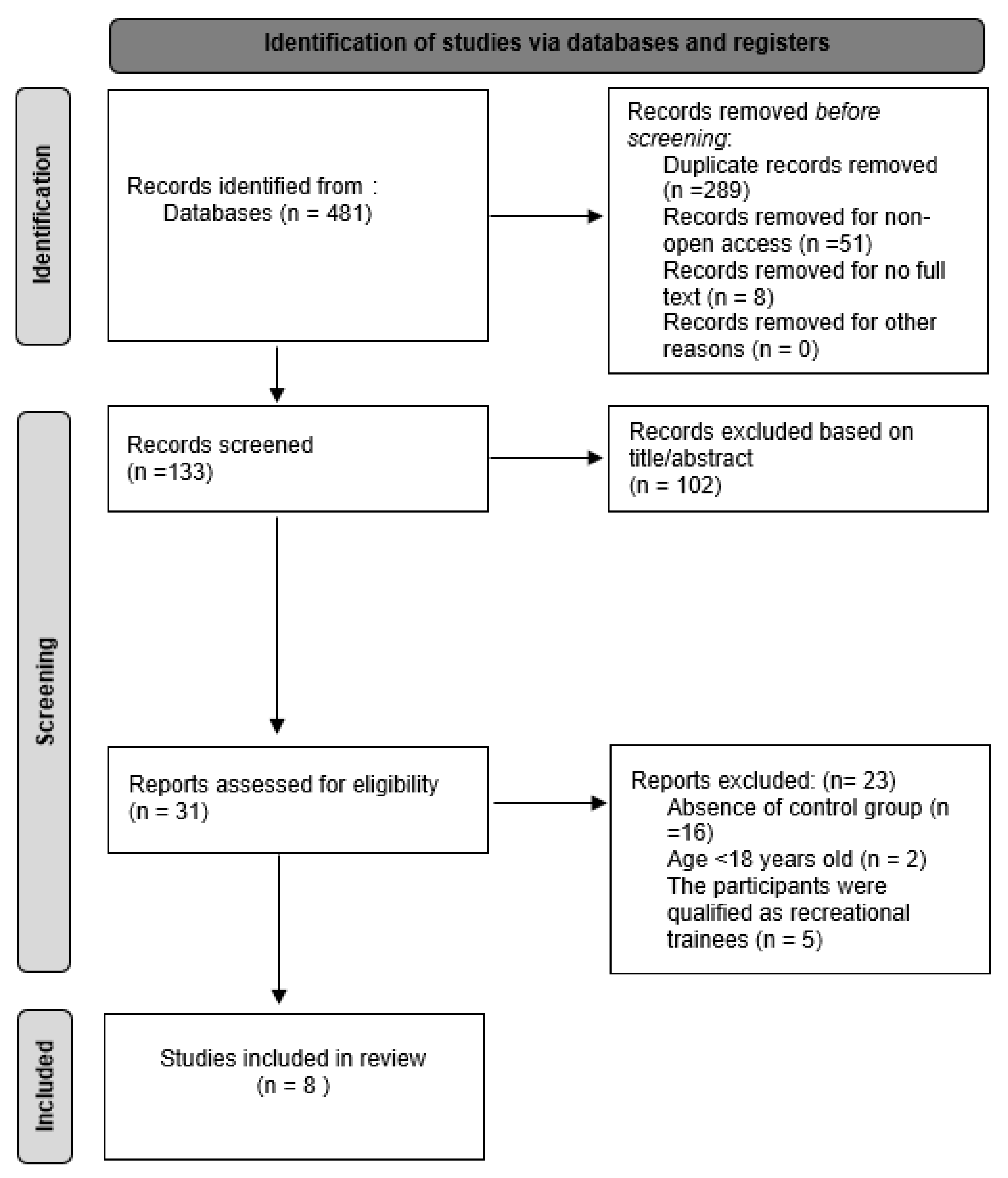
After searching databases using the specified keywords, initially, 481 scientific articles were identified. After excluding 348 articles due to duplicates, lack of full access, absence of full text, or non-English text, 133 articles remained. These were screened based on their titles and abstracts, resulting in the selection of 31 publications that were thoroughly read to assess their compliance with inclusion and exclusion criteria. An outline of the search strategy is depicted in Figure 1.
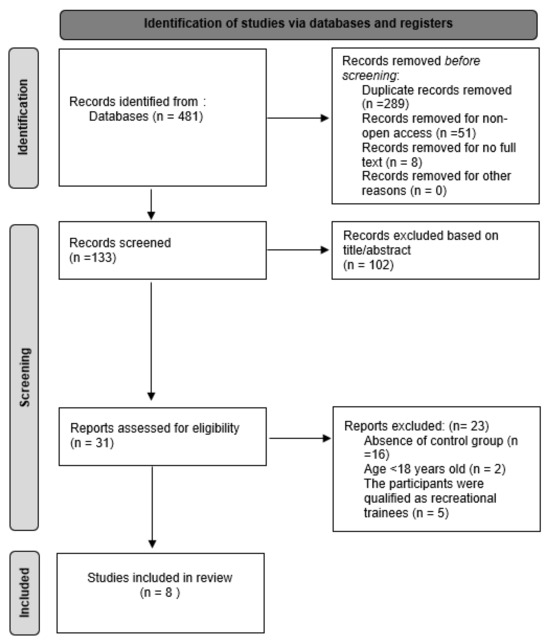
Figure 1.
PRISMA flowchart for identification and selection of study in review.
3.2. Study Characteristics
Detailed descriptions of the included studies are provided in the table below, including division into experimental and control groups, the PAPE protocol used, and the results and conclusions of the authors. Eight studies were included (where each of them is a comparative study, five of them are randomized controlled trials [10,12,23,24,25]), of which three focused on 40 volleyball players [10,12,26], three on 127 individuals with significant experience in strength training [24,25,27], one on 26 basketball players [23], and one on 31 handball players [28]. The total number of participants included in the studies was 224 individuals aged 18 and above. The experimental groups comprised a total of 115 (+31) participants, while the control groups comprised 78 (+31) participants. Only two experimental and control groups consisted exclusively of women [26,27]; the rest involved men. Among the four qualifying studies, the PAPE activation protocol utilized submaximal loads (>70%) in four cases [10,12,24,26], while isometric methods and loads below 50% of maximal weight were used in the remaining studies [23,26,28,29]. The average increase in height achieved based on the intervention from the publications was 4.03% (p < 0.05). Detailed results and key information regarding the studies included in the systematic review are presented in Table 2.
Table 2.
Characteristics and results of studies included in systematic review.
Of the studies analyzed, two demonstrated high quality, while the remaining six showed moderate risk (Table 3).
Table 3.
PEDro scale for the included studies.
3.3. Main Outcomes
The systematic review explored the effects of PAPE protocols on vertical jump performance, drawing on data from eight studies with a total of 224 participants. The key findings demonstrate that PAPE protocols can lead to short-term improvements in jump performance, although the magnitude of these improvements varies depending on the specifics of the protocol and the characteristics of the participants.
Most studies reported significant increases in jump height following the application of PAPE protocols. For instance, a study on elite female volleyball players observed improvements in countermovement jump height after using a protocol involving half-squat exercises at 90% of one-repetition maximum (1RM). Similar positive effects were noted in high-level volleyball players who experienced enhanced CMJ performance after performing hack squats with heavy loads. These results suggest that high-intensity exercises targeting major muscle groups involved in jumping can effectively induce the PAPE effect.
However, not all studies found significant effects. For example, a study on semi-professional basketball players reported no substantial changes in jump height, peak relative power, or movement depth following PAPE interventions. This variability in outcomes indicates that the effectiveness of PAPE is influenced by factors such as the type of activation exercises used, the timing of post-activation performance, and individual physiological differences among athletes.
Furthermore, protocols using isometric exercises also showed promise. Studies demonstrated that isometric squats could effectively enhance jump performance, highlighting that different types of muscle contractions might be useful for inducing the PAPE effect.
In conclusion, while PAPE protocols generally enhance vertical jump performance, their effectiveness can be highly individualized. These findings underscore the importance of tailoring PAPE protocols to the specific needs and characteristics of athletes to maximize performance improvements. Future research should aim to refine these protocols, considering variables such as load intensity, type of exercise, and recovery periods to optimize the application of PAPE in athletic training.
4. Discussion
The use of the protocol is widespread in the scientific community, as evidenced by numerous scientific publications [14,29,30,31]. However, only a small portion of these studies are supported by properly designed experiments that include a control group [10,12,23,24,25,26,27,28]. The PAPE effect refers to the short-term improvement in athletic performance following a high-intensity training stimulus [32]. In the analyzed study, both complex potentiation exercises (CPX) and complex movement potentiation (CMP) were used to induce PAPE, but the results did not show significant differences between these two methods in terms of their effectiveness in inducing this effect [23]. These findings are significant because they suggest that despite differences in training structure, both methods are equally effective in eliciting short-term performance improvements. This can be crucial for coaches and athletes in planning training sessions, especially in sports where brief moments of effort determine performance outcomes, such as basketball [33]. The application of CPX or CMP can be effective in enhancing specific skills like jumps or sprints through strategic planning and the use of weights and exercises that induce PAPE before main training components or competitions [23]. It is also worth noting that the lack of significant differences in PAPE induction between CPX and CMP raises questions about other factors, such as individual physiological characteristics of athletes, types of exercises, exercise intensity, or recovery time between exercises, that may influence PAPE effectiveness.
Protocols PAPE is associated with various physiological processes, such as muscle temperature increase, muscle water content change, or activation of a greater number of motor units [7,26]. This distinction is important because it allows for a better understanding and optimization of training protocols. Additionally, the study showed that PAPE effects depend on many individual factors, such as physiological characteristics of athletes, their experience, age, distribution of muscle fibers, and training level [26]. This means that PAPE effectiveness may vary depending on individual athlete characteristics, suggesting the need for customization of activation protocols.
In the study “Postsubmaximal Isometric Full Squat Jump Potentiation in Trained Men”, an attempt was made to examine the impact of submaximal isometric squats on jump height in a group of trained men. Participants were divided into an experimental and control group, where the experimental group performed isometric squats with a load of 70% of one-repetition maximum (1RM) [25]. The results showed that as early as the third minute after the conditioning activity (CA), there was a statistically significant improvement in jump height, which persisted for the next 6 min [24]. These findings are important for understanding the mechanisms behind and may have significant practical implications.
PAPE, as a phenomenon involving short-term performance improvement after conditioning activity, is traditionally used in various sports disciplines, but research on isometric muscle actions as a form of activation has been less widespread. This study underscores that full isometric squats can be an effective tool for improving jump performance, which can be valuable in sports where such abilities are crucial [28]. Moreover, this study adds significant information to the literature regarding the optimal timing of PAPE, suggesting that the best effects occur between 3 and 9 min after CA [28]. Another significant aspect is the use of submaximal loads, which, as the results indicate, can effectively induce PAPE without excessive fatigue, which is critical for athletes interested in maximizing performance without risking injury or excessive strain [34]. These findings can be used to optimize training, especially in the context of competition preparation, where precise timing and type of activation can significantly enhance athletic performance [34].
The study by Berriel and colleagues on the impact of post-activation performance enhancement on countermovement jump height among professional volleyball players observed that PAPE intervention led to a significant increase in CMJ height by 16.3%, while the control group without PAPE intervention experienced a decrease of 5% [10]. These results are crucial for understanding how muscle activation before proper training can significantly impact athletic performance. PAPE, known for the short-term increase in muscle strength after prior conditioning activity, was applied in this case through plyometric exercises with additional resistance. Importantly, there were no differences between groups in perceived recovery scores (PRS) or effort ratings (RPE), indicating that despite increased training load, the perception of effort and recovery remained unchanged [10]. Such findings have significant implications for coaches and athletes, suggesting that appropriately planned PAPE interventions can improve key athletic skills like jumps without causing additional perceptual fatigue [17]. Furthermore, this points to the possibility of integrating such training strategies into routine athlete preparations to maximize their performance during competitions [35].
The study demonstrated that both SJ and CMJ jumps showed significant increases in height after CA. Interestingly, both displacement jumps, which involve a stretch–shortening cycle (SSC), and non-displacement jumps showed similar responses to PAPE. It is worth noting that the presence or absence of SSC in the CA action and subsequent tasks did not significantly influence the PAPE response, which may suggest that potentiation mechanisms operate similarly regardless of the nature of the movement task [27]. Some studies have suggested that similarity in movement range and type of contraction between CA and subsequent tasks may enhance the PAPE effect. However, the results of this study do not confirm this hypothesis, as improvement occurred independently of SSC utilization [27]. Such findings may lead to considerations on how to plan PAPE training to be as effective as possible, taking into account the specific needs and training goals of athletes. It is also interesting to note that despite promising results, PAPE does not always lead to statistically significant performance improvements in every study, which may be due to differences in training protocols, the intensity of pre-activation exercises, or timing relative to the main effort [2]. Therefore, future research should consider these factors and carefully plan protocols to better understand the mechanisms and applications of PAPE in sports practice. Comparison with previous studies reveals that while some protocols such as those involving plyometric exercises consistently yield positive results, others like isometric exercises show more variability. For instance, one study observed a significant improvement in jump height only in athletes with a specific muscle fiber composition, suggesting that PAPE may be more effective in certain subpopulations. These discrepancies highlight the importance of individualized approaches in the application of PAPE [2,36].
A recent study conducted by Masel and Maciejczyk provides interesting insights into the complexity and various effects of PAPE on jump outcomes among elite volleyball players. Despite a structured approach to inducing PAPE through conditioning activity—specifically deadlifts with added resistance—the results highlight the complex interaction between individual physiological responses and the effectiveness of such protocols [12].
A significant observation from the study is the considerable variability in individual responses to the same PAPE protocol. This phenomenon is crucial for understanding the effectiveness of interventions in performance sports but also underscores the need for personalized training programs. While the general protocol did not lead to significant improvements in jump power for all participants, a more detailed analysis revealed that a subgroup of athletes showed positive responses, particularly in the squat jump (SJ) compared to the countermovement jump [12]. This difference can be attributed to biomechanical similarities between the conditioning activity and SJ, which typically engage similar muscle groups and movement patterns.
Furthermore, the lack of a universally positive response among the study group highlights several factors that may influence the effectiveness of PAPE protocols. These include the specificity of the conditioning activity relative to the task performed, athletes’ muscle fiber composition, and even the timing and intensity of the conditioning activity [37]. While accommodating resistance may be a valuable tool in enhancing performance, its application requires careful adjustment to each athlete’s individual characteristics and capabilities [12]. The results underscore the importance of a holistic approach to training and conditioning athletes, prompting a rethink of the commonly used “one size fits all” methodology in training programs. Instead, they advocate for a more nuanced strategy that considers the unique physiological and biomechanical profiles of each athlete, thereby optimizing athletic outcomes while potentially reducing the risk of injuries associated with inappropriate training loads or activities that are not tailored to individual needs.
A review of the literature on the effects of PAPE highlights the significant role of various factors such as the type and intensity of conditioning activity, the time elapsed between its completion and the main effort, and the individual physiological characteristics of athletes in shaping the effectiveness of this phenomenon. Studies on PAPE are crucial for better understanding the physiological processes occurring in muscles after specific types of physical activity and for optimizing training protocols in sports.
4.1. Limitations of the Study
A wide variety of PAPE protocols were used in the selected studies, which complicates results comparison and determination of the best approach. Differences in intensity, duration, and type of activation exercises can significantly influence outcomes. Few studies investigate athletes’ perception of effort and fatigue after PAPE application, which is crucial for understanding the impact of these exercises on athletes’ overall feelings and well-being. Some of the included studies may have methodological limitations, such as small sample sizes, lack of control groups, or inconsistency in outcome assessment, affecting the credibility of conclusions.
4.2. Recommendations for Future Research
Future research should focus on several key areas. It is important to analyze the long-term effects of different PAPE protocols, particularly their impact on explosive strength and sports performance. Additionally, examining the optimal intensity of activation exercises and rest periods to maximize PAPE effectiveness is crucial. Another important aspect is the individualization of protocols, taking into account specific athlete characteristics, such as muscle fiber composition and training level. Research should also compare the effectiveness of different types of activation exercises, such as isometric, isotonic, and plyometric exercises, and their impact on various types of jumps and explosive movements. Investigating the effects of PAPE on fatigue and athletes’ subjective perceptions can help in better tailoring training sessions. Applying PAPE across different sports disciplines and deepening the understanding of its physiological mechanisms could contribute to optimizing training and enhancing sports performance. It has been emphasized that the mechanisms responsible for PAPE are complex and involve various physiological processes, such as increased muscle temperature, changes in muscle water content, and the recruitment of additional motor units. These processes collectively contribute to enhanced neuromuscular performance, although the specific pathways remain under investigation. Further research is needed to explore how variations in exercise intensity, rest intervals, and individual athlete characteristics influence the overall effectiveness of PAPE protocols.
5. Conclusions
This literature analysis indicates the presence of diverse pre-activation protocols, such as high-intensity conditioning, strength exercises, isometric drills, and plyometrics, all of which can enhance athletic performance. Despite the lack of conclusive evidence favoring one method over others, the effectiveness of PAPE varies and is influenced by factors such as the intensity of the conditioning activity, the rest period between conditioning and performance, and individual physiological characteristics. These findings suggest that PAPE protocols should be tailored to the specific needs of athletes to maximize their effectiveness. Future research should focus on long-term studies and include larger, more diverse populations to better understand the potential applications of PAPE across different sports and training contexts. The PAPE phenomenon is governed by complex physiological processes, suggesting the need for further research to deepen our understanding of its mechanisms and optimize training protocols. Limitations of this review include the small sample sizes in several included studies, the high heterogeneity of the protocols, and the focus on short-term outcomes. Future studies should explore the long-term effects of PAPE and investigate how different variables, such as training experience and gender, modulate its impact on performance. In response to the first research question, this review finds that different PAPE protocols can indeed yield varying effects on jump performance, depending on factors such as the intensity of the activation exercise. Regarding the second research question, key factors influencing PAPE effectiveness include athlete-specific characteristics such as muscle fiber composition and training level.
Practical Implications
The practical application of PAPE protocols can significantly enhance athletic performance in power-demanding sports such as basketball and volleyball. It is crucial to tailor these protocols to the individual needs of athletes, considering the specific demands of their sport and their training level. Personalizing PAPE optimizes neuromuscular readiness, minimizes fatigue, and maximizes training outcomes. For athletes requiring quick and powerful jumps, it is recommended to use PAPE protocols with submaximal loads at an appropriately selected time before key elements of training or competition. This approach helps optimize neuromuscular readiness without overloading the body and risking fatigue. Moreover, individualizing PAPE protocols can lead to maximizing training effects and improving athletic performance.
Author Contributions
Conceptualization, K.K., Ł.R., T.A. and P.K.; methodology, K.K.; software, K.K.; validation, T.A., M.S. and P.K.; formal analysis, K.K., P.K. and T.A.; investigation, P.K.; resources, P.K. and Ł.R.; data curation, K.K.; writing—original draft preparation, K.K., Ł.R. and P.K; writing—review and editing, Ł.R., K.K. and P.K.; visualization, K.K. and M.S.; supervision, T.A. and M.S.; project administration, K.K.; funding acquisition, T.A. and Ł.R. All authors have read and agreed to the published version of the manuscript.
Funding
This research received no external funding.
Institutional Review Board Statement
Not applicable.
Informed Consent Statement
Not applicable.
Data Availability Statement
The original contributions presented in the study are included in the article; further inquiries can be directed to the corresponding author.
Conflicts of Interest
The authors declare no conflicts of interest.
Registration Information
The review registration was done a posteriori on 2 August 2024. The review has been registered in OSF database: https://osf.io/8b476.
References
- Blazevich, A.J.; Babault, N. Post-Activation Potentiation Versus Post-Activation Performance Enhancement in Humans: Historical Perspective, Underlying Mechanisms, and Current Issues. Front. Physiol. 2019, 10, 1359. [Google Scholar] [CrossRef] [PubMed]
- Rumeau, V.; Grospretre, S.; Babault, N. Post-Activation Performance Enhancement and Motor Imagery Are Efficient to Emphasize the Effects of a Standardized Warm-Up on Sprint-Running Performances. Sports 2023, 11, 108. [Google Scholar] [CrossRef] [PubMed]
- Moiseev, S.A.; Ivanov, S.M.; Gorodnichev, R.M. The Motor Synergies’ Organization Features at Different Levels of Motor Control during High Coordinated Human’s Movement. J. Evol. Biochem. Physiol. 2022, 58, 610–622. [Google Scholar] [CrossRef]
- Mohr, M.; Nann, M.; Von Tscharner, V.; Eskofier, B.; Nigg, B.M. Task-Dependent Intermuscular Motor Unit Synchronization between Medial and Lateral Vastii Muscles during Dynamic and Isometric Squats. PLoS ONE 2015, 10, e0142048. [Google Scholar] [CrossRef]
- Charissou, C.; Vigouroux, L.; Berton, E.; Amarantini, D. Fatigue- and Training-Related Changes in ‘Beta’ Intermuscular Interactions between Agonist Muscles. J. Electromyogr. Kinesiol. 2016, 27, 52–59. [Google Scholar] [CrossRef]
- Tillin, N.A.; Bishop, D. Factors Modulating Post-Activation Potentiation and Its Effect on Performance of Subsequent Explosive Activities. Sports Med. 2009, 39, 147–166. [Google Scholar] [CrossRef]
- Seitz, L.B.; Haff, G.G. Factors Modulating Post-Activation Potentiation of Jump, Sprint, Throw, and Upper-Body Ballistic Performances: A Systematic Review with Meta-Analysis. Sports Med. 2016, 46, 231–240. [Google Scholar] [CrossRef]
- Wilson, J.M.; Duncan, N.M.; Marin, P.J.; Brown, L.E.; Loenneke, J.P.; Wilson, S.M.C.; Jo, E.; Lowery, R.P.; Ugrinowitsch, C. Meta-Analysis of Postactivation Potentiation and Power: Effects of Conditioning Activity, Volume, Gender, Rest Periods, and Training Status. J. Strength Cond. Res. 2013, 27, 854–859. [Google Scholar] [CrossRef]
- Rixon, K.P.; Lamont, H.S.; Bemben, M.G. Influence of Type of Muscle Contraction, Gender, and Lifting Experience on Postactivation Potentiation Performance. J. Strength Cond. Res. 2007, 21, 500–505. [Google Scholar] [CrossRef]
- Berriel, G.P.; Cardoso, A.S.; Costa, R.R.; Rosa, R.G.; Oliveira, H.B.; Kruel, L.F.M.; Peyré-Tartaruga, L.A. Effects of Postactivation Performance Enhancement on the Vertical Jump in High-Level Volleyball Athletes. J. Hum. Kinet. 2022, 82, 145–153. [Google Scholar] [CrossRef]
- Vargas-Molina, S.; Salgado-Ramírez, U.; Chulvi-Medrano, I.; Carbone, L.; Maroto-Izquierdo, S.; Benítez-Porres, J. Comparison of Post-Activation Performance Enhancement (PAPE) after Isometric and Isotonic Exercise on Vertical Jump Performance. PLoS ONE 2021, 16, e0260866. [Google Scholar] [CrossRef] [PubMed]
- Masel, S.; Maciejczyk, M. Effects of Post-Activation Performance Enhancement on Jump Performance in Elite Volleyball Players. Appl. Sci. 2022, 12, 9054. [Google Scholar] [CrossRef]
- Hall, K.B.; Immink, M.A.; Martin, D.T.; Bennett, H.; Crowther, R.G. Dose–Response Effect of an Inertia Flywheel Postactivation Performance Enhancement Protocol on Countermovement Jump Performance. J. Appl. Biomech. 2024, 40, 147–154. [Google Scholar] [CrossRef]
- Krzysztofik, M.; Wilk, M.; Stastny, P.; Golas, A. Post-Activation Performance Enhancement in the Bench Press Throw: A Systematic Review and Meta-Analysis. Front. Physiol. 2021, 11, 598628. [Google Scholar] [CrossRef]
- Krzysztofik, M.; Trybulski, R.; Trąbka, B.; Perenc, D.; Łuszcz, K.; Zajac, A.; Alexe, D.I.; Dobrescu, T.; Moraru, C.E. The Impact of Resistance Exercise Range of Motion on the Magnitude of Upper-Body Post-Activation Performance Enhancement. BMC Sports Sci. Med. Rehabil. 2022, 14, 123. [Google Scholar] [CrossRef]
- Krzysztofik, M.; Wilk, M.; Golas, A.; Lockie, R.G.; Maszczyk, A.; Zajac, A. Does Eccentric-Only and Concentric-Only Activation Increase Power Output? Med. Sci. Sports Exerc. 2020, 52, 484–489. [Google Scholar] [CrossRef]
- Suchomel, T.J.; Sato, K.; Deweese, B.H.; Ebben, W.P.; Stone, M.H. Potentiation Effects of Half-Squats Performed in a Ballistic or Nonballistic Manner. J. Strength Cond. Res. 2016, 30, 1652–1660. [Google Scholar] [CrossRef]
- Krzysztofik, M.; Wilk, M.; Lockie, R.G.; Golas, A.; Zajac, A.; Bogdanis, G.C. Postactivation Performance Enhancement of Concentric Bench Press Throw After Eccentric-Only Conditioning Exercise. J. Strength Cond. Res. 2022, 36, 2077–2081. [Google Scholar] [CrossRef]
- Gołaś, A.; Maszczyk, A.; Zajac, A.; Mikołajec, K.; Stastny, P. Optimizing Post Activation Potentiation for Explosive Activities in Competitive Sports. J. Hum. Kinet. 2016, 52, 95. [Google Scholar] [CrossRef]
- Chiu, L.Z.F.; Fry, A.C.; Weiss, L.W.; Schilling, B.K.; Brown, L.E.; Smith, S.L. Postactivation Potentiation Response in Athletic and Recreationally Trained Individuals. Natl. Strength Cond. Assoc. Res. 2003, 17, 671–677. [Google Scholar]
- Page, M.J.; McKenzie, J.E.; Bossuyt, P.M.; Boutron, I.; Hoffmann, T.C.; Mulrow, C.D.; Shamseer, L.; Tetzlaff, J.M.; Akl, E.A.; Brennan, S.E.; et al. The PRISMA 2020 Statement: An Updated Guideline for Reporting Systematic Reviews. BMJ 2021, 372, 71. [Google Scholar] [CrossRef] [PubMed]
- Maher, C.G.; Sherrington, C.; Herbert, R.D.; Moseley, A.M.; Elkins, M. Reliability of the PEDro Scale for Rating Quality of Randomized Controlled Trials. Phys. Ther. 2003, 83, 713–721. [Google Scholar] [CrossRef] [PubMed]
- Biel, P.; Ewertowska, P.; Stastny, P.; Krzysztofik, M. Effects of Complex Training on Jumping and Change of Direction Performance, and Post-Activation Performance Enhancement Response in Basketball Players. Sports 2023, 11, 181. [Google Scholar] [CrossRef] [PubMed]
- Koźlenia, D.; Domaradzki, J. Postsubmaximal Isometric Full Squat Jump Potentiation in Trained Men. J. Strength Cond. Res. 2024, 38, 459–464. [Google Scholar] [CrossRef]
- Koźlenia, D.; Domaradzki, J. Effects of Post-Activation Protocols Based on Slow Tempo Bodyweight Squat and Isometric Activity on Vertical Jump Height Enhancement in Trained Males: A Randomized Controlled Trial. PeerJ 2023, 11, e15753. [Google Scholar] [CrossRef]
- Villalon-Gasch, L.; Penichet-Tomas, A.; Sebastia-Amat, S.; Pueo, B.; Jimenez-Olmedo, J.M. Postactivation Performance Enhancement (PAPE) Increases Vertical Jump in Elite Female Volleyball Players. Int. J. Environ. Res. Public Health 2022, 19, 462. [Google Scholar] [CrossRef]
- Koźlenia, D.; Domaradzki, J. The Effectiveness of Isometric Protocols Using an External Load or Voluntary Effort on Jump Height Enhancement in Trained Females. Sci. Rep. 2023, 13, 13535. [Google Scholar] [CrossRef]
- Spieszny, M.; Trybulski, R.; Biel, P.; Zając, A.; Krzysztofik, M. Post-Isometric Back Squat Performance Enhancement of Squat and Countermovement Jump. Int. J. Environ. Res. Public Health 2022, 19, 12720. [Google Scholar] [CrossRef]
- Prieske, O.; Chaabene, H.; Gäbler, M.; Herz, M.; Helm, N.; Markov, A.; Granacher, U. Seasonal Changes in Anthropometry, Body Composition, and Physical Fitness and the Relationships with Sporting Success in Young Sub-Elite Judo Athletes: An Exploratory Study. Int. J. Environ. Res. Public Health 2020, 17, 7169. [Google Scholar] [CrossRef]
- Finlay, M.J.; Bridge, C.A.; Greig, M.; Page, R.M. Upper-Body Post-Activation Performance Enhancement for Athletic Performance: A Systematic Review with Meta-Analysis and Recommendations for Future Research. Sports Med. 2022, 52, 847–871. [Google Scholar] [CrossRef]
- Boullosa, D. Post-Activation Performance Enhancement Strategies in Sport: A Brief Review for Practitioners. Hum. Mov. 2021, 22, 101–109. [Google Scholar] [CrossRef]
- Maroto-Izquierdo, S.; Bautista, I.J.; Rivera, F.M. Post-Activation Performance Enhancement (PAPE) after a Single Bout of High-Intensity Flywheel Resistance Training. Biol. Sport 2020, 37, 343–350. [Google Scholar] [CrossRef] [PubMed]
- Scanlan, A.T.; Dascombe, B.J.; Reaburn, P.; Dalbo, V.J. The Physiological and Activity Demands Experienced by Australian Female Basketball Players during Competition. J. Sci. Med. Sport 2012, 15, 341–347. [Google Scholar] [CrossRef] [PubMed]
- SMITH, J.C.; FRY, A.C.; WEISS, L.W.; LI, Y.; KINZEY, S.J. The Effects of High-Intensity Exercise on a 10-Second Sprint Cycle Test. J. Strength Cond. Res. 2001, 15, 344–348. [Google Scholar] [CrossRef]
- Docherty, D.; Robbins, D.; Hodgson, M. Complex Training Revisited A Review of Its Current Status as a Viable Training Approach. Strength Cond. J. 2004, 26, 52–57. [Google Scholar] [CrossRef]
- Barreto, M.V.C.; Telles, J.F.d.S.; de Castro, M.R.; Mendes, T.T.; Rodrigues, C.P.; de Freitas, V.H. Temporal Response of Post-Activation Performance Enhancement Induced by a Plyometric Conditioning Activity. Front. Sports Act. Living 2023, 5, 1209960. [Google Scholar] [CrossRef]
- Petisco, C.; Ramirez-Campillo, R.; Hernández, D.; Gonzalo-Skok, O.; Nakamura, F.Y.; Sanchez-Sanchez, J. Post-Activation Potentiation: Effects of Different Conditioning Intensities on Measures of Physical Fitness in Male Young Professional Soccer Players. Front. Psychol. 2019, 10, 449463. [Google Scholar] [CrossRef]
Disclaimer/Publisher’s Note: The statements, opinions and data contained in all publications are solely those of the individual author(s) and contributor(s) and not of MDPI and/or the editor(s). MDPI and/or the editor(s) disclaim responsibility for any injury to people or property resulting from any ideas, methods, instructions or products referred to in the content. |
© 2024 by the authors. Licensee MDPI, Basel, Switzerland. This article is an open access article distributed under the terms and conditions of the Creative Commons Attribution (CC BY) license (https://creativecommons.org/licenses/by/4.0/).