Artificial Intelligence in Aviation: New Professionals for New Technologies


Abstract
:1. Introduction
2. Related Works
2.1. Artificial Intelligence in the Aviation Industry
2.1.1. AI in Air Traffic Management
2.1.2. AI in Aviation Safety
2.1.3. AI in Aviation Maintenance
2.1.4. AI for Autonomous Unmanned Aircraft
2.2. AI in Official Documents of Civil Aviation Organizations
- Partnering in the United Nations AI for Good Annual Global Summit, presenting the work session on AI in aviation, as well as participating in mobility sessions.
- Hosting internships, developing in-house deep learning AI models showcasing natural language processing techniques for aeronautical information management, as well as document summarization.
- Supporting local AI company networks, start-ups, and incubators such as Thales AI@Centech and Concordia District 3 by providing ideas and coaching.
- Collaborating with McGill on the introduction of AI in aviation inside the McGill data science and machine learning program.
- Broadening the horizon of AI in aviation through workshops organized in collaboration with the Consortium for Research and Innovation in Aerospace in Quebec (CRIAQ).
- Exploring the creation of an AI in Aviation Focus Group under the auspices of the International Telecommunication Union to address issues related to compliance and certification.
2.3. AI in Aviation Education
2.4. The Key Literature Gaps and Opportunities for Further Research
3. Materials and Methods
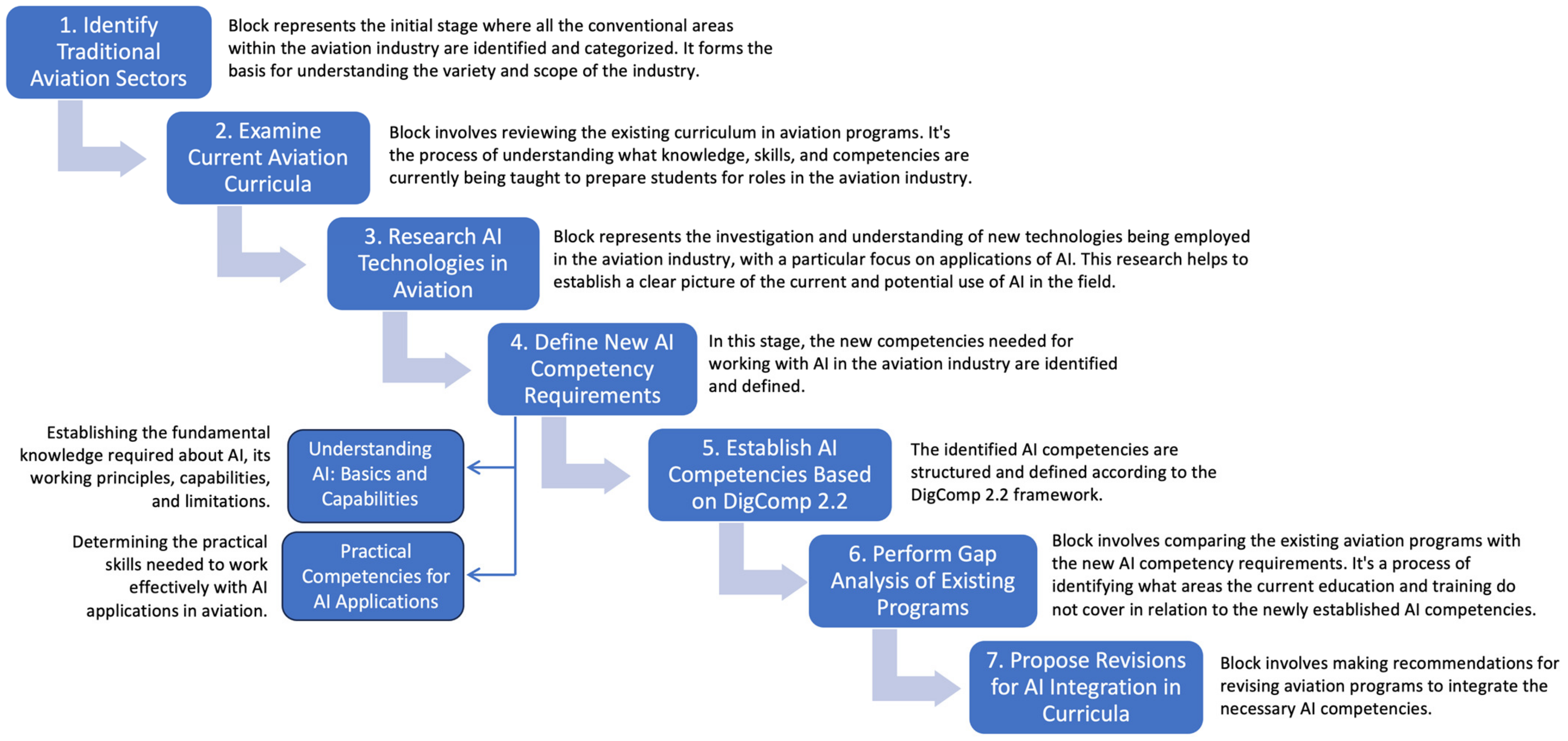
- Data collection, sources: comprehensive review of current literature, industry reports, publications, and interviews with seasoned industry professionals spanning various roles for Block 1; aviation program curricula, course catalogs, and descriptions from multiple universities for Block 2; data on current and emerging applications of AI across aviation, including documents, news articles, expert interviews, conference presentations for Block 3; job postings, industry reports, and expert interviews for Block 4.
- Constructing analytic codes and categories from data: “flight operations”, “maintenance and engineering”, “air traffic management”, etc., for Block 1; “pilot training”, “aviation law”, etc., for Block 2; “flight simulation”, “aircraft design”, etc., for Block 3; “to learn AI prediction capabilities for flight planning”, “to use AI for data analysis”, etc., for Block 4.
- Using the constant comparative method, which involves making comparisons during each stage of the analysis.
- Advancing theory development during each step of data collection and analysis: this research employs AI instead of regular extensive surveys.
- Axial Coding: grouping open codes into higher-level competency categories for each aviation field or based on the area of aviation and type of AI application, e.g., category “Pilot training”, “AI in Pilot Training” for Block 3, “Core AI Knowledge” for Block 4.
- Memo-writing to elaborate categories, specify their properties, and identify gaps.
- Sampling aimed toward theory construction, not for population representativeness.
- Conducting the literature review after developing an independent analysis.
4. Results
4.1. Traditional Aviation Sectors: Identifying and Categorizing the Foundational Pillars
4.2. Aviation Training and Education: Examine Current Aviation Curricula
4.3. Industry Demand for Artificial Intelligence Competencies in Aviation Graduates
- Flight planning and optimization—AI can analyze weather patterns, air traffic, runway conditions, and other variables to generate optimal flight plans that minimize fuel costs and emissions while maintaining safety.
- Predictive maintenance—Machine learning algorithms can monitor aircraft performance and usage data to anticipate potential equipment failures before they occur.
- Air traffic management—AI systems can better manage complex air traffic flow, optimizing aircraft sequencing and routing to improve efficiency and capacity at airports.
- Passenger experience—Chatbots, virtual assistants, and other AI tools can provide personalized recommendations and 24/7 automated customer service for passengers.
- Safety and accident investigation—AI techniques like computer vision and natural language processing can extract insights from flight recorder data and reports to identify risks.
4.4. Aviation Education and Industry Demand for AI Competencies
- Understanding AI Concepts and Applications in Aviation (NextTech)
- Working Effectively with AI Systems (NextGen)
- Core AI approaches like machine learning, neural networks, and computer vision.
- How these techniques can be specifically applied in flight operations, maintenance, air traffic control, etc.
- AI system components, architecture, capabilities, and limitations.
- Data requirements, integration needs, and infrastructure for implementing aviation AI.
- Existing and emerging use cases of AI in the relevant aviation domain.
- Interpreting and critically evaluating AI system outputs.
- Knowing when to rely on AI vs. human expertise.
- Communicating and collaborating effectively with AI agents.
- Maintaining ethical and responsible AI implementation practices.
- Identifying challenges and limitations of AI systems in practice.
- Adapting workflow to integrate AI tools into business processes.
- Continuously monitoring AI system performance and improvements.
4.5. Proposal for Including AI-Driven Aviation Competences in DigComp 2.2 Framework
- Area 1. Information and data literacy.
- Area 2. Communication and collaboration.
- Area 3. Digital content creation.
- Area 4. Safety.
- Area 5. Problem-solving.
4.6. Gap Analysis of Existing Programs: Required Transformation in Aviation Bachelor Programs’ Implementation
- Screening 65 aviation-related bachelor’s programs to identify relevant engineering programs.
- Excluding programs focusing predominantly on management, 16 programs were selected for final analysis.
- Annotating program descriptions for keywords related to the digital field and machine learning and artificial intelligence subfield.
- Leveraging the expertise of subject matter experts in natural language processing and aviation engineering
- Making the annotated corpus available to facilitate further research.
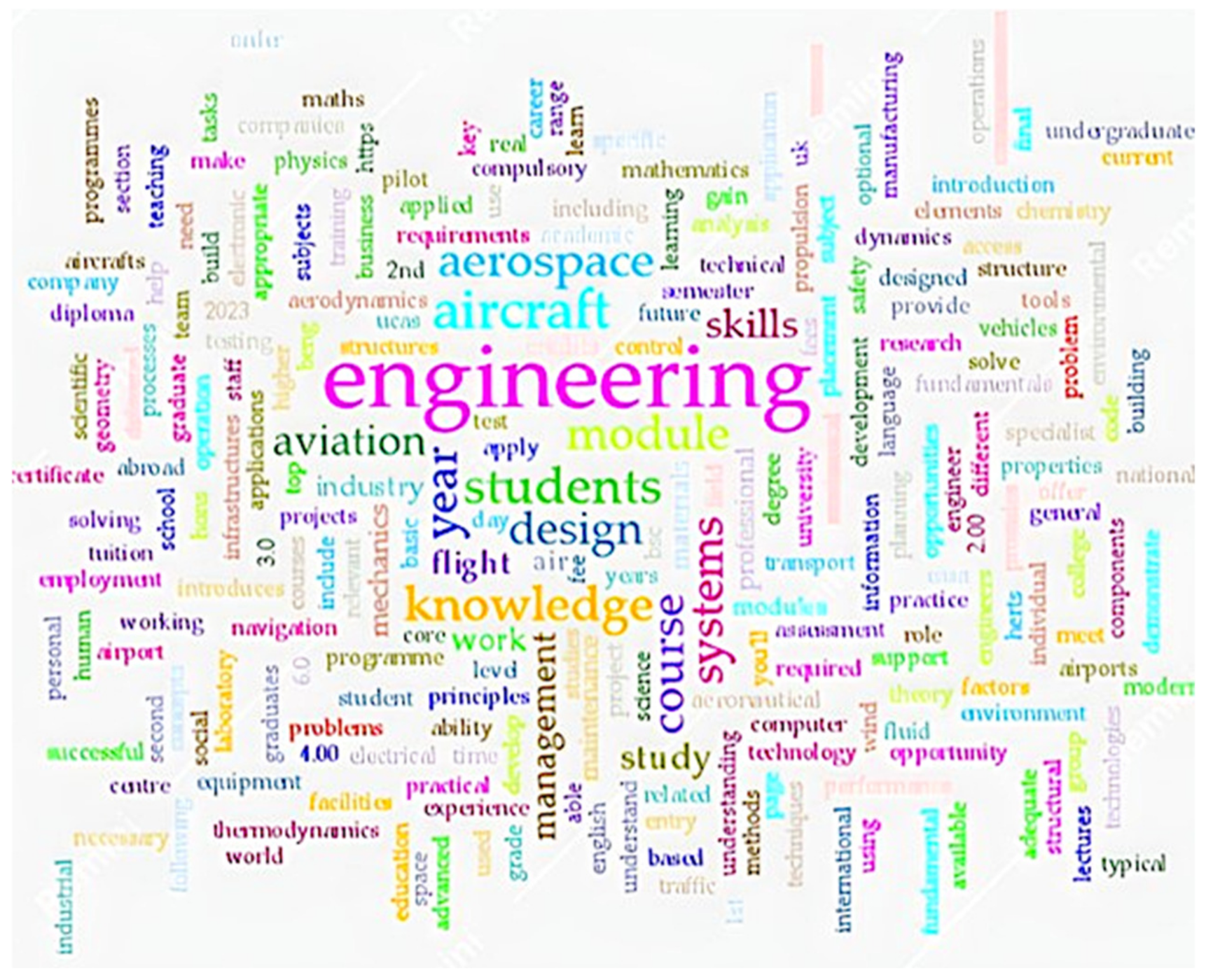
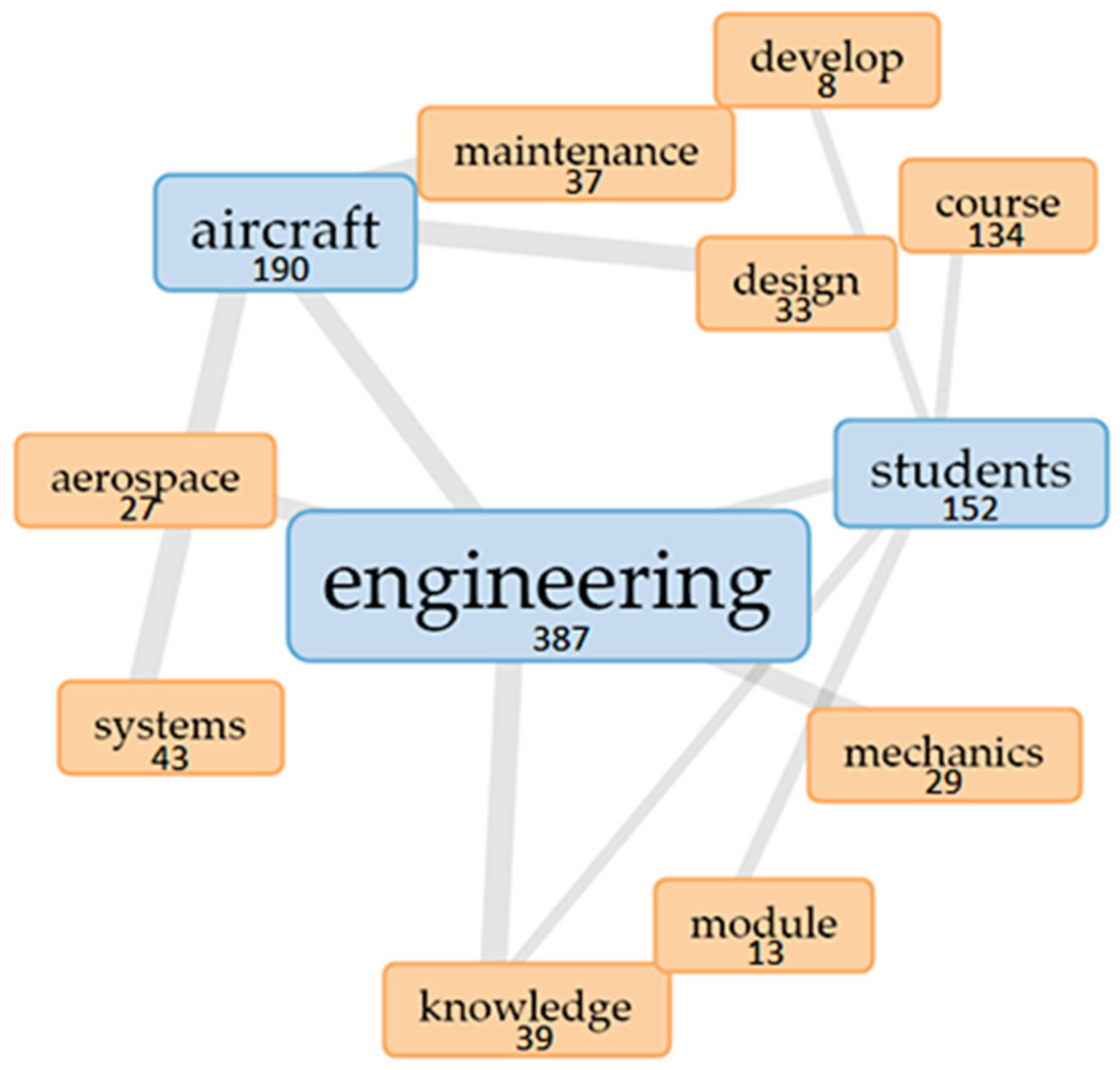
- Vocabulary Density: 0.136.
- Readability Index: 17.653.
- Average Words Per Sentence: 27.5.
4.7. Summary of Results
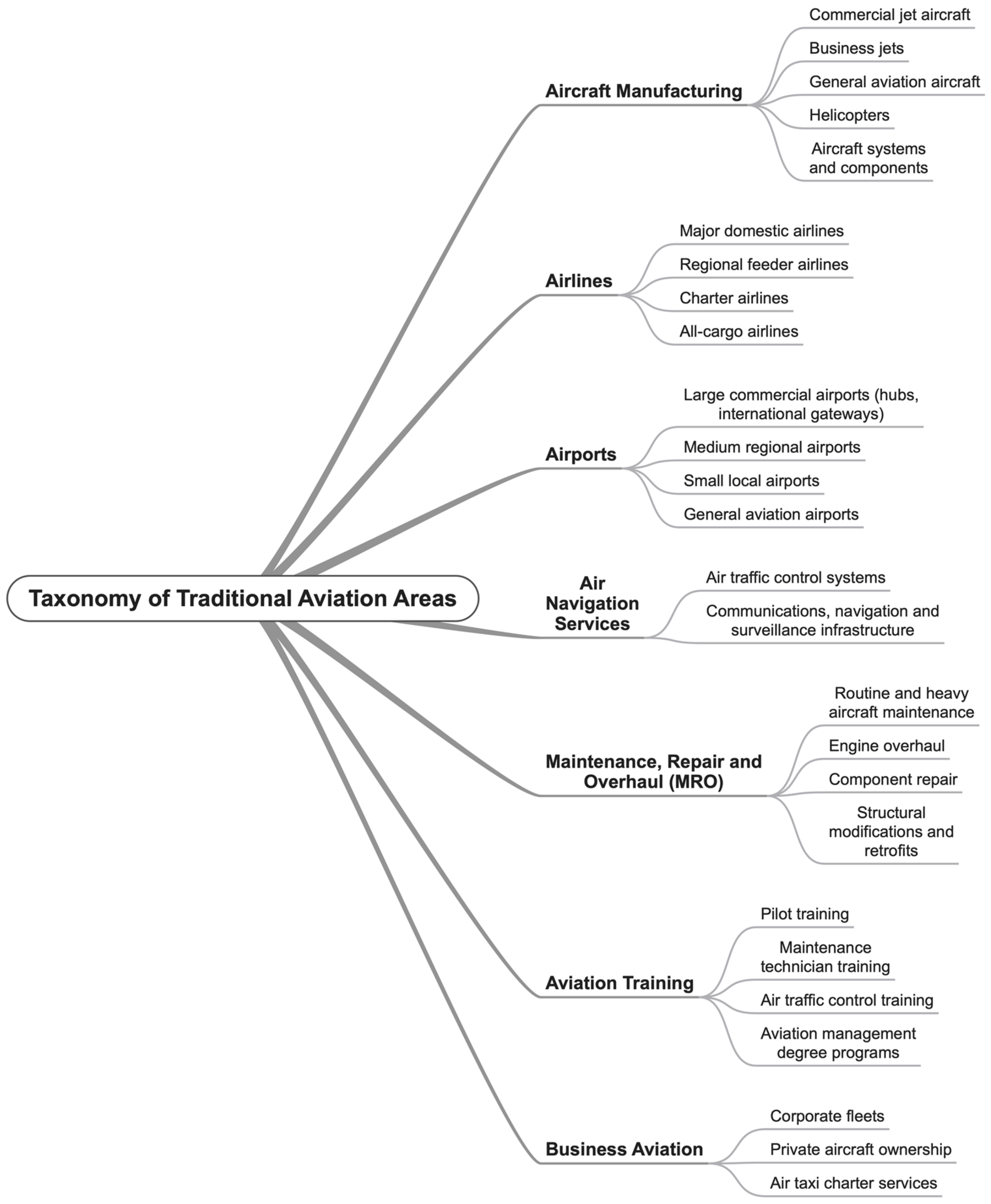
- Block 1: Figure 2. “Taxonomy of traditional aviation sectors”.
- Block 2: Table 1. “The general classification of education programs for the aviation industry”.
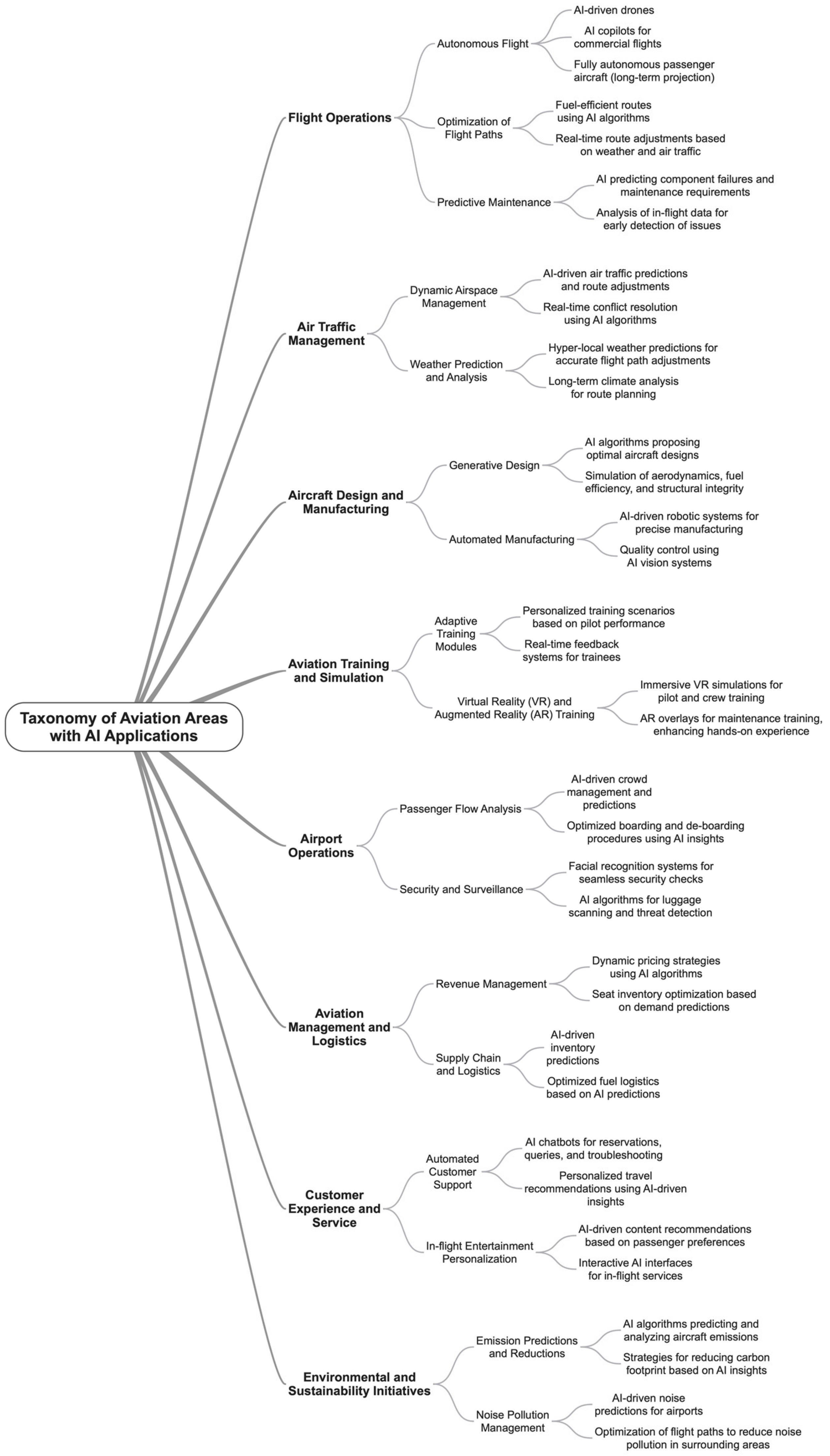
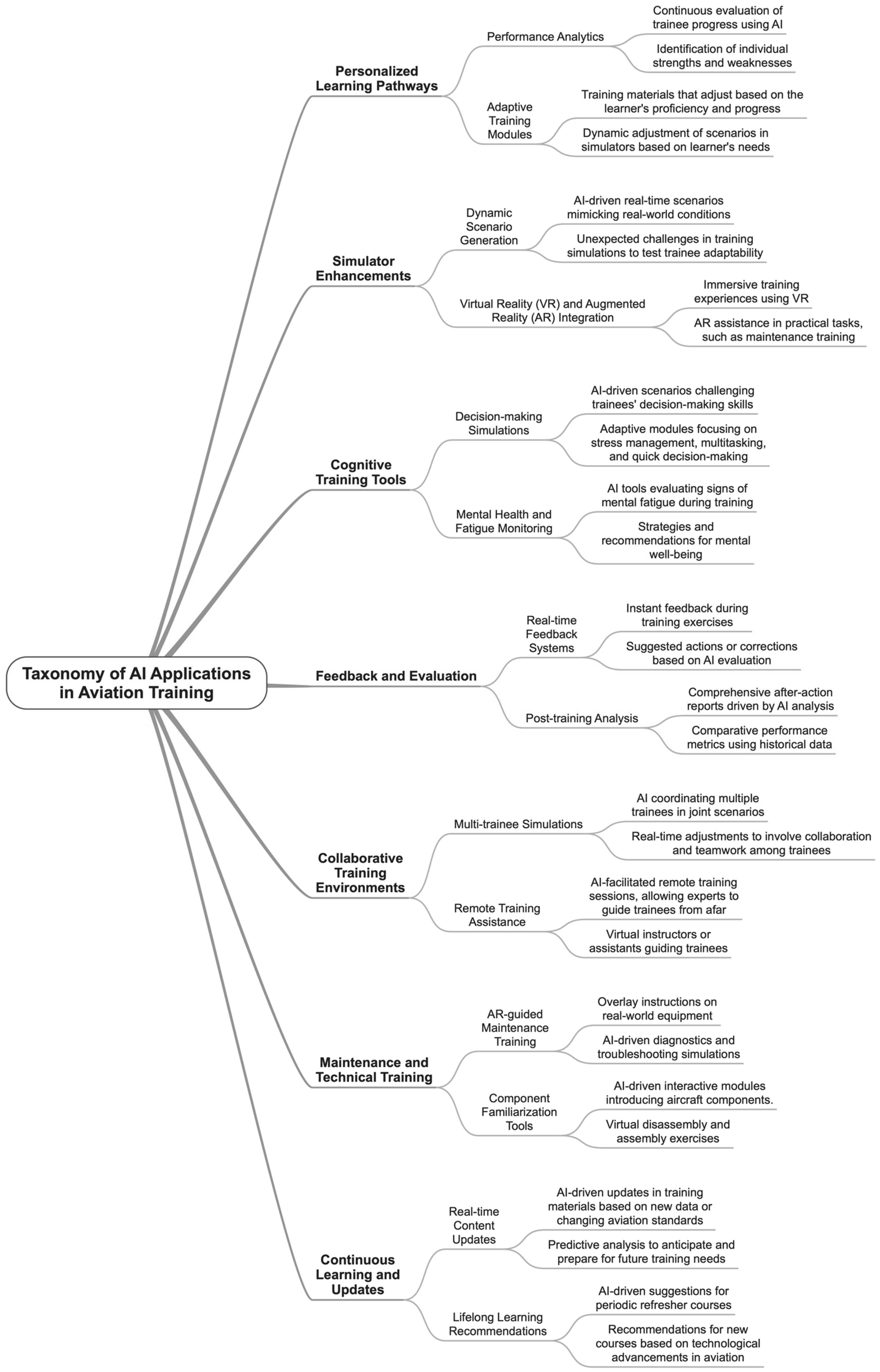
- Block 3: Figure 3. “The taxonomy of aviation areas with AI applications”.
- Block 5: Table 4. “AI-driven aviation competences in DigComp 2.2 framework”.
5. Discussion
- Machine learning—understanding supervised, unsupervised, and reinforcement learning models.
- Neural networks—knowledge of deep learning architectures and training techniques.
- Natural language processing—comprehending how NLP systems analyze text and language.
- Computer vision—principles of how AI can identify patterns in visual data.
- AI ethics—awareness of ethical issues like bias, transparency, and responsibility.
- Coding in languages like Python and R to program AI algorithms.
- Working with AI development platforms such as TensorFlow and PyTorch.
- Data analysis and visualization to prepare, understand, and interpret AI training data.
- Using AI APIs and cloud services like AWS AI to integrate smart systems.
- Monitoring, maintaining, and retraining AI models in production environments.
- Identifying high-value opportunities for AI augmentation in aviation tasks.
- Communicating and coordinating effectively with AI agents.
- Judging when to rely on AI systems vs. human expertise and experience.
- Explaining and justifying AI model behaviors and decisions.
- Monitoring AI for accuracy, errors, bias, and unintended consequences.
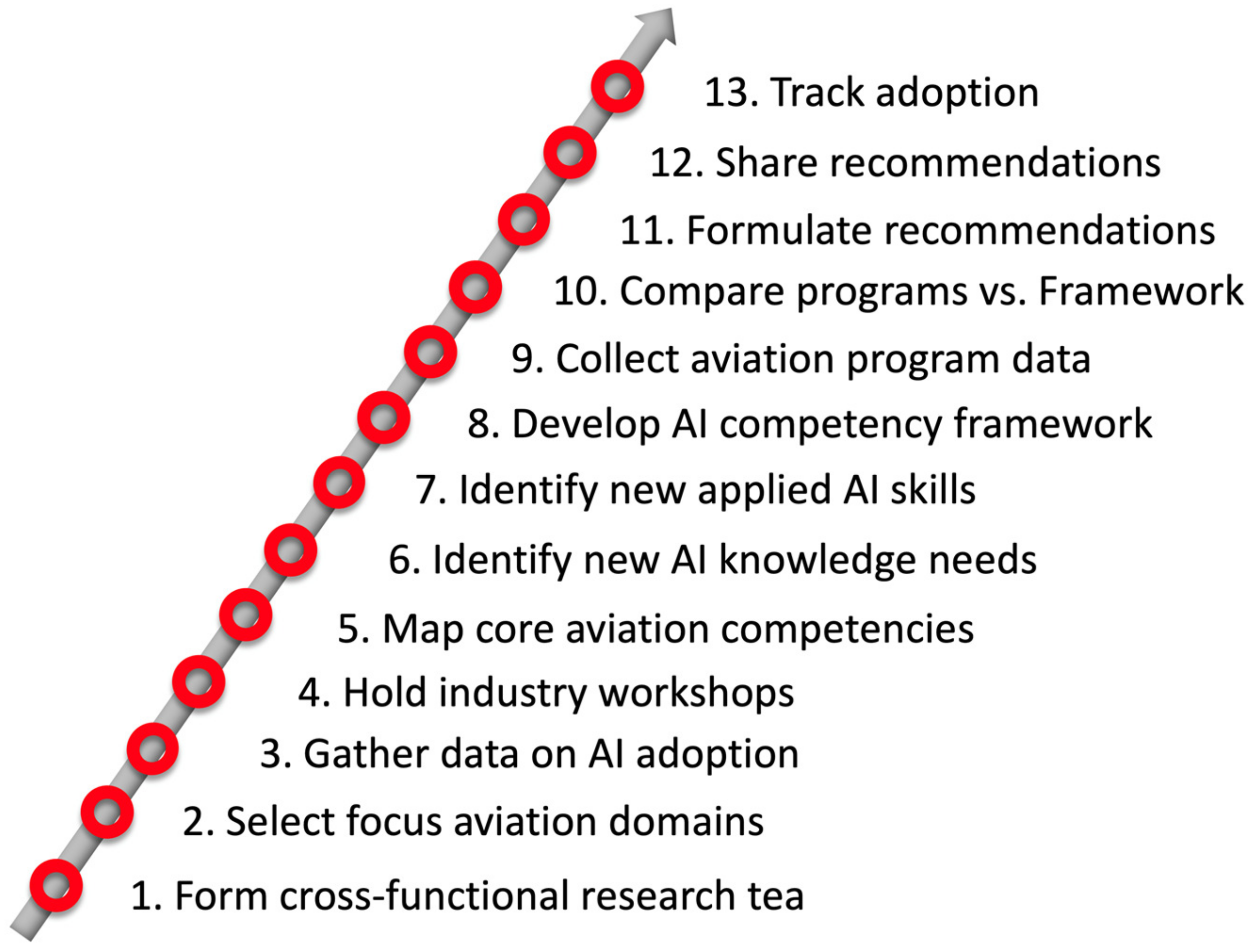
- Form a cross-functional research team. Assemble a team that includes aviation educators, AI experts, industry representatives, and education policymakers. This facilitates collaboration and buy-in.
- Select focus aviation domains. The team selects which professional areas and occupations to focus the competency analysis on based on the maturity of AI adoption.
- Gather data on AI adoption. Conduct an environmental scan to collect data on current and emerging AI applications across the focus aviation domains.
- Hold industry workshops. Host workshops with aviation organizations to identify examples of AI integration and resulting competency requirements.
- Map core aviation competencies. Analyze focus aviation professions to identify traditional education requirements and learning outcomes.
- Identify new AI knowledge needs. Determine essential conceptual AI competencies professionals will require specific to their role.
- Identify new applied AI skills. Determine key applied skills needed to collaborate and work alongside AI technologies in each domain.
- Develop AI competency framework. Organize identified competencies into a structured framework mapped to an established digital competence model.
- Collect aviation program data. Gather syllabi, learning outcomes, and course information from existing aviation programs.
- Compare programs vs. frameworks. Analyze programs to identify gaps between current and needed AI competencies.
- Formulate recommendations. Develop specific recommendations to address competency gaps through curricular updates and new courses.
- Share recommendations. Disseminate the competency framework and implementation roadmap to aviation education institutions and accreditation bodies.
- Track adoption. Establish mechanisms to monitor uptake and iterate on the framework over time to align with evolving technologies.

- Curriculum redesign requires time and faculty/industry consensus. A phased rollout focusing first on electives and pilot modules can help build gradually.
- Developing new lab infrastructure and purchasing AI software/hardware entails financial investment. Pursuing public and private funding sources can help overcome costs.
- Faculty will need support in developing expertise in AI technologies. Multi-phase professional training, industry exchanges, and hiring specialized AI lecturers can build capacity.
- Increased emphasis on data science may require trade-offs with traditional aviation coursework. Holistic curricular reviews should aim for balanced integration.
- Legal and ethical risks around data privacy, AI bias, and model transparency will need ongoing governance. Developing codes of conduct and review boards can help manage concerns.
- Ongoing studies will be needed to benchmark implementation efforts and assess the efficacy of AI aviation education.
- More research should identify effective pedagogies for teaching technical AI concepts in aviation contexts.
- Additional work should explore how aviation AI competencies translate into career readiness and performance.
- Research partnerships between institutions will be valuable to share best practices in aviation AI education.
- Students will gain relevant skills for the AI-driven job market while also maintaining aviation expertise.
- Educators take on new curriculum design and teaching challenges but prepare students for the future.
- Regulators and accreditors enable progress by supporting new standards and program iterations.
- Industry stakeholders aid training programs via partnerships and can recruit work-ready graduates.
- 14.
- The study only considers aviation engineering programs at European universities that are listed in the Educations.com database and described in English. Programs from other regions and databases are excluded.
- 15.
- The analysis relies on program descriptions at university homepages such as syllabi, and course outlines as the sole data source. Other sources were not consulted. The concept is that universities demonstrate the most important study outcomes openly on their web pages. The study assumes that the most relevant information about programs, including key learning outcomes, is communicated through program descriptions on university websites. However, extended syllabi and course outlines not presented on the program homepage may have provided additional insights into the extent of artificial intelligence and machine learning content within the programs.
- 16.
- The annotation of key terms related to artificial intelligence and machine learning depends on the semantic interpretation of the experts involved. The ambiguity of natural language precludes the use of pre-defined keyword lists. This introduces a degree of subjectivity into the annotation process.
- 17.
- The study only considers programs at the bachelor’s level. Postgraduate programs are outside the scope of this research.
- 18.
- The annotated corpus has not been validated through independent annotation by additional experts or computational methods.
- The Anticipated Evolution of AI in Aviation. Over the coming decade, we envision AI solidifying its presence across the aviation landscape. Key areas of integration include maintenance—where predictive maintenance powered by AI will be the norm—air traffic management, in-flight services, and the enhancement of passenger experiences. Moreover, AI-enhanced simulations are expected to become a cornerstone of pilot training, revolutionizing the manner in which pilots are equipped to handle real-world scenarios.
- Challenges and Considerations for AI-centric Aviation Education. A global introduction of an AI-centric curriculum in aviation is fraught with challenges. These range from reconciling diverse pedagogical standards and contending with varying levels of technological infrastructure to ensuring educators themselves are proficient in the principles and pragmatic applications of AI.
- Safety Protocols in the Age of AI. The sanctity of safety in aviation remains paramount. To ensure that AI’s integration does not inadvertently compromise this, stringent testing of AI systems in simulated environments is essential. Collaborations with AI specialists during the design and execution phases, complemented by persistent human oversight—especially in high-stakes decision-making junctures—will be critical.
- AI Technologies Taking the Lead. While AI’s tentacles will spread wide, certain technologies are poised to be especially transformative. We project that machine learning models (especially for predictive maintenance), natural language processing (for augmenting passenger experience), and reinforcement learning (for optimizing air traffic patterns) will be at the forefront.
- Harmonizing Human Expertise with AI. The future lies not in choosing between human expertise and AI but in orchestrating a harmonious collaboration between the two. Continuous training and the upskilling of aviation professionals will be instrumental in achieving this balance.
- Navigating the Ethical Airspace. The ethical implications of integrating AI into aviation are profound. From ensuring unbiased AI behavior to championing transparency and explainability in AI-driven decisions, the industry must tread with caution and conscience.
- The Quest for Global AI Standardization in Aviation. This is perhaps one of the most challenging endeavors, necessitating collaborations between global aviation bodies, adaptive regulatory frameworks, and an agility to keep pace with swift technological evolutions.
6. Conclusions
Author Contributions
Funding
Data Availability Statement
Acknowledgments
Conflicts of Interest
References
- Kashyap, R. Artificial Intelligence Systems in Aviation. In Cases on Modern Computer Systems in Aviation; Shmelova, T., Ed.; IGI Global: Hershey, PA, USA, 2019; pp. 1–26. [Google Scholar] [CrossRef]
- Yang, C.; Huang, C. Natural Language Processing (NLP) in Aviation Safety: Systematic Review of Research and Outlook into the Future. Aerospace 2023, 10, 600. [Google Scholar] [CrossRef]
- Kulida, E.; Lebedev, V. About the Use of Artificial Intelligence Methods in Aviation. In Proceedings of the 13th International Conference on Management of Large-Scale System Development (MLSD), Moscow, Russia, 1–3 July 2020; pp. 1–5. [Google Scholar] [CrossRef]
- ICAO. Working Paper on Artificial Intelligence and Digitalization in Aviation; ICAO: Montreal, QC, Canada, 2019; Available online: https://www.icao.int/Meetings/a40/Documents/WP/wp_268_en.pdf (accessed on 7 August 2023).
- Degas, A.; Islam, M.R.; Hurter, C.; Barua, S.; Rahman, H.; Poudel, M.; Ruscio, D.; Ahmed, M.U.; Begum, S.; Rahman, M.A.; et al. A Survey on Artificial Intelligence (AI) and Explainable AI in Air Traffic Management: Current Trends and Development with Future Research Trajectory. Appl. Sci. 2022, 12, 1295. [Google Scholar] [CrossRef]
- Ortner, P.; Steinhöfler, R.; Leitgeb, E.; Flühr, H. Augmented Air Traffic Control System—Artificial Intelligence as Digital Assistance System to Predict Air Traffic Conflicts. AI 2022, 3, 623–644. [Google Scholar] [CrossRef]
- Xie, Y.; Pongsakornsathien, N.; Gardi, A.; Sabatini, R. Explanation of Machine-Learning Solutions in Air-Traffic Management. Aerospace 2021, 8, 224. [Google Scholar] [CrossRef]
- Kistan, T.; Gardi, A.; Sabatini, R. Machine Learning and Cognitive Ergonomics in Air Traffic Management: Recent Developments and Considerations for Certification. Aerospace 2018, 5, 103. [Google Scholar] [CrossRef]
- Hurter, C.; Degas, A.; Guibert, A.; Durand, N.; Ferreira, A.; Cavagnetto, N.; Islam, M.R.; Barua, S.; Uddin Ahmed, M.; Begum, S.; et al. Usage of More Transparent and Explainable Conflict Resolution Algorithm: Air Traffic Controller Feedback. Transp. Res. Proc. 2022, 66, 270–278. [Google Scholar] [CrossRef]
- Pérez-Castán, J.A.; Pérez Sanz, L.; Fernández-Castellano, M.; Radišić, T.; Samardžić, K.; Tukarić, I. Learning Assurance Analysis for Further Certification Process of Machine Learning Techniques: Case-Study Air Traffic Conflict Detection Predictor. Sensors 2022, 22, 7680. [Google Scholar] [CrossRef] [PubMed]
- Hashemi, S.M.; Hashemi, S.A.; Botez, R.M.; Ghazi, G. Aircraft Trajectory Prediction Enhanced through Resilient Generative Adversarial Networks Secured by Blockchain: Application to UAS-S4 Ehécatl. Appl. Sci. 2023, 13, 9503. [Google Scholar] [CrossRef]
- Madeira, T.; Melício, R.; Valério, D.; Santos, L. Machine Learning and Natural Language Processing for Prediction of Human Factors in Aviation Incident Reports. Aerospace 2021, 8, 47. [Google Scholar] [CrossRef]
- Kumar, S.G.; Corrado, S.J.; Puranik, T.G.; Mavris, D.N. Classification and Analysis of Go-Arounds in Commercial Aviation Using ADS-B Data. Aerospace 2021, 8, 291. [Google Scholar] [CrossRef]
- Rose, R.L.; Puranik, T.G.; Mavris, D.N. Natural Language Processing Based Method for Clustering and Analysis of Aviation Safety Narratives. Aerospace 2020, 7, 143. [Google Scholar] [CrossRef]
- Lee, H.; Madar, S.; Sairam, S.; Puranik, T.G.; Payan, A.P.; Kirby, M.; Pinon, O.J.; Mavris, D.N. Critical Parameter Identification for Safety Events in Commercial Aviation Using Machine Learning. Aerospace 2020, 7, 73. [Google Scholar] [CrossRef]
- Nogueira, R.P.R.; Melicio, R.; Valério, D.; Santos, L.F.F.M. Learning Methods and Predictive Modeling to Identify Failure by Human Factors in the Aviation Industry. Appl. Sci. 2023, 13, 4069. [Google Scholar] [CrossRef]
- Tikayat Ray, A.; Bhat, A.P.; White, R.T.; Nguyen, V.M.; Pinon Fischer, O.J.; Mavris, D.N. Examining the Potential of Generative Language Models for Aviation Safety Analysis: Case Study and Insights Using the Aviation Safety Reporting System (ASRS). Aerospace 2023, 10, 770. [Google Scholar] [CrossRef]
- Doğru, A.; Bouarfa, S.; Arizar, R.; Aydoğan, R. Using Convolutional Neural Networks to Automate Aircraft Maintenance Visual Inspection. Aerospace 2020, 7, 171. [Google Scholar] [CrossRef]
- Abdelghany, E.S.; Farghaly, M.B.; Almalki, M.M.; Sarhan, H.H.; Essa, M.E.-S.M. Machine Learning and IoT Trends for Intelligent Prediction of Aircraft Wing Anti-Icing System Temperature. Aerospace 2023, 10, 676. [Google Scholar] [CrossRef]
- Gao, Z.; Mavris, D.N. Statistics and Machine Learning in Aviation Environmental Impact Analysis: A Survey of Recent Progress. Aerospace 2022, 9, 750. [Google Scholar] [CrossRef]
- Brandoli, B.; de Geus, A.R.; Souza, J.R.; Spadon, G.; Soares, A.; Rodrigues, J.F., Jr.; Komorowski, J.; Matwin, S. Aircraft Fuselage Corrosion Detection Using Artificial Intelligence. Sensors 2021, 21, 4026. [Google Scholar] [CrossRef]
- Yang, R.; Gao, Y.; Wang, H.; Ni, X. Fuzzy Neural Network PID Control Used in Individual Blade Control. Aerospace 2023, 10, 623. [Google Scholar] [CrossRef]
- Wang, Z.; Zhao, Y. Data-Driven Exhaust Gas Temperature Baseline Predictions for Aeroengine Based on Machine Learning Algorithms. Aerospace 2023, 10, 17. [Google Scholar] [CrossRef]
- Chen, J.; Qi, G.; Wang, K. Synergizing Machine Learning and the Aviation Sector in Lithium-Ion Battery Applications: A Review. Energies 2023, 16, 6318. [Google Scholar] [CrossRef]
- Baumann, M.; Koch, C.; Staudacher, S. Application of Neural Networks and Transfer Learning to Turbomachinery Heat Transfer. Aerospace 2022, 9, 49. [Google Scholar] [CrossRef]
- Quadros, J.D.; Khan, S.A.; Aabid, A.; Alam, M.S.; Baig, M. Machine Learning Applications in Modelling and Analysis of Base Pressure in Suddenly Expanded Flows. Aerospace 2021, 8, 318. [Google Scholar] [CrossRef]
- Papakonstantinou, C.; Daramouskas, I.; Lappas, V.; Moulianitis, V.C.; Kostopoulos, V. A Machine Learning Approach for Global Steering Control Moment Gyroscope Clusters. Aerospace 2022, 9, 164. [Google Scholar] [CrossRef]
- Sarkar, N.I.; Gul, S. Artificial Intelligence-Based Autonomous UAV Networks: A Survey. Drones 2023, 7, 322. [Google Scholar] [CrossRef]
- Aghazadeh Ardebili, A.; Ficarella, A.; Longo, A.; Khalil, A.; Khalil, S. Hybrid Turbo-Shaft Engine Digital Twinning for Autonomous Aircraft via AI and Synthetic Data Generation. Aerospace 2023, 10, 683. [Google Scholar] [CrossRef]
- Mariani, M.; Fiori, S. Design and Simulation of a Neuroevolutionary Controller for a Quadcopter Drone. Aerospace 2023, 10, 418. [Google Scholar] [CrossRef]
- Casabianca, P.; Zhang, Y. Acoustic-Based UAV Detection Using Late Fusion of Deep Neural Networks. Drones 2021, 5, 54. [Google Scholar] [CrossRef]
- Alrayes, F.S.; Alotaibi, S.S.; Alissa, K.A.; Maashi, M.; Alhogail, A.; Alotaibi, N.; Mohsen, H.; Motwakel, A. Artificial Intelligence-Based Secure Communication and Classification for Drone-Enabled Emergency Monitoring Systems. Drones 2022, 6, 222. [Google Scholar] [CrossRef]
- Wang, G.; Ai, J.; Mo, L.; Yi, X.; Wu, P.; Wu, X.; Kong, L. Anomaly Detection for Data from Unmanned Systems via Improved Graph Neural Networks with Attention Mechanism. Drones 2023, 7, 326. [Google Scholar] [CrossRef]
- ICAO. Attracting, Educating and Retaining the Next Generation; ICAO: Montreal, QC, Canada, 2017; p. 7. Available online: https://www.icao.int/safety/ngap/Documentation/icao_training_report_vol7_No3.pdf (accessed on 7 September 2023).
- EASA. EASA Artificial Intelligence Roadmap 1.0; EASA: Cologne, Germany, 2020; Available online: https://www.easa.europa.eu/en/downloads/109668/en (accessed on 7 September 2023).
- European Aviation Artificial Intelligence High Level Group. The FLY AI Report Demystifying and Accelerating AI in Aviation/ATM; EUROCONTROL: Brussels, Belgium, 2020; Available online: https://www.eurocontrol.int/publication/fly-ai-report (accessed on 7 September 2023).
- FAA. Technical Discipline: Artificial Intelligence—Machine Learning; FAA: Washington, DC, USA, 2022. Available online: https://www.faa.gov/aircraft/air_cert/step/disciplines/artificial_intelligence (accessed on 7 September 2023).
- IATA. AI in Aviation: Exploring the Fundamentals, Threats, and Opportunities of Artificial Intelligence (AI) in the Aviation Industry; White Paper; IATA: Montreal, QC, Canada, 2018; Available online: https://www.iata.org/contentassets/2d997082f3c84c7cba001f506edd2c2e/ai-white-paper.pdf (accessed on 7 September 2023).
- European Commission. EU AI Act: First Regulation on Artificial Intelligence 2023; European Commission: Brussels, Belgium, 2023; Available online: https://www.europarl.europa.eu/news/en/headlines/society/20230601STO93804/eu-ai-act-first-regulation-on-artificial-intelligence?&at_campaign=20226-Digital&at_medium=Google_Ads&at_platform=Search&at_creation=RSA&at_goal=TR_G&at_advertiser=Webcomm&at_audience=ai%20europe&at_topic=Artificial_intelligence_Act&at_location=LV&gclid=CjwKCAjw8symBhAqEiwAaTA__IQ5BDyPcf7q7qibfaj0mvGRxZjRhUIE4DI6gri2phJOQt3Jw7L_rRoCqR8QAvD_BwE (accessed on 7 September 2023).
- European Commission. Communication on Fostering a European Approach to Artificial Intelligence; European Commission: Brussels, Belgium, 2021; Available online: https://digital-strategy.ec.europa.eu/en/library/communication-fostering-european-approach-artificial-intelligence (accessed on 7 September 2023).
- European Commission. Coordinated Plan on Artificial Intelligence; European Commission: Brussels, Belgium, 2021; Available online: https://digital-strategy.ec.europa.eu/en/policies/plan-ai (accessed on 7 September 2023).
- European Commission. Proposal for a Regulation Laying Down Harmonised Rules on Artificial Intelligence; European Commission: Brussels, Belgium, 2021; Available online: https://digital-strategy.ec.europa.eu/en/library/proposal-regulation-laying-down-harmonised-rules-artificial-intelligence (accessed on 7 September 2023).
- ICAO. ICAO’s Activities in the Field of AI; ICAO: Montreal, QC, Canada, 2023; Available online: https://www.icao.int/safety/Pages/Artificial-Intelligence-(AI).aspx (accessed on 7 September 2023).
- Ahmad, S.F.; Rahmat, M.K.; Mubarik, M.S.; Alam, M.M.; Hyder, S.I. Artificial Intelligence and Its Role in Education. Sustainability 2021, 13, 12902. [Google Scholar] [CrossRef]
- Hamal, O.; El Faddouli, N.-E.; Harouni, M.H.A.; Lu, J. Artificial Intelligent in Education. Sustainability 2022, 14, 2862. [Google Scholar] [CrossRef]
- Kabashkin, I.; Misnevs, B.; Puptsau, A. Transformation of the University in the Age of Artificial Intelligence: Models and Competences. Transp. Telecommun. J. 2023, 24, 3923–3926. [Google Scholar] [CrossRef]
- Kelemen, M.; Polishchuk, V.; Kelemen, M., Jr.; Sabo, J. A Hybrid Model for Evaluating the Outcomes of Student Pilots within the Didactic System of Aviation Education. Aerospace 2023, 10, 281. [Google Scholar] [CrossRef]
- Zuluaga-Gomez, J.; Prasad, A.; Nigmatulina, I.; Motlicek, P.; Kleinert, M. A Virtual Simulation-Pilot Agent for Training of Air Traffic Controllers. Aerospace 2023, 10, 490. [Google Scholar] [CrossRef]
- Ke, L.; Zhang, G.; He, J.; Li, Y.; Li, Y.; Liu, X.; Fang, P. Pilot Selection in the Era of Virtual Reality: Algorithms for Accurate and Interpretable Machine Learning Models. Aerospace 2023, 10, 394. [Google Scholar] [CrossRef]
- Yang, S.; Yu, K.; Lammers, T.; Chen, F. Artificial Intelligence in Pilot Training and Education—Towards a Machine Learning Aided Instructor Assistant for Flight Simulators. In HCI International 2021—Posters; Stephanidis, C., Antona, M., Ntoa, S., Eds.; Springer: Cham, Switzerland, 2021; Volume 1420, pp. 581–587. [Google Scholar] [CrossRef]
- Charmaz, K. Constructing Grounded Theory; SAGE: Thousand Oaks, CA, USA, 2014. [Google Scholar]
- Birks, M.; Mills, J. Grounded Theory: A Practical Guide, 2nd ed.; SAGE: Thousand Oaks, CA, USA, 2015. [Google Scholar]
- Aldiabat, K.M.; Le Navenec, C.-L. Data Saturation: The Mysterious Step in Grounded Theory Methodology. Qual. Rep. 2018, 23, 245–261. [Google Scholar] [CrossRef]
- Creswell, J.W.; Poth, C.N. Qualitative Inquiry and Research Design Choosing Among Five Approaches, 4th ed.; SAGE: Thousand Oaks, CA, USA, 2017. [Google Scholar]
- Snyder, H. Literature Review as a Research Methodology: An Overview and Guidelines. J. Bus. Res. 2019, 104, 333–339. [Google Scholar] [CrossRef]
- Elo, S.; Kääriäinen, M.; Kanste, O.; Pölkki, T.; Utriainen, K.; Kyngäs, H. Qualitative Content Analysis: A Focus on Trustworthiness. SAGE Open 2014, 4, 2158244014522633. [Google Scholar] [CrossRef]
- Kallio, H.; Pietilä, A.-M.; Johnson, M.; Kangasniemi, M. Systematic Methodological Review: Developing a Framework for a Qualitative Semi-Structured Interview Guide. J. Adv. Nurs. 2016, 72, 2954–2965. [Google Scholar] [CrossRef]
- Saldaña, J. The Coding Manual for Qualitative Researchers, 3rd ed.; SAGE: Thousand Oaks, CA, USA, 2021. [Google Scholar]
- Creswell, J.W.; Creswell, J.D. Research Design: Qualitative, Quantitative, and Mixed Methods Approaches, 5th ed.; SAGE: Thousand Oaks, CA, USA, 2018. [Google Scholar]
- Spall, S. Peer Debriefing in Qualitative Research: Emerging Operational Models. Qual. Inq. 1998, 4, 280–292. [Google Scholar] [CrossRef]
- Wolf, Z.R. Exploring the Audit Trail for Qualitative Investigations. Nurse Educ. 2003, 28, 175–178. [Google Scholar] [CrossRef]
- Thomas, D.R. A General Inductive Approach for Analyzing Qualitative Evaluation Data. Am. J. Eval. 2006, 27, 237–246. [Google Scholar] [CrossRef]
- Find & Compare Study Programs Abroad. Available online: https://www.educations.com/ (accessed on 7 August 2023).
- Vuorikari, R.; Kluzer, S.; Punie, Y. DigComp 2.2: The Digital Competence Framework for Citizens—With New Examples of Knowledge, Skills and Attitudes; Publications Office of the European Union: Luxembourg, 2022. [Google Scholar]
- Raw Data of Engineering Aviation Corpus. Available online: https://shorturl.at/dtyGK (accessed on 7 August 2023).
- Voyant Tools. Text Analysis Environment. Available online: https://voyant-tools.org/docs/#!/guide/about (accessed on 7 August 2023).
- Alejandro, P.; David, I. Educational Research and Innovation Teachers as Designers of Learning Environments the Importance of Innovative Pedagogies: The Importance of Innovative Pedagogies; OECD Publishing: Paris, France, 2018. [Google Scholar]




| Aviation Programs | Area of Appointment | Basic Competencies |
|---|---|---|
| Pilot training | These programs are intended for individuals who want to become professional pilots. The graduates can work for commercial airlines, cargo airlines, charter flights, or in private aviation. | Aerodynamics, navigation, weather forecasting, flight planning, aircraft operations, emergency procedures, and Federal Aviation Regulations. |
| Aerospace Engineering | Aerospace engineers design aircraft and spacecraft. They work in manufacturing, analysis and design, research and development, and the federal government. | Aerodynamics, structures and materials, propulsion systems, stability and control, aircraft design, systems integration, CAD (Computer Aided Design), simulation, and modeling. |
| Aviation Management | Graduates can work in airlines, airports, or aviation authorities. They handle operations, logistics, budgeting, safety procedures, and human resources. | Aviation law, safety management, airport planning, airline operations, financial management, human resource management, strategic planning, and regulatory compliance. |
| Air Traffic Control | Air Traffic Controllers work in control towers, approach control facilities, or route centers, coordinating the movement of air traffic to ensure that planes stay safe distances apart. | Air traffic control principles, aviation safety, navigation, weather, Federal Aviation Regulations, decision-making, and stress management. |
| Aircraft Maintenance and Repair | These graduates can work in airline companies, maintenance, repair, and overhaul (MRO) organizations, and aircraft manufacturing firms. | Aircraft systems, inspection procedures, maintenance techniques, troubleshooting, Federal Aviation Regulations, use of maintenance manuals, and aircraft electrical systems. |
| Aviation Technology | Aviation technologists often work as aviation technicians or technologists at airline companies, airports, or aviation authorities. Their job is to work on the equipment and technology that make aviation possible. | Principles of flight, aircraft systems, aviation safety, Federal Aviation Regulations, avionics, navigation systems, and maintenance procedures. |
| Aviation Safety | Aviation safety specialists work with airlines, aviation authorities, and organizations to manage and prevent risk in aviation operations. | Accident investigation, safety management systems, risk assessment, aviation law, human factors in aviation, emergency response planning, and safety culture. |
| Aeronautics/Aviation Science | This is a broader field, leading to various professions in aviation, from piloting to administration. | Aerodynamics, flight operations, navigation, weather, aviation management, air traffic control, aviation law, safety procedures, and aircraft systems. |
| Area of AI-Driven Aviation Industry | Aviation Industry | Aviation Education |
|---|---|---|
| Pilot training | AI can be used to optimize flight paths for efficiency and safety, simulate different flight conditions for pilot training, and assist with real-time decision-making during flights. | AI can be used to personalize the learning experience for each trainee, provide virtual reality-based training, identify weaknesses in a trainee’s skill set, and track progress over time. |
| Aerospace Engineering | AI can be used to design more efficient aircraft, simulate, and analyze various flight conditions, and predict maintenance needs. | AI can be used to provide hands-on experience with designing aircraft in a virtual environment, help students understand complex concepts through simulation, and use predictive modeling to enhance their understanding of aircraft design and maintenance. |
| Aviation Management | AI can be used for flight scheduling, route optimization, fuel management, and analyzing passenger behavior to improve customer service. | AI can be used to simulate various management scenarios, teach students about decision-making algorithms, and provide real-world case studies for analysis. |
| Air Traffic Control | AI can be used to predict flight patterns, manage air traffic flow, and enhance communication between pilots and air traffic controllers. | AI can be used to provide immersive training experiences, simulate different traffic scenarios, and help students understand the complexities of air traffic management. |
| Aircraft Maintenance and Repair | AI can be used for predictive maintenance, fault detection, and quality assurance, thereby reducing downtime and increasing the safety of aircraft. | AI can be used to simulate different maintenance scenarios, help students understand the nuances of aircraft systems, and provide hands-on experience in a virtual environment. |
| Aviation Technology | AI can enhance aviation technology by improving navigation systems, enhancing cockpit automation, and optimizing fuel efficiency. | AI can be used to provide students with an understanding of how AI technologies are developed and applied in aviation and to train them on the latest aviation technologies. |
| Aviation Safety | AI can be used to analyze accident data, predict potential safety issues, and assist in creating safety protocols and emergency response strategies. | AI can be used to simulate different safety scenarios, analyze historical accident data, and train students on risk assessment and management. |
| Aeronautics/Aviation Science | AI can be applied broadly in aeronautics, from enhancing aerodynamics to optimizing fuel consumption, improving safety, and aiding in aircraft design. | AI can be used to teach students about the different ways AI can be applied in aeronautics, provide simulations for hands-on learning, and assist in research and development projects. |
| Area of AI-Driven Aviation Industry | Understanding AI (NextTech) | New Conditions (NextGen) |
|---|---|---|
| Pilot Training | Professionals should understand the principles of AI and machine learning and how AI systems assist in flight planning, optimization, and real-time decision-making. | Professionals need to be adept at interpreting data from AI systems, understand the limitations of AI, and know how to respond when AI systems fail or give unexpected outputs. |
| Aerospace Engineering | Engineers should understand how AI can aid in the design process, simulation, and predictive maintenance. They should be able to use AI tools for optimization and modeling. | Engineers should adapt to a collaborative environment where AI tools assist them. They must learn how to input correct parameters, interpret results, and troubleshoot AI systems. |
| Aviation Management | Professionals should understand how AI can optimize scheduling and routing and improve customer service. They should be aware of AI tools used in decision-making processes. | Managers must know how to integrate AI decision-making tools with human oversight, how to manage data-driven teams, and how to make final decisions when AI suggestions conflict with traditional methods. |
| Air Traffic Control | Professionals should understand how AI can predict flight patterns and manage air traffic. They should be able to use AI-enhanced communication tools. | Controllers need to learn how to make decisions when AI predictions conflict with human judgment, how to use AI tools under stressful conditions, and how to troubleshoot these tools when necessary. |
| Aircraft Maintenance and Repair | Professionals should understand how AI is used in predictive maintenance, fault detection, and quality assurance. They should be proficient in using AI-based diagnostic tools. | Technicians should know how to interpret results from AI diagnostic tools, when to rely on these tools versus manual checks, and how to keep AI tools up to date with evolving technologies. |
| Aviation Technology | Professionals should understand how AI is improving navigation systems, cockpit automation, and fuel efficiency. They should be proficient in the latest AI technologies. | Technologists need to understand how to implement and manage AI tools, interpret the data from these tools, and troubleshoot issues that arise during their operation. |
| Aviation Safety | Professionals should understand how AI is used to analyze accident data and predict potential safety issues. They should know how to use AI tools for risk assessment. | Safety specialists need to know when to rely on AI tools for risk prediction and when to trust human judgment, how to interpret AI-produced safety data, and how to manage AI tools for optimum safety. |
| Aeronautics/Aviation Science | Professionals should understand the broad applications of AI in aeronautics, from enhancing aerodynamics to optimizing fuel consumption. | Aeronautics professionals need to understand how to use AI for research and development, how to interpret results from AI tools, and how to integrate AI with traditional aeronautic practices. |
| Aviation Area | Proficiency Levels | Knowledge | Skills | Attitudes |
|---|---|---|---|---|
| Pilot Training Competence Area: Problem-Solving (Area 5 in DigComp 2.2) Competence: Incorporation of AI in flight planning and decision-making | Foundation Level: Understand the basic principles of AI and how AI systems assist in flight planning and decision-making. Intermediate Level: Able to interpret data from AI systems and apply it in decision-making processes. Advanced Level: Able to optimize the usage of AI systems in flight training and make critical decisions based on AI data. | Understand AI principles, applications of AI in flight training, and limitations of AI. | Able to use AI systems for flight training, interpret AI data, and make decisions based on AI outputs. | Maintain a problem-solving attitude, adaptability to new technologies, and ethical awareness in AI usage. |
| Aerospace Engineering Competence Area: Digital Content Creation (Area 3 in DigComp 2.2) Competence: Application of AI in aerospace engineering and design | Foundation Level: Understand how AI can aid in the design process and predictive maintenance. Intermediate Level: Able to use AI tools for aircraft design and simulation. Advanced Level: Able to use AI tools to optimize designs, troubleshoot AI system errors, and adapt AI tools for specific engineering tasks. | Understand AI principles, applications of AI in aerospace engineering, AI tools, and programming languages. | Able to use AI tools for aircraft design, interpret results from AI systems, and troubleshoot these systems. | Maintain a creative and analytical mindset, adaptability to new technologies, and ethical considerations in AI usage. |
| Aviation Management Competence Area: Problem-Solving (Area 5 in DigComp 2.2) Competence: Incorporation of AI in aviation management processes and decision-making. | Foundation Level: Understand the basic principles of AI and how AI can optimize scheduling and routing and improve customer service. Intermediate Level: Able to use AI tools in team decision-making processes and customer service. Advanced Level: Able to integrate AI decision-making tools with human oversight, manage data-driven teams, and make final decisions when AI suggestions conflict with traditional methods. | Understand AI principles, applications of AI in aviation management, AI tools, and data analysis. | Able to use AI tools for decision-making, interpret AI data, and manage AI in a team environment. | Maintain a problem-solving attitude, adaptability to new technologies, and ethical awareness in AI usage. |
| Air Traffic Control Competence Area: Communication and Collaboration (Area 2 in DigComp 2.2) Competence: Application of AI in air traffic control processes and communications. | Foundation Level: Understand the basic principles of AI and how AI can predict flight patterns and manage air traffic. Intermediate Level: Able to use AI-enhanced communication tools and collaborate with AI in traffic management. Advanced Level: Able to make decisions when AI predictions conflict with human judgment, use AI tools under stressful conditions, and troubleshoot these tools when necessary. | Understand AI principles, applications of AI in air traffic control, AI-enhanced communication tools, and data analysis. | Able to use AI tools for air traffic management, interpret AI data, and manage AI in high-stress situations. | Maintain a problem-solving attitude, adaptability to new technologies, and ethical considerations in AI usage. |
| Aircraft Maintenance and Repair Competence Area: Digital Content Creation (Area 3 in DigComp 2.2) Competence: Application of AI in aircraft maintenance and repair processes. | Foundation Level: Understand the basic principles of AI and how it can be used in predictive maintenance, fault detection, and quality assurance. Intermediate Level: Able to use AI tools for predictive maintenance and fault detection and implement AI findings into repair strategies. Advanced Level: Able to use AI for diagnostics, troubleshoot AI system errors, and keep AI tools up to date with evolving technologies. | Understand AI principles, applications of AI in aircraft maintenance and repair, AI tools, and data analysis. | Able to use AI tools for aircraft maintenance and repair, interpret AI data, and implement AI in repair strategies. | Maintain a problem-solving attitude, precision in implementing AI suggestions, adaptability to new technologies, and ethical awareness of AI usage. |
| Aviation Technology Competence Area: Problem-Solving (Area 5 in DigComp 2.2) Competence: Incorporation of AI in aviation technology systems. | Foundation Level: Understand the basic principles of AI and how AI can be used to improve navigation systems, cockpit automation, and fuel efficiency. Intermediate Level: Able to use AI tools for enhancing aviation technology, interpret AI data, and implement AI findings into technology improvements. Advanced Level: Able to manage and troubleshoot AI tools, integrate AI with traditional aviation technology practices, and adapt AI tools to specific technology needs. | Understand AI principles, applications of AI in aviation technology, AI tools, and data analysis. | Able to use AI tools for aviation technology, interpret AI data, and implement AI in technology improvements. | Maintain a problem-solving attitude, precision in implementing AI suggestions, adaptability to new technologies, and ethical considerations in AI usage. |
| Aviation Safety Competence Area: Safety (Area 4 in DigComp 2.2) Competence: Integration of AI in aviation safety measures and risk assessments. | Foundation Level: Understand the basic principles of AI and how it can be used in accident prediction, risk assessment, and safety improvement. Intermediate Level: Able to use AI tools for safety management, interpret AI data, and implement AI findings into safety strategies. Advanced Level: Able to use AI for comprehensive risk prediction, manage AI tools for optimum safety, and make critical decisions when AI predictions conflict with human judgment. | Understand AI principles, applications of AI in aviation safety, AI tools, and data analysis. | Able to use AI tools for aviation safety, interpret AI data, and implement AI in safety strategies. | Maintain a safety-first attitude, precision in implementing AI suggestions, adaptability to new technologies, and ethical awareness in AI usage. |
| Aeronautics/Aviation Science Competence Area: Digital Content Creation (Area 3 in DigComp 2.2) Competence: Application of AI in aeronautical research, development, and design. | Foundation Level: Understand the basic principles of AI and how it can be used to enhance aerodynamics, optimize fuel consumption, and assist in research and development. Intermediate Level: Able to use AI tools for aeronautical research and design, interpret AI data, and implement AI findings into aeronautical strategies. Advanced Level: Able to interpret results from AI tools, integrate AI with traditional aeronautical practices, troubleshoot AI system issues, and keep AI tools up to date with evolving technologies. | Understand AI principles, applications of AI in aeronautics/aviation science, AI tools, and data analysis. | Able to use AI tools for aeronautical research and design, interpret AI data, and implement AI in aeronautical strategies. | Maintain a problem-solving attitude, precision in implementing AI suggestions, adaptability to new technologies, and ethical considerations in AI usage. |
| Study Program | University, Country | Digital Competences Field | AI and ML Competences Subfield |
|---|---|---|---|
| 1. BSc Aviation Engineering | Kaunas University of Technology Lithuania, Kaunas | Computer, Information Technology, Automate | Automate: Automated aircraft design systems |
| 2. Aerospace Engineering Design | Universidad European, Madrid, Spain | Computer, Digital, Robot-, Automate | Automate: The basic principles of flight control and automation. |
| 3. Aviation Engineering | Transport and Telecommunication Institute, Latvia | ||
| 4. BSc in Aeronautical Management | Higher Institute of Education and Sciences, Portugal | Computer | |
| 5. Aerospace Engineering | Brunel University London, UK | Computer, Digital, Robot, Software, Programming | Simulator: Full-motion engineering flight simulator. |
| 6. Aircraft Engineering with Pilot Studies | University of Salford, UK | Computer, Robot, Automate, Software, Programming, Coding | Simulator: Merlin MP520-T Engineering Flight Simulator provides you with practical experience in aircraft design), Automate: This module will give you an in-depth knowledge of flight instruments, flight management, and automatic flight. |
| 7. Aviation Engineering | Kingston University, UK | Digital, Software | |
| 8. Professional Aviation Engineering Practice | City College Norwich, UK | Computer, Digital | |
| 9. BSc Transport (Avia) | Silesian University of Technology, Germany | Computer, Information Technology, Automate, Programming | Automate: IT module (automation and control, information technology, programming, etc.) |
| 10. Aircraft Engineering | University of the Highlands and Islands, UK | Software | |
| 11. Aerospace Engineering in Air Navigation | Rey Juan Carlos University, Spain | Computer, Programming, Database | |
| 12. Aerospace Engineering in Transportation and Airports | Rey Juan Carlos University, Spain | Computer, Automate, Programming, Database | Automate: The fundamentals of fluid mechanics; the basic principles of flight control and automation. |
| 13. Aerospace Engineering in Aerospace Vehicles | Rey Juan Carlos University, Spain | Computer, Automate, Programming, Database | Automate: The fundamentals of fluid mechanics; the basic principles of flight control and automation. |
| 14. Aircraft Maintenance Engineering | Solihull College & University Centre, UK | Computer, Software | Simulator: The Centre for Advanced Aeronautical provision is fully equipped, including an aviation hangar housing a Jetstream aircraft and a 737 simulator. |
| 15. Aerospace Engineering | University of Cardiff, UK | Digital | Simulator: This course will include a live flight experience, which is reinforced with SIM work in a Flight Simulator. |
| 16. Bachelor of Engineering in Aeronautical Engineering | University of Limerick, Ireland | Computer |
| Courses | Embedded AI Content |
|---|---|
| Aircraft Systems | Introduce AI-based fault detection and diagnostics tools for troubleshooting aircraft systems. Have students train machine learning models on aircraft sensor data. |
| Aerodynamics | Incorporate AI simulation and modeling tools like neural networks to predict aircraft performance. Students can compare AI aerodynamic models vs. analytical models. |
| Aviation Data Analytics | Focus on developing skills in analyzing aviation data sets using Python/R and applying machine learning techniques for tasks like predictive maintenance. |
| AI for Pilots | Dedicated course on AI applications in avionics, air traffic control, and flight planning. Hands-on projects with flight simulators and AI assistants. |
| AI for Aviation Operations | Survey AI use cases across airlines, airports, MROs, and air navigation. Group projects on prototyping AI tools for ops optimization. |
| Aviation Information Systems | Adding AI components like virtual assistants, chatbots, and recommendation engines. Assignments on natural language processing applications. |
| AI Ethics in Aviation | Seminar-style course discussing responsible use of AI in aviation, examining biases, privacy concerns, etc. Student debates on regulatory issues. |
Disclaimer/Publisher’s Note: The statements, opinions and data contained in all publications are solely those of the individual author(s) and contributor(s) and not of MDPI and/or the editor(s). MDPI and/or the editor(s) disclaim responsibility for any injury to people or property resulting from any ideas, methods, instructions or products referred to in the content. |
© 2023 by the authors. Licensee MDPI, Basel, Switzerland. This article is an open access article distributed under the terms and conditions of the Creative Commons Attribution (CC BY) license (https://creativecommons.org/licenses/by/4.0/).
Share and Cite
Kabashkin, I.; Misnevs, B.; Zervina, O. Artificial Intelligence in Aviation: New Professionals for New Technologies. Appl. Sci. 2023, 13, 11660. https://doi.org/10.3390/app132111660
Kabashkin I, Misnevs B, Zervina O. Artificial Intelligence in Aviation: New Professionals for New Technologies. Applied Sciences. 2023; 13(21):11660. https://doi.org/10.3390/app132111660
Chicago/Turabian StyleKabashkin, Igor, Boriss Misnevs, and Olga Zervina. 2023. "Artificial Intelligence in Aviation: New Professionals for New Technologies" Applied Sciences 13, no. 21: 11660. https://doi.org/10.3390/app132111660
APA StyleKabashkin, I., Misnevs, B., & Zervina, O. (2023). Artificial Intelligence in Aviation: New Professionals for New Technologies. Applied Sciences, 13(21), 11660. https://doi.org/10.3390/app132111660