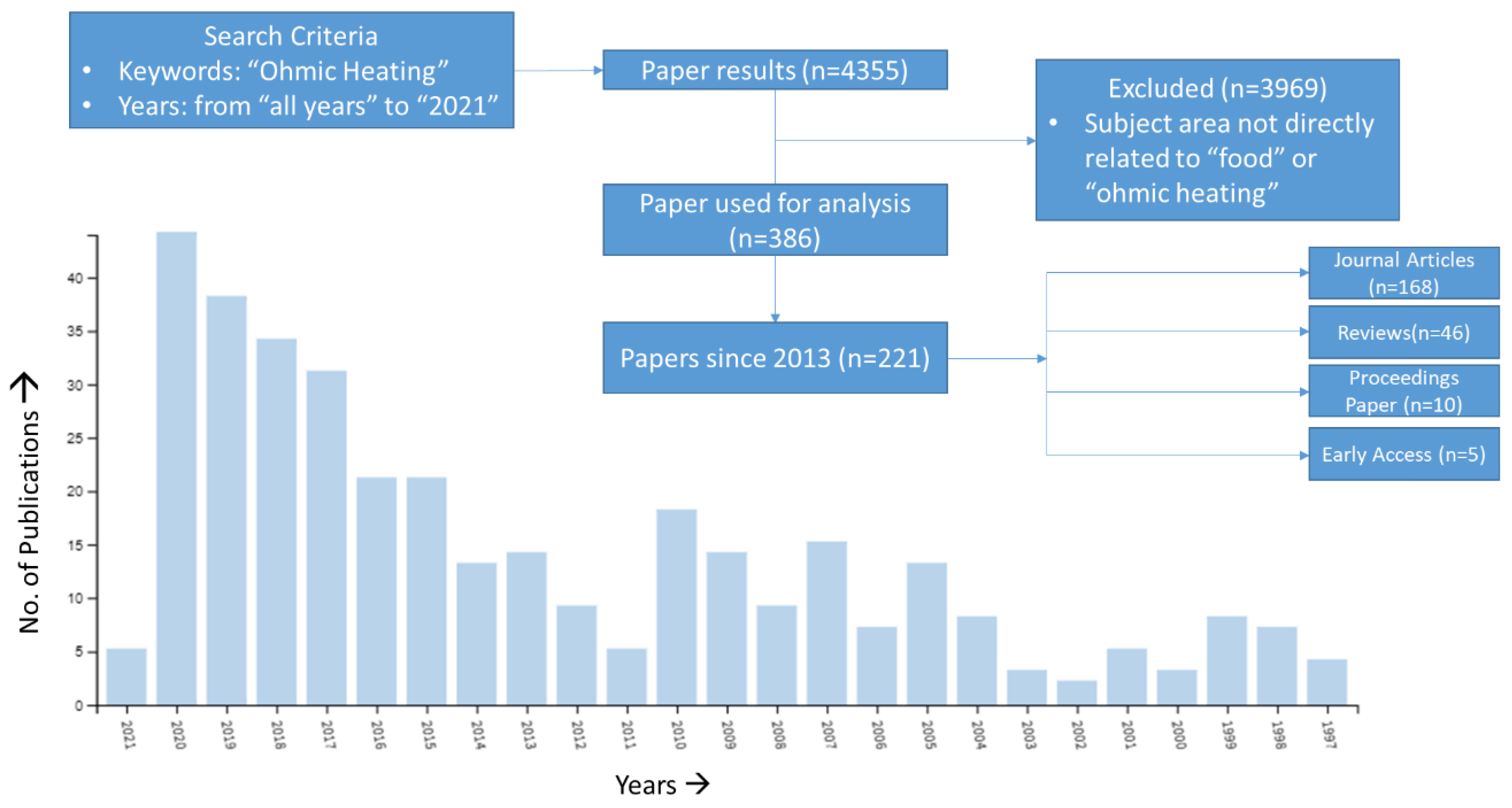
Ohmic Heating in the Food Industry: Developments in Concepts and Applications during 2013–2020

 ,
,  , and
, and 
Abstract
1. Introduction
2. Review Methodology
3. Principles of Ohmic Heating
4. Electrical Conductivity of Ohmic Heating
5. Applications of Ohmic Heating
6. Advantages and Disadvantages of Ohmic Heating
7. Effects of Ohmic Heating on Quality of Food Products
8. Effects of Ohmic Heating on Inactivation Microorganisms in Food
9. The Effect of Ohmic Heating on the Bioactive Compounds in Food
10. Effect of Ohmic Heating on Inactivation of Enzymes in Food
11. Future Trends
12. Conclusions
Author Contributions
Funding
Institutional Review Board Statement
Informed Consent Statement
Data Availability Statement
Acknowledgments
Conflicts of Interest
References
- Kurian, J.K.; Raghavan, G.S.V. Conventional and Advanced Thermal Processing Technologies for Enhancing Food Safety. In Food Safety Engineering; Springer: Cham, Switzerland, 2020; pp. 447–469. [Google Scholar]
- Zhang, Z.-H.; Wang, L.-H.; Zeng, X.-A.; Han, Z.; Brennan, C.S. Non-thermal technologies and its current and future application in the food industry: A review. Int. J. Food Sci. Technol. 2018, 54, 1–13. [Google Scholar] [CrossRef] [Scilit]
- Pratap-Singh, A.; Singh, A.; Ramaswamy, H.S. Heat transfer phenomena during thermal processing of liquid particulate mixtures—A review. Crit. Rev. Food Sci. Nutr. 2017, 57, 1350–1364. [Google Scholar] [CrossRef] [Scilit]
- Pratap-Singh, A.; Yen, P.P.-L.; Ramaswamy, H.S.; Singh, A. Recent advances in agitation thermal processing. Curr. Opin. Food Sci. 2018, 23, 90–96. [Google Scholar] [CrossRef] [Scilit]
- Singh, A.; Pratap-Singh, A.; Ramaswamy, H.S. A Controlled Agitation Process for Improving Quality of Canned Green Beans during Agitation Thermal Processing. J. Food. Sci. 2016, 81, E1399–E1411. [Google Scholar] [CrossRef] [Scilit] [PubMed]
- Dag, D.; Singh, R.K.; Kong, F. Developments in Radio Frequency Pasteurization of Food Powders. Food Rev. Int. 2020, 1–18. [Google Scholar] [CrossRef] [Scilit]
- Funcia, E.S.; Gut, J.A.W.; Sastry, S.K. Effect of Electric Field on Pectinesterase Inactivation during Orange Juice Pasteurization by Ohmic Heating. Food Bioprocess Technol. 2020, 13, 1206–1214. [Google Scholar] [CrossRef] [Scilit]
- Tian, X.; Yu, Q.; Wu, W.; Dai, R. Inactivation of Microorganisms in Foods by Ohmic Heating: A Review. J. Food Prot. 2018, 81, 1093–1107. [Google Scholar] [CrossRef] [Scilit] [PubMed]
- Lyng, J.G.; Clemente, I.; McKenna, B.M. Ohmic Pasteurization of Meat and Meat Products. In Handbook of Farm, Dairy and Food Machinery Engineering; Academic Press: Cambridge, MA, USA, 2019; pp. 593–622. [Google Scholar]
- Stojceska, V.; Atuonwu, J.; Tassou, S.A. Ohmic and conventional drying of citrus products: Energy efficiency, greenhouse gas emissions and nutritional properties. Energy Procedia 2019, 161, 165–173. [Google Scholar] [CrossRef] [Scilit]
- Pires, R.P.; Cappato, L.P.; Guimarães, J.T.; Rocha, R.S.; Silva, R.; Balthazar, C.F.; Freitas, M.Q.; Silva, P.H.F.; Neto, R.P.; Tavares, M.I.B.; et al. Ohmic heating for infant formula processing: Evaluating the effect of different voltage gradient. J. Food Eng. 2020, 280, 109989. [Google Scholar] [CrossRef] [Scilit]
- Gavahian, M.; Sastry, S.; Farhoosh, R.; Farahnaky, A. Ohmic heating as a promising technique for extraction of herbal essential oils: Understanding mechanisms, recent findings, and associated challenges. In Advances in Food and Nutrition Research; Academic Press: Cambridge, MA, USA, 2020; Volume 91, pp. 227–273. [Google Scholar]
- Picart-Palmade, L.; Cunault, C.; Chevalier-Lucia, D.; Belleville, M.-P.; Marchesseau, S. Potentialities and Limits of Some Non-thermal Technologies to Improve Sustainability of Food Processing. Front. Nutr. 2019, 5, 130. [Google Scholar] [CrossRef] [Scilit]
- Makroo, H.A.; Rastogi, N.K.; Srivastava, B. Ohmic heating assisted inactivation of enzymes and microorganisms in foods: A review. Trends Food Sci. Technol. 2020, 97, 451–465. [Google Scholar] [CrossRef] [Scilit]
- Lee, S.-Y.; Ryu, S.; Kang, D.-H. Effect of Frequency and Waveform on Inactivation of Escherichia coli O157: H7 and Salmonella enterica Serovar Typhimurium in Salsa by Ohmic Heating. Appl. Environ. Microbiol. 2013, 79, 10–17. [Google Scholar] [CrossRef] [Scilit] [PubMed]
- Kim, S.S.; Park, S.H.; Kim, S.H.; Kang, D.H. Synergistic effect of ohmic heating and UV-C irradiation for inac-tivation of Escherichia coli O157: H7, Salmonella Typhimurium and Listeria monocytogenes in buffered peptone water and tomato juice. Food Control 2019, 102, 69–75. [Google Scholar] [CrossRef] [Scilit]
- Park, I.-K.; Ha, J.-W.; Kang, D.-H. Investigation of optimum ohmic heating conditions for inactivation of Esche-richia coli O157: H7, Salmonella enterica serovar Typhimurium, and Listeria monocytogenes in apple juice. BMC Microbiol. 2017, 17, 117. [Google Scholar] [CrossRef] [Scilit]
- Leizerson, S.; Shimoni, E. Effect of ultrahigh-temperature continuous ohmic heating treatment on fresh orange juice. J. Agric. Food Chem. 2005, 53, 3519–3524. [Google Scholar] [CrossRef] [Scilit] [PubMed]
- Cho, W.-I.; Yi, J.Y.; Chung, M.-S. Pasteurization of fermented red pepper paste by ohmic heating. Innov. Food Sci. Emerg. Technol. 2016, 34, 180–186. [Google Scholar] [CrossRef] [Scilit]
- Alamprese, C.; Cigarini, M.; Brutti, A. Effects of ohmic heating on technological properties of whole egg. Innov. Food Sci. Emerg. Technol. 2019, 58, 102244. [Google Scholar] [CrossRef] [Scilit]
- Leite, T.S.; Samaranayake, C.P.; Sastry, S.K.; Cristianini, M. Polyphenol oxidase inactivation in viscous fluids by ohmic heating and conventional thermal processing. J. Food Process. Eng. 2019, 42. [Google Scholar] [CrossRef] [Scilit]
- Hashemi, S.M.B.; Roohi, R. Ohmic heating of blended citrus juice: Numerical modeling of process and bacterial inactivation kinetics. Innov. Food Sci. Emerg. Technol. 2019, 52, 313–324. [Google Scholar] [CrossRef] [Scilit]
- Darvishi, H.; Salami, P.; Fadavi, A.; Saba, M.K. Processing kinetics, quality and thermodynamic evaluation of mulberry juice concentration process using Ohmic heating. Food Bioprod. Process. 2020, 123, 102–110. [Google Scholar] [CrossRef] [Scilit]
- Mandal, R.; Mohammadi, X.; Wiktor, A.; Singh, A.; Singh, A.P.; Anubhav, P.S. Applications of Pulsed Light Decontamination Technology in Food Processing: An Overview. Appl. Sci. 2020, 10, 3606. [Google Scholar] [CrossRef] [Scilit]
- Kim, S.-S.; Sung, H.-J.; Kwak, H.-S.; Joo, I.-S.; Lee, J.-S.; Ko, G.; Kang, D.-H. Effect of Power Levels on Inactivation of Escherichia coli O157:H7, Salmonella Typhimurium, and Listeria monocytogenes in Tomato Paste Using 915-Megahertz Microwave and Ohmic Heating. J. Food Prot. 2016, 79, 1616–1622. [Google Scholar] [CrossRef] [Scilit] [PubMed]
- Kim, N.; Ryang, J.; Lee, B.; Kim, C.; Rhee, M. Continuous ohmic heating of commercially processed apple juice using five sequential electric fields results in rapid inactivation of Alicyclobacillus acidoterrestris spores. Int. J. Food Microbiol. 2017, 246, 80–84. [Google Scholar] [CrossRef] [Scilit]
- Kim, S.-S.; Kang, D.-H. Comparison of pH effects on ohmic heating and conventional heating for inactivation of Escherichia coli O157: H7, Salmonella enterica Serovar Typhimurium and Listeria monocytogene s in orange juice. LWT 2015, 64, 860–866. [Google Scholar] [CrossRef] [Scilit]
- Pereira, R.N.; Costa, J.; Rodrigues, R.M.; Villa, C.; Machado, L.; Mafra, I.; Vicente, A. Effects of ohmic heating on the immunoreactivity of β-lactoglobulin—A relationship towards structural aspects. Food Funct. 2020, 11, 4002–4013. [Google Scholar] [CrossRef] [Scilit]
- Pereira, R.; Pereira, M.D.; Teixeira, J.A.; Vicente, A.A. Effects of Ohmic Heating Technology in Chemical Properties of Foods. In Proceedings of the Slovak Society of Chemical Engineering Institute of Chemical and Environmental Engineering Slovak University of Technology in 33rd International Conference of SSCHE, Bratislava, Slovakia, 22–26 May 2006; pp. 113-1–113-9, ISBN 80-227-2409-2. [Google Scholar]
- Pereira, R.N.; Rodrigues, R.M.; Genisheva, Z.; Oliveira, H.; de Freitas, V.; Teixeira, J.A.; Vicente, A.A. Effects of ohmic heating on extraction of food-grade phytochemicals from colored potato. LWT 2016, 74, 493–503. [Google Scholar] [CrossRef] [Scilit]
- Jesus, M.S.; Ballesteros, L.F.; Pereira, R.N.; Genisheva, Z.; Carvalho, A.S.; Pereira-Wilson, C.; Teixeira, J.A.; Domingues, L. Ohmic heating polyphenolic extracts from vine pruning residue with enhanced biological activity. Food Chem. 2020, 316, 126298. [Google Scholar] [CrossRef] [Scilit] [PubMed]
- Pereira, R.; Martins, J.; Mateus, C.; Teixeira, J.A.C.; Vicente, A.A.A. Death kinetics of Escherichia coli in goat milk and Bacillus licheniformis in cloudberry jam treated by ohmic heating. Chem. Pap. 2007, 61, 121–126. [Google Scholar] [CrossRef] [Scilit]
- Coelho, M.; Pereira, R.; Rodrigues, A.S.; Teixeira, J.A.; Pintado, M.E. Extraction of tomato by-products’ bioac-tive compounds using ohmic technology. Food Bioprod. Process. 2019, 117, 329–339. [Google Scholar] [CrossRef] [Scilit]
- Vicente, A.A.; Pereira, R.N.; Penna, T.C.V.; Knirsch, M. Electricity effects on microorganisms and enzymes. In Ohmic Heating in Food Processing; CRC Press: Boca Raton, FL, USA, 2014; pp. 115–126. [Google Scholar]
- Castro, I.; Macedo, B.; Teixeira, J.A.; Vicente, A.A. The effect of electric field on important food-processing en-zymes: Comparison of inactivation kinetics under conventional and ohmic heating. J. Food Sci. 2004, 69, C696–C701. [Google Scholar] [CrossRef] [Scilit]
- Kaur, N.; Singh, A.K. Ohmic Heating: Concept and Applications—A Review. Crit. Rev. Food Sci. Nutr. 2016, 56, 2338–2351. [Google Scholar] [CrossRef] [Scilit]
- Singh, R.P.; Heldman, D.R. Introduction to Food Engineering, 5th ed.; Academic Press Incorporation: Orlando, FL, USA, 2014. [Google Scholar]
- Silva, V.L.; Santos, L.M.; Silva, A.M. Ohmic heating: An emerging concept in organic synthesis. Chem. Eur. J. 2017, 23, 7853–7865. [Google Scholar] [CrossRef] [Scilit]
- Al-Hilphy, A.R.S. Engineering intervention for extraction of essential oils from plants. In Engineering Interventions in Foods and Plants; Vermaz, D.K., Goyal, M.R., Eds.; Apple Academic Press: Cambridge, MA, USA, 2018; 298p, ISBN 978-1-77188-596-6. [Google Scholar]
- Kumar, T. A Review on Ohmic Heating Technology: Principle, Applications and Scope. Int. J. Agric. Environ. Biotechnol. 2018, 11, 679–687. [Google Scholar] [CrossRef] [Scilit]
- Kumar, T.; Smith, D.D.; Kumar, S.; Vimla, B. Effect of voltage gradient and temperature on electrical conduc-tivity of grape (Vitis vinifera L.) juice during ohmic heating. Int. J. Curr. Microbiol. Appl. Sci. 2018, 7, 1914–1921. [Google Scholar] [CrossRef] [Scilit]
- Kumar, J.P.; Ramanathan, M.; Ranganathan, T.V. Ohmic heating technology in food processing–A review. Int. J. Food Eng. Res. Technol. 2014, 3, 1236–1241. [Google Scholar]
- Indiarto, R.; Rezaharsamto, B. A Review on Ohmic Heating and Its Use in Food. Int. J. Sci. Technol. Res. 2020, 9, 485–490. [Google Scholar]
- Sakr, M.; Liu, S. A comprehensive review on applications of ohmic heating (OH). Renew. Sustain. Energy Rev. 2014, 39, 262–269. [Google Scholar] [CrossRef] [Scilit]
- Bender, D.; Gratz, M.; Vogt, S.; Fauster, T.; Wicki, B.; Pichler, S.; Kinner, M.; Jäger, H.; Schoenlechner, R. Ohmic Heating—A Novel Approach for Gluten-Free Bread Baking. Food Bioprocess Technol. 2019, 12, 1603–1613. [Google Scholar] [CrossRef] [Scilit]
- Darvishi, H.; Hosainpour, A.; Nargesi, F. Ohmic Heating Behaviour and Electrical Conductivity of Tomato Paste. J. Nutr. Food Sci. 2012, 2, 1–5. [Google Scholar] [CrossRef]
- Boldaji, M.T.; Borghei, A.M.; Beheshti, B.; Hosseini, S.E. The process of producing tomato paste by ohmic heating method. J. Food Sci. Technol. 2014, 52, 1–9. [Google Scholar] [CrossRef] [Scilit]
- Varghese, K.S.; Pandey, M.C.; Radhakrishna, K.; Bawa, A.S. Technology, applications and modelling of ohmic heating: A review. J. Food Sci. Technol. 2014, 51, 2304–2317. [Google Scholar] [CrossRef] [Scilit]
- Arroyo, C.; Lyng, J.G. Electroprocessing of meat and meat products. In Emerging Technologies in Meat Processing: Production, Processing and Technology; Wiley: Hoboken, NJ, USA, 2016; pp. 103–130. [Google Scholar]
- Llave, Y.; Udo, T.; Fukuoka, M.; Sakai, N. Ohmic heating of beef at 20 kHz and analysis of electrical conductivity at low and high frequencies. J. Food Eng. 2018, 228, 91–101. [Google Scholar] [CrossRef] [Scilit]
- Muhammad, A.I.; Shitu, A.; Tadda, M.A. Ohmic Heating as Alternative Preservation Technique—A Review. Arid Zone Journal of Engineering. Technol. Environ. 2019, 15, 268–277. [Google Scholar]
- Richa, R.; Shahi, N.C.; Singh, A.; Lohani, U.C.; Omre, P.K.; Kumar, A.; Bhattacharya, T.K. Ohmic Heating Technology and Its Application in Meaty Food: A Review. Adv. Res. 2017, 10, 1–10. [Google Scholar] [CrossRef] [Scilit]
- Costa, N.R.; Cappato, L.P.; Ferreira, M.V.S.; Pires, R.P.; Moraes, J.; Esmerino, E.A.; Silva, R.; Neto, R.P.; Tavares, M.I.B.; Freitas, M.Q.; et al. Ohmic Heating: A potential technology for sweet whey processing. Food Res. Int. 2018, 106, 771–779. [Google Scholar] [CrossRef] [Scilit] [PubMed]
- Kautkar, S.; Pandey, R.K.; Richa, R.; Kothakota, A. Temperature dependent electrical conductivities of ginger paste during ohmic heating. Int. J. Agric. Environ. Biotechnol. 2014, 8, 21. [Google Scholar] [CrossRef] [Scilit]
- Gomathy, K.; Thangavel, K.; Balakrishnan, M.; Kasthuri, R. Effect of ohmic heating on the electrical conductivity, biochemical and rheological properties of papaya pulp. J. Food Process Eng. 2015, 38, 405–413. [Google Scholar] [CrossRef] [Scilit]
- Parmar, P.; Singh, A.K.; Meena, G.S.; Borad, S.; Raju, P.N. Application of ohmic heating for concentration of milk. J. Food Sci. Technol. 2018, 55, 4956–4963. [Google Scholar] [CrossRef] [Scilit]
- Suebsiri, N.; Kokilakanistha, P.; Laojaruwat, T.; Tumpanuvat, T.; Jittanit, W. The Pasteurization of Milk Applying Ohmic Heating in Comparison with Conventional Method and the Quality Attributes of Lactose-Free Milk. Res. J. Phranakhon Rajabhat Sci. Technol. 2019, 14, 25–35. [Google Scholar]
- Karunanithi, S.; Pare, A.; Sunil, C.K.; Loganathan, M. Optimization of Process Parameters of Ohmic Heating for Improving Yield and Quality of Tomato Seed Oil. Int. J. Pure App. Biosci. 2019, 7, 104–114. [Google Scholar] [CrossRef] [Scilit]
- Sarkis, J.R.; Jaeschke, D.P.; Mercali, G.D.; Tessaro, I.C.; Marczak, L.D.F. Degradation kinetics of anthocyanins in blackberry pulp during ohmic and conventional heating. Int. Food Res. J. 2019, 26, 87–97. [Google Scholar]
- Kumar, V.A.; Pravitha, M.; Pare, A. Optimization of Composite Protein-Lipid Film by Ohmic Heating using Mixture Design. Int. J. Curr. Microbiol. App. Sci. 2019, 8, 230–240. [Google Scholar] [CrossRef] [Scilit]
- Supratomo, S.; Laga, A.; Tahir, M.; Mochtar, A.A.; Salengke, S. Design and performance test of ohmic-assisted cocoa fermentation apparatus. ARPN J. Eng. Appl. Sci. 2019, 14, 1515–1523. [Google Scholar]
- Bansode, S.; Ranveer, R.C.; Tapre, A.R.; Ganorkar, P.M.; Sadale, S.B.; Sahoo, A.K. Enzymatic Clarification and Preservation of Aloe vera Juice by Ohmic Heating. Curr. J. Appl. Sci. Technol. 2019, 35, 1–9. [Google Scholar] [CrossRef] [Scilit]
- Hardinasinta, G.; Salengke, S.; Juaedi, M.; Mursalim, M. Ohmic heating characteristics and degradation kinetics of anthocyanin in mulberry juice. IOP Conf. Ser. Earth Environ. Sci. 2019, 355, 012094. [Google Scholar] [CrossRef] [Scilit]
- Aydin, C.; Kurt, Ü.; Kaya, Y. Comparison of the Effects of Ohmic and Conventional Heating Methods on Some Quality Parameters of the Hot-smoked Fish Pâté. J. Aquat. Food Prod. Technol. 2020, 29, 407–416. [Google Scholar] [CrossRef] [Scilit]
- Rocha, R.S.; Silva, R.; Guimarães, J.T.; Balthazar, C.F.; Pimentel, T.C.; Neto, R.P.; Tavares, M.I.B.; Esmerino, E.A.; Freitas, M.Q.; Cappato, L.P.; et al. Possibilities for using ohmic heating in Minas Frescal cheese production. Food Res. Int. 2020, 131, 109027. [Google Scholar] [CrossRef] [Scilit]
- Patel, A.; Singh, M. Ohmic Heating for Food Products- A Review. Curr. J. Appl. Sci. Technol. 2018, 27, 1–7. [Google Scholar] [CrossRef] [Scilit] [PubMed]
- Müller, W.A.; Marczak, L.D.F.; Sarkis, J.R. Microbial inactivation by ohmic heating: Literature review and in-fluence of different process variables. Trends Food Sci. Technol. 2020, 99, 650–659. [Google Scholar] [CrossRef] [Scilit]
- Jaeger, H.; Roth, A.; Toepfl, S.; Holzhauser, T.; Engel, K.-H.; Knorr, D.; Vogel, R.F.; Bandick, N.; Kulling, S.; Heinz, V.; et al. Opinion on the use of ohmic heating for the treatment of foods. Trends Food Sci. Technol. 2016, 55, 84–97. [Google Scholar] [CrossRef] [Scilit]
- Kaur, R.; Gul, K.; Singh, A.K. Nutritional impact of ohmic heating on fruits and vegetables—A review. Cogent Food Agric. 2016, 2, 1159000. [Google Scholar] [CrossRef] [Scilit]
- Sun, H.; Kawamura, S.; Himoto, J.-I.; Itoh, K.; Wada, T.; Kimura, T. Effects of Ohmic Heating on Microbial Counts and Denaturation of Proteins in Milk. Food Sci. Technol. Res. 2008, 14, 117–123. [Google Scholar] [CrossRef] [Scilit]
- Olivera, D.F.; Salvadori, V.O.; Marra, F. Ohmic treatment of fresh foods: Effect on textural properties. Int. Food Res. J. 2013, 20, 1617–1621. [Google Scholar]
- Yildiz-Turp, G.; Sengun, I.; Kendirci, P.; Icier, F.; Yıldız-Turp, G. Effect of ohmic treatment on quality characteristic of meat: A review. Meat Sci. 2013, 93, 441–448. [Google Scholar] [CrossRef] [Scilit] [PubMed]
- Kumari, K.; Mudgal, V.D.; Viswasrao, G.; Srivastava, H. Studies on the effect of ohmic heating on oil recovery and quality of sesame seeds. J. Food Sci. Technol. 2016, 53, 2009–2016. [Google Scholar] [CrossRef] [Scilit]
- Abedelmaks, T.G.; Mohsen, S.M.; Duedahl-Ol, L.; Elnikeety, M.M.; Feyissa, A.H. Effect of Ohmic Heating Parameters on Inactivation of Enzymes and Quality of Not-from-concentrate Mango Juice. Asian J. Sci. Res. 2018, 11, 383–392. [Google Scholar] [CrossRef] [Scilit]
- Ramírez-Jiménez, A.K.; Rangel-Hernández, J.; Morales-Sánchez, E.; Loarca-Piña, G.; Gaytán-Martínez, M. Changes on the phytochemicals profile of instant corn flours obtained by traditional nixtamalization and ohmic heating process. Food Chem. 2019, 276, 57–62. [Google Scholar] [CrossRef] [Scilit] [PubMed]
- Mercali, G.D.; Gurak, P.D.; Schmitz, F.; Marczak, L.D.F. Evaluation of non-thermal effects of electricity on anthocyanin degradation during ohmic heating of jaboticaba (Myrciaria cauliflora) juice. Food Chem. 2015, 171, 200–205. [Google Scholar] [CrossRef] [Scilit] [PubMed]
- Schottroff, F.; Biebl, D.; Gruber, M.; Burghardt, N.; Schelling, J.; Gratz, M.; Schoenher, C.; Jaeger, H. Inactivation of vegetative microorganisms by ohmic heating in the kilohertz range—Evaluation of experimental setups and non-thermal effects. Innov. Food Sci. Emerg. Technol. 2020, 63, 102372. [Google Scholar] [CrossRef] [Scilit]
- Murashita, S. Development of Non-Thermal Microbial Inactivation Techniques: Application of Ohmic Heating and Irradiation of UVC by Light-Emitting Diode. Ph.D. Dissertation, Hokkaido University, Sapporo, Japan, 2018. [Google Scholar] [CrossRef]
- Song, W.J.; Sung, H.J.; Kang, D.H. Inactivation of E scherichia coli O157: H7 and S almonella Typhimurium in apple juices with different soluble solids content by combining ozone treatment with mild heat. J. Appl. Microbiol. 2015, 118, 112–122. [Google Scholar] [CrossRef] [Scilit] [PubMed]
- Lyng, J.G.; McKenna, B.M.; Arroyo, C. Ohmic heating of foods. In Alternatives to Conventional Food Processing; Royal Society of Chemistry: London, UK, 2018; pp. 95–137. [Google Scholar]
- Zell, M.; Lyng, J.G.; Cronin, D.A.; Morgan, D.J. Ohmic cooking of whole beef muscle—Evaluation of the impact of a novel rapid ohmic cooking method on product quality. Meat Sci. 2010, 86, 258–263. [Google Scholar] [CrossRef] [Scilit]
- Somavat, R. Applications and Effects of Ohmic Heating: Sterilization, Influence on Bacterial Spores, Enzymes, Bioactive Components and Quality Factors in Food. Ph.D. Thesis, The Ohio State University, Columbus, OH, USA, 2011. [Google Scholar]
- Sagong, H.-G.; Park, S.-H.; Choi, Y.-J.; Ryu, S.; Kang, D.-H. Inactivation of Escherichia coli O157:H7, Salmonella Typhimurium, and Listeria monocytogenes in Orange and Tomato Juice Using Ohmic Heating. J. Food Prot. 2011, 74, 899–904. [Google Scholar] [CrossRef] [Scilit] [PubMed]
- Lee, S.-Y.; Sagong, H.-G.; Ryu, S.; Kang, D.-H. Effect of continuous ohmic heating to inactivate Escherichia coli O157:H7, Salmonella Typhimurium and Listeria monocytogenes in orange juice and tomato juice. J. Appl. Microbiol. 2012, 112, 723–731. [Google Scholar] [CrossRef] [Scilit] [PubMed]
- Sengun, I.Y.; Turp, G.Y.; Icier, F.; Kendirci, P.; Kor, G. Effects of ohmic heating for pre-cooking of meatballs on some quality and safety attributes. LWT 2014, 55, 232–239. [Google Scholar] [CrossRef] [Scilit]
- Kumar, M.; Hausain, A. Effect of ohmic heating of buffalo milk on microbial quality and tesure of paneer. Asian J. Dairy. Food Res. 2014, 33, 9–13. [Google Scholar] [CrossRef] [Scilit]
- Salari, S.; Jafari, S.M. The Influence of Ohmic Heating on Degradation of Food Bioactive Ingredients. Food Eng. Rev. 2020, 12, 191–208. [Google Scholar] [CrossRef] [Scilit]
- Jatau, S.H.; Sokoto, M.A.; Almustapha, M.N.; Muhammad, C.; Dabai, M.U.; Zubairu, A.Y. Effect of heat on lycopene content of hot peppers (capsicum annum) using various processing temperature. Int. J. Sci. Eng. 2018, 14, 32–39. [Google Scholar]
- Cappato, L.P.; Ferreira, M.V.S.; Moraes, J.; Pires, R.P.; Rocha, R.S.; Silva, R.; Calado, V.M. Whey acer-ola-flavoured drink submitted Ohmic Heating: Bioactive compounds, antioxidant capacity, thermal behavior, water mo-bility, fatty acid profile and volatile compounds. Food Chem. 2018, 263, 81–88. [Google Scholar] [CrossRef] [Scilit] [PubMed]
- Mercali, G.D.; Jaeschke, D.P.; Tessaro, I.C.; Marczak, L.D.F. Degradation kinetics of anthocyanins in acerola pulp: Comparison between ohmic and conventional heat treatment. Food Chem. 2013, 136, 853–857. [Google Scholar] [CrossRef] [Scilit]
- Sakulchuthathip, V.; Yasurin, P.; Tangduangdee, C.; Asavasanti, S. Extraction of bioactive compounds from Chinese chives using ohmic assisted hydrodistillation. Extraction 2017, 15, 17. [Google Scholar]
- Kuriya, S.P.; Silva, R.; Rocha, R.S.; Guimarães, J.T.; Balthazar, C.F.; Pires, R.P.; Raices, R.S. Assessment the impact of the electric field on the quality parameters of blueberry flavored dairy desserts. Food Res. Int. 2020, 134, 1–38. [Google Scholar] [CrossRef] [Scilit] [PubMed]
- Loypimai, P.; Moongngarm, A.; Chottanom, P.; Moontree, T. Ohmic heating-assisted extraction of anthocyanins from black rice bran to prepare a natural food colourant. Innov. Food Sci. Emerg. Technol. 2015, 27, 102–110. [Google Scholar] [CrossRef] [Scilit]
- Poojitha, P.; Athmaselvi, K. Influence of sucrose concentration on electric conductivity of banana pulp during ohmic heating. Food Sci. Technol. Int. 2018, 24, 664–672. [Google Scholar] [CrossRef] [Scilit]
- Saberian, H.; Esfahani, Z.H.; Abbasi, S. Effect of conventional and ohmic pasteurization on some bioactive components of aloe Vera gel juice. Iran. J. Chem. Chem. Eng. 2015, 34, 99–108. [Google Scholar]
- Jaeschke, D.P.; Marczak, L.D.F.; Mercali, G.D. Evaluation of non-thermal effects of electricity on ascorbic acid and carotenoid degradation in acerola pulp during ohmic heating. Food Chem. 2016, 199, 128–134. [Google Scholar] [CrossRef] [Scilit] [PubMed]
- Abedelmaksoud, T.G.; Mohsen, S.M.; Duedahl-Olesen, L.; Elnikeety, M.M.; Feyissa, A.H. Optimization of ohmic heating parameters for polyphenoloxidase inactivation in not-from-concentrate elstar apple juice using RSM. J. Food Sci. Technol. 2018, 55, 2420–2428. [Google Scholar] [CrossRef] [Scilit] [PubMed]
- Mäntsälä, P.; Jarmo, N. Enzymes: The biological catalysts of life. Physiol. Maintanance 2009, 2, 1–22. [Google Scholar]
- Terefe, N.S.; Buckow, R.; Versteeg, C. Quality-Related Enzymes in Fruit and Vegetable Products: Effects of Novel Food Processing Technologies, Part 1: High-Pressure Processing. Crit. Rev. Food Sci. Nutr. 2014, 54, 24–63. [Google Scholar] [CrossRef] [Scilit] [PubMed]
- Kostelac, D.; Putnik, P.; Markov, K.; Frece, J.; Kovačević, D.B. Effects of electrotechnologies on enzymes in foods and food model systems. Curr. Opin. Food Sci. 2020, 31, 47–56. [Google Scholar] [CrossRef] [Scilit]
- Han, Y.; Cheng, J.-H.; Sun, D.-W. Activities and conformation changes of food enzymes induced by cold plasma: A review. Crit. Rev. Food Sci. Nutr. 2019, 59, 794–811. [Google Scholar] [CrossRef] [Scilit]
- Poojary, M.; Roohinejad, S.; Koubaa, M.; Barba, F.; Passamonti, P.; Jambrak, A.R.; Greiner, R. Impact of pulsed electric fields on enzymes. In Handbook of Electroporation; Miklavbcic, D., Ed.; Springer: Cham, Switzerland, 2016. [Google Scholar]
- Yu, L.J.; Ngadi, M.; Raghavan, G.S.V. Effect of temperature and pulsed electric field treatment on rennet co-agulation properties of milk. J. Food Eng. 2009, 95, 115–118. [Google Scholar] [CrossRef] [Scilit]
- Tappi, S.; Ragni, L.; Tylewicz, U.; Romani, S.; Ramazzina, I.; Rocculi, P. Browning response of fresh-cut apples of different cultivars to cold gas plasma treatment. Innov. Food Sci. Emerg. Technol. 2019, 53, 56–62. [Google Scholar] [CrossRef] [Scilit]
- Saxena, J.; Makroo, H.A.; Srivastava, B. Effect of ohmic heating on Polyphenol Oxidase (PPO) inactivation and color change in sugarcane juice. J. Food Process. Eng. 2016, 40, 1–11. [Google Scholar] [CrossRef] [Scilit]
- Li, X.; Xu, X.; Wang, L.; Regenstein, J.M. Effect of ohmic heating on physicochemical properties and the key en-zymes of water chestnut juice. J. Food Process. Preserv. 2019, 43, e13919. [Google Scholar] [CrossRef] [Scilit]
- Makroo, H.A.; Srivastava, B.; Sit, N.; Badwaik, L.S.; Das, A.B. Effects of ohmic heating on different liquid food materials. Trends Innov. Food Process. Technol. 2017, 3, 95–115. [Google Scholar]
- Li, F.D.; Chen, C.; Ren, J.; Wang, R.; Wu, P. Effect of ohmic heating of soymilk on urease inactivation and kinet-ic analysis in holding time. J. Food Sci. 2015, 80, E307–E315. [Google Scholar] [CrossRef] [Scilit] [PubMed]
- Jakób, A.; Bryjak, J.; Wójtowicz, H.; Illeová, V.; Annus, J.; Polakovič, M. Inactivation kinetics of food enzymes during ohmic heating. Food Chem. 2010, 123, 369–376. [Google Scholar] [CrossRef] [Scilit]
- Sengun, I.Y.; Icier, F.; Kor, G. Effects of Combined Ohmic-Infrared Cooking Treatment on Microbiological Inactivation of Meatballs. J. Food Process. Eng. 2015, 40. [Google Scholar] [CrossRef] [Scilit]
- Mesías, M.; Wagner, M.; George, S.; Morales, F.J. Impact of conventional sterilization and ohmic heating on the amino acid profile in vegetable baby foods. Innov. Food Sci. Emerg. Technol. 2016, 34, 24–28. [Google Scholar] [CrossRef] [Scilit]
- Pereira, R.N.; Teixeira, J.A.; Vicente, A.A.; Cappato, L.P.; Ferreira, M.V.D.S.; Rocha, R.D.S.; Da Cruz, A.G. Ohmic heating for the dairy industry: A potential technology to develop probiotic dairy foods in association with modifications of whey protein structure. Curr. Opin. Food Sci. 2018, 22, 95–101. [Google Scholar] [CrossRef] [Scilit]
- Park, S.H.; Balasubramaniam, V.; Sastry, S.K. Quality of shelf-stable low-acid vegetables processed using pressure–ohmic–thermal sterilization. LWT 2014, 57, 243–252. [Google Scholar] [CrossRef] [Scilit]
- Wongsa-Ngasri, P.; Sastry, S.K. Effect of ohmic heating on tomato peeling. LWT 2015, 61, 269–274. [Google Scholar] [CrossRef] [Scilit]
- Ramaswamy, H.S.; Marcotte, M. Food Processing: Principles and Applications, 1st ed.; CRC Press: Boca Raton, RL, USA, 2005. [Google Scholar]
- Kanogchaipramot, K.; Tongkhao, K.; Sajjaanantakul, T.; Kamonpatana, P. Ohmic Heating of an Electrically Conductive Food Package. J. Food Sci. 2016, 81, E2966–E2976. [Google Scholar] [CrossRef] [Scilit] [PubMed]


| Application | Electrical Properties | Temperature (°C) | Time (min) | Overall Outcomes | References |
|---|---|---|---|---|---|
| Pasteurized Lactose-Free Milk | 0.635–1.230 S/m | 25–65 | 30 | There was no significant difference in protein content, total acidity, and specific weight between the treated milk samples | [57] |
| Tomato seed oil | 14–10 V/cm | 40–60 | 5–15 | The type of oil was closed to the control sample and within the acceptable quality standards compared to conventional heating | [58] |
| Black raspberries | 23, 60, 125 V | 70–90 | 0–90 | Anthocyanin degradation at low voltage while its degradation increased when applying high voltage | [59] |
| Soy milk Peanut milk Corn milk | 12 V/cm | 85 ± 3 | 5 | A little effect on the yield and the content of lipoprotein in the membrane. Other changes such as color, dryness, and membrane thickness have been found with the ability to control the temperature and distribute it homogeneously | [60] |
| Cocoa fermentation | 5, 97 V/cm | 40, 45, 50 | 9.3, 13, 17 | The fermentation temperature was rapidly reached compared to conventional heating which required 8–12 h. | [61] |
| Aloe vera juice | 0.15, 0.25, 0.5 V | 24–25, 19–20 and 21 | 3, 5, 10 | Inactivate enzymes and reduce turbidity in aloe juice, thereby maintaining juice quality during storage for 60 days. | [62] |
| Mulberry juice | 0.014–0.039 S/m | 80–90 | 90 | The linear rate of heating and electrical conductivity increased with increasing temperature, and the degradation and deterioration of anthocyanins increased with increasing temperature | [63] |
| Smoked fish Pâté | 5 V/cm | 78 | 8.28 | A higher amount of volatile nitrogen during the storage period, the lower the TBA and PH values, the results were within the permissible limits. Less processing time and less energy consumption compared to conventional heating | [64] |
| Lactoglobulin proteins | 4 V/cm | 72.5 90 65 | 15 1 s 30 | Reducing the allergenic potential of β-LG based products. | [28] |
| Minas Frescal cheese | 4–12 V/cm | 72–75 | 15 s | Improving the sensory characteristics of the cheese of the product, in addition to increasing the proportion of active compounds | [65] |
| Foods | Electrical Properties | Effect of Ohmic Heating | References |
|---|---|---|---|
| Milk | 0.39 S/m | Inhibition of aerobic and thermophilic bacteria, there was no difference in the degrees of protein denaturation. A deadly thermal effect for microorganisms and another non-thermal effect due to the electric current. Very effective for milk pasteurization without the additional degradation of protein. | [70] |
| Fresh solid food (potatoes, carrots, and apples) | 1100 V/m; 2200 V/m; 3300 V/m). | A significant of ohmic heating on the texture of solid food. The hardness of the samples decreased with the treatment time and resulted in structural damage, even though the food material used in the study had a low electrical conductivity. | [71] |
| Meat and its production | 0.8 S/m and 1.6 S/m | The quantity of the product is higher while maintaining the sensory quality and improving the color compared to the traditional method, preventing the growth of microbes effectively. Temperature of 100 °C was able to cause the toxic changes in meat and meat products due to direct contact with electrodes and meat products. | [72] |
| Colored potato | 15 V/cm and 30 V/cm | Extraction of anthocyanins and phenolic compounds in large quantities, treatment time and energy consumption were low. | [30] |
| Sesame oil | 600, 750 and 900 V/m | The oil extraction rate was higher than mechanical recovery. Free fatty acids (oleic acid) and peroxide value were within acceptable limits. | [73] |
| Mango juice | 40 V/cm, 80 °C and holding time for 60 s | Polyphenol oxidase inhibition 96%, pectin methyl esterase 90%, decrease in the value of ascorbic acid (11.3%), total phenol content 8% higher compared to conventional heating and improve the functional properties of juice. | [74] |
| Corn flour | 120 V, 60 Hz. | Maintaining the insoluble fiber content, the percentage of soluble fibers increased by 65%, maintaining the composition of both phenols and antioxidants, greatly reducing water loss. | [75] |
| Polyphenolic extracts from vine pruning residue | 496.0–840.0 V/cm | An increase in the concentration of phenolic compounds, antioxidant activity, antimicrobial activity, and inhibitory activity of cancer cell growth. The extracts had advantages in the food, pharmaceutical, or cosmetic industries compared to other extraction methods in which toxic solvents should be removed. | [31] |
| Pasteurized orange juice | 32–36 V/cm, 60–90 °C, holding times 0–200 s | The pectin esterase inhibition was higher compared to the conventional method. | [7] |
| Food Matrix | Microorganisms | Treatment Conditions | Inactivation Effects | References |
|---|---|---|---|---|
| Orange juice | Bacteria, yeasts, molds | 50 Hz; 90, 120, 150 °C; 1.13, 0.85, 0.68 s | Complete inactivation of bacteria, yeasts, and molds | [18] |
| Cloudberry jam | Bacillus licheniformis | 50 Hz | D-values lower for OH than for thermal treatments; z-values 11.4 and 11.1 °C | [73] |
| Milk | Viable aerobes | 20 kHz; current varied from 7.3 to 2.0 A (voltage from 70 to 12 V) during the heating and holding phases, respectively | D-values for ohmic samples (8.64, 6.18, 0.38 min) were lower than those for conventional water bath samples | [70] |
| Meat | Listeria innocua | 50 Hz, 8.33 V/cm, 95 °C, 7 min | Bacteria inactivated to non-detectable | [81] |
| Tomato soup | Geobacillus stearothermophilus spores | 60 Hz and 10 kHz; 0, 15, 60,120 s for 121°C; 0, 15, 30, and 90 s for 125 °C; 0, 5, 10, 30 s for 130 °C | More than 5-log reduction in Geobacillus stearothermophilus spores | [82] |
| Tomato juice | E. coli O157:H7, Salmonella Typhimurium, Listeria monocytogenes | 60 Hz; 90 s; 20 V/cm60 Hz; 180 s; 15 V/cm 60 Hz; 480 s; 10 V/cm | 5-log reduction in all bacteria | [83] |
| Tomato juice | Salmonella Typhimurium Listeria monocytogenes | 25–40 V/cm, 76 °C, for 30 s | 5-log reduction in bacteria population | [84] |
| Beef meatballs | Molds, yeasts, Staphylococcus aureus, L. monocytogenes | 50 Hz; 15.26 V/cm; 758 °C; 0 s holding | Molds, yeasts reduced significantly S. aureus eliminated completely; L. monocytogenes cells not inactivated efficiently | [85] |
| Buffalo milk | Total visible colonies, yeasts, and molds, E. coli, Salmonella | 72 °C, frequency in range of 0–200 Hz current in range of 0–200 amperes voltage in range of 0–220 volts | Larger reductions of total visible colonies yeasts and molds, E. coli, and coliforms, Salmonella were completely killed | [86] |
| Tomato paste | E. coli O157:H7 Salmonella Typhimurium L.monocytogenes | 8.3–27.8 V/cm, 67–80 °C, for 60 s | 3-log reduction in E. coli O157:H7 Salmonella population, 3-log reduction in T. L. monocytogenes | [25] |
| Apple juice | Alicyclobacillus acidoterrestris Spores | 25 kHz; 26.7 V/cm; 100 °C; 30 s | Total inactivation | [26] |
| Concentrated Tomato juice | S. Typhimurium L.monocytogenes | 13.4 V/cm, 60–63°C, for 190–250 s | 5-log reduction in bacteria population | [17] |
| Foods | Condition | Effects On Bioactive Compounds Content, Phenolic Content, and Antioxidant Activity | References |
|---|---|---|---|
| Chinese Chives | 11.5 V/cm,100 °C and followed by 5.3 V/cm, 45 min | Reduced extraction time from 3 h to 45 min (75% reduction) compared to Hydrodistillation method. In addition, there was no significant difference in antioxidant activities of the extracts compared to Hydrodistillation method. | [91] |
| Blue-berry flavored dairy desserts | (1.82, 3.64, 5.45, 7.30, 9.1)V/cm, 90 °C, 3 min | 1.82 V/cm of electrical field intensity contributed to better preservation of bioactive compounds (phenolic compounds, anthocyanins) and increased antioxidant ability. | [92] |
| Black rice bran | 50, 100, 150, and 200 V/cm,105 °C, 3 min | A higher yield of bioactive and anthocyanin contents using ohmic heating compared to the steam-assisted solvent extraction methods. | [93] |
| Banana pulp | 13.33, 20 and 26.66 V/cm, 100 °C, 210 s | A decrease in ascorbic acid content was observed with an increase in voltage gradient. | [94] |
| Aloe vera gel juice | 30, 35, 45 and 55 V/cm at 60 Hz, 20 to 85 °C | Vitamin C was decreasd during ohmic heating more compared to conventional heating, while total phenolic content was increased more significantly compared to conventional pasteurization. | [95] |
| Tomato by-products | 4, 6 and 11 V/cm, 0–100 °C for 30 min | An improvement in the process of extracting polyphenols using ohmic heating by 77% compared to the control sample treated by the conventional method, extracting lycopene by 4.93 g/g FWfrom the byproducts of tomato without using organic solvents | [33] |
| Acerola pulp | 30 V, 60 Hz; 80, 85, 90, and 95 °C for 60 min, under oxygen atmosphere | The electric field did not affect the degradation rates of both ascorbic acid and carotenoid during ohmic heating. The results also reported high rate of both ascorbic acid and carotenoid degradation when the initial oxygen concentration is | [96] |
| Apple juice | 30, 35 and 40 V/cm, 60 Hz frequency; 60, 70 and 80 °C | The total extracted phenolic content was increased by 5.4% with ohmic heating and 2.5% with conventional method compared to fresh apple juice. The loss of ascorbic acid and carotenoids contents of ohmic treated sample was less than the conventional treated sample. | [97] |
Publisher’s Note: MDPI stays neutral with regard to jurisdictional claims in published maps and institutional affiliations. |
© 2021 by the authors. Licensee MDPI, Basel, Switzerland. This article is an open access article distributed under the terms and conditions of the Creative Commons Attribution (CC BY) license (http://creativecommons.org/licenses/by/4.0/).
Share and Cite
Alkanan, Z.T.; Altemimi, A.B.; Al-Hilphy, A.R.S.; Watson, D.G.; Pratap-Singh, A. Ohmic Heating in the Food Industry: Developments in Concepts and Applications during 2013–2020. Appl. Sci. 2021, 11, 2507. https://doi.org/10.3390/app11062507
Alkanan ZT, Altemimi AB, Al-Hilphy ARS, Watson DG, Pratap-Singh A. Ohmic Heating in the Food Industry: Developments in Concepts and Applications during 2013–2020. Applied Sciences. 2021; 11(6):2507. https://doi.org/10.3390/app11062507
Chicago/Turabian StyleAlkanan, Zina T., Ammar B. Altemimi, Asaad R. S. Al-Hilphy, Dennis G. Watson, and Anubhav Pratap-Singh. 2021. "Ohmic Heating in the Food Industry: Developments in Concepts and Applications during 2013–2020" Applied Sciences 11, no. 6: 2507. https://doi.org/10.3390/app11062507
APA StyleAlkanan, Z. T., Altemimi, A. B., Al-Hilphy, A. R. S., Watson, D. G., & Pratap-Singh, A. (2021). Ohmic Heating in the Food Industry: Developments in Concepts and Applications during 2013–2020. Applied Sciences, 11(6), 2507. https://doi.org/10.3390/app11062507