


Abstract
Transportation disadvantage is about the difficulty accessing mobility services required to complete activities associated with employment, shopping, business, essential needs, and recreation. Technological innovations in the field of smart mobility have been identified as a potential solution to help individuals overcome issues associated with transportation disadvantage. This paper aims to provide a consolidated understanding on how smart mobility innovations can contribute to alleviate transportation disadvantage. A systematic literature review is completed, and a conceptual framework is developed to provide the required information to address transportation disadvantage. The results are categorized under the physical, economic, spatial, temporal, psychological, information, and institutional dimensions of transportation disadvantage. The study findings reveal that: (a) Primary smart mobility innovations identified in the literature are demand responsive transportation, shared transportation, intelligent transportation systems, electric mobility, autonomous vehicles, and Mobility-as-a-Services. (b) Smart mobility innovations could benefit urban areas by improving accessibility, efficiency, coverage, flexibility, safety, and the overall integration of the transportation system. (c) Smart mobility innovations have the potential to contribute to the alleviation of transportation disadvantage. (d) Mobility-as-a-Service has high potential to alleviate transportation disadvantage primarily due to its ability to integrate a wide-range of services.
1. Introduction
In recent decades, rural-to-urban migration influenced by factors such as increased employment opportunities, access to services, education, and communication networks has led to a period of rapid urbanization [1]. Over 50% of the world’s population live in cities with this number expected to increase to 68% by 2050 [2]. While the environmental impact of providing transportation infrastructure in growing cities remains a primary concern in research [3], another important challenge relates to the provision of an inclusive, accessible, and affordable transportation for all individuals [4]. This is important as having access to transportation is crucial to improve social inclusion and allow people to access essential services, employment, and recreational facilities. Access to transportation is a critical component in achieving quality of life—particularly among vulnerable groups such as the elderly and disabled [5].
Transportation disadvantage relates to an individual’s ability to access transport and is particularly prevalent in areas without good access to public transportation. In these areas, individuals must rely on “private motor vehicles” (PMV), which typically come with higher costs than public transport due to purchasing, fuel, maintenance, insurance, and storage costs [6]. This combined with increased population growth has had a significant impact on property values with areas around public transport nodes experiencing higher property values [7]. Lower income earners are then forced into surrounding fringe areas, further increasing transportation costs and exacerbating issues surrounding transport disadvantage [8].
Smart mobility has been identified as a potential solution to alleviate many of the issues associated with transport disadvantage [9]. Smart mobility, a general term used to describe many of the transport-related technologies that have been implemented in urban areas, represents a new way of thinking about transportation including the creation of a more sustainable system that is able to overcome some of the issues associated with PMV [10,11]. While the number of research articles that focus on smart mobility is growing, little research to date has focused on how smart mobility can address transport disadvantage. Similarly, where specific smart mobility innovations, such as “autonomous vehicles” (AV), “flexible transportation services” (FTS), and “free-floating e-mobility” (FFM), or the integration of intelligent technologies have been investigated as a potential solution to transport disadvantage, they are often treated as separate entities with only a few comprehensive attempts to conceptualize how their integration can contribute to or alleviate the issue [12]. This requires explicit consideration as these changes do not happen in a silo, but are rather concurrent, or even dependent, on each other.
This paper attempts to contribute to existing research by analyzing the way that smart mobility innovations can address transport disadvantage in cities. Using a systematic literature review as the research methodology, this paper seeks to answer the research question: How can smart mobility contribute to alleviate transport disadvantage? To answer this question and ensure all technological advances are considered, we first reviewed the literature to determine the innovations relevant to the smart mobility field, how they relate to each other, and what the major benefits of these systems are to urban areas. Then, by looking through the lens of transport disadvantage, major contributions were identified and associated with our research aim and question. From the literature review, a conceptual framework representing the relationship between the benefits of smart mobility innovations and the various aspects of transport disadvantage was developed with the view that it could help researchers better understand the relationship between the two concepts. This paper also highlights future areas of research that can help other look to smart mobility innovations to alleviate issues regarding transport disadvantage.
2. Background to Smart Mobility
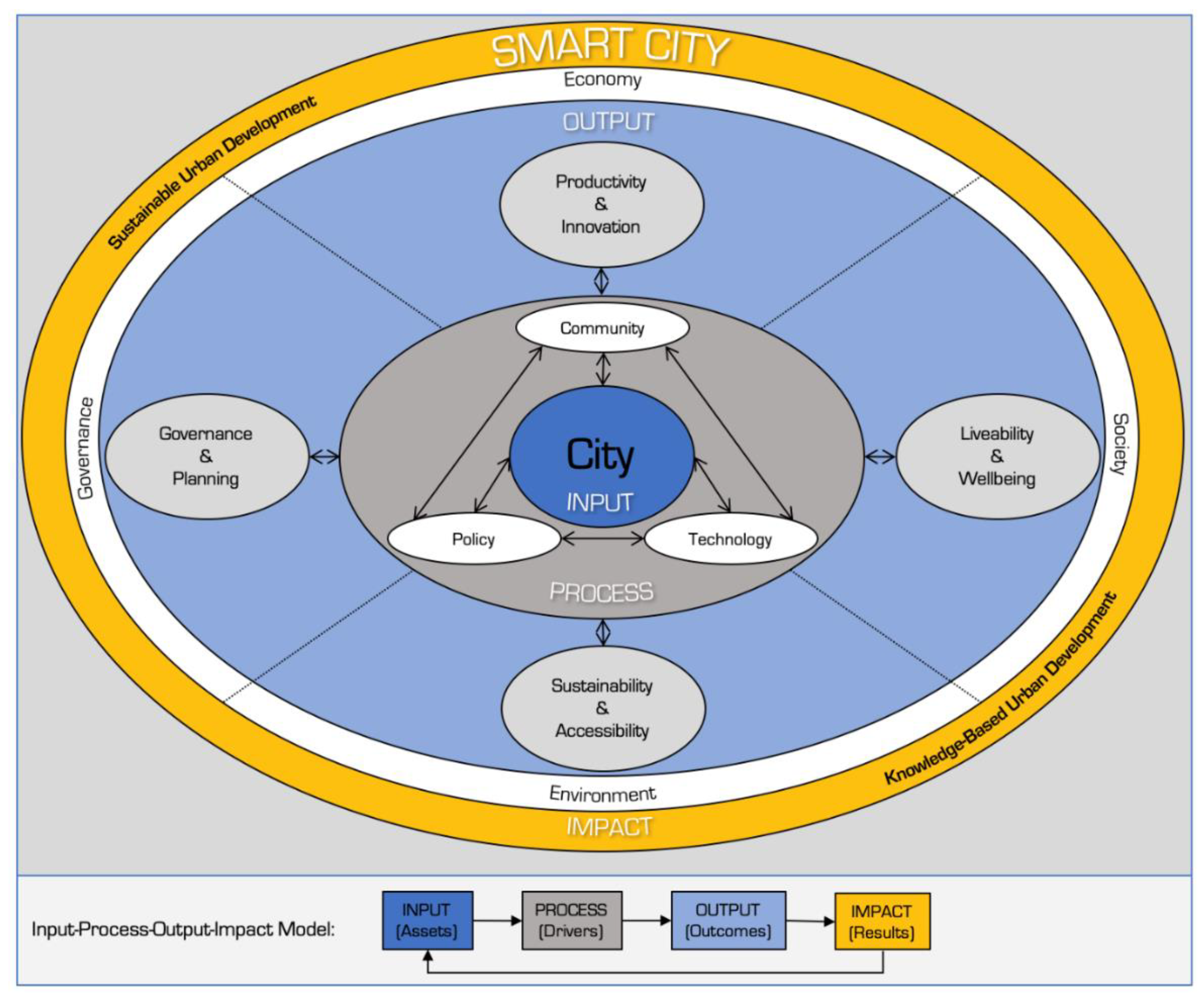
Smart mobility as a concept has its roots within the smart cities model: driven by policy, technology, and community, the primary goal of smart cities is to deliver productivity, innovation, livability, wellbeing, sustainability, accessibility, and good governance and planning [13]. The conceptual framework shown in Figure 1 demonstrates this concept through a simple input–output–impact model. In the context of smart cities, the transportation system could be considered an asset of the city which is implemented through various drivers, including technology, policy, and community. When successfully implemented, these drivers should lead to more desirable outputs (or outcomes), the result (or impact) being a smarter city—or in this case a smarter mobility system [13].
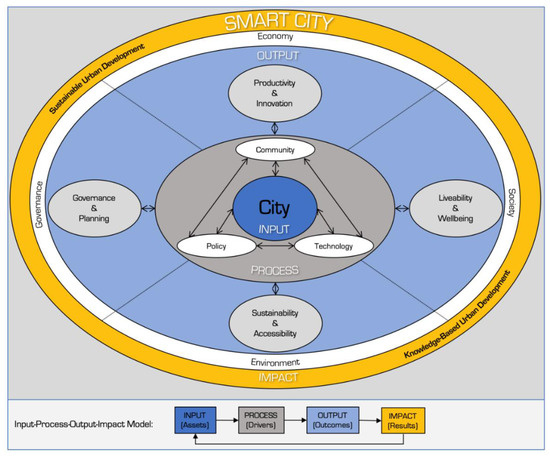
Figure 1.
Smart city conceptual framework (derived from [13]).
Built into this concept of smart cities is the notion of smart mobility [10,14]. Similar to the broader smart city concept, smart mobility is partially driven by community and policy; however, much of the focus is on using technology as a way to transform the transportation system while addressing the societal, economic, and environmental impacts associated with PMV, including issues regarding transport disadvantage [15,16]. Some of these innovations such as “demand responsive transportation” (DRT) have been implemented by local governments as a way of offering services to those most in need or replace underutilized public transport systems. They are often viewed more as an extension of the existing public transport network than a stand-alone system [17]. Similarly, ubiquitous infrastructure (“U-Infrastructure”) harnesses technological advances in ICT, “intelligent transportation systems” (ITS), and digital networks to improve efficiency of urban infrastructure [18].
Other systems including car sharing, ride sharing, FFM, AV, and alternative fuel vehicles are driven by private industry and with rapid advances in technology they are likely to disrupt the transport system, whether their benefits are harnessed by governments or they are left to evolve organically [19,20]. This was seen in 2015 in Australia following the introduction of Uber’s ride sharing platform. Regulators were effectively left playing catch-up to a disruptive technology that was implemented and already in widespread use prior to the appropriate legislation being developed. The impact of this lack of foresight not only led to issues regarding overnight loss of value to taxi licenses [21] but has also led to concerns about the underpayment of workers [22], and an eventual oversaturation of the market [23].
There is an important distinction to be made here about how smart mobility innovation are introduced into the market and the importance of managing disruptive technology. While modern visions of smart mobility are generally optimistic and show a transportation system where everybody has equal access and PMV travel is replaced with services that users can access on-demand, the reality could be very different. In fact, as with the introduction of the automobile in the early 1900s, there is a risk that this new technology will create even greater issues that we were unable to see or predict due to a persistent cloud of optimism that shades our judgement. Thus, critical in the realm of urban governance is to develop an understanding of the potential contributions of smart mobility so that its impacts can be managed effectively and the societal, economic, and environmental objectives of the smart city are achieved [24].
The conceptual background for smart mobility outlined above underlines the importance of further investigating the contribution smart mobility can make to urban areas. This is particularly true with regards to the issue of transport disadvantage which could potentially risk further decline if smart mobility innovations are implemented into urban areas without any actions taken by decision-makers. Similarly, misunderstanding the potential benefits of smart mobility could lead to missing opportunities to improve the equity of the transportation system.
3. Materials and Methods
For this study, a systematic literature review was utilized as the methodology and based on the three-stage approach implemented by Yigitcanlar et al. [15]. The purpose of the review was to address the research question: How can smart mobility contribute to alleviate transport disadvantage?
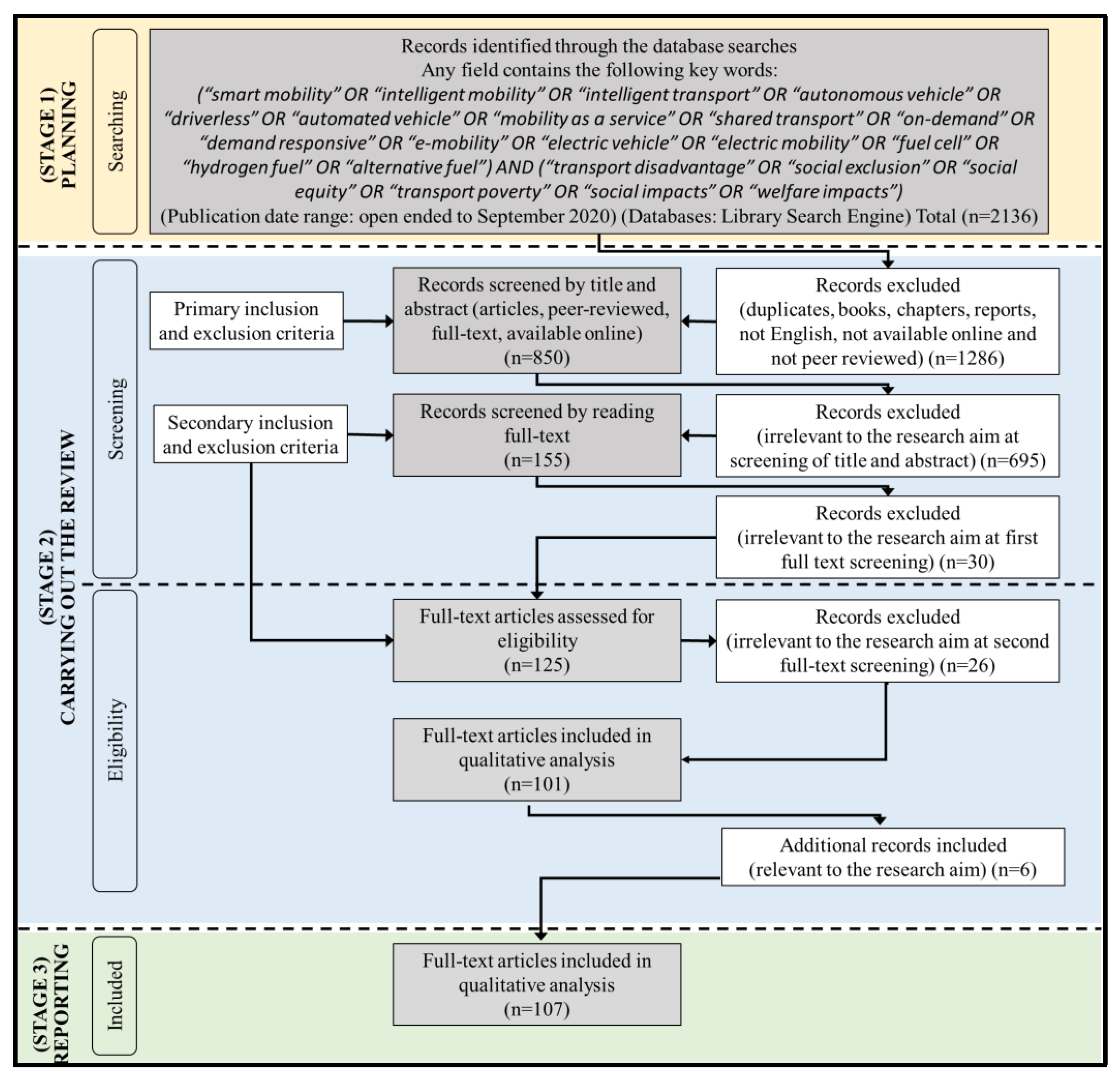
The first stage in this process was planning. Our research objectives were defined as being to identify any relationship between smart mobility innovations and transport disadvantage. Based on this objective research aim and question, several keywords relevant to the subject area were developed. Primary inclusion criteria included articles that were peer-reviewed, published online, and in English. Secondary inclusion criteria were to only include articles that were relevant to the research aim. Exclusionary criteria were articles that did not meet the inclusion criteria. The keywords were then used to undertake an open-ended search to September 2020 using a university library search engine with access to 393 academic databases. Boolean search query was used with keywords, as shown in Figure 2. The initial search yielded 2136 articles.
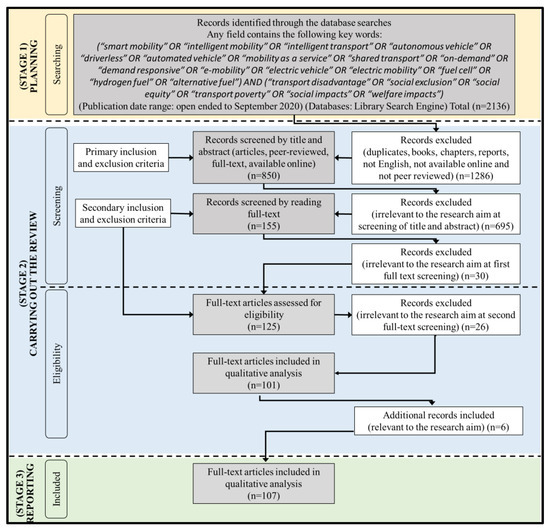
Figure 2.
Literature selection procedure (source: authors).
The second stage of the process was performing the review. Abstracts of the proposed articles were scanned against the primary inclusion and exclusion criteria; duplicates and articles that did not comply with the criteria were removed. Following this, the full text of the remaining articles was read twice to ensure compliance with the secondary inclusion criteria. Articles irrelevant to the research aim were removed. In total, 99 articles were considered relevant to the research aim and included in the final qualitative review. Figure 1 provides a step by step outline of the literature selection and review.
The remaining articles (n = 101) were categorized using a directed content analysis method, whereby major themes were selected based on a theory or framework identified in the literature. An additional six publications relevant to research topic but not otherwise meeting the search criteria were also added to the study. As the purpose of the review was to determine the contribution smart mobility innovations could make to alleviate transport disadvantage, a framework was selected to ensure all relevant dimensions were considered. Based on a previous review of transport disadvantage by Yigitcanlar et al. [4], it was decided that Suhl and Carreno’s [25] six dimensions for transport disadvantage—i.e., physical, economic, spatial, temporal, psychological, and information—would be used as it was the most comprehensive. The articles were then reviewed using a descriptive rather statistical technique. Pattern matching and other qualitative techniques, such as scanning for common subjects, were also used to group the articles into the pre-defined categories. As a result, relationships were identified between the transport disadvantage dimensions and the number of final categories reduced to three: (a) Physical and Economic (n = 39); (b) Spatial and Temporal (n = 33); and (c) Psychological and Information (n = 28). Following a review of the literature a seventh category, “institutional disadvantage”, was also discussed (n = 7). A description of the relevant dimensions is shown in Table 1.

Table 1.
Dimensions of transportation disadvantage (derived from [4,25]).
The third and final stage of the process was reporting. In this stage, the analysis of the 107 articles completed during the screening stage was used to present the results by preparing and writing the final article. Finally, additional publications (n = 31) were used to support our findings, elaborate on our results, and provide a contextual background to this research.
4. Results
4.1. General Observations
Interest in the social issues surrounding smart mobility has grown over the past two decades. In fact, while only 2 of the selected articles were published before 2005, that number has continued to grow with 4 articles published during 2006–2008, 5 articles during 2009–2011, 13 articles during 2012–2014, 20 articles during 2015–2017, and 63 since 2018. Leading authors are affiliated with universities in Europe (n = 58), Oceania (n = 19), North America (n = 18), Asia (n = 9), South America (n = 1), and Middle East (n = 2). The articles were published in a wide-range of journal including Research in Transportation Economics (n = 9), Sustainability (n = 9), Transport Policy (n = 7), Journal of Transport Geography (n = 6), Transport Research Part A (n = 5), Transportation (n = 5), Travel, Behaviour & Society (n = 4), Transport Planning and Technology (n = 4), Transport Reviews (n = 4), Journal of Transport & Health (n = 3), Energies (n = 2), Energy Research & Social Science (n = 2), Land Use Policy (n = 2), Local Economy (n = 2), and Transportation Research Part D (n = 2). The remaining 41 articles were published in 36 different journals from a range of research areas including urban planning and policy, transportation, ethics, sociology, and health.
Articles were categorized into three groups based on the defined categories: Physical and Economic (n = 33), Temporal and Spatial (n = 31), and Psychological and Information (n = 26). With reference to the main smart mobility innovations, DRT were discussed in 40 articles, followed by AV (n = 38), ITS (n = 25), shared mobility (n = 17), “Mobility-as-a-Service” (MaaS) (n = 12), and “alternative fuel vehicles” (n = 12). Twelve articles discussed smart mobility generally but were not specific regarding technological innovations.
4.2. Smart Mobility Impacts
This section discusses the main innovations identified in the literature that are associated with smart mobility and what impacts these innovations will make to transportation. Understanding the broad impacts each of the innovations will have on the transportation system is important so that the flow on effects can be analyzed against each of the transport disadvantage dimensions.
The six major smart mobility innovations identified in the literature are: (a) DRT; (b) shared mobility; (c) ITS; (d) alternative fuel vehicles; (e) AV; and (f) MaaS. ITS, alternative fuel vehicles, and AV represent direct technological advances that will affect vehicles and infrastructure. On the other hand, while technology is critical to the development of DRT, shared mobility, and MaaS, they are more associated with innovations to the way transportation services are provided to the community rather than a direct impact to the vehicles and infrastructure in the transport system. A description of each of these innovations and relevant literature is shown in Table 2.
Table 2.
Smart mobility innovations (source: authors).
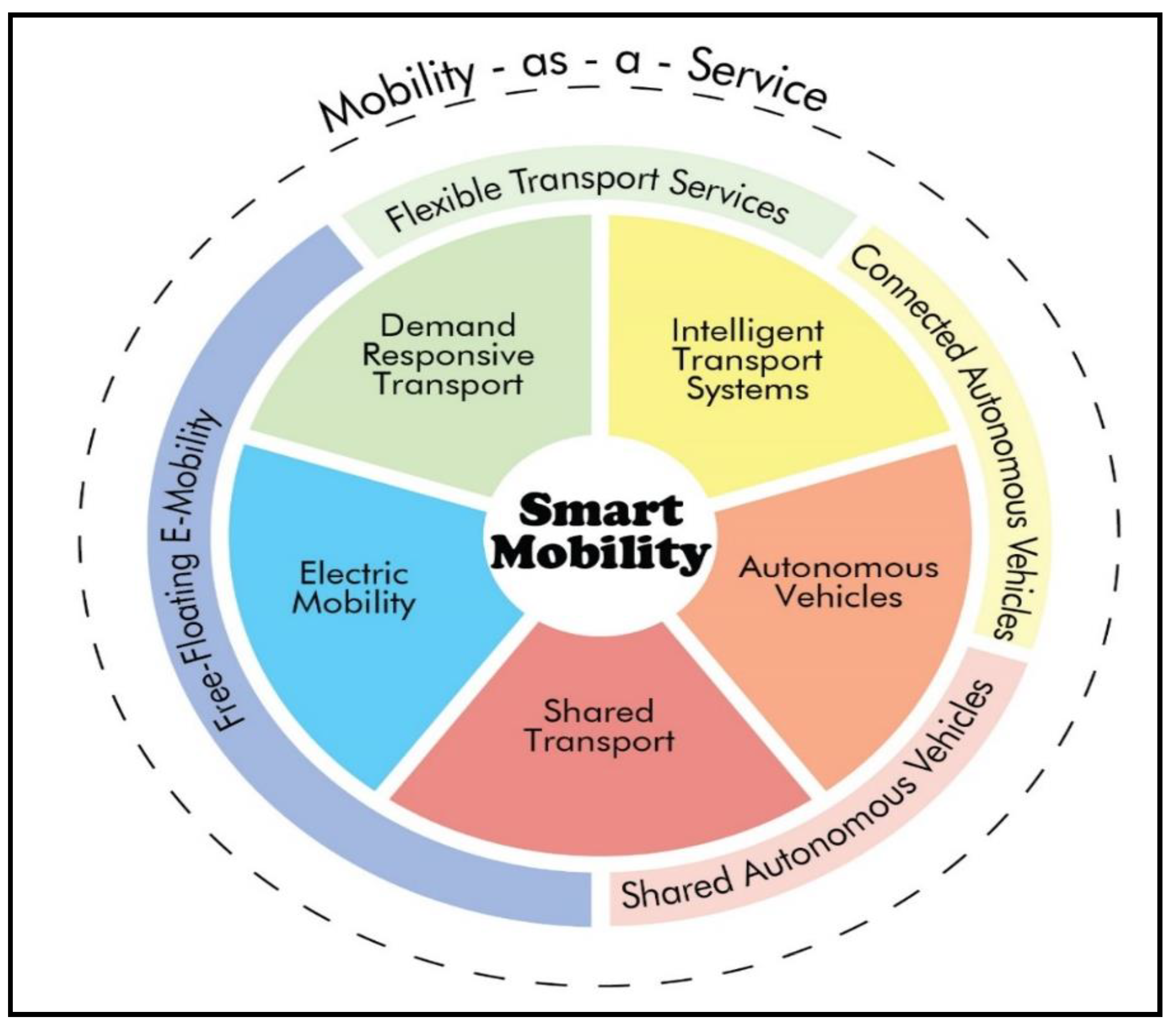
The innovations often overlap to optimize the potential positive impacts. DRT systems and AV enabled by ITS technology are often referred to as real-time or dynamic FTS [61] and connected AV (CAV), respectively [55,62]. Shared AV (SAV) incorporates elements of shared mobility and AV [44], and FFM is essentially a combination of shared mobility, battery electric vehicles, and DRT [63]. MaaS forms an overarching platform in which each of these services can be bundled together [64]. A conceptual diagram is shown in Figure 3 to better understand the relationships between these innovations. This diagram is by no means exhaustive, for example free floating e-mobility incorporates elements of ITS, and, when offered as a bicycle service, it might not rely on electric powered engines. In addition, DRT are typically offered as shared mobility to improve efficiency and costs [65]. Nonetheless, the figure provides a conceptual outline to better understand the relationships between the various smart mobility innovations identified in the literature.
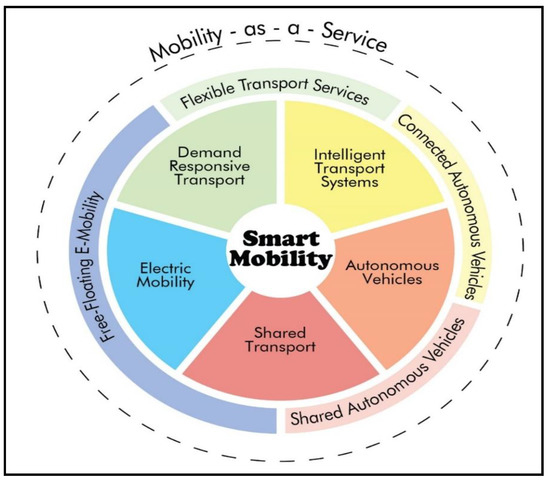
Figure 3.
Relationship between smart mobility innovations (source: authors).
4.3. Physical and Economic Dimensions
This section discusses how smart mobility innovations can contribute to the alleviation of the physical and economic dimensions of transport disadvantage. Based on the reviewed literature smart mobility could alleviate the physical and economic dimensions of transport disadvantage by: (a) improving accessibility to transportation for those unable to access or operate a vehicle; (b) creating a transportation system in which services are more responsive to user needs; (c) reducing the cost for users by improve the efficiency of the transportation system and promoting a move towards shared mobility; and (d) improving the “value of time” (VOT) spent in transit. A list of all reviewed literature is shown in Appendix A.
Firstly, various smart mobility innovations have been shown to improve accessibility for those physically unable to access transportation or operate a vehicle. Access to a vehicle is an important factor in maintaining a good standard of living and providing security and freedom of movement to access social activities, employment, and other services, including healthcare [57,66], particularly in low-density areas [67]. DRT services that provide door-to-door transportation have been shown to improve user accessibility by reducing issues surrounding the first- and last-mile access of public transport [68]. In fact, when compared to traditional public transport services, one study showed high satisfaction with flexible DRT services resulting in a doubling of older users [69]. Furthermore, when operated as a shared service they have been shown to increase social interactions resulting in reduced feelings of isolation [68].
Despite the benefits of DRT, another commonly cited innovation to improve accessibility relates to AV [57,70]. As AV are able to drive without human input, the elderly, disabled, young, unlicensed, and those unfamiliar with local conditions may no longer be excluded from operating a PMV [51,71,72,73]. Even in a semi-AV setting, in-vehicle technologies such as crash avoidance; warnings for lane departure, collision, and blind spots; navigation systems; parking assistance; and adaptive cruise control may result in more elderly residents being able to hold onto their license for longer [52,74]. Some may also benefit from improved access to FFM including bike sharing, which would add additional accessibility options—particularly for short distance trips [75]. Due to these advantages, it is important that these services are implemented with regulations to ensure equal access [40].
Nevertheless, increased accessibility means that there is a risk of increasing accessibility to PMV. This could result in more demand for car ownership and increased per capita “vehicle kilometers traveled” (VKT) [10]. This premise is supported by research which predicts that AV will result in a mode shift away from public and active transport, increasing total VKT by 15–59% [57]. This could lead to increased externalities including congestion and urban sprawl and result in greater infrastructure and transit costs [53,57,76]. Due to this potential impact, researchers consistently highlight the benefits of shared mobility [53,56]. If fact, research shows that SAV would actually decrease VKT by 10–25% [57]. However, this shift is dependent on how shared mobility appeals to consumers and will require a significant cultural shift supported by policy and regulation, public awareness campaigns, and land use interventions—particularly in areas where PMV is the dominate mode choice [66,77].
Secondly, smart mobility innovations present an opportunity to provide services to the transport disadvantage populations that are more responsive to their specific needs. In fact, when enabled by other smart technology, DRT systems have been able to use advances in data collection, distribution, and analysis to improve decision-making, simplify ticketing, and enhance route planning, scheduling, and vehicle selection [29,78,79]. Data obtained from smart ticketing systems can be integrated and used to analyze the behavior of passengers and identifying service gaps [80]. AV are also important because without the need for a driver the internal layouts can be reconfigured to provide comfort and access based on special needs [72].
This is important as studies have found that, for shared mobility to be appealing, it needs to be flexible and able to satisfy individual needs—particularly with regards to having both on- and off-peak access to employment, healthcare, and recreational areas [81]. Integrated services such as MaaS can help by facilitating better multi-stakeholder collaboration and the sharing of information. The needs and trends of each individual user can then be used collaboratively to support the day-to-day operation of the entire system [82] and connect potential users with the most suitable providers [42].
Thirdly, there is potential for smart mobility to reduce transportation costs by improving the efficiency of the transportation system and promoting a move towards shared mobility. The integration of services through a MaaS-like system and the use of ITS has the potential to reduce administration and management costs. Cost savings related to the design of transportation systems could theoretically be passed onto the consumer or used to supply transportation services to the disadvantaged [24,79]. Using shared mobility as a replacement for PMV would also remove many of the economic barriers associated with ownership—e.g., purchasing, maintenance, insurance, and storage costs [39]. Parking costs would also be reduced under a shared system as vehicles would spend less time in idle [34,83]. However, the distribution of shared services is likely to favor areas with high demand and is unlikely to reduce issues associated with geographic-related transport disadvantage. Furthermore, disability related disadvantage is unlikely to benefit from car and bike schemes alone [34]. AV would be beneficial in this regard as removing the need for a driver would significantly reduce operational costs and help solve issues associated with accessibility. In fact, SAV have the potential to reduce total transportation cost by over 80% when compared to traditional PMV [39].
However, new technology also brings high upfront costs and low short-term return on investment. Thus, while research continues to show that there is a huge demand for more sustainable vehicles [84], residents are willing to pay extra for more environmentally friendly options [49], and shared mobility is cheaper than car ownership [85], it may be difficult to guarantee economic sustainability—particularly in the short term. For example, while the use of alternative environmentally friendly fuels often achieves better economic performance, the high cost of vehicles—particularly hydrogen fuel cell vehicles—can make the economic sustainability of such vehicles difficult [48]. Similarly, despite potential for lower maintenance costs, reduced accidents, and overall efficiency, the high upfront cost may limit potential for market penetration [85].
Finally, cost alone might be not be enough to sway users to a shared system. In fact, in many countries, the modes with the lowest cost of operation—e.g., public and active transportation—are often not the ones with the highest market share. Other factors, such as comfort and prestige, also play a part [39]. AV could transform interior of private vehicles into mobile offices, dwellings, or entertainment and communication hubs improving the VOT by facilitating the ability to work, eat, socialize, and rest while in transit [56]. This could improve work life balance and reduce stress—particularly among those who travel regularly. Conversely, increasing VOT may also lead to an increase in VKT, further exacerbating issues associated with infrastructure demand and urban sprawl [39,86].
From an economic perspective, the increase in demand for private AV may also lead to disadvantaged populations being priced out of the market, leaving them unable to benefit from the advantages of the technology [40,56,87]. Similarly, with alternative fuel vehicles, users unable to afford the new technology may be charged with a Pigouvian tax to discourage the use of fossil fuels [47,50,88,89]. Increased use in private AV and shared mobility may also lead to a reduction in public transport use, reducing revenue and resulting in higher costs and future degradation of services. This is likely to impact lower income and geographically disadvantaged residents the most [56,90].
There is also economic risk associated with an integrated transportation system such as MaaS. Where a single entity is responsible for the selection and distribution of mobility providers, the system itself may become a barrier to new transportation companies entering the market. This could result in monopolization, increasing the risk of uncompetitive markets, price gouging, and other unfair businesses practices [76,91]. Conversely, government control could create tension with the private sector, which is critical in the development and funding of new transportation innovations [24,76]. If we are to rely on private companies to provide most of the services, it is unlikely that off-peak and low demand services would be provided, and significant subsides, political engagement, and planning would be required to ensure that societal goals are being maintained [92].
4.4. Spatial and Temporal Dimensions
This section discusses how smart mobility innovations can contribute to the alleviation of the spatial and temporal dimensions of transport disadvantage. Due to the association with time and distance, this dimension is most closely related to issues surrounding geographic-related transport disadvantage. Based on the reviewed literature, smart mobility could alleviate the spatial and temporal dimensions of transport disadvantage by: (a) filling gaps in the public transport network by improving the coverage and frequency of services; (b) strengthening the connection with public services by designing services to act as a feeder system which connects to major public transport nodes and employment centers; (c) improving the flexibility of public transport by offering services on-demand; and (d) creating more transportation choices in areas where choice is traditionally limited. A list of all reviewed literature is shown in Appendix A.
Firstly, literature on smart mobility consistently identifies smart mobility innovations as a way to fill gaps in the public transport network. In doing so, smart mobility can contribute to improved coverage and frequency of services [43,93]. DRT services, in particular, have been highlighted as a way to provide door-to-door transportation by using fleets of smaller shared vehicles as opposed to fixed route services [94]. Other advantages of using smaller vehicles over traditional buses is that they have a lower operational cost per passenger and can access areas with smaller road widths [94]. However, these services often require significant government subsidies as they do not have the required number of users to support profitability over the required coverage [35,95]. While subsidizing these services may be more economical than providing fixed route public transport [96], ITS can also help better match supply and demand and develop locally specific strategies that also contribute to lower costs and better efficiency [95,97]. ITS has been shown to allow better real-time control over the networks and enhance the potential for DRT to provide increased flexibility and greater coverage while bringing costs closer to that of public transport [27,43]. SAV has also been identified as a way to improve coverage particularly by reducing the instance of dead runs [33,98].
Notwithstanding, there will also be issues associated with providing the necessary infrastructure to facilitate suitable network coverage [99,100]. Furthermore, when promoting alternative fuel vehicles that generate electricity from the grid, there may be issues associated with grid capacity. Infrastructure issues are intensified in low density and rural areas due to inadequate infrastructure and longer transmission distances [47,50,101]. As such, low-density areas would still attract higher transportation costs than high density areas, and significant investment is required for ensure geographic equity [101]. One solution relates to cross-subsidization where profits made in areas with high demand are used to subsidize and fund the required infrastructure in areas with lower demand [47,95]. By sharing information and resources across the transportation system MaaS can help facilitate this cross-subsidization to ensure maximum profitability and promote social equity [83]. Furthermore, since subsidies may make low density housing more attractive, planning interventions that promote walking, cycling, higher densities around employment and transit centers, and investment in high speed public transport remain important [59,102].
Secondly, smart mobility can be used to support investment in high-speed public transport by using innovative services to act as a feeder system, which acts as a first- and last-mile connection to major public transport nodes and employment centers [96]. Theoretically, improved access to public transport would reduce car dependency and therefore reduce transportation costs [103]. DRT systems could be timed to public transport hubs to ensure reductions in transfer times. Public transport would therefore form the backbone of these “pulse networks”, which could also allow for integrated ticketing and services [103]. The overall coverage of these networks could be supported by shared mobility such as FFM that would provide connections for shorter distances and provide more transportation options [37,104]. By limiting long trips, directly into denser urban areas congestion will be reduced, which means individuals who are required to travel by PMV will likely see a reduction in fuel price and time spent in traffic [96].
Efficient trip chaining is also important as studies have shown that users are more sensitive to travel time than travel cost; thus, ensuring transfers are easy and free from unnecessary delays can contribute to improving the appeal of public transport [105]. ITS has a role in improving the efficiency of these transfer, by improving the ability to apply real-time alterations to routing [26,104,106]. In fact, studies have shown that DRT services that connect directly to major transportation hubs and are enabled by ITS contribute to increases in total public transport ridership [27,107]. Furthermore, significant modal shift away from PMV has been observed when “artificial intelligence” (AI) is used to configure routes to reduce travel time [108] or through the use of MaaS systems to create synergies between mobility providers [109].
Thirdly, by improving the flexibility of public transport and offering services on-demand, transportation systems can be designed to respond directly to the specific geographic and social characteristics of the local area [32,97]. For example, in some areas, such as those with large numbers of tourists, conventional public transport with fixed schedules and timetables may be more advantageous [28,110]. In addition, in areas with higher numbers of people unable to operate a vehicle, car sharing schemes should be limited in favor of more flexible routes and timetables [111]. Similarly, in very low-density areas, semi-fixed, as opposed to door-to-door, services may be more efficient [33]. In designing transportation systems, planners should consider how changes respond to local characteristics and ensure the optimal allocation of available resources [32]. Furthermore, any local transportation plan should be able to be scaled up if demand increases to ensure equal and equitable coverage [96].
Finally, using smart mobility to create more options for users in areas where transportation choice is limited can be beneficial [59]. Having more mobility options available to users has been identified as an important step to overcome the culture of PMV ownership. Similarly, supportive policies with awareness of shared services would be useful [112]. MaaS provides an opportunity to bundle services and offer a range of options to consumers through a single online platform [83,109]. Alternatively, transportation choice may also include the choice to not travel. Advances in the design of digital neighborhoods, smart homes, ICT, and home delivery has the potential to remove the need for physical trips—particularly those related to employment [94,112]. Similarly, with the view to reduce PMV, ICT and data obtained from ITS can be used to help residents make more informed decisions regarding residential or work location [113].
4.5. Psychological and Information Dimensions
This section discusses how smart mobility innovations can contribute to the alleviation of the psychological and information dimensions of transport disadvantage. Based on the reviewed literature, smart mobility could alleviate the spatial and temporal dimensions of transport disadvantage by: (a) improving the safety of travel; (b) improving the perception of existing transportation options; and (c) improving the ability to make informed decisions. A list of all reviewed literature is shown in Appendix A (Table A1).
Firstly, smart mobility innovations have been shown to contribute to improved safety in the transportation system. This is important as the perception of safety is critical to ensure individuals want to use smart mobility [54]. AV have the potential to significantly reduce the number of vehicular accidents caused by human error [54,55,114]. CAVs can use advances in ITS, ICT, and AI data processing to communicate with other vehicles, infrastructure, and sensors, identifying dangers early and further improving safety for drivers and pedestrians [55]. In addition, given that no driver is required in the internal configuration, it can be reconfigured to add to the safety of the vehicle [55]. Similarly, DRT that offers door-to-door transportation and shared mobility are perceived as a safer option than public transport—particularly at nighttime [30,31,115].
Nonetheless, from the perspective of the user, safety not only comes from feeling safe while engaged in journey, but also with regards to digital safety [36,116]. In fact, lack of trust in technology is consistently identified as a reason for not using new transport technologies, particularly among the elderly [54,117,118,119]. This is understandable as increased reliance on technology introduces additional risks including those related to data privacy, cyberterrorism, grounding of fleets due to grid failures, faulty data [55,120], unconscious bias [114], and questions of legal liability [121]. To build trust, significant investment is required in cyber and data safety. Information campaigns are also beneficial to garner support among late adopters [119].
Secondly, there is potential for smart mobility innovations to improve the perception of existing DRT and public transport systems. Many DRT have been implemented around the world; however, the perception of these services is often that they are for the old and disabled—even when they are offered to all in the community [122,123]. Furthermore, users who benefit the most from the services are often confused and unclear about how these new transportation services could serve them [123,124,125]. In fact, research has shown that attitudes towards smart mobility among those with disabilities was entirely dependent on having prior knowledge of the technology [125]. Those with more knowledge tended to be more positive [126].
More information about potential routes and scheduling could help users better navigate new transportation innovations [124]. MaaS can help with this by providing all services and relevant information through a single digital platform giving users unbiased choice of various modes [38,60]. In addition, as all services are effectively bundled together, any offerings that are targeted towards those with special needs may no longer be viewed as an entitlement but would instead be part of a city, regional, or nationwide system that is synergized to benefits all of society [58].
Finally, smart mobility could improve the ability for commuters to make informed decisions. Technological advances in ITS can facilitate the collection and analysis of large amounts of data from cameras, sensors, vehicle locations, smart ticketing systems, social media, credit cards, mobile phones, and many other sources [13,45,127]. Automating the analysis of this “big data” could help individuals with route planning and vehicle selection [44,46,128]. The ability to make informed decisions based on real-time data can help commuters reduce uncertainty, fear, discomfort, enhance user experience, and improve confidence [44,45,115].
However, given the reliance on smart technology, there are issues associated with technical literacy and the digital divide [36,38,116,117]. The digital divide refers to the gap between those who can access ICT and those who cannot. This issue is not only associated with the spatial distribution of network coverage or equality of access to physical smart devices but also the ability for particular socioeconomic groups to use and understand the technology [36,117,127]. Statistically, the elderly, lower income, female, and disabled are less familiar with new technology due to lower lifelong exposure to ICT. Therefore, they often struggle to quickly learn the required skills to access and pay for digital services [117,127,129]. This is where an integrated system such as MaaS can help. By integrating a range of mobility providers into a single platform, it could simplify the process for accessing transport by reducing complexity and the need to cycle through various mobility applications [127]. Stakeholder engagement and public participation is also important to understand existing challenges within the community [130].
4.6. Institutional Dimensions
Upon review of the literature, a seventh and final transport disadvantage dimensions has emerged. The “institutional” dimension includes institutional and governance related barriers including policy, regulation, and institutions that may limit an individual’s ability to use a transport mode or service. Based on the reviewed literature, smart mobility innovations do not necessarily directly contribute to the alleviation of this barrier. However, given the fast pace nature of technological change within the transport sector—including widespread trials of smart mobility services including DRT, AV, and MaaS and the rapid emergence of new technologies associated with car-, bike-, and scooter-sharing—it is important that decision makers understand the strengths and weakness associated with them so that opportunities and risks can be identified. This is important because public sector does not necessarily function adequately in times of uncertainty [76] and a failure to address the short- and long-term issues associated with these transport services could exacerbate negative externalities associated with the transport system. It is therefore important that strategies remain flexible so that they can adapt to changing circumstances and community needs [30,131].
It is critical that institutional barriers do not inhibit the ability for users to access services which could have wider societal benefits including high cost and inconvenience of registering for new services [132], laws that explicitly ban the use or inhibits the ability to use a mode or services within a particular area [133], or lack of available infrastructure to support mode choice—e.g., lack of dedicated active and public transport infrastructure [134]. Of equal importance is the use of institutional measures to promote and support the development of smart mobility. These could include: (a) establishment of standards for data management and sharing, which should be established on a national or transnational level [135]; (b) institutional support structures to assist with community adaptation to new technology, particularly among disadvantaged groups including elderly, migrants, or disabled [136]; (c) development of parking restrictions to discourage private vehicle use [131], engaging the public in decision-making [130]; and (d) ensuring public value and societal goals are maintained [24,137].
5. Discussion
5.1. Key Findings
This review study investigated the impact of smart mobility innovations through the lens of transport disadvantage. Specifically, the review sought to answer the research question: How can smart mobility contribute to the alleviation of transport disadvantage? Firstly, some common smart mobility innovations were identified and the relationships between these innovations shown. These innovations include new vehicular and infrastructural innovations such AV, ITS, and alternative fuel vehicles, in addition to new and existing ways of offering services to the community including DRT, shared mobility, and MaaS. These innovations will likely benefit urban areas by improving accessibility, efficiency, coverage, flexibility, safety, and integration of the transportation system.
The study also showed how smart mobility innovations have the potential to contribute to the alleviation of all six dimensions of transport disadvantage: (a) physical; (b) economic; (c) spatial; (d) temporal; (e) psychological; and (f) information. We also discussed some implications associated with a seventh, “institutional”, dimension. Potential risks have been identified, and there are a number of key actions that can be taken to alleviate these risks. Of these actions, the implementation of MaaS and shared mobility appears as a common thread to overcoming the risks associated with smart mobility.
Firstly, a move towards the shared mobility is critical to ensure resources are shared efficiency and services offered have the required accessibility, coverage, and flexibility to reach all users and do not result in excess consumer costs or reliance on government subsidies. This conclusion is reflected in studies on DRT [66], AV [39,40,52], and MaaS [40].
Secondly, the review showed that it is often a combination of innovations that will best benefit the transport disadvantage. For instance, DRT and AV are shown to work more efficiently, and safely, when enabled by ITS and other smart technology including big data and cloud computing. Furthermore, the negative externalities associated with AV use, including increased VKT, suburbanization, and infrastructure demand, are significantly reduced when operating within a shared economy. This highlights the specific advantages of MaaS, which as an integrated system can provide the operational structure from which new innovations are trialed and released into the market. It also can help connect users to shared mobility and provide a platform from which mobility providers share resources. Sharing data between mobility providers could help decision-makers achieve better outcomes as issues associated with transport disadvantage can be considered by looking at the transportation system as a whole rather than concentrating on individual parts. Similar conclusions regarding the importance of MaaS as an overarching operational structure is supported by a number of studies including Gonzalez-Feliu et al. [82], Mulley and Kronsell [58], Soares Machado et al. [38], and Beecroft et al. [116].
Lastly, a summary of smart mobility potential contribution and risks and their association with transport disadvantage dimensions is shown in Table 3.
Table 3.
Summary of literature review findings (source: authors).
5.2. Conceptual Framework
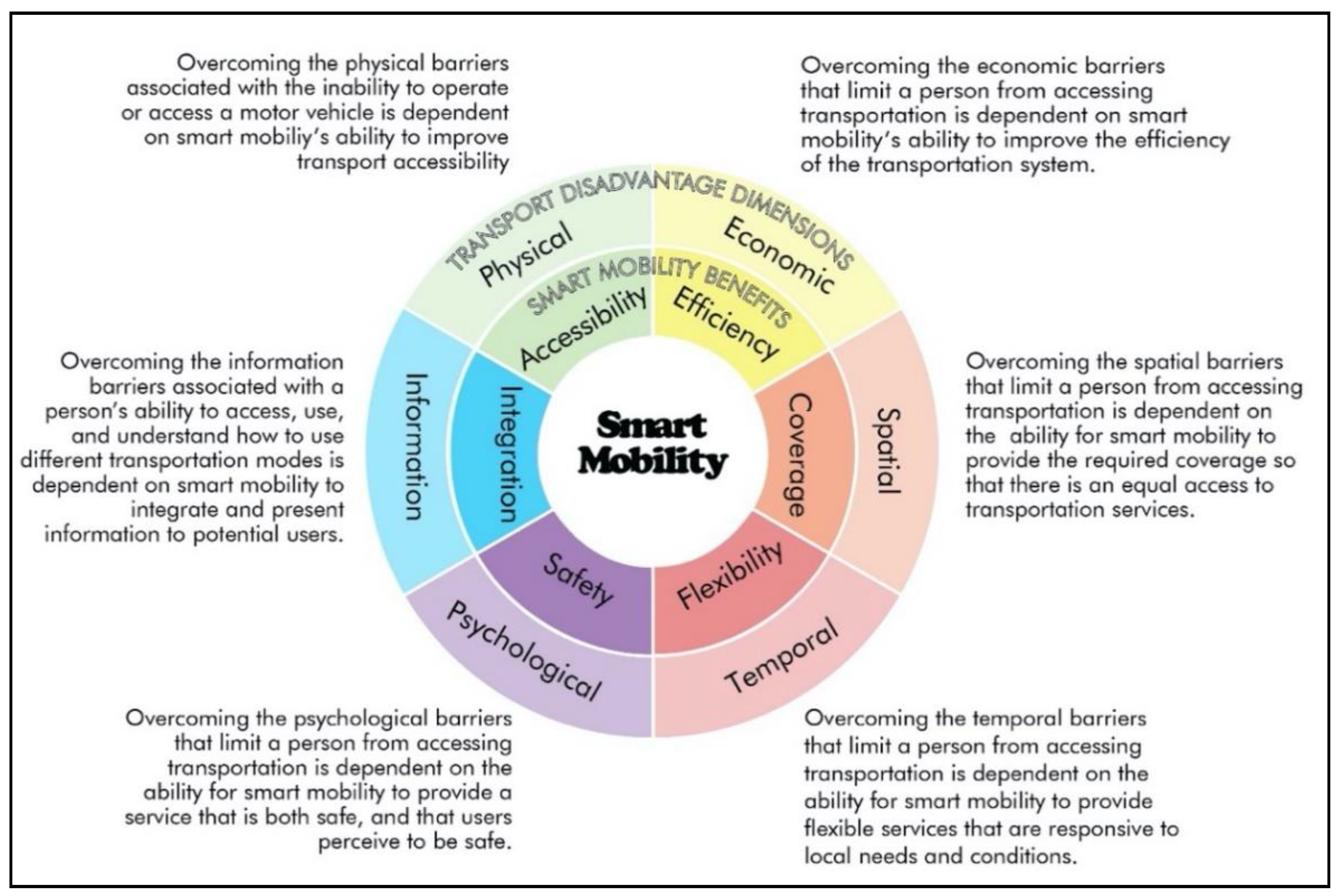
Within the realm of smart mobility, a key challenge to overcome transport disadvantage is to understand how the specific benefits of new transportation innovations can be harnessed to respond to each of the dimensions of transport disadvantage. The results of the literature review highlight important relationships between the benefits of smart mobility innovations and the different dimensions of transport disadvantages. Specifically, the review showed that the benefits of smart mobility can be specifically aligned with the corresponding transport disadvantage dimension. A conceptual framework showing the relationship between these factors is shown in Figure 4. For the purpose of providing a conceptual framework related to how smart mobility can alleviate transport disadvantage, the institutional barrier has been excluded from the framework as it is not a barrier that can be overcome by smart mobility innovations alone. Nevertheless, supportive policy, regulations, and other governance structures are critical to the implementation smart mobility in a way that strengthens its benefits while responding to issues of transport disadvantage.
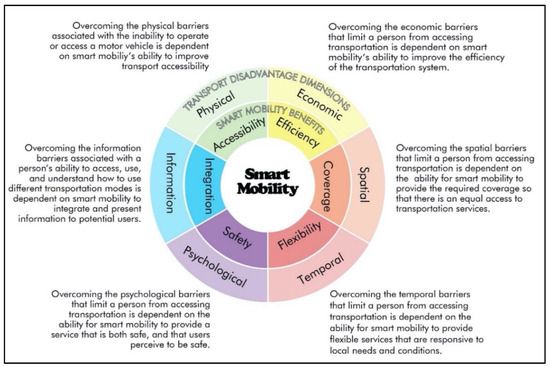
Figure 4.
Conceptual framework of smart mobility and transportation disadvantage (source: authors).
Firstly, when looking through the physical dimension of transport disadvantage, the primary contribution of smart mobility is its ability to improve transportation accessibility through implementation of AV, flexible door-to-door transportation, strengthening connections with existing public transport networks, providing more mode options, or specifically targeting user needs. Similarly, when looking through the economic dimension of transport disadvantage, the primary contribution of smart mobility is its ability to improve transportation efficiency, which could contribute to reduced consumer costs—whether by reducing cost of actual travel or increasing the VOT spent in traffic.
Secondly, when looking through the spatial dimension of transport disadvantage, the primary contribution of smart mobility is its ability to improve transportation coverage by filling gaps in public transport or acting as a feeder system to major public transport nodes. Similarly, when looking through the temporal dimension of transport disadvantage, the primary contribution of smart mobility is its ability to improve flexibility by moving towards dynamic routing of transportation services, having more real-time control over the transportation network, better matching supply and demand, reducing transfer times and reducing congestion for those who are required to travel by PMV.
Finally, when looking through the psychological dimension of transport disadvantage, the primary contribution of smart mobility is its ability to improve transportation safety, whether through the use of AV which removes the need for a human driver, ITS that communicate with vehicles and drivers regarding potential hazards, or door-to-door transportation that removes safety concerns associated with accessing fixed-route public transport stops—particularly in low occupancy areas. Similarly, when looking through the information dimension of transport disadvantage, the primary contribution of smart mobility is its ability to integrate a wide range of data and services which can be used to improve decision-making whether those decisions are made autonomously or following analysis of available data regulators, mobility providers, and users.
Given the relationship between smart mobility and transport disadvantage, the challenge for decision-makers and mobility providers is to analyze specific case study areas to determine the issues associated with transport disadvantage that are most relevant. From there, the smart mobility benefits that most closely represent each of these dimensions can be used to identify which innovation is best suited for the local area.
5.3. Research Directions
Few studies identified in this review considered the six smart mobility innovations together as a broad driver for change in the transportation system. Given that alternative fuel vehicles, such as battery electric and hybrid electric, and ITS have already started to be introduced into urban areas, and trials of AV are prevalent throughout the world, it is problematic to analyze each of these technological drivers as individual entities that will not interact and influence the success, or failure, of each other. The management of these technological innovations is therefore necessary to harness their benefits in response to transport disadvantage. That is why new operational structures and ways of looking at the transportation system including DRT, shared mobility, and MaaS remain important.
Nonetheless, while DRT systems are not new and have been implemented throughout the world—as an alternative to public transport and targeted toward those experiencing disadvantage—it has developed a stigma whereby it is often viewed as an option for only the aged and disabled. Similarly, shared mobility offered by private industry including ride-sharing, car-sharing, and FFM are typically targeted towards users in centralized, denser areas where the highest demand is available to ensure maximum profit. These services, therefore, rarely benefit those experiencing transport disadvantage, and often only exacerbate existing issues with unequal accessibility. As an integrated service, MaaS represents a new way of branding DRT, while enhancing public transport, shared mobility, and other elements of the transportation system. Furthermore, MaaS presents a unique opportunity to provide the platform from which new innovations are introduced into market, the data analyzed, shared, and used to assess its suitability for alleviating transport disadvantage, and other related issues.
Prospective research should, hence, look at ways to use MaaS to harness the benefits of smart mobility innovations and attract users to shared mobility and public transport. MaaS is a relatively new topic so further research could focus on the barriers, and risks associated with implementing MaaS within urban areas. Analysis throughout a range of case study areas using transportation modeling, consumer surveys, expert opinion, and trials could also identify issues specific to the varying characteristics of different regions, including those associated with regulatory systems, policy frameworks, cultural differences, and geographic conditions.
Secondly, research could also focus on other innovative ways to integrate transportation modes, attract users to shared mobility, or develop alternatives systems. Research could explore the role of other technological advances outside the field of transportation including 5G, AI, digital twins, virtual reality, blockchain, IoT, big data, and cloud computing. For example, the use of virtual reality and augmented reality could be used to educate, market, and promote new transportation innovations towards individuals and business. Similarly, it could be used to let users experience new transportation technology prior to analyzing their attitudes.
Finally, given the recent events associated with the COVID-19 pandemic and its potential implication on consumer attitudes towards shared mobility, there is also a need to analyze whether the experience has changed user perspectives and willingness-to-ride shared, and public transport. This is important as attitudes may be changing due to increased awareness of vulnerabilities associated with virus transmission from passengers sharing close quarters in vehicles that often rely on centralized air-conditioning and little ventilation [138]. Furthermore, given these unprecedented events and the pressure on individuals and business to quickly adopt remote working and social environments transportation researchers may be more inclined to ask whether no mobility is smarter than smart mobility. From a transport disadvantage perspective research could be undertaken to compare individual transportation needs before, during, and after the lockdown experiences. Representatives from the commercial sector could be interviewed to discuss experiences with remote working, and how the experience will shape business models into the future, as one of the advantages of remote working is that for many jobs individuals may no longer be limited to employment opportunities due to location or issues with being able to afford or access transportation that is responsive to their needs.
Author Contributions
L.B., data collection, processing, investigation, analysis, writing—original draft preparation, and writing—review and editing; and T.Y. and A.P., supervision, conceptualization, writing—review and editing. All authors have read and agreed to the final version of the manuscript.
Funding
This research received no external funding.
Acknowledgments
This research did not receive any specific grant from funding agencies in the public, commercial or not-for-profit sectors. The authors thank the editor and three anonymous referees for their invaluable comments on an earlier version of the manuscript.
Conflicts of Interest
The authors declare no conflict of interest.
Appendix A
Table A1.
Reviewed literature pieces.
References
- Ingrao, C.; Messineo, A.; Beltramo, R.; Yigitcanlar, T.; Ioppolo, G. How can life cycle thinking support sustainability of buildings? J. Clean. Prod. 2018, 201, 556–569. [Google Scholar] [CrossRef]
- Arbolino, R.; De Simone, L.; Carlucci, F.; Yigitcanlar, T.; Ioppolo, G. Towards a sustainable industrial ecology. J. Clean. Prod. 2018, 178, 220–236. [Google Scholar] [CrossRef]
- Lee, S.H.; Yigitcanlar, T.; Han, J.H.; Leem, Y.T. Ubiquitous urban infrastructure: Infrastructure planning and development in Korea. Innovation 2008, 10, 282–292. [Google Scholar] [CrossRef]
- Yigitcanlar, T.; Mohamed, A.; Kamruzzaman, M.; Piracha, A. Understanding transport-related social exclusion. Urban Pol. Res. 2019, 37, 97–110. [Google Scholar] [CrossRef]
- Currie, G.; Delbosc, A. Modelling the social and psychological impacts of transport disadvantage. Transportation 2010, 37, 953–966. [Google Scholar] [CrossRef]
- Duvarci, Y.; Yigitcanlar, T.; Mizokami, S. Transportation disadvantage impedance indexing. J. Transp. Geogr. 2015, 48, 61–75. [Google Scholar] [CrossRef]
- Yigitcanlar, T.; Dodson, J.; Gleeson, B.; Sipe, N. Travel self-containment in master planned estates. Urban Pol. Res. 2007, 25, 129–149. [Google Scholar] [CrossRef]
- Delbosc, A.; Currie, G. The spatial context of transport disadvantage, social exclusion and well-being. J. Transp. Geogr. 2011, 19, 1130–1137. [Google Scholar] [CrossRef]
- Yigitcanlar, T.; Wilson, M.; Kamruzzaman, M. Disruptive impacts of automated driving systems on the built environment and land use. JOItmC 2019, 5, 24. [Google Scholar] [CrossRef]
- Noy, K.; Givoni, M. Is ‘Smart Mobility’ Sustainable? Sustainability 2018, 10, 422. [Google Scholar] [CrossRef]
- Yigitcanlar, T.; Kamruzzaman, M. Smart cities and mobility. J. Urban Technol. 2019, 26, 21–46. [Google Scholar] [CrossRef]
- Golbabaei, F.; Yigitcanlar, T.; Bunker, J. The role of shared autonomous vehicle systems in delivering smart urban mobility. Int. J. Sustain. Transp. 2020. [Google Scholar] [CrossRef]
- Yigitcanlar, T.; Han, H.; Kamruzzaman, M.; Ioppolo, G.; Sabatini-Marques, J. The making of smart cities. Land Use Policy 2019, 88, 104187. [Google Scholar] [CrossRef]
- Yigitcanlar, T.; Kamruzzaman, M.; Foth, M.; Sabatini-Marques, J.; Da Costa, E.; Ioppolo, G. Can cities become smart without being sustainable? Sustain. Cities Soc. 2019, 45, 348–365. [Google Scholar] [CrossRef]
- Yigitcanlar, T.; Desouza, K.; Butler, L.; Roozkhosh, F. Contributions and risks of artificial intelligence (AI) in building smarter cities. Energies 2020, 13, 1473. [Google Scholar] [CrossRef]
- Yigitcanlar, T.; Butler, L.; Windle, E.; Desouza, K.; Mehmood, R.; Corchado, J. Can building ‘artificially intelligent cities’ protect humanity from natural disasters, pandemics and other catastrophes? Sensors 2020, 20, 2988. [Google Scholar] [CrossRef]
- Kaufman, B. 1 Million Rides and Counting. The Conversation 2020. Available online: https://theconversation.com/1-million-rides-and-counting-on-demand-services-bring-public-transport-to-the-suburbs-132355 (accessed on 1 May 2020).
- Mahbub, P.; Goonetilleke, A.; Ayoko, G.A.; Egodawatta, P.; Yigitcanlar, T. Analysis of build-up of heavy metals and volatile organics on urban roads in Gold Coast, Australia. Water Sci. Technol. 2011, 63, 2077–2085. [Google Scholar] [CrossRef]
- Dowling, R. Smart Cities: Does This Mean More Transport Disruption. The Conversation 2016. Available online: https://theconversation.com/smart-cities-does-this-mean-more-transport-disruptions-63638 (accessed on 1 May 2020).
- Kane, M.; Whitehead, J. How to ride transport disruption. Aust. Plan. 2017, 54, 177–185. [Google Scholar] [CrossRef]
- De Percy, M. Taxi Driver Compensation for Uber Is Unfair and Poorly Implemented. The Conversation 2016. Available online: https://theconversation.com/taxi-driver-compensation-for-uber-is-unfair-and-poorly-implemented-64354 (accessed on 1 May 2020).
- Munton, J.R. Explainer: What Rights Do Workers Have to Getting Paid in the Gig Economy? The Conversation 2017. Available online: https://theconversation.com/explainer-what-rights-do-workers-have-to-getting-paid-in-the-gig-economy-70281 (accessed on 1 May 2020).
- Barratt, T.; Veen, A.; Goods, C.; Josserand, E.; Kaine, S. As Yet Another Ridesharing Platform Launches in Australia, How Does This All End? The Conversation 2018. Available online: https://theconversation.com/as-yet-another-ridesharing-platform-launches-in-australia-how-does-this-all-end-98389 (accessed on 1 May 2020).
- Docherty, I.; Marsden, G.; Anable, J. The governance of smart mobility. Trans. Res. Part A Policy Pract. 2018, 115, 114–125. [Google Scholar] [CrossRef]
- Suhl, K.; Carreno, M. Can transport-related social exclusion be measured? In Proceedings of the 8th International Conference, Vilnius, Lithuania, 19–20 May 2011; pp. 1001–1008. [Google Scholar]
- Mageean, J.; Nelson, J.D. The evaluation of demand responsive transport services in Europe. J. Transp. Geogr. 2003, 11, 255–270. [Google Scholar] [CrossRef]
- Brake, J.; Nelson, J.D.; Wright, S. Demand responsive transport. J. Transp. Geogr. 2004, 12, 323–337. [Google Scholar] [CrossRef]
- Battellino, H. Transport for the transport disadvantaged. Trans. Policy 2009, 16, 123–129. [Google Scholar] [CrossRef]
- Nelson, J.D.; Wright, S.; Masson, B.; Ambrosino, G.; Naniopoulos, A. Recent developments in Flexible Transport Services. Res. Transp. Econ. 2010, 29, 243–248. [Google Scholar] [CrossRef]
- Nelson, J.D.; Phonphitakchai, T. An evaluation of the user characteristics of an open access DRT service. Res. Transp. Econ. 2012, 34, 54–65. [Google Scholar] [CrossRef]
- Wang, C.; Quddus, M.; Enoch, M.; Ryley, T.; Davison, L. Multilevel modelling of Demand Responsive Transport (DRT) trips in Greater Manchester based on area-wide socio-economic data. Transportation 2014, 41, 589–610. [Google Scholar] [CrossRef]
- Gomes, R.; Pinho de Sousa, J.; Galvão Dias, T. Sustainable Demand Responsive Transportation systems in a context of austerity. Res. Transp. Econ. 2015, 51, 94–103. [Google Scholar] [CrossRef]
- Viergutz, K.; Schmidt, C. Demand responsive - vs. conventional public transportation. Procedia Comput. Sci. 2019, 151, 69–76. [Google Scholar] [CrossRef]
- Clark, J.; Curl, A. Bicycle and car share schemes as inclusive modes of travel? Soc. Incl. 2016, 4, 83–99. [Google Scholar] [CrossRef]
- Illgen, S.; Höck, M. Establishing car sharing services in rural areas. Transportation 2020, 47, 811–826. [Google Scholar] [CrossRef]
- Jin, S.T.; Kong, H.; Wu, R.; Sui, D.Z. Ridesourcing, the sharing economy, and the future of cities. Cities 2018, 76, 96–104. [Google Scholar] [CrossRef]
- Li, X.; Zhang, Y.; Sun, L.; Liu, Q. Free-floating bike sharing in Jiangsu. Energies 2018, 11, 1664. [Google Scholar] [CrossRef]
- Soares Machado, C.; de Salles Hue, N.P.M.; Berssaneti, F.T.; Quintanilha, J.A. An overview of shared mobility. Sustainability 2018, 10, 4342. [Google Scholar] [CrossRef]
- Axsen, J.; Sovacool, B.K. The roles of users in electric, shared and automated mobility transitions. Transp. Res. D Transp. Environ. 2019, 71, 1–21. [Google Scholar] [CrossRef]
- Martin, G. An ecosocial frame for autonomous vehicles. Capital. Nat. Social. 2019, 30, 55–70. [Google Scholar] [CrossRef]
- Meelen, T.; Frenken, K.; Hobrink, S. Weak spots for car-sharing in The Netherlands? Energy Res. Soc. Sci. 2019, 52, 132–143. [Google Scholar] [CrossRef]
- Zhou, J. Ride-sharing service planning based on smartcard data. Trans. Policy 2019, 79, 1–10. [Google Scholar] [CrossRef]
- Brake, J.; Nelson, J.D. A case study of flexible solutions to transport demand in a deregulated environment. J. Transp. Geogr. 2007, 15, 262–273. [Google Scholar] [CrossRef]
- Davidsson, P.; Hajinasab, B.; Holmgren, J.; Jevinger, Å.; Persson, J. The fourth wave of digitalization and public transport. Sustainability 2016, 8, 1248. [Google Scholar] [CrossRef]
- Chen, Y.; Ardila-Gomez, A.; Frame, G. Achieving energy savings by intelligent transportation systems investments in the context of smart cities. Transp. Res. D Transp. Environ. 2017, 54, 381–396. [Google Scholar] [CrossRef]
- Melo, S.; Macedo, J.; Baptista, P. Guiding cities to pursue a smart mobility paradigm. Res. Transp. Econ. 2017, 65, 24–33. [Google Scholar] [CrossRef]
- Wells, P. Converging transport policy, industrial policy and environmental policy. Local Econ. 2012, 27, 749–763. [Google Scholar] [CrossRef]
- Hoque, N.; Biswas, W.; Howard, I. Life cycle sustainability assessment of alternative energy sources for the western australian transport sector. Sustainability 2020, 12, 5565. [Google Scholar] [CrossRef]
- Bigerna, S.; Polinori, P. Willingness to pay and public acceptance for hydrogen buses. Sustainability 2015, 7, 13270–13289. [Google Scholar] [CrossRef]
- Ortar, N.; Ryghaug, M. Should all cars be electric by 2025? Sustainability 2019, 11, 1868. [Google Scholar] [CrossRef]
- Thomopoulos, N.; Givoni, M. The autonomous car—A blessing or a curse for the future of low carbon mobility? Eur. J. Futures Res. 2015, 3, 1–14. [Google Scholar] [CrossRef]
- Milakis, D.; van Arem, B.; van Wee, B. Policy and society related implications of automated driving. J. Intell. Transp. Syst. 2017, 21, 324–348. [Google Scholar] [CrossRef]
- Milakis, D.; Kroesen, M.; van Wee, B. Implications of automated vehicles for accessibility and location choices. J. Transp. Geogr. 2018, 68, 142–148. [Google Scholar] [CrossRef]
- Lim, H.S.; Taeihagh, A. Autonomous vehicles for smart and sustainable cities. Energies 2018, 11, 1062. [Google Scholar] [CrossRef]
- Dean, J.; Wray, A.; Braun, L.; Casello, J.; McCallum, L.; Gower, S. Holding the keys to health? BMC Public Health 2019, 19, 1258. [Google Scholar]
- Bissell, D.; Birtchnell, T.; Elliott, A.; Hsu, E.L. Autonomous automobilities. Curr. Sociol. 2020, 68, 116–134. [Google Scholar] [CrossRef]
- Rojas-Rueda, D.; Nieuwenhuijsen, M.J.; Khreis, H.; Frumkin, H. Autonomous vehicles and public health. Annu. Rev. Public Health 2020, 41, 329–345. [Google Scholar] [CrossRef]
- Mulley, C.; Kronsell, A. The “uberisation” of public transport and mobility as a service (MaaS). Res. Transp. Econ. 2018, 69, 568–572. [Google Scholar] [CrossRef]
- Hawkins, J.; Habib, K.N. Heterogeneity in marginal value of urban mobility. Transportation 2019. [Google Scholar] [CrossRef]
- Becker, H.; Balac, M.; Ciari, F.; Axhausen, K.W. Assessing the welfare impacts of shared mobility and mobility as a service (MaaS). Trans. Res. Part A Policy Pract. 2020, 131, 228–243. [Google Scholar] [CrossRef]
- Van Engelen, M.; Cats, O.; Post, H.; Aardal, K. Enhancing flexible transport services with demand-anticipatory insertion heuristics. Transp. Res. E Logist. Transp. Rev. 2018, 110, 110–121. [Google Scholar] [CrossRef]
- Yigitcanlar, T.; Kankanamge, N.; Vella, K. How are smart city concepts and technologies perceived and utilized? a systematic geo-twitter analysis of smart cities in Australia. J. Urban Technol. 2020. [Google Scholar] [CrossRef]
- Winter, K.; Cats, O.; Correia, G.; van Arem, B. Performance analysis and fleet requirements of automated demand-responsive transport systems as an urban public transport service. IJTST 2018, 7, 151–167. [Google Scholar] [CrossRef]
- Matyas, M.; Kamargianni, M. The potential of mobility as a service bundles as a mobility management tool. Transportation 2019, 46, 1951–1968. [Google Scholar] [CrossRef]
- Czioska, P.; Kutadinata, R.; Trifunović, A.; Winter, S.; Sester, M.; Friedrich, B. Real-world meeting points for shared demand-responsive transportation systems. Public Transp. 2019, 11, 341–377. [Google Scholar] [CrossRef]
- Harrison, G.; Shepherd, S. An interdisciplinary study to explore impacts from policies for the introduction of low carbon vehicles. Transp. Plan. Technol. 2014, 37, 98–117. [Google Scholar] [CrossRef]
- Tao, Z.; Zhou, J.; Lin, X.; Chao, H.; Li, G. Investigating the impacts of public transport on job accessibility in Shenzhen, China. Land Use Policy 2020, 99, 105025. [Google Scholar] [CrossRef]
- O’Shaughnessy, M.; Casey, E.; Enright, P. Rural transport in peripheral rural areas. Soc. Enterp. J. 2011, 7, 183–190. [Google Scholar] [CrossRef]
- Broome, K.; Worrall, L.; Fleming, J.; Boldy, D. Evaluation of flexible route bus transport for older people. Trans. Policy 2012, 21, 85–91. [Google Scholar] [CrossRef]
- Faisal, A.; Yigitcanlar, T.; Kamruzzaman, M.; Currie, G. Understanding autonomous vehicles. J. Transp. Land Use 2019, 12, 45–72. [Google Scholar] [CrossRef]
- Mackett, R. Improving accessibility for older people. J. Transp. Health 2015, 2, 5–13. [Google Scholar] [CrossRef]
- Adnan, N.; Md Nordin, S.; Bin Bahruddin, M.A.; Ali, M. How trust can drive forward the user acceptance to the technology? Trans. Res. Part A Policy Pract. 2018, 118, 819–836. [Google Scholar] [CrossRef]
- Wong, S. Traveling with blindness. Health Place 2018, 49, 85–92. [Google Scholar] [CrossRef]
- Faisal, A.; Yigitcanlar, T.; Kamruzzaman, M.; Paz, A. Mapping two decades of autonomous vehicle research. J. Urban Technol. 2020. [Google Scholar] [CrossRef]
- Haustein, S.; Siren, A. Older people’s mobility. Transp. Rev. 2015, 35, 466–487. [Google Scholar] [CrossRef]
- Curtis, C.; Stone, J.; Legacy, C.; Ashmore, D. Governance of future urban mobility. Urban Pol. Res. 2019, 37, 393–404. [Google Scholar] [CrossRef]
- Canitez, F. Pathways to sustainable urban mobility in developing megacities. Technol. Forecast. Soc. Chang. 2019, 141, 319–329. [Google Scholar] [CrossRef]
- Zografos, K.; Androutsopoulos, K.; Sihvola, T. A methodological approach for developing and assessing business models for flexible transport systems. Transportation 2008, 35, 777–795. [Google Scholar] [CrossRef]
- Stanley, J.; Lucas, K. Workshop 6 Report: Delivering sustainable public transport. Res. Transp. Econ. 2014, 48, 315–322. [Google Scholar] [CrossRef]
- Evans, G.; Guo, A.W.; Blythe, P.; Burden, M. Integrated smartcard solutions. Transp. Plan. Technol. 2015, 38, 534–551. [Google Scholar] [CrossRef]
- Cheyne, C.; Imran, M. Shared transport. Energy Res. Soc. Sci. 2016, 18, 139–150. [Google Scholar] [CrossRef]
- Gonzalez-Feliu, J.; Pronello, C.; Salanova Grau, J. Multi-stakeholder collaboration in urban transport. Transport 2018, 33, 1079–1094. [Google Scholar] [CrossRef]
- Mulley, C.; Nelson, J.D.; Wright, S. Community transport meets mobility as a service. Res. Transp. Econ. 2018, 69, 583–591. [Google Scholar] [CrossRef]
- Waseem, M.; Sherwani, A.; Suhaib, M. Integration of solar energy in electrical, hybrid, autonomous vehicles. SN Appl. Sci. 2019, 1, 1459. [Google Scholar] [CrossRef]
- Turoń, K.; Kubik, A. Economic aspects of driving various types of vehicles in intelligent urban transport systems, including car-sharing services and autonomous vehicles. Appl. Sci. 2020, 10, 5580. [Google Scholar] [CrossRef]
- Sun, Y.; Olaru, D.; Smith, B.; Greaves, S.; Collins, A. Road to autonomous vehicles in Australia. Road Trans. Res. 2017, 26, 34–47. [Google Scholar]
- Kuzio, J. Planning for social equity and emerging technologies. Transp. Res. Rec. 2019, 2673, 693–703. [Google Scholar] [CrossRef]
- Newman, D. Cars and consumption. Cap. Cl. 2013, 37, 457–476. [Google Scholar] [CrossRef]
- Newman, D. Automobiles and socioeconomic sustainability. Transfers 2017, 7, 100–106. [Google Scholar] [CrossRef]
- Freemark, Y.; Hudson, A.; Zhao, J. Are cities prepared for autonomous vehicles? JAPA 2019, 85, 133–151. [Google Scholar] [CrossRef]
- Ferdman, A. Corporate ownership of automated vehicles. Transp. Rev. 2020, 40, 95–113. [Google Scholar] [CrossRef]
- Legacy, C.; Ashmore, D.; Scheurer, J.; Stone, J.; Curtis, C. Planning the driverless city. Transp. Rev. 2019, 39, 84–102. [Google Scholar] [CrossRef]
- Santos, G.; Behrendt, H.; Teytelboym, A. Part II: Policy instruments for sustainable road transport. Res. Transp. Econ. 2010, 28, 46–91. [Google Scholar] [CrossRef]
- Grieco, M. Social sustainability and urban mobility. Soc. Responsib. J. 2015, 11, 82–97. [Google Scholar] [CrossRef]
- Mulley, C.; Nelson, J.D. Flexible transport services. Res. Transp. Econ. 2009, 25, 39–45. [Google Scholar] [CrossRef]
- Allen, J.; Farber, S. Sizing up transport poverty. Trans. Policy 2019, 74, 214–223. [Google Scholar] [CrossRef]
- Leibert, T.; Golinski, S. Peripheralisation. Comp. Popul. Stud. 2016, 41, 255–284. [Google Scholar]
- Lam, D.; Givens, J.W. Small and smart. New Glob. Stud. 2018, 12, 21–36. [Google Scholar] [CrossRef]
- Liu, C.; Yu, B.; Zhu, Y.; Liu, L.; Li, P. Measurement of rural residents’ mobility in western China. Sustainability 2019, 11, 2492. [Google Scholar] [CrossRef]
- Sovacool, B.; Martiskainen, M.; Hook, A.; Baker, L. Decarbonization and its discontents. Clim. Chang. 2019, 155, 581–619. [Google Scholar] [CrossRef]
- Soares Machado, C.; Takiya, H.; Quintanilha, J. Placement of Infrastructure for Urban Electromobility. Sustainability 2020, 12, 6324. [Google Scholar] [CrossRef]
- Le Boennec, R.; Nicolaï, I.; Da Costa, P. Assessing 50 innovative mobility offers in low-density areas. Trans. Policy 2019, 83, 13–25. [Google Scholar] [CrossRef]
- Petersen, T. Watching the Swiss. Trans. Policy 2016, 52, 175–185. [Google Scholar] [CrossRef]
- McLeod, S.; Scheurer, J.; Curtis, C. Urban Public Transport. J. Plan. Lit. 2017, 32, 223–239. [Google Scholar] [CrossRef]
- Jokinen, J.P.; Sihvola, T.; Mladenovic, M.N. Policy lessons from the flexible transport service pilot Kutsuplus in the Helsinki Capital Region. Trans. Policy 2019, 76, 123–133. [Google Scholar] [CrossRef]
- Martinez, L.M.; Viegas, J.M.; Eiro, T. Formulating a new express minibus service design problem as a clustering problem. Transp. Sci. 2014, 49, 85–98. [Google Scholar] [CrossRef]
- Ferreira, L.; Charles, P.; Tether, C. Evaluating flexible transport solutions. Transp. Plan. Techn. 2017, 30, 249–269. [Google Scholar] [CrossRef]
- Akgöl, K.; Günay, B. Prediction of Modal Shift Using Artificial Neural Networks. TEM J. 2014, 3, 223–229. [Google Scholar]
- Kandt, J.; Leak, A. Examining inclusive mobility through smartcard data. J. Transp. Geogr. 2019, 79, 102474. [Google Scholar] [CrossRef]
- Tomej, K.; Liburd, J.J. Sustainable accessibility in rural destinations. J. Sustain. Tour. 2020, 28, 222–239. [Google Scholar] [CrossRef]
- Lucas, K.; Currie, G. Developing socially inclusive transportation policy. Transportation 2012, 39, 151–173. [Google Scholar] [CrossRef]
- Kammerlander, M.; Schanes, K.; Hartwig, F.; Jäger, J.; Omann, I.; O’Keeffe, M. A resource-efficient and sufficient future mobility system for improved well-being in Europe. Eur. J. Futures Res. 2015, 3, 1–11. [Google Scholar] [CrossRef]
- Guo, Y.; Peeta, S. Impacts of personalized accessibility information on residential location choice and travel behavior. Travel Behav. Soc. 2020, 19, 99–111. [Google Scholar] [CrossRef]
- Howard, A.; Borenstein, J. The ugly truth about ourselves and our robot creations. Sci. Eng. Ethics. 2018, 24, 1521–1536. [Google Scholar] [CrossRef]
- Beecroft, M.; Pangbourne, K. Future prospects for personal security in travel by public transport. Transp. Plan. Techn. 2015, 38, 131–148. [Google Scholar] [CrossRef]
- Beecroft, M.; Cottrill, C.D.; Farrington, J.H.; Nelson, J.D.; Niewiadomski, P. From infrastructure to digital networks. Scott. Geogr. J. 2015, 135, 343–355. [Google Scholar] [CrossRef]
- Groth, S. Multimodal divide. Trans. Res. Part A Policy Pract. 2019, 125, 56–71. [Google Scholar] [CrossRef]
- Sener, I.N.; Zmud, J.; Williams, T. Measures of baseline intent to use automated vehicles. Transp. Res. Part F Traffic Psychol. Behav. 2019, 62, 66–77. [Google Scholar] [CrossRef]
- Martínez-Díaz, M.; Soriguera, F.; Pérez, I. Autonomous driving: A bird’s eye view. IET Intell. Transp. Syst. 2019, 13, 563–579. [Google Scholar] [CrossRef]
- Tang, C.S.; Veelenturf, L.P. The strategic role of logistics in the industry 4.0 era. Transp. Res. E Logist. Transp. Rev. 2019, 129, 1–11. [Google Scholar] [CrossRef]
- Nordhoff, S.; Kyriakidis, M.; van Arem, B.; Happee, R. A multi-level model on automated vehicle acceptance (MAVA). Theor. Issues Ergon. Sci. 2019, 20, 682–710. [Google Scholar] [CrossRef]
- Shergold, I.; Parkhurst, G. Transport-related social exclusion amongst older people in rural Southwest England and Wales. J. Rural Stud. 2012, 28, 412–421. [Google Scholar] [CrossRef]
- Graham, H.; de Bell, S.; Flemming, K.; Sowden, A.; White, P.; Wright, K. The experiences of everyday travel for older people in rural areas. J. Transp. Health 2018, 11, 141–152. [Google Scholar] [CrossRef]
- Ward, M.R.; Somerville, P.; Bosworth, G. Now without my car I don’t know what I’d do. Local Econ. 2013, 28, 553–566. [Google Scholar] [CrossRef]
- Bennett, R.; Vijaygopal, R.; Kottasz, R. Willingness of people with mental health disabilities to travel in driverless vehicles. J. Transp. Health 2019, 12, 1–12. [Google Scholar] [CrossRef]
- Bennett, R.; Vijaygopal, R.; Kottasz, R. Attitudes towards autonomous vehicles among people with physical disabilities. Trans. Res. Part A Policy Pract. 2019, 127, 1–17. [Google Scholar] [CrossRef]
- Velaga, N.R.; Beecroft, M.; Nelson, J.D.; Corsar, D.; Edwards, P. Transport poverty meets the digital divide: Accessibility and connectivity in rural communities. J. Transp. Geogr. 2012, 21, 102–112. [Google Scholar] [CrossRef]
- Hensher, D.A. Some insights into the key influences on trip-chaining activity and public transport use of seniors and the elderly. Int. J. Sustain. Transp. 2007, 1, 53–68. [Google Scholar] [CrossRef]
- Goggin, G.; Ellis, K.; Hawkins, W. Disability at the centre of digital inclusion. Commun. Res. Pract. 2019, 5, 290–303. [Google Scholar] [CrossRef]
- Yigitcanlar, T. Australian local governments’ practice and prospects with online planning. URISA J. 2006, 18, 7–17. [Google Scholar]
- Meng, L.; Somenahalli, S.; Berry, S. Policy implementation of multi-modal (shared) mobility. Transp. Rev. 2020, 40, 670–684. [Google Scholar] [CrossRef]
- Guo, Y.; Wang, J.; Peeta, S.; Anastasopoulos, P.C. Impacts of internal migration, household registration system, and family planning policy on travel mode choice in China. Travel Behav. Soc. 2018, 13, 128–143. [Google Scholar] [CrossRef]
- Guo, Y.; Wang, J.; Peeta, S.; Ch. Anastasopoulos, P. Personal and societal impacts of motorcycle ban policy on motorcyclists’ home-to-work morning commute in China. Travel Behav. Soc. 2020, 19, 137–150. [Google Scholar] [CrossRef]
- Liu, J.; Xiao, L.; Yang, L.; Zhou, J. A tale of two social groups in Xiamen, China: Trip frequency of migrants and locals and its determinants. Travel Behav. Soc. 2020, 20, 213–224. [Google Scholar] [CrossRef]
- Creutzig, F.; Franzen, M.; Moeckel, R.; Heinrichs, D.; Nagel, K.; Nieland, S.; Weisz, H. Leveraging digitalization for sustainability in urban transport. Glob. Sustain. 2019, 2, e14. [Google Scholar] [CrossRef]
- Ruan, Y.; Zhu, D.; Lu, J. Social adaptation and adaptation pressure among the “drifting elderly” in China. Int. J. Health Plan. Manag. 2019, 34, e1149–e1165. [Google Scholar] [CrossRef] [PubMed]
- Hopkins, D.; Schwanen, T. Automated mobility transitions. Sustainability 2018, 10, 956. [Google Scholar] [CrossRef]
- Wong, Y.Z. To Limit Coronavirus Risks on Public Transport, Here’s What We Can Learn from Efforts Overseas. The Conversation 2020. Available online: https://theconversation.com/to-limit-coronavirus-risks-on-public-transport-heres-what-we-can-learn-from-efforts-overseas-133764 (accessed on 20 March 2020).
© 2020 by the authors. Licensee MDPI, Basel, Switzerland. This article is an open access article distributed under the terms and conditions of the Creative Commons Attribution (CC BY) license (http://creativecommons.org/licenses/by/4.0/).