1. Introduction
Business Intelligence (BI) encompasses a set of applications, infrastructure-related tools, and best practices that facilitate data access and analysis. This process helps in gathering information that improves decision-making and organizational performance, consequently leading to competitive advantages (
Jasim et al., 2020). Business intelligence consists of systems and tools that facilitate data collection, storage, and analysis for users across various organizational roles. These resources present information in a timely and suitable manner, helping in rational decision-making, which improves organizational competitiveness and performance (
Maaitah, 2023). In the business world of today, organizations face challenges such as heightened competition, technological advancements, and financial crises, which require top management to add value for shareholders. Organizational performance is a critical factor for assessing the outcomes of an organization’s operations, especially when using rare resources and unique capabilities to fulfill market opportunities as well as threats (
Ping et al., 2018).
BI has been presented as a tool, product, and system for making accurate and intelligent decisions for business in the shortest amount of time, with applications and analytics based on operational and analytical databases. It generates and contributes to decisions on creative business activities (
Abu-AlSondos, 2023;
Maaitah, 2023). BI provides business information in a timely and appropriate manner for use, as well as the ability to interpret and comprehend the buried meanings of BI (
Skyrius, 2021). The effectiveness and productivity of intelligent business systems are essential to the success of a business and competitive advantage (
Moussas et al., 2024).
Furthermore, various research has shown that organizational performance is a crucial strength (
Shniekat et al., 2022). As a consequence, researchers and practitioners have focused their studies on understanding the factors that affect the success of organizations. They analyzed how particular variables and techniques affect organizational performance positively or negatively (
Al-Hosaini et al., 2023;
Shniekat et al., 2022).
The banking industry has a lot of challenges to deal with in a world that is changing quickly (
Oudat et al., 2024;
J. O. Saleh et al., 2023). In particular, the rapidly shifting needs and wants of customers have made banks compete more with each other, which has led them to use IT for business intelligence and take advantage of new opportunities (
Ebrahim et al., 2021).
Increasing consumer awareness and understanding necessitate that banks develop and apply creative strategies that take into account customer behaviors and attitudes in order to remain competitive. In addition to that is the incredible development in information technology, which forces banks to provide a wide range of products and services (
M. H. Saleh et al., 2023).
The purpose of the study is to investigate the business intelligence capabilities, business intelligence infrastructure, and collaboration capability on organizational performance among commercial banks in Jordan. The study also aims to investigate the explore the moderating role of employee BI experiences.
2. Literature Review and Hypothesis Development
Based on the combined studies, there is insufficient empirical evidence analyzing the integrated framework of business intelligence capabilities, business intelligence infrastructure, and collaboration capability, in addition to their impact on organizational performance in the banking industry. This study additionally explores the moderating variable of employee BI experiences, which has not been explored in such an integrated manner.
2.1. Business Intelligence Capability and Organizational Performance
Capabilities are an essential resource for a firm in achieving uniqueness and competitive advantage (
Shi & Zailani, 2025). IT (information technology) capabilities indicate the deployment and use of IT resources, comprising employees, technologies, and relationships with other resources, in order to enhance business operations and achieve competitive advantage (
Trieu et al., 2023). In this study, BI capabilities are defined as the application and engagement of BI resources with other resources to improve business processes, hence indicating a more specific category of technical abilities within the framework of BI systems. Business Intelligence resources include technology such as data stores, dashboards, data mining, visualization, reporting, software applications, and other hardware. Resources can cover both real and intangible elements, such as employees, governance structures, cultural aspects, goods, financial assets, skills, and knowledge. Businesses incorporate these resources into business processes to improve operational performance (
Wang et al., 2022).
There are two types of business intelligence capabilities: those that focus on the inside and those that focus on the outside (
Lloyd, 2011). Internally oriented BI capabilities are all about processing internal information across different areas of the business, such as manufacturing and inspection of quality (
Brosig et al., 2020). ERP systems, or enterprise resource planning systems, are instances of internally focused Business Intelligence tools that seek data from internal operations to improve company efficiency and make sure that products are made reliably (
Da Silva, 2024).
Externally oriented business intelligence capabilities focus on the external environment, including the needs of customers and suppliers, enabling organizations to respond promptly to market changes and encourage collaboration between internal entities and external clients and partners (
Hyun et al., 2023). Internally oriented BI capabilities focus on efficiency, cost reduction, and product reliability, whereas externally oriented BI capabilities focus on differentiated products and help with market research and CRM procedures.
According to the literature review,
Wang et al. (
2022) found a positive and strong relationship between business intelligence capabilities and organizational performance in Malaysia.
Another study (
Jahmani et al., 2025) showed the positive impact of business intelligence capabilities on the competitive performance of supermarkets in Jordan.
Additionally, recent research by
Khan et al. (
2024) found that BA capabilities improve corporate resources such as information quality and innovative capacity, which then have a significant impact on a firm’s agility and permanency.
Likewise,
Khawaldeh and Alzghoul (
2024) found that business intelligence capabilities have a significant impact on a firm’s agility, which influences its overall performance. As a result, this research develops the following hypotheses:
H1. Business intelligence capabilities positively influence organizational performance.
2.2. Business Intelligence Infrastructure and Organizational Performance
Business intelligence infrastructure is the integrated technical and organizational framework that supports any BI system within an organization. It helps the collection, processing, storage, analysis, and transformation of data from various sources and transforms sources into accurate and reliable information, thus helping with strategic and operational decision-making for the managers (
Alawamleh et al., 2023).
However, the infrastructure includes data warehouses, integrated data tools, database management systems, analytics software, reporting tools, and interactive dashboards. It also includes the organizational and administrative processes that make sure the data is always accurate and of high quality (
Qaffas et al., 2023). Infrastructure is an essential part that helps an organization use its BI capabilities (
Wamai et al., 2022). This foundation makes it possible to use sophisticated techniques like data mining and predictive analytics. This allows management make decisions based on facts and evidence instead of emotions or guesses. A solid BI infrastructure helps businesses become more flexible, improve performance, give stakeholders greater value, make decisions easier, and support long-term digital change in the overall economy.
Wang et al. (
2022) examined the influence of business intelligence (BI) infrastructure on organizational performance in Malaysia, revealing a positive and significant correlation between BI infrastructure and organizational performance. Furthermore,
Qaffas et al. (
2023) found that talent capabilities in large-scale data analytics positively impact business intelligence infrastructure, resulting in improved financial and marketing performance.
In another study,
Judijanto et al. (
2024) showed that BI systems improve organizational agility and competitiveness; in addition, data quality, management support, user training, and strong IT infrastructure are among the factors that drive their success and influence organizational performance. Additionally,
Wamai et al. (
2022) found that there is a favorable association between business intelligence infrastructure capabilities and the performance of commercial banks in Kenya, which improves growth and efficiency. The study also requested that bank management use these capabilities to promote bank performance and, as a result, shareholder returns. As a consequence, this study proposes the following hypotheses.
H2. Business intelligence infrastructure significantly influences organizational performance.
2.3. Collaboration Capability and Organizational Performance
Theoretical frameworks for collaboration capabilities have complex connections to the developing theory of the company, namely the resource-based view (
Wernerfelt, 1984). Collaboration capability is a broad term that highlights numerous successes in collective knowledge creation and innovation, emphasizing the relational dimension where communication, trust, and commitment are the essential components that differentiate relational from transactional collaboration (
Moeliadi et al., 2025).
In addition, collaboration capability, in the context of globalization, is an important skill for firms because they cannot successfully run their businesses on their own (
Moeliadi et al., 2025). collaboration is the ability of an organization to work together with suppliers, clients, vendors, and employees (
Chen, 2024). External collaboration is all about carefully coordinating and sharing information with outside parties like suppliers, customers, and other companies (
Najafi-Tavani et al., 2018). Internal collaboration, on the other hand, is all about making sure that employees in different departments can communicate clearly so that they can come up with innovative concepts for how to run the business (
Oh et al., 2014).
The research conducted by
Hidayat and Pok (
2023) shows that the capacity for collaboration significantly improves the performance of small and medium-sized firms (SMEs) in a rising economy, with this effect being greater when accounting for the company’s capabilities. This shows the significance of the collaborative capacity variable in improving the competitiveness and operational efficiency of SMEs in developing countries.
A further study by
Ping et al. (
2018) confirmed this finding, showing that the utilization of business intelligence and collaborative capabilities is a significant determinant of business performance. A study conducted by
Pundziene and Geryba (
2022) in the United States, Sweden, and Lithuania showed that the influence of dynamic capabilities on the performance of digitally born SMEs increases when mediated by collaborative innovations inside these enterprises. As a result, this study formulates the subsequent hypothesis:
H3. Collaboration capability positively influences organizational performance.
2.4. Moderator’s Effect on Employee BI Experiences
The employee experience in BI refers to the accessibility, efficiency, and participation of employees with the institution’s data analytics tools. This can indicate the easy availability of data, the readability of reports for users, and the relevance of information to their everyday duties. Effective business intelligence facilitates speedy and precise decision-making grounded in data that is accessible (
Djedid, 2025).
Employee talent expectations remain an ongoing problem in employee engagement. The concept of engagement and its relevance for talent retention undergoes considerable transformation each decade. The employee engagement experience is rapidly changing. A new approach to talent motivation and retention is emerging post-epidemic. The concept of considering employees as resources is growing to encompass the notion of employees as customers. Every business allocates resources toward improving the customer experience. Customers offer significant value, and a unique experience serves to attract and retain them. This concept is similarly applicable to employee experiences.
Companies use a variety of methods to try to get their employees more involved in the experience economy. Some companies have changed the way their jobs and departments work to put more emphasis on the employee experience. In the modern age, it has become more and more necessary to focus on the employee experience and how it impacts engagement and performance. Employee involvement is anticipated to vary across businesses and sectors, leading to a variety in employee experiences (
Kulkarni & Mohanty, 2022).
Prior studies show that employees’ job performance and satisfaction are greatly affected by their interactions with BI systems. The researcher argues that employee experience strengthens the relationship between organizational and technological factors and the use of BI systems. The association between environmental factors and the use of BI systems in commercial banks, however, remained unaffected (
Mohammed et al., 2024). Also, according to a different study (
Dwivedi & Mahanty, 2024), incorporating AI tools enhances employee experiences in a number of areas, such as hiring and performance management, which raises employee satisfaction and productivity in businesses. In addition to another study, one of the factors influencing internal auditors’ adoption of Computer-Aided Auditing (CAAT) techniques in Jordanian companies was employee experience. The study found that employee experience plays a significant role in improving the relationship between independent and dependent variables, and highlighted its importance (
Alsarayrah & Ali, 2025). In this context, our theoretical framework integrates a significant moderator by including employee BI experiences as a variable in our study. Our research shows that this component can be analyzed through survey-based methodologies. As a result, this study formulates the subsequent hypotheses:
H4. Employee BI experiences positively influence organizational performance.
H5. Employee BI experiences moderate the relationship between business intelligence capabilities and organizational performance.
H6. Employee BI experiences moderate the relationship between business intelligence infrastructure and organizational performance.
H7. Employee BI experiences moderate the relationship between collaboration capability and organizational performance.
2.5. Dynamic Capacity Theory
The Dynamic Capability (DC) theory was first put forward by Teece and Pisano in 1994 and further extended upon by Teece in 1997 (
Teece & Pisano, 1994). DC is founded on previous concepts such as “combinative capabilities” and the concept of “routines” under the evolutionary theory of economic change. It was created to overcome the shortcomings of the resource-based perspective (RBV) and remains an area of investigation alongside RBV in modern strategic management discussions (
Eisenhardt & Martin, 2017).
Dynamic capacity theory is mainly focused on an organization’s or business’s capacity to continually and effectively develop internal abilities and assets in order to be successful in the face of rapid environmental changes (
Bleady et al., 2018). According to this theory, an organization must be able to restructure, update, and develop its resources in response to market developments. This theory is certainly applicable to the variables in my study, which investigate the impact of business intelligence capabilities, business intelligence infrastructure, and collaboration capability on organizational performance. Business intelligence is frequently seen as a critical tool for improving decision-making and operational procedures.
In his genuine work,
Mintzberg and Bruce (
1998) argue that a company’s business capabilities are intrinsically connected to its strategy, illustrating that an authentic, disciplined strategy emerges from the cultivated skills, daily operations, and operational competencies of the organization.
The theory improves effectiveness, creativity, and assessment by utilizing dynamic capability principles, including business intelligence competencies. It describes how the integration of human resources, technological advances, and infrastructure affects a business’s stability and productivity. Dynamic capabilities allow businesses to close resource gaps in accordance with management needs. Decision makers and managers utilize these capabilities to reorganize the company’s resource base in accordance with the needs of the environment.
Consequently, this theory offers a valuable framework for examining the influence of business intelligence capabilities and proves particularly pertinent in this context. The researcher aims to close this gap by additionally investigating the business intelligence infrastructure and collaboration capabilities’ impact on organizational performance in achieving a sustainable competitive advantage.
3. Materials and Methods
The study employed a qualitative design to examine how business intelligence capabilities, business intelligence infrastructure, and collaboration capabilities affect organizational performance. It also investigates how employee BI experiences can moderate the relationship.
3.1. Study Design
To accomplish this, a questionnaire was made based on prior research. To get the information needed to test the study’s hypotheses, the questionnaire has six main parts with 33 questions. At first, the study had seven descriptive questions that were used to analyze the sample, mainly demographic questions about the employees’ education level and work experience. A five-point Likert scale was employed to gather the requisite data pertaining to the study variables.
Five questions were utilized for the business intelligence capabilities variable, derived from the previous research (
Huy & Phuc, 2023); five questions were employed for the business intelligence infrastructure variable, adapted from an earlier study (
Ismail, 2018); five questions were utilized for the collaboration capability variable, adapted from a previous study (
Blomqvist & Levy, 2006); and four questions were used for the moderating effect of employee BI experiences variable, adapted from a prior study (
Alsarayrah & Ali, 2025). The organizational performance dependent variable was assessed using seven questions adapted from prior research (
Al-Hosaini et al., 2023;
Atta et al., 2024a;
Jawabreh et al., 2023;
Shniekat et al., 2022).
Additionally, maintain the validity of the questionnaire’s design, the content was adapted to align with the study’s context and the particulars of the study population, depending on feedback from three professors with expertise in this domain.
3.2. Study Population and Sample
The study population consisted of Jordanian commercial banks that use business intelligence in the running of their businesses. Accordingly, the study respondents were employees of banks utilizing business intelligence in their operations, representing various management levels, including IT managers, senior managers, and supervisors, due to their extensive expertise in the field of business intelligence. Given the difficulty of enrolling every employee within the study population, a convenience sampling strategy was used. This strategy helped us to obtain the necessary data while confirming it accurately represented the entire population. Data was collected from IT managers, senior managers, and supervisors at commercial banks between June 2025 and October 2025.
Accordingly, we created a self-administered questionnaire using Google Forms to obtain data. Participants were given a link to this survey. The questionnaire received 197 valid and comprehensive responses.
Following running a descriptive analysis with the help of SPSS 26, this study will use the PLS-SEM for further data analysis in order to assess hypotheses. This analysis will use Smart PLS 4, which is based on two types of models: a structural model and a measurement model.
3.3. Research Framework
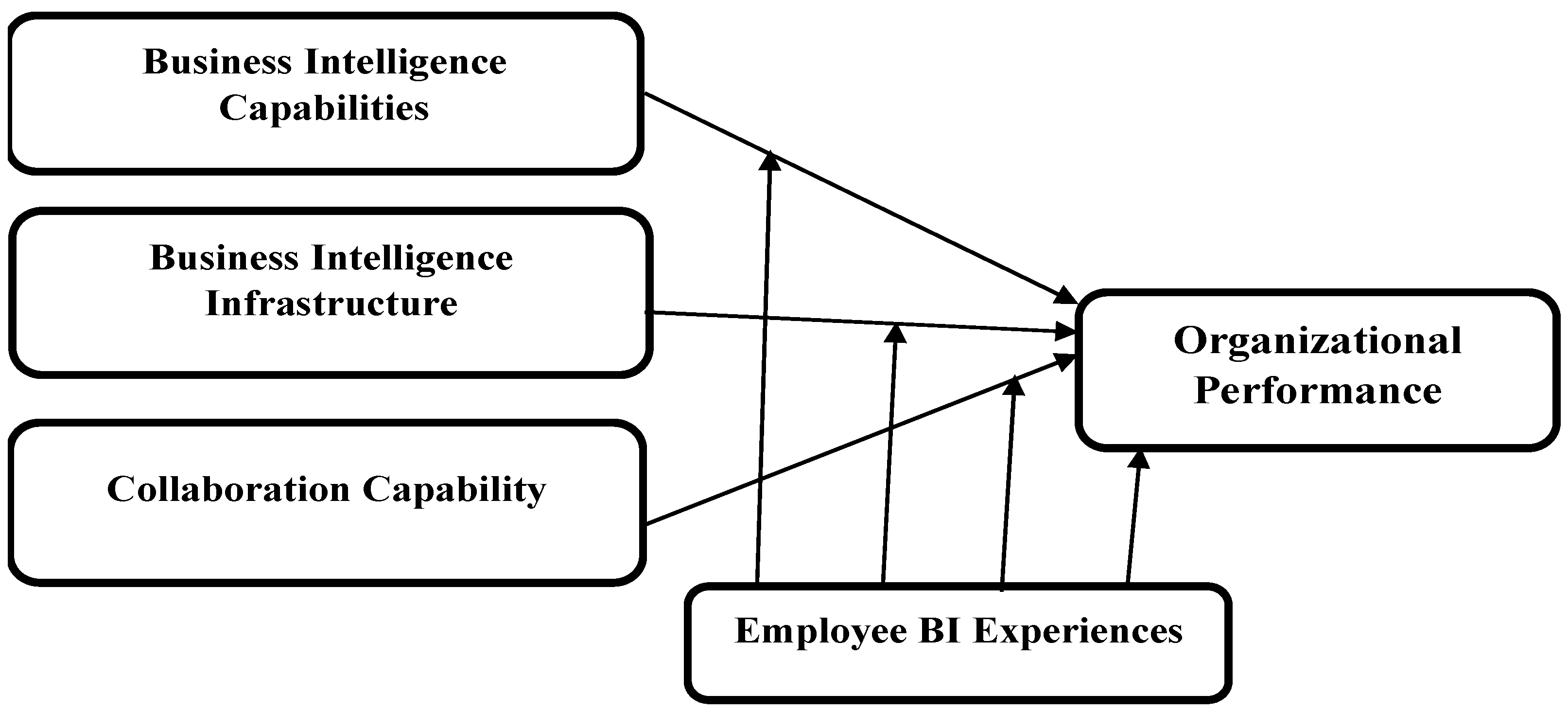
This study adopted a theoretical framework, illustrated in
Figure 1, to analyze the proposed hypotheses. The model below was created to look into how business intelligence capabilities, business intelligence infrastructure, and collaboration capabilities affect organizational performance. It also examines how employee BI experience in the banking industry moderates these relationships.
3.4. The Pilot Study
After the questionnaire was made, a six-part instrument was created. The first part had demographic information, the second, third, and fourth parts were about the dependent variables, the fifth part was about the independent variable, and the last part was about the moderator variable. Then, a pilot test was done with fifty employees from Jordan’s financial institutions. Each participant had at least two years of experience using business intelligence in financial services.
The aim of this assessment was to further validate the instrument’s validity and reliability. The pilot study confirmed that the questionnaire was suitable and clear for the study and statistical analysis, given that Cronbach’s alpha, kurtosis, and skewness were all within the appropriate ranges for each variable studied (business intelligence capabilities, business intelligence infrastructure, collaboration capability, organizational performance, and employee BI experiences), which served as mediators. Additionally, 500 questionnaires will be handed out to bank managers in order to encourage analysis of the study and the evaluation of the hypotheses raised.
4. Analysis and Results
The present study employs two models, one for measurement and a second for structural modeling, both of built on Smart PLS 4. This analysis will provide more comprehension of the links between the variables investigated.
4.1. The Outer Measurement Model
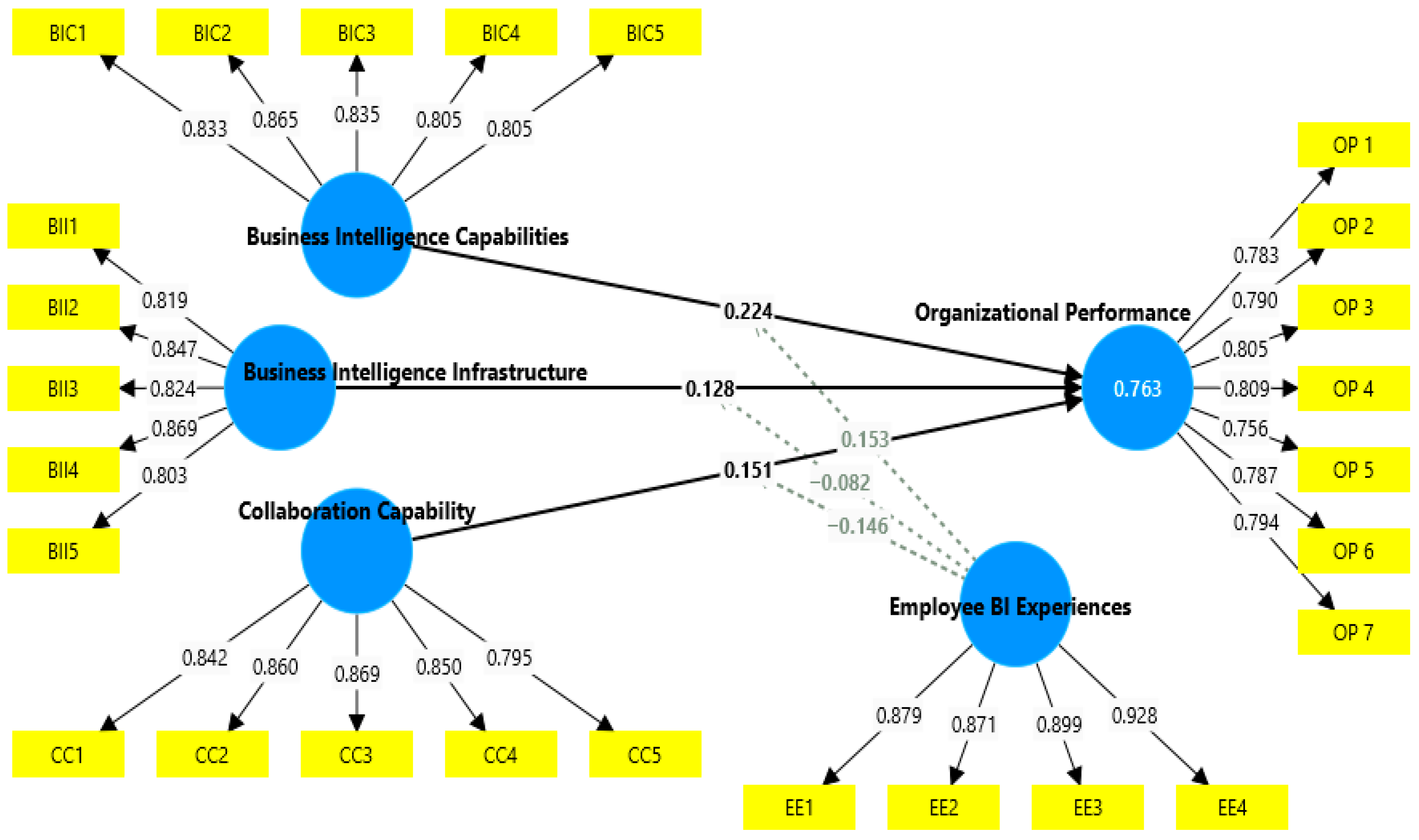
Initially, the analysis based on PLS includes the assessment of the measurement model results. This model provides fundamental reliability, convergent validity, and discriminant validity for the assessment of the measurement model in PLS. The results displayed in
Table 1 and
Figure 2 of the measurement model point out that all elemental loads exceed 0.756, which is considered acceptable to be consistent (
Hair et al., 2023).
Table 2 displays AVE results exceeding 0.693, showing satisfactory results consistent with
Hair et al. (
2023). The combined reliability (CR) is greater than 0.887, regarded as acceptable by
Henseler et al. (
2015); in addition, a Cronbach’s alpha coefficient of 0.866 or above is considered acceptable according to
Hair et al. (
2023). Consequently, convergent validity is verified. Discriminatory validity must be assessed after the evaluation of convergent validity for the constructs presented in
Table 3.
Table 1 and
Table 2 and
Figure 2 show that the findings fall within the acceptable range. This facilitates a risk-free assessment of the structural model, which constitutes the second model of this study.
4.2. Discriminant Validity
When we test the measurement model, we can evaluate discriminant validity, which demonstrates how differently each measuring item in the suggested model represents its factor from every other item. The heterotrait–monotrait (HTMT) ratio method and the Fornell and Larcker correlation method can both be used to evaluate the discriminant validity in the current study. The first method is an alternate approach, as suggested by (
Henseler et al., 2015), to evaluating discriminant validity in PLS-SEM. Based on the multifruit and multimethod matrix, or HTMT of correlations, discriminant validity can be assessed. The discriminant validity is insufficient when the HTMT value is close to 1. As a result,
Table 3 shows the HTMT criterion values and the new normal, which satisfy the lowest HTMT value and fall within the recommended range (
Henseler et al., 2015).
Table 3 shows the second way is to evaluate discriminant validity based on the Fornell–Larcker correlation matrix. In this way, discriminant validity is well established when the AVE of a single factor is greater than the squared multiple correlations of that factor with other factors (
Fornell & Larcker, 1981). Given that the correlation matrix illustrated in
Table 4 satisfied the Fornell–Larcker criterion, all the constructs in the proposed model and the new normal illustrated discriminant validity for the empirical data for the current study are acceptable.
4.3. Examination of Structural Models
Having established the validity of the measurement model, we then evaluated the structural model using smart PLS 4. To guarantee that the number of cases and observations in the sample is comparable, path coefficient evaluations should employ a bootstrap method with a minimum sample size of 5000 (
Hair et al., 2023). The initial sample size was 500, and this investigation employed 5000 resampling iterations using bootstrap cases.
The structural model evaluation process involves recommended principal tests, agreed upon across numerous scientific studies, which are crucial for testing the seven research hypotheses presented in the study for the independent and moderating variables, along with the dependent variable.
Hair et al. (
2023) highlighted this important critical analysis process, primarily aimed at obtaining the necessary results to clearly assess the model’s quality. This study relies on the common principal results obtained in this analysis, such as path estimates, t-values, and
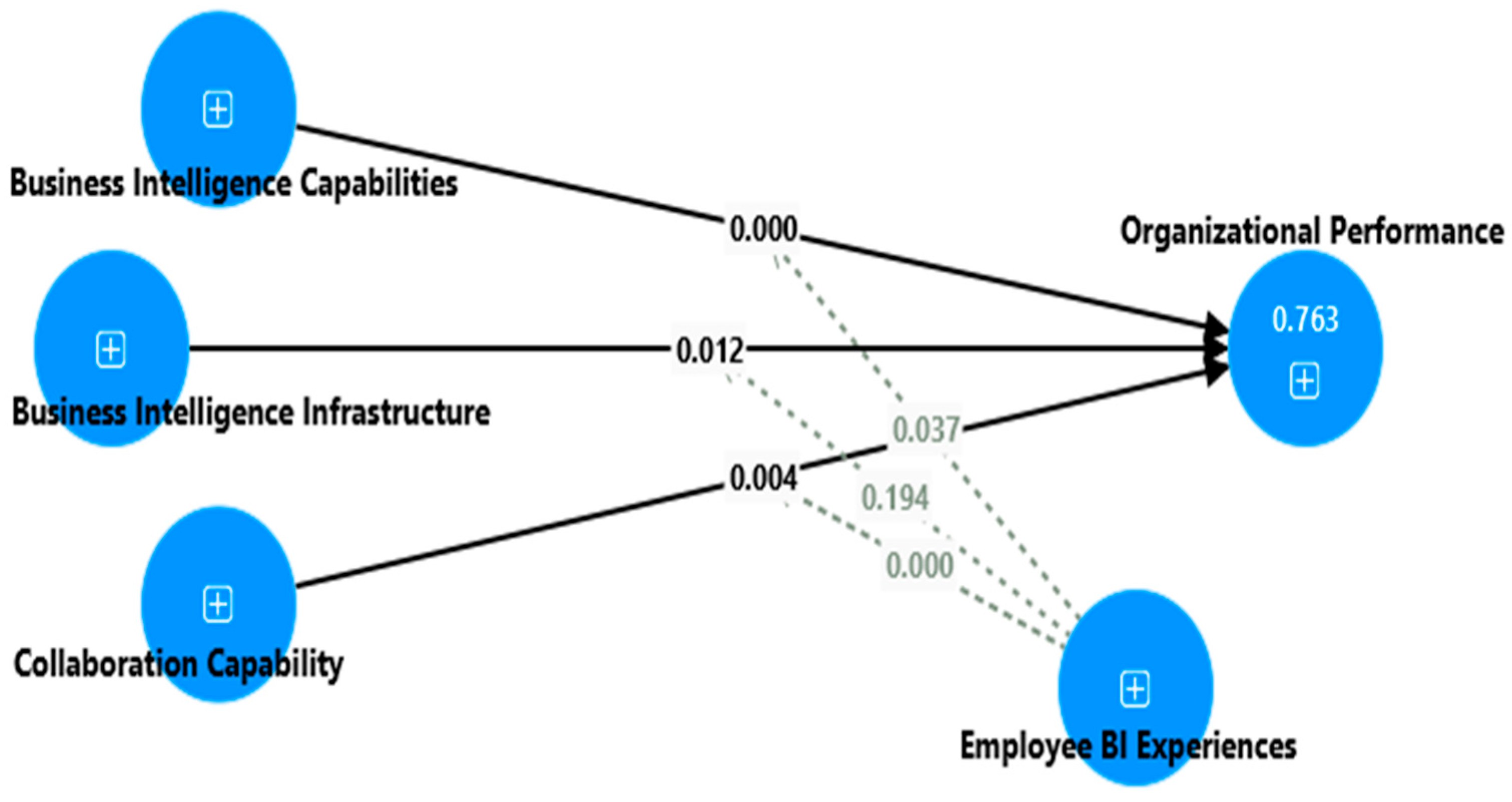
p-values, to conduct a clear review and decide on the seven research hypotheses, either accepting or rejecting them. The analysis employed a bootstrapping approach, as illustrated in
Figure 3, to obtain the direct-effects results, shown in
Figure 3 and Table 6.
The results indicated that business intelligence capabilities, business intelligence infrastructure, and collaboration capability had a significant impact on organizational performance (p < 0.05), thus supporting all relevant research hypotheses. A significant relationship was also found between employee experience in business intelligence and bank performance. I also found that there was a significant effect of the moderating variable of employee experience in business intelligence, between business intelligence capabilities, business intelligence infrastructure, and bank performance, but there was no significant effect of the moderating variable, employee experience in business intelligence, between collaboration capabilities and performance of banks in Jordan.
Table 5 shows the R-squared coefficient data. The research found that the model factors, including business intelligence capabilities, business intelligence infrastructure, and collaboration capability, explained 76.3% of the variation in the 0.757 organizational performance, as shown by the resulting figure of 0.763. This shows that various sources of data have made a major contribution, with the goal of aligning with our research variables. The corrected R-value was 0.757, which is a bit lower than the R-value, as shown in
Table 5. The prediction inaccuracy caused by adding extra variable-associated predictors is taken into account by this modified R-value. As a result, the model helps clarify why there is some variation in how banks in Jordan assess organizational performance.
5. Discussion
The Smart PLS analysis results demonstrated interrelationships among the three independent variables: (business intelligence capabilities, business intelligence infrastructure, and collaboration capability) affecting the organizational performance, with (employee BI experiences) serving as a moderator in commercial banks in Jordan.
Table 6 shows the findings of the hypotheses, which are as follows:
H1: Business intelligence capabilities positively and significantly influence organizational performance among commercial banks. Based on the statistical analysis of this hypothesis in
Table 6, T = 4.221 and
p = 0.000, the results of this research analysis are consistent with previous recent studies, such as
Da Silva (
2024) and
Wang et al. (
2022).
This result indicates that business intelligence capabilities strengthen and enhance the capability of the bank to make accurate choices, which in turn leads to a rise in efficiency in operations and an apparent enhancement in the bank’s financial performance.
H2: Business intelligence infrastructure significantly influences organizational performance. Based on the statistical analysis of this hypothesis in
Table 6, T = 2.510 and
p = 0.012. This result is consistent with the findings of
Judijanto et al. (
2024) and
Wamai et al. (
2022). This result indicates that a strong business intelligence infrastructure is very important and helps banks improve the speed of operations, improve service efficiency, and promote more effective banking decisions.
H3: The analysis revealed that collaboration capability positively affects organizational performance. The result for this hypothesis is T = 2.870 and
p = 0.004. This result is consistent with
Hidayat and Pok (
2023) and
Ping et al. (
2018). The result of this hypothesis indicates that a bank’s success improves significantly when there is effective cooperation among bank employees. This, in turn, leads to increased bank productivity and improved output.
H4. The analysis revealed that employee BI experiences positively affect organizational performance. The result for this hypothesis is T = 8.415 and p = 0.000. This result indicates that the expertise of employees in the field of business intelligence is essential for improving bank performance because it allows them to make accurate and timely decisions, which helps to improve the bank’s overall performance.
H5: The analysis revealed that employee BI experiences moderate the relationship between business intelligence capabilities and organizational performance. The result is T = 2.085 and p = 0.037. These findings show that when employees have appropriate business intelligence expertise, they have a greater influence on bank performance because it enables them to increase efficiency and facilitate informed decision-making by both bank managers and employees.
H6: The study revealed that employee BI experiences did not moderate the relationship between business intelligence infrastructure and organizational performance. The result in
Table 6 shows that T = 1.299 and
p = 0.194. These data showed that staff expertise with business intelligence did not increase the association between infrastructure and bank performance. The resilience of the business intelligence infrastructure has an equal impact on performance, regardless of whether staff members have great business intelligence skills. This relationship is not affected or enhanced by employee experience.
H7: The analysis revealed that employee BI experiences moderate the relationship between collaboration capability and organizational performance (T = 3.922, p = 0.000). These findings show that employee business intelligence experience has a greater effect on the relationship between collaboration capabilities and bank performance. This is because employees’ business intelligence experience enables them to collaborate more efficiently and quickly to achieve company objectives.
6. Conclusions
The goal was to look into how business intelligence capabilities, business intelligence infrastructure, and collaboration capabilities affect organizational performance, as well as how employee BI experiences moderate these effects.
The study sample comprised 500 individuals across various management levels, including IT managers, deputy top executives, and supervisors, within commercial banks in Jordan. In total, 212 people answered the survey that was sent out, and 197 of those answers were valid for statistical analysis. The proposed relationships were evaluated using SPSS and Smart PLS software.
The results indicated that business intelligence capabilities, business intelligence infrastructure, and collaboration capability had a significant impact on organizational performance (p < 0.05), thus supporting all relevant research hypotheses. A significant relationship was also found between employee experience in business intelligence and bank performance. I also found that there was a significant effect of the moderating variable of employee experience in business intelligence, between business intelligence capabilities, business intelligence infrastructure, and bank performance, but there was no significant effect of the moderating variable, employee experience in business intelligence, between collaboration capabilities and performance of banks in Jordan.
7. Theoretical and Practical Implications of This Study
The study expands current knowledge by providing insights pertinent to the banking sector, stakeholders, and policymakers worldwide, particularly in Jordan. Theoretical consequences: This study strengthens the theoretical framework by demonstrating that business intelligence capabilities, infrastructure, and collaboration are among the most fundamental factors for improving performance in Jordanian commercial banks. It also highlights the growing importance of employee expertise in business intelligence, which enhances the effectiveness of these capabilities, infrastructure, and collaboration, thus underscoring the pivotal role of human factors in leveraging technological and organizational resources. Furthermore, this study addresses a research gap by integrating several variables not previously studied, in addition to including a significant moderating variable that contributes significantly to the overall performance of these variables. The results expand the framework of resource-based and socio-technical theories by incorporating business intelligence, organizational capabilities, and employee expertise. This study also gives educational institutions, researchers, and future researchers a solid theoretical base.
This part shows that the performance of Jordanian banks is significantly and favorably dependent on business intelligence (BI) capabilities, BI infrastructure, and collaboration capabilities. Employee BI expertise improves BI capabilities and collaboration, but not business intelligence infrastructure and organizational performance. In real life, bank managers, supervisors, and stakeholders need to acquire BI tools, keep a strong BI infrastructure, and encourage employees at all levels to work together. Giving employees chances to learn and share what they know helps them get the most out of technology and working together. In general, integrating technology, organizational capabilities, and employee expertise is essential for enhancing banking performance.
8. Limitations and Further Research
The primary drawback of this study is that it was limited to the banks in Jordan in a specific geographical and time-based context, which may restrict the generality of the findings to other industries.
Another drawback is the reliance on data gathered through a questionnaire, which may be subject to the individual biases of the participating bank staff and might not have considered every external variable impacting bank performance.
This study examined commercial entities in Jordan. A similar study may be conducted on Islamic banks, or a comparison between commercial and Islamic banks could possibly be explored in this setting.
The study sample comprised 500 individuals across various management tiers, including IT managers, deputy managers, and supervisors, within commercial banks in Jordan. Another study like this one could be done with a different group of non-managerial bank workers, like small and medium-sized businesses (SMEs).
Business intelligence capabilities, business intelligence infrastructure, and collaboration capability on organizational performance, along with the moderating effect of employee BI experiences. This variable accounted for 76% of the cases, supporting the notion that additional variables also affect organizational performance. More research could be done to find factors that can help banks perform better as an organization. There are many ways to do this, like using qualitative methods or interviewing bank or company managers instead of giving them questionnaires. More variables, like IT knowledge, IT structures, culture, innovation, and AI factors, may be included in future research.
Author Contributions
Conceptualization, H.A.M.A. and N.J.S.A.-d.; Methodology, A.h.A.; Software, H.A.M.A.; Validation, H.A.M.A., N.J.S.A.-d. and A.h.A.; Formal analysis, A.h.A.; Investigation, H.A.M.A.; Resources, H.A.M.A.; Data curation, N.J.S.A.-d.; Writing—original draft, H.A.M.A.; Writing—review & editing, R.G.A., N.J.S.A.-d. and A.A.S.; Visualization, N.J.S.A.-d.; Supervision, H.A.M.A., R.G.A. and A.A.S. All authors have read and agreed to the published version of the manuscript.
Funding
This research received no external funding.
Institutional Review Board Statement
The study was conducted in accordance with the Declaration of Helsinki, and the protocol was approved by the Research Ethics Committee of Al-Hussein Bin Talal University (protocol code: 073 and date of approval: 10 May 2025).
Informed Consent Statement
Informed consent was obtained from all subjects involved in the study.
Data Availability Statement
The original contributions presented in this study are included in the article. Further inquiries can be directed to the corresponding author.
Conflicts of Interest
The authors declare no conflicts of interest.
References
- Abu-AlSondos, I. A. (2023). The impact of business intelligence system (BIS) on quality of strategic decision-making. International Journal of Data & Network Science, 7(4), 1901–1912. [Google Scholar]
- Alawamleh, H., Sharari, F., Nawaiseh, K., & Shibly, M. (2023). The impact of business intelligence on organizational performance: The moderating role of innovation capabilities in Jordanian banks. Journal of System and Management Sciences, 14(12), 199–214. [Google Scholar]
- Al-Hosaini, F. F., Ali, B. J., Baadhem, A. M., Jawabreh, O., Atta, A. A. B., & Ali, A. (2023). The impact of the Balanced Scorecard (BSC) non-financial perspectives on the financial performance of private universities. Information Sciences Letters, 12(9), 2903–2913. [Google Scholar] [CrossRef] [Scilit]
- Ali, B. J., Alrabei, A. M., Momany, M. T., Munir, K., Oudat, M. S., Qeshta, M. H., & Jawabreh, O. (2025). Influence of artificial intelligence technology on green electronic auditing: Moderating effect of organizational culture. Heritage and Sustainable Development, 7(2), 1055–1070. [Google Scholar] [CrossRef] [Scilit]
- Al-Jedaia, Y., & Mehrez, A. (2020). The effect of performance appraisal on job performance in governmental sector: The mediating role of motivation. Management Science Letters, 10(9), 2077–2088. [Google Scholar] [CrossRef] [Scilit]
- Alsarayrah, T., & Ali, B. J. (2025). The moderating role of auditor experience on determinants of computer-assisted auditing tools and techniques. Journal of Risk and Financial Management, 18(4), 206. [Google Scholar] [CrossRef] [Scilit]
- Atta, A. A. B., Baniata, H. M., Othman, O. H., Ali, B. J., Abughaush, S. W., Aljundi, N. A., & Ahmad, A. Y. B. (2024a). The impact of computer assisted auditing techniques in the audit process: An assessment of performance and effort expectancy. International Journal of Data & Network Science, 8(2), 977–988. [Google Scholar]
- Atta, A. A. B., Shehdeh, M., Othman, M. D., Ahmad, A. B., Hamdan, M., & Ali, B. J. (2024b). Risk management compliance of financial technology firms operating in Jordan. Journal of Logistics, Informatics and Service Science, 11(2), 251–265. [Google Scholar]
- Bleady, A., Ali, A. H., & Ibrahim, S. B. (2018). Dynamic capabilities theory: Pinning down a shifting concept. Academy of Accounting and Financial Studies Journal, 22(2), 1–16. [Google Scholar]
- Blomqvist, K., & Levy, J. (2006). Collaboration capability—A focal concept in knowledge creation and collaborative innovation in networks. International Journal of Management Concepts and Philosophy, 2(1), 31–48. [Google Scholar] [CrossRef] [Scilit]
- Brosig, C., Westner, M., & Strahringer, S. (2020, June 22–24). Revisiting the concept of IT capabilities in the era of digitalization. 2020 IEEE 22nd Conference on Business Informatics (CBI), Antwerp, Belgium. [Google Scholar]
- Chen, C.-H. (2024). Influence of big data analytical capability on new product performance—The effects of collaboration capability and team collaboration in high-tech firm. Chinese Management Studies, 18(1), 1–23. [Google Scholar] [CrossRef] [Scilit]
- Da Silva, J. C. L. (2024). A importância do business intelligence (Bi) e do sistema enterprise resourse. Revista Tópicos, 2(10), 1–17. [Google Scholar]
- Djedid, S. (2025). Reshaping employee experience through artificial intelligence: An analytical perspective supported by real-world examples. Journal of Excellence for Economics and Management Research, 9(1), 362–381. [Google Scholar]
- Dwivedi, D. N., & Mahanty, G. (2024). AI-powered employee experience: Strategies and best practices. In Exploring the intersection of AI and human resources management (pp. 166–181). IGI Global Scientific Publishing. [Google Scholar]
- Ebrahim, S. A. H., Ali, B. J., & Oudat, M. S. (2021). The effect of board characteristics on intellectual capital in the commercial banks sector listed on the Bahrain bourse: An empirical study. Information Sciences Letters, 10(4), 91–109. [Google Scholar] [CrossRef] [Scilit]
- Eisenhardt, K. M., & Martin, J. A. (2017). Dynamic capabilities: What are they? In The SMS Blackwell handbook of organizational capabilities (pp. 341–363). Wiley-Blackwell. [Google Scholar]
- Fornel, C., & Larcker, D. F. (1981). Evaluating structural equation models with unobservable variables and measurement error. Journal of Marketing Research, 18(1), 39–50. [Google Scholar] [CrossRef] [Scilit]
- Hair, J., Jr., Hair, J. F., Jr., Sarstedt, M., Ringle, C. M., & Gudergan, S. P. (2023). Advanced issues in partial least squares structural equation modeling. saGe publications. [Google Scholar]
- Henseler, J., Ringle, C. M., & Sarstedt, M. (2015). A new criterion for assessing discriminant validity in variance-based structural equation modeling. Journal of the Academy of Marketing Science, 43, 115–135. [Google Scholar] [CrossRef] [Scilit]
- Hidayat, A. S., & Pok, W. C. (2023). 14 Modelling the collaborative advantage of SMEs in pursuit of competitiveness: An emerging economy case. In De gruyter handbook of SME entrepreneurship (p. 301). De Gruyter. [Google Scholar]
- Huy, P. Q., & Phuc, V. K. (2023). Big data in relation with business intelligence capabilities and e-commerce during COVID-19 pandemic in accountant’s perspective. Future Business Journal, 9(1), 40. [Google Scholar] [CrossRef] [Scilit]
- Hyun, Y., Park, J., Kamioka, T., & Chang, Y. (2023). Organizational agility enabled by big data analytics: Information systems capabilities view. Journal of Enterprise Information Management, 36(4), 1032–1055. [Google Scholar] [CrossRef] [Scilit]
- Ismail, A. B. (2018). The Relationship among business intelligence systems adoption, information technology infrastructure, innovation and competitive environment on performance [Ph.D. thesis, Universiti Utara Malaysia]. [Google Scholar]
- Jahmani, K., Mohammad, S. I., Kutieshat, R. J., Almutairi, A. A. A., Abueid, A. I., Al-Ayed, S. I., Aburub, F. A. F., Vasudevan, A., & Shlash, A. (2025). Impact of business intelligence capabilities on competitive performance of Jordanian hypermarkets. In Artificial intelligence, sustainable technologies, and business innovation: Opportunities and challenges of digital transformation (pp. 73–86). Springer. [Google Scholar]
- Jasim, H., Sulaiman, Z., Zakuan, N., & Hashim, A. (2020). Influence of competitive intelligence success on business competitive advantage: A conceptual framework. International Journal of Innovation, Creativity and Change, 11(12), 795–807. [Google Scholar]
- Jawabreh, O., Baadhem, A. M., Ali, B. J., Atta, A. A. B., Ali, A., Al-Hosaini, F. F., & Allahham, M. (2023). The influence of supply chain management strategies on organizational performance in hospitality industry. Applied Mathematics, 17(5), 851–858. [Google Scholar]
- Judijanto, L., Makkawaru, Z., & Yusniar, Y. (2024). The effect of business intelligence system implementation on organizational performance in the digital age. West Science Information System and Technology, 2(3), 398–404. [Google Scholar] [CrossRef] [Scilit]
- Khan, A., Talukder, M. S., Islam, Q. T., & Islam, A. N. (2024). The impact of business analytics capabilities on innovation, information quality, agility and firm performance: The moderating role of industry dynamism. VINE Journal of Information and Knowledge Management Systems, 54(5), 1124–1152. [Google Scholar] [CrossRef] [Scilit]
- Khawaldeh, K., & Alzghoul, A. (2024). Nexus of business intelligence capabilities, firm performance, firm agility, and knowledge-oriented leadership in the Jordanian high-tech sector. Problems and Perspectives in Management, 22(1), 115–127. [Google Scholar] [CrossRef] [Scilit]
- Kulkarni, M. M., & Mohanty, D. V. (2022). An experiential study on drivers of employee experience. International Journal of Management and Humanities, 8(12), 1–7. [Google Scholar] [CrossRef] [Scilit]
- Lloyd, J. (2011). Identifying key components of business intelligence systems and their role in managerial decision making. Available online: https://scholarsbank.uoregon.edu/server/api/core/bitstreams/9c1a0783-6f70-4d13-b58f-d90928eadb99/content (accessed on 17 October 2018).
- Maaitah, T. (2023). The role of business intelligence tools in the decision making process and performance. Journal of Intelligence Studies in Business, 13(1), 43–52. [Google Scholar] [CrossRef] [Scilit]
- Mintzberg, H., & Bruce, B. (1998). Strategy safari: A guided tour through the wilds of strategic management. The Journal of Business Strategy, 19(6), 53. [Google Scholar]
- Moeliadi, S., Arief, M., Gunadi, W., & Rahim, R. K. (2025). The impact of collaboration capability, ambidextrous leadership and digital capability on bank performance sustainability. Banks and Bank Systems, 20(1), 231. [Google Scholar] [CrossRef] [Scilit]
- Mohammed, A. B., Al-Okaily, M., Qasim, D., & Al-Majali, M. K. (2024). Towards an understanding of business intelligence and analytics usage: Evidence from the banking industry. International Journal of Information Management Data Insights, 4(1), 100215. [Google Scholar] [CrossRef] [Scilit]
- Moussas, K., Hafiane, J., & Achaba, A. (2024). Business intelligence and its pivotal role in organizational performance: An exhaustive literature review. Journal of Autonomous Intelligence, 7(4), 1–14. [Google Scholar] [CrossRef] [Scilit]
- Najafi-Tavani, S., Najafi-Tavani, Z., Naudé, P., Oghazi, P., & Zeynaloo, E. (2018). How collaborative innovation networks affect new product performance: Product innovation capability, process innovation capability, and absorptive capacity. Industrial Marketing Management, 73, 193–205. [Google Scholar] [CrossRef] [Scilit]
- Oh, S., Yang, H., & Kim, S. W. (2014). Managerial capabilities of information technology and firm performance: Role of e-procurement system type. International Journal of Production Research, 52(15), 4488–4506. [Google Scholar] [CrossRef] [Scilit]
- Oudat, M., Ali, B., Hazaimeh, H., & El-Bannany, M. (2024). The effect of financial risks on the performance of Islamic and commercial banks in UAE. Frontiers in Applied Mathematics and Statistics, 9, 1250227. [Google Scholar] [CrossRef] [Scilit]
- Ping, T. A., Chinn, C. V., Yin, L. Y., & Muthuveloo, R. (2018). The impact of information technology capability, business intelligence use and collaboration capability on organizational performance among public listed companies in Malaysia. Global Business and Management Research, 10(1), 293–312. [Google Scholar]
- Pundziene, A., & Geryba, L. (2022). Managing technological innovations: Dynamic capabilities, collaborative innovation and born-digital. Academy of Management Proceedings. [Google Scholar]
- Qaffas, A. A., Ilmudeen, A., Almazmomi, N. K., & Alharbi, I. M. (2023). The impact of big data analytics talent capability on business intelligence infrastructure to achieve firm performance. Foresight, 25(3), 448–464. [Google Scholar] [CrossRef] [Scilit]
- Qeshta, M. H., Ali, B. J., Abdelaziz, M. S., Almsni, F. M., & Oroud, Y. (2024, December 11–12). Optimal board characteristics for making effective decisions affecting financial performance: An examination study. 2024 International Conference on Decision Aid Sciences and Applications (DASA), Manama, Bahrain. [Google Scholar]
- Saleh, J. O., Jaber, J., Garaibeh, A., Ali, B., & Ali, A. (2023). The impact of financial determinants on bank deposits using ARDL model. Journal of Statistics Applications & Probability, 12(2), 441–452. [Google Scholar] [CrossRef] [Scilit]
- Saleh, M. H., Jawabreh, O., & Ali, B. J. (2023). The role of performance Jordanian insurance companies in economic growth: Evidence from the PMG panel-ARDL approach. Cuadernos de Economía, 46(131), 30–42. [Google Scholar]
- Shi, X., & Zailani, S. (2025). Capabilities and resources for value creation and sustainable competitive advantage: A study of the chinese video game industry. Sustainability, 17(2), 605. [Google Scholar] [CrossRef] [Scilit]
- Shniekat, N., Al_Abdallat, W., Al-Hussein, M., & Ali, B. (2022). Influence of management information system dimensions on institutional performance. Information Sciences Letters, 11(5), 1435–1443. [Google Scholar] [CrossRef] [Scilit]
- Skyrius, R. (2021). Business intelligence. Springer. [Google Scholar]
- Teece, D., & Pisano, G. (1994). The dynamic capabilities of firms: An introduction. Industrial and Corporate Change, 3(3), 537–556. [Google Scholar] [CrossRef] [Scilit]
- Trieu, H. D., Van Nguyen, P., Nguyen, T. T., Vu, H. M., & Tran, K. (2023). Information technology capabilities and organizational ambidexterity facilitating organizational resilience and firm performance of SMEs. Asia Pacific Management Review, 28(4), 544–555. [Google Scholar] [CrossRef] [Scilit]
- Wamai, J., James, R., & Tumuti, J. (2022). Effect of business intelligence infrastructure capabilities on performance of commercial banks in Kenya. The International Journal of Business & Management, 10(2), 9–14. [Google Scholar] [CrossRef] [Scilit]
- Wang, J., Omar, A. H., Alotaibi, F. M., Daradkeh, Y. I., & Althubiti, S. A. (2022). Business intelligence ability to enhance organizational performance and performance evaluation capabilities by improving data mining systems for competitive advantage. Information Processing & Management, 59(6), 103075. [Google Scholar] [CrossRef] [Scilit]
- Wernerfelt, B. (1984). A resource-based view of the firm. Strategic Management Journal, 5(2), 171–180. [Google Scholar] [CrossRef] [Scilit]
| Disclaimer/Publisher’s Note: The statements, opinions and data contained in all publications are solely those of the individual author(s) and contributor(s) and not of MDPI and/or the editor(s). MDPI and/or the editor(s) disclaim responsibility for any injury to people or property resulting from any ideas, methods, instructions or products referred to in the content. |



 ,
,