


Abstract
Building on multiple theoretical views, this paper aimed to investigate how traits and their specific mechanisms transfer into realized entrepreneurial behaviors. Thus, this paper seeks to address various apparent gaps through an integrative theoretical framework that examines the serial mediation between Individual Entrepreneurial Orientation, Entrepreneurial Alertness, and Entrepreneurial Intentions, and their influence on Entrepreneurial Behavior. Based on a quantitative method with a survey strategy, this paper applied partial least squares-based structural equation modeling on a sample of 405 aspiring entrepreneurs in Saudi Arabia. The paper’s findings confirmed the positive and significant relationships between Individual Entrepreneurial Orientation and Entrepreneurial Alertness, Entrepreneurial Alertness and Entrepreneurial Intentions, and Entrepreneurial Intentions and Entrepreneurial Behavior. In addition, the results supported three indirect hypotheses, corroborating that Individual Entrepreneurial Orientation could affect Entrepreneurial Behavior indirectly through Entrepreneurial Alertness and Entrepreneurial Intentions. Likewise, the results supported the serial mediation hypothesis, in which Individual Entrepreneurial Orientation influenced Entrepreneurial Behavior through a sequential process, with both Entrepreneurial Alertness and Entrepreneurial Intentions as mediators. This paper offers theoretical and practical implications for the literature and practice of entrepreneurship. The study contributes to our understanding of the traits and cognitions that can motivate individuals to start a business. In addition, this study responded to many previous calls to examine not only the direct effects of EI antecedents but also the mediating roles of key factors.
1. Introduction
As a developing economy experiencing rapid growth, Saudi Arabia aims to transform its economy by 2030 through its overarching Vision 2030 (Alshahrani et al., 2024; Kinawy, 2025). Saudi Vision 2030 aims to modernize the economy by lowering unemployment and shifting the focus from oil to other industries. In particular, the plan intends to increase the GDP contribution of SMEs to 35% and reduce unemployment from 12% to 7% (Rostan & Rostan, 2020). The country thus demonstrates the potential of entrepreneurship to achieve these economic objectives. According to Elnadi and Gheith (2023) and Al-Mamary and Alshallaqi (2022), entrepreneurship is a promising sector in Saudi Arabia. The government is taking various initiatives, such as establishing significant public and private institutions (e.g., Monsha’at, the Public Investment Fund, the Misk Foundation), offering a range of services to support entrepreneurs in establishing new ventures (Alshrari et al., 2021; Kinawy, 2025). The outcomes of such efforts are profoundly reflected in the GEM 2019 and 2023 survey results, which estimated that approximately 76.3% (2019) and 95% (2023) of Saudi Arabia’s adult population perceives the country as having favorable conditions for starting a business (Roomi et al., 2023).
As such, the government believes that entrepreneurs are critical to reconstructing economies through their impact on economic growth, technology, society, and venture creation (Hassan et al., 2021; Nungsari et al., 2023). They are vital drivers of economic growth because of the many advantages they bring, such as job creation, technology transfer between research and commercial markets, enhanced competitiveness and innovation, and social empowerment (Al-Mamary & Alraja, 2022). However, entrepreneurship is a multidimensional process that evolves through the instrumental interaction of multiple interrelated factors over time. Previous studies have identified significant antecedents and pathways that guide entrepreneurial behavior ( I. Martins & Perez, 2025). Nevertheless, the processes by which traits and cognitions influence an entrepreneur’s intentions and behaviors remain key areas of research (Bilal & Fatima, 2022; Tran et al., 2024). This warrants further investigation into the precise mechanisms that impart traits into the elicited entrepreneurial behaviors. A better understanding of this process is important for developing theory and informing practice. This paper, therefore, aimed to fill apparent gaps by taking an integrative theoretical approach to the interrelationships among individual entrepreneurial orientation (IEO), entrepreneurial alertness (EA), and entrepreneurial intentions (EI), and how these relationships affect entrepreneurial behavior (EB).
IEO is a cognitive measure developed by Bolton and Lane (2012) that describes a person’s engagement in entrepreneurial activities across three determinants: proactiveness, innovativeness, and risk-taking. IEO emphasizes people’s attitudes toward using these abilities in business decision-making (Adeniyi, 2024). The IEO construct influences a person’s dispositional beliefs, which in turn impact their entrepreneurial mindset and behaviors (Pidduck et al., 2020). Knowledge of EO at the personal level could help future business owners and investors (Bilal et al., 2022). In this paper, IEO serves as the base independent variable, primarily driving the other constructs.
Moving on, EA involves actively seeking out information and deepening knowledge of market challenges to uncover opportunities (Levasseur et al., 2022; Tang et al., 2012). The process starts with the ability to look for opportunities and the ongoing growth of the person to turn those opportunities into realities (Li et al., 2020). Kirzner (1997) defined EA as an individual’s capacity to notice opportunities that have been overlooked. Research on EA has focused on individuals’ cognitive capacities because of the emphasis on acting and seizing opportunities (Levasseur et al., 2022; Pidduck et al., 2020). Tang et al. (2012) referred to EA as involving three main factors: information scanning and search, information association and connection, and evaluation and judgment. Hence, the EA in this study is a vital consequence of IEO and a predictor of EI.
On one hand, EI is integrated into the conceptual model. EI refers to the individual’s determination to set up a new business or become self-employed (Liñán & Chen, 2009). According to Bird’s concept of EI, an individual’s intention reflects their mind and is linked to their perceptions, abilities, and behaviors regarding a specific object or activity (Bird, 1988). Thus, EI represents a popularly assumed antecedent of acting toward new venture creation or development. According to Ajzen (1991), intentions capture the motivational features influencing actions and show how difficult it is for individuals to try.
On the other hand, EB describes the attitudes and behaviors that entrepreneurs display (Tran et al., 2024). Thus, EB, as stated by Duong and Vu (2023) can be defined as the process of identifying, assessing, and investigating a business opportunity. This includes concrete steps toward developing the business, such as creating a business plan, talking to potential clients about products or business ideas, setting aside funds for investing in a company, and conducting market research (Adeel et al., 2023). So, while intentions represent the cognitive decision to engage in entrepreneurship, behaviors are its visible manifestations (Ajzen, 1991). Thus, behaviors go beyond intentions to reflect the execution of entrepreneurial activities in the real world.
Research Gaps
The landscape of entrepreneurship research continues to develop and increasingly highlights the complex dynamics around IEOs and their outcomes (Falahat et al., 2024; Koe et al., 2024). The IEO is crucial to understanding entrepreneurial development, yet research has lagged in examining its role and its relationship to entrepreneurial success (Adeniyi, 2024; Lumpkin & Pidduck, 2021). According to Shi et al. (2024), previous studies have helped identify and understand the IEO; however, further examination is needed to clarify how this orientation affects entrepreneurial success and to uncover the mechanisms underlying the IEO’s outcomes. In addition, further research is needed into how the IEO reflects an individual’s underlying propensity to think and behave entrepreneurially through the components of risk-taking, innovativeness, and proactiveness (I. Martins & Perez, 2025).
The EO has traditionally been viewed as a corporate-level construct (Bolton & Lane, 2012; Twum et al., 2021), and various scholars have examined how the EO shapes the firm-level EI (Aydin et al., 2023; Covin et al., 2020). However, Bilal and Fatima (2022); Bolton and Lane (2012); Twum et al. (2021); and Yu et al. (2025) have recommended that the EO should be explored at the individual level in order to investigate the orientation–intention relationship further.
Similarly, there have been calls for entrepreneurship researchers to investigate better how individual characteristics are linked to cognitive constructs (Bilal & Fatima, 2022; Yu et al., 2025). Recent discussions by Clark et al. (2024) note that there is growing credibility and momentum in research on IEOs; however, Yu et al. (2025) emphasize the rarity of any examination of the connection between IEOs and EAs. By identifying that the IEO precedes EA, the researchers outline the relationship between these constructs, an innovative proposition that future research will benefit from exploring (Nika & Bashir, 2023; Yu et al., 2025). Furthermore, although EA is implicated in the discovery of entrepreneurial opportunities, its impact on the development of EI and EB remains under-investigated (Lanivich et al., 2022; Montiel-Campos, 2024; Zhou & Mei, 2024). Understanding how EAs relate to the development of EI and EB offers valuable insights into entrepreneurship development (Montiel-Campos, 2023; Zhou & Mei, 2024). In addition, continued investigation into the EA–EI relationship offers an opportunity to improve our understanding of how potential entrepreneurs are developed. In this area, verifying EA promotes opportunity recognition and the identification of people with business intent (Otache et al., 2024). However, the association between EA and EBs is still underexplored (Biswas & Verma, 2021; Edigbo et al., 2021; Li et al., 2020; Zhou & Mei, 2024).
A growing body of literature shows that EIs are critical in entrepreneurial processes and EBs (Duong, 2023; Hung & Khai, 2022; Katoch et al., 2025). However, little research on entrepreneurship has tested the connection between the EI and EB (Bouarir et al., 2023; Gieure et al., 2020; Yu et al., 2025). To date, the research has shown that intentions correlate with later behaviors, but the explanatory power of intentions remains modest (Dieguez & Gomes, 2025; Yu et al., 2025). This indicates that there is often a discrepancy, or “gap”, between what individuals intend to engage in entrepreneurial activity and the actions they ultimately take (or fail to take) (Dieguez & Gomes, 2025; Katoch et al., 2025; Le et al., 2023). In that setting, examining the direct effects of EI on EB—as recommended by (Gieure et al., 2020; Hee et al., 2022; Kong et al., 2020; Meoli et al., 2020)—can help assess the ability of intentions to predict actions among aspiring entrepreneurs.
Furthermore, previous studies primarily focused on examining the direct role of antecedents or consequences of EI (Alferaih, 2022; Anjum et al., 2023; Le et al., 2023). This is a significant gap, as understanding the cognitive-motivational process of entrepreneurship depends on fully explaining the sequential functions of many dimensions. It is important to close this theoretical gap, since mediation analysis breaks down links between different aspects and offers more insight into how and why they connect across time than direct effects alone can (Le et al., 2023).
Additionally, as much of the previous literature on EB predictors and factors has focused on developed countries, more research is needed in developing countries (Alferaih, 2022; Elnadi & Gheith, 2021). Sharahiley (2020) has noted a lack of EI research in developing nations, particularly in the Arab world. This is an important research gap, as EI may vary across developed and less developed nations (Anjum et al., 2023). As such, the topic of entrepreneurship should be further investigated through the lens of the developing world, with initial focus on countries such as Saudi Arabia (Al-Mamary & Alraja, 2022; Elnadi & Gheith, 2023).
Against that background, this study attempts to address essential research gaps to achieve the following objectives:
- Evaluating the direct impacts of the individual entrepreneurial orientation, entrepreneurial alertness, and entrepreneurial intention.
- Examining the indirect influence of the individual entrepreneurial orientation on entrepreneurial behavior (via the mediation of entrepreneurial alertness and entrepreneurial intention independently).
- Examining the indirect influence of the individual entrepreneurial orientation on entrepreneurial behavior (via the serial mediation of entrepreneurial alertness and entrepreneurial intention).
The remainder of this paper is organized as follows: Section 2 reviews the literature and presents the hypotheses. Then, Section 3 outlines the methods. Following that, Section 4 presents the analysis, and Section 5 discusses the results. Next, this study’s limitations are presented in Section 6, while the seventh and eighth sections outline its implications and, finally, conclude the discussion.
2. Theoretical Framework
2.1. Underpinning Theories
The current paper draws on recognized theories such as the theory of planned behavior (TPB) (Ajzen, 1991), alertness theory (Kirzner, 1979), and the entrepreneurial event model (EEM) (Shapero & Sokol, 1982) to conceptualize interaction among the certain key constructs encompassing dynamics of entrepreneurial behaviors. The TPB was applied to investigate the impact of IEO, a personal characteristic, on EA. It also addresses the association of EI and EB. TPB’s emphasis on intention, attitude, perceived behavioral control, and subjective norms positions it as a key theory for examining EIs and personal traits (Aydin et al., 2023; Cao et al., 2022). Furthermore, the TPB suggests that an individual’s intention is a central determinant of their behavior (Duong & Vu, 2023). Alertness theory (Kirzner, 1997, 1979) offers a lens for understanding the emergence of new opportunities through discovery rather than creation. In EA, the underlying concept of alertness involves an individual’s ability to detect unexploited profit opportunities that others cannot so easily notice. The theory postulates that persons higher in alertness are much more sensitive to subtle market signals that may indicate profitable opportunities, unmet needs, inefficiencies, and/or emerging technologies (Edigbo et al., 2021). EA theory conceptually grounds the opportunity identification processes underpinning EA hypotheses (Edigbo et al., 2021). The Entrepreneurial Event Model (EEM) (Shapero & Sokol, 1982) provides a very appropriate framework for conceptualizing the serial mediation hypothesis. The EEM focuses on the cognitive antecedents of EI and actions (Alferaih, 2022). The EEM provides an essential framework for understanding complexity in entrepreneurship (Nguyen & Nguyen, 2024) by integrating individual characteristics, cognitive processes, and behavioral outcomes, offering a holistic perspective on how entrepreneurs become aware of opportunities and decide to act on them. The motivation to choose these theories as underpinning frameworks for this research has been their perceived higher efficacy to explain the dynamics of entrepreneurial behaviors as hypothesized in this research.
2.2. IEO → EA
IEO has been theorized and grounded in beliefs (Lumpkin & Pidduck, 2021) or in what people believe to be true (their internals). IEO has been justified by Clark et al. (2024), who argued that, since people are the heart of organizations, they play a distinct and special role. Yu et al. (2025) define IEO as a dispositional construct encompassing both risk-taking beliefs and the behaviors required to create new value under uncertainty, and as proactive, autonomous, innovative, and competitive. In contrast, EA is a cognition-based construct (Lanivich et al., 2025) that comprises cognitive activities of awareness, thoughts, and perceptions (Yu et al., 2025). In the case of EA, scholars highlight the role of mental processes in recognizing and analyzing business opportunities (Lanivich et al., 2022; Tang et al., 2012).
IEO examines traits directly related to the formation of flexible cognitive schemes, which correspond to alertness and broad associative thinking (Bilal & Fatima, 2022). However, Yu et al. (2025) reported a dearth of IEO-EA research in the literature. Clark et al. (2024) reported that the direct linkage between an entrepreneur’s IEO and the level of EA is a relatively young field of scientific research, but early research in this area seems promising. For years, scholars have sought to determine what distinguishes those who seize opportunities in new ventures from those who pass them by. Specifically, studies have connected characteristics that fall under the umbrella of IEO, such as risk-taking, inventiveness, and proactiveness, to higher levels of entrepreneurial aspirations and behaviors (Bolton & Lane, 2012). Consequently, based on the integrated viewpoints, IEO serve as distinct underlying cognitive orientations that are thought to have a direct effect on EA levels.
The TPB provides a solid foundation for the connection between IEO and EA. IEO could contribute to the formation of attitudes toward EA that lead to various forms of Eis (Al-Mamary & Alshallaqi, 2022). Moreover, IEO may facilitate cognitive elements that contribute to EA, such as risk-taking and proactivity (Nika & Bashir, 2023). These cognitive components also align well with the TPB model’s cognitive components. Because TPB can provide evidence about the roles of various processes and factors, it will contribute to a more valuable understanding of entrepreneurial processes. Thus, Individuals who possess greater IEO exhibit traits that are supposed to promote knowledge structures that enhance opportunity perception (Hung & Khai, 2022). Drawing on the above discussion, we propose the following hypothesis:
H1.
IEO is significantly and positively associated with EA.
2.3. EA → EI
One component that has recently attracted greater interest for its impact on EI is EA (Jiatong et al., 2021; Montiel-Campos, 2024). Drawing from (Elnadi & Gheith, 2023; Montiel-Campos, 2023; Otache et al., 2024; Tang et al., 2012), EA initiates the motivation to pursue unexploited opportunities and the continuous commitment to transform these prospects into action. According to Mehdizadeh et al. (2021), one of the strongest predictors of actual entrepreneurial potential is EA, as it initiates the entrepreneurship process.
Initially, the more Alert a person is, the better he or she is at noticing market gaps or opportunities for new ventures (Montiel-Campos, 2024). Additionally, alerted individuals are more knowledgeable regarding changes in consumer tastes, technological changes, and other environmental events (Chen et al., 2020). The fundamental principle of Kirzner’s (1997) theory of alertness is that entrepreneurs can see opportunities that others overlook (Chavoushi et al., 2021).
In addition, Kirzner (2009) suggest that high EA provides entrepreneurial individuals with the potential to take action, when necessary, through proactive behavior. Proactivity arises because entrepreneurs who display EA are aware of the potential rewards and pitfalls of seizing opportunities in the entrepreneurial world. Some empirical studies have confirmed the predictive role of EA (Montiel-Campos, 2024; Ugwueze et al., 2022) showing that individuals with greater EA are more likely to perceive business opportunities and actively start their own companies to fulfil their ambitions (Zhou & Mei, 2024). Drawing from alertness theory and the above discussion, we propose the following hypotheses:
H2.
EA is significantly and positively associated with EI.
2.4. EI → EB
Since EI is the main predictor of entrepreneurial conduct in entrepreneurship studies, researchers frequently use it to predict EB to promote the benefits of entrepreneurship (Gieure et al., 2020). However, many people with entrepreneurial ideas never truly follow through (Fu et al., 2022). This is an important concern, as it can deter future entrepreneurs and undermine the positive effects of entrepreneurial activity (Meoli et al., 2020). Meoli et al. (2020) and Duong (2023) also suggest that behavioral intention is a powerful predictor of a limited number of non-complex behaviors, including exercising, voting, and financial donations. Consequently, we should learn more about the relationship between EI and EB. Meoli et al. (2020) studied data from 20,754 participants and found that only 2% of graduates started their own business within a year of graduation. Therefore, examining the direct effects between EI and EB can help assess the ability of intentions to predict actions within the context of the entire theoretical framework tested. Besides, expanding our understanding of the connection between EIs and EB is crucial. Based on the above theoretical and empirical discussion and on the investigation of the relationship between EI and behavior in the context of the KSA, the following hypothesis is proposed.
H3.
EI is significantly and positively associated with EB.
2.5. The Mediating Role of EA
The function of EA as a mediator has been recognized as a key component of every entrepreneurial process since Kirzner’s EA theory (Kirzner, 1997) has helped identify opportunities in a given environment (Chavoushi et al., 2021). Grounded in alertness theory (Kirzner, 1973, 1979), EA is a key concept for understanding the entrepreneurial process, particularly in articulating how it mediates the relationship between antecedents such as IEO and entrepreneurial outcomes. According to Nika and Bashir (2023), this cognitive skill is likely to not only allow individuals to identify and address viable opportunities but also help them make decisions about them. Thus, as individuals become more alert, they are likely to become more willing to form intentions to act on entrepreneurial opportunities (Tang et al., 2021). According to Hu et al. (2018), analyzing EA is also relevant because it pertains to an individual’s awareness, evaluation, and attitude towards risks associated with changes and uncertainties in the external environment. Fundamentally, EA is viewed Kirzner (1997) as influencing motivated behaviors, perceptions, and judgments. Analyzing the function of alertness provides a step-by-step perspective, mirroring theories of entrepreneurship as a process that develops over time (Montiel-Campos, 2023; Tang et al., 2021). Thus, a more comprehensive view is offered by viewing EA as transmitting the effects of traits on both EI and EB, confirming that the mediating role of alertness may provide new conceptual insights. This emphasizes cognition as developmental, rather than static, and beyond static typologies (Tang et al., 2012). This investigation may lead to theoretical and practical contributions. Accordingly, we proposed the following hypothesis:
H4.
EA significantly and positively mediates the relationship between IEO and EB.
2.6. The Mediating Role of EI
Entrepreneurship is a multifaceted process that begins with inclinations and culminates in actual venture actions. The body of existing research underscores the intricacy of this process (Cui & Bell, 2022), in which multiple mechanisms influence how traits unfold into emergent behaviors. To close the cognitive gap between attitudes and behavior, we empirically conceptualize and establish EI’s unique mediating role. Based on the literature review, this study introduces EI to assess its mediating role in the association between IEO and EA with EBs.
Few previous studies have demonstrated that EI mediates the effects of several antecedents on EB (Duong, 2023), including risk aversion (Baluku et al., 2019), trait competitiveness (Neneh, 2019), and educational activities (Cui & Bell, 2022). Thus, while the mediating role of EI between antecedents and EB is growing, empirical validation of EI’s specific mediating role between IEO and EB has been inadequate (Gazi et al., 2024). Instead of examining the underlying mechanisms of EI, most studies to date have evaluated it as a direct predictor of EB (Alferaih, 2022; Anjum et al., 2023; Le et al., 2023). This is a significant gap, since understanding the cognitive–motivational process of entrepreneurship depends on elucidating the sequential functions of multiple dimensions. Based on the above discussion, we propose the following hypothesis:
H5.
EI significantly and positively mediates the relationship between IEO and EB.
2.7. The Serial Mediation Role of EA and EI
Aspiring entrepreneurs need to give their venture ideas, well-defined goals, and intentions to act (Asante et al., 2023). Setting goals gives aspiring entrepreneurs the drive to turn opportunities into reality. Defining their business concept, target market, unique value proposition, and go-to-market strategy in detail will help aspiring entrepreneurs make their intentions clearer (Al-Mamary & Alshallaqi, 2022). Furthermore, aspiring entrepreneurs are aware that turning their aspirations into ventures is a gradual process (Jiang et al., 2021; Kautonen et al., 2015). The rapid transition from concept to market could eventually threaten sustainability. The best way to understand the process is to break it into phases. IEO progressively affects EA, which in turn fosters the growth of EI and influences EB. The EA provides an essential cognitive bridge connecting IEO and EI. According to Tang et al. (2012), identifying and assessing opportunities makes it easier to create specific goals and plans for entrepreneurship. EI represents the motivating connection between EAs and EBs. Strong intentions drive behavior and mobilize resources to exploit opportunities (Bouarir et al., 2023).
From a process standpoint, there are new implications when considering the gradual growth of capacities. This emphasizes the necessity of specialized training that prioritizes learning distinct skills over advancement. This nuanced perspective guides more effective support to enhance capacities. Prior work has explored segments of the proposed relationships.
Previous studies have sought to link IEO to various factors, such as alertness (Biswas & Verma, 2021), Entrepreneurial readiness (Adeniyi, 2024), and intentions (Lone & Baba, 2024). Others tried to link EA to EI (Zhou & Mei, 2024) or EBs (Li et al., 2020). The majority of previous studies have considered only a direct relationship or with a single mediator only (Gieure et al., 2020; Kong et al., 2020). Thus, to our knowledge, no previous study has modeled the serial mediation chain from traits to action through EA and EI. In general, considering complete pathways can provide insights that cannot be derived from a single link in isolation. In other words, serial mediation embeds a richer cognitive–motivational process by which latent entrepreneurial traits are actualized into purposeful intentions and then into concrete EBs.
Since the entrepreneurial context is multifaceted due to individual and cognitive characteristics that affect the recognition of opportunities and the taking of action, we aim to explore how individual traits may lead to action through interventions in cognition and intention. To better discern the interplay and complexity of these phenomena, an integrated theory that merges the characteristics of the EEM (Shapero & Sokol, 1982) and TPB (Ajzen, 1991) is developed to theoretically ground and make sense of the serial mediation process. This integration helped us better understand the interactions between individual and cognitive characteristics and their impact on entrepreneurship.
The features of proactivity, risk-taking readiness, and innovativeness (Adeniyi, 2024; Bolton & Lane, 2012) that determine the disposition to see or exploit opportunities are included in IEO (Clark et al., 2024). According to the TPB, these personal traits place attitudes and perceptions of control within the context of personal behavior. Individuals with strong IEO are more inclined to have a positive attitude toward entrepreneurship and to view risks as challenges rather than threats (Hung & Khai, 2022). This proactive stance could advance a mindset conducive to entrepreneurial engagement.
EA can be viewed as the cognitive capacity to observe and act on the opportunities within the environment (Chen et al., 2020; Tang et al., 2021); through the lens of EEM, EA is one of the cognitive functions that contribute to opportunity recognition (Lanivich et al., 2025). EA consists of searching and scanning for information, connecting previously unrelated information, and deciding whether a profitable business opportunity exists (Tang et al., 2021). Yu et al. (2025) propose that the existence of an IEO trait with the following properties could significantly help modify these perceptions and increase the likelihood of discovering and exploiting such opportunities. From a TPB perspective, EA increases the likelihood of entrepreneurial involvement (Pidduck et al., 2020). This implies that the greater the alertness of individuals in the environment to opportunities within it, the more likely they are to consider and act on them, thereby enhancing their level of commitment to entrepreneurship. Greater EI then facilitates the next stage of the establishment of entrepreneurial ambition. Therefore, once people know about possible opportunities, the second step is to practice EI. This is demonstrated in the TPB, where intentions are given greater weight as antecedents of behavior. Zhou and Mei (2024) determine that with high levels of EA, people develop the ability to see opportunities that they can utilize, thereby growing their EI. Lastly, intention-to-action, EEM, and TPB demonstrate how strong EI leads to real venture formation and growth behavior (Alferaih, 2022; Sharahiley, 2020). EB involves the exercise of finding and acting upon opportunities. Both the EEM model and the TPB influence the transition from EI to EB. According to the TPB, EI should be needed to trigger EB (Neneh & Dzomonda, 2024). Based on the above discourse, we propose the following hypothesis:
H6.
EA and EI significantly and serially mediate the impact of IEO on EB.
2.8. Conceptual Model
This conceptual model (Figure 1) outlines our hypothesized direct, mediation, and serial mediation relationships among the four subject constructs.
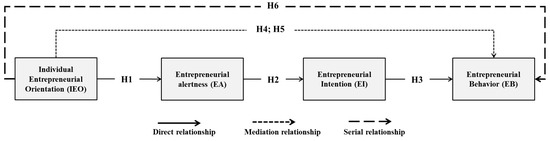
Figure 1.
Conceptual model.
3. Materials and Methods
This study employs a deductive, quantitative design, as deemed appropriate for such studies (e.g., Balgiu & Simionescu-Panait, 2024; Dieguez & Gomes, 2025).
3.1. Scope of Study and Sampling
The Small and Medium Enterprises General Authority (Monshaat) is a Saudi Arabian governmental entity that provides support and resources to individual entrepreneurs and small and medium enterprises. It manages and supervises all business incubators, accelerators, and entrepreneurs nationwide (Monsha’at, 2023). The sample for this research consisted of potential or aspiring entrepreneurs who had participated in Monshaat’s programs. Their perspective as beginners venturing into business provided unique and enlightening insights (Asante et al., 2023). Furthermore, aspiring entrepreneurs are at an early stage of development and well-placed to shed light on the key constructs and relationships under investigation (Kolvereid, 2005).
A sampling frame consisting of all the target informants was obtained from Monsha’at. We applied a simple random sampling (SRS) design to select the sample. SRS assures representativeness when a random sample is drawn from the entire population. Participants would have the chance to participate and be selected at random, without bias or filtering (Stratton, 2021).
Monsha’at was approached to assist in distributing the survey by enlarging the pool through its departments that manage and supervise all business incubations, accelerations, and entrepreneurs nationwide (Monsha’at, 2023). 427 complete questionnaires were returned, out of which 22 responses were dropped from inclusion in the ultimate analysis due to incomplete or inadequate responses.
3.2. Questionnaire Design
The questionnaire consisted of closed-ended questions to assess the primary constructs of IEO, EA, EI, and EB. The measurement scales for this research have been adapted from reputable prior studies (see Appendix A). The responses were recorded on a five-point Likert-type scale ranging from 1 (strongly disagree) to 5 (strongly agree).
3.3. Data Analysis
Structural Equation Modelling (SEM) can model the associations among subject constructs and assess the quality of their measurements. Farooq (2018) explained that neither of the two popular approaches in SEM (i.e., CB-SEM and PLS-SEM) is superior. The choice depends on the model and data attributes, as Hair and Alamer (2022) maintained, given the research objective. The researchers have implemented PLS-SEM in this study for several important reasons. First, PLS-SEM can be advantageous when dealing with non-normal data, as it does not assume normality (Sarstedt et al., 2020). PLS-SEM can produce consistent parameter estimates regardless of the data distribution because the constructs in the study’s model were measured reflectively (Hair et al., 2022). The study’s goal was to investigate connections and predict how the constructs would interact to explain the dependent variables. The variance-based methodology of PLS-SEM is perfectly adapted to these objectives of variance exploration, prediction, and explanation (Roemer et al., 2021; Sarstedt et al., 2020). Third, a comprehensive analytical technique is necessary due to the structural model’s complexity, as evidenced by both direct and indirect effects and several interactions among the constructs (Sarstedt et al., 2020). The PLS-SEM algorithm is well-suited to managing such intricate models with multiple paths (Dash & Paul, 2021). Fourth, bootstrapping was required to assess the significance of the postulated indirect effects and multiple mediation processes following PLS-SEM recommendations. This bootstrapping approach is supported by methodological experts and facilitated by PLS-SEM (Dash & Paul, 2021; Guenther et al., 2023).
4. Results
4.1. Participants Profile
The data collection phase ran from May 2024 to August 2024, and 405 informants participated (see Table 1). All participant data was downloaded anonymously and securely stored on an encrypted flash drive. Furthermore, all participant data was safeguarded after collection, ensuring anonymity was consistently maintained.

Table 1.
Participants’ profiles.
4.2. Common Method Bias/Variance (CMB/CMV) and Non-Response Bias
To evaluate the apparent common method bias (CMB), the researcher executed the measured latent marker variable (MLMV) method, which effectively identifies bias/variance issues in structural equation modeling (Chin et al., 2013). This model used the education variable as a marker variable because it is unrelated to the conceptual framework. Accordingly, the researchers used the MLMV approach to assess potential biases or variances arising from common method bias in their PLS-SEM models (Sarstedt et al., 2020). Table 2 presents R2 results for the dependent variables, which varied by less than 10% after controlling for respondents’ education levels (Podsakoff et al., 2012). Thus, according to the latent marker variable approach, the model had no CMB/CMV issues.
Table 2.
Common method bias/variance (CMB/CMV).
The researchers also checked for nonresponse bias following (Rezaei & Ortt, 2018; Sok et al., 2017) by comparing whether early respondents’ first 10% of the responses received (41 participants) replied differently from late 10% of the responses received (41 participants) via a t-test (Gupta & Batra, 2016). The results (Table 3) show no significant differences between the early and late respondents in IEO (t = −1.530; p = 0.134), EA (t = 1.347; p = 0.186), EI (t = 0.151; p = 0.881), or EB (t = 0.095; p = 0.925), which suggests that nonresponse bias is not a genuine concern in the current study.
Table 3.
Paired samples t-test (paired differences).
4.3. Measurement Model Assessment
4.3.1. Reliability and Convergent Validity
The reliability of the individual items is assessed through the significance and magnitude of the factor loadings (Sujati & Akhyar, 2020). Items whose loadings were either not significant or less than the recommended threshold of 0.7 were removed. Internal consistency reliability at the construct level is evaluated using measures such as composite reliability (CR) and Cronbach’s alpha (CA), with values of 0.7 or higher indicating adequate internal consistency among the indicators of each construct (Sujati & Akhyar, 2020). Table 4 shows that Cronbach’s alpha and CR values for all the variables were higher than the minimum suggested value of 0.70 (Bacon et al., 1995; Hair et al., 2022).
Table 4.
Reliability and Convergent validity.
To ascertain convergent validity, the average variance extracted (AVE) for each construct should exceed 0.5 to demonstrate a sufficient amount of variance is shared between a construct and its measures relative to measurement error (Fornell & Larcker, 1981). Table 4 shows that the convergent validity was established.
4.3.2. Discriminant Validity
Discriminant validity is useful for statistically determining whether the unobserved latent variables overlap or are distinct from one another (Roemer et al., 2021). It looks at how strongly items of one construct are related but how weakly they are related to items of other constructs (Fornell & Larcker, 1981; Henseler et al., 2015; Roemer et al., 2021). To assess discriminant validity, the Fornell and Larcker criteria as well as the HTMT are suitable methods (Ab Hamid et al., 2017). Each dimension’s square root of the AVE is compared in the Fornell–Larcker criterion test item. The results (Table 5) show that when the AVE and correlations are compared, the square root of the AVE is larger than each of the correlations listed below. In addition, in accordance with Hair et al. (2022), discriminant validity is proven if the AVE values’ square root is greater than a cut-off point of 0.7.
Table 5.
Discriminant validity.
In research using partial least squares structural equation modelling (PLS-SEM), the HTMT criterion has gained favor as a means of demonstrating discriminant validity (Roemer et al., 2021). The HTMT ratio compares the average heterotrait–heteromethod correlation with the average monotrait–heteromethod correlation among indicator variables (Henseler et al., 2015). According to Gold et al. (2001), constructions with lower HTMT values—below the thresholds of 0.85–0.90, with less variance, can be distinguished from one another. Table 5 shows that the results for all the constructs are higher on the diagonal, and all the values are greater than 0.70, which validates the discriminant validity for all the constructs, as recommended by Hair et al. (2022) and Roemer et al. (2021). In addition, the h marks represent the HTMT test results, indicating that the constructs share less common variance and can be considered distinct, as the HTMT values are below the thresholds of 0.85–0.90 (Roemer et al., 2021). In this instance, all values exceeded this threshold. Thus, discriminant validity was established.
4.4. Assessment of Structural Equation Model (SEM)
4.4.1. The Model’s Goodness of Fit, Explanatory, and Predictive Power
Several goodness-of-fit indices were reported to evaluate the model fit. Fit indices (Table 6), including the chi-square/df ratio, CFI, TLI, NFI, GFI, and RMSEA, can offer an overall goodness of fit assessment of how well the proposed pattern of relationships between indicators and constructs matches the actual data by feeding the suggested measurement model structure (Hancock & Mueller, 2008; Shultz et al., 2020). The model has a good fit if the confirmatory fit index (CFI) and the Tucker-Lewis index (TLI) are >0.95 (Dash & Paul, 2021; Hooper et al., 2008). In addition, an adequate-fitting model was assumed if the root mean square error approximation (RMSEA) was less than 0.08 (Hair et al., 2022). Overall, most of the significant model fit indices are within the recommended values.
Table 6.
Fit Index of the CFA Model.
According to Salkind (2010), R2 refers to the strength of the linear relationship between a regression model’s independent and dependent variables. According to Cohen (2013), R2 values are categorized as low or ineffective at 0.02, moderate at 0.13, and positive or significant at 0.26. Table 7 represents R2 values. These suggest that the structural model has significant explanatory power, as the results are above 0.26.
Table 7.
Coefficient of determination (R2 value).
The effect size (f2) is the statistical measure used to determine the magnitude of the effect or predictive power of the model (Ripollés & Blesa, 2023). The effect size f2 is the measure of the impact of each independent variable on the dependent variable (Cohen, 2013). Cohen (2013) suggested 0.02, 0.15, and 0.35 as the thresholds for small, medium, and large effect sizes. Table 8 shows that f2 falls within the range of small to large effects.
Table 8.
Effect size (f2).
Finally, the researchers assess the predictive power of the study model by applying PLS prediction. According to Shmueli et al. (2019) the stated criterion, sufficient predictive relevance is indicated if Q2 is greater than 0. Table 9 shows that Q2 values exceeded zero, establishing sufficient predictive relevance.
Table 9.
Cross-Validated Redundancy.
4.4.2. The Structural Equation Model Estimates
After the measurement model was validated, the researcher tested the proposed linkages between the constructs listed in the conceptual framework to examine the structural model relationships. Additionally, this tool facilitates the estimation of numerous factors and related independence throughout a single investigation (Henseler, 2021). A complete latent model was employed in the SEM (Hair et al., 2022). Bootstrapping with 10,000 and 95% confidence intervals. In SMART-PLS, SEM is used to test the study’s hypotheses (Figure 2). A hypothesis test was used to assess the research outcomes, with the bootstrap data-resampling process, which was applied since it is believed to be the strongest statistical tool for assessing the direct, indirect, and overall impacts of variables, since the sample size does not influence it in its estimations (Dash & Paul, 2021; Hair & Alamer, 2022).
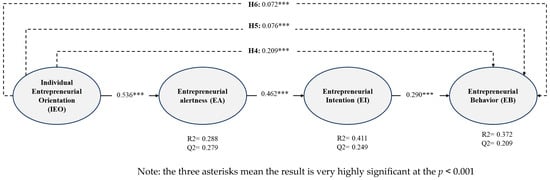
Figure 2.
Structural equation model.
For the direct hypotheses, Table 10 below shows the results. Hypothesis H1 examined the significant positive relationship between IEO and EA. The analysis results support this hypothesis (β = 0.537, p < 0.001). This means that with an increase in IEO, individuals become more vulnerable to entrepreneurial changes and, in the long run, become more alert to entrepreneurship (Nika & Bashir, 2023). Furthermore, hypothesis H2 examines the positive impact of EAs on EI. The results supported this hypothesis (β = 0.602, p < 0.001), demonstrating that those who are more skilled at identifying opportunities are more likely to consider launching their own company to capitalize on them. Hypothesis H3 examined whether EI positively leads to EB. The analysis results supported this hypothesis (β = 0.526, p < 0.001).
Table 10.
Structural path estimates.
Table 11 presents the results for the study model’s indirect hypotheses. Results for H4 and H5 supported both hypotheses. H6 represents a more complex serial multiple mediation model in which IEO is hypothesized to affect EA, then EI, and ultimately EB. The study of indirect effects enhances awareness of how one group can affect another population through intermediate linkages. It detects the possibility of ancestral impacts being transmitted across several mediating groups. Accounting for direct and indirect paths also enhances explanatory power beyond bivariate analyses of individual relationships. In general, testing these mediated hypotheses can provide valuable new information on the complex linkages between populations while accounting for dependence across associations (Table 11). EA and EI serially mediate the IEO findings on EB. The conclusion is to accept H6.
Table 11.
Results of the indirect relationship.
5. Discussion
In this paper, the researchers aimed to validate the hypothesis that individuals with high levels of IEO are more likely to engage in entrepreneurial activities. With the TPB’s theoretical underpinnings and empirical evidence from past studies, there is substantial support for the influence of IEO on EA. Furthermore, this paper contributes to the body of knowledge by showing that IEO reflects a cognitive propensity to pursue ventures and entrepreneurial opportunities, as the relationship between IEO and EA has attracted little scholarly attention (Clark et al., 2024; Yu et al., 2025). Thus, high-IEO individuals are more aware of entrepreneurial opportunities than those with low IEO, indicating that they are more attuned to business opportunities (Nika & Bashir, 2023). Research shows that individuals with certain entrepreneurial traits, such as proactiveness and innovativeness, tend to be more responsive to environmental changes and opportunities to turn ideas into ventures (Bilal & Fatima, 2022). Thus, exploring the IEO as an antecedent could create variation in EA and affect subsequent entrepreneurial outcomes.
The findings of this paper suggest that EA is an added personal attribute that directly influences and shapes aspiring entrepreneurs’ intentions at a significant level. Moreover, individuals with high EA often view situations from distinctly different perspectives or perceive them in ways that those with low EA do not (Montiel-Campos, 2024). The greater the EA is, the more ideas are generated, and consequently, the greater the chance of starting a business. Therefore, a considerable level of EI corresponds to a substantial level of EA (Biswas & Verma, 2021; Zhou & Mei, 2024). According to the Alertness Theory, an individual varies in their ability to detect, discover, and identify entrepreneurial opportunities because they differ in experiential knowledge and cognitive processes (Montiel-Campos, 2023). For this reason, more alert individuals are those who may best identify and exploit opportunities that come their way. Increased EA affects an individual’s intentions to engage in opportunity-driven entrepreneurial action behaviors. Biswas and Verma (2021) A study on the relationship between EA and EI among university students showed that those high in alertness are more likely to have stronger intentions to take entrepreneurial action. As such, heightened alertness to opportunities positively influences one who has intensified positive intentions toward entrepreneurship. Other studies, such as Adeel et al. (2023), indicate higher EI among university students who perceive more opportunities in entrepreneurship. This indicates the realization of entrepreneurial opportunities through greater awareness of opportunities.
Scholars have focused much research on EI to learn more about how entrepreneurs emerge and why people start businesses (Al-Mamary & Alraja, 2022; Lone & Baba, 2024). EI is linked to a person’s readiness to adopt an entrepreneurial mindset and make the commitment to launch a new company (Ceresia & Mendola, 2020). Thus, we integrate EI as another central construct that may help validate intention as a significant determinant of actual entrepreneurial actions in the Saudi Arabian context, where aspiring entrepreneurs are involved. According to the TPB, intentions are the strongest predictor of behavior (Heinemann et al., 2022). EI gives individuals power, motivates them to act entrepreneurially, and indicates how much work they are willing to put into business development operations (Adeel et al., 2023). Cahyadi and Selamat (2023) conducted a study among university graduates, they found that individuals with higher levels of EIs were more likely to start their businesses and engage in entrepreneurial ventures over time. This highlights the predictive power of EIs on actual EBs. EI is widely considered an antecedent of actual EB. According to Bouarir et al. (2023), although many people develop intentions to establish and grow businesses, only a few succeed in turning those intentions into action. Thus, entrepreneurship entails real actions, not mere intentions.
Furthermore, past studies confirmed that EI serves as a bridge between ambition and the realities of business creation (Duong, 2023; Tran et al., 2024). To strengthen this transition to actual action, Finding a mentor or networking opportunity with more established entrepreneurs is highly recommended to solidify intentions (Adeniyi, 2023; Eid et al., 2023). Mechanisms such as business plan competitions, accelerators, and incubators may be considered events where one can get feedback, find resources, and maybe even find mentors. In addition, Mentorship programs through incubators can also offer opportunities for peer-to-peer learning by fostering communities where founders share insights, learn from others’ successes and setbacks, and forge partnerships. According to Ayad et al. (2022), Such supportive environment could empower aspiring entrepreneurs to refine market entry strategies and mitigate risk, thus enabling the translation of EI into EB.
This study’s findings indicated that IEO acts as either a direct or an indirect influence on the creation of EIs and thus on the determination of EBs. Loan et al. (2021) explored the mediating role played by EIs in the relationship between opportunity recognition, ESE, and EBs. They found that EI has a significant mediating effect on the relationships between these individual variables and EBs. EI is, hence, essential in mediating personal attributes into behavior. The findings from this research have the potential to improve scholarships by thoroughly locating EI as the motivating cognitive mechanism driving the IEO-EB link. This would complement existing information by not merely hinting but by statistically establishing the staged role of intentions. Practically speaking, understanding the thoughts and drives of entrepreneurs during the venture creation process helps them better understand their own thoughts (Sahinidis & Xanthopoulou, 2022), whether generating ideas, formalizing strategies, or expanding businesses. Thus, a genuine knowledge gap might be filled and theory and practice advanced by explicitly analyzing EI as a mediator.
According to the study findings, IEO had a significant indirect influence on EB via this serial path. The outcome of EB is shaped by a multitude of contextual and individual elements (Loan et al., 2021; Naser & Al-Tit, 2023). To the best of our knowledge, the indirect effects of individual traits, such as IEO, unfolding through various intervening processes structured in a conceptual chain model, have not been predicted in prior studies. The hypothesis offers a distinctively original theoretical contribution by putting out and verifying this model with empirical data. By conceiving multistage processes in a novel way rather than in conventional single-mediator frameworks, it expands on the current understanding.
The results provide a more sophisticated understanding of how attributes and cognitions interact at different phases to promote entrepreneurial activity over time. The EEM proposed by Shapero and Sokol (1982) supported the mechanisms proposed in this hypothesis. At its core, the model suggests that the relationship between exogenous conditions and EBs is mediated by perceived desirability and feasibility. The study postulates that EA and EI successively mediate the influence of individual EO on EB. The feasibility domain closely mirrors EA, which measures an entrepreneur’s scanning and opportunity appraisal skills. EI, on the other hand, represents desirability-related goal-setting tendencies associated with choosing entrepreneurship as a career. Crucially, in the suggested causal chain, the proposed ordering places EA as impacting EI (Zhou & Mei, 2024). This novel application and extension make substantial contributions to the theoretical understanding of entrepreneurial development.
Over the past several decades, universities have played an increasingly prominent role in developing entrepreneurship through their education programs (Gazi et al., 2024). Our findings also extend recent work on entrepreneurial capital formation in higher education contexts. In particular, Teodoro and Bernadó (2025), reveal how entrepreneurship education embedded within university innovation ecosystems could contributes to the development of an entrepreneur’s capital mainly through the increase in the entrepreneur’s EIs to start their business. While their research emphasizes the institutional and educational foundations of entrepreneurial capacity, the current study complements this perspective by explicating the cognitive and behavioral mechanisms through which such capital is activated. By empirically showing that EA precedes EI and that EI subsequently translates into EB, our results provide micro-level evidence for a staged entrepreneurial process. This study supports Teodoro and Bernadó (2025) assertion that higher education can facilitate the development of entrepreneurial capital, while at the same time demonstrating how that capital can ultimately lead to the creation of an entrepreneur’s business. In this manner, this study deepens the understanding of the importance of using sequentially structured mechanisms to study the success of entrepreneurship education and regional innovation initiatives.
6. Implications and Conclusions
6.1. Theoretical Implications
This study provides empirical evidence that advances the understanding of entrepreneurship theory by demonstrating how embedded traits, as presented in the foundational literature, encourage goal-directed pursuits. The findings highlight the significance of IEO and support the view that EO can be studied and measured at the individual level. This paper contributes to the body of knowledge by showing that IEO reflects a cognitive propensity to pursue ventures and entrepreneurial opportunities (Clark et al., 2024; Yu et al., 2025). This exploration helps close the gap in the literature concerning IEO–EA connections, as mentioned by Yu et al. (2025), who found limited literature on individual IEO–EA connections. Proof of IEO’s motivational impact on cognitive and behavioral outcomes clarified its predictive role as a characteristic influencing the entrepreneurial path.
In addition, this paper has significant theoretical implications for EA. For example, the study supported the proposed connection between IEO and EA, namely that particular characteristics influence cognitive patterns. Understanding how entrepreneurial mindsets lead to the development of EA improves the understanding of orientation theory (Clark et al., 2024). Furthermore, recognizing that EA follows IEO helps explain how cognitive tendencies thought to be responsible for opportunity perception are translated into predictive dispositions. As such, the study illuminates a poorly defined cognitive route in theories. In addition, given the limited research on the consequences of EAs, the present study has theoretical significance by confirming that EAs have a positive, significant relationship with EI. As such, this paper supported the existence of a direct path from EA to EI.
This study makes a significant novel contribution by supporting the serial multiple mediator hypothesis, which states that EA and EI successively mediate the relationship between an individual’s EO and EB. The results indicated substantial evidence of serial mediation. IEO had a positive effect on EA, which bolstered EI and eventually affected EB. Several studies have emphasized the role of IEO in explaining EI and EB (Gieure et al., 2020; Lone & Baba, 2024). To the best of our knowledge, no single study has examined whether EA and EI may act as sequential mediators of the relationship between IEO and EB. In addition, few studies have explored a serial mediating process in which some predictors influence EB.
6.2. Practical Implications
6.2.1. Practical Implications for Individuals
Aspiring entrepreneurs should consciously and effectively develop specific competencies, such as innovativeness, proactiveness, risk-taking, and opportunity recognition, which are at the core of an entrepreneurial business venture’s success. Entrepreneurship programs aimed at developing such competencies should focus on activities that better expose people to new information while encouraging exploratory thinking (Liu et al., 2023). For example, the initiation of innovation workshops, ideation sessions, and problem-solving can assist entrepreneurs in achieving preparedness to identify and exploit commercial value from market opportunities (Mehdizadeh et al., 2021). The present research highlights that these competencies will enable the identification of emergent trends or gaps within the Saudi market.
Given the Saudi Arabian cultural context, embedding Islamic values such as truthfulness, concern for the group’s welfare, and self-control into entrepreneurship training aligns with their ethical framework. Courses that apply these values in practice empower people to establish ethical, socially responsible businesses (Barqawi et al., 2025). In addition, it reflects the individual’s commitment not only to personal but also to societal development. Islamic Business ethics also focus on sustainability and ethical interaction with others (Rehan et al., 2019), issues crucial to contemporary entrepreneurship.
In a practical context, an entrepreneur who resists hindrances by changing tack and adjusting strategy whenever anything comes up is better positioned to sustain their enterprise over a longer cycle. Encouraging people to be active participants in the Saudi Arabian entrepreneurial ecosystem provides them with a wealth of resources, networks, and support structures (Alshrari et al., 2021). Involvement in entrepreneurship hubs, innovation centers, or specific industry events helps keep pace with market changes, access financing options (Shahriar et al., 2024), and interact with fellow entrepreneurs (Sahinidis & Xanthopoulou, 2022). According to Al-Mamary et al. (2025), Vision 2030 was advanced by Saudi Arabia to develop a strong entrepreneurial ecosystem and establish platforms through which individuals can grow their business ideas from conception to launch.
6.2.2. Practical Implications for Organizations
Organizations, such as educational institutions, business accelerators and incubators, and corporate partners, play critical roles in fostering positive ecosystems for potential entrepreneurs (Nikitina et al., 2023). Strategic programming and resources enable an organization to drive potential people toward developing their entrepreneurial capabilities to address the initial phases of venture creation. Drawing from this paper, entrepreneurship programs at Saudi universities and other educational institutions should be improved and expanded to include theoretical and applied aspects (Alshebami, 2024). These training and educational programs must transcend mere coursework by incorporating project-based learning, internships, and partnerships with startup incubators, exposing students to the realities of business (António Porfírio et al., 2023; Shahriar et al., 2024). Specialized tracks in digital entrepreneurship, innovation management, and social entrepreneurship are examples of how business schools equip students with skills that meet market needs. In addition, ideation skills, prototyping, and market analysis may be developed through entrepreneurial boot camps and competitions that introduce students to the complete range of entrepreneurial processes.
Furthermore, the present study sheds light on aspiring entrepreneurs’ IEO and EI. According to Koe (2016), students from varying study fields portray varying IEO capabilities. For instance, business students and non-business students differ significantly in their levels of risk-taking and innovativeness. This notion implies that it is no longer viable for universities to develop a common entrepreneurship education curriculum that caters to students from diverse fields of study (Nikitina et al., 2023). The current study supports the assertion that universities and other learning platforms should design curricula tailored to the unique needs of learners across different faculties.
Another practical implication for organizations is that they can further enhance their training programs through experiential models such as Kolb’s Experiential Learning Cycle (Kolb, 1985) or the Business Model Generation Model (Osterwalder & Pigneur, 2010). These models enable participants to practice structured real-life problems by applying learned concepts to simulated or real entrepreneurial scenarios. The model activities of hackathons, case competitions, and venture simulations allow participants to brainstorm solutions to pressing issues, prototype their ideas, and test them in a collaborative environment. Through such hands-on learning, aspiring entrepreneurs develop practical skills, confidence, and the ability to adapt to new challenges.
In Saudi Arabia, where digital transformation is on the rise (Hasan et al., 2024), it will become increasingly important for organizations to provide digital skills resources, particularly in e-commerce, digital marketing, and technology innovation (Alferaih, 2022; Digital Cooperation Organization, 2023). Tech-based ventures can be supported through the establishment of a Technology Business Incubator (TBI) within universities and local startup hubs, which would house advanced resources comprising modern technology, technical expertise, and workshops in emerging digital trends to enable the use of state-of-the-art technologies by entrepreneurs and skill them to create and manage digitally enabled businesses (Ayad et al., 2022).
6.2.3. Practical Implications for Policy Makers
Policymakers are vital in creating a conducive entrepreneurial environment through supportive policies, resource allocation, and relevant ecosystem development (Bradley et al., 2021). To prompt more entrepreneurship, governments can provide grants, low-interest loans, and venture capital funds for early-stage and high-impact areas. The establishment of a public–private partnership will provide better industry selection in which to invest, which is in line with Saudi Vision 2030. Financing innovation hubs and entrepreneurship centers would enable the distribution of resources at all levels—from startup grants to subsidized office space—supporting entrepreneurs at all stages of their ventures (Kinawy, 2025).
Policymakers should also coordinate with the education sector to inculcate entrepreneurship education into the mainstream early enough, through initiatives that focus on innovation, problem-solving, and digital competencies (Kautonen et al., 2015). In addition, entrepreneurial education reforms must focus on including entrepreneurship courses to prepare students for a dynamic economy, although practical heuristic models of learning have been stressed. This, in turn, may foster a long-term entrepreneurial mindset among Saudi citizens.
Policymakers can influence cultural attitudes toward entrepreneurship through celebrating local success stories or creating public awareness of the advantages of entrepreneurship (Cao et al., 2022). National-level events will make startups more visible and generate buzz of excitement around innovation. By highlighting entrepreneurs as role models, policymakers can also create a storyline that links entrepreneurship to Saudi cultural values, inspiring more citizens to pursue business ventures.
Saudi policymakers could foster only one ecosystem by creating university-private-government partnerships that can then provide resources, networking, and mentorship across the entrepreneurial value chain. This would further reduce the barriers to entrepreneurship, as government-led ecosystems could also provide legal and advisory services (Elnadi & Gheith, 2021).
6.3. Limitations and Future Research Directions
This study aimed to address previous calls to investigate an apparent gap by providing a framework that uses EA and EI to mediate the IEO-EB relationship among aspiring entrepreneurs in KSA. However, some limitations to this study offer potential avenues for future directions.
This study was confined to aspiring entrepreneurs within Saudi Arabia only. This approach narrows the sampling, limiting the generalizability of findings (Oliveira & Rua, 2018). Future studies should expand the samples to participants from diverse groups, not just aspiring entrepreneurs but also experienced entrepreneurs and industry professionals, to increase the generalizability of the findings (Duong, 2023). This would broaden the sample to include aspiring and established entrepreneurs of various ages, regions, and industries, thereby expanding understanding of EI and behavior.
This study primarily focuses on individual-level factors of IEO, EA, and EI, distinct from external and contextual influences, such as the institutional supportiveness of economic conditions and cultural norms, which are recognized as influencing levels of entrepreneurship (Lin et al., 2022; Moharrak et al., 2025). For instance, family support (J. M. Martins et al., 2023), religion, and the regulatory environment in Saudi Arabia (Moharrak et al., 2025) could be among the major influences that affect EBs. Thus, these elements open an excellent path for future research to focus more on the contextual and environmental aspects that influence entrepreneurship in developing countries such as KSA. In doing so, such examinations of how environmental factors interact with individual-level traits will provide additional insight into the entrepreneurial ecosystem and what hinders or drives entrepreneurship.
Although the study validated IEO, EA, and EI as predictors of EB, it is important to examine other moderators and/or mediators that can illuminate the complex layers through which a variety of factors influence their behaviors, thereby broadening the literature in the field of entrepreneurship (Alshebami, 2024). Entrepreneurship activities and actions did not happen in isolation; they take place within contextual factors of many kinds (Mabkhot et al., 2024), including culture (Zaid et al., 2024), economics (Koe et al., 2024), or institutions (Sarabdeen et al., 2025). So, the addition of mediating and moderating variables can refine the understanding of how various factors influence aspiring entrepreneurs EBs. Further research could investigate whether certain features of cultural or religious backgrounds (Barqawi et al., 2025) act as moderators, enabling the identification of specific features that characterize Saudi Arabian entrepreneurship (Al-Mamary et al., 2025). Likewise, examining other factors, such as entrepreneurial resilience or adaptability, as mediators may reveal other paths through which traits and EIs are transformed into EBs.
The cross-sectional design of the study does not capture longitudinal trends in the development of behaviors across the lifecycle. Future research should include longitudinal designs that track behaviors over time (Liu et al., 2023). This design enables the researcher to note changes in self-efficacy, opportunity recognition, and environmental factors, and to examine how these factors influence entrepreneurial decisions across different stages of the entrepreneurship journey. Furthermore, researchers strongly recommend conducting comparative studies across countries, students, genders, and education levels (Bigos & Michalik, 2020; Taneja et al., 2024). This approach will help researchers answer questions about the cultural differences that exist and their impact on the development of an entrepreneurial mindset in both developed and developing countries. Moreover, it will help to explore the differences in the policies employed to support and promote entrepreneurship across different levels of economic development. These questions could contextualize values that provide deeper insights into the relationship among culture, policy, and entrepreneurship, thereby informing better strategies to foster entrepreneurship across a variety of settings. Consequently, when comparing within groups, cultures, or contexts, the researchers will be better positioned to evaluate the influence of socioeconomic background, education, cultural norms, etc., on individual intention to be an entrepreneur (António Porfírio et al., 2023; Essel et al., 2020). This study also applied self-report questionnaires for data collection, which might have introduced some biases (CMB/CMV) (Kock, 2021). Future research could combine multimethod data collection techniques to triangulate questionnaires with observational data and expert evaluations (Podsakoff et al., 2012). This combination of quantitative surveys and qualitative data would provide a deeper understanding of EIs and actions, while enhancing the reliability and validity of the findings.
Finally, future studies could investigate the impact of recent policy interventions, such as Vision 2030’s efforts to encourage entrepreneurship, by tracking changes in entrepreneurial activity, startup success rates, and economic consequences. Research may also investigate how distinct aspects of the entrepreneurial ecosystem, such as access to finance, infrastructure, and networking opportunities, influence longitudinal entrepreneurial outcomes in Saudi Arabia. Lessons from such analyses could inform the design of policies that better match the needs and challenges of entrepreneurs, thereby providing more effective support for would-be entrepreneurs in Saudi Arabia.
6.4. Conclusions
This paper helps understand the concept of EB by identifying factors that influence Saudi aspiring entrepreneurs in this context. The findings of this study revealed that IEO, EA, and EI can be used to predict actions related to fostering new businesses. The hypotheses were directly and serially verified, thereby increasing the empirical support for models linking a person’s entrepreneurial orientation, alertness, intention, and behavior. This suggests that the Kingdom of Saudi Arabia is subject to the basic notions of the entrepreneurial mindset, opportunity identification, and the intention–behavior link. Therefore, this paper aimed to address these shortcomings by developing an integrative theoretical model examining the pathways through which IEO and EAs influence EIs and EBs. Additionally, the researcher incorporated ESE as a moderator, which could strengthen or weaken the relationships between EI and EB and between EA and EB.
Author Contributions
Conceptualization, M.A.A. and M.Z.Y.; methodology, M.A.A.; software, M.A.A.; validation, M.Z.Y. and A.A.; analysis, M.A.A.; investigation, M.A.A.; writing—original draft preparation, M.A.A.; writing—review and editing, M.Z.Y. and A.A.; visualization, M.A.A.; supervision, A.A. and M.Z.Y.; project administration, M.A.A. All authors have read and agreed to the published version of the manuscript.
Funding
This research received no external funding.
Institutional Review Board Statement
Ethical review and approval were waived for this study since our research was not treating humans as subjects for experimentation. It collects data on their perceptions regarding their Entrepreneurial actions, and other factors such as Entrepreneurial Orientation, entrepreneurial alertness, and intentions. This study was conducted according to the guidelines of the Declaration of Helsinki.
Informed Consent Statement
Informed consent was obtained from all subjects involved in the study.
Data Availability Statement
Data are available upon request from the corresponding author, due to the privacy.
Conflicts of Interest
The authors declare no conflicts of interest.
Abbreviations
The following abbreviations are used in this manuscript:
| IEO | Individual Entrepreneurial Orientation |
| EA | Entrepreneurial Alertness |
| EI | Entrepreneurial Intention |
| EB | Entrepreneurial Behavior |
Appendix A
| Demographic Characteristics | ||||
| (Q1) Gender: Male (1) Female (2) | ||||
| (Q2) At least one of the student’s parents is an entrepreneur. Dummy variable Yes (1) No (2) | ||||
| (Q3) whether the participants engaged in entrepreneurship programs before or not. Dummy variable Yes (1) No (2) | ||||
| (Q4) Education level: | ||||
| High school (1) | Diploma (2) | Bachelor’s degree (3) | Master’s degree (4) | Ph.D. (5) |
| (Q5) Age: | ||||
| 18–24 (1) | 25–31 (2) | 32–38 (3) | 39–45 (4) | Above 45 (5) |
| Code | Constructs and Items |
| IEO | Individual Entrepreneurial Orientation (Bolton & Lane, 2012) |
| IEO 1 | I usually act in anticipation of future problems, needs, or changes. |
| IEO 2 | I plan on projects. |
| IEO 3 | I prefer to “step up” and get things going on projects rather than sit and wait for someone else to do it. |
| IEO 4 | I like to take bold action by venturing into the unknown. |
| IEO 5 | I am willing to invest much time and/or money in something that might yield a high return. |
| IEO 6 | I tend to act “boldly” in situations where risk is involved. |
| IEO 7 | I often like to try new and unusual activities that are not typical but not necessarily risky. |
| IEO 8 | I prefer trying my unique way of learning new things rather than doing it like everyone else. |
| IEO 9 | I favor experimentation and original approaches to problem-solving rather than using methods others generally use for solving their problems. |
| IEO10 | I prefer to emphasise projects that use unique, one-of-a-kind approaches rather than revisiting tried-and-true approaches that have been used before. |
| EA | Entrepreneurial Alertness (Tang et al., 2012, 2021) |
| EA 1 | I frequently interact with others to acquire new information. |
| EA 2 | I always look for new business ideas when looking for information. |
| EA 3 | I see links between seemingly unrelated pieces of information. |
| EA 4 | I am good at “connecting dots. |
| EA 5 | I often see connections between previously unconnected domains of information. |
| EA 6 | I can distinguish between profitable opportunities and not-so-profitable opportunities. |
| EA 7 | When facing multiple opportunities, I can select the good ones. |
| EI | Entrepreneurial intention (Liñán & Chen, 2009) |
| EI 1 | I am ready to do anything to be an entrepreneur. |
| EI 2 | My professional goal is to become an entrepreneur. |
| EI 3 | I will make every effort to start and run my own firm. |
| EI 4 | I am determined to create a firm in the future. |
| EI 5 | I have very serious thoughts of starting a firm. |
| EI 6 | I have the firm intention to start a firm someday. |
| EB | Entrepreneurial behavior (Gieure et al., 2020) |
| EB 1 | I have collected information about markets or competitors. |
| EB 2 | I already developed a business plan. |
| EB 3 | I have started product/service development |
| EB 4 | I have started marketing or promotion efforts |
| EB 5 | I have purchased materials, equipment, and machinery for the business |
| EB 6 | I already saved money to invest in a business. |
| EB 7 | I already belong to a social network that can promote my business. |
References
- Ab Hamid, R., Sami, W., & Sidek, M. (2017). Discriminant validity assessment: Use of fornell & larcker criterion versus HTMT criterion. Journal of Physics: Conference Series, 890(1), 012163. [Google Scholar] [CrossRef]
- Adeel, S., Daniel, A. D., & Botelho, A. (2023). The effect of entrepreneurship education on the determinants of entrepreneurial behaviour among higher education students: A multi-group analysis. Journal of Innovation and Knowledge, 8(1), 100324. [Google Scholar] [CrossRef]
- Adeniyi, A. O. (2023). The mediating effects of entrepreneurial self-efficacy in the relationship between entrepreneurship education and start-up readiness. Humanities and Social Sciences Communications, 10(1), 801. [Google Scholar] [CrossRef]
- Adeniyi, A. O. (2024). Individual entrepreneurial orientation for entrepreneurial readiness. Humanities and Social Sciences Communications, 11(1), 264. [Google Scholar] [CrossRef]
- Ajzen, I. (1991). The theory of planned behavior. Organizational Behavior and Human Decision Processes, 50(2), 179–211. [Google Scholar] [CrossRef]
- Alferaih, A. (2022). Starting a new business? Assessing university students’ intentions towards digital entrepreneurship in Saudi Arabia. International Journal of Information Management Data Insights, 2(2), 100087. [Google Scholar] [CrossRef]
- Al-Mamary, Y. H., Abubakar, A. A., & Alfalah, A. A. (2025). The effect of psychological, market, economic, socio-cultural, entrepreneurial orientation and educational and skills factors on empowering women for new venture creation. Humanities & Social Sciences Communications, 12(1), 840. [Google Scholar] [CrossRef]
- Al-Mamary, Y. H., & Alraja, M. M. (2022). Understanding entrepreneurship intention and behavior in the light of TPB model from the digital entrepreneurship perspective. International Journal of Information Management Data Insights, 2(2), 100106. [Google Scholar] [CrossRef]
- Al-Mamary, Y. H., & Alshallaqi, M. (2022). Impact of autonomy, innovativeness, risk-taking, proactiveness, and competitive aggressiveness on students’ intention to start a new venture. Journal of Innovation and Knowledge, 7(4), 100239. [Google Scholar] [CrossRef]
- Alshahrani, M. A., Yaqub, M. Z., & Alabdali, M. A. (2024). Examining the role of intellectual capital in maturing sustainable competitive advantage through enkindling innovations in SMEs: The moderating role of entrepreneurship-orientation. Journal of Intellectual Capital, 25(2–3), 328–359. [Google Scholar] [CrossRef]
- Alshebami, A. S. (2024). Fuelling entrepreneurial success: Unravelling the nexus of financial resources, self-efficacy, outcome expectations and entrepreneurial intentions in Saudi micro and small enterprises. Discover Sustainability, 5(1), 62. [Google Scholar] [CrossRef]
- Alshrari, A., Hassan, W. K., & Salmen Aljaaidi, K. (2021). Saudi Arabian 2030 vision and entrepreneurial intention among university students. AD-Minister, 38, 43–62. [Google Scholar] [CrossRef]
- Anjum, T., Amoozegar, A., Farrukh, M., & Heidler, P. (2023). Entrepreneurial intentions among business students: The mediating role of attitude and the moderating role of university support. Education and Training, 65(4), 587–606. [Google Scholar] [CrossRef]
- António Porfírio, J., Augusto Felício, J., Carrilho, T., & Jardim, J. (2023). Promoting entrepreneurial intentions from adolescence: The influence of entrepreneurial culture and education. Journal of Business Research, 156, 113521. [Google Scholar] [CrossRef]
- Asante, E. A., Khurshid, H., Affum-Osei, E., & Antwi, C. O. (2023). Examining the impact of trait grit on aspiring entrepreneur’s new venture ideation: Evidence from Ghana. Journal of Vocational Behavior, 144, 103889. [Google Scholar] [CrossRef]
- Ayad, T., Sobaih, A. E., & Elshaer, I. A. (2022). University incubator support and entrepreneurial intention among tourism graduates: Mediating role of personal attitude. Sustainability, 14(23), 16045. [Google Scholar] [CrossRef]
- Aydin, Š., Knezović, E., Bičo, A., & Smajić, H. (2023). Age, entrepreneurial and intrapreneurial intentions: The mediating role of individual entrepreneurial orientation. Journal of Enterprising Communities, 18(1), 94–113. [Google Scholar] [CrossRef]
- Bacon, D. R., Sauer, P. L., & Young, M. (1995). Composite reliability in structural equations modeling. Educational and Psychological Measurement, 55(3), 394–406. [Google Scholar] [CrossRef]
- Balgiu, B. A., & Simionescu-Panait, A. (2024). Entrepreneurial intention in Romanian engineering students: Expanding the theory of planned behavior. Administrative Sciences, 14(11), 275. [Google Scholar] [CrossRef]
- Baluku, M. M., Leonsio, M., Bantu, E., & Otto, K. (2019). The impact of autonomy on the relationship between mentoring and entrepreneurial intentions among youth in Germany, Kenya, and Uganda. International Journal of Entrepreneurial Behavior & Research, 25(2), 170–192. [Google Scholar] [CrossRef]
- Barqawi, O. A., Al-Dajani, H., Turro, A., & Urbano, D. (2025). Navigating faith and enterprise: An institutional analysis of women’s entrepreneurship in Islam’s heartlands. International Journal of Gender and Entrepreneurship. ahead of print. [Google Scholar] [CrossRef]
- Bigos, K., & Michalik, A. (2020). Do emotional competencies influence students’ entrepreneurial intentions? Sustainability, 12(23), 10025. [Google Scholar] [CrossRef]
- Bilal, A. R., & Fatima, T. (2022). Disentangling the individual entrepreneurial orientation and SMEs success nexus: An action-based interplay of exploration activities and entrepreneurial alertness. Journal of Entrepreneurship in Emerging Economies, 14(6), 976–1000. [Google Scholar] [CrossRef]
- Bilal, A. R., Fatima, T., Iqbal, S., & Imran, M. K. (2022). I can see the opportunity that you cannot! A nexus between individual entrepreneurial orientation, alertness, and access to finance. European Business Review, 34(4), 556–577. [Google Scholar] [CrossRef]
- Bird, B. (1988). Implementing entrepreneurial ideas: The case for intention. Academy of Management Review, 13(3), 442–453. [Google Scholar] [CrossRef]
- Biswas, A., & Verma, R. K. (2021). Attitude and alertness in personality traits: A pathway to building entrepreneurial intentions among university students. Journal of Entrepreneurship, 30(2), 367–396. [Google Scholar] [CrossRef]
- Bolton, D. L., & Lane, M. D. (2012). Individual entrepreneurial orientation: Development of a measurement instrument. Education and Training, 54(2–3), 219–233. [Google Scholar] [CrossRef]
- Bouarir, H., Diani, A., Boubker, O., & Rharzouz, J. (2023). Key determinants of women’s entrepreneurial intention and behavior: The role of business opportunity recognition and need for achievement. Administrative Sciences, 13(2), 33. [Google Scholar] [CrossRef]
- Bradley, S. W., Kim, P. H., Klein, P. G., McMullen, J. S., & Wennberg, K. (2021). Policy for innovative entrepreneurship: Institutions, interventions, and societal challenges. Strategic Entrepreneurship Journal, 15(2), 167–184. [Google Scholar] [CrossRef]
- Cahyadi, F. C., & Selamat, F. (2023). The effects of entrepreneurial role model, entrepreneurial education, and individual entrepreneurial orientation dimensions on entrepreneurial intention among the students of a faculty of economics and business in Jakarta. International Journal of Application on Economics and Business, 1(2), 112–122. [Google Scholar] [CrossRef]
- Cao, Y., Asad, M. M., Wang, L., Naz, A., & Almusharraf, N. (2022). Role of personality traits for entrepreneurial intentions of young entrepreneurs: A case study of higher education institution. Frontiers in Psychology, 13, 1010412. [Google Scholar] [CrossRef]
- Ceresia, F., & Mendola, C. (2020). Am I an entrepreneur? Entrepreneurial self-identity as an antecedent of entrepreneurial intention. Administrative Sciences, 10(3), 46. [Google Scholar] [CrossRef]
- Chavoushi, Z. H., Zali, M. R., Valliere, D., Faghih, N., Hejazi, R., & Dehkordi, A. M. (2021). Entrepreneurial alertness: A systematic literature review. Journal of Small Business & Entrepreneurship, 33(2), 123–152. [Google Scholar] [CrossRef]
- Chen, P. C., Chan, W. C., Hung, S. W., & Lin, D. Z. (2020). How entrepreneurs recognise entrepreneurial opportunity and its gaps: A cognitive theory perspective. Technology Analysis and Strategic Management, 32(2), 223–238. [Google Scholar] [CrossRef]
- Chin, W. W., Thatcher, J. B., Wright, R. T., & Steel, D. (2013). Controlling for common method variance in PLS analysis: The measured latent marker variable approach. In New perspectives in partial least squares and related methods (pp. 231–239). Springer. [Google Scholar] [CrossRef]
- Clark, D. R., Pidduck, R. J., Lumpkin, G. T., & Covin, J. G. (2024). Is it okay to study Entrepreneurial Orientation (EO) at the individual level? Yes! Entrepreneurship: Theory and Practice, 48(1), 349–391. [Google Scholar] [CrossRef]
- Cohen, J. (2013). Statistical power analysis for the behavioral sciences. In Statistical power analysis for the behavioral sciences. Routledge. [Google Scholar] [CrossRef]
- Covin, J. G., Rigtering, J. P. C., Hughes, M., Kraus, S., Cheng, C. F., & Bouncken, R. B. (2020). Individual and team entrepreneurial orientation: Scale development and configurations for success. Journal of Business Research, 112, 1–12. [Google Scholar] [CrossRef]
- Cui, J., & Bell, R. (2022). Behavioural entrepreneurial mindset: How entrepreneurial education activity impacts entrepreneurial intention and behaviour. The International Journal of Management Education, 20(2), 100639. [Google Scholar] [CrossRef]
- Dash, G., & Paul, J. (2021). CB-SEM vs PLS-SEM methods for research in social sciences and technology forecasting. Technological Forecasting and Social Change, 173, 121092. [Google Scholar] [CrossRef]
- Dieguez, T., & Gomes, S. (2025). Bridging intention and action in sustainable university entrepreneurship: The role of motivation and institutional support. Administrative Sciences, 15(11), 422. [Google Scholar] [CrossRef]
- Digital Cooperation Organization. (2023). STARTUP country guide 2023: The Kingdom of Saudi Arabia. In From charity to social change: Trends in Arab philanthropy. American University in Cairo Press. [Google Scholar] [CrossRef]
- Duong, C. D. (2023). A moderated mediation model of perceived barriers, entrepreneurial self-efficacy, intentions, and behaviors: A social cognitive career theory perspective. Oeconomia Copernicana, 14(1), 355–388. [Google Scholar] [CrossRef]
- Duong, C. D., & Vu, N. X. (2023). The single, complementary, balanced, and imbalanced influences of entrepreneurial attitudes and intentions on entrepreneurial behaviors: Polynomial regression with response surface analysis. Heliyon, 9(3), e14604. [Google Scholar] [CrossRef]
- Edigbo, A. O., Ogbo, A., Onwe, C. C., Igwe, A., & Okafor, L. C. (2021). Mediating role of entrepreneurial alertness between prior entrepreneurial exposures and entrepreneurial intentions. Entrepreneurial Business and Economics Review, 9(4), 67–84. [Google Scholar] [CrossRef]
- Eid, N. A. A., Alkhathlan, K. A., Haque, M. I., Alkhateeb, T. T. Y., Mahmoud, D. H. I., Eliw, M., & Adow, A. H. (2023). Exploring the entrepreneurial intentions of Princess Nourah Bint Abdulrahman University students and the university’s role aligned with vision 2030. Sustainability, 15(24), 16769. [Google Scholar] [CrossRef]
- Elnadi, M., & Gheith, M. H. (2021). Entrepreneurial ecosystem, entrepreneurial self-efficacy, and entrepreneurial intention in higher education: Evidence from Saudi Arabia. International Journal of Management Education, 19(1), 100458. [Google Scholar] [CrossRef]
- Elnadi, M., & Gheith, M. H. (2023). The role of individual characteristics in shaping digital entrepreneurial intention among university students: Evidence from Saudi Arabia. Thinking Skills and Creativity, 47, 101236. [Google Scholar] [CrossRef]
- Essel, E. O., Min, W., Essel, C. H., & Dumor, K. (2020). Unemployment blues: Analysis of the dual mediating effects of knowledge and perception on entrepreneurial intentions in the environment. SAGE Open, 10(3). [Google Scholar] [CrossRef]
- Falahat, M., Sithamparam, A. G., Zin, N. A. M., & Ng, K. M. (2024). Examine the interaction impact of psychological characteristics on individual entrepreneurial orientation and cyberpreneurship intentions. Journal of Infrastructure, Policy and Development, 8(4), 3381. [Google Scholar] [CrossRef]
- Farooq, M. S. (2018). Modelling the significance of social support and entrepreneurial skills for determining entrepreneurial behaviour of individuals. World Journal of Entrepreneurship, Management and Sustainable Development, 14(3), 242–266. [Google Scholar] [CrossRef]
- Fornell, C., & Larcker, D. F. (1981). SEM with unobservable variables and measurement error: Algebra and statistics. Journal of Marketing Research, 18(3), 382–388. [Google Scholar] [CrossRef]
- Fu, X., Yan, T., Tian, Y., Niu, X., Xu, X., Wei, Y., Hu, Q., Ouyang, Z., & Wu, X. (2022). Exploring factors influencing students’ entrepreneurial intention in vocational colleges based on structural equation modeling: Evidence from China. Frontiers in Psychology, 13, 898319. [Google Scholar] [CrossRef]
- Gazi, M. A. I., Rahman, M. K. H., Yusof, M. F., Masud, A. A., Islam, M. A., Senathirajah, A. R. b. S., & Hossain, M. A. (2024). Mediating role of entrepreneurial intention on the relationship between entrepreneurship education and employability: A study on university students from a developing country. Cogent Business and Management, 11(1), 2294514. [Google Scholar] [CrossRef]
- Gieure, C., Benavides-Espinosa, M. d. M., & Roig-Dobón, S. (2020). The entrepreneurial process: The link between intentions and behavior. Journal of Business Research, 112, 541–548. [Google Scholar] [CrossRef]
- Gold, A. H., Malhotra, A., & Segars, A. H. (2001). Knowledge management: An organizational capabilities perspective. Journal of Management Information Systems, 18, 185–214. [Google Scholar] [CrossRef]
- Guenther, P., Guenther, M., Ringle, C. M., Zaefarian, G., & Cartwright, S. (2023). Improving PLS-SEM use for business marketing research. Industrial Marketing Management, 111, 127–142. [Google Scholar] [CrossRef]
- Gupta, V. K., & Batra, S. (2016). Entrepreneurial orientation and firm performance in Indian SMEs: Universal and contingency perspectives. International Small Business Journal: Researching Entrepreneurship, 34(5), 660–682. [Google Scholar] [CrossRef]
- Hair, J., & Alamer, A. (2022). Partial Least Squares Structural Equation Modeling (PLS-SEM) in second language and education research: Guidelines using an applied example. Research Methods in Applied Linguistics, 1(3), 100027. [Google Scholar] [CrossRef]
- Hair, J., Hult, G., Ringle, M., & Sarstedt, M. (2022). A primer on Partial Least Squares Structural Equation Modeling (PLS-SEM) (3rd ed.). Sage. [Google Scholar]
- Hancock, G. R., & Mueller, R. (2008). Best practices in structural equation modeling. In Best practices in quantitative methods (pp. 488–510). SAGE Publications, Inc. [Google Scholar]
- Hasan, A., Alenazy, A. A., Habib, S., & Husain, S. (2024). Examining the drivers and barriers to adoption of e-government services in Saudi Arabia. Journal of Innovative Digital Transformation, 1(2), 139–157. [Google Scholar] [CrossRef]
- Hassan, A., Anwar, I., Saleem, I., Islam, K. M. B., & Hussain, S. A. (2021). Individual entrepreneurial orientation, entrepreneurship education and entrepreneurial intention: The mediating role of entrepreneurial motivations. Industry and Higher Education, 35(4), 403–418. [Google Scholar] [CrossRef]
- Hee, S. N., Tit, Y. C., & Mui Hung Kee, D. (2022). Entrepreneurial intention-behaviour link: The moderating effects of COVID-19 perception, entrepreneurial motivation, and prior entrepreneurial exposure. International Journal of Entrepreneurship and Management Practices, 5(19), 01–09. [Google Scholar] [CrossRef]
- Heinemann, H., Mussel, P., & Schäpers, P. (2022). Curious enough to start up? How epistemic curiosity and entrepreneurial alertness influence entrepreneurship orientation and intention. Frontiers in Psychology, 13, 1003866. [Google Scholar] [CrossRef]
- Henseler, J. (2021). Composite-based structural equation modeling: Analyzing latent and emergent variables. Guilford Publications. [Google Scholar]
- Henseler, J., Ringle, C. M., & Sarstedt, M. (2015). A new criterion for assessing discriminant validity in variance-based structural equation modeling. Journal of the Academy of Marketing Science, 43(1), 115–135. [Google Scholar] [CrossRef]
- Hooper, D., Coughlan, J., & Mullen, M. R. (2008). Structural equation modelling: Guidelines for determining model fit. Electronic Journal of Business Research Methods, 6(1), 53–60. [Google Scholar]
- Hu, R., Wang, L., Zhang, W., & Bin, P. (2018). Creativity, proactive personality, and entrepreneurial intention: The role of entrepreneurial alertness. Frontiers in Psychology, 9, 951. [Google Scholar] [CrossRef]
- Hung, P. T., & Khai, N. Q. (2022). Individual entrepreneurial orientation and ethnic minorities’ entrepreneurial intention: A case of northern mountainous provinces of Vietnam. International Journal of Operations and Quantitative Management, 28(1), 226–241. [Google Scholar]
- Jiang, X., Jiang, F., Sheng, S., & Wang, G. (2021). A moderated mediation model linking entrepreneurial orientation to strategic alliance performance. British Journal of Management, 32(4), 1338–1358. [Google Scholar] [CrossRef]
- Jiatong, W., Murad, M., Li, C., Gill, S. A., & Ashraf, S. F. (2021). Linking cognitive flexibility to entrepreneurial alertness and entrepreneurial intention among medical students with the moderating role of entrepreneurial self-efficacy: A secondorder moderated mediation model. PLoS ONE, 16, e0256420. [Google Scholar] [CrossRef]
- Katoch, R., Rana, A., & Singh, M. (2025). Entrepreneurial intentions: What is known, unknown, and lacking? A unifying review and new pathways for potential research. Business Perspectives and Research, 13(3), 323–346. [Google Scholar] [CrossRef]
- Kautonen, T., van Gelderen, M., & Fink, M. (2015). Robustness of the theory of planned behavior in predicting entrepreneurial intentions and actions. Entrepreneurship Theory and Practice, 39(3), 655–674. [Google Scholar] [CrossRef]
- Kinawy, R. (2025). Kicking off prosperity: Unraveling the football-marketing Nexus in Saudi Arabia’s tourism and economy. Soccer and Society, 26(5), 807–834. [Google Scholar] [CrossRef]
- Kirzner, I. (1973). Competition and entrepreneurship. University of Chicago Press. [Google Scholar] [CrossRef]
- Kirzner, I. (1979). Perception, opportunity and profit. Journal of Behavioral Economics, 8(2), 183–188. [Google Scholar] [CrossRef]
- Kirzner, I. (1997). Entrepreneurial discovery and the competitive market process: An Austrian approach. Journal of Economic Literature, 35(1), 60–85. [Google Scholar]
- Kirzner, I. (2009). The alert and creative entrepreneur: A clarification. Small Business Economics, 32(2), 145–152. [Google Scholar] [CrossRef]
- Kock, N. (2021). Harman’s single factor test in PLS-SEM: Checking for common method bias. Data Analysis Perspectives Journal, 2(2), 1–6. [Google Scholar]
- Koe, W. (2016). The relationship between Individual Entrepreneurial Orientation (IEO) and entrepreneurial intention. Journal of Global Entrepreneurship Research, 6(1), 13. [Google Scholar] [CrossRef]
- Koe, W., Krishnan, R., & Marmaya, N. (2024). Online student engagement and entrepreneurial intention: Mediating role of individual entrepreneurial orientation. Information Management and Business Review, 16(2), 185–194. [Google Scholar] [CrossRef]
- Kolb, D. A. (1985). Learning style inventory: Self scoring test and interpretation booklet. McBer and Company. [Google Scholar]
- Kolvereid, L. (2005). Aspiring, nascent and fledgling entrepreneurs: An investigation of the business start-up process. Entrepreneurship & Regional Development, 17(2), 109–127. [Google Scholar] [CrossRef]
- Kong, F., Zhao, L., & Tsai, C. H. (2020). The relationship between entrepreneurial intention and action: The effects of fear of failure and role model. Frontiers in Psychology, 11, 229. [Google Scholar] [CrossRef] [PubMed]
- Lanivich, S. E., Smith, A., Levasseur, L., Pidduck, R. J., Busenitz, L., & Tang, J. (2022). Advancing entrepreneurial alertness: Review, synthesis, and future research directions. Journal of Business Research, 139, 1165–1176. [Google Scholar] [CrossRef]
- Lanivich, S. E., Zahoor, N., Donbesuur, F., Miri, D., & Adomako, S. (2025). Entrepreneurial alertness: A mechanism for innovation and growth in an emerging economy. Asia Pacific Journal of Management, 42(1), 109–136. [Google Scholar] [CrossRef]
- Le, T. T., Doan, X. H., & Duong, C. D. (2023). A serial mediation model of the relation between cultural values, entrepreneurial self-efficacy, intentions and behaviors: Does entrepreneurial education matter? A multi-group analysis. Journal of Open Innovation: Technology, Market, and Complexity, 9(2), 100064. [Google Scholar] [CrossRef]
- Levasseur, L., Tang, J., Karami, M., Busenitz, L., & Kacmar, K. M. (2022). Increasing alertness to new opportunities: The influence of positive affect and implications for innovation. Asia Pacific Journal of Management, 39(1), 27–49. [Google Scholar] [CrossRef]
- Li, C., Murad, M., Shahzad, F., Khan, M. A. S., Ashraf, S. F., & Dogbe, C. S. K. (2020). Entrepreneurial passion to entrepreneurial behavior: Role of entrepreneurial alertness, entrepreneurial self-efficacy and proactive personality. Frontiers in Psychology, 11, 1611. [Google Scholar] [CrossRef]
- Lin, S., De-Pablos-heredero, C., Botella, J. L. M., & Lin-Lian, C. (2022). Entrepreneurial intention of Chinese students studying at universities in the community of Madrid. Sustainability, 14(9), 5475. [Google Scholar] [CrossRef]
- Liñán, F., & Chen, Y. (2009). Development and cross-cultural application of a specific instrument to measure entrepreneurial intentions. Entrepreneurship Theory and Practice, 33(3), 593–617. [Google Scholar] [CrossRef]
- Liu, M., Gorgievski, M. J., Zwaga, J., & Paas, F. (2023). How entrepreneurship program characteristics foster students’ study engagement and entrepreneurial career intentions: A longitudinal study. Learning and Individual Differences, 101, 102249. [Google Scholar] [CrossRef]
- Loan, L. T., Duong Cong, D., Thang, H. N., Nga, N. T. V., Van, P. T., & Hoa, P. T. (2021). Entrepreneurial behaviour: The effects of the fear and anxiety of COVID-19 and business opportunity recognition. Entrepreneurial Business and Economics Review, 9(3), 7–23. [Google Scholar] [CrossRef]
- Lone, A. H., & Baba, I. R. (2024). Entrepreneurial intentions of progressive farmers: The influence of innovativeness, risk-taking and proactiveness. Journal of Agribusiness in Developing and Emerging Economies, 14(4), 769–787. [Google Scholar] [CrossRef]
- Lumpkin, G. T., & Pidduck, R. J. (2021). Global entrepreneurial orientation (GEO): An updated, multidimensional view of EO. In Entrepreneurial orientation: Epistemological, theoretical, and empirical perspectives (Vol. 22, pp. 17–68). Advances in Entrepreneurship, Firm Emergence and Growth. Emerald Publishing Limited. [Google Scholar] [CrossRef]
- Mabkhot, H., Semlali, Y., Gelaidan, H. M., Abdelwahed, N. A. A., & Shaari, H. (2024). Green entrepreneurial intentions in Saudi youth: Cultural insights and implications. Discover Sustainability, 5(1), 480. [Google Scholar] [CrossRef]
- Martins, I., & Perez, J. P. (2025). Individual entrepreneurial orientation: Analyzing what we know, what we need to know, and future directions. Journal of Small Business Management, 1–50. [Google Scholar] [CrossRef]
- Martins, J. M., Shahzad, M. F., & Xu, S. (2023). Factors influencing entrepreneurial intention to initiate new ventures: Evidence from university students. Journal of Innovation and Entrepreneurship, 12(1), 63. [Google Scholar] [CrossRef]
- Mehdizadeh, H., Gholami, H., Shiri, N., & Khoshmaram, M. (2021). Predicting entrepreneurial opportunity recognition in higher education: A case from Iran. Journal of Applied Research in Higher Education, 13(4), 944–960. [Google Scholar] [CrossRef]
- Meoli, A., Fini, R., Sobrero, M., & Wiklund, J. (2020). How entrepreneurial intentions influence entrepreneurial career choices: The moderating influence of social context. Journal of Business Venturing, 35(3), 105982. [Google Scholar] [CrossRef]
- Moharrak, M., Alreshaid, F., Park, K. M., & Alsaber, A. R. (2025). International hidden entrepreneurs: Concealed partnerships in new venture formation in an emerging markets context. Journal of Innovation & Knowledge, 10(2), 100669. [Google Scholar] [CrossRef]
- Monsha’at. (2023). SME monitor: MONSHA’AT quarterly report Q4 2023. Monsha’at. [Google Scholar]
- Montiel-Campos, H. (2023). An overview of the empirical research on entrepreneurial alertness using a systematic literature review method. Journal of Entrepreneurship, Management and Innovation, 19(1), 141–173. [Google Scholar] [CrossRef]
- Montiel-Campos, H. (2024). Entrepreneurial alertness and new firm performance: A moderated mediation model. SAM Advanced Management Journal, 89(3), 253–271. [Google Scholar] [CrossRef]
- Naser, A. B., & Al-Tit, A. A. (2023). Women’s entrepreneurial behavior in Saudi Arabian SMEs: A study based on Ajzen’s theory of planned behavior. International Journal of Advanced and Applied Sciences, 10(9), 132–138. [Google Scholar] [CrossRef]
- Neneh, B. N. (2019). From entrepreneurial alertness to entrepreneurial behavior: The role of trait competitiveness and proactive personality. Personality and Individual Differences, 138, 273–279. [Google Scholar] [CrossRef]
- Neneh, B. N., & Dzomonda, O. (2024). Transitioning from entrepreneurial intention to actual behaviour: The role of commitment and locus of control. International Journal of Management Education, 22(2), 100964. [Google Scholar] [CrossRef]
- Nguyen, P. N. D., & Nguyen, H. H. (2024). Examining the role of family in shaping digital entrepreneurial intentions in emerging markets. SAGE Open, 14(1), 1–19. [Google Scholar] [CrossRef]
- Nika, A. S., & Bashir, N. U. (2023). Influence of entrepreneurial orientation and alertness on firm performance: Multi group analysis of family and non-family firms in tourism sector. African Journal of Hospitality, Tourism and Leisure, 12(3), 863–882. [Google Scholar] [CrossRef]
- Nikitina, T., Licznerska, M., Ozoliņa-Ozola, I., & Lapina, I. (2023). Individual entrepreneurial orientation: Comparison of business and STEM students. Education and Training, 65(4), 565–586. [Google Scholar] [CrossRef]
- Nungsari, M., Ngu, K., Wong Ni Shi, D., Chin, J. W., Chee, S. Y., Wong, X. S., & Flanders, S. (2023). Translating entrepreneurial intention to behaviour amongst micro and small entrepreneurs. Journal of Entrepreneurship in Emerging Economies, 15(6), 1512–1533. [Google Scholar] [CrossRef]
- Oliveira, A., & Rua, O. L. (2018). From intention to entrepreneurial action: Assessing the impact of the barriers on the creation of new organizations. RAUSP Management Journal, 53(4), 507–534. [Google Scholar] [CrossRef]
- Osterwalder, A., & Pigneur, Y. (2010). Business model generation: A handbook for visionaries, game changers, and challengers. Wiley. [Google Scholar]
- Otache, I., Edopkolor, J. E., Sani, I. A., & Umar, K. (2024). Entrepreneurship education and entrepreneurial intentions: Do entrepreneurial self-efficacy, alertness and opportunity recognition matter? International Journal of Management Education, 22(1), 100917. [Google Scholar] [CrossRef]
- Pidduck, R. J., Busenitz, L. W., Zhang, Y., & Ghosh Moulick, A. (2020). Oh, the places you’ll go: A schema theory perspective on cross-cultural experience and entrepreneurship. Journal of Business Venturing Insights, 14, e00189. [Google Scholar] [CrossRef]
- Podsakoff, P. M., MacKenzie, S. B., & Podsakoff, N. P. (2012). Sources of method bias in social science research and recommendations on how to control it. Annual Review of Psychology, 63, 539–569. [Google Scholar] [CrossRef]
- Rehan, F., Block, J., & Fisch, C. (2019). Entrepreneurship in Islamic communities. Journal of Enterprising Communities: People and Places in the Global Economy, 13(5), 557–583. [Google Scholar] [CrossRef]
- Rezaei, J., & Ortt, R. (2018). Entrepreneurial orientation and firm performance: The mediating role of functional performances. Management Research Review, 41(7), 2040–8269. [Google Scholar] [CrossRef]
- Ripollés, M., & Blesa, A. (2023). Moderators of the effect of entrepreneurship education on entrepreneurial action. International Journal of Entrepreneurial Behavior & Research, 29(7), 1402–1426. [Google Scholar] [CrossRef]
- Roemer, E., Schuberth, F., & Henseler, J. (2021). HTMT2—An improved criterion for assessing discriminant validity in structural equation modeling. Industrial Management and Data Systems, 121(12), 2637–2650. [Google Scholar] [CrossRef]
- Roomi, M. A., Coduras, A., & Saiz-Alvarez, J. M. (2023). Riyadh: Evolving to become as one of the MENA region’s key entrepreneurial ecosystems. Sustainability, 15(20), 15109. [Google Scholar] [CrossRef]
- Rostan, P., & Rostan, A. (2020). Where is Saudi Arabia’s economy heading? International Journal of Emerging Markets, 16(8), 2009–2033. [Google Scholar] [CrossRef]
- Sahinidis, A. G., & Xanthopoulou, P. I. (2022). Shaping entrepreneurial intentions: The moderating role of entrepreneurship education. Balkan and Near Eastern Journal of Social Sciences, 8(1), 116–121. [Google Scholar]
- Salkind, N. J. (2010). Content validity. In Encyclopedia of research design. SAGE Publications, Inc. [Google Scholar] [CrossRef]
- Sarabdeen, M., Ismail, S., Hidzir, P. A. M., Alofaysan, H., & Rahmat, S. (2025). The role of social financing in promoting social equity and shared value: A cross-sectional study of small and medium enterprises in Malaysia and Saudi Arabia. Sustainability, 17(5), 1889. [Google Scholar] [CrossRef]
- Sarstedt, M., Ringle, C. M., & Hair, J. F. (2020). Handbook of market research (Issue July). Springer. [Google Scholar] [CrossRef]
- Shahriar, M. S., Hassan, M. S., Islam, M. A., Sobhani, F. A., & Islam, M. T. (2024). Entrepreneurial intention among university students of a developing economy: The mediating role of access to finance and entrepreneurship program. Cogent Business and Management, 11(1), 2322021. [Google Scholar] [CrossRef]
- Shapero, A., & Sokol, L. (1982). The social dimensions of entrepreneurship. University of Illinois at Urbana-Champaign’s Academy for Entrepreneurial Leadership Historical Research Reference in Entrepreneurship. [Google Scholar]
- Sharahiley, S. M. (2020). Examining entrepreneurial intention of the Saudi Arabia’s university students: Analyzing alternative integrated research model of TPB and EEM. Global Journal of Flexible Systems Management, 21(1), 67–84. [Google Scholar] [CrossRef]
- Shi, L. H., Smith, J. B., Zou, S., Han, Y., & Tan, K. F. (2024). The mediated and moderated effects of IEO on international performance: An investigation of emerging market SMEs. Journal of World Business, 59(4), 101550. [Google Scholar] [CrossRef]
- Shmueli, G., Sarstedt, M., Hair, J. F., Cheah, J.-H., Ting, H., Vaithilingam, S., & Ringle, C. M. (2019). Predictive model assessment in PLS-SEM: Guidelines for using PLSpredict. European Journal of Marketing, 53(11), 2322–2347. [Google Scholar] [CrossRef]
- Shultz, K. S., Whitney, D. J., & Zickar, M. J. (2020). Confirmatory Factor Analysis. In Measurement theory in action (pp. 302–316). Routledge. [Google Scholar] [CrossRef]
- Sok, P., Snell, L., Lee, W. J., & Sok, K. M. (2017). Linking entrepreneurial orientation and small service firm performance through marketing resources and marketing capability: A moderated mediation model. Journal of Service Theory and Practice, 27(1), 231–249. [Google Scholar] [CrossRef]
- Stratton, S. J. (2021). Population research: Convenience sampling strategies. Prehospital and Disaster Medicine, 36(4), 373–374. [Google Scholar] [CrossRef] [PubMed]
- Sujati, H., & Akhyar, M. (2020). Testing the construct validity and reliability of curiosity scale using confirmatory factor analysis. Journal of Educational and Social Research, 10(4), 229–237. [Google Scholar] [CrossRef]
- Taneja, M., Kiran, R., & Bose, S. C. (2024). Assessing entrepreneurial intentions through experiential learning, entrepreneurial self-efficacy, and entrepreneurial attitude. Studies in Higher Education, 49(1), 98–118. [Google Scholar] [CrossRef]
- Tang, J., Baron, R. A., & Yu, A. (2021). Entrepreneurial alertness: Exploring its psychological antecedents and effects on firm outcomes. Journal of Small Business Management, 61(6), 2879–2908. [Google Scholar] [CrossRef]
- Tang, J., Kacmar, K. M. M., & Busenitz, L. (2012). Entrepreneurial alertness in the pursuit of new opportunities. Journal of Business Venturing, 27(1), 77–94. [Google Scholar] [CrossRef]
- Teodoro, J., & Bernadó, E. (2025). Entrepreneurial capital creation in higher education institutions: The case of the start for future program. Triple Helix, 11(3), 379–411. [Google Scholar] [CrossRef]
- Tran, V. H., Vu, T. N., Pham, H. T., Nguyen, T. P. T., & Duong, C. D. (2024). Closing the entrepreneurial attitude-intention-behavior gap: The direct and moderating role of entrepreneurship education. Journal of International Education in Business, 17(1), 107–132. [Google Scholar] [CrossRef]
- Twum, K. K., Kwakwa, P. A., Ofori, D., & Nkukpornu, A. (2021). The relationship between individual entrepreneurial orientation, network ties, and entrepreneurial intention of undergraduate students: Implications on entrepreneurial education. Entrepreneurship Education, 4(1), 39–66. [Google Scholar] [CrossRef]
- Ugwueze, A. U., Ike, O. O., & Ugwu, L. (2022). Responding to social change: Innovativeness, entrepreneurial alertness, and entrepreneurial intention in Nigeria: The role of family support. Entrepreneurship Education, 5(4), 465–485. [Google Scholar] [CrossRef]
- Yu, A., Stambaugh, J., Kataria, N., & Lin, H. E. (2025). Linking individual entrepreneurial orientation to entrepreneurial alertness. Asia Pacific Journal of Management, 42(1), 167. [Google Scholar] [CrossRef]
- Zaid, M. A. K., Khan, M. F., Ahmed, A., Gelaidan, H. M., & Al Koliby, I. S. (2024). Does environmental finance matter for sustainability? The role of financial innovation and Fintech. Discover Sustainability, 5(1), 500. [Google Scholar] [CrossRef]
- Zhou, S., & Mei, W. (2024). Interrelationship between entrepreneurial alertness and intention among university students: A moderated mediation model. ECNU Review of Education. [Google Scholar] [CrossRef]
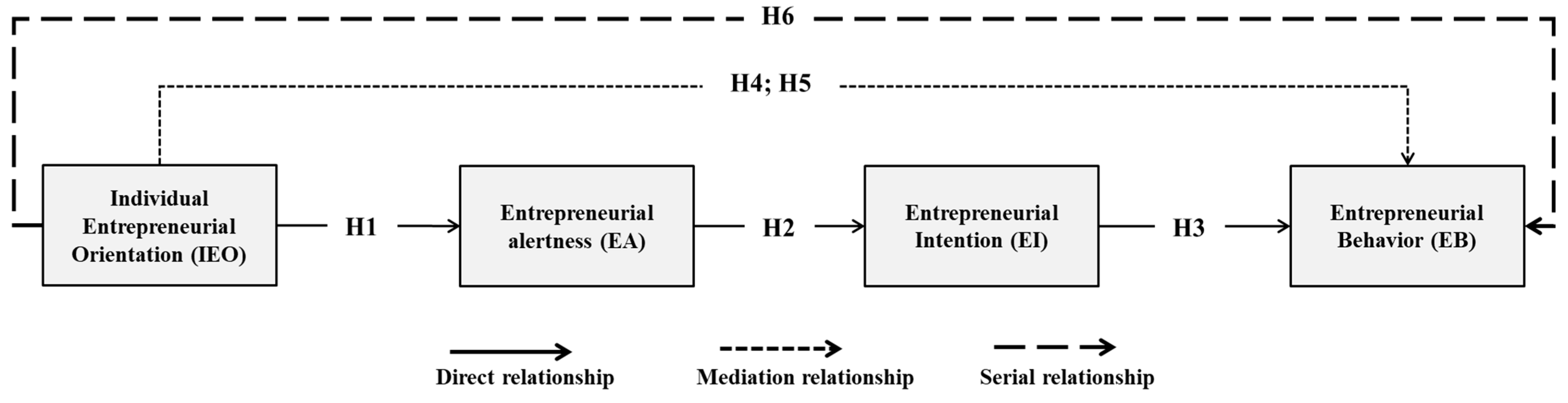
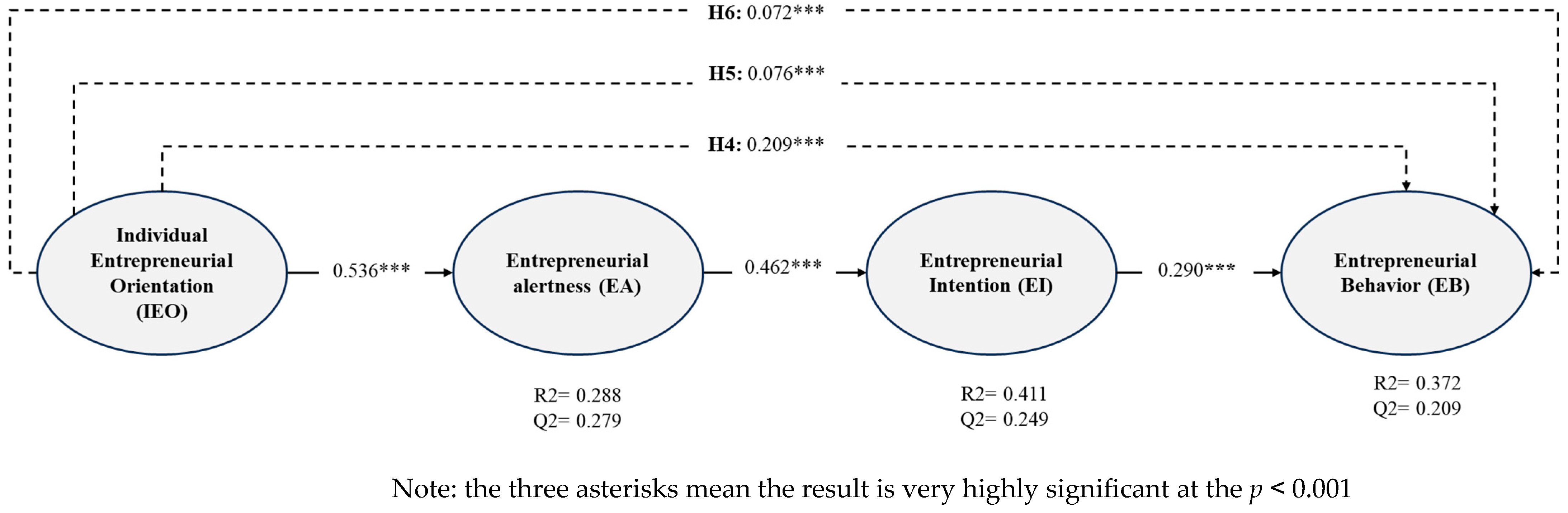
Disclaimer/Publisher’s Note: The statements, opinions and data contained in all publications are solely those of the individual author(s) and contributor(s) and not of MDPI and/or the editor(s). MDPI and/or the editor(s) disclaim responsibility for any injury to people or property resulting from any ideas, methods, instructions or products referred to in the content. |
© 2026 by the authors. Licensee MDPI, Basel, Switzerland. This article is an open access article distributed under the terms and conditions of the Creative Commons Attribution (CC BY) license.