1. Introduction
Continuous innovation has become a defining characteristic of successful organizations in the contemporary economy. In competitive and fast-changing markets, firms must persistently adapt their products, services, and internal processes to remain viable (
Anderson et al., 2014). Innovative ability is not determined solely by technology or strategy, but also by organizational and interpersonal factors that influence employee behavior. Increasingly, research has highlighted that the work environment, particularly the perceived climate that supports creativity and change, plays a central role in encouraging employees to engage in innovation-related activities (
Hernández & González-Romá, 2016;
Malibari & Bajaba, 2022;
Yuan & Woodman, 2010). A supportive climate for innovation provides employees with psychological safety, access to resources, and reinforcement for creative efforts that advance organizational goals (
Elamin et al., 2024).
While the relationship between organizational climate and innovation has received considerable attention, the mechanisms through which these perceptions shape individual attitudes and behaviors remain underdeveloped in extant literature. Innovation processes are inherently social, requiring collaboration, trust, and open communication between leaders and subordinates (
Pieterse et al., 2010). This relational dimension suggests that employees’ relationships with leaders significantly shape responses to the organization’s innovation climate. Prior studies indicate that high-quality leader-member exchange (LMX) relationships foster greater employee engagement, psychological empowerment, and creativity (
Graen & Uhl-Bien, 1995;
Volmer et al., 2012;
Martin et al., 2016). However, the extent to which LMX enhances or constrains the influence of innovation climate on employee innovation behaviors and affective workplace outcomes remains insufficiently explored.
Existing research often treats climate for innovation as a direct antecedent of innovation outcomes without adequately exploring the behavioral and relational pathways that explain this influence (
Anderson et al., 2014;
Malibari & Bajaba, 2022;
Hernández & González-Romá, 2016). The innovation process, comprised of idea generation, promotion, and implementation, represents a potential mechanism through which contextual factors translate into meaningful employee experiences (
Holman et al., 2012). However, participation in these innovation activities is not uniformly distributed across employees. The extent to which individuals engage in the innovation process may depend on the quality of their relationships with their supervisors.
High-quality leader-member exchanges are characterized by trust, reciprocity, and open communication, all of which can enhance the translation of innovation-supportive climates into active innovation behavior (
Graen & Uhl-Bien, 1995;
Volmer et al., 2012;
Bakar & Sheer, 2013;
Martin et al., 2016). Despite this theoretical alignment, empirical evidence on how LMX moderates the effects of innovation climate on innovation outcomes remains limited (
Chiniara & Bentein, 2016;
S. Kim & Beehr, 2020). LMX is a relevant moderator because employees rely on their supervisors to interpret climate signals and assess whether innovation-related actions are safe and worthwhile. High-quality relationships provide support and clarity, making employees more likely to act on innovation-supportive cues. Low-quality relationships may limit these effects by creating uncertainty or reducing access to guidance and resources.
Lastly, studies have shown that supportive climates encourage positive outcomes such as creative performance (e.g.,
Shanker et al., 2017), yet few have examined how such climates influence affective workplace outcomes, such as job satisfaction and organizational commitment, in relation to LMX or the innovation process. These affective outcomes are critical to sustaining innovation because employees who are emotionally invested in their organization are more likely to persist in the face of uncertainty and resource constraints (
Allen & Meyer, 1990;
Miao et al., 2017).
Affective outcomes, such as job satisfaction and organizational commitment, play a central role in whether employees persist in idea generation, promotion, and implementation. Employees who feel supported, valued, and emotionally connected to their organizations are more likely to overcome uncertainty and remain engaged in innovation efforts. Understanding how a climate for innovation shapes these affective states fills an important gap in the literature. Recent work shows that innovation-supportive climates shape affective experiences such as job satisfaction and commitment by influencing psychological resources and emotional states (
Demircioglu, 2023;
Jianchun, 2024). However, these studies do not fully explain the behavioral or relational conditions that strengthen or weaken these effects, leaving open questions about how climate signals are interpreted and enacted in daily work.
Although prior research shows that innovation-supportive climates promote creative behavior, much less is known about how these climates shape employees’ affective experiences or why these effects vary across individuals. Existing studies tend to emphasize innovative behaviors while giving limited attention to the emotional and attitudinal responses that sustain long-term involvement in innovation activities. In particular, research has not fully clarified how contextual cues, behavioral mechanisms, and relational conditions such as LMX work together to influence employees’ well-being, commitment, and emotional connection to their work. The central research question guiding this study is: How does climate for innovation influence employees’ affective workplace outcomes through the innovation process, and to what extent does LMX condition these effects? This research advances understanding of how organizational context and interpersonal dynamics jointly influence both innovative behavior and the emotional connection employees maintain with their work and organization. Understanding how climate and relational conditions encourage innovative behaviors and influence emotional well-being offers practical guidance for leaders seeking to develop workplaces that are both innovative and supportive. These insights can help organizations strengthen employee engagement and maintain the conditions necessary for sustainable innovation.
Research Purpose and Contributions
The purpose of this study is to address existing research gaps by examining how the climate for innovation relates to job satisfaction and organizational commitment through the innovation process. Additionally, this study explores how the quality of the leader–member relationship conditions these effects as a boundary condition. Drawing from social exchange theory (
Blau, 1964) and LMX theory (
Graen & Uhl-Bien, 1995), the proposed model integrates contextual and relational perspectives to explain how employees experience and respond to an innovation-supportive environment.
This research makes several contributions to current literature. First, it advances theory by connecting the contextual construct of innovation climate with individual-level affective outcomes through the innovation process, addressing recent calls for greater attention to multilevel linkages between organizational context and employee well-being (
Malibari & Bajaba, 2022). Second, by introducing LMX as a moderator, we explain why some employees are more responsive than others to innovation-supportive climates. Employees in high-quality exchanges are more likely to receive encouragement, resources, and feedback from supervisors that facilitate engagement in innovation activities (
Volmer et al., 2012;
Bakar & Sheer, 2013;
Martin et al., 2016;
Chiniara & Bentein, 2016). Third, this research contributes methodologically by testing a moderated mediation model using conditional process analysis (
Hayes, 2018). This approach clarifies the sequential and contingent nature of relationships among innovation climate, innovation behavior, and affective outcomes. Collectively, these contributions provide a more comprehensive understanding of how innovation-supportive environments, when reinforced by strong leader–member relationships, promote both innovative behavior and positive emotional attachment to the organization.
3. Materials and Methods
The data collection procedure adopted in this study followed current practice for survey-based research (e.g.,
Casper et al., 2013;
Masuda et al., 2012). Students enrolled in business administration classes at a large university in the United States were trained on data collection procedures and ethics in research methods that aligned with the course content. Students were offered minor extra credit for recruiting study participants who were adults employed in a full-time capacity and not currently enrolled in their course. Participants confirmed these criteria through a screening item at the start of the survey, and responses that did not meet eligibility requirements were removed prior to analysis. Trained evaluators verified referral information to prevent duplicate entries and reduce selection bias. These steps strengthened data quality while providing a consistent and ethically grounded recruitment process.
Student-assisted recruitment was selected because it offers an efficient approach for accessing full-time employees across multiple industries and has been used in comparable organizational research. While convenience sampling limits the generalizability of the findings, the diversity in industry representation and job roles helps produce a sample that reflects a broad range of workplace experiences. This method also supported student learning objectives related to research design and ethical data collection. All procedures were approved by the institutional review board, and participants were informed of their right to withdraw at any time without penalty. Participants were also informed that their participation was voluntary, confidential, and anonymous. Extra credit was provided only when alternative options of equal value were available to ensure that students did not feel pressured to participate.
This data collection method produced a usable sample size of 567 survey responses. A variety of industries were represented in the survey which strengthens the generalizability of the results, and the top industries represented in the sample were Finance, Banking, and Professional Services (18%) and Healthcare (15%). Females made up the majority of the sample (59%), and the majority of the respondents held a bachelor’s degree or higher (66%). Most respondents were 35–45 years old, and the average experience within their current position was 7.8 years. Twenty-seven percent of the sample had manager or director responsibility, and twenty-one percent (21%) served in a personnel supervisory role. A descriptive profile of the sample is provided in
Table A1.
The items used to measure organizational climate for innovation, LMX, job satisfaction, and organizational commitment in this study were assessed on a five-point Likert scale ranging from “Strongly Agree” to “Strongly Disagree” in response to a prompt which stated “Please indicate the extent to which you agree or disagree with the following items.” The innovation process was measured on a five-point Likert scale ranging from “a great deal” to “not at all” with the prompt “Please indicate the extent to which you have done this in your job within the last year.”
No pilot testing or expert review was necessary because each scale has been well validated in previous empirical studies, and the items are appropriate for the contexts examined in this study. The
Scott and Bruce (
1994) scale captures employees’ perceptions of organizational support for creativity, which is foundational for understanding climate for innovation. The
Dunegan et al. (
1992) measure of LMX reflects relationship quality in a way that aligns with social exchange theory, which underpins the moderator in the model. The
Holman et al. (
2012) innovation process scale assesses the three stages of innovation behavior that serve as the central mediating mechanism here. The
Meyer and Allen (
1993) affective commitment scale and the
Idaszak et al. (
1988) job satisfaction items capture affective workplace outcomes that represent the model’s dependent variables. These validated instruments ensure that each construct is measured in a theoretically grounded and psychometrically reliable manner.
Evidence of sufficient construct reliability for each of the measures was indicated by surpassed benchmarks regarding Cronbach’s Alpha (α > 0.70), average variance extracted (AVEs > 0.50), and composite reliability (reliabilities > 0.70). The convergent validity and discriminant validity of the measures was assessed with a confirmatory factor analysis using SPSS 24. A direct oblimin rotation with Kaiser normalization used in the CFA to allow the items to correlate. Using this approach, the observed variables are calculated as a function of the factors so the resulting item loadings represent standardized regression coefficients (
Thompson, 2004). Each factor indicator was significant (
p < 0.01) and sufficient fit statistics were found for the measurement model χ
2 (164) = 617.71,
p < 0.01, NFI = 0.96, CFI = 0.97, RMSEA = 0.06. These results indicate satisfactory convergent validity of the measures used in this study, and the construct measures are presented in
Table A2 with the standardized regression coefficients.
Evidence of discriminant validity between the constructs was provided by the confirmatory factor analysis in which each measure’s average variance extracted was greater than the squared correlation between the measures (
Fornell & Larcker, 1981).
Table A3 depicts the means, standard deviations, correlations, and reliabilities of the measurement scales. Collectively, these results indicated sufficient reliability and validity (i.e., convergent and discriminant) of the constructs measured in this study.
4. Results
The analyses proceeded in three stages. First, we examined whether LMX moderated the relationship between innovation climate and the innovation process. Second, we tested whether the innovation process mediated the relationship between climate for innovation and each affective outcome. Third, we assessed the conditional indirect effects to determine whether mediation varied across levels of LMX.
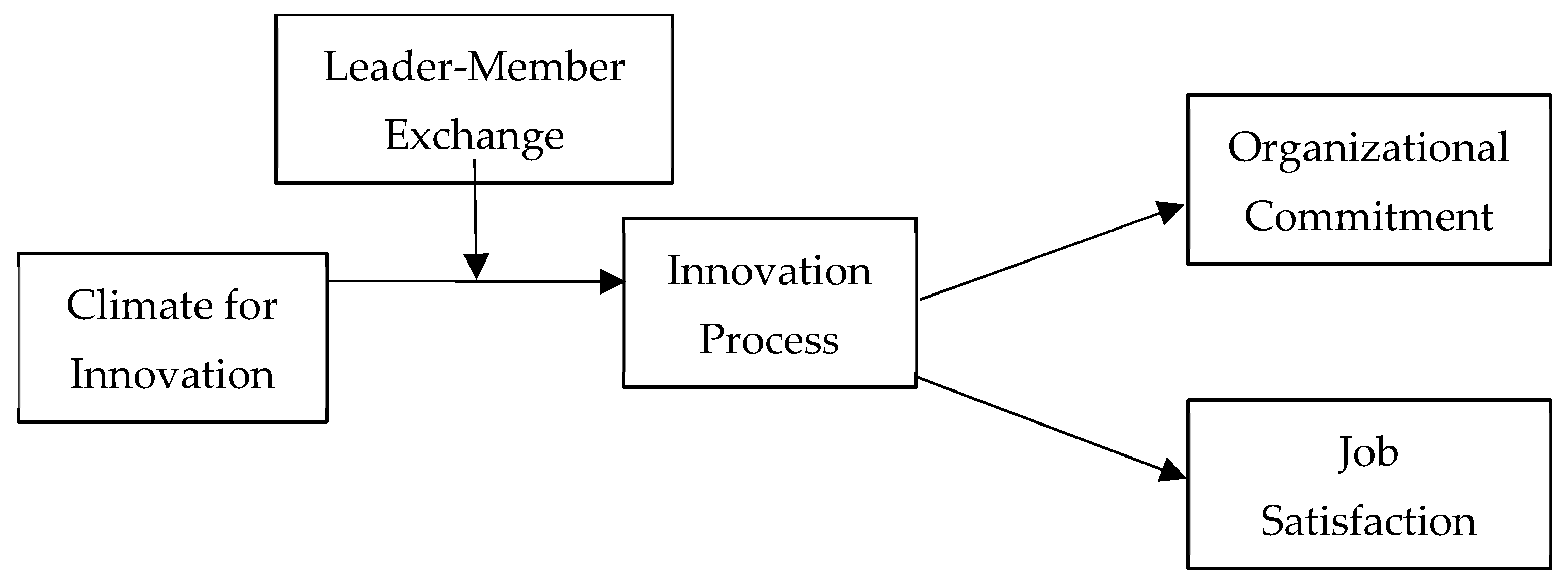
This research examined the extent to which LMX moderated the relationship between climate for innovation and the innovation process (H1), and whether the innovation process mediated the relationship between climate for innovation and two affective outcomes including organizational commitment (H2) and job satisfaction (H3). The hypothesized direct and indirect relationships were analyzed with the
Hayes (
2018) methodology for testing moderated-mediation models. This approach estimates two regression equations, the first of which estimates the hypothesized moderating effect (
Preacher et al., 2007). A first-stage moderated-mediation model was hypothesized in this study (
Hayes, 2018) so the initial regression equation estimated the impact of
X on
M (i.e., climate for innovation on the innovation process) moderated linearly by
W (i.e., LMX) as follows:
The subsequent regression equation measured the effect of the independent variable, moderator, and mediator on the dependent variables (
Preacher et al., 2007). In this equation, the estimated indirect effect of
X on
Y (i.e., climate for innovation on job satisfaction and organizational commitment) is a function of the effect of
X on
M and the direct effect of
M on
Y as a linear product of
W (
Edwards & Lambert, 2007;
Hayes, 2018;
Preacher et al., 2007). Including
XW and
W when estimating
Y permits
W to moderate the direct effect of
X without augmenting the indirect effect of
X (
Hayes, 2018). Therefore, the second regression was:
Based on the hypothesized model, Model 7 of the Process software v3.4 (
Hayes, 2018) was run in SPSS to examine the potential for moderation of the a-path (i.e., independent variable to the mediator), but not the c-path (i.e., independent variable to the dependent variable). Mean-centering was used to reduce potential collinearity effects between the independent variable and interaction term (
Shieh, 2011). The results of this operation are displayed in
Table A4.
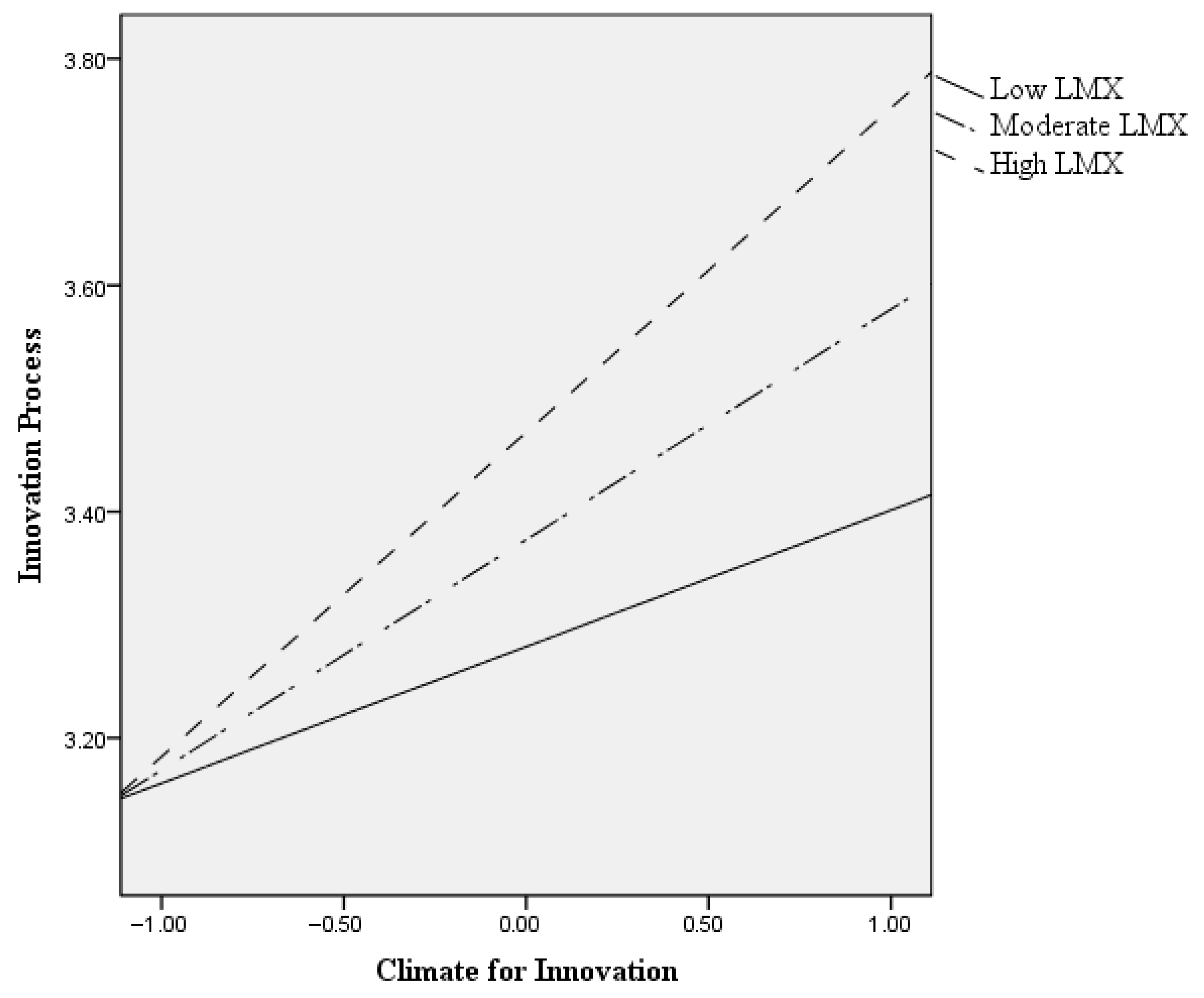
Regression results showed that climate for innovation predicted participation in the innovation process (b = 0.20, p < 0.01) and that the interaction between climate for innovation and LMX was significant (b = 0.11, p < 0.01), indicating that LMX strengthened this relationship. The innovation process was positively associated with organizational commitment (b = 0.26, p < 0.01) and job satisfaction (b = 0.24, p < 0.01). Climate for innovation retained a significant direct effect on both outcomes, consistent with partial mediation.
The persistence of the direct effects suggests that participation in the innovation process accounts for part, but not all, of the link between innovation climate and affective outcomes. This implies that climate for innovation influences satisfaction and commitment through both behavioral engagement and other pathways, such as psychological safety or empowerment, which may operate alongside innovation behavior. Therefore, Hypotheses 1 was supported by these findings, and Hypotheses 2 and 3 received partial support.
The significant interaction between climate for innovation and LMX shows that employees with stronger relationships with their supervisors are more likely to respond to an innovation supportive climate by engaging in idea related activities. This pattern supports the first stage of the moderated mediation model in
Figure A1 and demonstrates that contextual and relational conditions jointly shape innovation behavior.
A conditional process analysis is used to test for moderated mediation, which in this study is the extent to which LMX moderates the relationship between climate for innovation and workplace outcomes (i.e., job satisfaction and organizational commitment) through the innovation process. The conditional process analysis generates bias-corrected confidence intervals by taking a sampling distribution from the data which is referred to as a “bootstrap” analysis (
Hayes, 2018). Confidence intervals that do not include zero indicate evidence of moderated mediation as these mediating “path” effects are statistically different from zero after the moderating effect is taken into account (
Hayes, 2018).
Table A5 displays the indirect effects of climate for innovation at levels of LMX (i.e., one standard deviation above the mean value, at the mean value, and one standard deviation below the mean value) working through the innovation process to influence job satisfaction and organizational commitment. The right-hand columns in
Table A5 provide evidence of moderated mediation as confidence intervals do not include zero at low, moderate, and high levels of LMX.
The conditional process analysis indicated that the indirect effects of climate for innovation strengthened at higher levels of LMX. When LMX was high, employees appeared more likely to translate supportive climate cues into innovation behavior, which in turn enhanced job satisfaction and organizational commitment. When LMX was low, these indirect effects were weaker. This pattern suggests that relationship quality shapes whether employees trust and act on the opportunities provided by innovation supportive climates.
As a safety precaution for the survey data, variance inflation factors and condition indices were examined to assess multicollinearity among the variables. Variance inflation factors were all below 10 (i.e., ranged 1.08–1.29), and condition indices were all below 30 (i.e., ranged 10.35–15.55). Thus, no evidence of multicollinearity existed between the variables (
Hair et al., 2006). Overall, these results support the hypothesized moderated-mediation model as LMX moderated the relationship between climate for innovation and the innovation process, and the innovation process partially mediated the relationship between climate for innovation and the hypothesized affective workplace outcomes (i.e., job satisfaction and organizational commitment).
Taken together, the results support a moderated mediation model in which climate for innovation influences affective outcomes partly through the innovation process and more strongly when LMX is high. These findings highlight the joint role of contextual and relational conditions in shaping innovation behavior and employee attitudes, providing a foundation for the implications discussed next.
5. Discussion
The results were mostly supportive of the proposed model. H1 was supported, indicating that LMX strengthens the relationship between climate for innovation and engagement in the innovation process. H2 and H3 received partial support, showing that the innovation process transmits part of the effect of innovation climate to organizational commitment and job satisfaction. LMX strengthens the influence of innovation supportive climates because employees rely on their supervisors to interpret organizational expectations and assess the risks associated with innovation. High-quality relationships provide reassurance, guidance, and access to resources, which make employees more likely to trust climate cues and act on them. This dynamic helps explain why the indirect effect of climate on affective outcomes is stronger when employees experience supportive relationships with their leaders. Taken together, the pattern is consistent with moderated mediation in which LMX amplifies the translation of innovation-supportive context into innovation behavior, which then carries benefits for affective outcomes.
5.1. Theoretical Implications
These findings connect contextual and relational perspectives by showing that climate for innovation does not operate in a vacuum. Prior work has established that climate for innovation predicts idea generation and implementation (
Anderson et al., 2014;
Shanker et al., 2017). Our findings extend this stream by identifying the innovation process as a behavioral mechanism linking climate to affective outcomes that sustain innovation over time. Participation in the innovation process can strengthen positive emotional states by giving employees opportunities to experience autonomy, express competence, and see the impact of their ideas. These experiences enhance meaningfulness and personal investment, which contribute to satisfaction and commitment.
The moderating role of LMX confirmed by this study underscores the social nature of innovation. High-quality exchanges lower perceived risk and encourage discretionary effort (
Graen & Uhl-Bien, 1995;
Dulebohn et al., 2012;
Martin et al., 2016). Consistent with this view, employees in high-quality exchanges appear more likely to convert innovation-supportive cues into concrete innovation behaviors. This aligns with evidence that strong exchange relationships are associated with greater autonomy, feedback, and creative involvement (
Volmer et al., 2012;
Tierney et al., 1999) and with recent work showing that higher quality exchanges are linked to richer resource access and proactive crafting of work (
Ji et al., 2023).
The mediation pattern suggests the innovation process is a central pathway through which climate for innovation relates to affective outcomes, but not the only one. Partial mediation implies that climate may also shape attitudes through additional channels, such as psychological safety, empowerment, or value congruence that are not fully captured by innovation behavior alone (
Amabile & Pratt, 2016;
Deci & Ryan, 2000). While strong innovation climates generally promote innovative behavior, they may also reduce the relative importance of LMX if climate signals are particularly clear or consistent. Future research could examine whether climate strength moderates the role of leader relationships or whether certain types of climates reduce the variance explained by interpersonal factors. The non-mediated portion of the effect suggests that climate for innovation also shapes affective outcomes through additional pathways, such as psychological safety, empowerment, or perceived organizational support. These mechanisms likely operate alongside innovation behavior and represent important directions for further study.
The findings also speak to broader issues of emotional health in organizational settings. Innovation supportive climates provide employees with psychological safety and a sense of autonomy, which contribute to positive affect at work. High-quality LMX relationships further enhance emotional well-being by offering support, trust, and clear communication. Together, these conditions foster a workplace environment where employees can engage creatively and experience stronger satisfaction and commitment, aligning the study with current discussions on emotional experiences and well-being in the workplace.
This study advances innovation climate research by identifying a behavioral mechanism and a relational boundary condition that operate together to shape employee attitudes. Prior studies often examine climate or leadership in isolation, but the present findings highlight how both forces converge to influence innovation participation and subsequent affective outcomes. This integrated perspective clarifies how organizational and interpersonal factors jointly support innovation and well-being.
5.2. Practical Implications
These results offer actionable guidance for leaders and practitioners seeking to foster innovation and retain engaged employees. Many organizations invest in systems that encourage creativity, yet the success of these systems often depends on the daily relational support employees receive. Understanding how climate cues and leader relationships work together can help organizations allocate resources more effectively and design practices that support both performance and employee well-being. First, leaders should proactively support innovative experimentation, provide forums for idea promotion, and facilitate idea implementation to increase employees’ engagement in the innovation process, which raise job satisfaction and commitment.
Second, supervisors should develop individualized, trust-based relationships that provide coaching, resource brokering, and fair recognition, as high-quality exchanges unlock the behavioral benefits of innovation-supportive climates. Supervisor support can enhance the effectiveness of climate initiatives by translating organizational expectations into everyday interactions. Organizations can reinforce innovation supportive climates by implementing practices such as regular idea review sessions, cross functional problem-solving groups, and structured opportunities for employees to share and refine proposals. Supervisors can support these efforts by offering timely feedback, recognizing employee contributions, and helping employees navigate barriers to implementation. We also note that organizations differ in the resources available to support innovation and leadership development. Smaller organizations or units with limited budgets may benefit from lower cost practices such as short coaching conversations, peer mentoring, or streamlined idea submission processes that reinforce supportive climate signals without requiring extensive investment.
Third, providing training and routines that help employees move from idea generation to promotion and implementation can translate climate cues into outcomes. Examples include structured ideation pipelines, cross-functional sponsors, and implementation sprints (
de Jong & den Hartog, 2010;
Holman et al., 2012). Fourth, because context and exchange quality interact, organizations will gain more by pairing climate investments with leader training that enhances coaching and relational competence. Recent evidence in service settings also suggests that engagement mechanisms and knowledge sharing can amplify innovative behaviors, offering an additional lever for practice (
Elamin et al., 2024).
By integrating climate for innovation, LMX, and the innovation process in a single model, this study shows that innovation-supportive environments are more likely to produce affective benefits when supervisors cultivate high-quality relationships. It also demonstrates that the innovation process represents a concrete behavioral route by which climate becomes consequential for employees’ attachment and satisfaction. These insights advance theory that links context, relationships, and behavior, and they offer practical direction for organizations seeking to innovate while sustaining employee well-being.
5.3. Limitations and Future Research
Although our findings contribute to a more nuanced understanding of how innovation climate and LMX jointly shape innovation behavior and affective outcomes, several limitations should be acknowledged. First, the cross-sectional design limits the ability to draw firm causal conclusions. While the conditional process analysis (
Hayes, 2018) offers statistical rigor in estimating indirect and moderated effects, longitudinal or experimental designs are needed to establish temporal ordering among innovation climate, innovation behavior, and affective outcomes (
Edwards & Lambert, 2007;
Preacher et al., 2007). Future studies could employ time-lagged data to better capture how changes in leader–member relationships and climate perceptions develop and interact over time.
Future studies could build on these findings by using longitudinal designs to clarify the temporal ordering among climate perceptions, leader-member relationships, innovation behavior, and affective outcomes. Multilevel approaches would also help illuminate how unit level climate strength or leader practices influence individual responses to innovation supportive environments. In addition, collecting supervisor ratings or matched employee supervisor data would reduce reliance on self-report measures and capture a richer picture of the social dynamics that shape innovation behavior.
Second, reliance on self-report data introduces potential common method variance. Although measures were drawn from validated scales (
Scott & Bruce, 1994;
Dunegan et al., 1992;
Holman et al., 2012), future research could triangulate data sources by pairing employee surveys with supervisor ratings or objective performance indicators. Incorporating multi-source assessments of LMX and innovation behavior would enhance validity and mitigate perceptual bias (
Podsakoff et al., 2012).
Third, although the sample contained cross-industry diversity, all responses were from one nation, which may constrain generalizability. National culture and institutional norms can shape both leadership exchanges and organizational climate perceptions (
Anderson et al., 2014). Future research should examine whether these relationships hold across cultural settings that differ in power distance, collectivism, or uncertainty avoidance, as these dimensions influence both leader–member interactions and openness to innovation.
Fourth, although the moderated mediation was supported, several boundary conditions merit attention. For example, the strength of the climate effect may depend on job discretion and task interdependence. In tightly regulated roles with low autonomy, even strong climate signals may be harder to enact without leader advocacy, which raises the importance of high-quality exchange relationships (
Volmer et al., 2012). Furthermore, climate perceptions and LMX are both shaped by local units. Unmodeled unit-level climate strength or dispersion could influence how consistently employees receive and act on innovation cues (
Anderson et al., 2014).
Future research is also needed to investigate other downstream organizational outcomes linked to innovation processes, such as turnover intentions, performance, or firm-level innovation. Integrating multilevel designs would clarify how individual innovation processes aggregate to collective innovation and performance (
Hunter et al., 2007). Longitudinal or experimental designs could clarify whether increases in climate or LMX precede growth in innovation behaviors and affective outcomes (
Hayes, 2018;
Edwards & Lambert, 2007;
Preacher et al., 2007).
6. Conclusions
This study advances understanding of how innovation-supportive climates influence both innovation behavior and affective experiences at work. By identifying the innovation process as a behavioral mechanism and LMX as a boundary condition, the findings clarify how organizational context and relational dynamics jointly shape employee attitudes. Supportive climates and high-quality leader-member relationships foster psychological safety and positive emotional experiences that contribute to job satisfaction and organizational commitment, underscoring the importance of environments where employees feel encouraged to experiment, share ideas, and participate in meaningful work processes.
The results further show that strong leader-member relationships amplify the benefits of an innovation-supportive climate. When employees trust their supervisors and feel supported in offering new ideas, they are more likely to engage in generating, promoting, and implementing those ideas. Participation in this innovation process enhances feelings of competence and meaningfulness, which strengthens commitment and satisfaction. These findings extend innovation climate research by demonstrating how contextual and relational factors converge to influence both innovation behavior and emotional well-being.
Practically, the study suggests that innovation is most effective when supported by both organizational systems and strong leader-employee relationships. Organizations can enhance innovation and employee well-being by cultivating climates that encourage risk taking and experimentation while also investing in leadership practices that build trust, empowerment, and individualized support. In essence, innovation is not only a technical endeavor but also a social and emotional one. Climate creates the conditions for innovation, but it is through strong relationships and active participation in the innovation process that this potential becomes realized.