Transformational Leadership and Internal Communication as Predictors of Job Performance: A Perspective of Peruvian University Workers

Abstract
1. Introduction
2. Literature Review
2.1. Definition of Terms
Transformational Leadership
2.2. Job Performance
2.3. Internal Communication
2.4. Hypothesis Development
2.4.1. Transformational Leadership and Job Performance
2.4.2. Internal Communication and Job Performance
3. Materials and Methods
3.1. Sample and Procedure
3.2. Statistical Analysis
4. Results
5. Discussions
6. Conclusions and Recommendations
6.1. Theoretical Implications
6.2. Practical Implications
6.3. Limitations and Future Research
Author Contributions
Funding
Institutional Review Board Statement
Informed Consent Statement
Data Availability Statement
Conflicts of Interest
References
- Achyuta, G., Shadangi, P., Tiwary, A., Gupta, A., As, P., Chheda, K., Babitha, B., & Kataria, A. (2025). Exploring the influence of communication mechanisms on organizational effectiveness and employee engagement. Management, 3, 167. [Google Scholar] [CrossRef] [Scilit]
- Aggarwal, S. R. (2016). Business communication: A skill. International Education & Research Journal, 2(2), 3–5. [Google Scholar]
- Aguirre-Camarena, R., Aguilar Doñe, B. C., Manchego Guerra, J. R., Barraza Lino, R. P., & Rengifo Villanueva, R. (2025, July 16–18). Job satisfaction and work engagement in the workplace, a systematic review for the period 2019–2024. 23rd LACCEI International Multi-Conference for Engineering, Education and Technology (LACCEI): “Engineering, Artificial Intelligence, and Sustainable Technologies in Service of Society”, Mexico City, Mexico. [Google Scholar] [CrossRef] [Scilit]
- Akkaya, B. (2019). The relationship between primary school Teachers’ organizational citizenship behaviors and counter-productive work behaviors. Eurasian Journal of Educational Research, 19, 1–28. [Google Scholar] [CrossRef] [Scilit]
- Al, A., & Abdullah, N. (2020). The impacts of organizational culture and transformational leadership style on the employee’s job performance: A case study at UAE’s petrochemical company. Journal of Human Resources Management Research, 2020, 379522. [Google Scholar] [CrossRef] [Scilit]
- Aldossari, F., & Alanizan, S. (2025). The impact of transformational leadership on employee performance: The mediating role of job satisfaction and organizational commitment. Edelweiss Applied Science and Technology, 9(6), 609–625. [Google Scholar] [CrossRef] [Scilit]
- Ali, N., & Zia-ur-Rehman, M. (2014). Impact of job design on employee performance, mediating role of job satisfaction: A study of FMCG’s sector in Pakistan. International Journal of Business and Management, 9(2), 70–79. [Google Scholar] [CrossRef] [Scilit]
- Alloubani, A., Akhu-Zaheya, L., Mubarak, I., & Altamari, M. (2019). Leadership styles’ influence on the quality of nursing care. International Journal of Health Care Quality Assurance, 32(6), 1022–1033. [Google Scholar] [CrossRef] [Scilit]
- Ato, M., López, J., & Benavente, A. (2013). Un sistema de clasificación de los diseños de investigación en psicología. Anales de Psicología, 29(3), 1038–1059. [Google Scholar] [CrossRef] [Scilit]
- Avolio, B., Kahai, S., & Dodge, G. (2001). E-Leadership: Implications for theory, research, and practice. Leadership Quarterly, 11(4), 615–668. [Google Scholar] [CrossRef] [Scilit]
- Baihaqui, R., & Fitrianingrum, A. (2025). Transformational Leadership, Internal Communication, and Job Satisfaction as Determining Factors of Bank Indonesia Employee Performance. Jurnal Riset Bisnis Indonesia, 22(2), 998–1010. [Google Scholar]
- Balluerka, M., Gorostiaga, M., Rodriguez, A., & Ulacia, I. (2021). El desempeño adaptativo: Implicaciones para la gestión de recursos humanos en el sector público. Pertsonak Eta Antolakunde Publikoak Kudeatzeko Euskal Aldizkaria/Revista Vasca de Gestión de Personas y Organizaciones Públicas, 20, 8–29. [Google Scholar] [CrossRef] [Scilit]
- Bass, B. M., Avolio, B. J., & Goodheim, L. (1987). Biography and the assessment of transformational leadership at the world-class level. Journal of Management, 13(1), 7–19. [Google Scholar] [CrossRef] [Scilit]
- Bastari, A., Eliyana, A., & Wijayanti, T. (2020). Effects of transformational leadership styles on job performance with job motivation as mediation: A study in a state-owned enterprise. Management Science Letters, 10(12), 2883–2888. [Google Scholar] [CrossRef] [Scilit]
- Bautista, R., Cienfuegos, R., & Aquilar, J. (2020). El desempeño laboral desde una perspectiva teórica. Revista de Investigación Valor Agregado, 7(1), 54–60. [Google Scholar] [CrossRef] [Scilit]
- Belias, D., Ntalakos, A., & Rossidis, I. (2025). The influence of different leadership styles on hotel employees’ communication satisfaction. In Contributions to management science (pp. 307–329). Springer Nature. [Google Scholar] [CrossRef] [Scilit]
- Bernal, C. A. (2010). Metodología de la Investigación. Para administración, economía, humanidades y ciencias sociales (3rd ed.). Pearson Educación, S.A. [Google Scholar]
- Bhatti, M., & Alyahya, M. (2021). Role of leadership style in enhancing health workers job performance. Polish Journal of Management Studies, 24(2), 55–66. [Google Scholar] [CrossRef] [Scilit]
- Bisharat, H., Obeidat, B., Alrowwad, A., Tarhini, A., & Mukattash, I. (2016). The effect of human resource management practices on organizational commitment in chain pharmacies in Jordan. International Journal of Business and Management, 12(1), 50–67. [Google Scholar] [CrossRef] [Scilit]
- Bolarinwa, K., Ajayi, I., Adenuga, O., & Obayelu, A. (2013). Leadership styles and employees’ job performance at forestry research institute of Nigeria. Journal of Agricultural Extension, 17(1), 38–46. [Google Scholar] [CrossRef] [Scilit]
- Borman, W. C., & Motowidlo, S. J. (1993). Expanding the criterion domain to include elements of contextual performance. In N. Schmitt, & W. C. Borman (Eds.), Personnel selection in organizations (pp. 71–98). Jossey-Bass. [Google Scholar]
- Brandolini, A., Frigoli, M. G., & Hopkins, N. (2009). Comunicacion interna. Jurnal Penelitian Pendidikan Guru Sekolah Dasar, 6, 12. [Google Scholar]
- Briceño Acaro, C. A., & Jiménez Jiménez, L. M. (2025). Influencia del sistema organizacional en satisfacción laboral del personal de la CAC fronteras del sur. Revista Enfoques, 9(36), 397–406. [Google Scholar] [CrossRef] [Scilit]
- Bris, M. M. (2000). Clima de trabajo y organizaciones que aprenden. Educar, 27, 103–117. [Google Scholar]
- Buchholz, W., & Eichenseer, M. (2019). Advantageous leadership in public good provision: The case of an endogenous contribution technology. Journal Economic, 126, 1–17. [Google Scholar] [CrossRef] [Scilit]
- Budiadi, H. (2026). A Literature review on the influence of transformational leadership, emotional intelligence, and organizational culture on employee engagement in the digital era. Quality-Access to Success, 27(210), 287–294. [Google Scholar] [CrossRef] [Scilit]
- Burns, J. (1987). Leadership. Harper & Row. [Google Scholar]
- Burns, J. (2004). Transforming leadership: A new pursuit of happiness. Grove Press. [Google Scholar]
- Byantara, R. A., Qamari, I. N., & Saad, M. S. M. (2023). Transformational leadership, organisational climate, and internal locus of control on innovative work behaviour in hospitality sector of rural area. BISMA (Bisnis Dan Manajemen), 15(2), 119–138. [Google Scholar] [CrossRef] [Scilit]
- Caniëls, M. C. J., Semeijn, J. H., & Renders, I. H. M. (2018). Mind the mindset! The interaction of proactive personality, transformational leadership and growth mindset for engagement at work. Career Development International, 23(1), 48–66. [Google Scholar] [CrossRef] [Scilit]
- Carrico, A. R., & Riemer, M. (2011). Motivating energy conservation in the workplace: An evaluation of the use of group-level feedback and peer education. Journal of Environmental Psychology, 31(1), 1–13. [Google Scholar] [CrossRef] [Scilit]
- Castro Vázquez, P. M. (2016). El papel de los valores hacia el trabajo en la motivación laboral y el desempeño de trabajadores de PYMES Potosinas. Universidad Autónoma de San Luis Potosí. [Google Scholar]
- Chan, S., & Lai, H. (2017). Understanding the link between communication satisfaction, perceived justice and organizational citizenship behavior. Journal of Business Research, 70, 214–223. [Google Scholar] [CrossRef] [Scilit]
- Charry, H. (2018). La gestión de la comunicación interna y el clima organizacional en el sector público. COMUNI@CCIÓN, 9(1), 25–34. [Google Scholar]
- Chênevert, D., Vandenberghe, C., Doucet, O., & Ben Ayed, A. K. (2013). Passive leadership, role stressors, and affective organizational commitment: A time-lagged study among health care employees. European Review of Applied Psychology, 63(5), 277–286. [Google Scholar] [CrossRef] [Scilit]
- Chi, H., Vu, T., Nguyen, H. V., & Truong, T. H. (2023). How financial and non–financial rewards moderate the relationships between transformational leadership, job satisfaction, and job performance. Cogent Business and Management, 10(1), 2173850. [Google Scholar] [CrossRef] [Scilit]
- Chiavenato, I. (2009). Gestión del talento humano. Mcgraw-Hill Publishing Co. [Google Scholar]
- Chiavenato, I. (2011). Administración de recursos humanos (9th ed.). McGraw-Hill/Interamericana Editores. [Google Scholar]
- Chin, M. G. (1998). The partial least squares approach to structural formula modeling. Advances in Hospitality and Leisure, 8(2), 295–336. [Google Scholar]
- Chin, W. W. (2010). How to write up and report PLS analyses. In Handbook of partial least squares (pp. 655–690). Springer. [Google Scholar] [CrossRef] [Scilit]
- Choi, S., Goh, C., Adam, M., & Tan, O. (2016). Transformational leadership, empowerment, and job satisfaction: The mediating role of employee empowerment. Human Resources for Health, 14(1), 73. [Google Scholar] [CrossRef] [Scilit]
- Clifton, J. (2019). Investigating the dark side of stories of “good” leadership: A discursive approach to leadership gurus’ storytelling. International Journal of Business Communication, 56(1), 82–99. [Google Scholar] [CrossRef] [Scilit]
- Dávalos-Mogollón, M., Ramírez-Hernández, M. A. S., Turriate-Guzman, A. M., Alarcón-Llontop, L.-R., Acevedo-Carrillo, M., Caldas-Gayoso, N. I., & Córdova-Robles, C. (2024). Internal communication in the scopus database: Systematic literature review 2019–2023. In Lecture notes in networks and systems (pp. 209–217). Springer. [Google Scholar] [CrossRef] [Scilit]
- Dong, S., Ramli, R., & Cheah, J. L.-S. (2025). An exploration of internal communication dimensions and transformational leadership to improve employee advocacy: A study based on an employee perspective in China’s broadcasting stations. Frontiers in Communication, 10, 1560270. [Google Scholar] [CrossRef] [Scilit]
- Donkor, F., Dongmei, Z., & Sekyere, I. (2021). The mediating effects of organizational commitment on leadership styles and employee performance in SOEs in Ghana: A structural equation modeling analysis. SAGE Open, 11(2), 21582440211008894. [Google Scholar] [CrossRef] [Scilit]
- Duque, J., García, M., & Hurtado, A. (2017). Influence of emotional intelligence on job skills: An empirical study in employees at the administrative level. Estudios Gerenciales, 33(144), 250–260. [Google Scholar] [CrossRef] [Scilit]
- Fahmy, R., Lukito, H., & Zuhri, M. (2023). Performance evaluation: An intervening model of job satisfaction, transformational leadership and career development. Journal Publicuho, 6(2), 366–376. [Google Scholar] [CrossRef] [Scilit]
- Garad, A., Haryono, S., Yaya, R., Pratolo, S., & Rahmawati, A. (2022). The relationship between transformational leadership, improving employee’s performance and the raising efficiency of organizations. Management and Production Engineering Review, 13(2), 15–30. [Google Scholar] [CrossRef] [Scilit]
- Gehrau, V., Lührmann, J., Stehle, H., & Röttger, U. (2024). The impact of internal communication on individual empowerment: Findings of a representative employee survey in Germany. International Journal of Strategic Communication, 18(3), 208–227. [Google Scholar] [CrossRef] [Scilit]
- Geraldo, L. (2022). Validación de la escala desempeño laboral individual en colaboradores peruanos. Revista de Investigación en Psicología, 25(1), 63–81. [Google Scholar] [CrossRef] [Scilit]
- Ghasemi, F., & Herman, K. C. (2024). Understanding teacher counterproductive work behavior: Tracing individual, occupational, and organizational factors. Psychology in the Schools, 61(11), 4250–4272. [Google Scholar] [CrossRef] [Scilit]
- Gomes, P., Santos, E., & Martins, E. (2023). An exploratory analysis of internal communication in times of the COVID-19 pandemic. Global Business and Organizational Excellence, 42(5), 37–49. [Google Scholar] [CrossRef] [Scilit]
- Guerrero, M., Sotelo, J., & Cabezuelo, F. (2022). La comunicación interna como herramienta estratégica constructora y transmisora de la cultura organizacional. ADResearch ESIC International Journal of Communication Research, 27, e206. [Google Scholar] [CrossRef] [Scilit]
- Hair, J., Anderson, R., Babin, B., & Black, W. (2010). Multivariate data analysis. In Australia: Cengage: 8 edition (7th ed.). Pearson Prentice Hall. [Google Scholar]
- Hair, J. F., Ringle, C. M., & Sarstedt, M. (2011). PLS-SEM: Indeed a silver bullet. Journal of Marketing Theory and Practice, 19(2), 139–152. [Google Scholar] [CrossRef] [Scilit]
- Hair, J. F., Risher, J. J., Sarstedt, M., & Ringle, C. M. (2019). When to use and how to report the results of PLS-SEM. European Business Review, 31(1), 2–24. [Google Scholar] [CrossRef] [Scilit]
- Hair, J. F., Sarstedt, M., Hopkins, L., & Kuppelwieser, V. G. (2014). Partial least squares structural equation modeling (PLS-SEM): An emerging tool in business research. European Business Review, 26(2), 106–121. [Google Scholar] [CrossRef] [Scilit]
- Hambleton, R., Merenda, P., & Spielberger, C. (2005). Adapting educational and psychological tests for cross-cultural assessment. Lawrence Erlbaum Associates. [Google Scholar]
- Hendri, M. I. (2025). Exploring factors shaping sustainable employee performance: A systematic literature review. Social Sciences & Humanities Open, 11, 101586. [Google Scholar] [CrossRef] [Scilit]
- Imam, H., Sahi, A., & Farasat, M. (2023). The roles of supervisor support, employee engagement and internal communication in performance: A social exchange perspective. Corporate Communications: An International Journal, 28(3), 489–505. [Google Scholar] [CrossRef] [Scilit]
- Imhangbe, O., Okecha, R., & Obozuwa, J. (2019). Principals’ leadership styles and teachers’ job performance: Evidence from Edo State, Nigeria. Administration & Leadership, Educational Management, 47(6), 909–924. [Google Scholar] [CrossRef] [Scilit]
- Indrawiani, T., Suliyanto, S., & Indrayanto, A. (2025). Organizational justice and governance: Reducing counterproductive work behavior through emotional intelligence. Journal of Governance and Regulation, 14(2), 199–213. [Google Scholar] [CrossRef] [Scilit]
- Kim, Y., & Meganck, S. (2025). Fostering employee support for corporate social advocacy (CSA) through dialogic internal communication and transformational leadership. Journal of Public Relations Research, 37(1–2), 189–208. [Google Scholar] [CrossRef] [Scilit]
- Kim, Y., & Uysal, N. (2025). Transparent communication and employee outcomes: The mediating role of workplace sense of community in enhancing voice, loyalty, and positive work behaviors. International Journal of Business Communication. [Google Scholar] [CrossRef] [Scilit]
- Kock, N. (2011). Using WarpPLS in e-collaboration studies: Descriptive statistics, settings, and key analysis results. International Journal of E-Collaboration, 7(2), 1–18. [Google Scholar] [CrossRef] [Scilit]
- Kock, N. (2013). WarpPLS 4.0 user manual. ScriptWarp Systems. [Google Scholar]
- Kock, N. (2014). Advanced mediating effects tests, multi-group analyses, and measurement model assessments in PLS-based SEM. International Journal of E-Collaboration, 10(1), 1–13. [Google Scholar] [CrossRef] [Scilit]
- Kock, N. (2015). A note on how to conduct a factor-based PLS-SEM analysis. International Journal of E-Collaboration, 11(3), 1–9. [Google Scholar] [CrossRef] [Scilit]
- Koopmans, L., Bernaards, C., Hildebrandt, V., Wilmar, B., Schaufeli, B., Henrica, C., & Allar, J. (2011). Conceptual frameworks of individual work performance: A systematic review. Journal of Occupational and Environmental Medicine, 53(8), 856–866. [Google Scholar] [CrossRef] [Scilit]
- Kuczman, K., Jenei, S., Singh, D. P., Cseri, P., Poyda-Nosyk, N., Varga, E., & Dávid, L. D. (2024). Strategic importance of corporate communication and leadership styles in the performance of Slovakian SMEs. Journal of Ecohumanism, 3(8), 8155–8167. [Google Scholar] [CrossRef] [Scilit]
- Lee, Y. H., Woo, B., & Kim, Y. (2018). Transformational leadership and organizational citizenship behavior: Mediating role of affective commitment. International Journal of Sports Science and Coaching, 13(3), 373–382. [Google Scholar] [CrossRef] [Scilit]
- Liu, P., Xiu, Q., & Yao, H. (2025). Exploring the relationships among transformational leadership, teacher retention, communication and organisational citizenship behaviour. European Journal of Education, 60(2), e70126. [Google Scholar] [CrossRef] [Scilit]
- López-Cabarcos, M., Vázquez-Rodríguez, P., & Quiñoá-Piñeiro, L. (2022). An approach to employees’ job performance through work environmental variables and leadership behaviours. Journal of Business Research, 140, 361–369. [Google Scholar] [CrossRef] [Scilit]
- López Damián, J. A., & Yee Villanueva, E. (2024). Las 5E del Endomarketing para reducir la rotación de personal en las Pymes. Revista Enfoques, 8(30), 126–144. [Google Scholar] [CrossRef] [Scilit]
- Luis Hernández Juárez, J., René, J., & Morales, M. (2017). Evaluación de la motivación y satisfacción laboral en un organismo autónomo de la administración pública del Estado de Sinaloa [Assessing the motivation and job satisfaction in an autonomous body of the public management of the state of Sinaloa]. Daena: International Journal of Good Conscience, 12(2), 107–147. [Google Scholar]
- Madhu, B., & Krishnan, V. (2005). Impact of transformational leadership and Karma-Yoga on organizational citizenship behavior. Prestige Journal of Management and Research, 9, 1–20. [Google Scholar]
- Manzoor, F., Wei, L., Nurunnabi, M., Subhan, Q., Shah, S., & Fallatah, S. (2019). The impact of transformational leadership on job performance and CSR as mediator in SMEs. Sustainability, 11(2), 436. [Google Scholar] [CrossRef] [Scilit]
- Miheso, A. L., & Mukanzi, C. (2020). Effect of employee communication dimensions on organizational commitment at Kenya national library service. International Journal of Recent Research in Social Sciences and Humanities (IJRRSSH), 7(2), 114–149. [Google Scholar]
- Mikkola, L., & Valo, M. (2020). Workplace communication (1st ed.). Routledge. [Google Scholar]
- Millones-Liza, D., & García-Salirrosas, E. (2022, May 13–15). Development and validation of a self-assessment scale of job performance in teleworking. 2022 8th International Conference on E-Business and Mobile Commerce (ICEMC 2022), Seoul, Republic of Korea. [Google Scholar] [CrossRef] [Scilit]
- Nadeak, B., & Naibaho, L. (2020). Motivation and hrm factors relation to the employee loyalty. Polish Journal of Management Studies, 22(2), 261–276. [Google Scholar] [CrossRef] [Scilit]
- Nazari, R., Fallahnejad, A., & Fard, M. M. (2022). Achieving sustainable job performance of employees through transformational leadership and employee participation. Journal on Innovation and Sustainability RISUS, 13(3), 162–175. [Google Scholar] [CrossRef] [Scilit]
- Obiunu, J. J., & Yalaju, J. O. (2020). Influence of emotional intelligence, interpersonal communication and job satisfaction on the job performance of staff in Chevron Nigeria limited, Warri, Delta state Nigeria. Academic Journal of Interdisciplinary Studies, 9(4), 160–167. [Google Scholar] [CrossRef] [Scilit]
- Ohunakin, F., & Olugbade, O. (2022). Do employees’ perceived compensation system influence turnover intentions and job performance? The role of communication satisfaction as a moderator. Tourism Management Perspectives, 42, 100970. [Google Scholar] [CrossRef] [Scilit]
- Olinda, K., & Mori, C. (2020). Gestión del talento humano en el desempeño laboral, proyecto especial Huallaga central y Bajo Mayo 2020. Ciencia Latina Revista Científica Multidisciplinar, 2215(2), 684–703. [Google Scholar] [CrossRef] [Scilit]
- Othman, A. (2009). Strategic integration of human resource management practices: Perspectives of two major Japanese electrical and electronics companies in Malaysia. Cross Cultural Management: An International Journal, 16(2), 197–214. [Google Scholar] [CrossRef] [Scilit]
- Papic Domínguez, K. (2019). Los tipos de comunicación organizacional interna en establecimientos educacionales municipalizados en Chile. Cuadernos de Investigación Educativa, 10(1), 63–83. [Google Scholar] [CrossRef] [Scilit]
- Parra, O. B., Guiliany, J. G., & Belloso, R. (1997). Algunas consideraciones teóricas sobre el liderazgo transformacional. Telos, 15(2), 165–177. [Google Scholar]
- Pashanasi, B., Gárate, J., & Palomino, G. (2021). Desempeño laboral en instituciones de educación superior: Una revisión Latinoamericana de literatura. Comuni@cción: Revista de Investigación en Comunicación y Desarrollo, 12(3), 163–174. [Google Scholar] [CrossRef] [Scilit]
- Pérez, A. (2009). Evaluación del desempeño laboral. UPIICSA, XVII(VII), 50–51. [Google Scholar]
- Phan, N. (2025). Transforming internal communication: Strategies for engagement and organizational success. Business and Professional Communication Quarterly. [Google Scholar] [CrossRef] [Scilit]
- Pineda, J., Salazar, L., Zaragoza, W., & Silva, G. (2023). Desempeño laboral: Revisión literaria job performance: Literature review. Commercium Plus, 5, 1–12. [Google Scholar]
- Podsakoff, P. M., MacKenzie, S. B., Lee, J.-Y., & Podsakoff, N. P. (2003). Common method biases in behavioral research: A critical review of the literature and recommended remedies. Journal of Applied Psychology, 88(5), 879–903. [Google Scholar] [CrossRef] [Scilit]
- Princy, J., Samyuktha, S. K., Mekala, P., Jagatheeswari, S., & Manochithra, P. (2026). Work motivation and organisational commitment influencing job performance of employees working in select information technology companies. In Studies in systems, decision and control (pp. 945–960). Springer. [Google Scholar] [CrossRef] [Scilit]
- Rabiul, M., Mansur, S., & Rashid, H. (2023). Connecting transformational leadership and emotional energy to job performance: The boundary role of meaninful work. Journal of Hospitality Marketing & Management, 32(8), 1126–1145. [Google Scholar] [CrossRef] [Scilit]
- Rezeki, F. (2023). The influence of transformational leadership style, organizational culture and organizational communication on employee job satisfaction. Asian Journal of Management Entrepreneurship and Social Science, 3, 698–714. [Google Scholar]
- Robbins, S. P. (2004). Comportamiento organizacional. Pearson. [Google Scholar]
- Rodríguez-Marulanda, K., & Lechuga-Cardozo, J. (2019). Desempeño laboral de los docentes de la Institución Universitaria ITSA. Revista Ean, (87), 79–101. [Google Scholar] [CrossRef] [Scilit]
- Rojas Carrasco, O. A., Vivas Escalante, A. D., Mota Suárez, K. T., & Quiñonez Fuentes, J. Z. (2020). Transformational leadership from the perspective of humanist pedagogy. Sophia, 2020(28), 237–262. [Google Scholar] [CrossRef] [Scilit]
- Saif, N., Amelia, Goh, G. G. G., Rubin, A., Shaheen, I., & Murtaza, M. (2024). Influence of transformational leadership on innovative work behavior and task performance of individuals: The mediating role of knowledge sharing. Heliyon, 10(11), e32280. [Google Scholar] [CrossRef] [Scilit]
- Salcedo, A. (2018). Liderazgo transformacional. Que es y como medirlo. ESIC. [Google Scholar]
- Saleem, A., Aslam, S., Yin, H., & Rao, C. (2020). Principal leadership styles and teacher job performance: Viewpoint of middle management. Sustainability, 12(8), 3390. [Google Scholar] [CrossRef] [Scilit]
- Saraih, U. N., Azmi, A. H., Sakdan, M. F., Mohd Karim, K., & Amlus, M. H. (2019). Understanding the effects of interpersonal communication and task design on job performance among employees in the manufacturing company. Humanities and Social Sciences Reviews, 7(5), 448–453. [Google Scholar] [CrossRef] [Scilit]
- Seraj, A., & Sundram, K. (2025). The interplay between leadership communication, internal communication, information & communication technology and satisfaction; exploring the mediating role of employee engagement. International Journal of Operations and Quantitative Management, 31(2), 47–65. [Google Scholar]
- Shao, H., Fu, H., Ge, Y., Jia, W., Li, Z., & Wang, J. (2022). Moderating effects of transformational leadership, affective commitment, job performance, and job insecurity. Frontiers in Psychology, 13, 847147. [Google Scholar] [CrossRef] [Scilit]
- Shao, Z., Feng, Y., & Liu, L. (2012). The mediating effect of organizational culture and knowledge sharing on transformational leadership and enterprise resource planning systems success: An empirical study in China. Computers in Human Behavior, 28(6), 2400–2413. [Google Scholar] [CrossRef] [Scilit]
- Singh, F., & Denner, N. (2025). Illuminating informal communication in organizations—A scoping review. Journal of Communication Management, 1–17. [Google Scholar] [CrossRef] [Scilit]
- Smeets, S., & Beach, D. (2022). New institutional leadership goes viral EU crisis reforms and the coming about of the covid recovery fund. European Journal of Political Research, 62, 377–396. [Google Scholar] [CrossRef] [Scilit]
- Sotamba Romero, V. J. (2025). Efectos del liderazgo en el clima organizacional de la gestión marítima: Análisis de caso. Revista Enfoques, 9(34), 139–155. [Google Scholar] [CrossRef] [Scilit]
- Sousa, M., Oliveira, A., & Mesquita, A. (2025). Actions to improve internal communication: The case of the beta company. In Smart innovation, systems and technologies (pp. 389–401). Springer. [Google Scholar] [CrossRef] [Scilit]
- Spector, P. E. (2020). Emotion and various forms of job performance. In L.-Q. Yang, R. Cropanzano, C. S. Daus, & V. Martínez-Tur (Eds.), The Cambridge handbook of workplace affect (pp. 120–130). Cambridge University Press. [Google Scholar]
- Tarmeño-Bernuy, L. E., Cosme-Silva, O., & Rincón-Calvo, S. Y. (2025). Satisfaction and organizational commitment in job performance: A systematic review. Edelweiss Applied Science and Technology, 9(2), 51–63. [Google Scholar] [CrossRef] [Scilit]
- Thibault, T., & Kelloway, E. K. (2020). Personality and counterproductive work behavior. In The Wiley encyclopedia of personality and individual differences (pp. 599–603). Wiley. [Google Scholar] [CrossRef] [Scilit]
- Toro Jaramillo, I. D., & Parra Ramírez, R. D. (2006). Método y conocimiento Metodología de la investigación. Universidad Eafi. [Google Scholar]
- van Beveren, P., Dórdio Dimas, I., Renato Lourenço, P., & Rebelo, T. (2017). Propiedades psicométricas de la versión Portuguesa de la escala Global Transformational Leadership (GTL). Revista de Psicologia Del Trabajo y de Las Organizaciones, 33(2), 109–114. [Google Scholar] [CrossRef] [Scilit]
- Varela, N., & González, C. (2018). Perception of transformational leadership style and its effectiveness on virtual work-teams (VWT). A literature review in the organizational context. Revista Espacios, 39(48), 15–25. [Google Scholar]
- Vásquez, M., Inostroza, R., & Acosta, H. (2021). Liderazgo transformacional: Su impacto en la confianza organizacional, work engagement y desempeño laboral en trabajadores millennials en Chile. Revista de Psicología, 30(1), 1–17. [Google Scholar] [CrossRef] [Scilit]
- Vicuña, M., & Dominguez, A. (2025, June 22–25). Navigating leadership styles in higher education: Implications for governance and effectiveness in Chile. 2025 ASEE Annual Conference & Exposition, Montreal, QC, Canada. [Google Scholar] [CrossRef] [Scilit]
- Wang, H. J., Demerouti, E., & Le Blanc, P. (2017). Transformational leadership, adaptability, and job crafting: The moderating role of organizational identification. Journal of Vocational Behavior, 100, 185–195. [Google Scholar] [CrossRef] [Scilit]
- Warni, R. E., Aslamiah, & Rizalie, A. M. (2021). Relationship of transformational leadership, work culture and job satisfaction with teacher performance. Journal of K6 Education and Management, 4(2), 122–128. [Google Scholar] [CrossRef] [Scilit]
- Welch, M., & Jackson, P. (2007). Rethinking internal communication: A stakeholder approach. Corporate Communications: An International Journal, 12(2), 177–198. [Google Scholar] [CrossRef] [Scilit]
- Wulandari, R. (2014). Effective interpersonal communication for foreign managers to Indonesian—CO workers. Binus Business Review, 5(1), 145–157. [Google Scholar] [CrossRef] [Scilit]
- Xiong, B., Wu, X., & Sui, Q. (2023). The impact of transformational leadership on the turnover intention of the new generation of knowledgeable employees: A moderated mediation model. Frontiers in Psychology, 13, 1090987. [Google Scholar] [CrossRef] [Scilit]
- Yuntina, L., Sari, E., & Karnati, N. (2025). The influence of transformational leadership, compensation on task performance mediated by organizational commitment. Jurnal Cakrawala Pendidikan, 44(2), 250–261. [Google Scholar] [CrossRef] [Scilit]
- Zhang, Q., Rashid Abdullah, A., Hossan, D., & Hou, Z. (2021). The effect of transformational leadership on innovative work behavior with moderating role of internal locus of control and psychological empowerment. Management Science Letters, 11, 1267–1276. [Google Scholar] [CrossRef] [Scilit]
- Zheng, X., Yang, M., & Gao, W. (2013). A HLM study of transformational leadership on nurses’professional quality life and organizational commitment. Chinese Journal of Practical Nursing, 36, 58–61. [Google Scholar]
- Zulkarnen, & Sudarme, N. (2017). Pengaruh gaya kepemimpinan transformasional dan kompensasi terhadap kepuasan kerja karyawan restoran Warung Taulan Badung. E-Jurnal Manajemen Universitas Udayana, 7(1), 332–359. [Google Scholar] [CrossRef] [Scilit]



| Frequency | Percentage | ||
|---|---|---|---|
| Sex | Female | 168 | 43.60 |
| Male | 217 | 56.40 | |
| Total | 385 | 100.0 | |
| Status | Married | 232 | 60.3 |
| Single | 133 | 34.5 | |
| Divorced | 17 | 4.4 | |
| Widowed | 1 | 0.3 | |
| Co-habitant | 2 | 0.5 | |
| Total | 385 | 100.0 | |
| Age | 19–23 | 11 | 2.9 |
| 24–28 | 57 | 14.9 | |
| 29–33 | 51 | 13.2 | |
| 34–38 | 52 | 13.2 | |
| 39–43 | 64 | 16.6 | |
| 44–48 | 58 | 15.1 | |
| 49–53 | 45 | 11.8 | |
| 54–58 | 22 | 14.6 | |
| 59–64 | 20 | 5.2 | |
| 65–68 | 5 | 1.4 | |
| Total | 385 | 100 | |
| Occupational Area | Professor | 152 | 39.5 |
| Administrative support staff | 169 | 43.9 | |
| Service area support staff | 64 | 16.6 | |
| Total | 385 | 100 |
| Item | Loading | p-Value | CR | Cronbach’s | AVE | Full Collinearity VIFs |
|---|---|---|---|---|---|---|
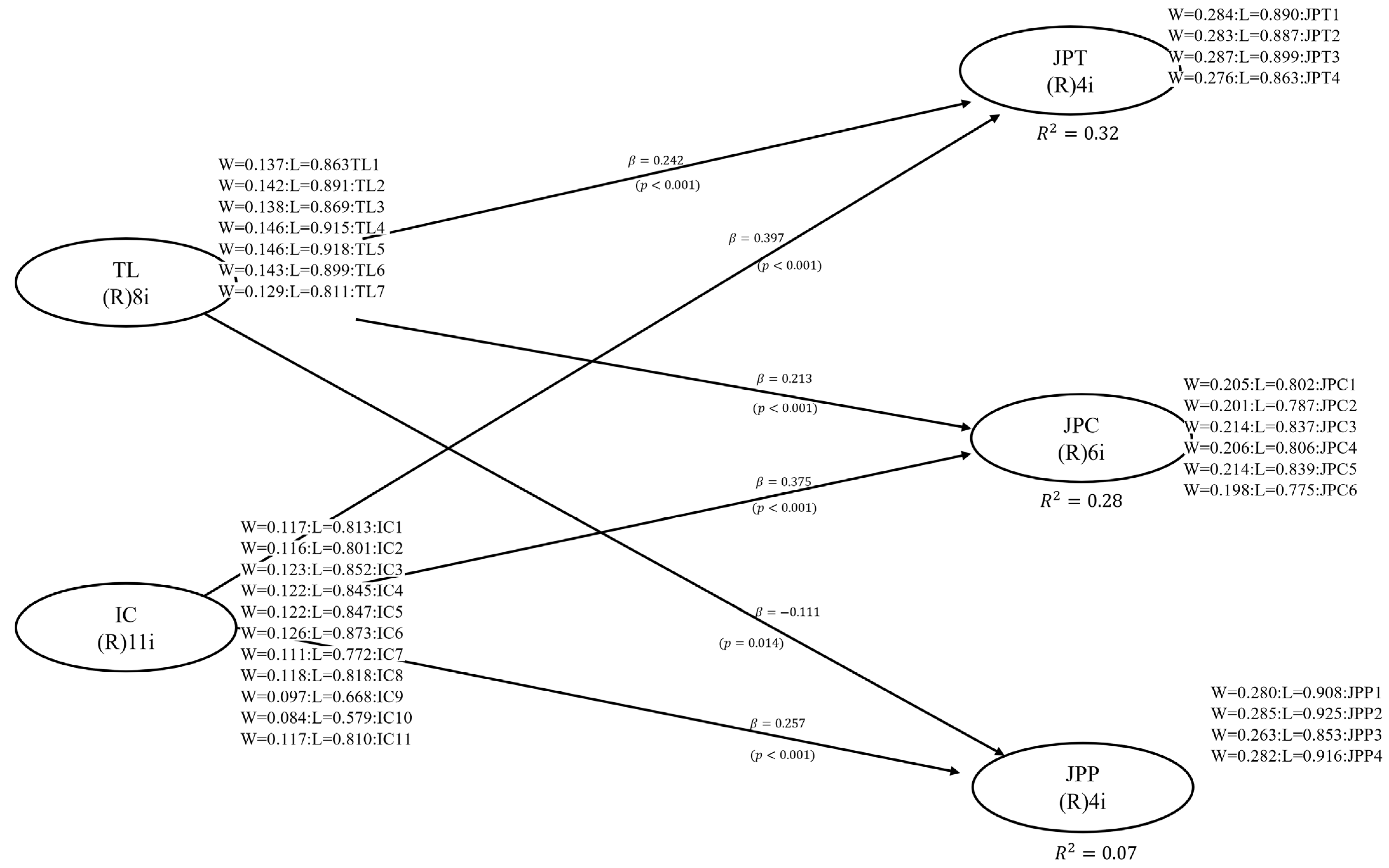
| TL1 | 0.863 | <0.001 | 0.967 | 0.961 | 0.785 | 1.414 |
| TL2 | 0.891 | <0.001 | ||||
| TL3 | 0.869 | <0.001 | ||||
| TL4 | 0.915 | <0.001 | ||||
| TL5 | 0.918 | <0.001 | ||||
| TL6 | 0.899 | <0.001 | ||||
| TL7 | 0.811 | <0.001 | ||||
| IC1 | 0.813 | <0.001 | 0.949 | 0.940 | 0.630 | 1.717 |
| IC2 | 0.801 | <0.001 | ||||
| IC3 | 0.852 | <0.001 | ||||
| IC4 | 0.845 | <0.001 | ||||
| IC5 | 0.847 | <0.001 | ||||
| IC6 | 0.873 | <0.001 | ||||
| IC7 | 0.772 | <0.001 | ||||
| IC8 | 0.818 | <0.001 | ||||
| IC9 | 0.668 | <0.001 | ||||
| IC10 | 0.579 | <0.001 | ||||
| IC11 | 0.810 | <0.001 | ||||
| JPT1 | 0.890 | <0.001 | 0.935 | 0.907 | 0.783 | 2.551 |
| JPT2 | 0.887 | <0.001 | ||||
| JPT3 | 0.899 | <0.001 | ||||
| JPT4 | 0.863 | <0.001 | ||||
| JPC1 | 0.802 | <0.001 | 0.918 | 0.893 | 0.653 | 2.327 |
| JPC2 | 0.787 | <0.001 | ||||
| JPC3 | 0.837 | <0.001 | ||||
| JPC4 | 0.806 | <0.001 | ||||
| JPC5 | 0.839 | <0.001 | ||||
| JPC6 | 0.775 | <0.001 | ||||
| JPP1 | 0.908 | <0.001 | 0.945 | 0.922 | 0.811 | 1.097 |
| JPP2 | 0.925 | <0.001 | ||||
| JPP3 | 0.853 | <0.001 | ||||
| JPP4 | 0.916 | <0.001 |
| LT | IC | JPT | JPC | JPP | |
|---|---|---|---|---|---|
| LT | 0.886 | ||||
| IC | 0.497 | 0.793 | |||
| JPT | 0.404 | 0.515 | 0.885 | ||
| JPC | 0.345 | 0.475 | 0.744 | 0.808 | |
| JPP | −0.066 | 0.17 | −0.056 | 0.052 | 0.901 |
| Hypothesis | Pat Coefficient | p-Value | Decision | |
|---|---|---|---|---|
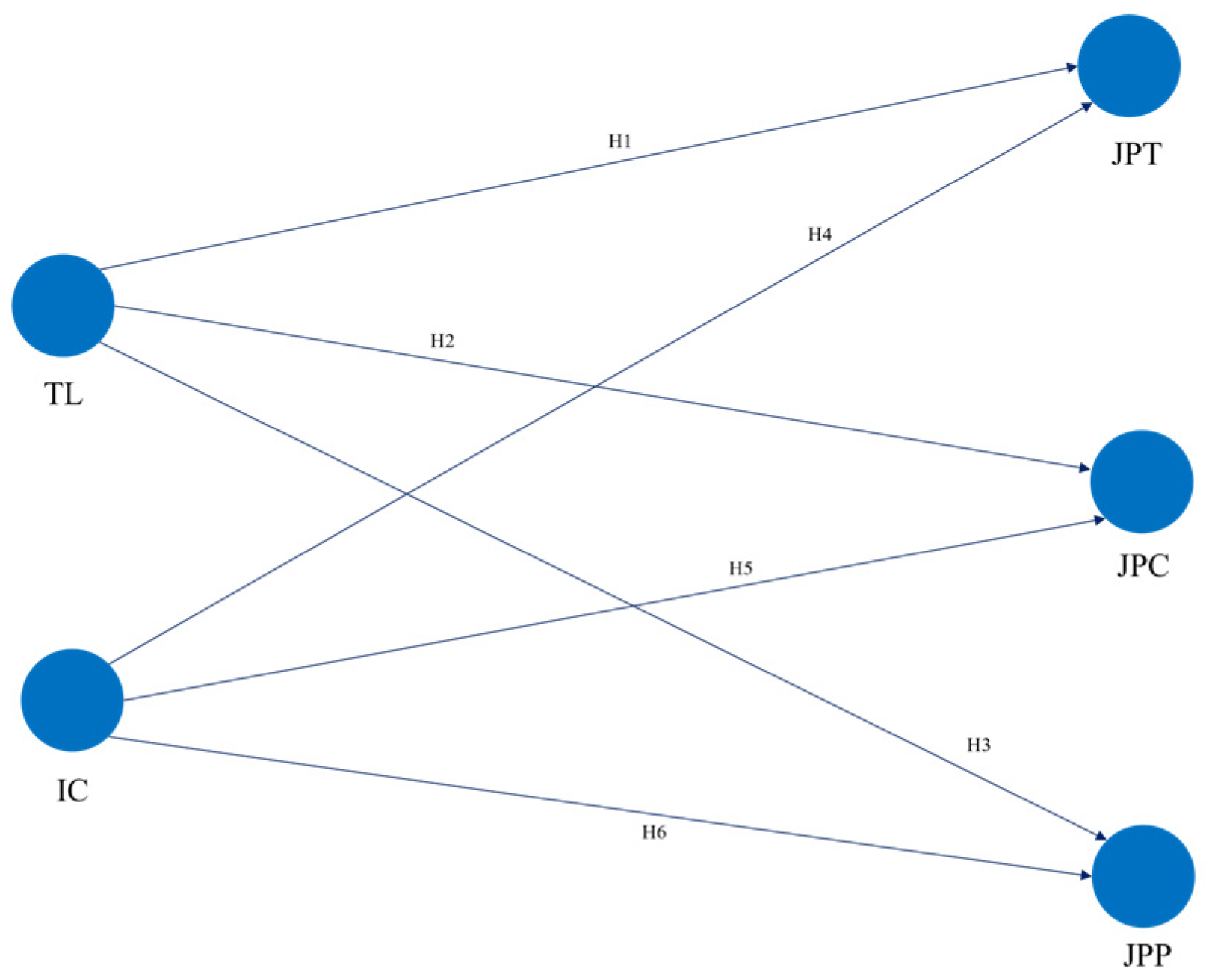
| H1 | TL-JPT | 0.242 | <0.001 | Accepted |
| H2 | TL-JPC | 0.213 | <0.001 | Accepted |
| H3 | TL-JPP | −0.111 | 0.014 | Accepted |
| H4 | IC-JPT | 0.397 | <0.001 | Accepted |
| H5 | IC-JPC | 0.375 | <0.001 | Accepted |
| H6 | IC-JPP | 0.257 | <0.001 | Accepted |
Disclaimer/Publisher’s Note: The statements, opinions and data contained in all publications are solely those of the individual author(s) and contributor(s) and not of MDPI and/or the editor(s). MDPI and/or the editor(s) disclaim responsibility for any injury to people or property resulting from any ideas, methods, instructions or products referred to in the content. |
© 2026 by the authors. Licensee MDPI, Basel, Switzerland. This article is an open access article distributed under the terms and conditions of the Creative Commons Attribution (CC BY) license.
Share and Cite
Jaimes-Soncco, I.E.; Saavedra-Vásconez, J.K.; Haro-Caceres, J.L.; Cisneros-Gonzales, E.O.; Millones-Liza, D.Y. Transformational Leadership and Internal Communication as Predictors of Job Performance: A Perspective of Peruvian University Workers. Behav. Sci. 2026, 16, 588. https://doi.org/10.3390/bs16040588
Jaimes-Soncco IE, Saavedra-Vásconez JK, Haro-Caceres JL, Cisneros-Gonzales EO, Millones-Liza DY. Transformational Leadership and Internal Communication as Predictors of Job Performance: A Perspective of Peruvian University Workers. Behavioral Sciences. 2026; 16(4):588. https://doi.org/10.3390/bs16040588
Chicago/Turabian StyleJaimes-Soncco, Inés Elena, Jéssica Karina Saavedra-Vásconez, Juan Luis Haro-Caceres, Edwin Octavio Cisneros-Gonzales, and Dany Yudet Millones-Liza. 2026. "Transformational Leadership and Internal Communication as Predictors of Job Performance: A Perspective of Peruvian University Workers" Behavioral Sciences 16, no. 4: 588. https://doi.org/10.3390/bs16040588
APA StyleJaimes-Soncco, I. E., Saavedra-Vásconez, J. K., Haro-Caceres, J. L., Cisneros-Gonzales, E. O., & Millones-Liza, D. Y. (2026). Transformational Leadership and Internal Communication as Predictors of Job Performance: A Perspective of Peruvian University Workers. Behavioral Sciences, 16(4), 588. https://doi.org/10.3390/bs16040588