


Current Trends in Music Performance Anxiety Intervention



Abstract
1. Introduction
2. Materials and Methods
2.1. Search Method
2.2. Inclusion Criteria
2.3. Exclusion Criteria
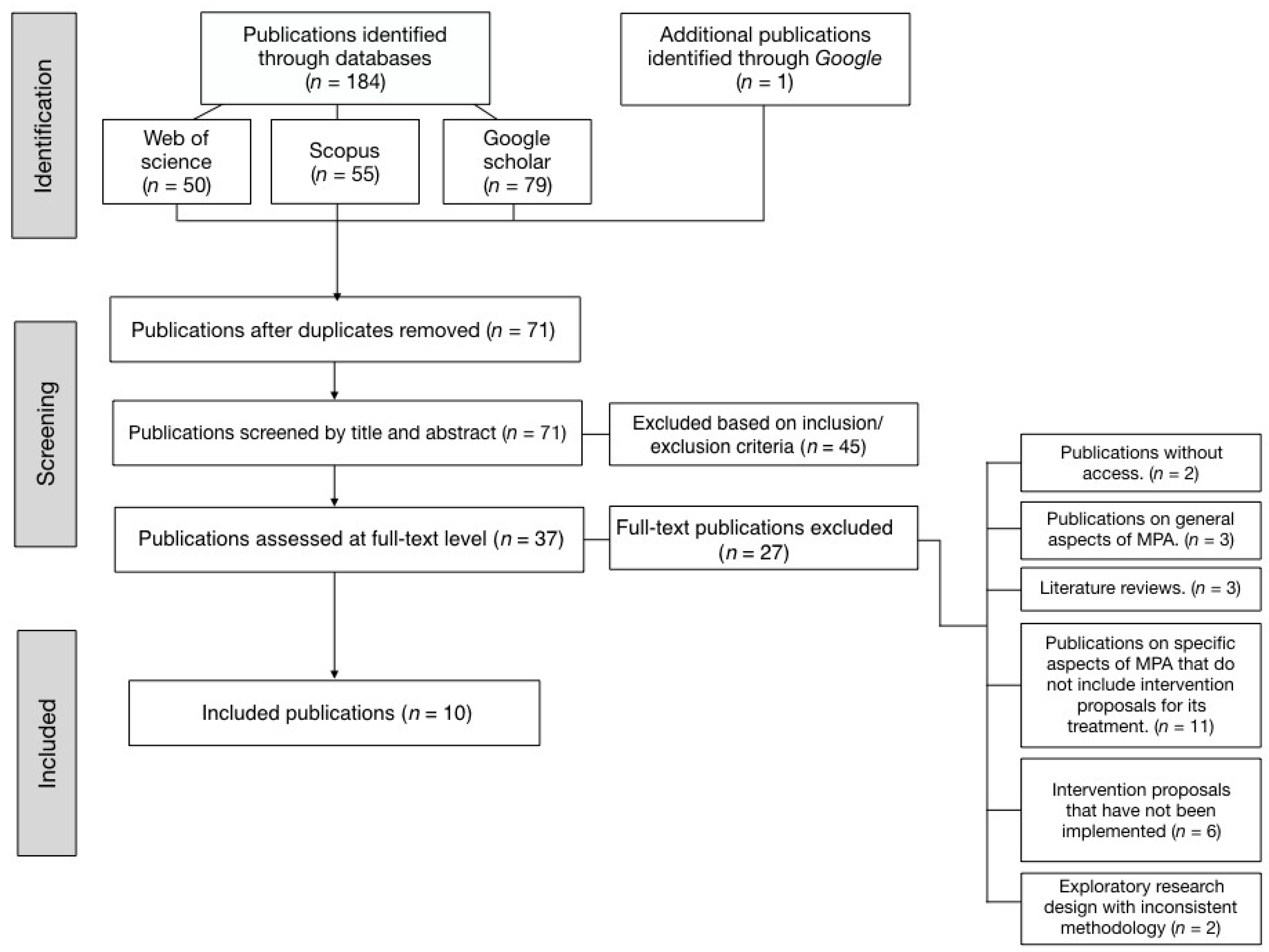
3. Results
4. Discussion
5. Limitations and Strengths
Author Contributions
Funding
Conflicts of Interest
References
- American Psychiatric Association. Diagnostic and Statistical Manual of Mental Disorders: DSM-5; APA: Washington, DC, USA, 1994; Volume 10. [Google Scholar]
- Kenny, D.T. A Systematic Review of Treatments for Music Performance Anxiety. Anxiety Stress Coping 2005, 18, 183–208. [Google Scholar] [CrossRef] [Scilit]
- Cortés-Hernández, N.L.; González-Santoyo, I.; López-Tello, A.; Moreno-Coutiño, A.B. Intervención basada en atención plena compasiva en estudiantes de música con sintomatología ansiosa. Psicol. Salud 2023, 33, 131–145. [Google Scholar] [CrossRef] [Scilit]
- World Health Organization International Statistical Classification of Diseases and Related Health Problems; World Health Organization: Geneva, Switzerland, 2015; ISBN 978-92-4-154916-5.
- Díaz, F.M. Relationships Among Meditation, Perfectionism, Mindfulness, and Performance Anxiety Among Collegiate Music Students. J. Res. Music Educ. 2018, 66, 150–167. [Google Scholar] [CrossRef] [Scilit]
- Herrera-Torres, L.; Campoy-Barreiro, C. Ansiedad escénica musical en profesorado de conservatorio: Frecuenciay análisis por género. Rev. Psicol. Educ. 2020, 15, 32. [Google Scholar] [CrossRef] [Scilit]
- Fernholz, I.; Mumm, J.L.M.; Plag, J.; Noeres, K.; Rotter, G.; Willich, S.N.; Ströhle, A.; Berghöfer, A.; Schmidt, A. Performance Anxiety in Professional Musicians: A Systematic Review on Prevalence, Risk Factors and Clinical Treatment Effects. Psychol. Med. 2019, 49, 2287–2306. [Google Scholar] [CrossRef] [Scilit]
- Kenny, D. The Psychology of Music Performance Anxiety; OUP Oxford: Oxford, UK, 2011; ISBN 978-0-19-162099-7. [Google Scholar]
- Dalia, G. El Músico Adicto. La Musicorexia; Ideamusica: Madrid, Spain, 2014. [Google Scholar]
- Lledó-Valor, R. Las Habilidades Interpretativas y Personales del Músico: Programa para Mejorar la Interpretación Saxofonística en Público. Ph.D. Thesis, Universidad Catolica de Murcia, Murcia, Spain, 2022. [Google Scholar]
- Ballester-Martínez, J. Un Estudio de la Ansiedad Escénica en los Músicos de los Conservatorios de la Región de Murcia. Ph.D. Thesis, Universidad de Murcia, Murcia, Spain, 2015. [Google Scholar]
- Nwokenna, E.N.; Sewagegn, A.A.; Falade, T.A. Effect of Educational Music Intervention on Emotion Regulation Skills of First-Year University Music Education Students. Medicine 2022, 101, e32041. [Google Scholar] [CrossRef] [Scilit]
- Shaw, B.P. A National Analysis of Music Coursetaking, Social-Emotional Learning, and Academic Achievement Using Propensity Scores. J. Res. Music Educ. 2022, 69, 388–401. [Google Scholar] [CrossRef] [Scilit]
- Cernuda, A. La ansiedad escénica en los músicos profesionales de alto rendimiento. Un problema de adicción y salud pública. In Proceedings of the II Congreso Virtual Internacional de Psicología, Online, 26 April 2018; Volume 2, p. 15. [Google Scholar]
- Belmonte-Useros, E.B. Canto. Bases y Método: 1, 1st ed.; Almud Ediciones de Castilla-La Mancha: Albacete, Spain, 2017; ISBN 978-84-946676-3-3. [Google Scholar]
- Altenmüller, E.; Jasusch, H.-C. Focal Dystonia in Musicians: Phenomenology, Pathophysiology, Triggering Factors, and Treatment. Med. Probl. Perform. Artists 2010, 25, 3–9. [Google Scholar] [CrossRef] [Scilit]
- Young, V.; Burwell, K.; PICKUP, D. Areas of Study and Teaching Strategies Instrumental Teaching: A Case Study Research Project. Music Educ. Res. 2003, 5, 139–155. [Google Scholar] [CrossRef] [Scilit]
- Fernández-Morante, B.; Ortiz, F.D.P.; Blanco-Piñeiro, P. Profesionales de la psicología como docentes en los conservatorios de música: Hacia una educación musical sostenible. Pap. Psicol. 2020, 41, 38–45. [Google Scholar] [CrossRef] [Scilit]
- Rosset, J.; Odam, G. The Musician’s Body: A Maintenance Manual for Peak Performance; Routledge: London, UK, 2017. [Google Scholar]
- Papageorgi, I. Prevalence and Predictors of Music Performance Anxiety in Adolescent Learners: Contributions of Individual, Task-Related and Environmental Factors. Music Sci. 2022, 26, 101–122. [Google Scholar] [CrossRef] [Scilit]
- Lang, P. Fear Reduction and Fear Behavior: Problems in Treating a Construct. In Proceedings of the Research in Psychotherapy Conference, Chicago, IL, USA, 3 May–1 June 1968. [Google Scholar] [CrossRef] [Scilit]
- Londoño-López, D.; Osorno-Cardona, A.M. Niveles de Ansiedad en Bailarines de Competencia, en una Academia de Baile de la Ciudad de Medellín. Ph.D. Thesis, Corporación Universitaria Minuto de Dios, Bogotá, Columbia, 2019. [Google Scholar]
- Barlow, D.H. Unraveling the Mysteries of Anxiety and Its Disorders from the Perspective of Emotion Theory. Am. Psychol. 2000, 55, 1247–1263. [Google Scholar] [CrossRef]
- Fernández-Granados, L.M.; Bonastre, C. La Ansiedad en la Interpretación Musical: Programa de intervención en un coro. Rev. Electrónica Complut. Investig. Educ. Music 2021, 18, 49–60. [Google Scholar] [CrossRef] [Scilit]
- Sharma, K.K.; Srinivasan, M.; Sarkar, S.; Kaur, R.; Sharma, Y.; Venkatesan, L.; Gupta, S.; Venugopal, A. Depression, Anxiety, Insomnia, and Distress among Health-Care Workers Posted in COVID-19 Care. Indian J. Psychiatr. Nurs. 2023, 20, 28. [Google Scholar] [CrossRef] [Scilit]
- Arias-Gonzáles, J.L.A.; Cáceres-Chávez, M.D.R.C. Ansiedad escénica y ejecución musical en estudiantes del conservatorio de música en Arequipa, 2020. ESCENA Rev. Artes 2021, 81, 170–182. [Google Scholar] [CrossRef] [Scilit]
- Papageorgi, I.; Hallam, S.; Welch, G.F. A Conceptual Framework for Understanding Musical Performance Anxiety. Res. Stud. Music Educ. 2007, 28, 83–107. [Google Scholar] [CrossRef] [Scilit]
- Barbeau, A.K. Performance Anxiety Inventory for Musicians (PerfAIM): A New Questionnaire to Assess Music Performance Anxiety in Popular Musicians; McGill University Libraries: Montréal, QC, Canada, 2011. [Google Scholar]
- Fernández-Morante, B. Psychological Violence in Current Musical Education at Conservatoires. Rev. Int. Educ. Music 2018, 6, 13–22. [Google Scholar] [CrossRef] [Scilit]
- Zhukov, K. Current Approaches for Management of Music Performance Anxiety: An Introductory Overview. Med. Probl. Perform. Artists 2019, 34, 53–60. [Google Scholar] [CrossRef] [Scilit]
- Herrera-Torres, L.; Manjón, G.J.; Quiles, O.L. Ansiedad escénica musical en alumnos de flauta travesera de conservatorio. Rev. Mex. Psicol. 2015, 32, 169–181. [Google Scholar]
- Burin, A.B.; Barbar, A.E.M.; Nirenberg, I.S.; Osório, F.d.L. Music Performance Anxiety: Perceived Causes, Coping Strategies and Clinical Profiles of Brazilian Musicians. Trends Psychiatry Psychother. 2020, 41, 348–357. [Google Scholar] [CrossRef] [Scilit]
- Burin, A.B.; Osório, F.D.L. Interventions for Music Performance Anxiety: Results from a Systematic Literature Review. Arch. Clin. Psychiatry 2016, 43, 116–131. [Google Scholar] [CrossRef] [Scilit]
- Barrios-Serna, K.V.; Orozco Núñez, D.M.; Pérez Navas, E.C.; Conde Cardona, G.; Barrios Serna, K.V.; Orozco Núñez, D.M.; Pérez Navas, E.C.; Conde Cardona, G. Nuevas recomendaciones de la versión PRISMA 2020 para revisiones sistemáticas y metaanálisis. Acta Neurológica Colomb. 2021, 37, 105–106. [Google Scholar] [CrossRef] [Scilit]
- Page, M.J.; Mckenzie, J.E.; Bossuyt, P.M.; Boutron, I.; Hoffmann, T.C.; Mulrow, C.D.; Mother, D. A Declaração PRISMA 2020: Diretriz Atualizada Para Relatar Revisões Sistemáticas. Rev. Panam. Salud Pública 2022, 46, e112. [Google Scholar] [CrossRef] [PubMed]
- Sánchez-Serrano, S.; Pedraza-Navarro, I.; Donoso-González, M. ¿Cómo hacer una revisión sistemática siguiendo el protocolo PRISMA? Usos y estrategias fundamentales para su aplicación en el ámbito educativo a través de un caso práctico. Bordón Rev. Pedagog. 2022, 74, 51–66. [Google Scholar] [CrossRef] [Scilit]
- Clarke, L.K.; Osborne, M.S.; Baranoff, J.A. Examining a Group Acceptance and Commitment Therapy Intervention for Music Performance Anxiety in Student Vocalists. Front. Psychol. 2020, 11, 538344. [Google Scholar] [CrossRef] [Scilit] [PubMed]
- Czajkowski, A.M.L.; Grasley, A.E.; Allis, M. Mindfulness for Musicians: A Mixed Methods Study Investigating the Effects of 8-Week Mindfulness Courses on Music Students at a Leading Conservatoire. Music. Sci. 2022, 26, 259–279. [Google Scholar] [CrossRef] [Scilit]
- de Lima-Osório, F.; Espitia-Rojas, G.V.; Aguiar-Ricz, L.N. Effects of Intranasal Oxytocin on the Self-Perception and Anxiety of Singers during a Simulated Public Singing Performance: A Randomized, Placebo-Controlled Trial. Front. Neurosci. 2022, 16, 943578. [Google Scholar] [CrossRef] [Scilit]
- Moral-Bofill, L.; López de la Llave, A.; Pérez-Llantada, M.C.; Holgado-Tello, F.P. Development of Flow State Self-Regulation Skills and Coping With Musical Performance Anxiety: Design and Evaluation of an Electronically Implemented Psychological Program. Front. Psychol. 2022, 13, 899621. [Google Scholar] [CrossRef] [Scilit]
- Shaw, T.A.; Juncos, D.G.; Winter, D. Piloting a New Model for Treating Music Performance Anxiety: Training a Singing Teacher to Use Acceptance and Commitment Coaching With a Student. Front. Psychol. 2020, 11, 882. [Google Scholar] [CrossRef] [Scilit]
- Shorey, A. Testing the Effects of Mindfulness Meditation in Reducing Music Performance Anxiety as Measured by Cortisol and Self-Report. Honor. Program Theses 2020, 412, 1–18. [Google Scholar]
- Tang, Y.; Ryan, L. Music Performance Anxiety: Can Expressive Writing Intervention Help? Front. Psychol. 2020, 11, 1334. [Google Scholar] [CrossRef] [Scilit] [PubMed]
- Tief, V.J.; Gröpel, P. Pre-Performance Routines for Music Students: An Experimental Pilot Study. Psychol. Music 2021, 49, 1261–1272. [Google Scholar] [CrossRef] [Scilit]
- Bond, F.W.; Hayes, S.C.; Baer, R.A.; Carpenter, K.M.; Guenole, N.; Orcutt, H.K.; Waltz, T.; Zettle, R.D. Preliminary Psychometric Properties of the Acceptance and Action Questionnaire-II: A Revised Measure of Psychological Inflexibility and Experiential Avoidance. Behav. Ther. 2011, 42, 676–688. [Google Scholar] [CrossRef] [Scilit] [PubMed]
- Ruiz, F.J.; Suárez-Falcón, J.C. The Spanish Version of the Believability of Anxious Feelings and Thoughts Questionnaire. Psicothema 2014, 26, 308–313. [Google Scholar] [CrossRef] [Scilit]
- Lovibond, P.F.; Lovibond, S.H. The Structure of Negative Emotional States: Comparison of the Depression Anxiety Stress Scales (DASS) with the Beck Depression and Anxiety Inventories. Behav. Res. Ther. 1995, 33, 335–343. [Google Scholar] [CrossRef] [Scilit]
- López-Tello, A.; Moreno-Coutiño, A. Escala de Compasión (ECOM) Para Población Mexicana. Psicol. Salud 2018, 29, 25–32. [Google Scholar] [CrossRef] [Scilit]
- Spahn, C.; Walther, J.-C.; Nusseck, M. The Effectiveness of a Multimodal Concept of Audition Training for Music Students in Coping with Music Performance Anxiety. Psychol. Music 2016, 44, 893–909. [Google Scholar] [CrossRef] [Scilit]
- Lorenzo-Ruiz, A.; Abalo, J.; Madam, A.; Los, M.; Londián, A.; Martín, M.; Torres, F. Validation of the State-Trait Anxiety Inventory for Children in Cuban Adolescents. Psicol. Salud 2013, 13, 2003. [Google Scholar]
- Ruiz, F.J.; Suárez-Falcón, J.C.; Riaño-Hernández, D. Psychometric properties of the Mindful Attention Awareness Scale in Colombian undergraduates. SUMPSIC 2016, 23, 18–24. [Google Scholar] [CrossRef] [Scilit]
- Lupano-Perugini, M.L.; de la Iglesia, G.; Castro-Solano, A.; Keyes, C.L.M. The Mental Health Continuum-Short Form (MHC-SF) in the Argentinean Context: Confirmatory Factor Analysis and Measurement Invariance. Eur. J. Psychol. 2017, 13, 93–108. [Google Scholar] [CrossRef] [Scilit]
- Rolffs, J.L.; Rogge, R.D.; Wilson, K.G. Disentangling Components of Flexibility via the Hexaflex Model: Development and Validation of the Multidimensional Psychological Flexibility Inventory (MPFI). Assessment 2018, 25, 458–482. [Google Scholar] [CrossRef] [Scilit] [PubMed]
- Krane, V. The Mental Readiness Form as a Measure of Competitive State Anxiety. Sport Psychol. 1994, 8, 189–202. [Google Scholar] [CrossRef] [Scilit]
- Cardaciotto, L.; Herbert, J.; Forman, E.; Moitra, E.; Farrow, V. The Assessment of Present-Moment Awareness and Acceptance The Philadelphia Mindfulness Scale. Assessment 2008, 15, 204–223. [Google Scholar] [CrossRef] [Scilit]
- Ritchie, L.; Williamon, A. Measuring Distinct Types of Musical Self-Efficacy. Psychol. Music 2011, 39, 328–344. [Google Scholar] [CrossRef] [Scilit]
- Iacoponi, E.; Mari, J.J. Reliability and Factor Structure of the Portuguese Version of Self-Reporting Questionnaire. Int. J. Soc. Psychiatry 1989, 35, 213–222. [Google Scholar] [CrossRef] [Scilit]
- Gismero, E. EHS. Escala de Habilidades Sociales; TEA Ediciones: Madrid, Spain, 2000; ISBN 978-84-7174-609-2. [Google Scholar]
- Brugués, A.O. Music Performance Anxiety—Part 2: A Review of Treatment Options. Med. Probl. Perform. Artists 2011, 26, 164–171. [Google Scholar] [CrossRef] [Scilit]
- Esquivel-Lauzurique, M.; Vera Fernández, Y.; Dennis, C.-L.; Rubén Quesada, M.; Álvarez Valdés, G.; Lye, S.; Tamayo-Pérez, V. Prevalence, Incidence, and Persistence of Postpartum Anxiety, Depression, and Comorbidity: A Cohort Study Among Women in Havana Cuba. J. Perinat. Neonatal Nurs. 2022, 36, E15–E24. [Google Scholar] [CrossRef] [Scilit]
- Rodríguez-Mora, Á.; López Díaz, R. Rasgos de personalidad y variables asociadas a la ansiedad escénica musical. Ansiedad Estrés 2020, 26, 33–38. [Google Scholar] [CrossRef] [Scilit]
- Barrientos-Fernández, A.; Sánchez-Cabrero, R.; Arigita-García, A.; Mañoso-Pacheco, L.; Pericacho-Gómez, F.J.; Novillo-López, M.Á. Measurement of Different Types of Intelligence (General, Verbal vs. Non-Verbal, Multiple), Academic Performance and Study Habits of Secondary Students at a Music Integrated Centre. Data Brief 2019, 25, 104124. [Google Scholar] [CrossRef] [Scilit]
- Sánchez-Cabrero, R.; Barrientos-Fernández, A.; Arigita-García, A.; Mañoso-Pacheco, L.; Costa-Román, O. Demographic Data, Habits of Use and Personal Impression of the First Generation of Users of Virtual Reality Viewers in Spain. Data Brief 2018, 21, 2651–2657. [Google Scholar] [CrossRef] [Scilit]
- Damian-Quinto, O.R. La Ansiedad en los Estudiantes de Música y Estrategia Para su Mejora. Master’s Thesis, Universidad Nacional de Educacion, Lima, Peru, 2021. [Google Scholar]
- Urruzola, M.V.; Bernaras, E. Aprendizaje musical y ansiedad escénica en edades tempranas: 8–12 años. Rev. Psicodidáctica 2020, 25, 76–83. [Google Scholar] [CrossRef] [Scilit]
- Conti, M.G.; Díaz, A.; Blak, M.G. Manifestaciones fonoaudiológicas de la ansiedad por performance musical en cantantes solistas y coreutas. Boletín Univ. Mus. Soc. Argent. 2019, 11, 17–59. [Google Scholar]
- Conti, M.; Díaz, A.; Blake, M. La autoevaluación como destreza en el músico performer. Rev. Actos 2021, 3, 124–134. [Google Scholar] [CrossRef] [Scilit]
- Beltrán-Zaldumbide, M.A.; Borja-Narváez, D.S. La Ansiedad Escénica en Estudiantes de Música y Sus Métodos de Tratamiento, una Revisión Bibliográfica. Bachelor’s Thesis, Universidad Politécnica Salesianase de Quito, Quito, Ecuador, 2022. [Google Scholar]

| Publications | Design | Data Collection | Type of Treatment | Control | Duration of Intervention | N (GE/GC) and Participant Profiles | Statistical Contrast Tests Applied | Summary of Results |
|---|---|---|---|---|---|---|---|---|
| Clarke, O. & Baranoff (2020) [37] (Australia) | Uncontrolled trial. Quasi-experimental within-subject design with pre- and post-treatment measurements. Follow up over three months. | K-MPAI, MPFI-SF DASS, and MHC-SF. Open questions | Group therapy of acceptance and commitment | No control group | Six weeks. One 2 h session per week. | 6 (6/-) University music students in their 1st, 2nd, or 3rd year of studies | Repeated measures analyses of variance (ANOVA) | A significant and sustained reduction in MPA was observed over time (Huynh–Feldt correction F (1.11, 5.58) = 9.48, p = 0.019, partial η 2 = 0.655). |
| Cortés-Hernández et al. (2023) [3] (Mexico) | Uncontrolled trial. Quasi-experimental within-subject design with pre- and post-treatment measurements, without follow up. | IDARE, MAAS, and ECOM | Mindfulness and compassion therapy | No control group | Eight weeks. One 2 h session per week. | 20 (20/-) University music students | McNemar’s Test and the Wilcoxon Rank-Sum Test | No significant changes in trait and state anxiety or physiological variables. |
| Czajkowski et al. (2022) [38] (United Kingdom) | Uncontrolled trial. Quasi-experimental within-subject design, without follow up. | FFMQ, ad hoc questionnaire MFM, and semi-structured interview | Mindfulness through the MfPAS course | No control group | Eight weeks. Weekly group session of 2–2.5 h. Daily individual practice (Routine) of 40–45 min. | 25 (25/-) University music students | Paired t-tests and related non-parametric samples Wilcoxon | Indirectly reported improved MPA via Mindfulness tests (p < 0.01). Qualitative data showed varied focus on positive effects on MPA symptoms. |
| De Lima-Osorio et al. (2022) [39] (Brazil) | Crossover experimental design applying the double-blind technique to the same subjects. | K-MPAI, SSPS-P, and SRQ-20 | Oxytocin (pharmacological treatment) | Placebo | Two measurement sessions with a distance of 15 to 30 days. | 50 (22/28) Music students and professionals | ANOVA 2 × 2 for crossover trials | Oxytocin improved the cognitive component of MPA (p = 0.06). |
| Fernández- Granados y Bonastre (2021) [24] (Spain) | Uncontrolled trial. Quasi-experimental within-subject design with pre- and post-treatment, without follow up. | Open questions | Psychotherapy, visualization, body awareness, breathing, and relaxation | No control group | Eight sessions over two weeks (Each session lasts 15 min.) | 46 (46/-) Amateurs, beginners, pre-college or university students, and professionals | Analysis of variance (ANOVA) and Student’s t-tests | The results were not statistically significant in the Psychological Vulnerability, Specific Thoughts, Motor and Physiological scales overall, but were significant in some items of each scale. |
| Moral-Bofill et. al. (2022) [40] (Spain) | Controlled trial. Mixed experimental design, between-subjects and within-subjects, with pre- and post-treatment measurements, without follow up. | EFIM, KMPAI-E, and SSS | HAMI method. Cognitive behavioral therapy (CBT) exercises, mindfulness, emotional regulation therapy, optimal experience states, and positive psychology | Untreated control group | Not specified. | 62 (28/34) Students in their final year of university and university professors | Structural equation modeling (SEM), repeated measures mixed ANOVA, and Student’s t-test | Intervention significantly decreased MPA (t = 2.64, p = 0.01, d = 0.24), and self-awareness (t = −3.66, p = 0.00, d = 0.70) in the experimental group. |
| Shaw et al. (2020) [41] (United Kingdom) | Uncontrolled trial. Single- subject design. Measurements taken before, at the midpoint, and after the intervention. Follow up after three months. | BAFT, AAQ-2, PHLMS, and K-MPAI | (ACT) acceptance and commitment coaching (version of commitment therapy) | No control group | One introductory session and six 1 h sessions over four months. | 1 (1/-) University musical theater student and professional | Reliable change index | Clinically significant improvements in two ACT-based processes believed to correlate with improved psychological flexibility in previous ACT for MPA psychotherapy research, i.e., acceptance of MPA-related discomfort and defusion from MPA-related thoughts. |
| Shorey (2020) [42] (United States) | Controlled trial. Mixed experimental design, between-subjects and within-subjects, with pre- and post-treatment measurements without follow up. | K-MPAI and FZA-S | Mindfulness, yoga, and other mind–body exercises | Equivalent neutral treatment | A single session. | 16 (8/8) University music students | One-tailed t-test and Regression model | There were no significant improvements in cortisol reactivity or state MPA. |
| Tang & Ryan (2020) [43] (United States) | Controlled trial. Mixed experimental design, between-subjects and within-subjects, with pre- and post-treatment measurements, without follow up. | QSMEEPH and expressive writing | Expressive writing | Equivalent neutral treatment | Two sessions two to three days apart. | 35 (18/17) University music students | Mixed-design ANOVA | Students with high levels of MPA significantly reduced it (F = 4.99, p < 0.04). |
| Tief & Gröpel (2021) [44] (Austria) | Controlled trial. Mixed experimental design, between-subjects and within-subjects, with pre- and post-treatment measurements, without follow up. | K-MPAI, MRF-3, and SMPQ | Pre-concert routines (goal setting system = control group) | Active comparator (a goal setting system applied to control group) | Two sessions 33 days apart. | 30 (15/15) Music students and professionals | 2 × 2 repeated measures ANOVA and chi-square test | There were no significant differences observed in MPA in either of the two intervention techniques. |
Disclaimer/Publisher’s Note: The statements, opinions and data contained in all publications are solely those of the individual author(s) and contributor(s) and not of MDPI and/or the editor(s). MDPI and/or the editor(s) disclaim responsibility for any injury to people or property resulting from any ideas, methods, instructions or products referred to in the content. |
© 2023 by the authors. Licensee MDPI, Basel, Switzerland. This article is an open access article distributed under the terms and conditions of the Creative Commons Attribution (CC BY) license (https://creativecommons.org/licenses/by/4.0/).
Share and Cite
Gómez-López, B.; Sánchez-Cabrero, R. Current Trends in Music Performance Anxiety Intervention. Behav. Sci. 2023, 13, 720. https://doi.org/10.3390/bs13090720
Gómez-López B, Sánchez-Cabrero R. Current Trends in Music Performance Anxiety Intervention. Behavioral Sciences. 2023; 13(9):720. https://doi.org/10.3390/bs13090720
Chicago/Turabian StyleGómez-López, Belén, and Roberto Sánchez-Cabrero. 2023. "Current Trends in Music Performance Anxiety Intervention" Behavioral Sciences 13, no. 9: 720. https://doi.org/10.3390/bs13090720
APA StyleGómez-López, B., & Sánchez-Cabrero, R. (2023). Current Trends in Music Performance Anxiety Intervention. Behavioral Sciences, 13(9), 720. https://doi.org/10.3390/bs13090720

