


Abstract
The integration of sedimentological and micropaleontological data in the Zanclean and Gelasian shallow-marine deposits of the Crotone Basin (southern Italy) has allowed documentation of meter-to-decameter-scale high-frequency sequences bounded by wave-ravinement surfaces (WRSs), which in turn are composed of meter-scale sedimentological cycles, referred to as bedsets. In contrast to high-frequency sequences, bedsets have a more subtle appearance, and their boundaries exhibit limited lateral extent compared to WRSs. Moreover, the micropaleontological analyses have allowed the definition of three parameters: distal/proximal (D/P: ratio between distal and proximal benthic foraminifera); fragmentation (Fr: percentage of fragmentation of benthic foraminifera); and P/B (ratio between planktonic and benthic foraminifera). In particular, the D/P and Fr allow to recognize uncertainty intervals containing the maximum flooding surface (MFS) of high-frequency sequences, whereas the P/B documents water-depth changes. Unlike in high-frequency sequences, the D/P, Fr and P/B parameters usually do not show appreciable variations associated with bedsets, confirming that the latter are unrelated to shoreline shifts and water-depth variations, but are rather controlled by minor sediment supply and/or wave regime changes. However, in rare cases, the micropaleontological parameters seem to indicate that subtle transgressive-regressive trends and water-depth variations can also be associated with bedset deposition, alluding to a ‘grey area’ of transition between high-frequency sequences of very small scale and bedsets. Further research is, therefore, needed to constrain the boundary between sedimentology and stratigraphy.
1. Introduction
The separation between stratigraphic and sedimentological cycles is apparently well defined, as the former are usually associated with shoreline transgressions and regressions, whereas the latter, also referred to as bedsets, should only be associated with cyclic processes involving local energy and sediment supply [1,2,3,4,5,6,7]. Although systems tracts forming stratigraphic sequences are well recognizable where transgressions and regressions are associated with high-magnitude relative sea-level changes and/or high-magnitude sediment supply variations, meter-to-decameter-scale high-frequency sequences associated with minor shoreline shifts can be difficult to distinguish from meter-scale bedsets, especially in outcrops with limited areal extent. For this reason, Zecchin et al. [5,6] defined a series of criteria to discriminate between high-frequency sequences and bedsets, which integrate sedimentological, stratigraphic, micropaleontological, mineralogical, and diagenetic approaches. In general, bedset boundaries have a more limited lateral extent and a more subtle physical appearance than the high-frequency sequence boundaries, and the distribution of heavy minerals changes significantly only across stratigraphic boundaries such as wave-ravinement surfaces [5,6].
Despite the progress to date, challenges still remain with respect to the distinction between stratigraphic and sedimentological cycles, as the increasingly finer scales of observation approach the limits of high-resolution stratigraphic studies. This challenge is exacerbated by the common organization of ‘bedsets’ into ‘bedset sets’, and the assumption that these units can also be associated with shoreline shifts and minor relative sea-level changes, similar to sequences [8,9,10]. Based on field data from Pliocene and early Pleistocene shallow-marine deposits of the Crotone Basin (southern Italy; Figure 1 and Figure 2), this study aims to separate stratigraphic from sedimentologic cycles, also employing updated micropaleontological criteria to better define this distinction. These results can help improve the highest resolution sequence stratigraphic analyses of shallow-marine deposits by bringing into focus the objective criteria that define the limit between sedimentology and stratigraphy.
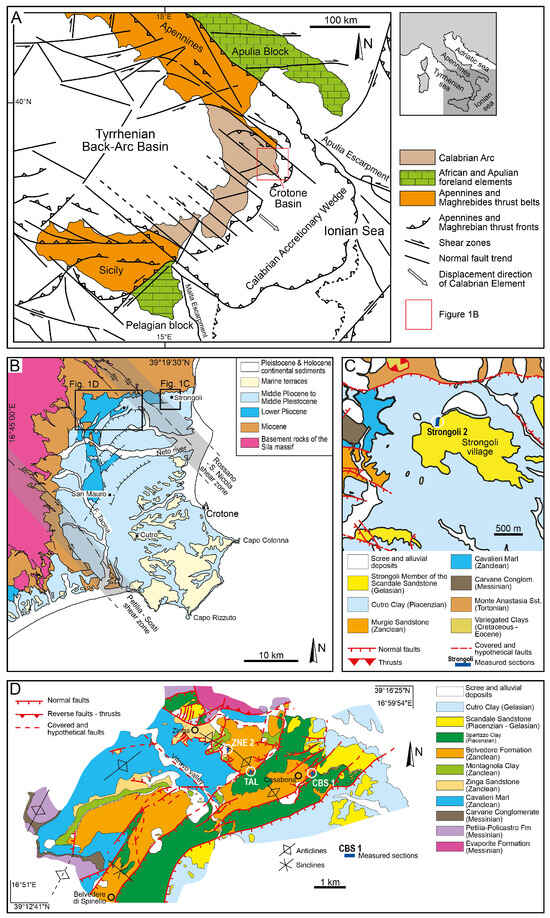
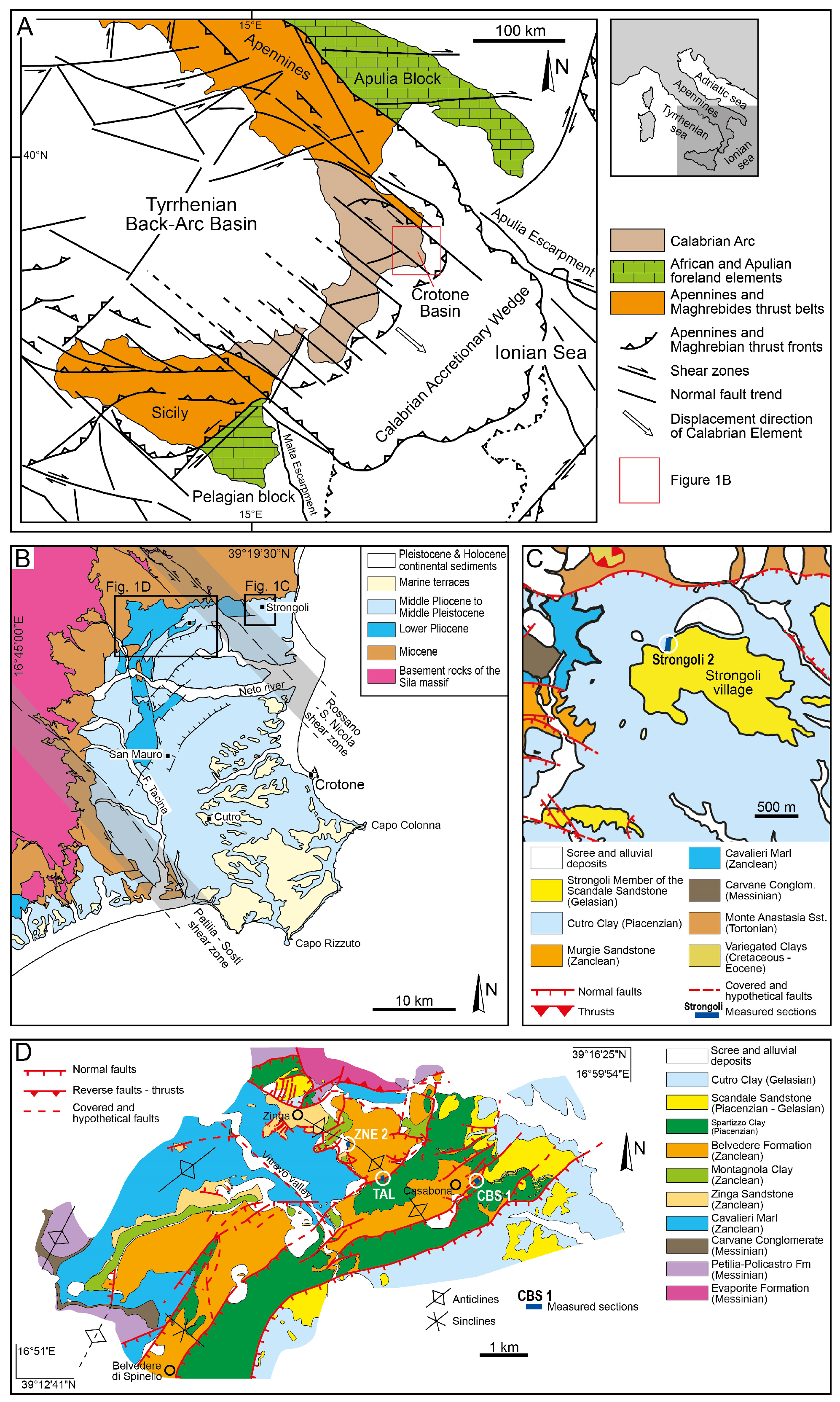
Figure 1.
(A) Structural map of the Calabrian Arc showing the location of the Crotone Basin (modified from Van Dijk and Okkes [11]). (B) Simplified geological map of the Crotone Basin, showing the maps illustrated in Figure 1C,D (modified from Zecchin et al. [12,13,14]). (C) Geological map of the Strongoli area (Figure 1B for location), showing the position of the Strongoli 2 measured section (modified from Zecchin et al. [13,15]). (D) Geological map of the western part of the study area in the Crotone Basin (Figure 1B for location), showing the position of the CBS 1, TAL and ZNE 2 measured sections (modified from Zecchin et al. [14]).
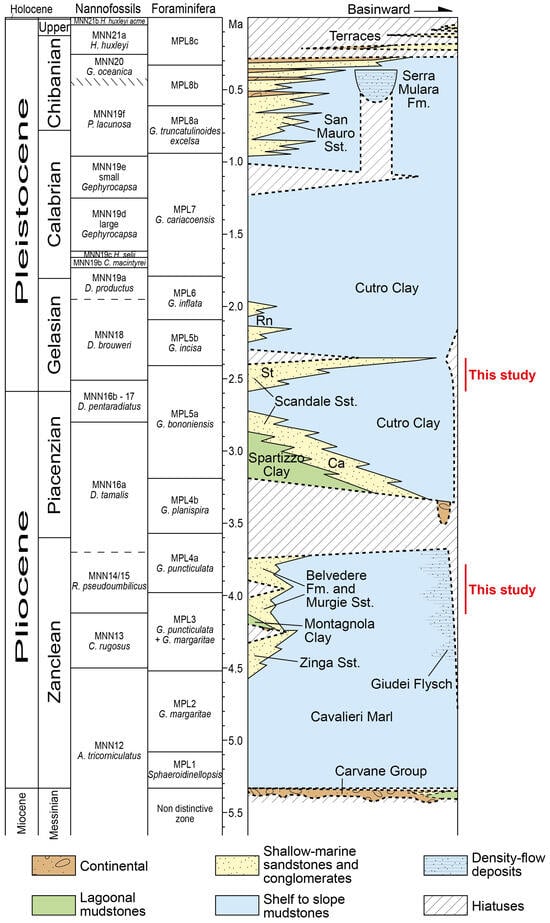
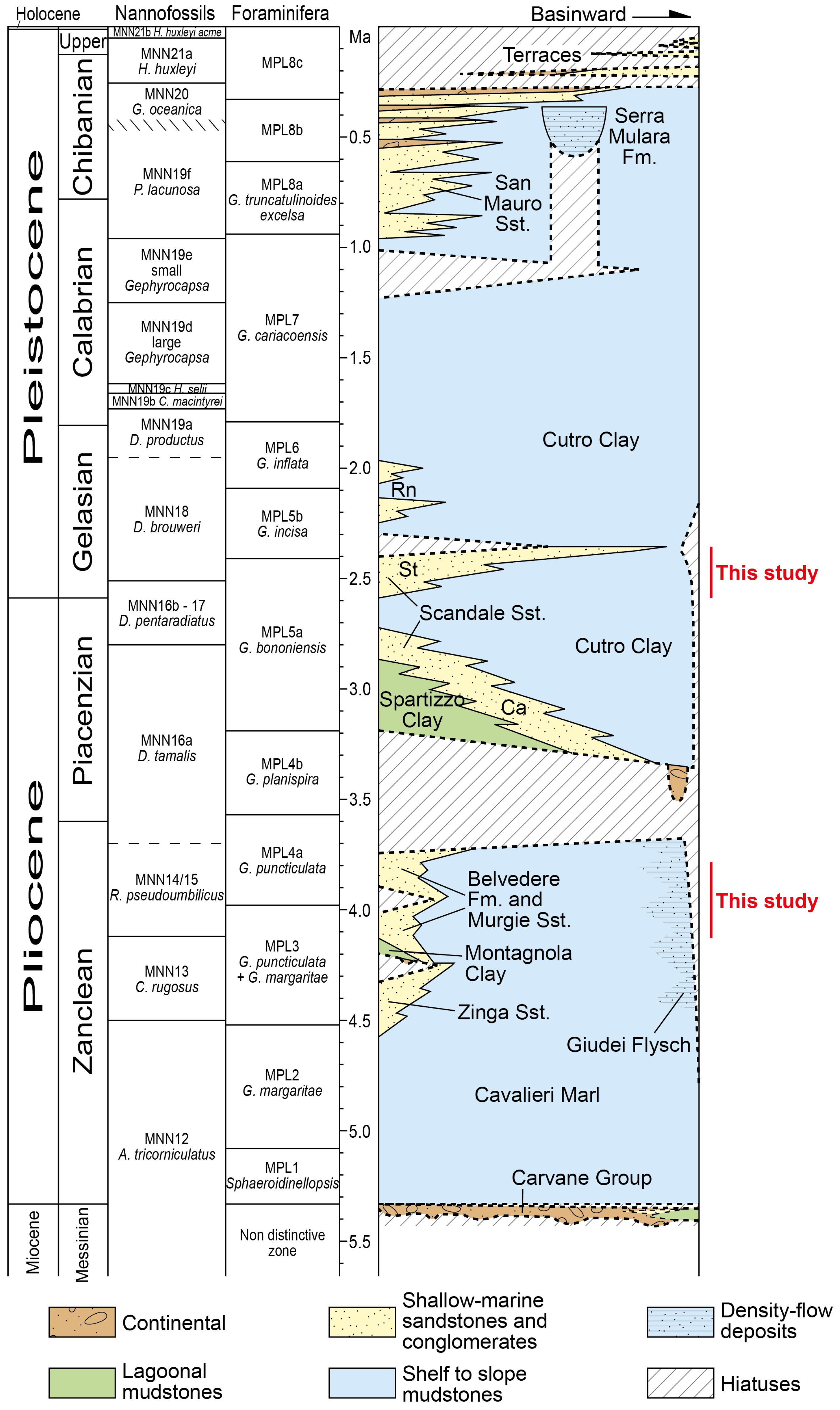
Figure 2.
The Plio-Pleistocene part of the sedimentary succession of the Crotone Basin (modified from Zecchin et al. [15]), compared with the IUGS International Chronostratigraphic Chart (https://stratigraphy.org/ICSchart/ChronostratChart2021-05.pdf accessed on 18 February 2026), and the calcareous nannofossil and planktonic foraminifera biostratigraphic schemes [16,17,18,19]. The studied succession is part of the Zanclean Belvedere Formation and the Gelasian Strongoli Member of the Scandale Sandstone. Abbreviations: Ca—Casabona Member; Rn—Rocca di Neto Member; St—Strongoli Member.
2. Geological Setting
The Crotone Forearc Basin developed from late Serravallian onwards on the Ionian side of the Calabrian Arc (southern Italy), the latter being located between the southern Apennines and the Sicilian Maghrebides and composed of metamorphic, plutonic and sedimentary units [20,21,22] (Figure 1A,B). The evolution of the Calabrian Arc was characterized by an overall SE-ward migration of the whole terrane, concomitant with the subduction of the Ionian oceanic crust and the opening of the Tyrrhenian backarc basin since the Middle Miocene [23,24,25,26,27,28,29,30,31] (Figure 1).
The sedimentary succession of the Crotone Basin consists of Serravallian to Middle Pleistocene marine, coastal and continental deposits (Figure 1B and Figure 2) and records both tectonic subsidence events and phases of uplift plus basin closure, as well as glacio-eustasy [12,15,32,33,34,35,36,37,38,39,40,41]. A generalized tectonic uplift started during the Middle Pleistocene, and this process led to the emergence of the inner part of the basin and the formation of a staircase of marine terraces [42,43,44,45].
3. Methods
The considered examples of shallow-marine deposits are described by four detailed measured sections (Figure 1C,D, Figure 3, Figure 4, Figure 5 and Figure 6). Facies analysis provides the basis for the recognition of facies associations and depositional environments (Table 1), whereas depositional trends and key bounding surfaces are essential to define the sequence stratigraphic framework of the recognized stratigraphic sequences and bedsets.
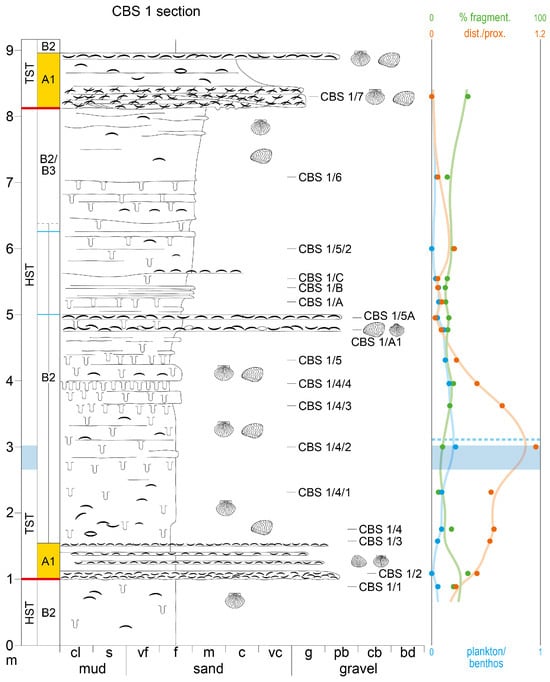
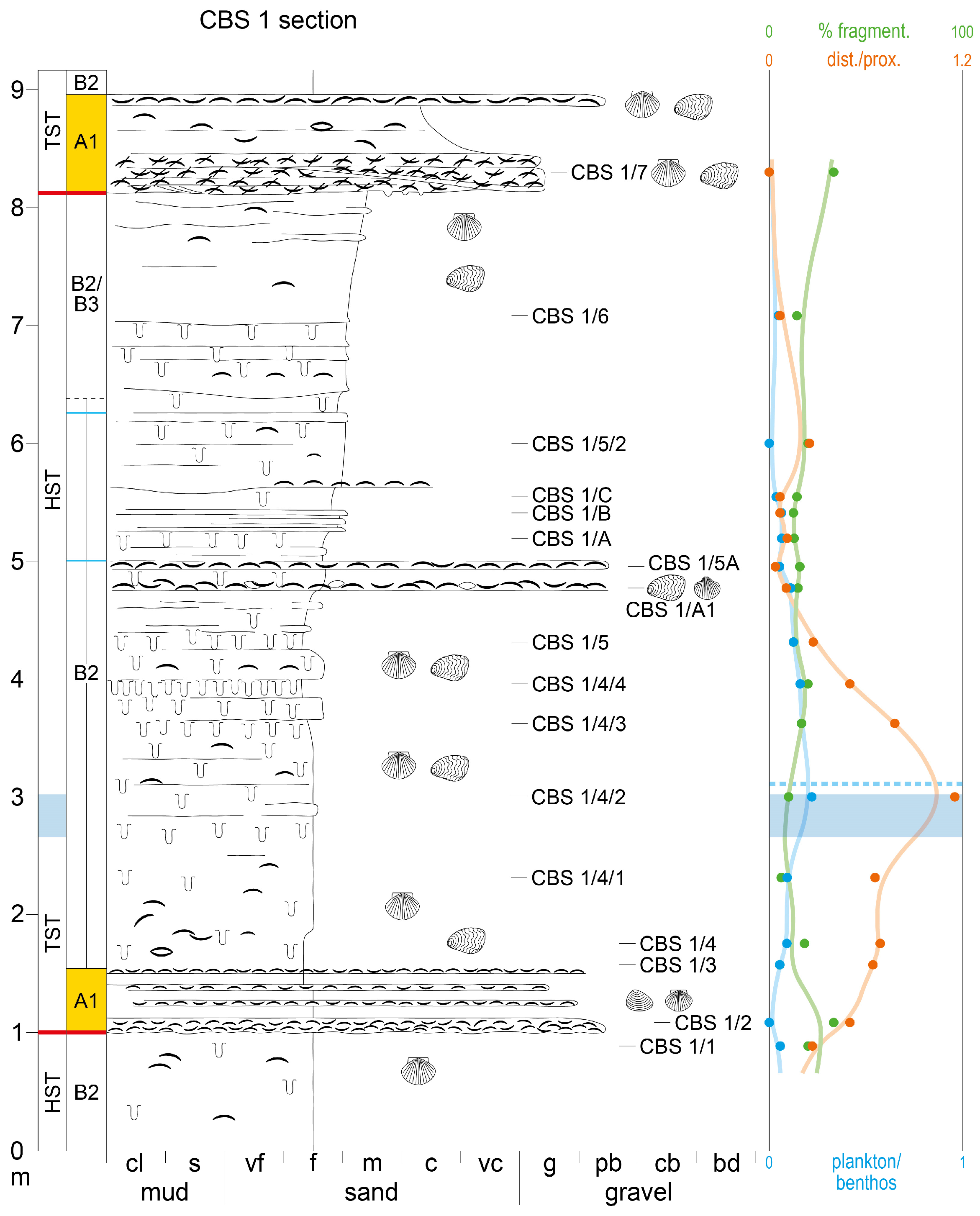
Figure 3.
The South Casabona (CBS) 1 section of the Belvedere Formation (Figure 1D for location and Figure 4 for symbols; modified from Zecchin et al. [14]). Sedimentary structures, fossils, samples, facies and facies contacts, sequence stratigraphic surfaces, systems tracts and bedset boundaries are shown. The curves derived from the micropaleontological analysis (% fragmentation, distal/proximal and plankton/benthos, see text) are shown on the right. Two discontinuity surfaces bounding bedsets are found in the middle to upper part of a high-frequency sequence bounded by wave-ravinement surfaces and composed of a transgressive systems tract (TST) and a highstand systems tract (HST). TST and HST are separated by an uncertainty interval inferred to contain the maximum flooding surface, defined on a micropaleontological basis (see text).
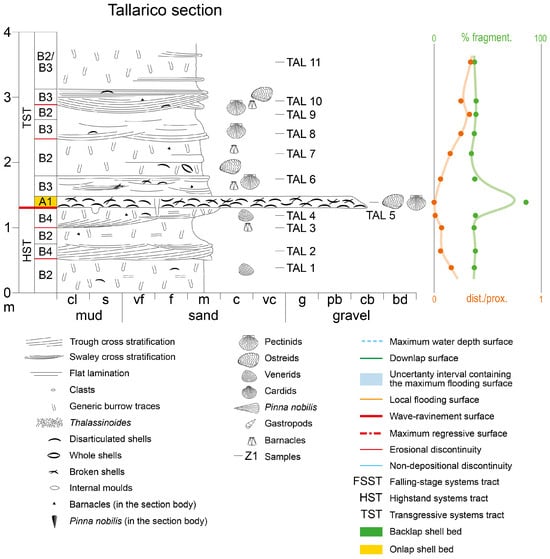
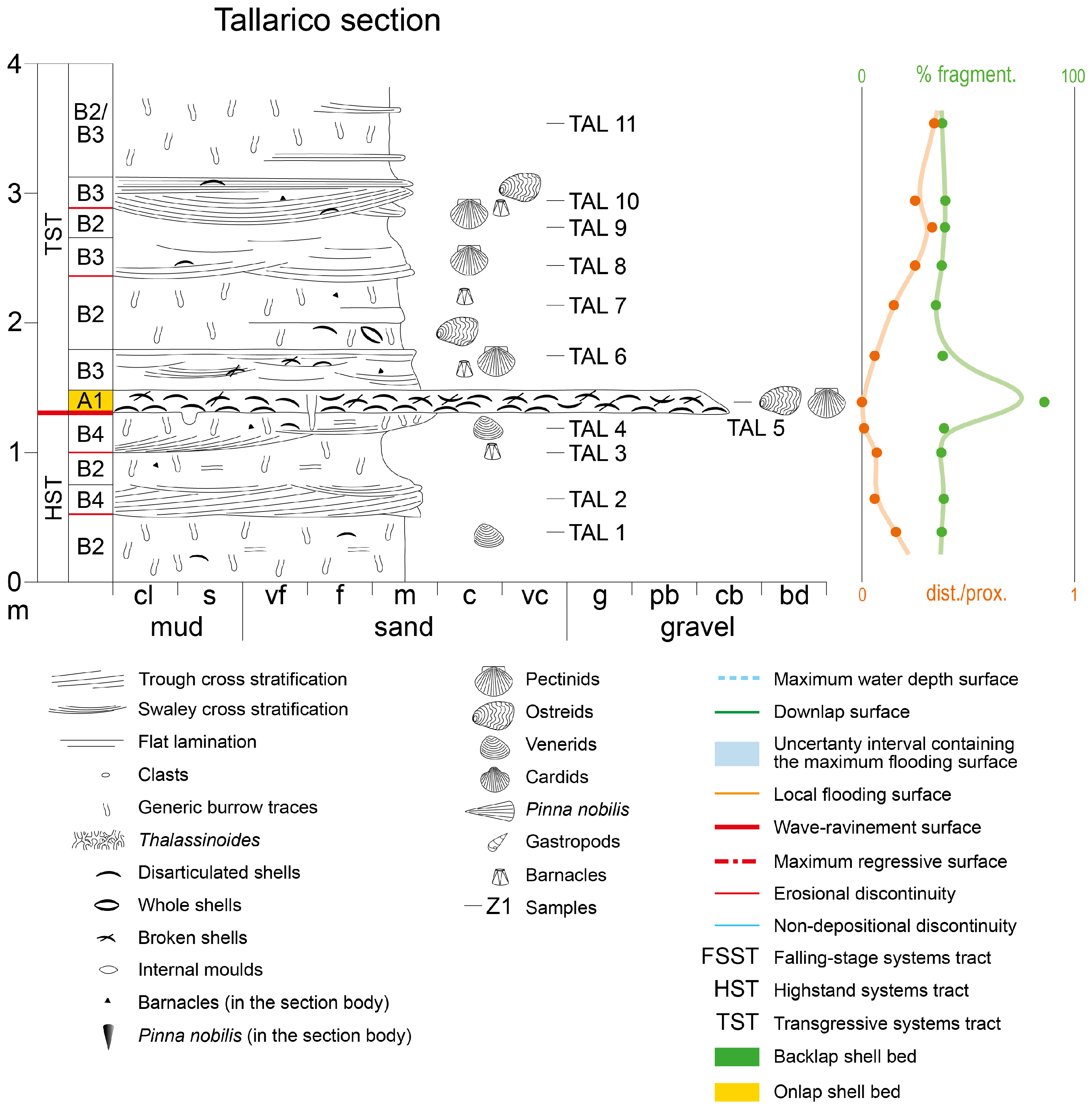
Figure 4.
The Tallarico (TAL) section of the Belvedere Formation (Figure 1D for location; modified from Zecchin et al. [5]). Sedimentary structures, fossils, samples, facies and facies contacts, sequence stratigraphic surfaces, systems tracts and bedset boundaries are shown. The curves derived from the micropaleontological analysis (% fragmentation and distal/proximal, see text) are shown on the right. The section documents a wave-ravinement surface separating the HST (below) and the TST (above) of two high-frequency sequences, which are in turn composed of bedsets bounded by erosional discontinuities.
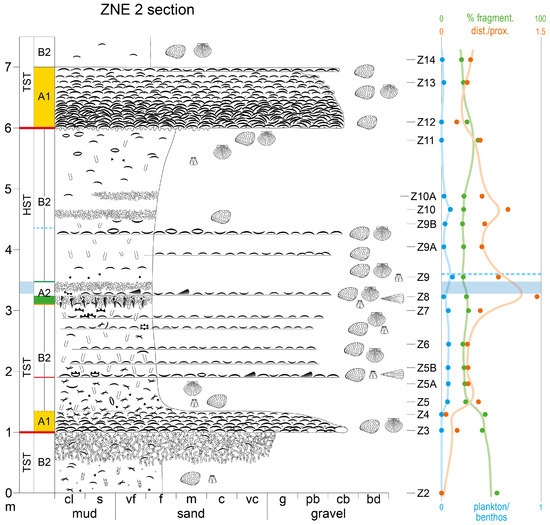
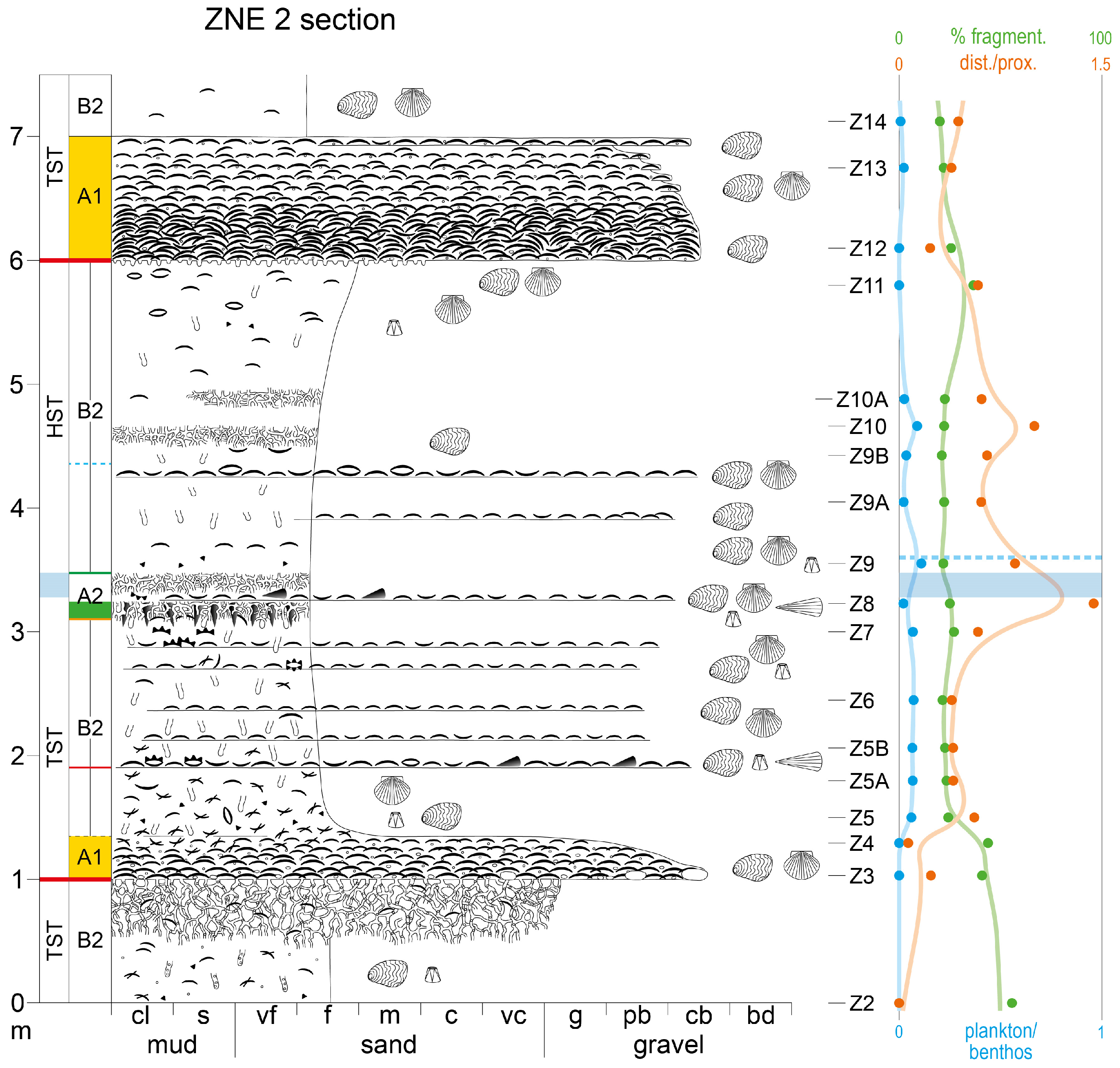
Figure 5.
The East Zinga (ZNE) 2 section of the Belvedere Formation (Figure 1D for location and Figure 4 for symbols; modified from Zecchin et al. [14]). Sedimentary structures, fossils, samples, facies and facies contacts, sequence stratigraphic surfaces, systems tracts and bedset boundaries are shown. The curves derived from the micropaleontological analysis (% fragmentation, distal/proximal and plankton/benthos, see text) are shown on the right. A high-frequency sequence bounded above and below by wave ravinement surfaces is documented. The sequence is composed of a TST and an HST separated by an uncertainty interval inferred to contain the maximum flooding surface, defined on a micropaleontological basis (see text). The TST is composed of two bedsets separated by an erosional discontinuity, whereas the HST is composed of two bedsets separated by a non-depositional discontinuity.
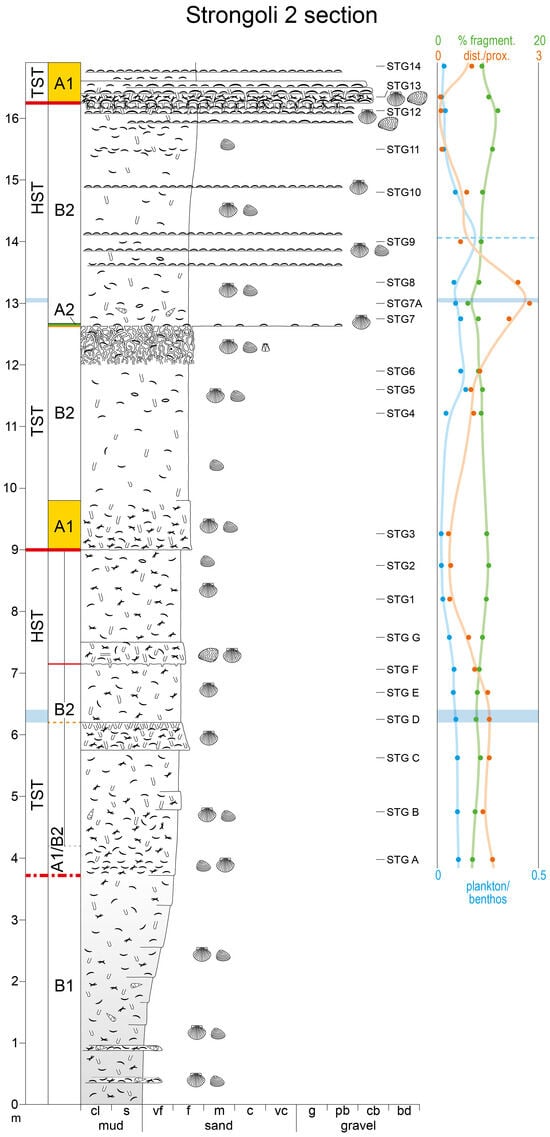
Figure 6.
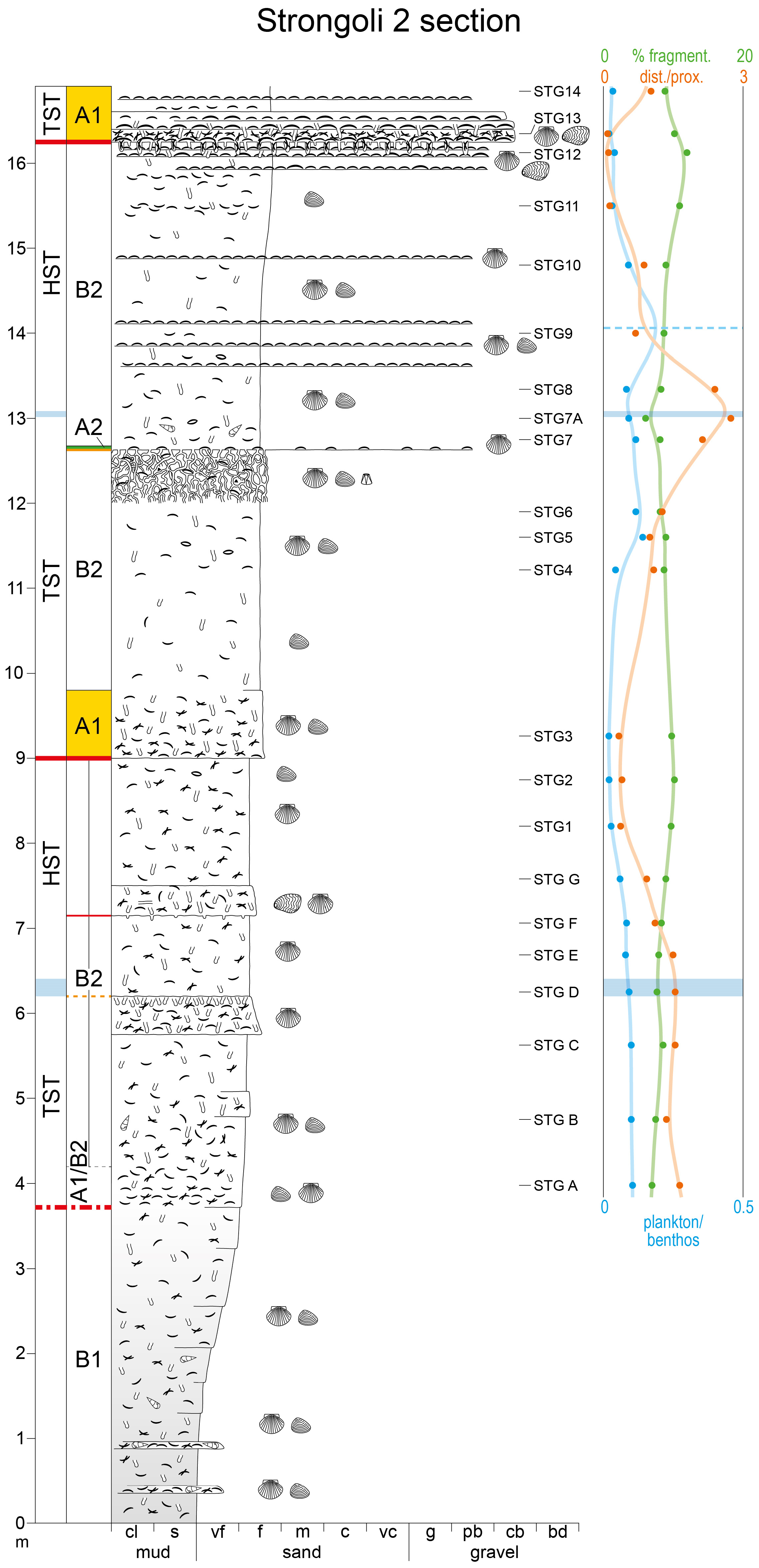
The Strongoli 2 section of the Strongoli Sandstone (Figure 1C for location and Figure 4 for symbols; modified from Zecchin et al. [13]). Sedimentary structures, fossils, samples, facies and facies contacts, sequence stratigraphic surfaces, systems tracts and bedset boundaries are shown. The curves derived from the micropaleontological analysis (% fragmentation, distal/proximal and plankton/benthos, see text) are shown on the right. Two high-frequency sequences bounded by wave-ravinement surfaces, and composed of TST and HST, are documented. TSTs and HSTs are separated by an uncertainty interval inferred to contain the maximum flooding surface, defined on a micropaleontological basis (see text). The HST of the lower sequence is composed of two bedsets separated by an erosional discontinuity.
Sixty-eight sediment samples were collected along the measured sections (Figure 3, Figure 4, Figure 5 and Figure 6), and approximately 100 g of sediment was taken from each sample for micropalaeontological analyses. The sample aliquots were dried at 50 °C for 24 h and then treated with hydrogen peroxide (10% vol) for 12 h, in order to remove the organic matter. Samples were then washed through a 125 μm mesh and dried. From the corresponding washing residues, 3 g of sediment was separated, except for the samples of the TAL section, for which, due to the scarcity of specimens, 15 g of sediment was separated. All benthic foraminifera present in this amount of sediment were counted and classified following the taxonomic order of Loeblich and Tappan [46] and subsequent studies (see Section 5).

Table 1.
Facies and depositional environments of the studied succession.
Table 1.
Facies and depositional environments of the studied succession.
| Facies Association and Facies | Lithology and Thickness | Sedimentary Structures and Bioturbation | Fossils | Interpretation |
|---|---|---|---|---|
| A—Condensed shallow-marine | ||||
| A1: Wave-dominated shell-rich deposit | Stacked shell beds forming tabular cemented units 0.15 to 1 m thick. The grain size of the matrix ranges from fine-grained siliciclastic sandstone to granule-grade conglomerate and contains shell debris in variable amounts. Cobbles and pebbles of sandstone may be found at the base. | Planar stratification and local swaley cross-stratification. Local upward decreasing shell abundance. Common substrate-controlled Glossifungites Ichnofacies at the base. Scattered bioturbation in the body. Erosional base and sharp to gradual upward transition into Facies B2. | Ostreids, pectinids and minor venerids (usually disarticulated and broken), usually convex-up arranged but also concave-up arranged. Shells form stacked horizontal sheets or can be chaotically packed. | Shoreface deposit recording low net sedimentation rates, high-energy wave action and high production of mollusk communities [5,13,14,47,48,49,50]. |
| A2: Surface-related shell bed | Shell-rich fine-grained siliciclastic sandstone, 1 shell to 0.4 m thick. | Diffuse bioturbation and shell layers in the thicker beds, common substrate-controlled Glossifungites Ichnofacies up to 0.5 m deep at the base. Sharp base and top. | Disarticulated and locally broken pectinids, ostreids and minor venerids and barnacles, aligned on the basal surface or in layers within the thicker beds. Local presence of Pinna nobilis in life position at the base. | Community shell concentration recording low energy levels and sediment starvation in the distal lower shoreface [14,47,49,51,52]. |
| B—Siliciclastic shoreface | ||||
| B1: Sand and mud | Very fine-grained quartz sandstone with silt matrix 3–4 m thick | Structureless, rare cm-scale sand layers, sparse bioturbation. Gradational upper boundary with Facies B2. | Venerids, pectinids and gastropods | Shoreface–shelf transition [13,47,53,54]. |
| B2: Burrowed sandstone | Fine- to medium-grained siliciclastic sandstone up to 4.5 m thick. | Mostly structureless to planar stratified, scattered bioturbation, locally intense. The boundaries are sharp to gradual with Facies A1, A2, B1 and B3. | Sparse disarticulated (whole in places) pectinid, ostreid and venerid shells. Barnacles are also common. Gastropods, and disarticulated cardids and Pinna nobilis are locally present. | Lower shoreface and low-energy middle/upper shoreface [5,13,14,47,54,55]. |
| B3: Swaley cross-stratified to planar-laminated sandstone | Medium- to very coarse-grained siliciclastic sandstone up to 0.4 m thick. | Swaley cross-stratification to planar lamination. Scattered bioturbation. Sharp lower boundary and sharp to gradual upper boundary with Facies B2. Facies B2/B3 transitions with intermediate characteristics are also present. | Disarticulated and locally broken pectinid and ostreid shells, mainly convex-up arranged. Occasional barnacles. | Storm-dominated middle shoreface [5,14,56,57,58]. |
| B4: Mixed trough and swaley cross-stratified sandstone | Medium-grained siliciclastic sandstone up to 0.3 m thick. | Trough and swaley cross-stratification. Erosional lower boundary and gradual upper boundary with Facies B2. | Barren. | Storm-dominated middle-upper shoreface transition [5,53,59,60]. |
4. The Studied Succession
4.1. Sedimentary Units
The deposits considered for this study are part of the Zanclean Belvedere Formation and the Gelasian Strongoli Member of the Scandale Sandstone (simply referred to herein as the Strongoli Sandstone [13,32]; Figure 1C,D, Figure 2 and Figure 7), which were largely documented by Zecchin et al. [5,13,14,47] and references therein, to whom the reader is referred for a complete description.
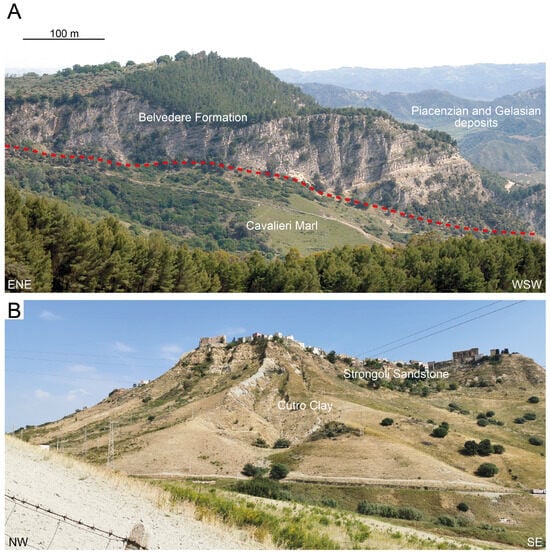
Figure 7.
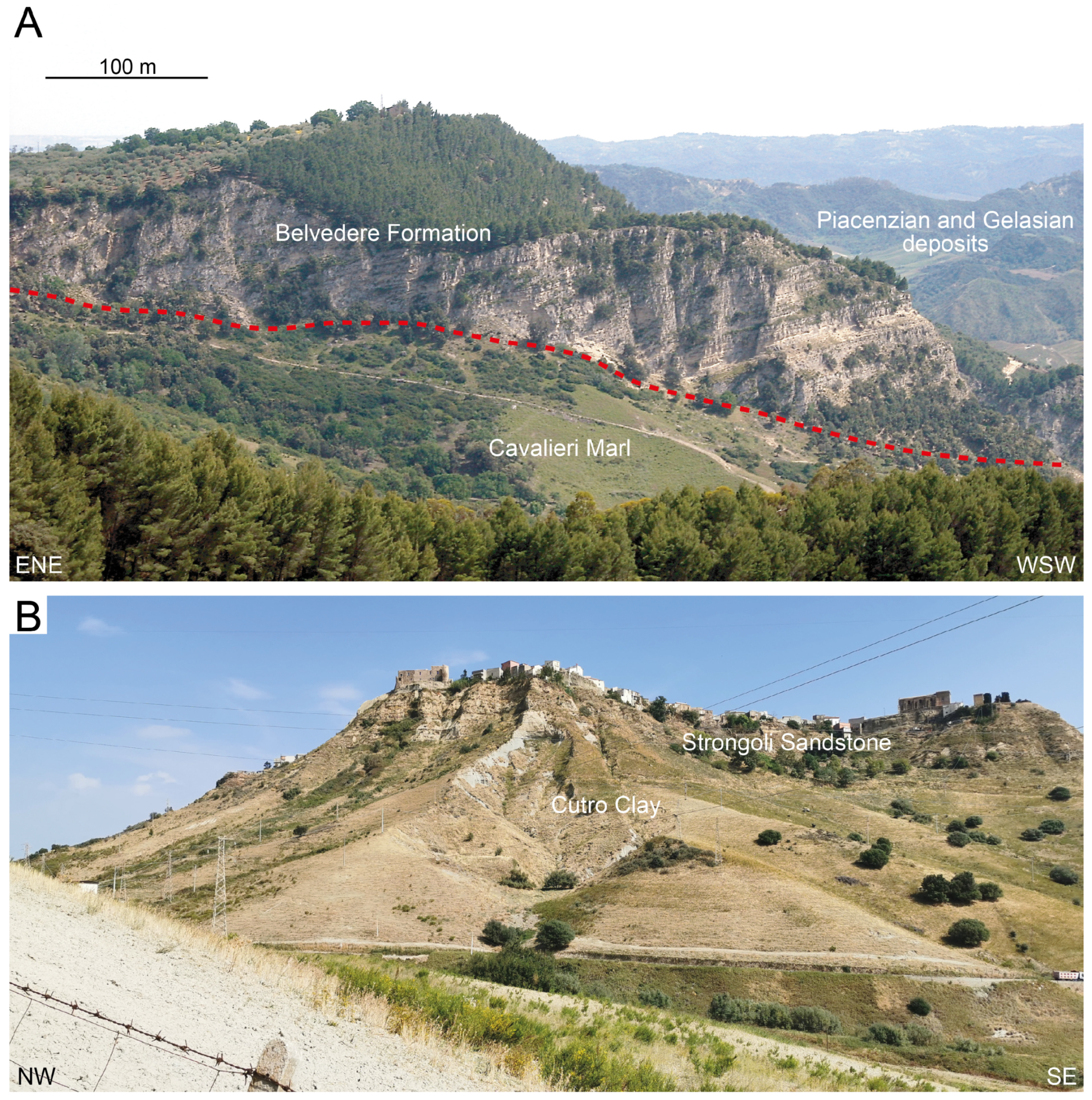
(A) Example of a large outcrop of the Zanclean, shallow-marine Belvedere Formation, separated from the Zanclean Cavalieri Marl by a normal fault (red dotted line; Figure 1D and Figure 2). (B) Piacenzian to Gelasian normal regressive succession showing the transition between the shelf Cutro Clay and the shallow-marine Strongoli Sandstone (Figure 1C and Figure 2).
In brief, the shallow-marine Belvedere Formation (Figure 2 and Figure 7A) is tens to hundreds of meters thick and is composed of siliciclastic and bioclastic deposits accumulated within half-graben sub-basins [5,12,14,15,34,35,47,61]. Fault-controlled subsidence led to a marked aggradational component that affords the recognition of meter- to decameter-scale sequences, which are inferred to have been controlled by Milankovitch-driven climatic and sediment supply changes [5,14,47]. Typically, these sequences are bounded by wave-ravinement surfaces (WRS) and consist of a transgressive systems tract (TST), containing shell-rich deposits, and a mainly siliciclastic highstand systems tract (HST) (Figure 3, Figure 4 and Figure 5).
The Strongoli Sandstone (Figure 2 and Figure 7B) is up to 70 m thick and pinches out basinward within shelf deposits (the Cutro Clay, Figure 2 and Figure 7B) [13,15,35,47,62]. An overall regressive trend, from shoreface–shelf transition to upper shoreface settings, is shown by the unit [13]. The middle to upper part of the Strongoli Sandstone is composed of six high-frequency sequences up to 7 m thick, which exhibit an architecture similar to that of the Belvedere Formation (Figure 6) and are inferred to be controlled by Milankovitch cyclicity [47].
4.2. Facies and Depositional Environments
Facies and interpreted depositional environments for the studied deposits of both the Belvedere Formation and the Strongoli Sandstone are illustrated in Table 1. Further facies details of these units are reported by Zecchin et al. [5,13,14,47]. Two facies associations were recognized: condensed shallow-marine (A) and siliciclastic shoreface (B) (Table 1). Facies association A includes shell-rich deposits recording net sediment bypass and/or starvation, whereas facies association B contains mostly siliciclastic shoreface deposits.
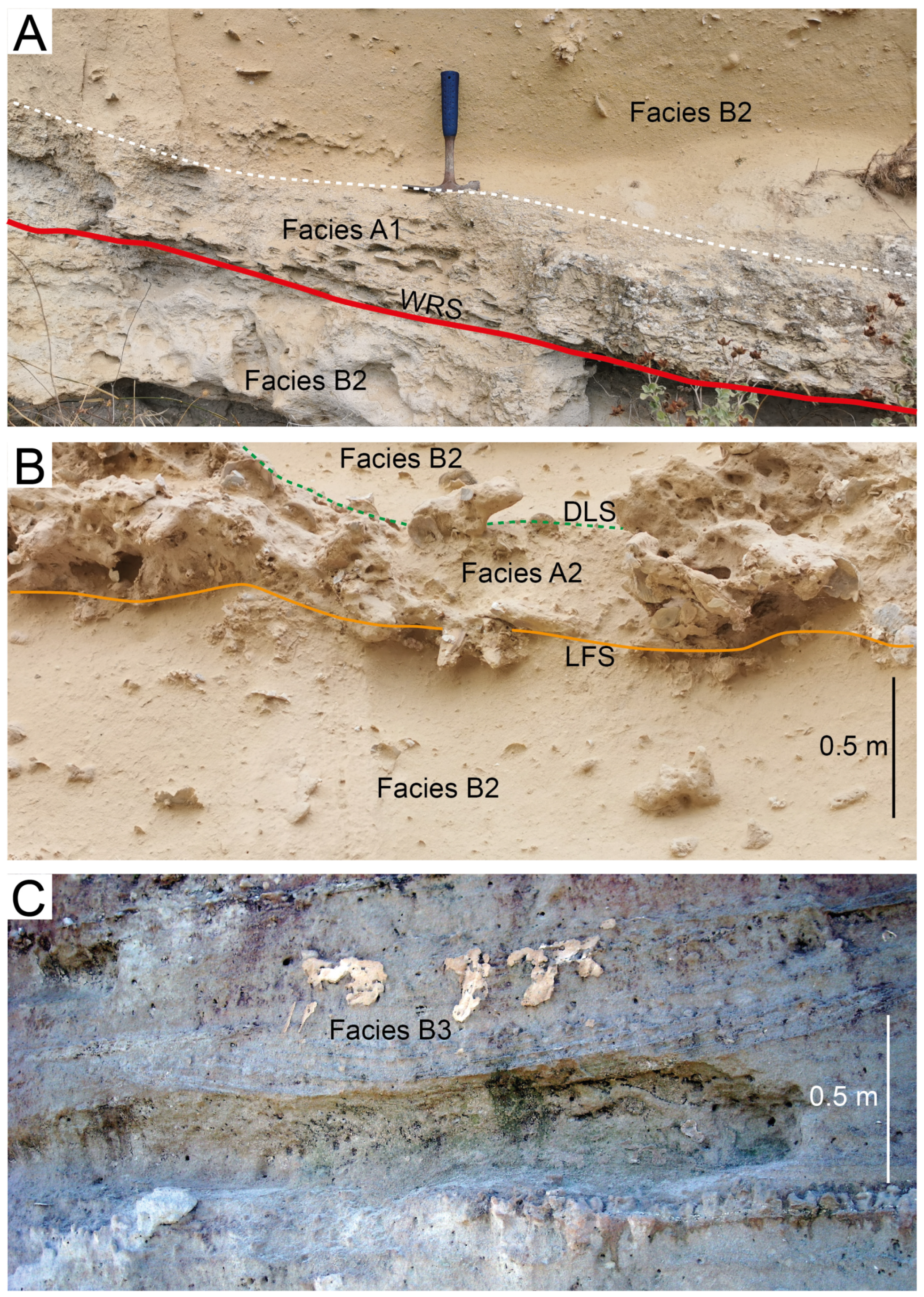
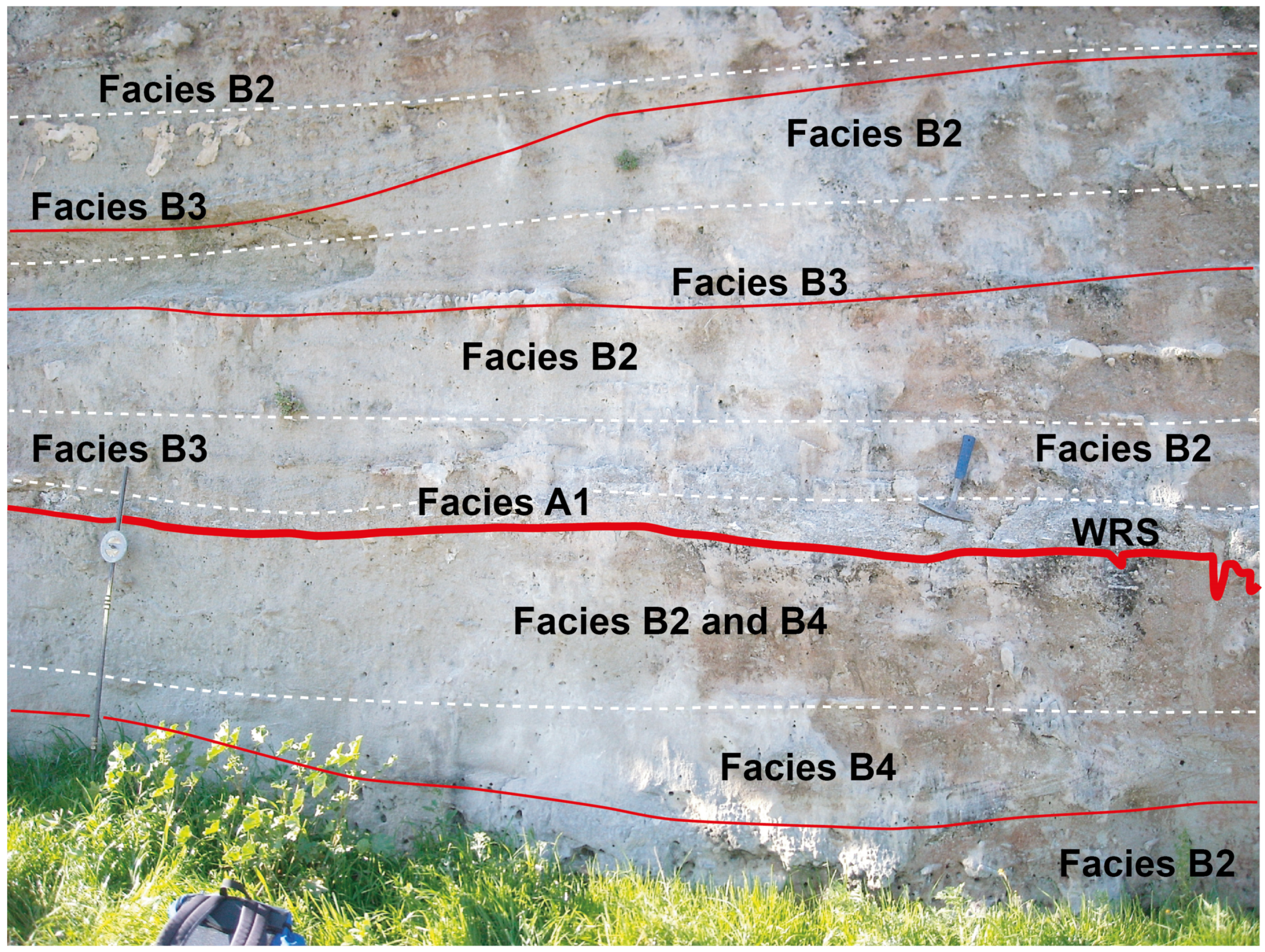
The shell-rich Facies A1 (Figure 3, Figure 4, Figure 5, Figure 6 and Figure 8A) reflects depositional conditions characterized by high energy levels due to the action of waves and storm flows, leading to sediment bypass during coastal retreat, as well as trophic conditions favoring the development of rich mollusk communities [5,14,47]. Shells are commonly arranged in layers. Facies A1 is erosionally based, and commonly typified by the substrate-controlled Glossifungites Ichnofacies (Figure 4, Figure 5 and Figure 8A). A pebble-to-cobble-sized lag can be rarely found at the base (Figure 5). In some cases, deposits with intermediate features between Facies A1 and the siliciclastic Facies B2 (see below) have been observed (Figure 6). Facies A2 is typically thin (no more than 0.4 m), burrowed, exhibits the Glossifungites Ichnofacies at its sharp base, and is locally associated with Pinna nobilis shells in life position, all features that reflect low energy levels and overall sediment starvation (Figure 5, Figure 6 and Figure 8B [14,47]).
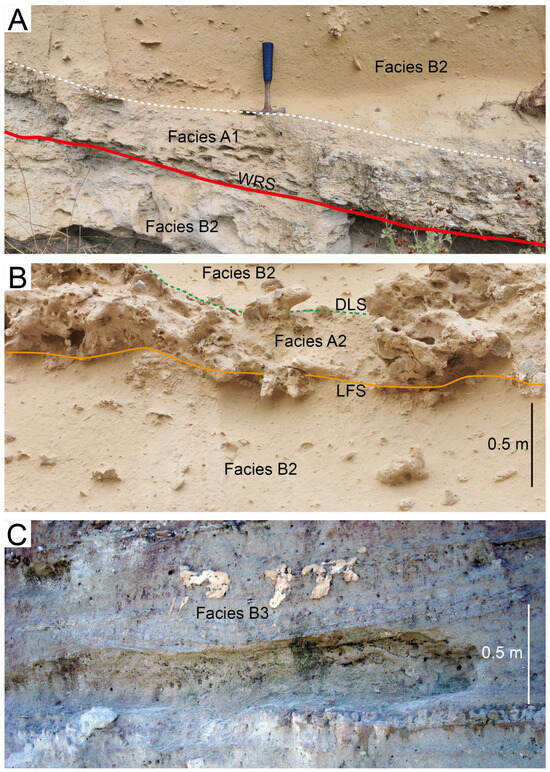
Figure 8.
(A) The shell-rich Facies A1 in the ZNE 2 section (Figure 5), between intervals of the siliciclastic Facies B2. Facies A1 is bounded below by a wave-ravinement surface (WRS) that truncates the underlying deposits. The underlying Facies B2 is penetrated by burrows belonging to the Glossifungites Ichnofacies. (B) Burrowed interval belonging to Facies A2 in the ZNE 2 section (Figure 5), bounded below by a local flooding surface (LFS) and above by a downlap surface (DLS) (see text). Facies A2 is encased in Facies B2. Note two Pinna nobilis shells in life position that descend from the LFS. (C) Swaley cross-stratification of Facies B3 in the TAL section (Figure 4).
Facies association B documents a regressive shoreface succession (e.g., [53]). Facies B1 (Figure 6) is characterized by lower grain size and energy conditions, reflecting shoreface–shelf transition depositional settings. Facies B2, characterized by diffuse bioturbation and local shell layers (Figure 3, Figure 4, Figure 5, Figure 6 and Figure 8A,B), is the most common facies in the studied deposits and documents accumulation in lower shoreface settings or in middle to upper shoreface settings typified by temporarily decreased energy conditions [5,13,14,47]. Higher energy levels are documented by swaley cross-stratified (Facies B3; Figure 4 and Figure 8C) and mixed trough and swaley cross-stratified (Facies B4; Figure 4) sandstones, accumulated, respectively, in wave-dominated middle shoreface and transitional middle-upper shoreface settings [5,14,47].
5. Micropaleontological Analysis
The dominance of shallow-water species of benthic foraminifera in the sediment samples (Supplementary data) is justified by the proximal depositional settings of the studied deposits. These species are represented by Ammonia parkinsoniana, A. tepida and Elphidium spp. [63,64,65,66] (see Supplementary data). The abundance of more distal species, such as Amphycorina scalaris, Bolivina spp., Bulimina spp., Cibicidoides pseudoungerianus, Globobulimina affinis, Lenticulina spp., Nonion boueanum, Nonion faba, Planulina ariminensis, Uvigerina spp., increases in deeper settings (e.g., [67,68,69]) (Supplementary data). For the TAL section (Figure 4), showing abundant proximal facies (Facies B3 and B4), Ammonia beccarii, Biasterigerina planorbis, Cibicides refulgens, Lobatula lobatula and Nonionella turgida are considered as relatively distal species (Supplementary data) [68,70,71,72]. In contrast, if present, these species are not considered as ‘distal’ in the other sections, where lower shoreface deposits containing more distal species are found. Planktonic foraminifera are scarce or absent in all sections. Reworked specimens of both benthic and planktonic foraminifera are abundant and must be excluded from the calculation of the parameters.
Following Zecchin et al. [13,14,47], three parameters were calculated on the basis of the micropaleontological analysis: the ‘% fragmentation’ (Fr; the percentage of fragmentation benthic foraminifera for each sample), the ‘distal/proximal’ (D/P; the ratio between relatively distal and proximal species of benthic foraminifera for each sample), and the ‘plankton/benthos’ (P/B; the ratio between the number of planktonic foraminifera and benthic foraminifera for each sample) (Figure 3, Figure 4, Figure 5 and Figure 6). The Fr considers specimens fragmented naturally, thus excluding those resulting from the preparation process [14]. In particular, two or more fresh fragments of the same specimen in the slide are assumed to be the result of the preparation and are therefore included in the count of whole specimens. This is because it is unlikely that fragments of the same specimen, produced by local high-energy environmental conditions, are sedimented together [14]. The evaluation of this parameter requires criteria consistency; if specimens with less than a given percentage of preservation are considered as fragmented, this must be valid for all samples [73]. It is known that the Fr parameter reflects the environmental energy, in turn linked to changes in wave/current power and/or shoreline shifts, whereas the D/P parameter is thought to be sensitive to sedimentation rates linked to shoreline shifts [13,14,47,73]. Maximum values of the D/P parameter are close to minimum values of the Fr parameters (Figure 3, Figure 5 and Figure 6), reflecting maximum flooding conditions. In contrast, higher values of the P/B parameter indicate maximum water-depth conditions, which usually follow (occur later than) maximum flooding conditions (the maximum water-depth surface, MWDS [13,14,47,73]) (Figure 3, Figure 5 and Figure 6).
Due to the way the D/P parameter is defined, the species of relatively distal and proximal benthic foraminifera may vary case by case, in relation to the taxa present in a given succession, as well as the position of a given section along depositional dip [73]. Considering the available literature [63,64,65,66,67,68,69,70,71,72], for the CBS 1, ZNE 2 and Strongoli sections (Figure 3, Figure 5 and Figure 6), the D/P parameter is calculated as follows:
D/P = (% Amphycorina scalaris, % Bolivina spp., % Bulimina spp., % Cibicidoides pseudoungerianus, % Globobulimina affinis, % Lenticulina spp., % Nonion boueanum, % Nonion faba, % Planulina ariminensis, % Uvigerina spp.)/(% Ammonia tepida + % Ammonia parkinsoniana + % Elphidium spp.).
For the TAL section (Figure 4), the D/P parameter is calculated as follows:
D/P = (% Ammonia beccarii + % Biasterigerina planorbis + % Cibicides refulgens + % Lobatula lobatula + % Nonionella turgida)/(% Ammonia parkinsoniana + % Elphidium spp.).
The Fr, D/P and P/B parameters are shown along the measured sections as average curves interpolating the measured points (Figure 3, Figure 4, Figure 5 and Figure 6). An uncertainty interval between Fr minima and D/P maxima, within which the maximum flooding surface (MFS) should lie, can be defined within each sequence [13,14,47,73] (Figure 3, Figure 5 and Figure 6). The uncertainty interval is the best way to pick the cryptic MFS, which usually lacks any physical diagnostic features.
6. Cyclicity of the Sedimentary Succession
6.1. High-Frequency Sequences
The high-frequency sequences of the studied deposits were largely described by Zecchin et al. [13,14,47]. These sequences (5 to 7 m thick in the present examples; Figure 3, Figure 4, Figure 5, Figure 6 and Figure 9) are bounded by wave-ravinement surfaces (WRS) and are typically composed of a shell-rich (mainly Facies A1 and B2 with occasional Facies B3) transgressive systems tract (TST) and a mostly siliciclastic (mainly Facies B2 and B3 with minor Facies B4) highstand systems tract (HST). The WRS can be marked by the Glossifungites Ichnofacies and by shell beds (Facies A1) produced by sediment bypass during shoreface retreat (the onlap shell bed; OSB [48]), and by lag deposits (Figure 3, Figure 4, Figure 5, Figure 6 and Figure 8A). WRSs are close to Fr maxima and D/P minima (Section 5) (Figure 3, Figure 4 and Figure 6), except in cases where the WRS overlies proximal deposits of the underlying sequence, characterized by higher values of Fr and lower values of D/P (Figure 5). MFSs are cryptic and are placed roughly in the middle of sequences; they lie within the uncertainty interval between D/P maxima and Fr minima (see Section 5 and Zecchin et al. [13,14,47,73]) (Figure 3, Figure 5 and Figure 6). Uncertainty intervals containing the MFS range between a few cm and 0.3 m in thickness and cannot be recognized by sedimentological criteria. However, the local flooding surface (LFS), produced between lower shoreface and inner shelf settings by sediment starvation during late transgression, is a facies contact usually found just below the uncertainty interval (Figure 5, Figure 6 and Figure 8B). LFSs can be marked by the Glossifungites Ichnofacies and relatively thin shell beds (the backlap shell beds; BSB) that may contain shells in life position in relatively distal settings (Facies A2) [48,74,75] (Figure 5, Figure 6 and Figure 8B). The downlap surface (DLS; Figure 5 and Figure 8B) is recognizable at the top of the BSB or, more generally, of the condensed section (CS), and marks the base of the HST prograding shallow-marine wedge [48]. The maximum water-depth surface (MWDS) is a cryptic surface picked at the P/B maxima (Figure 3, Figure 5 and Figure 6), which is inferred to coincide with the deepest bathymetry within a sequence [14,73]. The MWDS is usually placed just above the MFS, in the early HST (Figure 3, Figure 5 and Figure 6).
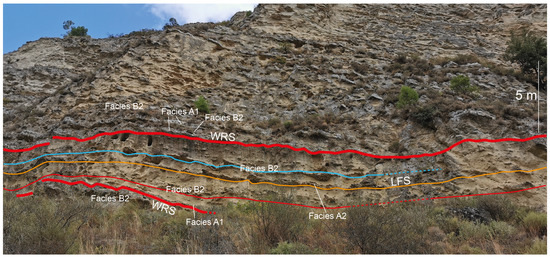
Figure 9.
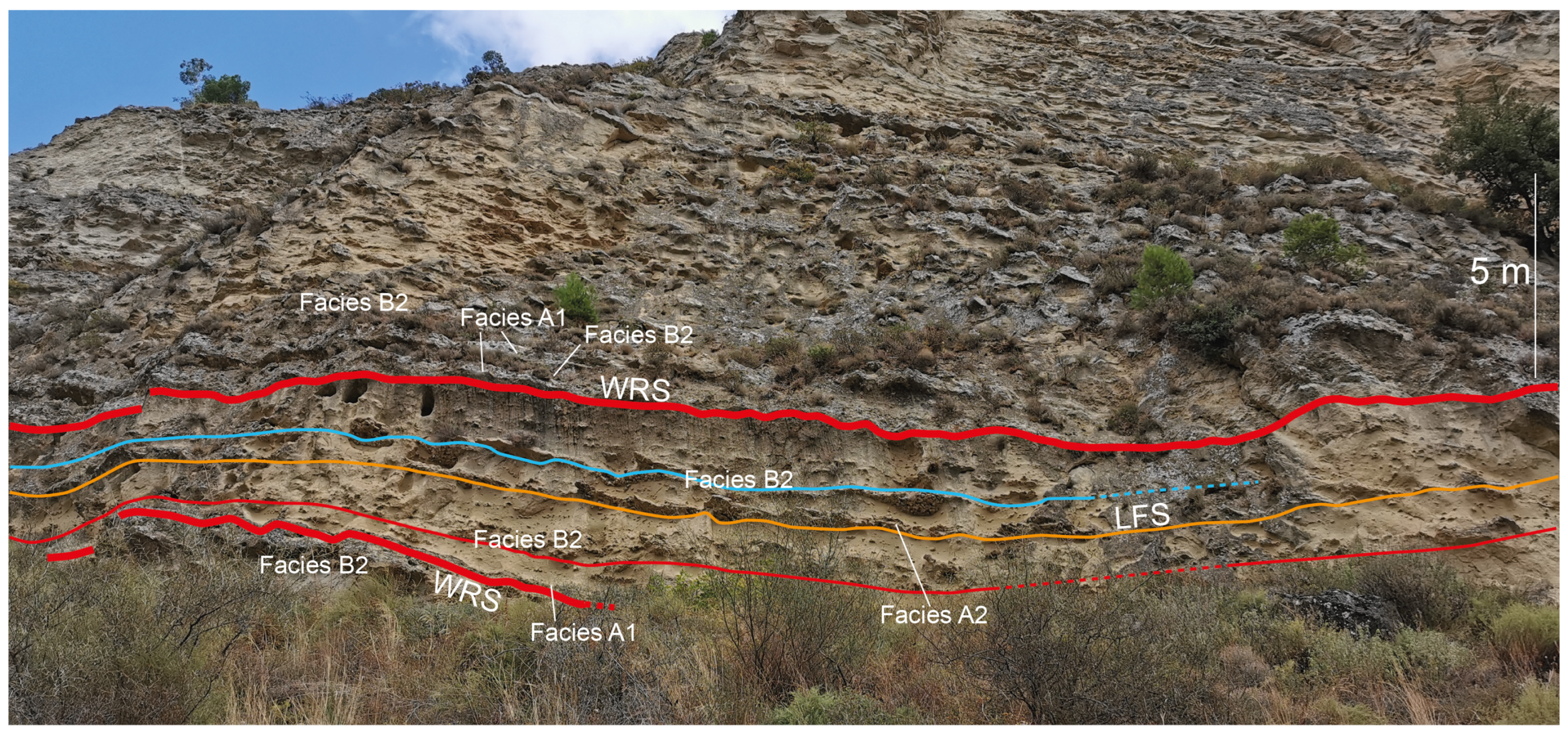
View of the high-frequency sequence documented by the ZNE 2 section (Figure 1D and Figure 5), bounded at the base and at the top by wave-ravinement surfaces (WRS) (see Table 1 for facies code). A local-flooding surface (LFS), close to maximum flooding conditions (see text), is found in the middle of the sequence. A bedset boundary represented by an erosional discontinuity (thin red line) is found in the lower, transgressive part of the sequence, whereas another bedset boundary, represented by a non-depositional discontinuity (thin blue line) is found in the regressive part.
The studied high-frequency sequences are inferred to be generated by climate-driven changes in sedimentation rates, probably linked to the Milankovitch cyclicity [5,14,47].
6.2. Intra-Sequence Cyclicity
6.2.1. General Characteristics
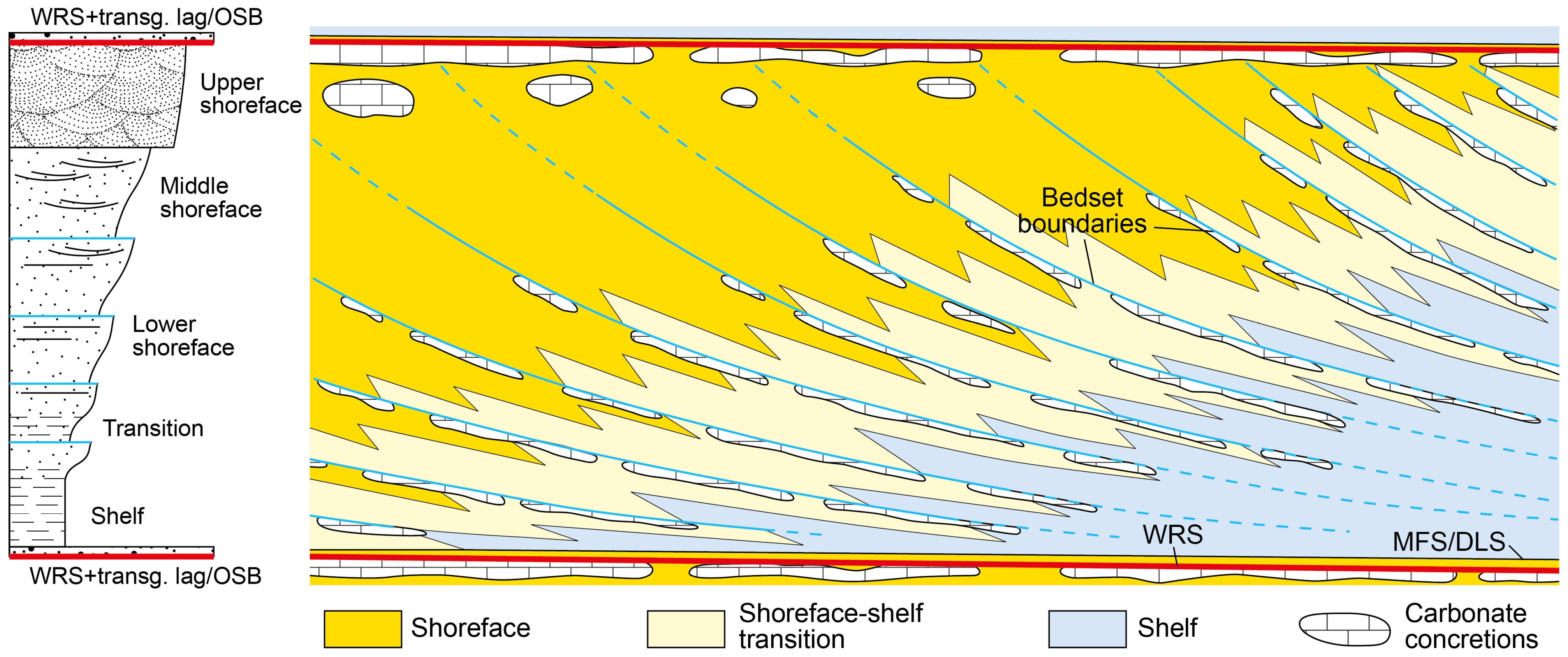
Internal subdivisions of high-frequency sequences and component systems tracts can be referred to as bedsets, which consist of dm- to m-scale sedimentary units separated by non-depositional or erosional discontinuities, defining individual clinoforms [2,8] (Figure 10). Non-depositional discontinuities are associated with an abrupt upward decrease in thickness and amalgamation of event beds and are related to a decrease in sediment supply and/or energy [2,6]. In contrast, erosional discontinuities record an abrupt upward increase in bed amalgamation and grain size and are inferred to be related to an increase in sediment supply and/or energy [2,6]. Non-depositional and erosional discontinuities resemble flooding surfaces (maximum regressive surfaces, MRSs, or LFSs) and regressive surfaces of marine erosion (RSME), respectively; however, bedset boundaries are more limited laterally and are unrelated to transgressive or regressive shoreline shifts, as they tend to disappear landward in upper shoreface settings (Figure 10) [2,6]. As such, bedsets reflect cycles of internal reorganization of a depositional system, without a change in the systems tract [7].
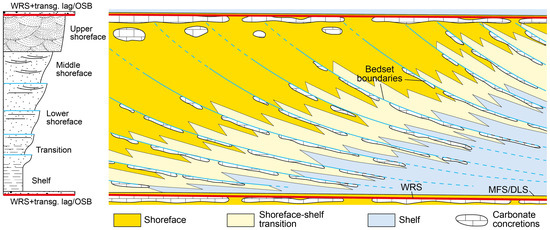
Figure 10.
Example of high-frequency sequence dominated by normal regressive deposits (modified from Hampson et al. [76]). Non-depositional discontinuities bounding bedsets, which are highlighted also in the representative section on the left, define clinoforms composing the prograding succession. Bedset boundaries tend to disappear both in proximal and distal directions. Abbreviations: DLS—downlap surface; MFS—maximum flooding surface; OSB—onlap shell bed; WRS—wave-ravinement surface.
In the studied high-frequency sequences, bedsets are locally recognizable; they are ca. 0.5 to 1.8 m thick and can be bounded by non-depositional discontinuities (upper part of the CBS 1 and ZNE 2 sections, Figure 3, Figure 5 and Figure 9) or by erosional discontinuities (lower part of the Strongoli 2 and ZNE 2 sections and Tal section, Figure 4, Figure 5, Figure 6, Figure 9 and Figure 11). LFSs may also be considered as non-depositional discontinuities bounding bedsets, although the LFS/DLS pairs, if present, bound CSs and interrupt the bedset stack (Figure 5 and Figure 8B). The WRSs bounding the high-frequency sequences can also act as the base of the first bedset of a sequence, or the top of the last bedset of the underlying sequence (Figure 3, Figure 4, Figure 5 and Figure 6). Bedsets can be found only occasionally in part of the section (CBS 1 and Strongoli 2 section, Figure 3 and Figure 6) or in the whole section (ZNE 2 and Tal sections, Figure 4, Figure 5, Figure 9 and Figure 11); their lateral continuity along strike ranges from tens to hundreds of meters.
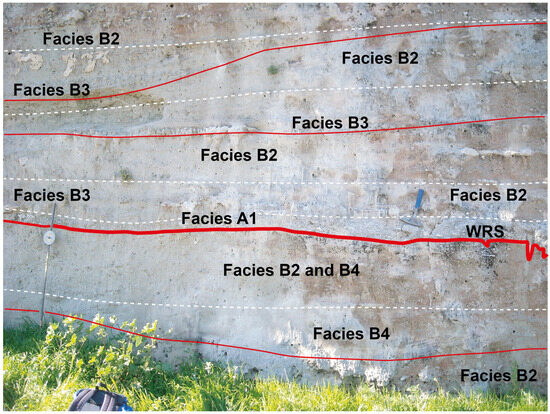
Bedsets bounded by non-depositional discontinuities show an upward increase in the degree of amalgamation of storm beds, sparse shells, and grain sizes in the range of Facies B2 to Facies B2/B3 (Figure 3 and Figure 5); in some cases, intense burrowing is found just above the base (Figure 5). Their boundaries are usually placed above storm beds and separate opposite trends of upward increase in storm beds (below) and their sharp decrease across the boundaries (Figure 3, Figure 5 and Figure 9). Bedsets bounded by erosional discontinuities show an upward decrease in the degree of amalgamation of storm beds, or more in general of facies associated with higher energy levels, as documented by a rapid upward shift from Facies B4 or B3 and Facies B2 (Figure 4 and Figure 11), although a persistence of Facies B2 throughout the bedset is also observed (Figure 5 and Figure 9). An upward decrease in grain size and an increase in bioturbation were also observed (Figure 4 and Figure 5). The bedsets boundaries in this case are placed at the base of storm beds or at the basal WRS, and in some cases are marked by the Glossifungites Ichnofacies (Figure 4, Figure 5, Figure 9 and Figure 11). Where bedsets are bounded at the base by the WRS, their lower part consists of Facies A1 (Figure 4, Figure 5, Figure 9 and Figure 11).
In general, the studied bedsets meet the sedimentological and stratigraphic criteria highlighted by Zecchin et al. [6] to discriminate sedimentological and stratigraphic cycles, in particular: (1) only minor environmental changes, usually associated with adjacent facies or subfacies changes, are observed across bedset boundaries; (2) water-depth changes usually do not occur across bedset boundaries (with exceptions, see Section 6.2.2 and Section 7); (3) bedset boundaries show a more modest physical appearance than the WRSs bounding high-frequency sequences; (4) bedset boundaries have a smaller lateral extent compared to WRSs; (5) bedset boundaries are not associated with condensed shell beds (except for the first bedset above a WRS or a LFS); (6) in general, bedsets are thinner (dm- to m-scale) than high-frequency sequences (m- to dam-scale); (7) in contrast to sequences, bedsets are not composed of (do not include) clinoforms. As for the micropaleontological and diagenetic criteria reported by Zecchin et al. [6], the former are illustrated and discussed in Section 6.2.2 and Section 7, while the latter are exemplified by a modest cementation associated with bedset boundaries, if compared to WRSs and LFSs. Regarding the mineralogical criteria, they were illustrated by Zecchin et al. [5,6], who highlighted that the abundance of heavy minerals in the sediment does not change across bedset boundaries but only across sequence stratigraphic surfaces produced in high-energy conditions. The highest abundance of heavy minerals was invariably found within the OSBs immediately overlying WRSs [5,6].
6.2.2. Relationships with Micropaleontological Parameters
In contrast to high-frequency sequences, in most cases bedsets and their boundaries are not associated with significant changes in the Fr, D/P and P/B parameters that are described in Section 5. In fact, except for the maxima or minima that are recorded close to sequence boundaries and MFSs, the curves of these parameters exhibit minor, erratic variations, which usually seem to be unrelated to bedset boundaries (Figure 3, Figure 4, Figure 5 and Figure 6).
However, an exception has been observed in the upper part of the ZNE 2 section (Figure 5). Here, the two bedsets composing the HST are separated by a non-depositional discontinuity placed at ca. 4.3 m, above a shell-rich storm bed and below an intensely burrowed interval in Facies B2, marking an abrupt interruption of storm-related event beds (Figure 5). In contrast to what was observed in other situations, in this case a secondary positive peak of both the D/P and P/B parameters is found right at the burrowed interval at ca. 4.7 m, just above the bedset boundary and centered on the Z10 sample (Figure 5). The Fr parameter does not show a significant local variation, but it is still in a relatively thick interval of minimum values that is centered on the MFS of the high-frequency sequence (Figure 5). The significance of these observations is discussed in the next Section.
7. Discussion and Conclusions
Integrated sedimentological and micropaleontological data in selected Zanclean and Gelasian sections of the Crotone Basin have allowed documentation, although discontinuously, of a decimeter-to-meter-scale cyclicity within meter-to-decameter-scale high-frequency sequences inferred to be linked to the Milankovitch cyclicity [14,47] (Figure 3, Figure 4, Figure 5 and Figure 6).
The lack of correlation between the intra-sequence cycles and the variations in micropaleontological parameters linked to transgressive and regressive trends (i.e., Fr, D/P and P/B; Section 5), in contrast to what is observed for high-frequency sequences [13,14,47,73], strongly suggests that this minor cyclicity is unrelated to shoreline shifts and is probably controlled by local sediment supply and wave-climate changes (e.g., [2,8]). The disconnect from shoreline shifts, in particular, is a key element allowing to classify these minor cycles as bedsets; i.e., sedimentological cycles bounded by either non-depositional or erosional discontinuities, rather than stratigraphic sequences (e.g., [5,7]).
However, the occasional recognition of minor D/P and P/B variations close to bedset boundaries, such as those observed in the upper part of the ZNE 2 section in the Zanclean Belvedere Formation (Figure 5), raises interesting questions. In the ZNE 2 section, both the D/P and P/B parameters show secondary maxima at ca. 4.7 m that follow those associated with maximum flooding and maximum water-depth conditions, respectively, whereas the Fr parameter remains relatively low (Figure 5).
One possibility is that the observed secondary positive peaks, centered on only one sample, are simply erratic variations without any real physical significance. However, the significant value of the D/P parameter at that sample, not much lower than the main peak at ca. 3.2 m, together with the evidence that such a secondary peak falls in an intensely burrowed interval just above the bedset boundary, indicating lower energy levels (Figure 5), would suggest that the secondary peaks of the D/P and P/B parameters are real. In the latter case, since increases in the D/P and P/B parameters indicate transgression and increasing depth, respectively, the non-depositional discontinuity at ca. 4.3 m would be followed by a very minor shoreline transgression, as in the case of an MRS.
Such observations are not really surprising, as the transgressions and regressions that define the high-frequency sequences of the Belvedere Formation are inferred to be controlled by climate-induced changes in sediment supply [14,47], whereas bedsets are in turn likely associated with minor sediment supply changes, much more localized and shorter in duration than sequences, such that associated shoreline shifts are usually not found. It is therefore possible that these minor sediment supply changes may occasionally lead to barely recognizable shoreline shifts that are very modest and more laterally limited than those associated with the sequence that hosts the bedsets.
Another possible explanation relies on the irregularity of the Milankovitch cycles. The trend of the precession, obliquity and eccentricity cycles, in fact, is not sinusoidal and commonly exhibits secondary peaks (e.g., [77,78]). The secondary maxima of the D/P and P/B parameters in the ZNE 2 section (Figure 5), therefore, could record a secondary shoreline transgression and associated MFS within the larger HST regressive phase of the main (higher rank) sequence, and this minor (lower rank) transgression would be still associated with a climatically induced decrease in sediment supply, as for the main TST. Following the stratigraphic sequence concept of Zecchin and Catuneanu [3] and Catuneanu and Zecchin [4], in this hypothesis, the HST of the main sequence found in the ZNE 2 section may consist of two lower rank sequences separated by an MRS, rather than two bedsets. However, in this case only a sub-facies change from storm shell beds to burrowed sandstone is found at ca. 4.3 m (Figure 5), but a transgressive trend is not clearly recognizable on the basis of field data; it is therefore preferred to keep a bedset boundary at 4.3 m, as a working hypothesis, which is more in line with the magnitude and scale of the observed changes. Further work, however, could clarify whether the bedset boundary should be upgraded to the status of a sequence boundary or not.
In contrast to the examples from the CBS 1, Strongoli 2 and TAL sections, where a distinction between bedsets and stratigraphic sequences is clearly recognizable with both sedimentological and micropaleontological criteria (Figure 3, Figure 4 and Figure 6), the evidence found in the ZNE 2 section (Figure 5) is more ambiguous in terms of a clear separation between sedimentologic (bedsets) and stratigraphic cycles. This illustrates that an unequivocal distinction between the two types of cycles may not be possible in all cases, and that a choice one way or the other can be arbitrary in some situations. It is, therefore, suggested that a clear recognition of changes between transgressive and regressive trends by means of field/core observations remains essential in deciding whether meter-scale cycles are lower rank sequences or bedsets. Ambiguity between sedimentological and stratigraphic cycles is implicit in models that consider bedsets as cycles controlled by minor shoreline shifts and deepening/shallowing episodes, which are features that also characterize stratigraphic sequences, and/or illustrate a hierarchy of bedsets and sets of bedsets that blur the distinction between sedimentological and stratigraphic cycles [9,10]. Both shoreline reorganizations and minor relative sea-level changes as possible controlling mechanisms on bedset boundaries are also advocated by Sømme et al. [8].
In any case, irrespective of the preferred terminology, cycles with intermediate features between high-frequency sequences (sensu Zecchin and Catuneanu [3] and Catuneanu and Zecchin [4]) and sedimentological cycles exist and share characteristics of both, testifying to the passage between sedimentology and stratigraphy.
Supplementary Materials
The following supporting information can be downloaded at: https://www.mdpi.com/article/10.3390/geosciences16020089/s1, Table S1: Number of benthic microforaminifera specimens found in the samples collected along the measured sections.
Author Contributions
Conceptualization, M.Z. and O.C.; Methodology, M.Z. and M.C.; Software, M.Z.; Validation, M.Z. and M.C.; Formal analysis, M.Z. and M.C.; Investigation, M.Z., M.C. and O.C.; Resources, M.C.; Data curation, M.C.; Writing—original draft, M.Z.; Writing—review and editing, M.Z., M.C. and O.C.; Visualization, M.Z.; Supervision, M.Z. and O.C.; Project administration, M.Z. All authors have read and agreed to the published version of the manuscript.
Funding
This research received no funding.
Data Availability Statement
The original contributions presented in this study are included in the article/Supplementary Materials. Further inquiries can be directed to the corresponding author(s).
Conflicts of Interest
The authors declare no conflicts of interest.
References
- Van Wagoner, J.C.; Mitchum, R.M.; Campion, K.M.; Rahmanian, V.D. Siliciclastic Sequence Stratigraphy in Well Logs, Cores, and Outcrops; AAPG Methods in Exploration; American Association of Petroleum Geologists: Tulsa, OK, USA, 1990; Volume 7, p. 55. [Google Scholar]
- Hampson, G.J. Discontinuity surfaces, clinoforms, and facies architecture in a wave-dominated, shoreface-shelf parasequence. J. Sediment. Res. 2000, 70, 325–340. [Google Scholar] [CrossRef]
- Zecchin, M.; Catuneanu, O. High-resolution sequence stratigraphy of clastic shelves I: Units and bounding surfaces. Mar. Pet. Geol. 2013, 39, 1–25. [Google Scholar] [CrossRef]
- Catuneanu, O.; Zecchin, M. High-resolution sequence stratigraphy of clastic shelves II: Controls on sequence development. Mar. Pet. Geol. 2013, 39, 26–38. [Google Scholar] [CrossRef]
- Zecchin, M.; Caffau, M.; Catuneanu, O.; Lenaz, D. Discrimination between wave-ravinement surfaces and bedset boundaries in Pliocene shallow-marine deposits, Crotone Basin, southern Italy: An integrated sedimentological, micropaleontological and mineralogical approach. Sedimentology 2017, 64, 1755–1791. [Google Scholar] [CrossRef]
- Zecchin, M.; Catuneanu, O.; Caffau, M. High-resolution sequence stratigraphy of clastic shelves V: Criteria to discriminate between stratigraphic sequences and sedimentological cycles. Mar. Pet. Geol. 2017, 85, 259–271. [Google Scholar] [CrossRef]
- Catuneanu, O. Principles of Sequence Stratigraphy, 2nd ed.; Elsevier: Amsterdam, The Netherlands, 2022; p. 494. [Google Scholar]
- Sømme, T.O.; Howell, J.A.; Hampson, G.J.; Storms, J.E.A. Genesis, architecture, and numerical modeling of intra-parasequence discontinuity surfaces in wave-dominated deltaic deposits: Upper Cretaceous Sunnyside Member, Blackhawk Formation, Book Cliffs, Utah, U.S.A. In Recent Advances in Models of Siliciclastic Shallow-Marine Stratigraphy; Hampson, G.J., Steel, R.J., Burgess, P.M., Dalrymple, R.W., Eds.; SEPM Special Publication: Claremore, OK, USA, 2008; Volume 90, pp. 421–441. [Google Scholar]
- Ainsworth, R.B.; Vakarelov, B.K.; MacEachern, J.A.; Rarity, F.; Lane, T.I.; Nanson, R.A. Anatomy of a shoreline regression: Implications for the high-resolution stratigraphic architecture of deltas. J. Sediment. Res. 2017, 87, 425–459. [Google Scholar] [CrossRef]
- Isla, M.F.; Coronel, M.D.; Schwarz, E.; Veiga, G.D. Depositional architecture of a wave-dominated clastic shoreline (Pilmatué Member, Argentina): Linking dynamics and stratigraphic record of bar-trough systems. Mar. Pet. Geol. 2020, 118, 104417. [Google Scholar] [CrossRef]
- Van Dijk, J.P.; Okkes, F.W.M. Neogene tectonostratigraphy and kinematics of Calabrian basins; implications for the geodynamics of the Central Mediterranean. Tectonophysics 1991, 196, 23–60. [Google Scholar] [CrossRef]
- Zecchin, M.; Massari, F.; Mellere, D.; Prosser, G. Anatomy and evolution of a Mediterranean-type fault bounded basin: The Lower Pliocene of the northern Crotone Basin (Southern Italy). Basin Res. 2004, 16, 117–143. [Google Scholar] [CrossRef]
- Zecchin, M.; Caffau, M.; Catuneanu, O. Identification of maximum flooding surfaces at different scales: The case of the Piacenzian to Gelasian Cutro Clay and Strongoli Sandstone (Crotone Basin, southern Italy). Mar. Pet. Geol. 2022, 146, 105971. [Google Scholar] [CrossRef]
- Zecchin, M.; Caffau, M.; Catuneanu, O. Recognizing maximum flooding surfaces in shallow-water deposits: An integrated sedimentological and micropaleontological approach (Crotone Basin, southern Italy). Mar. Pet. Geol. 2021, 133, 105225. [Google Scholar] [CrossRef]
- Zecchin, M.; Civile, D.; Caffau, M.; Critelli, S.; Muto, F.; Mangano, G.; Ceramicola, S. Sedimentary evolution of the Neogene-Quaternary Crotone Basin (southern Italy) and relationships with large-scale tectonics: A sequence stratigraphic approach. Mar. Pet. Geol. 2020, 117, 104381. [Google Scholar] [CrossRef]
- Cita, M.B. Studi sul Pliocene e sugli strati di passaggio dal Miocene al Pliocene. VIII. Planktonic foraminiferal biozonation of the Mediterranean Pliocene deep-sea record. A revision. Riv. Ital. Di Paleontol. E Stratigr. 1975, 81, 527–544. [Google Scholar]
- Rio, D.; Raffi, I.; Villa, G. Pliocene-Pleistocene calcareous nannofossil distribution patterns in the Western Mediterranean. Proc. Ocean Drill. Program Sci. Results 1990, 107, 513–533. [Google Scholar]
- Lourens, L.J.; Antonarakou, A.; Hilgen, F.J.; Van Hoof, A.A.M.; Vergnaud-Grazzini, C.; Zachariasse, W.J. Evaluation of the Plio-Pleistocene astronomical timescale. Paleoceanography 1996, 11, 391–413. [Google Scholar] [CrossRef]
- Raffi, I.; Backman, J.; Fornaciari, E.; Pälike, H.; Rio, D.; Lourens, L.; Hilgen, F. A review of calcareous nannofossil astrobiochronology encompassing the past 25 million years. Quat. Sci. Rev. 2006, 25, 3113–3137. [Google Scholar] [CrossRef]
- Amodio Morelli, L.; Bonardi, G.; Colonna, V.; Dietrich, D.; Giunta, G.; Ippolito, F.; Liguori, V.; Lorenzoni, S.; Paglionico, A.; Perrone, V.; et al. L’Arco Calabro-Peloritano nell’orogene Appenninico-Maghrebide. Mem. Della Soc. Geol. Ital. 1976, 17, 1–60. [Google Scholar]
- Van Dijk, J.P.; Bello, M.; Brancaleoni, G.P.; Cantarella, G.; Costa, V.; Frixa, A.; Golfetto, F.; Merlini, S.; Riva, M.; Torricelli, S.; et al. A regional structural model for the northern sector of the Calabrian Arc (southern Italy). Tectonophysics 2000, 324, 267–320. [Google Scholar] [CrossRef]
- Bonardi, G.; Cavazza, W.; Perrone, V.; Rossi, S. Calabria–Peloritani terrane and northern Ionian Sea. In Anatomy of an Orogen: The Apennines and Adjacent Mediterranean Basins; Vai, G.B., Martini, I.P., Eds.; Kluwer Academic Publishers: Bodmin, UK, 2001; pp. 287–306. [Google Scholar]
- Malinverno, A.; Ryan, W.B.F. Extension in the Tyrrhenian Sea and shortening in the Apennines as a result of arc migration driven by sinking of the lithosphere. Tectonics 1986, 5, 227–245. [Google Scholar] [CrossRef]
- Faccenna, C.; Becker, T.W.; Lucente, F.P.; Jolivet, L.; Rossetti, F. History of subduction and back-arc extension in the Central Mediterranean. Geophys. J. Int. 2001, 145, 809–820. [Google Scholar] [CrossRef]
- Faccenna, C.; Civetta, L.; D’Antonio, M.; Funiciello, F.; Margheriti, L.; Piromallo, C. Constraints on mantle circulation around the deforming Calabrian slab. Geophys. Res. Lett. 2005, 32, L06311. [Google Scholar] [CrossRef]
- Sartori, R. The Tyrrhenian back-arc basin and subduction of the Ionian lithosphere. Episodes 2003, 26, 217–221. [Google Scholar] [CrossRef] [PubMed]
- Guillaume, B.; Funiciello, F.; Faccenna, C.; Martinod, J.; Olivetti, V. Spreading pulses of the Tyrrhenian Sea during the narrowing of the Calabrian slab. Geology 2010, 38, 819–822. [Google Scholar] [CrossRef]
- Critelli, S. Provenance of Mesozoic to Cenozoic Circum-Mediterranean sandstones in relation to tectonic setting. Earth-Sci. Rev. 2018, 185, 624–648. [Google Scholar] [CrossRef]
- Tripodi, V.; Muto, F.; Brutto, F.; Perri, F.; Critelli, S. Neogene-quaternary evolution of the forearc and backarc regions between the Serre and Aspromonte Massifs, Calabria (southern Italy). Mar. Pet. Geol. 2018, 95, 328–343. [Google Scholar] [CrossRef]
- Critelli, S.; Martín-Martín, M. Provenance, Paleogeographic and paleotectonic interpretations of Oligocene-Lower Miocene sandstones of the western-central Mediterranean region: A review. J. Asian Earth Sci. X 2022, 8, 100124. [Google Scholar] [CrossRef]
- Critelli, S.; Martín-Martín, M. History of western Tethys Ocean and the birth of the circum-Mediterranean orogeny as reflected by source-to-sink relations. Int. Geol. Rev. 2024, 66, 505–515. [Google Scholar] [CrossRef]
- Roda, C. Distribuzione e facies dei sedimenti Neogenici nel Bacino Crotonese. Geol. Romana 1964, 3, 319–366. [Google Scholar]
- Van Dijk, J.P. Sequence stratigraphy, kinematics and dynamic geohistory of the Crotone Basin (Calabria arc, central mediterranean): An integrated approach. Mem. Della Soc. Geol. Ital. 1990, 44, 259–285. [Google Scholar]
- Zecchin, M.; Mellere, D.; Roda, C. Sequence stratigraphy and architectural variability in growth fault-bounded basin fills: A review of Plio-Pleistocene stratal units of the Crotone Basin, southern Italy. J. Geol. Soc. 2006, 163, 471–486. [Google Scholar] [CrossRef]
- Zecchin, M.; Caffau, M.; Civile, D.; Critelli, S.; Di Stefano, A.; Maniscalco, R.; Muto, F.; Sturiale, G.; Roda, C. The Plio-Pleistocene evolution of the Crotone Basin (southern Italy): Interplay between sedimentation, tectonics and eustasy in the frame of Calabrian Arc migration. Earth Sci. Rev. 2012, 115, 273–303. [Google Scholar] [CrossRef]
- Massari, F.; Prosser, G. Late Cenozoic tectono-stratigraphic sequences of the Crotone Basin: Insights on the geodynamic history of the Calabrian arc and Tyrrhenian Sea. Basin Res. 2013, 25, 26–51. [Google Scholar] [CrossRef]
- Criniti, S.; Borrelli, M.; Falsetta, E.; Civitelli, M.; Pugliese, E.; Arcuri, N. Sandstone petrology of the Crotone basin, Calabria (Italy) from well cores. Rend. Online Della Soc. Geol. Ital. 2023, 59, 64–70. [Google Scholar] [CrossRef]
- Mangano, G.; Zecchin, M.; Civile, D.; Critelli, S. Tectonic evolution of the Crotone Basin (central Mediterranean): The important role of two strike-slip fault zones. Mar. Pet. Geol. 2024, 163, 106769. [Google Scholar] [CrossRef]
- Zecchin, M.; Caffau, M.; Di Stefano, A.; Maniscalco, R.; Lenaz, D.; Civile, D.; Muto, F.; Critelli, S. The Messinian succession of the Crotone Basin (southern Italy) II: Facies architecture and stratal surfaces across the Miocene-Pliocene boundary. Mar. Pet. Geol. 2013, 48, 474–492. [Google Scholar] [CrossRef]
- Zecchin, M.; Civile, D.; Caffau, M.; Muto, F.; Di Stefano, A.; Maniscalco, R.; Critelli, S. The Messinian succession of the Crotone Basin (southern Italy) I: Stratigraphic architecture reconstructed by seismic and well data. Mar. Pet. Geol. 2013, 48, 455–473. [Google Scholar] [CrossRef]
- Zecchin, M.; Praeg, D.; Ceramicola, S.; Muto, F. Onshore to offshore correlation of regional unconformities in the Plio-Pleistocene sedimentary successions of the Calabrian Arc (central Mediterranean). Earth-Sci. Rev. 2015, 142, 60–78. [Google Scholar] [CrossRef]
- Gliozzi, E. I terrazzi del Pleistocene superiore della Penisola di Crotone (Calabria). Geol. Romana 1987, 26, 17–79. [Google Scholar]
- Cosentino, D.; Gliozzi, E.; Salvini, F. Brittle deformations in the Upper Pleistocene deposits of the Crotone Peninsula, Calabria, southern Italy. Tectonophysics 1989, 163, 205–217. [Google Scholar] [CrossRef]
- Zecchin, M.; Nalin, R.; Roda, C. Raised Pleistocene marine terraces of the Crotone peninsula (Calabria, southern Italy): Facies analysis and organization of their deposits. Sediment. Geol. 2004, 172, 165–185. [Google Scholar] [CrossRef]
- Zecchin, M.; Caffau, M.; Ceramicola, S. Interplay between regional uplift and glacio-eustasy in the Crotone Basin (Calabria, southern Italy) since 0.45 Ma: A review. Glob. Planet. Change 2016, 143, 196–213. [Google Scholar] [CrossRef]
- Loeblich, A.R.; Tappan, H. Foraminiferal Genera and Their Classification; Van Nostrand Reinhold Company: New York, NY, USA, 1987; p. 970. [Google Scholar]
- Zecchin, M.; Caffau, M.; Catuneanu, O. Zanclean to Gelasian high-frequency sequences of the Crotone Basin (southern Italy): Architectural variability and forcing mechanisms. Mar. Pet. Geol. 2024, 162, 106753. [Google Scholar] [CrossRef]
- Kidwell, S.M. Condensed deposits in siliciclastic sequences: Expected and observed features. In Cycles and Events in Stratigraphy; Einsele, G., Ricken, W., Seilacher, A., Eds.; Springer: Berlin/Heidelberg, Germany, 1991; pp. 682–695. [Google Scholar]
- Norris, R.D. Taphonomic gradients in shelf fossil assemblages: Pliocene Purisima Formation, California. Palaios 1986, 1, 256–270. [Google Scholar] [CrossRef]
- Zecchin, M.; Catuneanu, O.; Caffau, M. Wave-ravinement surfaces: Classification and key characteristics. Earth Sci. Rev. 2019, 188, 210–239. [Google Scholar] [CrossRef]
- Kidwell, S.M.; Fürsich, F.T.; Aigner, T. Conceptual framework for the analysis and classification of fossil concentrations. Palaios 1986, 1, 228–238. [Google Scholar] [CrossRef]
- Cantalamessa, G.; Di Celma, C.; Ragaini, L. Sequence stratigraphy of the Punta Ballena Member of the Jama Formation (Early Pleistocene, Ecuador): Insights from integrated sedimentologic, taphonomic and paleoecologic analysis of molluscan shell concentrations. Palaeogeogr. Palaeoclimatol. Palaeoecol. 2005, 216, 1–25. [Google Scholar] [CrossRef]
- Clifton, H.E. A reexamination of facies models for clastic shorelines. In Facies Models Revisited; Posamentier, H.W., Walker, R.G., Eds.; SEPM Society for Sedimentary Geology: Claremore, OK, USA, 2006; Volume 84, pp. 293–337. [Google Scholar]
- Galloway, W.E.; Hobday, D.K. Terrigenous Clastic Depositional Systems—Applications to Fossil Fuel and Groundwater Resources, 2nd ed.; Springer: New York, NY, USA, 1996; p. 489. [Google Scholar]
- Reading, H.G.; Collinson, J.D. Clastic Coasts. In Sedimentary Environments; Processes, Facies and Stratigraphy; Reading, H.G., Ed.; Blackwell Science: Oxford, UK, 1996; pp. 154–231. [Google Scholar]
- Dott, R.H.; Bourgeois, J. Hummocky stratification: Significance of its variable bedding sequences. Geol. Soc. Am. Bull. 1982, 93, 663–680. [Google Scholar] [CrossRef]
- Dumas, S.; Arnott, R.W.C.; Southard, J.B. Experiments on oscillatory-flow and combined-flow bed forms: Implications for interpreting parts of the shallow-marine sedimentary record. J. Sediment. Res. 2005, 75, 501–513. [Google Scholar] [CrossRef]
- Leckie, D.A.; Walker, R.G. Storm- and tide-dominated shorelines in Cretaceous Moosebar-Lower Gates interval-outcrop equivalents of deep basin gas trap in Western Canada. AAPG Bull. 1982, 66, 138–157. [Google Scholar]
- Massari, F.; Parea, G.C. Progradational gravel beach sequences in a moderate- to high-energy, microtidal marine environment. Sedimentology 1988, 35, 881–913. [Google Scholar] [CrossRef]
- Hart, B.S.; Plint, A.G. Gravelly shoreface and beachface deposits. In Sedimentary Facies Analysis; International Association of Sedimentologists Special Publication; Plint, A.G., Ed.; John Wiley & Sons, Inc.: Hoboken, NJ, USA, 1995; Volume 22, pp. 75–99. [Google Scholar]
- Zecchin, M. Relationships between fault-controlled subsidence and preservation of shallow-marine small-scale cycles: Example from the lower Pliocene of the Crotone Basin (southern Italy). J. Sediment. Res. 2005, 75, 300–312. [Google Scholar] [CrossRef]
- Capraro, L.; Consolaro, C.; Fornaciari, E.; Massari, F.; Rio, D. Chronology of the middle-upper Pliocene succession in the Strongoli area: Constraints on the geological evolution of the Crotone Basin (southern Italy). In Tectonics of the Western Mediterranean and North Africa; Geological Society Special Publication 2006; Moratti, G., Chalouan, A., Eds.; Geological Society of London: London, UK, 2006; Volume 262, pp. 323–336. [Google Scholar]
- Abbott, S.T. Foraminiferal paleobathymetry and mid-cycle architecture of mid-Pleistocene depositional sequences, Wanganui Basin, New Zealand. Palaios 1997, 12, 267–281. [Google Scholar] [CrossRef]
- Naish, T.R.; Kamp, P.J.J. Foraminiferal depth palaeoecology of Late Pliocene shelf sequences and system tracts, Wanganui Basin, New Zealand. Sediment. Geol. 1997, 110, 237–255. [Google Scholar] [CrossRef]
- Donnici, S.; Serandrei-Barbero, R. The benthic foraminiferal communities of the North Adriatic continental shelf. Mar. Micropaleontol. 2002, 44, 93–123. [Google Scholar] [CrossRef]
- Mendes, I.; Gonzalez, R.; Dias, J.M.A.; Lobo, F.; Martins, V. Factors influencing recent benthic foraminifera distribution on the Guadiana shelf (Southwestern Iberia). Mar. Micropaleontol. 2004, 51, 171–192. [Google Scholar] [CrossRef]
- Stefanelli, S. Benthic foraminiferal assemblages as tools for paleoenvironmental reconstruction of the early-middle Pleistocene Motalbano Jonico composite section. Boll. Della Soc. Paleontol. Ital. 2003, 42, 281–299. [Google Scholar]
- Morigi, C.; Jorissen, F.J.; Fraticelli, S.; Horton, B.P.; Principi, M.; Sabbatini, A.; Capotondi, L.; Curzi, P.V.; Negri, A. Benthic foraminiferal evidence for the formation of the Holocene mud-belt and bathymetrical evolution in the central Adriatic Sea. Mar. Micropaleontol. 2005, 57, 25–49. [Google Scholar] [CrossRef]
- Phipps, M.D.; Kaminiski, M.A.; Aksu, A.E. Calcareous benthic foraminiferal biofacies along a depth transect on the southwestern marmara shelf (Turkey). Micropaleontology 2010, 56, 377–392. [Google Scholar] [CrossRef]
- Frezza, V.; Carboni, M.G. Distribution of recent foraminiferal assemblages near the Ombrone River mouth (Northern Tyrrhenian Sea, Italy). Rev. Micropaléontologie 2009, 52, 43–66. [Google Scholar] [CrossRef]
- Rossi, V.; Barbieri, G.; Vaiani, S.C.; Amorosi, A. Benthic foraminifers from Holocene subaqueous deltas of the Western Mediterranean: Stratigraphic implications and palaeoenvironmental significance of the biofacies. Mar. Geol. 2021, 442, 106632. [Google Scholar] [CrossRef]
- Jamrich, M.; Rybár, S.; Ruman, A.; Kováčová, M.; Hudáčková, N. Biostratigraphy and paleoecology of the upper Badenian carbonate and siliciclastic nearshore facies in the Vienna Basin (Slovakia). Facies 2024, 70, 5. [Google Scholar] [CrossRef]
- Zecchin, M.; Catuneanu, O.; Caffau, M. High-resolution sequence stratigraphy of clastic shelves IX: Methods for recognizing maximum flooding conditions in shallow-marine settings. Mar. Pet. Geol. 2023, 156, 106468. [Google Scholar] [CrossRef]
- Naish, T.R.; Kamp, P.J.J. Sequence stratigraphy of sixth-order (41 k.y.) Pliocene-Pleistocene cyclothems, Wanganui basin, New Zealand: A case for the regressive systems tract. Geol. Soc. Am. Bull. 1997, 109, 978–999. [Google Scholar] [CrossRef]
- Kondo, Y.; Abbott, S.T.; Kitamura, A.; Kamp, P.J.J.; Naish, T.R.; Kamataki, T.; Saul, G.S. The relationship between shell bed type and sequence architecture: Examples from Japan and New Zealand. Sediment. Geol. 1998, 122, 109–127. [Google Scholar] [CrossRef]
- Hampson, G.J.; Rodriguez, A.B.; Storms, J.E.A.; Johnson, H.D.; Meyer, C.T. Geomorphology and high-resolution stratigraphy of progradational wave-dominated shoreline deposits: Impact on reservoir-scale facies architecture. In Recent Advances in Models of Siliciclastic Shallow-Marine Stratigraphy; SEPM Special Publication 2008; Hampson, G.J., Steel, R.J., Burgess, P.M., Dalrymple, R.W., Eds.; SEPM Society for Sedimentary Geology: Claremore, OK, USA, 2008; Volume 90, pp. 117–142. [Google Scholar]
- Shackleton, N.J.; Hall, M.A.; Pate, D. Pliocene stable isotope stratigraphy of ODP Site 846. Proc. Ocean. Drill. Program Sci. Results 1995, 138, 337–356. [Google Scholar]
- Lisiecki, L.E.; Raymo, M.E. A Pliocene-Pleistocene stack of 57 globally distributed benthic δ18O records. Paleoceanography 2005, 20, PA1003. [Google Scholar] [CrossRef]
Disclaimer/Publisher’s Note: The statements, opinions and data contained in all publications are solely those of the individual author(s) and contributor(s) and not of MDPI and/or the editor(s). MDPI and/or the editor(s) disclaim responsibility for any injury to people or property resulting from any ideas, methods, instructions or products referred to in the content. |
© 2026 by the authors. Licensee MDPI, Basel, Switzerland. This article is an open access article distributed under the terms and conditions of the Creative Commons Attribution (CC BY) license.