2.1. Physical Configuration
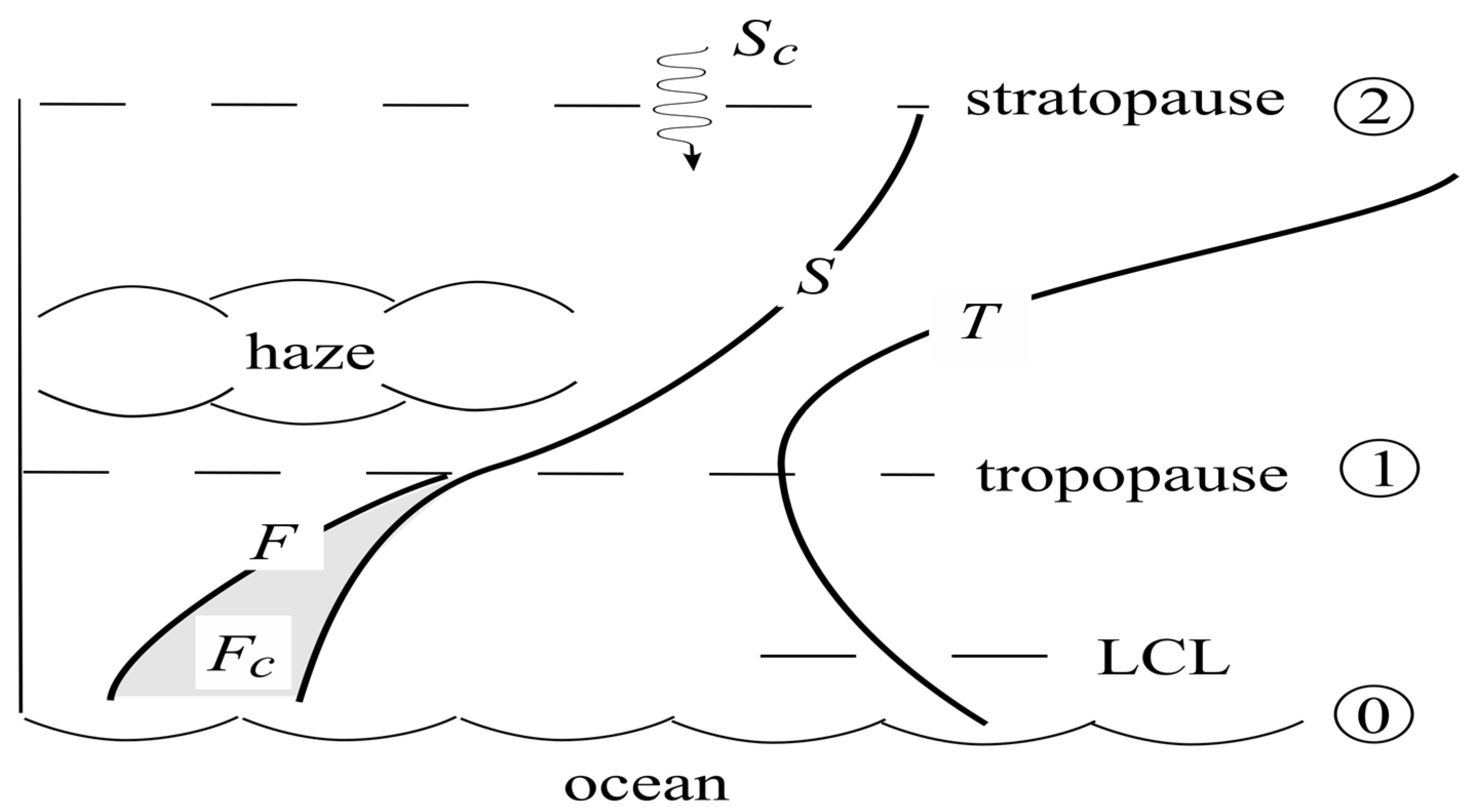
We first deduce the minimal physical configuration of our model, as sketched in
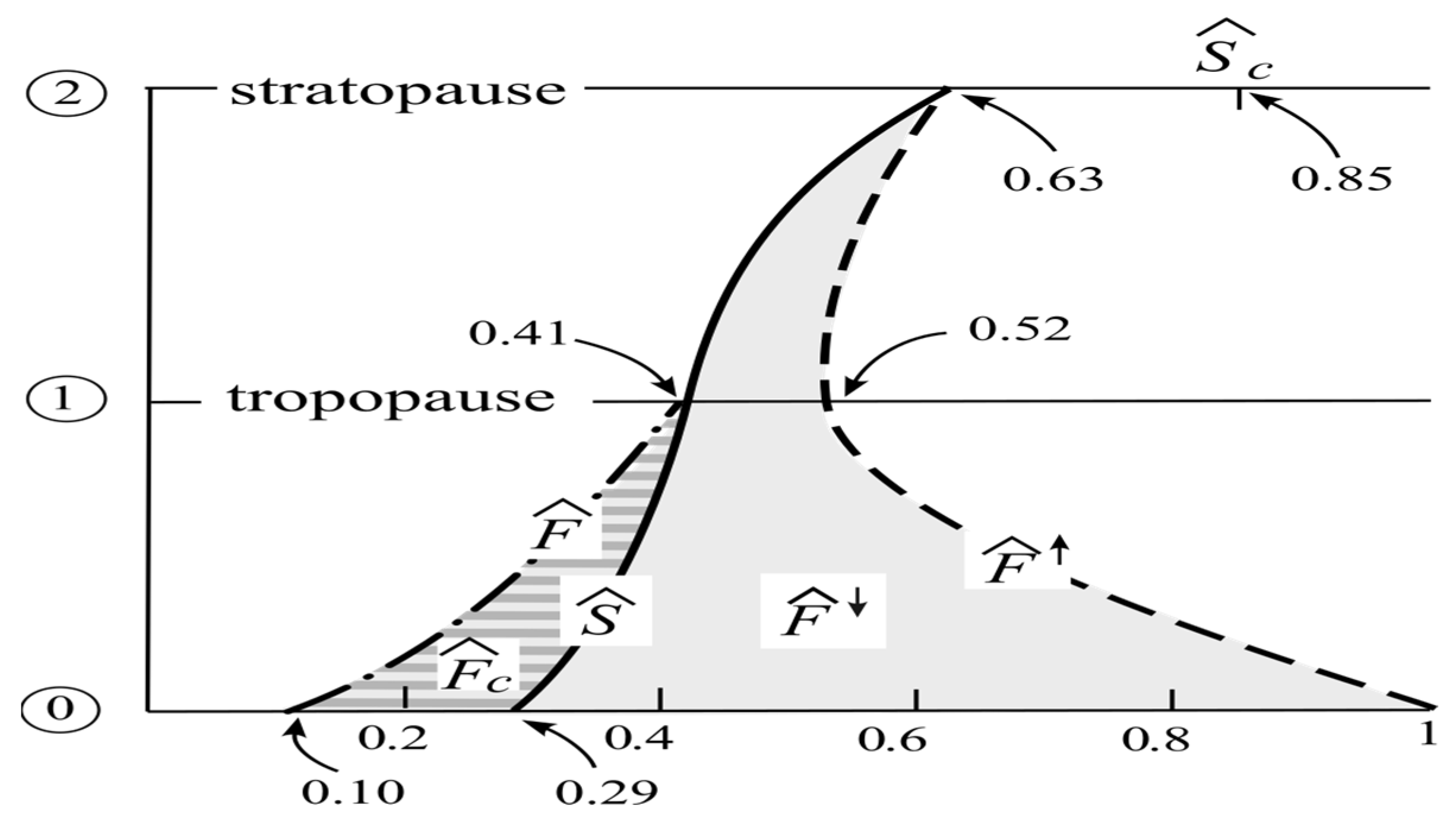
Figure 1, in which the surface, tropopause and stratopause are designated as levels 0, 1 and 2, respectively. For convenience, all symbols and parameter values are listed in
Appendix A, and as a general convention, dependent variables are global means, which are starred for current surface (reference) values, hatted when nondimensionalized by these reference values, and subscripted 0/1/2 for model levels.
In past discussions of Titan’s tropospheric temperature, it is often assumed to be in radiative equilibrium but with a lapse rate bounded above by an adiabat through convective adjustment [
19,
20,
21]. This interpretation is conceptually misleading because radiative fluxes depend on mole fraction of the thermal absorber, which is itself redistributed by convection throughout the troposphere [
22]. A more logical reasoning would be to begin with the inevitable convection as solar radiation warms the surface. Owing to the mixed methane–ethane ocean [
23], the rising air in convective plumes is initially undersaturated (Raoult’s law) [
18,
24] and cools dry adiabatically until it condenses at the lifting condensation level (LCL). Above the LCL, convection is sustained by buoyancy released by condensation, and its highest reach during episodic convective storms defines the effective tropopause.
With convection being initiated at the surface, the methane mole fraction is uniform below the LCL, but decreases with height above the LCL, as methane condenses, up to the tropopause, beyond which it again becomes uniform in the absence of convection [
25]. Despite its low concentration in the stratosphere, methane remains the primary producer of organic haze through photolysis, a prominent feature of the Titan’s atmosphere. Since its particle size overlaps visible wavelengths, the haze scatters sunlight efficiently [
26], and its stratospheric aggregate also absorbs the shortwave flux in comparable measure [
27], which I take to be its intrinsic property. As haze is thermally inactive [
3], the absorbed solar energy must be balanced by optically thin hence near-isotropic thermal emission by the stratospheric methane [
2]. As such, about half of the shortwave flux absorbed by haze is reradiated downward in the longwave band through the tropopause [
27]. The shortwave flux entering the troposphere is further attenuated by near-infrared methane absorption [
28] before ultimately absorbed by the ocean, the origin of the anti-greenhouse effect of the tropospheric methane.
As seen in
Figure 1, the shortwave flux (
S) equals the net longwave flux (
F) in the stratosphere in maintaining radiative equilibrium [
2] but because the shortwave optical depth is much smaller than the longwave one in the troposphere (
Section 2.5),
S exceeds
F with the excess representing the convective flux (
, shaded). Although the convective flux is small compared with the solar constant, it remains commensurate with radiative fluxes [
20] and hence cannot be neglected. More fundamentally, convective flux is the primary source of irreversible entropy production and thus plays a central role in our model closure.
2.2. Vertical Profiles
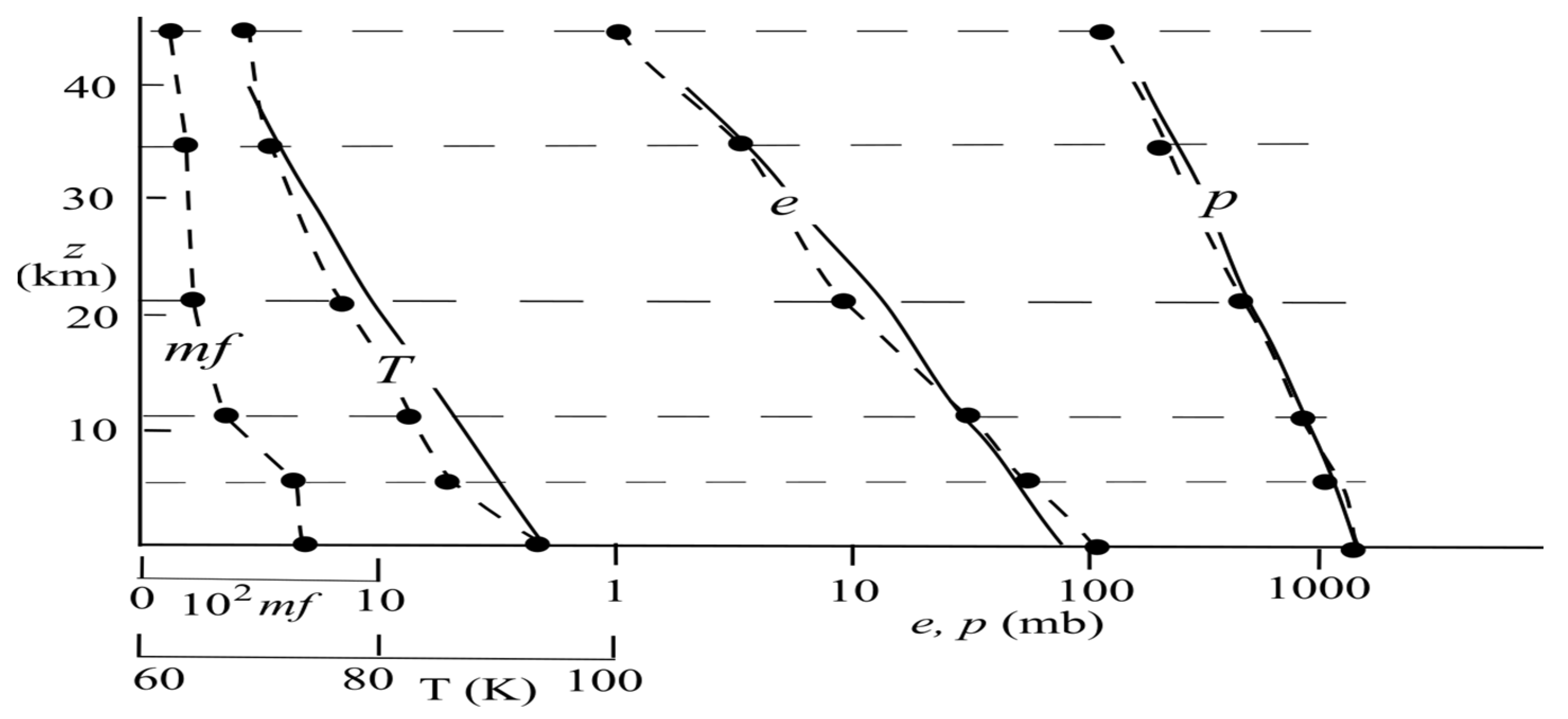
We next consider vertical profiles of climate properties (
Figure 2) necessary for later derivation of the optical depth. The modeled ones for the current surface temperature of
are shown in solid lines alongside the observed ones in solid dots taken from [
29] (their Table 1). The observed partial pressure (
e) is calculated as the product of the methane mole fraction (
mf) with the total pressure (
p).
To interpret the temperature profile, we note that although rising air in convective plumes cools dry adiabatically until it reaches the LCL, convective plumes are episodic on Titan [
22], as seen in the noisy lapse rate [
30] (their Figure 6), which nonetheless averages to about half the (nitrogen) dry adiabatic rate. Above the LCL, convective motion is propelled by self-induced condensation but, because of shallowness of the LCL, only occasional convective storms may reach the tropopause, whose marking is discussed later (
Section 2.4). Then the slow planetary rotation impedes the tropical convergence of vapor that propels the deep updraft—the Intertropical Convergence Zone (ITCZ)—of Earth, which has been attributed as the driver of its moist-adiabatic lapse rate [
31]. Sans these terrestrial provisions, the tropospheric lapse rate simply decreases monotonically with height in Titan, displaying no imprint of adiabatic motion, and given the simple form of the observed temperature profile, we approximate it by an exponential function, which is then uniquely specified by the temperature (
) and lapse rate (
) at the surface
The modeled temperature profile is for (about half the dry adiabatic lapse rate), the latter a property that is independent of the surface temperature. It is seen that the modeled temperature closely matches the observed one, in support of the approximation (1).
For the observed mole fraction, it is homogenized below the LCL by convective mixing, but decreases with height above the LCL due to condensation, and again tends to a constant in the stratosphere in the absence of convection [
29,
32]. For a model derivation of the partial pressure, we note that the observed relative humidity inferred from Huygens measurements lies in mid-tenths, so for simplicity, we adopt a single representative value
, which is seen to reproduce the observed partial pressure profile under Clausius–Clapeyron (C–C) scaling [
29]. This approximation represents an empirical closure given the episodic nature of the convection. With the uniform relative humidity, the partial pressure satisfies
where
is the latent heat of evaporation of methane and
is its gas constant. Integrating vertically from the surface yields
where
and the reference vapor pressure is defined as
with
being the saturated vapor pressure at the reference temperature
. The partial pressure (3), shown in the solid line, reproduces the observed profile, thus supporting the assumed relative humidity. The sensitivity of the model climate to its chosen value will be discussed later in
Section 2.7. Since Titan’s atmosphere is a dilute, N
2-dominated mixture [
1], we assume hydrostatic balance and ideal gas law so the total pressure satisfies
Since the bracketed term is relatively unvarying compared with the partial pressure, we obtain a power law
where
for the present climate. One may regard this power law as intrinsic to the Titan’s troposphere since the surface lapse rate (
, being proportional to the dry adiabatic lapse rate, is unvarying, and the surface temperature (
) is seen later to be constrained by MEP to be near methane’s triple point. In support of this power-law dependence, the modeled total pressure is seen to match the observed one almost exactly.
To recap, we have assumed, as intrinsic to Titan’s troposphere, an exponentially decaying lapse rate and a uniform 50% relative humidity, which have reproduced the observed vertical profiles of temperature, partial pressure and total pressure, in support of the model approximations.
2.4. Longwave Fluxes
The upward longwave flux is governed by the Schwarzschild equation
which has the solution
The two terms on the right-hand side represent transmission of emissions from the surface and interim gas, respectively. Equation (15) allows the integration in (17) to render a dimensionless solution
where
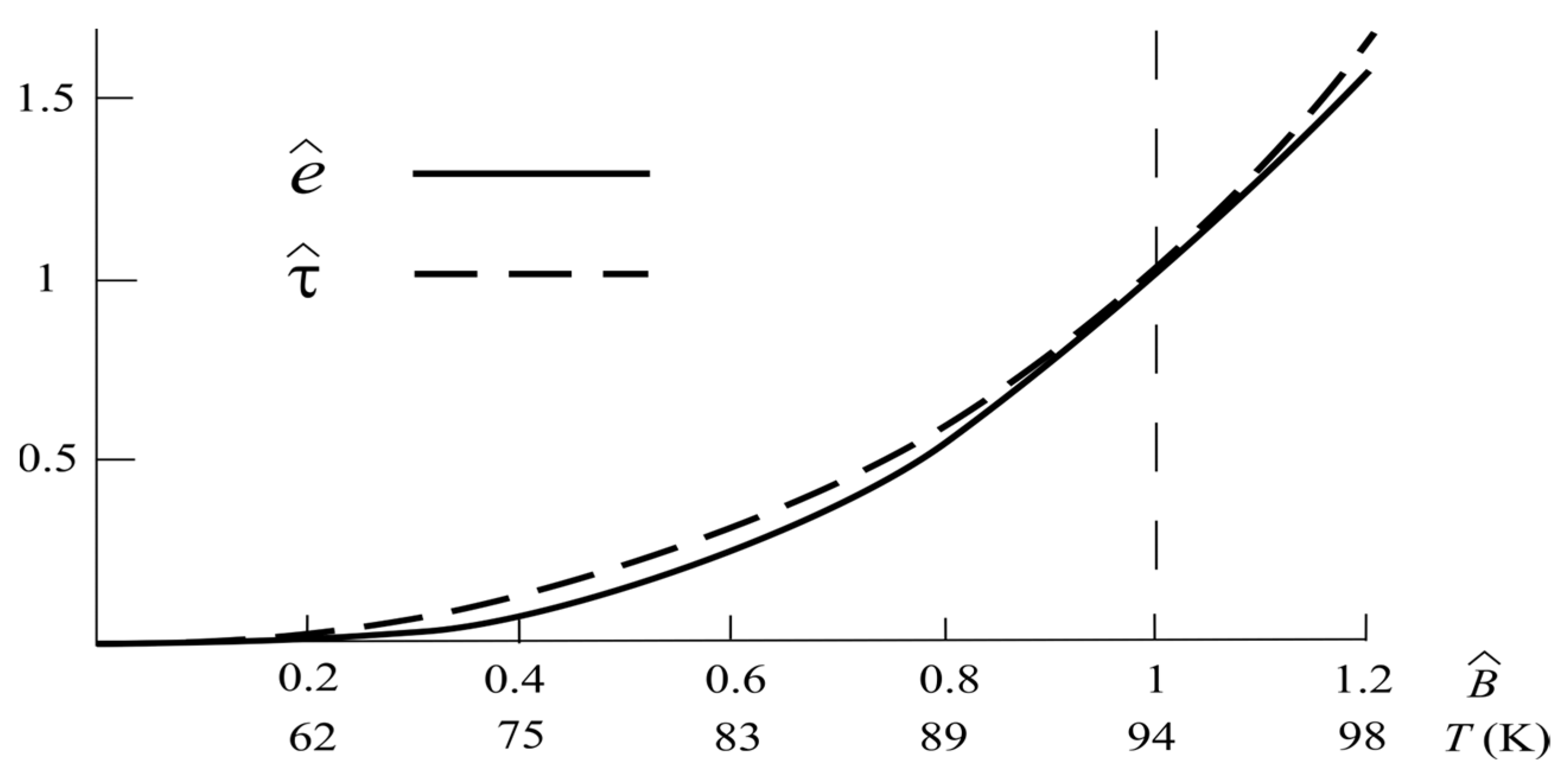
is the standard exponential integral. With the optical depth linked to the local temperature via (15), the upward longwave flux can be calculated as a function of the local temperature hence it is uniquely specified by the surface temperature (1). As an example, it is plotted in
Figure 4 (upper solid line) for the present surface temperature (
). Expectedly, it decreases upward (moving to the left) as attenuation of the surface emission overrides the emission by the interim methane gas. This longwave flux is subjected to the following boundary condition at the tropopause (vertical dashed line).
Because of the small optical depth of the stratosphere [
32], the air temperature just beyond the tropopause should be at the skin temperature of the upward longwave flux (OLR,
), and since the temperature is continuous across the tropopause, it sets the boundary condition that
As shown graphically in
Figure 4, it is the intersection of the above two (thin) lines, which then specifies the tropopause temperature (vertical dashed line). Mathematically, substituting (19) into (18), the tropopause temperature satisfies
where
and
Equating the tropopause temperature with (15) applied at the tropopause, we obtain an equation governing the tropopause optical depth
,
For a given surface temperature, hence optical depth
, one may adjust
until this equation is satisfied. With (20) and (19), one then obtains the tropopause temperature and OLR. For the current surface temperature, the modeled tropopause has an optical depth of 0.45 and temperature of 68 K, both consistent with observations [
30,
32,
34]. One should note that the close match of the modeled and observed temperatures is not due to tuning of the optical depth (15) since it involves no consideration of radiative fluxes; rather, it underscores the strong constraint the skin temperature (19) places on the energy balance of Titan.
Likewise, the downward longwave flux satisfies the Schwarzschild equation
with the solution
where
is the downward longwave flux at the tropopause to be discussed later (
Section 2.5). Subject to nondimensionalization and (15), the downward longwave flux becomes
where
is the exponential integral. The downward longwave flux for the present surface temperature is plotted in
Figure 4 (shaded) for the case of
, a value derived later for the current climate (
Section 2.5). It is seen that the downward longwave flux increases strongly toward the surface (to the right) due to both increasing temperature and thermal opacity. The net longwave flux
thus is as shown in the thick dashed line. It increases upward (to the left), signifying longwave cooling of the troposphere by the greenhouse effect. At the surface, in particular, the net longwave flux is from (27) and (26),
which enters the energy balance considered next.
2.5. Energy Balances
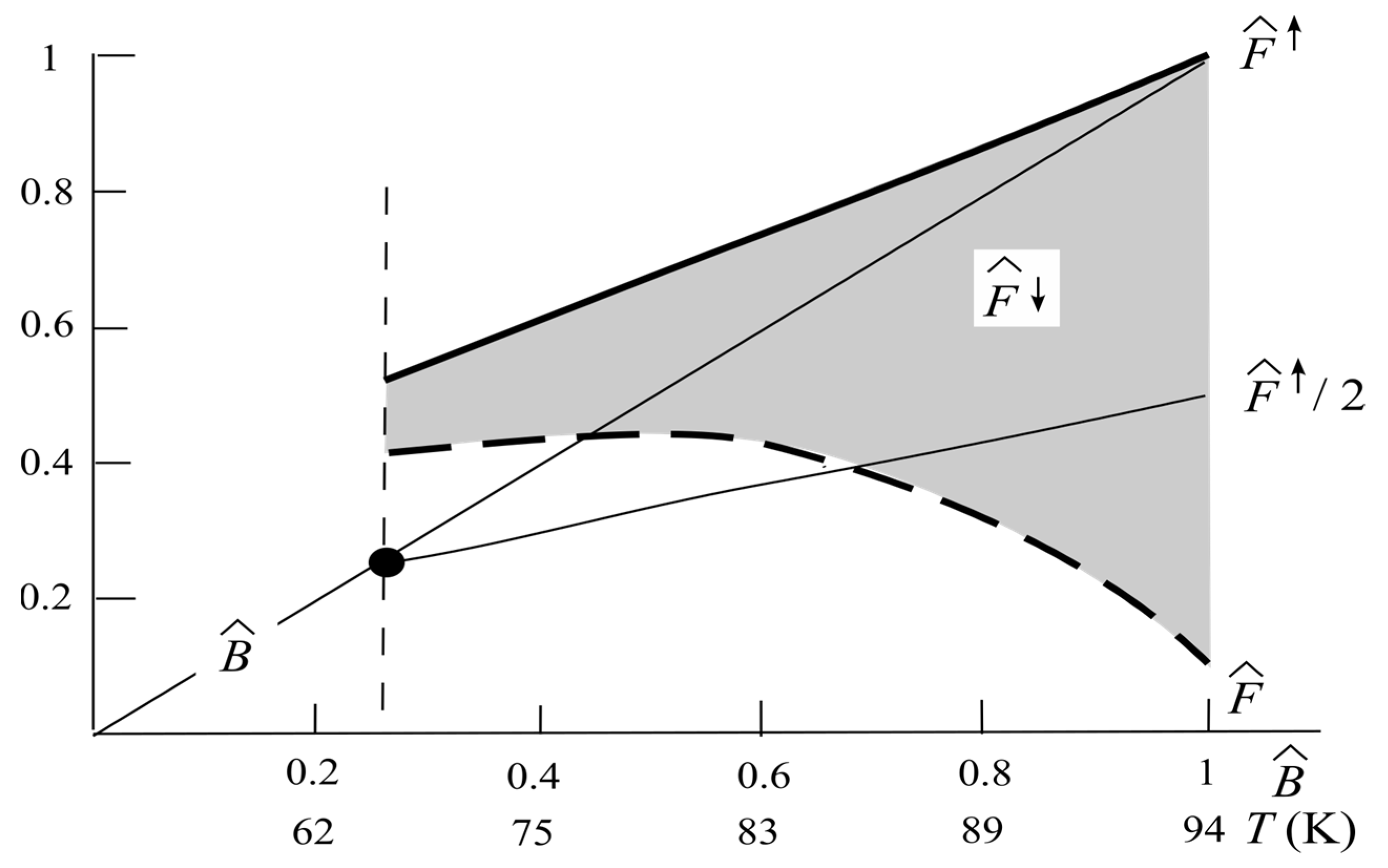
To aid the following discussion, we show a schematic of heat fluxes in
Figure 5. Their dimensionless values are calculated for the present surface temperature based on expressions derived below. To obtain dimensional fluxes, multiply the dimensionless values with the reference value
.
The solid line is the incoming shortwave flux, which is scattered by stratospheric haze to cross the stratopause (level 2) at
where
is the present solar constant,
r is the haze reflectance, and
h is the unknown haze cover. Since the haze scatters and absorbs the solar radiation in comparable measure (
Section 2.1), equating the gray absorption coefficient (
a) with the reflectance (
r), the downward shortwave flux entering through the tropopause (level 1) is
This flux is further attenuated by methane absorption in the near-infrared before reaching the surface [
35,
36]. Although haze may extend into the troposphere through sedimentation [
24], particle growth and aging have greatly diminished its shortwave absorptive efficiency [
35], which moreover has no intrinsic temperature dependence and hence can be folded into the anti-greenhouse effect of the overlying stratospheric haze. As such, the observed tropospheric attenuation of the shortwave flux must be attributed primarily to absorption by the gaseous methane [
27,
35]. Let
k be the ratio of methane’s gray shortwave to longwave absorption coefficients, then the shortwave flux reaching the surface is
where
’s pertain to the longwave optical depths discussed in
Section 2.3. For the observed shortwave attenuation of 30% [
27], it implies a shortwave optical depth of
and using longwave optical depths of
,
(
Section 2.4), it yields
k, an intrinsic property of the gaseous methane. This equation entails the anti-greenhouse effect of the tropospheric methane; the latter thus plays the dual roles of (longwave) greenhouse and (shortwave) anti-greenhouse effects in the troposphere.
The absorbed solar heat
) by the stratospheric haze can be expended only by the longwave emission of the stratospheric methane, and its low optical depth promotes isotropic emission, so we assume half the solar absorption is reradiated downward through the tropopause or
We recognize that the present stratospheric longwave emission might have 6/4 partition in favor of the upward one [
27], a possible discrepancy considered minor for our crude model. The energy balance at the tropopause states
or the combined downward shortwave and longwave fluxes equal the OLR. Because of the isotropic stratospheric emission, this energy balance at the tropopause assures the same at the stratopause. Substituting (30) and (32) into (33), we derive the haze absorption
which is thus a function of both the surface temperature (via OLR) and solar constant. Qualitatively, higher OLR or lower solar constant would be countered by less haze that let in more sunlight to maintain the tropopause energy balance. Substituting (34) into (30), the incident SW flux through the tropopause is
which thus declines with lower OLR or higher solar constant. As seen in (31), this shortwave flux is further attenuated in the troposphere by near-infrared methane absorption, which represents a critical anti-greenhouse effect in addition to that of the stratospheric haze.
In the stratosphere, there is radiative equilibrium, so the shortwave flux (
) overlaps the net longwave flux (
). In the troposphere, small
k implies that the shortwave flux is less attenuated than the net longwave flux (dash-dotted), the excess representing the convective flux
(striped)
The troposphere, by definition, thus is in convective–radiative equilibrium, so the convective flux may not be neglected even if it is locally small, as sometimes assumed [
4]. More significantly, however, this convective flux is the source of the irreversible entropy production hence critical to the model closure, as discussed next.
2.6. Maximum Entropy Production
In the above, we have linked climate properties to the surface temperature, which are plotted in
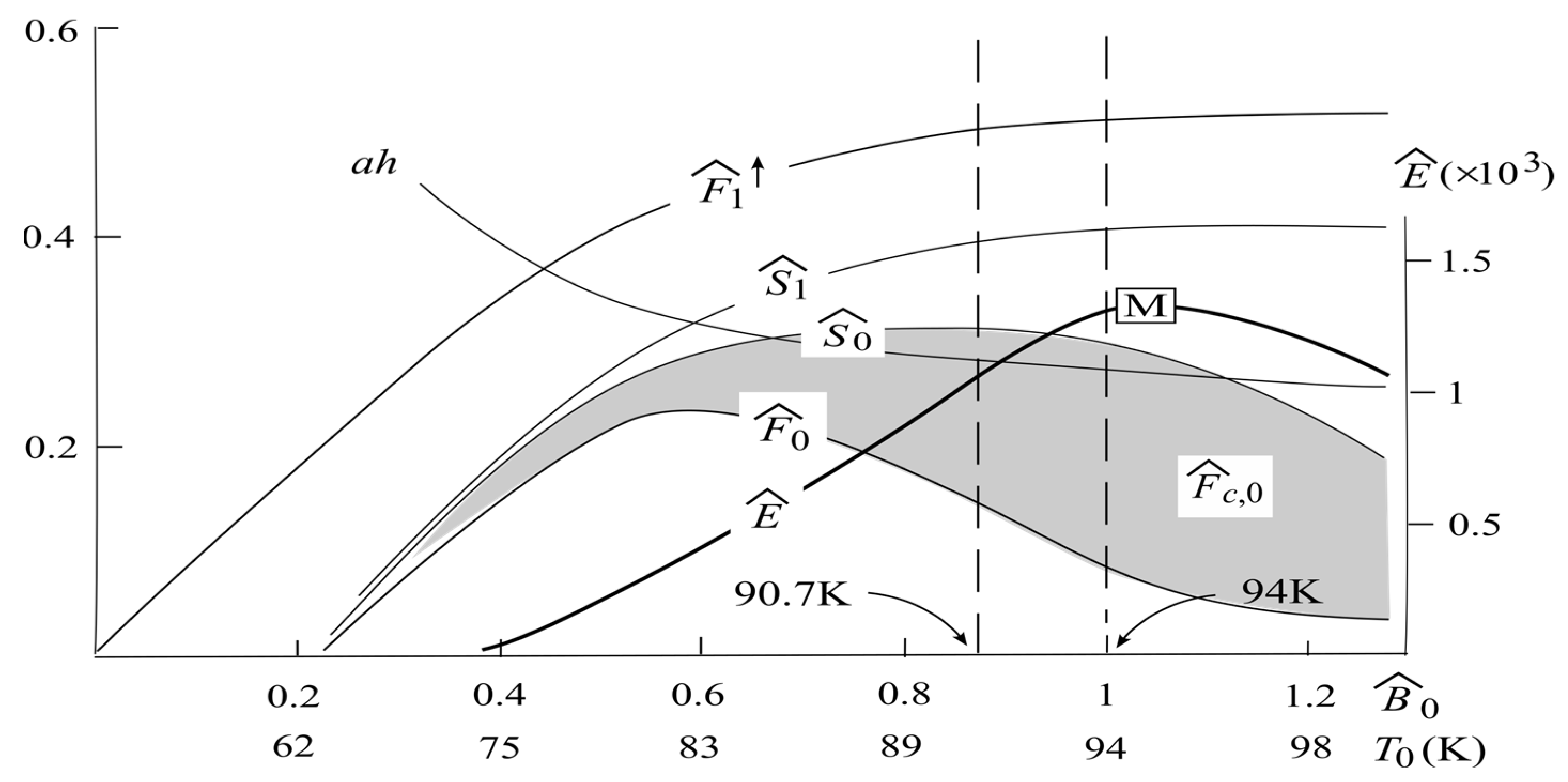
Figure 6, referred to as the regime diagram. This diagram encapsulates the core physics of the model leading to the MEP solution, as expounded next. As the surface warms, OLR (
) increases with the surface emission initially, but plateaus when the greenhouse effect rapidly approaches saturation after the triple point (the left vertical dashed line) [
37]. To counter the rising OLR, haze absorption (
ah) would decrease to let in more solar flux through the tropopause (
), which plateaus like the OLR. This shortwave flux is attenuated in the troposphere due to near-infrared absorption by methane, so the shortwave flux reaching the surface (
) would reverse the above rising trend and decline with the surface temperature; this is the anti-greenhouse effect exerted by the tropospheric methane, in addition to that by the stratospheric haze.
In the meantime, the rapidly increasing greenhouse effect that asymptotes the OLR has strongly depressed the net surface longwave flux (), which undergoes inflection near the triple point (the left vertical dashed line) before it decays to zero. For convenience, we shall refer to the surface temperature above the triple point as “saturated greenhouse” range. The deficit of against the absorbed shortwave flux must be accommodated by the surface convective flux (, shaded), which thus exhibits a bulge as the surface warms from the saturating greenhouse to the still-rising anti-greenhouse effects. We shall next show that this bulge also manifests in the irreversible entropy production ().
The irreversible entropy production (
) stems from convection in the troposphere (between levels 0 and 1) [
38]
recognizing that convection terminates at the tropopause. Defining a “radiative” cooling temperature
by
Equation (37) becomes
where
is the thermodynamic efficiency of the atmospheric heat engine. To derive
and consistent with our minimal model, we approximate the vertical profile of the convective flux (striped area in
Figure 5) as linear in
, then (38) yields
While the above linear assumption is crude, it is nonetheless better justified than the commonly used effective temperature
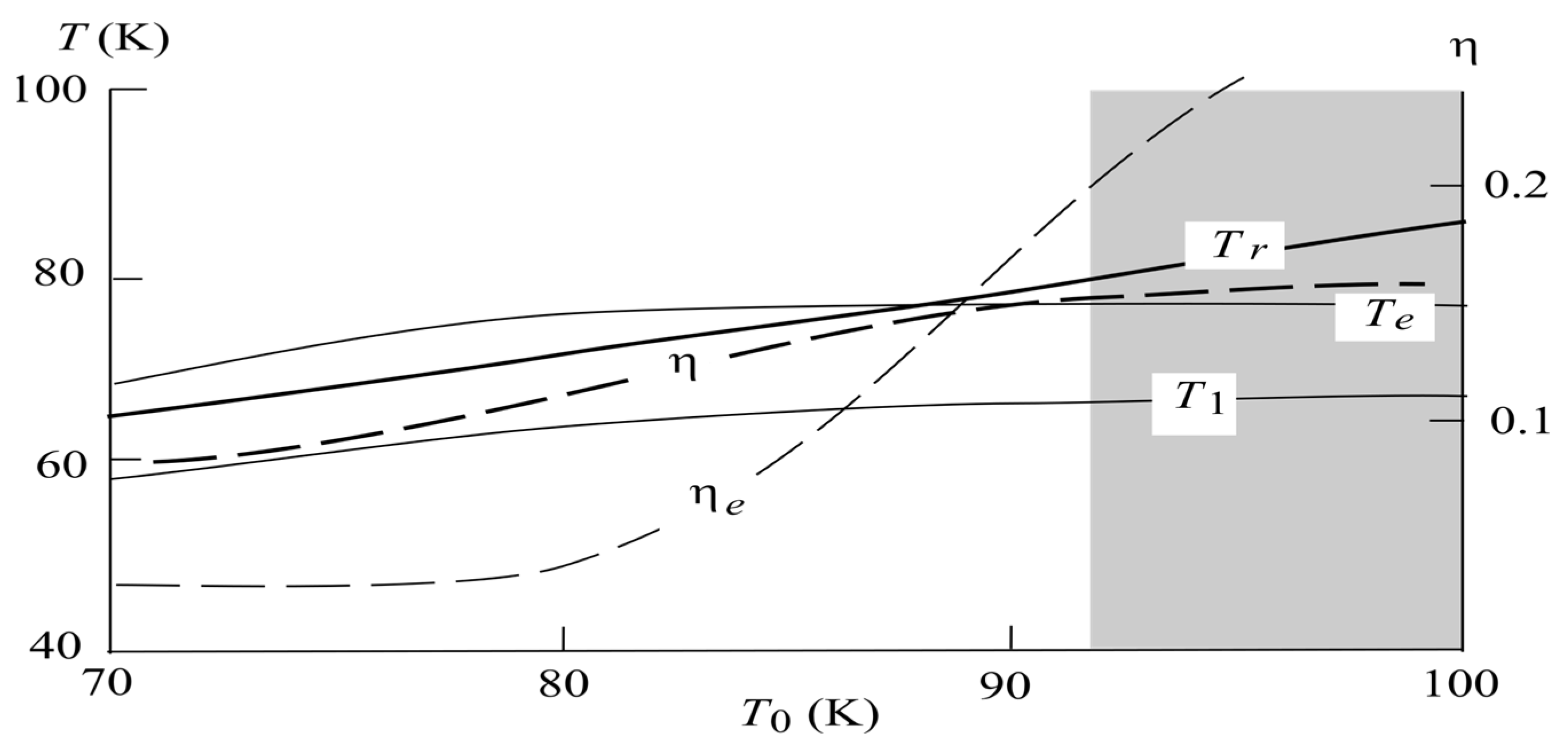
of the OLR. To see this, we plot in
Figure 7 the tropopause temperature
, the effective temperature
, the radiative cooling temperature
, as well as thermodynamic efficiencies
(based on
) and η (based on
) against the surface temperature
over its plausible range. It is seen that
is quite higher than
and it does not level off like
; this difference is the reason that
asymptotes to around 15%, a value consistent with the current observation [
39], whereas
increases indefinitely, clearly unphysical. In fact, as seen in [
31], the radiative cooling temperature on Earth is proportional to the surface temperature to render a thermodynamic efficiency that is relative unvarying, which should apply to Titan as well. The thick lines are thus the pertinent ones for calculating the entropy production (39) and with the levering-off of the thermodynamic efficiency and the minor dependence on the surface temperature in the saturated greenhouse range (above the triple point, shaded), one expects the entropy production to vary primarily with the surface convective flux to exhibit a maximum.
This surface convective flux, as seen in
Figure 5, is the deficit of the net surface longwave flux
against the shortwave flux absorbed by the ocean
, or
so its maximization
yields
or equal downward slopes of these two curves in
Figure 6. As such, the maximum must lie in the saturated greenhouse range where
slope is easing while
slope is steepening. Because the much weaker visible absorption than the thermal one due to small
k (31),
curve is shifted to higher optical depth, which nonetheless represents only minor surface warming because of the C–C scaling (
Figure 3). As such, we expect MEP, while above the triple point, to remain close to it. In
Figure 6, the nondimensionalized entropy production (
) is plotted in a thick solid line, which shows a maximum at around 95 K (the open box marked M for MEP), which is close to the observed 94 K (the right vertical dashed line), and both are indeed near the triple point, as we have reasoned above. Since the vertical profiles of climate properties shown in
Figure 2 are based on the current surface temperature, they are likewise reproduced by MEP.
Being a minimal model, there are fewer tunable parameters compared with typical climate models, so the observational agreement offers an added support of MEP as a governing principle of Titan’s climate. In addition, the predicted haze albedo (
ah) is 0.26, close to the observed Bond albedo [
40], which underscores the importance of the haze abundance in regulating the solar forcing. Our approach differs fundamentally from prevailing ones that prescribe the surface temperature to reproduce the observed climate properties, including the haze abundance. While such diagnostic approach has validated the radiative–convective equilibrium, it does not offer a causal explanation of the observed haze amount or its coupled surface temperature, the stated aim of the present study.
2.7. Long-Term Stability
While MEP successfully predicts the present surface temperature, one naturally wonders how robust it is and how it might have evolved over geological time. Previous studies have explored Titan’s thermal history, but typically without accounting for potential negative feedback of the haze amount. Since self-adjusting haze layer plays a key role in stabilizing our surface temperature, we expect a sharp contrast in our projected long-term change compared with earlier works.
One well-documented forcing change pertains to the solar constant, which has increased by about 20% since the late heavy bombardment (LHB) about four billion years ago. A similar scenario was experienced by Earth [
41], yet early Earth could be as warm as today. This is the well-known FYSP [
42], which can be resolved by MEP when self-adjusting cloud buffers the solar forcing [
16,
17]. By analogy, Titan’s haze may a serve similar regulatory role, mitigating the impact of solar variability.
Besides the solar constant, another less certain external change is the composition of the mixed methane–ethane ocean as methane is converted to ethane over tens of million years [
43], unless it is replenished by still-debated processes [
44,
45]. Then, even if methane evolution can be ascertained, translating it to temperature change encounters the same nonclosure of atmosphere models if the haze amount needs to be prescribed [
18]. This shortfall is amended in our model by self-adjusting haze, hence a thermodynamical closure via MEP. To illustrate the temperature response to changing ocean composition, we consider a hypothetical 20% enrichment of the oceanic methane, which would increase the surface relative humidity by the same amount [
46].
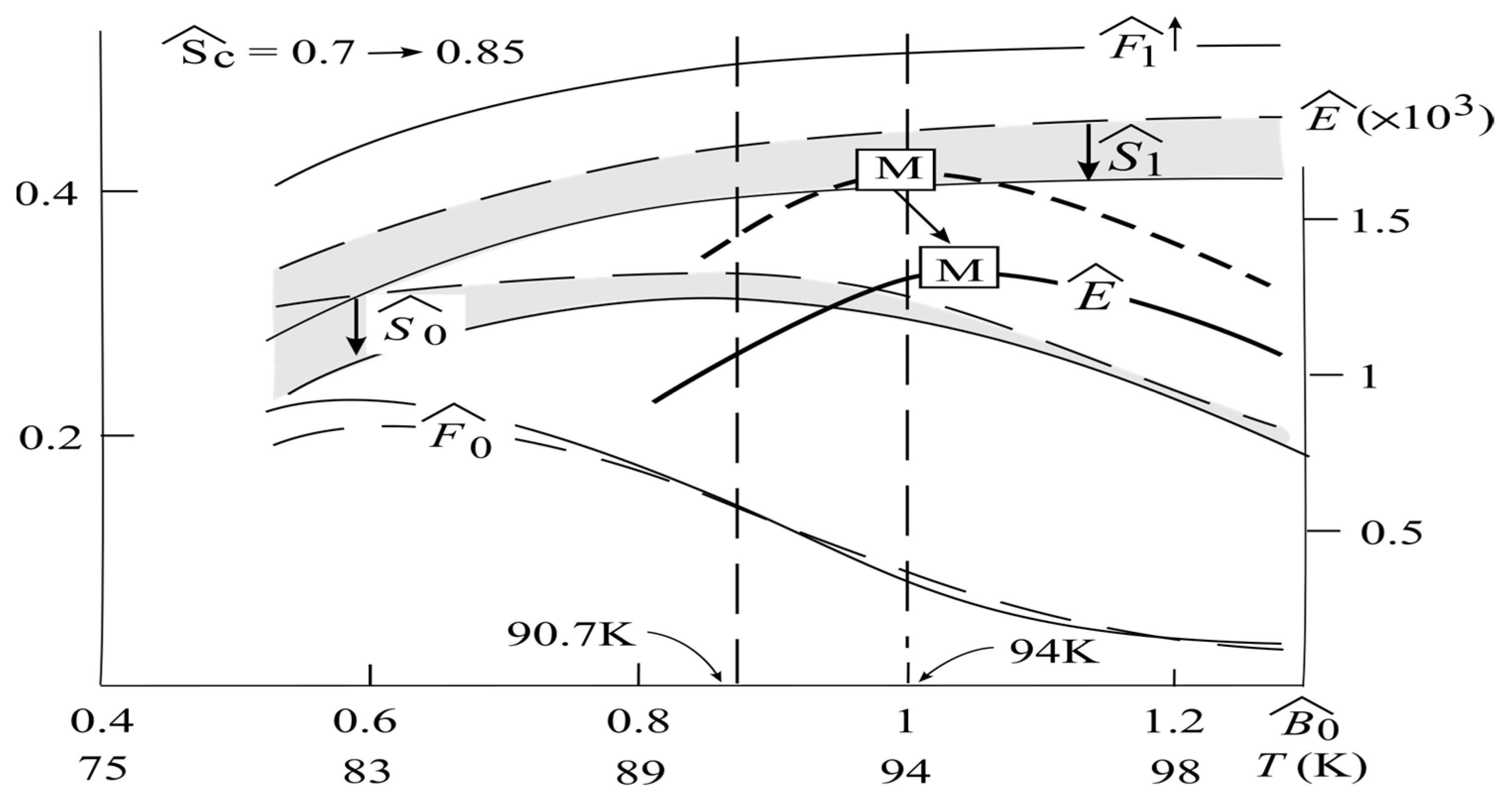
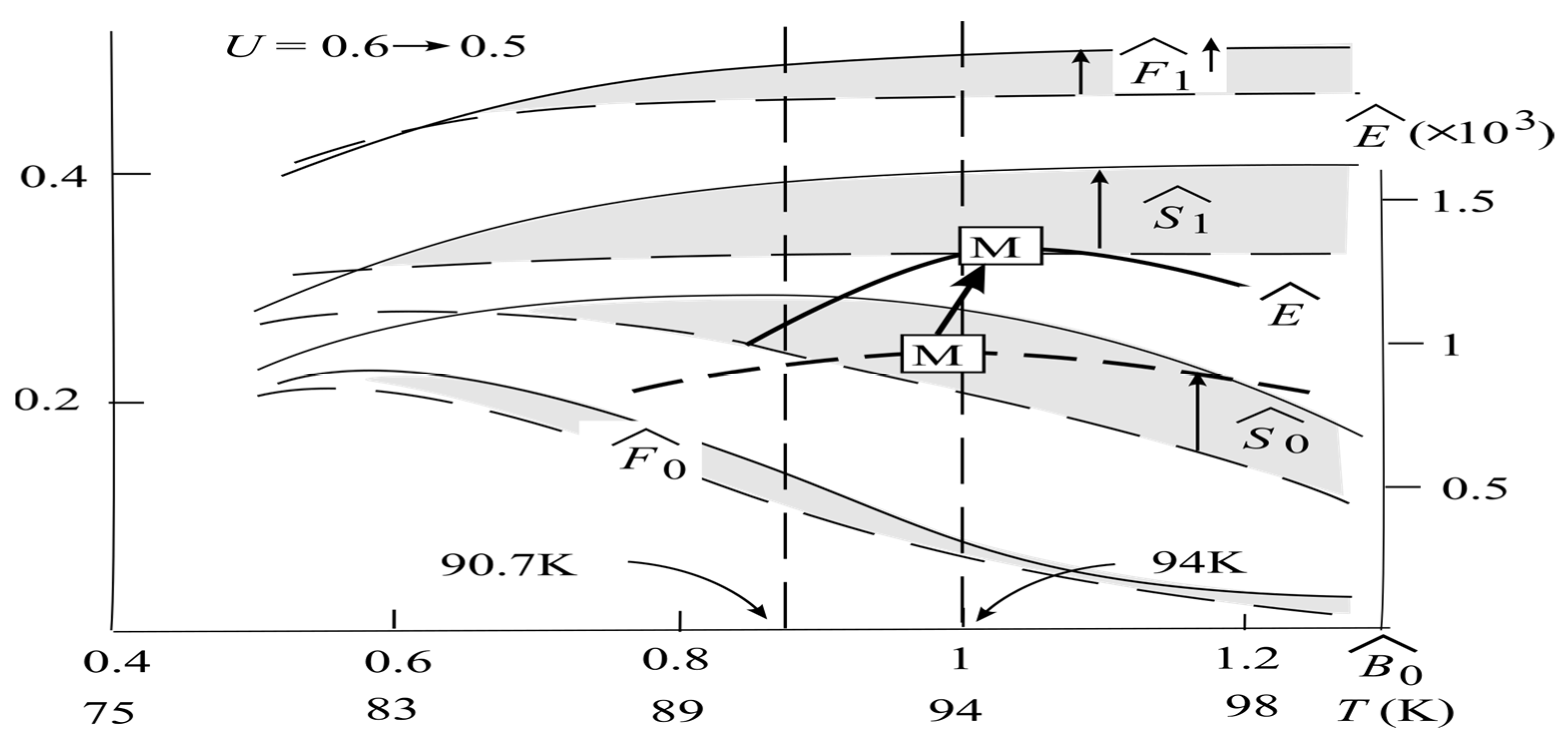
We first consider the simpler case of solar perturbation and plot in
Figure 8 the evolution from the early Titan (dashed lines,
) to the present (solid lines,
), as indicated by arrows spanning the shaded differences. It shows surprisingly that the surface temperature has warmed only by 1 K. To interpret this result, we shall first derive an approximate MEP solution, which is of an analytical form to aid such understanding.
Since the perturbed MEP state remains in the saturated greenhouse range, both OLR (
) and shortwave flux entering the troposphere (
) have largely plateaued. Neglecting small terms in (28) based on
Figure 4 and
Figure 5, the net surface longwave flux is approximately
Equation (44) implies, for the maximized surface convective flux,
Substituting from (31) and (45), and neglecting smaller terms, we derive
which states a balance between the anti-greenhouse (left-hand side) and greenhouse (right-hand side) effects. The anti-greenhouse efficiency depends on both the incoming shortwave flux (
) and shortwave optical depth, which is much smaller than the longwave one, as entailed in the small
k. The greenhouse efficiency on the other hand decays as the inverse square of the optical depth in the saturated greenhouse range. With the small
, (47) leads to an analytical expression for the surface optical depth of the MEP state
Subject to the linkage (15) and the SB law, the corresponding surface temperature is 91 K, which is about 4 K lower than that shown in
Figure 6, a deviation that is not unexpected given the additional approximations, but since it has incorporated dominant terms, it may serve as a proxy of the full MEP state in assessing qualitative dependence and order-of-magnitude quantitative perturbations. Being in the saturated greenhouse range, this proxy MEP state has the following base values calculated from expressions derived in
Section 2.5 and with the same reference values listed in
Appendix A:
,
,
,
,
,
,
, and
. These values are needed to calculate percentage perturbations.
Let primed variables denote perturbations and unprimed variables assigned above base values, we first consider climate response to the lower solar constant of
or
, which may represent the early Titan. The resulting percentage changes are listed in the top row of
Table 1 based on following derivations.
The solar constant has no influence on OLR, so a weaker solar forcing is fully countered by less haze, and its reduced shortwave absorption implies smaller downward longwave flux hence greater shortwave flux entering the troposphere, so from (35),
or
which is 1/3 smaller percentagewise than the forcing change. Since
anchors the anti-greenhouse effect, its increase requires smaller optical depth to balance the saturated greenhouse effect, as entailed in the proxy MEP solution (48), resulting in
hence additional 1/3 reduction from the solar perturbation. From (31) and recognizing that
(OLR is unchanged)
which represents a slight increase in absorbed shortwave flux over the incoming one due to smaller optical depth. Since the optical depth
is linked to the surface emission
via C–C scaling (15), the latter is perturbed as
so that
which represents halving of the perturbed optical depth. The strongest reduction comes from a further four-fold reduction in the surface temperature on account of the SB law or
The surface temperature thus is lower by
. All above perturbations of the proxy MEP state are consistent with that shown in
Figure 8 based on the full solution, in support of our use of the proxy state in explaining the climate perturbations.
Tracking the perturbation sequence of
Table 1 due to change in the solar constant (
), it is reduced 1/3 by haze (
) and methane absorption (
, additional 1/3 by the anti-greenhouse effect (
), another halving by C–C scaling (
), and finally a four-fold reduction due to the SB law (
). Defining climate sensitivity by the percentage change in the surface temperature relative to that of the forcing, it is only 0.04. We project therefore that, if MEP applies, the early Titan is only about ~1 K cooler when Sun is 20% dimmer, a sharp contrast to ~20 K cooling projected previously when haze is fixed; the disparity of the prior works being deprived of haze feedback, the weaker solar flux needs to be wholly balanced by lowered surface emission, resulting in a much cooler surface. In our model, on the other hand, the solar perturbation is successively countered by stratospheric and tropospheric anti-greenhouse effect in facilitating MEP, resulting in only minor cooling of the surface.
We shall next consider the temperature response to 20% higher methane concentration in the ocean as reflected in the same increase in the relative humidity (Raoult’s law) or
. The changing regimes are plotted in
Figure 9, and the percentage changes in climate properties are listed in the middle row of
Table 1.
Differing from the solar forcing, changing the relative humidity
would perturb the reference optical depth
as they are linked through (5) and (13)
so that
Since by definition
we have
so the optical depth is perturbed by both temperature and relative humidity, the two terms on the right-hand side, respectively. Unlike the solar forcing, the changing relative humidity would alter the OLR governed by (23). Varying this equation, noting that
and neglect smaller terms, it is straightforward to derive
leading to
and from (59),
Applying (15), the tropopause temperature hence OLR would be perturbed as
This OLR reduction would lessen the incoming shortwave flux as seen from (35), yielding
and to boost the anti-greenhouse effect to balance the greenhouse effect, the optical depth would increase by, from (48),
With
and
known, (31) yields
Again, the percentage change in shortwave flux absorbed by the surface is slightly amplified over the incoming one, so the anti-greenhouse effect due to the tropospheric methane is slightly enhanced. Applying (59), we derive
That is, although the absolute optical depth increases (66), the scaled one actually decreases, which is what impacts the surface emission via C–C scaling (15), yielding
so that
and
All the above changes are consistent with the regime change shown in
Figure 9 based on the full solution, which thus is explained. In particular, the surface temperature is cooled by 1.3 K, commensurate with that seen in
Figure 9, implying a sensitivity of −0.07, which doubles that to the solar forcing, but remains small.
Tracking the perturbation sequence of the middle row of
Table 1, the higher relative humidity (
hence stronger greenhouse effect, would reduce OLR by 10%, which increases the haze amount and downward longwave radiation to reduce the shortwave flux entering the troposphere by 16%, and further for that reaching the surface. To boost the anti-greenhouse effect in countering the saturated greenhouse effect, the optical depth increases by 8%, but because of the higher relative humidity, the surface emission actually decreases by −5%, hence the surface temperature by −1.3% on account of the SB law. This cooling is of the same sign as that found by [
46] when oceanic methane is enriched, but quantitatively the cooling is much smaller because of MEP. The sensitivity −0.07 doubles that to the solar change but remains very low.
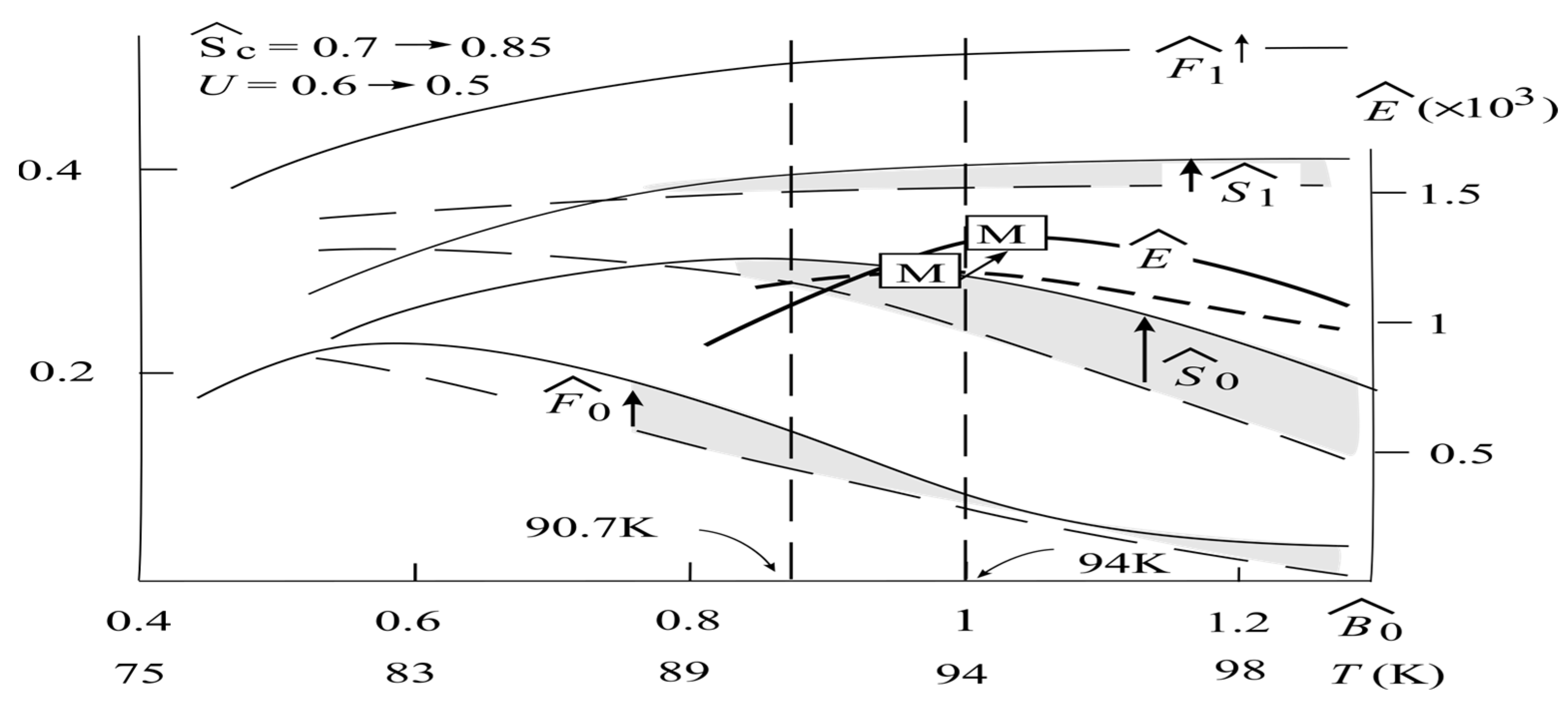
As a further illustration, we consider the combined perturbation of solar constant and relative humidity, with the regime diagram shown in
Figure 10 and the percentage changes listed in the bottom row of
Table 1. It is seen that the percentage changes, although sizable, remain linear and additive hence explainable by the foregoing discussion. It results in a surface cooling of about ~2 K, which is consistent with that shown in
Figure 10 based on the full solution. This minor cooling departs sharply from the ~20 K cooling projected previously with fixed haze [
18]. It is noted nonetheless that MEP peak is less distinct, so the surface temperature is more vulnerable to additional perturbations, and one may not preclude the possibility that the surface could cool to the triple point to render a vastly different early Titan of frozen ocean.