


Abstract
The SE Baltic area, the former Eastern Prussia, is renowned for complex natural history. Over the past millions of years, the area experienced major geological events and geomorphic landscape transformations, resulting in the present relief configuration. Past climates and environments gave rise to the specific life-forms that proliferated in the Paleozoic and Mesozoic–Early Cenozoic shallow sea/lacustrine basins, and the Late Cenozoic riverine and continental settings. During the Paleogene, forested sub-tropical lands and deltaic settings of coastal sea lagoons gave rise to the famed amber formations (Blue Ground) hosting inclusions of resin-sealed insect and other small invertebrates that offer an unprecedented look into the 35–34 million-year habitats. Ferruginous sandstones, formed in shallow waters incorporating remains of thermophilous fauna—bivalves and gastropods, bryozoans, and sea urchins, among others—lie above the amber-bearing deposits. Oligocene–Miocene continental (riverine, lacustrine, and palustrine) conditions relate to the “Brown Coal Formation”, embedding a variety of fossil plants. Finally, the Quaternary Period brought dramatic geo-environmental shifts, with cyclic interstadial sea transgressions and massive glacial erosion events delivering fossiliferous erratics with an array of primitive Paleozoic and later Mesozoic life-forms. Overall, the extraordinary paleontology of the SE Baltic area adds, within its geological context, to the European geoheritage and the world natural heritage.
1. Introduction
Geoheritage focuses on unique landforms, geological bodies, and the enclosed inorganic and organic features, including ancient life-forms [1]. The fossil record represents a specific component of geoheritage [2,3,4,5]. The geoheritage studies—research and conservation—within the broader Baltic area have received more attention during the past years in linkage to geo-tourism and geo-environmental protection (e.g., [6,7,8]). Compared to the neighboring countries—Poland and Lithuania, sharing at large their geological history (e.g., [9,10,11,12])—the geoheritage concept in the present Kaliningrad Region of the Russian Federation is relatively new [13].
The first geological and paleontological reconnaissance in this area of the former East Prussia (pre-WW2 Germany), conducted at the beginning of the 19th century, revealed a captivating, multifaceted natural history spanning over the past millions of years. Mainly, the Paleogene formations sealing affluent amber records from the Sambia Peninsula (Figure 1) became the focus of the first scientific studies. The meticulous studies of amber inclusions, centered at Königsberg University and the East Prussia Museum, disclosed to scientists and the general public the fascinating life of the past, seen through the immense and world-unique collections of fossil fauna and flora of diverse geological ages. These pilot studies laid the foundations of present paleontological investigations [14,15], as well as the modern economic exploitation of amber-bearing deposits [16,17].
The search for new fossils found in the Kaliningrad Region is of great scientific importance. Most of the old German collections (assembled before 1945) were lost during WW2. Among these collections, there were unique holotypes and type series of newly described species originating from the local deposits. Present paleontological research is thus of major importance for detailing the fossil records’ taxonomies. The broad geological diversity of the fossil-bearing formations, rocks, and minerals (bedrocks, inclusions, erratic boulders, and Pleistocene deposits) presumes the presence of other new species of ancient flora and fauna. The spectacular coastal sections with fossil biota records provide, along with the scenic landscapes, a compound framework of the regional as well as the territorial geoheritage. The present paleontology research details the past (Mesozoic, Paleozoic, and Cenozoic) settings and identifies the life-forms once occupying the SE Baltic Sea area. The current studies have both scientific and applied meaning, aiming to raising public awareness of the fossil legacy of the Kaliningrad Region, its geo-historical uniqueness, and its modern social–cultural value.
This paper follows the original study on the principal geo-sites of the Kaliningrad Region [13] that provided the geological context of the here-presented paleontological records. The unique fossil plant and invertebrate findings encompass most of Earth history from the Precambrian to Late Pleistocene (the Last Ice Age). The study underscores the scientific, educational, and touristic potential of the East Baltic geoheritage.
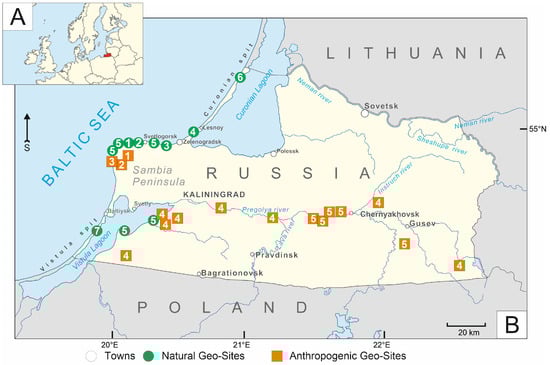
Figure 1.
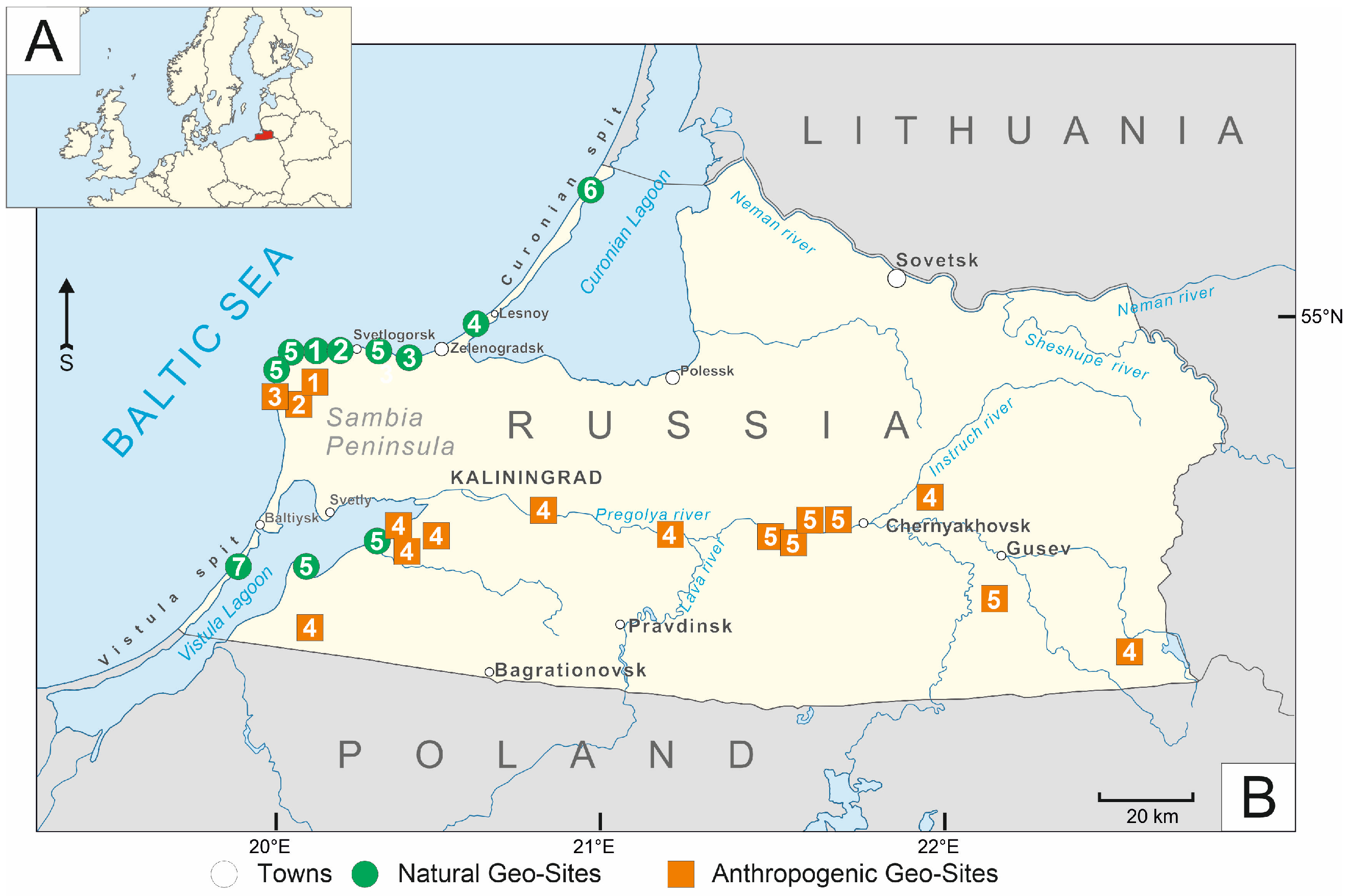
(A) Study area; (B) geographic location of the geological sections and paleontological sites. Natural fossil-bearing geo-sites: 1—Krant Ground section, Filino Bay; 2—“Brown Coal Formation” near Otradnoye Village; 3—clays of the Baltic Glacial Lake near Kulikovo Village; 4—fossil gyttja and peat section near Lesnoye Village; 5—coastal erratic boulders; 6—erratic boulders of the Curonian Spit; 7—erratic boulders of the Vistula Spit. Anthropogenic fossil-bearing geo-sites: 1—the last glacial erratic boulders of the Sinyavino amber pit; 2—Primorsky amber pit (Blue Ground, Oligocene flora and erratic boulders); 3—Palmnikensky amber pit (Blue Ground); 4—sites with erratic boulders; 5—sites with erratic boulders and the Pleistocene flora and fauna occurrences.
Figure 1.
(A) Study area; (B) geographic location of the geological sections and paleontological sites. Natural fossil-bearing geo-sites: 1—Krant Ground section, Filino Bay; 2—“Brown Coal Formation” near Otradnoye Village; 3—clays of the Baltic Glacial Lake near Kulikovo Village; 4—fossil gyttja and peat section near Lesnoye Village; 5—coastal erratic boulders; 6—erratic boulders of the Curonian Spit; 7—erratic boulders of the Vistula Spit. Anthropogenic fossil-bearing geo-sites: 1—the last glacial erratic boulders of the Sinyavino amber pit; 2—Primorsky amber pit (Blue Ground, Oligocene flora and erratic boulders); 3—Palmnikensky amber pit (Blue Ground); 4—sites with erratic boulders; 5—sites with erratic boulders and the Pleistocene flora and fauna occurrences.
2. Geography and Geological Context of Fossil Records
The study area is located in the South-East of the Baltic Sea in the Kaliningrad Region, the western enclave of the Russian Federation (Figure 1). Geologically, the broader geographical space is a part of the East European Platform, geographically forming the vast plains of the Polish–Lithuanian Depression, adjoining the maritime coast from the East. Its westernmost continental extension is formed by the Sambia Peninsula, which is the key place of the present paleontological geoheritage investigations within the region.
The geological basement of the Eastern Baltic platform is structured by the tectonically deformed Precambrian crystalline and metamorphic rocks superimposed by a massive sedimentary cover 1–3 km thick [18,19]. These overburden formations include deposits of all geological ages from the Paleozoic to the Cenozoic [20]. The Early–Middle Paleozoic/Caledonian orogeny (490–390 My) deformed the earlier Cambrian, Ordovician, Silurian, and Early Devonian bodies [21]. The Late Paleozoic tectonics are represented by a complex of regressive Late Devonian and Permian stratigraphic units. The following Cimmerian folding stage (~210–100 My) generated transgressive, terrigenous, and carbonate sedimentary suites, hosting off-shore fossil fuel reservoirs in some places [22]. The Hercynian/Alpine uplift, lasting from the Early Cretaceous (~102 My) to Pliocene (~5–3 My), generated up to 60 m-high steep coastal cliffs along the western part of the Sambia Peninsula [23]. The sea-eroded Paleocene and Eocene siliciclastic deposits became the main source of the fossil materials, including amber [24].
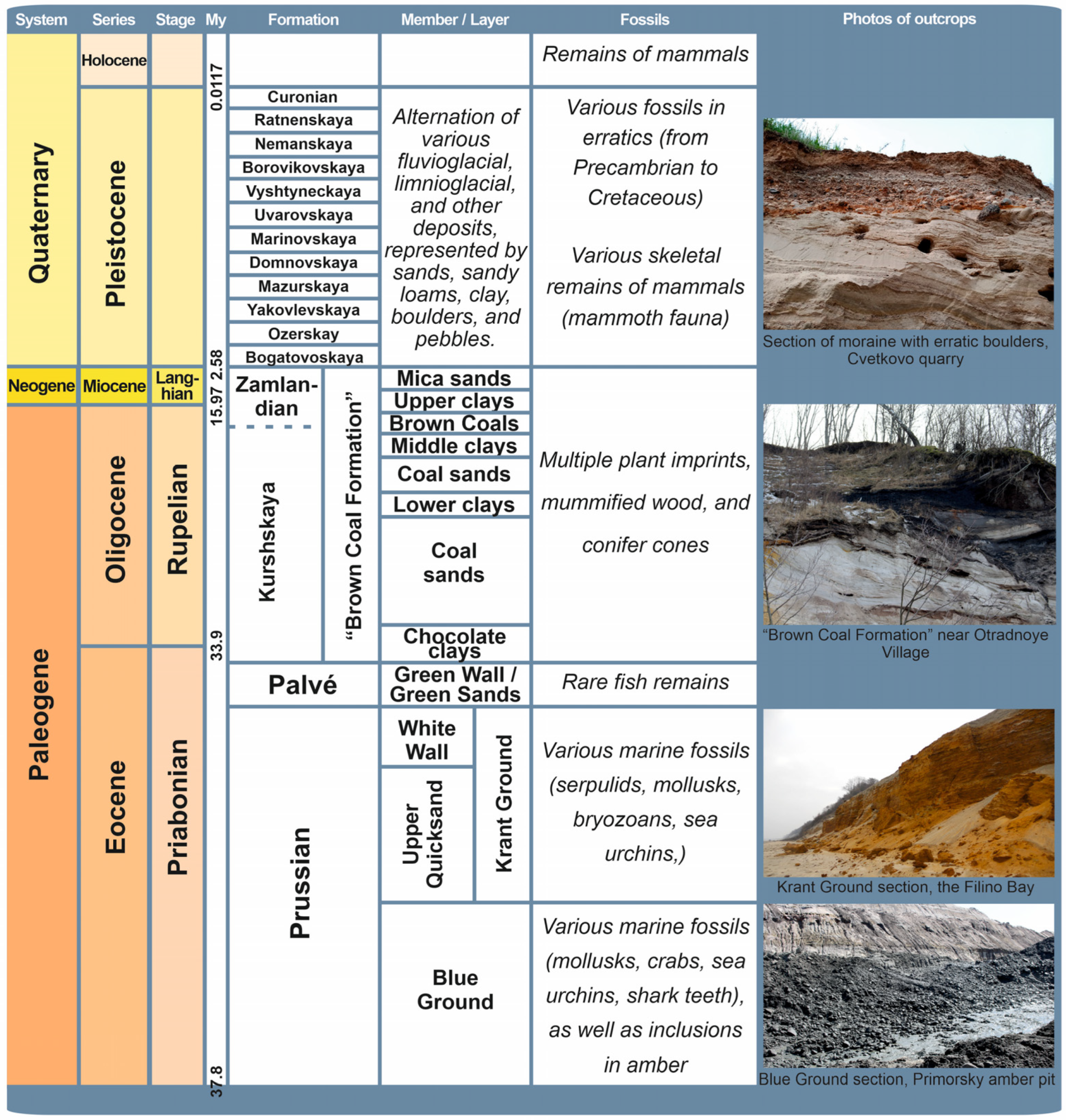
The Paleozoic, Mesozoic, and early Cenozoic structural geology units (Figure 2) create a base for the overlying Pre-Quaternary and Quaternary deposits. The Tertiary relief in the SE Baltic region is built by the presently buried paleo-valleys and the marine sedimentary formations of various geneses, lithologies, and thicknesses [20]. The exposed terrestrial part of the peninsula was geomorphically shaped by Miocene and Pliocene denudation uplands with locally preserved paleo-relief relics and erosional landforms (paleo-incisions), reaching a depth up to 240 m [25].
The geologically most recent Quaternary surface cover was modeled by Pleistocene glaciations interspersed by interglacial marine transgressions. During the Last Glacial Maximum (20,000–18,000 years ago), the Scandinavian ice limits reached the southern Baltic area [26,27,28]. The northern continental ice-flows significantly lowered the formerly elevated pre-Quaternary relief. Following the final ice stagnation, the ice-sheet retreated from the Kaliningrad area at ~11,700 year BP. The repeated glacial advances shaped the former pre-glacial plains, transporting masses of rocks, including fossiliferous ones, ice-eroded from the original geological formations. Thick glacio-fluvial, glacio-lacustrine, and glacial facies constitute the modern relief. Following the deglaciation, the early Holocene (12,000–8000 year BP) shorelines of the south-eastern Baltic Sea have experienced significant geomorphic transformations. The post-glacial landscapes, including the modern ones, experience a major glacio-isostatic continental rebound well seen in the north of the Kaliningrad Region [29].
The documented fossiliferous geo-sites reflect the complex natural history of the region. The present-day exposure of the ancient fossils along the Baltic shorelines is increasingly generated by the sea erosion of unconsolidated geological deposits forming prominent coastal cliffs. Organic or lithified remains of flora and fauna are embedded in the stratified units (Figure 2) and/or are sealed in massive glacial or proglacial sedimentary bodies of the industrially mined sites [30,31]. The rich paleontological records are witnesses of ancient mosaic landscapes and prolific life-forms occupying the present south-eastern Baltic coastal area during the past hundreds of millions of years. The long-established paleontology science is integrated in the regional geoheritage concept.
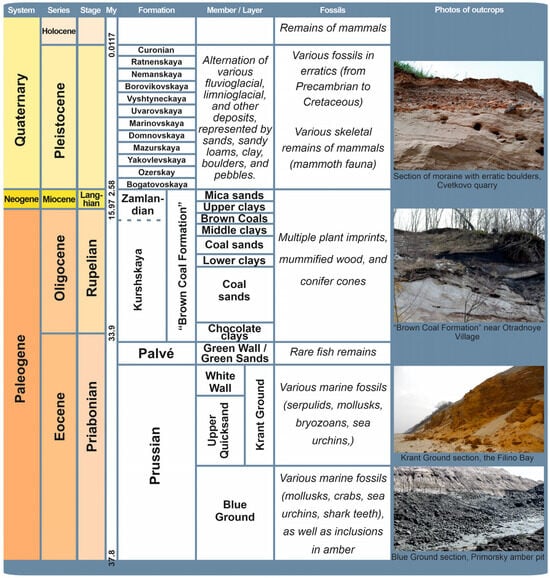
Figure 2.
Chronostratigraphic scheme of the Cenozoic history (37.8–0 My) of the Kaliningrad Region with the principal fossil-bearing sections (photographs by E. Mychko).
Figure 2.
Chronostratigraphic scheme of the Cenozoic history (37.8–0 My) of the Kaliningrad Region with the principal fossil-bearing sections (photographs by E. Mychko).
3. Paleontology Research History
The history of study of the geological structures, past landscapes and environments, and the paleontological finds in the territory of the former East Prussia—the present Kaliningrad Region—spans more than two centuries. Three stages characterize this research: the East Prussian (before 1945), the Soviet (1945–1991), and the Russian (since 1991).
The East Prussian period of research is primarily associated with the work of German scientists and the active collecting of fossil materials and compilation of the first geological maps and stratigraphic schemes. The initial major works on the geology of the region were presented by Gustav Zaddach [32,33]. As a professor of zoology and anatomy at Königsberg University, he studied the Cenozoic deposits of the Samland (now Sambia) Peninsula. G. Zaddach assembled rich paleontological collections and described the main geological formations exposed along the coast. The unique fossils served as a background for the following paleontological studies. An initial systematic geological study of the Curonian Lagoon was conducted by Gottlieb Berendt [34], and of the Sambia Peninsula’s coastline by Ernst Schellwien [35]. The evolution of historical and structural geology knowledge of that time was then presented in the fundamental work “The Geology of East Prussia” by Alexander Tornquist [36].
The first specialized paleontological studies addressed the amber and fossil inclusions. The German botanist Heinrich Göppert and the paleontologist Georg Berendt from Danzig (Gdansk) published a synthesized study on the classification of plant and animal fossils found in the Baltic amber [37], which is still considered as fundamental. Other synthesized works were devoted to the Proterozoic, Lower Paleozoic, Mesozoic, and Paleogene fossils retrieved from the East Prussia bedrock formations and the glacial erratics [38,39,40,41], and the amber inclusions [42]. Fossil microorganisms (chitinozoans, acritarchs, dinoflagellates, and spore-pollen assemblages) and graptolites were published by Alfred Eisenack [43,44,45,46], the founder of micro-paleontology and German palynology.
At the turn of the 19th and 20th centuries, collecting the erratic-stone fossils and the amber inclusions became widespread and very popular, resulting in some major private collections [47]. A significant contribution to the development of paleontology was made by Richard Klebs, a professor at the University of Königsberg, geologist, and pharmacist. His collection, counting more than 27,000 specimens, became the core amber collection at the Provincial Museum of East Prussia. Its contents are now allocated in the Geology and Paleontology Museum at the University of Göttingen [48].
The University of Königsberg, or Albertina, became one of the leading educational and scientific institutions in Europe at the time. By the beginning of the 20th century, the facility had six faculties and 40 institutes [49]. In 1875, the Provincial Museum of East Prussia was founded, dedicated to the natural history of the province. The institution housed the most valuable geological and anthropological collections, as well as a library containing over 12,000 volumes, including unique and rare minerals and fossils discovered in East Prussia [50]. At the end of World War II, only part of the Provincial Museum’s collection was evacuated. The institute building and the museum were severely damaged. The museum’s paleontological collections were largely lost.
After the war, when East Prussia became part of the USSR administratively as the Kaliningrad Region, the Soviet geological exploration focused on large-scale geological surveys. The field investigations were conducted by the Paleontological Institute of the Russian Academy of Sciences. There was very minor interest in the fossils except for the amber arthropod inclusions—Diptera (I. D. Sukachev), Homoptera (D.E. Shcherbakov), Hymenoptera (A. P. Rasnitsyn), weevils (V.V. Zherikhin), and spiders (K.Yu. Eskov). Just in the late 1950s, new fossil plants’ collections from the Oligocene sections were published [51,52]. The research remained oriented on strategic resources and documentation of the mineral-bearing sedimentary placers.
The most recent, Russian period of the geological and paleontological studies of the Kaliningrad region started with a major decrease in funding for scientific institutions. Only minor research was conducted, although some significant works devoted to the stratigraphy of the Kaliningrad Region were published [18,53]. A renewed interest in the amber inclusions has been presented by several monographs devoted to the paleo-fauna of the Baltic amber [54,55]. In 1995, a new scientific journal “Amber & Fossils” became published by the Museum of the World Ocean, Kaliningrad. In the last decade, there has been a revival in the study of fossils from the region’s erratic boulders [14,15,56,57,58].
The main repositories that store fossils discovered in the Kaliningrad Region are as follows: the Atlantic Branch of the Shirshov Institute of Oceanology of the Russian Academy of Sciences (AO IO RAS), Kaliningrad; the Museum of the World Ocean (MWO), Kaliningrad; Amber Museum (AM), Kaliningrad; and the Kaliningrad Regional Museum of History and Arts (KRMHA). The present study treats the most unique, and at the same time, characteristic, fossils stored in the above institutions. References to published materials are provided. The overview of the paleontological records follows our own field research in the region.
4. Paleontology Geoheritage Records
4.1. Paleogene Amber Inclusions
Amber (fossil resin) with fossil flora and fauna inclusions makes up to ~10% of all the currently mined amber. Inclusions represent a special type of fossil. Not only the fossilized soft tissues are preserved, but also the original (life-time) coloring of plants and organisms are partially preserved. Close studies of morphological features of individual species of the paleo-biota help in understanding the past biodiversity, paleoecology, and especially the invertebrate evolutionary taxonomy. The predominance of arthropods trapped in amber is explained by the great variety of species along with their small size (Figure 3).
4.1.1. Fauna Inclusions
About four thousand different fossil species of arthropods have been identified in the Baltic amber. Crustaceans are found in succinites—representatives of Isopoda and Amphipoda. The former, land crustaceans, seldom occur in the Baltic fossil record. The latter are rare aquatic or semi-aquatic species, found occasionally in amber. The first found amphipod in Baltic amber was Palaeogammarus sambiensis [59]. More recently, an ostracod of the genus Cyclocypris has been described [60]. Millipedes—a super-class of arthropods, forest dwellers—are much more common [61,62,63,64].
The next group of arthropods—arachnids (Figure 3f,g)—occurs more often in the amber inclusions than millipedes or crustaceans. Spiders are one of the most common groups. Their share of the total number of inclusions is ~8% [65]. Altogether, 59 spider families have been determined [66]. Soft and hard ticks (Ixodidae and Argasidae) are also very diverse, represented by dozens of different species. Among these, parasites, disease carriers, and ixodid ticks, namely the species Ixodes succineus, were described [67]. A large variety of oribatid mites was identified in the amber collection of the University of Königsberg [68]. A large primitive tick from the order Opilioacariformes has been reported [69], with a preserved segmentation on the abdomen and six pairs of eyes.
In addition to the listed taxa of arachnids, there are inclusions of the orders of harvestmen, scorpions, pseudo-scorpions, and even solpugs. The latter are represented by only two finds, one of which is used to describe the new species Palaeoblossia groehni [69,70]. Occasionally, rather amazing large tropical arachnids—phrynes—are encountered, also found in fossil resins from India, Mexico, and the Dominican Republic [64].
The present research attention is on the most diverse class of arthropods—insects, represented by a number of orders: Diptera, Coleoptera, Hymenoptera, Hemiptera, Lepidoptera, and some others. Most of the recorded taxa belong to this class. The entomofauna of the Baltic amber inclusions (Figure 3h,i) have been studied since the 19th century, with many individual groups of insects described—such as bristletails [71], ants [72], wasps, bees, or flies [73,74]. The latter organisms constitute up to 50% of the more recent amber finds [16]. Some of the most interesting insects are Coleoptera (beetles). Currently, 420 genera of 78 families of this order are known from the Baltic, Ukrainian (Rovno), and the Saxonian ambers [75]. In the Baltic Paleogene materials, the beetles are represented by 434 species of 287 genera, from which only 149 are extinct [76].
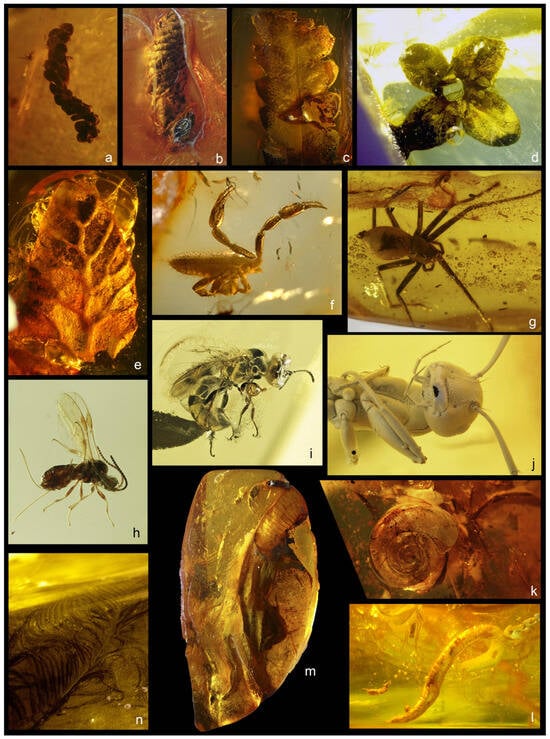
Figure 3.
The Baltic amber inclusions: (a) liverwort (Hepaticophyta); (b) pine cone Pinus wredeana; (c) fragment of a fern frond (Polypodiophyta); (d) flower of Myrsinopsis succinea; (e) fragment of fern leaf Berendtiopteris humboldtiana; (f) pseudoscorpion; (g) spider (Araneae); (h) braconid wasp (Braconidae); (i) sphecoid wasp (Crabrionidae?); (j) ant Tetraponera sp.; (k) gastropod shell; (l) annelid worm; (m) lizard Succinilacerta succinea; (n) bird feather. Collection B.E. Zhukovsky, photo by A.R. Manukyan (a,c,g); coll. BIN RAS, photo by A.A. Zolina (b); coll. A.V. Afanasyev, photo by A.R. Manukyan (d); coll. Geological Center of the University of Göttingen, photo by E.M. Sadowski (e); coll. A. Niggeloh; Schalksmühle, Germany (f); coll. Kaliningrad Amber Museum, photo by A. R. Manukyan (h,m,n); coll. and photo by J. Damsen (i,j); coll. Museum of the World Ocean, photo by A. R. Manukyan (k); coll. S.I. Shishov, photo by A.R. Manukyan (l).
Figure 3.
The Baltic amber inclusions: (a) liverwort (Hepaticophyta); (b) pine cone Pinus wredeana; (c) fragment of a fern frond (Polypodiophyta); (d) flower of Myrsinopsis succinea; (e) fragment of fern leaf Berendtiopteris humboldtiana; (f) pseudoscorpion; (g) spider (Araneae); (h) braconid wasp (Braconidae); (i) sphecoid wasp (Crabrionidae?); (j) ant Tetraponera sp.; (k) gastropod shell; (l) annelid worm; (m) lizard Succinilacerta succinea; (n) bird feather. Collection B.E. Zhukovsky, photo by A.R. Manukyan (a,c,g); coll. BIN RAS, photo by A.A. Zolina (b); coll. A.V. Afanasyev, photo by A.R. Manukyan (d); coll. Geological Center of the University of Göttingen, photo by E.M. Sadowski (e); coll. A. Niggeloh; Schalksmühle, Germany (f); coll. Kaliningrad Amber Museum, photo by A. R. Manukyan (h,m,n); coll. and photo by J. Damsen (i,j); coll. Museum of the World Ocean, photo by A. R. Manukyan (k); coll. S.I. Shishov, photo by A.R. Manukyan (l).
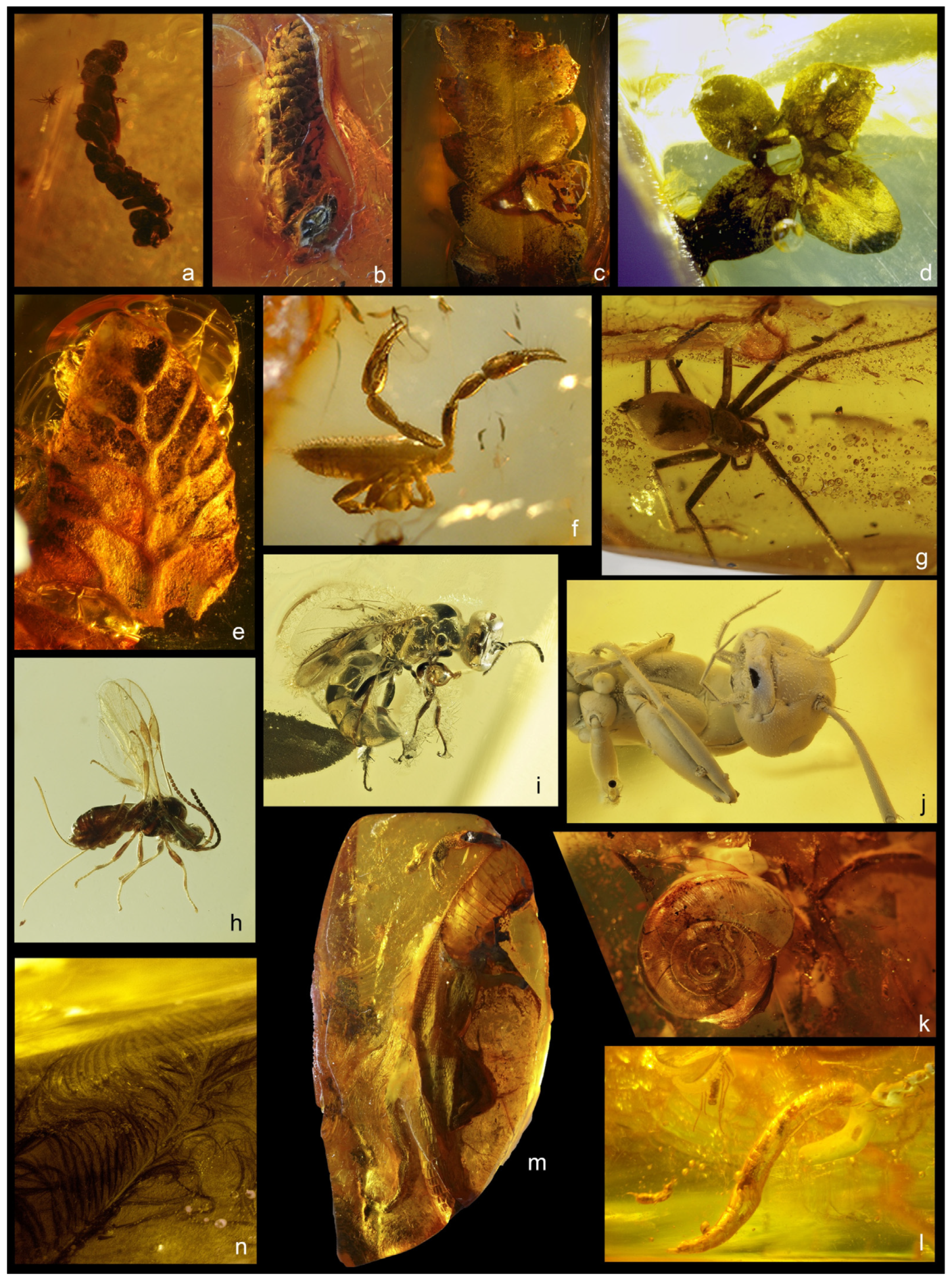
Other invertebrates (Figure 3k,l) sealed in the Baltic fossil resin are represented by annelids and roundworms [77], as well as mollusks—pulmonate gastropod shells (seven genera). A new species of pulmonate snails, Balticopta gusakovi, has been identified [78].
Exceptionally, amber inclusions of vertebrates occur (Figure 3m,n). Their rarity is understandable. Vertebrates are larger in size comparing to arthropods, and have more strength to escape from a resin trap. An incomplete specimen of the lizard Succinilacerta succinea is stored in the Gdansk Amber Museum [79]. The gecko Yantarogekko balticus is represented by a tiny (15 mm) front body part [80]. Unidentified bird feathers and fur of mammals related to hedgehogs (family Amphilemuridae) have also been recorded [81].
4.1.2. Flora Inclusions
The Blue Ground in the Kaliningrad Region’s amber quarries also retains large amounts of macro-botanical remains (Figure 3a–e). The fossil vegetation (fragments of tree trunks and fewer imprints of leaves and bark), released from the lignite beds, provide testimony on the diversity of species and the structure of the ancient Paleogene forest and its floristic composition [37,82,83]. Pine and spruce trees as well as numbers of species of flowering plants were taxonomically determined in the classic works [84].
Attempts have been made to identify the resin-tree producer by comparing the Baltic amber with the resins of modern conifers. Agathis from the Araucariaceae family, cedar, larch, and Sciadopitys have all been determined as the amber producers [85]. However, pine is considered to be the major Baltic amber maker, as indicated by the presence of resin-sealed pinecones [15].
The typical 35 million-year-old “amber forest” was a humid, mixed broad-leaved and coniferous sub-tropical to temperate forest with an admixture of tropical plants [86]. The canopy was formed by Sequoia and Agathis; lower down were conifers, interspersed with various deciduous trees such as maple, laurel, myrtle, palm, and vine, but mainly oak [87]. The forest floor included mosses and ferns [15]. Based on modern analogues, it was similar in composition to the present (sub-)tropical forests of East Asia and Central America, characterized by a dense, evergreen vegetation cover of tropical thickets and flowering plants. The fossil insects sealed in amber point to a mosaic cover with dark coniferous forests on the northern mountain slopes, and tropical vegetation on foothills and the southern slopes [88]. The widespread presence of oak in combination with pine suggests drier continental conditions at some locations during certain time spans.
The ferns’ diversity is very small, represented by only two species: Matonia striata and Berendtiopteris humboldtiana [89]. On the other hand, the dominant gymnosperms include pine (subgenera Strobus and Pinus), spruce (Picea), pseudohemlock (Pseudotsuga), and hemlock (Tsuga). Podocarpus (Podocarpus), sciadopitys (Sciadopitys), glyptostrobus (Glyptostrobus), sequoia (Sequoia), and cryptomeria (Cryptomeria) altogether illustrate the great diversity of the conifers [15]. The flowering plants/trees are represented by a broad variety of beech (Fagaceae) [90], fossil oaks (Quercus, Eotrigonobalanus, Trigonobalanopsis), laurels (Cinnamomum), fan-leaved palms, and parasitic epiphytes. Unique remains of Roridulaceae [91] and Symplocos kowalewskii—the largest flower recorded in the Baltic amber—were also found [92]. Other plant amber inclusions include the remains of semi-parasitic shrubs of the genus Arceuthobium, or dwarf mistletoe with root systems found under the coniferous tree bark [93].
Within the Eastern Baltic region, most likely there were no mountains during the Eocene because of the long-term geological stability of the East European Craton [94], and just a minor orogenetic uplift that occurred during the Paleogene. The “amber landscape” likely consisted of gently sloping plains drained by small rivers aligned by mixed humid riparian forests along river banks. The diversity of arthropods suggests tropical environments combined with sub-tropical rainforests [95,96]. Lichens suggest a humid, temperate Paleogene climate [97]. The open forest canopy provided a suitable substrate to the calicioid fungi, lichens, and various micro-biota, in combination with favorable lighting conditions and a high atmospheric humidity [98]. The fact that the “amber forest” was sunlit and open is also indicated by numerous findings of fossil cereals.
In sum, the East Baltic amber provides the most informative geoheritage source of the ancient biota of the Kaliningrad Region. The continuing search for new fossil taxa underlines the prime historical paleontology relevance of the amber inclusions. These, in combination with other forms of the fossilized ancient flora and fauna records, provide insights on the paleo-vegetation structure and past biotopes of the present Baltic area.
4.2. Fossils of Blue Ground
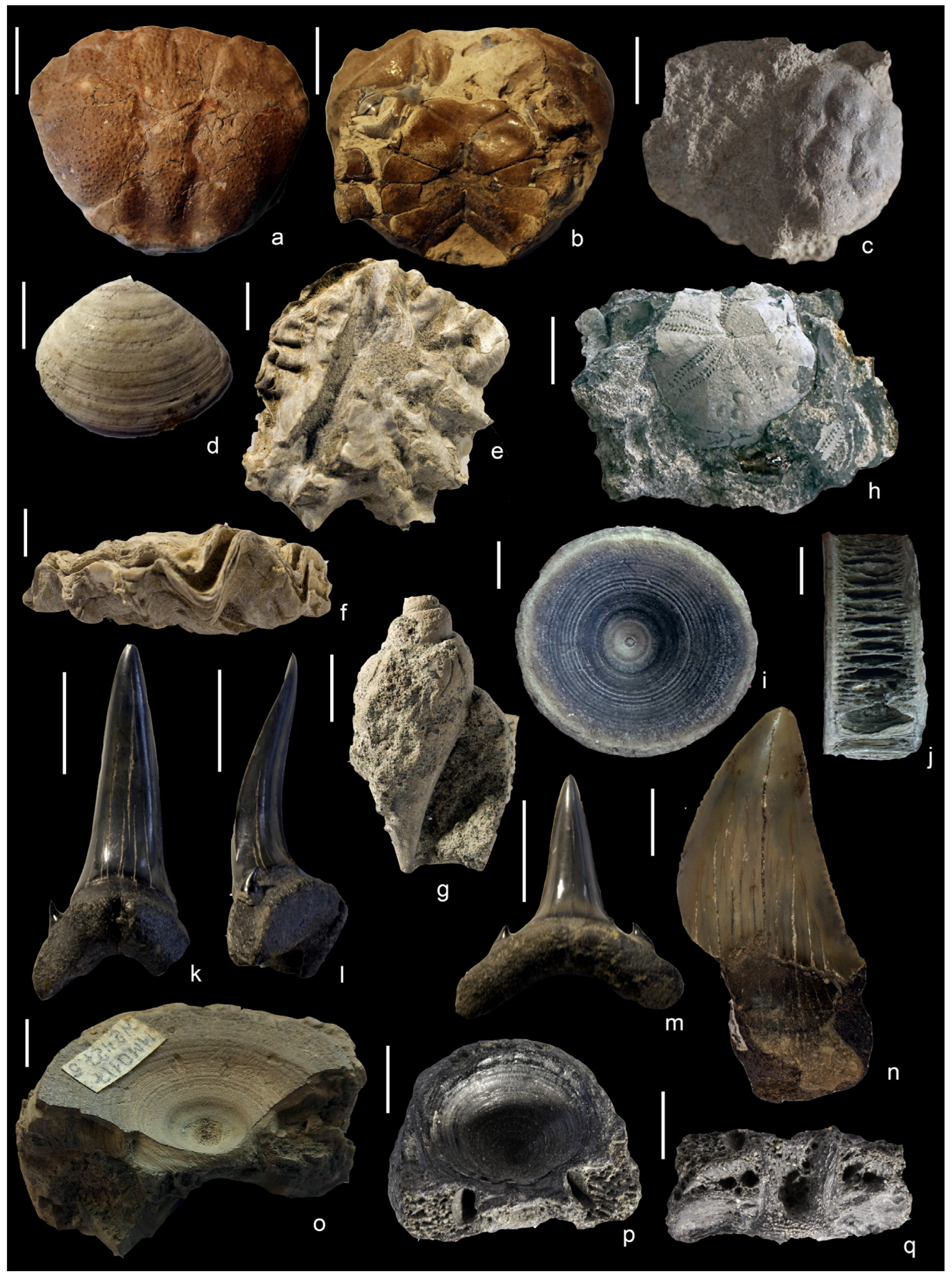
In addition to amber, a rich collection of fossils, with 114 species, was collected from the Eocene-age Blue Ground (35–34 My)—a member of the Prussian Formation [39,40]. Part of it has been recently catalogued [99]. In particular, the crustaceans are very diverse, counting the remains of the barnacles (Balanus unguiformis), the hermit crabs (Pagurus damesii), the lobsters (Hoploparia klebsii), and other crabs, including Calappilia perlata, Palaeotrichia laevis, P. multispinatus, Parthenope bittneri, Micromaia spinosa, Typilobus corrodatus, Noetlingia succini, and Coeloma balticum (Figure 4a–c) [15,56]. Other marine animals are represented by shells of polychaete serpulid worms, such as Serpula flagelliformis, Serpula heptagona, and Ditrupa strangulate.
The most numerous invertebrate faunal element is mollusks [40,100]. They are represented by a large number of species and forms (Figure 4d–g), including scaphopods (Antalis acutum); gastropods (Aporrhais sp., Onustus sp., Fusus sp., Athleta sp., Cilichna sp., Galeodea sp., Pseudoneptunea sp., etc.); and bivalves (Ostrea sp., Gigantostrea sp., Pecten sp., Atrina sp., Nuculana sp., Anomia sp., Arctica sp., Panopea sp., etc.) [14]. Bryozoans comprise the taxa of Cheilostomatida, Lunulitidae, Cribrilinidae, and Adeonellopsis sp. [58]. The sea urchins of the Blue Ground (Figure 4h) are as equally diverse as the bivalves and gastropods. They count 13 different species—Coelopleurus zaddachi, Baueria geometrica, Salenia pellati, Echinocyamus piriformis, Lenita patellaris, Fibulaster michelini, Samlandaster germanicus, Echinolampas subsimilis, Schizaster acuminatus, Hemipatagus sambiensis, Scutella noetlingi, Hemipatagus grignonensis, and Laevipatagus bigibbus [14].
The great diversity of the marine fossils attests to a rich ancient biocenosis at the time of the Blue Ground, about 35–34 million years ago. The ancient aquatic environment was biotically very productive, corresponding to shallow-sea biotopes of coastal sub-littoral settings and warm lagoon waters. In addition to the diverse benthic fauna, numerous pelagic animals, recorded as fragmental bone remains, lived in the waters of the Danish–Polish Strait during the Late Paleogene [15].
Vertebrates of the Blue Ground are represented by the teeth and vertebrae of chimaeras (Edaphodon), sharks and rays (Aetobates sp., Alopias sp., Astrape sp., Otodus sp., Galeocerdo sp., Lamna sp., Odontaspis sp., Squatina sp., and other species) (Figure 4i–q), the remains of ray-finned fish (Pseudosphaerodon), and even crocodile teeth [39]. Numerous sharks’ teeth were collected from borehole cores and in the Primorsky quarry [101]. The largest number of shark teeth comes from the vicinity of Svetlogorsk town (Figure 1B) [102].
The original collection of the Geological and Mineralogical Institute of Königsberg includes, among other paleontological curiosities, a skin plate from an ancient sturgeon, otoliths from the catfish Arius crassus, remnants of turtle and crocodile osteoderms, creodont canines, vertebrae from pythons (genus Palaeophis), and a bone plate with pharyngeal teeth of the wrasse Phyllodus sambiemsis [50].
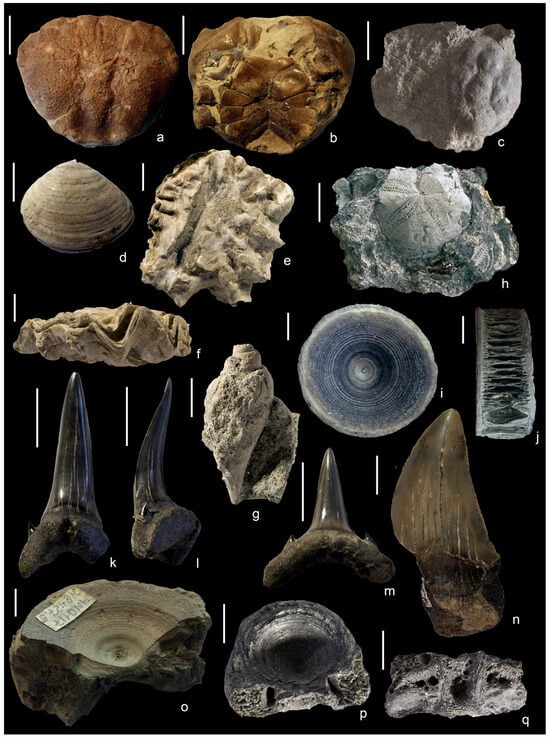
Figure 4.
Fossils of the Blue Ground member (Upper Eocene; ~35–34 My) of the Sambia Peninsula: (a,b) carapace of the crab Coeloma baltica; (c) carapace of the crab Palaeotrichia laevis; (d) valve Cyprina?; (e,f) shell of the oyster Ostrea sp.; (g) poorly preserved gastropod cast; (h) test of the sea urchin Laeoipatagus bigibbus; (i,j) vertebra of a shark; (k,l) tooth of the shark Hypotodus verticalis; (m) tooth of the shark Brachycarcharias cf. lerichei; (n) large tooth (without roots) of the shark Carcharocles sp.; (o) vertebra of the shark Galeomorphi indet.; (p,q) vertebra of the flat-bottomed shark Squatina sp. Scale bar—1 cm. Collection E.I. Kukuev (a,b), from the original coll. of F. Noetling, coll. of V. Van Straalen in Brussels (Royal Belgian Institute of Natural Sciences) (c); coll. of the Museum of the World Ocean (d,g,n,o), the amber combine (e,f,p,q), and coll. of the AO IO RAS (h,i–m); photo by Eduard Mychko.
Figure 4.
Fossils of the Blue Ground member (Upper Eocene; ~35–34 My) of the Sambia Peninsula: (a,b) carapace of the crab Coeloma baltica; (c) carapace of the crab Palaeotrichia laevis; (d) valve Cyprina?; (e,f) shell of the oyster Ostrea sp.; (g) poorly preserved gastropod cast; (h) test of the sea urchin Laeoipatagus bigibbus; (i,j) vertebra of a shark; (k,l) tooth of the shark Hypotodus verticalis; (m) tooth of the shark Brachycarcharias cf. lerichei; (n) large tooth (without roots) of the shark Carcharocles sp.; (o) vertebra of the shark Galeomorphi indet.; (p,q) vertebra of the flat-bottomed shark Squatina sp. Scale bar—1 cm. Collection E.I. Kukuev (a,b), from the original coll. of F. Noetling, coll. of V. Van Straalen in Brussels (Royal Belgian Institute of Natural Sciences) (c); coll. of the Museum of the World Ocean (d,g,n,o), the amber combine (e,f,p,q), and coll. of the AO IO RAS (h,i–m); photo by Eduard Mychko.
4.3. Fossils of Krant Ground
Another fossiliferous unit called Krant Ground is stratigraphically positioned within the upper part (member) of the Prussian Formation overlying the Blue Ground (Figure 2). The unit provides a high diversity of ancient life-forms (Figure 5). The key section is exposed at the western sea coast of the Sambia Peninsula near the villages of Primorye and Filino (Figure 1B). This distinct Paleogene geological body constitutes of compact-cemented red ferruginous sands and sandstones, up to 8–9 m thick, exposed at the bottom of the actively eroded cliffs and overlain by greenish sands and the “Brown Coal Formation” (a common name for the Kurshskaya and Zamlandian Formations).
The lithological composition of the Krant Ground is almost identical to that of its in-land analogue—the Upper Quicksand layer, which is exposed in the Primorsky Amber quarry (Figure 1B). Both layers contain a large proportion of glauconite and other iron minerals—pyrite, marcasite, and siderite. Long-term shallow water stands on the Baltic paleo-coast led to leaching of iron and subsequent oxidation that resulted in the creation of limonites and hard, mineral-percolated rusty-colored ferruginous crusts characterizing this sedimentary facies.
These deposits were first mentioned in the work of Karl Thomas [103], reporting on the enclosed fossils. Various species of bivalves, gastropods, sea urchins, and bryozoans were identified [104]. Altogether, 34 species were described, indicating a faunal diversity poorer than in the Blue Ground (zone A1), with 114 species [39,40]. E Zaddach [32,105] and A Johnsen [106] detailed the geological structure and lithology of these deposits, respectively. The modern interpretation of this geological unit suggests its genetic origin in the intertidal zone close to the coast during the late Eocene [107].
Recent studies have allowed for a close examination of the fossils’ diversity with identification of new taxonomic concepts [14]. The fossil records are sealed within sandstone cobble blocks with secondary concretions in the lower part of the section. The degree of preservation varies from low (imprints and casts or leached voids) to high preservation, where the finest details of structure are visible. The latter examples are exclusive to concretions made of gray sandstone, which are very dense and have a pinkish crust. The most common fossils found in these concretions are shells and casts of large oysters—Ostrea (Cubitostrea) ventilabrum and another species, Ostrea (Cubitostrea) cf. plicata, and rare Gigantostrea gigantica. Bivalves are also represented by a number of families, including Nuculidae, Mytilidae, Pinnidae, Pteriidae, Limopsidae, Glycymeridae, Pectinidae, Limidae, Anomiidae, Astartidae, and Cardiidae, among others. Other Krant Ground mollusks belong to scaphopods (Antalis sp.) and gastropods (Euspira sp., Aporrhais sp., Galeodea sp., Onustus sp., and Athleta sp.) [14,15]. Some isolated fossil-bearing rocks found in these deposits consist entirely of bryozoan colonies or bryozoan biostromes [58].
Numerous ichnofossils appearing in the form of tubes of various sizes and shapes are observed in the outcrops, mainly of the genus Ophiomorpha. These fossil features are interpreted as traces of burrowing marine animals (primarily decapod crustaceans) that used to live in the coastal zone [15]. Occasionally, some corals are found in the deposits. They are represented by both solitary and colonial forms.
Finally, the Eocene sections of the Sambia Peninsula also include the Palvé Formation (Green Wall). If the underlying Blue and Krant Ground deposits were rich in fossils, the macro-faunistic composition of the Palvé Formation is rather poor. It is represented by extremely rare remains of fish [108].
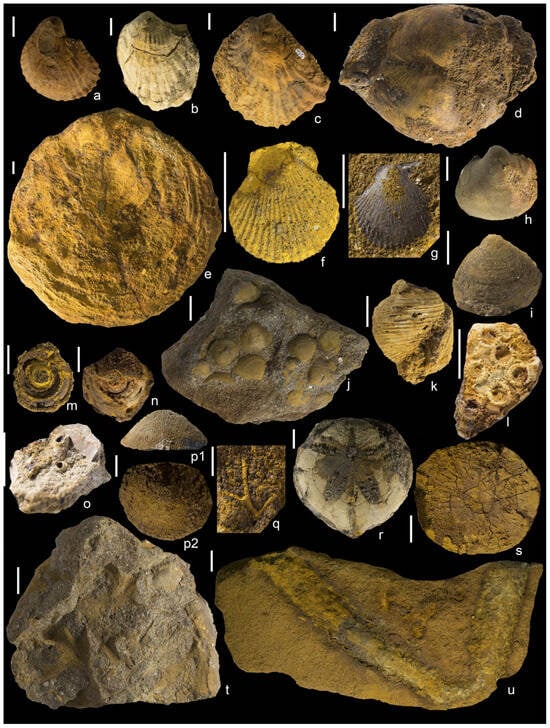
Figure 5.
Fossils of the Krant Ground member (Upper Eocene; ~34 My), the Sambia Peninsula: (a–c) upper valves (cast) of the oysters Ostrea (Cubitostrea) ventilabrum; (d) shell (cast) of Glycymeris cf. obovate; (e) upper valve (cast) of the oyster Gigantostrea gigantica; (f) left valve (cast) of Pecten (Flabellipecten) incurvatus; (g) right valve of Mimachlamys cf. bellicostata; (h) left valve of Nemocardium (Habecardium) cf. tenuisulcatum; (i) left valve of Nemocardium (Habecardium) excomatulum; (j) sandstone with shells of Nemocardium (Habecardium) excomatulum; (k) incomplete shell (cast) of gastropod Athleta (Volutocorbis) cf. suturalis; (l) coral Stylinidae gen. et sp. indet; (m,n) serpulid Vermicularia bognoriensis; (o) fragments of serpulid Ditrupa strangulata; (p1,p2) colony of bryozoans Lunulitidae gen. et sp. indet; (q) colony of bryozoans Onychocellidae gen. et sp. indet.; (r) test of sea urchin Laevipatagus bigibbus; (s) imprint of test of sea urchin Scutella noetlingi; (t) sandstone with imprints of bryozoans? Rectonychocella sp.; (u) burrows of crustacean Ophiomorpha nodosa in sandstone. Scale bar—1 cm. Collection of the AO IO RAS, photo by Eduard Mychko.
Figure 5.
Fossils of the Krant Ground member (Upper Eocene; ~34 My), the Sambia Peninsula: (a–c) upper valves (cast) of the oysters Ostrea (Cubitostrea) ventilabrum; (d) shell (cast) of Glycymeris cf. obovate; (e) upper valve (cast) of the oyster Gigantostrea gigantica; (f) left valve (cast) of Pecten (Flabellipecten) incurvatus; (g) right valve of Mimachlamys cf. bellicostata; (h) left valve of Nemocardium (Habecardium) cf. tenuisulcatum; (i) left valve of Nemocardium (Habecardium) excomatulum; (j) sandstone with shells of Nemocardium (Habecardium) excomatulum; (k) incomplete shell (cast) of gastropod Athleta (Volutocorbis) cf. suturalis; (l) coral Stylinidae gen. et sp. indet; (m,n) serpulid Vermicularia bognoriensis; (o) fragments of serpulid Ditrupa strangulata; (p1,p2) colony of bryozoans Lunulitidae gen. et sp. indet; (q) colony of bryozoans Onychocellidae gen. et sp. indet.; (r) test of sea urchin Laevipatagus bigibbus; (s) imprint of test of sea urchin Scutella noetlingi; (t) sandstone with imprints of bryozoans? Rectonychocella sp.; (u) burrows of crustacean Ophiomorpha nodosa in sandstone. Scale bar—1 cm. Collection of the AO IO RAS, photo by Eduard Mychko.
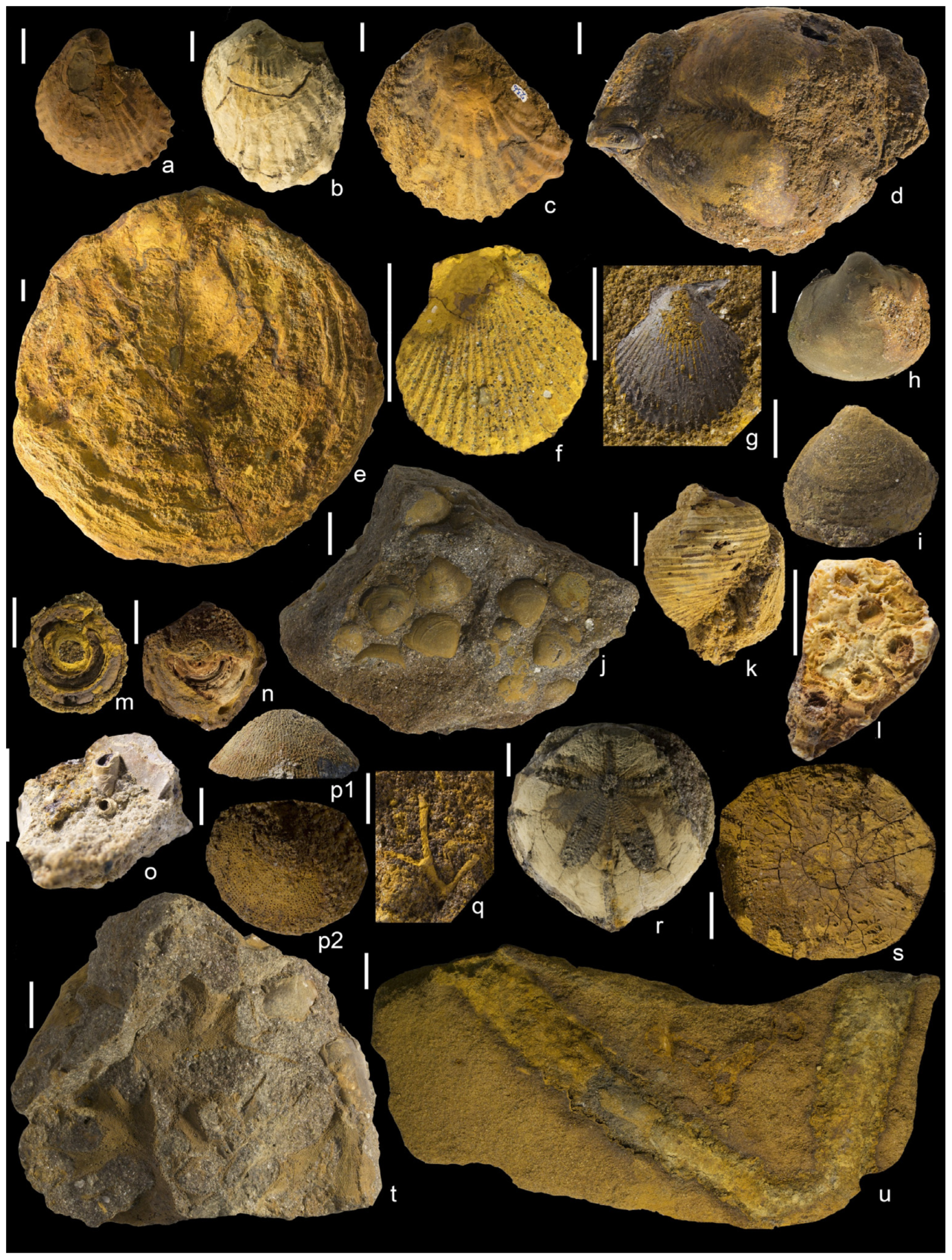
4.4. Oligocene–Neogene Flora Remains
At the Eocene–Oligocene boundary (33.9–33.4 My), defined by the major fauna extinction events, the connection between the North Sea paleo-basin and the Northern Peritethys via the Danish–Polish Strait ceased, and the strait area itself became shallow. In the territory of the southern Baltic region, the former late Eocene sea conditions changed to lagoon-delta settings, and then to continental (river, lake, and marsh) ones, affecting the types of sedimentation and the resulting stratigraphic facies. These deposits are widespread in the west of the Kaliningrad Region and are united in the so-called “Brown Coal Formation” (Figure 2) [33]. The geological strata are distinguished by rich layers of fossil flora [15]. The age of the “Brown Coal Formation” is a subject of debate. The lower part of these deposits was formed at the very end of the Eocene and in the Oligocene–Miocene [109].
The fossil flora on the coast of Kaliningrad have been known for over 200 years [110]. Pine (Pinites thomasianus) cones and hornbeam (Carpinites dubius) leaves, as well as wood from a lignified oak, were found during amber mining [37]. A total of 66 plant taxa of 45 genera were identified [111]. An exceptional collection of over 500 plant imprints, hundreds of fragments of wood, fruits, and seeds were assembled in the mid-20th century, constituting a study base for the Tertiary paleontology of the Kaliningrad region [51,52,112,113,114], including previously unknown fruits [115,116,117].
The fossil flora of this region (Figure 6) significantly differ from the coeval floras around the world. Recent palynological investigations of the contextual layers document mixed coniferous–broad-leaved mesophytic forests that grew along lowland shores occupied by marshy vegetations. Major cooling at the Eocene/Oligocene boundary resulted in the appearance of hemlock in the plant communities and an increase in the proportion of catkins (alder, birch, and hornbeam). Presumably, in the late Oligocene–early Miocene, the proportion of small-leaved trees, especially alder and hazel, sharply increased, while the number of pine trees decreased. Wetter and warmer climatic conditions are assumed for the early Miocene. This time was characterized by the expansion of walnut and cypress trees, and Cyrillaceae. In the middle Miocene (16–11.6 My), the Baltic area climate was still quite warm, but drier. Moisture-dependent species, such as Podocarpus, and swamp cypress Glyptostrobus disappeared from the local plant communities [109].
4.5. Pleistocene Fossils
At the end of the Neogene, about three million years ago, progressing global cooling greatly affected the climate, fauna, and landscapes of the present Kaliningrad Region. During the Pleistocene interglacials, the climate was warmer, yet environmental conditions varied. The southern Baltic area remained ice-free during the climatically moderate interstadials, separating the glacial stages. Mosaic parklands and arid tundra steppes became established during the Last Ice Age (74,000–12,000 years ago), characterized by the periglacial “mammoth fauna” communities.
Fossil finds of the Pleistocene animals in East Prussia were known since the 19th century, primarily from the last interglacial (MIS 5) deposits [50]. The skeletal remains of Ice Age animals included woolly mammoths (Mammuthus primigenius), woolly rhinoceroses (Coelodonta antiquitatis), aurochs (Bos cf. primigenius), horses (Equus cf. ferus), and giant deer (Megaloceros cf. giganteus). The invertebrate records enclose bivalves, including pearl mussels (Unio sp.) and pea mussels (Pisidium obtusale), and gastropods (Valvata piscinalis and Bithynia tentaculate), as well as ostracods, diatoms, and horsetail remains (Figure 7).
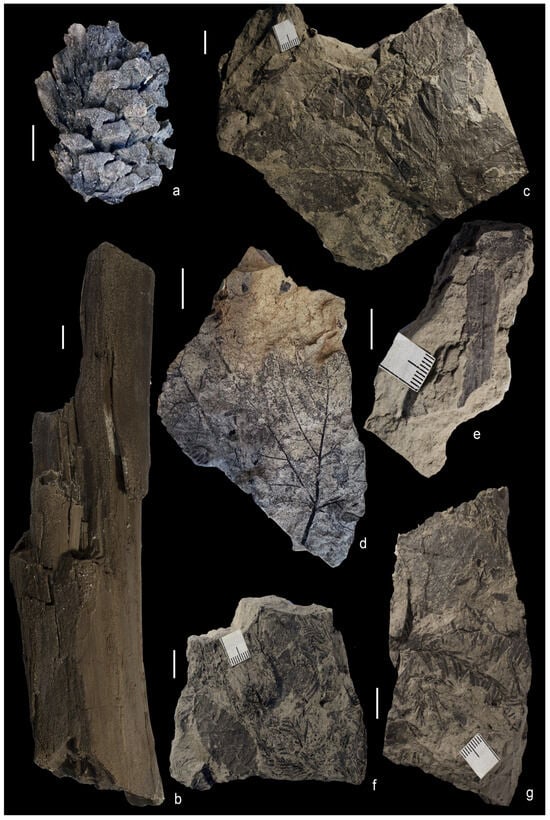
Figure 6.
Oligocene (33.9–23 My) plant remains, Sambia Peninsula: (a) cone of Pinus thomasiana; (b) lignified (mummified) wood; (c) buckthorn leaf imprint (Rhamnus goeppertii); (d) alder leaf imprint (Alnus kefersteinii), (e) tupelo leaf imprint (Nyssa punctata); (f) a leaf imprint of Elaeocarpus microphallus and Taxodium balticum; (g) Baltic cypress leaf imprint (Taxodium balticum). Collection of the AO IO RAS, photo by Eduard Mychko.
Figure 6.
Oligocene (33.9–23 My) plant remains, Sambia Peninsula: (a) cone of Pinus thomasiana; (b) lignified (mummified) wood; (c) buckthorn leaf imprint (Rhamnus goeppertii); (d) alder leaf imprint (Alnus kefersteinii), (e) tupelo leaf imprint (Nyssa punctata); (f) a leaf imprint of Elaeocarpus microphallus and Taxodium balticum; (g) Baltic cypress leaf imprint (Taxodium balticum). Collection of the AO IO RAS, photo by Eduard Mychko.
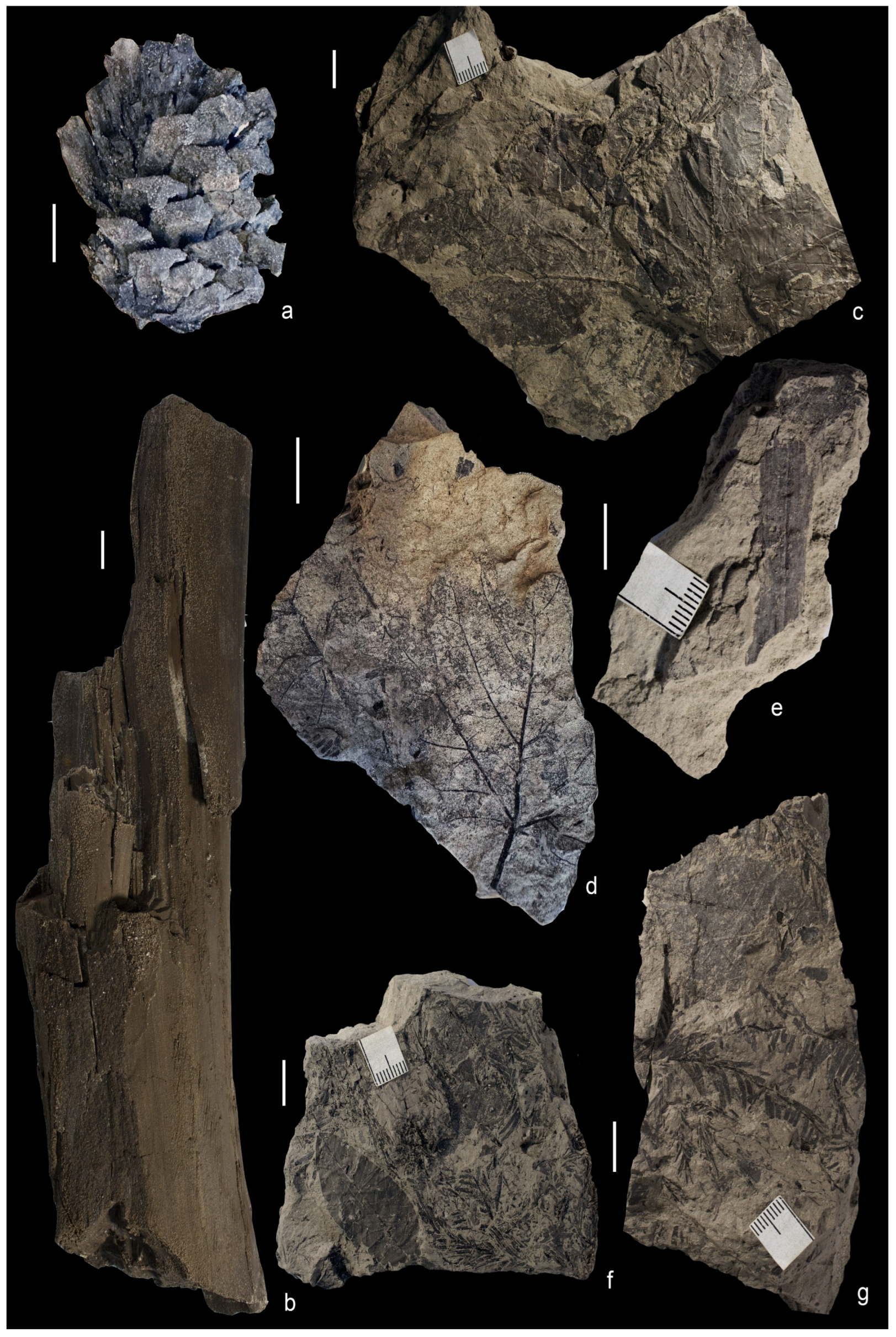
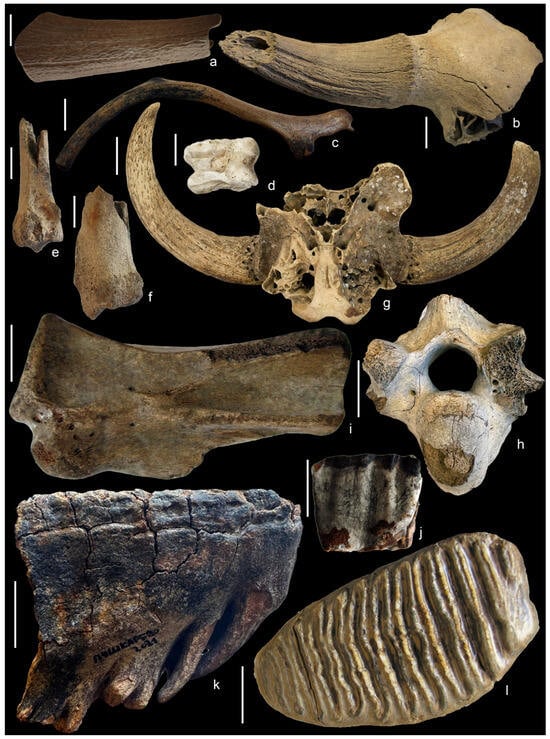
Figure 7.
Bone remains of Pleistocene mammals from the Kaliningrad region: (a) fragment of red deer horn (Cervus cf. elaphus), Sirenevsky quarry; (b) skull fragment of a primitive bison (Bison cf. priscus), a pit under the Europa shopping center in Kaliningrad; (c) rounded horn of a reindeer (Rangifer cf. tarandus), Curonian Spit; (d) astragalus of a red deer (Cervus cf. elaphus), Sirenevsky quarry; (e,f) distal fragment of the radius of a cave lion (Pantera cf. leo spelaea), Sirenevsky sand and gravel quarry; (g) a posterior fragment of the skull of the Eurasian aurochs (Bos cf. primigenius primigenius), the bottom of the Baltic Sea near Zelenogradsk; (h) bison vertebra (Bison cf. priscus), Sirenevsky quarry; (i) a proximal fragment of the scapula of the woolly rhinoceros (Coelodonta cf. antiquitatis), Sirenevsky quarry; (j) incomplete tooth of the woolly rhinoceros (Coelodonta antiquitatis), Sirenevsky quarry; (k,l) teeth of woolly mammoths (Mammuthus primigenius), Sirenevsky quarry. Scale bar—5 cm. Collections of the AO IO RAS (b,d,h,k) and the Museum of the World Ocean (a,c,e,f,i,j,l), photo by Eduard Mychko.
Figure 7.
Bone remains of Pleistocene mammals from the Kaliningrad region: (a) fragment of red deer horn (Cervus cf. elaphus), Sirenevsky quarry; (b) skull fragment of a primitive bison (Bison cf. priscus), a pit under the Europa shopping center in Kaliningrad; (c) rounded horn of a reindeer (Rangifer cf. tarandus), Curonian Spit; (d) astragalus of a red deer (Cervus cf. elaphus), Sirenevsky quarry; (e,f) distal fragment of the radius of a cave lion (Pantera cf. leo spelaea), Sirenevsky sand and gravel quarry; (g) a posterior fragment of the skull of the Eurasian aurochs (Bos cf. primigenius primigenius), the bottom of the Baltic Sea near Zelenogradsk; (h) bison vertebra (Bison cf. priscus), Sirenevsky quarry; (i) a proximal fragment of the scapula of the woolly rhinoceros (Coelodonta cf. antiquitatis), Sirenevsky quarry; (j) incomplete tooth of the woolly rhinoceros (Coelodonta antiquitatis), Sirenevsky quarry; (k,l) teeth of woolly mammoths (Mammuthus primigenius), Sirenevsky quarry. Scale bar—5 cm. Collections of the AO IO RAS (b,d,h,k) and the Museum of the World Ocean (a,c,e,f,i,j,l), photo by Eduard Mychko.
Recent stratigraphic studies of the Borovikovskaya Formation near Kaliningrad have detailed the geological contexts and the taxonomies of the megafauna findings [18], also described in other places of the region (Figure 1) [118,119,120]. The oldest finds of the classical “Mammoth Fauna” date > 50,000–45,000 years ago [121]. Mammoths were widespread within the broader eastern Baltic area 30,000 years ago, and their slow disappearance occurred after the Last Glacial Maximum (22,000–18,000 years ago) [122,123].
The taxonomic diversity of the Pleistocene Elephantidae is not confined to the most recent species—the woolly mammoth (Mammuthus primigenius). According to the latest data from the neighboring Poland [124], the steppe mammoth (Mammuthus trogontherii) and the European straight-tusked elephant (Elephas (Palaeoloxodon) antiquus) roamed the Baltic lowlands in the Early and Late Pleistocene. The recent findings of a scapula of a woolly rhinoceros (Coelodonta cf. antiquitatis) from a quarry near the Rovnoye village and other rhinoceros bones (near the Talpaki, Sirenevsky, Novosirenevsky, and Pushkarevsky pits) attest to the common presence of this animal along with other large herbivores once occupying the eastern Baltic territory [15].
Bone fragments of other animals, such as the European aurochs (Bos cf. primigenius) skull (Zelenogradsk) (Figure 1B), have been recently collected [15]. The modern form of the Ice Age animal survived until the early 17th century; the last individual died in 1627 in a forest near Warsaw. The other Ice Age species, such as the primitive bison or steppe bison (Bison cf. priscus), reindeer (Rangifer tarandus), red deer (Cervus cf. elaphus), and a caballoid horse (Equus cf. caballus), provide evidence of the last glacial tundra forests and open parklands. A radius bone of a cave lion (Panthera cf. leo spelaea) from the Sirenevsky pit points to the presence of the large Pleistocene carnivore in the investigated area [125].
Overall, the Pleistocene fauna records document biotically productive biotopes along the fluctuating and retreating Scandinavian ice-sheet margin during the Last Ice Age and the early post-glacial period, respectively. Tundra, forest–tundra, and periglacial parkland steppes were the principal ecosystems. Preservation of the skeletal remains varies according to the local geological contexts and the times of recovery of the fossil records.
4.6. Glacial Erratics Fossils
Quaternary glaciations largely transformed the land physiography of the region. Cubic kilometers of rocks were repeatedly transported hundreds and thousands of kilometers from their source areas in Scandinavia during ice advances. The Pliocene relief was periodically flattened by glaciers, with the most recent ones reaching the eastern Baltic limits during the Late Pleistocene (130,000–12,000 years ago) glacial stages [26,27,28]. The former Neogene landscapes were dissected by the glacial ablation flows, forming a gullied top surface. The continental ice transported large rock blocks (glacial erratics), as well as rather heterogeneous glacigenic (till) deposits composed of angular rock debris and gravels within a silty–sandy–clayey matrix. During ice melting, these subglacial or supraglacial moraine accumulations structured elevated hills separated by hummocky depressions filled by finer clastic (silty–clayey) sediments.
On the sea coast of the Sambia Peninsula, as well as in the in-land quarries in the Kaliningrad Region, a diversity of the ice-derived sedimentary materials brought by the Scandinavian glaciers is found. These mostly well-rounded erratic rocks include various lithified fossils of the entire Phanerozoic age, encompassing the last one billion years. Because of the sealing, hard rocky contexts, the incorporated small fossils are largely well-preserved, subjected to past lithification processes.
Cambrian (550–488 My) fossiliferous rocks (Figure 8a) are the most common, represented by banded compact sandstones and quartzites of a violet, pinkish, and purple color. Some of the clasts display a fine layering (the Kalmarsund sandstones), and the others consist of perpendicular columns (sandstones with Skolithos); they have a stripped structure (the Chiasma sandstones) or a laminated bedding (sandstones with Xenusion). Other rocks show textural variations and recrystallization [15]. The first scientific reports of these fossiliferous erratics, enclosing lithified fauna, date to the late 19th and early 20th centuries [38,126]. Clastics of the ancient Cambrian carbonate rocks are very rare. A Cambrian bituminous limestone from moraine deposits incorporating a trilobite was found near Pasłęk (Poland), 40 km south of the present Kaliningrad border [41].
Ordovician (488–443 My) glacial erratics sealing ancient forms of life (Figure 8b–j) compose more than half of the sedimentary rocks found within the glaciogenic deposits of the SE Baltic area. These materials with ancient fossils caught scientific attention at the very beginning of paleontological investigations in Eastern Prussia [38,127,128,129], resulting in a detailed taxonomic classification [126]. The present (below) description follows the classification system of the modern Paleozoic collections from northern Germany [130,131,132], recently supplemented and revised [15,133,134].
Based on the lithological characteristics, age, and the geological provenience of the fossiliferous erratics, the following principal petrographic groups can be identified: Ceratopyge-limestone and shale; a variegate red and grey Orthoceras-limestone; light-gray pebbly conglomerates with Athiella jentzschi brachiopods; limestone with remains of the cephalopod Anthoceras vaginatum; coelosphaeridium-limestone, among other rocks.
The diversity of the fossils incorporated in the Ordovician boulder- and cobble-size deposits of the Kaliningrad Region is wide-ranging, including the remains of both flora and fauna. There are calcareous algae—receptaculites (Receptaculitaphyceae) and paleoporella (Palaeoporelleae); sponges; hyoliths; corals; conularians; bryozoans; brachiopods; gastropods; ostracods; echinoderms; bivalves; rostroconchs; monoplacophoran; cephalopods; trilobites; and graptolites, among the other aquatic life-forms [15,38,41,127,128,129,130,131,132,135,136,137,138,139,140,141,142,143,144]. These fossils altogether document flourishing past marine ecosystems.
Silurian (443–419 My) fossiliferous rocks (Figure 8k–s), well-known since the late 19th century [38,127,128,129], are widespread in the glacial deposits of the southern Baltic region, next in the distribution frequency to the Ordovician rocks.
The most common types of the Silurian fossil-bearing sedimentary rocks include boulder-to-cobble-size limestone with the brachiopods Borealis borealis; siltstone boulders with the brachiopods Pentamerus oblongus; shale erratics with the graptolites Cyrtograptus and Rastrites; coralline limestone; crinoid limestone; conglomerates with the crinoids Phacites gothladicus; a light-gray shale with the grapholites Colonographus colonus; greenish-grey graptolithe rocks; limestone with the Ilionia bivalve; and other facies [126]. The most common erratic rock is the Beyrichian limestone, hosting abundant Beyrichiidae ostracods. Overall, the fossils are as diverse and numerous as the Ordovician ones [15].
Particularly taxonomically varied are corals, represented by the tabulate and rugosa groups of a broad geological age (the Late Llandoverian to Ludlowian) and geographical provenance. These rocks mostly relate to the parent coralline limestone bedrock on Gotland [38,126,127]. Conularians and crinoids are also found, with the latter forming varieties of crinoid limestone. In particular, brachiopods enclosed in the Silurian rocks serve for determining the geological age of the paleontological records [127,128,129], along with the bryozoans, mollusks, and trilobites. Ostracods from the Baltic Silurian formations mirror the wide diversity of the ancient marine fauna [138,145,146,147,148].
In addition to trilobites and ostracods, other extinct arthropods, such as the eurypterids Eurypterus fischeri, occur [38,127,131]. The Silurian graptolites are considered as classic [44]. Finally, the erratics of the Silurian rocks often contain remains of vertebrates, such as primitive fish-like animals—acanthodians and thelodonta [127,131,149].
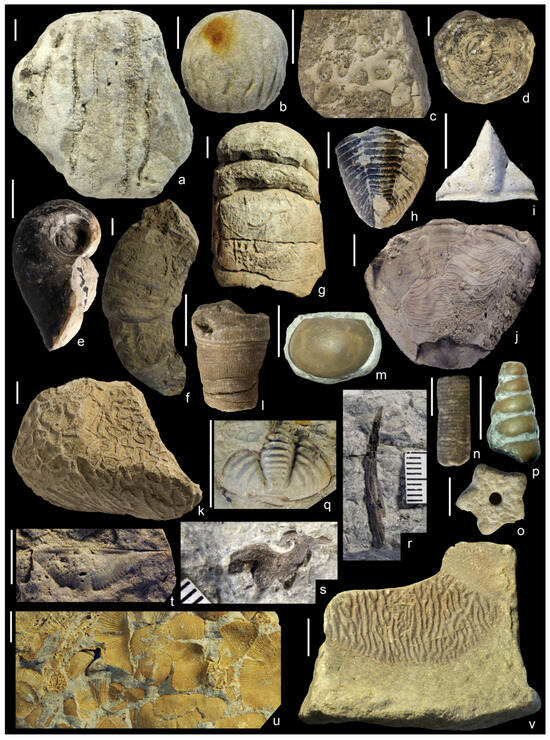
Figure 8.
Paleozoic fossils from the Quaternary glacial erratics. (a) Cambrian; (b–j) Ordovician; (k–s) Silurian; (t–v) Devonian; (a) Early Cambrian sandstone boulder with burrows of Diplocraterion isp.; (b) sponge Astylospongia cf. praemorsa; (c) bryozoan Stictoporellinae gen. sp. indet.; (d) bryozoan Diplotrypa sp., a ventral view; (e) cast of gastropod shell Salpingostoma sp.; (f) cast of cephalopod shell Oelandoceras erraticum; (g) cast of cephalopod shell Endoceras sp.; (h) trilobite pygidium Toxochasmops macrourus; (i) trilobite cranidium Lonchodomas postrostratus; (j) trilobite pygidium Pseudasaphus tecticaudatus; (k) tabulate coral Catenipora sp.; (l) rugosa coral (unidentified); (m) large ostracod Leperditia sp.; (n) fragment of crinoid stem; (o) segment of crinoid stem; (p) gastropod shell Murchisonia articulata; (q) trilobite pygidium Calymene sp.; (r) acanthode spike Acanthodii gen. indet.; (s) dental spiral of Ischnacanthiformes gen. indet.; (t) brachiopod Cyrtospiri fervjacheslavi; (u) dolomite with numerous casts and shell imprints of brachiopods of various species; (v) scale of porolepiform Holoptychius? sp. Scale bar—1 cm. Collection of the AO IO RAS.
Figure 8.
Paleozoic fossils from the Quaternary glacial erratics. (a) Cambrian; (b–j) Ordovician; (k–s) Silurian; (t–v) Devonian; (a) Early Cambrian sandstone boulder with burrows of Diplocraterion isp.; (b) sponge Astylospongia cf. praemorsa; (c) bryozoan Stictoporellinae gen. sp. indet.; (d) bryozoan Diplotrypa sp., a ventral view; (e) cast of gastropod shell Salpingostoma sp.; (f) cast of cephalopod shell Oelandoceras erraticum; (g) cast of cephalopod shell Endoceras sp.; (h) trilobite pygidium Toxochasmops macrourus; (i) trilobite cranidium Lonchodomas postrostratus; (j) trilobite pygidium Pseudasaphus tecticaudatus; (k) tabulate coral Catenipora sp.; (l) rugosa coral (unidentified); (m) large ostracod Leperditia sp.; (n) fragment of crinoid stem; (o) segment of crinoid stem; (p) gastropod shell Murchisonia articulata; (q) trilobite pygidium Calymene sp.; (r) acanthode spike Acanthodii gen. indet.; (s) dental spiral of Ischnacanthiformes gen. indet.; (t) brachiopod Cyrtospiri fervjacheslavi; (u) dolomite with numerous casts and shell imprints of brachiopods of various species; (v) scale of porolepiform Holoptychius? sp. Scale bar—1 cm. Collection of the AO IO RAS.
Devonian (419–359 My) fossiliferous rocks (Figure 8t–v) are less common than the Ordovician and Silurian ones; they are mainly represented by various brachiopods [128]. The fossils associate with two main lithological facies—dolomites and sandstones [127]. The varying hardness of the yellow-gray to red-gray-colored dolomites predetermines the selective preservation of the fossils, which are recorded exclusively in the form of casts. The variegate reddish to white sandstone facies are rather rare, delivering brachiopods and fragmented fish remains [50].
The Lower Devonian fossiliferous clastics are rare; they are represented by the Givetian sandstones sealing imprints of primitive vascular plants, and conglomerates hosting fish remains [134,150]. Occasionally, a light-gray fossiliferous limestone with crustacean-conchostracan shells is encountered [15].
Remains of vertebrates occur in the Devonian boulders of the Kaliningrad Region, as well as in the bedrock throughout the area of the Main Devonian field (the northwestern part of the Russian Platform, with a wide distribution of Devonian deposits). Among them, fragments of agnathans (jawless fishes) are widespread, including heterostracans in particular. Remains of psammosteid heterostracans and acanthodians (an extinct class of jawed fishes) are also common. Fossils of placoderms (primitive jawed fishes) are occasionally found, represented mainly by two large orders—antiarchs and arthrodires [15].
Carboniferous, Permian, and Triassic (359–201 My) fossiliferous records in the Quaternary glacigenic deposits of the region are close to absent. This is despite the proximity of the major Permian formations in northern Lithuania [151], and small outcrops on the shelf of the Baltic Sea [21]. These geological bodies were apparently not eroded by the expanding northern ice-sheets and remained protected by an overburden cover. Surficial exposure of the time-corresponding erratics cannot be locally excluded.
Jurassic (201–143 My) boulders are, on occasion, found in unsorted glacial deposits. However, these time-corresponding fossiliferous materials are fairly rare (Figure 9a–e), and largely represented lithologically by a dense, dark-brown limestone and a calcareous sandstone incorporating oolithes of iron hydroxides, along with abundant detritus fragments of ammonites and bivalves. The fossil content and the lithological characteristics of the rocks indicate their linkage to the Middle and Upper Jurassic deposits.
The Jurassic fossil records were studied by numerous researchers [152,153,154,155]. Dinocysts (dinoflagellate cysts) from the Callovian-age boulders were described in detail [43,45,46]. The erratics also include shells of various ammonites: Eichwaldiceras, Quenstedtoceras, Cosmoceras, Peltoceras, and many other genera [15]. Occasionally, large nautilus shells are found. Bivalves are very diverse and numerous, and in the taxonomic composition, similar to the assemblages from the deposits of Lithuania and northern Germany [156,157]. Gastropods are less diverse and poorly preserved [15]. Belemnites (Belemnopsis hastate) in the Callovian boulders occur as small rostra and are very rare, as well as brachiopods (Rhynchonelloidella varians). Rare representatives of the terebratulid Terebratula lahuseni are encountered [15]. In terms of fossil flora, a leaf fragment of a fern (Sagenopteris caledonica) was recorded in association with fossil shells [158].
Cretaceous (143–66 My) fossils sealed in the glacial erratic boulders and cobbles (Figure 9f–m) include widespread light-gray marls, white chalks, and black flints. These rocks, found frequently in glacial moraines of the region, are very rich in fossils. On some modern beaches, the Late Cretaceous petrographic and mineralogical components make up to 90% of the coarse-grained coastal clastic material. The incorporated fossil record is largely represented by numerous fossilized sponge hexactinellids of various forms—cup-shaped, mushroom-shaped, complex curved labyrinths, and others [159].
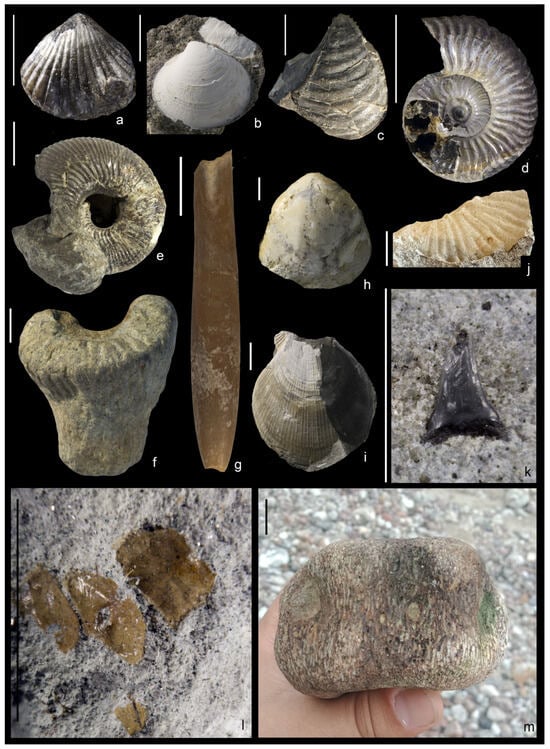
Figure 9.
Fossils from the Mesozoic glacial erratics of the Kaliningrad Region: (a–e) Jurassic; (f–m) Cretaceous; (a) brachiopod shell Rhynchonelloidella varians; (b) bivalve Anisocardia? sp.; (c) bivalve Trigonia sp.; (d) ammonite shell Quenstedtoceras vertumnum; (e) ammonite shell Eichwaldiceras sp.; (f) sponge Rhizopoterion? sp.; (g) belemnite rotstra Belemnitella sp.; (h) shell of the brachiopod Terebratula carnea; (i) bivalve shell Pecten cretosus; (j) fragment of imprint of shell of ammonite Schloenbachia varians; (k) shark tooth; (l) scales of bony fish; (m) mosasaur vertebra. Scale bar—1 cm. Collection of the AO IO RAS, photo by Eduard Mychko.
Figure 9.
Fossils from the Mesozoic glacial erratics of the Kaliningrad Region: (a–e) Jurassic; (f–m) Cretaceous; (a) brachiopod shell Rhynchonelloidella varians; (b) bivalve Anisocardia? sp.; (c) bivalve Trigonia sp.; (d) ammonite shell Quenstedtoceras vertumnum; (e) ammonite shell Eichwaldiceras sp.; (f) sponge Rhizopoterion? sp.; (g) belemnite rotstra Belemnitella sp.; (h) shell of the brachiopod Terebratula carnea; (i) bivalve shell Pecten cretosus; (j) fragment of imprint of shell of ammonite Schloenbachia varians; (k) shark tooth; (l) scales of bony fish; (m) mosasaur vertebra. Scale bar—1 cm. Collection of the AO IO RAS, photo by Eduard Mychko.
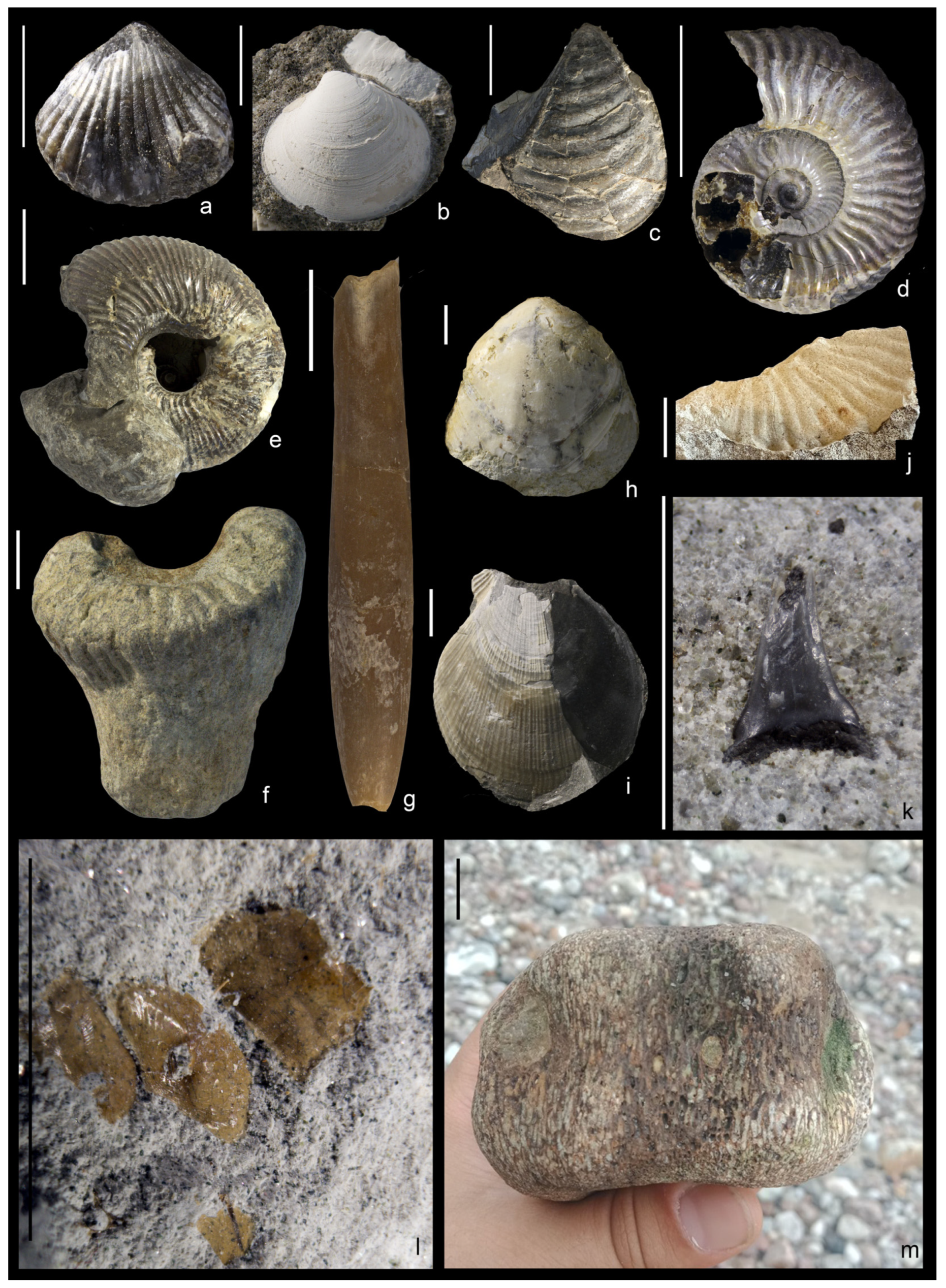
Belemnite rostra are the second most common among the Cretaceous fossils, with the genus Belemnitella being the most ordinary belemnite representatives. The size of the rostra varies from a few millimeters to 15 cm [15]. Bivalves entail grypheids, pectenids, inoceramids, pinnas, cardiids, and other groups. Gastropods are less diverse and rare, as well as ammonites and brachiopods from the Late Cretaceous Cenomanian rocks [39]. These fossil-bearing erratics enclose the heteromorphic ammonites Turrilites costatus [50] and the brachiopod species Lingula krausei [160].
Remains of vertebrates are occasionally found in the Upper Cretaceous lithic facies. The retrieved fossils include the teeth of ancient sharks of different sizes and morphologies discovered in the Neman River in Lithuania, together with marine reptile remains [161]. Ichnofossils of Lepidenteron lewesiensis, in the appearance of unbranched burrows lined-up by small fish scales and bones, are sometimes found in white and light-gray marls [162]. A tooth of Ptychodus (shark) discovered near Zelenogradsk was recently described [163].
Rare remains of Cretaceous marine reptiles were previously reported; most of the finds belonged to the species Plesiosaurus and Mosasaurus [164]. Finally, the most recent finds are represented by marine reptile remains [15].
5. Discussion: The South-East Baltic Paleontology and Geoheritage
The above overview illustrates the wide diversity and natural beauty of the ancient fossil archives of diverse geological ages, formation histories, and contextual provenance. The complex regional surficial geology, affected by periodic marine transgressions, major aridization stages, and repeated glaciations, resulted in the present mosaic relief hosting unique geo-forms. At the same time, the documented fossiliferous geo-sites underline the key relevance of the fossil geoheritage of the Kaliningrad Region, which used to be one of the most renowned European centers of paleontological explorations of the 19th and the early 20th century. In spite of the uniqueness of the presently defined geo-sites, incorporating affluent fossil materials [13], the overall public consciousness of their scientific value is still rather minor. Some sites, such as the Krant Ground at Primorye–Filino, are popular places for geological excursions and amateur fossil collecting. Natural science organization and geological fieldwork training for Immanuel Kant Baltic Federal University students is held there on a regular basis.
The geological instability of the area, because of the post-glacial neotectonics [165] along with strengthening geomorphic processes such as sea-wave erosion, constitutes the principal risk to the most unique paleontological sites distributed along the western coast. Some of the paleontologically most valuable places are increasingly threatened by the Baltic Sea storm surges and cliff undercutting, causing a progressing erosion of the shorelines. This process is observed along the entire southern Baltic region [166,167]. The Eocene Krant Ground cliffs in Filino Bay, found at the westernmost extension of the Sambia Peninsula (Figure 1B), experience a progressive retreat due to the dominant west-oriented wave streams, leading to gradual destruction of this unique paleontological locality. The negative effects of these natural processes are best observed in Filino Bay, as well as at some other coastal geo-sites of the peninsula (Svetlogorsk and Donskoye), delivering numerous fossils washed out from the Krant Ground outcrops [168].
Modern industrial and development activities, along with individual human actions, can equally impose negative effects to the paleontological geoheritage of the Kaliningrad Region. Large-scale constructions and gravel exploitation at the in-land gravel sites may cause much harm and a permanent loss of the buried pre-Quaternary records, as well as the Pleistocene fossil-bearing beds. A separate issue is the expanding illegal fossil collecting and mining of the amber-sealing deposits. Another adverse factor is amateurs “hunting” for fossils, including their underwater collection. This concerns both the amber inclusions and the fossiliferous erratics of the Blue Ground and the Krant Ground, respectively. These principal fossil-hosting geological formations call for immediate legal state protection. Implementation of appropriate and effective geo-environmental strategies is most essential to secure some paleontological sites from complete destruction.
The documented principal paleontological geoheritage loci of the Kaliningrad Region [13], combining the scientifically relevant site geology and rich fossil records, have a solid potential for initiation of cognitive and educational geo-tourism [169,170]. This concerns, in particular, the amber sites and the associated exhibitions in Yantarnoe and Kaliningrad. Compared to the Polish and Lithuanian sectors of the Baltic coast, where the amber deposits also occur, although so far not in such quantities [171,172,173], this branch of (geo-)tourism is still marginal and largely omitted by local tour operators.
The plentiful paleontological records from the glacial erratics offer a very promising field of investigations of an international scientific relevance. This study was initiated by prominent German paleontologists working in the former East Prussia, such as Gustav Zaddach, Gottlieb Berendt, Carl Erich Andre, Fritz Noetling, and many others, more than 150 years ago. Already at that time, numerous unique species of past flora and fauna, found exclusively in the local fossiliferous outcrops and rocks, were described.
6. Conclusions
The SE Baltic area of the Kaliningrad Region represents a unique place, providing witness to its complex paleo-geographical development and long geological history. The multifaceted natural evolution over the past hundreds of millions of years generated a broad array of geo-forms and the prominent geological bodies, sealing rich fossil records of various ages and differential preservation. Most of the findings of the past flora and fauna originate from the stratified formations within the coastal cliffs of the Sambia Peninsula that are subjected to progressive sea erosion. The two-hundred-year-long history of paleontological investigations provided a solid professional background for the modern fossil-record studies integrated into the international geoheritage concept of the Baltic space. The East Baltic amber presents the most informative source of ancient biota. The affluent amber-bearing bodies with uncovered paleontological records are world-unique. The existing/potential anthropogenic and natural risks call for effective state protection of the principal paleontological geo-sites within the area. Administrative regulations for industrial/development land management should be put into practice to minimize the risks of destruction of the fossiliferous (and other) sites. The concept of geo-conservation has to be law-implemented to ensure the long-term preservation of the principal paleontological geo-sites for future generations.
The rest of the former extensive collections of fossils, largely lost during WW2, still provide a base for comparative studies of amber inclusions and fossils from the glacial erratics. The present investigations follow this grand legacy. A systematic search for new fossil specimens, completing the previously described ancient biotic species, has a fundamental relevance for modern, exact taxonomic studies. Re-installation of the once-famous German paleontological school in the frame of the current research should integrate the national geoheritage program and the European geo-conservation strategy. Public awareness on the natural wealth and the historical geological uniqueness of the Kaliningrad Region is most important. The great diversity of organisms sealed in the Paleogene amber inclusions, along with the other paleontological records enclosed within the stratified geological formations and the chronologically wide-ranging glacial erratics, underline their major scientific value and research significance. Implementation of the regional geoheritage concept as a part of the country’s tourism industry with new-fangled (geo-site) destinations opens new opportunities for local tour operators.
Author Contributions
Conceptualization and investigations, E.M. and J.C.; methodology, E.M.; formal analysis, E.M. and J.C.; resources, E.M.; data curation, E.M.; writing—draft, E.M. and J.C.; writing—review and editing, J.C.; E.M. prepared the pre-Quaternary paleontology part; J.C. prepared the regional geology, geoheritage, and the Quaternary paleontology sections of the present study. All authors have read and agreed to the published version of the manuscript.
Funding
The paleontological studies (E.M) were carried out within the state assignment of the Ministry of Science and Higher Education of the Russian Federation for the IO RAS (Theme No. FMWE-2024-0025), and by the Environmental Research Centre, Stare Mesto, Czech Republic (J.C).
Data Availability Statement
The data presented in this study are available on request (E.M.).
Acknowledgments
Joint field investigations were organized by the MWO, Kaliningrad.
Conflicts of Interest
The authors declare no conflict of interest.
References
- Gray, M. Geodiversity: Valuing and Conserving Abiotic Nature; John Wiley & Sons: Chichester, UK, 2013; 495p. [Google Scholar]
- Page, K.N.; Meléndez, G.; Gonera, M. Protected sites or protected heritage?—Systems and opinions for palaeontological conservation from a trans European perspective. In Towards the Balanced Management and Conservation of the Geological Heritage in the New Millenium; Barettino, D., Vallejo, M., Gallego, E., Eds.; Sociedad Geológica de España: Madrid, Spain, 1999; pp. 45–51. [Google Scholar]
- Page, K.N. Fossils, heritage and conservation: Managing demands on a precious resource. In Geoheritage: Assessment, Protection, and Management; Reynard, E., Brilha, J., Eds.; Elsevier: Chennai, India, 2018; pp. 107–128. [Google Scholar]
- DeMiguel, D.; Brilha, J.; Alegret, L.; Arenillas, I.; Arz, J.A.; Gilabert, V.; Strani, F.; Valenciano, A.; Villas, E.; Azanza, B. Linking geological heritage and geoethics with a particular emphasis on palaeontological heritage: The new concept of ‘palaeontoethics’. Geoheritage 2021, 13, 69. [Google Scholar] [CrossRef]
- Grigorescu, D.A. Paleontological Heritage and its Conservation in the UNESCO European Geoparks. Geoconserv. Res. 2021, 4, 6–24. [Google Scholar]
- Willman, S.; Bauert, H.; Raukas, A. Fostering geotourism on Central Baltic islands. In Proceedings of the 8th European Geoparks Conference, Idanha-a-Nova, Portugal, 14–16 September 2009. [Google Scholar]
- Raukas, A.; Stankowski, W. The Kaali crater field and other geosites of Saaremaa Island (Estonia): The perspectives for a geopark. Geologos 2010, 16, 59–68. [Google Scholar] [CrossRef]
- Strzelecki, M.C.; Duszyński, F.; Tyszkowski, S.; Zbucki, Ł. Limestone Sea Stacks (Rauks) Record Past Sea Levels and Rocky Coast Evolution in the Baltic Sea (Gotland and Farö Islands, Sweden). Front. Earth Sci. 2022, 16, 895419. [Google Scholar] [CrossRef]
- Skridlaite, G.; Gedminiene, L.; Vaznyte, J.; Saarmann, S. Geology interpretation at a spot: Knowledge transfer, geoheritage and geoconservation problems in the protected areas of Lithuania. In Proceedings of the 20th EGU General Assembly, Vienna, Austria, 4–13 April 2018; p. 2367. [Google Scholar]
- Jamorska, I.; Sobiech, M.; Karasiewicz, T.; Tylmann, K. Geoheritage of postglacial areas in northern Poland—Prospects for geotourism. Geoheritage 2020, 12, 12. [Google Scholar] [CrossRef]
- Migoń, P. Granite Landscapes, Geodiversity and Geoheritage—Global Context. Heritage 2021, 4, 198–219. [Google Scholar] [CrossRef]
- Skibiński, J.; Kultys, K.; Baran-Zgłobicka, B.; Zgłobicki, W. Geoparks in SE Poland as Areas of Tourism Development: Current State and Future Prospects. Resources 2021, 10, 113. [Google Scholar] [CrossRef]
- Chlachula, J.; Mychko, E.V. Geoheritage of the Kaliningrad Region, SE Baltic Coast. Geoheritage 2023, 15, 132. [Google Scholar] [CrossRef]
- Mychko, E.V.; Popov, S.V.; Koromyslova, A.V.; Goncharova, I.A.; Berezovsky, A.A.; Sladkovskaya, M.G.; Iakovleva, A.I.; Kalyakin, E.A.; Dorokhova, E.V. “Krant ground” of the Sambian Peninsula (Kaliningrad Region): Orictofossil assemblage and formation conditions. Bull. Mosc. Soc. Nat. Geol. Ser. 2021, 96, 1–66. (In Russian) [Google Scholar]
- Mychko, E.V. The Fossil Record of the Amberland: The Natural History of the Kaliningrad Region; Phyton XXI: Moscow, Russia, 2022; 320p. (In Russian) [Google Scholar]
- Sivkov, V.V.; Zhamoida, V.A. Amber deposits in the Kaliningrad Region. In Terrestrial and Inland Water Environment of the Kaliningrad Region; Gritsenko, V.A., Ed.; The Handbook of Environmental Chemistry; Springer: Berlin/Heidelberg, Germany, 2018; Volume 65, pp. 33–44. [Google Scholar]
- Krek, A.; Ulyanova, M.; Koschavets, S. Influence of land-based Kaliningrad (Primorsky) amber mining on coastal zone. Mar. Pollut. Bull. 2018, 131, 1–9. [Google Scholar] [CrossRef] [PubMed]
- Zagorodnykh, V.A.; Dovbnya, A.V.; Zhamoida, V.A. Stratigraphy of the Kaliningrad Region; Department of Natural Resources of Russia for the North-West Region: Kaliningrad, Russia, 2001; 226p. (In Russian) [Google Scholar]
- Pira, V.; Flodén, T.; Mokrik, R. The Baltic Sea basin in the geology of Fennoscandia and Baltic region. Short Sci. Rep. 2003, 2003, 134–137. [Google Scholar]
- Ūsaitytė, D. The geology of the southeastern Baltic Sea: A review. Earth-Sci. Rev. 2000, 50, 137–225. [Google Scholar] [CrossRef]
- Kirikov, V.P. Stratigrafiya. In State Geological Map of the Russian Federation. Scale 1:1,000,000 (Third Generation). Ser. Central European. Sheet N-(34) Kaliningrad. Explanatory Note; Lukyanova, N.V., Bogdanov, Y.B., Vasileva, O.V., Vargin, G.P., Eds.; Kartfabrika VSEGEI: St. Petersburg, Russia, 2011; pp. 11–74. (In Russian) [Google Scholar]
- Otmas, A.A.; Grigiriev, G.A.; Zitner, Y.I.; Soloveva, Y.I. Resource base of the Kaliningrad region and the prospects for expansion. Geomodel 2018, 1, 1–6. (In Russian) [Google Scholar]
- Babakov, A. Morphology and dynamics of the Baltic Sea Shore within Kaliningrad Oblast (overview). Arch. Hydro-Eng. Environ. Mech. 2018, 65, 177–202. [Google Scholar] [CrossRef]
- Kasiński, J.R.; Kramarska, R.; Słodkowska, B.; Sivkov, V.; Piwocki, M. Paleocene and Eocene deposits on the eastern margin of the Gulf of Gdańsk (Yantarny P-1 borehole, Kaliningrad region, Russia). Geol. Q. 2020, 64, 29–53. [Google Scholar] [CrossRef]
- Mikhnevich, G.S. Features of the surface structure pre-quaternary deposits in the Kaliningrad region. Bull. St. Petersburg State Univ. Ser. Geol. Geogr. 2015, 7, 21–35. (In Russian) [Google Scholar]
- Lambeck, K.; Purcell, A.; Zhao, J.; Svensson, N.O. The Scandinavian Ice Sheet: From MIS 4 to the end of the Last Glacial Maximum. Boreas 2010, 39, 410–435. [Google Scholar] [CrossRef]
- Makkaveyev, A.N.; Faustova, M.A.; Karpukhina, N.V. Maximum extent of the Valdaian (Weichselian) glaciation and relief in the peripheral area of the ice sheet. Geomorfologiya 2020, 3, 3–19. (In Russian) [Google Scholar]
- Korsakova, O.; Vashkov, A.; Nosova, O. European Russia: Glacial Landforms from the Last Glacial Maximum. In European Glacial Landscapes; Palacios, D., Hughes, P.D., Andrés, N., Eds.; Elsevier: Amsterdam, The Netherlands, 2022; pp. 389–393. [Google Scholar]
- Bitinas, A.; Damušytė, A. Influence of Neotectonics to the development of coastal zone of the South-Eastern Baltic. In Proceedings of the Volume of Abstracts, 2nd MELA Conference Glaciotectonic Structures, Palaeobasins and Neotectonic Setting, Vilnius, Lithuania, 27–31 August 2007. [Google Scholar]
- Khorikov, V.I.; Neevin, I.A.; Sergeev, A.Y.; Prishchepenko, D.V. Results of geological hazards monitoring of the south-eastern Baltic coastal zone (the Russian Sector). In Coastal Marine Zone: Investigations, Management, Perspectives; 2018; pp. 38–44. (In Russian) [Google Scholar]
- Ryabchuk, D.; Sergeev, A.; Burnashev, E.; Khorikov, V.; Neevin, I.; Kovaleva, O.; Danchenkov, A. Coastal processes in the Russian Baltic (eastern Gulf of Finland and Kaliningrad area). Q. J. Eng. Geol. Hydrogeol. 2021, 54, 2020–2036. [Google Scholar] [CrossRef]
- Zaddach, E.G. Über die Bernstein- und Braunkohlenlager des Samlandes. Schriften Phys.-Okon. Ges. Zukönigsberg Pr. 1860, 1, 1–44. (In German) [Google Scholar]
- Zaddach, E.G. Das Tertiärgebirge des Samlandes. Schriften Phys.-Okon. Ges. Zukönigsberg Pr. 1868, 8, 85–197. (In German) [Google Scholar]
- Berendt, G. Geologie des Kurischen Haffes und Seiner Umgebung; W Koch Commission: Königsberg, Russia, 1869; pp. 131–238. (In German) [Google Scholar]
- Schellwien, E. Geologische Bilder von der samländischen Küste. Schriften Phys.-Okon. Ges. Königsberg Preuss. 1905, 44, 1–43. (In German) [Google Scholar]
- Tornquist, A. Geologie Ostpreussen; Borntrager: Konigsberg, Germany, 1910; 231p. (In German) [Google Scholar]
- Göppert, H.R.; Berendt, G.C. Der Bernstein und die in ihm Befindlichen Pflanzenreste der Vorwelt; Commission der Nicolaischen Buchhandlung: Berlin, Germany, 1845; 126p. (In German) [Google Scholar]
- Noetling, F. Die Cambrischen und Silurischen Geschiebe der Provinzen Ost- und West-Preussen; Jahrbuch der Königlich Preussischen Geologischen Landesanstalt und Bergakademie zu Berlin: Berlin, Germany, 1882; pp. 261–324. (In German) [Google Scholar]
- Noetling, F. Die Fauna des Samländischen Tertiärs. Teil I (Vertebrata, Crustacea und Vermes, Echinodermata). In Abhandlungen zur Geologischen Specialkarte von Preussen und den Thüringischen Staaten; Preussische Geologische Landesanstalt: Berlin, Germany, 1885; Volume 8, pp. 1–216. (In German) [Google Scholar]
- Noetling, F. Die Fauna des Samländischen Tertiärs. Teil II (Gastropoda, Pelecypoda, Bryozoa, Geologischer Theil). In Abhandlungen zur Geologischen Specialkarte von Preussen und den Thüringischen Staaten; Preussische Geologische Landesanstalt: Berlin, Germany, 1888; Volume 6, pp. 1–109. (In German) [Google Scholar]
- Pompeckj, J.F. Die Trilobiten-Fauna der Ostund Westpreussischen Diluvialgeschiebe; Beiträgezur Naturkunde Preussens Herausgegeben; Physikalisch-Ökonomischen Gesellschaft zu Königsberg: Königsberg, Germany, 1890; Volume 7, pp. 1–97. (In German) [Google Scholar]
- Andrée, K. Die wissenschaftlicheBedeutung des Bernsteins und neuereBernsteinforschungen. Forschungen Fortschritte 1936, 12, 357–359. (In German) [Google Scholar]
- Eisenack, A. Mikrofossilien aus Doggergeschieben Ostpreussens. In Zeitschrift für Geschiebeforschung und Flachlandsgeologie; Nägele & Obermiller: Stuttgart, Germany, 1935; Volume 11, pp. 167–184. (In German) [Google Scholar]
- Eisenack, A. Neue Graptolithen aus Geschiebenbaltischen Silurs. Palaeontol. Z. 1935, 17, 73–90. (In German) [Google Scholar] [CrossRef]
- Eisenack, A. Dinoflagellaten aus dem Jura. Ann. Protistol. 1936, 5, 59–63. (In German) [Google Scholar]
- Eisenack, A. Eodiniapachytheca n. g.n, sp., einprimitiver Dinoflagellat aus einem KellowayGeschiebe Ostpreussens. In Zeitschrift für Geschiebeforschung und Flachlandsgeologie; Nägele & Obermiller: Stuttgart, Germany, 1936; Volume 12, pp. 72–75. (In German) [Google Scholar]
- Manukyan, A.R. Chastnoe kollekcionirovanie yantarya s vklyucheniyami v Kaliningrade (Private amber collections in Kaliningrad). In Kollekciya v Prostranstve Kultury: Tezisy Dokladov Mezhdunarodnoj Nauchnoj Konferencii 18–21 Sentyabrya 2017 g; Kaliningradskij Oblastnoj Muzej Yantarya: Kaliningrad, Russia, 2018; pp. 74–76. (In Russian) [Google Scholar]
- Ritzkowski, S. Curiosities in Baltic amber from the Konigsberg amber collection, now in the Gottingen collection. In Amber—Views—Opinions; International Amber Association: Gdańsk, Poland, 2006; pp. 58–61. [Google Scholar]
- Andrée, K. Die Albertus-Universität. Schicksal und Leistung. In Ostpreußen. Leistung und Schicksal; Gause, F., Ed.; Burkhard-Verlag: Essen, Germany, 1958; pp. 239–257. (In German) [Google Scholar]
- Jentzsch, A. Führer Durch Die Geologischen Sammlungen des Provinzial-Museums der Physikalisch-Ökonomischen Gesellschaft zu Königsberg; Wilh-Koch: Königsberg, Germany, 1892; 106p. (In German) [Google Scholar]
- Budantsev, L.Y.; Sveshnikova, I.N. Tertiary flora of the Kaliningrad Peninsula. II. Bot. J. 1959, 8, 1154–1158. (In Russian) [Google Scholar]
- Budantsev, L.Y.; Sveshnikova, I.N. Tertiary flora of the Kaliningrad Peninsula IV. In Proceedings of the Botanical Institute of the USSR Academy of Sciences. Ser. 8, Paleobotany; Botanical Institute of the USSR Academy of Sciences: St. Petersburg, Russia, 1964; Volume 5, pp. 83–112. (In Russian) [Google Scholar]
- Paškevičius, J. Geology of the Baltic Republic; Valstubinis Leidybos Centras: Vilnius, Lithuania, 1999; 387p. [Google Scholar]
- Poinar, G.O. Life in Amber; Stanford University Press: Stanford, CA, USA, 1992; 350p. [Google Scholar]
- Weitschat, W.; Wichard, W. Atlas of Plants and Animals in Baltic Amber; Verlag Friedrich Pfeil: Muenchen, Germany, 2002; 256p. [Google Scholar]
- Mychko, E.V. New findings of crabs of Coelomabalticum in Eocene of the Sambia Peninsula (Kaliningrad Region). Bull. Mosc. Soc. Nat. Geol. Ser. 2018, 93, 63–72. (In Russian) [Google Scholar]
- Mychko, E.V.; Tarasenko, K.K. The first finding of Basilosauridae (Mammalia: Cetacea) in Upper Eocene of Baltic States (Russia, Kaliningrad region). Paleontol. J. 2020, 54, 311–318. [Google Scholar] [CrossRef]
- Koromyslova, A.V.; Mychko, E.V. Upper Eocene (Priabonian) bryozoans from the Sambia Peninsula of the Kaliningrad Oblast (Russia). Neues Jahrb. Für Geol. Paläontologie–Abh. 2024, 312, 133–165. [Google Scholar] [CrossRef]
- Zaddach, E.G. Ein Amphipodeim Bernstein. Schriften Phys.-Okon. Ges. Zukönigsberg Pr. 1864, 5, 1–12. (In German) [Google Scholar]
- Keyser, D.; Weitschat, W. First record of ostracods (Crustacea) in Baltic amber. Hydrobiologia 2005, 538, 107–114. [Google Scholar] [CrossRef]
- Bachofen-Echt, A. Uber die Myriapoden des Bernsteins. Palaeobiologica 1942, 7, 394–403. (In German) [Google Scholar]
- Haug, J.T.; Muller, C.H.G.; Sombke, A. A centipede nymph in Baltic amber and a new approach to document amber fossils. Org. Divers. Evol. 2013, 13, 425–432. [Google Scholar] [CrossRef]
- Wesener, T. The oldest pill millipede fossil: A species of the Asiatic pill millipede genus Hyleoglomeris in Baltic amber (Diplopoda: Glomerida: Glomeridae). ZoologischerAnzeiger 2019, 283, 40–45. [Google Scholar] [CrossRef]
- Manukyan, A.R. Mikromir Yantarya. Paleosistematika. (World of Amber. Paleosystematics), Part 1; Kaliningradskij Oblastnoj Muzej Yantarya: Kaliningrad, Russia, 2019; 54p. (In Russian) [Google Scholar]
- Krzeminska, E.; Krzeminski, W. Les Fantomes de l’ambre; Musée d’Histoire Naturelle: Neuchatel, Switzerland, 1992; 142p. [Google Scholar]
- Dunlop, J.A.; Marusik, Y.; Vlaskin, A.P. Comparing Arachnids in Rovno Amber with the Baltic and Bitterfeld Deposits. Paleontol. J. 2019, 53, 1074–1083. [Google Scholar] [CrossRef]
- Weidner, H. Eine Zecke, Ixodes succineus sp. n. im baltischen Bernstein. Veröffentlichungen Uberseemus. Brem. 1964, 3, 143–151. (In German) [Google Scholar]
- Sellnick, M. Die Oribatiden der Bernsteinsammlung der Universitat Konigsberg i. Pr. Schriften Phys.-Okon. Ges. Zukönigsberg Pr. 1918, 59, 21–42. (In German) [Google Scholar]
- Dunlop, J.A.; Wunderlich, J.; Poinar, G.O., Jr. The first fossil opilioacariform mite (Acari: Opilioacariformes) and the first Baltic amber camel spider (Solifugae). Trans. R. Soc. Edinb. Earth Sci. 2004, 94, 261–273. [Google Scholar] [CrossRef]
- Dunlop, J.A.; Klann, A.E. A second camel spider (Arachnida: Solifugae) from Baltic amber. Acta Geol. Pol. 2009, 59, 39–44. [Google Scholar]
- Silvestri, F. Die Thysanuren des baltischen Bernsteins. Schriften Phys.-Okon. Ges. Zukönigsberg Pr. 1912, 53, 42–66. (In German) [Google Scholar]
- Wheeler, W.M. The Ants of the Baltic Amber. Schriften Phys.-Okon. Ges. Zukönigsberg Pr. 1914, 55, 1–141. (In German) [Google Scholar]
- Cockekell, T.D.A. Descriptions of Hymenoptera from Baltic Amber. Schriften Phys.-Okon. Ges. Zukönigsberg Pr. 1909, 50, 1–20. (In German) [Google Scholar]
- Cockekell, T.D.A. Some Additional Bees from Prussian Amber. Schriften Phys.-Okon. Ges. Zukönigsberg Pr. 1909, 50, 21–25. (In German) [Google Scholar]
- Alekseev, V.I. Coleoptera from the middle-upper Eocene European ambers: Generic composition, zoogeography and climatic implications. Zootaxa 2017, 4290, 401–443. [Google Scholar] [CrossRef]
- Alekseev, V.I. The beetles (Insecta: Coleoptera) of Baltic amber: The checklist of described species and preliminary analysis of biodiversity. Zool. Ecol. 2013, 23, 5–12. [Google Scholar] [CrossRef]
- Kulicka, R.; Kosmowska-Ceranowicz, B. Rare organic inclusions in the Baltic amber. Estud. Mus. Cienc. Nat. Alava 1999, 14, 155–160. [Google Scholar]
- Balashov, I.A.; Perkovsky, E.E. An Eocene land snail Balticoptagusakovi gen.n., sp.n. (Stylommatophora: Gastrocoptidae) from Baltic amber. Invertebr. Zool. 2020, 17, 18–24. [Google Scholar] [CrossRef]
- Borsuk-Białynicka, M.; Lubka, M.; Bohme, W. A lizard from Baltic amber (Eocene) and the ancestry of the crown group lacertids. Acta Palaeontol. Pol. 1999, 44, 349–382. [Google Scholar]
- Bauer, A.M.; Bohme, W.; Weitschat, W. An Early Eocene gecko from Baltic amber and its implications for the evolution of gecko adhesion. J. Zool. 2005, 265, 327–332. [Google Scholar] [CrossRef]
- Sidorchuk, E.A.; Bochkov, A.V.; Weiterschan, T.; Chernova, O.F. A case of mite-on-mammal ectoparasitism from Eocene Baltic amber (Acari: Prostigmata: Myobiidaeand Mammalia: Erinaceomorpha). J. Syst. Palaeontol. 2018, 17, 331–347. [Google Scholar] [CrossRef]
- Caspary, R.; Klebs, R. Die Flora des Bernsteins und anderer fossiler Harze des ostpreussischen Tertiärs. Thallophyta. 2. Bryophyta. 3. Pteridophyta. 4. Gymnospermae. Abh. Königlich Preußischen Geol. Landesanst. 1906, 4, 1–182. [Google Scholar]
- Göppert, H.R.; Menge, A. Die Flora des Bernsteins und ihre Beziehungen zur Flora der Tertiarformation und der Gegenwart, 1. Band: Von den Bernstein-Coniferen, Insbesondereauch in IhrenBeziehungenzu den Coniferen der Gegenwart; Verlag von Wilhelm Engelmann: Leipzig, Germany, 1883; 63p. (In German) [Google Scholar]
- Conwentz, H. Die Flora des Bernsteins: Zweiter Band. Die Angiospermen des Bernsteins; Verlag von Wilhelm Engelmann: Leipzig, Germany, 1886; 140p. (In German) [Google Scholar]
- Wolfe, A.P.; Tappert, R.; Muehlenbachs, K.; Boudreau, M.; McKellar, R.C.; Basinger, F.; Garret, A. A new proposal concerning the botanical origin of Baltic amber. Proc. R. Soc. B Biol. Sci. 2009, 276, 3403–3412. [Google Scholar] [CrossRef]
- Katinas, V. Yantar’ iYantaronosnye Otlozheniya Yuzhnoj Pribaltiki; Tr. Lit-NIGRI: Vilnius, Lithuania, 1971; Volume 20, 156p. (In Russian) [Google Scholar]
- Turkin, N.I.; Dedkov, V.V. Dominanty yantarnogo lesa (Dominants of the amber forest). In Teoreticheskie I Prikladnye AspektyBiologii: Mezhvuz. Sb. Nauch. Tr.; Kaliningrad State University Press: Kaliningrad, Russia, 1999; pp. 21–28. (In Russian) [Google Scholar]
- Ander, K. Die Insektenfauna des Baltischen Bernsteins nebst damit verknüpften zoogeographischen Problemen; Lunds Universitets Årsskrift, N.F.: Lund, Sweden, 1942; Volume 38, pp. 1–83. (In German) [Google Scholar]
- Sadowski, E.M.; Schmidt, A.R.; Denk, T. Staminate inflorescences with in situ pollen from Eocene Baltic amber reveal high diversity in Fagaceae (oak family). Willdenowia 2020, 50, 405–517. [Google Scholar] [CrossRef]
- Sadowski, E.M.; Hofmann, C.C. The largest amber-preserved flower revisited. Sci. Rep. 2023, 13, 17. [Google Scholar] [CrossRef]
- Sadowski, E.M.; Seyfullah, L.J.; Sadowski, F.; Fleischmann, A.; Behling, H.; Schmidt, A.R. Carnivorous leaves from Baltic amber. Proc. Natl. Acad. Sci. USA 2014, 112, 190–195. [Google Scholar] [CrossRef]
- Sadowski, E.M.; Seyfullah, L.J.; Wilson, C.A.; Calvin, C.L.; Schmidt, A.R. Diverse early dwarf mistletoes (Arceuthobium), ecological keystones of the Eocene Baltic amber biota. Am. J. Bot. 2017, 104, 694–718. [Google Scholar] [CrossRef]
- Sadowski, E.M.; Schmidt, A.R.; Rudall, P.J.; Simpson, D.A.; Grohn, C.; Wunderlich, J.; Seyfullah, L.J. Graminids from Eocene Baltic amber. Rev. Palaeobot. Palynol. 2016, 233, 161–168. [Google Scholar] [CrossRef]
- Nikishin, A.M.; Ziegler, P.A.; Stephenson, R.A.; Cloetingh, S.A.P.L.; Furne, A.V.; Fokin, P.A.; Ershov, A.V.; Bolotov, S.N.; Korotaev, M.V.; Alekseev, A.S.; et al. Late Precambrian to Triassic history of the East European Craton: Dynamics of sedimentary basin evolution. Tectonophysics 1996, 268, 23–63. [Google Scholar] [CrossRef]
- Wichard, W.; Grohn, C.; Seredszus, F. Aquatic Insects in Baltic Amber; Verlag Kessel: Remagen-Oberwinter, Germany, 2009; 336p. [Google Scholar]
- Weitschat, W.; Wichard, W. Baltic Amber. In Biodiversity of Fossils in Amber from the Major World Deposits; Penney, D., Ed.; Siri Scientific Press: Manchester, UK, 2010; pp. 80–115. [Google Scholar]
- Kaasalainen, U.; Schmidt, A.R.; Rikkinen, J. Diversity and ecological adaptations in Paleogene lichens. Nat. Plants 2017, 3, 7049. [Google Scholar] [CrossRef] [PubMed]
- Rikkinen, J.K.; Schmidt, A. Morphological Convergence in Forest Microfungi Provides a Proxy for Paleogene Forest Structure. In Transformative Paleobotany. Papers to Commemorate the Life and Legacy of Thomas N. Taylor; Krings, M., Harper, C.J., Cuneo, N.R., Rothwell, G.W., Eds.; Academic Press: Cambridge, MA, USA, 2018; pp. 527–549. [Google Scholar]
- Daniels, C.H.; Heinke, A.; Heunisch, C.; Lindert, W.; Wiese, T. Wissenschaftliche Originale in den Sammlungen BGR/NLfB Hannover und BGR Berlin. Schriftenverzeichnis; Bundesanstalt für Geowissenschaften und Rohstoffe: Berlin, Germany, 1999; 93p. (In German) [Google Scholar]
- von Koenen, A. Revision der Mollusken–Fauna des SamlandischenTertiars. In Abhandlungen zur Geologischen Specialkarte von Preussen und den Thüringischen Staaten; Preussische Geologische Landesanstalt: Berlin, Germany, 1894; Volume 10, pp. 1366–1392. (In German) [Google Scholar]
- Zharkov, M.P.; Glikman, L.S.; Kaplan, A.A.; Krasnov, S.G.; Strelnikova, N.I. O vozraste paleogena Kaliningradskoj oblasti (On the Paleogene chronology of the Kaliningrad coast). Izv. SSSR Seriya Geol. 1976, 1, 132–135. (In Russian) [Google Scholar]
- Kukuev, E.I.; Batal’yants, K.Y. Zuby akul v okamenelostyakh poberezhya Zemlandskogo poluostrova (Shark teeth in fossils of the Zemlandsk Peninsula coast). In Kompleksnoe Izuchenie Bassejna Atlanticheskogo Okeana; Kaliningrad State University Press: Kaliningrad, Russia, 2006; pp. 86–91. (In Russian) [Google Scholar]
- Thomas, K. Die Bernsteinformation des Samlandes. Preußische Prov.-Blätter 1847, 3, 241–245. (In German) [Google Scholar]
- Erman, A.; Herter, P. Ueber Tertiärschichten, welche die bemsteinführende Braunkohle an der Samländischen Ostseeküstebedecken. Z. Dtsch. Geol. Ges. 1850, 2, 410–427. (In German) [Google Scholar]
- Zaddach, E.G. Über die Tertiärbildungen des Samlandes. Schriften Phys.-Okon. Ges. Königsberg Pr. 1867, 8, 85–197. (In German) [Google Scholar]
- Johnsen, A. Über den Krant des Zipfelberges im Samland. Schriften Phys.-Okon. Ges. Königsberg Pr. 1907, 47, 46–51. (In German) [Google Scholar]
- Standke, G. Die Tertiärprofile der samländischen Bernsteinküste bei Rauschen. Schriftenreihe Geowiss. 1998, 7, 93–133. (In German) [Google Scholar]
- Voigt, E. Ein Fischskelett aus dem unteroligozänen Grünsand von Palmnicken im Samland. Z. Dtsch. Geol. Ges. 1937, 89, 72–76. (In German) [Google Scholar]
- Kuzmina, O.B.; Iakovleva, A.I.; Mychko, E.V. The Age and Depositional Settings of the Upper Paleogene–Lower Neogene Kurshskaya Formation in its Stratotype Section (Kaliningrad Oblast) based on Palynological Data. Stratigr. Geol. Correl. 2023, 31, 657–675. [Google Scholar] [CrossRef]
- Schweigger, A.F. Beobachtungen auf Naturhistorischen Reisen; Georg Reimer: Berlin, Germany, 1819; 130p. (In German) [Google Scholar]
- von Heer, O. Miocene baltische Flora. Beiträge Naturkunde Preuss. 1869, 2, 104. (In German) [Google Scholar]
- Sveshnikova, I.N.; Budantsev, L.Y. Tertiary flora of the Kaliningrad Peninsula. I. Bot. J. 1959, 44, 211–214. (In Russian) [Google Scholar]
- Sveshnikova, I.N.; Budantsev, L.Y. Tertiary flora of the Kaliningrad Peninsula. III. Bot. J. 1960, 45, 871–875. (In Russian) [Google Scholar]
- Dorofeev, P.I.; Sveshnikova, I.N. On representatives of the genus Athrotaxis from the Paleogene of the Kaliningrad region. Paleontol. J. 1963, 2, 116–125. (In Russian) [Google Scholar]
- Vikulin, S.V. Fruits of Symplocaceae in the Oligocene flora of the Kaliningrad region. Bot. J. 2010, 95, 631–636. (In Russian) [Google Scholar]
- Vikulin, S.V. Fruits of Ericaceae (Ericales: Epacridaceae, Ericaceae) in the Oligocene floras of the Kaliningrad and Voronezh regions. Bot. J. 2010, 95, 59–69. (In Russian) [Google Scholar]
- Vikulin, S.V. Fruits of Arctostaphylos (Ericaceae) in the Oligocene flora of the Kaliningrad region. Bot. J. 2011, 96, 863–868. (In Russian) [Google Scholar]
- Martynovich, N.V.; Grishanov, G.V. The remains of the mammoth fauna in the Kaliningrad Region. In Fundamental Problems of the Quaternary, Results of the Study and the Main Trends of Further Research; Publishing House of the SB RAS: Irkutsk, Russia, 2015; pp. 303–305. (In Russian) [Google Scholar]
- Martynovich, N.V.; Grishanov, G.V. Woolly rhinoceros (Coelodonta antiquitatis) in the Kaliningrad Region. Baikal Zool. J. 2016, 2, 44–47. (In Russian) [Google Scholar]
- Kuzmin, Y.V.; van der Plicht, J.; Martynovich, N.V.; Grishanov, G.V. The first radiocarbon dates from the bones of mammoths (Mammuthus primigenius) in the Kaliningrad region (Russia). In Eurasia in the Cenozoic. Stratigraphy, Paleoecology, Cultures; Publishing House ISU: Irkutsk, Russia, 2016; Volume 5, pp. 38–42. (In Russian) [Google Scholar]
- Kuzmin, Y.V.; Martynovich, N.V.; Van Der Plicht, J. The first radiocarbon and stable isotope data for megafauna remains in Kaliningrad Province, Russia. J. Quat. Sci. 2024, 40, 367–371. [Google Scholar] [CrossRef]
- Sommer, R.S.; Benecke, N. First radiocarbon dates on woolly mammoth (Mammuthusprimigenius) from northern Germany. J. Quat. Sci. 2009, 24, 902–905. [Google Scholar] [CrossRef]
- Ukkonen, P.; Aaris-Sorensen, K.; Arppe, L.; Clark, P.U.; Daugnora, L.; Lister, A.M.; Lougas, L.; Seppa, H.; Sommer, R.S.; Stuart, A.J.; et al. Woolly mammoth (Mammuthus primigenius Blum.) and its environment in northern Europe during the last glaciations. Quat. Sci. Rev. 2011, 30, 693–712. [Google Scholar] [CrossRef]
- Pawłowska, K. Elephantids from Pleistocene Poland: State of knowledge. Quat. Int. 2015, 379, 89–105. [Google Scholar] [CrossRef]
- Martynovich, N.V. The first discovery of a cave lion (Panthera leospelaea) in the Kaliningrad region. Baikal Zool. J. 2020, 1, 49–51. (In Russian) [Google Scholar]
- Roedel, H. Sedimentärgeschiebe (Uebersicht-Literatur). Neubearbeitungstatteineszweiten Nachtrages. Helios 1926, 29, 70–140. (In German) [Google Scholar]
- Roemer, F. Lethaea erratica oder Aufzählung und Beschreibung der in der norddeutschenEbenevorkommenden Diluvial-Geschiebenordischer Sedimetär-Gesteine. Geol. Paläontologische Abh. 1885, 2, 250–420. (In German) [Google Scholar]
- Kiesow, J. Uebersilurische und devonische Geschiebe Westpreussens. Schriften Naturforschenden Ges. Danz. Neue Folge 1884, 6, 205–303. (In German) [Google Scholar]
- Gagel, C. Die Brachiopoden der cambrischen und silurischen Geschiebeim Diluvium der Provinzen Ost- und West-preussen; Beiträgezur Naturkunde Preussens Herausgegeben; Physikalisch-Ökonomischen Gesellschaft zu Königsberg: Königsberg, Germany, 1890; Volume 6, pp. 1–79. (In German) [Google Scholar]
- Neben, W.; Krueger, H.H. Fossilienordovicischer Geschiebe. Staringia 1971, 1, 3–60. (In German) [Google Scholar]
- Neben, W.; Krueger, H.H. Fossilienordovicischer und silurischer Geschiebe. Staringia 1973, 2, 3–73. (In German) [Google Scholar]
- Neben, W.; Krueger, H.H. Fossilien kambrischer, ordovicischer und silurischer Geschiebe. Staringia 1979, 5, 1–63. (In German) [Google Scholar]
- Rudolph, F.; Bilz, W.; Pittermann, D. Fossilien an Nord- und Ostsee. Finden und Bestimmen; Quelle & Meyer: Wiebelsheim, Germany, 2010; 288p. (In German) [Google Scholar]
- Rudolph, F. Strandsteine. Available online: http://strandsteine.de/ (accessed on 13 January 2025). In German.
- Steinhardt, E.T.G. Die bis jetzt in Preussische Geschiebengefundenen Trilobiten; Beiträgezur Naturkunde Preussens Herausgegeben; Physikalisch-Ökonomischen Gesellschaft zu Königsberg: Königsberg, Germany, 1874; Volume 3, pp. 1–64. (In German) [Google Scholar]
- Dewitz, H. Beiträge zur Kenntniss der in den ostpreussisclien Silurgesclieben-vorkommenden Cephalopoden. Schriften Phys.-Okon. Ges. Zukönigsberg Pr. 1879, 20, 162–180. (In German) [Google Scholar]
- Schröder, H. BeiträgezurKenntniss der in ostundwestpreussischen Diluvialgeschiebengefundenen Silurcephalopoden. Schriften Phys.-Okon. Ges. Zukönigsberg Pr. 1881, 22, 54–96. (In German) [Google Scholar]
- Schallreuter, R. Ostrakoden aus ordovizischen Geschieben Westfalens I. Geol. Paläontologie Westfal 1987, 7, 15–29. (In German) [Google Scholar]
- Rhebergen, F. A new Ordovician astylospongiid sponge (Porifera) as an erratic from Baltica. Neth. J. Geosci. 2004, 83, 255–265. [Google Scholar] [CrossRef]
- Rhebergen, F. Short note on three species of Ordovician Orchocladina (Demospongea, Porifera). Scr. Geol. 2011, 143, 123–126. [Google Scholar]
- Malinky, J.M. Hyolitha from the Early Paleozoic glacial erratic boulders (Geschiebe) of Germany and Poland. Foss. Rec. 2007, 10, 71–90. [Google Scholar] [CrossRef]
- Amler, M.R.W.; Lohrengel, A.F. Ein Pseudobigaleai der Rostroconch in einem ober ordovizischen Geschiebe [A Pseudobigaleaid Rostroconch from an Upper Ordovician Geschiebe]. Arch. Geschiebekd 2015, 7, 261–276. (In German) [Google Scholar]
- Keulen, P.; Rhebergen, F. Typology and fossil assemblage of Sandbian (Ordovician) ‘baksteenkalk’: An erratic silicified limestone of Baltic origin from the northeastern Netherlands and adjacent areas of Germany. Est. J. Earth Sci. 2017, 66, 198–219. [Google Scholar] [CrossRef]
- Schröder, H. Beiträge zur Kenntniss der in Ostundwestpreussischen Diluvialgeschiebengefundenen Silurcephalopoden (Fortsetzung). Schriften Phys.-Okon. Ges. Zukönigsberg Pr. 1882, 23, 87–106. (In German) [Google Scholar]
- Schallreuter, R. Beiträge zur Geschiebekunde Westfalens II Ostrakoden aus ordovizischen Geschieben II. Geol. Paläontologie Westfal 1993, 27, 1–273. (In German) [Google Scholar]
- Schallreuter, R. Ostrakoden aus silurischen Geschieben II. Geol. Paläontologie Westfal 1995, 34, 1–145. (In German) [Google Scholar]
- Schallreuter, R. Ostrakoden aus silurischen Geschieben III. Geol. Paläontologie Westfal 1996, 42, 5–25. (In German) [Google Scholar]
- Schallreuter, R. Ostrakoden aus silurischen Geschieben IV. Geol. Paläontologie Westfal 2000, 53, 1–69. (In German) [Google Scholar]
- Kunth, A. Ueber Pteraspis. Z. Dtsch. Geol. Ges. 1872, 24, 1–8. (In German) [Google Scholar]
- Lienau, H.-W. Geschiebe–Botenaus dem Norden; Geschiebekdeaktuell: Hamburg, Germany, 1990; 115p. (In German) [Google Scholar]
- Suvejzdis, P.I. (Ed.) Permskaya Sistema Pribaltiki (Fauna i Stratigrafiya); Trudy LitovskogoNauchno-Issledovatelskogo Geologo-Razvedochnogo Instituta: Vilnius, Lithuania, 1975; Volume 29, 305p. (In Russian) [Google Scholar]
- Schellwien, E. Der litauisch-kurische Jura und die ostpreußischen Geschiebe in dem neuen. NeuesJahrbuch Mineral. Geol. Paläontologie 1894, 2, 207–227. (In German) [Google Scholar]
- Klien, G. Über Oxfordgeschiebe. Schriften Phys.-Okon. Ges. Zukönigsberg Pr. 1910, 51, 212–214. (In German) [Google Scholar]
- Beurlen, K. Zwei stratigraphisch wichtige Geschiebe (Jura und Kreide) aus dem ostpreußischen Diluvium. In Centralblatt für Mineralogie, Geologie und Paläontologie. Abteilung B: Geologie und Paläontologie; E. Schweizerbart’sche Verlagsbuchhandlung: Stuttgart, Germany, 1931; pp. 145–160. (In German) [Google Scholar]
- Frebold, H. Unterer Kimmeridge in Ostpreussischen Geschieben. Neues Jahrb. Mineral. Geol. Paläontologie Abt. B 1926, 54, 411–418. (In German) [Google Scholar]
- Koppka, J. Neue Bivalven (Heterodonta, Anomalodesmata) aus Kelloway-geschieben Norddeutschlands. Arch. Geschiebekd 2004, 4, 233–272. (In German) [Google Scholar]
- Koppka, J.; Hinz-Schallreuter, I.; Fürsich, F.-T. High-Diversity Bivalve Faunas in the Middle Jurassic of the Southern Baltic Sea. In Proceedings of the Abstracts and Posters of the International Congress on Bivalvia at the Universitat Autònoma de Barcelona, Spain, 22–27 July 2006; Malchus, N., Pons, J.M., Eds.; Organisms Diversity & Evolution; Springer: Berlin/Heidelberg, Germany, 2006; Volume 6, p. 327. [Google Scholar]
- Horn, M. Sagenopteris caledonica n. sp. aus einem Callovien-Geschiebe Ostpreußens. Schriften Phys.-Okon. Ges. Zukönigsberg 1913, 54, 239–240. (In German) [Google Scholar]
- von Ungern-Sternberg, E. Die Hexactineüiden der Senonen Diluvialgeschiebe in OstundWestpreussen. Schriften Phys.-Okon. Ges. Zukönigsberg 1902, 43, 132–151. (In German) [Google Scholar]
- Bitner, M.A.; Emig, C.C. On the type species of Lingularia, and description of Eolingularia n. gen. Carnets Géologie 2016, 16, 543–555. [Google Scholar] [CrossRef]
- Dalinkevičius, J.A. On the fossil fishes of the Lithuanian Chalk. I. Selachii. Mémoires Fac. Sci. L’université Vytautas Grand 1935, 9, 247–305. [Google Scholar]
- Bieńkowska-Wasiluk, M.; Uchman, A.; Jurkowska, A.; Świerczewska-Gładysz, E. The trace fossil Lepidenteronlewesiensis: A taphonomic window on diversity of Late Cretaceous fishes. Paläontologische Z. 2015, 89, 795–806. [Google Scholar] [CrossRef]
- Vazhenin, G.A.; Bogatenko, I.E.; Gorodchikov, S.V.; Mychko, E.V. First finding of tooth of Ptychodus (Elasmobranchii: Lamniformes) in moraine of the Kaliningrad Region. Vestn. Immanuel Kant Balt. Fed. Univ. 2025, 2, 130–141. [Google Scholar] [CrossRef]
- Schröder, H. Saurierresteaus der baltischen oberen Kreide. Jahrb. Königlich Preuss. Landesanst. Bergakad. Berl. 1884, 5, 293–333. (In German) [Google Scholar]
- Ulomov, V.I.; Akatova, K.N.; Medvedeva, N.S. Estimation of seismic hazard in the Kaliningrad region. Izv. Phys. Solid Earth 2008, 44, 691–705. [Google Scholar] [CrossRef]
- Rozynski, G.; Pruszak, Z. Currents and sediment transport along the sea shore of the Gulf of Gdansk: A remote sensing study. Oceanologia 2010, 52, 431–444. [Google Scholar]
- Cerkowniak, G.R.; Ostrowski, R.; Pruszak, Z. Application of Dean’s curve to investigation of a long-term evolution of the southern Baltic multi-bar shore profile. Oceanologia 2017, 59, 18–27. [Google Scholar] [CrossRef]
- Ryabkova, O.I.; Levchenkov, A.V. Study of the coast of the Sambian Peninsula: The contribution of German, Soviet, and Russian scientists. Bull. Immanuel Kant Balt. Fed. Univ. Ser. Nat. Med. Sci. 2016, 3, 44–70. (In Russian) [Google Scholar]
- Dewar, K. Geotourism: The Tourism of Geology and Landscape; Goodfellow Publishers: Oxford, UK, 2011; 208p. [Google Scholar]
- Dowling, R.K.; Newsome, D. Geotourism: Definition, characteristics and international perspectives. In Handbook of Geotourism; Dowling, R., Newsome, D., Eds.; Edward Elgar Publishing: Cheltenham, UK, 2018; pp. 1–22. [Google Scholar]
- Łach, J. Amber deposits in Poland. In Amber in Poland and in the World; Kosmowska-Ceranowicz, B., Gierłowski, W., Sontag, E., Eds.; University of Gdańsk: Gdańsk, Poland, 2017; pp. 57–68. [Google Scholar]
- Wendt, A. Amber in Lithuania: Deposits and their investigation. In Amber in Poland and in the World; Kosmowska-Ceranowicz, B., Gierłowski, W., Sontag, E., Eds.; University of Gdańsk: Gdańsk, Poland, 2020; pp. 69–78. [Google Scholar]
- Golubina, A.N.; Kruzhalin, V.I. Amber tourism in the Kaliningrad region: Current state and development prospects. In Proceedings of the 5th International Scientific Conference “Tourism and Recreation: Current Challenges and Prospects”, Sibenik, Croatia, 7–9 October 2021; pp. 45–50. [Google Scholar]
Disclaimer/Publisher’s Note: The statements, opinions and data contained in all publications are solely those of the individual author(s) and contributor(s) and not of MDPI and/or the editor(s). MDPI and/or the editor(s) disclaim responsibility for any injury to people or property resulting from any ideas, methods, instructions or products referred to in the content. |
© 2025 by the authors. Licensee MDPI, Basel, Switzerland. This article is an open access article distributed under the terms and conditions of the Creative Commons Attribution (CC BY) license.