

Paleontology Geoheritage of the Kaliningrad Region, South-East Baltic


Abstract
1. Introduction

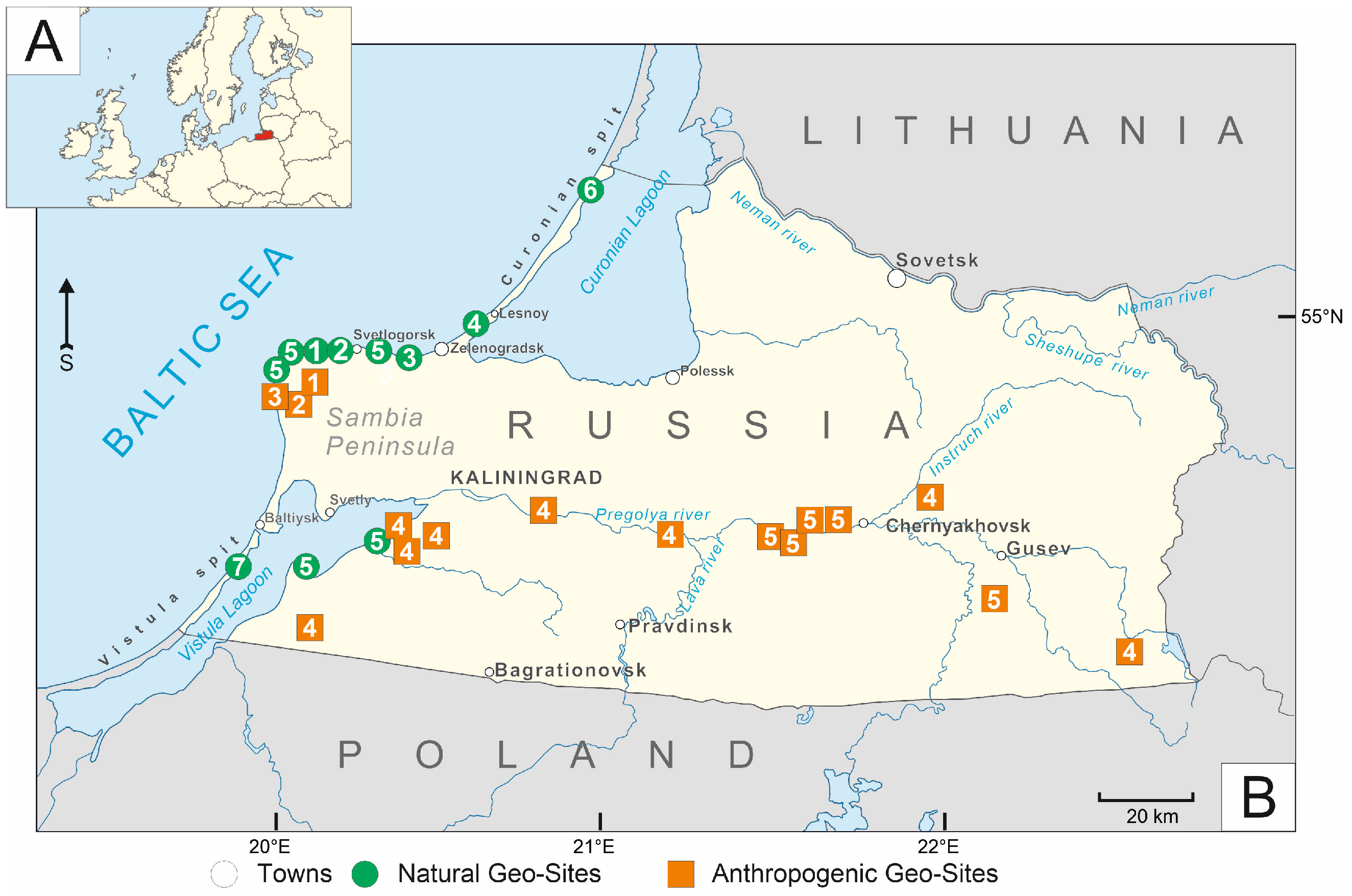
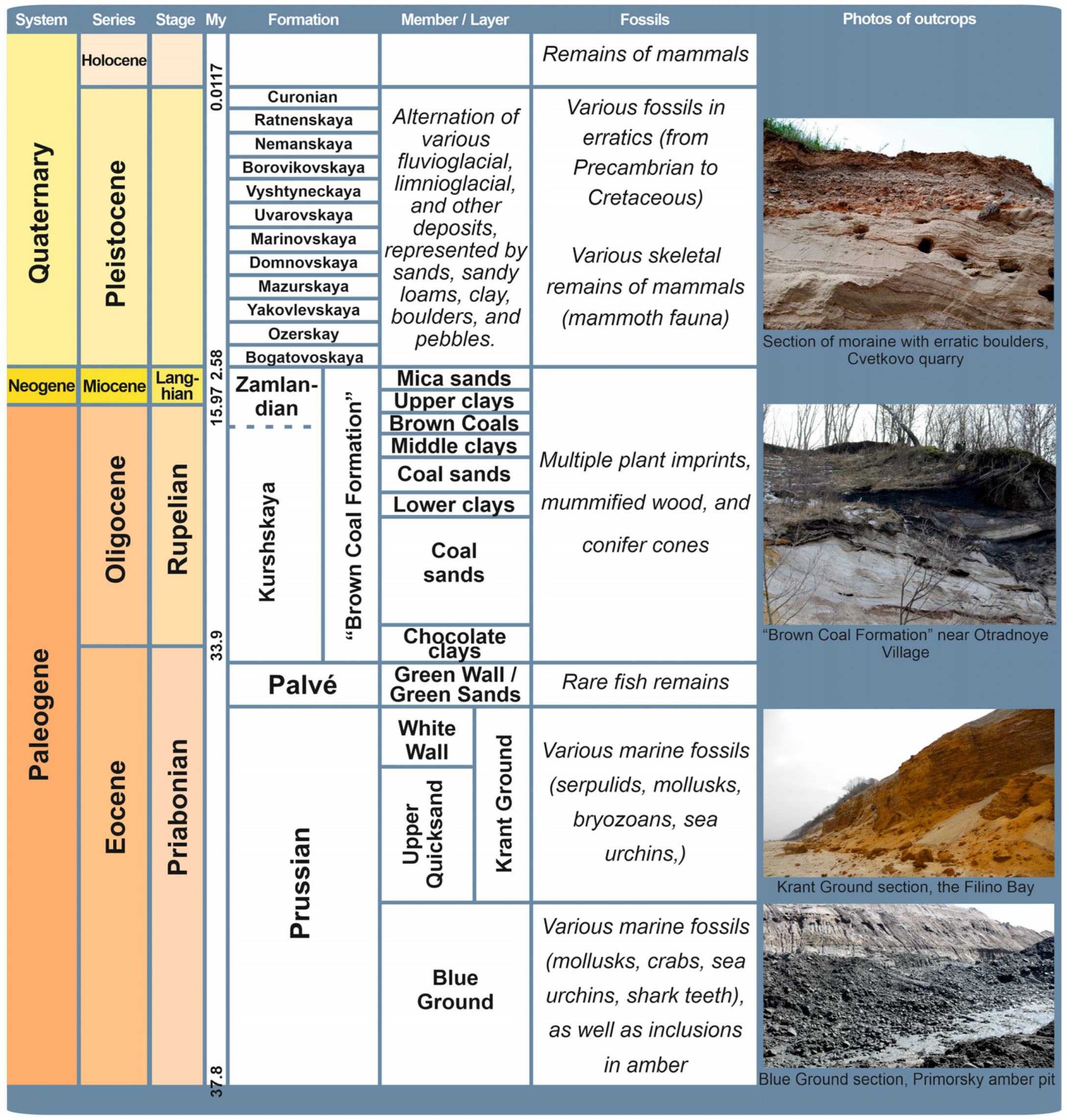
2. Geography and Geological Context of Fossil Records

3. Paleontology Research History
4. Paleontology Geoheritage Records
4.1. Paleogene Amber Inclusions
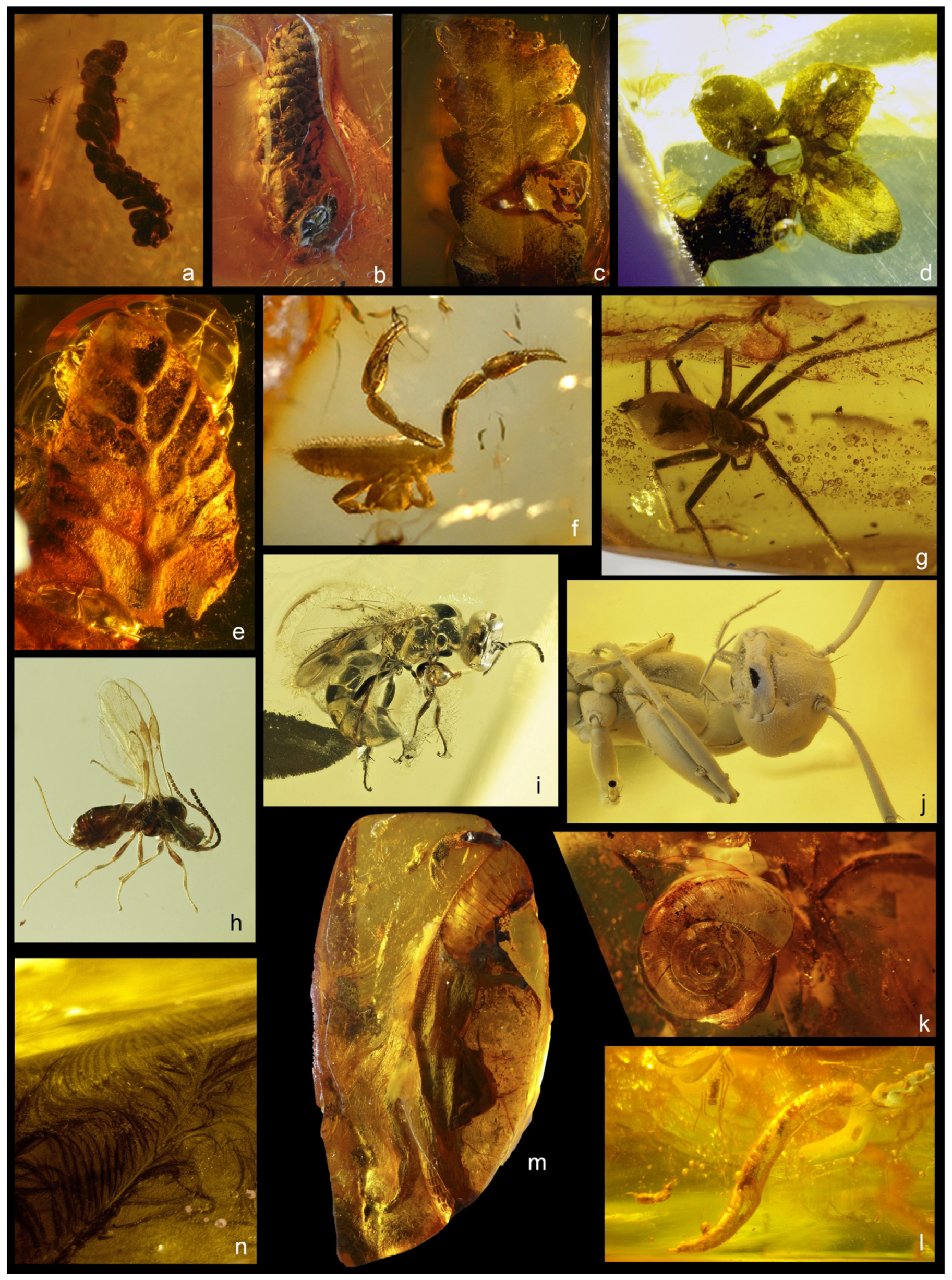
4.1.1. Fauna Inclusions

4.1.2. Flora Inclusions
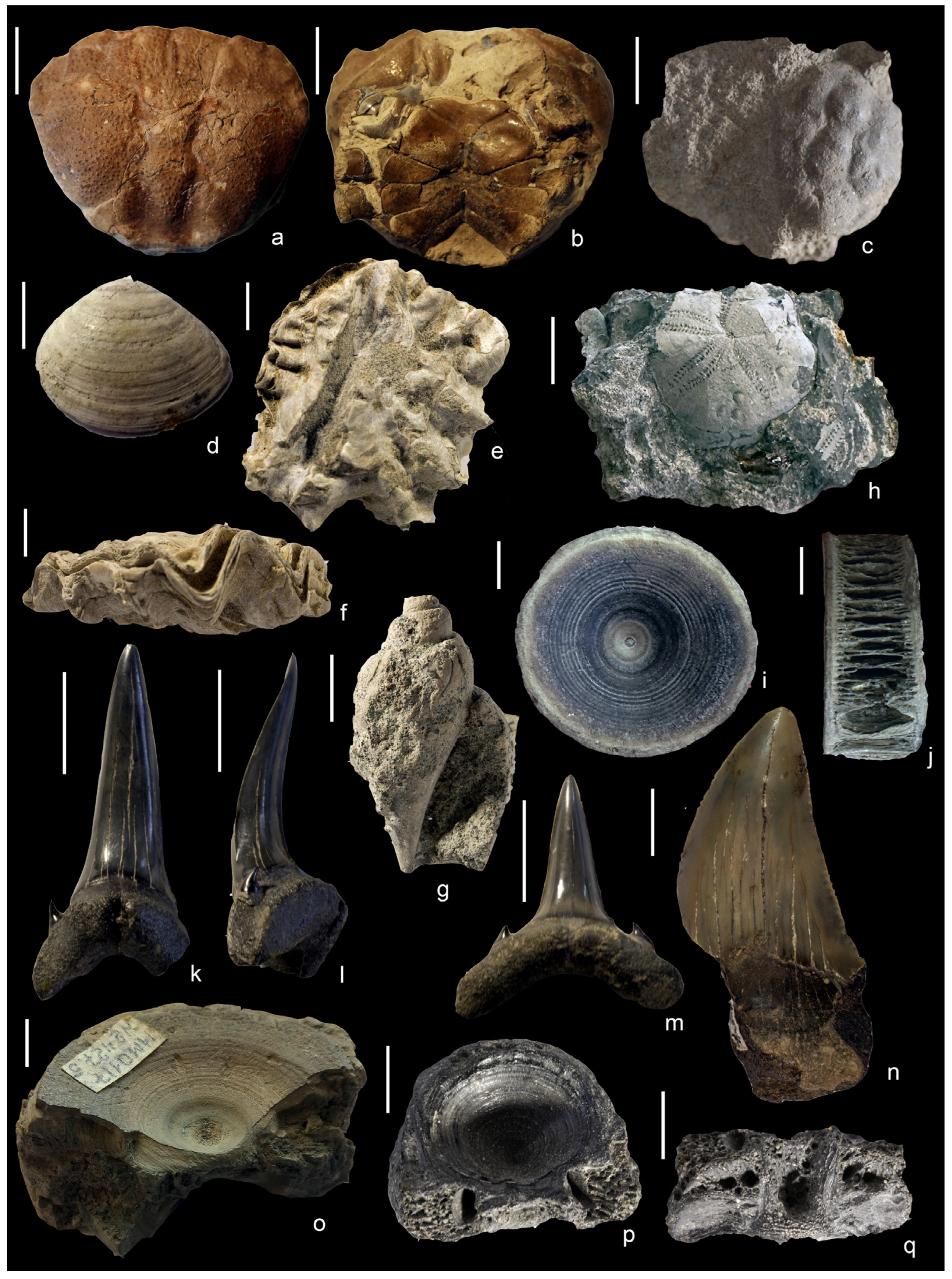
4.2. Fossils of Blue Ground

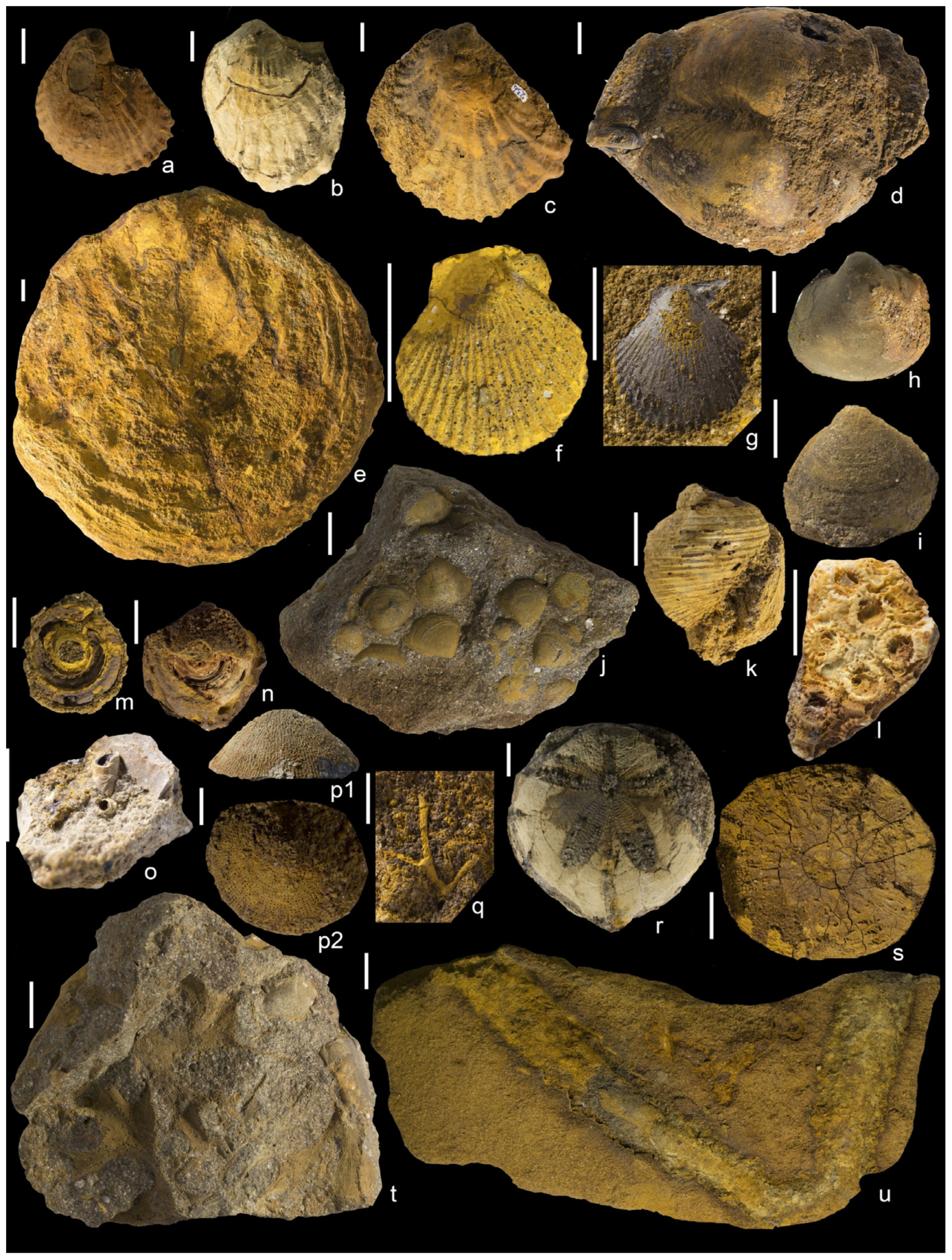
4.3. Fossils of Krant Ground

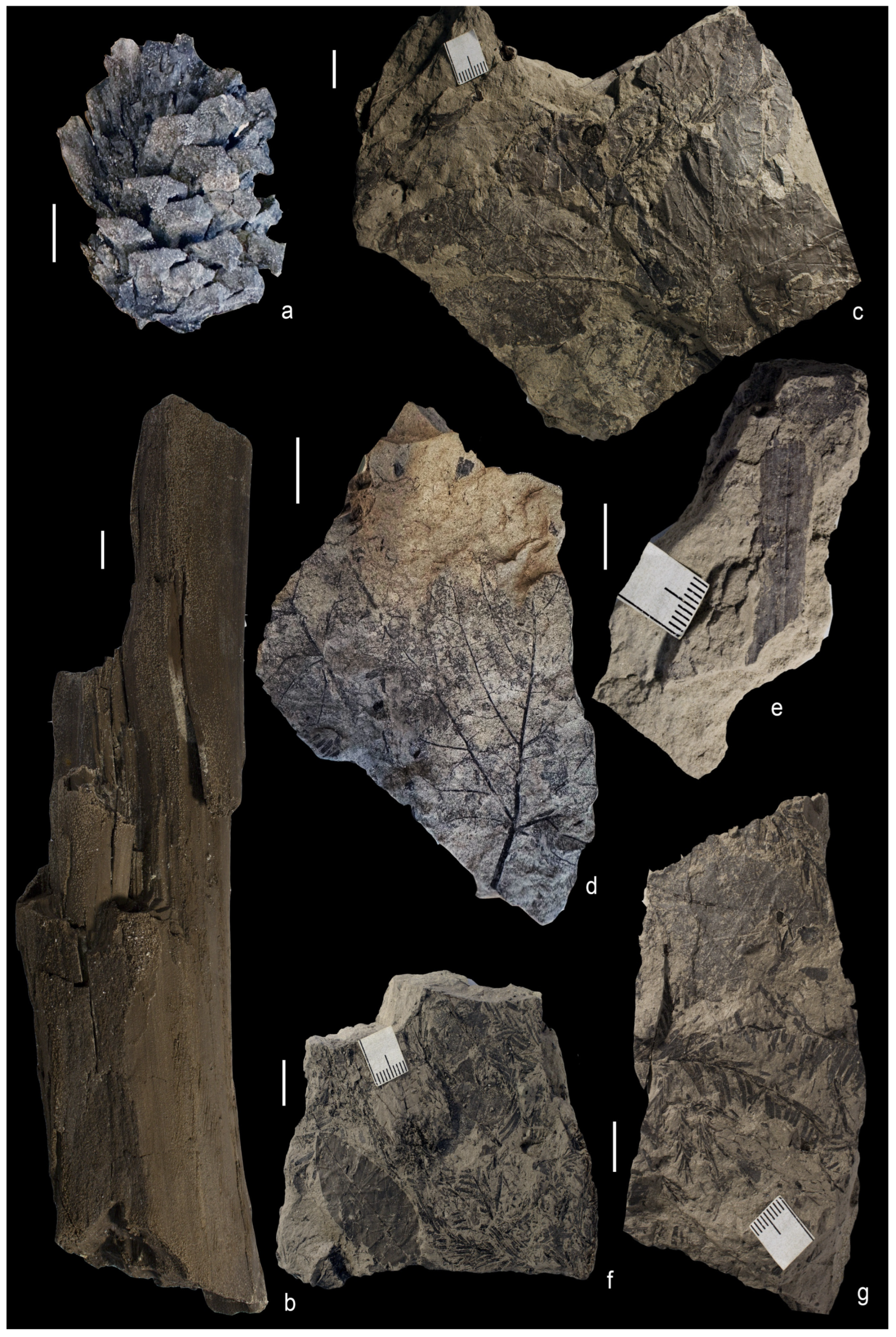
4.4. Oligocene–Neogene Flora Remains
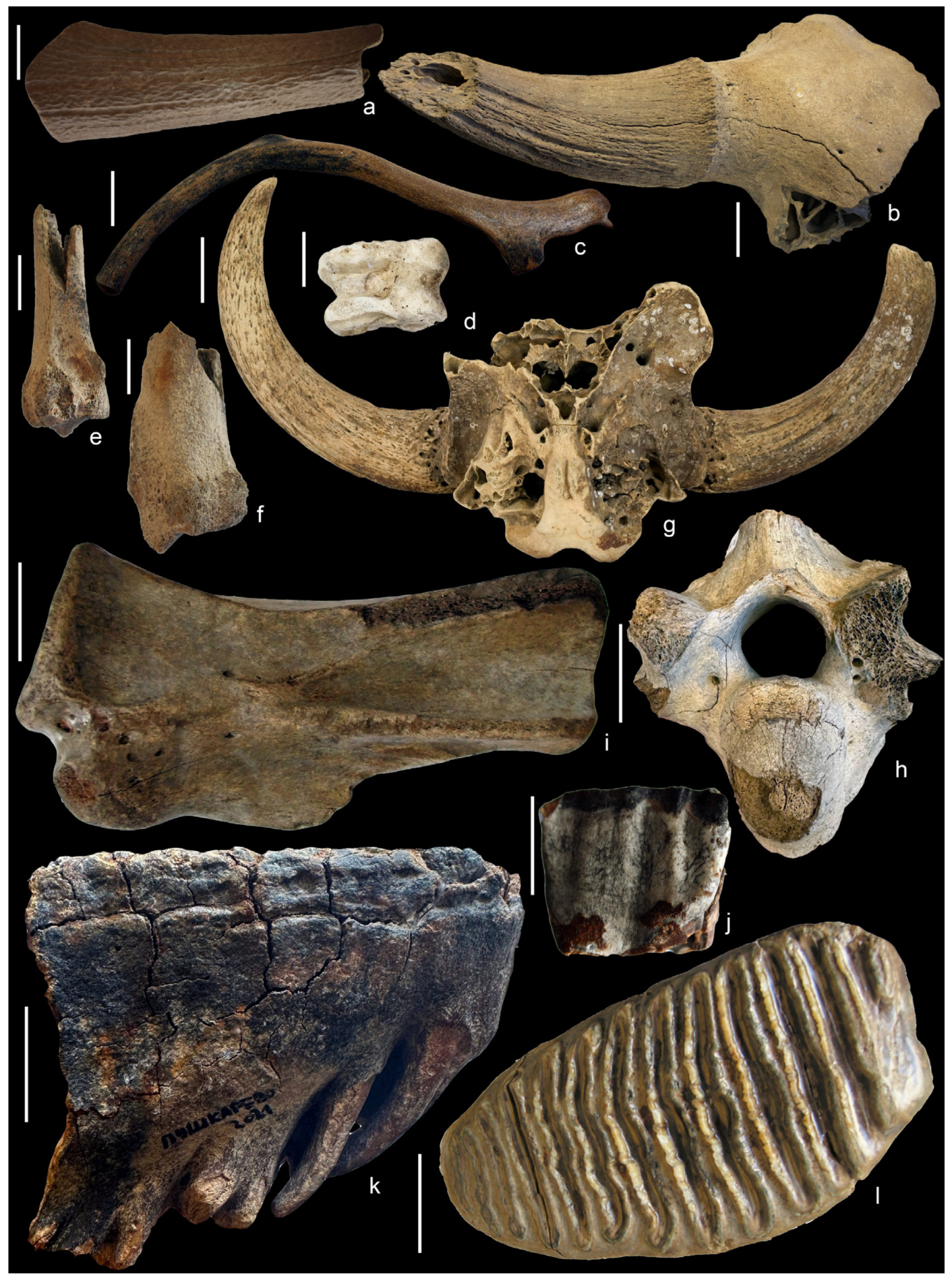
4.5. Pleistocene Fossils


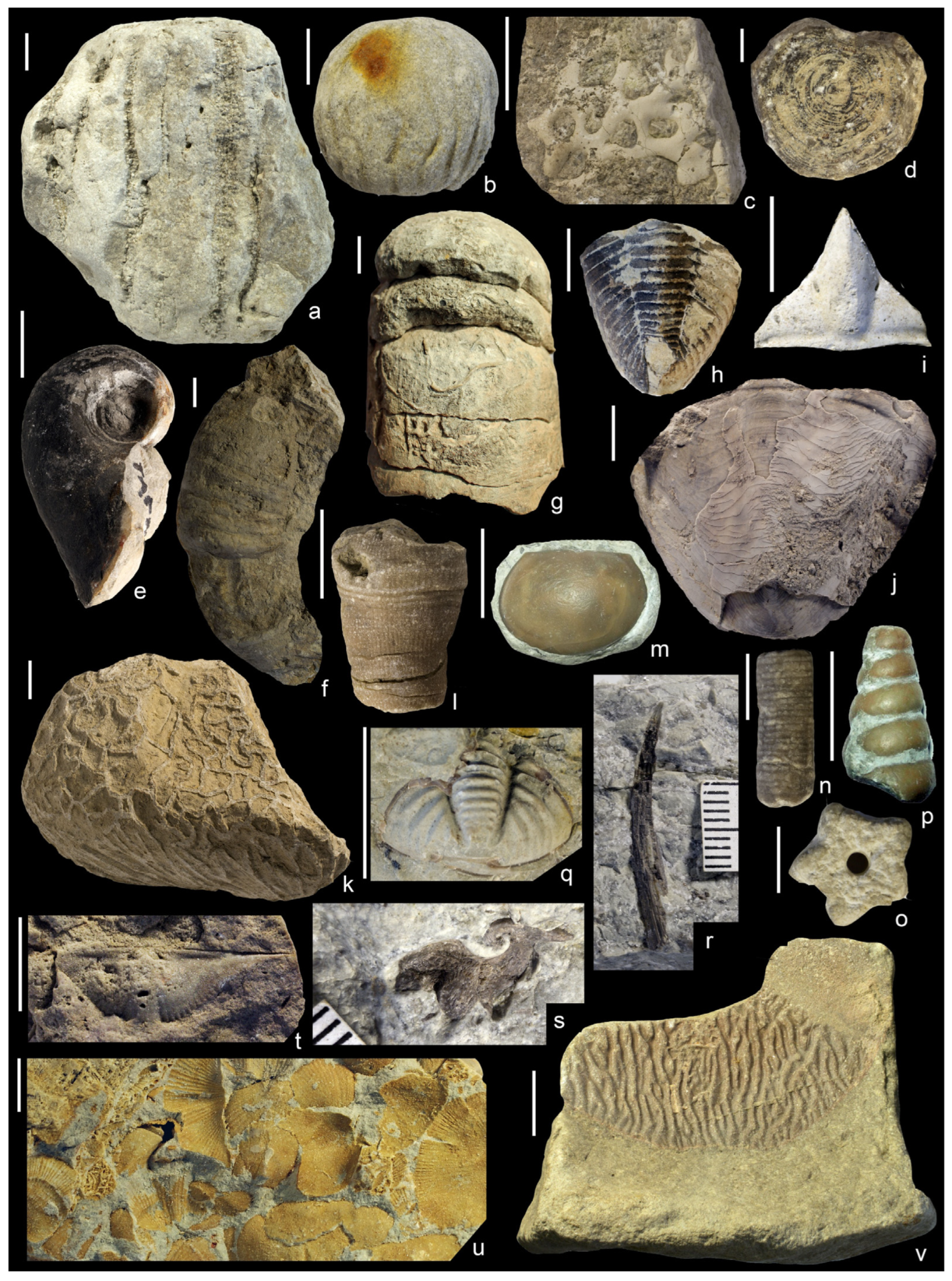
4.6. Glacial Erratics Fossils


5. Discussion: The South-East Baltic Paleontology and Geoheritage
6. Conclusions
Author Contributions
Funding
Data Availability Statement
Acknowledgments
Conflicts of Interest
References
- Gray, M. Geodiversity: Valuing and Conserving Abiotic Nature; John Wiley & Sons: Chichester, UK, 2013; 495p. [Google Scholar]
- Page, K.N.; Meléndez, G.; Gonera, M. Protected sites or protected heritage?—Systems and opinions for palaeontological conservation from a trans European perspective. In Towards the Balanced Management and Conservation of the Geological Heritage in the New Millenium; Barettino, D., Vallejo, M., Gallego, E., Eds.; Sociedad Geológica de España: Madrid, Spain, 1999; pp. 45–51. [Google Scholar]
- Page, K.N. Fossils, heritage and conservation: Managing demands on a precious resource. In Geoheritage: Assessment, Protection, and Management; Reynard, E., Brilha, J., Eds.; Elsevier: Chennai, India, 2018; pp. 107–128. [Google Scholar]
- DeMiguel, D.; Brilha, J.; Alegret, L.; Arenillas, I.; Arz, J.A.; Gilabert, V.; Strani, F.; Valenciano, A.; Villas, E.; Azanza, B. Linking geological heritage and geoethics with a particular emphasis on palaeontological heritage: The new concept of ‘palaeontoethics’. Geoheritage 2021, 13, 69. [Google Scholar] [CrossRef]
- Grigorescu, D.A. Paleontological Heritage and its Conservation in the UNESCO European Geoparks. Geoconserv. Res. 2021, 4, 6–24. [Google Scholar]
- Willman, S.; Bauert, H.; Raukas, A. Fostering geotourism on Central Baltic islands. In Proceedings of the 8th European Geoparks Conference, Idanha-a-Nova, Portugal, 14–16 September 2009. [Google Scholar]
- Raukas, A.; Stankowski, W. The Kaali crater field and other geosites of Saaremaa Island (Estonia): The perspectives for a geopark. Geologos 2010, 16, 59–68. [Google Scholar] [CrossRef]
- Strzelecki, M.C.; Duszyński, F.; Tyszkowski, S.; Zbucki, Ł. Limestone Sea Stacks (Rauks) Record Past Sea Levels and Rocky Coast Evolution in the Baltic Sea (Gotland and Farö Islands, Sweden). Front. Earth Sci. 2022, 16, 895419. [Google Scholar] [CrossRef]
- Skridlaite, G.; Gedminiene, L.; Vaznyte, J.; Saarmann, S. Geology interpretation at a spot: Knowledge transfer, geoheritage and geoconservation problems in the protected areas of Lithuania. In Proceedings of the 20th EGU General Assembly, Vienna, Austria, 4–13 April 2018; p. 2367. [Google Scholar]
- Jamorska, I.; Sobiech, M.; Karasiewicz, T.; Tylmann, K. Geoheritage of postglacial areas in northern Poland—Prospects for geotourism. Geoheritage 2020, 12, 12. [Google Scholar] [CrossRef]
- Migoń, P. Granite Landscapes, Geodiversity and Geoheritage—Global Context. Heritage 2021, 4, 198–219. [Google Scholar] [CrossRef]
- Skibiński, J.; Kultys, K.; Baran-Zgłobicka, B.; Zgłobicki, W. Geoparks in SE Poland as Areas of Tourism Development: Current State and Future Prospects. Resources 2021, 10, 113. [Google Scholar] [CrossRef]
- Chlachula, J.; Mychko, E.V. Geoheritage of the Kaliningrad Region, SE Baltic Coast. Geoheritage 2023, 15, 132. [Google Scholar] [CrossRef]
- Mychko, E.V.; Popov, S.V.; Koromyslova, A.V.; Goncharova, I.A.; Berezovsky, A.A.; Sladkovskaya, M.G.; Iakovleva, A.I.; Kalyakin, E.A.; Dorokhova, E.V. “Krant ground” of the Sambian Peninsula (Kaliningrad Region): Orictofossil assemblage and formation conditions. Bull. Mosc. Soc. Nat. Geol. Ser. 2021, 96, 1–66. (In Russian) [Google Scholar]
- Mychko, E.V. The Fossil Record of the Amberland: The Natural History of the Kaliningrad Region; Phyton XXI: Moscow, Russia, 2022; 320p. (In Russian) [Google Scholar]
- Sivkov, V.V.; Zhamoida, V.A. Amber deposits in the Kaliningrad Region. In Terrestrial and Inland Water Environment of the Kaliningrad Region; Gritsenko, V.A., Ed.; The Handbook of Environmental Chemistry; Springer: Berlin/Heidelberg, Germany, 2018; Volume 65, pp. 33–44. [Google Scholar]
- Krek, A.; Ulyanova, M.; Koschavets, S. Influence of land-based Kaliningrad (Primorsky) amber mining on coastal zone. Mar. Pollut. Bull. 2018, 131, 1–9. [Google Scholar] [CrossRef] [PubMed]
- Zagorodnykh, V.A.; Dovbnya, A.V.; Zhamoida, V.A. Stratigraphy of the Kaliningrad Region; Department of Natural Resources of Russia for the North-West Region: Kaliningrad, Russia, 2001; 226p. (In Russian) [Google Scholar]
- Pira, V.; Flodén, T.; Mokrik, R. The Baltic Sea basin in the geology of Fennoscandia and Baltic region. Short Sci. Rep. 2003, 2003, 134–137. [Google Scholar]
- Ūsaitytė, D. The geology of the southeastern Baltic Sea: A review. Earth-Sci. Rev. 2000, 50, 137–225. [Google Scholar] [CrossRef]
- Kirikov, V.P. Stratigrafiya. In State Geological Map of the Russian Federation. Scale 1:1,000,000 (Third Generation). Ser. Central European. Sheet N-(34) Kaliningrad. Explanatory Note; Lukyanova, N.V., Bogdanov, Y.B., Vasileva, O.V., Vargin, G.P., Eds.; Kartfabrika VSEGEI: St. Petersburg, Russia, 2011; pp. 11–74. (In Russian) [Google Scholar]
- Otmas, A.A.; Grigiriev, G.A.; Zitner, Y.I.; Soloveva, Y.I. Resource base of the Kaliningrad region and the prospects for expansion. Geomodel 2018, 1, 1–6. (In Russian) [Google Scholar]
- Babakov, A. Morphology and dynamics of the Baltic Sea Shore within Kaliningrad Oblast (overview). Arch. Hydro-Eng. Environ. Mech. 2018, 65, 177–202. [Google Scholar] [CrossRef]
- Kasiński, J.R.; Kramarska, R.; Słodkowska, B.; Sivkov, V.; Piwocki, M. Paleocene and Eocene deposits on the eastern margin of the Gulf of Gdańsk (Yantarny P-1 borehole, Kaliningrad region, Russia). Geol. Q. 2020, 64, 29–53. [Google Scholar] [CrossRef]
- Mikhnevich, G.S. Features of the surface structure pre-quaternary deposits in the Kaliningrad region. Bull. St. Petersburg State Univ. Ser. Geol. Geogr. 2015, 7, 21–35. (In Russian) [Google Scholar]
- Lambeck, K.; Purcell, A.; Zhao, J.; Svensson, N.O. The Scandinavian Ice Sheet: From MIS 4 to the end of the Last Glacial Maximum. Boreas 2010, 39, 410–435. [Google Scholar] [CrossRef]
- Makkaveyev, A.N.; Faustova, M.A.; Karpukhina, N.V. Maximum extent of the Valdaian (Weichselian) glaciation and relief in the peripheral area of the ice sheet. Geomorfologiya 2020, 3, 3–19. (In Russian) [Google Scholar]
- Korsakova, O.; Vashkov, A.; Nosova, O. European Russia: Glacial Landforms from the Last Glacial Maximum. In European Glacial Landscapes; Palacios, D., Hughes, P.D., Andrés, N., Eds.; Elsevier: Amsterdam, The Netherlands, 2022; pp. 389–393. [Google Scholar]
- Bitinas, A.; Damušytė, A. Influence of Neotectonics to the development of coastal zone of the South-Eastern Baltic. In Proceedings of the Volume of Abstracts, 2nd MELA Conference Glaciotectonic Structures, Palaeobasins and Neotectonic Setting, Vilnius, Lithuania, 27–31 August 2007. [Google Scholar]
- Khorikov, V.I.; Neevin, I.A.; Sergeev, A.Y.; Prishchepenko, D.V. Results of geological hazards monitoring of the south-eastern Baltic coastal zone (the Russian Sector). In Coastal Marine Zone: Investigations, Management, Perspectives; 2018; pp. 38–44. (In Russian) [Google Scholar]
- Ryabchuk, D.; Sergeev, A.; Burnashev, E.; Khorikov, V.; Neevin, I.; Kovaleva, O.; Danchenkov, A. Coastal processes in the Russian Baltic (eastern Gulf of Finland and Kaliningrad area). Q. J. Eng. Geol. Hydrogeol. 2021, 54, 2020–2036. [Google Scholar] [CrossRef]
- Zaddach, E.G. Über die Bernstein- und Braunkohlenlager des Samlandes. Schriften Phys.-Okon. Ges. Zukönigsberg Pr. 1860, 1, 1–44. (In German) [Google Scholar]
- Zaddach, E.G. Das Tertiärgebirge des Samlandes. Schriften Phys.-Okon. Ges. Zukönigsberg Pr. 1868, 8, 85–197. (In German) [Google Scholar]
- Berendt, G. Geologie des Kurischen Haffes und Seiner Umgebung; W Koch Commission: Königsberg, Russia, 1869; pp. 131–238. (In German) [Google Scholar]
- Schellwien, E. Geologische Bilder von der samländischen Küste. Schriften Phys.-Okon. Ges. Königsberg Preuss. 1905, 44, 1–43. (In German) [Google Scholar]
- Tornquist, A. Geologie Ostpreussen; Borntrager: Konigsberg, Germany, 1910; 231p. (In German) [Google Scholar]
- Göppert, H.R.; Berendt, G.C. Der Bernstein und die in ihm Befindlichen Pflanzenreste der Vorwelt; Commission der Nicolaischen Buchhandlung: Berlin, Germany, 1845; 126p. (In German) [Google Scholar]
- Noetling, F. Die Cambrischen und Silurischen Geschiebe der Provinzen Ost- und West-Preussen; Jahrbuch der Königlich Preussischen Geologischen Landesanstalt und Bergakademie zu Berlin: Berlin, Germany, 1882; pp. 261–324. (In German) [Google Scholar]
- Noetling, F. Die Fauna des Samländischen Tertiärs. Teil I (Vertebrata, Crustacea und Vermes, Echinodermata). In Abhandlungen zur Geologischen Specialkarte von Preussen und den Thüringischen Staaten; Preussische Geologische Landesanstalt: Berlin, Germany, 1885; Volume 8, pp. 1–216. (In German) [Google Scholar]
- Noetling, F. Die Fauna des Samländischen Tertiärs. Teil II (Gastropoda, Pelecypoda, Bryozoa, Geologischer Theil). In Abhandlungen zur Geologischen Specialkarte von Preussen und den Thüringischen Staaten; Preussische Geologische Landesanstalt: Berlin, Germany, 1888; Volume 6, pp. 1–109. (In German) [Google Scholar]
- Pompeckj, J.F. Die Trilobiten-Fauna der Ostund Westpreussischen Diluvialgeschiebe; Beiträgezur Naturkunde Preussens Herausgegeben; Physikalisch-Ökonomischen Gesellschaft zu Königsberg: Königsberg, Germany, 1890; Volume 7, pp. 1–97. (In German) [Google Scholar]
- Andrée, K. Die wissenschaftlicheBedeutung des Bernsteins und neuereBernsteinforschungen. Forschungen Fortschritte 1936, 12, 357–359. (In German) [Google Scholar]
- Eisenack, A. Mikrofossilien aus Doggergeschieben Ostpreussens. In Zeitschrift für Geschiebeforschung und Flachlandsgeologie; Nägele & Obermiller: Stuttgart, Germany, 1935; Volume 11, pp. 167–184. (In German) [Google Scholar]
- Eisenack, A. Neue Graptolithen aus Geschiebenbaltischen Silurs. Palaeontol. Z. 1935, 17, 73–90. (In German) [Google Scholar] [CrossRef]
- Eisenack, A. Dinoflagellaten aus dem Jura. Ann. Protistol. 1936, 5, 59–63. (In German) [Google Scholar]
- Eisenack, A. Eodiniapachytheca n. g.n, sp., einprimitiver Dinoflagellat aus einem KellowayGeschiebe Ostpreussens. In Zeitschrift für Geschiebeforschung und Flachlandsgeologie; Nägele & Obermiller: Stuttgart, Germany, 1936; Volume 12, pp. 72–75. (In German) [Google Scholar]
- Manukyan, A.R. Chastnoe kollekcionirovanie yantarya s vklyucheniyami v Kaliningrade (Private amber collections in Kaliningrad). In Kollekciya v Prostranstve Kultury: Tezisy Dokladov Mezhdunarodnoj Nauchnoj Konferencii 18–21 Sentyabrya 2017 g; Kaliningradskij Oblastnoj Muzej Yantarya: Kaliningrad, Russia, 2018; pp. 74–76. (In Russian) [Google Scholar]
- Ritzkowski, S. Curiosities in Baltic amber from the Konigsberg amber collection, now in the Gottingen collection. In Amber—Views—Opinions; International Amber Association: Gdańsk, Poland, 2006; pp. 58–61. [Google Scholar]
- Andrée, K. Die Albertus-Universität. Schicksal und Leistung. In Ostpreußen. Leistung und Schicksal; Gause, F., Ed.; Burkhard-Verlag: Essen, Germany, 1958; pp. 239–257. (In German) [Google Scholar]
- Jentzsch, A. Führer Durch Die Geologischen Sammlungen des Provinzial-Museums der Physikalisch-Ökonomischen Gesellschaft zu Königsberg; Wilh-Koch: Königsberg, Germany, 1892; 106p. (In German) [Google Scholar]
- Budantsev, L.Y.; Sveshnikova, I.N. Tertiary flora of the Kaliningrad Peninsula. II. Bot. J. 1959, 8, 1154–1158. (In Russian) [Google Scholar]
- Budantsev, L.Y.; Sveshnikova, I.N. Tertiary flora of the Kaliningrad Peninsula IV. In Proceedings of the Botanical Institute of the USSR Academy of Sciences. Ser. 8, Paleobotany; Botanical Institute of the USSR Academy of Sciences: St. Petersburg, Russia, 1964; Volume 5, pp. 83–112. (In Russian) [Google Scholar]
- Paškevičius, J. Geology of the Baltic Republic; Valstubinis Leidybos Centras: Vilnius, Lithuania, 1999; 387p. [Google Scholar]
- Poinar, G.O. Life in Amber; Stanford University Press: Stanford, CA, USA, 1992; 350p. [Google Scholar]
- Weitschat, W.; Wichard, W. Atlas of Plants and Animals in Baltic Amber; Verlag Friedrich Pfeil: Muenchen, Germany, 2002; 256p. [Google Scholar]
- Mychko, E.V. New findings of crabs of Coelomabalticum in Eocene of the Sambia Peninsula (Kaliningrad Region). Bull. Mosc. Soc. Nat. Geol. Ser. 2018, 93, 63–72. (In Russian) [Google Scholar]
- Mychko, E.V.; Tarasenko, K.K. The first finding of Basilosauridae (Mammalia: Cetacea) in Upper Eocene of Baltic States (Russia, Kaliningrad region). Paleontol. J. 2020, 54, 311–318. [Google Scholar] [CrossRef]
- Koromyslova, A.V.; Mychko, E.V. Upper Eocene (Priabonian) bryozoans from the Sambia Peninsula of the Kaliningrad Oblast (Russia). Neues Jahrb. Für Geol. Paläontologie–Abh. 2024, 312, 133–165. [Google Scholar] [CrossRef]
- Zaddach, E.G. Ein Amphipodeim Bernstein. Schriften Phys.-Okon. Ges. Zukönigsberg Pr. 1864, 5, 1–12. (In German) [Google Scholar]
- Keyser, D.; Weitschat, W. First record of ostracods (Crustacea) in Baltic amber. Hydrobiologia 2005, 538, 107–114. [Google Scholar] [CrossRef]
- Bachofen-Echt, A. Uber die Myriapoden des Bernsteins. Palaeobiologica 1942, 7, 394–403. (In German) [Google Scholar]
- Haug, J.T.; Muller, C.H.G.; Sombke, A. A centipede nymph in Baltic amber and a new approach to document amber fossils. Org. Divers. Evol. 2013, 13, 425–432. [Google Scholar] [CrossRef]
- Wesener, T. The oldest pill millipede fossil: A species of the Asiatic pill millipede genus Hyleoglomeris in Baltic amber (Diplopoda: Glomerida: Glomeridae). ZoologischerAnzeiger 2019, 283, 40–45. [Google Scholar] [CrossRef]
- Manukyan, A.R. Mikromir Yantarya. Paleosistematika. (World of Amber. Paleosystematics), Part 1; Kaliningradskij Oblastnoj Muzej Yantarya: Kaliningrad, Russia, 2019; 54p. (In Russian) [Google Scholar]
- Krzeminska, E.; Krzeminski, W. Les Fantomes de l’ambre; Musée d’Histoire Naturelle: Neuchatel, Switzerland, 1992; 142p. [Google Scholar]
- Dunlop, J.A.; Marusik, Y.; Vlaskin, A.P. Comparing Arachnids in Rovno Amber with the Baltic and Bitterfeld Deposits. Paleontol. J. 2019, 53, 1074–1083. [Google Scholar] [CrossRef]
- Weidner, H. Eine Zecke, Ixodes succineus sp. n. im baltischen Bernstein. Veröffentlichungen Uberseemus. Brem. 1964, 3, 143–151. (In German) [Google Scholar]
- Sellnick, M. Die Oribatiden der Bernsteinsammlung der Universitat Konigsberg i. Pr. Schriften Phys.-Okon. Ges. Zukönigsberg Pr. 1918, 59, 21–42. (In German) [Google Scholar]
- Dunlop, J.A.; Wunderlich, J.; Poinar, G.O., Jr. The first fossil opilioacariform mite (Acari: Opilioacariformes) and the first Baltic amber camel spider (Solifugae). Trans. R. Soc. Edinb. Earth Sci. 2004, 94, 261–273. [Google Scholar] [CrossRef]
- Dunlop, J.A.; Klann, A.E. A second camel spider (Arachnida: Solifugae) from Baltic amber. Acta Geol. Pol. 2009, 59, 39–44. [Google Scholar]
- Silvestri, F. Die Thysanuren des baltischen Bernsteins. Schriften Phys.-Okon. Ges. Zukönigsberg Pr. 1912, 53, 42–66. (In German) [Google Scholar]
- Wheeler, W.M. The Ants of the Baltic Amber. Schriften Phys.-Okon. Ges. Zukönigsberg Pr. 1914, 55, 1–141. (In German) [Google Scholar]
- Cockekell, T.D.A. Descriptions of Hymenoptera from Baltic Amber. Schriften Phys.-Okon. Ges. Zukönigsberg Pr. 1909, 50, 1–20. (In German) [Google Scholar]
- Cockekell, T.D.A. Some Additional Bees from Prussian Amber. Schriften Phys.-Okon. Ges. Zukönigsberg Pr. 1909, 50, 21–25. (In German) [Google Scholar]
- Alekseev, V.I. Coleoptera from the middle-upper Eocene European ambers: Generic composition, zoogeography and climatic implications. Zootaxa 2017, 4290, 401–443. [Google Scholar] [CrossRef]
- Alekseev, V.I. The beetles (Insecta: Coleoptera) of Baltic amber: The checklist of described species and preliminary analysis of biodiversity. Zool. Ecol. 2013, 23, 5–12. [Google Scholar] [CrossRef]
- Kulicka, R.; Kosmowska-Ceranowicz, B. Rare organic inclusions in the Baltic amber. Estud. Mus. Cienc. Nat. Alava 1999, 14, 155–160. [Google Scholar]
- Balashov, I.A.; Perkovsky, E.E. An Eocene land snail Balticoptagusakovi gen.n., sp.n. (Stylommatophora: Gastrocoptidae) from Baltic amber. Invertebr. Zool. 2020, 17, 18–24. [Google Scholar] [CrossRef]
- Borsuk-Białynicka, M.; Lubka, M.; Bohme, W. A lizard from Baltic amber (Eocene) and the ancestry of the crown group lacertids. Acta Palaeontol. Pol. 1999, 44, 349–382. [Google Scholar]
- Bauer, A.M.; Bohme, W.; Weitschat, W. An Early Eocene gecko from Baltic amber and its implications for the evolution of gecko adhesion. J. Zool. 2005, 265, 327–332. [Google Scholar] [CrossRef]
- Sidorchuk, E.A.; Bochkov, A.V.; Weiterschan, T.; Chernova, O.F. A case of mite-on-mammal ectoparasitism from Eocene Baltic amber (Acari: Prostigmata: Myobiidaeand Mammalia: Erinaceomorpha). J. Syst. Palaeontol. 2018, 17, 331–347. [Google Scholar] [CrossRef]
- Caspary, R.; Klebs, R. Die Flora des Bernsteins und anderer fossiler Harze des ostpreussischen Tertiärs. Thallophyta. 2. Bryophyta. 3. Pteridophyta. 4. Gymnospermae. Abh. Königlich Preußischen Geol. Landesanst. 1906, 4, 1–182. [Google Scholar]
- Göppert, H.R.; Menge, A. Die Flora des Bernsteins und ihre Beziehungen zur Flora der Tertiarformation und der Gegenwart, 1. Band: Von den Bernstein-Coniferen, Insbesondereauch in IhrenBeziehungenzu den Coniferen der Gegenwart; Verlag von Wilhelm Engelmann: Leipzig, Germany, 1883; 63p. (In German) [Google Scholar]
- Conwentz, H. Die Flora des Bernsteins: Zweiter Band. Die Angiospermen des Bernsteins; Verlag von Wilhelm Engelmann: Leipzig, Germany, 1886; 140p. (In German) [Google Scholar]
- Wolfe, A.P.; Tappert, R.; Muehlenbachs, K.; Boudreau, M.; McKellar, R.C.; Basinger, F.; Garret, A. A new proposal concerning the botanical origin of Baltic amber. Proc. R. Soc. B Biol. Sci. 2009, 276, 3403–3412. [Google Scholar] [CrossRef]
- Katinas, V. Yantar’ iYantaronosnye Otlozheniya Yuzhnoj Pribaltiki; Tr. Lit-NIGRI: Vilnius, Lithuania, 1971; Volume 20, 156p. (In Russian) [Google Scholar]
- Turkin, N.I.; Dedkov, V.V. Dominanty yantarnogo lesa (Dominants of the amber forest). In Teoreticheskie I Prikladnye AspektyBiologii: Mezhvuz. Sb. Nauch. Tr.; Kaliningrad State University Press: Kaliningrad, Russia, 1999; pp. 21–28. (In Russian) [Google Scholar]
- Ander, K. Die Insektenfauna des Baltischen Bernsteins nebst damit verknüpften zoogeographischen Problemen; Lunds Universitets Årsskrift, N.F.: Lund, Sweden, 1942; Volume 38, pp. 1–83. (In German) [Google Scholar]
- Sadowski, E.M.; Schmidt, A.R.; Denk, T. Staminate inflorescences with in situ pollen from Eocene Baltic amber reveal high diversity in Fagaceae (oak family). Willdenowia 2020, 50, 405–517. [Google Scholar] [CrossRef]
- Sadowski, E.M.; Hofmann, C.C. The largest amber-preserved flower revisited. Sci. Rep. 2023, 13, 17. [Google Scholar] [CrossRef]
- Sadowski, E.M.; Seyfullah, L.J.; Sadowski, F.; Fleischmann, A.; Behling, H.; Schmidt, A.R. Carnivorous leaves from Baltic amber. Proc. Natl. Acad. Sci. USA 2014, 112, 190–195. [Google Scholar] [CrossRef]
- Sadowski, E.M.; Seyfullah, L.J.; Wilson, C.A.; Calvin, C.L.; Schmidt, A.R. Diverse early dwarf mistletoes (Arceuthobium), ecological keystones of the Eocene Baltic amber biota. Am. J. Bot. 2017, 104, 694–718. [Google Scholar] [CrossRef]
- Sadowski, E.M.; Schmidt, A.R.; Rudall, P.J.; Simpson, D.A.; Grohn, C.; Wunderlich, J.; Seyfullah, L.J. Graminids from Eocene Baltic amber. Rev. Palaeobot. Palynol. 2016, 233, 161–168. [Google Scholar] [CrossRef]
- Nikishin, A.M.; Ziegler, P.A.; Stephenson, R.A.; Cloetingh, S.A.P.L.; Furne, A.V.; Fokin, P.A.; Ershov, A.V.; Bolotov, S.N.; Korotaev, M.V.; Alekseev, A.S.; et al. Late Precambrian to Triassic history of the East European Craton: Dynamics of sedimentary basin evolution. Tectonophysics 1996, 268, 23–63. [Google Scholar] [CrossRef]
- Wichard, W.; Grohn, C.; Seredszus, F. Aquatic Insects in Baltic Amber; Verlag Kessel: Remagen-Oberwinter, Germany, 2009; 336p. [Google Scholar]
- Weitschat, W.; Wichard, W. Baltic Amber. In Biodiversity of Fossils in Amber from the Major World Deposits; Penney, D., Ed.; Siri Scientific Press: Manchester, UK, 2010; pp. 80–115. [Google Scholar]
- Kaasalainen, U.; Schmidt, A.R.; Rikkinen, J. Diversity and ecological adaptations in Paleogene lichens. Nat. Plants 2017, 3, 7049. [Google Scholar] [CrossRef] [PubMed]
- Rikkinen, J.K.; Schmidt, A. Morphological Convergence in Forest Microfungi Provides a Proxy for Paleogene Forest Structure. In Transformative Paleobotany. Papers to Commemorate the Life and Legacy of Thomas N. Taylor; Krings, M., Harper, C.J., Cuneo, N.R., Rothwell, G.W., Eds.; Academic Press: Cambridge, MA, USA, 2018; pp. 527–549. [Google Scholar]
- Daniels, C.H.; Heinke, A.; Heunisch, C.; Lindert, W.; Wiese, T. Wissenschaftliche Originale in den Sammlungen BGR/NLfB Hannover und BGR Berlin. Schriftenverzeichnis; Bundesanstalt für Geowissenschaften und Rohstoffe: Berlin, Germany, 1999; 93p. (In German) [Google Scholar]
- von Koenen, A. Revision der Mollusken–Fauna des SamlandischenTertiars. In Abhandlungen zur Geologischen Specialkarte von Preussen und den Thüringischen Staaten; Preussische Geologische Landesanstalt: Berlin, Germany, 1894; Volume 10, pp. 1366–1392. (In German) [Google Scholar]
- Zharkov, M.P.; Glikman, L.S.; Kaplan, A.A.; Krasnov, S.G.; Strelnikova, N.I. O vozraste paleogena Kaliningradskoj oblasti (On the Paleogene chronology of the Kaliningrad coast). Izv. SSSR Seriya Geol. 1976, 1, 132–135. (In Russian) [Google Scholar]
- Kukuev, E.I.; Batal’yants, K.Y. Zuby akul v okamenelostyakh poberezhya Zemlandskogo poluostrova (Shark teeth in fossils of the Zemlandsk Peninsula coast). In Kompleksnoe Izuchenie Bassejna Atlanticheskogo Okeana; Kaliningrad State University Press: Kaliningrad, Russia, 2006; pp. 86–91. (In Russian) [Google Scholar]
- Thomas, K. Die Bernsteinformation des Samlandes. Preußische Prov.-Blätter 1847, 3, 241–245. (In German) [Google Scholar]
- Erman, A.; Herter, P. Ueber Tertiärschichten, welche die bemsteinführende Braunkohle an der Samländischen Ostseeküstebedecken. Z. Dtsch. Geol. Ges. 1850, 2, 410–427. (In German) [Google Scholar]
- Zaddach, E.G. Über die Tertiärbildungen des Samlandes. Schriften Phys.-Okon. Ges. Königsberg Pr. 1867, 8, 85–197. (In German) [Google Scholar]
- Johnsen, A. Über den Krant des Zipfelberges im Samland. Schriften Phys.-Okon. Ges. Königsberg Pr. 1907, 47, 46–51. (In German) [Google Scholar]
- Standke, G. Die Tertiärprofile der samländischen Bernsteinküste bei Rauschen. Schriftenreihe Geowiss. 1998, 7, 93–133. (In German) [Google Scholar]
- Voigt, E. Ein Fischskelett aus dem unteroligozänen Grünsand von Palmnicken im Samland. Z. Dtsch. Geol. Ges. 1937, 89, 72–76. (In German) [Google Scholar]
- Kuzmina, O.B.; Iakovleva, A.I.; Mychko, E.V. The Age and Depositional Settings of the Upper Paleogene–Lower Neogene Kurshskaya Formation in its Stratotype Section (Kaliningrad Oblast) based on Palynological Data. Stratigr. Geol. Correl. 2023, 31, 657–675. [Google Scholar] [CrossRef]
- Schweigger, A.F. Beobachtungen auf Naturhistorischen Reisen; Georg Reimer: Berlin, Germany, 1819; 130p. (In German) [Google Scholar]
- von Heer, O. Miocene baltische Flora. Beiträge Naturkunde Preuss. 1869, 2, 104. (In German) [Google Scholar]
- Sveshnikova, I.N.; Budantsev, L.Y. Tertiary flora of the Kaliningrad Peninsula. I. Bot. J. 1959, 44, 211–214. (In Russian) [Google Scholar]
- Sveshnikova, I.N.; Budantsev, L.Y. Tertiary flora of the Kaliningrad Peninsula. III. Bot. J. 1960, 45, 871–875. (In Russian) [Google Scholar]
- Dorofeev, P.I.; Sveshnikova, I.N. On representatives of the genus Athrotaxis from the Paleogene of the Kaliningrad region. Paleontol. J. 1963, 2, 116–125. (In Russian) [Google Scholar]
- Vikulin, S.V. Fruits of Symplocaceae in the Oligocene flora of the Kaliningrad region. Bot. J. 2010, 95, 631–636. (In Russian) [Google Scholar]
- Vikulin, S.V. Fruits of Ericaceae (Ericales: Epacridaceae, Ericaceae) in the Oligocene floras of the Kaliningrad and Voronezh regions. Bot. J. 2010, 95, 59–69. (In Russian) [Google Scholar]
- Vikulin, S.V. Fruits of Arctostaphylos (Ericaceae) in the Oligocene flora of the Kaliningrad region. Bot. J. 2011, 96, 863–868. (In Russian) [Google Scholar]
- Martynovich, N.V.; Grishanov, G.V. The remains of the mammoth fauna in the Kaliningrad Region. In Fundamental Problems of the Quaternary, Results of the Study and the Main Trends of Further Research; Publishing House of the SB RAS: Irkutsk, Russia, 2015; pp. 303–305. (In Russian) [Google Scholar]
- Martynovich, N.V.; Grishanov, G.V. Woolly rhinoceros (Coelodonta antiquitatis) in the Kaliningrad Region. Baikal Zool. J. 2016, 2, 44–47. (In Russian) [Google Scholar]
- Kuzmin, Y.V.; van der Plicht, J.; Martynovich, N.V.; Grishanov, G.V. The first radiocarbon dates from the bones of mammoths (Mammuthus primigenius) in the Kaliningrad region (Russia). In Eurasia in the Cenozoic. Stratigraphy, Paleoecology, Cultures; Publishing House ISU: Irkutsk, Russia, 2016; Volume 5, pp. 38–42. (In Russian) [Google Scholar]
- Kuzmin, Y.V.; Martynovich, N.V.; Van Der Plicht, J. The first radiocarbon and stable isotope data for megafauna remains in Kaliningrad Province, Russia. J. Quat. Sci. 2024, 40, 367–371. [Google Scholar] [CrossRef]
- Sommer, R.S.; Benecke, N. First radiocarbon dates on woolly mammoth (Mammuthusprimigenius) from northern Germany. J. Quat. Sci. 2009, 24, 902–905. [Google Scholar] [CrossRef]
- Ukkonen, P.; Aaris-Sorensen, K.; Arppe, L.; Clark, P.U.; Daugnora, L.; Lister, A.M.; Lougas, L.; Seppa, H.; Sommer, R.S.; Stuart, A.J.; et al. Woolly mammoth (Mammuthus primigenius Blum.) and its environment in northern Europe during the last glaciations. Quat. Sci. Rev. 2011, 30, 693–712. [Google Scholar] [CrossRef]
- Pawłowska, K. Elephantids from Pleistocene Poland: State of knowledge. Quat. Int. 2015, 379, 89–105. [Google Scholar] [CrossRef]
- Martynovich, N.V. The first discovery of a cave lion (Panthera leospelaea) in the Kaliningrad region. Baikal Zool. J. 2020, 1, 49–51. (In Russian) [Google Scholar]
- Roedel, H. Sedimentärgeschiebe (Uebersicht-Literatur). Neubearbeitungstatteineszweiten Nachtrages. Helios 1926, 29, 70–140. (In German) [Google Scholar]
- Roemer, F. Lethaea erratica oder Aufzählung und Beschreibung der in der norddeutschenEbenevorkommenden Diluvial-Geschiebenordischer Sedimetär-Gesteine. Geol. Paläontologische Abh. 1885, 2, 250–420. (In German) [Google Scholar]
- Kiesow, J. Uebersilurische und devonische Geschiebe Westpreussens. Schriften Naturforschenden Ges. Danz. Neue Folge 1884, 6, 205–303. (In German) [Google Scholar]
- Gagel, C. Die Brachiopoden der cambrischen und silurischen Geschiebeim Diluvium der Provinzen Ost- und West-preussen; Beiträgezur Naturkunde Preussens Herausgegeben; Physikalisch-Ökonomischen Gesellschaft zu Königsberg: Königsberg, Germany, 1890; Volume 6, pp. 1–79. (In German) [Google Scholar]
- Neben, W.; Krueger, H.H. Fossilienordovicischer Geschiebe. Staringia 1971, 1, 3–60. (In German) [Google Scholar]
- Neben, W.; Krueger, H.H. Fossilienordovicischer und silurischer Geschiebe. Staringia 1973, 2, 3–73. (In German) [Google Scholar]
- Neben, W.; Krueger, H.H. Fossilien kambrischer, ordovicischer und silurischer Geschiebe. Staringia 1979, 5, 1–63. (In German) [Google Scholar]
- Rudolph, F.; Bilz, W.; Pittermann, D. Fossilien an Nord- und Ostsee. Finden und Bestimmen; Quelle & Meyer: Wiebelsheim, Germany, 2010; 288p. (In German) [Google Scholar]
- Rudolph, F. Strandsteine. Available online: http://strandsteine.de/ (accessed on 13 January 2025). In German.
- Steinhardt, E.T.G. Die bis jetzt in Preussische Geschiebengefundenen Trilobiten; Beiträgezur Naturkunde Preussens Herausgegeben; Physikalisch-Ökonomischen Gesellschaft zu Königsberg: Königsberg, Germany, 1874; Volume 3, pp. 1–64. (In German) [Google Scholar]
- Dewitz, H. Beiträge zur Kenntniss der in den ostpreussisclien Silurgesclieben-vorkommenden Cephalopoden. Schriften Phys.-Okon. Ges. Zukönigsberg Pr. 1879, 20, 162–180. (In German) [Google Scholar]
- Schröder, H. BeiträgezurKenntniss der in ostundwestpreussischen Diluvialgeschiebengefundenen Silurcephalopoden. Schriften Phys.-Okon. Ges. Zukönigsberg Pr. 1881, 22, 54–96. (In German) [Google Scholar]
- Schallreuter, R. Ostrakoden aus ordovizischen Geschieben Westfalens I. Geol. Paläontologie Westfal 1987, 7, 15–29. (In German) [Google Scholar]
- Rhebergen, F. A new Ordovician astylospongiid sponge (Porifera) as an erratic from Baltica. Neth. J. Geosci. 2004, 83, 255–265. [Google Scholar] [CrossRef]
- Rhebergen, F. Short note on three species of Ordovician Orchocladina (Demospongea, Porifera). Scr. Geol. 2011, 143, 123–126. [Google Scholar]
- Malinky, J.M. Hyolitha from the Early Paleozoic glacial erratic boulders (Geschiebe) of Germany and Poland. Foss. Rec. 2007, 10, 71–90. [Google Scholar] [CrossRef]
- Amler, M.R.W.; Lohrengel, A.F. Ein Pseudobigaleai der Rostroconch in einem ober ordovizischen Geschiebe [A Pseudobigaleaid Rostroconch from an Upper Ordovician Geschiebe]. Arch. Geschiebekd 2015, 7, 261–276. (In German) [Google Scholar]
- Keulen, P.; Rhebergen, F. Typology and fossil assemblage of Sandbian (Ordovician) ‘baksteenkalk’: An erratic silicified limestone of Baltic origin from the northeastern Netherlands and adjacent areas of Germany. Est. J. Earth Sci. 2017, 66, 198–219. [Google Scholar] [CrossRef]
- Schröder, H. Beiträge zur Kenntniss der in Ostundwestpreussischen Diluvialgeschiebengefundenen Silurcephalopoden (Fortsetzung). Schriften Phys.-Okon. Ges. Zukönigsberg Pr. 1882, 23, 87–106. (In German) [Google Scholar]
- Schallreuter, R. Beiträge zur Geschiebekunde Westfalens II Ostrakoden aus ordovizischen Geschieben II. Geol. Paläontologie Westfal 1993, 27, 1–273. (In German) [Google Scholar]
- Schallreuter, R. Ostrakoden aus silurischen Geschieben II. Geol. Paläontologie Westfal 1995, 34, 1–145. (In German) [Google Scholar]
- Schallreuter, R. Ostrakoden aus silurischen Geschieben III. Geol. Paläontologie Westfal 1996, 42, 5–25. (In German) [Google Scholar]
- Schallreuter, R. Ostrakoden aus silurischen Geschieben IV. Geol. Paläontologie Westfal 2000, 53, 1–69. (In German) [Google Scholar]
- Kunth, A. Ueber Pteraspis. Z. Dtsch. Geol. Ges. 1872, 24, 1–8. (In German) [Google Scholar]
- Lienau, H.-W. Geschiebe–Botenaus dem Norden; Geschiebekdeaktuell: Hamburg, Germany, 1990; 115p. (In German) [Google Scholar]
- Suvejzdis, P.I. (Ed.) Permskaya Sistema Pribaltiki (Fauna i Stratigrafiya); Trudy LitovskogoNauchno-Issledovatelskogo Geologo-Razvedochnogo Instituta: Vilnius, Lithuania, 1975; Volume 29, 305p. (In Russian) [Google Scholar]
- Schellwien, E. Der litauisch-kurische Jura und die ostpreußischen Geschiebe in dem neuen. NeuesJahrbuch Mineral. Geol. Paläontologie 1894, 2, 207–227. (In German) [Google Scholar]
- Klien, G. Über Oxfordgeschiebe. Schriften Phys.-Okon. Ges. Zukönigsberg Pr. 1910, 51, 212–214. (In German) [Google Scholar]
- Beurlen, K. Zwei stratigraphisch wichtige Geschiebe (Jura und Kreide) aus dem ostpreußischen Diluvium. In Centralblatt für Mineralogie, Geologie und Paläontologie. Abteilung B: Geologie und Paläontologie; E. Schweizerbart’sche Verlagsbuchhandlung: Stuttgart, Germany, 1931; pp. 145–160. (In German) [Google Scholar]
- Frebold, H. Unterer Kimmeridge in Ostpreussischen Geschieben. Neues Jahrb. Mineral. Geol. Paläontologie Abt. B 1926, 54, 411–418. (In German) [Google Scholar]
- Koppka, J. Neue Bivalven (Heterodonta, Anomalodesmata) aus Kelloway-geschieben Norddeutschlands. Arch. Geschiebekd 2004, 4, 233–272. (In German) [Google Scholar]
- Koppka, J.; Hinz-Schallreuter, I.; Fürsich, F.-T. High-Diversity Bivalve Faunas in the Middle Jurassic of the Southern Baltic Sea. In Proceedings of the Abstracts and Posters of the International Congress on Bivalvia at the Universitat Autònoma de Barcelona, Spain, 22–27 July 2006; Malchus, N., Pons, J.M., Eds.; Organisms Diversity & Evolution; Springer: Berlin/Heidelberg, Germany, 2006; Volume 6, p. 327. [Google Scholar]
- Horn, M. Sagenopteris caledonica n. sp. aus einem Callovien-Geschiebe Ostpreußens. Schriften Phys.-Okon. Ges. Zukönigsberg 1913, 54, 239–240. (In German) [Google Scholar]
- von Ungern-Sternberg, E. Die Hexactineüiden der Senonen Diluvialgeschiebe in OstundWestpreussen. Schriften Phys.-Okon. Ges. Zukönigsberg 1902, 43, 132–151. (In German) [Google Scholar]
- Bitner, M.A.; Emig, C.C. On the type species of Lingularia, and description of Eolingularia n. gen. Carnets Géologie 2016, 16, 543–555. [Google Scholar] [CrossRef]
- Dalinkevičius, J.A. On the fossil fishes of the Lithuanian Chalk. I. Selachii. Mémoires Fac. Sci. L’université Vytautas Grand 1935, 9, 247–305. [Google Scholar]
- Bieńkowska-Wasiluk, M.; Uchman, A.; Jurkowska, A.; Świerczewska-Gładysz, E. The trace fossil Lepidenteronlewesiensis: A taphonomic window on diversity of Late Cretaceous fishes. Paläontologische Z. 2015, 89, 795–806. [Google Scholar] [CrossRef]
- Vazhenin, G.A.; Bogatenko, I.E.; Gorodchikov, S.V.; Mychko, E.V. First finding of tooth of Ptychodus (Elasmobranchii: Lamniformes) in moraine of the Kaliningrad Region. Vestn. Immanuel Kant Balt. Fed. Univ. 2025, 2, 130–141. [Google Scholar] [CrossRef]
- Schröder, H. Saurierresteaus der baltischen oberen Kreide. Jahrb. Königlich Preuss. Landesanst. Bergakad. Berl. 1884, 5, 293–333. (In German) [Google Scholar]
- Ulomov, V.I.; Akatova, K.N.; Medvedeva, N.S. Estimation of seismic hazard in the Kaliningrad region. Izv. Phys. Solid Earth 2008, 44, 691–705. [Google Scholar] [CrossRef]
- Rozynski, G.; Pruszak, Z. Currents and sediment transport along the sea shore of the Gulf of Gdansk: A remote sensing study. Oceanologia 2010, 52, 431–444. [Google Scholar]
- Cerkowniak, G.R.; Ostrowski, R.; Pruszak, Z. Application of Dean’s curve to investigation of a long-term evolution of the southern Baltic multi-bar shore profile. Oceanologia 2017, 59, 18–27. [Google Scholar] [CrossRef]
- Ryabkova, O.I.; Levchenkov, A.V. Study of the coast of the Sambian Peninsula: The contribution of German, Soviet, and Russian scientists. Bull. Immanuel Kant Balt. Fed. Univ. Ser. Nat. Med. Sci. 2016, 3, 44–70. (In Russian) [Google Scholar]
- Dewar, K. Geotourism: The Tourism of Geology and Landscape; Goodfellow Publishers: Oxford, UK, 2011; 208p. [Google Scholar]
- Dowling, R.K.; Newsome, D. Geotourism: Definition, characteristics and international perspectives. In Handbook of Geotourism; Dowling, R., Newsome, D., Eds.; Edward Elgar Publishing: Cheltenham, UK, 2018; pp. 1–22. [Google Scholar]
- Łach, J. Amber deposits in Poland. In Amber in Poland and in the World; Kosmowska-Ceranowicz, B., Gierłowski, W., Sontag, E., Eds.; University of Gdańsk: Gdańsk, Poland, 2017; pp. 57–68. [Google Scholar]
- Wendt, A. Amber in Lithuania: Deposits and their investigation. In Amber in Poland and in the World; Kosmowska-Ceranowicz, B., Gierłowski, W., Sontag, E., Eds.; University of Gdańsk: Gdańsk, Poland, 2020; pp. 69–78. [Google Scholar]
- Golubina, A.N.; Kruzhalin, V.I. Amber tourism in the Kaliningrad region: Current state and development prospects. In Proceedings of the 5th International Scientific Conference “Tourism and Recreation: Current Challenges and Prospects”, Sibenik, Croatia, 7–9 October 2021; pp. 45–50. [Google Scholar]
Disclaimer/Publisher’s Note: The statements, opinions and data contained in all publications are solely those of the individual author(s) and contributor(s) and not of MDPI and/or the editor(s). MDPI and/or the editor(s) disclaim responsibility for any injury to people or property resulting from any ideas, methods, instructions or products referred to in the content. |
© 2025 by the authors. Licensee MDPI, Basel, Switzerland. This article is an open access article distributed under the terms and conditions of the Creative Commons Attribution (CC BY) license.
Share and Cite
Mychko, E.; Chlachula, J. Paleontology Geoheritage of the Kaliningrad Region, South-East Baltic. Geosciences 2026, 16, 13. https://doi.org/10.3390/geosciences16010013
Mychko E, Chlachula J. Paleontology Geoheritage of the Kaliningrad Region, South-East Baltic. Geosciences. 2026; 16(1):13. https://doi.org/10.3390/geosciences16010013
Chicago/Turabian StyleMychko, Eduard, and Jiri Chlachula. 2026. "Paleontology Geoheritage of the Kaliningrad Region, South-East Baltic" Geosciences 16, no. 1: 13. https://doi.org/10.3390/geosciences16010013
APA StyleMychko, E., & Chlachula, J. (2026). Paleontology Geoheritage of the Kaliningrad Region, South-East Baltic. Geosciences, 16(1), 13. https://doi.org/10.3390/geosciences16010013