Dietary Inclusion of 1,3-Butanediol Increases Dam Circulating Ketones and Increases Progeny Birth Weight
by
 , and
, and
Udani Wijesiriwardana
1,*, 
John R. Pluske
2,3,
Jessica R. Craig
2,4,
Jeremy Cottrell
1 and
Frank R. Dunshea
1
1
Faculty of Veterinary and Agricultural Sciences, The University of Melbourne, Parkville, VIC 3010, Australia
2
Agricultural Sciences, College of Science, Health, Engineering and Education, Murdoch University, Murdoch, WA 6150, Australia
3
Australasian Pork Research Institute Ltd. (APRIL), Willaston, SA 5118, Australia
4
Research and Innovation, Rivalea (Australia) Pty. Ltd., Corowa, NSW 2646, Australia
*
Author to whom correspondence should be addressed.
Animals 2019, 9(8), 479; https://doi.org/10.3390/ani9080479
Submission received: 16 June 2019
/
Revised: 19 July 2019
/
Accepted: 19 July 2019
/
Published: 24 July 2019
(This article belongs to the Special Issue Recent Advances in Pig Nutrition)
Simple Summary
Gilt progeny are born and weaned lighter and have poorer life-time performance than sow progeny. Low birth weights and pre-weaning mortality are highly associated with and are often a result of reduced milk consumption and vigor. Glycogen stores are deposited in utero and are relied on heavily within the first hours of life. Because of rapid depletion of these stores, piglets must consume enough milk immediately post-partum for survival. Similar to glucose, ketone bodies have the ability to readily pass the placenta for the piglet to use in the neonatal period. Supplementing late gestation diets with ketogenic substances as an alternative source of energy can potentially be used by the piglet, reducing the rapid depletion of glycogen stores. This study supplemented late gestation diets of both gilts and sows with the ketogenic substance 1,3-Butanediol and found that birth weights and total litter weights were increased in both gilt and sow progeny. While Butanediol can potentially increase birth weight and growth performance in the post-parturition period, a strong parity effect was still evident throughout the study with sow progeny outperforming gilt progeny
Abstract
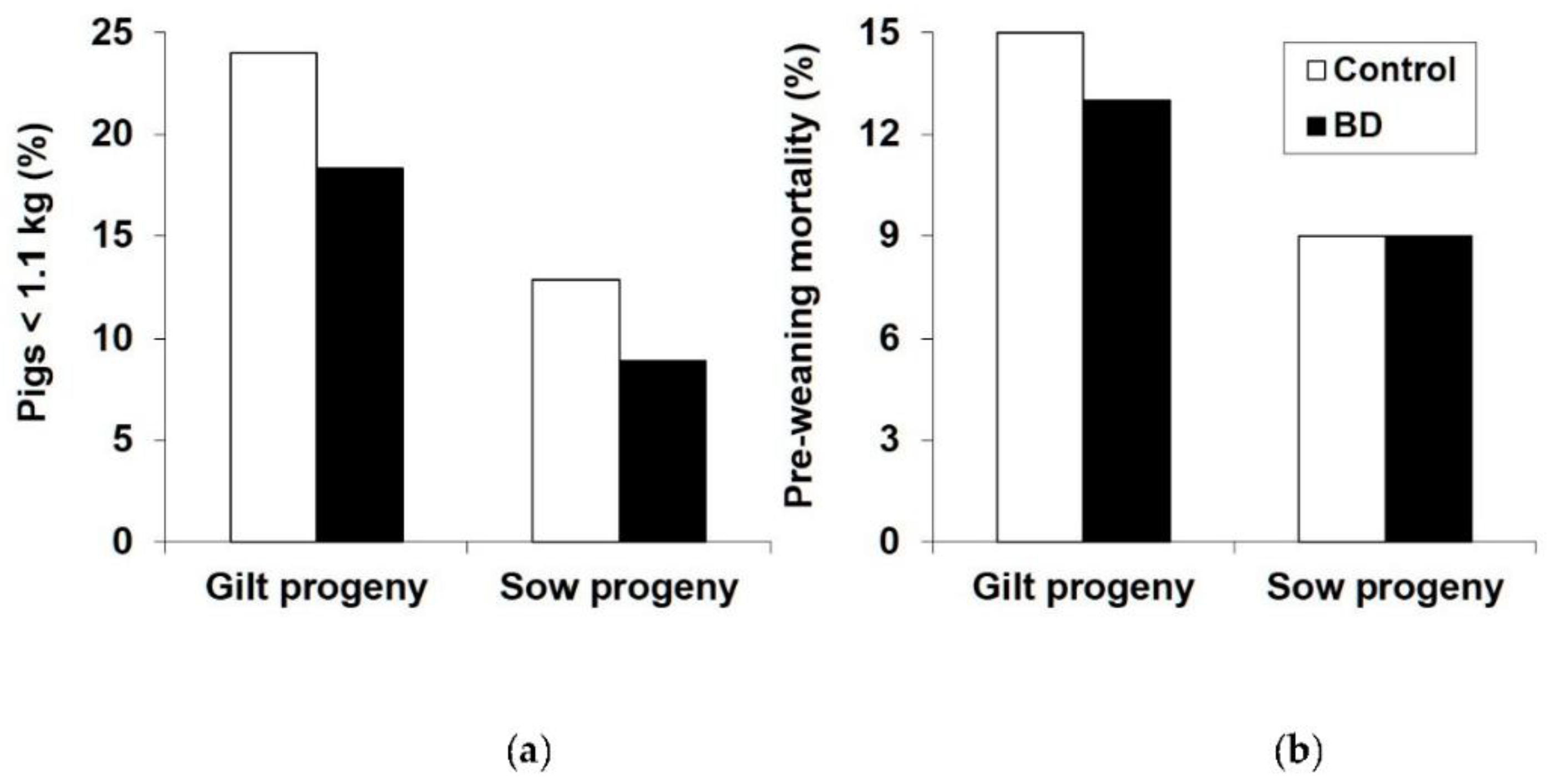
1,3-Butanediol (BD) is a ketogenic substance that can improve piglet growth and survival and potentially increase performance in gilt progeny when provided as a dietary supplement during late gestation. Gilts (n = 77; parity 1) and sows (n = 74; parities 2 and 3) were fed either a standard commercial gestation diet or a diet supplemented with 4% BD from day 90 of gestation until farrowing. Dams fed with diets supplemented with BD had higher plasma beta-hydroxybutyrate (p = 0.01) and lower non-esterified fatty acid concentrations (p < 0.001). The percentage of progeny that were light-for-age (<1.1 kg) at birth was decreased by BD (18.2 vs. 13.5%, p < 0.006), particularly in gilts (24.0 vs. 18.3%, p < 0.034). Individual birth weights and litter weights birth weights tended to be increased by the BD diet (p = 0.085 and 0.078; respectively) although these effects were not maintained to weaning. Pre-weaning mortality was greater in gilt than in sow progeny and was not altered by dietary BD. Feeding BD in late gestation can improve birth weight, but further work is needed to see if these effects are carried through subsequent stages of growth, particularly in gilt progeny.
Keywords:
gilt progeny; parity; birthweight; ketones; pre-weaning mortality