You are currently viewing a new version of our website. To view the old version click .

Animals, Volume 8, Issue 2

February 2018 - 15 articles

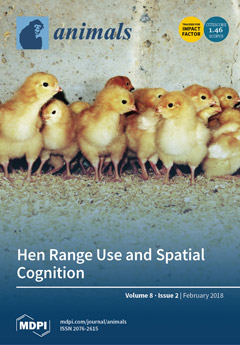
Cover Story: Electronic tracking of free-range laying hens reveals that some hens never venture outside. Fear may play a role but there is still much to be understood about why birds in the same flock vary so dramatically. In an article published in this journal, researchers tested birds that varied in their outdoor range use in a spatial cognition test where hens learned to locate a food reward within a T-maze. The researchers also looked at whether early enrichment could improve learning in the T-maze. ‘Birds that never used the outdoor area were slower to learn to find the food reward’ says Dr Dana Campbell from the CSIRO. ‘Learning rate in the T-maze also predicted some aspects of range use in young birds’. Enriching the chicks’ environment improved learning but tested age played a strong role. These results further the understanding of factors that may influence range use in a free-range system. View this paper
  • Issues are regarded as officially published after their release is announced to the table of contents alert mailing list .
  • You may sign up for email alerts to receive table of contents of newly released issues.
  • PDF is the official format for papers published in both, html and pdf forms. To view the papers in pdf format, click on the "PDF Full-text" link, and use the free Adobe Reader to open them.

Articles (15)

  • Article
  • Open Access
17 Citations
8,179 Views
16 Pages

In the Eye of the Beholder: Owner Preferences for Variations in Cats’ Appearances with Specific Focus on Skull Morphology

  • Mark J. Farnworth,
  • Rowena M. A. Packer,
  • Lorena Sordo,
  • Ruoning Chen,
  • Sarah M. A. Caney and
  • Danièlle A. Gunn-Moore

20 February 2018

Changes in the popularity of cat breeds are largely driven by human perceptions of, and selection for, phenotypic traits including skull morphology. The popularity of breeds with altered skull shapes appears to be increasing, and owner preferences ar...

  • Review
  • Open Access
9 Citations
8,551 Views
12 Pages

14 February 2018

Current animal research ethics frameworks emphasise consequentialist ethics through cost-benefit or harm-benefit analysis. However, these ethical frameworks along with institutional animal ethics approval processes cannot satisfactorily decide when a...

  • Feature Paper
  • Article
  • Open Access
7 Citations
6,027 Views
14 Pages

14 February 2018

The merits of various housing options for domestic cats in shelters have been debated. However, comparisons are difficult to interpret because cats are typically not able to be randomly assigned to different housing conditions. In the current study,...

  • Feature Paper
  • Article
  • Open Access
31 Citations
5,958 Views
14 Pages

Spatial Cognition and Range Use in Free-Range Laying Hens

  • Dana L.M. Campbell,
  • Andrew C. Talk,
  • Ziyang A. Loh,
  • Tim R. Dyall and
  • Caroline Lee

8 February 2018

Radio-frequency identification tracking shows individual free-range laying hens vary in range use, with some never going outdoors. The range is typically more environmentally complex, requiring navigation to return to the indoor resources. Outdoor-pr...

  • Article
  • Open Access
19 Citations
23,987 Views
11 Pages

The Impact of Excluding Food Guarding from a Standardized Behavioral Canine Assessment in Animal Shelters

  • Heather Mohan-Gibbons,
  • Emily D. Dolan,
  • Pamela Reid,
  • Margaret R. Slater,
  • Hugh Mulligan and
  • Emily Weiss

8 February 2018

Many shelters euthanize or restrict adoptions for dogs that exhibit food guarding while in the animal shelter. However, previous research showed that only half the dogs exhibiting food guarding during an assessment food guard in the home. So, dogs ar...

  • Article
  • Open Access
10 Citations
5,925 Views
20 Pages

Surrenderers’ Relationships with Cats Admitted to Four Australian Animal Shelters

  • Sarah Zito,
  • Mandy Paterson,
  • John Morton,
  • Di Vankan,
  • Pauleen Bennett,
  • Jacquie Rand and
  • Clive J. C. Phillips

7 February 2018

The surrender of cats to animal shelters results in financial, social and moral burdens for the community. Correlations of caretaking and interactions with surrendered cats were calculated, to understand more about humans’ relationships with surrende...

  • Review
  • Open Access
33 Citations
17,465 Views
12 Pages

Mudskippers and Their Genetic Adaptations to an Amphibious Lifestyle

  • Xinxin You,
  • Min Sun,
  • Jia Li,
  • Chao Bian,
  • Jieming Chen,
  • Yunhai Yi,
  • Hui Yu and
  • Qiong Shi

7 February 2018

Mudskippers are the largest group of amphibious teleost fish that are uniquely adapted to live on mudflats. During their successful transition from aqueous life to terrestrial living, these fish have evolved morphological and physiological modificati...

  • Article
  • Open Access
12 Citations
12,384 Views
19 Pages

Online Relinquishments of Dogs and Cats in Australia

  • Susan J. Hazel,
  • Caitlin J. Jenvey and
  • Jonathan Tuke

7 February 2018

While traditionally people relinquish their pets to an animal shelter or pound, the internet provides a newer method to re-home. We analyzed advertisements (ads) on the largest website in Australia for trading dogs and cats: Gumtree. Data was collect...

  • Perspective
  • Open Access
13 Citations
9,163 Views
11 Pages

6 February 2018

Pregnancy and parturition in all mammals is accompanied with physical, psychological, social, and hormonal shifts that impact the mother physically and psychologically. Pre-weaning piglet mortality continues to be a major welfare and economic issue i...

  • Article
  • Open Access
6 Citations
7,868 Views
8 Pages

A Novel Non-Invasive Selection Criterion for the Preservation of Primitive Dutch Konik Horses

  • Sharon May-Davis,
  • Wendy Y. Brown,
  • Kathleen Shorter,
  • Zefanja Vermeulen,
  • Raquel Butler and
  • Marianne Koekkoek

1 February 2018

The Dutch Konik is valued from a genetic conservation perspective and also for its role in preservation of natural landscapes. The primary management objective for the captive breeding of this primitive horse is to maintain its genetic purity, whilst...

of 2

Get Alerted

Add your email address to receive forthcoming issues of this journal.

XFacebookLinkedIn
Animals - ISSN 2076-2615