The Donkey Genome: From Evolutionary Insights to Sustainable Breeding Strategies

 ,
,  , and
, and
Simple Summary
Abstract
1. Introduction
2. Materials and Methods
3. The Construction and Optimization of the Donkey Reference Genome
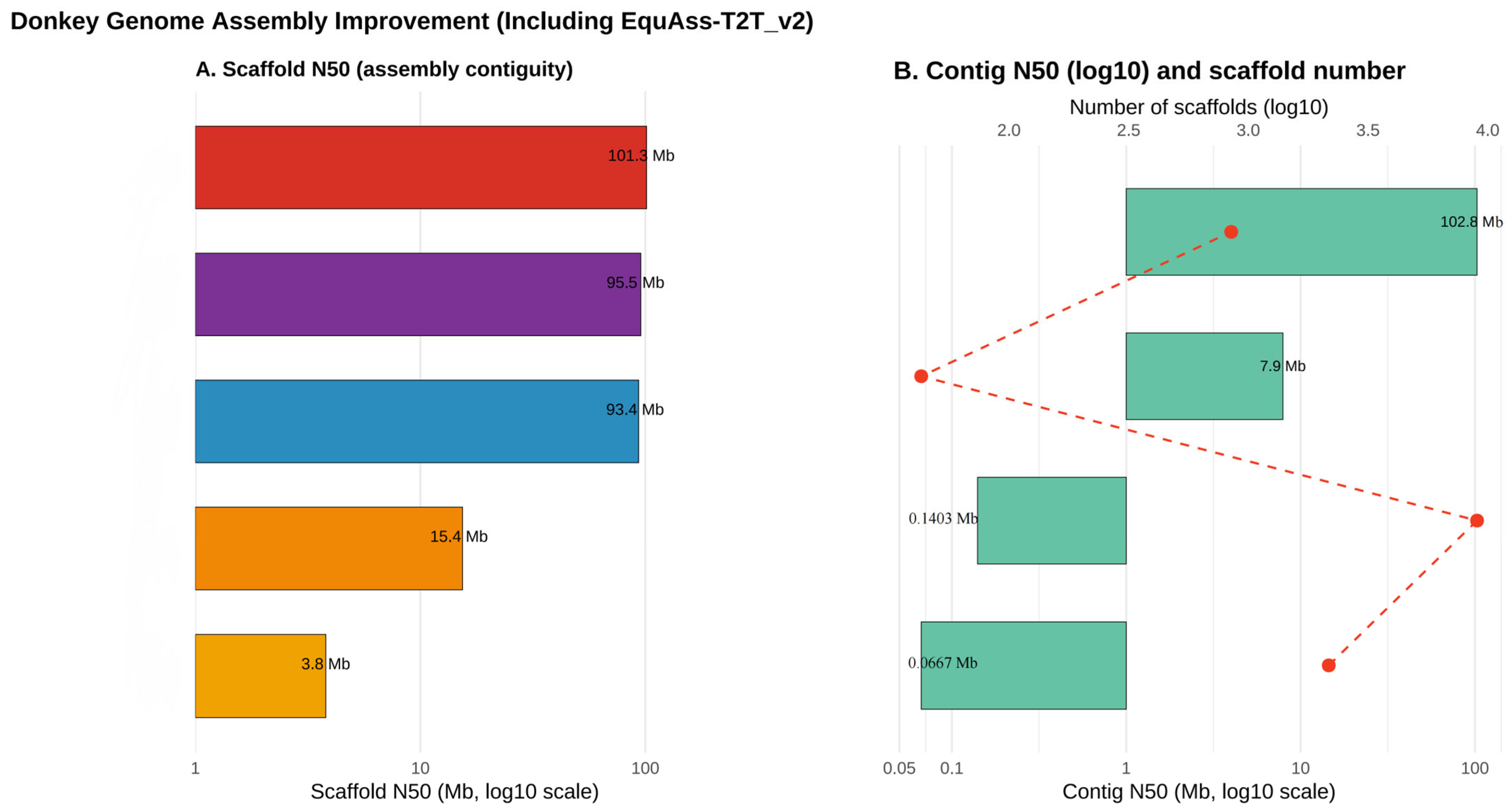
3.1. Evolution of Genome Assembly Technologies in Donkeys
3.2. Multi-Omics Integration for Functional Genome Annotation
4. Population Genomics and Domestication History of Donkeys
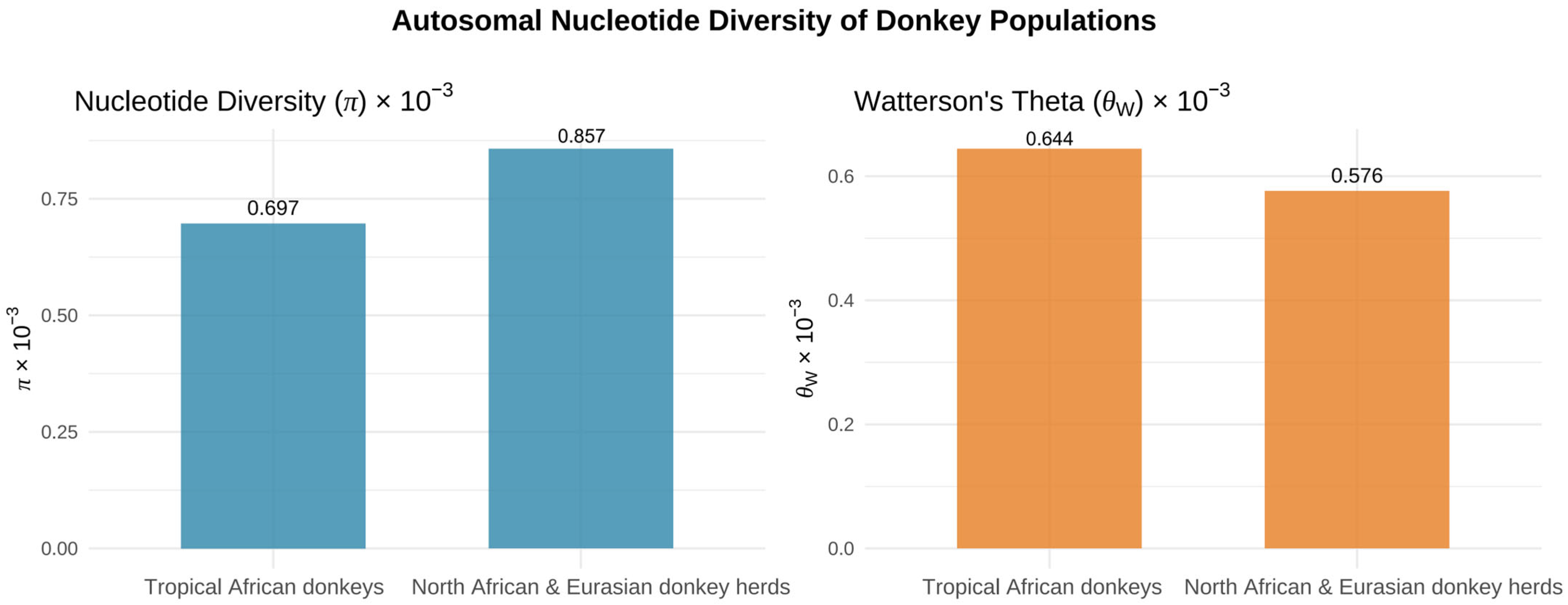
4.1. Genomic Signatures of Adaptation and Selection
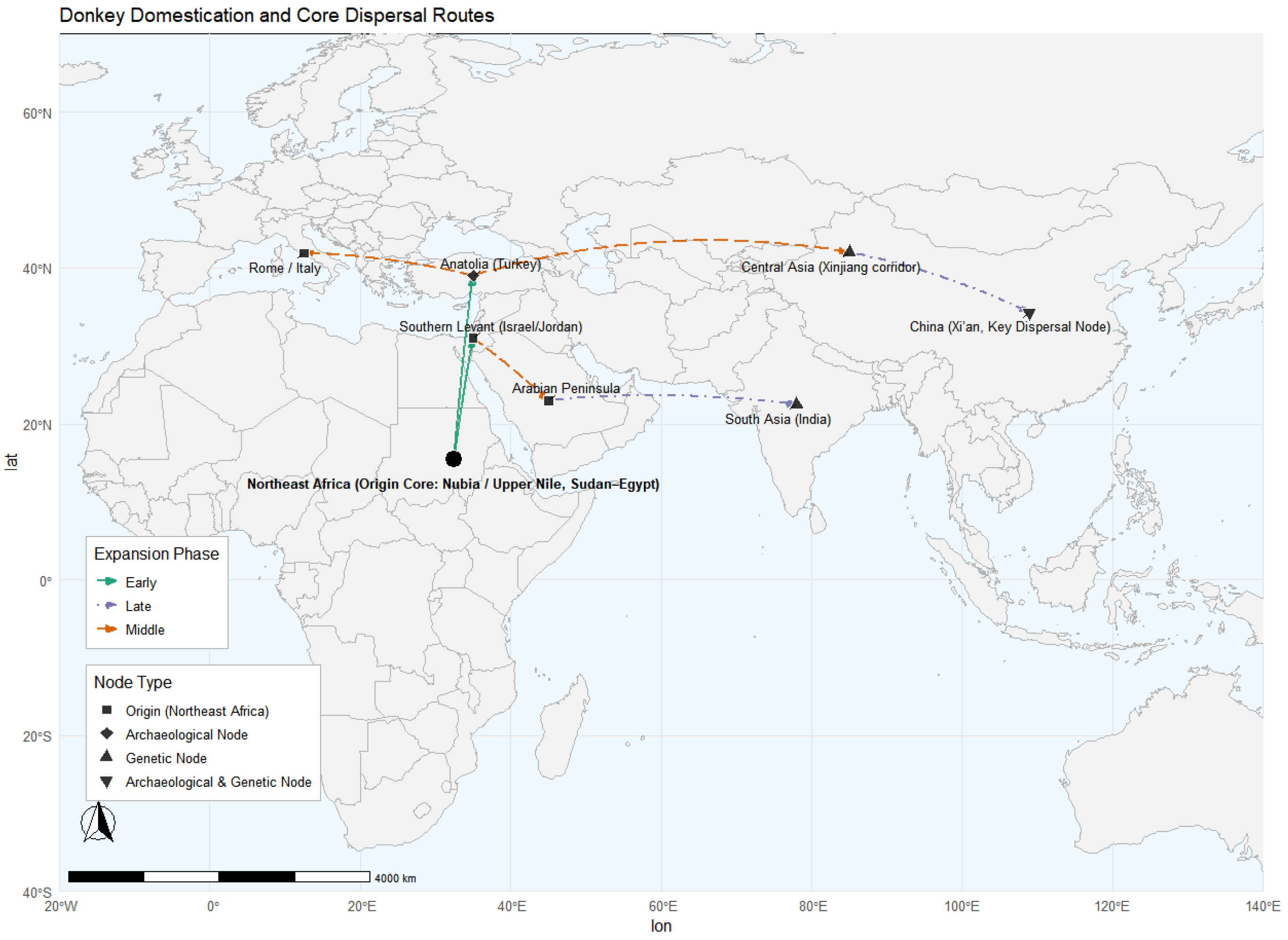
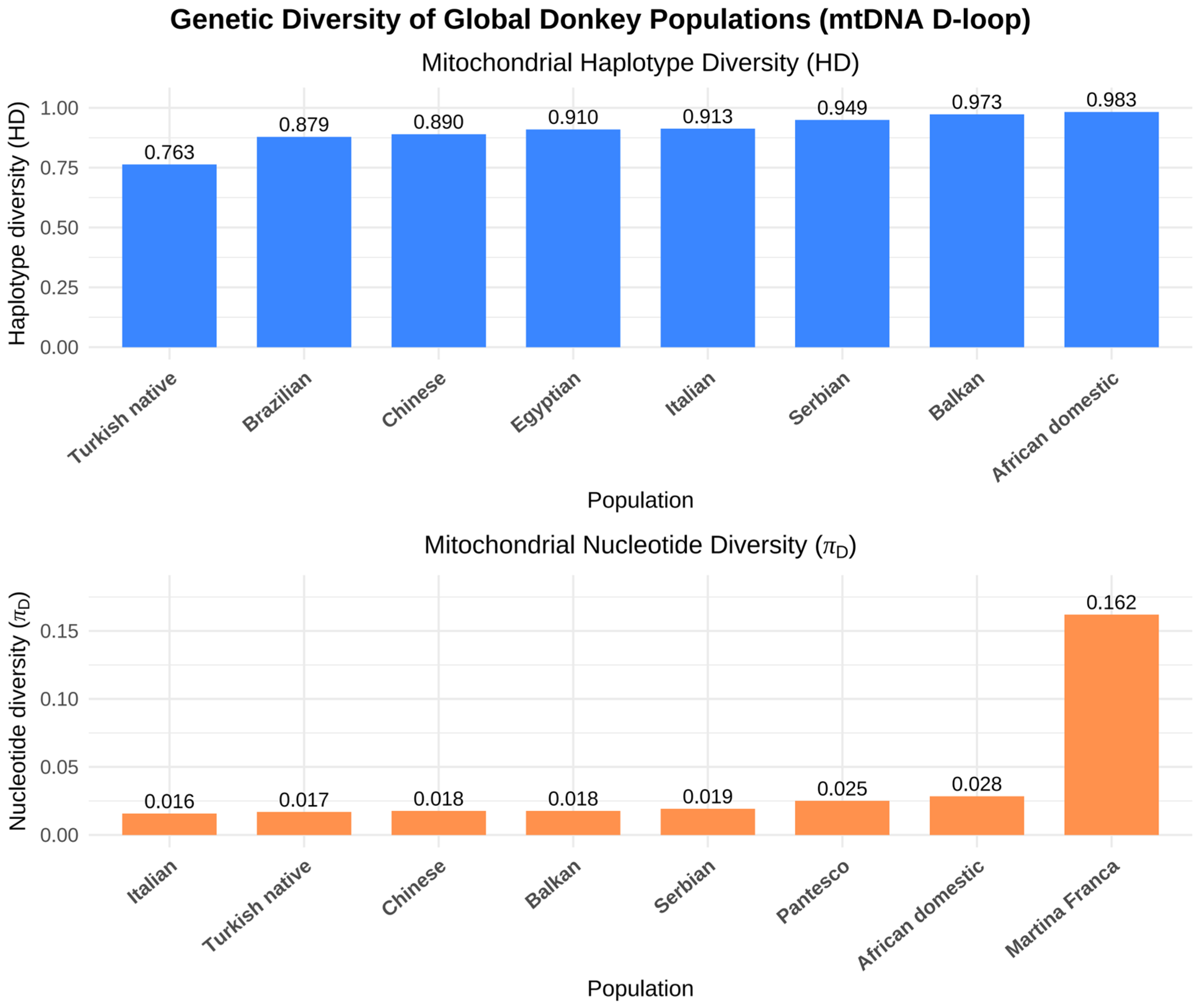
4.2. Multi-Origin Domestication and Genetic Admixture
5. The Genomic Basis of Economic Traits in the Donkey
5.1. Production and Adaptive Traits
5.2. Reproductive and Dairy Traits
5.3. Multi-Omics Integration and Functional Verification of Candidate Loci
6. Applications of Genomics in Donkey Breeding and Conservation
7. Challenges, Limitations, and Ethical Considerations
7.1. Phenotypic Data Quality and Standardization
7.2. Technical, Resource, and Policy Constraints
7.3. Ethical and Biosafety Considerations
8. Conclusions and Perspectives
Author Contributions
Funding
Institutional Review Board Statement
Informed Consent Statement
Data Availability Statement
Conflicts of Interest
References
- Rossel, S.; Marshall, F.; Peters, J.; Pilgram, T.; Adams, M.D.; O’Connor, D. Domestication of the donkey: Timing, processes, and indicators. Proc. Natl. Acad. Sci. USA 2008, 105, 3715–3720. [Google Scholar] [CrossRef]
- Todd, E.T.; Tonasso-Calvière, L.; Chauvey, L.; Schiavinato, S.; Fages, A.; Seguin-Orlando, A.; Clavel, P.; Khan, N.; Pérez Pardal, L.; Patterson Rosa, L. The genomic history and global expansion of domestic donkeys. Science 2022, 377, 1172–1180. [Google Scholar] [CrossRef] [PubMed]
- Kimura, B.; Marshall, F.B.; Chen, S.; Rosenbom, S.; Moehlman, P.D.; Tuross, N.; Sabin, R.C.; Peters, J.; Barich, B.; Yohannes, H.; et al. Ancient DNA from nubian and somali wild ass provides insights into donkey ancestry and domestication. Proc. Natl. Acad. Sci. USA 2011, 278, 50–57. [Google Scholar] [CrossRef] [PubMed]
- Cavalcanti, N.S.H.; Pimentel, T.C.; Magnani, M.; Pacheco, M.T.B.; Alves, S.P.; Branquinho Bessa, R.J.; Marília Da Silva Sant’Ana, A.; de Cássia Ramos Do Egypto Queiroga, R. Donkey milk and fermented donkey milk: Are there differences in the nutritional value and physicochemical characteristics? Lwt 2021, 144, 111239. [Google Scholar] [CrossRef]
- Wang, X.; Ren, W.; Peng, Y.; Khan, M.Z.; Liang, H.; Zhang, Y.; Liu, X.; Chen, Y.; Kou, X.; Wang, L.; et al. Elucidating the Role of Transcriptomic Networks and DNA Methylation in Collagen Deposition of Dezhou Donkey Skin. Animals 2024, 14, 1222. [Google Scholar] [CrossRef]
- Wang, X.; Peng, Y.; Liang, H.; Zahoor Khan, M.; Ren, W.; Huang, B.; Chen, Y.; Xing, S.; Zhan, Y.; Wang, C. Comprehensive transcriptomic analysis unveils the interplay of mRNA and LncRNA expression in shaping collagen organization and skin development in Dezhou donkeys. Front. Genet. 2024, 15, 1335591. [Google Scholar] [CrossRef]
- Chen, W.; Liu, X.; Zhu, Q.; Liu, J.; Ullah, A.; Liu, Y.; Wei, J.; Khan, M.Z.; Wang, C. Morphometric and Histological Characterization of Chestnuts in Dezhou Donkeys and Associations with Phenotypic Traits. Vet. Sci. 2025, 12, 846. [Google Scholar] [CrossRef]
- Li, M.; Sun, L.; Du, X.; Zhao, Y.; Ren, W.; Man, L.; Zhu, M.; Liu, G.; Khan, M.Z.; Wang, C. Characterization and discrimination of donkey milk lipids and volatiles across lactation stages. Food Chem. X 2024, 23, 101740. [Google Scholar] [CrossRef] [PubMed]
- Li, M.; Sun, L.; Du, X.; Ren, W.; Man, L.; Chai, W.; Zhu, M.; Liu, G.; Wang, C. Characterization of lipids and volatile compounds in boiled donkey meat by lipidomics and volatilomics. J. Food Sci. 2024, 89, 3445–3454. [Google Scholar] [CrossRef]
- Li, M.; Zhang, D.; Chai, W.; Zhu, M.; Wang, Y.; Liu, Y.; Wei, Q.; Fan, D.; Lv, M.; Jiang, X.; et al. Chemical and physical properties of meat from Dezhou black donkey. Food Sci. Technol. Res. 2022, 28, 87–94. [Google Scholar] [CrossRef]
- Chai, W.; Wang, L.; Li, T.; Wang, T.; Wang, X.; Yan, M.; Zhu, M.; Gao, J.; Wang, C.; Ma, Q.; et al. Liquid Chromatography–Mass Spectrometry-Based Metabolomics Reveals Dynamic Metabolite Changes during Early Postmortem Aging of Donkey Meat. Foods 2024, 13, 1466. [Google Scholar] [CrossRef]
- Wang, L.; Sheng, G.; Preick, M.; Hu, S.; Deng, T.; Taron, U.H.; Barlow, A.; Hu, J.; Xiao, B.; Sun, G. Ancient mitogenomes provide new insights into the origin and early introduction of Chinese domestic donkeys. Front. Genet. 2021, 12, 759831. [Google Scholar] [CrossRef]
- Wang, Y.; Hua, X.; Shi, X.; Wang, C. Origin, evolution, and research development of donkeys. Genes 2022, 13, 1945. [Google Scholar] [CrossRef]
- Camillo, F.; Rota, A.; Biagini, L.; Tesi, M.; Fanelli, D.; Panzani, D. The Current Situation and Trend of Donkey Industry in Europe. J. Equine Vet. Sci. 2018, 65, 44–49. [Google Scholar] [CrossRef]
- Goodrum, F.; Theuri, S.; Mutua, E.; Carder, G. The Donkey Skin Trade: Challenges and Opportunities for Policy Change. Glob. Policy 2022, 13, 304–309. [Google Scholar] [CrossRef]
- Pierini, C.; Landi, V.; Ciani, E.; Maggiolino, A.; Campanile, D.; Gomez Carpio, M.; De Palo, P. Conservation and genetic analysis of the endangered Martina Franca donkey using pedigree data. Front. Anim. Sci. 2025, 6, 1588467. [Google Scholar] [CrossRef]
- Bordonaro, S.; Guastella, A.M.; Criscione, A.; Zuccaro, A.; Marletta, D. Genetic diversity and variability in endangered Pantesco and two other Sicilian donkey breeds assessed by microsatellite markers. Sci. World J. 2012, 2012, 648427. [Google Scholar] [CrossRef] [PubMed]
- Seyiti, S.; Kelimu, A. Donkey Industry in China: Current Aspects, Suggestions and Future Challenges. J. Equine Vet. Sci. 2021, 102, 103642. [Google Scholar] [CrossRef] [PubMed]
- Martini, M.; Altomonte, I.; Licitra, R.; Salari, F. Short communication: Technological and seasonal variations of vitamin D and other nutritional components in donkey milk. J. Dairy. Sci. 2018, 101, 8721–8725. [Google Scholar] [CrossRef]
- Martini, M.; Altomonte, I.; Licitra, R.; Salari, F. Nutritional and nutraceutical quality of donkey milk. J. Equine Vet. Sci. 2018, 65, 33–37. [Google Scholar] [CrossRef]
- Zhang, X.; Jiang, G.; Ji, C.; Fan, Z.; Ge, S.; Li, H.; Wang, Y.; Lv, X.; Zhao, F. Comparative whey proteome profiling of donkey milk with human and cow milk. Front. Nutr. 2022, 9, 911454. [Google Scholar] [CrossRef] [PubMed]
- Zhang, Z.; Huang, B.; Wang, Y.; Zhu, M.; Liu, G.; Wang, C. A survey report on the donkey original breeding farms in China: Current aspects and future prospective. Front. Vet. Sci. 2023, 10, 1126138. [Google Scholar] [CrossRef]
- Salari, F.; Ciampolini, R.; Mariti, C.; Millanta, F.; Altomonte, I.; Licitra, R.; Auzino, B.; Ascenzi, C.D.; Bibbiani, C.; Giuliotti, L.; et al. A multi-approach study of the performance of dairy donkey during lactation: Preliminary results. Ital. J. Anim. Sci. 2019, 18, 1135–1141. [Google Scholar] [CrossRef]
- Parsad, R.; Bagiyal, M.; Ahlawat, S.; Arora, R.; Gera, R.; Chhabra, P.; Sharma, U. Unraveling the genetic and physiological potential of donkeys: Insights from genomics, proteomics, and metabolomics approaches. Mamm. Genome 2025, 36, 10–24. [Google Scholar] [CrossRef]
- Khan, M.Z.; Chen, W.; Wang, X.; Liang, H.; Wei, L.; Huang, B.; Kou, X.; Liu, X.; Zhang, Z.; Chai, W.; et al. A review of genetic resources and trends of omics applications in donkey research: Focus on China. Front. Vet. Sci. 2024, 11, 1366128. [Google Scholar] [CrossRef]
- Wang, C.; Li, H.; Guo, Y.; Huang, J.; Sun, Y.; Min, J.; Wang, J.; Fang, X.; Zhao, Z.; Wang, S.; et al. Donkey genomes provide new insights into domestication and selection for coat color. Nat. Commun. 2020, 11, 6014. [Google Scholar] [CrossRef]
- Renaud, G.; Petersen, B.; Seguin-Orlando, A.; Bertelsen, M.F.; Waller, A.; Newton, R.; Paillot, R.; Bryant, N.; Vaudin, M.; Librado, P.; et al. Improved de novo genomic assembly for the domestic donkey. Sci. Adv. 2018, 4, eaaq0392. [Google Scholar] [CrossRef] [PubMed]
- Huang, J.; Zhao, Y.; Bai, D.; Shiraigol, W.; Li, B.; Yang, L.; Wu, J.; Bao, W.; Ren, X.; Jin, B.; et al. Donkey genome and insight into the imprinting of fast karyotype evolution. Sci. Rep. 2015, 5, 14106. [Google Scholar] [CrossRef][Green Version]
- Bertolini, F.; Scimone, C.; Geraci, C.; Schiavo, G.; Utzeri, V.J.; Chiofalo, V.; Fontanesi, L. Next generation semiconductor based sequencing of the donkey (Equus asinus) genome provided comparative sequence data against the horse genome and a few millions of single nucleotide polymorphisms. PLoS ONE 2015, 10, e0131925. [Google Scholar] [CrossRef]
- Zeng, L.; Liu, H.-Q.; Tu, X.-L.; Ji, C.-M.; Gou, X.; Esmailizadeh, A.; Wang, S.; Wang, M.-S.; Wang, M.-C.; Li, X.-L.; et al. Genomes reveal selective sweeps in kiang and donkey for high-altitude adaptation. Zool. Res. 2021, 42, 450. [Google Scholar] [CrossRef] [PubMed]
- Shen, J.; Yu, J.; Dai, X.; Li, M.; Wang, G.; Chen, N.; Chen, H.; Lei, C.; Dang, R. Genomic analyses reveal distinct genetic architectures and selective pressures in chinese donkeys. J. Genet. Genom. 2021, 48, 737–745. [Google Scholar] [CrossRef]
- SAM, Y. African origins of modern asses as seen from paleontology and DNA: What about the Atlas wild ass? Geobios 2020, 58, 73–84. [Google Scholar] [CrossRef]
- Song, S.; Wang, S.; Li, N.; Chang, S.; Dai, S.; Guo, Y.; Wu, X.; Cheng, Y.; Zeng, S. Genome-wide association study to identify snps and candidate genes associated with body size traits in donkeys. Front. Genet. 2023, 14, 1112377. [Google Scholar] [CrossRef]
- Li, Y.-Y.; Liu, Y.; Liu, S.-Q.; He, Y.-G.; Lin, X.-R.; Li, Y.; Yang, T.; Feng, M.; Zhang, H.-T.; Wang, X.-Y.; et al. Comprehensive genomic analysis of genetic diversity, body size, and origins of the hetian gray donkey. BMC Genom. 2025, 26, 428. [Google Scholar] [CrossRef]
- Zhao, C.; Teng, J.; Zhang, X.; Wang, D.; Zhang, X.; Li, S.; Li, H.; Jiang, X.; Ning, C.; Zhang, Q. Optimizing genomic selection in dezhou donkey using low coverage whole genome sequencing. Res. Sq 2021. [Google Scholar] [CrossRef]
- Liu, S.; Su, J.; Yang, Q.; Sun, M.; Wang, Z.; Yu, J.; Jafari, H.; Lei, C.; Sun, Y.; Dang, R. Genome-wide analyses based on a novel donkey 40K liquid chip reveal the gene responsible for coat color diversity in Chinese Dezhou donkey. Anim. Genet. 2024, 55, 140–146. [Google Scholar] [CrossRef]
- Miao, X.; Yu, Y.; Zhao, Z.; Wang, Y.; Qian, X.; Wang, Y.; Li, S.; Wang, C. Chromosome-Level Haplotype Assembly for Equus asinu. Front. Genet. 2022, 13, 738105. [Google Scholar] [CrossRef]
- Yang, G.; Gong, M.; Yang, Q.; Li, Y.; Jafari, H.; Lei, C.; Jiang, Y.; Dang, R. Improved chromosome-level donkey (Equus asinus) genome provides insights into genome and chromosome evolution. J. Genet. Genom. 2025, 52, 269–272. [Google Scholar] [CrossRef] [PubMed]
- Jevit, M.J.; Castaneda, C.; Paria, N.; Das, P.J.; Miller, D.; Antczak, D.F.; Kalbfleisch, T.S.; Davis, B.W.; Raudsepp, T. Trio-binning of a hinny refines the comparative organization of the horse and donkey x chromosomes and reveals novel species-specific features. Sci. Rep. 2023, 13, 20180. [Google Scholar] [CrossRef] [PubMed]
- Li, C.; Xiang, X.; Huang, Y.; Zhou, Y.; An, D.; Dong, J.; Zhao, C.; Liu, H.; Li, Y.; Wang, Q.; et al. Long-read sequencing reveals genomic structural variations that underlie creation of quality protein maize. Nat. Commun. 2020, 11, 17. [Google Scholar] [CrossRef] [PubMed]
- Chan, S.; Lam, E.; Saghbini, M.; Bocklandt, S.; Hastie, A.; Cao, H.; Holmlin, E.; Borodkin, M. Structural variation detection and analysis using bionano optical mapping. In Copy Number Variants: Methods and Protocols; Springer: Berlin/Heidelberg, Germany, 2018; pp. 193–203. [Google Scholar]
- Cantalapiedra, J.L.; Prado, J.L.; Hernández Fernández, M.; Alberdi, M.T. Decoupled ecomorphological evolution and diversification in Neogene-Quaternary horses. Science 2017, 355, 627–630. [Google Scholar] [CrossRef] [PubMed]
- Ren, X.; Liu, Y.; Zhao, Y.; Li, B.; Bai, D.; Bou, G.; Zhang, X.; Du, M.; Wang, X.; Bou, T.; et al. Analysis of the whole-genome sequences from an equus parent-offspring trio provides insight into the genomic incompatibilities in the hybrid mule. Genes 2022, 13, 2188. [Google Scholar] [CrossRef] [PubMed]
- National Center for Biotechnology Information (NCBI). EquAss-T2T_v2 (GCF_041296235.1): Equus asinus Telomere-to-Telomere Genome Assembly; NCBI: Bethesda, MD, USA, 2024. Available online: https://www.ncbi.nlm.nih.gov/assembly/GCF_041296235.1 (accessed on 16 October 2025).
- Li, S.; Zhao, G.; Han, H.; Li, Y.; Li, J.; Wang, J.; Cao, G.; Li, X. Genome collinearity analysis illuminates the evolution of donkey chromosome 1 and horse chromosome 5 in perissodactyls: A comparative study. BMC Genom. 2021, 22, 665. [Google Scholar] [CrossRef] [PubMed]
- Wang, Y.; Miao, X.; Zhao, Z.; Wang, Y.; Li, S.; Wang, C. Transcriptome Atlas of 16 Donkey Tissues. Front. Genet. 2021, 12, 682734. [Google Scholar] [CrossRef]
- Zhou, X.; Wu, X.; Pei, C.; He, M.; Chu, M.; Guo, X.; Liang, C.; Bao, P.; Yan, P. Integrative analysis of Iso-Seq and RNA-seq data reveals transcriptome complexity and differential isoform in skin tissues of different hair length Yak. Bmc Genom. 2024, 25, 498. [Google Scholar] [CrossRef]
- Peng, S.; Bellone, R.; Petersen, J.L.; Kalbfleisch, T.S.; Finno, C.J. Successful atac-seq from snap-frozen equine tissues. Front. Genet. 2021, 12, 641788. [Google Scholar] [CrossRef]
- Yang, G.; Sun, Y.; Wang, Z.; Li, C.; Zhai, X.; Zhang, J.; Jafari, H.; Ren, G.; Lei, C.; Dang, R.; et al. Whole-genome resequencing of 391 Chinese donkeys reveals a population structure and provides insights into their morphological and adaptive traits. J. Integr. Agric. 2025, in press. [Google Scholar] [CrossRef]
- Criscione, A.; Chessari, G.; Cesarani, A.; Ablondi, M.; Asti, V.; Bigi, D.; Bordonaro, S.; Ciampolini, R.; Cipolat-Gotet, C.; Congiu, M.; et al. Analysis of ddRAD-seq data provides new insights into the genomic structure and patterns of diversity in Italian donkey populations. J. Anim. Sci. 2024, 102, skae165. [Google Scholar] [CrossRef]
- Dong, H.; Dong, Z.; Wang, F.; Wang, G.; Luo, X.; Lei, C.; Chen, J. Whole genome sequencing provides new insights into the genetic diversity and coat color of asiatic wild ass and its hybrids. Front. Genet. 2022, 13, 818420. [Google Scholar] [CrossRef]
- Rosenbom, S.; Costa, V.; Al-Araimi, N.; Kefena, E.; Abdel-Moneim, A.S.; Abdalla, M.A.; Bakhiet, A.; Beja-Pereira, A. Genetic diversity of donkey populations from the putative centers of domestication. Anim. Genet. 2015, 46, 30–36. [Google Scholar] [CrossRef]
- Huang, B.; Khan, M.Z.; Chai, W.; Ullah, Q.; Wang, C. Exploring genetic markers: Mitochondrial DNA and genomic screening for biodiversity and production traits in donkeys. Animals 2023, 13, 2725. [Google Scholar] [CrossRef]
- Han, H.; Chen, N.; Jordana, J.; Li, C.; Sun, T.; Xia, X.; Zhao, X.; Ji, C.; Shen, S.; Yu, J.; et al. Genetic diversity and paternal origin of domestic donkeys. Anim. Genet. 2017, 48, 708–711. [Google Scholar] [CrossRef]
- Beja-Pereira, A.; England, P.R.; Ferrand, N.; Jordan, S.; Bakhiet, A.O.; Abdalla, M.A.; Mashkour, M.; Jordana, J.; Taberlet, P.; Luikart, G. African Origins of the Domestic Donkey. Science 2004, 304, 1781. [Google Scholar] [CrossRef]
- Han, L.; Zhu, S.; Ning, C.; Cai, D.; Wang, K.; Chen, Q.; Hu, S.; Yang, J.; Shao, J.; Zhu, H.; et al. Ancient DNA provides new insight into the maternal lineages and domestication of Chinese donkeys. BMC Evol. Biol. 2014, 14, 246. [Google Scholar] [CrossRef]
- Xia, X.; Yu, J.; Zhao, X.; Yao, Y.; Zeng, L.; Ahmed, Z.; Shen, S.; Dang, R.; Lei, C. Genetic diversity and maternal origin of Northeast African and South American donkey populations. Anim. Genet. 2019, 50, 266–270. [Google Scholar] [CrossRef]
- Mazzatenta, A.; Vignoli, M.; Caputo, M.; Vignola, G.; Tamburro, R.; De Sanctis, F.; Roig, J.M.; Bucci, R.; Robbe, D.; Carluccio, A. Maternal Phylogenetic Relationships and Genetic Variation among Rare, Phenotypically Similar Donkey Breeds. Genes 2021, 12, 1109. [Google Scholar] [CrossRef] [PubMed]
- Özkan Ünal, E.; Özdil, F.; Kaplan, S.; Gürcan, E.K.; Genç, S.; Arat, S.; Soysal, M.İ. Phylogenetic Relationships of Turkish Indigenous Donkey Populations Determined by Mitochondrial DNA D-loop Region. Animals 2020, 10, 1970. [Google Scholar] [CrossRef]
- Stanisic, L.J.; Aleksic, J.M.; Dimitrijevic, V.; Simeunovic, P.; Glavinic, U.; Stevanovic, J.; Stanimirovic, Z. New insights into the origin and the genetic status of the Balkan donkey from Serbia. Anim. Genet. 2017, 48, 580–590. [Google Scholar] [CrossRef] [PubMed]
- Chen, S.Y.; Zhou, F.; Xiao, H.; Sha, T.; Wu, S.F.; Zhang, Y.P. Mitochondrial DNA diversity and population structure of four Chinese donkey breeds. Anim. Genet. 2006, 37, 427–429. [Google Scholar] [CrossRef] [PubMed]
- Pérez-Pardal, L.; Grizelj, J.; Traoré, A.; Cubric-Curik, V.; Arsenos, G.; Dovenski, T.; Marković, B.; Fernández, I.; Cuervo, M.; Álvarez, I.; et al. Lack of mitochondrial DNA structure in Balkan donkey is consistent with a quick spread of the species after domestication. Anim. Genet. 2014, 45, 144–147. [Google Scholar] [CrossRef]
- Cozzi, M.C.; Valiati, P.; Cherchi, R.; Gorla, E.; Prinsen, R.T.M.M.; Longeri, M.; Bagnato, A.; Strillacci, M.G. Mitochondrial DNA genetic diversity in six Italian donkey breeds (Equus asinus). Mitochondrial DNA Part A 2018, 29, 409–418. [Google Scholar] [CrossRef]
- Liu, Y.; Li, H.; Wang, M.; Zhang, X.; Yang, L.; Zhao, C.; Wu, C. Genetic architectures and selection signatures of body height in Chinese indigenous donkeys revealed by next-generation sequencing. Anim. Genet. 2022, 53, 487–497. [Google Scholar] [CrossRef]
- Wang, G.; Wang, F.; Pei, H.; Li, M.; Bai, F.; Lei, C.; Dang, R. Genome-wide analysis reveals selection signatures for body size and drought adaptation in liangzhou donkey. Genomics 2022, 114, 110476. [Google Scholar] [CrossRef]
- Liu, X.; Peng, Y.; Zhang, X.; Chen, W.; Chen, Y.; Wei, L.; Zhu, Q.; Khan, M.Z.; Wang, C. Potential genetic markers associated with environmental adaptability in herbivorous livestock. Animals 2025, 15, 748. [Google Scholar] [CrossRef] [PubMed]
- Bennett, E.A.; Weber, J.; Bendhafer, W.; Champlot, S.; Peters, J.; Schwartz, G.M.; Grange, T.; Geigl, E. The genetic identity of the earliest human-made hybrid animals, the kungas of Syro-Mesopotamia. Sci. Adv. 2022, 8, eabm0218. [Google Scholar] [CrossRef] [PubMed]
- Rambaldi Migliore, N.; Bigi, D.; Milanesi, M.; Zambonelli, P.; Negrini, R.; Morabito, S.; Verini-Supplizi, A.; Liotta, L.; Chegdani, F.; Agha, S.; et al. Mitochondrial DNA control-region and coding-region data highlight geographically structured diversity and post-domestication population dynamics in worldwide donkeys. PLoS ONE 2024, 19, e0307511. [Google Scholar] [CrossRef] [PubMed]
- Ma, X.-Y.; Ning, T.; Adeola, A.C.; Li, J.; Esmailizadeh, A.; Lichoti, J.K.; Agwanda, B.R.; Isakova, J.; Aldashev, A.A.; Wu, S.-F.; et al. Potential dual expansion of domesticated donkeys revealed by worldwide analysis on mitochondrial sequences. Zool. Res. 2020, 41, 51–60. [Google Scholar] [CrossRef]
- McHugo, G.P.; Dover, M.J.; MacHugh, D.E. Unlocking the origins and biology of domestic animals using ancient DNA and paleogenomics. BMC Biol. 2019, 17, 98. [Google Scholar] [CrossRef]
- Fages, A.; Hanghøj, K.; Khan, N.; Gaunitz, C.; Seguin-Orlando, A.; Leonardi, M.; McCrory Constantz, C.; Gamba, C.; Al-Rasheid, K.A.S.; Albizuri, S.; et al. Tracking Five Millennia of Horse Management with Extensive Ancient Genome Time Series. Cell 2019, 177, 1419–1435.e31. [Google Scholar] [CrossRef]
- Prasinou, P.; De Amicis, I.; Fusaro, I.; Bucci, R.; Cavallini, D.; Parrillo, S.; Caputo, M.; Gramenzi, A.; Carluccio, A. The Lipidomics of Spermatozoa and Red Blood Cells Membrane Profile of Martina Franca Donkey: Preliminary Evaluation. Animals 2023, 13, 8. [Google Scholar] [CrossRef]
- Khan, M.Z.; Chen, W.; Huang, B.; Liu, X.; Wang, X.; Liu, Y.; Chai, W.; Wang, C. Advancements in Genetic Marker Exploration for Livestock Vertebral Traits with a Focus on China. Animals 2024, 14, 594. [Google Scholar] [CrossRef]
- Lai, Z.; Wu, F.; Li, M.; Bai, F.; Gao, Y.; Yu, J.; Li, H.; Lei, C.; Dang, R. Tissue expression profile, polymorphism of IGF1 gene and its effect on body size traits of Dezhou donkey. Gene 2021, 766, 145118. [Google Scholar] [CrossRef]
- Claeys, W.L.; Verraes, C.; Cardoen, S.; De Block, J.; Huyghebaert, A.; Raes, K.; Dewettinck, K.; Herman, L. Consumption of raw or heated milk from different species: An evaluation of the nutritional and potential health benefits. Food Control. 2014, 42, 188–201. [Google Scholar] [CrossRef]
- Liu, X.; Peng, Y.; Zhang, X.; Wang, X.; Chen, W.; Kou, X.; Liang, H.; Ren, W.; Khan, M.Z.; Wang, C. Coloration in Equine: Overview of Candidate Genes Associated with Coat Color Phenotypes. Animals 2024, 14, 1802. [Google Scholar] [CrossRef]
- Polidori, P.; Cammertoni, N.; Santini, G.; Klimanova, Y.; Zhang, J.; Vincenzetti, S. Effects of Donkeys Rearing System on Performance Indices, Carcass, and Meat Quality. Foods 2021, 10, 3119. [Google Scholar] [CrossRef]
- Peng, Y.; Zhu, M.; Gong, Y.; Wang, C. Identification and functional prediction of lncRNAs associated with intramuscular lipid deposition in Guangling donkeys. Front. Vet. Sci. 2024, 11, 1410109. [Google Scholar] [CrossRef]
- Zhou, Z.; Fan, Y.; Wang, G.; Lai, Z.; Gao, Y.; Wu, F.; Lei, C.; Dang, R. Detection of Selection Signatures Underlying Production and Adaptive Traits Based on Whole-Genome Sequencing of Six Donkey Populations. Animals 2020, 10, 1823. [Google Scholar] [CrossRef] [PubMed]
- Kefena, E.; Dessie, T.; Tegegne, A.; Beja-Pereira, A.; Kurtu, M.Y.; Rosenbom, S.; Han, J.L. Genetic diversity and matrilineal genetic signature of native Ethiopian donkeys (Equus asinus) inferred from mitochondrial DNA sequence polymorphism. Livest. Sci. 2014, 167, 73–79. [Google Scholar] [CrossRef]
- Yang, T.; Wang, M.; Liu, Y.; Li, Y.; Feng, M.; Zhao, C. A mutation in POLR2A gene associated with body size traits in Dezhou donkeys revealed with GWAS. J. Anim. Sci. 2024, 102, skae217. [Google Scholar] [CrossRef]
- Liu, L.; Chen, B.; Chen, S.; Liu, W. A Genome-Wide Association Study of the Chest Circumference Trait in Xinjiang Donkeys Based on Whole-Genome Sequencing Technology. Genes 2023, 14, 1081. [Google Scholar] [CrossRef]
- Auzino, B.; Miranda, G.; Henry, C.; Krupova, Z.; Martini, M.; Salari, F.; Cosenza, G.; Ciampolini, R.; Martin, P. Top-Down proteomics based on LC-MS combined with cDNA sequencing to characterize multiple proteoforms of Amiata donkey milk proteins. Food Res. Int. 2022, 160, 111611. [Google Scholar] [CrossRef] [PubMed]
- Cosenza, G.; Ciampolini, R.; Iannaccone, M.; Gallo, D.; Auzino, B.; Pauciullo, A. Sequence variation and detection of a functional promoter polymorphism in the lysozyme c-type gene from Ragusano and Grigio Siciliano donkeys. Anim. Genet. 2018, 49, 270–271. [Google Scholar] [CrossRef]
- Özdil, F.; Bulut, H.; Işık, R. Genetic diversity of κ-casein (CSN3) and lactoferrin (LTF) genes in the endangered Turkish donkey (Equus asinus) populations. Arch. Anim. Breed. 2019, 62, 77–82. [Google Scholar] [CrossRef] [PubMed]
- Fang, C.; Farnir, F.; Liu, L.; Xiao, H. Unveiling Genetic Markers for Milk Yield in Xinjiang Donkeys: A Genome-Wide Association Study and Kompetitive Allele-Specific PCR-Based Approach. Int. J. Mol. Sci. 2025, 26, 2961. [Google Scholar] [CrossRef] [PubMed]
- Abitbol, M.; Legrand, R.; Tiret, L. A missense mutation in melanocortin 1 receptor is associated with the red coat colour in donkeys. Anim. Genet. 2014, 45, 878–880. [Google Scholar] [CrossRef]
- Utzeri, V.J.; Bertolini, F.; Ribani, A.; Schiavo, G.; Dall’Olio, S.; Fontanesi, L. The albinism of the feral Asinara white donkeys (Equus asinus) is determined by a missense mutation in a highly conserved position of the tyrosinase (TYR) gene deduced protein. Anim. Genet. 2016, 47, 120–124. [Google Scholar] [CrossRef]
- Haase, B.; Rieder, S.; Leeb, T. Two variants in the KIT gene as candidate causative mutations for a dominant white and a white spotting phenotype in the donkey. Anim. Genet. 2015, 46, 321–324. [Google Scholar] [CrossRef]
- Zhang, F.; Zhang, S.; Sun, Y.; Wang, J.; Shen, W. Comparative Transcriptomics Uncover the Uniqueness of Oocyte Development in the Donkey. Front. Genet. 2022, 13, 839207. [Google Scholar] [CrossRef]
- Li, Z.; Song, X.; Yin, S.; Yan, J.; Lv, P.; Shan, H.; Cui, K.; Liu, H.; Liu, Q. Single-Cell RNA-Seq Revealed the Gene Expression Pattern during the In Vitro Maturation of Donkey Oocytes. Genes 2021, 12, 1640. [Google Scholar] [CrossRef]
- Ake, A.S.; Ayo, J.O. Effects of melatonin on interleukins and heat stress protein responses in donkeys subjected to packing during the hot-dry season in the Northern Guinea Savanna zone of Nigeria. Comp. Clin. Pathol. 2023, 32, 899–906. [Google Scholar] [CrossRef]
- Samie, K.A.; Kowalewski, M.P.; Schuler, G.; Gastal, G.D.A.; Bollwein, H.; Scarlet, D. Roles of GDF9 and BMP15 in equine follicular development: In vivo content and in vitro effects of IGF1 and cortisol on granulosa cells. BMC Vet. Res. 2025, 21, 292. [Google Scholar] [CrossRef]
- Chen, S.; Schenkel, F.S.; Melo, A.L.P.; Oliveira, H.R.; Pedrosa, V.B.; Araujo, A.C.; Melka, M.G.; Brito, L.F. Identifying pleiotropic variants and candidate genes for fertility and reproduction traits in Holstein cattle via association studies based on imputed whole-genome sequence genotypes. BMC Genom. 2022, 23, 331. [Google Scholar] [CrossRef]
- Hosseinzadeh, S.; Rafat, S.A.; Fang, L. Integrated TWAS, GWAS, and RNAseq results identify candidate genes associated with reproductive traits in cows. Sci. Rep. 2025, 15, 1932. [Google Scholar] [CrossRef] [PubMed]
- Rodrigues, G.R.D.; Brito, L.F.; Mota, L.F.M.; Cyrillo, J.N.S.G.; Valente, J.P.S.; Benfica, L.F.; Silva Neto, J.B.; Borges, M.S.; Monteiro, F.M.; Faro, L.E.; et al. Genome-wide association studies and functional annotation of pre-weaning calf mortality and reproductive traits in Nellore cattle from experimental selection lines. BMC Genom. 2024, 25, 1196. [Google Scholar] [CrossRef] [PubMed]
- Zhang, H.; Bao, S.; Zhao, X.; Bai, Y.; Lv, Y.; Gao, P.; Li, F.; Zhang, W. Genome-Wide Association Study and Phenotype Prediction of Reproductive Traits in Large White Pigs. Animals 2024, 14, 3348. [Google Scholar] [CrossRef]
- Živkov Baloš, M.; Ljubojević Pelić, D.; Jakšić, S.; Lazić, S. Donkey Milk: An Overview of its Chemical Composition and Main Nutritional Properties or Human Health Benefit Properties. J. Equine Vet. Sci. 2023, 121, 104225. [Google Scholar] [CrossRef]
- Khan, M.Z.; Chen, W.; Li, M.; Ren, W.; Huang, B.; Kou, X.; Ullah, Q.; Wei, L.; Wang, T.; Khan, A.; et al. Is there sufficient evidence to support the health benefits of including donkey milk in the diet? Front. Nutr. 2024, 11, 1404998. [Google Scholar] [CrossRef]
- Zhou, M.; Huang, F.; Du, X.; Liu, G.; Wang, C. Analysis of the Differentially Expressed Proteins in Donkey Milk in Different Lactation Stages. Foods 2023, 12, 4466. [Google Scholar] [CrossRef] [PubMed]
- Luoyizha, W.; Zeng, B.; Li, H.; Liao, X. A Preliminary Study of Proteomic Analysis on Caseins and Whey Proteins in Donkey Milk from Xinjiang and Shandong of China. Efood 2021, 2, 27–36. [Google Scholar] [CrossRef]
- Cosenza, G.; Pauciullo, A. A Comprehensive Analysis of CSN1S2 I and II Transcripts Reveals Significant Genetic Diversity and Allele-Specific Exon Skipping in Ragusana and Amiatina Donkeys. Animals 2024, 14, 2918. [Google Scholar] [CrossRef]
- García-Gámez, E.; Gutiérrez-Gil, B.; Sahana, G.; Sánchez, J.; Bayón, Y.; Arranz, J. GWA Analysis for Milk Production Traits in Dairy Sheep and Genetic Support for a QTN Influencing Milk Protein Percentage in the LALBA Gene. PLoS ONE 2012, 7, e47782. [Google Scholar] [CrossRef]
- Zhou, J.; Liu, L.; Chen, C.J.; Zhang, M.; Lu, X.; Zhang, Z.; Huang, X.; Shi, Y. Genome-wide association study of milk and reproductive traits in dual-purpose Xinjiang Brown cattle. BMC Genom. 2019, 20, 827. [Google Scholar] [CrossRef]
- Kociszewska-Najman, B.; Borek-Dzieciol, B.; Szpotanska-Sikorska, M.; Wilkos, E.; Pietrzak, B.; Wielgos, M. The creamatocrit, fat and energy concentration in human milk produced by mothers of preterm and term infants. J. Matern.-Fetal Neonatal Med. 2012, 25, 1599–1602. [Google Scholar] [CrossRef]
- Rios-Leyvraz, M.; Yao, Q. Calcium, zinc, and vitamin D in breast milk: A systematic review and meta-analysis. Int. Breastfeed. J. 2023, 18, 27. [Google Scholar] [CrossRef] [PubMed]
- Malacarne, M.; Criscione, A.; Franceschi, P.; Bordonaro, S.; Formaggioni, P.; Marletta, D.; Summer, A. New Insights into Chemical and Mineral Composition of Donkey Milk throughout Nine Months of Lactation. Animals 2019, 9, 1161. [Google Scholar] [CrossRef]
- Zhou, M.; Ma, Z.; Du, X.; Wang, C.; Liu, G. The Milk Compositions and Blood Parameters of Lactating Dezhou Donkeys Changes With Lactation Stages. Vet. Med. Sci. 2025, 11, e70269. [Google Scholar] [CrossRef]
- Nayak, C.M.; Ramachandra, C.T.; Nidoni, U.; Hiregoudar, S.; Ram, J.; Naik, N. Physico-chemical composition, minerals, vitamins, amino acids, fatty acid profile and sensory evaluation of donkey milk from Indian small grey breed. J. Food Sci. Technol. 2020, 57, 2967–2974. [Google Scholar] [CrossRef]
- Garhwal, R.; Bhardwaj, A.; Sangwan, K.; Mehra, R.; Pal, Y.; Nayan, V.; Iquebal, M.A.; Jaiswal, S.; Kumar, H. Milk from Halari Donkey Breed: Nutritional Analysis, Vitamins, Minerals, and Amino Acids Profiling. Foods 2023, 12, 853. [Google Scholar] [CrossRef] [PubMed]
- Prasad, B. Nutritional and health benefits of donkey milk. J. Food Sci. Nutr. Ther. 2020, 6, 22–25. [Google Scholar] [CrossRef]
- Živkov-Baloš, M.; Popov, N.; Vidaković-Knežević, S.; Savić, S.; Gajdov, V.; Jakšić, S.; Ljubojević-Pelić, D. Nutritional quality of donkey milk during the lactation. Biotechnol. Anim. Husb. 2024, 40, 155–168. [Google Scholar] [CrossRef]
- Ljubojević Pelić, D.; Popov, N.; Gardić, E.; Vidaković Knežević, S.; Žekić, M.; Gajdov, V.; Živkov Baloš, M. Seasonal Variation in Essential Minerals, Trace Elements, and Potentially Toxic Elements in Donkey Milk from Banat and Balkan Breeds in the Zasavica Nature Reserve. Animals 2025, 15, 791. [Google Scholar] [CrossRef]
- Peng, S.; Dahlgren, A.R.; Donnelly, C.G.; Hales, E.N.; Petersen, J.L.; Bellone, R.R.; Kalbfleisch, T.; Finno, C.J. Functional annotation of the animal genomes: An integrated annotation resource for the horse. PLoS Genet. 2023, 19, e1010468. [Google Scholar] [CrossRef]
- Tian, Y.; Zhang, W.; Gao, C.; Wang, H.; Wang, J.; Cheng, S.; Zhang, S.; Zhang, M.; Li, J.; Sun, Y.; et al. Comprehensive multi-omics characterization of different cuts of Dezhou donkey meat. Food Chem. Mol. Sci. 2025, 11, 100267. [Google Scholar] [CrossRef]
- Pinzon-Arteaga, C.; Snyder, M.D.; Lazzarotto, C.R.; Moreno, N.F.; Juras, R.; Raudsepp, T.; Golding, M.C.; Varner, D.D.; Long, C.R. Efficient correction of a deleterious point mutation in primary horse fibroblasts with CRISPR-Cas9. Sci. Rep. 2020, 10, 7411. [Google Scholar] [CrossRef] [PubMed]
- Wang, X.; Fei, Y.; Shao, Y.; Liao, Q.; Meng, Q.; Chen, R.; Deng, L. Transcriptome analysis reveals immune function-related mRNA expression in donkey mammary glands during four developmental stages. Comp. Biochem. Physiol. Part D Genom. Proteom. 2024, 49, 101169. [Google Scholar] [CrossRef] [PubMed]
- Jin, Y.; Zhang, F.; Ma, R.; Xing, J.; Wang, M.; Sun, Y.; Zhang, G. Single-cell RNA sequencing unveils dynamic transcriptional profiles during the process of donkey spermatogenesis and maturation. Genomics 2025, 117, 110974. [Google Scholar] [CrossRef]
- Mecocci, S.; Pietrucci, D.; Milanesi, M.; Pascucci, L.; Filippi, S.; Rosato, V.; Chillemi, G.; Capomaccio, S.; Cappelli, K. Transcriptomic Characterization of Cow, Donkey and Goat Milk Extracellular Vesicles Reveals Their Anti-Inflammatory and Immunomodulatory Potential. Int. J. Mol. Sci. 2021, 22, 12759. [Google Scholar] [CrossRef] [PubMed]
- Fei, Y.; Gai, Y.; Liao, Q.; Zhang, L.; Li, Z.; Li, B.; Bai, M.; Li, N.; Deng, L. An Integrated Analysis of Lactation-Related miRNA and mRNA Expression Profiles in Donkey Mammary Glands. Genes 2022, 13, 1637. [Google Scholar] [CrossRef]
- Xu, Z.; Zeng, H.; Teng, J.; Ding, X.; Li, J.; Zhang, Z. Integrating eQTL and genome-wide association studies to uncover additive and dominant regulatory circuits in pig uterine capacity. Animal 2025, 19, 101599. [Google Scholar] [CrossRef]
- Ni, J.; Deng, B.; Zhu, M.; Wang, Y.; Yan, C.; Wang, T.; Liu, Y.; Li, G.; Ding, Y.; Jin, G. Integration of GWAS and eQTL Analysis to Identify Risk Loci and Susceptibility Genes for Gastric Cancer. Front. Genet. 2020, 11, 679. [Google Scholar] [CrossRef]
- Zhao, C.; Teng, J.; Zhang, X.; Wang, D.; Zhang, X.; Li, S.; Jiang, X.; Li, H.; Ning, C.; Zhang, Q. Towards a Cost-Effective Implementation of Genomic Prediction Based on Low Coverage Whole Genome Sequencing in Dezhou Donkey. Front. Genet. 2021, 12, 728764. [Google Scholar] [CrossRef]
- Xie, T.; Zhang, S.; Shen, W.; Zhang, G.; Guo, R.; Zhang, W.; Cao, Y.; Pan, Q.; Liu, F.; Sun, Y.; et al. Identification of Candidate Genes for Twinning Births in Dezhou Donkeys by Detecting Signatures of Selection in Genomic Data. Genes 2022, 13, 1902. [Google Scholar] [CrossRef]
- GB/T 29392-2022; Quality Grading of Livestock and Poultry Meat—Beef. Standardization Administration of China and State Administration for Market Regulation: Beijing, China, 2022.
- Tetens, J.; Widmann, P.; Kühn, C.; Thaller, G. A genome-wide association study indicates LCORL/NCAPG as a candidate locus for withers height in German Warmblood horses. Anim. Genet. 2013, 44, 467–471. [Google Scholar] [CrossRef] [PubMed]
- Mallick, H.; Rahnavard, A.; McIver, L.J.; Ma, S.; Zhang, Y.; Nguyen, L.H.; Tickle, T.L.; Weingart, G.; Ren, B.; Schwager, E.H.; et al. Multivariable association discovery in population-scale meta-omics studies. PLoS Comput. Biol. 2021, 17, e1009442. [Google Scholar] [CrossRef]
- Fu, J.; Zanotelli, V.R.T.; Howald, C.; Chammartin, N.; Kolpakov, I.; Xenarios, I.; Froese, D.S.; Wollscheid, B.; Pedrioli, P.G.A.; Goetze, S. A Multi-Omics Framework for Decoding Disease Mechanisms: Insights From Methylmalonic Aciduria. Mol. Cell. Proteom. 2025, 24, 100998. [Google Scholar] [CrossRef]
- Yang, Y.; Dong, L.; Li, Y.; Huang, Y.; Zeng, X. Summary data-based Mendelian randomization and single-cell RNA sequencing analyses identify immune associations with low-level LGALS9 in sepsis. J. Cell Mol. Med. 2024, 28, e18559. [Google Scholar] [CrossRef]
- Schwarz, L.; Heise, J.; Liu, Z.; Bennewitz, J.; Thaller, G.; Tetens, J. Mendelian randomisation to uncover causal associations between conformation, metabolism, and production as potential exposure to reproduction in German Holstein dairy cattle. Genet. Sel. Evol. 2025, 57, 7. [Google Scholar] [CrossRef] [PubMed]
- Bosse, M.; van Loon, S. Challenges in quantifying genome erosion for conservation. Front. Genet. 2022, 13, 960958. [Google Scholar] [CrossRef] [PubMed]
- Wellmann, R. Selection index theory for populations under directional and stabilizing selection. Genet. Sel. Evol. 2023, 55, 10. [Google Scholar] [CrossRef]
- Mustefa, A.; Assefa, A.; Misganaw, M.; Getachew, F.; Abegaz, S.; Hailu, A.; Emshaw, Y. Phenotypic characterization of donkeys in Benishangul Gumuz. Online J. Anim. Feed. Res. 2020, 10, 25–35. [Google Scholar]
- Fusaro, I.; Parrillo, S.; Buonaiuto, G.; Prasinou, P.; Gramenzi, A.; Bucci, R.; Cavallini, D.; Carosi, A.; Carluccio, A.; De Amicis, I. Effects of hemp-based polyunsaturated fatty acid supplementation on membrane lipid profiles and reproductive performance in Martina Franca jacks. Front. Vet. Sci. 2025, 12, 1553218. [Google Scholar] [CrossRef]
- Kefena, E.; Rosenbom, S.; Beja-Pereira, A.; Kurtu, M.Y.; Han, J.L.; Dessie, T. Genetic diversity and population genetic structure in native Ethiopian donkeys (Equus asinus) inferred from equine microsatellite markers. Trop. Anim. Health Prod. 2021, 53, 334. [Google Scholar] [CrossRef] [PubMed]
- Getachew, T.B.; Kassa, A.H.; Megersa, A.G. Phenotypic characterization of donkey population in South Omo Zone, Southern Ethiopia. Heliyon 2023, 9, e18662. [Google Scholar] [CrossRef] [PubMed]
- Li, W.; Qiu, L.; Guan, J.; Sun, Y.; Zhao, J.; Du, M. Comparative transcriptome analysis of longissimus dorsi tissues with different intramuscular fat contents from Guangling donkeys. BMC Genom. 2022, 23, 644. [Google Scholar] [CrossRef]
- van Marle-Köster, E.; Lashmar, S.F.; Retief, A.; Visser, C. Whole-Genome SNP Characterisation Provides Insight for Sustainable Use of Local South African Livestock Populations. Front. Genet. 2021, 12, 714194. [Google Scholar] [CrossRef]
- Li, C.; Han, J.; Chang, T.; Jafari, H.; Yang, Q.; Guo, J.; Lei, C.; Dang, R. Whole-genome analysis reveals genetic diversity and selection pressure in Sichuan donkey. BMC Genom. 2025, 26, 1072. [Google Scholar] [CrossRef]
- Landi, V.; Ceccobelli, S.; Bruno, S.; Pierini, C.; Campanile, D.; Ciani, E.; De Palo, P. Insights into pedigree- and genome-based inbreeding patterns in Martina Franca donkey breed. Animal 2025, 19, 101652. [Google Scholar] [CrossRef]
- Silva, G.A.A.; Harder, A.M.; Kirksey, K.B.; Mathur, S.; Willoughby, J.R. Detectability of runs of homozygosity is influenced by analysis parameters and population-specific demographic history. PLoS Comput. Biol. 2024, 20, e1012566. [Google Scholar] [CrossRef] [PubMed]
- Khatkar, M.S.; Moser, G.; Hayes, B.J.; Raadsma, H.W. Strategies and utility of imputed SNP genotypes for genomic analysis in dairy cattle. BMC Genom. 2012, 13, 538. [Google Scholar] [CrossRef]
- Tian, Y.; Niu, Y.; Zhang, X.; Wang, T.; Tian, Z.; Zhang, X.; Guo, J.; Ge, W.; Liu, S.; Sun, Y.; et al. The Transcriptomic Signature of Donkey Ovarian Tissue Revealed by Cross-Species Comparative Analysis at Single-Cell Resolution. Animals 2025, 15, 1761. [Google Scholar] [CrossRef]
- Chai, W.; Qu, H.; Ma, Q.; Zhu, M.; Li, M.; Zhan, Y.; Liu, Z.; Xu, J.; Yao, H.; Li, Z.; et al. RNA-seq analysis identifies differentially expressed gene in different types of donkey skeletal muscles. Anim. Biotechnol. 2023, 34, 1786–1795. [Google Scholar] [CrossRef]
- Gambini, A.; Smith, J.M.; Gurkin, R.J.; Palacios, P.D. Current and Emerging Advanced Techniques for Breeding Donkeys and Mules. Animals 2025, 15, 990. [Google Scholar] [CrossRef]
- Maswana, M.; Mugwabana, T.J.; Tyasi, T.L. Evaluation of breeding practices and morphological characterization of donkeys in Blouberg Local Municipality, Limpopo province: Implication for the design of community-based breeding programme. PLoS ONE 2022, 17, e0278400. [Google Scholar] [CrossRef]
- Zhu, B.; Park, J.; Coffey, S.R.; Russo, A.; Hsu, I.; Wang, J.; Su, C.; Chang, R.; Lam, T.T.; Gopal, P.P.; et al. Single-cell transcriptomic and proteomic analysis of Parkinson’s disease brains. Sci. Transl. Med. 2024, 16, eabo1997. [Google Scholar] [CrossRef]
- Liu, B.; Gong, S.; Tulafu, H.; Zhang, R.; Tao, W.; Adili, A.; Liu, L.; Wu, W.; Huang, J. Analysis of the Genetic Relationship and Inbreeding Coefficient of the Hetian Qing Donkey through a Simplified Genome Sequencing Technology. Genes 2024, 15, 570. [Google Scholar] [CrossRef]
- Chen, J.; Zhang, S.; Liu, S.; Dong, J.; Cao, Y.; Sun, Y. Single nucleotide polymorphisms (SNPs) and indels identified from whole-genome re-sequencing of four Chinese donkey breeds. Anim. Biotechnol. 2023, 34, 1828–1839. [Google Scholar] [CrossRef]
- He, H.; Liu, L.; Chen, B.; Xiao, H.; Liu, W. Study on lactation performance and development of KASP marker for milk traits in Xinjiang donkey (Equus asinus). Anim. Biotechnol. 2023, 34, 2724–2735. [Google Scholar] [CrossRef] [PubMed]
- Gichure, M.; Onono, J.; Wahome, R.; Gathura, P. Assessment of Phenotypic Characteristics and Work Suitability for Working Donkeys in the Central Highlands in Kenya. Vet. Med. Int. 2020, 2020, 8816983. [Google Scholar] [CrossRef] [PubMed]
- Zeng, H.; Guo, K.; Zhong, Z.; Teng, J.; Xu, Z.; Wei, C.; Shi, S.; Zhang, Z.; Gao, Y. Benchmarking 24 combinations of genotype pre-phasing and imputation software for SNP arrays in pigs. J. Integr. Agric. 2024, in press. [Google Scholar] [CrossRef]
- Golan, J.; Riddle, K.; Hudson, M.; Anderson, J.; Kusabs, N.; Coltman, T. Benefit sharing: Why inclusive provenance metadata matter. Front. Genet. 2022, 13, 1014044. [Google Scholar] [CrossRef]
- Cuellar, C.J.; Amaral, T.F.; Rodriguez-Villamil, P.; Ongaratto, F.; Martinez, D.O.; Labrecque, R.; Losano, J.D.D.A.; Estrada-Cortés, E.; Bostrom, J.R.; Martins, K.; et al. Consequences of gene editing of PRLR on thermotolerance, growth, and male reproduction in cattle. FASEB Bioadv 2024, 6, 223–234. [Google Scholar] [CrossRef]
- Zheng, Q.; Lin, J.; Huang, J.; Zhang, H.; Zhang, R.; Zhang, X.; Cao, C.; Hambly, C.; Qin, G.; Yao, J.; et al. Reconstitution of UCP1 using CRISPR/Cas9 in the white adipose tissue of pigs decreases fat deposition and improves thermogenic capacity. Proc. Natl. Acad. Sci. USA 2017, 114, E9474–E9482. [Google Scholar] [CrossRef] [PubMed]
- Monod, A.; Koch, C.; Jindra, C.; Haspeslagh, M.; Howald, D.; Wenker, C.; Gerber, V.; Rottenberg, S.; Hahn, K. CRISPR/Cas9-Mediated Targeting of BPV-1-Transformed Primary Equine Sarcoid Fibroblasts. Viruses 2023, 15, 1942. [Google Scholar] [CrossRef]
- Neumann, G.B.; Korkuć, P.; Arends, D.; Wolf, M.J.; May, K.; König, S.; Brockmann, G.A. Genomic diversity and relationship analyses of endangered German Black Pied cattle (DSN) to 68 other taurine breeds based on whole-genome sequencing. Front. Genet. 2023, 13, 993959. [Google Scholar] [CrossRef]
- Wang, J.; Liu, C.; Chen, J.; Bai, Y.; Wang, K.; Wang, Y.; Fang, M. Genome-Wide Analysis Reveals Human-Mediated Introgression from Western Pigs to Indigenous Chinese Breeds. Genes 2020, 11, 275. [Google Scholar] [CrossRef] [PubMed]
- Tesfaye, S.; Deressa, B.; Teshome, E. Study on the Health and Welfare of Working Donkeys in Mirab Abaya District, Southern Ethiopia. Acad. J. Anim. Dis. 2016, 5, 40–52. [Google Scholar]
- Pei, Y.; Song, Y.; Feng, Z.; Li, H.; Mu, Y.; Rehman, S.U.; Liu, Q.; Li, K. Myostatin Alteration in Pigs Enhances the Deposition of Long-Chain Unsaturated Fatty Acids in Subcutaneous Fat. Foods 2022, 11, 1286. [Google Scholar] [CrossRef]
- Ren, H.; Xiao, W.; Qin, X.; Cai, G.; Chen, H.; Hua, Z.; Cheng, C.; Li, X.; Hua, W.; Xiao, H.; et al. Myostatin regulates fatty acid desaturation and fat deposition through MEF2C/miR222/SCD5 cascade in pigs. Commun. Biol. 2020, 3, 612. [Google Scholar] [CrossRef]
- Zhu, Q.; Khan, M.Z.; Peng, Y.; Wang, C. A Comparative Review of Donkey Genetic Resources, Production Traits, and Industrial Utilization: Perspectives from China and Globally. Animals 2025, 15, 3372. [Google Scholar] [CrossRef]



| Category | Gene(s) | Breed(s)/Study System | Reported Association/Functional Note | Reference |
| Growth | NCAPG–LCORL TMEM154 | Multiple Chinese donkey populations (including Biyang, Sichuan, Liangzhou, and Hetian Gray) | Identified as strong candidate genomic regions associated with chest circumference and overall body size; the function of TMEM154 has been experimentally verified. | [48] |
| Growth | POLR2A CHRNB1 FGF11 ZBTB4 | Dezhou donkey | Candidate genes associated with body development-related traits. | [81] |
| Growth | NFATC2 PROP1 UBB HAND2 | Xinjiang donkey | Candidate genes influencing chest circumference and body conformation traits. | [82] |
| Growth | COG6 | Hetian Gray donkey | Newly identified candidate gene associated with donkey body shape. | [34] |
| Milk | CSN gene family | Amiata donkey | Genes affecting milk protein composition and processing characteristics. | [83] |
| Milk | LYZ | Ragusano and Grigio Siciliano donkeys | Associated with antimicrobial activity in milk by inhibiting pathogen growth; the function of LYZ has been experimentally verified. | [84] |
| Milk | CSN3 LTF | Turkish donkey | Genes associated with milk production and related traits. | [85] |
| Milk | TOP1MT GPIHBP1 DRG2 FLII PLK1 | Xinjiang donkey | Candidate genes related to average daily milk yield and total milk production. | [86] |
| Coat color | MC1R | Seven French studbook donkey breeds and American miniature donkeys | Allelic variation in MC1R is associated with red, chestnut, and black coat color phenotypes; gene function has been experimentally verified. | [87] |
| Coat color | ASIP | Dezhou donkey | Gene affecting coat color variation in mammals; the function of ASIP has been experimentally verified. | [36] |
| Coat color | KIT TYRP1 | Feral Asinara white donkeys (Italy) and multi-breed donkey populations showing white or white-spotted phenotypes (e.g., Miniature Donkey, Mammoth Jack). | Genes correlated with coat color and hair type traits. | [88,89] |
| Reproduction | WEE2 | Chinese Biyang donkey | Gene associated with oocyte development in donkeys. | [90] |
| Reproduction | CNBP CCNB1 CENPE | Chinese Biyang donkey | Genes involved in the maintenance of oocyte maturation. | [91] |
| Adaptation | HSP70 | Donkeys in Nigeria | Gene associated with heat stress response and thermal adaptation. | [92] |
| Adaptation | EPAS1 FAM184B | Multiple Chinese donkey populations (including Biyang, Sichuan, Liangzhou, and Hetian Gray) | Candidate genes involved in high-altitude adaptation. | [48] |
| Adaptation | GLDC HBB | Dezhou donkey, Qinghai donkey, Guola donkey, Guanzhong donkey, Kulun donkey and Xinjiang donkey | Genes associated with adaptation to hypoxic (low-oxygen) environments. | [79] |
| Genomic Tool/Application | Main Advantages | Main Constraints |
| Chromosome-level reference genomes | Provide high-quality gene annotation and structural variation information; enable accurate identification of candidate genes and regulatory elements [28,37]. | High construction cost; limited representation of local breeds and wild relatives in some references [2]. |
| Population-scale whole-genome resequencing (WGS) | Resolves population structure, selection signatures, and rare variants at high resolution; allows simultaneous assessment of genetic diversity and selection intensity [49,139]. | High sequencing and computational costs; limited feasibility in low-income regions [123]. |
| Genome-wide association studies (GWAS) | Identify genomic regions associated with growth, reproduction, and adaptive traits; support marker-assisted management [33,82]. | Highly sensitive to phenotyping quality and sample size; limited power for complex traits [33,86]. |
| Runs of Homozygosity (ROH) and genomic inbreeding analyses | Quantify inbreeding levels and historical bottlenecks; identify high-risk lineages [65,140] | Require medium- to high-density genotype data; threshold definitions may vary among populations [141]. |
| Low-density SNP panels with imputation | Cost-effective and operationally feasible; suitable for large-scale monitoring and long-term management [123]. | Lower resolution than WGS; imputation accuracy depends on reference panels [123,142]. |
| Reduced-representation sequencing (e.g., ddRAD-seq) | Economically efficient; suitable for multi-population comparisons and diversity assessments [50]. | Uneven genomic coverage; limited cross-study comparability [50]. |
| Multi-omics integration (e.g., RNA-seq) | Reveals regulatory mechanisms underlying phenotypic and adaptive variation; distinguishes regulatory from coding selection [90,143,144]. | Experimentally and analytically demanding; high requirements for sample quality [6,45]. |
| Genomics-assisted breeding and management | Improves selection efficiency; enables informed decisions at individual and population levels [145]. | High demands on technical infrastructure, expertise, and sustained funding [145]. |
Disclaimer/Publisher’s Note: The statements, opinions and data contained in all publications are solely those of the individual author(s) and contributor(s) and not of MDPI and/or the editor(s). MDPI and/or the editor(s) disclaim responsibility for any injury to people or property resulting from any ideas, methods, instructions or products referred to in the content. |
© 2025 by the authors. Licensee MDPI, Basel, Switzerland. This article is an open access article distributed under the terms and conditions of the Creative Commons Attribution (CC BY) license.
Share and Cite
Zhu, Q.; Khan, M.Z.; Jing, Y.; Geng, M.; Zhang, X.; Zheng, Y.; Cao, X.; Peng, Y.; Wang, C. The Donkey Genome: From Evolutionary Insights to Sustainable Breeding Strategies. Animals 2026, 16, 93. https://doi.org/10.3390/ani16010093
Zhu Q, Khan MZ, Jing Y, Geng M, Zhang X, Zheng Y, Cao X, Peng Y, Wang C. The Donkey Genome: From Evolutionary Insights to Sustainable Breeding Strategies. Animals. 2026; 16(1):93. https://doi.org/10.3390/ani16010093
Chicago/Turabian StyleZhu, Qifei, Muhammad Zahoor Khan, Yadi Jing, Mingyang Geng, Xuemin Zhang, Yunfan Zheng, Xianggang Cao, Yongdong Peng, and Changfa Wang. 2026. "The Donkey Genome: From Evolutionary Insights to Sustainable Breeding Strategies" Animals 16, no. 1: 93. https://doi.org/10.3390/ani16010093
APA StyleZhu, Q., Khan, M. Z., Jing, Y., Geng, M., Zhang, X., Zheng, Y., Cao, X., Peng, Y., & Wang, C. (2026). The Donkey Genome: From Evolutionary Insights to Sustainable Breeding Strategies. Animals, 16(1), 93. https://doi.org/10.3390/ani16010093