You are currently viewing a new version of our website. To view the old version click .

Animals, Volume 14, Issue 2

January-2 2024 - 179 articles

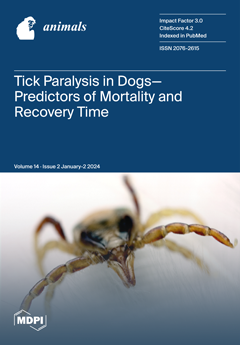
Cover Story:  Tick paralysis (TP) in dogs caused by Ixodes holocyclus can be perplexing for clinicians because individual case disease progression, recovery time, and mortality is often unpredictable. This study investigated clinical data from 506 natural cases of TP in Australia. The veterinarians involved used two new tools to assess disease severity: visual analogue scales (VAS) and facial expressions of distress. VAS scores for respiratory dysfunction and muscular weakness were highly predictive of mortality, but established methods for respiratory evaluation were not. Specific respiratory clinical signs were highly predictive of mortality. These findings will assist veterinarians in their management of TP cases, improving their prognosis about case progression and enabling timely decisions to prioritise intensive care therapy. View this paper
  • Issues are regarded as officially published after their release is announced to the table of contents alert mailing list .
  • You may sign up for email alerts to receive table of contents of newly released issues.
  • PDF is the official format for papers published in both, html and pdf forms. To view the papers in pdf format, click on the "PDF Full-text" link, and use the free Adobe Reader to open them.

Articles (179)

  • Case Report
  • Open Access
2,049 Views
8 Pages

Utero-Cutaneous Fistula in Ruminants: Characterization of the First Cases in Ewes and Cows

  • Antonio Carlos Lopes Câmara,
  • Gustavo Peixoto Braga,
  • Andrei Antonioni Guedes Fidelis,
  • Fausto Romualdo de Faria Dantas,
  • José Renato Junqueira Borges and
  • Márcio Botelho de Castro

22 January 2024

Reports on UCF in animals are still lacking in veterinary literature. Detailed clinical signs, laboratory findings, and follow-up information from the first cases of UCF in two ewes and two cows are provided. The cases occurred over a 12-year period....

  • Review
  • Open Access
11 Citations
5,160 Views
18 Pages

Methodology Advances in Vertebrate Age Estimation

  • Yifei Zhang,
  • Jinping Bi,
  • Yao Ning and
  • Jiang Feng

22 January 2024

Age is a core metric in vertebrate management, and the correct estimation of the age of an individual plays a principal role in comprehending animal behavior, identifying genealogical information, and assessing the potential reproductive capacity of...

  • Article
  • Open Access
5 Citations
2,391 Views
13 Pages

22 January 2024

Pig farmers in Taiwan tend to overdose copper (Cu) and zinc (Zn) in animal feeds to ensure pig health. The application of Cu- or Zn-rich livestock compost to fields can result in high Cu/Zn residues in surface soil and violate limitations for zinc an...

  • Article
  • Open Access
1 Citations
3,733 Views
12 Pages

The Spatial Ecology of Nuisance Crocodiles: Movement Patterns of Relocated American Crocodiles (Crocodylus acutus) in Guanacaste, Costa Rica

  • Tyler Steven Coleman,
  • Wray Gabel,
  • Michael Easter,
  • Maggie McGreal,
  • Mahmood Sasa Marin,
  • Davinia Beneyto Garrigos and
  • Christopher M. Murray

22 January 2024

Anthropogenic alterations of the environment have increased, highlighting the need for human–wildlife coexistence and conflict mitigation. Spatial ecology, and the use of passive satellite movement technology in particular, has been used to ide...

  • Feature Paper
  • Article
  • Open Access
3 Citations
6,927 Views
19 Pages

Detection and Molecular Diversity of Cryptosporidium spp. and Giardia duodenalis in the Endangered Iberian Lynx (Lynx pardinus), Spain

  • Pablo Matas-Méndez,
  • Gabriel Ávalos,
  • Javier Caballero-Gómez,
  • Alejandro Dashti,
  • Sabrina Castro-Scholten,
  • Débora Jiménez-Martín,
  • David González-Barrio,
  • Gemma J. Muñoz-de-Mier,
  • Begoña Bailo and
  • David Cano-Terriza
  • + 6 authors

22 January 2024

Cryptosporidium spp. and Giardia duodenalis are the main non-viral causes of diarrhoea in humans and domestic animals globally. Comparatively, much less information is currently available in free-ranging carnivore species in general and in the endang...

  • Feature Paper
  • Article
  • Open Access
1 Citations
1,771 Views
10 Pages

Prevalence and Risk Factors Associated with Rib Lesions in Dairy Cows

  • George Stilwell,
  • João M. B. Azevedo and
  • Telmo Nunes

22 January 2024

Unilateral or bilateral hard bony enlargement is sometimes palpated over dairy cows’ ribs. Although usually not painful, these injuries may have welfare and economic implications and can be used as indicators of poor husbandry conditions. The o...

  • Article
  • Open Access
10 Citations
2,203 Views
13 Pages

miR-10a-5p Regulates the Proliferation and Differentiation of Porcine Preadipocytes Targeting the KLF11 Gene

  • Wanfeng Zhang,
  • Tianzhi Zhao,
  • Xinyu Gao,
  • Shuangji Ma,
  • Tianye Gong,
  • Yang Yang,
  • Meng Li,
  • Guoqing Cao,
  • Xiaohong Guo and
  • Bugao Li

22 January 2024

In the swine industry, meat quality, color, and texture are influenced by the excessive differentiation of fat cells. miRNAs have emerged as integral regulators of adipose development. This study delves into the influence of miR-10a-5b on the prolife...

  • Feature Paper
  • Article
  • Open Access
14 Citations
15,210 Views
44 Pages

Impacts of Puppy Early Life Experiences, Puppy-Purchasing Practices, and Owner Characteristics on Owner-Reported Problem Behaviours in a UK Pandemic Puppies Cohort at 21 Months of Age

  • Claire L. Brand,
  • Dan G. O’Neill,
  • Zoe Belshaw,
  • Fiona C. Dale,
  • Bree L. Merritt,
  • Kathryn N. Clover,
  • Mi-Xue Michelle Tay,
  • Camilla L. Pegram and
  • Rowena M. A. Packer

22 January 2024

Problem behaviours are a leading cause of relinquishment and euthanasia of young dogs. Previous research has identified associations between owner-reported problem behaviours and risk factors, including how dogs were acquired as puppies, early social...

of 18

Get Alerted

Add your email address to receive forthcoming issues of this journal.

XFacebookLinkedIn
Animals - ISSN 2076-2615