Study Replication: Shape Discrimination in a Conditioning Procedure on the Jumping Spider Phidippus regius

1
Department of General Psychology, University of Padua, 35122 Padua, Italy
2
Esapolis’ Living Insects Museum of the Padua Province, 35143 Padua, Italy
3
Butterfly Arc Ltd., 35036 Padua, Italy
4
The BioRobotics Institute, Sant’Anna School of Advanced Studies, 56025 Pontedera, Italy
*
Author to whom correspondence should be addressed.
Animals 2023, 13(14), 2326; https://doi.org/10.3390/ani13142326
Submission received: 29 April 2023
/
Revised: 5 July 2023
/
Accepted: 13 July 2023
/
Published: 17 July 2023
(This article belongs to the Special Issue To See or Not to See: Current Progress in the Understanding of the Different Phenomenal Worlds)
Simple Summary
Seemingly disconnected elements of the environment, like the two visible halves of an animal behind a tree, can be correctly interpreted as part of the same object. This process is referred to as “amodal completion” and seems to take place across profoundly different animal species. In a previous experiment, we tested the ability of jumping spiders to associate geometric shapes with sucrose rewards and then generalize the learned association to the shapes’ hidden versions. In that experiment, the spiders learned the association but failed the generalization task, leaving open the question of whether they are capable of amodally completing shapes. Here, we replicated the experiment, increasing the number of subjects and employing a deep neural network based scoring procedure. The results closely match those observed in the previous experiment, but without rising to significance. We stress the importance of employing hands-off approaches to scoring procedures, maximizing objectivity and efficiency.
Abstract
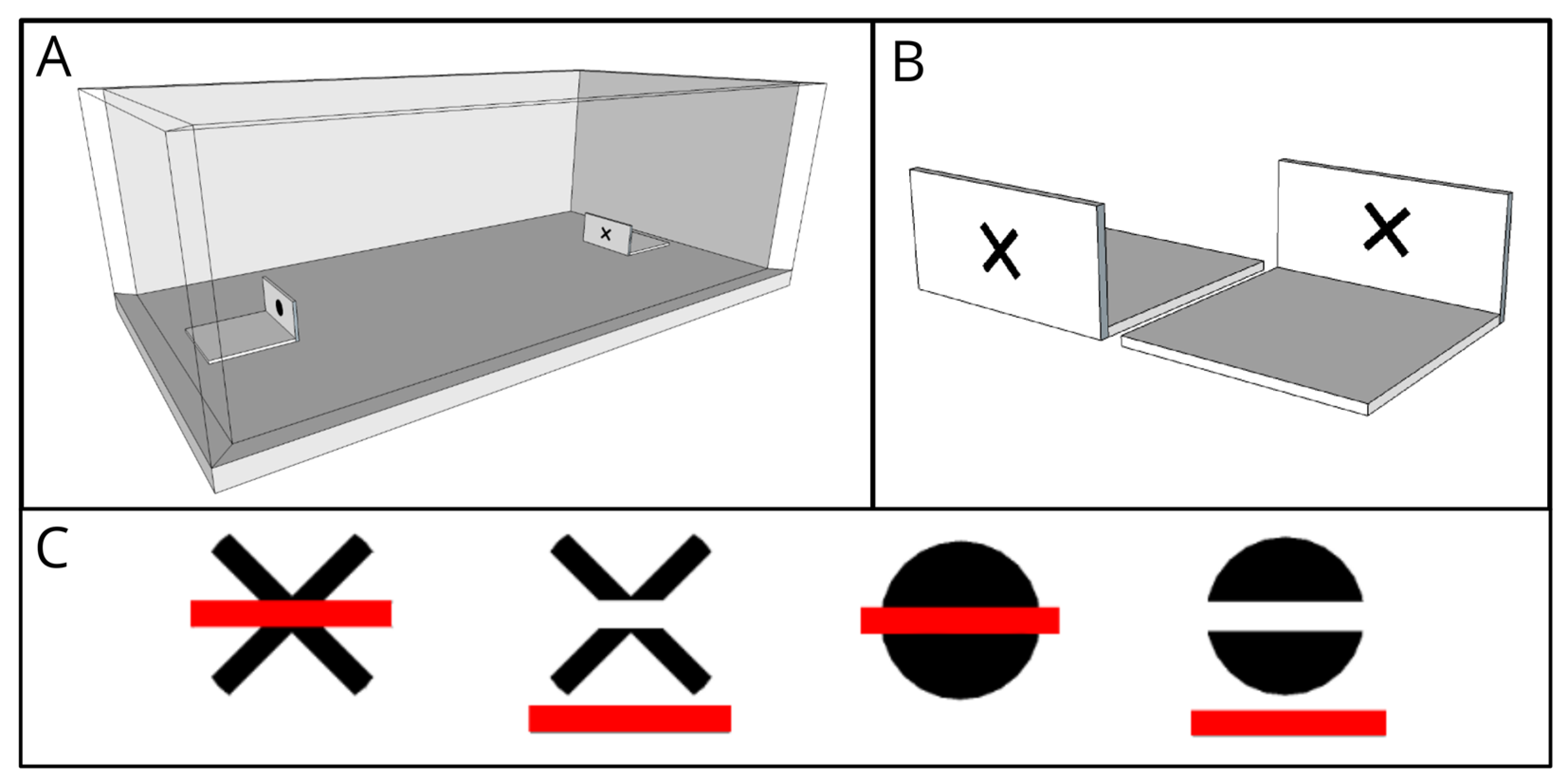
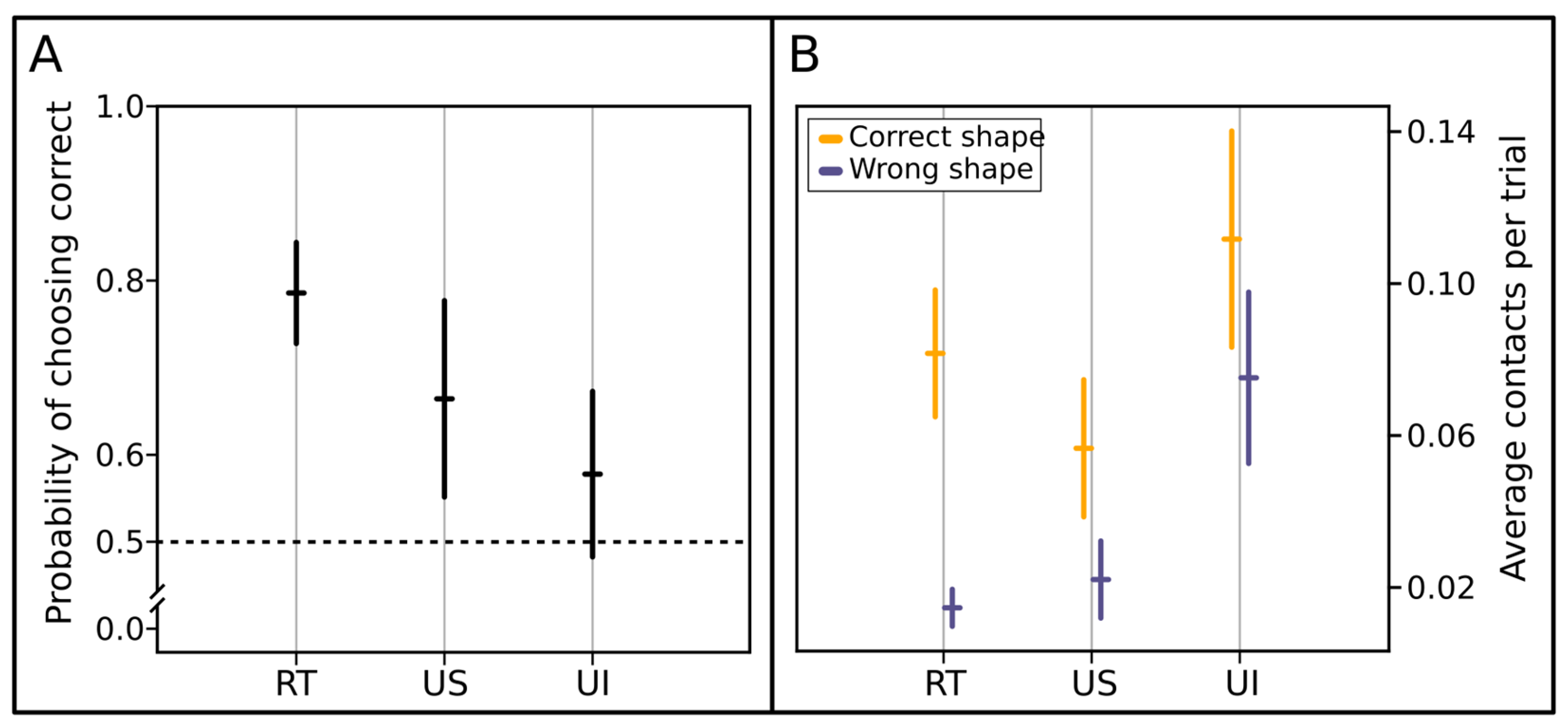
Spiders possess a unique visual system, split into eight different eyes and divided into two fully independent visual pathways. This peculiar organization begs the question of how visual information is processed, and whether the classically recognized Gestalt rules of perception hold true. In a previous experiment, we tested the ability of jumping spiders to associate a geometrical shape with a reward (sucrose solution), and then to generalize the learned association to a partially occluded version of the shape. The occluded shape was presented together with a broken version of the same shape. The former should be perceived as a whole shape only in the case the animals, like humans, are able to amodally complete an object partly hidden by an occluder; otherwise, the two shapes would be perceived as identical. There, the spiders learned the association but failed to generalize. Here, we present a replication of the experiment, with an increased number of subjects, a DeepLabCut-based scoring procedure, and an improved statistical analysis. The results of the experiment follow closely the direction of the effects observed in the previous work but fail to rise to significance. We discuss the importance of study replication, and we especially highlight the use of automated scoring procedures to maximize objectivity in behavioral studies.
Keywords:
amodal completion; Gestalt; vision; learning; invertebrates