
Adaptive Compensation Algorithm for Slow Response of TBM Hydraulic Cylinders Using a Parallel Auxiliary Pump

Abstract
1. Introduction
2. Modeling and Parameter Identification of Hydraulic System
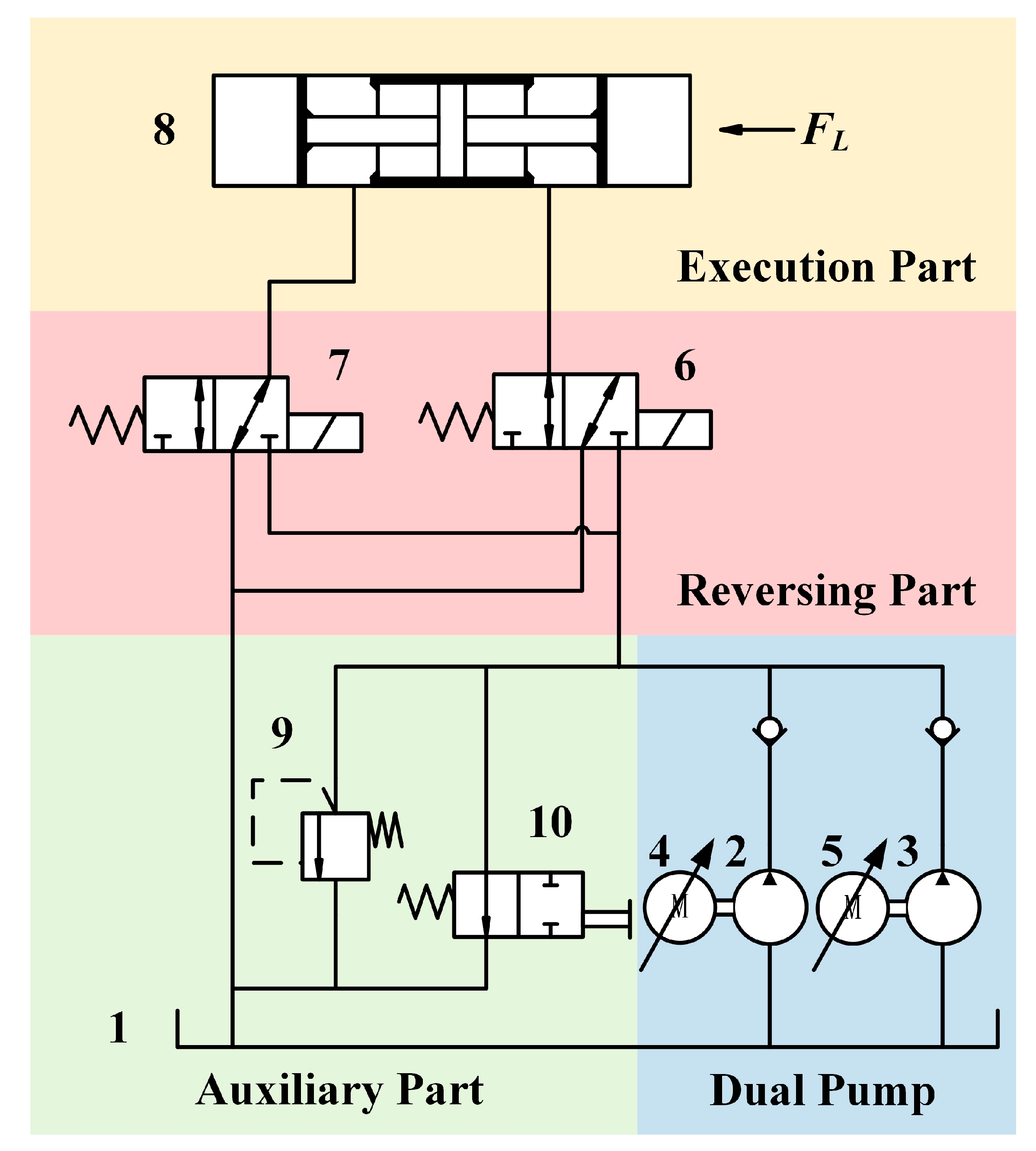
2.1. Hydraulic System and Components
2.2. Establishment of State-Space Model
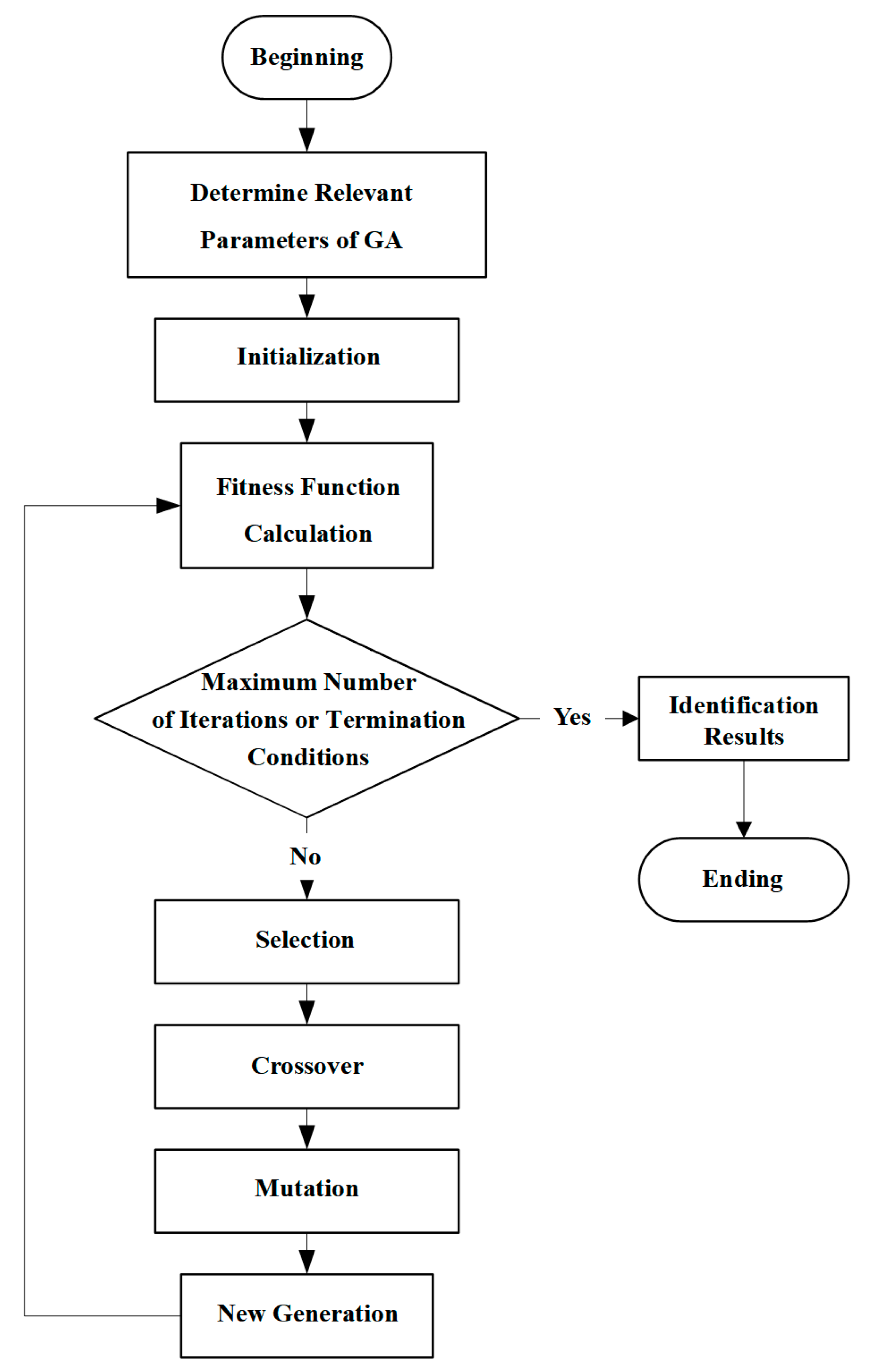
2.3. Identification of Unknown Parameters
3. Design and Analysis of the Adaptive Compensation Algorithm
3.1. Design of the Adaptive Compensation Algorithm
3.2. Stability Analysis of the Adaptive Compensation Algorithm
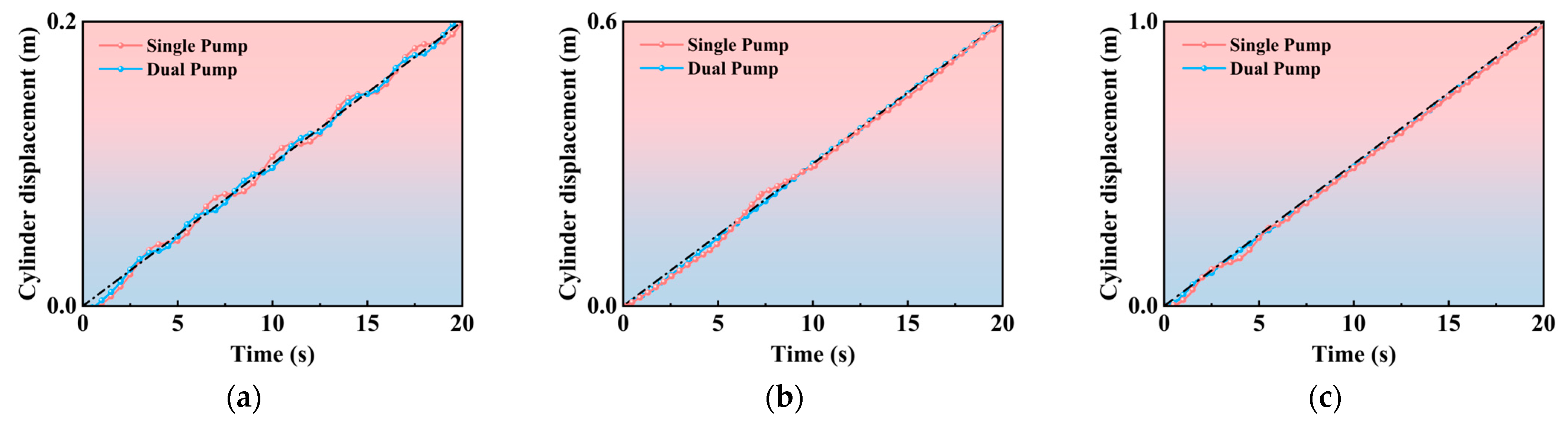
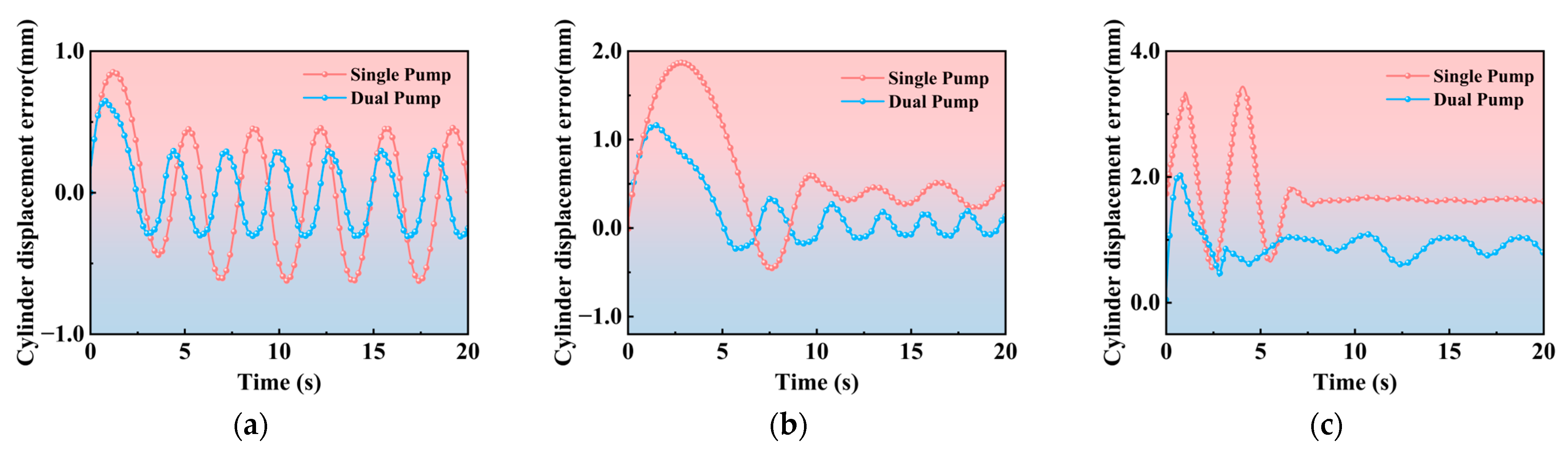
3.3. Verification of the Adaptive Compensation Algorithm
4. Experimental Validation of the Adaptive Compensation Algorithm
4.1. Experimental Setup and Comparative Validation
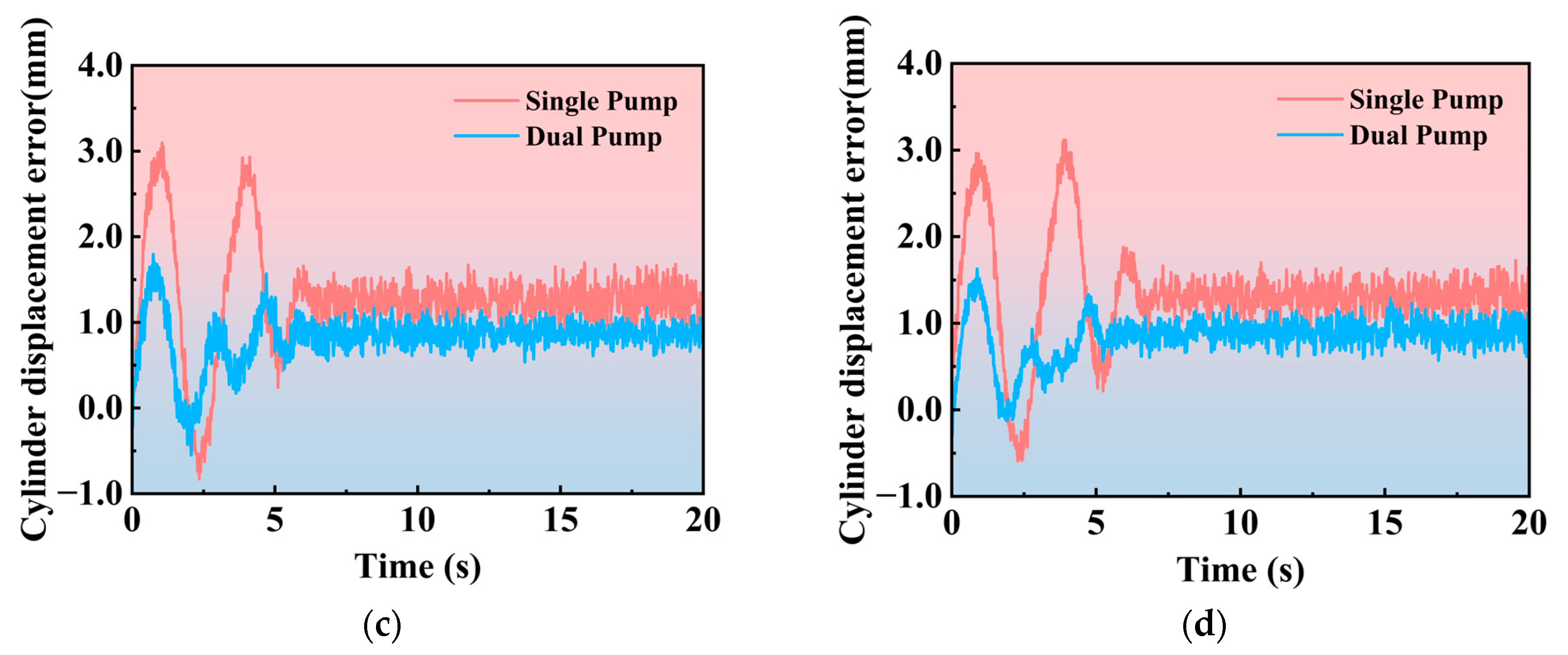
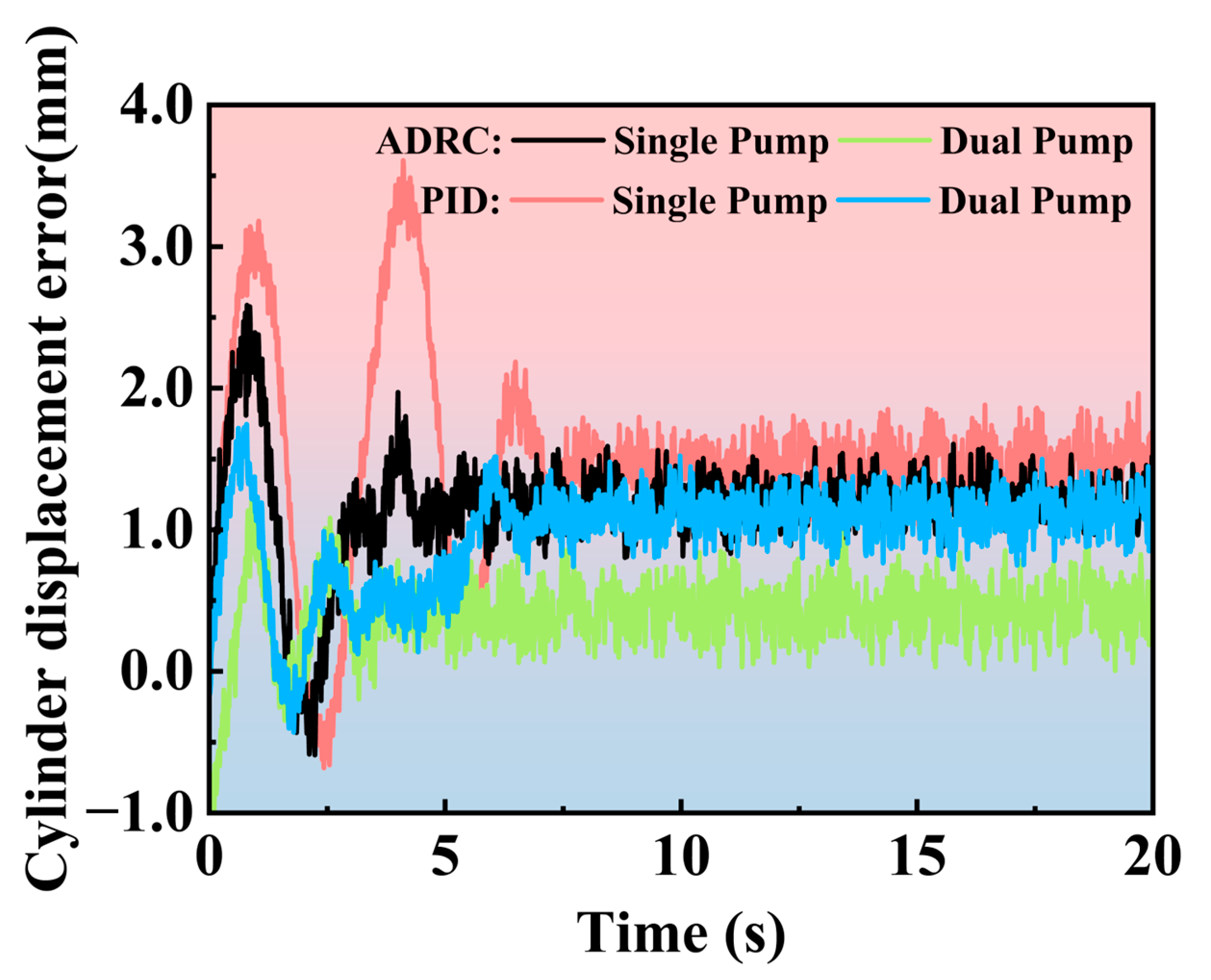
4.2. Further Experimental Analysis
5. Conclusions and Outlook
Author Contributions
Funding
Institutional Review Board Statement
Informed Consent Statement
Data Availability Statement
Acknowledgments
Conflicts of Interest
References
- Xu, Z.H.; Wang, W.Y.; Lin, P.; Nie, L.C.; Wu, J.; Li, Z.M. Hard-Rock TBM Jamming Subject to Adverse Geological Conditions: Influencing Factor, Hazard Mode and a Case Study of Gaoligongshan Tunnel. Tunn. Undergr. Space Technol. 2021, 108, 103683. [Google Scholar] [CrossRef] [Scilit]
- Wang, Z.; Jiang, Y.; Shao, X.; Liu, C. On-Site Measurement and Environmental Impact of Vibration Caused by Construction of Double-Shield TBM Tunnel in Urban Subway. Sci. Rep. 2023, 13, 17689. [Google Scholar] [CrossRef] [Scilit] [PubMed]
- Kong, S.-M.; Byun, Y.; Choi, S.-I.; Kim, C.-Y.; Lee, S.-W. A Study of Vibration Reduction Effects of TBM and NATM Parallel Construction Methods According to Tunnel Depth and Size. Appl. Sci. 2023, 13, 3492. [Google Scholar] [CrossRef] [Scilit]
- Wu, W.; Gong, G.; Huan, Q.; Zhou, X.; Chen, Y.; Peng, X. Investigation into the Electrohydraulic Synchronous Motion Control of a Thrust System for a Tunnel Boring Machine. Machines 2022, 10, 119. [Google Scholar] [CrossRef] [Scilit]
- Zheng, Z.; Luo, K.; Tan, X.; Jia, L.; Xie, M.; Xie, H.; Jiang, L.; Gong, G.; Yang, H.; Han, D. Autonomous Steering Control for Tunnel Boring Machines. Autom. Constr. 2024, 159, 105259. [Google Scholar] [CrossRef] [Scilit]
- Wang, R.; Zhang, L. A Theoretical Method and Model for TBM Tunnelling Trajectory Adjustment. Appl. Sci. 2023, 13, 10876. [Google Scholar] [CrossRef] [Scilit]
- Guan, C.; Pan, S. Adaptive Sliding Mode Control of Electro-Hydraulic System with Nonlinear Unknown Parameters. Control Eng. Pract. 2008, 16, 1275–1284. [Google Scholar] [CrossRef] [Scilit]
- Qiu, Z.; Hu, S.; Liang, X. Disturbance Observer Based Adaptive Model Predictive Control for Uncalibrated Visual Servoing in Constrained Environments. ISA Trans. 2020, 106, 40–50. [Google Scholar] [CrossRef] [Scilit]
- Gu, W.; Yao, J.; Yao, Z.; Zheng, J. Output Feedback Model Predictive Control of Hydraulic Systems with Disturbances Compensation. ISA Trans. 2019, 88, 216–224. [Google Scholar] [CrossRef] [Scilit]
- Zhang, Y.; Li, Y.; Li, G.; Li, G.; Wang, B. Simulation Analysis of MPC Control of Electro-Hydraulic Position Servo Systems. Chin. Hydraul. Pneum. 2024, 48, 38–45. [Google Scholar] [CrossRef]
- Yin, L.; Su, X. Research on Control of Hydraulic Position Tracking System Based on Event Triggering and Disturbance Observer. Processes 2025, 13, 1725. [Google Scholar] [CrossRef] [Scilit]
- Quan, Z.; Quan, L.; Zhang, J. Review of Energy Efficient Direct Pump Controlled Cylinder Electro-Hydraulic Technology. Renew. Sustain. Energy Rev. 2014, 35, 336–346. [Google Scholar] [CrossRef] [Scilit]
- Alle, N.; Hiremath, S.S.; Makaram, S.; Subramaniam, K.; Talukdar, A. Review on Electro Hydrostatic Actuator for Flight Control. Int. J. Fluid Power 2016, 17, 125–145. [Google Scholar] [CrossRef] [Scilit]
- Chao, Q.; Zhang, J.; Xu, B.; Huang, H.; Pan, M. A Review of High-Speed Electro-Hydrostatic Actuator Pumps in Aerospace Applications: Challenges and Solutions. J. Mech. Des. 2019, 141, 050801. [Google Scholar] [CrossRef] [Scilit]
- Takahashi, N.; Kondo, T.; Takada, M.; Masutani, K.; Okano, S.; Tsujita, M. Development of Prototype Electro-Hydrostatic Actuator for Landing Gear Extension and Retraction System. Proc. JFPS Int. Symp. Fluid Power 2008, 2008, 165–168. [Google Scholar] [CrossRef] [Scilit]
- Du, S.; Zhou, J.; Hong, J.; Zhao, H.; Ma, S. Application and Progress of High-Efficiency Electro-Hydrostatic Actuator Technology with Energy Recovery: A Comprehensive Review. Energy Convers. Manag. 2024, 321, 119041. [Google Scholar] [CrossRef] [Scilit]
- Kumar, M. A Survey on Electro Hydrostatic Actuator: Architecture and Way Ahead. Mater. Today Proc. 2021, 45, 6057–6063. [Google Scholar] [CrossRef] [Scilit]
- Yuan, C.; Pan, M.; Plummer, A. A Review of Switched Inertance Hydraulic Converter Technology. J. Dyn. Syst. Meas. Control 2020, 142, 050801. [Google Scholar] [CrossRef] [Scilit]
- Scheidl, R.; Woess, D. A Combined Multi-Pressure Switched Inertance Hydraulic Control Concept of a Differential Cylinder. MM Sci. J. 2022, 2022, 5775–5782. [Google Scholar] [CrossRef] [Scilit]
- Kogler, H. Digital Hydraulic Transformer Concepts for Energy-Efficient Motion Control. Actuators 2025, 14, 54. [Google Scholar] [CrossRef] [Scilit]
- Fang, D.; Jia, G.; Wang, J.; Wu, G.; Cao, L.; Zhang, J. Design and Analysis of a Novel Rotary Inertance Hydraulic Converter with the Continuous Controlling Turntable. Trans. Can. Soc. Mech. Eng. 2024, 48, 459–468. [Google Scholar] [CrossRef] [Scilit]
- Annaz, F.Y.; Kaluarachchi, M.M. Progress in Redundant Electromechanical Actuators for Aerospace Applications. Aerospace 2023, 10, 787. [Google Scholar] [CrossRef] [Scilit]
- Li, Y.; Pan, Y.; Zhang, L. Physics-Guided Deep Learning for Driving Force Estimation in Synchronous Tunnel Boring Machines under Missing Cylinders. Autom. Constr. 2024, 161, 105339. [Google Scholar] [CrossRef] [Scilit]
- Lin, P.; Ji, A.; Zhou, Y.; Zhang, L.; Tiong, R.L.K. Automated Position Control of Tunnel Boring Machine during Excavation Using Deep Reinforcement Learning. Appl. Soft Comput. 2024, 167, 112234. [Google Scholar] [CrossRef] [Scilit]
- Wang, M.; Tian, C.; Yang, W.; Zhou, Z.; Bai, Y.; Song, X.; Geng, Y. Study on the Information Evolution Law of Water-Resistant Rock Mass during Fault Water and Mud Inrush in TBM Tunnels. KSCE J. Civ. Eng. 2024, 28, 4088–4099. [Google Scholar] [CrossRef] [Scilit]
- Peng, J.-R.; Zhou, H.; Hao, J.-Y.; Wang, Y.-N. Vibration Reduction Technique of Shield Construction in Water-Rich Karst Strata. J. Infrastruct. Intell. Resil. 2024, 3, 100111. [Google Scholar] [CrossRef] [Scilit]
- Wang, S.; Wang, L.; Wu, L.; Li, X. A Jamming Risk Warning Model for TBM Tunnelling Based on Bayesian Statistical Methods. Sci. Rep. 2025, 15, 35452. [Google Scholar] [CrossRef] [Scilit]
- Jiang, L.; Zheng, Z.; Zhu, K.; Gong, G.; Yang, H.; Han, D. Novel Dual Parallel-Connected-Pump Hydraulic System and Error Allocation Strategy for Segment Assembly. Machines 2024, 12, 913. [Google Scholar] [CrossRef] [Scilit]
- Rahmat, M.F.; Husain, A.R.; Ishaque, K.; Sam, Y.M.; Ghazali, R.; Rozali, S.M.; Has, Z. Modeling and Controller Design of an Industrial Hydraulic Actuator System in the Presence of Friction and Internal Leakage. Int. J. Phys. Sci. 2011, 6, 3502–3517. [Google Scholar] [CrossRef]
- Zhang, K.; Zhang, J.; Gan, M.; Zong, H.; Wang, X.; Huang, H.; Su, Q.; Xu, B. Modeling and Parameter Sensitivity Analysis of Valve-Controlled Helical Hydraulic Rotary Actuator System. Chin. J. Mech. Eng. 2022, 35, 66. [Google Scholar] [CrossRef] [Scilit]
- Belloli, D.; Previdi, F.; Savaresi, S.M.; Cologni, A.; Zappella, M. Modeling and Identification of an Electro-Hydrostatic Actuator. IFAC Proc. 2010, 43, 620–625. [Google Scholar] [CrossRef] [Scilit]
- Zhang, Y.; Gong, G.; Yang, H.; Chen, Y.; Chen, G. Towards Autonomous and Optimal Excavation of Shield Machine: A Deep Reinforcement Learning-Based Approach. J. Zhejiang Univ.-Sci. A 2022, 23, 458–478. [Google Scholar] [CrossRef] [Scilit]
- Samaei, M.; Ranjbarnia, M.; Nourani, V.; Zare Naghadehi, M. Performance Prediction of Tunnel Boring Machine through Developing High Accuracy Equations: A Case Study in Adverse Geological Condition. Measurement 2020, 152, 107244. [Google Scholar] [CrossRef] [Scilit]



| Aspects | Conventional Dual Pump | Proposed Method |
|---|---|---|
| Hydraulic system configuration | Dual-pump, single-cylinder | Dual-pump, single-cylinder |
| Main pump flow | Predefined proportion of target flow tracking | Target flow tracking |
| Auxiliary pump flow | Predefined proportion of target flow tracking | Error-based adaptive flow compensation |
| Flow allocation principle | Experience-based ratio | Error-driven adaptive adjustment |
| Control structure | Dual-pump closed-loop tracking | Main pump tracking + auxiliary adaptive compensation |
| Unknown Parameters | Range of Values | Unit |
|---|---|---|
| 0.8 × 10⁹~1.6 × 10⁹ | Pa | |
| 1.0 × 10⁻¹³~5.0 × 10⁻¹² | m3/(s·Pa) | |
| 2000~8000 | (N·s)/m |
| Evaluation Metric | Values |
|---|---|
| 0.771 | |
| 0.162 | |
| 6.319 |
| Parameters | Values | Units | Physical Meanings |
|---|---|---|---|
| 50 | kg | equivalent load mass | |
| 0.0032 | m2 | effective pressure area | |
| 0.005 | m3 | zero-position initial volume | |
| 500 | N | Coulomb friction force |
| Parameters | Values | Physical Meanings |
|---|---|---|
| 0.1 s | time constant of the filter | |
| 0.25 | ||
| 0.22 | ||
| 0.02 | ||
| 5.2 | ||
| 4.0 | ||
| 0.8 | ||
| 0.28 | ||
| 0.22 | ||
| 0.10 | ||
| 0.15 s | micro-gating time constant | |
| 0.75 | minimum of the micro-gating parameter |
| Objects | Specifications | Key Parameters |
|---|---|---|
| Cylinder Displacement | LVDT-FHTA19 | Distance range: 0~500 mm |
| Operating temperature: −55~200 °C | ||
| System Pressure | EB100 | Pressure range: 0~200 bar |
| Operating temperature: −40~125 °C | ||
| Flow Rate | VS1EPC | Flow range: 0.05~80 L/min |
| Operating temperature: −40~120 °C |
| Evaluation Metrics | Max | Min | Mean | S.D. | |
|---|---|---|---|---|---|
| Single Pump | 10 kN | 3.352 mm | −0.863 mm | 1.284 mm | 0.663 mm |
| 9 kN | 3.3175 mm | −0.796 mm | 1.363 mm | 0.644 mm | |
| 8 kN | 3.097 mm | −0.831 mm | 1.285 mm | 0.628 mm | |
| 7 kN | 3.116 mm | −0.694 mm | 1.343 mm | 0.622 mm | |
| Dual Pump | 10 kN | 1.799 mm | −0.332 mm | 0.878 mm | 0.276 mm |
| 9 kN | 1.743 mm | −0.256 mm | 0.916 mm | 0.280 mm | |
| 8 kN | 1.796 mm | −0.450 mm | 0.822 mm | 0.285 mm | |
| 7 kN | 1.629 mm | −0.297 mm | 0.842 mm | 0.275 mm | |
| Parameters | Large-Displacement Pump | Small-Displacement Pump |
|---|---|---|
| Control Bandwidth | 15 rad/s | 20 rad/s |
| Observer Bandwidth | 45 rad/s | 60 rad/s |
| ESO Gain 1 | 90 | 120 |
| ESO Gain 2 | 2020 | 3550 |
| Estimated Input Gain | 58.5 | 37.5 |
Disclaimer/Publisher’s Note: The statements, opinions and data contained in all publications are solely those of the individual author(s) and contributor(s) and not of MDPI and/or the editor(s). MDPI and/or the editor(s) disclaim responsibility for any injury to people or property resulting from any ideas, methods, instructions or products referred to in the content. |
© 2026 by the authors. Licensee MDPI, Basel, Switzerland. This article is an open access article distributed under the terms and conditions of the Creative Commons Attribution (CC BY) license.
Share and Cite
Yang, S.; Han, D.; Jiang, L.; Jia, L.; Zheng, Z.; Tan, X.; Yang, H.; Hu, D. Adaptive Compensation Algorithm for Slow Response of TBM Hydraulic Cylinders Using a Parallel Auxiliary Pump. Actuators 2026, 15, 63. https://doi.org/10.3390/act15010063
Yang S, Han D, Jiang L, Jia L, Zheng Z, Tan X, Yang H, Hu D. Adaptive Compensation Algorithm for Slow Response of TBM Hydraulic Cylinders Using a Parallel Auxiliary Pump. Actuators. 2026; 15(1):63. https://doi.org/10.3390/act15010063
Chicago/Turabian StyleYang, Shaochen, Dong Han, Lijie Jiang, Lianhui Jia, Zhe Zheng, Xianzhong Tan, Huayong Yang, and Dongming Hu. 2026. "Adaptive Compensation Algorithm for Slow Response of TBM Hydraulic Cylinders Using a Parallel Auxiliary Pump" Actuators 15, no. 1: 63. https://doi.org/10.3390/act15010063
APA StyleYang, S., Han, D., Jiang, L., Jia, L., Zheng, Z., Tan, X., Yang, H., & Hu, D. (2026). Adaptive Compensation Algorithm for Slow Response of TBM Hydraulic Cylinders Using a Parallel Auxiliary Pump. Actuators, 15(1), 63. https://doi.org/10.3390/act15010063