Ceftazidime-Avibactam Regimens for the Treatment of Bacteremic and Non-Bacteremic Episodes of Carbapenemase-Producing Enterobacterales Infections in Immunosuppressed Patients

 , , , ,
Abstract
1. Introduction
2. Materials and Methods
2.1. Setting, Patients, and Study Design
- (a)
- Solid organ transplant (SOT) recipients under immunosuppressive therapy; or
- (b)
- Patients presenting with an HM or solid tumor (ST) treated with recent chemotherapy, anti-lymphocyte therapy, biological agents or high doses of corticosteroids; or
- (c)
- Patients with allogeneic HCT (with graft-versus-host disease at any time or without this condition in the first year post-transplant), or autologous HCT (within 6 months post-transplant); or
- (d)
- Patients presenting with an autoimmune disease under immunosuppressive therapy; and
- (e)
- Those with monomicrobial CPE infections who received definitive AT with CA or CA + ATM for ≥72 h.
- (a)
- Those with recurrent infections;
- (b)
- Those with polymicrobial infections;
- (c)
- Those with positive clinical samples that were not representative of true infection, even if they had received appropriate AT, e.g., asymptomatic bacteriuria, respiratory samples without criteria for pneumonia, superficial skin and soft tissue cultures, and isolation of CPE in blood cultures through the catheter without isolation in peripheral blood cultures;
- (d)
- Those in palliative care.
2.2. Definitions
2.3. Microbiological Studies
2.4. Statistical Analysis
3. Results
4. Discussion
5. Conclusions
Author Contributions
Funding
Institutional Review Board Statement
Informed Consent Statement
Data Availability Statement
Acknowledgments
Conflicts of Interest
References
- Lee, Y.L.; Ko, W.C.; Hsueh, P.R. Geographic patterns of global isolates of carbapenem-resistant Klebsiella pneumoniae and the activity of ceftazidime/avibactam, meropenem/vaborbactam, and comparators against these isolates: Results from the Antimicrobial Testing Leadership and Surveillance (ATLAS) program, 2020. Int. J. Antimicrob. Agents 2022, 60, 106679. [Google Scholar] [CrossRef] [PubMed]
- Lin, X.C.; Li, C.L.; Zhang, S.Y.; Yang, X.F.; Jiang, M. The Global and Regional Prevalence of Hospital-Acquired Carbapenem-Resistant Klebsiella pneumoniae Infection: A Systematic Review and Meta-analysis. Open Forum Infect. Dis. 2023, 11, ofad649. [Google Scholar] [CrossRef]
- Luterbach, C.L.; Pasquale, D.K.; Henderson, H.I.; Cober, E.; Richter, S.S.; Salata, R.A.; Kalayjian, R.C.; Watkins, R.R.; Hujer, A.M.; Hujer, K.M.; et al. A network analysis of carbapenem-resistant Klebsiella pneumoniae among healthcare facilities. Sci. Rep. 2025, 15, 27565. [Google Scholar] [CrossRef]
- Kanj, S.S.; Kantecki, M.; Arhin, F.F.; Gheorghe, M. Epidemiology and outcomes associated with MBL-producing Enterobacterales: A systematic literature review. Int. J. Antimicrob. Agents 2025, 65, 107449. [Google Scholar] [CrossRef] [PubMed]
- Macesic, N.; Uhlemann, A.C.; Peleg, A.Y. Multidrug-resistant Gram-negative bacterial infections. Lancet 2025, 405, 257–272. [Google Scholar] [CrossRef]
- Gales, A.C.; Stone, G.; Sahm, D.F.; Wise, M.G.; Utt, E. Incidence of ESBLs and carbapenemases among Enterobacterales and carbapenemases in Pseudomonas aeruginosa isolates collected globally: Results from ATLAS 2017–2019. J. Antimicrob. Chemother. 2023, 78, 1606–1615. [Google Scholar] [CrossRef] [PubMed]
- Echegorry, M.; Marchetti, P.; Sanchez, C.; Olivieri, L.; Faccone, D.; Martino, F.; Sarkis Badola, T.; Ceriana, P.; Rapoport, M.; Lucero, C.; et al. National Multicenter Study on the Prevalence of Carbapenemase-Producing Enterobacteriaceae in the Post-COVID-19 Era in Argentina: The RECAPT-AR Study. Antibiotics 2024, 13, 1139. [Google Scholar] [CrossRef]
- Gutiérrez-Gutiérrez, B.; Salamanca, E.; de Cueto, M.; Hsueh, P.R.; Viale, P.; Paño-Pardo, J.R.; Venditti, M.; Tumbarello, M.; Daikos, G.; Pintado, V.; et al. A Predictive Model of Mortality in Patients with Bloodstream Infections due to Carbapenemase-Producing Enterobacteriaceae. Mayo Clin. Proc. 2016, 91, 1362–1371, Erratum in Mayo Clin. Proc. 2016, 91, 1843. https://doi.org/10.1016/j.mayocp.2016.11.002. [Google Scholar] [CrossRef]
- Xu, L.; Sun, X.; Ma, X. Systematic review and meta-analysis of mortality of patients infected with carbapenem-resistant Klebsiella pneumoniae. Ann. Clin. Microbiol. Antimicrob. 2017, 16, 18. [Google Scholar] [CrossRef]
- Balbuena, J.P.; Cordova, E.; Mykietiuk, A.; Farina, J.; Gañete, M.; Scapellato, P.; Lespada, M.I.; Nannini, E.; Contreras, R.; Cunto, E.; et al. Carbapenem-resistant Gram-negative bacilli bacteremia in Argentina (EMBARCAR): Findings from a prospective, multicenter cohort study. Clin. Infect. Dis. 2025, ciaf259. [Google Scholar] [CrossRef]
- Freire, M.P.; Pierrotti, L.C.; Filho, H.H.; Ibrahim, K.Y.; Magri, A.S.; Bonazzi, P.R.; Hajar, L.; Diz, M.P.; Pereira, J.; Hoff, P.M.; et al. Infection with Klebsiella pneumoniae carbapenemase (KPC)-producing Klebsiella pneumoniae in cancer patients. Eur. J. Clin. Microbiol. Infect. Dis. 2015, 34, 277–286. [Google Scholar] [CrossRef]
- Trecarichi, E.M.; Pagano, L.; Martino, B.; Candoni, A.; Di Blasi, R.; Nadali, G.; Fianchi, L.; Delia, M.; Sica, S.; Perriello, V.; et al. Haematologic Malignancies Associated Bloodstream Infections Surveillance (HEMABIS) registry—Sorveglianza Epidemiologica Infezioni Funginein Emopatie Maligne (SEIFEM) group, Italy. Bloodstream infections caused by Klebsiella pneumoniae in onco-hematological patients: Clinical impact of carbapenem resistance in a multicentre prospective survey. Am. J. Hematol. 2016, 91, 1076–1081. [Google Scholar] [CrossRef] [PubMed]
- Tofas, P.; Skiada, A.; Angelopoulou, M.; Sipsas, N.; Pavlopoulou, I.; Tsaousi, S.; Pagoni, M.; Kotsopoulou, M.; Perlorentzou, S.; Antoniadou, A.; et al. Carbapenemase-producing Klebsiella pneumoniae bloodstream infections in neutropenic patients with haematological malignancies or aplastic anaemia: Analysis of 50 cases. Int. J. Antimicrob. Agents 2016, 47, 335–339. [Google Scholar] [CrossRef] [PubMed]
- Pérez-Nadales, E.; Fernández-Ruiz, M.; Gutiérrez-Gutiérrez, B.; Pascual, Á.; Rodríguez-Baño, J.; Martínez-Martínez, L.; Aguado, J.M.; Torre-Cisneros, J. Extended-spectrum β-lactamase-producing and carbapenem-resistant Enterobacterales bloodstream infection after solid organ transplantation: Recent trends in epidemiology and therapeutic approaches. Transpl. Infect. Dis. 2022, 24, e13881. [Google Scholar] [CrossRef]
- Falcone, M.; Bassetti, M.; Tiseo, G.; Giordano, C.; Nencini, E.; Russo, A.; Graziano, E.; Tagliaferri, E.; Leonildi, A.; Barnini, S.; et al. Time to appropriate antibiotic therapy is a predictor of outcome in patients with bloodstream infection caused by KPC-producing Klebsiella pneumoniae. Crit. Care 2020, 24, 29. [Google Scholar] [CrossRef] [PubMed]
- Micozzi, A.; Gentile, G.; Minotti, C.; Cartoni, C.; Capria, S.; Ballarò, D.; Santilli, S.; Pacetti, E.; Grammatico, S.; Bucaneve, G.; et al. Carbapenem-resistant Klebsiella pneumoniae in high-risk haematological patients: Factors favouring spread, risk factors and outcome of carbapenem-resistant Klebsiella pneumoniae bacteremias. BMC Infect. Dis. 2017, 17, 203. [Google Scholar] [CrossRef]
- van Duin, D.; Lok, J.J.; Earley, M.; Cober, E.; Richter, S.S.; Perez, F.; Salata, R.A.; Kalayjian, R.C.; Watkins, R.R.; Doi, Y.; et al. Colistin Versus Ceftazidime-Avibactam in the Treatment of Infections Due to Carbapenem-Resistant Enterobacteriaceae. Clin. Infect. Dis. 2018, 66, 163–171. [Google Scholar] [CrossRef]
- Castón, J.J.; Cano, A.; Pérez-Camacho, I.; Aguado, J.M.; Carratalá, J.; Ramasco, F.; Soriano, A.; Pintado, V.; Castelo-Corral, L.; Sousa, A.; et al. Impact of ceftazidime/avibactam versus best available therapy on mortality from infections caused by carbapenemase-producing Enterobacterales (CAVICOR study). J. Antimicrob. Chemother. 2022, 77, 1452–1460. [Google Scholar] [CrossRef]
- Falcone, M.; Giordano, C.; Leonildi, A.; Galfo, V.; Lepore, A.; Suardi, L.R.; Riccardi, N.; Barnini, S.; Tiseo, G. Clinical Features and Outcomes of Infections Caused by Metallo-β-Lactamase-Producing Enterobacterales: A 3-Year Prospective Study from an Endemic Area. Clin. Infect. Dis. 2024, 78, 1111–1119, Erratum in Clin. Infect. Dis. 2024, 79, 580. https://doi.org/10.1093/cid/ciae311. [Google Scholar] [CrossRef]
- Karaiskos, I.; Daikos, G.L.; Gkoufa, A.; Adamis, G.; Stefos, A.; Symbardi, S.; Chrysos, G.; Filiou, E.; Basoulis, D.; Mouloudi, E.; et al. Ceftazidime/avibactam in the era of carbapenemase-producing Klebsiella pneumoniae: Experience from a national registry study. J. Antimicrob. Chemother. 2021, 76, 775–783. [Google Scholar] [CrossRef]
- Zhuang, H.H.; Qu, Q.; Long, W.M.; Hu, Q.; Wu, X.L.; Chen, Y.; Wan, Q.; Xu, T.T.; Luo, Y.; Yuan, H.Y.; et al. Ceftazidime/avibactam versus polymyxin B in carbapenem-resistant Klebsiella pneumoniae infections: A propensity score-matched multicenter real-world study. Infection 2025, 53, 95–106. [Google Scholar] [CrossRef]
- Chen, Y.; Huang, H.B.; Peng, J.M.; Weng, L.; Du, B. Efficacy and Safety of Ceftazidime-Avibactam for the Treatment of Carbapenem-Resistant Enterobacterales Bloodstream Infection: A Systematic Review and Meta-Analysis. Microbiol. Spectr. 2022, 10, e0260321. [Google Scholar] [CrossRef]
- Chen, J.; Hu, Q.; Zhou, P.; Deng, S. Ceftazidime-avibactam versus polymyxins in treating patients with carbapenem-resistant Enterobacteriaceae infections: A systematic review and meta-analysis. Infection 2024, 52, 19–28. [Google Scholar] [CrossRef]
- Gupta, N.; Boodman, C.; Prayag, P.; Manesh, A.; Kumar, T.P. Ceftazidime-avibactam and aztreonam combination for Carbapenem-resistant Enterobacterales bloodstream infections with presumed Metallo-β-lactamase production: A systematic review and meta-analysis. Expert Rev. Anti-Infect. Ther. 2024, 22, 203–209. [Google Scholar] [CrossRef]
- Tamma, P.D.; Heil, E.L.; Justo, J.A.; Mathers, A.J.; Satlin, M.J.; Bonomo, R.A. Infectious Diseases Society of America 2024 Guidance on the Treatment of Antimicrobial-Resistant Gram-Negative Infections. Clin. Infect. Dis. 2024, ciae403. [Google Scholar] [CrossRef]
- Paul, M.; Carrara, E.; Retamar, P.; Tängdén, T.; Bitterman, R.; Bonomo, R.A.; de Waele, J.; Daikos, G.L.; Akova, M.; Harbarth, S.; et al. European Society of Clinical Microbiology and Infectious Diseases (ESCMID) guidelines for the treatment of infections caused by multidrug-resistant Gram-negative bacilli (endorsed by European society of intensive care medicine). Clin. Microbiol. Infect. 2022, 28, 521–547. [Google Scholar] [CrossRef]
- Tumbarello, M.; Giuliano, G.; Criscuolo, M.; Del Principe, M.I.; Papayannidis, C.; Fracchiolla, N.S.; Dargenio, M.; Cefalo, M.; Nadali, G.; Candoni, A.; et al. Clinical impact of ceftazidime/avibactam on the treatment of suspected or proven infections in a large cohort of patients with haematological malignancies: A multicentre observational real-world study. J. Antimicrob. Chemother. 2025, 80, 386–398. [Google Scholar] [CrossRef]
- Zhang, L.; Zhen, S.; Shen, Y.; Zhang, T.; Wang, J.; Li, J.; Lin, Q.; Xiao, Z.; Zheng, Y.; Jiang, E.; et al. Bloodstream infections due to Carbapenem-Resistant Enterobacteriaceae in hematological patients: Assessment of risk factors for mortality and treatment options. Ann. Clin. Microbiol. Antimicrob. 2023, 22, 41. [Google Scholar] [CrossRef] [PubMed]
- Sastre-Escolà, E.; Ntziora, F.; Chiurlo, M.; Martín-Dávila, P.; Mikulska, M.; Albasanz-Puig, A.; Machado, M.; Gutiérrez-Villanueva, A.; Márquez-Gómez, I.; Gasch-Blasi, O.; et al. Ceftazidime/avibactam for the treatment of bloodstream infection due to carbapenemase-producing Enterobacterales in onco-haematologic neutropenic patients (the TARZAN study). J. Antimicrob. Chemother. 2025, 80, 1673–1681. [Google Scholar] [CrossRef] [PubMed]
- Hu, J.; Zha, L.; Yu, Y.W.; Su, Q.; Fang, X.L.; Ji, J.R.; Shen, P.; Chen, Y.B.; Zheng, X.; Xiao, Y.H. Efficacy of ceftazidime-avibactam in the treatment of carbapenem-resistant Klebsiella pneumoniae infections: Focus on solid organ transplantation recipients. Int. J. Antimicrob. Agents 2024, 63, 107152. [Google Scholar] [CrossRef] [PubMed]
- Herrera, F.; Torres, D.; Laborde, A.; Jordán, R.; Mañez, N.; Berruezo, L.; Lambert, S.; Suchowiercha, N.; Costantini, P.; Nenna, A.; et al. Ceftazidime-Avibactam Improves Outcomes in High-Risk Neutropenic Patients with Klebsiella pneumoniae Carbapenemase-Producing Enterobacterales Bacteremia. Microorganisms 2024, 12, 195. [Google Scholar] [CrossRef]
- Averbuch, D.; Cordonnier, C.; Livermore, D.M.; Mikulska, M.; Orasch, C.; Viscoli, C.; Gyssens, I.C.; Kern, W.V.; Klyasova, G.; Marchetti, O.; et al. Targeted therapy against multi-resistant bacteria in leukemic and hematopoietic stem cell transplant recipients: Guidelines of the 4th European Conference on Infections in Leukemia (ECIL-4, 2011). Haematologica 2013, 98, 1836–1847. [Google Scholar] [CrossRef]
- Freifeld, A.G.; Bow, E.J.; Sepkowitz, K.A.; Boeckh, M.J.; Ito, J.I.; Mullen, C.A.; Raad, I.I.; Rolston, K.V.; Young, J.A.; Wingard, J.R.; et al. Clinical practice guideline for the use of antimicrobial agents in neutropenic patients with cancer: 2010 update by the Infectious Diseases Society of America. Clin. Infect. Dis. 2011, 52, e56–e93. [Google Scholar] [CrossRef]
- Averbuch, D.; Orasch, C.; Cordonnier, C.; Livermore, D.M.; Mikulska, M.; Viscoli, C.; Gyssens, I.C.; Kern, W.V.; Klyasova, G.; Marchetti, O.; et al. European guidelines for empirical antibacterial therapy for febrile neutropenic patients in the era of growing resistance: Summary of the 2011 4th European Conference on Infections in Leukemia. Haematologica 2013, 98, 1826–1835, Erratum in Haematologica 2014, 99, 400. [Google Scholar] [CrossRef] [PubMed]
- Horan, T.C.; Andrus, M.; Dudeck, M.A. CDC/NHSN surveillance definition of health care-associated infection and criteria for specific types of infections in the acute care setting. Am. J. Infect. Control 2008, 36, 309–332, Erratum in Am. J. Infect. Control 2008, 36, 655. [Google Scholar] [CrossRef] [PubMed]
- Friedman, N.D.; Kaye, K.S.; Stout, J.E.; McGarry, S.A.; Trivette, S.L.; Briggs, J.P.; Lamm, W.; Clark, C.; MacFarquhar, J.; Walton, A.L. Health care-associated bloodstream infections in adults: A reason to change the accepted definition of community-acquired infections. Ann. Intern. Med. 2002, 137, 791–797. [Google Scholar] [CrossRef]
- Singer, M.; Deutschman, C.S.; Seymour, C.W.; Shankar-Hari, M.; Annane, D.; Bauer, M.; Bellomo, R.; Bernard, G.R.; Chiche, J.D.; Coopersmith, C.M.; et al. The Third International Consensus Definitions for Sepsis and Septic Shock (Sepsis-3). JAMA 2016, 315, 801–810. [Google Scholar] [CrossRef]
- Bidell, M.R.; Lodise, T.P. Suboptimal Clinical Response Rates with Newer Antibiotics Among Patients with Moderate Renal Impairment: Review of the Literature and Potential Pharmacokinetic and Pharmacodynamic Considerations for Observed Findings. Pharmacotherapy 2018, 38, 1205–1215. [Google Scholar] [CrossRef] [PubMed]
- Crass, R.L.; Rodvold, K.A.; Mueller, B.A.; Pai, M.P. Renal Dosing of Antibiotics: Are We Jumping the Gun? Clin. Infect. Dis. 2019, 68, 1596–1602. [Google Scholar] [CrossRef]
- Tumbarello, M.; Raffaelli, F.; Giannella, M.; Mantengoli, E.; Mularoni, A.; Venditti, M.; De Rosa, F.G.; Sarmati, L.; Bassetti, M.; Brindicci, G.; et al. Ceftazidime-Avibactam Use for Klebsiella pneumoniae Carbapenemase-Producing K. pneumoniae Infections: A Retrospective Observational Multicenter Study. Clin. Infect. Dis. 2021, 73, 1664–1676. [Google Scholar] [CrossRef]
- Available online: http://antimicrobianos.com.ar/ATB/wp-content/uploads/2021/11/ALGORITMO-ETB-2021.pdf (accessed on 20 October 2025).
- Available online: https://antimicrobianos.com.ar/ATB/wp-content/uploads/2021/03/Predifusion-rapida-ATM-AVI.pdf (accessed on 20 October 2025).
- Girmenia, C.; Rossolini, G.M.; Piciocchi, A.; Bertaina, A.; Pisapia, G.; Pastore, D.; Sica, S.; Severino, A.; Cudillo, L.; Ciceri, F.; et al. Infections by carbapenem-resistant Klebsiella pneumoniae in SCT recipients: A nationwide retrospective survey from Italy. Bone Marrow Transplant. 2015, 50, 282–288. [Google Scholar] [CrossRef]
- Viale, P.; Tumietto, F.; Giannella, M.; Bartoletti, M.; Tedeschi, S.; Ambretti, S.; Cristini, F.; Gibertoni, C.; Venturi, S.; Cavalli, M.; et al. Impact of a hospital-wide multifaceted programme for reducing carbapenem-resistant Enterobacteriaceae infections in a large teaching hospital in northern Italy. Clin. Microbiol. Infect. 2015, 21, 242–247. [Google Scholar] [CrossRef]
- Enfield, K.B.; Huq, N.N.; Gosseling, M.F.; Low, D.J.; Hazen, K.C.; Toney, D.M.; Slitt, G.; Zapata, H.J.; Cox, H.L.; Lewis, J.D.; et al. Control of simultaneous outbreaks of carbapenemase-producing enterobacteriaceae and extensively drug-resistant Acinetobacter baumannii infection in an intensive care unit using interventions promoted in the Centers for Disease Control and Prevention 2012 carbapenemase-resistant Enterobacteriaceae Toolkit. Infect. Control Hosp. Epidemiol. 2014, 35, 810–817. [Google Scholar] [CrossRef]
- Schwaber, M.J.; Lev, B.; Israeli, A.; Solter, E.; Smollan, G.; Rubinovitch, B.; Shalit, I.; Carmeli, Y. Israel Carbapenem-Resistant Enterobacteriaceae Working Group. Containment of a country-wide outbreak of carbapenem-resistant Klebsiella pneumoniae in Israeli hospitals via a nationally implemented intervention. Clin. Infect. Dis. 2011, 52, 848–855. [Google Scholar] [CrossRef]
- López-Viñau, T.; Peñalva, G.; García-Martínez, L.; Castón, J.J.; Muñoz-Rosa, M.; Cano, Á.; Recio, M.; Cisneros, J.M.; Pérez-Nadales, E.; Rumbao Aguirre, J.; et al. Impact of an Antimicrobial Stewardship Program on the Incidence of Carbapenem Resistant Gram-Negative Bacilli: An Interrupted Time-Series Analysis. Antibiotics 2021, 10, 586. [Google Scholar] [CrossRef]
- Seas, C.; Legua, P.; Delfin, B.; Villavicencio, K.; Palomino, A.; Montenegro, P.; Aguilar, I.; La Rosa, Y.; Robles, M.; Young, F. Implementing an Antimicrobial Stewardship Program in an Oncology Center in Lima, Peru: A Model for Low- and Middle-Income Countries. Open Forum Infect. Dis. 2024, 11, ofae402. [Google Scholar] [CrossRef] [PubMed]
- Rodríguez Feria, D.; Diaz Brochero, C.R.; Muñoz Velandia, O.; Verhelst López, J.M.; Garzón Herazo, J.R. Effectiveness and safety of oral antibiotics as a decolonization strategy for carbapenem-resistant Enterobacteriaceae: A systematic review of randomized and non-randomized studies. Infect. Dis. Now 2025, 55, 105080. [Google Scholar] [CrossRef] [PubMed]
- Macareño-Castro, J.; Solano-Salazar, A.; Dong, L.T.; Mohiuddin, M.; Espinoza, J.L. Fecal microbiota transplantation for Carbapenem-Resistant Enterobacteriaceae: A systematic review. J. Infect. 2022, 84, 749–759. [Google Scholar] [CrossRef] [PubMed]
- You, T.Y.; Lo, C.L.; Tsai, W.C.; Jan, H.E.; Ko, W.C.; Lee, N.Y. Efficacy of short- versus prolonged-courses of antimicrobial therapy for carbapenem-resistant Klebsiella pneumoniae bloodstream infections: A propensity score-matched cohort study. J. Microbiol. Immunol. Infect. 2024, 57, 594–600. [Google Scholar] [CrossRef]
- Soto, C.L.; Hsu, A.J.; Lee, J.H.; Dzintars, K.; Choudhury, R.; Jenkins, T.C.; McCreary, E.K.; Quartuccio, K.S.; Stohs, E.J.; Zimmerman, M.; et al. Identifying Effective Durations of Antibiotic Therapy for the Treatment of Carbapenem-resistant Enterobacterales Bloodstream Infections: A Multicenter Observational Study. Clin. Infect. Dis. 2024, 78, 27–30. [Google Scholar] [CrossRef]
- Avni-Nachman, S.; Yahav, D.; Nesher, E.; Rozen-Zvi, B.; Rahamimov, R.; Mor, E.; Ben-Zvi, H.; Milo, Y.; Atamna, A.; Green, H. Short versus prolonged antibiotic treatment for complicated urinary tract infection after kidney transplantation. Transpl. Int. 2021, 34, 2686–2695. [Google Scholar] [CrossRef] [PubMed]
- Imlay, H.; Spellberg, B. Shorter is better: The case for short antibiotic courses for common infections in solid organ transplant recipients. Transpl. Infect. Dis. 2022, 24, e13896. [Google Scholar] [CrossRef] [PubMed]
- Herrera, F.; Torres, D.; Laborde, A.; Jordán, R.; Tula, L.; Mañez, N.; Pereyra, M.L.; Suchowiercha, N.; Berruezo, L.; Gudiol, C.; et al. Seven-day antibiotic therapy for Enterobacterales bacteremia in high-risk neutropenic patients: Toward a new paradigm. Eur. J. Clin. Microbiol. Infect. Dis. 2024, 43, 1741–1751. [Google Scholar] [CrossRef] [PubMed]
- Seo, H.; Kim, H.J.; Kim, M.J.; Chong, Y.P.; Kim, S.H.; Lee, S.O.; Choi, S.H.; Kim, Y.S.; Woo, J.H.; Jung, J. Comparison of clinical outcomes of patients infected with KPC- and NDM-producing Enterobacterales: A retrospective cohort study. Clin. Microbiol. Infect. 2021, 27, 1167.e1–1167.e8. [Google Scholar] [CrossRef]


| Variable | NBEs n = 38 n (%) | BEs n = 44 n (%) | Total n = 82 n (%) | p-Value |
|---|---|---|---|---|
| Age, median (IQR) | 61 (50–70) | 52 (47–62) | 56 (47–65) | 0.039 |
| Male sex | 20 (52.6) | 28 (63.6) | 48 (58.5) | 0.313 |
| Charlson comorbidity index, median (IQR) | 4 (2–5) | 3 (2–5) | 3 (2–5) | 0.584 |
| Solid organ transplant | 28 (73.7) | 23 (52.3) | 43 (52.4) | 0.0001 |
| Kidney transplant | 25 (65.8) | 15 (34.1) | 40 (48.8) | 0.004 |
| Pancreas–kidney transplant | 3 (7.9) | 0 (0) | 3 (3.66) | N/A |
| Hematological diseases | 6 (15.8) | 23 (52.3) | 29 (35.4) | 0.0006 |
| Acute myelogenous leukemia | 3 (7.9) | 12 (27.3) | 15 (18.3) | 0.042 |
| Acute lymphoblastic leukemia | 1 (2.6) | 4 (9.1) | 5 (6.10) | 0.366 |
| Multiple myeloma | 1 (2.6) | 6 (13.6) | 7 (8.54) | 0.115 |
| Myelodysplastic syndrome | 1 (2.6) | 1 (2.3) | 2 (2.44) | 1 |
| HCT | 2 (5.2) | 9 (20.5) | 11 (13.4) | 0.055 |
| Autologous | 0 (0) | 3 (6.8) | 3 (3.66) | N/A |
| Allogeneic | 2 (5.2) | 6 (13.6) | 8 (9.76) | 0.275 |
| Solid tumor | 4 (10.5) | 4 (9.1) | 8 (9.76) | 1 |
| Autoimmune diseases | 2 (5.2) | 4 (9.1) | 6 (7.32) | 0.681 |
| Disease status (in hematologic and solid neoplasms) | ||||
| Recent diagnosis | 3 (30) | 5 (18.5) | 8 (9.76) | 0.672 |
| Partial remission | 1 (10) | 1 (3.7) | 2 (2.44) | 0.473 |
| Refractory | 2 (20) | 8 (29.6) | 10 (12.2) | 0.694 |
| Relapsed | 1 (10) | 6 (22.2) | 7 (8.54) | 0.647 |
| Complete remission | 2 (20) | 7 (25.9) | 9 (11.0) | 1 |
| Immunosuppressive treatment | ||||
| Recent chemotherapy | 5 (13.2) | 22 (50) | 27 (32.9) | <0.0001 |
| Corticosteroid use | 15 (39.5) | 11 (25) | 26 (31.7) | 0.16 |
| Anti-lymphocyte and biological therapies | 21 (55.3) | 23 (52.3) | 44 (53.6) | 0.787 |
| Other immunosuppressors | 28 (73.7) | 17 (38.6) | 45 (54.9) | 0.001 |
| Neutropenia | 2 (5.2) | 20 (45.4) | 22 (26.8) | <0.0001 |
| High-risk febrile neutropenia | 2 (5.2) | 19 (43.2) | 21 (25.6) | 0.0001 |
| Duration of neutropenia, median (IQR) | 11 (7–14) | 16 (8–24) | 15.5 (7.25–22.25) | 0.485 |
| Variable | NBEs n = 38 n (%) | BEs n = 44 n (%) | Total n = 82 n (%) | p-Value |
|---|---|---|---|---|
| Recent hospitalization | 24 (63.2) | 27 (61.4) | 51 (62.2) | 0.867 |
| Previous antibiotic use | 32 (84.2) | 41 (93.2) | 73 (89.0) | 0.195 |
| Piperacillin-tazobactam | 16 (42.1) | 25 (56.8) | 41 (50.0) | 0.184 |
| Carbapenems | 9 (23.7) | 22 (50) | 31 (37.8) | 0.014 |
| Ceftazidime-avibactam | 8 (21) | 8 (18.2) | 16 (19.5) | 0.947 |
| Previous colonization | ||||
| KPC-CRE | 14 (36.8) | 11 (25) | 25 (30.5) | 0.245 |
| MBL-CRE | 3 (7.9) | 6 (13.6) | 9 (11.0) | 0.494 |
| OXA-48-group—CRE | 2 (5.2) | 1 (2.3) | 3 (3.66) | 0.594 |
| Recent colonization | ||||
| KPC-CRE | 14 (36.8) | 23 (52.3) | 37 (45.1) | 0.161 |
| MBL-CRE | 3 (7.9) | 9 (20.5) | 12 (14.6) | 0.129 |
| OXA-48-group—CRE | 2 (5.2) | 1 (2.3) | 2 (2.44) | 0.594 |
| Previous ICU admission | 8 (21) | 17 (38.6) | 25 (30.5) | 0.085 |
| Previous mechanical ventilation | 5 (13.2) | 12 (27.3) | 17 (20.7) | 0.172 |
| Previous hemodialysis | 12 (31.6) | 8 (18.2) | 20 (24.4) | 0.159 |
| Previous central venous catheter use | 23 (60.5) | 42 (95.5) | 65 (79.3) | <0.0001 |
| Previous urinary catheter use | 23 (60.5) | 21 (47.7) | 44 (53.7) | 0.246 |
| Previous urological instrumentation | 17 (44.7) | 8 (18.2) | 25 (30.5) | 0.0009 |
| Previous surgery | 20 (52.6) | 13 (29.6) | 33 (40.2) | 0.034 |
| Variable | NBEs n = 38 n (%) | BEs n = 44 n (%) | Total n = 82 n (%) | p-Value |
|---|---|---|---|---|
| Hospital-acquired infection | 21 (55.3) | 33 (88.6) | 60 (73.2) | 0.001 |
| Healthcare-associated infection | 17 (44.7) | 5 (11.4) | 22 (26.8) | 0.001 |
| Clinical source | ||||
| Primary bacteremia | 0 (0) | 7 (15.9) | 7 (8.54) | N/A |
| Urinary tract infection | 30 (78.9) | 13 (29.6) | 43 (52.4) | <0.0001 |
| Catheter-related infection | 0 (0) | 7 (15.9) | 7 (8.54) | N/A |
| Abdominal infection | 1 (2.6) | 10 (22.7) | 11 (13.4) | 0.009 |
| Perianal infection | 1 (2.6) | 3 (6.8) | 4 (4.88) | 0.62 |
| Low respiratory tract infection | 2 (5.2) | 1 (2.3) | 3 (3.66) | 0.594 |
| Skin and soft tissue infection | 3 (7.9) | 1 (2.3) | 4 (4.88) | 0.332 |
| Severe mucositis | 0 (0) | 4 (9.1) | 4 (4.88) | N/A |
| Fever | 24 (63.2) | 41 (93.2) | 65 (79.3) | 0.001 |
| Hypotension | 8 (21) | 16 (36.7) | 24 (29.3) | 0.129 |
| APACHE II Score—Median (IQR) | 14 (11–20) | 19 (13–23) | 17 (12–21.3) | 0.013 |
| PITT Score—Median (IQR) | 0 (0–2) | 1 (0–2) | 1 (0–2) | N/A |
| Empirical AT | ||||
| CA | 17 (44.7) | 17 (38.6) | 34 (41.5) | 0.576 |
| CA + ATM | 2 (5.2) | 8 (18.2) | 10 (12.2) | 0.097 |
| Piperacillin-tazobactam | 5 (13.2) | 6 (13.6) | 11 (13.4) | 1 |
| Carbapenem | 10 (23.3) | 16 (33.4) | 26 (31.7) | 0.329 |
| Amikacin | 2 (5.2) | 10 (23.7) | 12 (14.6) | 0.031 |
| Colistin | 0 (0) | 8 (18.2) | 8 (19.4) | N/A |
| Combined EAT | 6 (15.8) | 18 (40.9) | 24 (29.3) | 0.013 |
| Appropriated EAT | 23 (60.5) | 30 (68.2) | 53 (64.6) | 0.47 |
| Targeted AT | ||||
| CA | 33 (86.8) | 28 (63.6) | 61 (74.4) | 0.016 |
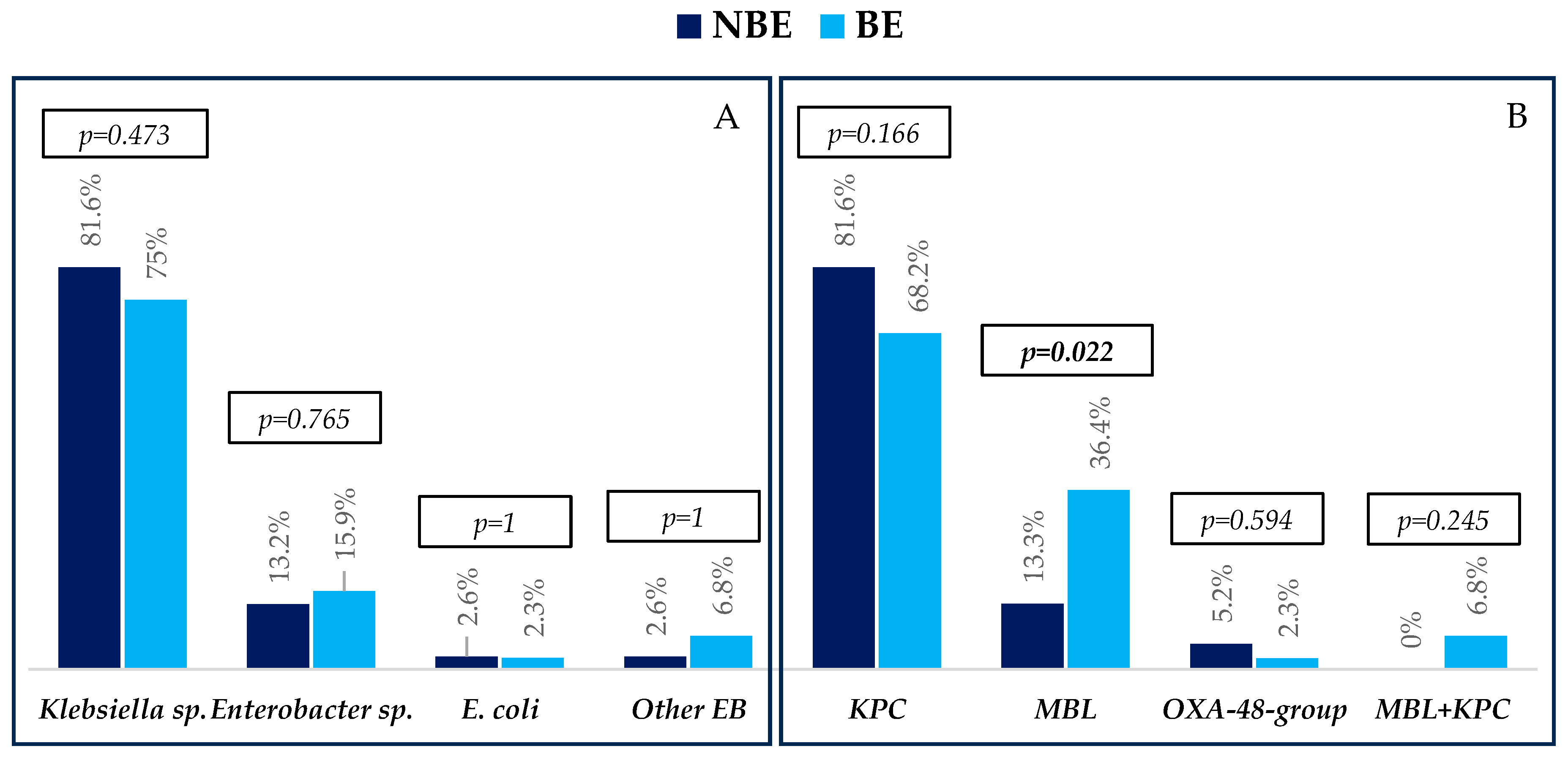
| CA + ATM | 5 (13.2) | 16 (36.4) | 21 (25.6) | 0.022 |
| Monotherapy | 35 (92.1) | 38 (86.4) | 73 (89) | 0.482 |
| Treatment duration (days) (median, IQR) | 7 (8–9) | 8 (7–11) | 8 (7–10) | 0.365 |
| Hypotension | 8 (21) | 16 (36.7) | 24 (29.3) | 0.129 |
| ICU admission | 5 (13.2) | 14 (31.8) | 19 (23.2) | 0.066 |
| Septic shock | 4 (10.5) | 12 (27.3) | 16 (19.5) | 0.092 |
| Multiorgan failure | 3 (7.9) | 8 (18.2) | 11 (13.4) | 0.208 |
| 7-day clinical | 35 (92.1) | 39 (88.6) | 74 (90.2) | 0.598 |
| 7-day mortality | 2 (5.2) | 3 (6.8) | 5 (6.10) | 1 |
| 30-day mortality | 4 (10.5) | 12 (27.3) | 16 (19.5) | 0.092 |
| Infection-related mortality | 1 (2.6) | 6 (13.6) | 7 (8.54) | 0.116 |
| Variable | Multivariate Logistic Regression | Multivariate Logistic Regression Adjusted for Propensity Score | ||||
|---|---|---|---|---|---|---|
| OR | 95% CI | p | OR | 95% CI | p | |
| Bacteremia | 1.8 | 0.44–7.04 | 0.427 | 1.5 | 0.36–6.29 | 0.567 |
| Septic shock | 10.4 | 2.66–40.8 | 0.001 | 6.5 | 1.58–26.72 | 0.01 |
| Refractory malignancy | 5.5 | 1.06–28.62 | 0.043 | 5.6 | 1.03–30.14 | 0.046 |
Disclaimer/Publisher’s Note: The statements, opinions and data contained in all publications are solely those of the individual author(s) and contributor(s) and not of MDPI and/or the editor(s). MDPI and/or the editor(s) disclaim responsibility for any injury to people or property resulting from any ideas, methods, instructions or products referred to in the content. |
© 2025 by the authors. Licensee MDPI, Basel, Switzerland. This article is an open access article distributed under the terms and conditions of the Creative Commons Attribution (CC BY) license (https://creativecommons.org/licenses/by/4.0/).
Share and Cite
Herrera, F.; Torres, D.; Leone, M.; Castro, M.G.; Camelo, J.L.; Temporiti, E.; Grippo, N.; Relloso, S.; Bonvehí, P. Ceftazidime-Avibactam Regimens for the Treatment of Bacteremic and Non-Bacteremic Episodes of Carbapenemase-Producing Enterobacterales Infections in Immunosuppressed Patients. Pathogens 2025, 14, 1300. https://doi.org/10.3390/pathogens14121300
Herrera F, Torres D, Leone M, Castro MG, Camelo JL, Temporiti E, Grippo N, Relloso S, Bonvehí P. Ceftazidime-Avibactam Regimens for the Treatment of Bacteremic and Non-Bacteremic Episodes of Carbapenemase-Producing Enterobacterales Infections in Immunosuppressed Patients. Pathogens. 2025; 14(12):1300. https://doi.org/10.3390/pathogens14121300
Chicago/Turabian StyleHerrera, Fabián, Diego Torres, María Leone, Maximiliano Gabriel Castro, Jorge López Camelo, Elena Temporiti, Natalin Grippo, Silvia Relloso, and Pablo Bonvehí. 2025. "Ceftazidime-Avibactam Regimens for the Treatment of Bacteremic and Non-Bacteremic Episodes of Carbapenemase-Producing Enterobacterales Infections in Immunosuppressed Patients" Pathogens 14, no. 12: 1300. https://doi.org/10.3390/pathogens14121300
APA StyleHerrera, F., Torres, D., Leone, M., Castro, M. G., Camelo, J. L., Temporiti, E., Grippo, N., Relloso, S., & Bonvehí, P. (2025). Ceftazidime-Avibactam Regimens for the Treatment of Bacteremic and Non-Bacteremic Episodes of Carbapenemase-Producing Enterobacterales Infections in Immunosuppressed Patients. Pathogens, 14(12), 1300. https://doi.org/10.3390/pathogens14121300