


Abstract
Glioblastoma (GB) is a highly aggressive brain tumor with a very poor prognosis. Treatment usually consists of surgery, followed by radiotherapy and chemotherapy, but the prognosis remains poor due to its resistance to therapies and a high recurrence rate. Multiple studies have reported the presence of human cytomegalovirus (HCMV) proteins and/or nucleic acids in GB tissues, suggesting its possible implication. These findings have led to the hypothesis that HCMV may contribute to tumor progression, immune evasion, angiogenesis, and resistance to therapy. Clinical trials using anti-HCMV therapies have shown promising preliminary results, indicating a potential therapeutic benefit. This review aims to provide a comprehensive overview of the current evidence linking HCMV to GB and the therapeutic implications. A deeper understanding of this complex interaction could unveil novel strategies for GB treatment.
1. Understanding Glioblastoma: Biology and Clinical Implications
Glioblastoma (GB) is the most common and aggressive primary brain tumor in adults. It is classified as a grade IV astrocytoma and is characterized by rapid proliferation, necrosis, microvascular proliferation, and diffuse infiltration. GB arises either de novo (primary GB) or through progression from lower-grade gliomas (secondary GB or astrocytoma, IDH-mutant), with each subtype displaying distinct molecular profiles [1]. Several genetic and environmental factors have been associated with its development. Primary GB is typically driven by early genomic alterations such as epidermal growth factor receptor (EGF-R) amplification, telomerase promoter (TERT) mutations, phosphatase and tensin homolog (PTEN) loss, and chromosomal instability, whereas secondary GB or astrocytoma, IDH-mutant often evolves through a stepwise accumulation of mutations, most characteristically IDH1/2 mutations and ATP-dependent helicase ATRX loss. Epigenetically, GB frequently exhibits widespread DNA methylation changes, including the well-described O6-methylguanine-DNA methyltransferase (MGMT) promoter methylation, which also influences treatment response [2,3]. Large-scale transcriptomic studies have defined molecular subtypes—classical, mesenchymal, and proneural—reflecting distinct oncogenic programs and cells of origin [1]. Beyond genetics, proposed risk factors include prior exposure to therapeutic ionizing radiation, though lifestyle and environmental risks remain poorly supported. Together, these findings illustrate that GB pathogenesis results from a complex interplay of genetic, epigenetic, and microenvironmental drivers rather than a single causative factor. Clinically, diagnosis relies on magnetic resonance imaging (MRI) and histopathology. Imaging typically shows a ring-enhancing lesion with central necrosis, perilesional edema, and mass effect. The standard treatment combines surgical resection, radiotherapy (60 Gy over 6 weeks), and temozolomide chemotherapy [4,5]. Even so, the prognosis remains poor, with a median survival of 12–15 months and an almost inevitable recurrence. Current research focuses on overcoming resistance mechanisms and the immunosuppressive tumor microenvironment (TME).
2. Human Cytomegalovirus: A Multifaceted Pathogen
Human cytomegalovirus (HCMV) is a large, enveloped double-stranded DNA virus belonging to the Betaherpesvirinae subfamily. Its genome spans approximately 230 kilobases and encodes over 200 distinct proteins. Like other members of this subfamily, HCMV displays strict species specificity while retaining the ability to infect a wide range of cell types [6,7]. In immunocompetent individuals, primary HCMV infection is typically asymptomatic or may manifest as a mild, self-limited febrile illness. Although viremia is rapidly controlled by cell-mediated immunity, viral genomes persist in a latent form for the lifetime of the host. In contrast, viral reactivation or uncontrolled replication can result in severe, life-threatening complications in immunocompromised patients [8]. Moreover, HCMV is recognized as the leading infectious cause of congenital malformations worldwide, contributing to developmental delay, sensorineural hearing loss, and intrauterine or neonatal death in approximately 10–15% of infected cases [9]. Despite major advances in both diagnostic approaches and antiviral therapy, HCMV continues to represent a significant clinical issue [6,7].
3. The Link Between HCMV and GB
For the first time, HCMV was classified recently as possibly carcinogenic to humans (Group 2B) by the International Agency for Research on Cancer (IARC), with evidence in humans relating mainly to acute lymphoblastic leukemia in children [10,11]. While the presence of HCMV within tumors remains debated, a substantial body of evidence supports its detection in GB tissues. The pioneering work of Cobbs et al. first reported HCMV in 95% of malignant gliomas, a prevalence markedly higher than that observed in the general population [12]. Subsequent studies have highlighted the complex interplay between HCMV and GB, suggesting that the virus may modulate immune cell activity and reshape the TME. Recent evidence also indicates that HCMV can be reactivated in GB patients undergoing brain radiotherapy [13]. Moreover, antiviral drugs commonly used to combat HCMV infections, such as valganciclovir, have shown promising results in the treatment of GB, by slowing tumor progression and improving patient survival by over 40 months in some cases [14]. In line with these findings, anti-HCMV therapy could now appear as a promising strategy to halt GB progression.
4. Mechanistic Insight of the Dual Facets of HCMV in GB: Oncomodulation and Beyond
Even though HCMV was classified as possibly carcinogenic to humans, this classification was based on limited evidence on acute lymphoblastic leukemia (ALL) in children whose bloodspots showed HCMV DNA or whose mothers were HCMV IgM seropositive during pregnancy [11]. As for the evidence for the association with GB and its direct oncogenesis, it was deemed “inadequate”. Henceforth, further studies are needed to determine if HCMV plays a role in GB development.
Emerging evidence suggests that several mechanisms may contribute to HCMV playing a role in tumor progression (Figure 1 and Table 1). Glycoproteins present on the viral envelope interact with specific cell surface receptors—such as platelet-derived growth factor receptor alpha (PDGFRα), neuropilin-2 (NRP2), and EGFR—to mediate viral entry. These interactions activate the PI3K/AKT signaling pathway [15]. Following HCMV entry, the immediate early protein IE1 enhances the stem-like properties of GB cells by modulating cell-cycle progression and promoting survival in vivo [16]. IE1 also contributes to angiogenesis and loss of tumor-suppressive functions through downregulation of TSP-1 and GFAP [17], while also driving PI3K/AKT activation, reducing Rb phosphorylation, and inhibiting p53 signaling via decreased p21 expression [18,19]. These effects collectively enhance the proliferation and invasiveness of GB cells [20]. Consistent with this, RNA-seq analyses of patient-derived GB cells infected with HCMV revealed upregulation of GB-associated genes, including strong induction of c-MET via NF-κB activation, which has been linked to accelerated tumor growth [21].
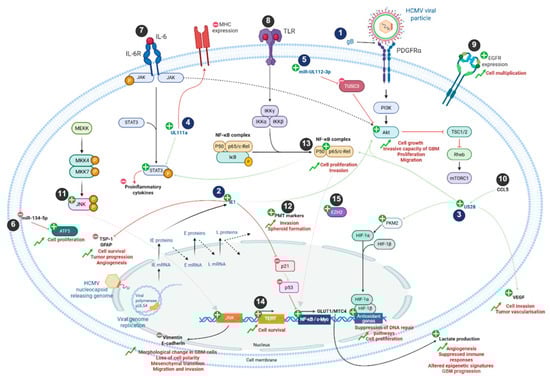
Figure 1.
Mechanistic implications of HCMV infection in GB cells. Viral and cellular components are represented in blue and black, respectively. Plus and minus signs represent upregulation or downregulation of signaling pathways, gene expression and protein production, respectively. During GB formation, HCMV infection activates numerous cellular signaling pathways such as JNK, PI3K/Akt, NF-κB, PKM2/HIF and STAT3 through viral proteins including IE1, US28 and UL111a. In addition, the viral miR-UL112-3p is involved in the upregulation of the PI3K/Akt pathway. This results in increased proliferation, invasion, growth, and migration of GB cells, as well as reduced levels of pro-inflammatory cytokines. Upregulation of JNK gene products is responsible for decreased expression of vimentin and E-cadherin, leading to morphological changes and mesenchymal transition. Lactate production is also increased by the NF-κB pathway and promotes angiogenesis, suppresses immune responses, alters epigenetic signatures, and enhances GB progression. In addition, cellular markers such as ATF5, EZH2, or PMT are also overexpressed during GB and enable its formation. HCMV infection further assists in the establishment of the GB TME. Numbers 1 to 15 refer to Table 1 to enhance figure comprehension. IL: interleukin; MHC: major histocompatibility complex; TLR: Toll-like receptor; PDGFR: platelet-derived growth factor receptor; EGFR: epithelial growth factor receptor; VEGF: vascular endothelial growth factor; ATF5: activating transcription factor 5; PMT: proneural–mesenchymal transition; miR: miRNA.

Table 1.
Viral and cellular markers involved in GB progression (Figure 1 related table).
Moreover, HCMV encodes a wide array of viral microRNAs (miRNAs) [22]. Among them, miR-UL112-3p, markedly upregulated in GB cells, targets TUSC3, a cellular mRNA, thereby stimulating AKT signaling pathway and promoting migration, invasion, cellular proliferation and overall poor prognosis and decreased patient survival [23]. In addition to encoding viral miRNAs, HCMV also modulates host cell miRNA expression. For instance, infection downregulates miR-134-5p in GB cells, resulting in increased levels of the anti-apoptotic factor ATF5 [24,25] and enhanced proliferative capacity [26].
Beyond miRNA, viral proteins also contribute to GB progression. The viral chemokine receptor homologue US28, expressed in approximately 60% of GB, enhances tumor invasion and promotes vascularization through VEGF induction [27,28] and IL-6/STAT3 and NFκB pathways [28,29]. US28 signaling also results in activation of the HIF-1/PKM2 [30]. HCMV also appears to modulate immune evasion mechanisms in GB through viral gene UL111A, an IL-10 homologue that suppresses proinflammatory cytokine production and downregulates MHC expression [31]. In addition, HCMV infection has been reported to enhance TERT activity to induce fibroblast survival [32]. HCMV can modulate both innate and adaptive immunity and reprogram cellular metabolism, collectively promoting an immunosuppressive tumor microenvironment. The virus expands populations of immunosuppressive cells, including Tregs and myeloid-derived suppressor cells (MDSCs), induces pro-tumoral cytokines, and upregulates GLUT1 and MCT4, driving lactate production that enhances angiogenesis, suppresses immune responses, and alters epigenetic states in neighboring non-infected cells, thereby contributing to GB progression [33,34]. HCMV also impairs NK cell recognition and cytotoxicity, disrupts dendritic cell maturation and antigen presentation, and promotes further Treg expansion, collectively dampening anti-tumor immunity [35,36,37]. These combined effects create an immunosuppressive microenvironment that facilitates GB growth. HCMV infection has further been shown to activate JNK signaling and induce morphological changes in GB cells, including reduced expression of E-cadherin and increased expression of vimentin [38]. These alterations result in loss of cell polarity and an epithelial-to-mesenchymal-like transition, favoring enhanced migration and invasiveness [39]. Collectively, these findings highlight the multifaceted role of HCMV in GB progression through the regulation of apoptosis, oncogenic signaling, immune evasion, metabolic reprogramming, and invasive potential.
Nevertheless, studies suggest that HCMV may function not only as an oncomodulator but also as a direct reprogramming vector. Recently, it has been shown that the infection of human astrocytes with clinical isolates of HCMV from GB patient biopsies induces the formation of GB-like cells. These cells possessed characteristics that mirror key features of aggressive GB, such as dedifferentiation and stemness, accompanied by an elevated expression of Myc and EZH2, elevated proneural–mesenchymal transition (PMT) markers, spheroid formation and invasiveness [40]. This ability to induce the transformation of cells has also been demonstrated in human embryonal lung fibroblasts and human mammary epithelial cells in vitro [41,42]. A limitation of these studies, however, is that they were conducted primarily at the cellular level and in patient biopsy samples, without validation in a relevant in vivo model.
Moreover, xenografting of HCMV-induced GB spheroids, generated from HCMV-infected human astrocytes, into immunodeficient Ragγ2C−/− mice resulted in the formation of tumors with a GB-like phenotype. These HCMV-derived tumors were characterized by glial proliferation, nuclear atypia with enlarged hyperchromatic nuclei, and high nestin expression, recapitulating key histopathological features observed in patient-derived GB xenografts. In addition, the TME of HCMV-derived tumors exhibited elevated Myc and EZH2 expression, paralleling findings in GB patient biopsies. Importantly, the presence of HCMV genes (IE1 and UL69) and proteins (IE1 and IE2) was consistently detected in these tumors even two months post-engraftment, suggesting a sustained association between HCMV and tumor progression. Finally, elevated levels of HCMV, Myc, EZH2, and EGFR were also observed in the patient-derived model (PDX-P3), a well-characterized GB positive control. These findings further raise questions about the potential contribution of HCMV to GB initiation and progression in patient-derived models [43].
5. HCMV as a Therapeutic Target in GB
HCMV has emerged as a highly promising therapeutic target in GB, given its detection in tumor tissues and its influence on both tumor progression and the immune microenvironment (Table 2).
Table 2.
HCMV-targeted strategies in GB models.
As previously described, HCMV promotes a tumor-supportive microenvironment and may contribute to therapy resistance. Consequently, targeting HCMV may enhance the efficacy of conventional GB treatments. Current research is exploring both the direct inhibition of HCMV and its viral proteins, as well as the use of HCMV antigens in immunotherapeutic approaches. The role of several viral proteins in tumor progression further underscores HCMV as a critical therapeutic target, fueling the development of novel treatment strategies. Peptide-based vaccination strategies targeting HCMV antigens have gained increasing attention in the context of GB. Vaccines incorporating a mutated form of the HCMV immediate early protein (HCMV-IE1mut) when combined with tumor-associated antigens such as Fibrinogen-like protein 2 (FGL2) have demonstrated synergistic effects in preclinical models. This combinatorial approach not only enhanced antitumor activity but also promoted stronger and more durable immune responses, highlighting its potential as a novel immunotherapeutic strategy against GB [44].
Another strategy consists of blocking viral entry receptors. The ephrin type A receptor 2 (EphA2), a member of the receptor tyrosine kinase family, is frequently overexpressed in GB. EphA2 has been identified as a critical host factor that mediates HCMV entry and membrane fusion in GB cells, thereby facilitating HCMV infection. Pharmacological or genetic inhibition of EphA2 has been shown to reduce HCMV infection and to attenuate tumor progression, highlighting its potential as a therapeutic target [46]. MicroRNA-based therapy can also be used to modulate microRNAs. Topoisomerase II alpha (TOP2A), which is silenced by microRNAs such as miR-139 and miR-548c-3p, plays a critical role in glioma cell proliferation and migration [49,50]. miR-144-3p, a member of the miR-144/451 cluster, acts as a tumor suppressor by directly targeting TOP2A, which is overexpressed in HCMV-positive gliomas. Restoration of miR-144-3p expression inhibits glioma growth in xenograft models, indicating that the upregulation of miR-144-3p can suppress the proliferation of HCMV-positive GB cells through inhibition of the TOP2A pathway [47]. Moreover, as previously described, the HCMV-encoded chemokine receptor US28 further contributes to tumor progression by activating intracellular signaling pathways. To counteract this effect, nanobodies specifically targeting US28 have been developed and shown to inhibit GB cell growth in vitro and in vivo. These nanobodies exhibit significant diagnostic and therapeutic potential for HCMV-associated GB, as preclinical mouse models demonstrate their efficacy in suppressing tumor growth [45].
To date, the majority of available HCMV therapies—(GCV, Cymevene R ©), valganciclovir (VGCV, Valcyte R ©), cidofovir (CDV, Vistide R ©) and foscarnet (FOS, Foscavir R ©)—act by interfering with the activity of the viral DNA polymerase pUL54. Interestingly, conventional antivirals such as valganciclovir, which target active viral replication, have been linked to improved survival outcomes in both non-randomized and randomized clinical studies [14,48]. Despite encouraging preclinical evidence, clinical translation remains limited, mainly due to the absence of standardized methods for detecting HCMV in GB and the paucity of large randomized trials. Notably, an ongoing multicenter phase 2 randomized trial (NCT04116411) is currently assessing the addition of valganciclovir versus placebo to standard therapy (radiotherapy plus temozolomide) in adults with newly diagnosed GB. However, these drugs are associated with significant toxicity and have contributed to the emergence of multiple drug-resistant HCMV strains [6]. In recent years, two novel compounds—maribavir and letermovir—have been introduced, targeting the viral kinase pUL97 and the terminase complex (pUL51-pUL56-pUL89), respectively. Although these newer agents demonstrate improved safety profiles, the rapid emergence of resistance remains a significant challenge [6,51]. New therapeutic targets are currently under investigation. Among the potential candidates, the terminase complex, which plays a key role in viral DNA packaging, stands out. Even if letermovir succeeds in inhibiting the packaging step by acting on the terminase complex, further studies could identify new functional motifs essential to its activity [52,53,54,55]. Another promising target is the helicase-primase complex, which is central to viral DNA replication by unwinding the DNA and synthesizing RNA primers required for DNA polymerase function. Notably, this complex is already effectively targeted in other herpesviruses such as HSV-1, HSV-2, and VZV [56]. However, none of the antivirals currently available are effective against the helicase-primase complex of HCMV. It is therefore crucial to characterize this complex to develop new therapeutic alternatives.
HCMV represents a promising therapeutic target in GB, with experimental evidence indicating that it influences tumor biology via complex oncomodulatory mechanisms. Nevertheless, methodological and clinical uncertainties remain. Progress in HCMV-targeted therapies will depend on standardized detection methods, a more comprehensive understanding of virus–tumor interactions, and rigorous validation in well-designed clinical trials.
6. Future Directions and Perspectives
The detection of HCMV in GB has produced highly inconsistent results, likely due to differences in detection methodologies, the specificity and sensitivity of the antibodies used, tissue processing and preservation procedures, variations in viral load, and the interpretative criteria applied across studies. Despite this heterogeneity, the possibility that HCMV contributes to GB biology has prompted interest in targeting the virus, and anti-HCMV therapy has emerged as a promising strategy to slow GB progression. Preclinical studies and early clinical trials with valganciclovir have yielded encouraging results, warranting rigorous clinical validation. However, current anti-HCMV agents routinely used for prevention and treatment targeting the viral polymerase are associated with hematologic and renal toxicities, and resistance mutations have also been reported for all antivirals whatever the target [57]. Alternative strategies must therefore be developed. Recently, we provided the first proof-of-concept that peptides designed to disrupt the pUL56–pUL89 interaction can effectively inhibit HCMV replication [58]. This strategy offers a novel approach to complement or replace traditional antivirals, which are often limited by side effects and resistance issues. Overall, targeting HCMV in GB emerges as a highly promising strategy, uniting viral biology, immunotherapy, and cancer signaling into a coherent therapeutic framework. By complementing existing treatments, this approach holds real potential to advance personalized, more effective interventions for GB patients.
Author Contributions
T.F., E.D., G.M., C.G. and A.D. prepared the initial draft of the manuscript. S.H. and G.L. revised the manuscript. All authors approved the final version of the manuscript.
Funding
GL received financial support from INSERM, CNRS, Toulouse University, Infinity, the Défi Clé Cell Based Biotherapies Occitanie (INTERCYTE), the association “Des étoiles dans la mer, vaincre le glioblastome”, the foundation “FONROGA”, the association “Eva pour la vie”, the association “Raphaël Coeur Chocolat”, the association “111 Des Arts, Toulouse”, the Ligue contre le cancer (FoCyG), the foundation “Flavien”, the federation “Grandir sans cancer”, and the “Association pour la Recherche sur les Tumeurs Cérébrales” (ARTC). The PhD thesis of TF is funded by the Occitanie Region and INSERM.
Data Availability Statement
The original contributions presented in this study are included in the article. Further inquiries can be directed to the corresponding author.
Acknowledgments
The figure was created with BioRender.com (https://www.biorender.com/).
Conflicts of Interest
The authors declare no conflicts of interest. The funders had no role in the design of the study; in the collection, analyses, or interpretation of data; in the writing of the manuscript; or in the decision to publish the results.
References
- Figarella-Branger, D.; Appay, R.; Metais, A.; Tauziède-Espariat, A.; Colin, C.; Rousseau, A.; Varlet, P. La classification de l’OMS 2021 des tumeurs du système nerveux central. Ann. Pathol. 2022, 42, 367–382. [Google Scholar] [CrossRef]
- Brennan, C.W.; Verhaak, R.G.W.; McKenna, A.; Campos, B.; Noushmehr, H.; Salama, S.R.; Zheng, S.; Chakravarty, D.; Sanborn, J.Z.; Berman, S.H.; et al. The Somatic Genomic Landscape of Glioblastoma. Cell 2013, 155, 462–477. [Google Scholar] [CrossRef]
- Thakkar, J.P.; Dolecek, T.A.; Horbinski, C.; Ostrom, Q.T.; Lightner, D.D.; Barnholtz-Sloan, J.S.; Villano, J.L. Epidemiologic and Molecular Prognostic Review of Glioblastoma. Cancer Epidemiol. Biomark. Prev. 2014, 23, 1985–1996. [Google Scholar] [CrossRef]
- Stupp, R.; Mason, W.P.; Van Den Bent, M.J.; Weller, M.; Fisher, B.; Taphoorn, M.J.B.; Belanger, K.; Brandes, A.A.; Marosi, C.; Bogdahn, U.; et al. Radiotherapy plus Concomitant and Adjuvant Temozolomide for Glioblastoma. N. Engl. J. Med. 2005, 352, 987–996. [Google Scholar] [CrossRef]
- Weller, M.; Van Den Bent, M.; Tonn, J.C.; Stupp, R.; Preusser, M.; Cohen-Jonathan-Moyal, E.; Henriksson, R.; Rhun, E.L.; Balana, C.; Chinot, O.; et al. European Association for Neuro-Oncology (EANO) Guideline on the Diagnosis and Treatment of Adult Astrocytic and Oligodendroglial Gliomas. Lancet Oncol. 2017, 18, e315–e329. [Google Scholar] [CrossRef]
- Ligat, G.; Cazal, R.; Hantz, S.; Alain, S. The Human Cytomegalovirus Terminase Complex as an Antiviral Target: A Close-up View. FEMS Microbiol. Rev. 2018, 42, 137–145. [Google Scholar] [CrossRef]
- Gourin, C.; Flores, T.; Mafi, S.; Malnou, C.; Alain, S.; Hantz, S.; Ligat, G. Challenges and advances in the management of HCMV infections. Virologie 2024, 28, 309–325. [Google Scholar] [CrossRef]
- Sinclair, J.; Sissons, P. Latency and Reactivation of Human Cytomegalovirus. J. Gen. Virol. 2006, 87, 1763–1779. [Google Scholar] [CrossRef]
- Leruez-Ville, M.; Ville, Y. Fetal Cytomegalovirus Infection. Best. Pract. Res. Clin. Obstet. Gynaecol. 2017, 38, 97–107. [Google Scholar] [CrossRef]
- Karagas, M.R.; Kaldor, J.; Michaelis, M.; Muchengeti, M.M.; Alfaiate, D.; Argirion, I.; Chen, X.; Cunha, C.; Hantz, S.; Koljonen, V.; et al. Carcinogenicity of Hepatitis D Virus, Human Cytomegalovirus, and Merkel Cell Polyomavirus. Lancet Oncol. 2025, 26, 994–995. [Google Scholar] [CrossRef] [PubMed]
- Francis, S.S.; Wallace, A.D.; Wendt, G.A.; Li, L.; Liu, F.; Riley, L.W.; Kogan, S.; Walsh, K.M.; de Smith, A.J.; Dahl, G.V.; et al. In Utero Cytomegalovirus Infection and Development of Childhood Acute Lymphoblastic Leukemia. Blood 2017, 129, 1680–1684. [Google Scholar] [CrossRef] [PubMed]
- Cobbs, C.S.; Harkins, L.; Samanta, M.; Gillespie, G.Y.; Bharara, S.; King, P.H.; Nabors, L.B.; Cobbs, C.G.; Britt, W.J. Human Cytomegalovirus Infection and Expression in Human Malignant Glioma. Cancer Res. 2002, 62, 3347–3350. [Google Scholar] [PubMed]
- Söderberg-Naucler, C.; Pantalone, M.R.; Stragliotto, G.; Bartek, J. Does Human Cytomegalovirus Provide a Novel Therapeutic Target for Patients with Glioblastoma? Philos. Trans. R. Soc. B 2025, 380, 20240403. [Google Scholar] [CrossRef]
- Stragliotto, G.; Pantalone, M.R.; Rahbar, A.; Söderberg-Nauclér, C. Valganciclovir as Add-On to Standard Therapy in Secondary Glioblastoma. Microorganisms 2020, 8, 1471. [Google Scholar] [CrossRef]
- Cobbs, C.; Khan, S.; Matlaf, L.; McAllister, S.; Zider, A.; Yount, G.; Rahlin, K.; Harkins, L.; Bezrookove, V.; Singer, E.; et al. HCMV Glycoprotein B Is Expressed in Primary Glioblastomas and Enhances Growth and Invasiveness via PDGFR-Alpha Activation. Oncotarget 2014, 5, 1091–1100. [Google Scholar] [CrossRef]
- Soroceanu, L.; Matlaf, L.; Khan, S.; Akhavan, A.; Singer, E.; Bezrookove, V.; Decker, S.; Ghanny, S.; Hadaczek, P.; Bengtsson, H.; et al. Cytomegalovirus Immediate Early Proteins Promote Stemness Properties in Glioblastoma. Cancer Res. 2015, 75, 3065–3076. [Google Scholar] [CrossRef]
- Lee, K.; Jeon, K.; Kim, J.-M.; Kim, V.N.; Choi, D.H.; Kim, S.U.; Kim, S. Downregulation of GFAP, TSP-1, and P53 in Human Glioblastoma Cell Line, U373MG, by IE1 Protein from Human Cytomegalovirus. Glia 2005, 51, 1–12. [Google Scholar] [CrossRef]
- Cobbs, C.S.; Soroceanu, L.; Denham, S.; Zhang, W.; Kraus, M.H. Modulation of Oncogenic Phenotype in Human Glioma Cells by Cytomegalovirus IE1–Mediated Mitogenicity. Cancer Res. 2008, 68, 724–730. [Google Scholar] [CrossRef]
- Hwang, E.-S.; Zhang, Z.; Cai, H.; Huang, D.Y.; Huong, S.-M.; Cha, C.-Y.; Huang, E.-S. Human Cytomegalovirus IE1-72 Protein Interacts with P53 and Inhibits P53-Dependent Transactivation by a Mechanism Different from That of IE2-86 Protein. J. Virol. 2009, 83, 12388–12398. [Google Scholar] [CrossRef]
- Holland, E.C. Gliomagenesis: Genetic Alterations and Mouse Models. Nat. Rev. Genet. 2001, 2, 120–129. [Google Scholar] [CrossRef]
- Krenzlin, H.; Zdioruk, M.; Nowicki, M.O.; Finkelberg, T.; Keric, N.; Lemmermann, N.; Skubal, M.; Chiocca, E.A.; Cook, C.H.; Lawler, S.E. Cytomegalovirus Infection of Glioblastoma Cells Leads to NF-κB Dependent Upregulation of the c-MET Oncogenic Tyrosine Kinase. Cancer Lett. 2021, 513, 26–35. [Google Scholar] [CrossRef]
- Diggins, N.L.; Skalsky, R.L.; Hancock, M.H. Regulation of Latency and Reactivation by Human Cytomegalovirus miRNAs. Pathogens 2021, 10, 200. [Google Scholar] [CrossRef]
- Liang, Q.; Wang, K.; Wang, B.; Cai, Q. HCMV-Encoded miR-UL112-3p Promotes Glioblastoma Progression via Tumour Suppressor Candidate 3. Sci. Rep. 2017, 7, 44705. [Google Scholar] [CrossRef] [PubMed]
- Sheng, Z.; Li, L.; Zhu, L.J.; Smith, T.W.; Demers, A.; Ross, A.H.; Moser, R.P.; Green, M.R. A Genome-Wide RNA Interference Screen Reveals an Essential CREB3L2-ATF5-MCL1 Survival Pathway in Malignant Glioma with Therapeutic Implications. Nat. Med. 2010, 16, 671–677. [Google Scholar] [CrossRef]
- Hu, M.; Yu, B.; Zhang, B.; Wang, B.; Qian, D.; Li, H.; Ma, J.; Liu, D.X. Human Cytomegalovirus Infection Activates Glioma Activating Transcription Factor 5 via microRNA in a Stress-Induced Manner. ACS Chem. Neurosci. 2021, 12, 3947–3956. [Google Scholar] [CrossRef]
- Wang, T.; Qian, D.; Hu, M.; Li, L.; Zhang, L.; Chen, H.; Yang, R.; Wang, B. Human Cytomegalovirus Inhibits Apoptosis by Regulating the Activating Transcription Factor 5 Signaling Pathway in Human Malignant Glioma Cells. Oncol. Lett. 2014, 8, 1051–1057. [Google Scholar] [CrossRef]
- Maussang, D.; Verzijl, D.; van Walsum, M.; Leurs, R.; Holl, J.; Pleskoff, O.; Michel, D.; van Dongen, G.A.M.S.; Smit, M.J. Human Cytomegalovirus-Encoded Chemokine Receptor US28 Promotes Tumorigenesis. Proc. Natl. Acad. Sci. USA 2006, 103, 13068–13073. [Google Scholar] [CrossRef]
- Soroceanu, L.; Matlaf, L.; Bezrookove, V.; Harkins, L.; Martinez, R.; Greene, M.; Soteropoulos, P.; Cobbs, C.S. Human Cytomegalovirus US28 Found in Glioblastoma Promotes an Invasive and Angiogenic Phenotype. Cancer Res. 2011, 71, 6643–6653. [Google Scholar] [CrossRef] [PubMed]
- Slinger, E.; Maussang, D.; Schreiber, A.; Siderius, M.; Rahbar, A.; Fraile-Ramos, A.; Lira, S.A.; Söderberg-Nauclér, C.; Smit, M.J. HCMV-Encoded Chemokine Receptor US28 Mediates Proliferative Signaling Through the IL-6–STAT3 Axis. Sci. Signal. 2010, 3, ra58. [Google Scholar] [CrossRef]
- De Wit, R.H.; Mujić-Delić, A.; Van Senten, J.R.; Fraile-Ramos, A.; Siderius, M.; Smit, M.J. Human Cytomegalovirus Encoded Chemokine Receptor US28 Activates the HIF-1α/PKM2 Axis in Glioblastoma Cells. Oncotarget 2016, 7, 67966–67985. [Google Scholar] [CrossRef] [PubMed]
- Spencer, J.V.; Lockridge, K.M.; Barry, P.A.; Lin, G.; Tsang, M.; Penfold, M.E.T.; Schall, T.J. Potent Immunosuppressive Activities of Cytomegalovirus- Encoded Interleukin-10. J. Virol. 2002, 76, 1285–1292. [Google Scholar] [CrossRef]
- Strååt, K.; Liu, C.; Rahbar, A.; Zhu, Q.; Liu, L.; Wolmer-Solberg, N.; Lou, F.; Liu, Z.; Shen, J.; Jia, J.; et al. Activation of Telomerase by Human Cytomegalovirus. J. Natl. Cancer Inst. 2009, 101, 488–497. [Google Scholar] [CrossRef]
- Harrison, M.A.A.; Hochreiner, E.M.; Benjamin, B.P.; Lawler, S.E.; Zwezdaryk, K.J. Metabolic Reprogramming of Glioblastoma Cells during HCMV Infection Induces Secretome-Mediated Paracrine Effects in the Microenvironment. Viruses 2022, 14, 103. [Google Scholar] [CrossRef]
- Mercado, N.B.; Real, J.N.; Kaiserman, J.; Panagioti, E.; Cook, C.H.; Lawler, S.E. Clinical Implications of Cytomegalovirus in Glioblastoma Progression and Therapy. npj Precis. Oncol. 2024, 8, 213. [Google Scholar] [CrossRef]
- Moutaftsi, M.; Mehl, A.M.; Borysiewicz, L.K.; Tabi, Z. Human Cytomegalovirus Inhibits Maturation and Impairs Function of Monocyte-Derived Dendritic Cells. Blood 2002, 99, 2913–2921. [Google Scholar] [CrossRef] [PubMed]
- Shen, Y.; Zhang, L.; Xue, X.; Feng, S. Molecular Mechanisms and Targets Underlying Immune Evasion by Human Cytomegalovirus. J. Microbiol. Immunol. Infect. 2025, in press. [Google Scholar] [CrossRef] [PubMed]
- Cox, M.; Kartikasari, A.E.R.; Gorry, P.R.; Flanagan, K.L.; Plebanski, M. Potential Impact of Human Cytomegalovirus Infection on Immunity to Ovarian Tumours and Cancer Progression. Biomedicines 2021, 9, 351. [Google Scholar] [CrossRef] [PubMed]
- Zhu, X.; Hu, B.; Hu, M.; Qian, D.; Wang, B. Human Cytomegalovirus Infection Enhances Invasiveness and Migration of Glioblastoma Cells by Epithelial-to-Mesenchymal Transition. Int. J. Clin. Exp. Pathol. 2020, 13, 2637–2647. [Google Scholar]
- Kjellman, C.; Olofsson, S.P.; Hansson, O.; Von Schantz, T.; Lindvall, M.; Nilsson, I.; Salford, L.G.; Sjögren, H.-O.; Widegren, B. Expression of TGF-β Isoforms, TGF-β Receptors, and SMAD Molecules at Different Stages of Human Glioma. Int. J. Cancer 2000, 89, 251–258. [Google Scholar] [CrossRef]
- El Baba, R.; Pasquereau, S.; Haidar Ahmad, S.; Monnien, F.; Abad, M.; Bibeau, F.; Herbein, G. EZH2-Myc Driven Glioblastoma Elicited by Cytomegalovirus Infection of Human Astrocytes. Oncogene 2023, 42, 2031–2045. [Google Scholar] [CrossRef]
- Geder, L.; Lausch, R.; O’Neill, F.; Rapp, F. Oncogenic Transformation of Human Embryo Lung Cells by Human Cytomegalovirus. Science 1976, 192, 1134–1137. [Google Scholar] [CrossRef] [PubMed]
- Kumar, A.; Tripathy, M.K.; Pasquereau, S.; Al Moussawi, F.; Abbas, W.; Coquard, L.; Khan, K.A.; Russo, L.; Algros, M.-P.; Valmary-Degano, S.; et al. The Human Cytomegalovirus Strain DB Activates Oncogenic Pathways in Mammary Epithelial Cells. eBioMedicine 2018, 30, 167–183. [Google Scholar] [CrossRef] [PubMed]
- Guyon, J.; Haidar Ahmad, S.; El Baba, R.; Le Quang, M.; Bikfalvi, A.; Daubon, T.; Herbein, G. Generation of Glioblastoma in Mice Engrafted with Human Cytomegalovirus-Infected Astrocytes. Cancer Gene Ther. 2024, 31, 1070–1080. [Google Scholar] [CrossRef]
- Wang, S.; Jiang, S.; Li, X.; Huang, H.; Qiu, X.; Yu, M.; Yang, X.; Liu, F.; Wang, C.; Shen, W.; et al. FGL2172-220 Peptides Improve the Antitumor Effect of HCMV-IE1mut Vaccine against Glioblastoma by Modulating Immunosuppressive Cells in the Tumor Microenvironment. OncoImmunology 2024, 13, 2423983. [Google Scholar] [CrossRef]
- Heukers, R.; Fan, T.S.; de Wit, R.H.; van Senten, J.R.; De Groof, T.W.M.; Bebelman, M.P.; Lagerweij, T.; Vieira, J.; de Munnik, S.M.; Smits-de Vries, L.; et al. The Constitutive Activity of the Virally Encoded Chemokine Receptor US28 Accelerates Glioblastoma Growth. Oncogene 2018, 37, 4110–4121. [Google Scholar] [CrossRef]
- Dong, X.-D.; Li, Y.; Li, Y.; Sun, C.; Liu, S.-X.; Duan, H.; Cui, R.; Zhong, Q.; Mou, Y.-G.; Wen, L.; et al. EphA2 Is a Functional Entry Receptor for HCMV Infection of Glioblastoma Cells. PLoS Pathog. 2023, 19, e1011304. [Google Scholar] [CrossRef]
- Song, J.; Ma, Q.; Hu, M.; Qian, D.; Wang, B.; He, N. The Inhibition of miR-144-3p on Cell Proliferation and Metastasis by Targeting TOP2A in HCMV-Positive Glioblastoma Cells. Molecules 2018, 23, 3259. [Google Scholar] [CrossRef]
- Ottenhausen, M.; Bodhinayake, I.; Schaefer, P.M.; Boockvar, J.A. VIGAS and Beyond: The Impact of HCMV-Infection and Its Treatment in Glioblastoma. Neurosurgery 2014, 74, N17–N18. [Google Scholar] [CrossRef]
- Srikantan, S.; Abdelmohsen, K.; Lee, E.K.; Tominaga, K.; Subaran, S.S.; Kuwano, Y.; Kulshrestha, R.; Panchakshari, R.; Kim, H.H.; Yang, X.; et al. Translational Control of TOP2A Influences Doxorubicin Efficacy. Mol. Cell Biol. 2011, 31, 3790–3801. [Google Scholar] [CrossRef]
- Hua, W.; Sa, K.-D.; Zhang, X.; Jia, L.-T.; Zhao, J.; Yang, A.-G.; Zhang, R.; Fan, J.; Bian, K. MicroRNA-139 Suppresses Proliferation in Luminal Type Breast Cancer Cells by Targeting Topoisomerase II Alpha. Biochem. Biophys. Res. Commun. 2015, 463, 1077–1083. [Google Scholar] [CrossRef] [PubMed]
- Gourin, C.; Flores, T.; Lefèvre, C.; Alain, S.; Ligat, G.; Hantz, S. Deciphering Letermovir’s Mode of Action and Resistance Mutation Effects. Antivir. Res. 2025, 244, 106289. [Google Scholar] [CrossRef]
- Ligat, G.; Jacquet, C.; Chou, S.; Couvreux, A.; Alain, S.; Hantz, S. Identification of a Short Sequence in the HCMV Terminase pUL56 Essential for Interaction with pUL89 Subunit. Sci. Rep. 2017, 7, 8796. [Google Scholar] [CrossRef]
- Ligat, G.; Couvreux, A.; Cazal, R.; Alain, S.; Hantz, S. Highlighting of a LAGLIDADG and a Zing Finger Motifs Located in the pUL56 Sequence Crucial for HCMV Replication. Viruses 2019, 11, 1093. [Google Scholar] [CrossRef]
- Gourin, C.; Lefèvre, C.; Flores, T.; Couvreux, A.; Alain, S.; Ligat, G.; Hantz, S. Key Domains Involved in the Interaction and Assembly of the HCMV Terminase Complex. Sci. Rep. 2025. [Google Scholar] [CrossRef]
- Muller, C.; Alain, S.; Gourin, C.; Baumert, T.F.; Ligat, G.; Hantz, S. New Insights into Human Cytomegalovirus pUL52 Structure. Viruses 2021, 13, 1638. [Google Scholar] [CrossRef]
- Ligat, G.; Da Re, S.; Alain, S.; Hantz, S. Identification of Amino Acids Essential for Viral Replication in the HCMV Helicase-Primase Complex. Front. Microbiol. 2018, 9, 2483. [Google Scholar] [CrossRef]
- Jacobsen, T.; Sifontis, N. Drug Interactions and Toxicities Associated with the Antiviral Management of Cytomegalovirus Infection. Am. J. Health Syst. Pharm. 2010, 67, 1417–1425. [Google Scholar] [CrossRef]
- Mafi, S.; Poyet, J.-L.; Alain, S.; Ligat, G.; Hantz, S. First Evidence of Efficacy of Peptides Targeting the pUL56-pUL89 Interaction Domain of the Human Cytomegalovirus Terminase Complex. Antivir. Res. 2025, 242, 106259. [Google Scholar] [CrossRef]
Disclaimer/Publisher’s Note: The statements, opinions and data contained in all publications are solely those of the individual author(s) and contributor(s) and not of MDPI and/or the editor(s). MDPI and/or the editor(s) disclaim responsibility for any injury to people or property resulting from any ideas, methods, instructions or products referred to in the content. |
© 2025 by the authors. Licensee MDPI, Basel, Switzerland. This article is an open access article distributed under the terms and conditions of the Creative Commons Attribution (CC BY) license (https://creativecommons.org/licenses/by/4.0/).