Staphylococci: What Has Changed in the Antibiotic Resistance Profile in the Last Decade—Analysis of Strains Isolated from Hospitalised Patients

 ,
,  ,
, 
Abstract
1. Introduction
2. Materials and Methods
2.1. Setting and Samples
2.2. Microbiological Analysis
2.3. Statistical Analysis
3. Results
4. Discussion
5. Conclusions
Supplementary Materials
Author Contributions
Funding
Institutional Review Board Statement
Informed Consent Statement
Data Availability Statement
Conflicts of Interest
References
- Foster, T.J. The Staphylococcus aureus “superbug”. J. Clin. Investig. 2004, 114, 1693–1696. [Google Scholar] [CrossRef] [Scilit] [PubMed]
- Touaitia, R.; Mairi, A.; Ibrahim, N.A.; Basher, N.S.; Idres, T.; Touati, A. Staphylococcus aureus: A review of the pathogenesis and virulence mechanisms. Antibiotics 2025, 14, 470. [Google Scholar] [CrossRef] [Scilit]
- Braun, T.; Kahanov, L.; Dannelly, K.; Lauber, C. CA-MRSA infection incidence and care in high school and intercollegiate athletics. Med. Sci. Sports Exerc. 2016, 48, 1530–1538. [Google Scholar] [CrossRef] [Scilit]
- Fooladvand, S.; Sarmadian, H.; Habibi, D.; van Belkum, A.; Ghaznavi-Rad, E. High prevalence of methicillin-resistant and enterotoxin gene-positive Staphylococcus aureus among nasally colonized food handlers in Central Iran. Eur. J. Clin. Microbiol. Infect. Dis. 2019, 38, 87–92. [Google Scholar] [CrossRef] [Scilit]
- Katkowska, M.; Kosecka-Strojek, M.; Wolska-Gębarzewska, M.; Kwapisz, E.; Wierzbowska, M.; Międzobrodzki, J.; Garbacz, K. Emerging challenges in methicillin resistance of coagulase-negative staphylococci. Antibiotics 2025, 14, 37. [Google Scholar] [CrossRef] [Scilit]
- David, M.Z.; Daum, R.S. Community-associated methicillin-resistant Staphylococcus aureus: Epidemiology and clinical consequences of an emerging epidemic. Clin. Microbiol. Rev. 2010, 23, 616–687. [Google Scholar] [PubMed]
- Yousefi, M.; Pourmand, M.R.; Fallah, F.; Hashemi, A.; Mashhadi, R.; Nazari-Alam, A. Characterization of Staphylococcus aureus biofilm formation in urinary tract infection. Iran. J. Public Health 2016, 45, 485–493. [Google Scholar]
- Linz, M.S.; Mattappallil, A.; Finkel, D.; Parker, D. Clinical impact of Staphylococcus aureus skin and soft tissue infections. Antibiotics 2023, 12, 557. [Google Scholar] [CrossRef] [Scilit]
- Heim, C.E.; Vidlak, D.; Scherr, T.D.; Hartman, C.W.; Garvin, K.L.; Kielian, T. IL-12 promotes myeloid-derived suppressor cell recruitment and bacterial persistence during Staphylococcus aureus orthopedic implant infection. J. Immunol. 2015, 194, 3861–3872. [Google Scholar] [CrossRef] [Scilit]
- Vidlak, D.; Kielian, T. Infectious dose dictates the host response during Staphylococcus aureus orthopedic-implant biofilm infection. Infect. Immun. 2016, 84, 1957–1965. [Google Scholar] [CrossRef] [Scilit] [PubMed]
- De Mesy Bentley, K.L.; Trombetta, R.; Nishitani, K.; Bello-Irizarry, S.N.; Ninomiya, M.; Zhang, L.; Chung, H.L.; McGrath, J.L.; Daiss, J.L.; Awad, H.A.; et al. Evidence of Staphylococcus aureus deformation, proliferation, and migration in canaliculi of live cortical bone in murine models of osteomyelitis. J. Bone Miner. Res. 2017, 32, 985–990. [Google Scholar] [CrossRef] [Scilit]
- Söderquist, B.; Wildeman, P.; Stegger, M.; Stenmark, B. Staphylococcus aureus from prosthetic joint infections and blood cultures display the same genetic background. APMIS 2025, 133, e70038. [Google Scholar] [CrossRef] [Scilit]
- Forget, V.; Fauconnier, J.; Boisset, S.; Pavese, P.; Vermorel, C.; Bosson, J.L.; Saragaglia, D.; Tonetti, J.; Mallaret, M.R.; Landelle, C. Risk factors for Staphylococcus aureus surgical site infections after orthopaedic and trauma surgery in a French university hospital. Int. J. Hyg. Environ. Health 2020, 229, 113585. [Google Scholar] [CrossRef] [Scilit] [PubMed]
- Van Belkum, A.; Melles, D.C. Not all Staphylococcus aureus strains are equally pathogenic. Discov. Med. 2009, 5, 148–152. [Google Scholar]
- Foster, T.J. Antibiotic resistance in Staphylococcus aureus: Current status and future prospects. FEMS Microbiol. Rev. 2017, 41, 430–449. [Google Scholar] [CrossRef] [Scilit]
- Szemraj, M.; Glajzner, P.; Sienkiewicz, M. Decreased susceptibility to vancomycin and other mechanisms of resistance to antibiotics in Staphylococcus epidermidis as a therapeutic problem in hospital treatment. Sci. Rep. 2023, 13, 13629. [Google Scholar] [CrossRef] [Scilit]
- Hajhamed, N.M.; Mohamed, N.S.; Abdalla, A.E.; Ebrahim, R.M.A.; Mohammed, S.I.; Bakheit, A.M.; Azhary, A.; Ahmed, A.E.; Abdelbagi, A.; Ali, M.S.E.; et al. Current status and recent trends in innovative tactics and the One Health approach to address the challenge of methicillin-resistant Staphylococcus aureus infections: A comprehensive review. Discov. Med. 2025, 2, 109. [Google Scholar] [CrossRef] [Scilit]
- Shariati, A.; Dadashi, M.; Chegini, Z.; van Belkum, A.; Mirzaii, M.; Khoramrooz, S.S.; Darban-Sarokhalil, D. The global prevalence of daptomycin-, tigecycline-, quinupristin/dalfopristin-, and linezolid-resistant Staphylococcus aureus and coagulase-negative staphylococci strains: A systematic review and meta-analysis. Antimicrob. Resist. Infect. Control 2020, 9, 56. [Google Scholar]
- Noskin, G.A. Tigecycline: A new glycylcycline for treatment of serious infections. Clin. Infect. Dis. 2005, 41, S303–S314. [Google Scholar] [CrossRef] [Scilit]
- Peterson, L.R. A review of tigecycline—The first glycylcycline. Int. J. Antimicrob. Agents 2008, 32 (Suppl. 4), S215–S222. [Google Scholar] [CrossRef] [Scilit]
- Laganà, P.; Votano, L.; Caruso, G.; Azzaro, M.; Lo Giudice, A.; Delia, S. Bacterial isolates from the Arctic region (Pasvik River, Norway): Assessment of biofilm production and antibiotic susceptibility profiles. Environ. Sci. Pollut. Res. Int. 2018, 25, 1089–1102. [Google Scholar]
- European Committee on Antimicrobial Susceptibility Testing (EUCAST). Clinical Breakpoint Tables; EUCAST: Växjö, Sweden, 2025. [Google Scholar]
- Clinical & Laboratory Standards Institute (CLSI). Breakpoint Implementation Toolkit (BIT); CLSI: Malvern, PA, USA, 2025. [Google Scholar]
- Martins, C.; Godycki-Cwirko, M.; Heleno, B.; Brodersen, J. Quaternary prevention: Reviewing the concept. Eur. J. Gen. Pract. 2018, 24, 106–111. [Google Scholar] [CrossRef] [Scilit] [PubMed]
- Butrico, C.E.; Klopfenstein, N.; Green, E.R.; Johnson, J.R.; Peck, S.H.; Ibberson, C.B.; Serezani, C.H.; Cassat, J.E. Hyperglycemia increases severity of Staphylococcus aureus osteomyelitis and influences bacterial genes required for survival in bone. Infect. Immun. 2023, 91, e0052922. [Google Scholar] [CrossRef] [Scilit] [PubMed]
- O’Connor, M.J.; Bartler, A.V.; Ho, K.C.; Zhang, K.; Casas Fuentes, R.J.; Melnick, B.A.; Huffman, K.N.; Hong, S.J.; Galiano, R.D. Understanding Staphylococcus aureus in hyperglycaemia: A review of virulence factor and metabolic adaptations. Wound Repair Regen. 2024, 32, 661–670. [Google Scholar] [CrossRef] [Scilit]
- Słowik, R.; Kołpa, M.; Wałaszek, M.; Różańska, A.; Jagiencarz-Starzec, B.; Zieńczuk, W.; Kawik, Ł.; Wolak, Z.; Wójkowska-Mach, J. Epidemiology of surgical site infections considering the NHSN standardized infection ratio in hip and knee arthroplasties. Int. J. Environ. Res. Public Health 2020, 17, 3167. [Google Scholar]
- Ahmed, E.F.; Gad, G.F.; Soliman, W.E.; El-Asady, R.S.; Hasaneen, A.M.; Abdelwahab, S.F. Prevalence of methicillin-resistant coagulase-negative staphylococci among Egyptian patients after surgical interventions. Trop. Doct. 2021, 51, 40–44. [Google Scholar] [PubMed]
- Shakir, A.; Abate, D.; Tebeje, F.; Weledegebreal, F. Magnitude of surgical site infections, bacterial etiologies, associated factors, and antimicrobial susceptibility patterns of isolates among post-operative patients in Harari region public hospitals, Harar, Eastern Ethiopia. Infect. Drug Resist. 2021, 14, 4629–4639. [Google Scholar] [CrossRef] [Scilit]
- Heilmann, C.; Ziebuhr, W.; Becker, K. Are coagulase-negative staphylococci virulent? Clin. Microbiol. Infect. 2019, 25, 1071–1080. [Google Scholar] [CrossRef] [Scilit]
- Abdullahi, I.N.; Latorre-Fernández, J.; Reuben, R.C.; Trabelsi, I.; González-Azcona, C.; Arfaoui, A.; Usman, Y.; Lozano, C.; Zarazaga, M.; Torres, C. Beyond the wild MRSA: Genetic features and phylogenomic review of mecC-mediated methicillin resistance in non-aureus staphylococci and mammaliicocci. Microorganisms 2023, 12, 66. [Google Scholar]
- Rossi, C.C.; Ahmad, F.; Giambiagi-deMarval, M. Staphylococcus haemolyticus: An updated review on nosocomial infections, antimicrobial resistance, virulence, genetic traits, and strategies for combating this emerging opportunistic pathogen. Microbiol. Res. 2024, 282, 127652. [Google Scholar] [CrossRef] [Scilit]
- Langford, B.J.; Soucy, J.R.; Leung, V.; So, M.; Kwan, A.T.H.; Portnoff, J.S.; Bertagnolio, S.; Raybardhan, S.; MacFadden, D.R.; Daneman, N. Antibiotic resistance associated with the COVID-19 pandemic: A systematic review and meta-analysis. Clin. Microbiol. Infect. 2023, 29, 302–309. [Google Scholar] [CrossRef] [Scilit]
- GBD 2021 Antimicrobial Resistance Collaborators. Global burden of bacterial antimicrobial resistance 1990–2021: A systematic analysis with forecasts to 2050. Lancet 2024, 404, 1199–1226.
- World Health Organization. Global Antibiotic Resistance Surveillance Report 2025; WHO: Geneva, Switzerland, 2025. [Google Scholar]
- Loewen, K.; Schreiber, Y.; Kirlew, M.; Bocking, N.; Kelly, L. Community-associated methicillin-resistant Staphylococcus aureus infection: Literature review and clinical update. Can. Fam. Physician 2017, 63, 512–520. [Google Scholar]
- Samia, N.I.; Robicsek, A.; Heesterbeek, H.; Peterson, L.R. Methicillin-resistant Staphylococcus aureus nosocomial infection has a distinct epidemiological position and acts as a marker for overall hospital-acquired infection trends. Sci. Rep. 2022, 12, 17007. [Google Scholar] [PubMed]
- Gostev, V.; Leyn, S.; Kruglov, A.; Likholetova, D.; Kalinogorskaya, O.; Baykina, M.; Dmitrieva, N.; Grigorievskaya, Z.; Priputnevich, T.; Lyubasovskaya, L.; et al. Global expansion of linezolid-resistant coagulase-negative staphylococci. Front. Microbiol. 2021, 12, 661798. [Google Scholar]
- Akinduti, P.A.; Obafemi, Y.D.; Ugboko, H.; El-Ashker, M.; Akinnola, O.; Agunsoye, C.J.; Oladotun, A.; Phiri, B.S.J.; Oranusi, S.U. Emerging vancomycin-non-susceptible coagulase-negative staphylococci associated with skin and soft tissue infections. Ann. Clin. Microbiol. Antimicrob. 2022, 21, 31. [Google Scholar] [PubMed]
- Karavasilis, V.; Zarkotou, O.; Panopoulou, M.; Kachrimanidou, M.; Themeli-Digalaki, K.; Stylianakis, A.; Gennimata, V.; Ntokou, E.; Stathopoulos, C.; Tsakris, A.; et al. Wide dissemination of linezolid-resistant Staphylococcus epidermidis in Greece is associated with a linezolid-dependent ST22 clone. J. Antimicrob. Chemother. 2015, 70, 1625–1629. [Google Scholar] [CrossRef] [Scilit]
- Layer, F.; Vourli, S.; Karavasilis, V.; Strommenger, B.; Dafopoulou, K.; Tsakris, A.; Werner, G.; Pournaras, S. Dissemination of linezolid-dependent, linezolid-resistant Staphylococcus epidermidis clinical isolates belonging to CC5 in German hospitals. J. Antimicrob. Chemother. 2018, 73, 1181–1184. [Google Scholar] [CrossRef] [Scilit]
- Li, X.; Arias, C.A.; Aitken, S.L.; Galloway Pena, J.; Panesso, D.; Chang, M.; Diaz, L.; Rios, R.; Numan, Y.; Ghaoui, S.; et al. Clonal emergence of invasive multidrug-resistant Staphylococcus epidermidis deconvoluted via a combination of whole-genome sequencing and microbiome analyses. Clin. Infect. Dis. 2018, 67, 398–406. [Google Scholar] [CrossRef] [Scilit]
- Cai, Y.; Wang, R.; Liang, B.; Bai, N.; Liu, Y. Systematic review and meta-analysis of the effectiveness and safety of tigecycline for treatment of infectious disease. Antimicrob. Agents Chemother. 2011, 55, 1162–1172. [Google Scholar] [CrossRef] [Scilit]
- Vega, S.; Dowzicky, M.J. Antimicrobial susceptibility among Gram-positive and Gram-negative organisms collected from the Latin American region between 2004 and 2015 as part of the Tigecycline Evaluation and Surveillance Trial. Ann. Clin. Microbiol. Antimicrob. 2017, 16, 50. [Google Scholar]
- Decousser, J.W.; Woerther, P.L.; Soussy, C.J.; Fines-Guyon, M.; Dowzicky, M.J. The Tigecycline Evaluation and Surveillance Trial: Assessment of the activity of tigecycline and other selected antibiotics against Gram-positive and Gram-negative pathogens from France collected between 2004 and 2016. Antimicrob. Resist. Infect. Control 2018, 7, 68. [Google Scholar] [CrossRef] [Scilit] [PubMed]
- Stilo, A.; Troiano, G.; Melcarne, L.; Gioffrè, M.E.; Nante, N.; Messina, G.; Laganà, P. Hand washing in operating room: A procedural comparison. Epidemiol. Biostat. Public Health 2016, 13, e11734-1–e11734-7. [Google Scholar] [CrossRef] [Scilit]
- Piscitelli, A.; Agodi, A.; Agozzino, E.; Arrigoni, C.; Barchitta, M.; Brusaferro, S.; Castaldi, S.; Castiglia, P.; Cozzi, L.; D’Errico, M.M.; et al. The Clean Care Contest: Promoting hand hygiene among healthcare and medical students. Ann. Ig. 2020, 32, 462–471. [Google Scholar] [PubMed]
- Cristina, M.L.; Valeriani, F.; Casini, B.; Agodi, A.; D’Errico, M.M.; Gianfranceschi, G.; Laganà, P.; Liguori, G.; Liguori, R.; Mucci, N.; et al. Procedures in endoscope reprocessing and monitoring: An Italian survey. Ann. Ig. 2018, 30, 45–63. [Google Scholar] [PubMed]
- Xie, A.; Sax, H.; Daodu, O.; Alam, L.; Sultan, M.; Rock, C.; Stewart, C.M.; Perry, S.J.; Gurses, A.P. Environmental cleaning and disinfection in the operating room: A systematic scoping review through a human factors and systems engineering lens. Infect. Control Hosp. Epidemiol. 2024, 45, 880–889. [Google Scholar]
- Brusaferro, S.; Arnoldo, L.; Finzi, G.; Mura, I.; Auxilia, F.; Pasquarella, C.; Agodi, A.; Board; Group. Hospital hygiene and infection prevention and control in Italy: State of the art and perspectives. Ann. Ig. 2018, 30, 1–6. [Google Scholar]



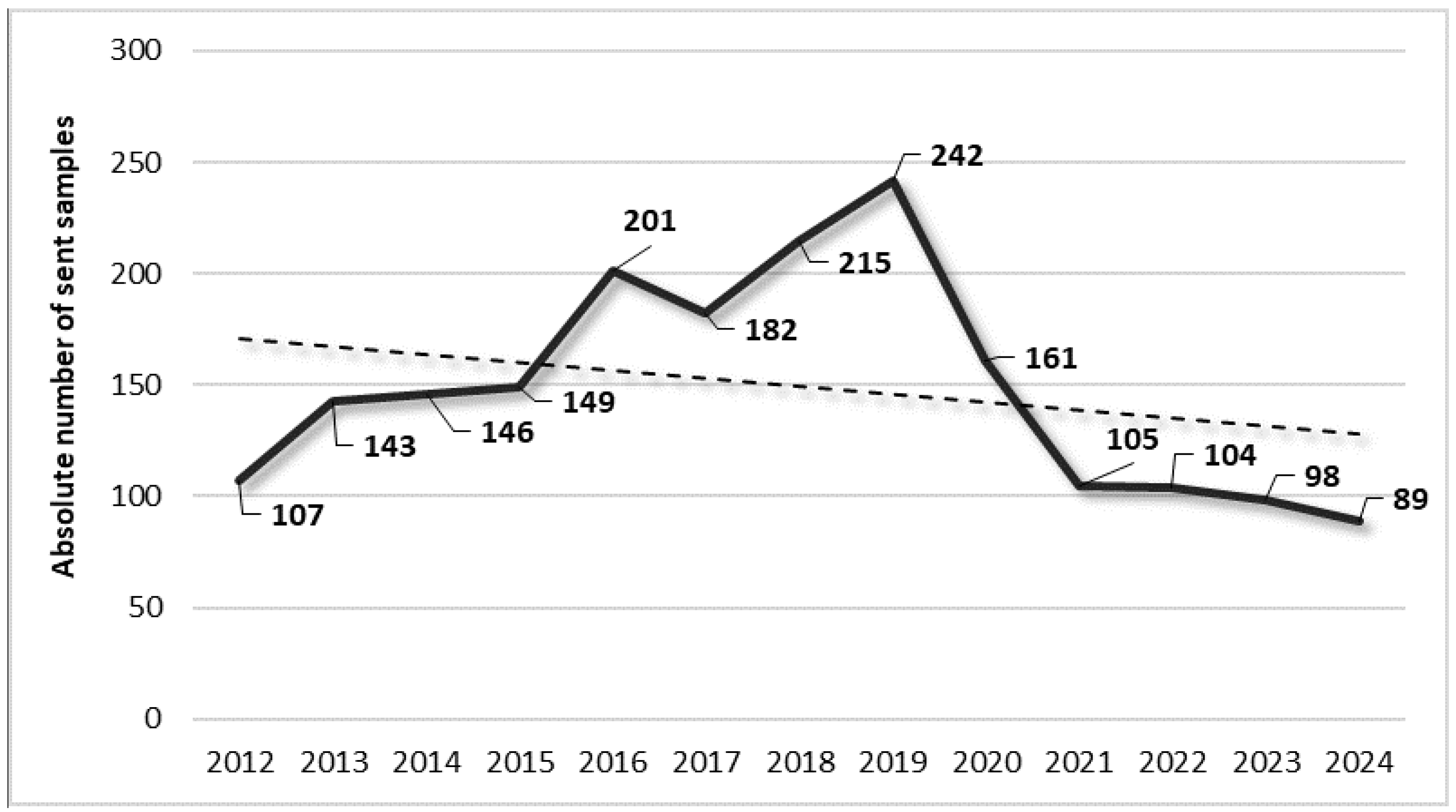
| Years | Total Sent Samples | Staphylococcus spp.-Positive Samples (%) |
|---|---|---|
| 2012 | 107 | 14 (13.1%) |
| 2013 | 143 | 15 (10.5%) |
| 2014 | 146 | 13 (8.9%) |
| 2015 | 149 | 9 (6.0%) |
| 2016 | 201 | 23 (11.4%) |
| 2017 | 182 | 19 (10.4%) |
| 2018 | 215 | 21 (9.8%) |
| 2019 | 242 | 36 (14.9%) |
| 2020 | 161 | 17 (10.6%) |
| 2021 | 105 | 11 (10.5%) |
| 2022 | 104 | 2 (1.9%) |
| 2023 | 98 | 7 (7.1%) |
| 2024 | 89 | 9 (10.1%) |
| TOT | 1942 | 196 (10.1%) |
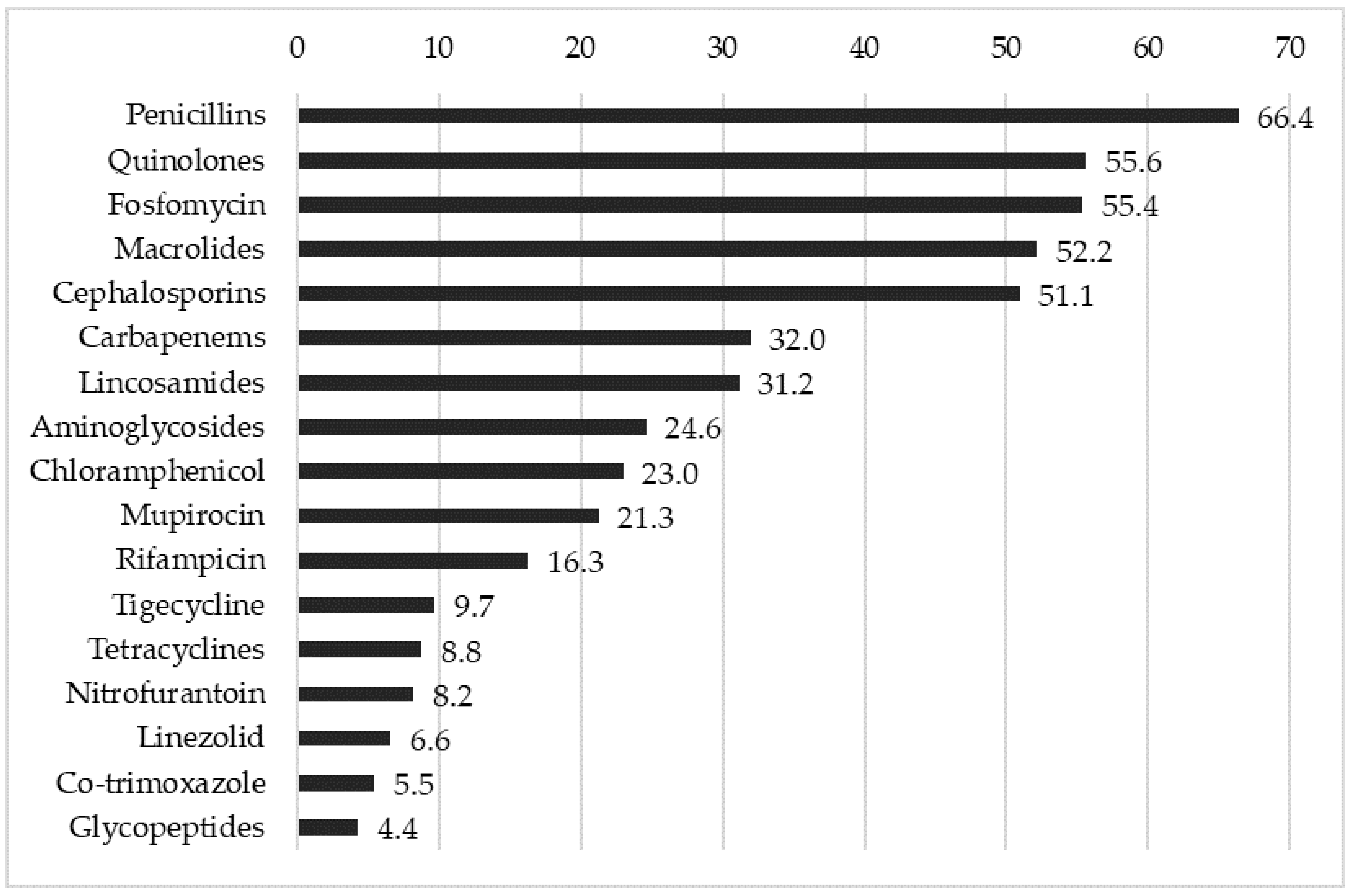
| PENICILLINS (66.4%) | Mean Percentage of Resistance |
|---|---|
| Benzylpenicillin (88.3%) | 88.3% |
Aminopenicillins:
| 74.5% |
Penicillinase-resistant:
| 74.8% |
Carboxypenicillins:
| 52.0% |
Ureidopenicillins:
| 41.9% |
| QUINOLONES (55.7%) | |
I gen. quinolones:
| 99.0% |
II gen. quinolones:
| 46.9% |
III gen. quinolones:
| 38.8% |
| CEPHALOSPORINS (51.0%) | |
I gen. cephalosporins:
| 54.7% |
II gen. cephalosporins:
| 43.9% |
III gen. cephalosporins:
| 56.0% |
| SSIs | Community Infections | Δ% | p-Value | |
|---|---|---|---|---|
| Aminoglycosides | 30.8 | 23.1 | 33.3 | ns |
| Carbapenems | 36.7 | 12.9 | 184.5 | <0.0001 |
| Cephalosporins | 61.3 | 44.9 | 36.6 | 0.0333 |
| Chloramphenicol | 23.1 | 22.9 | 0.9 | ns |
| Co-trimoxazole | 8.3 | 3.5 | 137.1 | ns |
| Fosfomycin | 60.5 | 54.1 | 11.8 | ns |
| Glycopeptides | 7.8 | 3.0 | 160.0 | ns |
| Lincosamides | 34.9 | 30.3 | 15.2 | ns |
| Linezolid | 7.7 | 2.0 | 285.0 | ns |
| Macrolides | 44.2 | 54.2 | −18.5 | ns |
| Mupirocin | 20.0 | 21.7 | −7.8 | ns |
| Nitrofurantoin | 7.7 | 8.3 | −7.2 | ns |
| Penicillins | 72.3 | 62.1 | 16.5 | ns |
| Quinolones | 49.6 | 55.1 | −10.1 | ns |
| Rifampicin | 20.5 | 15.3 | 34.0 | ns |
| Tetracyclines | 12.8 | 7.8 | 63.8 | ns |
| Tigecycline | 15.4 | 8.3 | 85.5 | ns |
| Average value | 31.6 | 26.6 | / | / |
Disclaimer/Publisher’s Note: The statements, opinions and data contained in all publications are solely those of the individual author(s) and contributor(s) and not of MDPI and/or the editor(s). MDPI and/or the editor(s) disclaim responsibility for any injury to people or property resulting from any ideas, methods, instructions or products referred to in the content. |
© 2025 by the authors. Licensee MDPI, Basel, Switzerland. This article is an open access article distributed under the terms and conditions of the Creative Commons Attribution (CC BY) license (https://creativecommons.org/licenses/by/4.0/).
Share and Cite
Facciolà, A.; Laganà, A.; Gioffrè, M.E.; Morabito, A.; Chiera, D.; Ferlazzo, M.; Laganà, P. Staphylococci: What Has Changed in the Antibiotic Resistance Profile in the Last Decade—Analysis of Strains Isolated from Hospitalised Patients. Pathogens 2025, 14, 1289. https://doi.org/10.3390/pathogens14121289
Facciolà A, Laganà A, Gioffrè ME, Morabito A, Chiera D, Ferlazzo M, Laganà P. Staphylococci: What Has Changed in the Antibiotic Resistance Profile in the Last Decade—Analysis of Strains Isolated from Hospitalised Patients. Pathogens. 2025; 14(12):1289. https://doi.org/10.3390/pathogens14121289
Chicago/Turabian StyleFacciolà, Alessio, Antonio Laganà, Maria Eufemia Gioffrè, Alessandro Morabito, Domenico Chiera, Marco Ferlazzo, and Pasqualina Laganà. 2025. "Staphylococci: What Has Changed in the Antibiotic Resistance Profile in the Last Decade—Analysis of Strains Isolated from Hospitalised Patients" Pathogens 14, no. 12: 1289. https://doi.org/10.3390/pathogens14121289
APA StyleFacciolà, A., Laganà, A., Gioffrè, M. E., Morabito, A., Chiera, D., Ferlazzo, M., & Laganà, P. (2025). Staphylococci: What Has Changed in the Antibiotic Resistance Profile in the Last Decade—Analysis of Strains Isolated from Hospitalised Patients. Pathogens, 14(12), 1289. https://doi.org/10.3390/pathogens14121289