


Tick-Borne Hemoparasites of Sheep: A Molecular Research in Turkey

 ,
,  ,
,  , ,
, ,  and
and 
Abstract
1. Introduction
2. Results
2.1. Overall Infection Rates
2.2. Co-Infections Detected in the Study
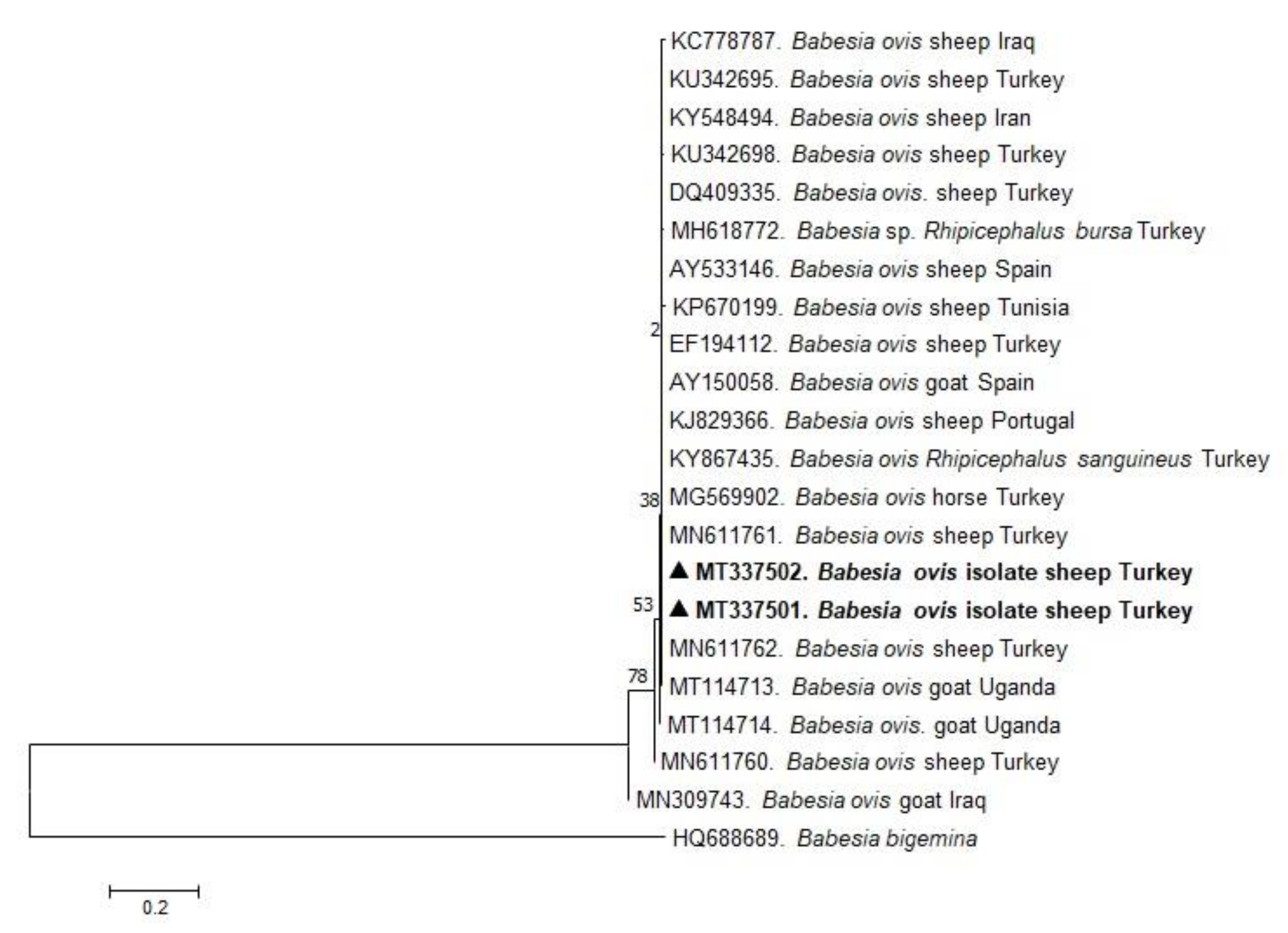
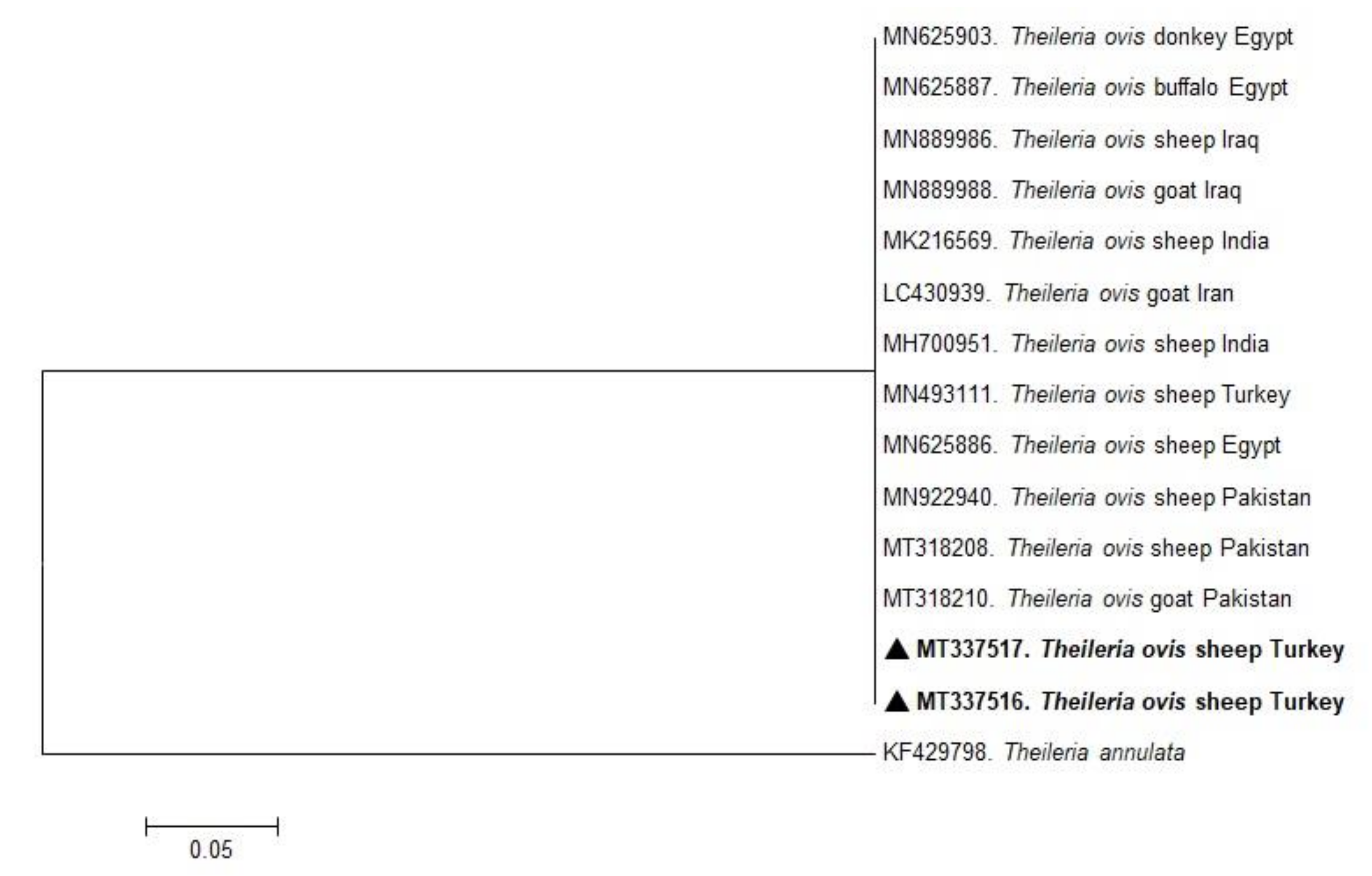
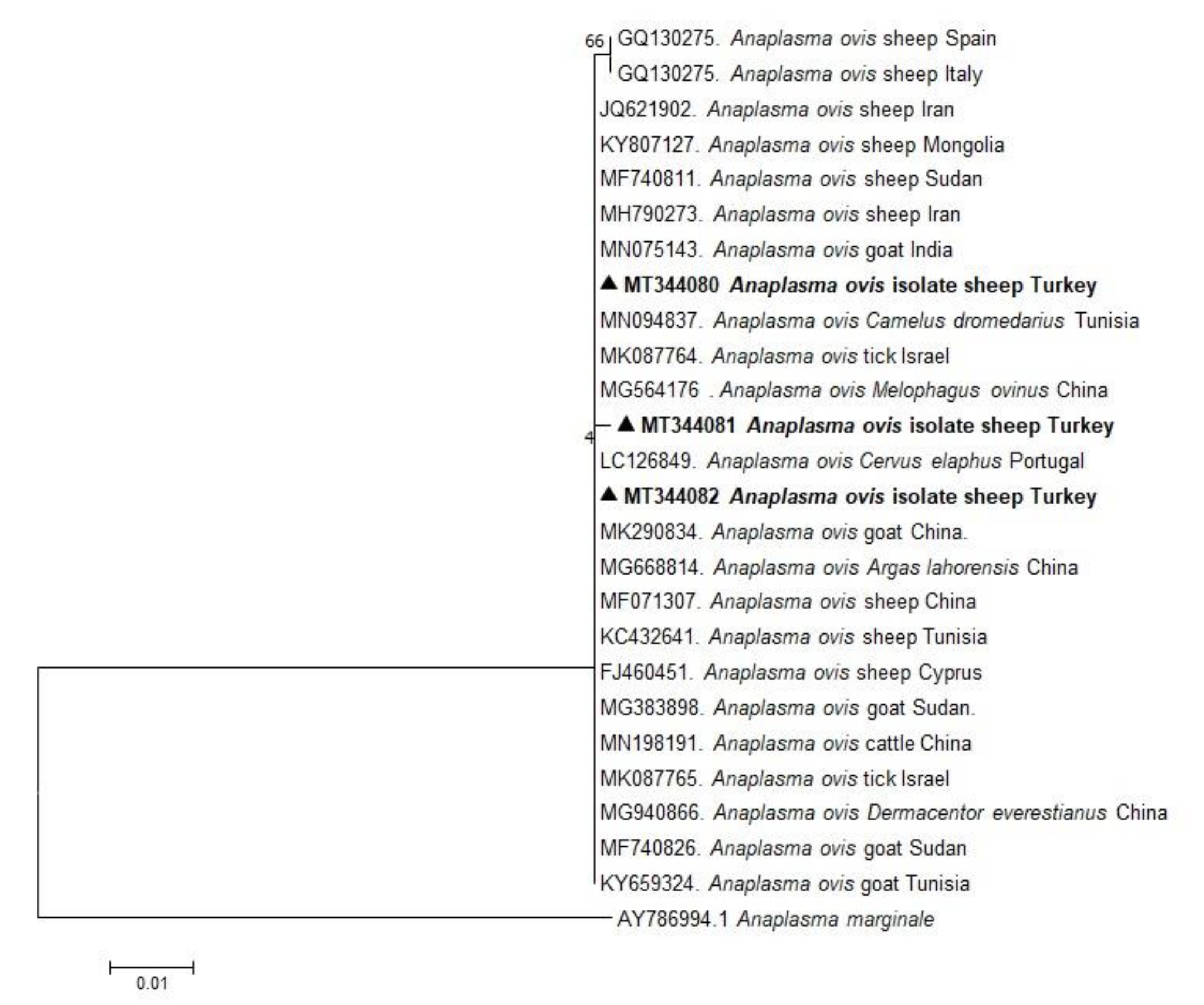
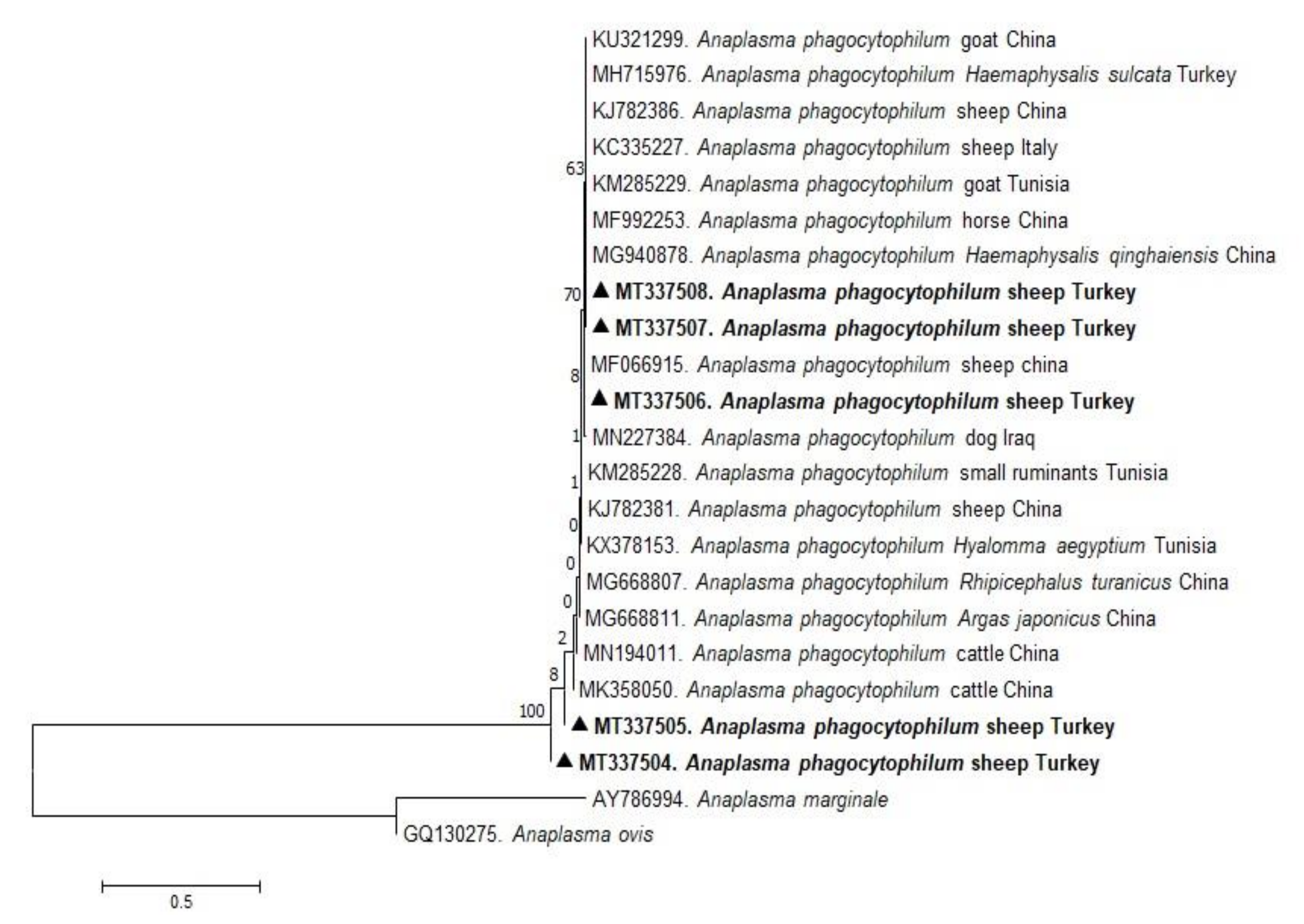
2.3. Phylogenetic Analysis
2.4. Statistical Analysis
3. Discussion
4. Materials and Methods
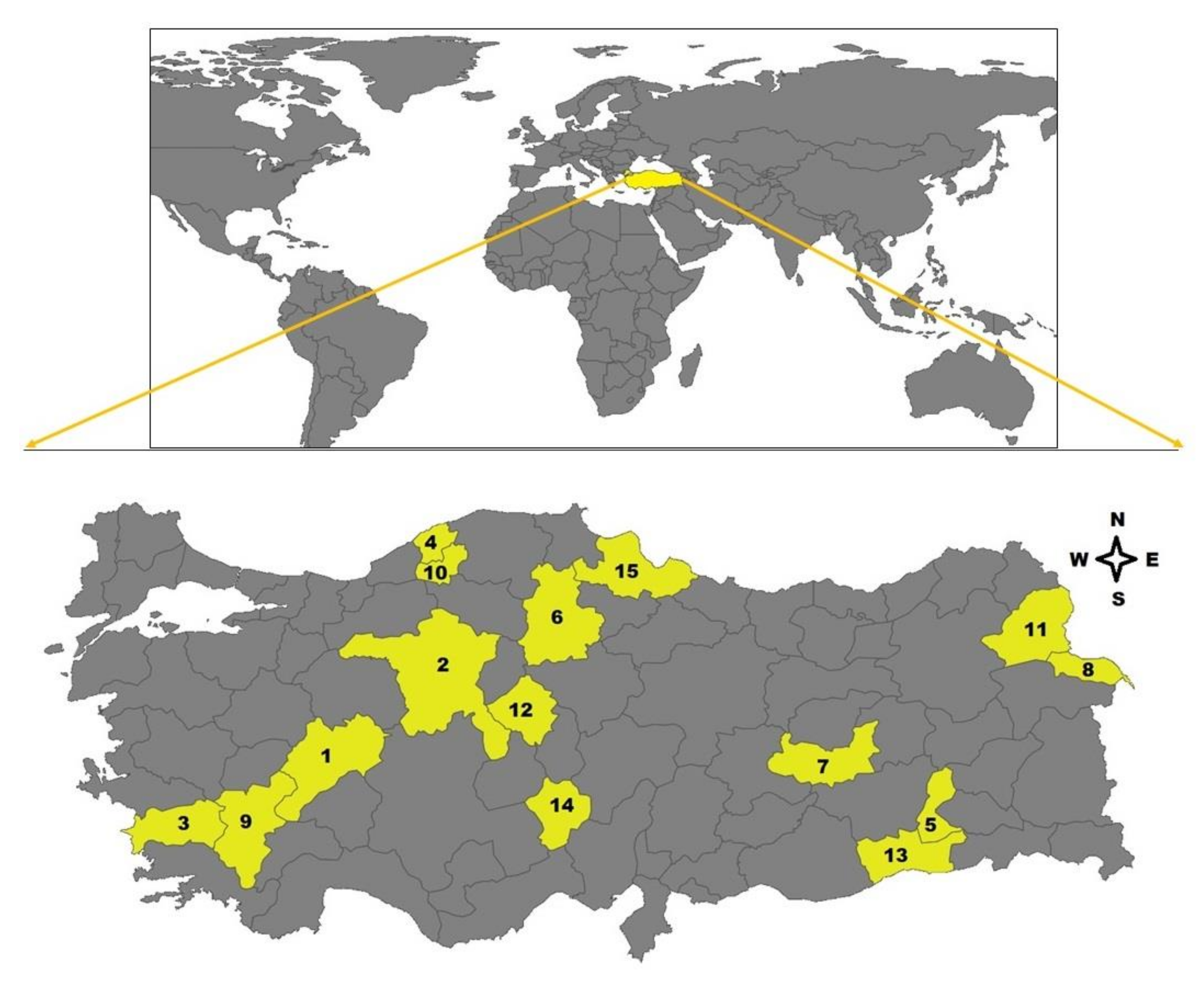
4.1. Study Areas and Sample Collection
4.2. DNA Extraction
4.3. Molecular Detection of Tick-Borne Pathogens
4.4. Cloning
4.5. Sequence Analysis
4.6. Phylogenetic Analysis
4.7. Ethical Statement
4.8. Statistical Analysis
Author Contributions
Funding
Informed Consent Statement
Data Availability Statement
Acknowledgments
Conflicts of Interest
References
- Uilenberg, G. International collaborative research: Significance of tick-borne hemoparasitic diseases to world animal health. Vet. Parasitol. 1995, 57, 19–41. [Google Scholar] [CrossRef] [Scilit]
- Sevinc, F.; Xuan, X. Major tick-borne parasitic diseases of animals: A frame of references in Turkey. Eurasian J. Vet. Sci. 2015, 31, 132–142. [Google Scholar] [CrossRef] [Scilit]
- Stuen, S.; Bergstrom, K.; Palmer, E. Reduced weight gain due to subclinical Anaplasma phagocytophilum (formerly Ehrlichia phagocytophila) infections. Exp. Appl. Acarol. 2002, 28, 209–215. [Google Scholar] [CrossRef] [Scilit]
- Garcia-Perez, A.L.; Barandika, J.; Oporto, B.; Povedano, I.; Juste, R.A. Anaplasma phagocytophila as an abortifacient agent in sheep farms from northern Spain. Ann. N. Y. Acad. Sci. 2003, 990, 429–432. [Google Scholar] [CrossRef] [Scilit] [PubMed]
- Stuen, S. Haemoparasites in small ruminants in European countries: Challenges and clinical relevance. Small Rumin. Res. 2016, 142, 22–27. [Google Scholar] [CrossRef] [Scilit]
- Aouadi, A.; Leulmi, H.; Boucheikhchoukh, M.; Benakhla, A.; Raoult, D.; Parola, P. Molecular evidence of tick-borne hemoprotozoan-parasites (Theileria ovis and Babesia ovis) and bacteria in ticks and blood from small ruminants in Northern Algeria. Comp. Immunol. Microbiol. Infect. Dis. 2017, 50, 34–39. [Google Scholar] [CrossRef] [Scilit] [PubMed]
- Oluwatayo, I.B.; Oluwatayo, T.B. Small ruminants as a source of financial security: A case study of woman in rural Southwest Nigeria. Inst. Money Technol. Financ. Incl. 2012, 2, 1–21. [Google Scholar]
- Turkısh Statistical Institute. Available online: http://www.turkstat.gov.tr/ (accessed on 27 February 2020).
- Sevinc, F.; Sevinc, M.; Ekici, O.D.; Yildiz, R.; Isik, N.; Aydogdu, U. Babesia ovis infections: Detailed clinical and laboratory observations in the pre- and post-treatment periods of 97 field cases. Vet. Parasitol. 2013, 191, 35–43. [Google Scholar] [CrossRef] [Scilit] [PubMed]
- Alessandra, T.; Santo, C. Tick-borne diseases in sheep and goats: Clinical and diagnostic aspects. Small Rumin. Res. 2012, 106S, S6–S11. [Google Scholar] [CrossRef] [Scilit]
- Sparagano, O.A.E.; Spitalska, E.; Namavari, M.; Torina, A.; Cannella, V.; Caracappa, S. Phylogenetics of Theileria species in small ruminants. Ann. N. Y. Acad. Sci. 2006, 1081, 505–508. [Google Scholar] [CrossRef] [Scilit]
- Razmi, G.; Pourhosseini, M.; Yaghfouri, S.; Rashidi, A.; Seidabadi, M. Molecular detection of Theileria spp. and Babesia spp. in sheep and ixodid ticks from the northeast of Iran. J. Parasitol. 2013, 99, 77–81. [Google Scholar] [CrossRef] [Scilit]
- Renneker, S.; Abdo, J.; Bakheit, M.A.; Kullmann, B.; Beyer, D.; Ahmed, J.; Seitzer, U. Co-infection of sheep with Anaplasma, Theileria and Babesia species in the Kurdistan region, Iraq. Transbound. Emerg. Dis. 2013, 60, 113–118. [Google Scholar] [CrossRef] [Scilit]
- Bilgic, H.B.; Bakirci, S.; Kose, O.; Unlu, A.H.; Hacilarlioglu, S.; Eren, H.; Weir, W.; Karagenc, T. Prevalence of tick-borne haemoparasites in small ruminants in Turkey and diagnostic sensitivity of single-PCR and RLB. Parasit. Vectors. 2017, 10, 211. [Google Scholar] [CrossRef] [Scilit]
- De la Fuente, J.; Atkinson, M.W.; Naranjo, V.; Fernandez de Mera, I.G.; Mangold, A.J.; Keating, K.A.; Kocan, K.M. Sequnce analysis of the msp4 gene of Anaplasma ovis strains. Vet. Microbiol. 2007, 119, 375–381. [Google Scholar] [CrossRef] [Scilit] [PubMed]
- Chochlakis, D.; Koliou, M.; Ioannou, I.; Tselentis, Y.; Psaroulaki, A. Kawasaki disease and Anaplasma sp. infection of an infant in Cyprus. Int. J. Infect. Dis. 2009, 13, e71–e73. [Google Scholar] [CrossRef] [Scilit]
- Chochlakis, D.; Ioannou, I.; Tselentis, Y.; Psaroulaki, A. Human anaplasmosis and Anaplasma ovis variant. Emerg. Infect. Dis. 2010, 16, 1031–1032. [Google Scholar] [CrossRef] [Scilit] [PubMed]
- Stuen, S. Tick-borne infections in small ruminants in northern Europe. Small Rumin. Res. 2013, 110, 142–144. [Google Scholar] [CrossRef] [Scilit]
- Stuen, S.; Granquist, E.G.; Silaghi, C. Anaplasma phagocytophilum- a widespread multi-host pathogen with highly adaptive strategies. Front. Cell. Infect. Microbiol. 2013, 3, 1–33. [Google Scholar] [CrossRef] [Scilit] [PubMed]
- Inci, A.; Ica, A.; Yildirim, A.; Duzlu, O. Identification of Babesia and Theileria species in small ruminants in Central Anatolia (Turkey) via reverse line blotting. Turk. J. Vet. Anim. Sci. 2010, 34, 205–210. [Google Scholar] [CrossRef] [Scilit]
- Ozubek, S.; Aktas, M. Molecular and parasitological survey of ovine piroplasmosis, including the first report of Theileria annulata (Apicomplexa: Theileridae) in sheep and goats from Turkey. J. Med. Entomol. 2017, 54, 212–220. [Google Scholar] [CrossRef] [Scilit]
- Zhou, M.; Cao, S.; Sevinc, F.; Sevinc, M.; Ceylan, O.; Ekici, S.; Jirapattharasate, C.; Moumouni, P.F.A.; Liu, M.; Wang, G.; et al. Molecular detection and genetic characterization of Babesia, Theileria and Anaplasma amongst apparently healthy sheep and goats in the central region of Turkey. Ticks Tick Borne Dis. 2017, 8, 246–252. [Google Scholar] [CrossRef] [Scilit]
- Sevinc, F.; Zhou, M.; Cao, S.; Ceylan, O.; Aydin, M.F.; Sevinc, M.; Xuan, X. Haemoparasitic agents associated with ovine babesiosis: A possible negative interaction between Babesia ovis and Theileria ovis. Vet. Parasitol. 2018, 252, 143–147. [Google Scholar] [CrossRef] [Scilit]
- Ringo, A.E.; Moumouni, P.F.A.; Taioe, M.; Jirapattharasate, C.; Liu, M.; Wang, G.; Gao, Y.; Guo, H.; Lee, S.; Zheng, W.; et al. Molecular analysis of tick-borne protozoan and rickettsial pathogens in small ruminants from two South African provinces. Parasitol. Int. 2018, 67, 144–149. [Google Scholar] [CrossRef] [Scilit]
- De la Fuente, J.; Estrada-Pena, A.; Venzal, J.M.; Kocan, K.M.; Sonenshine, D.E. Overview: Ticks as vectors of pathogens that cause disease in humans and animals. Front. Biosci. 2008, 13, 6938–6946. [Google Scholar] [CrossRef] [Scilit]
- Yin, H.; Schnittger, L.; Luo, J.; Seitzer, U.; Ahmed, J.S. Ovine theileriosis in China: A new look at an old story. Parasitol. Res. 2007, 101, S191–S195. [Google Scholar] [CrossRef] [Scilit] [PubMed]
- Bai, Q.; Liu, G.; Liu, D.; Ren, J.; Li, X. Isolation and preliminary characterization of a large Babesia sp. from sheep and goats in the eastern part of Gansu Province, China. Parasitol. Res. 2002, 88, S16–S21. [Google Scholar] [CrossRef] [Scilit] [PubMed]
- Uilenberg, G. Babesia—A historical overview. Vet. Parasitol. 2006, 138, 3–10. [Google Scholar] [CrossRef] [Scilit] [PubMed]
- Liu, A.H.; Yin, H.; Guan, G.Q.; Schnittger, L.; Liu, Z.J.; Ma, M.L.; Dang, Z.S.; Liu, J.L.; Ren, Q.Y.; Bai, Q.; et al. At least two genetically distinct large Babesia species infective to sheep and goats in China. Vet. Parasitol. 2007, 147, 246–251. [Google Scholar] [CrossRef] [Scilit]
- Ceylan, O.; Sevinc, F. Endemic instability of ovine babesiosis in Turkey: A country-wide sero-epidemiological study. Vet. Parasitol. 2020, 278, 109034. [Google Scholar] [CrossRef] [Scilit]
- Aydin, M.F.; Dumanli, N. Tick-borne pathogens in small ruminants in Turkey: A systematic review. Turk. Vet. J. 2019, 1, 74–83. [Google Scholar]
- Aktas, M.; Altay, K.; Dumanli, N. Development of a polymerase chain reaction method for diagnosis of Babesia ovis infection in sheep and goat. Vet. Parasitol. 2005, 133, 277–281. [Google Scholar] [CrossRef] [Scilit]
- Altay, K.; Dumanli, N.; Aktas, M. A study on ovine tick-borne hemoprotozoan parasites (Theileria and Babesia) in the East Black Sea Region of Turkey. Parasitol. Res. 2012, 111, 149–153. [Google Scholar] [CrossRef] [Scilit]
- Karatepe, B.; Ozubek, S.; Karatepe, M.; Aktas, M. Detection of Theileria and Babesia species in sheep and goats by microscopy and molecular methods in Nigde province, Turkey. Revue Med. Vet. 2019, 170, 136–143. [Google Scholar]
- Ahmed, J.; Yin, H.; Bakheit, M.; Liu, Z.; Mehlhorn, H.; Seitzer, U. Small ruminant theileriosis. In Progress in Parasitology; Mehlhorn, H., Ed.; Springer: Düsseldorf, Germany, 2011; Volume 2, pp. 135–154. [Google Scholar]
- Friedhoff, K.T. Tick-borne disease of sheep and goats caused by Babesia, Theileria or Anaplasma spp. Parassitologia 1997, 39, 99–109. [Google Scholar] [PubMed]
- Altay, K.; Dumanli, N.; Holman, P.J.; Aktas, M. Detection of Theileria ovis in naturally infected sheep by nested PCR. Vet. Parasitol. 2005, 127, 99–104. [Google Scholar] [CrossRef] [Scilit] [PubMed]
- Ringo, A.E.; Aboge, G.; Moumouni, P.F.A.; Lee, S.H.; Jirapattharasate, C.; Liu, M.; Gao, Y.; Guo, H.; Zheng, W.; Efstratiou, A.; et al. Molecular detection and genetic characterisation of pathogenic Theileria, Anaplasma and Ehrlichia species among apparently healthy sheep in central and western Kenya. Onderstepoort J. Vet. Res. 2019, 86, a1630. [Google Scholar] [CrossRef] [Scilit] [PubMed]
- Renneker, S.; Abdo, J.; Salih, D.E.A.; Karagenc, T.; Bilgic, H.; Torina, A.; Oliva, A.G.; Campos, J.; Kullmann, B.; Ahmed, J.; et al. Can Anaplasma ovis in small ruminants be neglected any longer? Transbound. Emerg. Dis. 2013, 60, 105–112. [Google Scholar] [CrossRef] [Scilit] [PubMed]
- Lbacha, H.A.; Alali, S.; Zouagui, Z.; El Mamoun, L.; Rhalem, A.; Petit, E.; Haddad, N.; Gandoin, C.; Boulouis, H.J.; Maillard, R. High prevalence of Anaplasma spp. in small ruminants in Morocco. Transbound. Emerg. Dis. 2017, 60, 250–263. [Google Scholar] [CrossRef] [Scilit]
- Altay, K.; Dumanli, N.; Aktas, M.; Ozubek, S. Survey of Anaplasma infections in small ruminants from east part of Turkey. Kafkas Univ. Vet. Fak. Derg. 2014, 20, 1–4. [Google Scholar] [CrossRef] [Scilit]
- Aktas, M.; Ozubek, S. Anaplasma ovis genetic diversity detected by major surface protein 1a and its prevalence in small ruminants. Vet. Microbiol. 2018, 217, 13–17. [Google Scholar] [CrossRef] [Scilit] [PubMed]
- Benedicto, B.; Ceylan, O.; Moumouni, P.F.A.; Lee, S.; Li, J.; Galon, E.M.; Liu, M.; Li, Y.; Ji, S.; Tumwebaze, M.A.; et al. Molecular detection and assessment of risk factors for tick-borne diseases in sheep and goats from Turkey. Acta Parasitol. 2020, 65, 723–732. [Google Scholar] [CrossRef] [Scilit]
- Oter, K.; Cetinkaya, H.; Vurusaner, C.; Toparlak, M.; Ergunay, K. Molecular detection and typing of Anaplasma species in small ruminants in Thrace Region of Turkey. Kafkas Univ. Vet. Fak. Derg. 2016, 22, 133–138. [Google Scholar] [CrossRef] [Scilit]
- Unver, A.; Sahin, M.; Erdogan, H.M.; Celebi, O. Investigation of antibodies against Anaplasma phagocytophilum in sheep by western blot analyses. Kafkas Univ. Vet. Fak. Derg. 2005, 11, 99–102. [Google Scholar]
- Gokce, H.I.; Genc, O.; Akca, A.; Vatansever, Z.; Unver, A.; Erdogan, H.M. Molecular and serological evidence of Anaplasma phagocytophilum infection of farm animals in the Black Sea Region of Turkey. Acta Vet. Hung. 2008, 56, 281–292. [Google Scholar] [CrossRef] [Scilit]
- Aktas, M.; Vatansever, Z.; Altay, K.; Aydin, M.F.; Dumanli, N. Molecular evidence for Anaplasma phagocytophilum in Ixodes ricinus from Turkey. Trans. R. Soc. Trop. Med. Hyg. 2010, 104, 10–15. [Google Scholar] [CrossRef] [Scilit] [PubMed]
- Aktas, M.; Altay, K.; Ozubek, S.; Dumanli, N. A survey of ixodid ticks feding on cattle and prevalence of tick-borne pathogens in the Black Sea region of Turkey. Vet. Parasitol. 2012, 187, 567–571. [Google Scholar] [CrossRef] [Scilit] [PubMed]
- Aktas, M. A survey of ixodid tick species and molecular identification of tick-borne pathogens. Vet. Parasitol. 2014, 200, 276–283. [Google Scholar] [CrossRef] [Scilit] [PubMed]
- Giangaspero, A.; Marangi, M.; Papini, R.; Paoletti, B.; Wijnveld, M.; Jongejan, F. Theileria sp. OT3 and other tick-borne pathogens in sheep and ticks in Italy: Molecular characterization and phylogeny. Ticks Tick Borne Dis. 2015, 6, 75–83. [Google Scholar] [CrossRef] [Scilit]
- Rjeibi, M.R.; Gharbi, M.; Mhadhbi, M.; Mabrouk, W.; Ayari, B.; Nasfi, I.; Jedidi, M.; Sassi, L.; Rekik, M.; Darghouth, M.A. Prevalence of piroplasms in small ruminants in North-West Tunisia and the first genetic characterisation of Babesia ovis in Africa. Parasite 2014, 21, 23. [Google Scholar] [CrossRef] [Scilit]
- Aktas, M.; Altay, K.; Dumanli, N. PCR-based detection of Theileria ovis in Rhipicephalus bursa adult ticks. Vet. Parasitol. 2006, 140, 259–263. [Google Scholar] [CrossRef] [Scilit]
- Kirvar, E.; Wilkie, G.; Katzer, F.; Brown, C.G.D. Theileria lestoquardi–maturation and quantification in Hyalomma anatolicum anatolicum ticks. Parasitology 1998, 117, 255–263. [Google Scholar] [CrossRef] [Scilit] [PubMed]
- Torina, A.; Agnone, A.; Blanda, V.; Alongi, A.; D’Agostino, R.; Caracappa, S.; de la Fuente, J. Development and validation of two PCR tests for the detection of and differentiation between Anaplasma ovis and Anaplasma marginale. Ticks Tick Borne Dis. 2012, 3, 283–287. [Google Scholar] [CrossRef] [Scilit]
- Barlough, J.E.; Madigan, J.E.; DeRock, E.; Dumler, J.S.; Bakken, J.S. Protection against Ehrlichia equi is conferred by prior infection with the human granulocytic ehrlichia (HGE agent). J. Clin. Microbiol. 1995, 33, 3333–3334. [Google Scholar] [CrossRef] [Scilit] [PubMed]
- Kawahara, M.; Rikihisa, Y.; Lin, Q.; Isogai, E.; Tahara, K.; Itagaki, A.; Hiramitsu, Y.; Tajima, T. Novel genetic variants of Anaplasma phagocytophilum, Anaplasma bovis, Anaplasma centrale, and a novel Ehrlichia sp. in wild deer and ticks on two major islands in Japan. Appl. Environ. Microbiol. 2006, 72, 1102–1109. [Google Scholar] [CrossRef] [Scilit] [PubMed]

| B. ovis | T. ovis | T. lestoquardi | A. ovis | A. phagocytophilum | |
|---|---|---|---|---|---|
| n/N/% | n/N/% | n/N/% | n/N/% | n/N/% | |
| Afyon | 0/20/0 | 13/20/65 | 0/20/0 | 1/20/5 | 12/20/60 |
| Ankara | 1/20/5 | 13/20/65 | 0/20/0 | 4/20/20 | 14/20/70 |
| Aydın | 0/20/0 | 9/20/45 | 0/20/0 | 2/20/10 | 10/20/50 |
| Bartın | 1/20/5 | 7/20/35 | 0/20/0 | 5/20/25 | 12/20/60 |
| Batman | 1/19/5.26 | 15/19/78.95 | 0/19/0 | 9/19/47.37 | 8/19/42.11 |
| Çorum | 1/20/5 | 9/20/45 | 0/20/0 | 2/20/10 | 15/20/75 |
| Elazığ | 0/20/0 | 8/20/40 | 0/20/0 | 0/20/0 | 14/20/70 |
| Iğdır | 0/20/0 | 1/20/5 | 0/20/0 | 2/20/10 | 7/20/35 |
| Isparta | 1/20/5 | 13/20/65 | 0/20/0 | 2/20/10 | 12/20/60 |
| Karabük | 0/20/0 | 5/20/25 | 0/20/0 | 3/20/15 | 15/20/75 |
| Kars | 0/20/0 | 1/20/5 | 0/20/0 | 1/20/5 | 10/20/50 |
| Kırşehir | 2/20/10 | 13/20/65 | 0/20/0 | 5/20/25 | 11/20/55 |
| Mardin | 0/20/0 | 12/20/60 | 0/20/0 | 7/20/35 | 14/20/70 |
| Niğde | 1/20/5 | 5/20/25 | 0/20/0 | 4/20/20 | 17/20/85 |
| Samsun | 0/20/0 | 0/20/0 | 0/20/0 | 1/20/5 | 0/20/0 |
| Total | 8/299/2.68 | 124/299/41.47 | 0/299/0 | 48/299/16.05 | 171/299/57.19 |
| Single Infections (n/%) | Dual Infections (n/%) | Triple Infections (n/%) | Quadruple Infections (n/%) | Total (n/%) | |||||||||||
|---|---|---|---|---|---|---|---|---|---|---|---|---|---|---|---|
| Bo | To | Tl | Ao | Ap | Bo + To | Bo + Ap | To + Ao | To + Ap | Ao + Ap | Bo + To + Ao | Bo + To + Ap | To + Ao + Ap | Bo + To + Ao + Ap | ||
| Afyon | - | 4/20 | - | - | 4/20 | - | - | 1/5 | 8/40 | - | - | - | - | - | 17/85 |
| Ankara | - | 3/15 | - | - | 4/20 | - | 1/5 | 1/5 | 6/30 | - | - | - | 3/15 | - | 18/90 |
| Aydın | - | 2/10 | - | - | 4/20 | - | - | 1/5 | 5/25 | - | - | - | 1/5 | - | 13/65 |
| Bartın | - | 1/5 | - | 1/5 | 5/25 | - | - | - | 3/15 | 1/5 | - | - | 2/10 | 1/5 | 14/70 |
| Batman | - | 5/26.3 | - | 3/15.8 | 1/5.3 | - | - | 3/15.8 | 3/15.8 | - | - | 1/5.3 | 3/15.8 | - | 19/100 |
| Çorum | - | - | - | - | 7/35 | - | - | 1/5 | 6/30 | - | - | 1/5 | 1/5 | - | 16/80 |
| Elazığ | - | 2/10 | - | - | 8/40 | - | - | - | 6/30 | - | - | - | - | - | 16/80 |
| Iğdır | - | - | - | 2/10 | 6/30 | - | - | - | 1/5 | - | - | - | - | - | 9/45 |
| Isparta | - | 3/15 | - | - | 4/20 | - | - | 1/5 | 8/40 | - | 1/5 | - | - | - | 17/85 |
| Karabük | - | 1/5 | - | - | 10/50 | - | - | - | 2/10 | 1/5 | - | - | 2/10 | - | 16/80 |
| Kars | - | - | - | 1/5 | 9/45 | - | - | - | 1/5 | - | - | - | - | - | 11/55 |
| Kırşehir | - | 2/10 | - | 1/5 | 2/10 | - | - | 1/5 | 7/35 | - | 1/5 | - | 1/5 | 1/5 | 16/80 |
| Mardin | - | 2/10 | - | 1/5 | 4/20 | - | - | - | 4/20 | - | - | - | 6/30 | - | 17/85 |
| Niğde | - | - | - | - | 14/70 | 1/5 | - | - | - | - | - | - | 4/20 | - | 19/95 |
| Samsun | - | - | - | 1/5 | - | - | - | - | - | - | - | - | - | - | 1/5 |
| Total | -/0 | 25/8.36 | -/0 | 10/3.34 | 82/27.42 | 1/0.33 | 1/0.33 | 9/3.01 | 60/20.07 | 2/0.67 | 2/0.67 | 2/0.67 | 23/7.69 | 2/0.67 | 219/73.24 |
| Niğde | Iğdır | Aydın | Mardin | Bartın | Kars | Samsun | Afyon | Elazığ | Karabük | Çorum | Ankara | Isparta | Kırşehir | Batman | Total | ||
|---|---|---|---|---|---|---|---|---|---|---|---|---|---|---|---|---|---|
| A. ovis | N | 16a,b,c,d | 18b,d,e | 18b,d,e | 13c,d | 15a,b,c,d | 19b,e | 19b,e | 19b,e | 20e | 17b,d,e | 18b,d,e | 16a,b,c,d | 18b,d,e | 15a,b,c,d | 10a,c | 251 |
| % | 80 | 90 | 90 | 65 | 75 | 95 | 95 | 95 | 100 | 85 | 90 | 80 | 90 | 75 | 52.6 | 83.9 | |
| P | 4a,b,c,d | 2b,d,e | 2b,d,e | 7c,d | 5a,b,c,d | 1b,e | 1b,e | 1b,e | 0e | 3b,d,e | 2b,d,e | 4a,b,c,d | 2b,d,e | 5a,b,c,d | 9a,c | 48 | |
| % | 20 | 10 | 10 | 35 | 25 | 5 | 5 | 5 | 0 | 15 | 10 | 20 | 10 | 25 | 47.4 | 16.1 | |
| A. phagocytophilum | N | 3a | 13b | 10b,c,d | 6a,c,d | 8a,b,c,d | 10b,c,d | 20e | 8a,b,c,d | 6a,c,d | 5a,d | 5a,d | 6a,c,d | 8a,b,c,d | 9b,c,d | 11b,c | 128 |
| % | 15 | 65 | 50 | 30 | 40 | 50 | 100 | 40 | 30 | 25 | 25 | 30 | 40 | 45 | 57.9 | 42.8 | |
| P | 17a | 7b | 10b,c,d | 14a,c,d | 12a,b,c,d | 10b,c,d | 0e | 12a,b,c,d | 14a,c,d | 15a,d | 15a,d | 14a,c,d | 12a,b,c,d | 11b,c,d | 8b,c | 171 | |
| % | 85 | 35 | 50 | 70 | 60 | 50 | 0 | 60 | 70 | 75 | 75 | 70 | 60 | 55 | 42.1 | 57.2 | |
| B. ovis | N | 19a | 20a | 20a | 20a | 19a | 20a | 20a | 20a | 20a | 20a | 19a | 19a | 19a | 18a | 18a | 291 |
| % | 95 | 100 | 100 | 100 | 95 | 100 | 100 | 100 | 100 | 100 | 95 | 95 | 95 | 90 | 94.7 | 97.3 | |
| P | 1a | 0a | 0a | 0a | 1a | 0a | 0a | 0a | 0a | 0a | 1a | 1a | 1a | 2a | 1a | 8 | |
| % | 5 | 0 | 0 | 0 | 5 | 0 | 0 | 0 | 0 | 0 | 5 | 5 | 5 | 10 | 5.3 | 2.7 | |
| T. ovis | N | 15a,b,c,d,e,f,g | 19f,g,h | 11d,e,i,j,k,l | 8k,l,m | 13c,e,i,j,k,l | 19b,g,h | 20h | 7j,l,m | 12a,c,d,e,i,j,k,l | 15a,b,c,d,e,f,g | 11a,c,d,e,i,j,k,l | 7i,j,k,l,m | 7i,j,k,l,m | 7i,j,k,l,m | 4m | 175 |
| % | 75 | 95 | 55 | 40 | 65 | 95 | 100 | 35 | 60 | 75 | 55 | 35 | 35 | 35 | 21.1 | 58.5 | |
| P | 5a,b,c,d,e,f,g | 1f,g,h | 9d,e,i,j,k,l | 12k,l,m | 7c,e,i,j,k,l | 1b,g,h | 0h | 13j,l,m | 8a,c,d,e,i,j,k,l | 5a,b,c,d,e,f,g | 9a,c,d,e,i,j,k,l | 13i,j,k,l,m | 13i,j,k,l,m | 13i,j,k,l,m | 15m | 124 | |
| % | 25 | 5 | 45 | 60 | 35 | 5 | 0 | 65 | 40 | 25 | 45 | 65 | 65 | 65 | 78.9 | 41.5 | |
| T. lestoquardi | N | 20a | 20a | 20a | 20a | 20a | 20a | 20a | 20a | 20a | 20a | 20a | 20a | 20a | 20a | 19a | 299 |
| % | 100 | 100 | 100 | 100 | 100 | 100 | 100 | 100 | 100 | 100 | 100 | 100 | 100 | 100 | 100 | 100 | |
| P | 0a | 0a | 0a | 0a | 0a | 0a | 0a | 0a | 0a | 0a | 0a | 0a | 0a | 0a | 0a | 0a | |
| % | 0 | 0 | 0 | 0 | 5 | 0 | 0 | 0 | 0 | 0 | 0 | 0 | 0 | 0 | 0 | 0 |
| Species | Target Gene | Primer Name | Primer Sequence (5′…′3) | Expected Size (bp) | Annealing Temperature (°C) | References |
|---|---|---|---|---|---|---|
| B. ovis | SSU rRNA | Bov F | TGGGCAGGACCTTGGTTCTTCT | 549 bp | 62 | Aktas et al. [32] |
| Bov R | CCGCGTAGCGCCGGCTAAATA | |||||
| T. ovis | SSU rRNA | TSsr 170-F | TCGAGACCTTCGGGT | 520 bp | 60 | Aktas et al. [52] |
| TSsr 670-R | TCCGGACATTGTAAAACAAA | |||||
| T. lestoquardi | 18S rRNA | T. lestoquardi F | GTGCCGCAAGTGAGTCA | 730 bp | 52 | Kirvar et al. [53] |
| T. lestoquardi R | GGACTGATGAGAAGACGATGAG | |||||
| A. ovis | MSP-4 | MSP-4-F | TGAAGGGAGCGGGGTCATGGG | 347 bp | 62 | Torina et al. [54] |
| MSP-4R | GAGTAATTGCAGCCAGGCACTCT | |||||
| A. phagocytophilum | 16S rRNA | EE1 | TCCTGGCTCAGAACGAACGCTGGCGGC | 1433 bp | 50 | Barlough et al. [55] |
| EE2 | AGTCACTGACCCAACCTTAAATGGCTG | |||||
| SSAp-F | GCT GAA TGT GGG GAT AAT TTA T | 641 bp | 55 | Kawahara et al. [56] | ||
| SSAp-R | ATG GCT GCT TCC TTT CGG TTA |
Publisher’s Note: MDPI stays neutral with regard to jurisdictional claims in published maps and institutional affiliations. |
© 2021 by the authors. Licensee MDPI, Basel, Switzerland. This article is an open access article distributed under the terms and conditions of the Creative Commons Attribution (CC BY) license (http://creativecommons.org/licenses/by/4.0/).
Share and Cite
Ceylan, O.; Byamukama, B.; Ceylan, C.; Galon, E.M.; Liu, M.; Masatani, T.; Xuan, X.; Sevinc, F. Tick-Borne Hemoparasites of Sheep: A Molecular Research in Turkey. Pathogens 2021, 10, 162. https://doi.org/10.3390/pathogens10020162
Ceylan O, Byamukama B, Ceylan C, Galon EM, Liu M, Masatani T, Xuan X, Sevinc F. Tick-Borne Hemoparasites of Sheep: A Molecular Research in Turkey. Pathogens. 2021; 10(2):162. https://doi.org/10.3390/pathogens10020162
Chicago/Turabian StyleCeylan, Onur, Benedicto Byamukama, Ceylan Ceylan, Eloiza May Galon, Mingming Liu, Tatsunori Masatani, Xuenan Xuan, and Ferda Sevinc. 2021. "Tick-Borne Hemoparasites of Sheep: A Molecular Research in Turkey" Pathogens 10, no. 2: 162. https://doi.org/10.3390/pathogens10020162
APA StyleCeylan, O., Byamukama, B., Ceylan, C., Galon, E. M., Liu, M., Masatani, T., Xuan, X., & Sevinc, F. (2021). Tick-Borne Hemoparasites of Sheep: A Molecular Research in Turkey. Pathogens, 10(2), 162. https://doi.org/10.3390/pathogens10020162

