1. Introduction
Digital transformation (DT) has become a central driver of change in public sector organizations, reshaping administrative routines, decision-making processes and the ways in which governments interact with citizens. These developments are simultaneously technical, institutional and social. Municipalities must interpret new expectations, adapt established practices and balance political mandates with limited resources (
Ciancarini et al. 2024;
Mergel et al. 2019). Many operate under demographic pressure, fragmented responsibilities and uneven administrative capacity, conditions that complicate the translation of national digital policies into coherent local strategies (
Oldenburg and Griesbaum 2022;
Schachtner 2025). Although legal frameworks such as Germany’s Online Access Act, Italy’s Stanca Act or France’s Law for a Digital Republic set formal requirements, implementation remains shaped by local histories, administrative cultures and institutional norms (
Lafioune et al. 2023;
Wagg and Simeonova 2022).
In this environment, digital technologies not only transform service delivery but also influence how institutional expectations, legitimacy concerns and professional values are negotiated in daily administrative practice. Existing qualitative instruments capture these dynamics only partially. Surveys and interviews often emphasize procedural or functional aspects and risk overlooking how practitioners understand institutional pressures in decentralized settings (
Eom and Lee 2022;
Peters et al. 2022). Focus groups provide richer opportunities for shared interpretation, yet many guides remain atheoretical or insufficiently attuned to the regulatory, peer-based and professional influences that shape DT processes (
Barbour 2018;
Gaston 2017;
Morgan 1997). As a result, there is a need for qualitative methods that support structured reflection and help practitioners articulate how institutional conditions shape digital change within their municipalities.
This study addresses this methodological gap by the development of a modular, theory-informed focus group instrument grounded in institutional theory. Institutional concepts were integrated into the instrument from the outset to enable reflection on legal mandates, peer expectations and professional norms. This grounding allows practitioners to discuss institutional influences in accessible terms while providing shared reference points for collective interpretation (
Reay and Jones 2016;
Stewart 2015). Action Design Research (ADR) provides the methodological foundation for this approach. Its cycles of exploration, adaptation and situated evaluation support iterative refinement and collaborative learning (
Sein et al. 2011). In public administration research, ADR offers a suitable framework for linking theoretical insights with practical inquiry and for addressing the socio-institutional complexity that characterizes DT (
Mullarkey and Hevner 2019;
Venable et al. 2016).
The paper demonstrates how institutional theory can inform the design of a qualitative research instrument and how practitioners engage with theory-based prompts during data generation. It shows how iterative refinement aligns conceptual clarity with contextual usability and how structured facilitation can enable reflexive engagement with institutional environments. In doing so, the study contributes to broader debates on how digital technologies reshape administrative practice and societal arrangements and responds to calls for approaches that acknowledge the institutional embeddedness of digital change (
Barata and Kayser 2023;
Kuhlmann and Heuberger 2023;
Patalon and Wyczisk 2024).
Further, this study contributes a design-science-based qualitative inquiry artifact for public-sector digital transformation: a modular focus group instrument that operationalizes institutional theory prospectively during data generation. The paper’s primary contribution is methodological and design-oriented. It consists of (1) the instantiated artifact as a qualitative empirically validated instrument including modular prompts and visual scaffolds that support structured institutional reflection, (2) an empirically documented versioning logic that links recurring interpretive breakdowns to concrete design revisions across Alpha and Beta cycles, (3) three transferable design principles (theory-driven modularity, reciprocal translation, and visual mediation) that can guide the development of similar qualitative instruments in governance domains characterized by institutional plurality, and (4) an extension of ADR’s Building, Intervention, Evaluation typology by theorizing an institutionally dominant mode of artifact evolution in legitimacy-sensitive governance contexts. Rather than producing substantive findings on municipal digital transformation itself, the study demonstrates how institutional theory can function as a kernel for qualitative instrument design through iterative, practice-embedded development.
The finalized artifact is referred to as the Modular Institutional Instrument (MII). Throughout the paper, we use MII or instrument to refer to the concrete focus group protocol and materials (prompts, visual scaffolds, facilitation procedures), while artifact denotes the comprehensive ADR design intervention including the theoretical framing, modular architecture, visual tools, versioning logic, and the reflective development process itself. The term guide is occasionally used when emphasizing the instrument’s facilitating function in participatory settings.
The remainder of the paper is structured as follows.
Section 2 outlines the institutional perspective that informs the design.
Section 3 details the ADR Methodology.
Section 4 focusses on the design and formalization process.
Section 5 discusses methodological and societal implications, followed by the conclusion.
2. Theoretical Background
Design-oriented research has generated a broad repertoire of approaches for developing artifacts in organizational environments. Among these, ADR has become particularly influential because it links artifact construction with intervention and evaluation in real-world contexts (
Sein et al. 2011). ADR has proven especially useful in socio-technical domains where technological change intersects with organizational routines, professional practices, and distributed authority (
Maccani et al. 2014;
Mullarkey and Hevner 2019;
Ahlemann et al. 2013).
At the same time, methodological reflections identify recurring difficulties in applying ADR. A central challenge concerns the translation of abstract theoretical constructs into forms that practitioners can meaningfully engage with. Researchers report tensions between rigor and accessibility and highlight the limited transferability of insights derived from highly situated development processes (
Haj-Bolouri et al. 2018).
Comparable problems are documented across digital government and collaborative innovation initiatives. Studies show that actors often struggle to connect governance models or reform programs with everyday administrative realities. Research on inter-organizational platforms and smart governance, for instance, points to persistent issues of interpretation and coordination (
Maccani et al. 2014;
Ahlemann et al. 2013). Similarly, work on participatory public sector innovation emphasizes that stakeholders frequently lack structured means for articulating how regulations, peer expectations, and professional norms shape their decisions (
Blomkamp 2022;
Söderström and Melin 2019).
These challenges are particularly visible in contexts such as inter-municipal cooperation, cross-departmental modernization, and multi-actor digital initiatives. Here, collaboration depends on making heterogeneous expectations discussable across professional and organizational boundaries. The literature therefore signals a recurring need for qualitative approaches that enable structured engagement with institutional conditions during interaction.
This requirement is not limited to municipal DT. Comparable situations arise in cross-border digital cooperation, public–private partnerships, and participatory governance settings, where actors must align divergent legitimacy claims and administrative traditions (
Maccani et al. 2014;
Ahlemann et al. 2013;
Blomkamp 2022). Across these domains, the difficulty lies less in initiating dialogue than in providing formats that render institutional influences visible and negotiable.
Taken together, prior research highlights a central methodological demand: design-oriented inquiry must enable participants to work with theoretical perspectives in practice rather than treating them as external analytical overlays. A perspective particularly suited to this purpose is institutional theory.
Institutional theory explains how organizations align with socially constructed expectations and how such alignment produces legitimacy (
Meyer and Rowan 1977;
Scott 2008). It emphasizes appropriateness, taken-for-granted assumptions, and culturally embedded templates that guide action. Institutional environments are structured by regulative, normative, and cognitive elements that define what is considered acceptable or responsible (
Scott 2008). In public administration, these mechanisms are especially pronounced. Legal mandates, professional norms, and public value expectations jointly shape how digital transformation is interpreted and enacted (
Kuhlmann and Heuberger 2023;
Mergel et al. 2019). Municipalities must translate national requirements into local practice under conditions of resource asymmetry, institutional plurality, and historically evolved routines (
Patalon and Wyczisk 2024).
Against this backdrop, institutional theory provides a suitable kernel for structuring qualitative inquiry into how actors perceive and negotiate digital change. It offers categories through which environmental pressures, legitimacy claims, and professional orientations can be articulated within participatory settings.
2.1. Field-Level Pressures: Institutional Isomorphism
A central strand of institutional theory examines how organizations align with environmental expectations.
DiMaggio and Powell (
1983) identify three forms of isomorphic pressure—coercive, mimetic and normative—that shape organizational behaviour. Coercive pressures include legal requirements such as the Online Access Act in Germany. Mimetic pressures arise under uncertainty when municipalities emulate perceived leaders. Normative pressures originate in professional standards, administrative education and shared occupational identities.
These pressures do not operate uniformly. Municipalities interpret and prioritize them through local histories, administrative cultures and resource distributions (
Mergel et al. 2019). As a result, DT goals are framed and enacted in divergent ways. This variation mirrors the governance challenges described in the Introduction, where demographic decline, fragmented responsibilities and uneven capacity shape how digital mandates are understood in practice. Understanding these field-level pressures provides an analytical basis for exploring how DT becomes embedded in different institutional contexts.
2.2. Interpretive Variation: Logics, Language and Agency
While isomorphic pressures highlight structural influences, complementary perspectives emphasize interpretive processes. The institutional logics perspective shows that public organizations draw on multiple belief systems—such as bureaucratic rule-following, managerial efficiency, community-oriented service or innovation-oriented governance—to justify decisions and prioritize issues (
Thornton et al. 2012). Institutional layering describes how new digital practices accumulate alongside established routines, often resulting in hybrid arrangements rather than the replacement of legacy structures (
Mahoney and Thelen 2012). Institutional work highlights how actors reproduce or challenge expectations through everyday practice (
Lawrence and Suddaby 2006). Discursive institutionalism draws attention to language and framing as mechanisms through which meanings are negotiated (
Schmidt 2008).
Together, these perspectives show that institutional dynamics are enacted rather than fixed. DT unfolds in settings where actors navigate overlapping logics, reconcile competing expectations and interpret digital technologies through locally meaningful categories. These dynamics become visible through interaction, making focus groups an appropriate method for examining how practitioners articulate assumptions and negotiate tensions (
Stewart 2015).
This interpretive complexity also has consequences for digital equity. Institutional dynamics can reproduce existing power asymmetries—for example, resource-rich municipalities can more easily align with normative expectations of ‘digital leadership,’ whereas under-resourced municipalities struggle with basic compliance. Making these dynamics explicit helps reveal how DT may inadvertently reinforce or mitigate existing inequalities. This aligns with critical perspectives arguing that digital change can reproduce social divides unless institutional conditions are taken into account (
Selwyn 2004;
van Dijk 2020). These considerations link the study to broader debates about how technology reshapes societal structures and public value.
2.3. Toward a Reflexive Design Logic for Qualitative Inquiry
The combination of isomorphic pressures, plural logics and interpretive agency provides a conceptual basis for designing qualitative instruments that support structured reflection. In this study, institutional theory was embedded into the architecture of the focus group guide from the outset. Coercive, mimetic and normative pressures shaped the modular structure and guided prompt organization. Insights from institutional logics informed questions that draw attention to competing priorities and underlying assumptions. Discursive institutionalism shaped the facilitation approach by foregrounding language, interpretive categories and meaning-making practices. Institutional work informed the guide’s attention to practitioner agency and micro-level negotiation.
Embedding these elements created a reflexive design logic that helps participants examine institutional influences in their own terms. This grounding ensures that the artifact functions not merely as a discussion tool but as an interpretive aid capable of supporting structured inquiry in heterogeneous governance environments. It positions institutional reflection as a necessary component of understanding how digital technologies affect administrative behavior, organizational culture and broader societal expectations.
2.4. Implications for Knowledge Infrastructures in Governance
Design-oriented applications of institutional theory respond to calls for reflexive and theory-informed knowledge tools in public sector innovation (
Blomkamp 2022;
Söderström and Melin 2019). Municipalities require settings that allow practitioners to articulate assumptions, surface institutional tensions and examine how digital initiatives relate to broader societal expectations. The focus group guide developed in this study contributes to such knowledge infrastructures by functioning as a boundary object that supports communication across professional roles and institutional backgrounds (
Star and Griesemer 1989).
The aim is not to simplify institutional theory but to translate its concepts into forms that are empirically discussable in participatory settings. This enhances conceptual coherence, strengthens interpretive depth and provides a shared structure for discussing the societal implications of DT. These methodological contributions also connect to broader debates on how digital technologies reshape values, practices and social arrangements, and how public sector organizations can respond to these shifts in equitable and reflexive ways.
4. Design Process
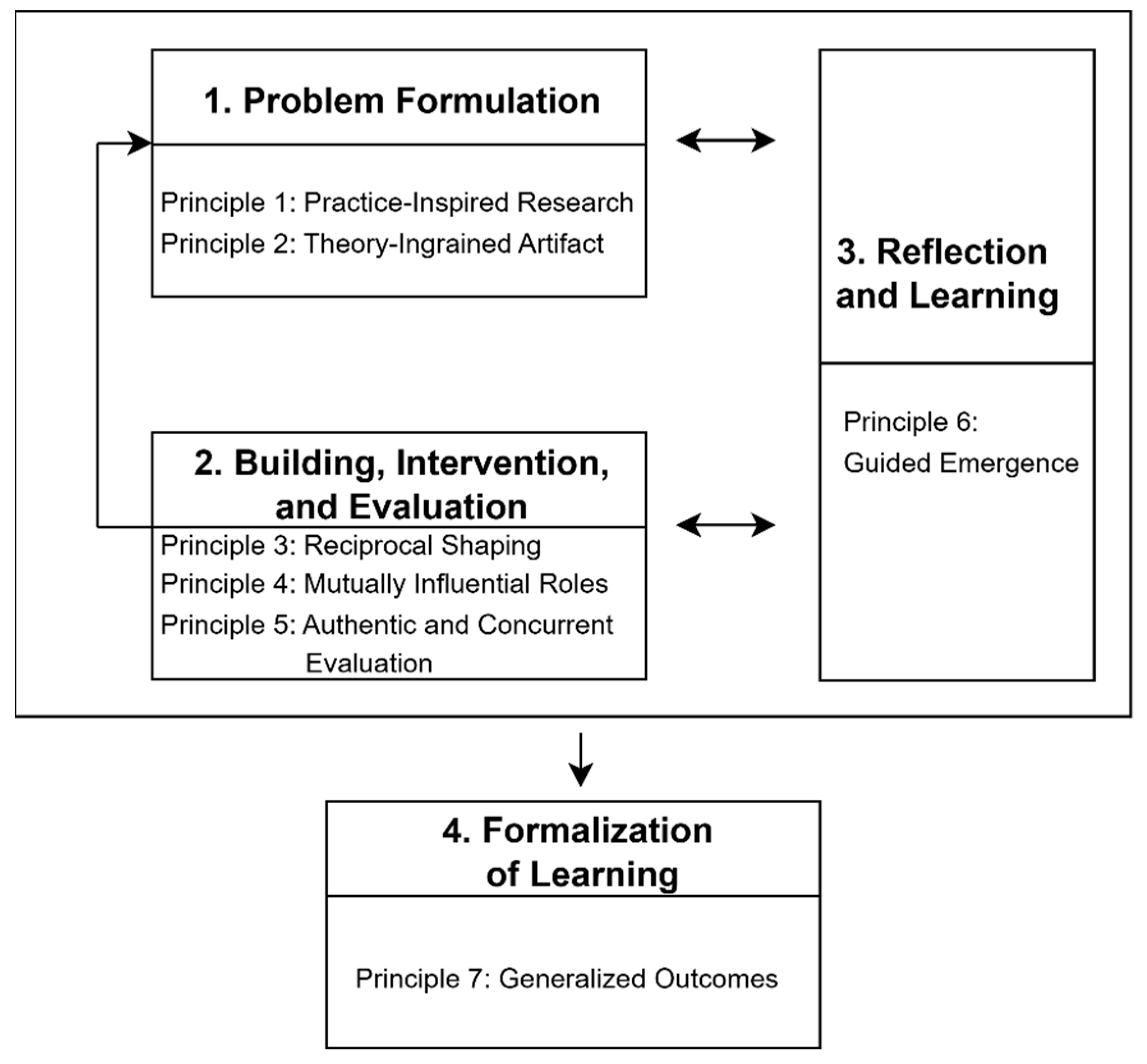
4.1. Stage 1: Problem Formulation
Stage 1 focused on clarifying the methodological challenge that motivated the development of the artifact. Existing focus group guides in public sector research often rely on standardized formats that reduce local variation or on open discussion formats that lack analytical structure (
Barbour 2018;
Roulston 2010). These limitations become particularly visible in municipal DT, where practitioners operate under resource constraints, diverse administrative routines and overlapping institutional expectations (
Wagg and Simeonova 2022). As a result, many qualitative instruments struggle to capture how institutional conditions shape everyday decisions about digital technologies.
The study therefore followed ADR’s principle of practice-inspired inquiry and began with a systematic exploration of the challenges identified by municipal actors. To support conceptual clarity, the study distinguishes between institutional influences and institutional dynamics. Institutional influences refer to the specific coercive, mimetic and normative pressures that act on municipalities at a given moment (
DiMaggio and Powell 1983). Institutional dynamics denote the processual ways in which these pressures are interpreted, negotiated and contested over time. While influences represent the forces applied to organizations, dynamics capture how these forces unfold in practice across roles, administrative cultures and historical trajectories.
Embedding these distinctions early in the design process ensured that the artifact addressed not only functional concerns but also the institutional environments in which DT is enacted. Collaborative workshops with practitioners provided the empirical basis for initial design assumptions. These workshops generated guiding questions on how institutional influences shape transformation efforts, how actor roles enable or constrain agency and how barriers and enablers manifest in daily work. They also made visible how discrete institutional influences accumulate into broader dynamics of adaptation, resistance and sensemaking.
The outcome of Stage 1 was a two-part design framework. The first component is a modular structure organized around coercive, mimetic and normative influences. The second component is a mapping logic that supports systematic exploration of actors, expectations and relationships across administrative domains. Together, these elements provided a conceptual foundation for the iterative Building, Intervention and Evaluation cycles in Stage 2 and ensured that the evolving artifact would be sensitive to the institutional plurality characteristic of municipal DT.
4.2. Stage 2: Building, Intervention and Evaluation
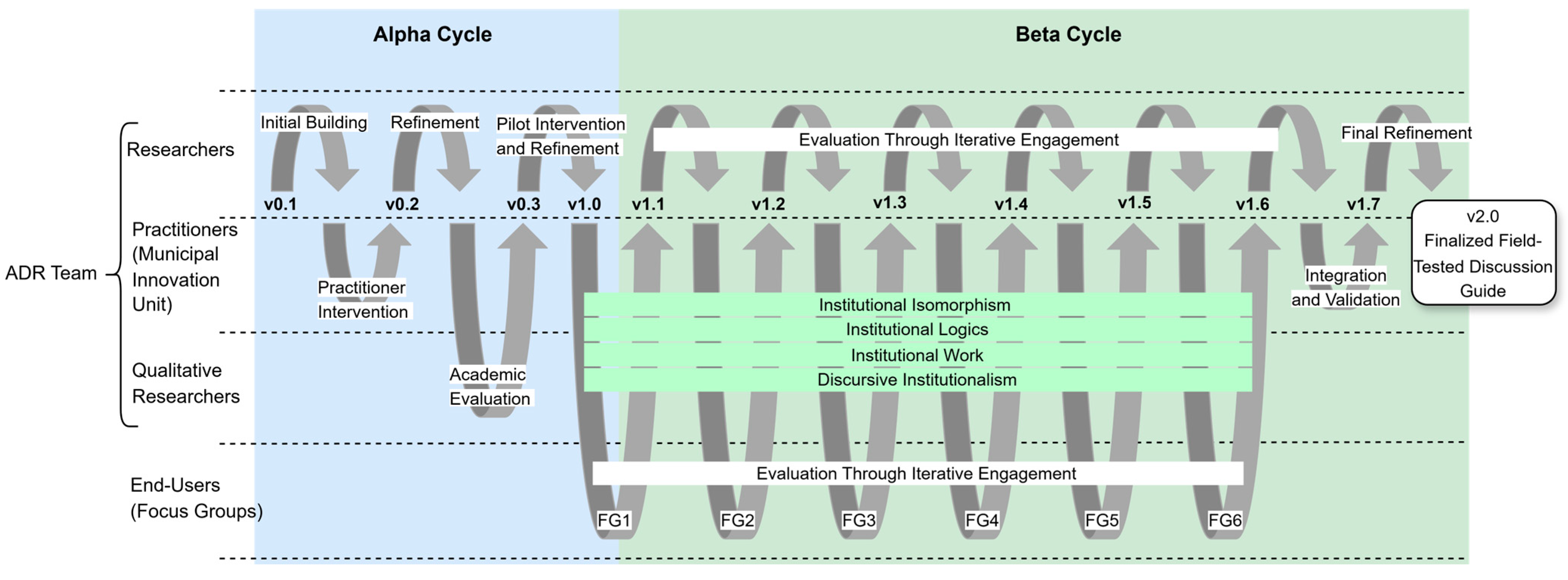
Stage 2 formed the core of the ADR process. As shown in
Figure 2, the artifact developed through an Alpha and a Beta cycle that operated as recursive learning loops rather than linear build-and-test sequences. Each cycle combined artifact construction, empirical engagement and iterative evaluation. The aim was to align theoretical grounding with contextual usability in settings characterized by institutional plurality and interpretive variation.
The ADR team consisted of two lead researchers, three practitioners from a municipal innovation unit (MIU) and three qualitative researchers. This interdisciplinary constellation enabled a participatory design approach and ensured that institutional concepts informed the artifact from the beginning. During the Beta cycle, the group of participants expanded to include chief digital officers, senior administrators, Smart City managers and project coordinators. Practitioners from the innovation unit shifted from co-design roles in the Alpha cycle to evaluative roles in the Beta cycle, creating reflective distance while maintaining continuity. This configuration reflected the institutionally shaped BIE logic described in the
Section 3.
Three ADR principles guided Stage 2. Reciprocal shaping captured how the artifact and its context influenced each other as theoretical assumptions encountered administrative practice. Mutually influential roles emphasized the distributed expertise of researchers and practitioners. Authentic and concurrent evaluation ensured that each focus group session functioned simultaneously as an intervention and an assessment.
Throughout Stage 2, the team used an internal versioning logic to document refinements to prompts, module sequencing and facilitation procedures. Rather than converging on a fixed design, the artifact followed a situated developmental trajectory in which conceptual clarity and contextual fit evolved through repeated use. The versioning logic is provided in
Appendix B to support methodological transparency and replicability.
4.2.1. Alpha Cycle
The Alpha cycle marked the first full implementation of Stage 2. It combined prototype construction with co-design and embedded evaluation. The initial prototype (v0.1) was developed by the lead researchers based on established focus group facilitation practices (
Krueger and Casey 2015;
Stewart 2015) and informed by institutional theory. It aimed to elicit practitioner perspectives across four domains: local understandings of DT, actor constellations, institutional influences and cross-cutting themes such as barriers and enablers.
Version v0.2 integrated feedback from a workshop with practitioners from the MIU. The workshop highlighted the need to reduce academic terminology—particularly references to mimetic and normative pressures—and prompted a shift toward practitioner-oriented wording without sacrificing conceptual precision. Version v0.3 underwent expert review by three qualitative researchers, whose feedback strengthened distinctions between institutional categories and improved analytical neutrality.
Version v1.0 was piloted with the innovation unit using visual scaffolds such as actor maps and modular card sets. Building and evaluation took place concurrently. When theoretical constructs proved difficult to interpret, they were immediately revised and retested. The Alpha cycle ended with an artifact that demonstrated conceptual coherence, interpretive accessibility and sufficient contextual usability to justify field-based evaluation.
4.2.2. Beta Cycle
The Beta cycle extended the BIE process into real municipal contexts. Six focus groups served as complete micro-cycles of BIE. Each session generated immediate insights into usability, interpretive clarity and contextual fit, fully consistent with ADR’s principle of authentic and concurrent evaluation.
Iterative engagement (v1.1–v1.6): Thirty participants from twenty-five municipalities engaged with the evolving artifact. The sample represented diverse organizational cultures, levels of digital maturity and professional backgrounds. Sessions took place in neutral university venues to minimize hierarchical dynamics and encourage open exchange. Facilitators used the MII together with visual tools that translated abstract institutional concepts into concrete administrative practice. To maintain reflective distance, practitioners involved in co-design did not participate in the early Beta sessions. This reduced potential bias and ensured that later refinements were grounded in the experiences of users who had not shaped earlier versions. Evaluation focused on whether the modules supported institutional reflection, surfaced implicit assumptions and revealed tensions across administrative units. Contributions from regional innovation actors and public–private partnership coordinators exposed the artifact to additional institutional logics and broadened its applicability across varied governance settings.
Integration and validation (v1.7): In the final iteration, the practitioners from the MIU rejoined the process to review cumulative refinements. Their assessment ensured that the artifact aligned with administrative routines while maintaining conceptual integrity. Their feedback informed version v2.0, which consolidated theoretical grounding, contextual adaptability and practical resonance.
Across these cycles, the MII evolved from a theory-driven prototype into a field-tested instrument capable of supporting institutional reflection and cross-role dialogue. Version v2.0 provided the foundation for formalizing the design knowledge captured in Stage 3 and Stage 4 of the ADR process.
4.3. Stage 3: Reflection and Learning
Stage 3 applied ADR’s principle of guided emergence and treated reflection as an ongoing process embedded in each use of the artifact. Municipal practitioners engaged with the MII in real time and interpreted institutional concepts through their administrative experience. Reflection therefore fulfilled both evaluative and developmental functions: it revealed how institutional expectations shaped interpretation and simultaneously informed the next iteration of the artifact.
Reflection drew on complementary data sources. Immediate debriefings documented interactional patterns and instances where institutional constructs required clarification. Transcript material and field notes captured recurring framings of institutional pressures, while short post-session surveys provided assessments of clarity, usability and interpretive accessibility. Together, these sources formed a cumulative evidence base that guided refinement during the Beta cycle.
The iterative adjustments that emerged from these insights focused on improving interpretive accessibility without reducing conceptual precision. When terminology appeared abstract, facilitators introduced contextual scaffolds that translated theoretical ideas into administrative language. These changes demonstrated reciprocal shaping: theoretical constructs informed the structure of the guide, while practitioner engagement influenced how these constructs were represented and applied.
4.3.1. Illustrating Iterative Refinement: A Prompt-Level Example
The systematic versioning protocol applied across all Alpha- and Beta-cycle iterations (see
Appendix B) generated multiple refinement patterns. The following example illustrates how practitioner feedback directly informed prompt refinement. In early Beta sessions (v1.2), mimetic and normative pressures were addressed through broadly framed prompts such as
“What influences your approach to digital transformation?” and
“Where do expectations come from?” During the third focus group, participants repeatedly conflated peer comparison with professional obligation, referring interchangeably to neighboring municipalities and professional norms. Field notes captured hesitation, divergent interpretations across administrative roles, and repeated requests for clarification, indicating deficiencies in both conceptual alignment (Criterion 1) and interpretive performance (Criterion 2).
In response, version v1.3 differentiated prompts more explicitly and adjusted the facilitation sequence to improve procedural clarity (Criterion 3). Mimetic pressures were addressed through comparative formulations such as “Which municipalities or projects do you look to as models when making digital decisions?”, whereas normative pressures were elicited through identity-oriented prompts including “What is considered proper or professional digital administration in your role?” These prompts were paired with clearer facilitator instructions on when to introduce the color-coded clustering cards (blue for driver, green for enabler or red for barriers), ensuring that visual scaffolds supported rather than obscured the conceptual distinction. This differentiation reduced facilitator intervention and enabled participants to articulate peer-oriented learning and professional expectations as distinct sources of influence.
Similar refinement patterns occurred across later iterations, where prompt wording, sequencing and visual scaffolds were adjusted in response to recurring interpretive difficulties. These prompt-level adjustments exemplify how institutional constructs were progressively translated into practitioner-accessible language through authentic and concurrent evaluation, demonstrating the interpretive engagement that characterizes the institutionally dominant mode of artifact development identified in this study.
4.3.2. Institutional Variation and Developmental Outcomes
Reflection also revealed marked variation in how municipalities experienced institutional influences. Coercive pressures were associated with mandates, compliance requirements and resource constraints, whereas mimetic and normative pressures were linked to peer benchmarking, regional cooperation structures, professional networks and local administrative cultures. This variation highlighted the interpretive flexibility of institutional environments and validated the need for a modular instrument capable of accommodating heterogeneous governance settings.
As Stage 3 progressed, it became evident that institutional expectations did not function merely as contextual background. They actively shaped how participants interpreted, appropriated and refined the artifact. Visual facilitation tools—such as mapping templates and clustering cards—became central for externalizing relationships between actors, pressures and expectations, thereby supporting cross-role interpretation. Adjustments in sequencing and terminology provided more accessible entry points into theoretical constructs and helped sustain engagement across diverse administrative profiles.
Stage 3 produced three outcomes:
First, the artifact achieved improved contextual fit as its modules increasingly reflected the institutional realities of municipal practice.
Second, the process generated deeper insight into how institutional pressures manifest in decentralized governance settings, especially where responsibilities are fragmented and legitimacy concerns are salient.
Third, interpretive engagement increased: participants articulated institutional tensions that extended beyond technical considerations and began to use the artifact as a resource for making sense of their own administrative environment.
These patterns indicated that institutional dynamics were beginning to shape the developmental trajectory of the artifact. This finding set the stage for the formalization of learning, where these situated insights were consolidated into transferable design knowledge.
4.4. Stage 4: Formalization of Learning
Stage 4 applied ADR’s principle of generalized outcomes and transformed the situated development of the artifact into transferable design knowledge. The aim was not to abstract isolated features but to identify the mechanisms through which institutional dynamics shaped the artifact’s evolution, interpretation and use. Focusing on recurring patterns across heterogeneous municipal settings ensured that the resulting design knowledge extends beyond the specific regional context and can inform methodological innovation in other governance domains. This approach strengthens the link between institutional theory and qualitative instrument design and positions the artifact within broader debates on how DT unfolds in legitimacy-sensitive and structurally diverse administrative environments.
4.4.1. The Formalized Artifact
The finalized MII (version 2.0) integrates the insights accumulated across six iterative ADR cycles. It operates both as a field-tested qualitative instrument and as a device for structured institutional reflection. Rather than prescribing a fixed protocol, the MII provides a flexible architecture that enables practitioners to explore DT in context.
To clarify the artifact’s architecture,
Table 1 outlines the five flexible phases that constitute the finalized MII, detailing their focus, and function.
The core of the artifact lies in its translation of institutional theory into practitioner-accessible language. This five-phase structure emerged through incremental refinement during the Alpha and Beta cycles. Abstract concepts are operationalized through specific prompts and visual tools that allow participants to externalize their environment.
Table 2 provides examples of how the theoretical constructs are converted into discussion prompts.
The prompts outlined in
Table 2 are embedded in a multimodal facilitation approach. To support the discursive process, the MII employs three primary visual scaffolds. First, a video provocation acts as a boundary object in Phase 2, presenting a stylized narrative of “overwhelmed administration” to legitimize the discussion of barriers. Second, collaborative clustering allows participants to physically group keywords (e.g., on a whiteboard), making the vague concept of DT tangible. Third, an interactive intensity map (used in Phase 3/4) enables the group to evaluate the administrative ecosystem on a metaplan board. Participants first assign actors to categories (drivers, barriers, enablers) and subsequently use a dot-voting technique—distributing a fixed budget of adhesive dots—to visually heat-map the perceived intensity of these influences. These multimodal tools help participants articulate assumptions and identify patterns.
The MII’s modular configuration supports adaptation to different group compositions while maintaining conceptual coherence across sessions. It does not offer prescriptive solutions; instead, it scaffolds structured inquiry by enabling practitioners to surface institutional tensions and examine the socio-institutional conditions that shape municipal DT. This capacity to facilitate reflective dialogue is central to the MII’s methodological value.
To clarify how the MII’s components relate to the underlying design logic,
Table 3 summarizes their alignment with the formalized design principles and indicates how their utility was demonstrated during iterative use.
4.4.2. Formalized Design Principles
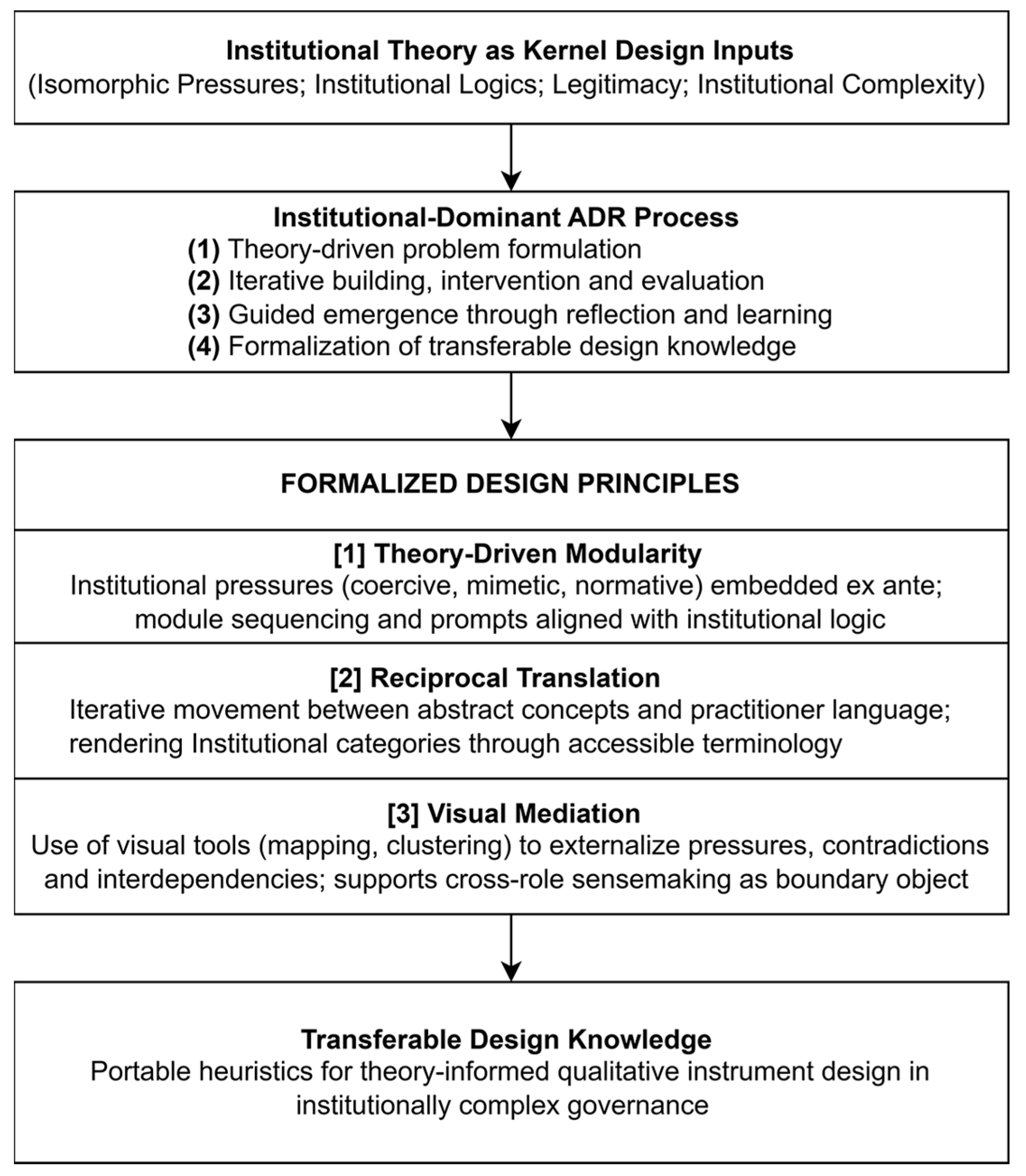
The formalization stage produced three design principles that capture how institutional theory shaped the artifact’s development.
Figure 3 summarizes these principles within the broader ADR process.
The first principle, theory-driven modularity, anchors the artifact in institutional constructs from the outset. Coercive, mimetic and normative pressures informed module sequencing, prompt formulation and the overall facilitation architecture. Embedding these pressures ex ante ensured that the guide reflected the institutional environments in which municipal DT unfolds and supported structured inquiry across heterogeneous administrative settings. This approach aligns with ADR’s emphasis on grounding artifacts in kernel theories and demonstrates how theoretical mechanisms can structure qualitative inquiry under conditions of interpretive variability.
The second principle, reciprocal translation, captures the iterative movement between abstract institutional concepts and practitioner language. Through successive reformulations, theoretical categories were made empirically accessible without compromising analytic precision. This translation enabled legitimacy concerns, symbolic expectations and professional norms to become discussable during data generation. It illustrates how design reasoning mediates between conceptual framing and lived administrative practice.
The third principle, visual mediation, operationalizes institutional complexity by enabling participants to externalize relationships, tensions and interdependencies. Mapping templates, clustering cards and related visual tools supported cross-role interpretation and facilitated shared meaning-making across diverse administrative logics. This multimodal scaffolding surfaced institutional dynamics that often remain implicit in everyday work.
Together, these principles form a portable and generative design logic. They show how institutional theory can guide the construction of qualitative instruments in governance environments characterized by fragmented responsibilities, plural logics and legitimacy-sensitive decision-making, and extend the repertoire of design reasoning available for inquiry in complex public sector contexts.
4.4.3. Theoretical and Methodological Contributions
The study offers several theoretical and methodological contributions. The artifact demonstrates that institutional theory can inform data generation prospectively by enabling practitioners to articulate institutional influences as part of the inquiry process. Across six iterative focus groups, participants used the MII to identify coercive, mimetic and normative pressures and to map how these pressures relate to actors, expectations and administrative routines. This pattern confirms that the artifact supports structured reflection in heterogeneous governance settings and assists practitioners in navigating institutional complexity.
The demonstrated utility of the MII forms the empirical basis for the design knowledge formalized in this study. The artifact encouraged interpretive engagement in each iteration and showed that institutional constructs can function as effective kernel theories for qualitative instrument design. The resulting design principles—theory-driven modularity, reciprocal translation and visual mediation—explain how theoretical mechanisms can be embedded in facilitation structures to strengthen practitioner understanding and enhance inquiry processes.
These principles provide mid-range design knowledge suitable for qualitative tools that must operate in environments shaped by diverse logics, distributed authority and legitimacy-sensitive decision-making. Methodologically, the study extends ADR by showing how artifact evolution unfolds when utility depends on interpretive alignment rather than technical optimization. This perspective broadens ADR’s methodological scope and positions it as a robust approach for developing inquiry tools in socio-institutional contexts where meaning, legitimacy and expectations are continuously negotiated.
4.4.4. Transferability and Future Applications
The design knowledge generated in this study is transferable because it is grounded in recurring patterns observed during use rather than tied to a single regional setting. Transferability does not require reproducing the MII in identical form. Instead, it emerges from applying the underlying design logic in governance environments where institutional plurality and distributed authority shape how DT is interpreted.
The three design principles offer practical heuristics for developing qualitative instruments in domains such as sustainability, inter-municipal cooperation or public health. Researchers in these fields can adapt the modular structure to local institutional mechanisms while retaining core features of structured reflection and shared interpretation. This adaptability allows the design logic to travel across administrative cultures with different legitimacy demands and coordination structures.
The principles show how theoretical framing, practitioner language and visual mediation can be combined to support sensemaking in complex institutional settings. They provide a foundation for constructing inquiry tools that help practitioners articulate assumptions, examine institutional pressures and reflect on the societal implications of technological change. Future research may build on this logic by developing new artifacts for public sector domains that exhibit similar challenges of interpretive variability and institutional uncertainty.
4.4.5. Open Science and Dissemination
The ADR process concludes with a dissemination strategy grounded in open science and co-creation. The finalized MII is publicly available via Zenodo under a Creative Commons license (
Patalon 2026). Dissemination activities draw on existing regional infrastructures and will include facilitator trainings, stakeholder workshops and practice-oriented materials, embedded within the Digitalise_SWF initiative in South Westphalia, a higher education–led regional collaboration that bundles digitalization expertise across institutions and engages municipalities, small and medium-sized enterprises, and societal actors to strengthen regional innovation capacity and support the transfer of research-based approaches to digital transformation in rural contexts.
For academic communities, the study provides a methodological reference supported by conference contributions and a methods-focused publication. For policy audiences, co-created explainers and demonstration materials offer accessible entry points for applying the design logic in practice. This approach strengthens the artifact’s role as a generative boundary object and contributes to methodological knowledge on theory-informed and context-sensitive instrument design.
5. Discussion
This study addresses a methodological gap in qualitative public sector research by showing how institutional theory can be embedded prospectively into artifact design through Action Design Research. Rather than generating substantive findings on municipal DT, the empirical work served as a series of evaluation episodes that provided situated feedback and supported iterative refinement in line with ADR’s principle of authentic and concurrent evaluation (
Sein et al. 2011;
Mullarkey and Hevner 2019). These episodes demonstrate that qualitative inquiry can inform design reasoning through real-time interaction rather than through retrospective interpretation alone (
Gregor and Hevner 2013;
Venable et al. 2016).
The results show that institutional theory can guide elicitation during data generation. Coercive, mimetic and normative pressure (
DiMaggio and Powell 1983), institutional work (
Lawrence and Suddaby 2006), institutional logics (
Thornton et al. 2012) and discursive institutionalism (
Schmidt 2008) were translated into prompts and visual scaffolds that supported accessible entry points into institutional reasoning. This translation enabled practitioners to express institutional dynamics as they emerge in everyday administrative practice. The approach aligns with interpretive strands of institutional theory that view legitimacy, expectations and meaning as enacted through interaction (
Reay and Jones 2016). The study shows that theory-informed prompting can support structured sensemaking by providing shared reference points for comparing interpretations and surfacing institutional tensions.
Across iterative cycles, institutional expectations shaped how participants engaged with and adapted the MII. These expectations functioned as developmental forces rather than background conditions. As a consequence, the evolution of the artifact cannot be explained through ADR’s distinction between IT-dominant and organization-dominant development alone (
Sein et al. 2011). Refinement was driven by interpretive engagement, legitimacy considerations, symbolic expectations and the need for cross-role alignment. These influences became visible through the recursive interaction between kernel theory, practitioner interpretation and the evolving guide.
Taken together, these patterns point to an emergent configuration of the BIE stage that can be described as institutionally dominant. This configuration differs from established ADR modes in three ways. First, institutional mechanisms—rather than technical or organizational demands—shaped development trajectories. Second, the MII functioned as a discursive boundary object (
Star and Griesemer 1989;
Ewenstein and Whyte 2009) that enabled participants to externalize tensions, compare expectations and articulate institutional assumptions. Third, interpretive alignment across heterogeneous administrative logics became a primary criterion for refinement. These features constitute a mode of artifact evolution in which institutional plurality and legitimacy-sensitive dynamics guide adaptation.
This configuration extends ADR methodologically. It shows that artifact development in governance settings must account for institutional complexity, symbolic pressures and interpretive variability. The findings also demonstrate how design-oriented qualitative inquiry can support environments marked by distributed authority, plural logics and contested meanings—conditions that define many contemporary public sector transformation processes. The study further contributes to research on reflexive knowledge infrastructures in public administration, where scholars highlight the importance of structured settings that support assumption surfacing, collective sensemaking and institutional reflexivity (
Blomkamp 2022;
Söderström and Melin 2019). The MII offers such a setting by enabling institutional reflection without prescribing solutions.
Overall, the study shows how institutional constructs can shape the architecture of a qualitative research instrument and how an institutionally dominant configuration of ADR can support design work in complex governance environments. The resulting design logic provides a basis for developing qualitative tools in contexts characterized by institutional plurality, fragmented responsibilities and evolving legitimacy demands—contexts that increasingly define DT in society.
5.1. Societal Implications and Digital Equity
The institutionally dominant mode of artifact development identified in this study has direct implications for digital equity and the societal distribution of digital public services. Municipalities interpret DT through distinct institutional lenses shaped by their resources, administrative cultures and professional networks. These differences can produce unequal capacities to respond to digital mandates and, in turn, uneven access to digital services. This aligns with
Barata and Kayser’s (
2023) observation that Industry 5.0 represents a shift from technology-driven to value-driven transformation, where institutional conditions fundamentally shape how digital technologies are adopted and given meaning. The MII developed in this study helps surface these variations by making institutional influences visible and discussable during collective inquiry.
This research indicates that coercive pressures are not experienced uniformly. Resource-constrained municipalities often perceive legal requirements as burdensome compliance obligations, while better-resourced municipalities interpret the same mandates as opportunities for strategic innovation. Mimetic and normative pressures similarly travel unevenly through local governance systems, reinforcing existing asymmetries when municipalities benchmark against peers whose conditions they cannot match. By enabling practitioners to articulate these differential experiences, the artifact supports a more accurate understanding of the pathways through which inequalities in digital service provision emerge.
This reflexive capacity aligns with broader calls for DT processes that prioritize inclusivity and consider how technological change intersects with existing social inequalities (
Eubanks 2018;
O’Neil 2016). The artifact therefore does more than structure qualitative inquiry: it provides a mechanism for institutional awareness that can inform more equitable policy design. By foregrounding how institutional conditions shape the adoption, use and meaning of digital technologies, the MII contributes to governance practices that are attentive to societal implications and better equipped to support fair and context-sensitive DT.
These equity concerns are reinforced by participation barriers that constrain institutional reflection in many DT processes. Information asymmetry between technical specialists and administrative generalists, limited opportunities for cross-role dialogue, and unequal access to legitimacy-conferring vocabularies can reduce participation quality and concentrate decision-making authority in narrow expert circles (
Mergel et al. 2019;
Wagg and Simeonova 2022). The artifact addresses these barriers by translating institutional theory into practitioner-accessible prompts and by employing visual scaffolds that externalize implicit relationships, enabling practitioners across administrative roles to articulate institutional concerns and contribute to collective sensemaking. This design logic demonstrates how ADR-based approaches can strengthen inclusive participation when interpretive pluralism and cross-role accessibility are foregrounded as design criteria. These considerations of equity and institutional awareness become even more critical as emerging technologies like artificial intelligence (AI) enter municipal administration
5.2. Future Horizons: AI Integration and Institutional Reflexivity
As AI becomes increasingly embedded in municipal administration—from automated triage in citizen services to predictive analytics in planning and resource allocation—the need for institutional reflexivity intensifies. The design principles developed in this study provide a foundation for examining how AI technologies intersect with existing institutional dynamics and how administrative actors negotiate the societal implications of algorithmic systems.
Future applications of the MII could integrate modules dedicated to algorithmic governance, automated decision-making and the legitimacy of AI-mediated processes in public service delivery. This is particularly important given that the acceptance of generative AI technologies is not guaranteed and depends on complex, often conditional determinants (
Kayser and Gradtke 2024). Such modules would help practitioners articulate how efficiency-oriented rationales for AI adoption interact with normative commitments to transparency, accountability and democratic oversight. Critical questions include how municipalities balance performance pressures with public value considerations, how institutional work is mobilized to sustain trust when algorithms shape administrative decisions and how practitioners interpret their roles in settings where digital systems increasingly mediate interactions with citizens.
The MII’s emphasis on visual mediation and cross-role dialogue offers a promising pathway for making the institutional implications of AI tangible and discussable. By externalizing assumptions, highlighting tensions and fostering shared interpretation, the guide can support structured reflection on issues such as algorithmic authority, data governance and citizens’ rights. These reflexive capacities are essential as municipalities navigate emerging forms of digital power and confront the social consequences of automated decision-making.
The institutionally dominant mode of artifact development identified in this study suggests that AI adoption in the public sector will not unfold as a purely technical process. Instead, it will be shaped by legitimacy concerns, professional norms and the negotiated meanings that administrators attach to algorithmic systems. Extending the MII to interrogate these dynamics can contribute to more responsible, equitable and context-sensitive approaches to AI-driven DT.
5.3. Practical and Theoretical Implications
The study offers several implications for research and practice at the intersection of technology, DT and society. On a practical level, the findings show that structured design cycles can support collaborative diagnosis, iterative learning and situated inquiry in governance settings marked by institutional ambiguity. The MII enables practitioners to examine how digital technologies intersect with legal mandates, professional norms and role expectations—an essential step, as many societal effects of DT arise from institutional negotiation rather than from technical innovation alone. Through its modular yet adaptable structure, the MII strengthens local learning processes, supports inclusive participation and provides a systematic but flexible format for reflection without imposing predefined solutions.
For managers and practitioners, the MII functions as a concrete tool for structuring dialogue under conditions of institutional plurality. It assists teams in articulating pressures associated with DT, surfacing implicit assumptions and identifying tensions across administrative roles. Because the MII emphasizes shared interpretation rather than prescriptive evaluation, it can inform strategic planning, capability development and the design of digital programs. By fostering coherent institutional understanding, it contributes to context-sensitive and equitable implementation of digital technologies in municipal settings.
The study also advances theoretical debates in institutional theory and design-oriented qualitative inquiry. It demonstrates that institutional mechanisms can be operationalized prospectively during data generation and that these mechanisms shape how digital technologies are interpreted and embedded in public organizations. The emergence of an institutionally dominant mode of artifact development highlights that institutional dynamics influence not only organizational responses to DT but also the methodological infrastructures used to study them. This insight broadens the repertoire of design science by showing that institutional constructs can function as kernel theories for qualitative artifacts. It also aligns with broader discussions on how DT reshapes social practices, values and structures, and how methodological innovation can support more reflexive engagement with these societal shifts.
5.4. Limitations and Further Research
The methodological contribution of this study is shaped by several limitations arising from its design-oriented and context-specific approach. The artifact was developed within a single regional governance environment. While this setting enabled authentic and concurrent evaluation, it limits transferability to administrative systems with different institutional cultures, resource configurations or coordination mechanisms. The empirical engagements functioned primarily as episodes of artifact maturation, rather than as a basis for systematic comparison. Consequently, the study cannot assess how institutional influences vary across municipalities, governance levels or national contexts. In addition, the development of the MII relied on interpretive engagement and reflexive dialogue—conditions that may be more difficult to sustain in environments that prioritize technical optimization, rapid prototyping or standardized testing, or in settings with limited organizational capacity for reflective inquiry.
These limitations open several avenues for future research that align with broader debates on DT. Applying the design logic in domains such as sustainability, public health or education may reveal how institutional constructs travel across policy fields shaped by distinct societal expectations, legitimacy regimes and equity concerns. Longitudinal studies could examine whether repeated use of the MII fosters institutional learning, stabilizes shared interpretations and supports more socially responsive transformation pathways. Comparative work across centralized, decentralized and networked administrative architectures may clarify how authority structures and governance arrangements influence the usefulness of the design principles and condition the interaction between digital technologies and institutional norms.
Future methodological research can also investigate how institutionally shaped modes of artifact development interact with participatory design approaches, developmental evaluation or emerging AI-supported qualitative methods. Such work can refine the conditions under which an institutionally dominant configuration is most effective and advance more reflexive, inclusive and societally aware inquiry in digitally transforming public sector environments.
6. Conclusions
This study developed and evaluated a modular, theory-informed focus group instrument—the Modular Institutional Instrument (MII)—through an ADR process. Iterative focus groups operated as evaluation episodes and generated situated feedback that supported continuous refinement. Across these cycles, institutional expectations shaped how practitioners interpreted and adapted the artifact, revealing a mode of artifact evolution that is institutionally rather than technically or organizationally dominant. This mode is especially relevant in governance settings where legitimacy, professional norms and distributed authority influence how DT unfolds.
The study contributes mid-range design knowledge grounded in an instantiated artifact. Three elements proved central: the modularization of coercive, mimetic and normative pressures; the translation between theoretical constructs and practitioner language; and the use of visual scaffolds as boundary objects that support cross-role dialogue. These elements were formalized as design principles that can guide the development of qualitative inquiry tools in legitimacy-sensitive and institutionally complex environments. The MII supported structured reflection during data generation and made institutional conditions visible in a clear and accessible way.
Although the study does not assess policy outcomes, it offers a transferable methodological approach that can inform inquiry in other public sector domains. Future research may adapt the design logic to examine how institutional mechanisms shape DT in areas such as sustainability, education or public health. The findings also demonstrate that institutional theory can serve as an effective kernel for qualitative instrument design, and that ADR provides a robust process for translating situated learning into reusable design knowledge. This approach gains additional relevance as emerging technologies such as artificial intelligence raise new questions about institutional legitimacy, algorithmic accountability and equitable service provision.
Overall, this research shows that theory-informed design can help public sector practitioners examine the societal and institutional conditions that shape DT and make these conditions empirically accessible for collective reflection.