1. Introduction
The incorporation of nanomaterials into cementitious systems has emerged as one of the most promising strategies to enhance the performance, durability, and sustainability of construction materials [
1]. Conventional cement mortars, despite their wide usage, are inherently limited by brittleness, low tensile and flexural strength, and vulnerability to chemical and environmental degradation [
2]. Nanotechnology offers a solution by refining the microstructure and influencing hydration reactions at the nanoscale [
3]. Among various nanomaterials, NS and NA have attracted substantial attention due to their unique physicochemical characteristics, compatibility with cement hydration products, and proven ability to improve both mechanical and durability properties [
4]. From a practical and economic standpoint, the selection of nano-silica and nano-alumina is also supported by their relatively high technological maturity and commercial availability compared with other emerging nanomaterials. Although their unit cost is higher than that of conventional supplementary cementitious materials, both NS and NA are typically incorporated at very low dosages (generally ≤3% by weight of cement), which significantly limits their overall cost contribution to the mix [
5]. Previous studies have indicated that the substantial gains in mechanical performance and durability achieved at such low addition levels can offset the higher material cost through extended service life and reduced maintenance requirements [
6,
7]. Therefore, NS and NA represent practical and performance-efficient options for cement mortar modification rather than bulk replacement materials.
Nano-silica is highly reactive owing to its amorphous structure and fine particle size, which enable it to act as both a pozzolanic additive and a micro-filler, leading to the formation of additional calcium silicate hydrate (C–S–H) gel that densifies the matrix and reduces porosity [
8,
9,
10]. In contrast, nano-alumina functions primarily as a nucleation site that accelerates early hydration and promotes the development of calcium aluminate hydrate (C–A–H) and calcium aluminosilicate hydrate (C–A–S–H) phases, enhancing early-age strength and long-term microstructural stability [
11,
12,
13]. Both nanomaterials are effective at low dosages, typically in the range of 1–3% for NS and 0.5–2% for NA, although excessive addition may cause agglomeration, loss of workability, and uneven particle dispersion [
14,
15]. As summarized in
Table 1, numerous studies have confirmed that NS and NA contribute to significant improvements in compressive and flexural strength, density, and durability while reducing sorptivity and chloride ion permeability. For example, Zhang et al. [
9] reported up to a 42% increase in compressive strength with 3% NS and optimum NA performance at 0.5%, while Andrade et al. [
10] observed a 158% rise in compressive strength and an 88% improvement in flexural strength at 3% NS. Similarly, Faez et al. [
13] recorded an 88% gain in compressive strength and a 45% reduction in water absorption with 2.5% NA, and Tsampali et al. [
12] found that NA additions between 1 and 3% reduced shrinkage and refined pore structure.
More recent works, such as those by Li et al. [
21] and Mousavi et al. [
25], emphasized the microstructural benefits of both nanoparticles, showing a 20–25% reduction in porosity and improved chloride penetration resistance. Although both NS and NA improve mechanical performance, NS generally exhibits stronger reactivity, promoting long-term pozzolanic activity and C–S–H formation, whereas NA enhances early hydration and microstructural nucleation, contributing to early-age strength development and long-term stability [
24,
26]. However, the addition of these nanoparticles also affects fresh-state flowability due to their high surface area and water demand; several authors, including Khorasani et al. [
17] and Mahmoudi [
27], reported reduced flow at dosages above 2%, while Zabihi & Ozkul [
8] suggested that optimized dispersion techniques or superplasticizers can mitigate this effect. Overall, the literature demonstrates that both NS and NA improve cement mortar performance through distinct but complementary mechanisms: NS enhances pozzolanic reactions and late-age strength, while NA accelerates hydration and contributes to matrix densification.
Despite the extensive body of literature on nano-silica- and nano-alumina-modified cement mortars, several gaps remain that limit direct comparison and practical implementation. Most existing studies investigate NS and NA independently or adopt different dosage ranges, mix proportions, curing regimes, and testing methodologies, which complicates the objective assessment of their relative efficiency and optimum content. Moreover, many studies focus primarily on mechanical performance without integrating durability indicators and statistical validation within a unified experimental framework. In this context, the novelty of the present work lies in the systematic and comparative evaluation of NS and NA at identical dosage levels (1%, 1.5%, and 2%) under strictly controlled mix design and curing conditions. By integrating fresh-state behavior, mechanical performance, durability-related transport properties, elemental composition (EDX), and two-factor statistical analysis, this study provides a clearer and statistically supported assessment of the performance mechanisms and efficiency of NS and NA, offering practical guidance for optimized nanomaterial selection in cement mortar applications.
2. Materials and Mix Design
This section describes the materials, mix design, sample preparation, and testing procedures adopted in this research. A total of seven mortar mixes were prepared to fulfill the objectives of the study. The mixtures consisted of Ordinary Portland Cement (OPC), standard sand, potable water, and two types of nanomaterials, NS and NA, each incorporated individually at addition levels of 1%, 1.5%, and 2% by weight of cement.
2.1. Cement
Ordinary Portland Cement (CEM I 42.5N), conforming to the requirements of ASTM C150/C150M–20, was used throughout the experimental program. The chemical composition and phase composition of the cement are presented in
Table 2, while its key physical properties are shown in
Table 3. The results indicate that the cement satisfies both Iraqi Standard Specification No. 5/2019 (IQS 5) and ASTM Type I limits. The high lime and silica contents suggest adequate formation of tricalcium silicate (C
3S) and dicalcium silicate (C
2S), which are essential for strength development, while moderate alumina and ferrite levels contribute to satisfactory workability and durability characteristics.
2.2. Fine Aggregate
Natural standard sand was used as the fine aggregate in all mortar mixtures. The sand met the grading requirements of ASTM C33, with a particle size distribution summarized in
Table 4, and its physical and chemical properties are presented in
Table 5. The sand exhibited a fineness modulus of 2.9, indicating a well-graded profile suitable for mortar applications, and contained low levels of chlorides and sulfates, ensuring compatibility with the cement matrix.
2.3. Water
Potable tap water was used for all mixes. The water had a neutral pH of 7.0, a chloride concentration of 0.04%, and a sulfate content of 0.08%, all within acceptable limits specified for concrete and mortar production. The use of clean, neutral water ensured that no external impurities affected the hydration process or the interaction of nanomaterials with cementitious compounds.
2.4. Nanomaterials
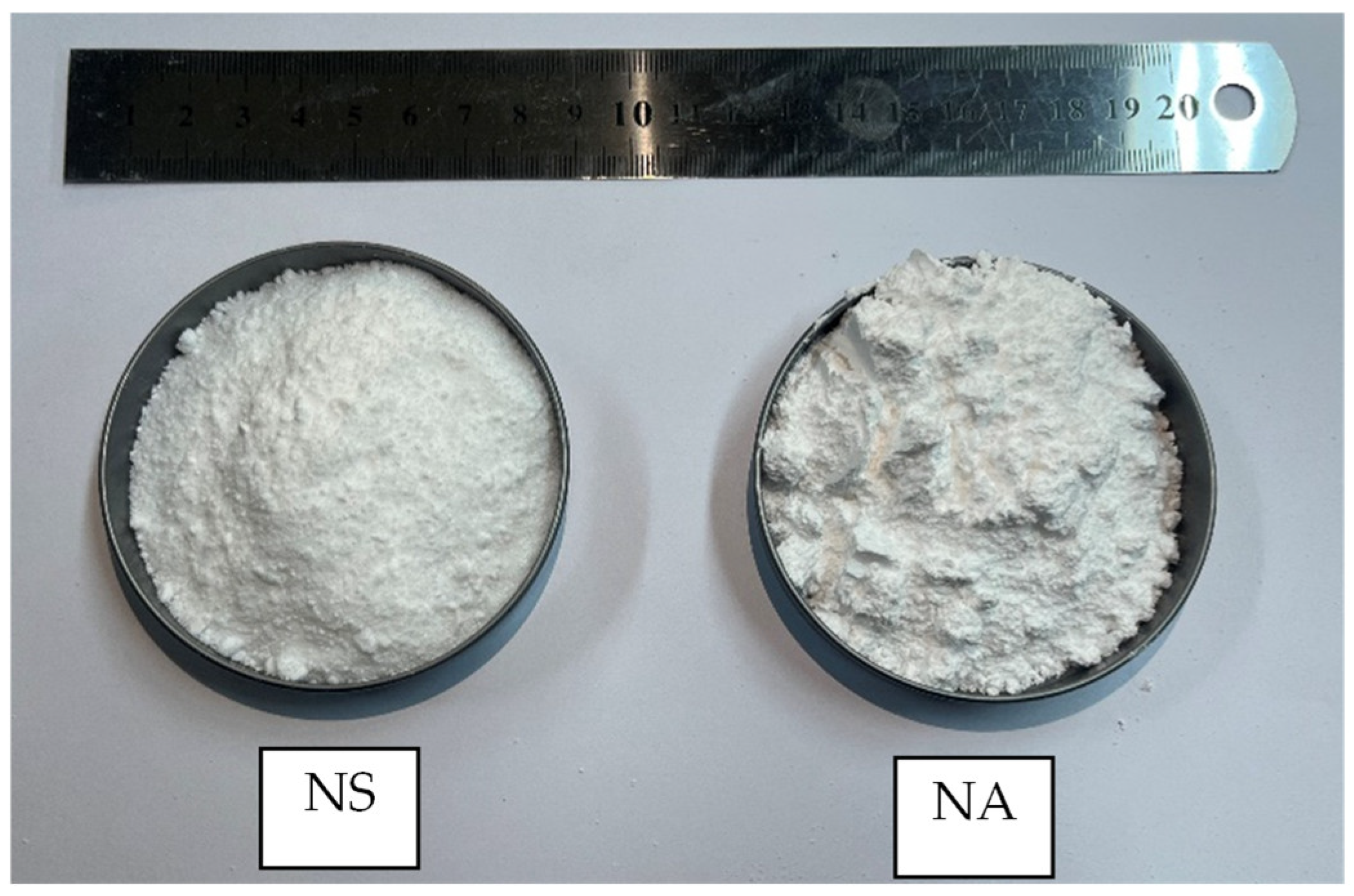
The nanomaterials used in this study were NS and NA, both of which were commercially procured from Hebei Suoyi New Material Technology Co., Ltd., Handan City, China. Their physical appearance is shown in
Figure 1, while their main physical and chemical properties are summarized in
Table 6. Both nanomaterials were supplied as high-purity white powders, with particle sizes ranging between 10 and 35 nm and purities exceeding 99.8%. The nano-silica possessed a lower bulk density (0.08 g/mL) and a higher specific surface area (190–250 m
2/g) compared to nano-alumina, which exhibited a density of 0.20 g/mL and a surface area of 120–160 m
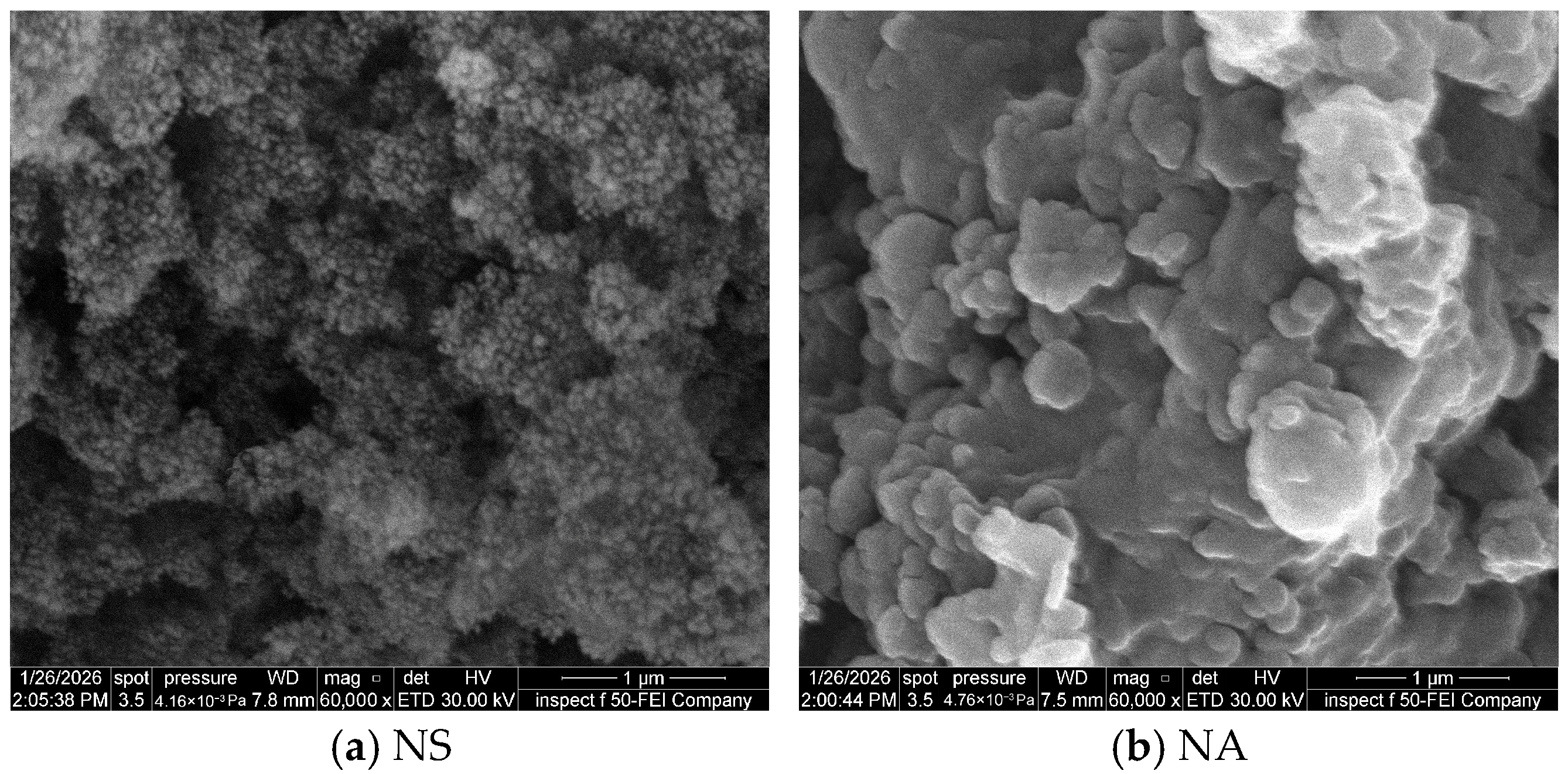
2/g. These intrinsic differences influenced their dispersion behavior and agglomeration tendency. The microstructural features of both nanomaterials, as revealed by scanning electron microscopy at magnification level 60k× (SEM) in
Figure 2, further highlight these distinctions. The SEM micrographs obtained at a magnification of 60,000× (
Figure 2) provide further insight into the morphological characteristics of the nanomaterials. Nano-silica (
Figure 2a) appears as densely agglomerated clusters composed of extremely fine primary particles, forming a porous and highly interconnected structure. This pronounced agglomeration is attributed to the very low bulk density and high specific surface area of nano-silica, which promote strong interparticle interactions and van der Waals forces. In contrast, nano-alumina (
Figure 2b) exhibits relatively more compact and plate-like or granular particle agglomerates with smoother surfaces and reduced agglomeration intensity. This behavior is consistent with its higher density and comparatively lower specific surface area, which limit particle–particle attraction. Each nanomaterial was incorporated individually into the mortar mixtures at addition levels of 1%, 1.5%, and 2% by weight of cement to assess their influence on the mechanical and durability performance of cement mortar.
2.5. Mixing and Curing Procedures
The mixing and curing procedures adopted in this study followed the requirements of ASTM C109/C109M, Standard Test Method for Compressive Strength of Hydraulic Cement Mortars. All mortar mixtures were prepared using a binder-to-sand ratio of 1:2.75 by weight and a water-to-cement ratio (w/c) of 0.50. A total of seven mortar mixes were produced: one control mix without any nanomaterial, three mixes containing NS at 1%, 1.5%, and 2%, and three mixes containing NA at the same dosage levels, all expressed as a percentage of cement weight. Prior to mixing, each nanomaterial was dispersed in 500 mL of water using a high-speed shear mixer operating at 4000 rpm for 15 min at room temperature (20–25 °C) to achieve a uniform suspension and minimize agglomeration. The use of high-speed shear mixing was selected in place of chemical superplasticizers to avoid introducing additional variables that could interfere with cement hydration, nanoparticle–cement interactions, and durability-related measurements, thereby allowing the isolated effects of nano-silica and nano-alumina to be systematically evaluated. The dry constituents cement and standard sand were first blended in a mechanical mixer for two minutes to obtain a homogeneous mixture. The nanomaterial–water suspension was then gradually introduced into the dry mix, followed by the remainder of the mixing water, and mixing continued at low speed until a uniform and workable mortar was obtained.
The flowability of the fresh mortar was evaluated using the flow table test according to ASTM C1437, and the water content was maintained constantly across all mixtures. After confirming the desired consistency, the mortar was placed into clean, lightly oiled molds, compacted in two layers, and the surface was leveled with a trowel. The specimens were covered with a plastic sheet to prevent moisture loss and demolded after 24 ± 2 h, then cured in water at room temperature (23–25 °C) until the designated testing ages of 7, 14, and 28 days. This procedure ensured uniform nanoparticle dispersion, consistent mixing energy, and stable curing conditions, thereby enabling reliable evaluation of the mechanical and durability properties of the modified cement mortars.
3. Testing Program
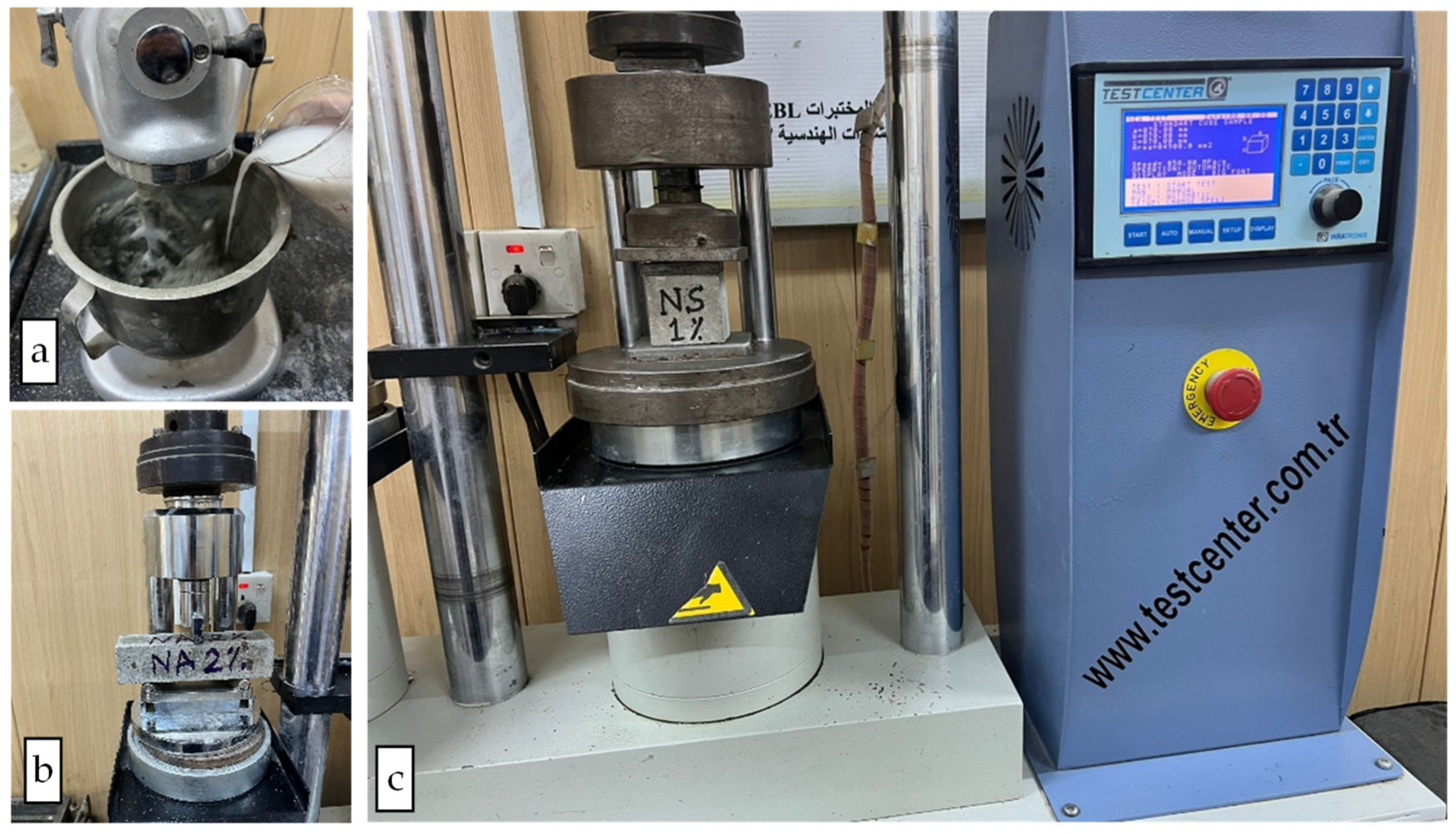
A comprehensive experimental testing program was designed to evaluate the mechanical, physical, and durability performance of the nano-modified cement mortars. The tests were conducted in accordance with the relevant ASTM standards to ensure reliability and comparability of results. The experimental workflow, including mixing and testing setups, is illustrated in
Figure 3.
Compressive strength was measured on 50 mm cube specimens at the ages of 7, 14, and 28 days in accordance with ASTM C109/C109M. The specimens were demolded after 24 h and cured in water at room temperature (23–25 °C) until testing. Strength testing was performed using a TC-B001 universal testing machine with a 3000 kN capacity, operated at a constant loading rate of 0.3 MPa/s. For each age and nanomaterial dosage, three replicates were tested, and the average value was reported. Flexural strength was determined on 40 × 40 × 160 mm prism specimens according to ASTM C348, using a three-point bending setup with a 100 mm span, and the mean of three results was calculated for each mix.
Flowability of the fresh mortar was measured using the flow table test following ASTM C230/C230M to assess the effect of nanomaterial addition on workability. The density of the hardened mortar was determined according to ASTM C642 by oven-drying the specimens at 105 ± 5 °C to a constant mass and dividing by their measured volumes. Durability-related properties were evaluated through several tests, including water absorption and apparent porosity (ASTM C642), sorptivity (ASTM C1585), and rapid chloride ion penetration (ASTM C1202), where the total electrical charge passed through the specimen over six hours was recorded in Coulombs.
Acid attack resistance was assessed at 28 days by immersing oven-dried specimens in a 5% sulfuric acid (H2SO4) solution, with results expressed as percentage weight loss and strength retention relative to the control mix. In addition, Energy-Dispersive X-ray Spectroscopy (EDX) analysis was carried out on selected samples to determine the elemental composition and identify potential changes in the hydration products and chemical phases due to the incorporation of nano-silica and nano-alumina. The overall testing program was designed to provide a comprehensive understanding of how NS and NA influence the fresh-state workability, mechanical strength development, and durability enhancement of cement mortar.
4. Results and Discussion
4.1. Fresh-State Properties
4.1.1. Flowability
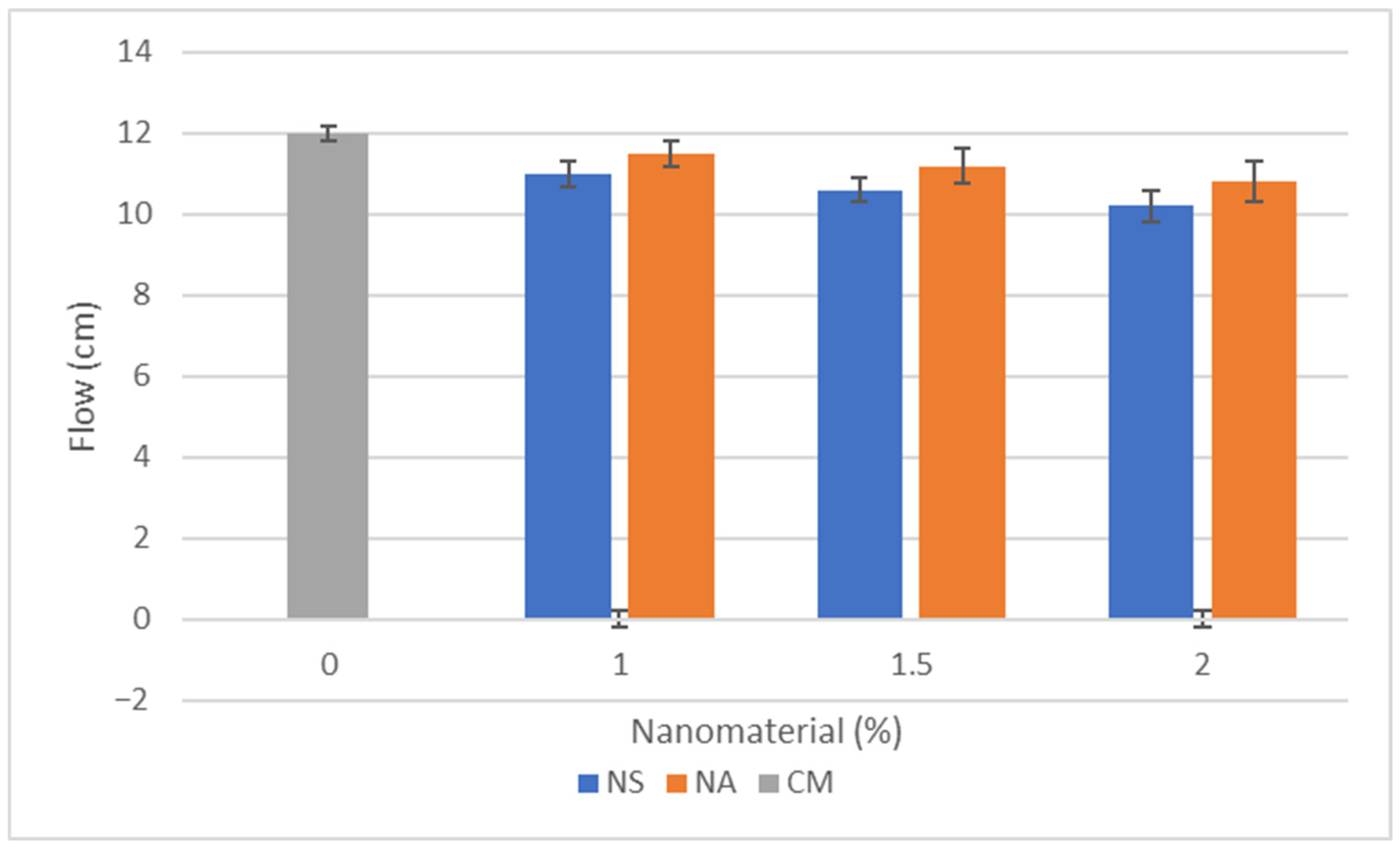
Figure 4 of the flow table results indicates that both NS and NA modified mortars exhibit a gradual loss of workability as the content of nanomaterials in them increases compared to the control mix (CM). The control mortar had a flow diameter of 12 cm and the addition of NS decreased the flow of the mortar to 11 cm, 10.6 cm, and 10.2 cm at 1%, 1.5%, and 2% dosage, respectively. A similar but slightly less pronounced reduction was observed for NA-modified mixes, which recorded flow values of 11.5 cm, 11.2 cm, and 10.8 cm at the same dosages. This trend indicates that both nanoparticles adversely affect flowability due to their extremely fine particles and large specific surface area, which increase the water demand and interparticle friction within the mix.
The reduction in workability was more significant for NS than for NA, which can be attributed to the higher surface area and stronger water adsorption capacity of nano-silica (190–250 m
2/g) compared to nano-alumina (120–160 m
2/g). Furthermore, the spherical morphology of NA facilitates better particle packing and less internal friction than the highly angular structure of NS. These observations are consistent with the findings of Tsampali et al. [
12] and Zhang et al. [
9], who both reported that increasing nano-silica and nano-alumina content leads to a reduction in flowability, with the effect being more pronounced for nano-silica. In particular, Zhang et al. [
9] attributed this behavior to the absorption of free mixing water by nanoparticles and the formation of a more cohesive paste, while Tsampali et al. [
12] noted that nano-alumina causes a smaller workability reduction due to its lower surface area and partial tendency to act as a lubricant between cement grains. Overall, the flow reduction observed here confirms that increasing nanoparticle dosage enhances cohesiveness and matrix viscosity, which may benefit microstructural refinement but requires careful water or superplasticizer adjustment to maintain adequate workability in practical applications.
4.1.2. Setting Time
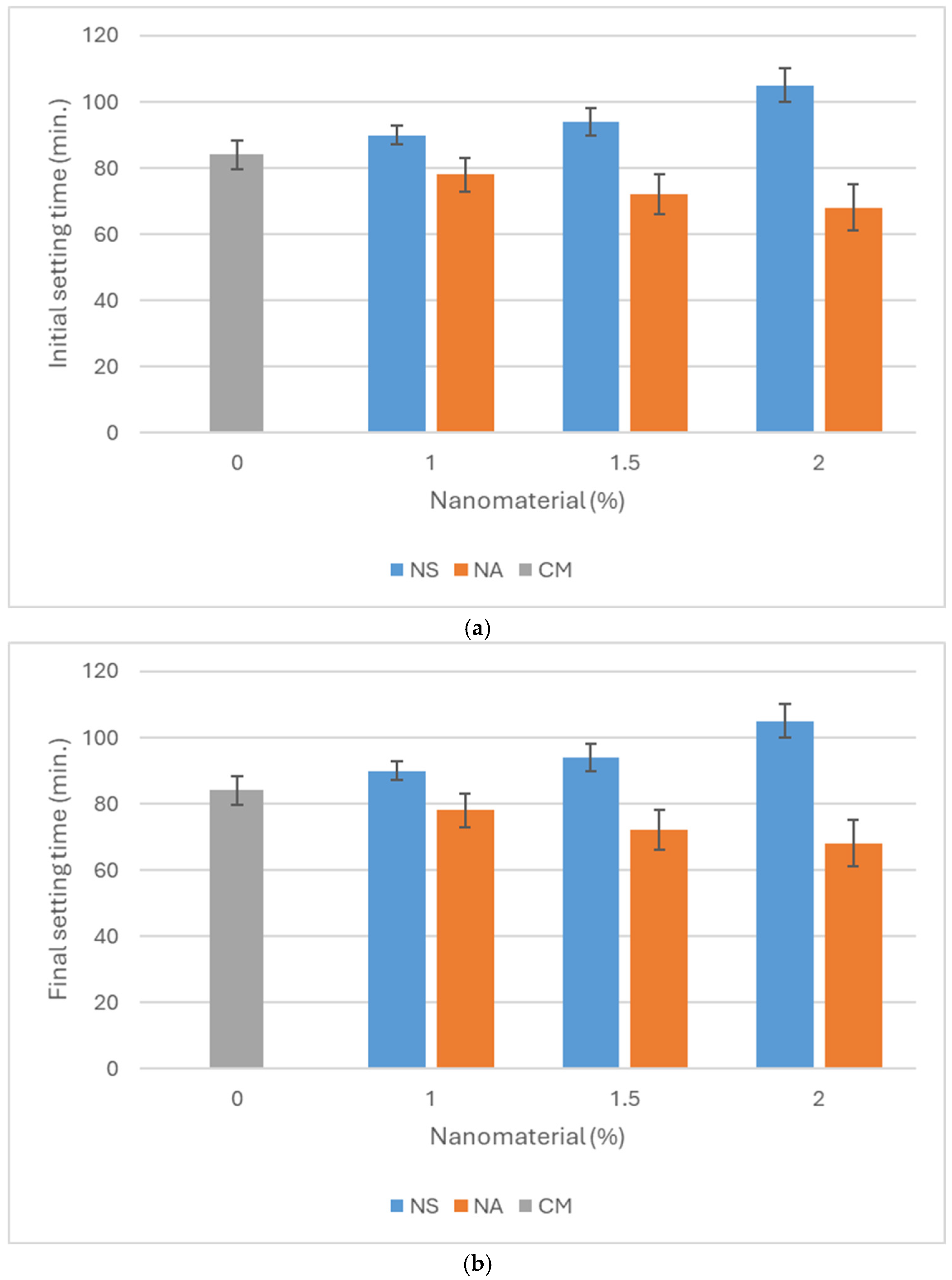
Figure 5a (initial setting time) and
Figure 5b (final setting time) give the effect of NS and NA on the setting behavior of cement mortar. The control mix had the initial setting time of 84 min and the final setting time of 265 min which is within the normal range of ordinary Portland cement mortars. The incorporation of NS led to the gradual rise in the initial and final setting times. The initial setting time increased by approximately 7%, 12%, and 25% for NS contents of 1%, 1.5%, and 2%, respectively, while the final setting time rose by about 2%, 5%, and 9% at the corresponding dosages compared to the control. This delay can be attributed to the high surface area and water absorption capacity of nano-silica, which increases paste viscosity and reduces the amount of free water available for early hydration. Consequently, the hydration of tricalcium silicate (C
3S) is slightly hindered, leading to a slower development of hydration products and extending the induction period. These findings are consistent with those of Kumar and Singh [
28] and Diddi et al. [
29], who reported similar retardation effects at higher NS contents due to agglomeration and reduced ionic mobility.
In contrast, NA incorporation led to a gradual reduction in both initial and final setting times. The initial setting time decreased by about 7%, 14%, and 19% for 1%, 1.5%, and 2% NA, respectively, relative to the control mix, while the final setting time dropped by approximately 4%, 9%, and 14%, respectively. The acceleration of setting observed with NA is attributed to the nucleation and catalytic effects of Al
2O
3 nanoparticles, which promote rapid formation of ettringite and calcium–aluminate–hydrate (C–A–H) phases in the early hydration stages. This behavior aligns with the results of Yusuf [
30], who found that NA accelerates setting by enhancing the reaction between calcium and sulfate ions, and with Diddi et al. [
29], who described NA as an efficient hydration accelerator due to its ability to provide additional nucleation sites.
Overall, NS demonstrated a retarding effect on setting due to increased water demand and surface activity, whereas NA exhibited an accelerating effect through enhanced nucleation and early hydration kinetics. These opposite trends suggest that while NS may be beneficial in applications requiring extended workability, NA can be advantageous in accelerating early-age reactions and reducing setting time in time-sensitive construction scenarios.
4.2. Hardened-State Properties
4.2.1. Compressive Strength
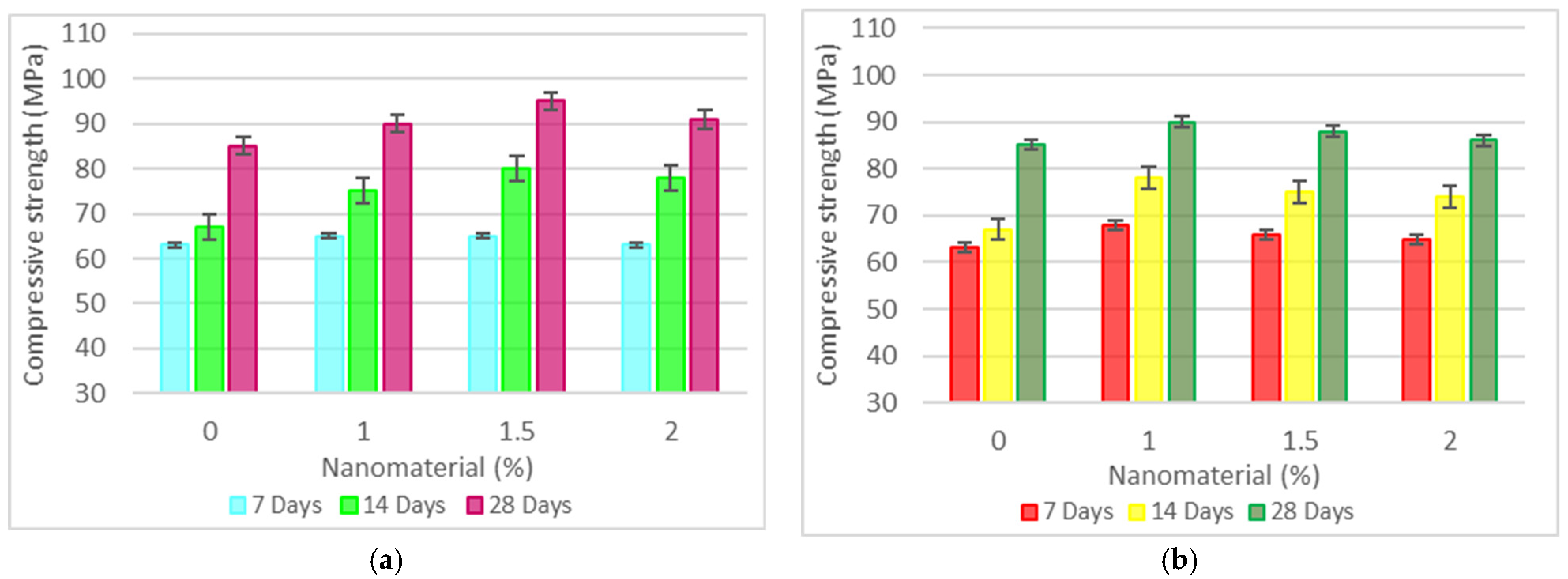
The dependence of compressive strength on the age of curing and the content of nanomaterials in the mortars is shown in
Figure 6. The compressive strengths of the control mix were 63.1 MPa, 67.05 MPa, and 85.1 MPa at 7, 14 and 28 days, respectively. Introduction of nanomaterials had a great impact on the pattern of strength development where both NS and NA enhanced strength relative to the control mix at all ages.
For nano-silica, the early-age (7-day) strength exhibited a modest improvement of 3.0% for both 1% and 1.5% NS, relative to the control mix, while the 2% NS mix recorded a slight decrease (−0.2%), indicating that excessive NS addition may hinder early hydration due to particle agglomeration and increased water demand. At 14 days, the enhancement became more evident, with 12%, 19%, and 16% increases for NS dosages of 1%, 1.5%, and 2%, respectively. The maximum strength gain was observed at 1.5% NS, which yielded 80 MPa compared to 67.05 MPa for the control. A similar trend was maintained at 28 days, where 1.5% NS achieved 95 MPa, representing an improvement of 11.6% over the control mix. This consistent enhancement confirms the effective pozzolanic activity of nano-silica, which promotes the formation of additional calcium–silicate–hydrate (C–S–H) gel and refines the pore structure, resulting in a denser microstructure and improved load-bearing capacity. Comparable findings were reported by Zhang et al. [
9] and Andrade et al. [
10], who observed optimal NS contents between 1 and 2% for significant strength enhancement due to its nucleation and filler effects.
For nano-alumina, the strength development followed a similar but slightly less pronounced pattern. The early-age (7-day) strength increased by 7.8% at 1% NA, whereas 1.5% and 2% dosages showed moderate gains of 4.6% and 3.0%, respectively, compared to the control. The 14-day strengths showed an even clearer improvement, with 16%, 12%, and 10% increases at 1%, 1.5%, and 2% NA, respectively. At 28 days, the strength enhancement peaked at 1% NA with 90 MPa, equivalent to a 5.8% increase over the control mix, followed by a gradual decline at higher dosages. These results indicate that small quantities of NA effectively act as nucleation sites, accelerating hydration and strengthening the microstructure at early ages. However, beyond the optimum content (≈1%), the potential for particle agglomeration and localized hydration product clustering can reduce matrix uniformity, leading to slightly lower strength gains. Similar behavior was observed by Diddi et al. [
29] and Yusuf [
30], who reported that NA contents above 1.5% tend to cause a marginal decline in mechanical performance due to reduced dispersion efficiency.
Comparatively, nano-silica demonstrated a stronger effect on long-term compressive strength than nano-alumina. This difference can be attributed to the highly reactive pozzolanic nature of NS, which continues to consume calcium hydroxide (CH) and generate secondary C–S–H gel over time, whereas NA mainly contributes through its nucleation effect during the early hydration stages. Consequently, the optimum dosages for peak compressive strength development was identified as 1.5% NS and 1% NA, yielding overall improvements of ≈11.6% and 5.8%, respectively, over the control mix at 28 days. In summary, both nanomaterials enhanced the compressive strength of cement mortar, but their efficiency and mechanisms differed. Nano-silica showed a sustained pozzolanic effect contributing to long-term strength, while nano-alumina provided accelerated early hydration and moderate strength gains. The results demonstrate that a well-optimized dosage of nanomaterials can significantly improve mortar performance, although excessive contents may lead to agglomeration, reduced workability, and marginal strength losses.
4.2.2. Flexural Strength
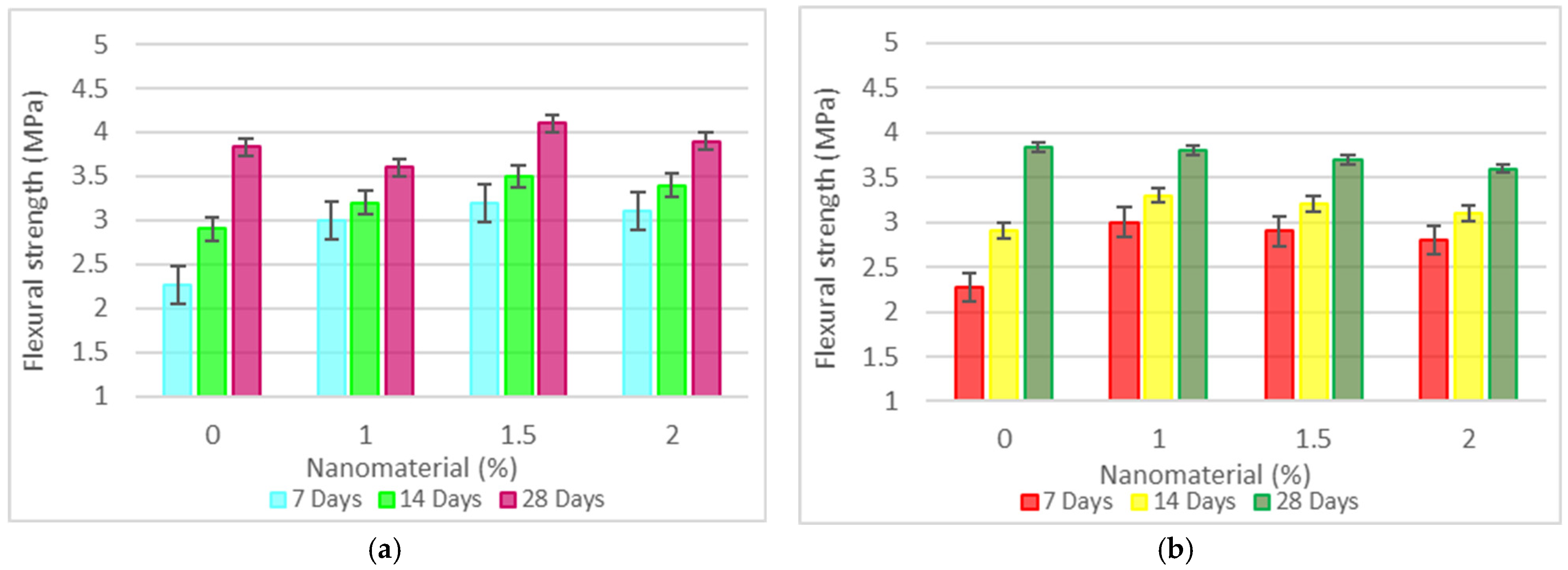
Figure 7 shows the flexural strength outcomes of cement mortar with NS and NA with various curing ages. The control mix recorded flexural strengths of 2.27 MPa, 2.9 MPa, and 3.83 MPa at 7, 14, and 28 days, respectively. The inclusion of both nanomaterials enhanced the flexural performance compared to the control, with the degree of improvement dependent on dosage and age. At early ages (7 days), both nanomaterials significantly enhanced the flexural strength compared to the control value of 2.27 MPa. The inclusion of 1% NS and 1% NA resulted in strength values of 3.0 MPa, marking an approximate 32% increase, while 1.5% NS produced the highest early-age gain, reaching 3.2 MPa. These improvements can be attributed to the fine particle size and high surface reactivity of the nanomaterials, which promote rapid formation of hydration products and improve the interfacial transition zone (ITZ) between cement paste and sand particles.
At 14 days, the strengthening effect became more evident for NS-modified mortars, especially at 1.5% dosage, which achieved 3.5 MPa compared with 2.9 MPa for the control. In contrast, mortars containing NA displayed a relatively modest improvement, reaching up to 3.3 MPa at the same age. This difference suggests that NS continues to contribute to secondary pozzolanic reactions beyond the initial hydration stage, whereas NA’s influence is primarily through its nucleation effect, which accelerates early hydration but tends to stabilize after one to two weeks.
By 28 days, the trend stabilized, and the positive influence of NS became more pronounced. The 1.5% NS mix achieved the highest flexural strength of 4.1 MPa, corresponding to an increase of about 7% compared to the control, followed by the 2% NS mix at 3.9 MPa. The consistent strength development with NS can be associated with the ongoing pozzolanic consumption of calcium hydroxide (CH) and the generation of additional calcium–silicate–hydrate (C–S–H) gel, leading to a refined and denser microstructure. On the other hand, NA-modified mortars displayed a more moderate long-term enhancement, with the 1% NA mix reaching 3.8 MPa, slightly below the control value but still indicating a beneficial early-age effect.
Comparatively, nano-silica demonstrated a more sustained improvement in flexural strength across all ages, confirming its superior pozzolanic activity and micro-filling efficiency. Nano-alumina, though less effective at later ages, showed advantages at early hydration stages due to its ability to serve as a nucleation site for C–A–H and ettringite formation. Similar patterns have been reported by Andrade et al. [
10] and Yusuf [
30], who noted that NS improves matrix densification, while NA enhances early reactivity but has limited long-term reactivity. In summary, the flexural strength of mortar improved notably with the addition of both nanomaterials, with the most favorable results obtained for mixes containing 1.5% NS and 1% NA. These dosages provided an optimal balance between particle dispersion and reactive surface area. Beyond these levels, excessive nanomaterial addition likely led to particle agglomeration, which restricted the uniform distribution of stress and slightly reduced flexural performance. The results highlight that while both nanomaterials contribute to strengthening mechanisms, nano-silica provides more durable and long-term benefits, whereas nano-alumina enhances early-age stiffness and crack resistance.
4.2.3. Density and Porosity
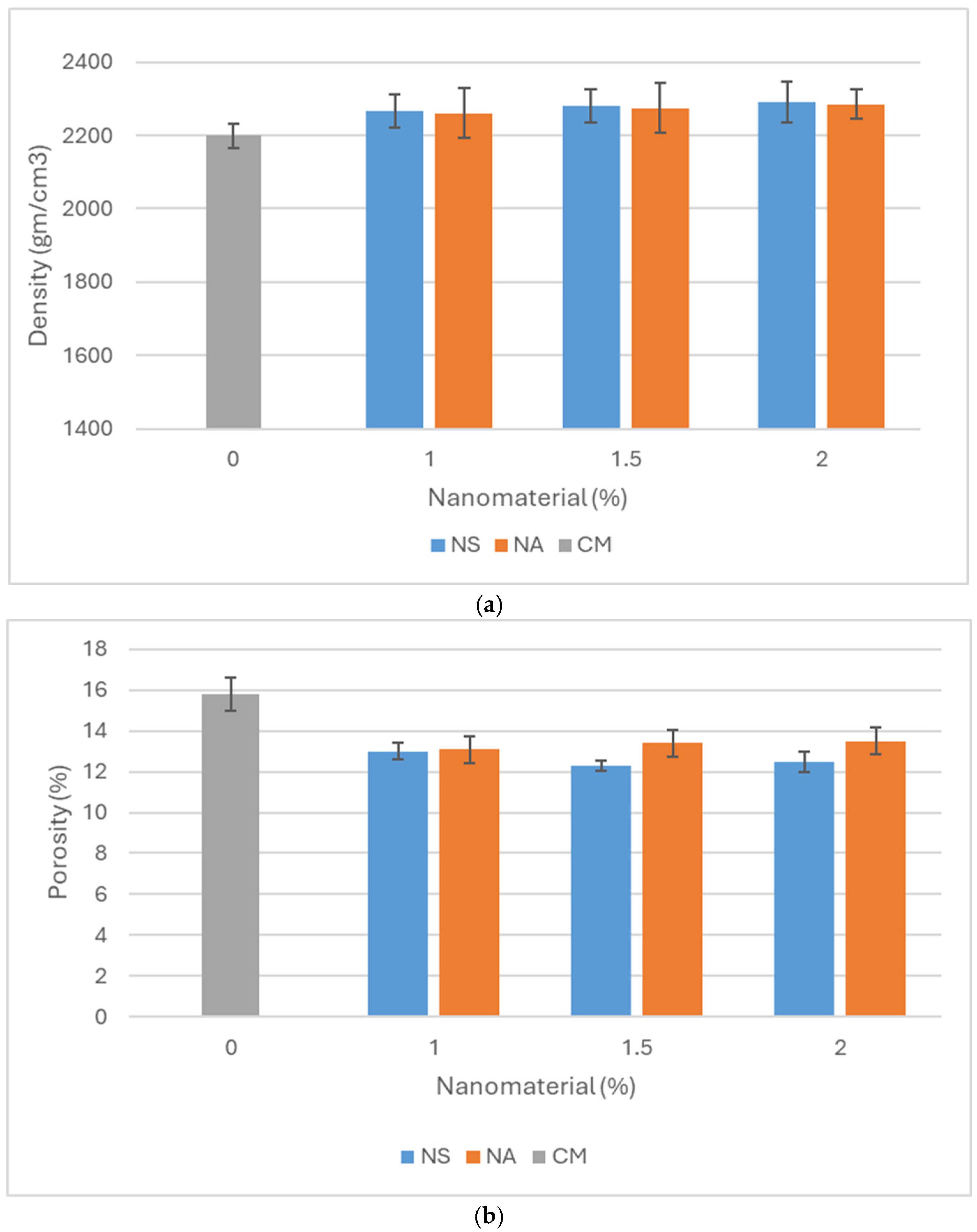
Figure 8 shows how density and porosity of mortars with NS and NA differed from the control mix (CM). The addition of nanomaterials resulted in the observed improvement in the compactness of the mortar matrix, which was reflected by the rise in density and subsequent decrease in porosity. For density, the control mix exhibited a value of 2200 kg/m
3, which increased progressively with the addition of both nanomaterials. The inclusion of NS resulted in densities of 2265, 2280, and 2290 kg/m
3 for the 1%, 1.5%, and 2% mixes, representing respective increases of approximately 3.0%, 3.6%, and 4.1% relative to the control. Similarly, mortars incorporating NA showed densities of 2260, 2275, and 2285 kg/m
3, corresponding to increases of 2.7%, 3.4%, and 3.9%, respectively. The enhancement in density is primarily attributed to the micro-filler effect of the nanoparticles, which occupy voids between cement grains and promote a more uniform and tightly packed microstructure. The slightly higher densities observed in NS-modified mortars compared to NA are likely due to the greater fineness and surface reactivity of nano-silica, leading to improved packing efficiency and the formation of additional calcium–silicate–hydrate (C–S–H) gel.
A reverse trend was observed for porosity, as shown in
Figure 8b. The control mix recorded a porosity of 15.8%, while NS addition reduced it to 13.0%, 12.3%, and 12.5% for 1%, 1.5%, and 2% dosages, respectively. This represents a porosity reduction of up to 22% at the optimum 1.5% NS dosage. Mortars containing NA exhibited slightly higher porosity values of 13.1%, 13.4%, and 13.5%, translating to reductions of approximately 17%, 15%, and 14% compared to the control. The decline in porosity with both nanomaterials confirms their effectiveness in refining the pore structure and enhancing matrix densification. However, the marginal increase at higher dosages (particularly at 2%) suggests that excessive nanoparticle content may promote particle agglomeration, which creates localized voids and partially offsets the densification benefits.
Overall, the results clearly demonstrate that incorporating nanomaterials improves the physical integrity of cement mortar by reducing internal porosity and increasing bulk density. Between the two nanomaterials, nano-silica proved more effective, owing to its higher specific surface area and superior pozzolanic activity, which contribute to continuous hydration and microstructural refinement. These findings are consistent with those reported by Zhang et al. [
9] and Andrade et al. [
10], who observed that NS promotes a denser matrix and a more homogeneous pore distribution. In contrast, nano-alumina primarily enhances early densification due to its nucleation role but has a relatively weaker long-term effect compared to NS.
4.2.4. Sorptivity
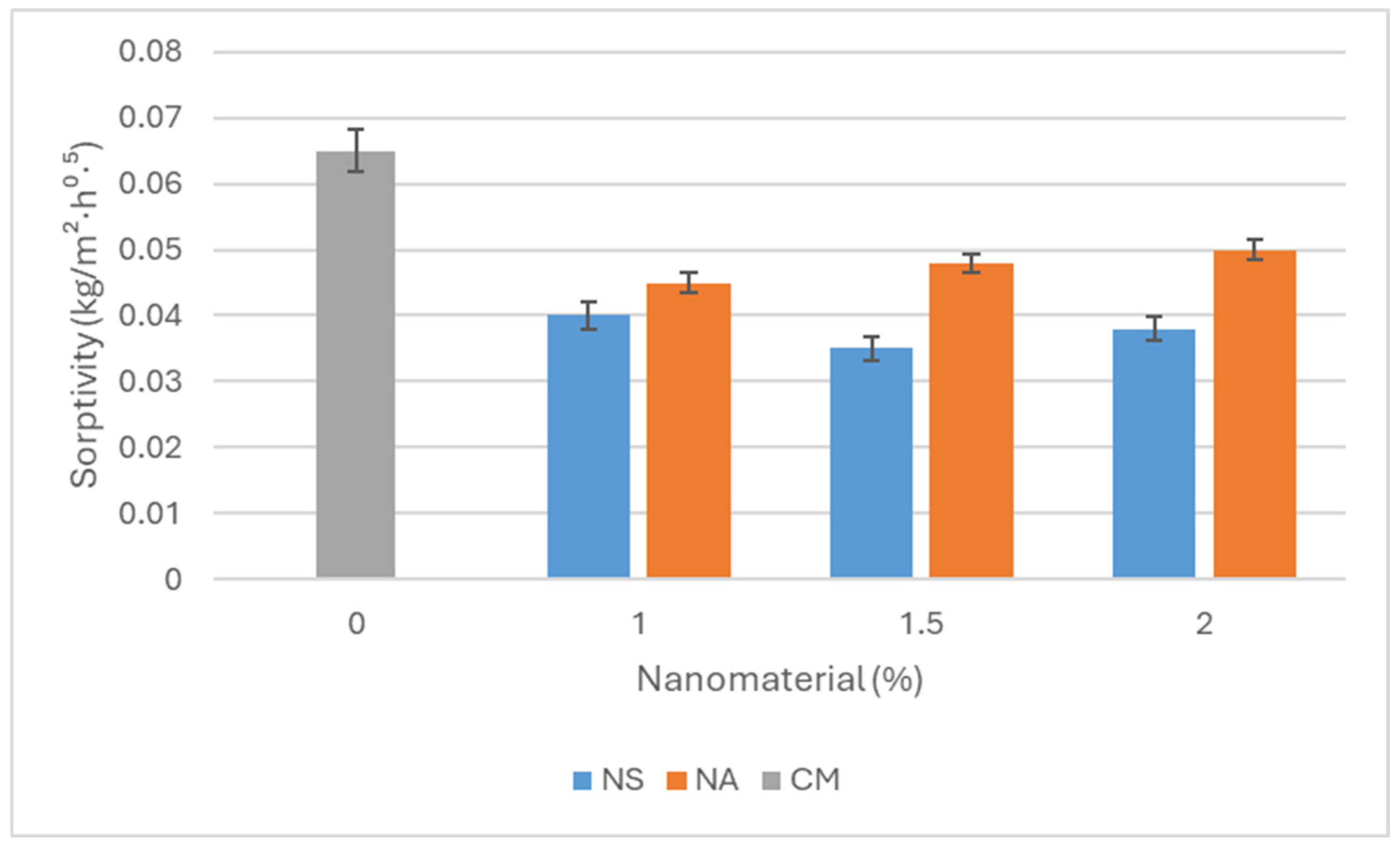
Figure 9 shows the effect of NS and NA on the permeability properties of cement mortars. One important parameter to determine the durability and connectivity of the pores of cementitious materials is sorptivity, which is a measure of the rate of water ingress by capillary suction. A smaller value of sorptivity means that there is a denser microstructure and the capillary pathways of transport are reduced.
The control mix exhibited a sorptivity coefficient of 0.065 kg/m2·h0.5, whereas all nanomaterial-modified mortars showed a marked reduction, confirming their densification effect. The addition of NS reduced the coefficient to 0.040, 0.035, and 0.038 kg/m2·h0.5 for 1%, 1.5%, and 2% dosages, respectively, corresponding to reductions of approximately 38%, 46%, and 42% relative to the control. In comparison, NA-modified mortars exhibited sorptivity values of 0.045, 0.048, and 0.050 kg/m2·h0.5, reflecting reductions of 31%, 26%, and 23%, respectively. The lowest sorptivity was obtained at 1.5% NS, indicating this dosage provides the most efficient refinement of pore structure. The superior performance of NS can be attributed to its high pozzolanic reactivity and fine particle size, which promote the formation of additional calcium–silicate–hydrate (C–S–H) gel and fill microvoids within the cement matrix. This leads to a more continuous and impermeable microstructure, limiting water ingress through capillary suction. The filler effect of NS also contributes to the reduction in sorptivity by improving particle packing and decreasing connectivity among pores.
Conversely, NA reduced sorptivity primarily through its nucleation and filling effects, accelerating early hydration and improving the initial pore structure. However, the relatively lower surface area and reactivity of NA compared to NS limit its long-term pore refinement capabilities.
These findings align well with the observations of Zhang et al. [
9] and Andrade et al. [
10], who reported that the addition of NS significantly improves the resistance to water transport in cementitious systems due to enhanced matrix densification and pore discontinuity. Similar studies by Yusuf [
30] also confirmed that nano-alumina decreases water absorption at early stages but has a comparatively lower impact at later curing ages. Overall, the reduction in sorptivity for both nanomaterials indicates enhanced durability potential. However, nano-silica demonstrates a more pronounced and sustained effect, with the 1.5% NS mix emerging as the optimal dosage that balances workability, strength, and resistance to capillary absorption.
4.2.5. Rapid Chloride Ion Penetration
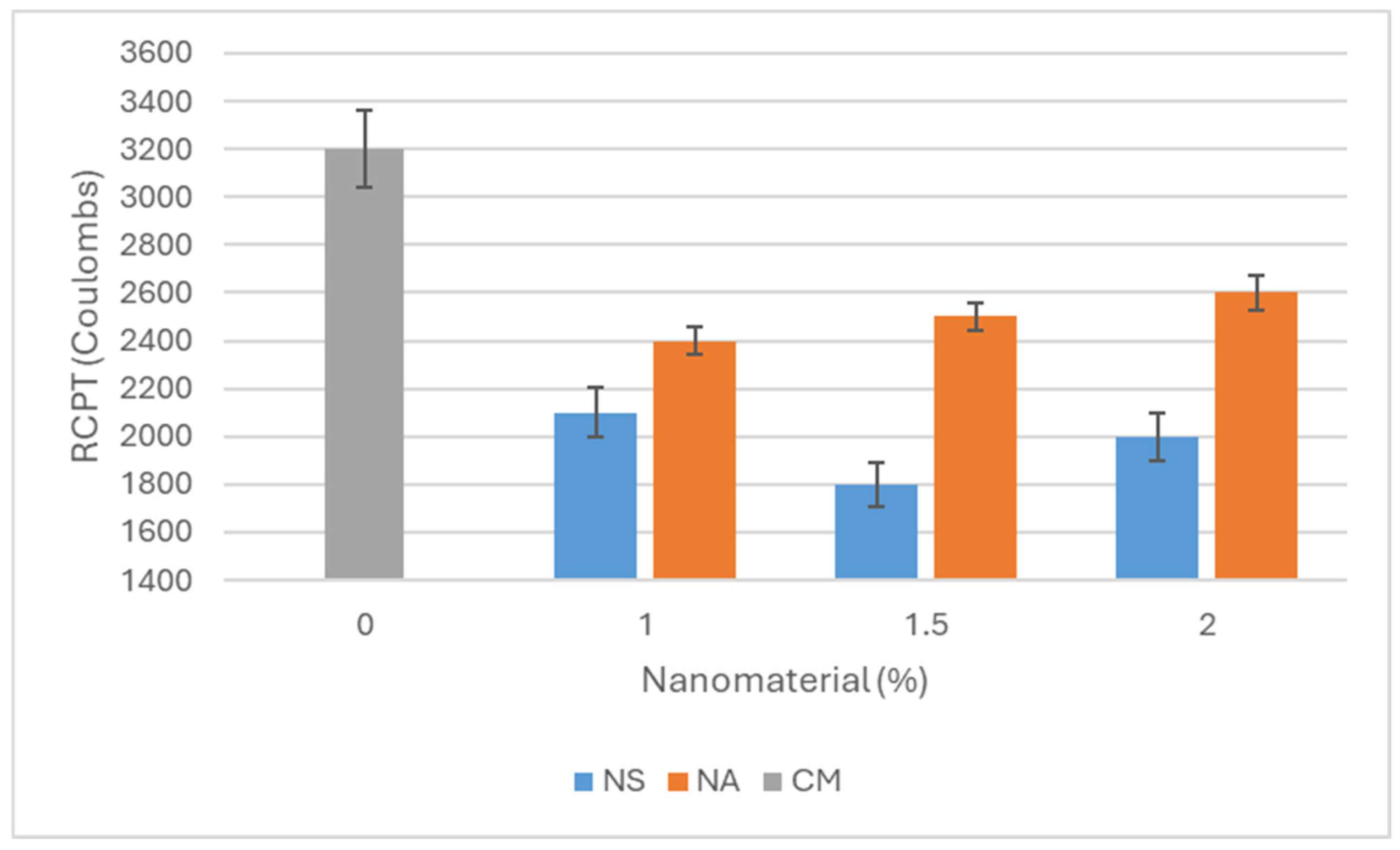
Rapid chloride ion penetration test (RCPT) performed to determine the cement mortar permeability to chloride, where the outcome was in the number of Coulomb of charge passing (
Figure 10). A smaller Coulomb value means that there is a denser microstructure and less susceptibility to the ingress of chloride ions. The control mix (CM) exhibited the highest charge of 3200 C, reflecting relatively high permeability. In contrast, the incorporation of both NS and NA significantly reduced the charge passed, confirming their role in improving the mortar’s resistance to ionic transport. For NS-modified mortars, the total charge values were 2100, 1800, and 2000 C for the 1%, 1.5%, and 2% mixes, corresponding to reductions of approximately 34%, 44%, and 38%, respectively, compared to the control. The lowest permeability was observed at 1.5% NS, which aligns with the optimum dosage identified from compressive strength and sorptivity results. The notable reduction in chloride permeability at this dosage can be attributed to the pozzolanic activity and filler effect of nano-silica, which enhance the formation of secondary calcium–silicate–hydrate (C–S–H) gel, refine pore structure, and block capillary channels that facilitate ion transport.
For NA-modified mortars, the corresponding RCPT values were 2400, 2500, and 2600 C, indicating permeability reductions of 25%, 22%, and 19%, respectively, relative to the control. Although NA also contributed to improved chloride resistance, its effectiveness was lower than that of NS. This can be explained by the comparatively lower surface area and reactivity of nano-alumina, which limits its ability to consume calcium hydroxide (CH) and form additional C–S–H. Nonetheless, NA acts as an efficient nucleation site during early hydration, accelerating the formation of hydration products and slightly enhancing the compactness of the microstructure.
Overall, both nanomaterials significantly enhanced chloride ion penetration resistance, with NS performing more effectively due to its superior pozzolanic reactivity and greater pore-blocking capability. These findings are consistent with previous studies by Li et al. [
21] and Zhang et al. [
31], who reported that NS markedly reduces chloride permeability by refining the microstructure and forming dense hydration products. In contrast, Yusuf [
30] and Chu et al. [
32] noted that NA contributes primarily through early-age densification but exhibits diminishing effects at higher dosages due to particle agglomeration and reduced dispersion efficiency. Hence, the results confirm that 1.5% NS provides the most efficient chloride resistance, while NA at 1% also offers a notable improvement compared to the control mix. The enhanced chloride resistance achieved through nanomaterial incorporation indicates substantial potential for improving the durability performance of cementitious materials in chloride-rich environments.
4.2.6. Acid Resistance
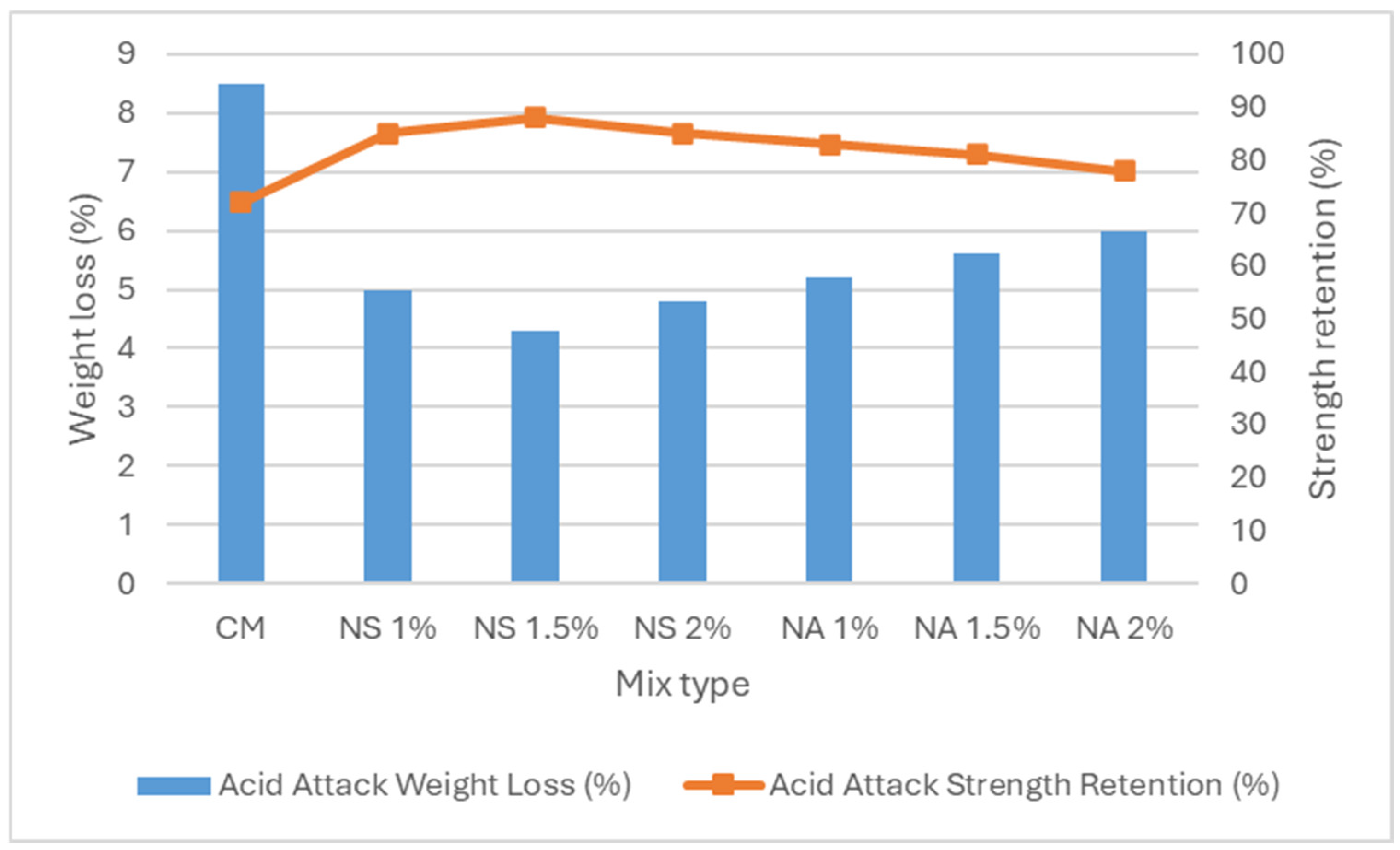
To determine the resistance of cement mortar to acid exposure, the weight loss during acid exposure and the compressive strength remaining after 28 days of acid exposure in 5% sulfuric acid (H
2SO
4) solution were measured as shown in
Figure 11. Calcium hydroxide (CH) and calcium silicate hydrate (C–S–H) phases are violently attacked by acidic environments and cause surface decay, as well as strength loss. Therefore, less weight loss and more strength retention mean an improved chemical stability and durability.
The control mix exhibited a weight loss of 8.5% and a strength retention of 72%, confirming significant vulnerability to acid attack. The incorporation of nanomaterials markedly improved acid resistance, with both nano-silica and nano-alumina showing reduced weight losses and higher residual strengths compared to the control. For NS-modified mortars, the weight loss decreased to 5.0%, 4.3%, and 4.8% for 1%, 1.5%, and 2% dosages, representing reductions of approximately 41%, 49%, and 44%, respectively. Correspondingly, the strength retention increased to 85%, 88%, and 85%. The best performance was observed for the 1.5% NS mix, which demonstrated the lowest material degradation and the highest retained strength. This superior acid resistance is attributed to the pozzolanic reaction between nano-silica and calcium hydroxide, producing additional C–S–H gel that reduces permeability and the availability of soluble calcium compounds susceptible to acid dissolution. Moreover, the filler effect of NS enhances the matrix density, providing a physical barrier to acid ingress.
In the case of NA-modified mortars, the weight losses were 5.2%, 5.6%, and 6.0% for 1%, 1.5%, and 2% dosages, equivalent to reductions of 39%, 34%, and 29% compared to the control, with corresponding strength retentions of 83%, 81%, and 78%, respectively. Although NA also enhanced acid resistance, its effect was less pronounced than that of NS. This difference can be linked to the lower pozzolanic reactivity of nano-alumina and its limited ability to form additional C–S–H gel. Instead, NA primarily acts as a nucleation center, promoting early hydration and microstructural refinement, but its long-term contribution to acid resistance is constrained. The results are consistent with previous findings by Li et al. [
21] and Andrade et al. [
10], who reported that NS significantly reduces acid-induced degradation by improving the matrix compactness and reducing calcium leaching. Similarly, Yusuf [
30] observed that NA imparts moderate resistance to chemical attack but tends to be less effective at higher dosages due to particle agglomeration and reduced dispersion efficiency.
Overall, both nanomaterials enhanced the durability of cement mortar under acidic conditions. However, the 1.5% NS mix exhibited the best performance, achieving nearly 50% lower weight loss and 22% higher strength retention than the control mix. These results confirm that the addition of nano-silica effectively mitigates acid-induced deterioration by densifying the microstructure, refining the pore network, and stabilizing the hydration products against chemical attack.
4.3. Chemical Composition (EDX Analysis)
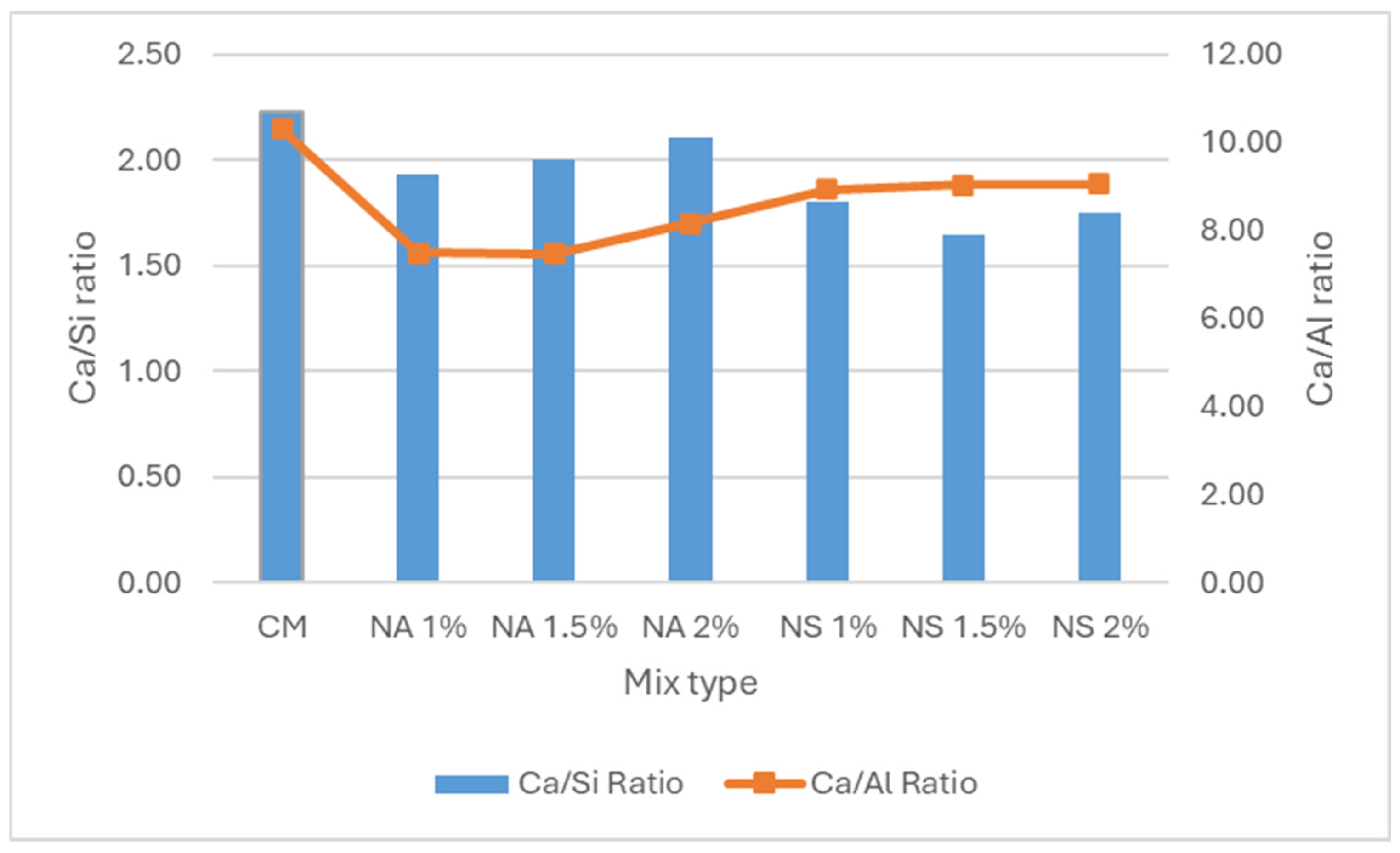
Energy-dispersive X-ray spectroscopy (EDX) was employed to investigate the influence of NS and NA on the elemental composition of hardened cement mortars. The results summarized in
Table 7 and illustrated in
Figure 12 reveal systematic variations in the relative contents of oxygen, silicon, aluminum, and calcium, providing insight into the compositional modifications induced by nanomaterial incorporation and their relation to hydration-related reactivity. The control mix exhibited a typical elemental distribution for hydrated cement mortar, characterized by oxygen, silicon, aluminum, and calcium contents of 47.2%, 14.8%, 3.2%, and 33%, respectively. This composition corresponds to a relatively high Ca/Si ratio, reflecting a calcium-rich chemical environment commonly observed in ordinary Portland cement systems. Upon incorporation of NS and NA, noticeable shifts in elemental composition were observed, particularly an increase in silicon and oxygen contents accompanied by a reduction in calcium concentration, indicating enhanced redistribution and consumption of calcium during hydration reactions.
For NS-modified mortars, the silicon content increased progressively with dosage, reaching a maximum value of 17% at 1.5% NS, while the calcium content decreased to approximately 28%. These changes resulted in a marked reduction in the Ca/Si ratio, suggesting increased incorporation of calcium into silicate-rich binding environments and a more silica-dominated chemical balance. The concurrent rise in oxygen content, approaching 50%, further reflects a higher degree of hydration and development of oxygen-rich binding phases. This elemental evolution is consistent with the significant improvements observed in compressive strength, density, and durability-related properties, indicating that NS promotes effective microstructural refinement through enhanced calcium–silicon interaction. In contrast, NA-modified mortars exhibited a moderate increase in aluminum content, rising from 3.2% in the control mix to 4.1% at 1.5% NA, accompanied by a reduction in calcium content to around 30%. The corresponding decrease in the Ca/Al ratio indicates increased participation of aluminum in hydration-related binding environments. However, compared to NS-modified mortars, NA mixes retained relatively higher calcium levels and exhibited less pronounced reductions in the Ca/Si ratio, suggesting a different interaction mechanism dominated by aluminum enrichment and hydration acceleration rather than extensive calcium redistribution. The comparative elemental trends highlight that nano-silica exerts a stronger influence on calcium–silicon balance, while nano-alumina primarily affects aluminum incorporation within the cement matrix. This distinction explains the superior performance of NS-modified mortars in terms of strength development and durability enhancement, particularly at the optimum dosage of 1.5% NS. Similar observations were reported by Andrade et al. [
10] and Yusuf [
30], who found that nano-silica enhances pozzolanic reactivity and calcium hydroxide consumption more effectively than nano-alumina, leading to a refined microstructure and improved mechanical and durability performance.
Overall, the EDX-derived elemental distributions demonstrate that both nanomaterials significantly modify the chemical environment of the cement matrix, with nano-silica producing the most favorable elemental balance characterized by increased silicon and oxygen contents and reduced calcium levels. The mix containing 1.5% NS exhibited the most pronounced elemental modification, which correlates well with its superior mechanical strength, reduced permeability, and enhanced durability observed in earlier sections of this study.
5. Statistical Inferences
To quantitatively assess whether the observed differences in performance were statistically meaningful, a two-factor analysis of variance (ANOVA) without replication was conducted for all investigated properties, considering nanomaterial type (NS vs. NA) and dosage level (0–2%) as independent variables. The null hypothesis posits that there is no difference in performance across all selected dosages and nanomaterial types. A 95% confidence level (α = 0.05) was adopted, where a
p-value lower than 0.05 indicates a statistically significant effect. The summary of
p-values and significance outcomes is presented in
Table 8. The ANOVA results indicate that mechanical properties, including 28-day compressive strength (
p = 0.2486 for dosage;
p = 0.1904 for nanomaterial type) and flexural strength (
p = 0.7586 for dosage;
p = 0.4309 for nanomaterial type), did not exhibit statistically significant differences within the investigated ranges, despite observable trends in mean values. Similarly, setting times (initial and final) showed no statistically significant dependence on either nanomaterial type or dosage (
p > 0.05), suggesting that the observed variations fall within experimental scatter.
In contrast, transport and durability-related properties demonstrated higher statistical sensitivity to nanoparticle dosage. Sorptivity showed a statistically significant dosage effect (p = 0.0306), while porosity (p = 0.0135) and rapid chloride ion penetration (RCPT) (p = 0.0484) also exhibited significant dependence on dosage, confirming that nanoparticle incorporation effectively alters pore structure and transport mechanisms. For acid attack resistance, the weight loss results revealed a statistically significant dosage effect (p = 0.0124), whereas the effect of nanomaterial type was not statistically significant (p = 0.1374), indicating that acid resistance is primarily governed by nanoparticle content rather than composition within the tested range. Density and flowability showed limited statistical differentiation between nanomaterial types, with dosage emerging as the dominant influencing factor (p < 0.05 for dosage in both cases).
Overall, the statistical analysis supports the conclusion that while strength-related properties exhibit comparable statistical behavior across mixes, durability and transport properties, including sorptivity, RCPT, porosity, and acid attack weight loss, demonstrate a statistically detectable dependence on nanoparticle dosage, highlighting the critical role of optimized nanomaterial content in enhancing long-term performance.
6. Conclusions
This study investigated the influence of NS and NA on the mechanical, physical, and durability performance of cement mortars at addition levels of 1%, 1.5%, and 2% by weight of cement. A comprehensive experimental program encompassing fresh-state, mechanical, durability, and microstructural evaluations was conducted to identify the most effective nanomaterial and optimum dosage. Based on the experimental results, the following conclusions can be drawn:
The high surface area of the nanoparticles worked on decreasing the mortar’s flowability as compared to the control mix because of the inclusion of NS and NA. The decrease was higher with NS, but all mixes were workable and could be used for practical purposes.
NS caused a slow rise in both initial and final setting times, whereas NA decreased setting time. This contradictory behavior between both materials refers to the pozzolanic activity of NS and the nucleation effect of NA, which increases the rate of cement hydration.
Both nanomaterials enhanced the mechanical performance of cement mortar at all curing ages; however, their efficiency differed with dosage and mechanism. NS exhibited superior late-age performance, with 1.5% NS yielding the maximum 28-day compressive strength (≈12% higher than the control), while NA was more effective at lower dosages, with 1% NA providing the optimum strength enhancement (≈6%), highlighting the distinct reactivity and efficiency ranges of the two nanomaterials.
The inclusion of nanoparticles increased the density and reduced porosity and water absorption, with NS showing a stronger effect. The 1.5% NS mix achieved about 4% increase in density and a 22% reduction in porosity, indicating improved microstructural compactness and reduced pore connectivity.
Durability performance improved significantly for all nanomodified mortars. Sorptivity, water absorption, and rapid chloride ion permeability decreased markedly, with RCPT charge reductions of approximately 44% for NS and 22% for NA. Improved resistance to acid attack was also observed, particularly for the 1.5% NS mix.
Elemental analysis (EDX) demonstrated systematic shifts in Si, O, Al, and Ca contents following nanomaterial incorporation, indicating enhanced chemical reactivity within the cement matrix. Nano-silica produced more pronounced reductions in Ca content relative to Si, reflecting its higher pozzolanic efficiency, whereas nano-alumina primarily altered the aluminate balance, supporting its role as a hydration accelerator rather than a dominant pozzolanic agent.
This study was limited to controlled laboratory conditions using a single cement type and curing regime. Although 1.5% NS and 1% NA were identified as the optimum dosages for enhancing overall performance, further studies under field and long-term exposure conditions are recommended.
Author Contributions
M.Z.A.-M.: Formal analysis, Data curation, Writing—original draft. Z.S.A.: Data curation, Resources, Supervision, Writing—original draft. T.H.I.: Methodology, Visualization, Writing—review and editing. A.H.A.: Conceptualization, Methodology, Writing—review and editing. N.K.O.: Data curation, Resources, Writing—review and editing. M.J.A.-K.: Formal analysis, Methodology, Writing—review and editing. S.H.G.: Investigation, Visualization, Writing—review and editing. All authors have read and agreed to the published version of the manuscript.
Funding
This research received no external funding.
Data Availability Statement
The data presented in this study are available on request from the corresponding author.
Acknowledgments
During the preparation of this manuscript, the authors used ChatGPT (GPT-4.1) for the purposes of grammar checks. The authors have reviewed and edited the output and take full responsibility for the content of this publication.
Conflicts of Interest
The authors declare no conflicts of interest.
References
- Sujitha, V.S.; Ramesh, B.; Xavier, J.R. Effects of nanomaterials on mechanical properties in cementitious construction materials for high-strength concrete applications: A review. J. Adhes. Sci. Technol. 2024, 38, 3737–3768. [Google Scholar] [CrossRef]
- Hossain, M.; Karim, M.; Hasan, M.; Hossain, M.; Zain, M. Durability of mortar and concrete made up of pozzolans as a partial replacement of cement: A review. Constr. Build. Mater. 2016, 116, 128–140. [Google Scholar] [CrossRef]
- Du, S.; Wu, J.; AlShareedah, O.; Shi, X. Nanotechnology in cement-based materials: A review of durability, modeling, and advanced characterization. Nanomaterials 2019, 9, 1213. [Google Scholar] [CrossRef]
- Arab, M.A.E.-S.; Mohamed, A.S.; Taha, M.K.; Nasr, A. Microstructure, durability and mechanical properties of high strength geopolymer concrete containing calcinated nano-silica fume/nano-alumina blend. Constr. Build. Mater. 2025, 472, 140903. [Google Scholar] [CrossRef]
- El-Gamal, S.; Abo-El-Enein, S.; El-Hosiny, F.; Amin, M.; Ramadan, M. Thermal resistance, microstructure and mechanical properties of type I Portland cement pastes containing low-cost nanoparticles. J. Therm. Anal. Calorim. 2018, 131, 949–968. [Google Scholar] [CrossRef]
- Ram, D.A.S.; Ramya, K.S.; Kamalakar, D. Effect of Nano Silica & Other Industrial Wastes on Strength and Economy of Concrete. In IOP Conference Series: Materials Science and Engineering; IOP Publishing: Bristol, UK, 2021; p. 012028. [Google Scholar]
- Labaran, Y.H.; Atmaca, N.; Tan, M.; Atmaca, K.; Aram, S.A.; Kaky, A.T. Nano-enhanced concrete: Unveiling the impact of nano-silica on strength, durability, and cost efficiency. Discov. Civ. Eng. 2024, 1, 116. [Google Scholar] [CrossRef]
- Zabihi, N.; Ozkul, M.H. The effect of nano-silica particles on fresh and hardened state properties of polymer cement mortars. Adv. Mater. Res. 2015, 1129, 113–120. [Google Scholar] [CrossRef]
- Zhang, A.; Yang, W.; Ge, Y.; Du, Y.; Liu, P. Effects of nano-SiO2 and nano-Al2O3 on mechanical and durability properties of cement-based materials: A comparative study. J. Build. Eng. 2021, 34, 101936. [Google Scholar] [CrossRef]
- Andrade, F.; Pires, T.; Silva, J. Influence of silicon-dioxide nanoparticles in cementitious mortars: Verification using X-ray diffraction, thermal analysis, physical, and mechanical tests. Mater. Res. Express 2023, 10, 025004. [Google Scholar] [CrossRef]
- Oltulu, M.; Şahin, R. Single and combined effects of nano-SiO2, nano-Al2O3 and nano-Fe2O3 powders on compressive strength and capillary permeability of cement mortar containing silica fume. Mater. Sci. Eng. A 2011, 528, 7012–7019. [Google Scholar] [CrossRef]
- Tsampali, E.; Tsardaka, E.C.; Pavlidou, E.; Paraskevopoulos, K.M.; Stefanidou, M. Comparative study of the properties of cement pastes modified with nano-silica and Nano-Alumina. Solid State Phenom. 2019, 286, 133–144. [Google Scholar] [CrossRef]
- Faez, A.; Sayari, A.; Manie, S. Mechanical and rheological properties of self-compacting concrete containing Al2O3 nanoparticles and silica fume. Iran. J. Sci. Technol. Trans. Civ. Eng. 2020, 44, 217–227. [Google Scholar] [CrossRef]
- Peerzada, M.; Adnan, K.; Bilal, B.; Janees, R.; Qazi, B.; Javed, N.A. Aptness of nano alumina (Al2O3) with high range water reducer-incorporated concrete. World J. Eng. 2023, 20, 746–753. [Google Scholar] [CrossRef]
- Arasteh-Khoshbin, O.; Seyedpour, S.M.; Ricken, T. The effect of Caspian Sea water on mechanical properties and durability of concrete containing rice husk ash, nano SiO2, and nano Al2O3. Sci. Rep. 2022, 12, 20202. [Google Scholar] [CrossRef]
- León Brito, N.; Massana Guitart, J.; Alonso Peralta, F.; Moragues Terrades, A.; Sanchez Espinosa, E. Comportamiento de morteros de cemento con nano adiciones sometidos a ciclos hielo-deshielo. In Proceedings of the VII Congreso Ibérico de Agroingeniería y Ciencias Hortícolas, Madrid, Spain, 26–29 August 2013. [Google Scholar]
- Khorasani, A.S.; Nuranian, H.; Yuzbashi, A.A.; Moghaddas, S.; Raz, M.; Tahriri, M. The effects of nanoparticles of silica and alumina on flow ability and compressive strength of cementitious composites. Key Eng. Mater. 2015, 631, 119–127. [Google Scholar] [CrossRef]
- Ma, B.; Li, H.; Mei, J.; Li, X. Influence of nano-SiO2 addition on properties of sulphoaluminate cement based material. J. Wuhan Univ. Technol.-Mater. Sci. Ed. 2017, 32, 106–112. [Google Scholar] [CrossRef]
- Ramezanianpour, A.A.; Mortezaei, M.; Mirvalad, S. Synergic effect of nano-silica and natural pozzolans on transport and mechanical properties of blended cement mortars. J. Build. Eng. 2021, 44, 102667. [Google Scholar] [CrossRef]
- Dheyaaldin, M.H.; Mosaberpanah, M.A.; Alzeebaree, R. The effect of nano-silica and nano-alumina with polypropylene fiber on the chemical resistance of alkali-activated mortar. Sustainability 2022, 14, 16688. [Google Scholar] [CrossRef]
- Li, C.; Cao, Y.; Li, G.; Liang, Q.; Wu, X.; Wu, G.; Wang, F.; Du, Q.; Wang, Y.; Qi, S. Modified cementitious materials incorporating Al2O3 and SiO2 nanoparticle reinforcements: An experimental investigation. Case Stud. Constr. Mater. 2023, 19, e02542. [Google Scholar] [CrossRef]
- Abouelnour, M.A.; Abd EL-Aziz, M.A.; Osman, K.M.; Fathy, I.N.; Tayeh, B.A.; Elfakharany, M.E. Recycling of marble and granite waste in concrete by incorporating nano alumina. Constr. Build. Mater. 2024, 411, 134456. [Google Scholar] [CrossRef]
- Ali, B. Evaluation of alkali-activated mortar incorporating combined and uncombined fly ash and GGBS enhanced with nano alumina. Civ. Eng. J. 2024, 10, 902–914. [Google Scholar] [CrossRef]
- Parhi, S.K.; Patro, S.K. Interfacial Insights and Remediation Strategies through Molecular Dynamics Probing of Nanoparticle Interactions in Cementitious Matrices: A Review. Langmuir 2025, 41, 16687–16713. [Google Scholar] [CrossRef]
- Mousavi, B.; Akhtarian, M.; Sadeghirad, A.; Lotfi, V. Effects of graphene-oxide and nanosilica on the wear resistance and strength of self-consolidating high-strength cement mortar. Adv. Mater. Process. Technol. 2025, 11, 268–282. [Google Scholar] [CrossRef]
- Zhao, Y.; Cui, N.; Zhao, S.; Zhu, Y.; Hou, P.; Feng, L.; Xie, N. Aggressive environment resistance of concrete products modified with nano alumina and nano silica. Front. Mater. 2021, 8, 695624. [Google Scholar] [CrossRef]
- Mahmoudi, A. Preparation and Physical Assessment of Portland Cement Base Composites Containing Nano Particles. Int. J. Metall. Mater. Eng. 2015, 9, 229–233. [Google Scholar]
- Kumar, A.; Singh, G. Effect of nano silica on the fresh and hardened properties of cement mortar. Int. J. Appl. Eng. Res. 2018, 13, 11183–11188. [Google Scholar]
- Kumar, D.P.; Amit, S.; Chand, M.S.R. Influence of various nano-size materials on fresh and hardened state of fast setting high early strength concrete [FSHESC]: A state-of-the-art review. Constr. Build. Mater. 2021, 277, 122299. [Google Scholar] [CrossRef]
- Yusuf, M.O. Characteristics of silica fume nano alumina ternary blended mortar. Sustainability 2023, 15, 14615. [Google Scholar] [CrossRef]
- Zhang, M.; Xu, R.; Tian, Z.; Li, Z. Durability of Marine Concrete with Nanoparticles under the Joint Effect of Dry–Wet Cycles, Cl− Erosion, and Carbonation. J. Mater. Civ. Eng. 2023, 35, 04023464. [Google Scholar] [CrossRef]
- Chu, H.; Wang, Q.; Gao, L.; Jiang, J.; Wang, F. An approach of producing Ultra-High-Performance concrete with high elastic modulus by Nano-Al2O3: A preliminary study. Materials 2022, 15, 8118. [Google Scholar] [CrossRef]
Figure 1.
Physical appearance of nanomaterials.
Figure 1.
Physical appearance of nanomaterials.
Figure 2.
SEM for the nanomaterials, (a) NS and (b) NA.
Figure 2.
SEM for the nanomaterials, (a) NS and (b) NA.
Figure 3.
Mixing and testing setup (a) nanomaterial addition, (b) flexural strength test (c) compressive strength test.
Figure 3.
Mixing and testing setup (a) nanomaterial addition, (b) flexural strength test (c) compressive strength test.
Figure 4.
Flowability test results for different mortar types.
Figure 4.
Flowability test results for different mortar types.
Figure 5.
Setting time versus mixes modified with nanomaterial: (a) Initial setting time and (b) Final setting time.
Figure 5.
Setting time versus mixes modified with nanomaterial: (a) Initial setting time and (b) Final setting time.
Figure 6.
Compressive strength for mixes with varying nanomaterials: (a) NS and (b) NA.
Figure 6.
Compressive strength for mixes with varying nanomaterials: (a) NS and (b) NA.
Figure 7.
Flexural strength for mixes with varying nanomaterials: (a) NS and (b) NA.
Figure 7.
Flexural strength for mixes with varying nanomaterials: (a) NS and (b) NA.
Figure 8.
(a) Density and (b) porosity results for mixes with varying nanomaterials.
Figure 8.
(a) Density and (b) porosity results for mixes with varying nanomaterials.
Figure 9.
Sorptivity for mixes with varying nanomaterials.
Figure 9.
Sorptivity for mixes with varying nanomaterials.
Figure 10.
RCPT results for mixes with varying nanomaterials.
Figure 10.
RCPT results for mixes with varying nanomaterials.
Figure 11.
Resistance for acid attack results vs. mix type.
Figure 11.
Resistance for acid attack results vs. mix type.
Figure 12.
Chemical composition indices for mixes with varying nanomaterials.
Figure 12.
Chemical composition indices for mixes with varying nanomaterials.
Table 1.
Chronological summary of nano-modified cement mortar studies.
Table 1.
Chronological summary of nano-modified cement mortar studies.
| Reference | Year | Nano-Material | Dosages | Main Outcomes |
|---|
| Oltulu & Şahin [11] | 2011 | NA | 0.5–2% | ≈27% ↑ * compressive strength; reduced capillary permeability; accelerated hydration; slight flow reduction. |
| Brito et al. [16] | 2013 | NS & NA | ≤2% | Improved strength and freeze–thaw resistance; refined porous matrix; enhanced durability. |
| Khorasani et al. [17] | 2014 | NS & NA | 1–3% | Strength ↑ with both NS and NA; slump flow ↓ * at higher dosages; durable, dense matrix. |
| Ma et al. [18] | 2017 | NS | 1.5% | ≈85% ↑ compressive/flexural strength; refined microstructure; moderate workability loss. |
| Tsampali et al. [12] | 2019 | NA | 0.5–3% | Strength ↑ and shrinkage ↓; microstructure densified; optimum near 2%. |
| Faez et al. [13] | 2020 | NA | 1–2.5% | Up to 88% ↑ compressive; 45% ↓ water absorption; pore refinement observed. |
| Zhang et al. [9] | 2021 | NS & NA | 0.5–3% | 42% ↑ compressive with 3% NS; optimum NA ≈ 0.5%; reduced sorptivity and improved density. |
| Ramezanianpour et al. [19] | 2021 | NS | ≤3% | >50% ↑ compressive strength with pozzolans; maintained flowability; chloride permeability ↓. |
| Dheyaaldin et al. [20] | 2022 | NS & NA | 1–2% | Mechanical and durability properties ↑; chemical resistance improved in alkali-activated mortar. |
| Arasteh-Khoshbin et al. [15] | 2022 | NS & NA | 2–8% | Strength ↑ and permeability ↓ with dosage; excessive content reduced workability. |
| Li et al. [21] | 2023 | NS & NA | 1–2% | ~20% ↑ compressive; porosity ↓ ≈ 2%; chloride resistance enhanced. |
| Andrade et al. [10] | 2023 | NS | 3% | 158% ↑ compressive; 88% ↑ flexural; 36% ↓ water absorption; 41% ↓ capillarity. |
| Abouelnour et al. [22] | 2024 | NA | 1% | ↑ compressive & flexural; density slightly ↓; refined microstructure; improved durability. |
| B. Ali [23] | 2024 | NA | 2% | Chloride diffusion ↓ significantly; ≈10% ↑ flexural; improved pore structure. |
| Parhi & Patro [24] | 2025 | NS & NA | 1–2% | 80% ↑ compressive; 150% ↑ flexural; microstructure densified; durability enhanced. |
| Mousavi et al. [25] | 2024 | NS | 2% | +26% compressive; +45% flexural; flowability ↓ with NS; durability ↑. |
Table 2.
Chemical composition and main compounds of Ordinary Portland Cement.
Table 2.
Chemical composition and main compounds of Ordinary Portland Cement.
| Chemical Composition | Result | IQS No. 5/2019 Limits | ASTM C150-20
Limits/Type I |
|---|
| Lime (CaO) | 65.0 | ----- | ----- |
| Silica (SiO2) | 21.0 | ----- | ----- |
| Alumina (Al2O3) | 5.50 | ----- | ----- |
| Iron Oxide (Fe2O3) | 2.98 | ----- | ----- |
| Magnesia (MgO) | 2.35 | ≤5.0 | ≤6.0% |
| Sulfate (SO3) | 2.56 | ≤2.8 If C3A > 3.5 | ≤3.0 if C3A ≤ 8% |
| Insoluble residue (I.R) | 0.89 | ≤1.5 | ≤1.5% |
| Loss on Ignition (L.O.I) | 1.55 | ≤4.0 | ≤3.0% |
| | Main Compound | | |
| Tri Calcium Silicate (C3S) | 56.17 | | |
| Di Calcium Silicate (C2S) | 22.46 | | |
| Tri Calcium Aluminate (C3A) | 7.50 | | |
| Tera Calcium Aluminate Ferrite (C4AF) | 8.35 | | |
Table 3.
Cement’s physical properties.
Table 3.
Cement’s physical properties.
| Physical Properties | Result | IQS No. 5/2019 Limits | ASTM C150-20
Limits/Type I |
|---|
| Specific surface area m2/kg (Blain method) | 334 | ≥250 | ≥260 |
| Initial setting time, (min) | 131 | ≥45 | ≥45 min |
| Final setting time, (h: min) | 5:14 | ≤10 | ≤375 min |
| Compressive strength, (MPa) |
| @ 2 days | 19 | ≥10 | … |
| @ 3 days | 20.7 | … | ≥12 |
| @ 7 days | 26.5 | … | ≥19 |
| @ 28 days | 42.8 | ≥42.5 | … |
Table 4.
Sieve analysis of fine aggregate.
Table 4.
Sieve analysis of fine aggregate.
| Sieve Size (mm) | % Passing | ASTM C33 Limits (%) |
|---|
| 9.5 | 100 | 100 |
| 4.75 | 98 | 95–100 |
| 2.36 | 90 | 80–100 |
| 1.18 | 70 | 50–85 |
| 0.6 | 45 | 25–60 |
| 0.3 | 20 | 5–30 |
| 0.15 | 5 | 0–10 |
Table 5.
Physical and chemical properties for the fine aggregate.
Table 5.
Physical and chemical properties for the fine aggregate.
| Fineness Modulus | 2.9 |
|---|
| Specific gravity | 2.6 |
| Absorption | 2% |
| Soundness (using sodium sulfate) | 7% |
| Unit weight | 1650 kg/m3 |
| Clay lumps and friable particles | 2.4% |
| Chloride content | 0.04% |
| Sulfate content (as SO3) | 0.3% |
Table 6.
Properties of nanomaterials.
Table 6.
Properties of nanomaterials.
| Material | Chemical Formula | Physical Form | Particle Size (nm) | Density (g/mL) | Specific Surface Area (m2/g) | Purity (%) |
|---|
| Nano-silica | SiO2 | White powder | 25–35 | 0.080 | 190–250 | 99.8 |
| Nano-alumina | Al2O3 | White powder | 10–20 | 0.200 | 120–160 | 99.9 |
Table 7.
EDX analysis results.
Table 7.
EDX analysis results.
| Mix Type | O (%) | Si (%) | Al (%) | Ca (%) | Na (%) | Mg (%) |
|---|
| Control | 47.2 | 14.8 | 3.2 | 33 | 0.5 | 1.3 |
| NA 1% | 49.2 | 15.5 | 4 | 30 | 0.4 | 0.9 |
| NA 1.5% | 48.8 | 15.3 | 4.1 | 30.6 | 0.4 | 0.8 |
| NA 2% | 48 | 15.1 | 3.9 | 31.8 | 0.4 | 0.8 |
| NS 1% | 49 | 16.4 | 3.3 | 29.5 | 0.4 | 0.8 |
| NS 1.5% | 50.2 | 17 | 3.1 | 28 | 0.3 | 0.7 |
| NS 2% | 49.5 | 16.6 | 3.2 | 29 | 0.3 | 0.8 |
Table 8.
Summary of two-factor ANOVA results.
Table 8.
Summary of two-factor ANOVA results.
| Performance Parameter | Source of Variation | p-Value | Significant Difference (Yes/No) |
|---|
| Compressive strength (28 days) | Nanomaterial type | 0.19 | No |
| Dosage level | 0.249 | No |
| Flexural strength (28 days) | Nanomaterial type | 0.431 | No |
| Dosage level | 0.759 | No |
| Initial setting time | Nanomaterial type | 0.108 | No |
| Dosage level | 0.989 | No |
| Final setting time | Nanomaterial type | 0.118 | No |
| Dosage level | 0.976 | No |
| Sorptivity | Nanomaterial type | 0.092 | No |
| Dosage level | 0.031 | Yes |
| RCPT | Nanomaterial type | 0.085 | No |
| Dosage level | 0.048 | Yes |
| Porosity | Nanomaterial type | 0.154 | No |
| Dosage level | 0.013 | Yes |
| Acid attack weight loss | Nanomaterial type | 0.137 | No |
| Dosage level | 0.012 | Yes |
| Density | Nanomaterial type | 0.047 | Yes |
| Dosage level | <0.001 | Yes |
| Flowability | Nanomaterial type | 0.049 | Yes |
| Dosage level | 0.018 | Yes |
| Disclaimer/Publisher’s Note: The statements, opinions and data contained in all publications are solely those of the individual author(s) and contributor(s) and not of MDPI and/or the editor(s). MDPI and/or the editor(s) disclaim responsibility for any injury to people or property resulting from any ideas, methods, instructions or products referred to in the content. |




 ,
,