Article

Failure Modes of Shear Keys in Girder Bridges Subjected to Girder–Bearing Separation and Collision Under Bidirectional Seismic Excitations


1
School of Intelligent Manufacturing and Construction, Jiangxi Polytechnic Institute (JPI), Xinyu 338000, China
2
School of Civil Engineering, Universiti Sains Malaysia (USM), Engineering Campus, Nibong Tebal 14300, Malaysia
3
Department of Civil, Construction and Environmental Engineering, Iowa State University, Ames, IA 50011, USA
4
Xinyu Architectural Design Institute Co., Ltd., Xinyu 338000, China
5
School of Civil Engineering, Nanning College of Technology, Guilin 541006, China
*
Authors to whom correspondence should be addressed.
Buildings 2026, 16(5), 931; https://doi.org/10.3390/buildings16050931
Submission received: 13 January 2026 / Revised: 8 February 2026 / Accepted: 20 February 2026 / Published: 26 February 2026
(This article belongs to the Special Issue Advanced Research on Cementitious Composites for Construction)

Abstract

This study investigates the influence of vertical separation between the girder and bearings under bidirectional seismic excitations on the failure modes of shear keys. A continuum dynamic model for a two-span girder bridge was established and solved using the transient wave eigenfunction expansion method. The dynamic response of structural vertical separation and horizontal collision under bidirectional seismic excitations was systematically analyzed. The results indicate that the vertical seismic component induces separation at the girder–bearing interface, which significantly alters both the magnitude and contact location of the horizontal collision force on the shear keys. This phenomenon is most pronounced when the predominant period of the ground motion approaches the structure’s vertical natural period, drastically amplifying the girder’s horizontal seismic response. Consequently, the failure mode of shear keys exhibits an evolutionary sequence: with increasing seismic amplitude, it transitions from flat shear to inclined shear, and ultimately to flexural failure. Crucially, this dynamic coupling effect simultaneously amplifies the horizontal collision force and reduces the shear keys’ load-bearing capacity. Under the most unfavorable collision conditions, the limit of the horizontal collision force can reach up to 5.12 times greater than its design bearing capacity. This study reveals that neglecting vertical seismic excitation severely underestimates the actual failure risk of shear keys, underscoring the critical need to consider this coupling effect in the seismic design and performance evaluation of bridges in high-intensity zones.

1. Introduction

As a primary seismic device in bridges, shear keys serve to limit the horizontal displacement of the superstructure. However, once they fail, the superstructure is highly susceptible to severe seismic damage due to unseating. Widespread failure of shear keys was observed in the Northridge earthquake [1]. During the Wenchuan earthquake, as many as 5560 highway bridges were damaged, with one of the most notable seismic damages being the extensive brittle shear failure of shear keys along their inclined sections. It is noteworthy that the number of damaged shear keys in simply supported girder bridges alone reached 720 sets [2,3].
The seismic collision behavior of shear keys is difficult to capture and observe directly during earthquakes. Consequently, existing research has predominantly relied on experimental methods and finite element simulation for investigation. Since 2001, Megally et al. [4] have pioneered a series of experimental studies involving lateral impact tests on shear keys with various geometries and reinforcement configurations. These investigations systematically explored the failure mechanisms of shear keys and subsequently proposed predictive formulas for the bearing capacities of external shear keys under flat shear, inclined shear, and flexural failure modes. The findings from this research were later incorporated into the design specifications of the California Department of Transportation (CalTrans) [5]. Subsequently, research on various types of shear keys proliferated. Xu et al. [6] conducted comparative experiments on 12 shear keys with different contact surfaces, analyzing the influence of shear reinforcement and impact location on their failure behavior. The results indicated that when shear keys fail in sliding mode, their peak strength exhibits a linear relationship with shear reinforcement parameters and a negative correlation with loading height. Kottari et al. conducted experimental studies on 12 shear keys with varying reinforcement configurations to investigate the influence of horizontal tie reinforcement strength and impact location on their load-bearing capacity. The results indicated that the strength of horizontal tie reinforcement had a relatively minor effect on the ultimate strength of the shear keys. However, an increase in collision height was found to significantly reduce their load-bearing capacity. This finding indirectly corroborates the conclusions drawn from Xu’s research [7]. Wang et al. [8] experimentally demonstrated that for prefabricated reinforced concrete shear keys subjected to high-intensity seismic actions the probability of diagonal shear failure exceeds 80%. In contrast to research focused solely on shear keys themselves, seismic studies considering the integrated system containing shear keys have also been widely conducted, though predominantly based on simulations. For instance, Yang et al. [9] developed a detailed solid-element model in ABAQUS to investigate lateral seismic pounding in high-speed railway simply supported girder bridges, explicitly incorporating the track system. Their findings indicated that a smaller pounding gap leads to a larger impact force upon collision but is more effective in controlling the relative displacement between the pier and the girder. Fu et al. [10,11] employed the same method to investigate the axial compressive behavior of the relevant new types of composite structures and achieved promising results. Pi et al. [12] utilized OpenSees to establish a single pier simply supported girder bridge model, simulating the seismic interaction among bearings, shear keys, and piers. Based on this analysis, they proposed a “controlled failure” design philosophy that emphasizes the coordinated seismic performance of these three components. Building upon this approach, Ma et al. employed a similar methodology to evaluate the trends in the seismic vulnerability of bridge substructures under varying shear key strengths [13].
The influence of vertical ground motion during near-fault earthquakes on the dynamic response of bridge structures is widely acknowledged as significant and non-negligible. The recognition of this issue dates back to the 1989 Loma Prieta earthquake, where post-event investigations documented cases of bridge piers penetrating through the deck superstructure [14]. This was followed by observations from the 1994 Northridge earthquake, where intense vertical seismic excitation was identified as a primary cause of compressive failure in concrete bridge piers, subsequently triggering bridge collapses and extensive pier damage [15]. Further evidence emerged from the 1995 Great Hanshin earthquake, where Tanimura et al. attributed the bearing damage at the Nishinomiya Bridge specifically to the impact forces resulting from the falling superstructure after being thrown upward by vertical motions [16]. The 2011 Christchurch earthquake provided additional field evidence of pier damage directly linked to vertical ground shaking. Despite these documented field cases, research into this phenomenon has progressed slowly [17]. This is largely attributable to its transient occurrence and the practical challenges associated with direct observation and measurement during seismic events. Early analytical work by Nie et al. (2002) [18] highlighted this gap, employing a single-pier sliding bearing model to investigate dynamic vertical contact reactions. Their findings challenged the conventional design assumption of constant vertical bearing reaction forces under seismic loading, demonstrating its inaccuracy. Subsequently, Yang and Yin [19,20] conducted a theoretical study using structural dynamics principles, providing one of the first formal demonstrations that the inherent lack of vertical restraint between the girder and bearings in simply supported bridges can lead to vertical separation and subsequent pounding under seismic excitation. Extending this line of inquiry, An and Chen [21,22] utilized a theory of infinite degrees of freedom to analyze the secondary consequences of vertical separation. Their research concluded that such separation events can not only occur but also critically amplify the dynamic horizontal response of the bridge girder. This amplification effect can, in turn, exacerbate damage to both the superstructure and the substructure, indicating a complex interaction between vertical and horizontal seismic responses that are often overlooked in simplified design models.
In summary, existing studies confirmed that girder bridges can experience bearing restraint failure due to vertical girder–bearing separation under seismic loads. This phenomenon critically alters the bridge’s dynamic response: it not only amplifies the relative displacement between the girder and pier shear key but also, through post-separation girder rotation and uplift, elevates the collision point (e.g., upward shift). This altered impact mechanism significantly increases the shear key’s risk of shear failure or even global collapse.
Currently, significant progress has been made in research on experiments and simulations technologies for structures [23,24,25]. In contrast, fundamental theoretical research remains notably insufficient. Theoretical frameworks serve as the cornerstone of engineering practice: they not only furnish analytical models and computational foundations for experiments and simulations, but also enhance the efficiency and cost-effectiveness of study, thereby holding irreplaceable core value. This study investigates a typical two-span simply supported girder bridge. First, a theoretical model describing the girder–shear key interaction under vertical separation is derived using continuum mechanics principles to elucidate its effects on collision force, collision position, and ultimate failure mode. Subsequently, a refined finite element model is developed to numerically validate the theoretical findings and conduct parametric analyses. It aims to provide a more precise theoretical foundation for the seismic design specifications applicable to such bridge types.

2. Methodology

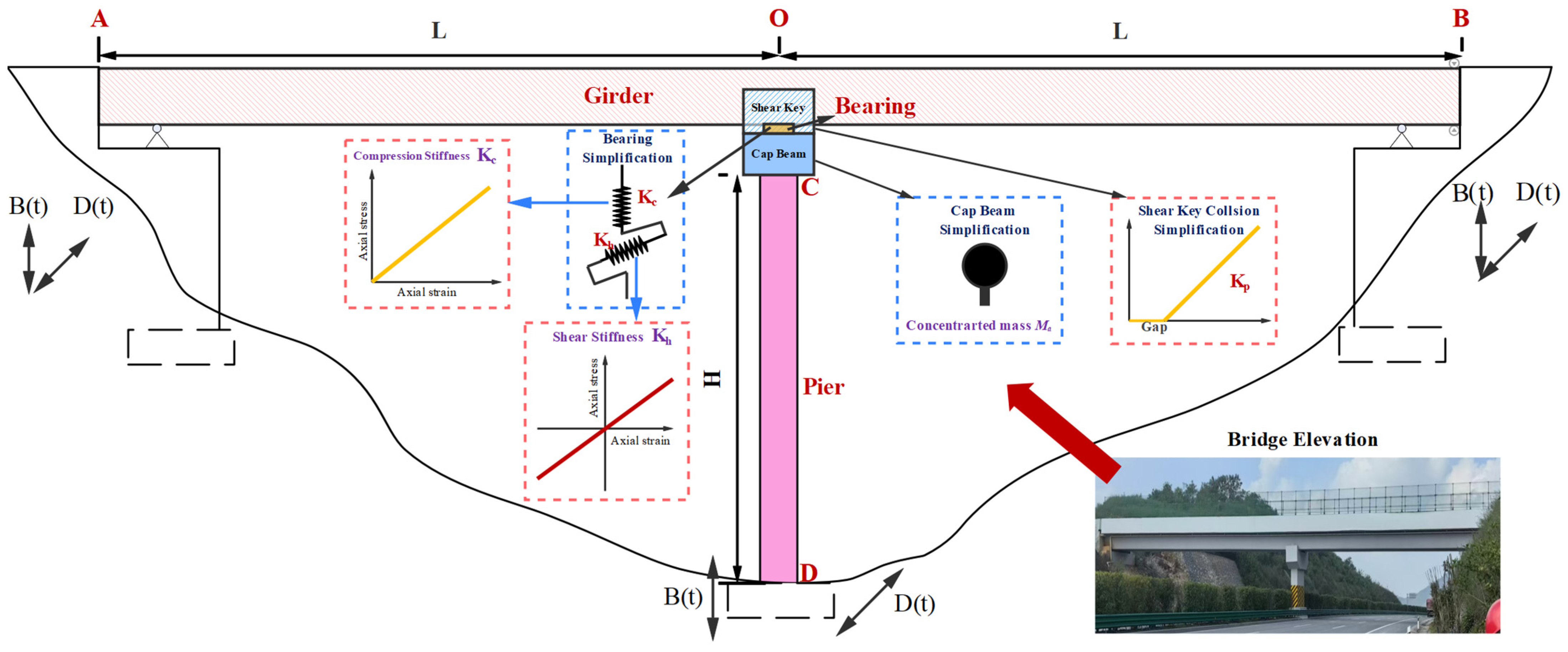
As a fundamental and significant configuration within the girder bridge system, the two-span girder bridge exhibits exceptionally high prevalence in global highway and railway engineering, particularly in the domain of small- to medium-span bridges. Serving as the most elementary building block of multi-span girder bridges, the two-span arrangement is common in practice. It is extensively employed in a wide variety of engineering scenarios, such as crossing rivers, roads, and urban interchange hubs, constituting one of the essential components of modern transportation networks. Therefore, the theoretical model is established based on a two-span reinforced concrete interchange bridge located in Jiangxi Province, China (Figure 1). The bridge components include the girder, bearings, cap beam (with shear keys), and piers. To capture the fundamental mechanical behavior, a simplified modeling strategy is employed within the theoretical framework. The girder is modeled as a Bernoulli-Euler beam for bending. The piers are simplified as St. Venant bars (for vertical deformation) and Bernoulli–Euler beams (for horizontal bending), respectively. The cap beam are represented as concentrated mass. Furthermore, to investigate the limit theoretical response values, the entire bridge structure is assumed to remain in the linear elastic stage throughout the seismic analysis. Therefore, the material plasticity, structural damping, strain rate and energy dissipation effects are not considered in this study [19].
The material density is ρ , the girder span length is L, the equivalent elastic modulus is Eg, the vertical and horizontal moments of inertia are Igy and Igx respectively, and the pier height is H, with an equivalent elastic modulus Ep and moment of inertia Ip. The girder and the cap beam are connected by laminated rubber bearings, whose horizontal and vertical compressive stiffness constraints are taken into consideration. Laminated rubber bearings typically sustain significant vertical loads, resulting in a vertical stiffness (Kc) substantially higher than their horizontal stiffness (Kh). The stress–strain relationship during compression is characterized by a slender hysteresis loop, from which the equivalent vertical stiffness and horizontal stiffness can be derived [21]. The collision between the shear key and the girder was modeled using a gap element combined with a linear elastic model. The cap beam was idealized as a lumped mass M a . Both ends of the girder were considered pinned, while the base of the pier was assumed to be fully fixed. When the girder remained in contact with the bearing, the connection satisfied the kinematic constraint and continuity conditions. Bidirectional seismic excitation was decoupled, with the vertical and horizontal components represented by B ( t ) and D ( t ) , respectively. The detailed theoretical model and corresponding parameter definitions are illustrated in Figure 1.

2.1. Solutions of Horizontal Dynamic Responses

2.1.1. Vertical Contact Stage

During the vertical contact phase, the bending wave response equations for the girder OA, OB and the pier CD are as follows:
O A / O B : E g I g x 4 X i ( x , t ) x 4 + ρ A g 2 X i ( x , t ) t 2 = 0 C D : E p I p 4 X p ( ξ , t ) ξ 4 + ρ A p 2 X p ( ξ , t ) t 2 = 0
where Xi  x , t i = 1 , 2 is the girder horizontal deflection, Xp  ξ , t is the horizontal displacement of the pier, and t is defined as the duration of seismic excitation, which satisfies t 0 , . The girder and pier considered in the present study need to be slender. Moreover, external damping and contact damping are not included in the model.
The dynamic displacement response equations for the girder satisfy the following boundary conditions:
X 1 ( L , t ) = X 2 ( L , t ) = D ( t ) ,   2 X 1 ( L , t ) / x 2 = 2 X 2 ( L , t ) / x 2 = 0 X 1 ( 0 , t ) = X 2 ( 0 , t ) , X 1 ( 0 , t ) / x = X 1 ( 0 , t ) / x , 2 X 1 ( 0 , t ) / x 2 = 2 X 1 ( 0 , t ) / x 2
The dynamic displacement response equations for the pier satisfy the following boundary conditions:
X p ( 0 , t ) = D ( t ) , X p ( 0 , t ) / ξ = D ( t ) / t ; 2 X p ( 0 , t ) / ξ 2 = 0
The continuity conditions in the horizontal direction between the girder and the pier are satisfied:
X P ( H , t ) = X i ( 0 , t ) + E p I p 3 X P ( H , t ) / ξ 3 K h E g I g x 3 X 1 ( 0 , t ) x 3 3 X 2 ( 0 , t ) x 3 E p I p 3 X p ( H , t ) ξ 3 = M a 2 X p ( H , t ) t 2
where Kh represents the horizontal stiffness of the laminated rubber bearing, and Ma denotes the lumped mass of the cap beam.
The displacement of the girder–pier system is decomposed into two components: a quasi-static component and a dynamic component:
X i ( x , t ) = X i s ( x , t ) + X i d ( x , t ) X p ( ξ , t ) = X p s ( ξ , t ) + X p d ( ξ , t )
The partial differential equation set in (5) was solved using the transient wave eigenfunction expansion method [19,20,21]. The total displacement response of the bridge structure can be expanded as follows:
X i ( x , t ) = D ( t ) + j = 1 φ i j ( x ) q j ( t ) X p ( ξ , t ) = D ( t ) + j = 1 φ p j ( x ) q j ( t )
where φ i j , φ p j ( j = 1 , 2 , 3 ) are the bending wave mode functions for the girder OA and OB and the pier CD, respectively. q j ( t ) represents the time function of the bridge structure. D ( t ) denotes the horizontal harmonic seismic excitation, which satisfies: D ( t ) = D 0 sin ( ω 0 + ϕ ) . The dynamic component of the response satisfies the displacement and continuity conditions of the structure.
Substituting Equation (6) into Equation (1) yields the nonhomogeneous equation for the bending wave modes of the structure. The general solution of its homogeneous equation can be expanded as follows:
φ 1 j ( x ) = A 1 sin K g j x + B 1 cos K g j x + C 1 sinh K g j x + D 1 cosh K g j x φ 2 j ( x ) = A 2 sin K g j x + B 2 cos K g j x + C 2 sinh K g j x + D 2 cosh K g j x φ p j ( ξ ) = E 3 sin K c j ξ + F 3 cos K c j ξ + G 3 sinh K c j ξ + H 3 cosh K c j ξ
where Kgj and Kcj denote the number of modes for the girder and the pier, respectively, satisfying K g j = ω j / a x ,   K p j = ω j / c , a x is the phase velocity of the horizontal bending wave in the girder, and c is the phase velocity of the horizontal bending wave in the pier. A1, B1, C1, D1; A2, B2, C2, D2; E3, F3, G3, H3 are the coefficients of the modal functions. Substituting the wave modal functions into the homogeneous boundary conditions and continuity conditions of the dynamic displacement solution, the existence of nontrivial solutions requires the determinant of the coefficient matrix to vanish (det(Z) = 0):
Z = A 1 , B 1 , C 1 , D 1 , A 2 , B 2 , C 2 , D 2 , E 3 , F 3 , G 3 , H 3 T = 0
Solving yields the implicit equation for the natural frequency ωi of the combined structure under co-moving motion:
M 2 ( sin K p j H s h K p j H ) + M 3 ( cos K p j H c h K p j H ) = ( tan K g j L t h K g j L ) + 4 E g I g x K g j 3 / K h
The modal functions of the bridge structures are as follows:
φ 1 j ( x ) = E j A j sin K g j ( x + L ) cos K g j L + s h K g j ( x + L ) c h K g j L φ 2 j ( x ) = E j A j sin K g j ( x L ) cos K g j L s h K g j ( x L ) c h K g j L φ p j ( ξ ) = E j M 2 ( sin K c j ξ s h K c j ξ ) + M 3 ( cos K c j ξ c h K c j ξ )
where Aj satisfies the following:
A j = E p I p [ M 2 ( cos K p j H + cosh K p j H ) + M 3 ( sin K p j H s h K p j H ) ] M a ω i 2 M 2 ( sin K p j H s h K p j H ) M 3 ( cos K p j H c h K p j H ) 4 E g I g x
where M2 and M3 can be solved by the bridge pier boundary condition (3), and Ej can be determined by the orthogonality condition of the composite structure.
Similarly, based on the orthonormality of the bridge structures [19], the temporal differential equation q j ( t ) for the contact phase also satisfies the following:
q j ( t 1 * ) + ω j 2 q ¨ j ( t 1 * ) = Q ¨ j ( t 1 * )
where t 1 * = t t 1 represents the duration of the contact phase, and t1 denotes the separation instant.
External seismic excitation Q ¨ j ( t 1 * ) is as follows:
Q ¨ j ( t 1 * ) = L 0 ρ A g 2 X 1 s ( x , t 1 * ) φ 1 j ( x ) t 2 d x 0 L ρ A g 2 X 2 s ( x , t 1 * ) φ 2 j ( x ) t 2 d x 0 H ρ A p 2 X p s ( ξ , t 1 * ) φ p j ( ξ ) t 2 d ξ
By applying the Laplace transform, the following can be obtained:
q j ( t 1 * ) = q j ( 0 ) cos ω j t 1 * + q ˙ j ( 0 ) ω j sin ω j t 1 * + 1 ω j 0 t 1 * Q ¨ j ( t ) sin ω j ( t 1 * τ ) d τ
Under the initial condition, the initial velocity q ˙ j ( 0 ) and initial displacement q j ( 0 ) of the structure satisfy the following:
q j ( 0 ) = L 0 ρ A g φ 1 g ( x ) X 1 s ( x , 0 ) d x + 0 L ρ A g φ 2 g ( x ) X 2 s ( x , 0 ) d x + 0 H ρ A p φ p ( x ) X p s ( ξ , 0 ) d ξ q ˙ j ( 0 ) = L 0 ρ A g φ 1 g ( x ) X ˙ 1 s ( x , 0 ) d x + 0 L ρ A g φ 2 g ( x ) X ˙ 2 s ( x , 0 ) d x + 0 H ρ A p φ p ( x ) X ˙ p s ( ξ , 0 ) d ξ

2.1.2. Vertical Separation Stage

After the vertical separation, the mid-span of girder AB detaches from the bearings, resulting in the vanishing of the constraint. Thus, the displacement responses of the bridge structures satisfy the following:
A B : E g I g 4 X ¯ ( x , t ) x 4 + ρ A g 2 X ¯ ( x , t ) t 2 = 0 C D : E p I p 4 X ¯ p ( ξ , t ) ξ 4 + ρ A p 2 X ¯ p ( ξ , t ) t 2 = 0
The displacement response equation of the girder satisfies the following boundary conditions:
X ¯ ( L , t ) = X ¯ ( L , t ) = D ( t )   2 X ¯ ( L , t ) / x 2 = 2 X ¯ ( L , t ) / x 2 = 0
The displacement response equation of the pier satisfies the following boundary conditions:
X p ( 0 , t ) = D ( t ) , X p ( 0 , t ) / ξ = D ( t ) / t       2 X p ( 0 , t ) / ξ 2 = 0 X ¯ p ( 0 , t ) = X ¯ p ( 0 , t ) / ξ = 0 , E p I p 2 X ¯ p ( H , t ) / ξ 2 = 0 E p I p 3 X ¯ p ( H , t ) / ξ 3 = M a 2 X ¯ p ( H , t ) / t 2
Similarly, the modal functions of the structures in the separated state are as follows:
φ ¯ j ( x ) = A ¯ j sin K ¯ g j ( x + L ) φ ¯ p j ( ξ ) = E ¯ j sin K ¯ p j ξ sinh K ¯ p j ξ sin K ¯ p j H + s h K ¯ p j H cos K ¯ p j H + c h K ¯ p j H ( cos K ¯ p j ξ c h K ¯ p j ξ )
where K ¯ g j ,   K ¯ p j denote the number of modes for the girder and the pier after separation, respectively, satisfying K ¯ g j = ω g j / a x and K ¯ p j = ω p j / c ; ω g j and ω p j are the natural frequencies of the girder and pier after separation, which satisfy Equation (20):
ω g j = E g I g x ρ A b j 2 π 2 4 L 2 E g I g x K ¯ p j 3 ( 1 + cos K ¯ p j H c h K ¯ p j H ) = ω p j 2 M a ( cos K ¯ p j H s h K ¯ p j H sin K ¯ p j H c h K ¯ p j H )
The temporal differential equations for the girder qgj(t) and pier qpj(t) after separation satisfy the following:
q g j ( t ) = q g j ( 0 ) cos ω g j t 2 * + q ˙ g j ( 0 ) ω g j sin ω g j t 2 * + 1 ω g j t 1 t 2 * Q ¨ g j ( t ) sin ω g j ( t τ ) d τ q p j ( t ) = q p j ( 0 ) cos ω p j t 2 * + q ˙ p j ( 0 ) ω p j sin ω p j t 2 * + 1 ω p j t 1 t 2 * Q ¨ p j ( t ) sin ω p j ( t τ ) d τ
where t 2 * = t t 1 ( t > t 1 ) represents the duration of the separation stage.
At the initial moment of separation, the displacement and velocity remain continuous with those of the previous phase (contact):
q j ( t 1 ) = q g j ( t 1 ) , q j ( t 1 ) = q p j ( t 1 ) q ˙ j ( t 1 ) = q ˙ g j ( t 1 ) , q ˙ j ( t 1 ) = q ˙ p j ( t 1 )
Given that the duration of re-contact after separation is relatively short, and the lateral constraint from the support during re-contact is minimal—thus having negligible impact on collision—the subsequent dynamic response analysis of the bridge structure will continue to use the natural frequencies of the girder and pier after separation for displacement response calculation [20]. This approach not only allows for the completion of response analysis in the following stages but also avoids non-convergence issues caused by overly complex computations.

2.1.3. Horizontal Collision Stage

When horizontal collision occurs, the following interface displacement condition is met:
X ¯ ( 0 , t ) X ¯ p ( H , t ) d 0
where d is the initial gap of the shear key.
The horizontal collision force is calculated as follows:
F ( t ) = K p X ¯ ( 0 , t ) X ¯ p ( H , t ) K p d X ¯ ( 0 , t ) X ¯ p ( H , t ) d 0 0 X ¯ ( 0 , t ) X ¯ p ( H , t ) d < 0
where Kp is defined as the stiffness of collision of shear keys.
For the calculation of collision force, this study employs the convolution integral method to analyze displacement variations induced by external excitation, thereby avoiding the difficulties associated with solving strongly nonlinear equations [19]. The collision process is modeled as the superposition of pre-collision displacement and the displacement change caused by the collision response X ¯ c , which can be expressed as follows:
X ¯ ( 0 , t ) = X ¯ ( 0 , t ) + X ¯ c ( 0 , t )
where X ¯ c denotes the displacement response of the bridge structure during the collision process, which can be decomposed into the girder collision response displacement X ¯ g c ( 0 , t ) and the pier collision response displacement X ¯ p c ( 0 , t ) . It satisfies the impulsive response excitation function of the collision:
X ¯ g c ( 0 , t ) = j = 1 φ ¯ j ( x ) t i t i + 1 F ( t ) 1 m g j ω g j sin ω g j ( t τ ) d τ X ¯ p c ( H , t ) = j = 1 φ ¯ p j ( ξ ) t i t i + 1 F ( t ) 1 m p j ω p j sin ω p j ( t τ ) d τ
where ti denotes the moment when the collision occurs, ti+1 denotes the moment when the collision ends, mgj and mpj represent the horizontal modal masses of the girder and the pier, respectively. The collision force F(t) at each instant during the collision process can then be determined from the relative displacement difference between the girder mid-span and the pier top.

2.2. Solutions of Vertical Dynamic Responses

2.2.1. Vertical Contact Stage

During the vertical contact phase, the bending wave response equations for the girders OA and OB and the axial wave response for the pier CD are as follows:
O A / O B : E g I g y 4 Y i ( x , t ) x 4 + ρ A g 2 Y i ( x , t ) t 2 = 0 C D : E p I p 4 Y p ( ξ , t ) ξ 4 + ρ A p 2 Y p ( ξ , t ) t 2 = 0
Due to space limitations, the detailed derivation process is omitted here. Based on the transient wave eigenfunction expansion method, the implicit equation for the natural frequency μ j of the combined structure is obtained as follows:
E p A p k j p cos k j p H ( tanh k j g L tan k j b L ) = 4 E g I g y k j g 3 ( sin k j p H + E p A p k j p cos k j p H K c )
where Kc is defined as the vertical stiffness of bearings.

2.2.2. Vertical Separation Stage

During the vertical separation phase, the bending wave response equations for the girder AB and the axial wave response for the pier CD are as follows:
A B : E g I g y 4 Y i ( x , t ) x 4 + ρ A g 2 Y i ( x , t ) t 2 = 0 C D : E p I p 2 Y p ( ξ , t ) ξ 2 ρ A p 2 Y p ( ξ , t ) t 2 = 0
During the separation process, the girder and the pier vibrate according to their respective wave modes, while the rubber bearing is unloaded (i.e., carries no force). The solution method for this stage is similar to that used in the horizontal response analysis described above and can be found in Refs. [19,20], so it will not be repeated in this paper. The initial displacement and initial velocity distributions for the separation process are taken as those at the end of the previous contact phase; thus, a continuous solution from the collision process to the separation process can be achieved.

3. Results

3.1. Parameters of Model

The calculated model in this study is based on a two-span continuous girder bridge. The density of the primary structural materials is 2600 kg/m3. The elastic modulus of concrete is 30 GPa, and that of steel reinforcement is 200 GPa. Following the principle of section deformation compatibility and referencing the “Design Specifications for Highway Reinforced Concrete and Prestressed Concrete Bridges and Culverts” (JTG/D62-2004) [26], the equivalent section properties were calculated. The equivalent cross-sectional area (Ag) of the girder is 6.31 m2, respectively. For the bridge pier, the cross-sectional area (Ap) 3.09 m2, respectively, with a concentrated mass (Ma) of 30,720 kg for the cap beam.
GYZ850-171 laminated rubber bearings were selected and installed between the cap beam and the girder [19]. As mentioned above, the stress–strain relationship during compression is characterized by a slender hysteresis loop, from which the equivalent vertical stiffness can be derived. Consequently, in this study, the vertical stiffness (Kc) and horizontal stiffness (Kh) of the bearings were set to 2 × 10 9   kN / m and 2 × 10 6   kN / m , respectively.
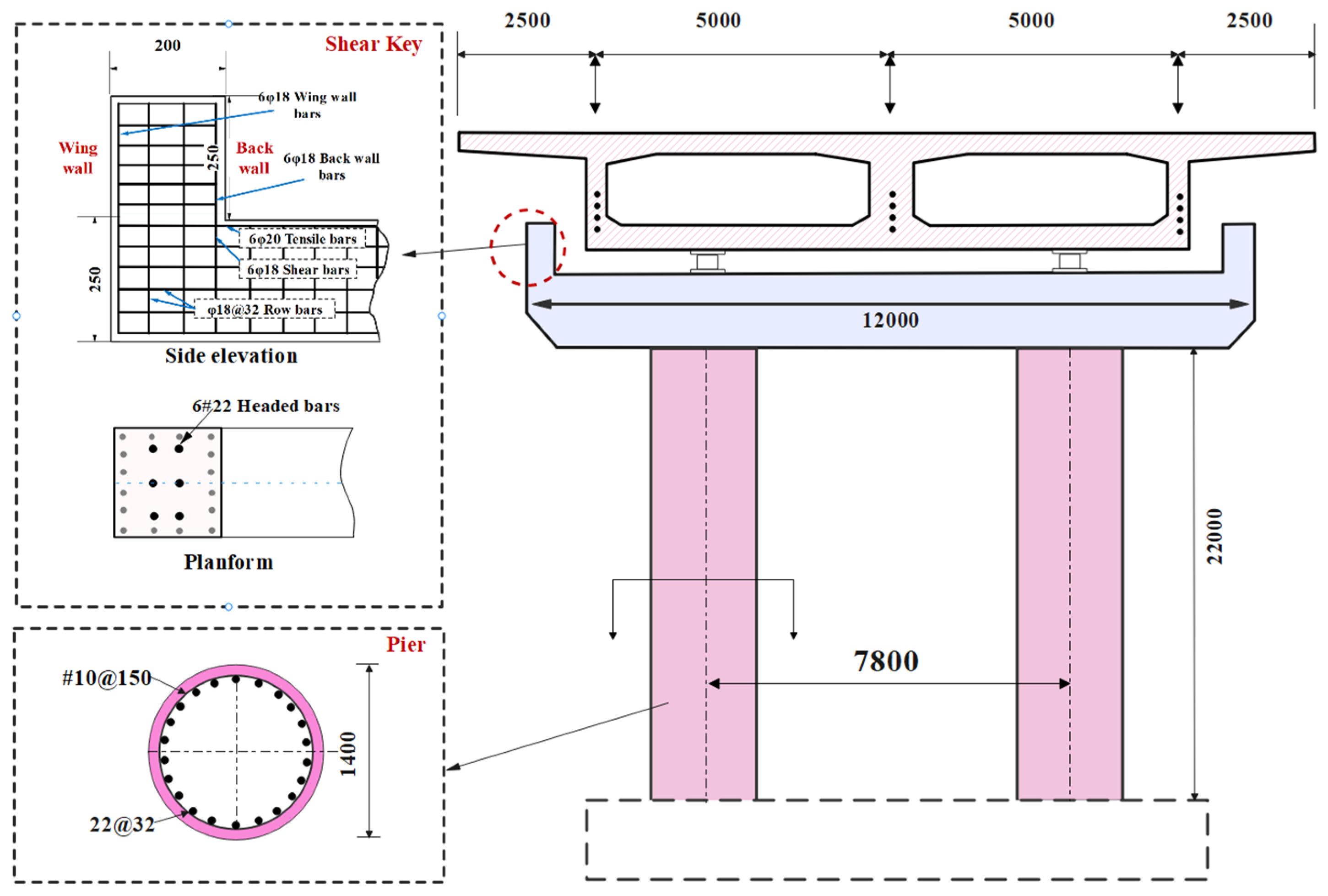
The shear key is designed as a monolithic cast in situ concrete structure. Since the stiffness of the shear key is closely related to its collision position, reinforcement configuration, thickness, and other factors, a rubber buffer pad is introduced at the contact surface to simplify the analysis [21]. The compressive stiffness of this buffer pad, denoted as Kp, is set to 2 × 10 8   kN / m . The initial clearance between the girder and the shear key, d, is set to 100 mm. Detailed reinforcement details and dimensional parameters are provided in Figure 2.
To realistically investigate the seismic response of bridge structures under near-fault seismic excitation, this study considers the relationship characterized by the ratio of vertical to horizontal peak ground acceleration (V/H). Accordingly, a response spectrum of the following form is selected for analysis [27]:
λ = V / H = α       T < 0.1 s α β ( T 0.1 )     0.1 s T < 0.3 s 0.5 T 0.3 s  
In seismic engineering research, ground motion inputs are typically derived from either real earthquake records or artificial harmonic waves. Artificial harmonic waves offer a distinct advantage: their parameters—such as period and amplitude—can be precisely and independently adjusted. This controlled parameterization allows for a clearer and more systematic investigation into the key factors influencing a structure’s transient dynamic response. Meanwhile, the real seismic waves also can be decomposed into an infinite harmonic component via Fourier transform. Therefore, to efficiently study fundamental dynamic behaviors like resonance and amplification effects, this study simplifies the seismic excitation into decoupled harmonic excitations acting in the horizontal, D ( t ) , and vertical, B ( t ) , directions. The specific expressions for the horizontal and vertical harmonic seismic excitations are as follows:
D ( t ) = D 0 sin ( ω 0 t ) , ω 0 = 2 π T h , D 0 = α H ω 0 2 B ( t ) = B 0 sin ( ω 0 t ) , ω 0 = 2 π T v , B 0 = λ α H ω 0 2
where D0 and B0 represent the displacement amplitudes of the horizontal and vertical seismic excitations, respectively, while ω and T denote the excitation frequency and period at horizontal and vertical directions. Based on the geological data of the engineering site, the epicentral distance for this study is set to 3 km. The coefficients in the formula are taken as α = 1.5 and β = 5, with an initial seismic excitation amplitude(αH) of 0.5 g (510 gal). Considering that the peak ground acceleration is predominantly concentrated within the excitation period T range of 0.1 to 0.5 s (the seismic excitation input can be divided into two distinct analytical scenarios, which are considering vertical seismic excitation scenario/bidirectional excitation Tvh and neglecting vertical excitation scenario/only horizontal excitation Th).

3.2. Vertical Separation Conditions

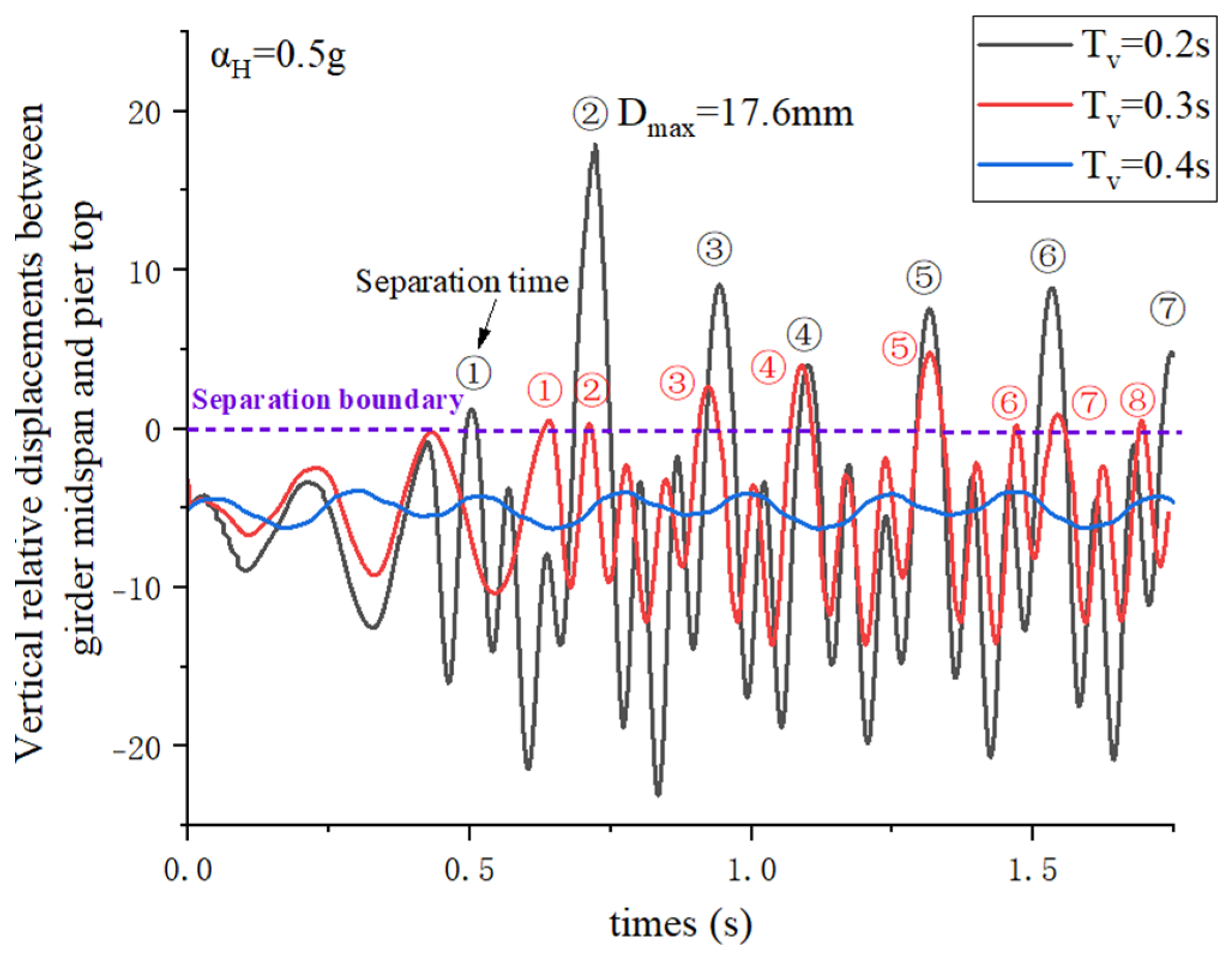
Figure 3 presents the vertical displacement responses of the girder mid and pier top under three vertical seismic excitation periods (Tv = 0.2 s, 0.3 s and 0.4 s). Three sets of curves are included in the figure, corresponding to the displacement variation of the girder mid-span, the pier top, and relative displacements (separation heights) with the change of excitation period, respectively, which can intuitively reflect the relative displacement relationship between the two components. When the excitation period Tv = 0.2 s, the vertical displacement of the girder significantly exceeds that of the pier top. This is accompanied by 7 distinct vertical separation phenomena, with a maximum relative displacement amplitude of 17.6 mm. Under the condition of Tv = 0.3 s, although vertical separation also occurred, both the number of separations and the displacement amplitude are significantly lower than those at Tv = 0.2 s. When Tv = 0.4 s, the displacement of girder mid-span is consistently less than that of the pier top, and no separation is observed. Since the first-order vertical natural vibration period of the structure (T1v ≈ 0.23 s) is relatively close to the excitation period of Tv = 0.2 s, the structure is prone to resonance response in this frequency band, thereby aggravating the degree of vertical separation. These results confirm the occurrence of vertical separation in girder bridges under the considered vertical conditions.
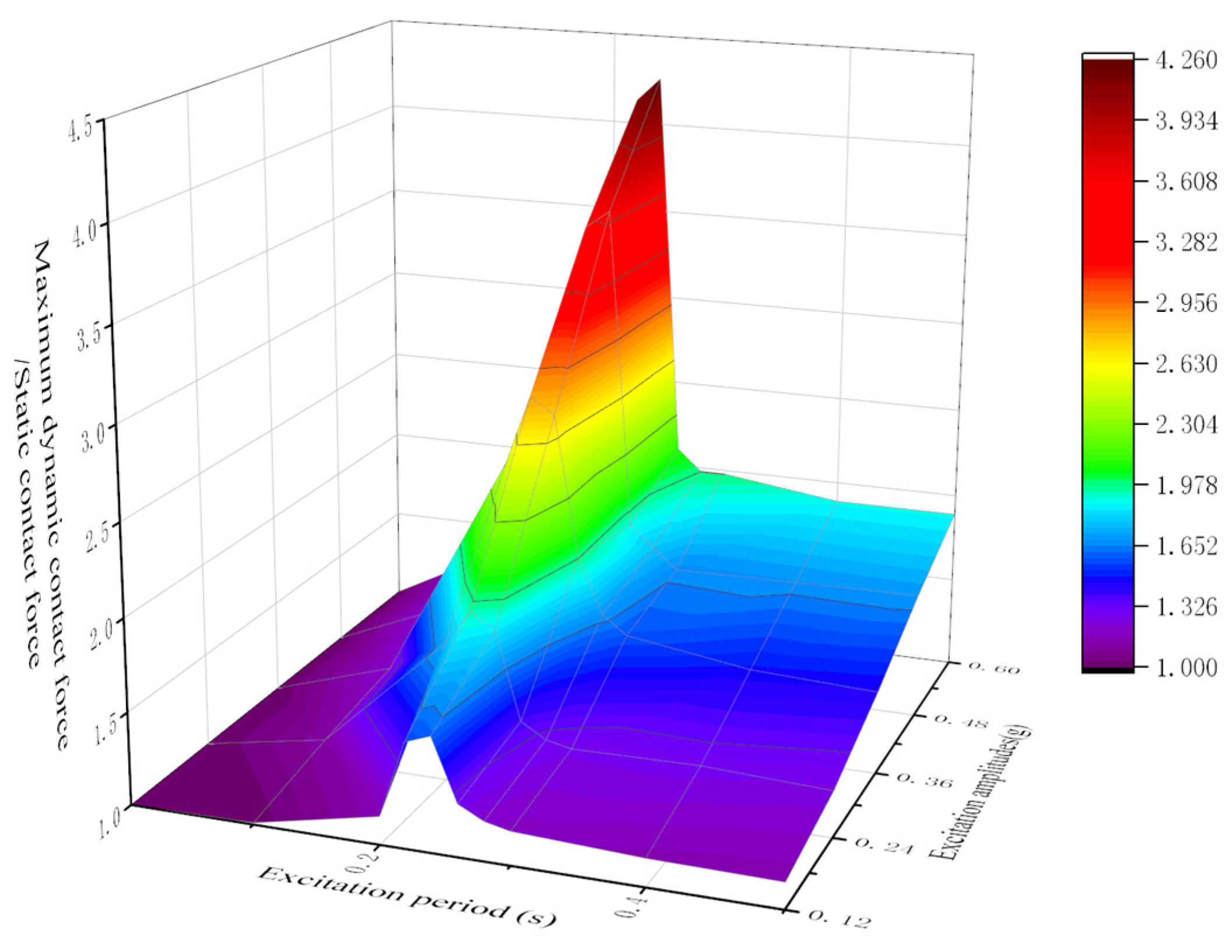
Figure 4 further illustrates the structural responses under different seismic excitation conditions in terms of the contact–separation state. The vertical axis is defined as the ratio of the maximum dynamic vertical contact force to the static contact force (a ratio equal to 1.0 indicates that the structure is in a stable, stationary contact state). When the excitation period T v falls within the range of 0.2 s to 0.3 s, a significant amplification of the vertical dynamic contact force is observed, and its peak value exhibits an approximately monotonic increasing trend with the increase in acceleration amplitude. This phenomenon primarily stems from the dynamic amplification effect (i.e., a notable increase in inertial force) caused by the instantaneous separation of the girder from the bearing under vertical seismic excitation, followed by its subsequent impact upon re–contact. In contrast, when the excitation period deviates from this interval, the ratio of dynamic to static contact force decreases significantly and gradually approaches 1.0.

3.3. Influence of Vertical Excitation Conditions on the Horizontal Dynamic Responses

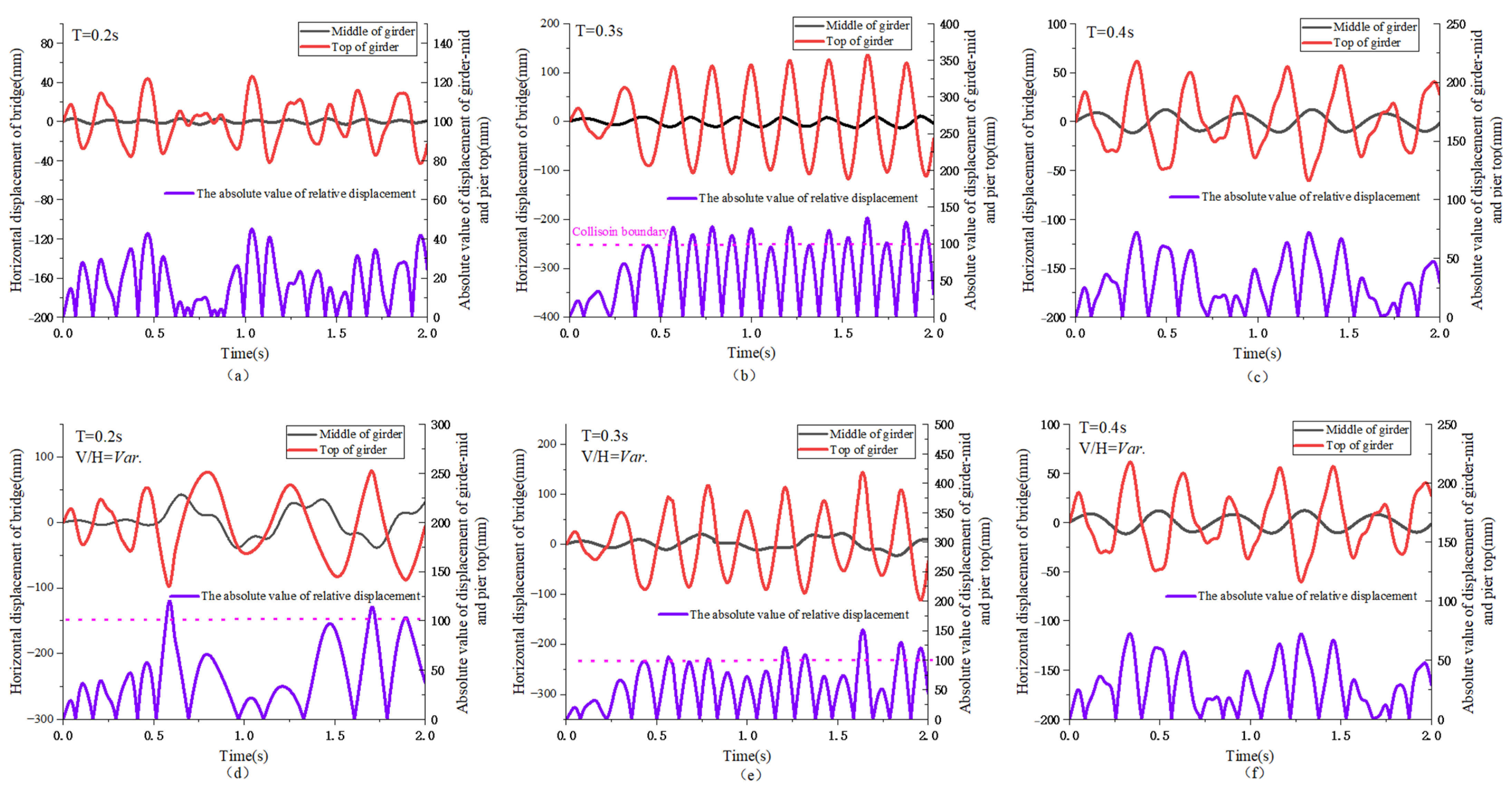
Previous studies have indicated that vertical excitation probably induces separation between the girder and the bearings. Figure 5 presents a comparative analysis of the time–history responses of the horizontal displacements and relative displacements at the girder mid-span and pier top of the bridge under two scenarios: neglecting (Figure 5a–c) and considering (Figure 5d–f) vertical seismic excitations. When the vertical excitation is neglected, pounding between the girder and the shear key occurs only once at Th = 0.3 s, with a maximum relative displacement of 147.8 mm. A total of 11 collision instances is observed throughout the entire process (see Figure 5b). In contrast, under the simultaneous bidirectional seismic excitations, the pounding effect between the shear keys and the girder is significantly intensified: at Tvh = 0.2 s, the peak structural relative displacement reaches 125.1 mm, which is 2.59 times that of the case neglecting vertical excitation (Th = 0.2 s). By T = 0.3 s, the relative displacement considering vertical excitation increases by 11% compared to the case where it is neglected. It is noteworthy that at T = 0.4 s, the displacement time–history responses from the theoretical solutions for the two scenarios essentially coincide. This is because vertical separation did not occur in this condition.
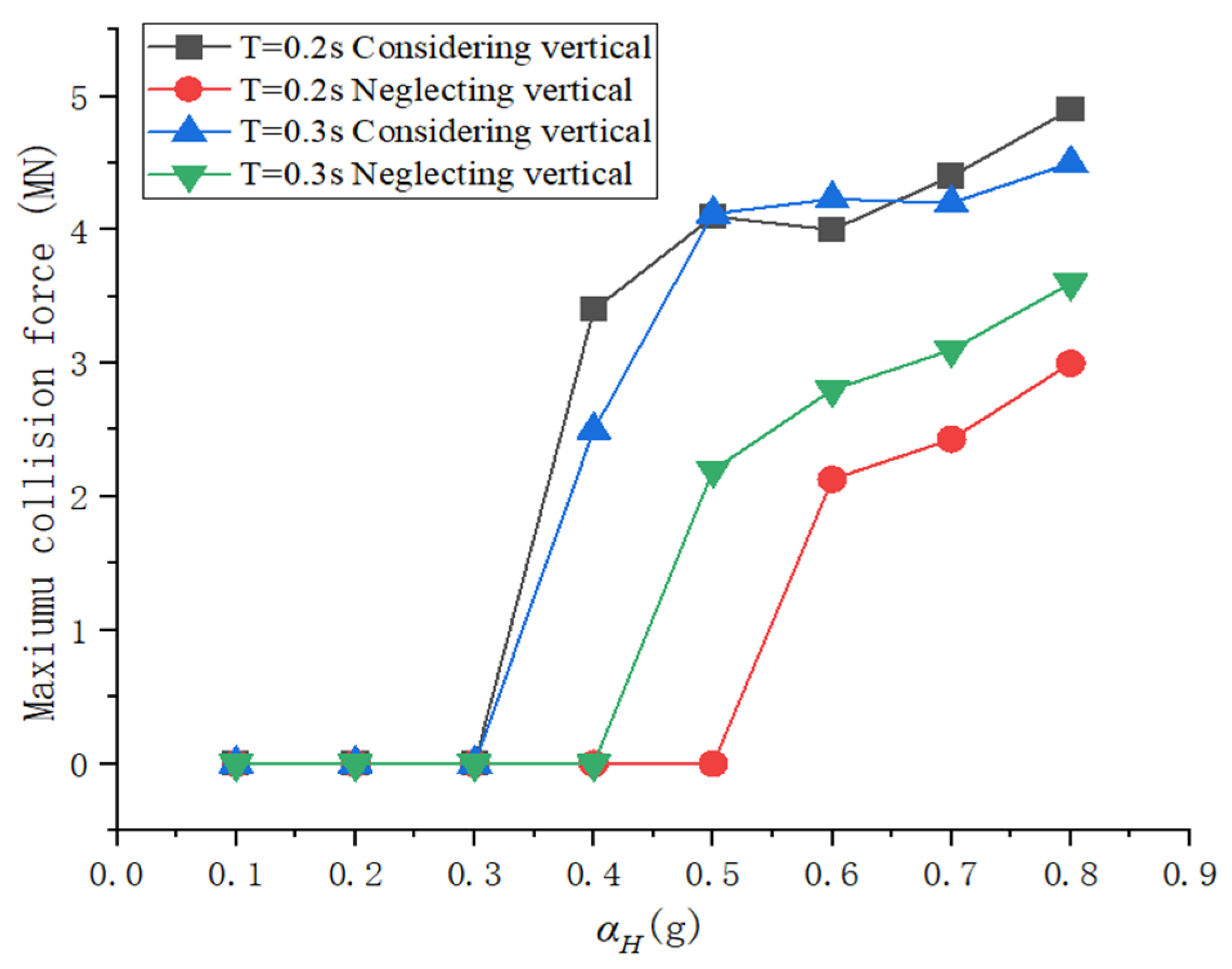
Furthermore, Figure 6 compiles the maximum collision forces under various excitation acceleration amplitudes (αH) ranging from 0.1 g to 0.8 g for two excitation periods T = 0.2 s and 0.3 s. The analysis reveals that when the vertical seismic excitation is neglected, the collision force increases monotonically with the horizontal excitation amplitude. At Th = 0.3 s (neglecting vertical excitation scenarios), significant collision is first observed at αH = 0.5 g, with a maximum collision force of 2.2 MN. When the excitation amplitude reaches 0.8 g, the collision force further increases to 3.6 MN, which is approximately 20% higher than that at Th = 0.2 s. This is primarily because T = 0.3 s is closer to the structure’s first-order horizontal natural period (T1h ≈ 0.31 s), inducing a more pronounced resonant response. However, when bidirectional seismic excitation is accounted for, the collision effect is significantly amplified: at Tvh = 0.2 s with an αH of 0.8 g, the collision force under the condition considering vertical excitation reaches 4.91 MN, whereas it is only 3.01 MN when vertical excitation is neglected—an increase of over 60%. This confirms that vertical seismic excitation can substantially intensify the collision between adjacent structures or components. Similarly, the collision force under the condition considering vertical seismic excitation reaches 4.51 MN at Tvh= 0.3 s. Under the same excitation conditions, the collision force when vertical excitation is neglected is only 79.8% of this value. As revealed by the preceding analysis, the structure experiences vertical separation between the girder and bearings at both characteristic periods of T = 0.2 s and 0.3 s. The data further indicate that this vertical separation significantly amplifies the horizontal seismic response of the structure and exacerbates the risk of collision against the shear keys. However, the dominant mechanisms for the increased seismic response differ between the two periods.
  • At Th = 0.3 s, which is close to the structure’s first-order horizontal natural period, the substantial increase in seismic response is predominantly governed by the horizontal resonance effect.
  • At Tvh = 0.2 s, since this period is closer to the structure’s first-order vertical natural period, the vertical separation becomes the primary factor amplifying the horizontal seismic responses.

3.4. Limit Solution Calculation for the Most Unfavorable Collision Condition

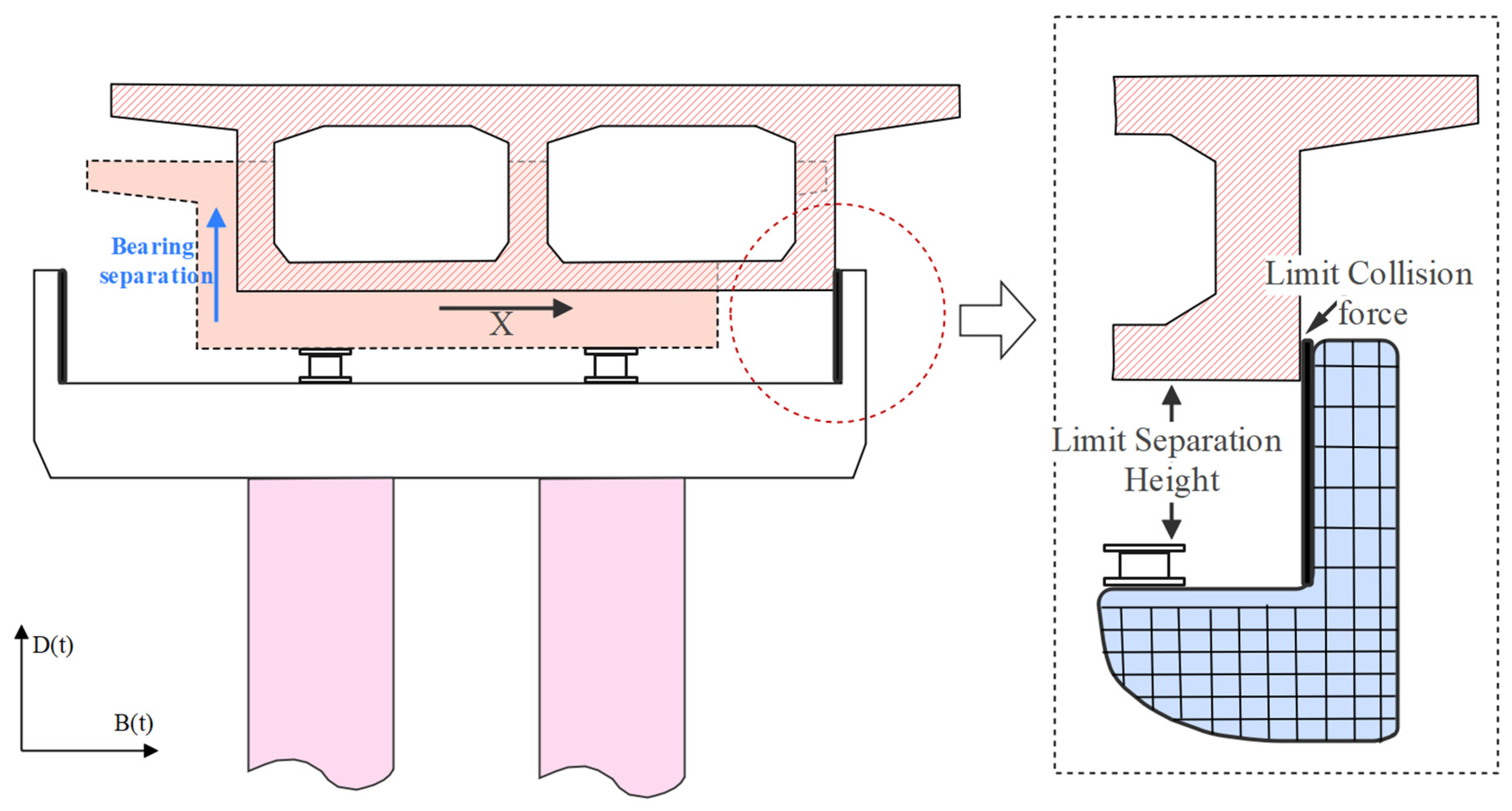
Given that vertical separation has a significant influence on the horizontal response, and that in real seismic excitations, separation and collision phenomena often occur concurrently, this study investigates the coupled effects of the two from the perspective of the most unfavorable condition. Specifically, the instant at which the vertical separation height and the horizontal collision force simultaneously reach their respective limits is identified as the most unfavorable collision condition, and it is assumed that both reach their limiting states synchronously at this instant for coupling analysis. Figure 7 illustrates a schematic of this most unfavorable collision behavior.
Based on the dynamic response expression of the structure, it can be observed that both the separation height and the horizontal collision force are determined by the velocities at the moments of separation and collision. Since the occurrence of separation and collision during an actual earthquake exhibits significant randomness, this study aims to investigate the most unfavorable condition by considering the case where both the separation height and the collision force reach their respective limit values simultaneously. To analyze the limit values of the separation height and the collision force, the following schemes are proposed:
  • Limit separation height: The initial moment of separation is taken as the reference point. Within the time range of one excitation period t T preceding this moment, the maximum relative velocity between the mid-span of the main girder and the top of the pier is collected. This maximum relative velocity is then used to calculate the limit value of the separation height.
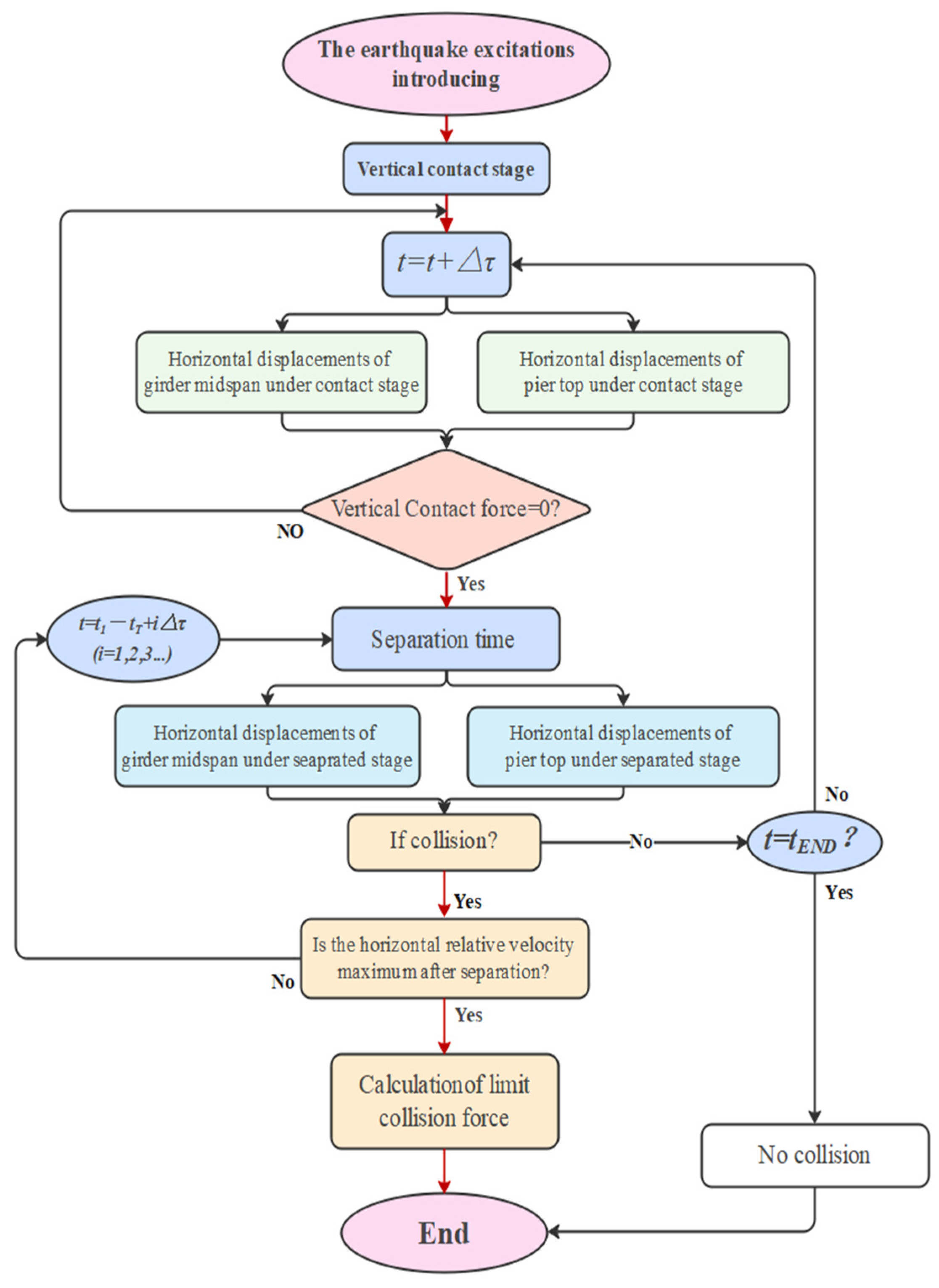
  • Limit collision force: A method analogous to that for separation is adopted. The time range of one excitation period before separation is considered, and it is assumed that separation could potentially occur at any discrete time step Δ τ within this range. For each assumed separation moment Δ τ , the post-separation relative collision velocity is computed using MATLAB (R2024b). The maximum value among all calculated relative velocities is then identified as the basis for determining the limit collision force. The specific procedural flowchart is illustrated in Figure 8.
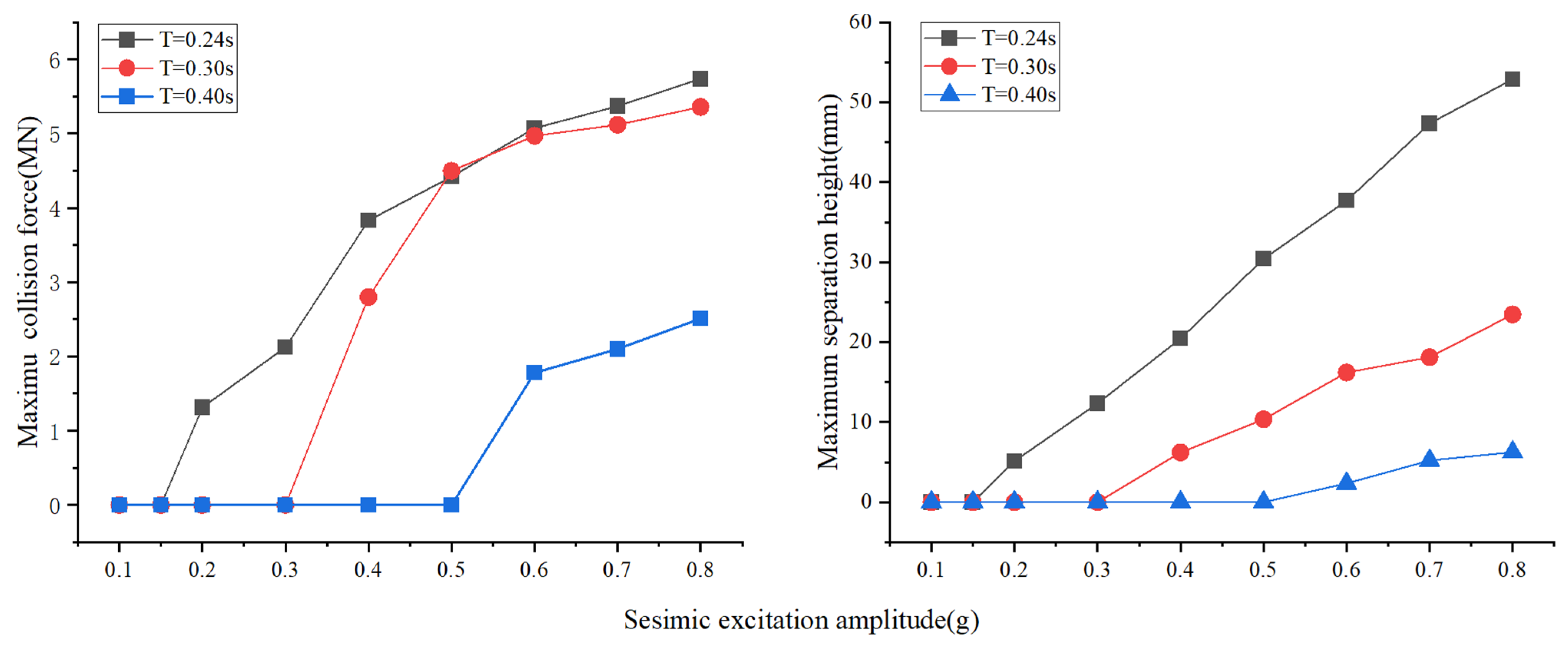
Figure 9 depicts the computed envelope values for structural collision force and separation height under bidirectional seismic excitations, Tvh = 0.24 s, 0.3 s, and 0.4 s, representing conditions near the first-order vertical (T1v), horizontal (T1h), and off-resonant natural periods, respectively. The data reveal a strong correlation between escalating horizontal collision forces and vertical separation events. Limit values for both metrics occur when the excitation period coincides with a first-order natural period (vertical or horizontal), and both increase monotonically with excitation amplitude. A key finding is the divergent growth behavior between these parameters: the limit collision force for Tvh = 0.3 s is similar to that for Tvh = 0.24 s, yet the corresponding growth in separation height is substantially attenuated. This phenomenon can be attributed to the fact that when Tvh = 0.24 s, the intensification of the vertical separation effect leads to a significant increase in the horizontal dynamic response of the structure, which in turn results in an increase in the collision force of the horizontal shear keys. In contrast, the Tvh = 0.3 s case, being closer to the horizontal period, features a smaller vertical excitation amplitude. Consequently, the induced separation is insufficient to contribute meaningfully to the collision force. At an excitation period of 0.4 s, since it is far from the structure’s natural vibration period, both the separation and collision responses are relatively small.

3.5. Influence of Bidirectional Excitation on Failure Modes of Shear Keys

3.5.1. Bearing Capacities of Monolithic Shear Keys

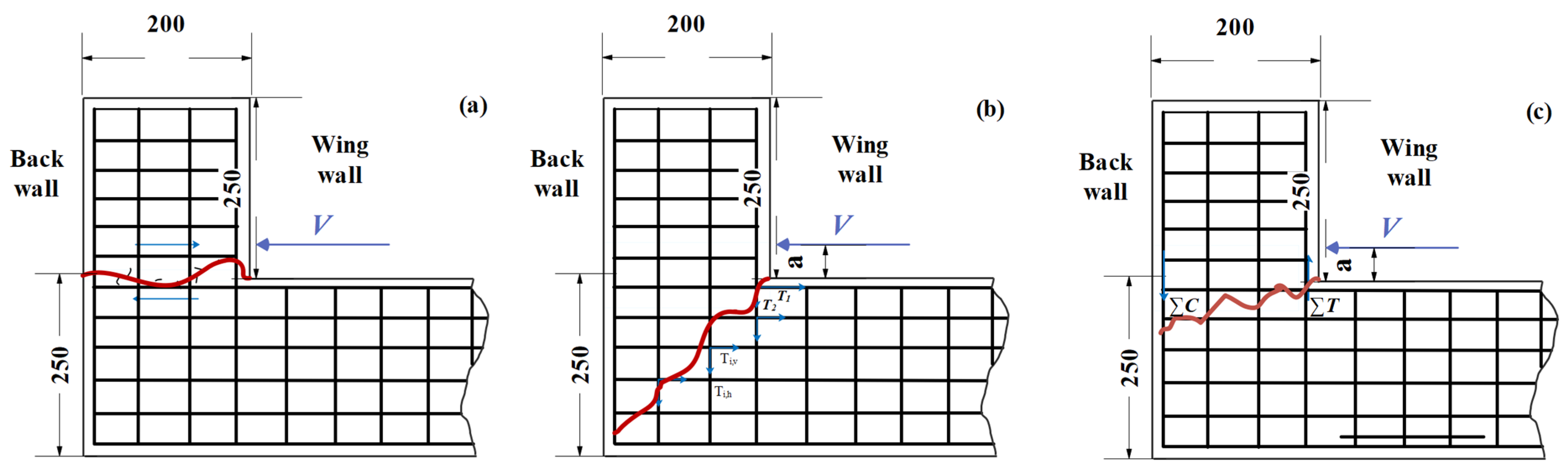
Existing research has identified three predominant failure mechanisms for monolithic shear keys under load: shear friction failure, strut-and-tie failure, and flexural moment failure [28]. These modes are primarily controlled by parameters including the steel strength of longitudinal and transverse bars, the reinforcement ratio, and the point of impact. The corresponding discriminant criteria are formulated as presented in Figure 10.
  • Shear friction bearing capacity VN1
V N 1 = μ ( A v f f v f + A v s f v s )
where μ represents the friction–slip coefficient for the concrete section, which is not a constant but depends on the specific sectional geometry [29,30]. To streamline the analysis, the model established in Reference [4] is utilized herein, which is taken as μ = 1.4λ for cast-in-place monolithic concrete shear keys. For conventional concrete, the coefficient λ is taken as 1.0. Avf, fvs denote the area and yield strength of the vertical rebars passing through the shear plane, respectively, while Avs, fys, represent the area and yield strength of the vertical rebars crossing the interface between the shear key base and the wing wall or back wall on both sides of the base wall (Figure 10a).
2.
Strut-and-tie failure bearing capacity VN2
V N 2 = 0.2 f c b h + A s , 1 f y , 1 h + A s , 2 f y , 2 d + n h A s , s f y , s h 2 2 s + n v A s , s f y , s d 2 2 s ( 1 h + a )
where a is the height from the collision point to the top of the base, As,1 is the total area of the horizontally oriented tensile reinforcement, fy1,2,s is the tensile strength of the reinforcement, As,2 is the total area of the first row of shear reinforcement (as the crack only passes through the first row, with no interaction with subsequent rows of shear reinforcement), and As,s is the cross-sectional area of the horizontal reinforcement. nh, nv represent the number of horizontal and vertical reinforcement faces, respectively (Figure 10b).
3.
Flexural moment bearing capacity M
M = η s 1 η s A s f y j d s
V N 3 = M / a  
where η s is the total number of rows of reinforcement crossing the shear key interface; jds represents the distance from the center of the tensile reinforcement to the center of the compressive reinforcement; As, fy denote the area and strength of vertical reinforcements; j is the bearing capacity evaluation factor of the shear key, taken as 0.9, and h is the height of the shear key (Figure 10c).
4.
Initial bearing capacity of shear keys
By substituting the shear key parameters defined in Section 3.1, Table 1 summarizes the initial bearing capacities corresponding to the three failure modes of the shear key (Vn1, Vn2, M). Meanwhile, to facilitate a horizontal comparison of the evolutionary trends among different failure modes, the flexural moment design value was normalized into an equivalent shear index, Vn3, using Equation (35).
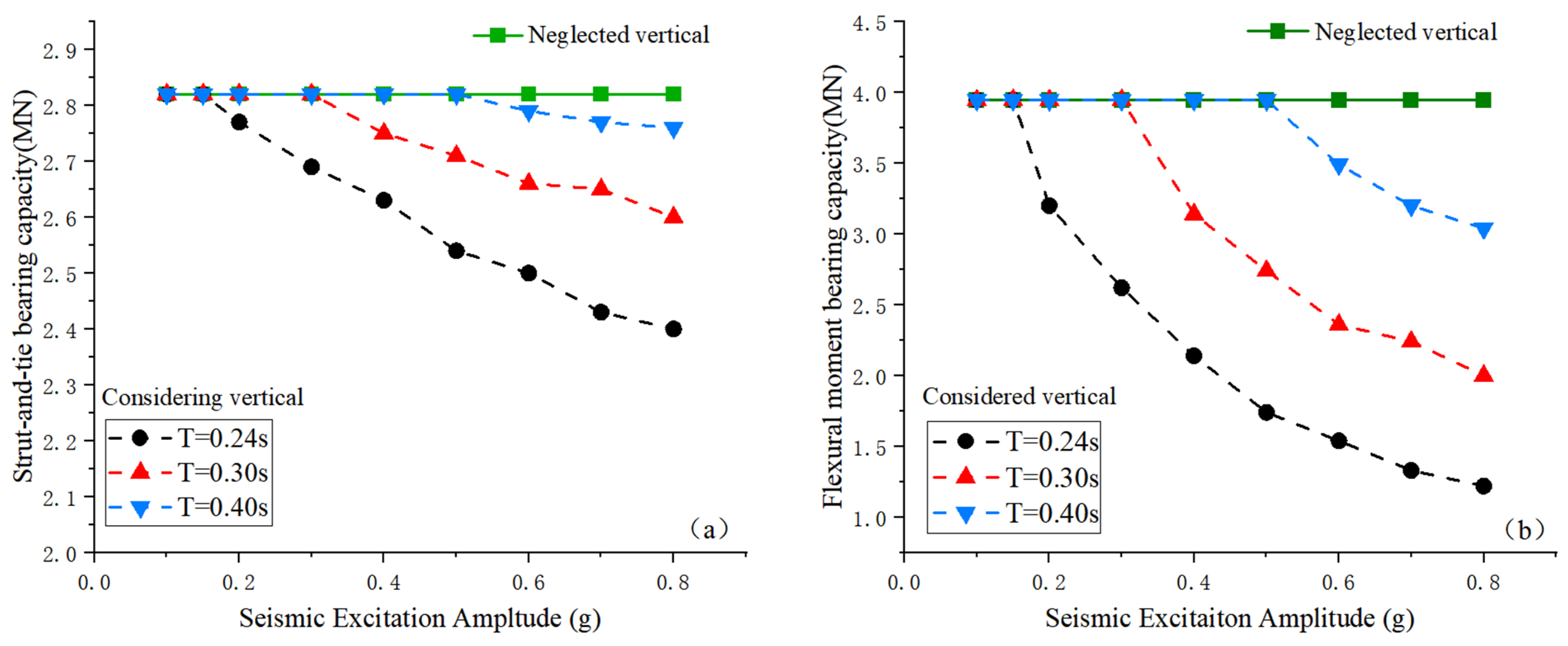
Given that the shear friction bearing capacity of the monolithic shear keys is primarily governed by the strength of the longitudinal reinforcement and concrete (Equation (32)), and thus remains relatively constant, Figure 11 focuses on illustrating the responses of the strut-and-tie and flexural capacities when the shear key undergoes collision under various vertical excitation periods Tv. The results indicate that under different Tv conditions, the variation trends of strut-and-tie and flexural moment capacities are highly consistent: as Tv increases, the bearing capacities of both modes exhibit a monotonic decay. A key finding is that the degradation in bearing capacity becomes particularly pronounced when Tv approaches the structure’s first vertical natural period (T1v). This phenomenon can be attributed to the fact that, under this specific condition, the separation height between the bearing and the girder reaches its maximum, causing the potential pounding point to shift upward and thereby intensifying the collision effect. However, a comparative analysis reveals that the flexural capacity is more sensitive to changes in the collision point. Consequently, its reduction in amplitude is significantly greater than that of the strut-and-tie failure mode. Taking the case of Tv = 0.24 s (corresponding to an excitation amplitude of 0.8 g) as an example, the equivalent shear values for strut-and-tie and flexural capacities drop precipitously to 2.40 MN and 1.22 MN, respectively. At this point, the flexural capacity is merely 50.8% of the strut-and-tie capacity. Similar characteristics have been found across other incentive cycle metrics. In summary, it can be concluded that if the vertical seismic excitation is not considered, the bearing capacity of a shear key is determined solely by its reinforcement detailing and structural strength. However, when vertical excitation is involved, the structure may experience multiple-failure mode transitions due to the occurrence of vertical separation phenomena.

3.5.2. Evolution of Governing Failure Mode in Shear Keys Under Vertical Excitations

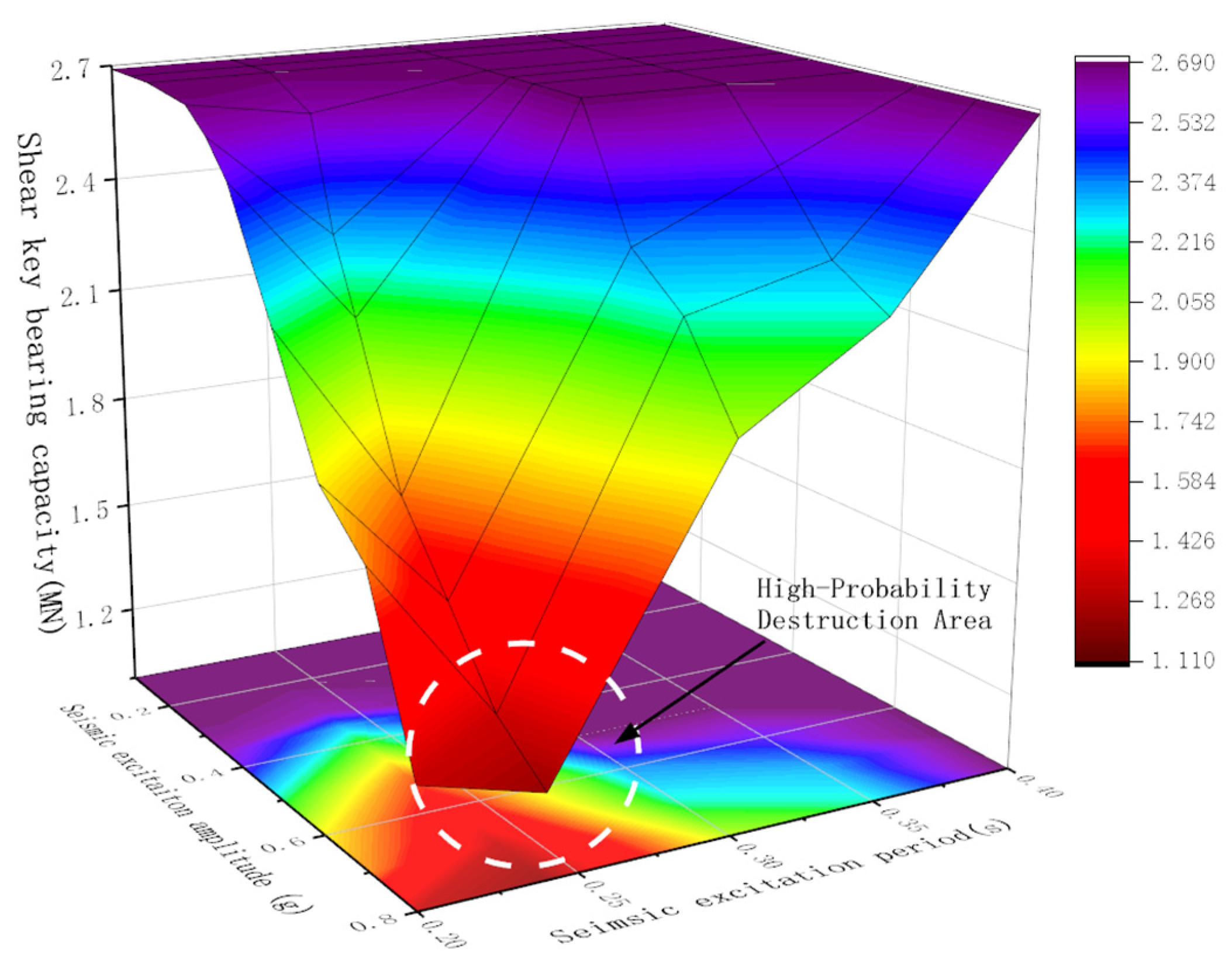
Figure 12 offers a panoramic depiction of their evolutionary trajectory in response to excitation conditions. Initially, under low-amplitude excitation, the shear key is predisposed to shear friction failure due to its inherently limit capacity in this regime. As the excitation amplitude escalates, the separation height between the bearings and the girder intensifies, triggering a precipitous decline in the strut-and-tie (Vn2) and equivalent shear index for flexural capacities (Vn3). This dramatic reduction, in turn, acts as a primary catalyst for the onset of these failure changes. A synthesis of the results reveals a clear hierarchical progression in failure modes with increasing excitation amplitude: an initial prevalence of shear friction failure gives way to dominance by strut-and-tie failure, which is ultimately superseded by flexural failure as the governing mechanism. Significantly, this evolutionary cascade is markedly accelerated and intensified when the vertical excitation period (Tv) converges upon the structure’s first vertical natural period (T1v). At this juncture of resonance, the structural dynamic response is profoundly amplified, propelling the shear key into a high-probability destruction area wherein its load-carrying capacity experiences a catastrophic drop to a mere 41.2% of its initial value, as illustrated by the red highlighted zone in Figure 12. This pronounced discrepancy underscores that flexural failure is likely to emerge as the governing failure mode in the seismic performance assessment of shear keys, especially under the condition of rare earthquakes.
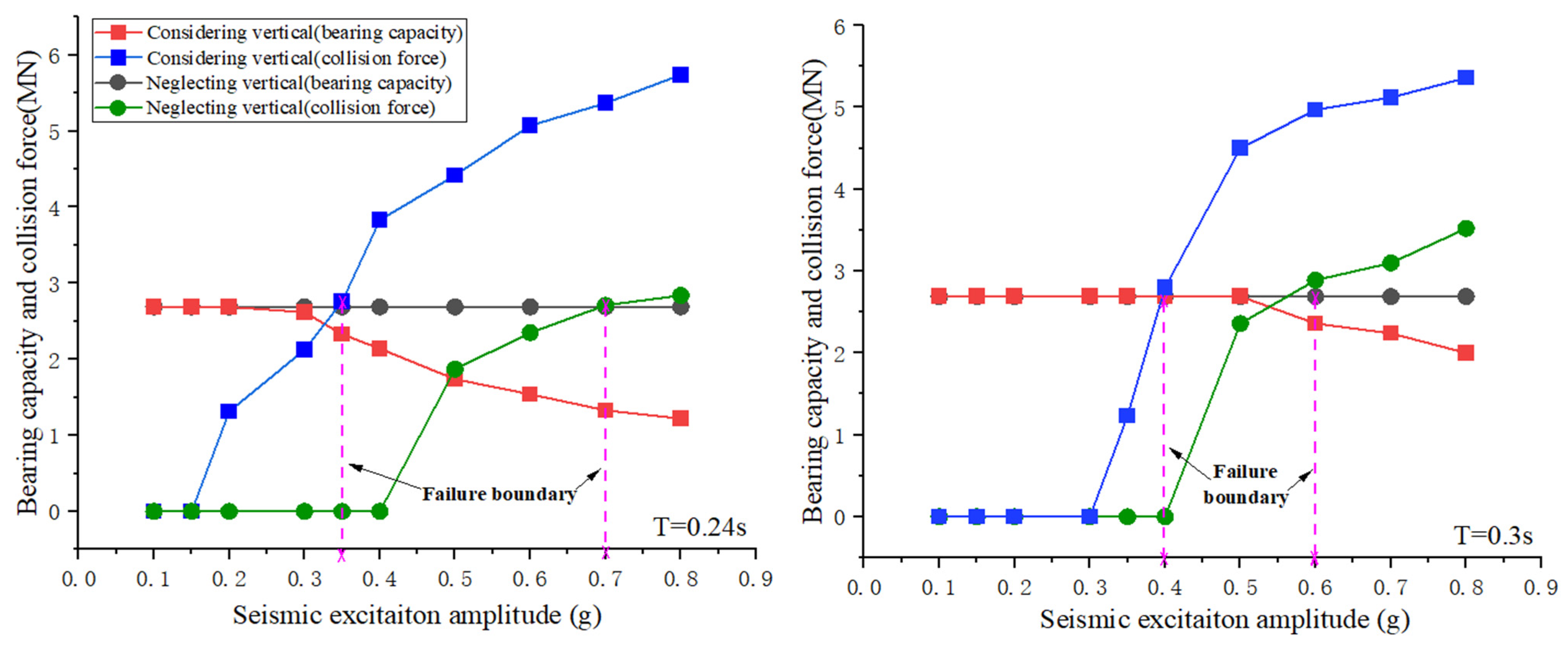
Furthermore, Figure 13 contrasts the collision response and bearing capacity evolution of shear keys under two scenarios. The analysis reveals that vertical seismic excitation exerts a profound influence on failure threshold of the shear keys. For case of Tvh = 0.24 s, the ground motion triggers vertical separation between the girder and the bearings, modifying their contact status. At an excitation amplitude of 0.2 g, horizontal collision initiates between the two components, and its bearing capacity commences a declining trend. When the amplitude escalates to 0.35 g, the collision force surpasses the shear key’s ultimate bearing capacity for the first time, culminating in failure. This failure threshold is markedly lower than the prediction from the Th model (neglecting vertical excitation); at 0.8 g amplitude, the collision force reaches 5.12 times the bearing capacity, inducing severe damage. In stark contrast, the Th model—where the girder and shear key maintain continuous vertical contact—experiences significantly constrained horizontal displacement, postponing the shear key’s initial failure until the excitation amplitude reaches 0.7 g. This comparison unequivocally shows that neglecting vertical seismic excitation grossly underestimates the collision force demand on the shear key in real seismic events, thereby substantially underestimating its failure probability. In the case of Tvh = 0.3 s, a similar reduction in the shear key’s failure threshold under vertical excitation is observed, albeit less prominently than under Tvh = 0.24 s. This is primarily attributed to the fact that this period deviates substantially from the structure’s fundamental vertical natural period T1v, rendering the vertical separation effect induced by vertical ground motion and its amplification of horizontal collision dynamics relatively muted.

3.6. Finite Element Validation

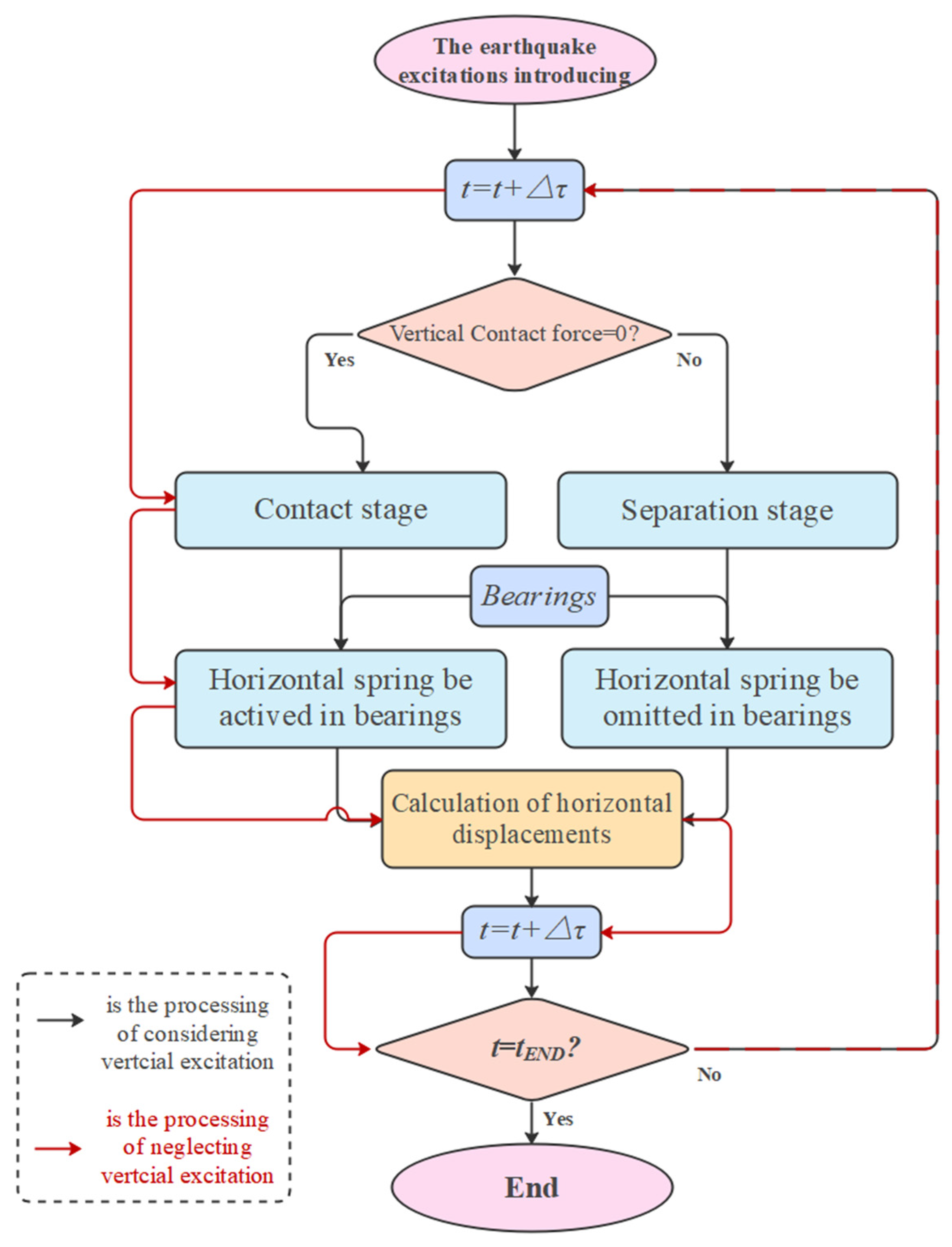
To validate the robustness of the proposed theoretical approach and its analytical outcomes, a three-dimensional dynamic model of the bridge was developed in ANSYS (2021R). The modeling specifications are detailed as follows: Girder ends were idealized as pinned joints with three-degree-of-freedom constraints, and the pier base was fully restrained. The girder, piers, and cap beam were discretized using BEAM4 elements, with the cap beam assumed to be infinitely stiff. For bearing, LINK10 element was implemented in the vertical direction to replicate the uniaxial tensile behavior of the vertical bearings. COMBIN14 spring–damper elements were employed to simulate the lateral stiffness of the bearings and connected to the girder through shared nodes. Shear key adopted the COMBIN40 member to simulate its dynamic behavior under seismic actions. All remaining parameters were kept consistent with those in the theoretical model. Simultaneously, a constant value of the V/H ratio was prescribed as 0.67 for both the theorical and numerical models during the validation process to ensure a consistent basis for comparison. In addition, the same harmonic excitation scheme was adopted in the present verification scheme, with an acceleration amplitude of 0.5 g and a vertical-to-horizontal load ratio V/H set to 1, so as to examine the reliability of the theoretical solution. The specific calculation procedure is illustrated in Figure 14.
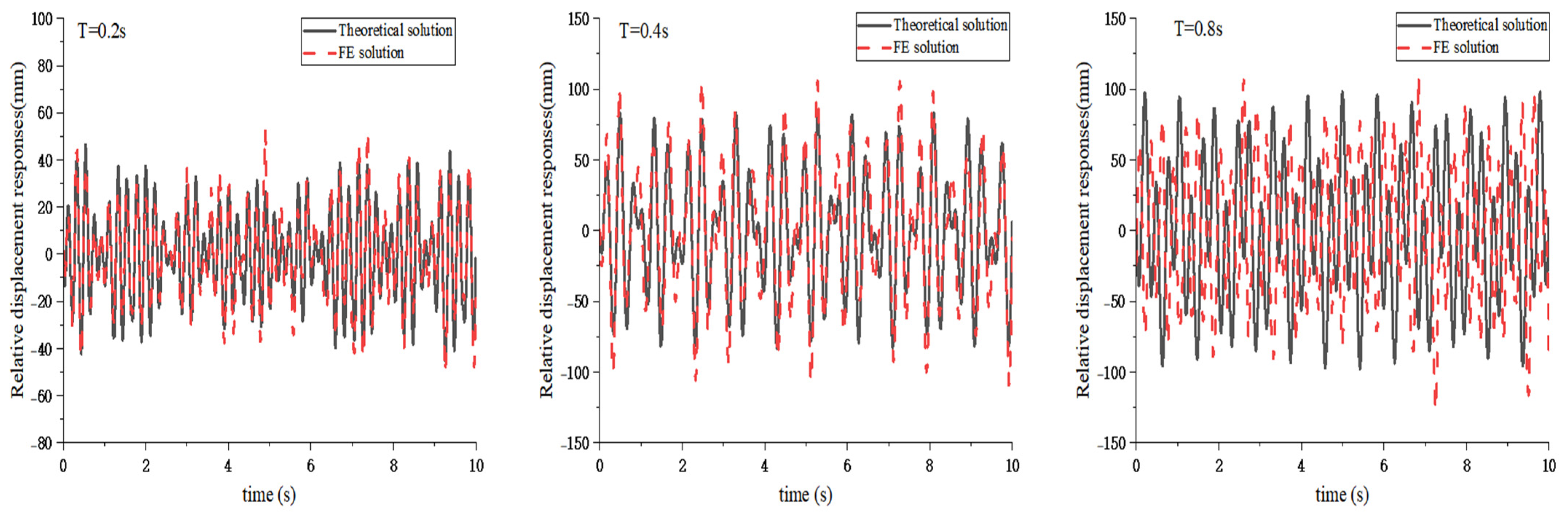
Figure 15 presents the theoretical and FE numerical solutions of the horizontal displacement responses at the mid-span of the girder and at the top of the pier, under excitation periods Th = 0.2 s, 0.4 s and 0.8 s. It can be seen that over a computation duration of 10 s, the two sets of results agree well, with errors confined to the range of 8–12%, and the overall variation trends of the displacement responses are essentially consistent. Under each of the three excitation periods, no horizontal collision phenomenon is observed in either the theoretical or the numerical solution.
The theoretical solution, based on the simplified “beam–spring–beam with lumped mass” decoupled model, tends to be more conservative in handling multi-dimensional dynamics compared to the FE numerical solution. This discrepancy primarily stems from the fact that decoupled calculations underestimate the impact of coupling effects on the bidirectional response of the structure. Nevertheless, theoretical solutions and the finite element solutions demonstrate similar conclusions and trends regarding the evolution of the dynamic bridge response. Compared with the FE approach, which is susceptible to variations in modeling details, the theoretical method possesses a more solid theoretical and methodological foundation and therefore offers higher credibility. It can serve as a reference for guiding further development of numerical methods.

4. Conclusions

This study calculated the influence of vertical separation on the failure mode of shear keys under artificial simple harmonic excitation using the continuum dynamics theory method and verified the effectiveness of the theoretical method in calculating structural dynamic response through FE modeling. The main conclusions are as follows:
  • The study identifies two critical sensitive periods: when the predominant period of the input ground motion approaches the bridge’s fundamental horizontal natural period (T1h), the horizontal dynamic response of the structure is drastically amplified due to resonance effects, leading to a significant increase in the collision force between the girder and the shear key; when the excitation period nears the structure’s fundamental vertical period (T1v), the surge in vertical displacement alters the trajectory of the girder’s motion, causing the collision point on the shear key to rise. This elevation of the collision point reduces the effective shear height of the shear key, thereby diminishing its sectional bearing capacity.
  • Compared to traditional unidirectional (horizontal) seismic analysis, bidirectional seismic input leads to a more complex failure mechanism for shear keys. Specifically, under unidirectional excitation, shear keys may experience relatively singular failure modes such as shear sliding, shear, or flexure. In contrast, under bidirectional seismic action, shear keys are more likely to undergo a “multi-stage failure” process progressing from shear friction to flexural failure. At the rare earthquake level, the probability of monolithic shear keys experiencing flexural moment failure and ultimately losing functionality increases significantly.
  • The FE model employed in this study effectively validates the aforementioned theoretical mechanisms, thereby demonstrating the reliability of the conclusions.
In summary, this study offers novel insights into the seismic design and codification of widely constructed elevated bridges with simply supported or continuous girder configurations. It conclusively demonstrates that neglecting the vertical seismic component may lead to a severe underestimation of the damage risk to shear keys and the overall collapse resistance of girder bridges. Specifically, the vertical separation of girder bridges induced by vertical seismic excitation may lead to a reduction in the bearing capacity of monolithic shear keys. This can transform their failure mode from a single failure into a progressive process involving multiple failures, while significantly increasing the risk of flexural failure. Therefore, in future shear key design, it is essential to fully consider the elevated collision risk caused by vertical seismic excitation and to systematically enhance their shear resistance by optimizing the external structural configuration of the shear keys. Concurrently, current mainstream design codes still lack sufficient consideration for the secondary damage induced by vertical excitation. This study contributes to deepening the theoretical foundation for bridge seismic resistance. However, it should be noted that the analysis in this paper is confined to one- or two-span small and middle-size girder bridges. Although the analytical theory and fundamental viewpoints are analogous for multi-span bridges, their specific characteristics concerning vertical separation and collision are likely more complex, necessitating further investigation. Furthermore, the analytical model employed herein is based on an elasticity assumption, failing to account for the plastic deformation and energy dissipation of structures during actual seismic events. Consequently, the model may not precisely simulate the true dynamic response of the structure under earthquake excitation. More detailed theoretical research will be required to address this aspect in the future.

Author Contributions

Conceptualization, S.C.; methodology, F.X. and H.S.; software, X.L.; validation, G.T. and P.L.; formal analysis, C.W.; data curation, F.M.N. and H.S.; writing—original draft preparation, S.C. and F.X.; writing—review and editing, C.W., P.L. and X.L.; visualization, S.C.; supervision, F.M.N.; funding acquisition, S.C. and G.T. All authors have read and agreed to the published version of the manuscript.

Funding

This work presented herein was carried out with research support from the Sichuan Province University Key Laboratory of Bridge Non-destructing Detecting and Engineering Computing, China (No. 2024QYJ05), Corporate Horizontal Project of Jiangxi Polytechnic Institute, China (2025-JGHX-28), Jiangxi Provincial Department of Education Science and Technology Project, China (GJJ2402901), and 2025 Scientific Research Basic Ability Improvement Project for Young and Middle-aged Teachers in Guangxi Universities (2025KY1107).

Data Availability Statement

All data supporting the findings of this study are available within the paper.

Acknowledgments

The authors gratefully acknowledge all co-authors for their invaluable guidance and contributions.

Conflicts of Interest

Author Chao Wang was employed by the company Xinyu Architectural Design Institute Co., Ltd. The remaining authors declare that the research was conducted in the absence of any commercial or financial relationships that could be construed as a potential conflict of interest.

References

  1. Chen, W.F.; Duan, L. Engineering Seismic Design; CRC Press: New York, NY, USA, 2003. [Google Scholar]
  2. Liu, J.X.; Zhao, G.H. Typical bridge damage analysis in “5·12” Wenchuan Earthquake. J. Archit. Civ. Eng. 2009, 2, 92–97. [Google Scholar]
  3. Peng, J.B.; Ma, R.Y.; Fan, W.; Men, Y.M.; Lin, H.Z.; Deng, Y.H. Science contemplation for Wenchuan Earthquake of 12 May, 2008. J. Earth Sci. Environ. 2009, 1, 1–29. [Google Scholar]
  4. Megally, S.H.; Filva, P.; Seible, F. Seismic Response of Sacrificial Shear Keys in Bridge Abutments; University of California: San Diego, CA, USA, 2001. [Google Scholar]
  5. California Department of Transportation. Seismic Design Criteria, in Version 1.7; California Department of Transportation: Saramento, CA, USA, 2013. Available online: https://dot.ca.gov/-/media/dot-media/programs/engineering/documents/seismicdesigncriteria-sdc/f0007585seismicdesigncriteriasdc17fullversionoeereleasea11y.pdf (accessed on 7 February 2026).
  6. Xu, L.C.; Li, J.Z. Experiment on seismic performance and its improvement of reinforced concrete retainers. China J. Highw. Transp. 2014, 9, 41–48. [Google Scholar]
  7. Kottari, A.; Shing, P.; Bromenschenkel, R. Shear behavior of exterior non-isolated shear keys in bridge abutments. ACI Struct. J. 2020, 2, 225–237. [Google Scholar] [CrossRef]
  8. Wang, C.; Xu, B.W.; Hu, W.B.; Hou, P.; Guan, G.Z.; Cui, F.K. Research on the seismic vulnerability of prefabricated bridge reinforced concrete lateral limit blocks. Transp. World 2024, 1, 16–18. [Google Scholar]
  9. Yang, M.G.; Meng, L.D.; Dai, L.Y. Transverse seismic pounding effect for simply supported girder bridges of high-speed railway considering track constraint. J. Cent. South Univ. 2018, 4, 916–924. [Google Scholar]
  10. Fu, H.; Tian, J.; Chin, C.L. Axial compression behavior of GFRP-steel composite tube confined seawater sea-sand concrete intermediate long columns. Eng. Struct. 2025, 333, 120157. [Google Scholar] [CrossRef]
  11. Fu, H.; Tian, J.; Chen, S.; Chin, C.L.; Ma, C.K. Axial compressive performance of CFRP-steel composite tube confined seawater sea-sand concrete intermediate slender columns. Constr. Build. Mater. 2024, 441, 137399. [Google Scholar] [CrossRef]
  12. Pi, S.M.; Xu, L.Q.; Sun, R.W. Research on bearing-shear key-pier interaction of simply supported girder bridges under earthquake excitation. World Earthq. Eng. 2020, 1, 137–146. [Google Scholar]
  13. Ma, Y.T.; Wang, J.M.; Wu, D.C. Study on the effect of transverse retainers on seismic vulnerability of typical highway continuous beam bridge in high seismic region. Earthq. Resist. Eng. Retrofit. 2022, 5, 67–76. [Google Scholar]
  14. Han, W.F.; Song, C.; Liang, G.Q. Strong ground motion at meizoseismal area & safety of important engineering projects at potential earthquake region. J. Eng. Geol. 2004, 12, 346–353. [Google Scholar]
  15. Papazoglou, A.J.; Elnashai, A.S. Analytical and field evidence of the damaging effect of vertical earthquake ground motion. Earthq. Eng. Struct. Dyn. 1996, 10, 1109–1137. [Google Scholar] [CrossRef]
  16. Tanimura, S.; Heya, H.; Umeda, T.; Mimura, K.; Yoshikawa, O. 3-Dimensional Analysis of Dynamic Behavior of Bearing of Nielsen Bridge. JSME Int. J. 2002, 45, 190–198. [Google Scholar] [CrossRef][Green Version]
  17. Chow, N.; Hao, H. Pounding damage to buildings and bridges in the 22 February 2011 Christchurch Earthquake. Int. J. Prot. Struct. 2011, 2, 123–139. [Google Scholar] [CrossRef]
  18. Nie, L.Y.; Li, J.Z.; Fan, L.C. Effects of dynamic vertical resistance force of sliding bearing of bridges. J. Tongji Univ. 2002, 30, 1290–1294. [Google Scholar]
  19. Yang, H.B.; Yin, X.C. Transient responses of girder bridges with poundings under near-fault vertical earthquake. Earthq. Eng. Struct. Dyn. 2015, 44, 2637–2657. [Google Scholar] [CrossRef]
  20. Yang, H.B.; Yin, X.C.; Xu, R. Effect of bridge bearing on vertical pounding in bridges under near-fault vertical earthquakes. Eng. Mech. 2014, 6, 183–190. [Google Scholar]
  21. Shutong, C.; Mohamed Nazri, F.; Wenjun, A.; Hao, F. Effect of girder-bearing separation on horizontal collision of shear keys under seismic excitations. Struct. Infrastruct. Eng. 2025, 1–15. [Google Scholar] [CrossRef]
  22. An, W.; Zhou, L.; Kang, M.; Yang, H.; Mo, L. Failure mode analysis of bridge pier due to eccentric impact based on separation of pier and beam. Sustainability 2023, 2, 1435. [Google Scholar] [CrossRef]
  23. Kim, S.J.; Holub, J.; Elnashai, A.S. Experimental investigation of the behaviour of RC bridge piers subjected to horizontal and vertical earthquake motion. Eng. Struct. 2011, 33, 2221–2235. [Google Scholar] [CrossRef]
  24. Fu, H.; Zhang, J.; Wu, Z.; Chin, C.L.; Ma, C.K. Nonlinear analysis of axial-compressed corroded circular steel pipes reinforced by FRP-casing grouting. J. Constr. Steel Res. 2023, 201, 107689. [Google Scholar] [CrossRef]
  25. Wu, X.; He, J.; Tian, J.; Liu, M.; Zheng, Y.; Zhang, W.; Wang, R. Multi-scale performance of underwater-castable ultra-high-volume fly-ash eco-friendly engineered cementitious composites: Microstructural characterization, workability, mechanical properties and environmental effects. Constr. Build. Mater. 2026, 506, 144870. [Google Scholar] [CrossRef]
  26. JTG/D62-2004; Specification for Design of Reinforced Concrete and Prestressed Concrete Bridges and Culverts. People’s Transportation Publishing House: Beijing, China, 2004.
  27. Gen, S.W.; Tao, X.X. The ratios of vertical to horizontal acceleration response spectra. Earthq. Eng. Eng. Vib. 2004, 5, 33–37. [Google Scholar]
  28. Bozorgazadeh, A.; Megally, S.H.; Restrepo, J.I. Capacity evaluation of exterior sacrificial shear keys of bridge abatements. J. Bridge Eng. 2006, 11, 555–565. [Google Scholar] [CrossRef]
  29. Wu, X.; He, J.; Tian, J.; Zheng, Y.; Fu, H.; Yuan, J.; Huang, W. Degradation behaviors and damage model of the interface between ECC and concrete under sulfate wet-dry cycling. Constr. Build. Mater. 2025, 476, 141283. [Google Scholar] [CrossRef]
  30. Tian, J.; Zhang, S.; Wu, X.; Zheng, Y.; Yu, W.; Wang, W.W.; Zuo, Y. Study on the comprehensive performances of self-sensing ECC under coupling effect of temperature and load: Microscopic characterization, self-sensing performance, damage self-sensing theoretical model. Constr. Build. Mater. 2025, 499, 144088. [Google Scholar] [CrossRef]
Figure 1. Bridge theoretical model.
Buildings 16 00931 g001
Figure 2. Bridge structural dimensions and parameters.
Buildings 16 00931 g002
Figure 3. Structural vertical displacement responses at Tv = 0.2 s, 0.3 s and 0.4 s.
Buildings 16 00931 g003
Figure 4. The ratio of the maximum dynamic contact force to the static contact force under different excitation separation conditions.
Buildings 16 00931 g004
Figure 5. Time–history responses of girder mid-span and pier top displacements under two scenarios (Neglecting vertical excitations: (ac); Considering vertical excitations: (df)).
Buildings 16 00931 g005
Figure 6. Maximum collision force under two scenarios.
Buildings 16 00931 g006
Figure 7. The most unfavorable collision behavior.
Buildings 16 00931 g007
Figure 8. Limit solution calculation flowchart.
Buildings 16 00931 g008
Figure 9. Limit values of collision forces and separation heights at Tvh = 0.24 s, 0.3 s, and 0.4 s.
Buildings 16 00931 g009
Figure 10. Failure modes of monolithic shear keys. (a): Shear friction failure model; (b): Strut-and-tie failure model; (c): Flexural moment failure model).
Buildings 16 00931 g010
Figure 11. Variation trends of bearing capacities under different excitation conditions. (a) Strut-and-tie bearing capacity; (b) flexural moment bearing capacity.
Buildings 16 00931 g011
Figure 12. Emergence and evolution of governing failure mode in shear keys.
Buildings 16 00931 g012
Figure 13. Comparison of shear key failure conditions under T = 0.24 s and 0.3 s.
Buildings 16 00931 g013
Figure 14. Finite Element (FE) program calculation procedure.
Buildings 16 00931 g014
Figure 15. Comparison of theoretical and FE solutions under excitation periods of 0.2 s, 0.4 s, and 0.8 s.
Buildings 16 00931 g015
Table 1. Initial capacity for each failure mode of monolithic shear keys.
Headed
Bar
Back Wall
Bar
Wing Wall
Bar
Shear ReinforcementTensile ReinforcementShear FrictionStrut-and-Tie *Flexural *
No.Area
/mm2
No.Area
/mm2
No.Area
/mm2
s
/mm
fyArea
/mm2
ds
/mm
VN1VN2MVN3
6228161527615273236015271702.692.82 *78.94 *
* the initial bearing capacity values.
Disclaimer/Publisher’s Note: The statements, opinions and data contained in all publications are solely those of the individual author(s) and contributor(s) and not of MDPI and/or the editor(s). MDPI and/or the editor(s) disclaim responsibility for any injury to people or property resulting from any ideas, methods, instructions or products referred to in the content.