1. Introduction
Climate change is increasingly forcing us to seek ecologically optimal solutions with the lowest possible generation of environmentally harmful CO
2 emissions when designing buildings. On the other hand, our modern lifestyle also requires that the interior spaces of such buildings provide us with the highest possible level of living comfort. Prefabricated timber construction has proven advantages in all these matters over other types of traditional buildings, such as concrete, steel, or masonry, and is also becoming increasingly popular in multi-storey construction [
1]. However, it should also be noted that, particularly when designing multi-storey timber structures, there are certain limitations regarding the maximum possible height or number of storeys of such buildings due to the combustibility of wood and its some specific structural limitations, primarily related to a low modulus of elasticity. Quite a few countries therefore have different regulations limiting the height or number of floors in timber structures. For instance, in Australia, the limit is prescribed according to a maximum effective height of up to 25 m [
2]. On the other hand, in Germany, the new legislation stipulates restrictions based on the number of floors rather than the height of the building and allows the construction of up to five storeys [
3]. In North America, it is usual for timber buildings to be only four storeys high, with five or six storeys occasionally allowed by authorities with local jurisdiction [
4].
The light timber-framed (LTF) and cross-laminated timber (CLT) systems are the most commonly used load-bearing constructions in prefabricated multi-storey timber buildings. Generally, the lateral load-bearing capacity and stiffness are higher in CLT, but in LTF there are, on the other hand, some advantages in thermal resistance. An analysis of the racking stiffness of CLT walls has not been performed in this study; however, their significantly higher stiffness can reasonably be anticipated based on geometric and material characteristics. As shown by the equations presented in
Section 2.1, the racking resistance and stiffness of an element are primarily governed by its effective bending stiffness (Equation (2a)) and shear stiffness (Equation (2b)). The values of the elastic modulus
and shear modulus
for LTF structures are provided in
Table 1, whereas for CLT these parameters amount to
and
, which are considerably higher. In addition, CLT walls are solid, full-panel wall elements, resulting in a larger second moment of area
, which further contributes to their increased racking stiffness. However, because of the relatively low racking stiffness of LTF wall elements, the maximum possible height of such buildings is limited to three or four storeys; however, it also depends on seismic or wind exposure and the form of the building.
In our study, only the racking behaviour of an LTF system under a horizontal point load will be thoroughly analysed. However, it is important to note that the racking stiffness of the LTF element depends on several independent parameters, such as the thickness of the timber frame, the thickness and type (OSB or fibre-plaster) of the sheathing boards, and the type, dimensions, and distribution of the fasteners used to attach the sheathing to the timber frame. All these parameters are studied in semi-analytical form using the Modified Gamma Method (MGM) in [
5], where the results for the in-plane wall stiffness of LTF wall elements with OSB and fibre-plaster sheathing are plotted as an analytical dependence on the fastener disposition (
s). In this method, the flexibility of the fasteners in the sheathing-to-framing connection is taken into account using the γ
y-coefficient, as prescribed in Eurocode 5 [
6], for beam elements. In a very similar way, Technical Committee CEN is currently developing a new proposal for the Eurocode standard for timber structures [
7,
8], including analytical or semi-analytical expressions for all six possible horizontal deformations used to calculate the lateral deflection of LTF elements. However, in both semi-analytical methods, MGM and Eurocode proposals [
7,
8], the main assumption is that Bernoulli’s hypothesis and, consequently, simple-beam theory are applied. Using these methods, LTF wall elements are treated as composite cantilever beams loaded with a horizontal point load at the top of the wall element, which is quite far from the real situation. The methods are, however, relatively simple and, as such, very suitable for design practice, but not especially accurate.
The most accurate computational approach is thus the FEM analysis with elastic spring elements that simulate the deformability of the fasteners in the plane connecting the sheathing boards to the timber frame elements. A two-dimensional approach for the sheathing boards and a one-dimensional orthotropic model for all timber frame elements is considered in this model. Such an approach is the most accurate while it avoids using a simple beam theory for the LTF wall element as it is assumed in both semi-analytical methods. However, this approach is very time-consuming and unsuitable for implementation in the design practice of multi-storey prefabricated timber buildings. Moreover, it always allows a parametric numerical approach depending on the different positions of fasteners in the sheathing-to-framing connection plane. An interesting FEM approach was also demonstrated by Benedetti et al. [
9]. All components of the lateral load–resisting system, including their connections, are explicitly modelled. Structures with one, three, and five stories are analysed using various distributions of lateral load capacity to evaluate their influence on overall structural performance and on the activation of different failure mechanisms through nonlinear static and dynamic analyses. The findings indicate that shear bracket connections—and, in particular, the sheathing-to-framing fasteners—govern the structural response of the buildings, as well as the prevailing failure mode, which is also the primary focus of this study. However, since shear-bracket connections can be considered in a purely analytical manner if necessary and are more intended for design and consideration in actual projects, the basic objective of our study is to consciously exclude this parameter and specifically consider the primary influence of sheathing-to-framing connections. In this sense, three different calculation procedures will be analysed and compared. However, the proposed numerical procedure in [
9] with a very large number of spring elements is still too time-consuming to be applicable for practical engineering use of multi-storey LTF structures.
In order to make the FEM model more useful for practical engineering applications and to essentially reduce the calculation time, a newly developed FEM 2D Hinge Model is presented in this study, where the sheathing-to-framing flexibility is taken into account by evenly and uniformly distributing the flexibility in the connection plane. The obtained numerical results are finally compared with those obtained with the MGM and with the FEM Spring Model. The results for the in-plane single-panel LTF wall element stiffness (
R) calculated in this way can then be further very easily applied directly to the analysis of multi-storey timber structures, as has already been demonstrated in numerous numerical examples [
10], albeit by using different and much older calculation procedures for (
R).
2. Theoretical Backgrounds
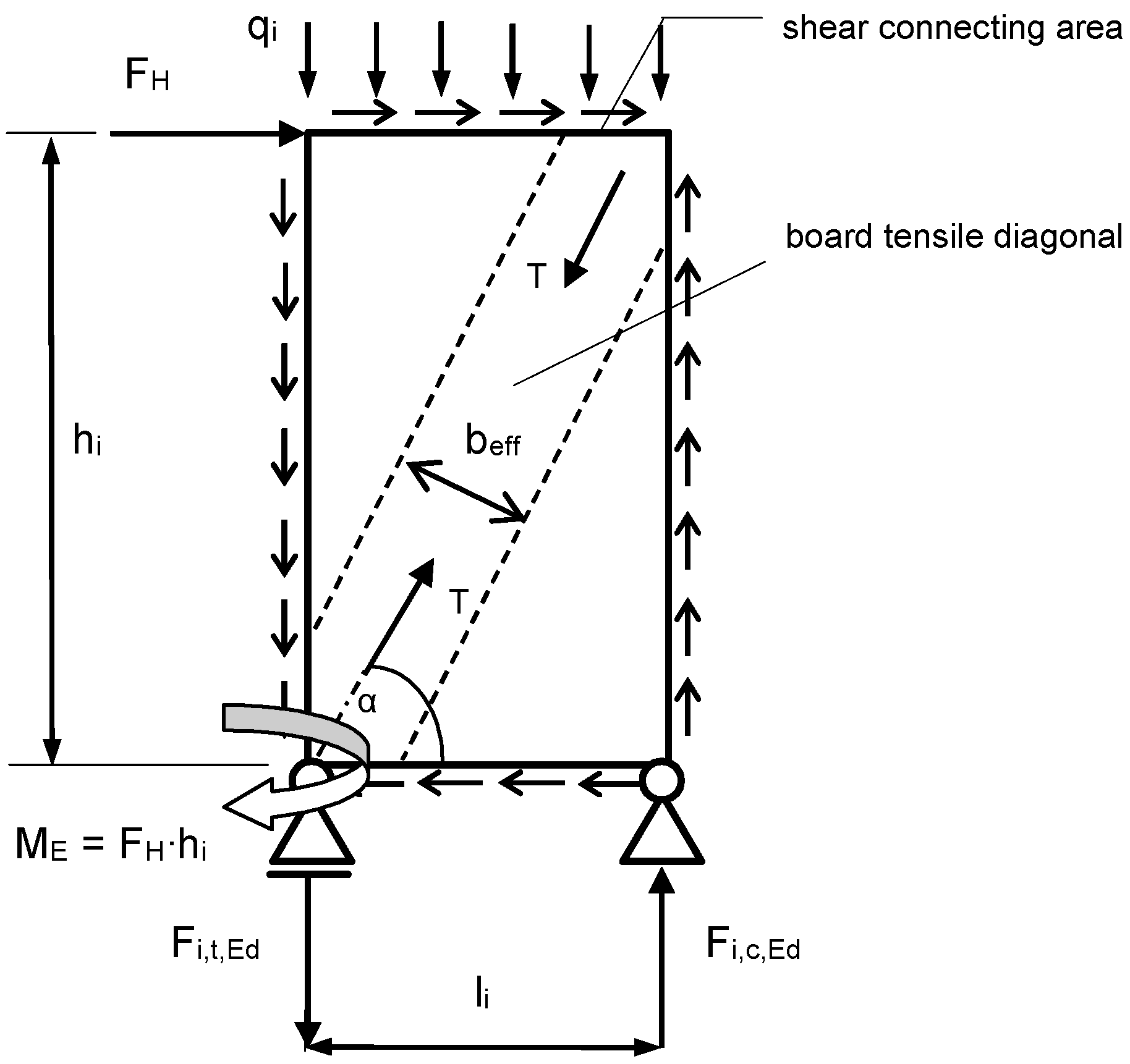
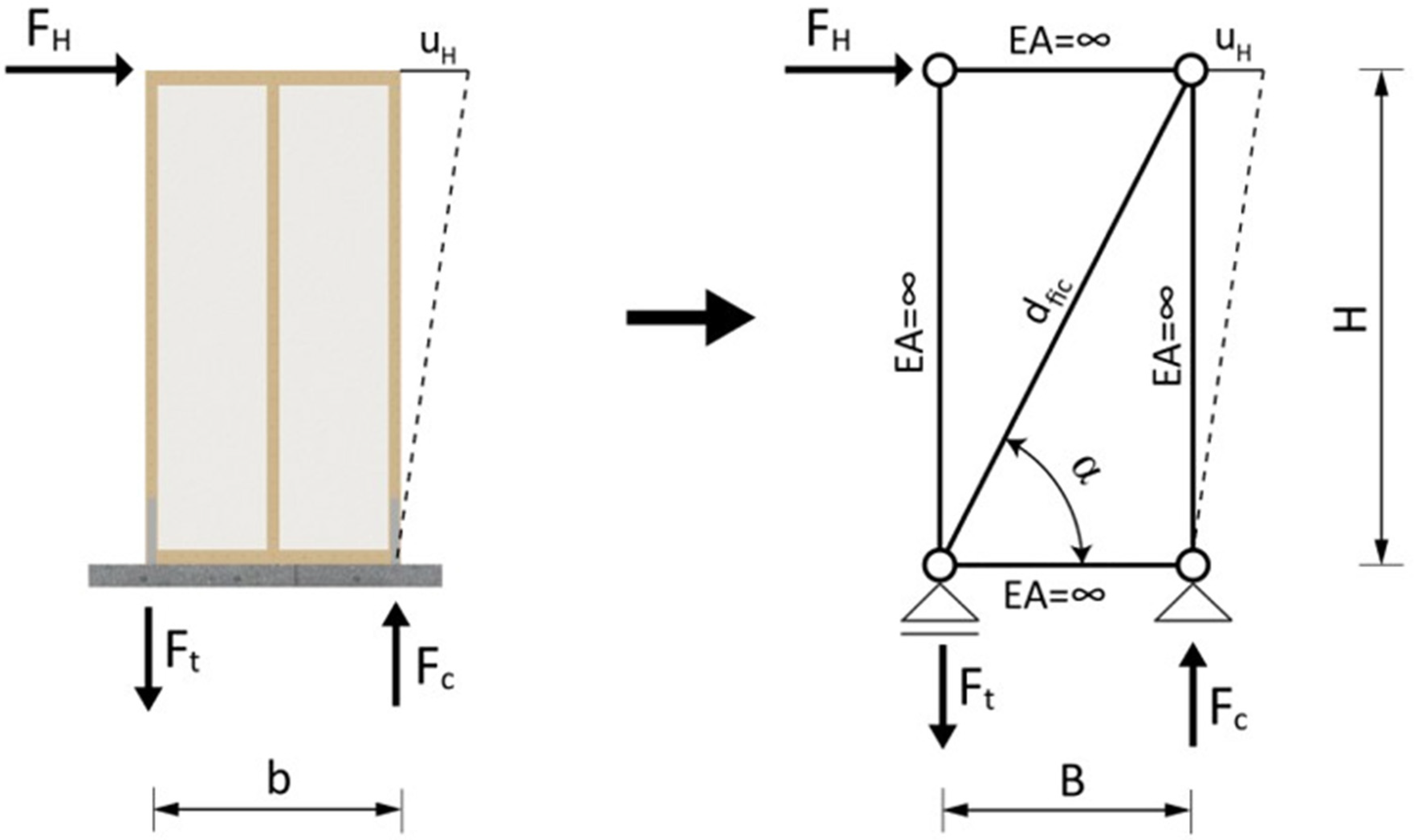
Since we will use both semi-analytical calculations with the previously developed MGM and later FEM calculations to validate the results in the study, the analytical transfer of the influence of horizontal load through a composite wall LTF element will first be presented in this section. From the schematic presentation in
Figure 1, we can see that the horizontal force (
FH) impact is first transferred via shear flow in the connection plane between the sheathing panels and the timber frame elements, where, due to the flexibility of the fasteners, certain shifts and consequent horizontal deformations naturally occur. Consequently, two basic horizontal displacements appear in such a case: the in-plane bending (
uB) and the in-plane shear (
uS). However, since mechanical metal fasteners are flexible in timber mass, the first additional horizontal displacement occurs in this case, which is the result of the mutual rotation of the sheathing panel relative to the timber frame. This horizontal deformation can be referred to as sheathing-to-frame deformation (
uN). The horizontal force is then transferred via a fictitious tensile diagonal (
T) of the sheathing board material to the lower support.
Figure 1 presents the basic Eurocode 5 [
6] assumptions, where all support elements (tension and compression supports with forces
Fi,t,Ed and
Fi,c,Ed) are presented as infinitely rigid, which is, however, not a realistic situation, and in certain cases it is necessary to take into account these two flexibilities with additional horizontal displacements as well. Some expressions for taking these two flexibilities, rocking (
uR) and bottom compressive rail deformation (
uC), into account were developed in [
10] based on experimental and numerical analyses as well. Further, they were implemented in a three-storey LTF timber building in [
11], with particular emphasis on the resulting reduction in horizontal stiffness and the consequent increase in the fundamental oscillation period of the supporting structure of the entire timber building. There is also one another flexibility that must be additionally considered: the rigid-body sliding of the shear wall (
uA) which is, however, not considered or numerically analysed in [
10,
11].
The CEN Technical Committee is currently in the final stages of developing new expressions for determining all six possible horizontal displacements resulting from horizontal point load on LTF wall elements. The expressions are both analytical and semi-analytical [
7,
8] and are presented in Equation (1) in the forms of
where
(EIy)eff,LTF represents the effective bending stiffness of the timber frame, and
Gp and
tp represent the shear modulus and the thickness of the sheathing boards. The geometrical values (
hi,
li) are schematically presented in
Figure 1.
The slip between the sheathing boards and the timber frame elements is approximated by the slip modulus of all fasteners, Kser,1 and Kser,2, in Equation (1c) by fastening both two-sided sheathing boards with mechanical fasteners (staples or nails) to the timber frame. The slip modulus of the shear connectors (Ka,x,j) and the the slip modulus of the anchors (KR), which prevent uplifting of LTF elements, are used in Equation (1d) and Equation (1e) to simulate both flexibilities.
However, it should be emphasised that both basic Equations (1a) and (1b) use Bernoulli’s simple-beam theory hypothesis for a vertical cantilever element, which is a rather rough assumption in this respect. Such an LTF wall element is actually a composite, in-plane, two-dimensional wall and not a bending, linear system at all. Consequently, although this calculation method is fairly simple and useful for engineering practice for LTF designers, it is not sufficiently accurate, as it does not describe the actual racking behaviour of such a composite LTF element in a completely satisfactory manner.
2.1. Semi-Analytical Approach Using the Modified Gamma Method (MGM)
The Modified Gamma Method (MGM) is used to calculate all horizontal displacements and horizontal stiffness of LTF wall elements. The main difference from the semi-analytical methods described in refs. [
7,
8] is that, in this case, the wall element is treated as a composite element, where the slip in the connecting plane is taken into account by the so-called
γy-coefficient from the Eurocode 5 standard [
6], which considers the flexibility of the fasteners. The effective bending stiffness
(EIy)eff and the shear stiffness
(GAs)eff of mechanically jointed beams, therefore, can be written in the analytical form of
Since the gamma (
γy) coefficient is used to take into account the flexibility of the fasteners and the calculation procedure for determining the flexural and shear stiffness follows the provisions of the Eurocode 5 standard [
6], the method is called the Modified Gamma Method. However, it is important to note that the method still uses the simple-beam theory of cantilever beams to calculate all stiffnesses, as previously described in [
10,
11]. It is important to note that in the MGM, term (1c), which takes into account the fasteners’ flexibility, is omitted, as this is already taken into account via the γ
y-coefficient in the terms for both stiffnesses (2a) and (2b).
With respect to Eurocode 5 [
6],
γy can be defined via the fastener spacing (
s) and the slip modulus per shear plane per fastener (
K) in the semi-analytical form of
Expression (3) for the γ
y-coefficient is derived from the differential equation describing partial composite action, based on the fundamental assumptions originally proposed by Möhler [
12]:
Bernoulli’s hypothesis is valid for each timber frame and sheathing board element.
The slip stiffness is assumed to be uniform over the entire connection length of the element, which implies that the fasteners are evenly spaced.
All structural components demonstrate completely linear-elastic material behaviour.
In the MGM, sheathing-to-framing deformation is accounted for through the γy-coefficient described in Equation (3), where the stiffness of an individual fastener is represented by the variable Kser and the spacing between fasteners by the value s. The value of γy theoretically ranges between 0 (fully deformable connection) and 1.0 (fully rigid—glued—connection).
Using these general assumptions, the racking displacements due to the bending moment (
ME =
FH∙hi) and the shear force (
VE =
FH) can be further calculated in the analytical form of
It is optionally possible to also consider the contribution of the rigid-body translation caused by the shear connectors of LTF elements to the bottom rail deformation (
uC, Equation (1f)), the rocking of the anchors (
uR, Equation (1e)), and the sliding of the shear connectors (
uA, Equation (1d)). The total racking displacement (
u) at the top of the LTF element is then expressed in the form of
If all supports in
Figure 1 are considered completely stiff and the consequent displacements
uA,
uR, and
uc are set to zero, the racking stiffness (
R) of the analysed LTF single-panel wall element using the MGM can finally be calculated in the form of inverse values of wall flexibility (
D):
The main benefit of this method is that it provides an analytical expression for the racking stiffness of the entire LTF element as a function of the fastener spacing s. A fully accurate contribution of the sheathing-to-framing deformation term alone, as given, for example, in Equation (1c), can be obtained in the MGM by comparing the displacement calculated using Equation (4), once with the γy value corresponding to the actual fastener arrangement and once with γy = 1.0.
This aspect was already analysed in a previous study [
5], where the partial influence of this deformability on the bending and shear deformation components of the LTF element in Equation (4) was examined separately. The influence of nonlinear fastener behaviour could also be incorporated into the MGM by systematically reducing the value of
Kser, which is precisely the subject of our ongoing and future studies.
2.2. FEM Spring Model
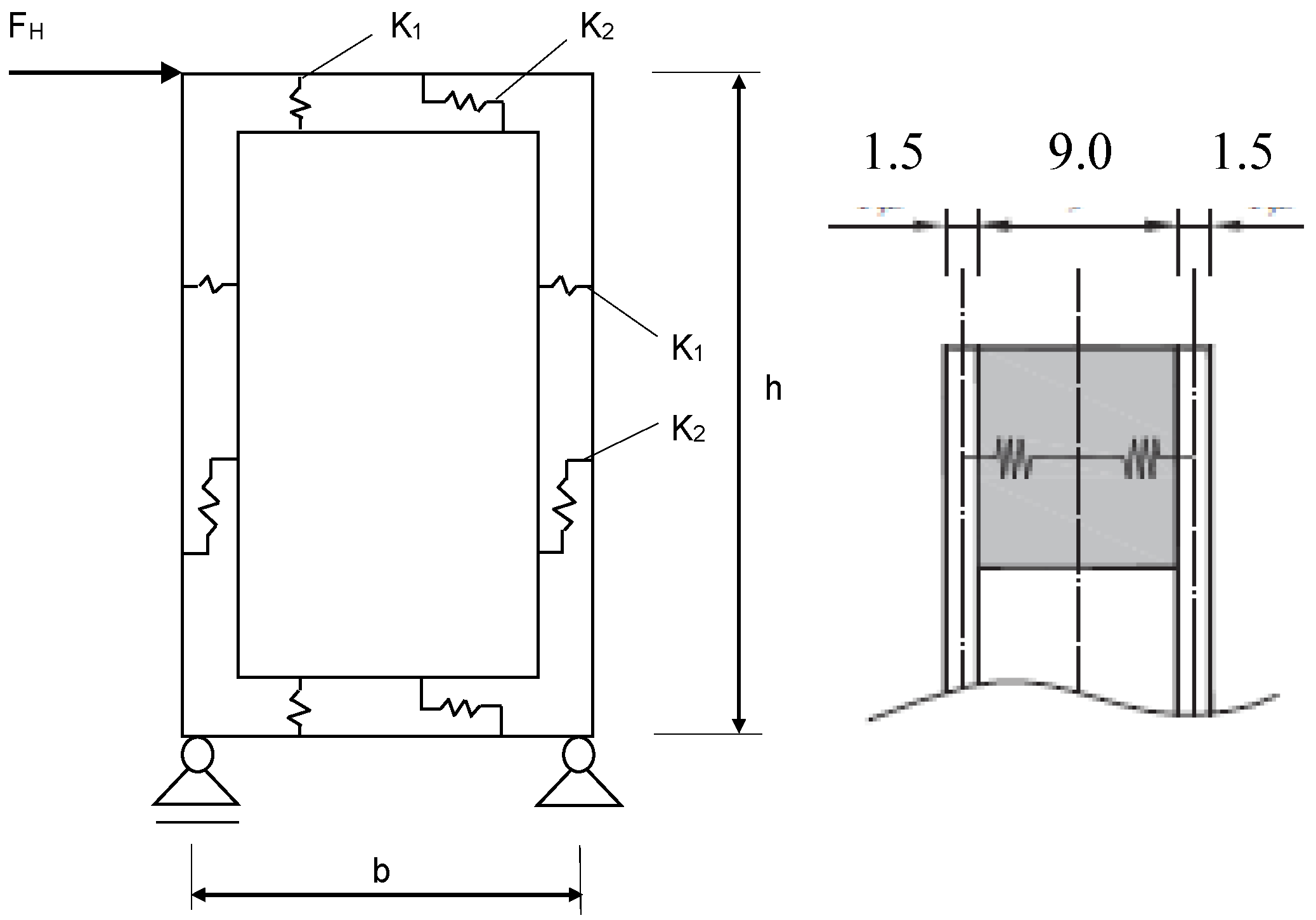
To model LTF wall elements in this case, we used FEM modelling, where the load-bearing frame timber elements (posts and beams) are modelled as orthotropic line elements, and the in-plane load-bearing sheathing boards as 2D in-plane resisting isotropic shell elements. The point is that in this case, we avoid using Bernoulli’s hypothesis, which we used in the semi-analytical procedures described above, and which was used there as the main and rather rough computational assumption. As a result, such an approach with FEM modelling can be much more accurate computationally, and special emphasis must be placed on the approximation of slips in the connection plane. Consequently, the main focus in this modelling is on simulating the flexibility of the fasteners between the sheathing boards and the timber frame elements, which are modelled according to the principle of linear-elastic springs. The whole model is schematically presented in
Figure 2. Racking stiffness (
R) is calculated by applying an arbitrarily selected horizontal force (
FH) acting on the upper-left corner of the wall element and calculating the horizontal displacement at this point using the FEM procedure described above. This gives us the horizontal wall flexibility (
D), and its inverse value is the horizontal in-plane stiffness (
R) of the LTF wall element. The model has already been used before in many numerical studies, for instance in [
5] as a validation FEM model to compare with the obtained results with MGM, and was also previously used and presented in slightly different numerical forms in [
13,
14].
Conversely, the disadvantage of this FEM spring approach compared to the analytical or semi-analytical approach, previously described in
Section 2.1., is that only a single-parametric computational variable can be used. As a result, individual simulations can be carried out only for specific configurations, with just one variable modified at a time and examined in detail. The dependence of the racking stiffness cannot, as in the previous subsection, be specified with an analytical or semi-analytical functional dependence on the fastener spacing within the connection plane between the sheathing panel and the timber frame, and consequently, the influence of any the most dependant parameters cannot be assessed. Furthermore, the calculation method is also very time-consuming and, in its present form, is not applicable for use in any multi-storey timber-framed structure at all.
2.3. FEM—Surface Model with Hinge on 2D Member Edge
The frame-type wall element model can also be simulated using shell (2D) elements, which was carried out in the SCIA Engineer v22 software [
15]. The wall frame members, i.e., top and bottom plates and studs, were modelled as 2D elements, where the cross-sectional dimensions were defined as the width or thickness of the plate. Sheathing panels were modelled on both external faces of the wall frame, including all relevant material properties. In practice, the sheathing-to-frame connections consist of discrete fasteners installed at a certain spacing; however, in the present model, these fasteners were simulated by means of a continuous hinged line connection with a “fictitious” fastener spacing. In this way, the time-consuming modelling of individual fasteners was avoided.
This modelling approach was implemented using the command
Hinge on 2D elements, in which the fasteners are represented by a line hinge connection assigned to 2D elements. The stiffness of the hinge connection already includes the actual fastener spacing and is expressed as K
ser/s. The stiffness of individual fasteners for FPB and OSB sheathing, as well as the method for determining these values, is described in
Section 3.1 Test Specimens. The advantage of this modelling approach compared to the model described in
Section 2.2 lies primarily in the significantly faster representation of the fasteners. Instead of the time-consuming process of discretely modelling individual fasteners at nodal points on a predefined grid, a hinged connection distributed along the entire element is employed. The effect of fastener spacing is accounted for indirectly through an appropriate reduction of the hinge stiffness, enabling more efficient and streamlined numerical modelling while maintaining accuracy.
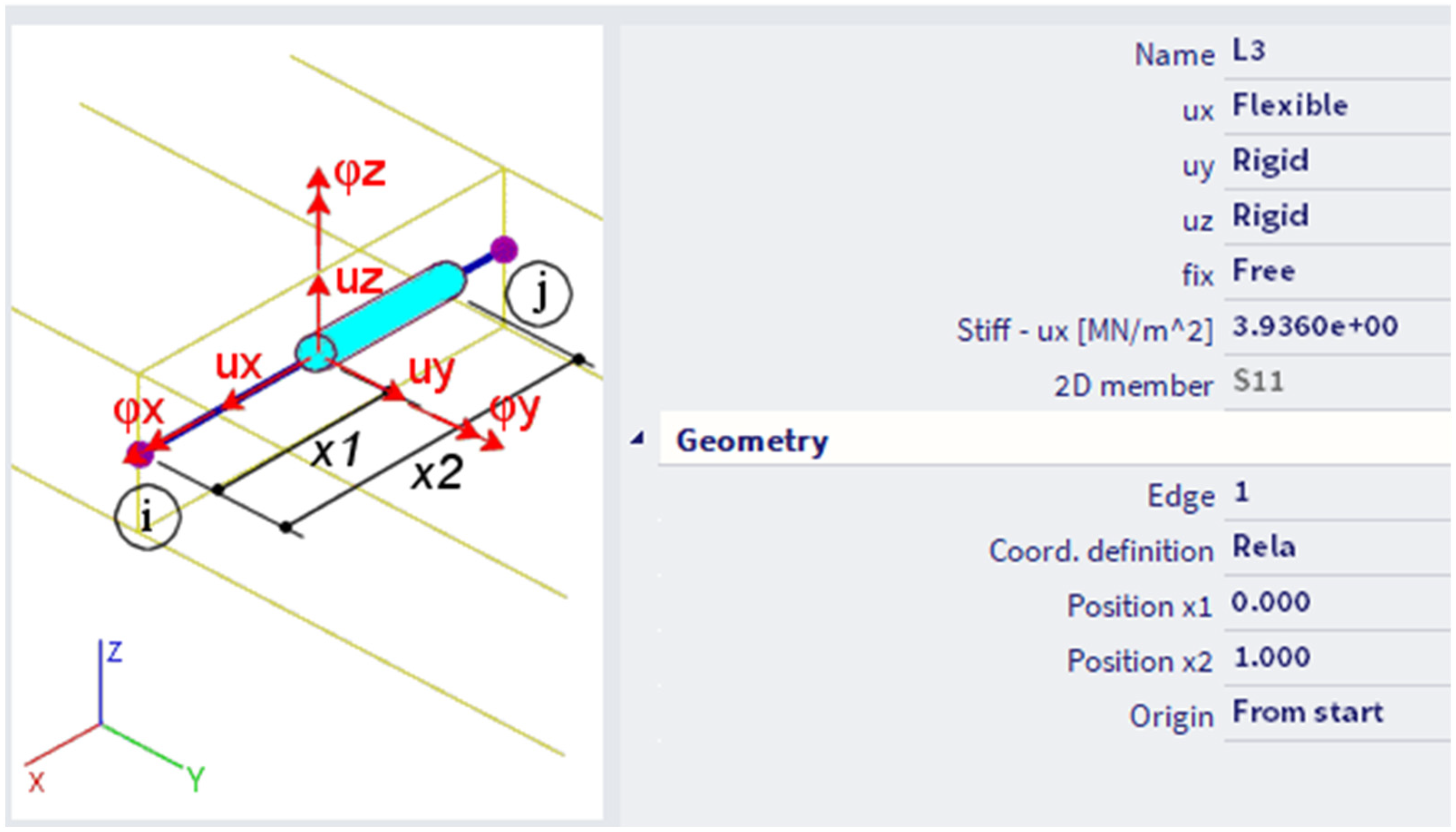
A schematic representation of the LCS (local coordinate system) of the hinge connection defined by
Hinge on 2D elements, together with the physical meaning and directions of the parameters—translations u
x, u
y, and u
z, and rotations f
ix, f
iy, and f
iz—is shown in the figure below. Since the horizontal stiffness of the wall under loading, as illustrated in
Figure 1, was investigated, the stiffness corresponding to K
ser/s was assigned in the horizontal direction for the wall and its individual elements, while absolute stiffness was defined in all other directions. Rotational degrees of freedom were released. For schematic illustration of the proposed procedure,
Figure 3 shows, for instance, the hinge for FPB sheathing with a fastener spacing of 75 mm. The corresponding stiffness of one fastener on a constant distance (
s) is
K1 = 295.218 N/mm, which is then equivalent to a constant shear layer stiffness of 3.936 N/mm per mm (or 3.936 MN/m
2).
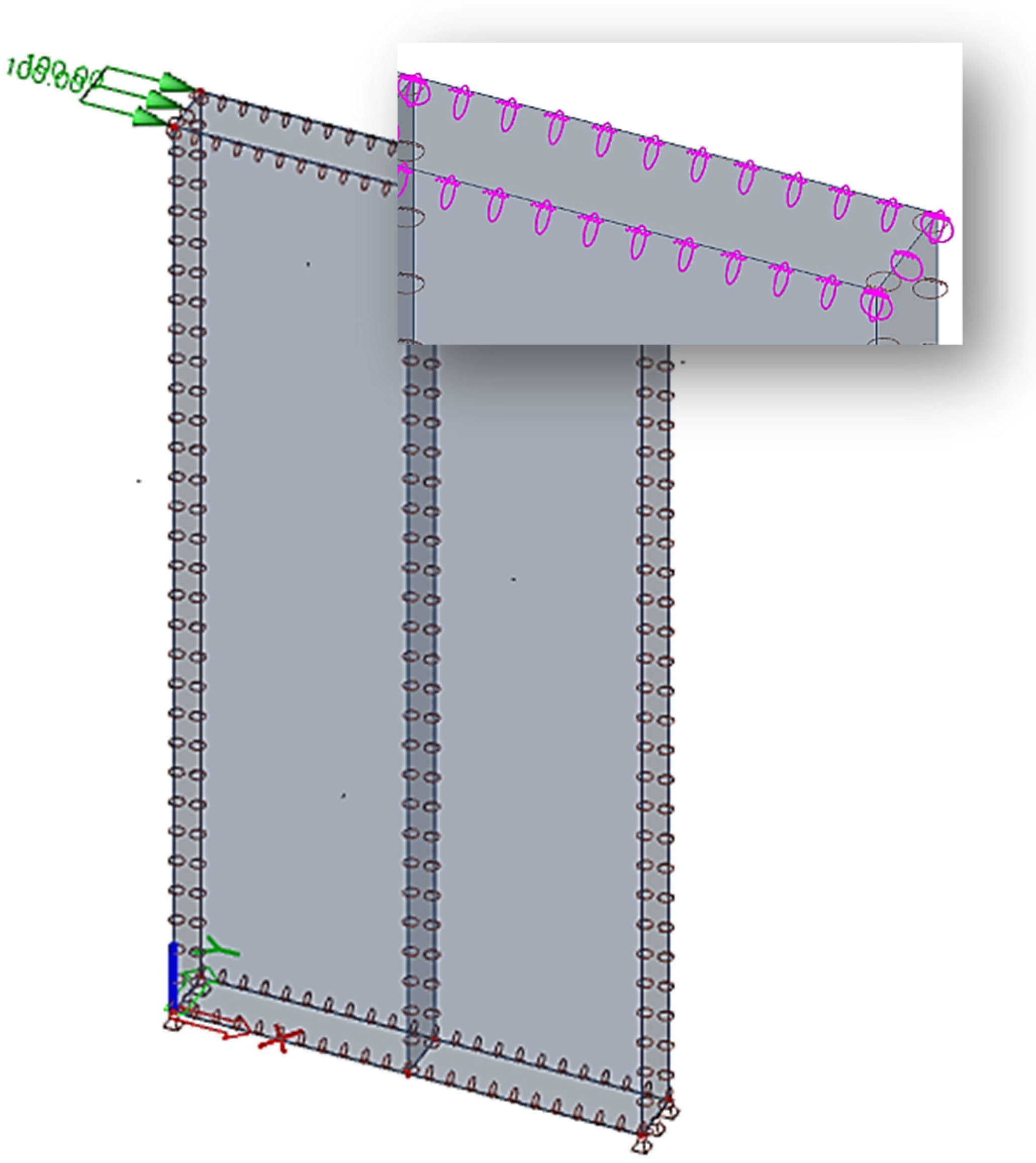
The complete numerical model is shown in
Figure 4. The structural components of the wall, including studs as well as the top and bottom girders, were represented using two-dimensional elements, with their geometric properties defined by the member thickness. The sheathing board elements were connected to the timber frame elements via hinge elements and were assigned the appropriate material characteristics. The wall is supported by two linear, absolutely rigid supports, thereby representing the boundary conditions shown in
Figure 1 in
Section 2 (Theoretical Background). A uniformly distributed load of 100 kN/m is applied along the top edge of the frame. The analysis is performed using the FEM numerical procedure with a mesh size of 20 × 20 cm. For the selected load level, the horizontal displacements of the frame are extracted, and the racking stiffness is determined in accordance with Equation (6). Gravitational loads, including self-weight, are excluded from the analysis.
2.4. Mathematical Modelling of Multi-Storey Timber-Framed Structures
A multi-storey prefabricated timber structure composed of light timber-framed (LTF) prefabricated wall elements can be modelled using a system of fictive diagonal wall elements, where each element with the diagonal represents a lateral load-bearing wall element, as schematically presented in
Figure 5. The diameter of each fictive diagonal (
dfic) is calculated to ensure that the horizontal displacement of the modelled LTF wall matches that of the actual LTF wall, using the following expression:
where
L is the length of the fictive diagonal,
E is the elastic modulus of the fictive diagonal (
E = 210 GPa if a steel bar is used for the diagonal in the calculation), and α is the inclination angle of the fictive diagonal. The main purpose of the numerical analysis of LTF elements in multi-storey timber construction is thus the determination of the racking stiffness (
R) of individual single-wall elements. For LTF walls with OSB or FPB sheathing boards, which are connected to the timber frame using mechanical fasteners, the racking stiffness (
R) can be determined using Equation (6) for a semi-analytical approach with the MGM, or alternatively in a semi-analytical approach by Equation (1), as prescribed by [
7,
8], to determine all possible horizontal displacements. More accurate are the FEM procedures described in
Section 2.2, with linear-elastic spring elements, and in
Section 2.3, with the newly developed 2D hinge element approach, which are both used to model and accurately simulate flexibility in the connection planes between the sheathing panel material and the timber frame components.
3. Numerical Study
The main objective of the analysis is to demonstrate a simple engineering approach, while maintaining a high level of accuracy in determining the racking stiffness of LTF wall elements using the newly developed FEM 2D Hinge Model. Wall elements with FPB and OSB sheathing board materials will be analysed separately, including both load-bearing internal and external wall elements. The results obtained with the newly developed FEM 2D Hinge Model computational approach will be compared with the results obtained with the semi-analytical MGM and the FEM Spring Model. Both methods have already been developed and validated in publications [
5,
16], including comparisons with the experimental results [
5]. As stated before, the FEM Spring Model is considered to be the most accurate computational approach for analysing such composite LTF wall elements, albeit very time-consuming. The FEM 2D Hinge Model is much faster and can be applied for further practical usage in multi-storey prefabricated timber structures. The main goal of this study is thus to validate the accuracy of the numerical results obtained with the FEM 2D Hinge Model using examples with different sheathing materials (FPB or OSB) and different types of timber frames (internal and external walls).
It should be noted that, due to the excessive computational time required by FEM models employing spring-type wall elements, engineering practice widely relies on models with fictitious diagonals for the analysis of multi-storey LTF structures. In such models, the cross-sectional diameter of the fictitious diagonal is developed based on the calculated stiffness of an individual wall element.
The main aim of this study is therefore to achieve a sufficiently accurate determination of the stiffness of an LTF wall element using FEM models. Owing to their fundamental modelling assumptions, these FEM-based approaches provide greater accuracy than the previously established MGM. Both the MGM and the Eurocode 5 [
6] proposals are based on simple beam theory and the Bernoulli hypothesis, which, in the present context, do not represent the most accurate modelling approach.
3.1. Analysed LTF Wall Elements
Only single-panel LTF elements will be analysed according to the presented scheme and boundary conditions in
Figure 2, with a total length
l = 1250 mm and a total height
h = 2635 mm. As the first aim of the study is to analyse the influence of the timber frame thickness, the LTF elements are separately analysed as:
- -
Internal wall elements with a strength grade C22 according to [
17], with a thickness of 90 mm and a width of 90 mm (
At1 = 90 × 90 mm) for all timber frame components (with
li = 1160 mm and
hi = 2545 mm in
Figure 2).
- -
External wall elements with a strength grade C22 according to [
17], with a thickness of 160 mm and a width of 80 mm (
At1 = 80 × 160 mm) for all timber frame components (
li = 1160 mm,
hi = 2545 mm).
The sheathing boards are also separately analysed as:
- -
Symmetrical two-sided fibre-plaster boards (FPB) with a thickness of 15 mm.
- -
Symmetrical two-sided OSB boards with a thickness of 15 mm.
Properties of these sheathing boards and of the frame material are given in the table below.
The FPB and OSB sheathing boards are connected to the timber frame using the same staples of diameter
ds = 1.53 mm and length
ls = 35 mm. Using the valid Eurocode 5 [
6] expressions, the slip modulus of the staples is therefore
Kser,FPB = 295.218 N/mm for wall elements with FPB and
Kser,OSB = 194.028 N/mm for OSB LTF elements.
The values of
and
are calculated based on the expression for directly driven nails, taken from Eurocode 5 [
6], which prescribes:
where
It is important to emphasise that Eurocode 5 [
6] specifies different expressions for the stiffness modulus of fasteners depending on the type of fastener used. Consequently, the choice of fasteners has a direct and significant influence on the racking resistance of the wall element. An extension of the present study to investigate the influence of different types of fasteners on racking resistance is therefore proposed as a topic for future research.
Since the fastener spacing is a very important parameter that significantly affects the horizontal stiffness of the LTF wall element, numerical calculations will be performed for the selected values s = 20, 37.5, 75, and 150 mm. In the case of a semi-analytical MGM approach, we can of course obtain the value for racking stiffness R as an analytical dependence on the parameter s, but for cases with FEM calculations, this is of course not possible, and we must use parametric calculations for the selected values.
3.2. Results and Discussion
As mentioned before, both internal and external LTF walls will be treated separately in the calculations with three different methods. This also allows for the analysis of the impact of the dimensions of the load-bearing timber frame components as one of the more important possible parameters.
3.2.1. Internal Wall Elements
As described in
Section 2.1, the results for the racking stiffness (
R) obtained with the MGM can be presented in fully analytical form, dependent on the fastener spacing parameter (
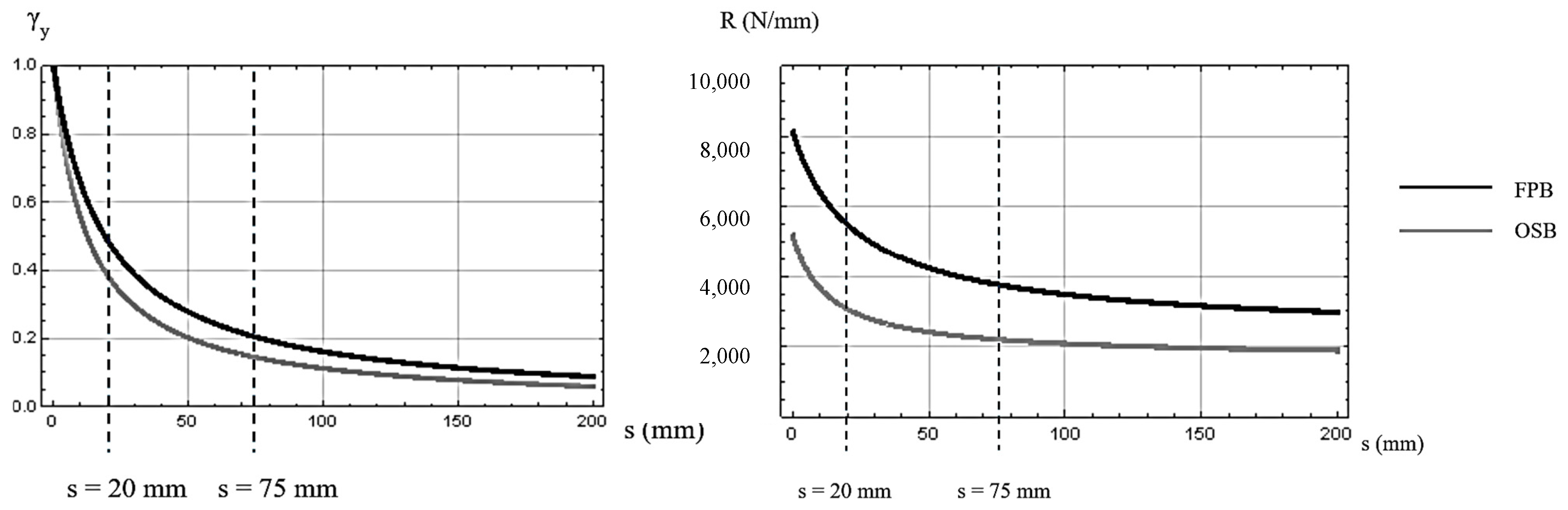
s). They are obtained using Equation (6), respecting Equation (3) for the γ
y-coefficient. The graphs for the γ
y-coefficient and the racking stiffness (
R), as an analytical dependence on fastener spacing (
s), are plotted in
Figure 6. The values for the γ
y-coefficient and racking stiffness are separately computed for the FPB and OSB sheathing boards. The values at
s = 20 mm and
s = 75 mm are specifically marked in the figure as the minimum selected parametric values (
s = 20 mm), prescribed by the Eurocode standard [
6], and the values that are typical used in practice (
s = 75 mm).
It can be generally observed from the results that the values for the racking stiffness of LTF wall elements with FPB sheathing boards are essentially higher compared with that of OSB sheathings. The reason lies in the very small value of the shear modulus (
G) for the OSB boards. The properties of these two sheathing board materials are given in
Table 1.
Among these, the γ
y-coefficient is also lower for OSB at any distance between the fasteners, which, according to Equation (6), additionally results in a lower value of
R. Further in-depth analyses and discussions on this topic can be found in a study that has already been conducted and published in [
5].
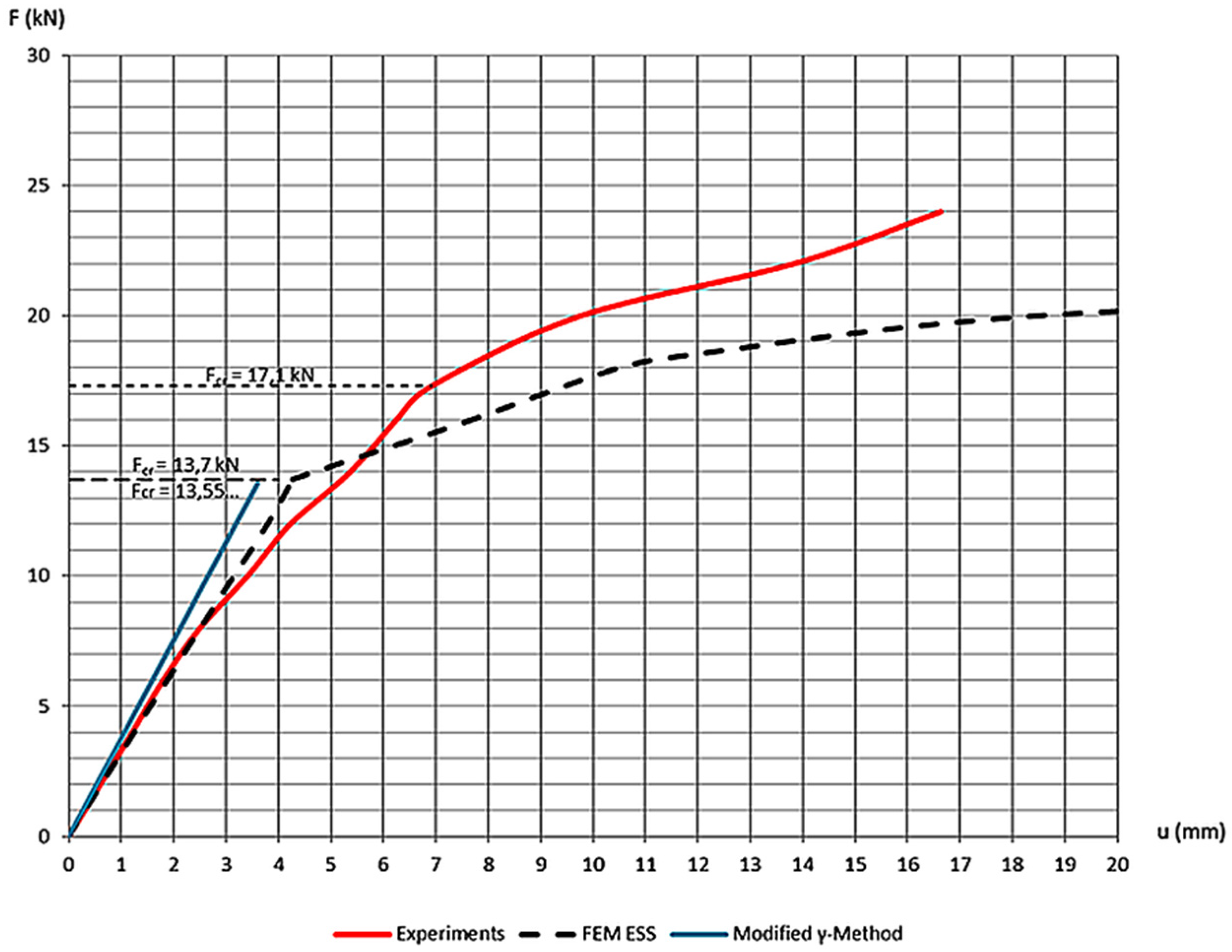
To validate the accuracy of all three numerical methods, the obtained numerical results will first be compared with the results of previous and already published experimental analyses performed in refs. [
18,
19] on the same test specimens of interior walls with the same dimensions and material characteristics. The results are shown in
Figure 7 for values of
s = 75 mm, which is the most typical value in practice and also the most frequently tested experimentally.
Total displacement results u
M+V from Equation (4), induced by the horizontal force
, are presented in
Figure 7. The analytical calculation using the MGM was carried out only within the elastic range, i.e., up to the initiation of the first crack in the FPB. The corresponding critical horizontal force,
, was determined using the equation below:
It has been shown that the correlation in the linear-elastic behaviour of the wall elements between the analytical approach, the FEM numerical approach, and the experimental test results is satisfactory. Therefore, the focus of this study and the subsequent results is primarily directed toward a parametric investigation and a comparison between analytical and numerical results for different spacings of the fasteners.
The same internal LTF elements are also numerically analysed using the FEM Spring Model from
Section 2.2 using the computer software Tower 8 [
20] and with the newly developed FEM 2D Hinge Model from
Section 2.3 using the computer software SCIA v22 [
15]. In both FEM cases, only parametrically chosen values for
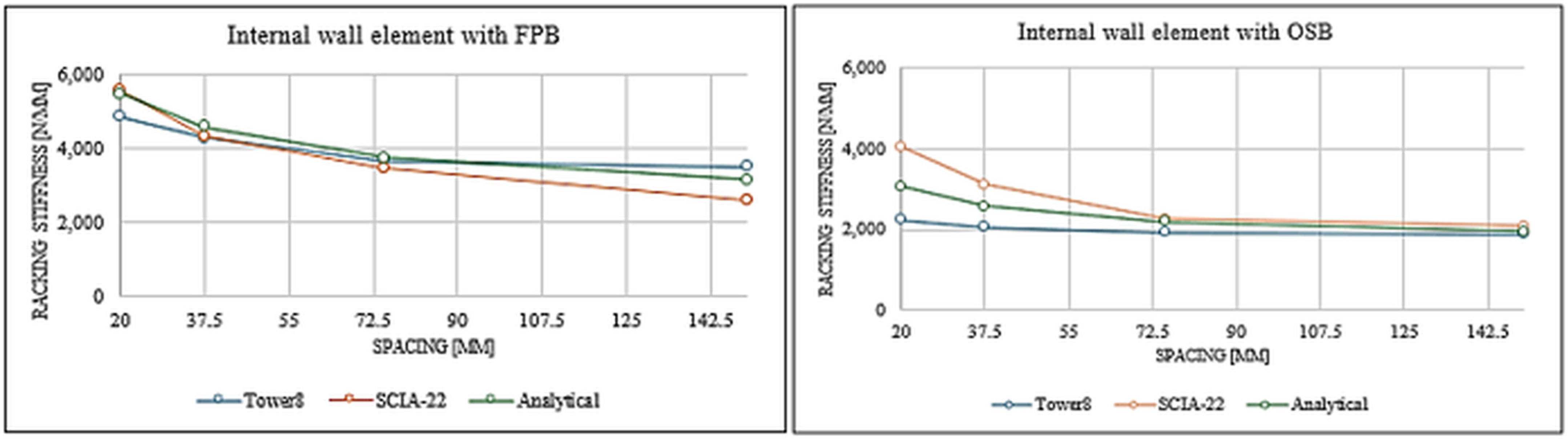
s can be analysed; there is no possibility of obtaining any analytical dependence. The results for the FPB and OSB sheathing boards are plotted in
Figure 8.
The results show that the match between the obtained values is significantly better for cases with FPB sheathing than for OSB, although for the typical value most commonly used in practice,
s = 75 mm, the match is very good in both cases. This also essentially follows the previous findings from [
5] and Ref. [
16] that the MGM is significantly more useful for FPB than for OSB LTF wall elements. For a better comparison of all parametrically analysed values, we further present all results obtained by all three procedures, as recorded in
Table 2 for FPB and in
Table 3 for OSB sheathing boards.
It is obvious that, especially for the FPB sheathing boards, there is generally very good agreement in the obtained results between the newly developed FEM 2D Hinge Model and the MGM. Agreement with the FEM Spring Model is very good in the range of
s between 37.5 and 75 mm, the most used distance of fasteners in practice. For cases with OSB sheathing, the fit is not as good, but it is satisfactory for cases with
s = 75 mm and
s = 150 mm. A comparison between FPB and OSB sheathings is also interesting in general. It is evident that the in-plane stiffness of LTF elements is significantly greater in the case of FPB sheathing boards, and the difference increases with decreasing distance between the fasteners (
s). This issue has already been analysed several times, both experimentally [
16] and numerically [
5,
18,
19], and therefore will not be a primary focus of our research in this paper.
3.2.2. External Wall Elements
Similarly, for the internal walls, we will present the racking stiffness (
R) as an analytical dependence on fastener spacing (
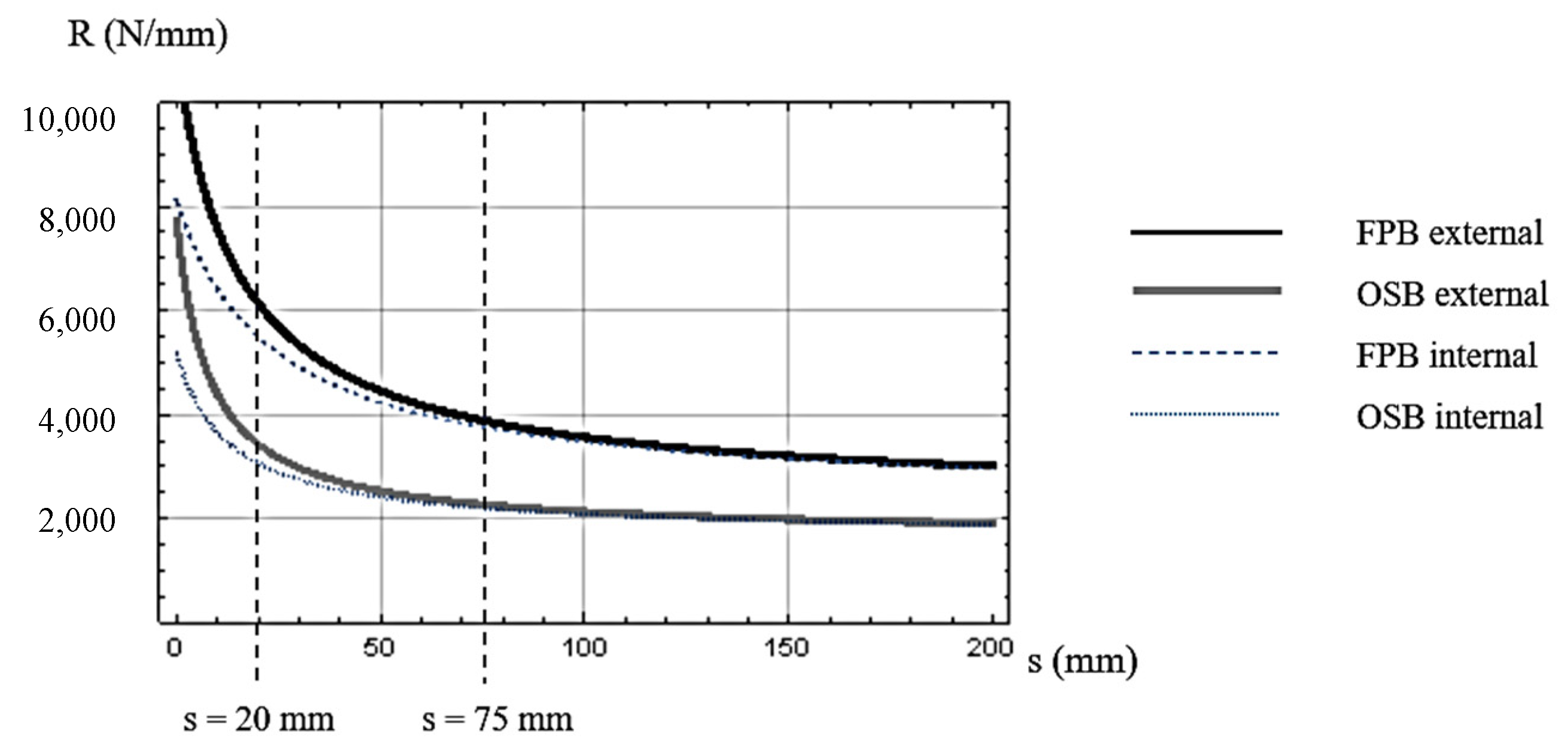
s). This can be obtained only using the MGM. The values are plotted in
Figure 9. Values for interior walls have also been added for information only, to provide a direct comparison of the impact of timber frame thickness. This issue has already been analysed in detail numerically in [
5].
We can see that there is essentially no significant difference in racking stiffness between external and internal walls, and consequently, the thickness of the timber frame has no particular impact on the in-plane behaviour of LTF wall elements. Consequently, we can further exclude it as a significant parameter, but we will of course need to retain the influence of the type of sheathing, as the difference between FPB and OSB wall types is again very obvious in this case. The type of sheathing material is therefore a much more sensitive parameter than the thickness of the timber frame or the classification of the wall element as external or internal. In general, the stiffness of the timber frame itself is significantly lower than that of the sheathing (see Equations (2a) and (2b)), meaning that both the type of sheathing material and the arrangement of the fasteners have a substantially greater influence on the overall structural behaviour than the dimensions of the timber frame alone.
In order to investigate how analytically obtained results using the MGM can be consistent with more accurate results obtained using FEM models, the same external LTF elements are also numerically analysed using the FEM Spring Model from
Section 2.2 with the computer software Tower 8 [
20] and with the newly developed FEM 2D Hinge Model from
Section 2.3 using the computer software SCIA v22 [
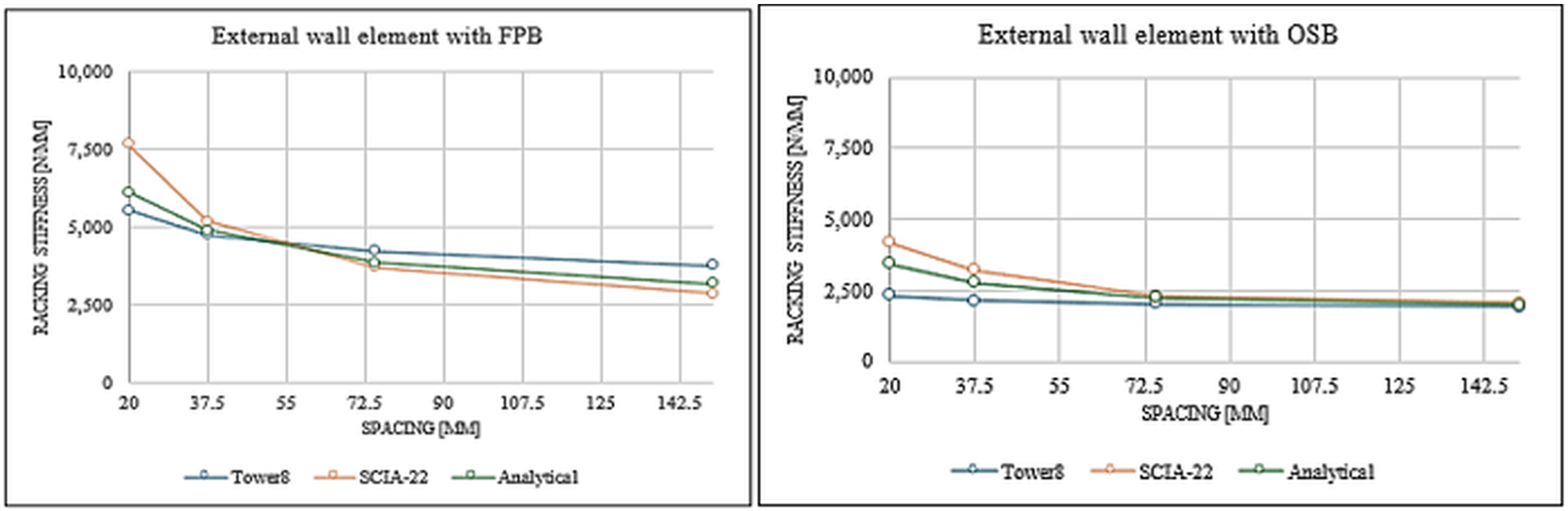
15]. The results for the FPB and OSB sheathing boards are plotted in
Figure 10.
For easier understanding, the results are also explicitly presented in
Table 4 and
Table 5 for FPB and OSB sheathing boards.
Analysing the results from
Figure 10 and
Table 3 and
Table 4, we can observe that the match of the results between all three methods is again better for FPB elements, but not as good as for internal wall elements. For FPB elements, agreement between the MGM and FEM 2D Hinge Model (SCIA) is satisfactory for all values with
s > 37.5 mm.
However, similar to previous findings using the semi-analytical MGM, we can conclude that even when using the more accurate FEM methods, the difference in results between external and internal walls is relatively small, especially for all distances between connecting elements where the distance is greater than 37.5 mm. This only confirms the fact that the type of wall element or the dimension of the supporting frame is not a sensitive parameter at all, but rather the type of the sheathing material and, of course, the distance (s) between the mechanical fasteners.
4. Conclusions
As mentioned in the paper, there are many different parameters (type of sheathing boards, fastener spacing, type of wall element, etc.) that can have a sensitive influence on the racking stiffness of light timber-framed (LTF) wall elements. Numerical treatment of the in-plane behaviour of such elements is thus usually very complex and can also be very time-consuming. The most accurate computational approach is the FEM analysis with elastic spring elements that simulate the flexibility of the fasteners in the connection plane. Nevertheless, due to its significant time requirements, this approach is practically unsuitable for the engineering design of multi-storey prefabricated LTF buildings.
In order to simplify this FEM process, a special and more practical FEM 2D Hinge Model was developed. Based on the results presented in
Figure 2,
Figure 3,
Figure 4 and
Figure 5 in
Section 3, this model shows very good agreement with the FEM Spring Model and the Modified Gamma Method (MGM), particularly for fastener spacing values (
s) greater than 37.5 mm. Such fastener disposition is also the one most frequently used in practice for LTF elements. The agreement is especially favourable for FPB sheathing boards and slightly less for OSB. The reason lies in the fact that FPB exhibits approximately eight times lower tensile strength than wooden OSB panels, as shown in
Table 1. This implies that the assumption of linear material behaviour, which is adopted in both analytical and numerical analyses, is more appropriate for FPB systems. Consequently, this leads to more accurate results and a higher level of agreement between the two approaches. In addition, the shear modulus of OSB sheathing is very low, resulting in significant shear deformations [
5]. For OSB wall elements, noticeable differences between calculation approaches occur only at spacing values of
s < 37.5 mm, which are, however, rarely used in practice.
The previously developed Modified Gamma Method (MGM) is a semi-analytical approach and is expected to be less accurate because a relatively strong approximation using simple beam theory supported by the Bernoulli hypothesis is used. However, it was demonstrated in our study that the method shows good agreement with results from both FEM methods for
s > 37.5 mm. On the other hand, contrary to the more accurate FEM models, the MGM offers a fully analytical insight into the lateral in-plane behaviour of LTF wall elements, as a dependence on fastener disposition (
s), and is also very simple for practical engineering use [
5].
Finally, the last important finding of the performed study is that it has been shown by all calculation approaches that the thickness of the load-bearing timber frame and the type of resisting LTF walls (internal or external) have practically no sensitive influence on the in-plane stiffness of such wall elements. Consequently, the type of sheathing material (FPB or OSB) and, of course, the spacing between the fasteners are much more sensitive parameters, which may require further consideration in future FEM studies.