1. Introduction
The advancement of modern architectural design has led to increasingly innovative and complex building forms. Contemporary structures often employ irregular, spatially curved surfaces to achieve rich artistic expression, utilizing numerous spatially bending-torsion members as seen in the Hangzhou Olympic Sports Center Stadium [
1], Shenzhen Airport Terminal 3 [
2], and the Shenzhen Binhua Pedestrian Bridge [
3]. These members are subjected to complex loading conditions, resulting in combined internal forces of bending moments, torsional moments, and axial forces. Their design is constrained by architectural geometric requirements, connection details with adjacent members, and overall structural stability considerations.
Current research has begun addressing the challenges of 3D modeling and lofting for spatially bending-torsion members. Scandola, L. et al. [
4] developed an algorithm for extracting bending-line centroids from mesh-based geometries and fitting NURBS curves, highlighting the challenge of adapting free-form bending processes by aligning parametric design targets with as-built geometries. Zhou, G.Q. et al. [
5] conducted 3D lofting research using AutoCAD software, importing contour points into Tekla to generate bending-torsion plates. Chen, S.H. et al. [
6] developed a method for batch extraction of 3D landscape bridge models—particularly complex curved surface geometry data—using Rhino and GH. Zhou, S.H. et al. [
7] employed the spatial 3D modeling software Digital Project to establish precise 3D spatial geometric and computational models for steel structures by simulating curves with segmented straight lines. Scandola, L. et al. [
8] introduced bending line reconstruction for free-form bent members using ray casting algorithms and NURBS fitting. Garba, U.H. et al. [
8] generated 2D propeller curves using NURBS interpolation for smooth geometry machining.
Despite extensive research, significant limitations persist in current design workflows. For instance, general-purpose parametric platforms like Autodesk Dynamo lack specialized tools for handling complex spatial torsion, while dedicated structural software such as Tekla struggles with the accurate geometric representation of bending-torsion members [
9]. The key unresolved challenges include:
- (1)
Existing methods struggle with rapid 3D model generation for bending-torsion members on highly complex architectural surfaces, particularly regarding member alignment with building envelopes and between members with varying cross-sectional heights.
- (2)
Limited research exists on generating variable-section members according to relevant standards, unable to realistically simulate positional changes within complex spatial structures.
- (3)
Current approaches require manual addition of control points to enhance surface representation accuracy [
10], as establishing functional expressions for twist angle variations remains challenging.
- (4)
No systematic method exists for efficiently subdividing and unfolding plate surfaces of complex bending-torsion members for fabrication.
Traditional manual modeling approaches are inadequate to meet these demands, underscoring the urgent need for robust parametric modeling solutions. Current design practices indicate that Rhino and GH, along with their extensive plugins, are becoming indispensable tools for architects [
11]. This paper develops a comprehensive spatial bending-torsion member detailing module based on GH that addresses these limitations. The main contributions include:
- (1)
A novel data structure for integrated description of bending-torsion members.
- (2)
Automated algorithms for axis smoothing, torsion control, and cross-section alignment.
- (3)
Implementation of variable-section generation and plate unfolding functions.
- (4)
Quantitative validation through engineering case studies.
2. Implementation Process
The construction process for complex curved structures determines the mesh division method based on different types of architectural surfaces. Structural engineers perform structural calculations and analysis to determine structural layout and member dimensions, completing the structural design. The detailed design phase for spatially bending-torsion members occurs after structural analysis is finalized, involving the design of bending-torsion members for manufacturing and fabrication [
12,
13,
14].
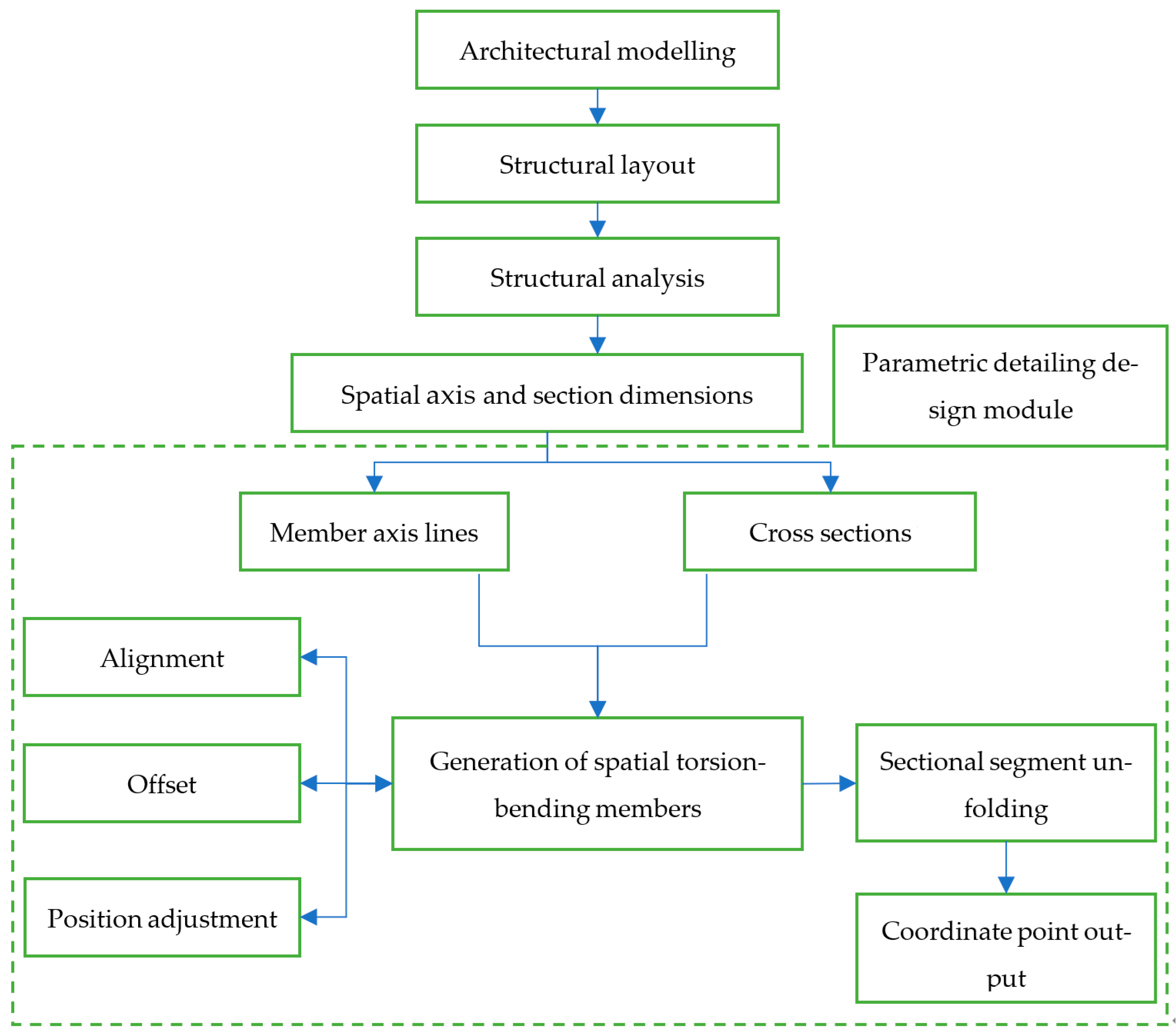
In practice, the detailed design process for spatial bending-torsion members is cumbersome, data integration is challenging, and design efficiency is low. This study proposes a parametric detailed design module for spatial bending-torsion members. Its workflow is illustrated in
Figure 1. Users provide the spatial axis positions and the linear model of the architectural structure. The member generation module controls the torsion angle based on the architectural line model and creates a 3D model in Rhino. If the model meets user requirements, it can output a 3D model, 2D fabrication drawings, and a design results summary table. If the model outcome is unsatisfactory, the user can adjust structural parameters, such as section data, surface fitting accuracy, etc., to parametrically refine the model. Beyond these structural parameters, additional functionalities are available for selection. For instance, surface alignment and offset, along with section position adjustments, can all be modified through visual operations to refine the parametric model.
4. Key Algorithms
4.1. Determination of Section Method Planes at Interpolation Points Along Member Axes
The spatial axes of bending-torsion members are typically described by non-uniform rational B-spline (NURBS) curves defined through n given fitting points. Let its curve equation be
C =
C(
t), where
t (0 <
t < 1) and
i = 0, 1, 2, …, n, as shown in Equation (1).
T = 0 and
t = 1 correspond to the curve’s start and end points, respectively.
In the equation, Pi denotes the curve control point; Wi represents the weight corresponding to the control point; Ni,3(t) is the basis function of the cubic NURBS.
When fitting the curve using interpolation points
Pi, the distances between interpolation points are often irregular. This leads to excessively large weights
Wi for certain interpolation points
Pi, resulting in a fitted member surface that lacks smoothness and naturalness. Artificially adding interpolation points can mitigate this issue, but it compromises efficiency and increases error. Therefore, this paper automatically increases interpolation points to
based on maximum spacing
m, analyzing slope changes to ensure uniform, smooth spacing, as shown in Equation (2).
where
,
Li denotes the spacing between original fitted curve control points.
This approach preserves the original interpolation points while ensuring a smooth and natural transition of the generated member surface.
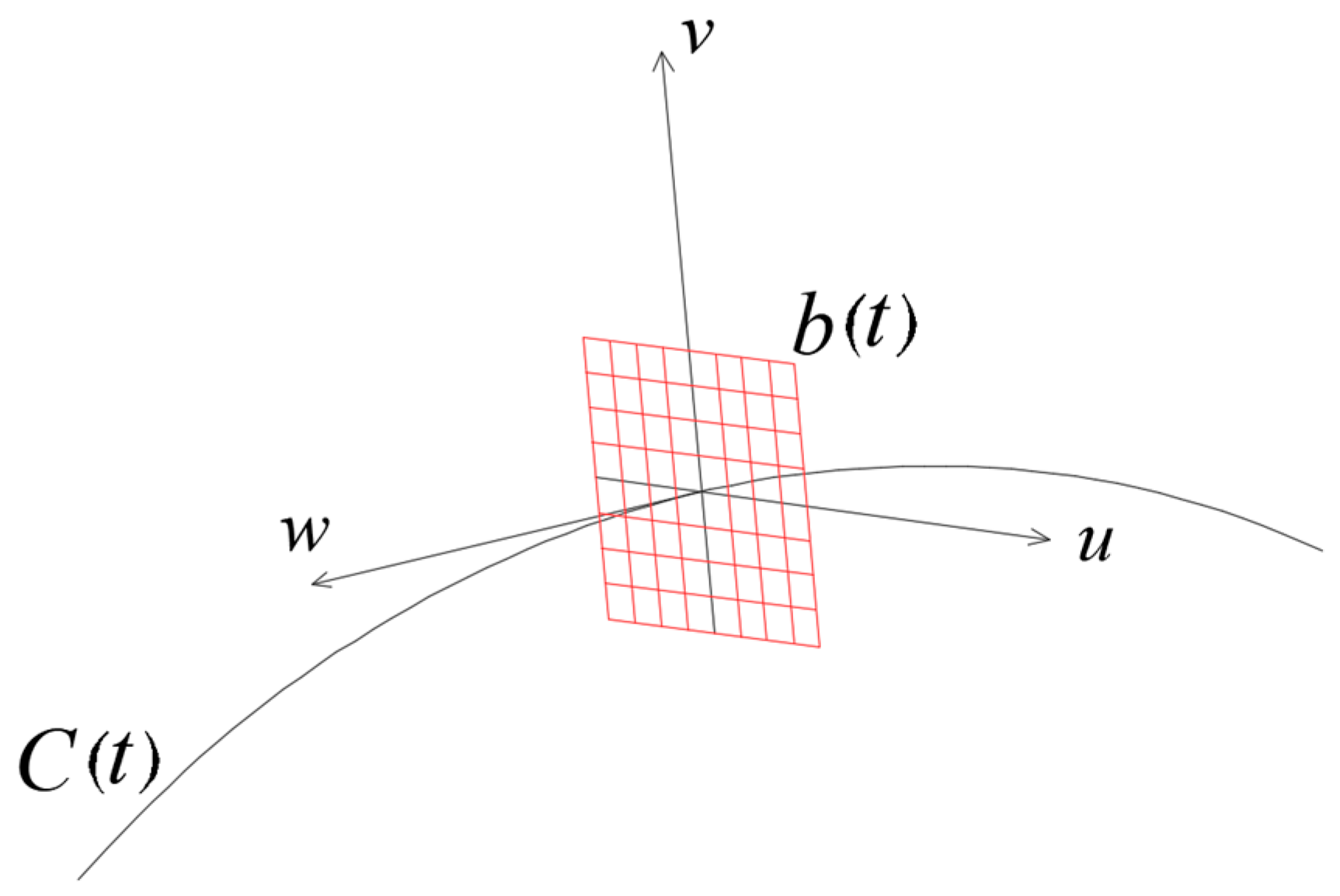
At any point
Pi on the curve, a local coordinate system exists with
Pi as its origin. Its
u,
v, and
w vectors represent the tangential direction, principal normal direction, and secondary normal direction of the curve at that point, respectively. Using the PerpFrame operator in the GH, the normal plane at any point along the member axis can be obtained, i.e., the working plane
b(
t) defined by
u and
v, as shown in
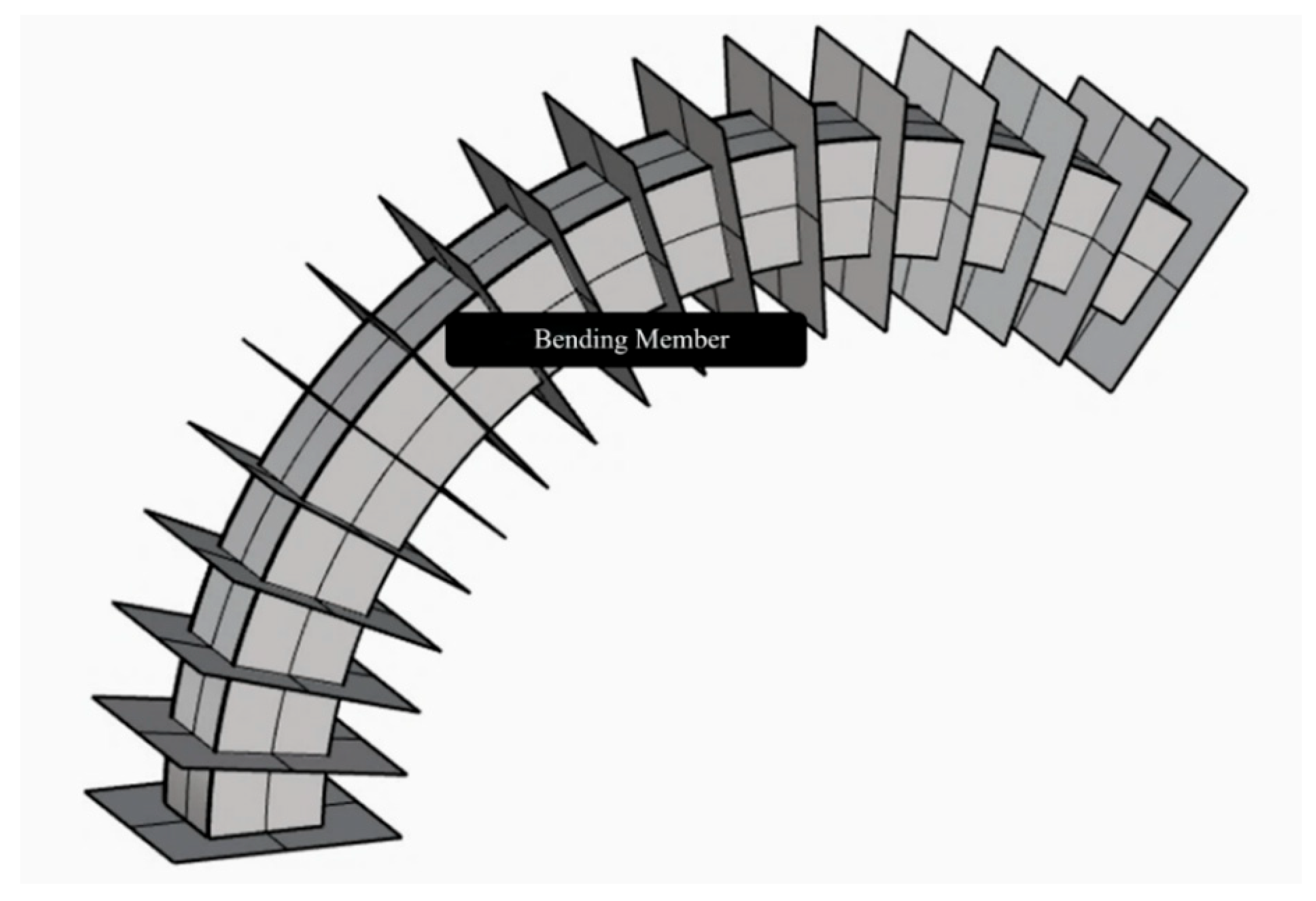
Figure 11. when curvature approaches zero, the algorithm adopts the normal vector from the previous interpolation point to avoid coordinate system failure. Place the cross-section on the normal plane at the interpolation point
Pi of the fitting curve. As
t varies from 0 to 1, the space swept by the cross-section fixed on the initial plane forms the spatial curved entity
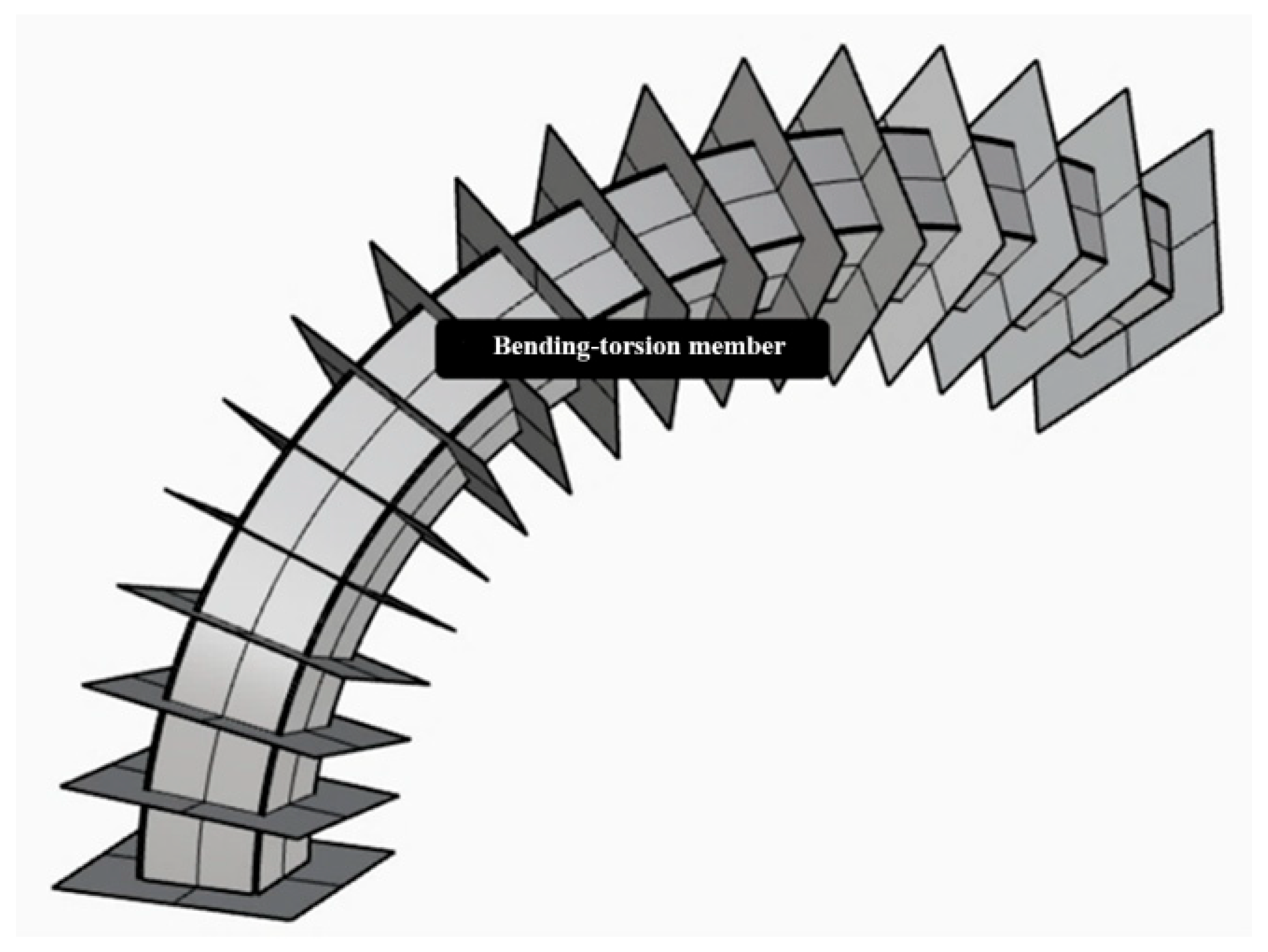
i. Multiple curved entities can be assembled to create the entire curved member, as shown in
Figure 12.
4.2. Determination of Principal Normal Vectors for Member Axis-Based Planes
As shown in
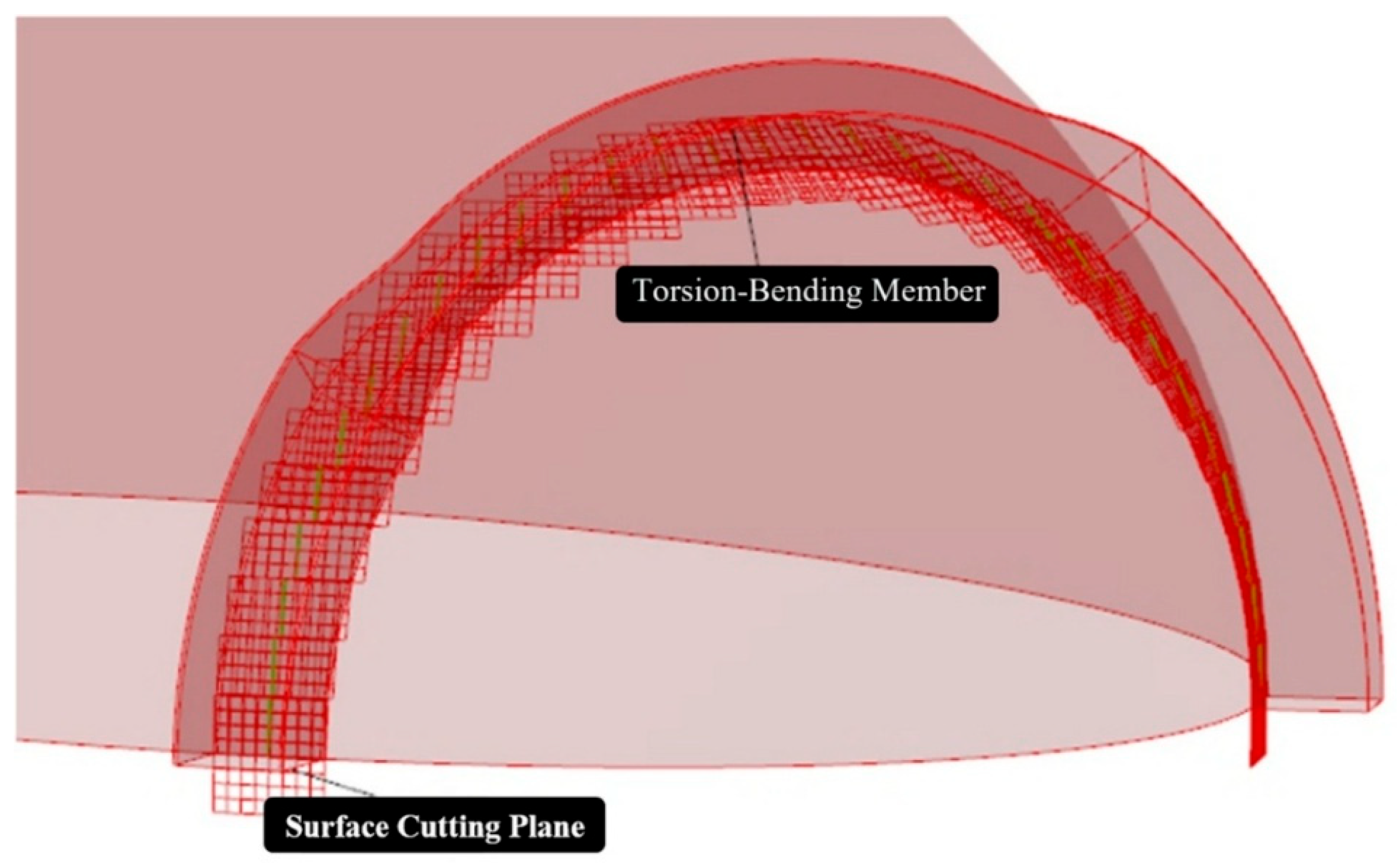
Figure 11, a tangent plane to the surface at the member axis on an ellipsoid is obtained. The normal vector of this tangent plane is the principal normal vector
vi(
t) of the cross-section. For the curved member described above, if the principal normal vector in the plane coordinate system
bi(
t) is replaced with the calculated
vi(
t) (where 0 <
t < 1), the cross-section rotates along the normal plane while sweeping along the member axis as
vi(
t) varies with the member axis parameter
t. This configuration forms a spatially bending-torsion member, as illustrated in
Figure 13.
The transformation from surface normal
ns to section rotation is shown in Equation (3).
where
θ is the torsion angle of the cross-section.
4.3. Alignment and Offset of Cross-Sections
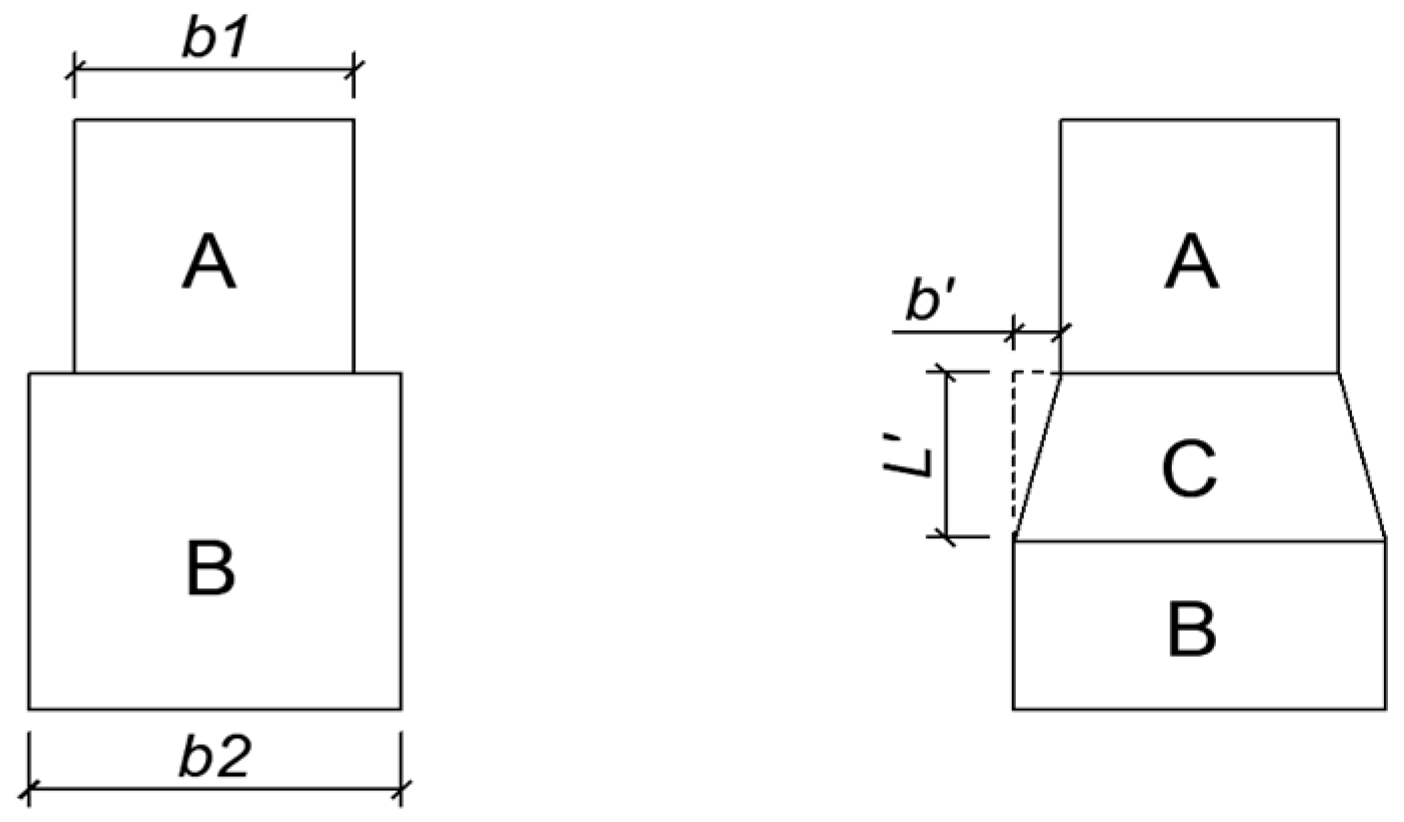
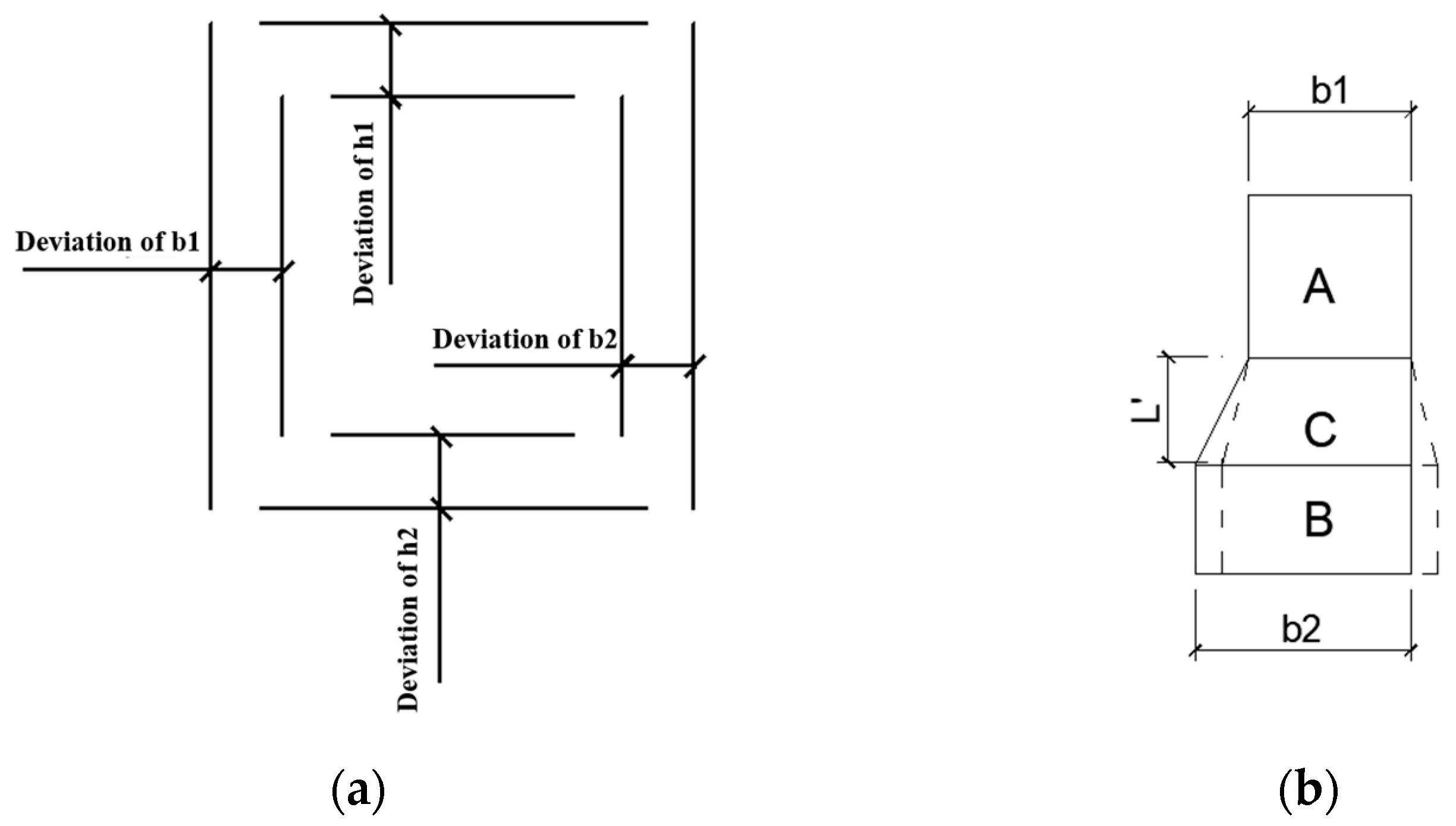
In practical engineering, bending-torsion members with different cross-sectional dimensions often require cross-sectional alignment. As shown in
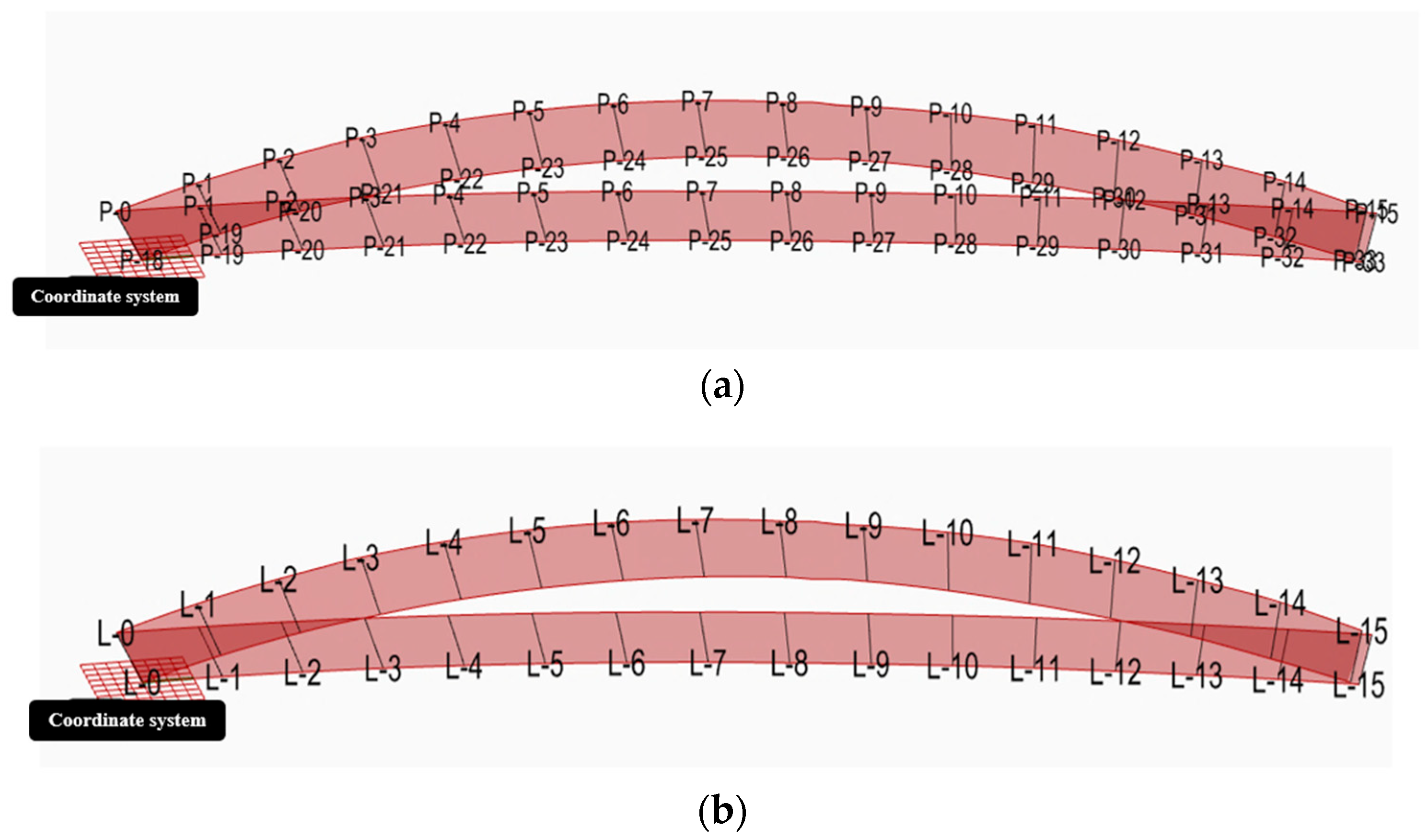
Figure 14b, when the centers of the two cross-sections are aligned, the right side of Section B in the b-direction aligns with the right side of Section A in the b-direction. Based on the geometric parameters of the member axis, the normal plane can be derived as a function of
vi(
t). By placing the cross-section on this normal plane, a spatial bending-torsion model of a multi-segment constant-section beam element can be established. The overall model offset is achieved by shifting the position of sections on the normal plane by the same distance along the
u and
v directions of the normal plane. The formation location of variable sections is determined based on engineering requirements, specifying both the variable section position and alignment method. Therefore, the start and end points of variable sections must account for scenarios where they do not coincide with curve interpolation points. In such cases, data for the start and end points of variable sections must be added to the existing curve interpolation points. Using the cross-sectional dimensions at both ends, the slope, and the spatial positions of interpolation points within the variable cross-section range, as shown in Equation (4), the variable cross-section dimensions at the plane positions of the interpolation points are obtained. Subsequently, the linearly varying variable cross-section surface portion is generated.
where
Hi represents the cross-sectional data of interpolation points within the variable cross-section range, such as height
h;
H0 denotes the cross-sectional dimension data at the start of the variable cross-section;
H1 denotes the cross-sectional dimension data at the end of the variable cross-section;
ki/
k represents the ratio of the distance from the start point to the interpolation point
i to the total length of the variable cross-section curve.
This linear interpolation method assumes gradual curvature variation. For highly curved segments, additional interpolation points must be inserted to maintain accuracy. In actual structures, highly curved segments often experience significant stress concentrations, making them generally unsuitable for variable cross-sections from both a fabrication and structural performance perspective.
After generating the variable-section and constant-section segments as described above, the alignment function must further determine the operation segment and alignment vector. Determining the alignment vector requires defining both its direction and magnitude (offset distance). Calculate the cross-sectional dimensions before and after the variable section. Then, based on the cross-section type specified in the parameter information, determine the assignment of data in both directions.
For rectangular cross-sections, each direction (B and H) has two faces. After defining the alignment data for both B and H directions, the alignment vector and operation segment are identified through user-selected reference planes and parameter inputs. In engineering practice, multiple alignment reference planes often exist, enabling simultaneous alignment in both B and H directions.
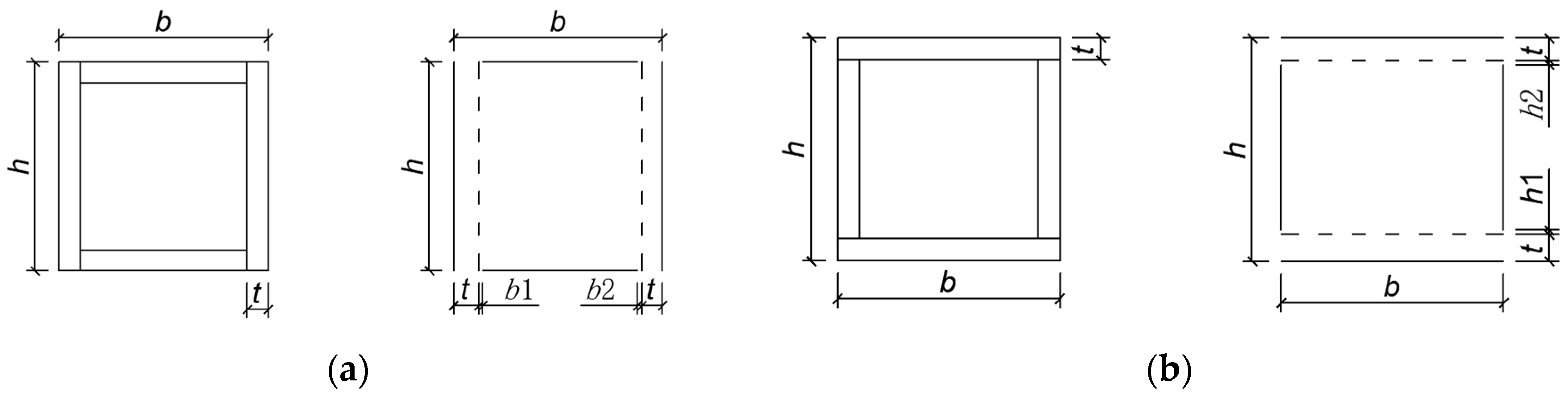
To enhance the module’s robustness and expand alignment application scenarios, when calculating the difference between variable cross-section dimensions, the Orient operator in GH software is utilized. This places both cross-section dimensions on the same working plane to compute the cross-section dimension differences:
b1,
b2,
h1, and
h2, as shown in
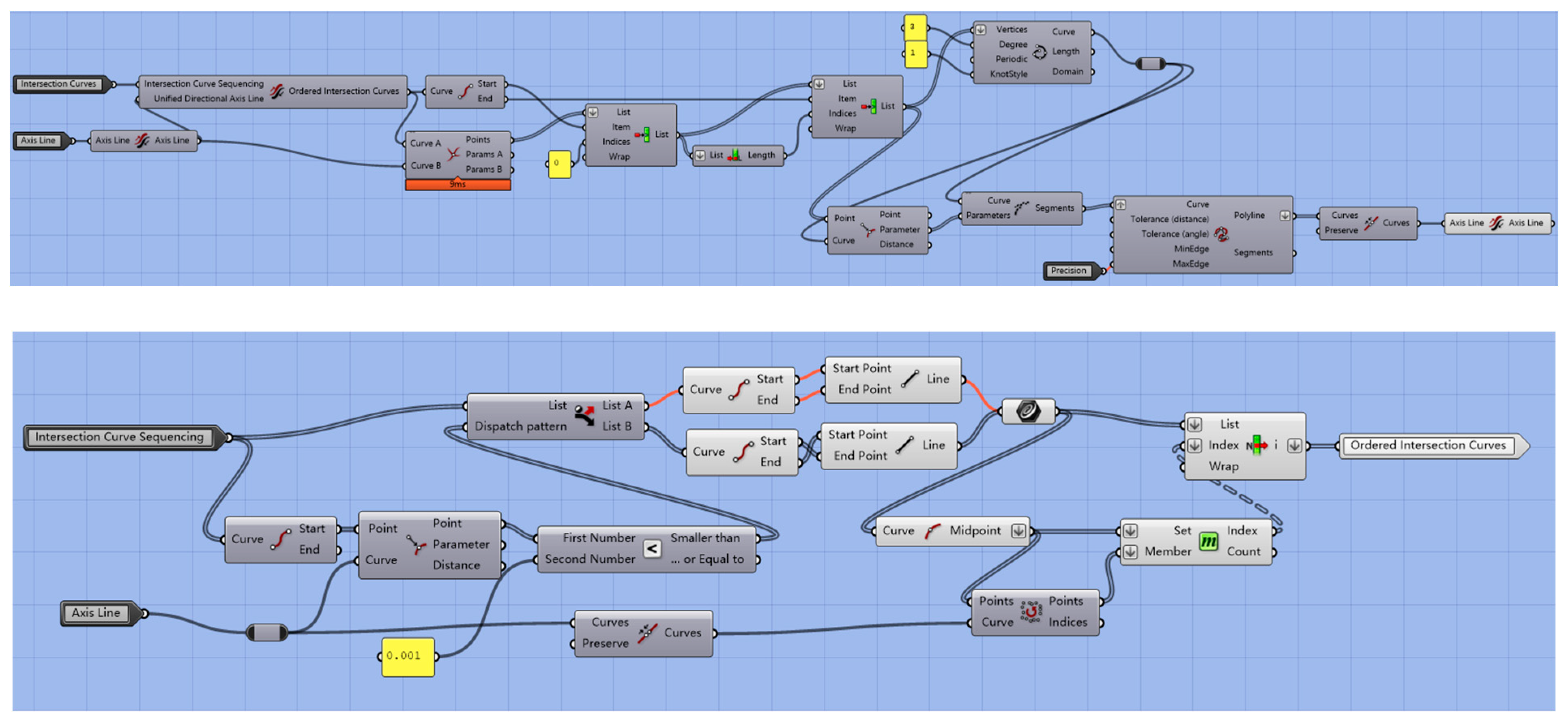
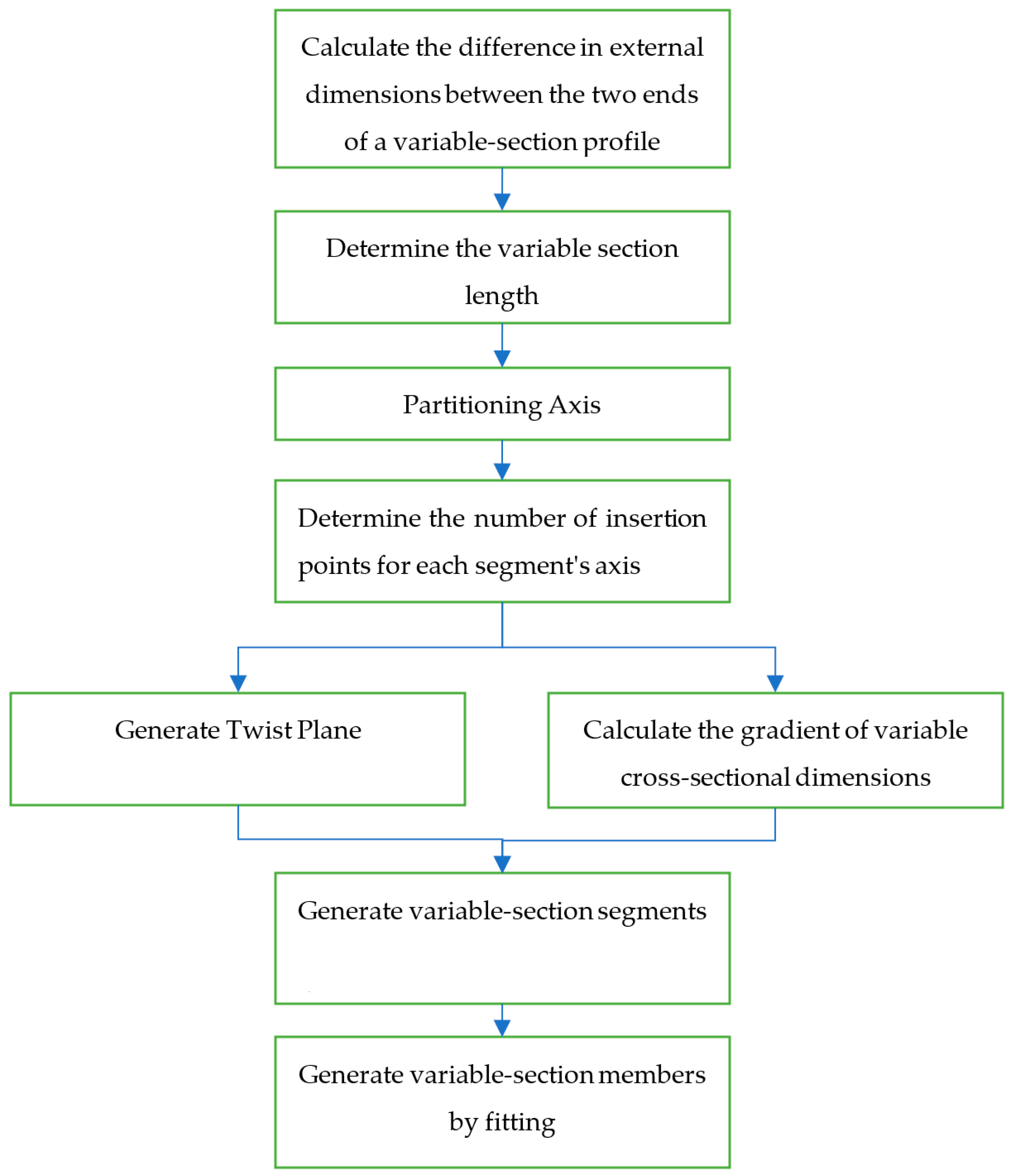
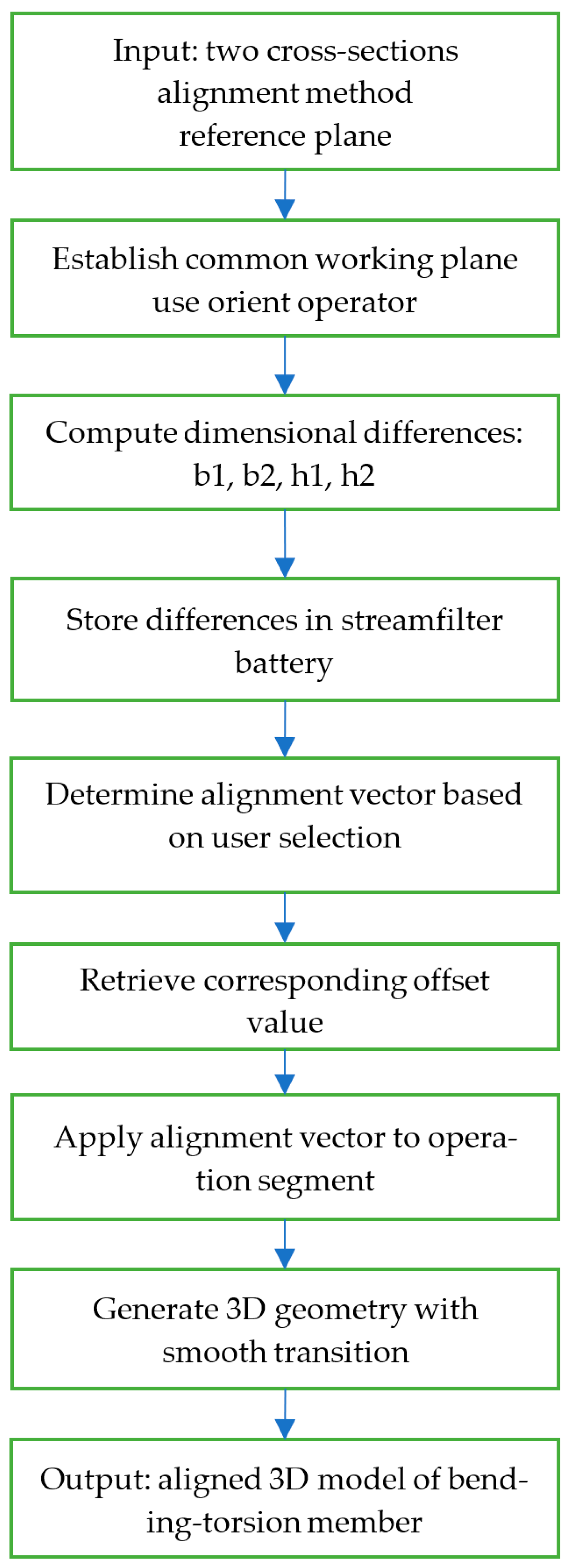
Figure 14a. These four-dimensional differences are stored in a StreamFilter battery block, which allows the module to dynamically retrieve the correct offset value based on the real-time spatial relationship between the sections. The implementation process is shown in
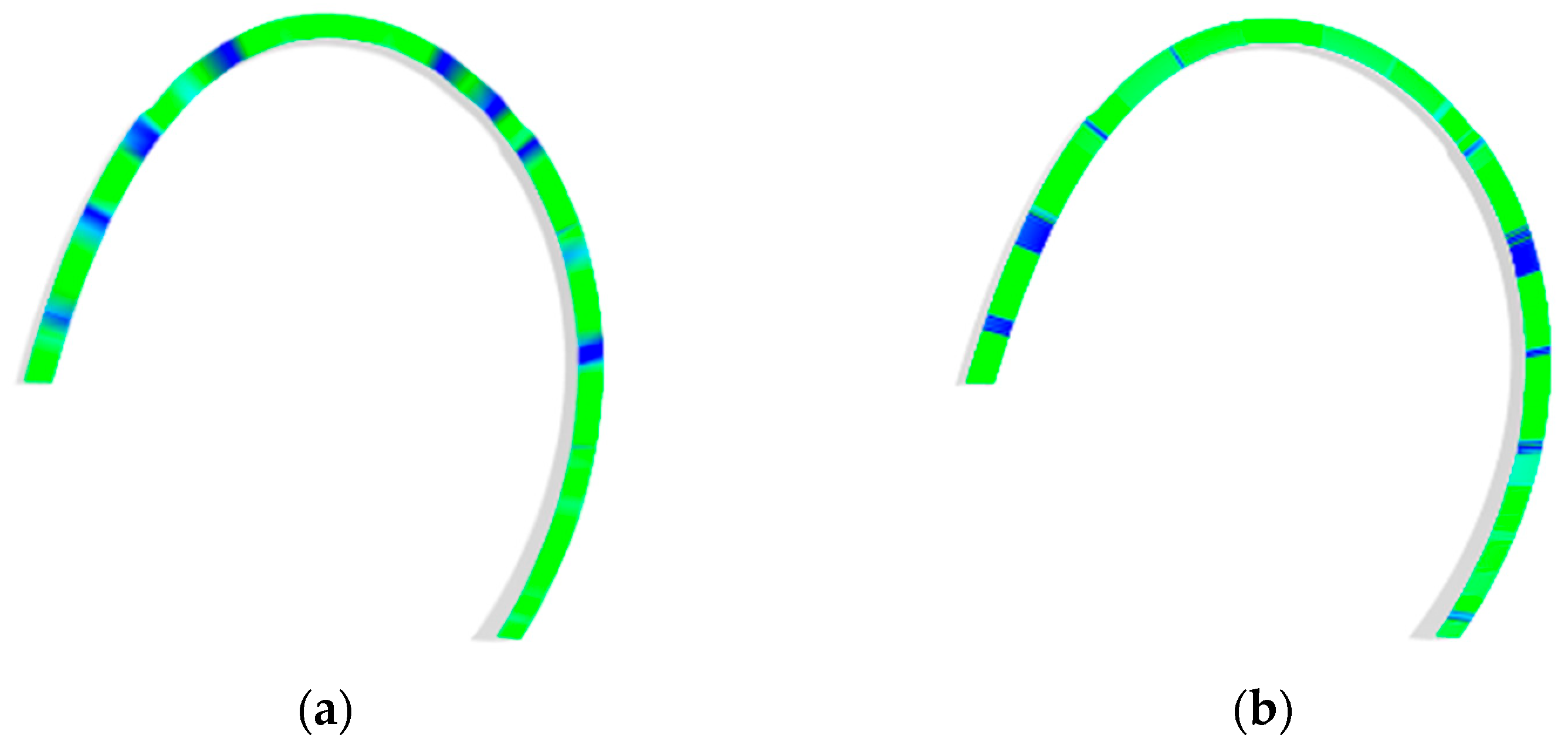
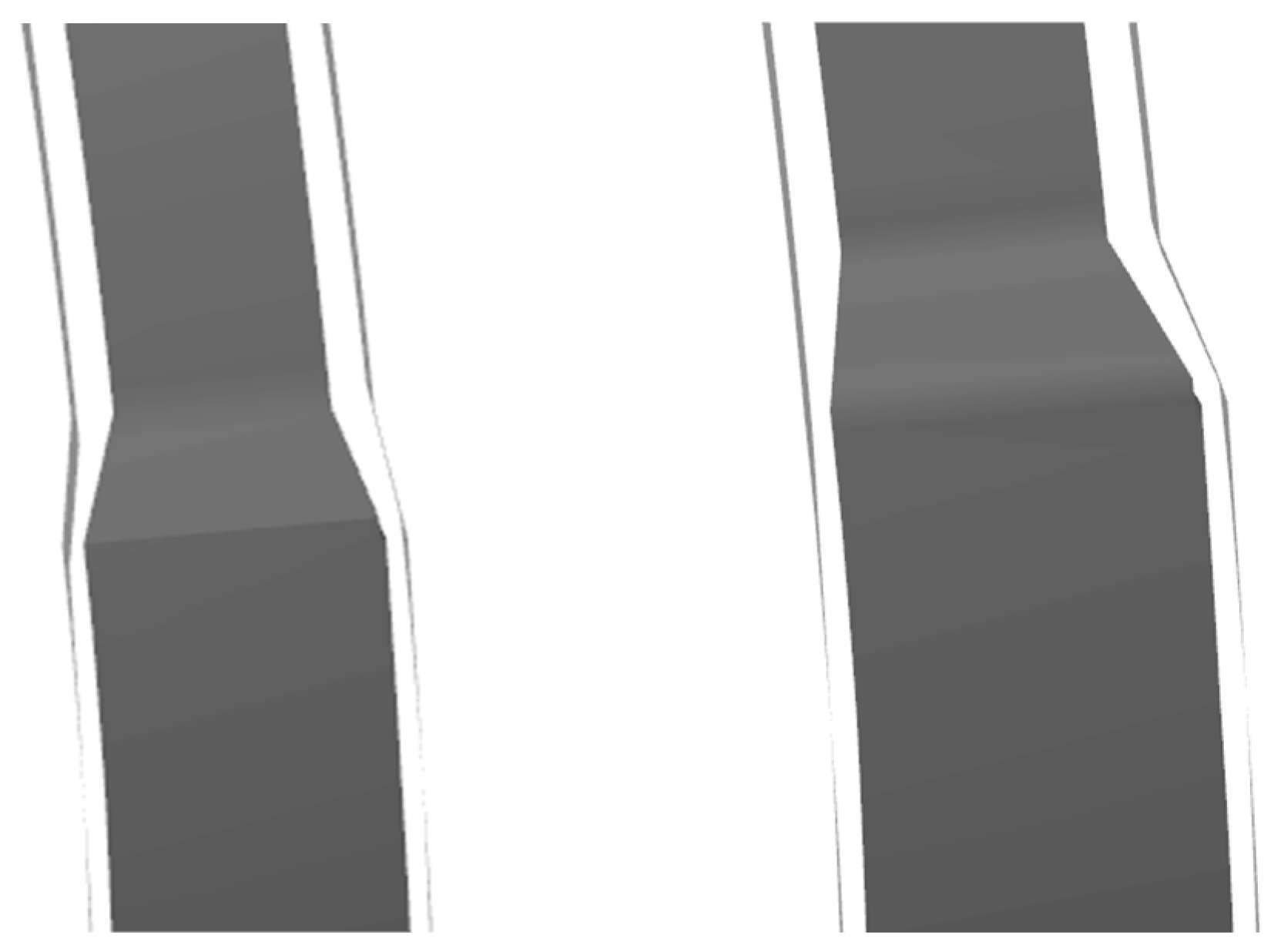
Figure 15. Based on the proposed method, the comparison results after selecting different alignment approaches are shown in
Figure 16.
5. Engineering Applications and Validation
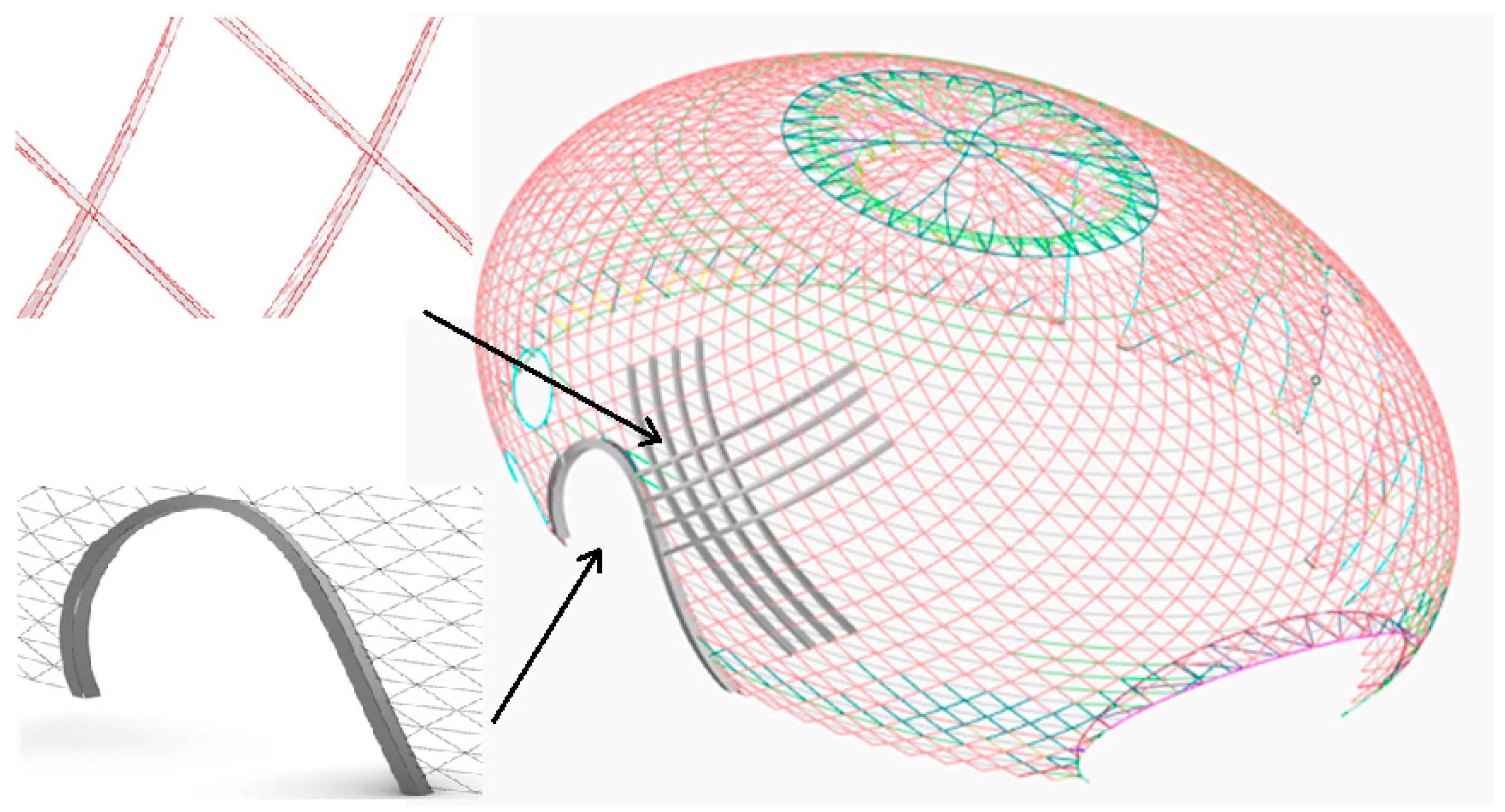
Figure 17 depicts a concert hall featuring an ellipsoidal grid shell structure. Both the entrance section and exterior members comprise spatially bending-torsion elements. The entire elements align with the architectural outer surface. Taking the generation of the entrance’s spatially bending-torsion steel members as an example for detailed design, these members consist of two cross-sectional dimensions:
Section 1: 800 mm × 800 mm × 20 mm,
Section 2: 600 mm × 600 mm × 16 mm.
The detailed design module for battery packs developed based on GH is shown in
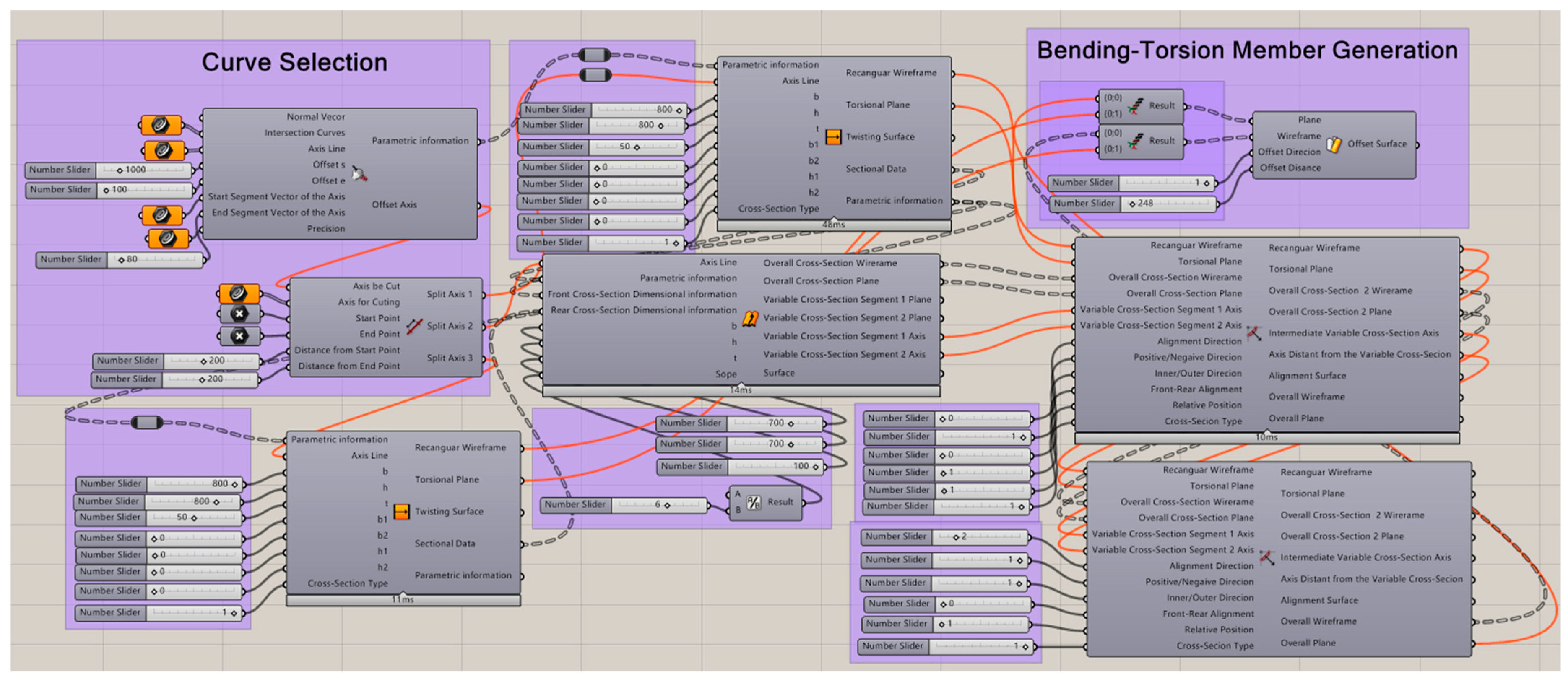
Figure 18. The torsion angle of the bending-torsion member is determined by the input architectural surface plane. Spatial axes located on the architectural surface plane are selected to define the position of the bending-torsion member. Selecting the cutting points of the axes on the spatial axes will divide the original spatial axes into axes with different cross-sectional dimensions where the bending-torsion members are located, thereby determining the spatial position of the variable cross-section.
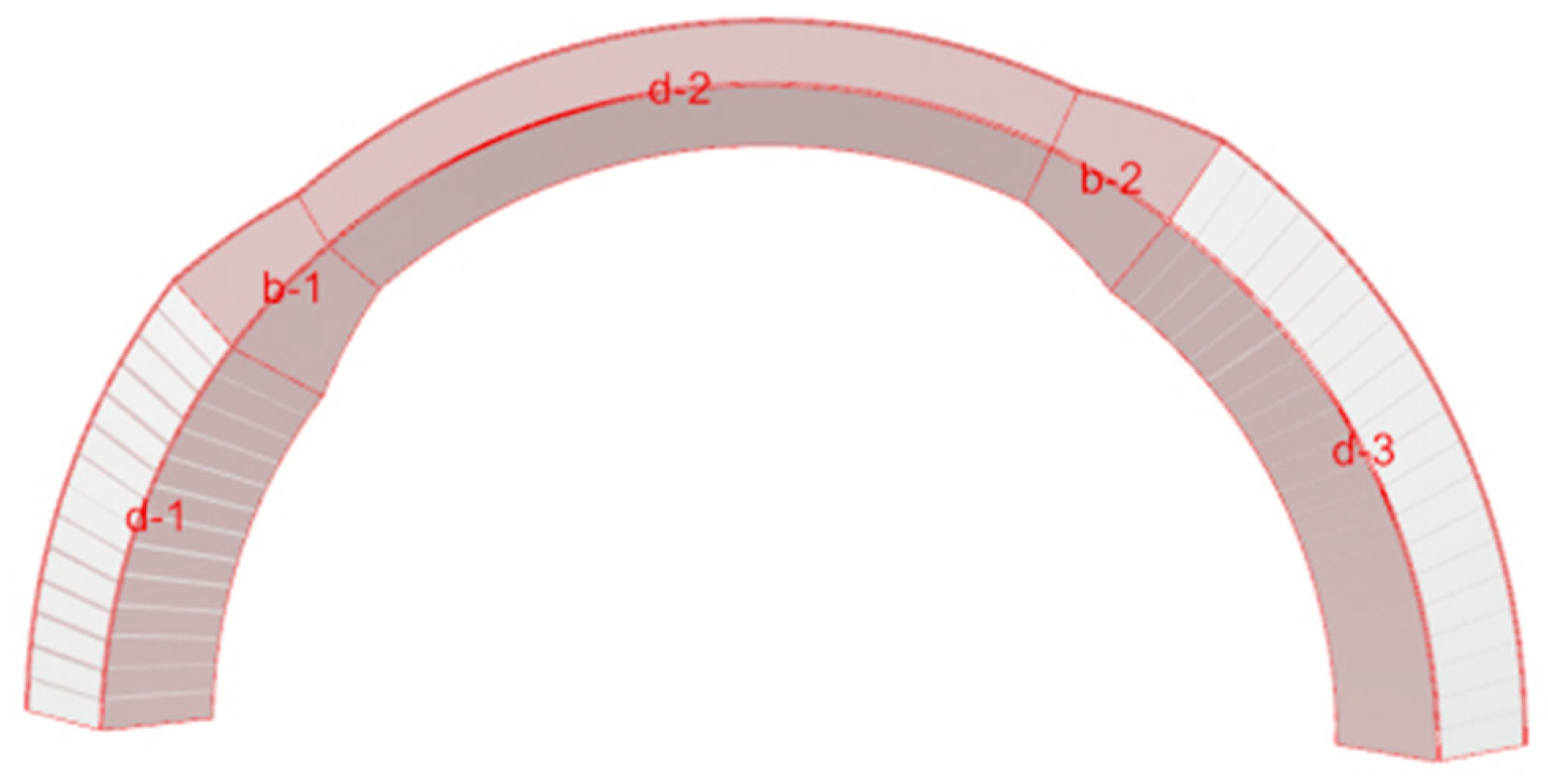
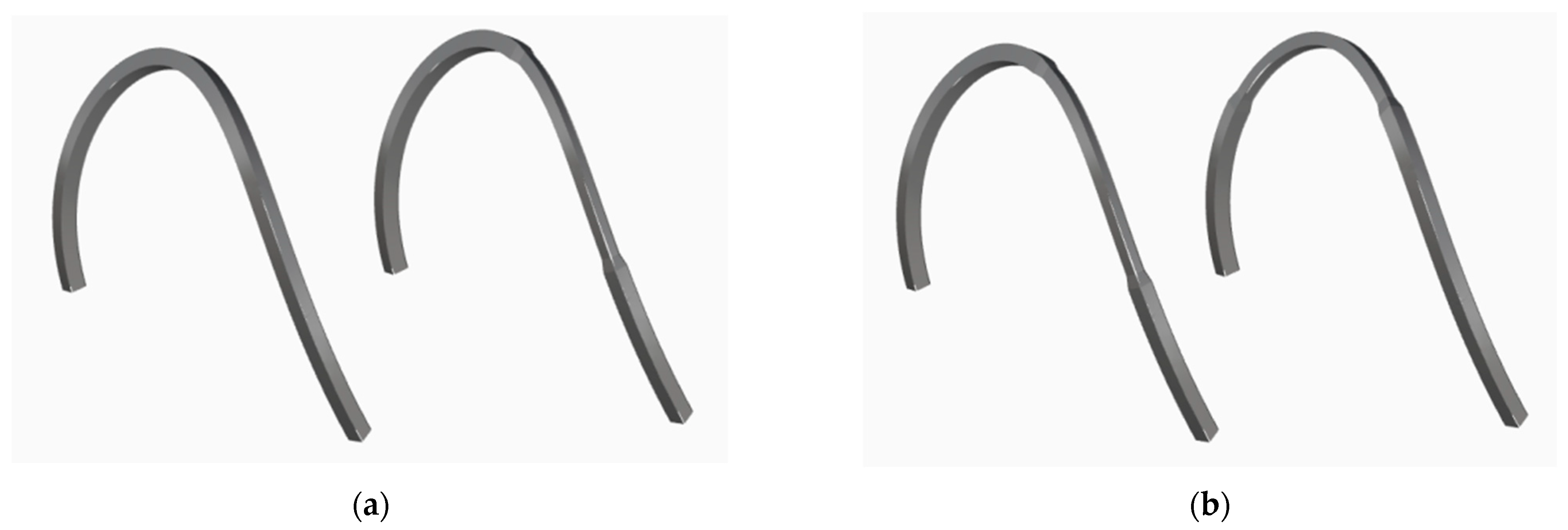
The comparison between single-section members and multi-section members after determining variable-section spatial positions is shown in
Figure 19a. The height of the spatial axis endpoints relative to the ground can be adjusted by altering the axis offset height. The position of variable sections can be fine-tuned by adjusting the offset distance of the cutting points. The comparison diagram after adjusting variable-section positions is shown in
Figure 19b. The member’s cross-section dimensions, alignment data, and offset data form a one-to-one correspondence with the array of cut axes. By editing the Excel data into text that can be inserted into the Panel cell, all bending-torsion members can be generated at once within the GH software.
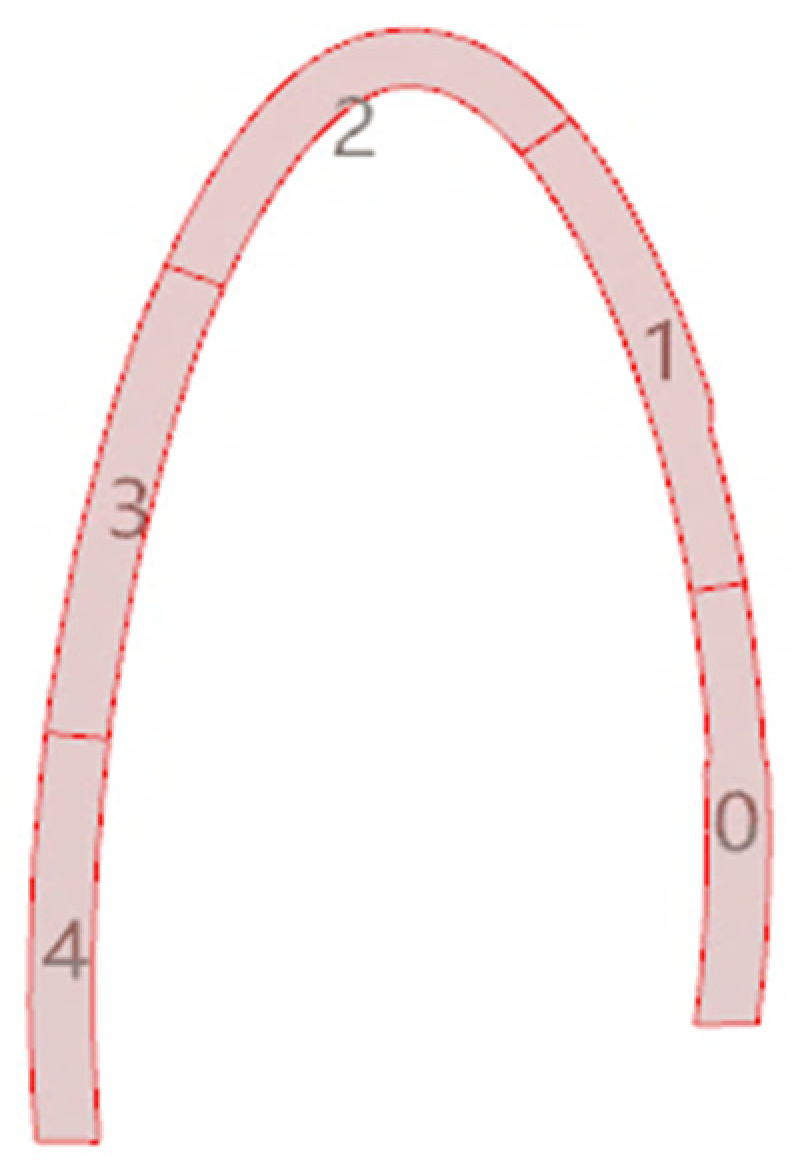
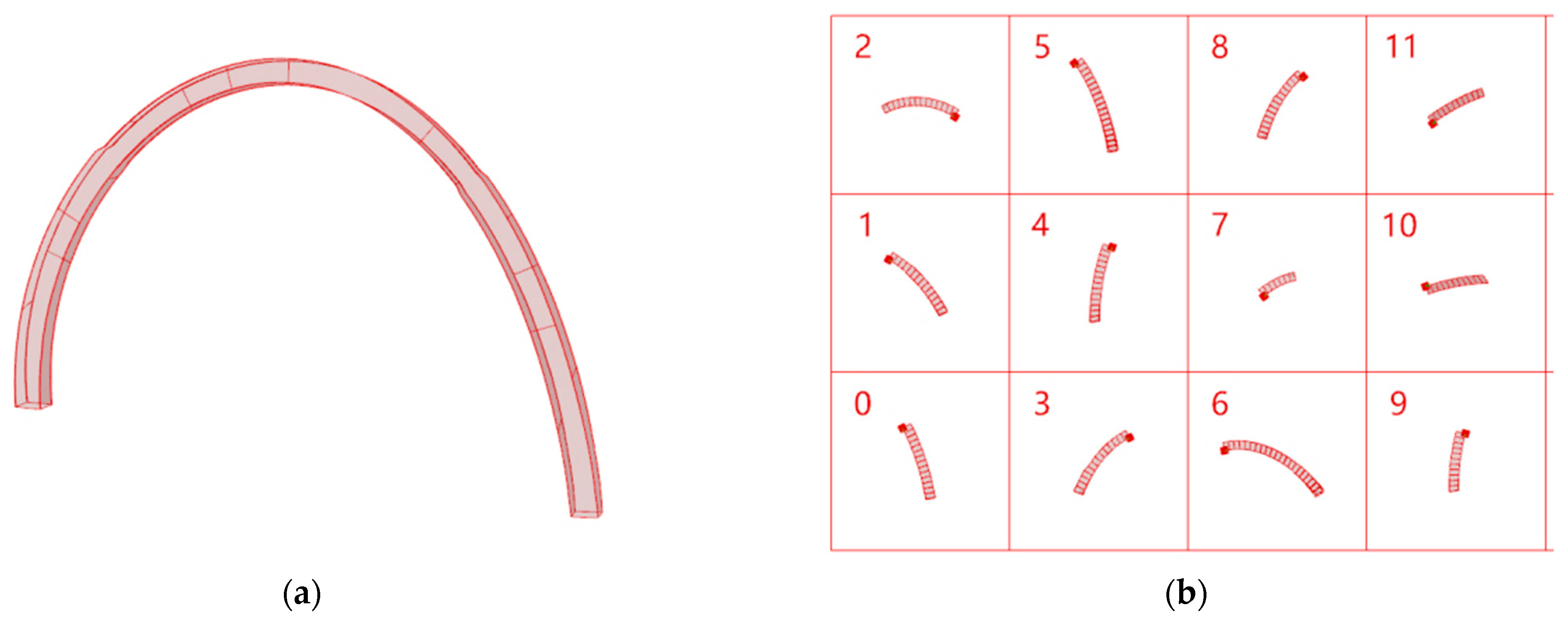
Excessively long plate sections complicate machining, necessitating longitudinal segmentation. To prevent stress concentration and welding distortion from longitudinal butt welding at identical plane positions, different segmentation ratios may be applied to the four plate sections. For example, when proportionally dividing the four surfaces forming the model—front curved surface, rear curved surface, upper curved surface, and lower curved surface—the front curved surface is divided according to (0.2, 0.4, 0.6, 0.8, 1), the rear curved surface according to (0.15, 0.35, 0.45, 0.75, 1), the upper curved surface according to (0.1, 0.3, 0.55, 0.7, 0.85, 1), and the rear surface at (0.25, 0.5, 0.65, 0.9, 1).
These ratios are determined based on welding specifications and finite element analysis. Measurement lines are applied based on the maximum dimension of 500 mm. Surface division and unfolding are shown in
Figure 20.
To quantify method precision, we compared the fitted member axis with the target architectural surface. The calculated root-mean-square deviation was less than 2.0 mm. Maximum torsion angle error was 0.5°, sufficient for architectural steel structure requirements. Compared to conventional workflows [
15], our method reduced modeling time by approximately 70% for equivalent complexity members. Rhino’s unfolding tools introduced maximum flattening errors of 1.2 mm, within acceptable fabrication tolerances for steel structures.
The fabrication and construction of variable-section bending-torsion members entail significant practical challenges. Manufacturing complexity arises from the need to precisely cut and form steel plates with continuously varying dimensions. On-site assembly necessitates precise temporary support systems and advanced surveying to ensure the correct spatial alignment of each segment. Welding between variable sections demands highly skilled workers and strict quality control due to the intricate node geometries. Feedback from an industrial partner quantified substantial efficiency gains: approximately 70% faster drafting, 40% less design rework, and a 15% reduction in material waste. These metrics underscore the module’s immediate practical value.
6. Conclusions
This paper presents a parametric detailed design methodology for spatially bending-torsion members on complex architectural surfaces, establishing key issues, data structures, and core algorithms. The main conclusions are:
- (1)
The proposed data structure accurately describes member axis geometry, twist angle, cross-sectional shape, subdivision surfaces, and unfolding pattern positioning coordinates, enabling parametric generation of spatially bending-torsion members. Upon design completion, positioning point coordinates and unfolding layout information are automatically generated, facilitating fabrication drawing production.
- (2)
Using architectural surface normal vectors as member torsion vectors, combined with automated interpolation point generation based on curvature variation, enhances surface smoothness of curved-torsional members. For rectangular sections, a multi-segment cross-section model replaces traditional plate-shell elements, improving representation accuracy.
- (3)
The developed detailed design module enables integrated member model generation based on curve positions and cross-sectional dimensions. Models can be aligned, offset, or modified as needed, achieving rapid mass production of bending-torsion member models. Engineering validation confirms the module’s performance, achieving root-mean-square deviations under 2 mm and reducing modeling time by approximately 70% compared to conventional workflows.
The current method assumes linear cross-section variation, which may require additional interpolation points for highly complex curvature changes. Future research will explore adaptive interpolation strategies and integration with structural analysis for optimized cross-section design.