Article

From Doping Intentions to Life Aspirations: A Goal Systems Perspective of Performance Enhancement in Sport


by
Despoina Ourda
1,*,
Lida Skoufa
1,
Andreas Loukovitis
1,
Haralambos Tsorbatzoudis
1 and
Vassilis Barkoukis
1,2
1
Department of Physical Education and Sport Sciences, Aristotle University of Thessaloniki, 54124 Thessaloniki, Greece
2
Department of Health and Life Sciences, Frederick University, 1036 Lefkosia, Cyprus
*
Author to whom correspondence should be addressed.
Sports 2026, 14(6), 219; https://doi.org/10.3390/sports14060219

Submission received: 8 April 2026 / Revised: 21 May 2026 / Accepted: 22 May 2026 / Published: 26 May 2026

Abstract

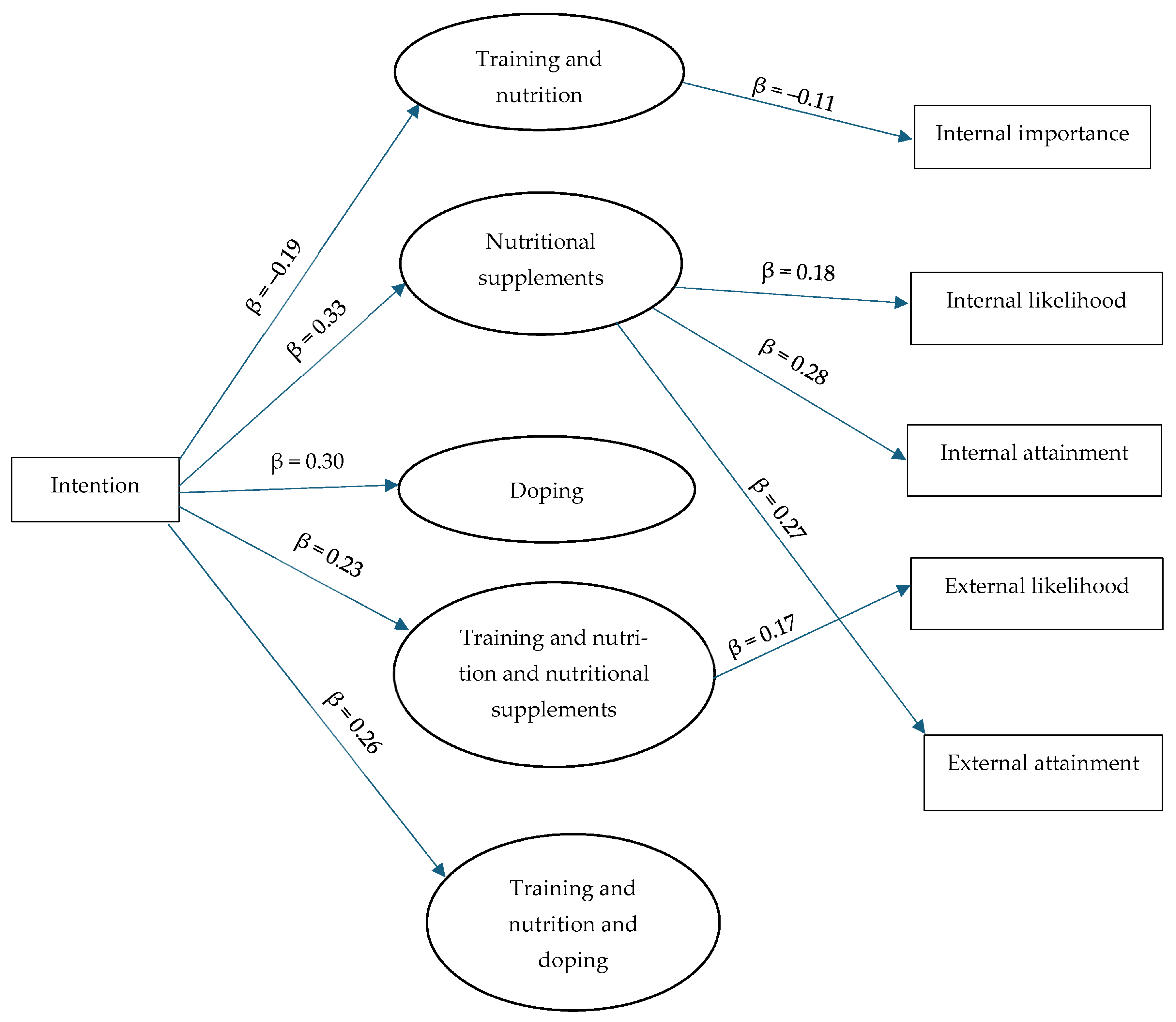
Doping research has predominantly focused on proximal cognitive predictors of athletes’ intentions to use prohibited substances, often conceptualizing doping as a final behavioral outcome. Drawing on Self-Determination Theory and Goal Systems Theory, the present study examined the relationships between doping intentions, perceived means of performance enhancement, and internal and external life aspirations among competitive athletes. A total of 204 athletes (Mage = 22.99 years) completed measures assessing doping intentions, perceived effectiveness of different performance enhancement means, and aspiration components. The results indicated that stronger doping intentions were negatively associated with internal aspiration components and positively associated with external aspiration components. Doping intentions were also positively related to perceived effectiveness of nutritional supplements, doping, and combined enhancement practices, while being negatively associated with reliance on training and nutrition alone. Several indirect effects were observed, demonstrating that perceived performance enhancement partially mediated the relationships between doping intentions and aspiration components. These findings suggest that performance enhancement behaviors are cognitively embedded within athletes’ motivational goal systems and play an active role in shaping aspiration-related evaluations. Overall, this study advances doping research by conceptualizing doping behavior as part of a broader, goal-directed, motivational structure rather than an isolated outcome.
Keywords: internal and external goals; Goal Systems Theory; Self-Determination Theory; motivational processes; nutritional supplements; competitive athletes internal and external goals; Goal Systems Theory; Self-Determination Theory; motivational processes; nutritional supplements; competitive athletes